Systematic Review and Meta-Analysis of Imipenem-Resistant Pseudomonas aeruginosa Prevalence in Iran
Abstract
Introduction
Methods
Results
Discussion
Conclusions
Author Contributions
Funding
Conflicts of Interest
References
- Hidron, A.I.; Edwards, J.R.; Patel, J.; et al. NHSN annual update: Antimicrobial-resistant pathogens associated with healthcare-associated infections: Annual summary of data reported to the National Healthcare Safety Network at the Centers for Disease Control and Prevention, 2006–2007. Infect Control Hosp Epidemiol 2008, 29, 996–1011. [Google Scholar] [CrossRef]
- Markou, P.; Apidianakis, Y. Pathogenesis of intestinal Pseudomonas aeruginosa infection in patients with cancer. Front Cell Infect Microbiol 2014, 3, 115. [Google Scholar] [CrossRef]
- Mahon, C.; Lehman, D.; Manuselis, G. Textbook of Diagnostic Microbiology, 4th ed.Saunders: USA, 2011. [Google Scholar]
- Brooks, G.F.; Carroll, K.C.; Butel, J.S.; et al. Adelberg. In Jawetz, Melnick, & Adelberg’s Medical Microbiology, 27th ed.; McGraw Hill Medical: New York, 2016. [Google Scholar]
- Vaez, H.; Moghim, S.; Nasr Esfahani, B.; Ghasemian Safaei, H. Clonal relatedness among imipenem-resistant Pseudomonas aeruginosa isolated from ICU-hospitalized patients. Crit Care Res Pract 2015, 2015, 983207. [Google Scholar]
- El Zowalaty, M.E.; Al Thani, A.A.; Webster, T.J.; et al. Pseudomonas aeruginosa: Arsenal of resistance mechanisms, decades of changing resistance profiles, and future antimicrobial therapies. Future Microbiol 2015, 10, 1683–1706. [Google Scholar] [CrossRef]
- Strateva, T.; Yordanov, D. Pseudomonas aeruginosa—A phenomenon of bacterial resistance. J Med Microbiol 58 Pt 9, 1133–1148. [CrossRef]
- Babu, K.V.; Visweswaraiah, D.S.; Kumar, A. The influence of imipenem resistant metallo-beta-lactamase positive and negative Pseudomonas aeruginosa nosocomial infections on mortality and morbidity. J Nat Sci Biol Med 2014, 5, 345–351. [Google Scholar] [CrossRef] [PubMed]
- Lautenbach, E.; Synnestvedt, M.; Weiner, M.G.; et al. Imipenem resistance in Pseudomonas aeruginosa: Emergence, epidemiology and impact on clinical and economical outcomes. Infect Control Hosp Epidemiol 2010, 31, 47–53. [Google Scholar] [CrossRef] [PubMed]
- Dantas, R.C.; Ferreira, M.L.; Gontijo-Filho, P.P.; Ribas, R.M. Pseudomonas aeruginosa bacteraemia: Independent risk factors for mortality and impact of resistance on outcome. J Med Microbiol 2014, 63 Pt 12, 1679–1687. [Google Scholar] [CrossRef]
- Egger, M.; Davey-Smith, G.; Altman, D. Systematic Reviews in Health Care: Meta-Analysis in Context, 2nd ed.BMJ: London, 2001. [Google Scholar]
- Higgins, J.P.; Thompson, S.G. Quantifying heterogeneity in a meta-analysis. Stat Med 2002, 21, 1539–1558. [Google Scholar] [CrossRef] [PubMed]
- Galvani, A.A.; Tukmechi, A. Determination of the prevalence of metallo-ß-lactamases producing Pseudomonas aeruginosa strains from clinical samples by imipenem-EDTA combination disk method in Mottahari and Emam Khomaini hospitals of Urmia. Rep Health Care 2015, 1, 65–68. [Google Scholar]
- Pourakbari, B.; Yaslianifard, S.; Yaslianifard, S.; Mahmoudi, S.; Keshavarz-Valian Mamishi, S. Evaluation of efflux pumps gene expression in resistant Pseudomonas aeruginosa isolates in an Iranian referral hospital. Iran J Microbiol 2016, 8, 249–256. [Google Scholar]
- Talebi-Taher, M.; Majidpour, A.; Gholami, A.; Rasouli-Kouhi, S.; Adabi, M. Role of efflux pump inhibitor in decreasing antibiotic cross-resistance of Pseudomonas aeruginosa in a burn hospital in Iran. J Infect Dev Ctries 2016, 10, 600–604. [Google Scholar] [CrossRef]
- Farajzadeh Sheikh, A.; Rostami, S.; Jolodar, A.; et al. Detection of metallo-beta lactamases among carbapenem-resistant Pseudomonas aeruginosa. Jundishapur J Microbiol 2014, 7, e12289. [Google Scholar] [CrossRef] [PubMed]
- Radan, M.; Moniri, R.; Khorshidi, A.; et al. Emerging carbapenem-resistant Pseudomonas aeruginosa isolates carrying blaIMP among burn patients in Isfahan, Iran. Arch Trauma Res 2016, 5, e33664. [Google Scholar] [CrossRef] [PubMed]
- Goli, H.R.; Nahaei, M.R.; Rezaee, M.A.; et al. Contribution of mexAB-oprM and mexXY (-oprA) efflux operons in antibiotic resistance of clinical Pseudomonas aeruginosa isolates in Tabriz, Iran. Infect Genet Evol 2016, 45, 75–82. [Google Scholar] [CrossRef]
- Mirbagheri, S.Z.; Meshkat, Z.; Naderinasab, M.; Rostami, S.; Nabavinia, M.S.; Rahmati, M. Study on imipenem resistance and prevalence of blaVIM1 and blaVIM2 metallo-beta lactamases among clinical isolates of Pseudomonas aeruginosa from Mashhad, Northeast of Iran. Iran J Microbiol 7, 72–78.
- Abiri, R.; Mohammadi, P.; Shavani, N.; Rezaei, M. Detection and genetic characterization of metallo-β-lactamase IMP-1 and VIM-2 in Pseudomonas aeruginosa strains from different hospitals in Kermanshah, Iran. Jundishapur J Microbiol 2015, 8, e22582. [Google Scholar] [CrossRef] [PubMed]
- Bahar, M.A.; Jamali, S.; Samadikuchaksaraei, A. Imipenem-resistant Pseudomonas aeruginosa strains carry metallo-β-lactamase gene bla-VIM in a level I Iranian burn hospital. Burns 2010, 36, 826–830. [Google Scholar] [CrossRef]
- Shahcheraghi, F.; Nikbin, V.S.; Feizabadi, M.M. Identification and genetic characterization of metallo-beta-lactamase-producing strains of Pseudomonas aeruginosa in Tehran, Iran. New Microbiol 2010, 33, 243–248. [Google Scholar]
- Khosravi, A.D.; Mihani, F. Detection of metallo-beta-lactamase-producing Pseudomonas aeruginosa strains isolated from burn patients in Ahwaz, Iran. Diagn Microbiol Infect Dis 2008, 60, 125–128. [Google Scholar] [CrossRef]
- Sepehriseresht, S.; Boroumand, M.A.; Pourgholi, L.; Sotoudeh Anvari, M.; Habibi, E.; Sattarzadeh Tabrizi, M. Detection of vim- and ipm-type metallo-beta-lactamases in Pseudomonas aeruginosa clinical isolates. Arch Iran Med 2012, 15, 670–673. [Google Scholar]
- Rahimi, B.; Shojapour, M.; Sadeghi, A.R.; Pourbabaei, A.A. [The study of the antibiotic resistance pattern of Pseudomonas aeruginosa strains isolated from hospitalized patients in Arak]. Arak Med Univ J 2012, 15, 8–14. [Google Scholar]
- Nikokar, I.; Tishayar, A.; Flakiyan, Z.; et al. Antibiotic resistance and frequency of class 1 integrons among Pseudomonas aeruginosa, isolated from burn patients in Guilan, Iran. Iran J Microbiol 2013, 5, 36–41. [Google Scholar]
- Alikhani, M.Y.; Karimi Tabar, Z.; Mihani, F.; et al. Antimicrobial resistance patterns and prevalence of blaPER-1 and blaVEB-1 genes among ESBL-producing Pseudomonas aeruginosa isolates in West of Iran. Jundishapur J Microbiol 2014, 7, e8888. [Google Scholar] [CrossRef]
- Fazeli, H.; Bafghi, F.; Faghri, J.; Akbari, R. [Molecular study of PER and VEB genes is multidrug resistant Pseudomonas aeroginosa isolate from clinical specimens in Isfahan/Iran and their antibiotic resistance patterns]. J Kerman Univ Med Sci 2012, 19, 345–353. [Google Scholar]
- Golshani, Z.; Ahadi, A.M.; Sharifzadeh, A. Antimicrobial susceptibility pattern of Pseudomonas aeruginosa isolated from patients referring to hospitals. Arch Hyg Sci 2012, 1, 48–53. [Google Scholar]
- Vaez, H.; Faghri, J.; Nasr Esfahani, B.; et al. Antibiotic resistance patterns and genetic diversity in clinical isolates of Pseudomonas aeruginosa isolated from patients of a referral hospital, Isfahan, Iran. Jundishapur J Microbiol 2015, 8, e20130. [Google Scholar] [CrossRef]
- Yousefi, S.; Nahaei, M.; Farajnia, S.; et al. Class 1 integron and imipenem resistance in clinical isolates of Pseudomonas aeruginosa: Prevalence and antibiotic susceptibility. Iran J Microbiol 2010, 2, 115–121. [Google Scholar]
- Mirsalehian, A.; Feizabadi, M.; Nakhjavani, F.A.; Jabalameli, F.; Goli, H.; Kalantari, N. Detection of VEB-1, OXA-10 and PER-1 genotypes in extended-spectrum β-lactamase-producing Pseudomonas aeruginosa strains isolated from burn patients. Burns 2010, 36, 70–74. [Google Scholar] [CrossRef]
- Saderi, H.; Lotfalipour, H.; Owlia, P.; Salimi, H. Detection of metallo-ß-lactamase producing Pseudomonas aeruginosa isolated from burn patients in Tehran, Iran. Lab Med 2010, 41, 609–612. [Google Scholar] [CrossRef]
- Hakemi Vala, M.; Hallajzadeh, M.; Hashemi, A.; et al. Detection of Ambler class A, B and D ß-lactamases among Pseudomonas aeruginosa and Acinetobacter baumannii clinical isolates from burn patients. Ann Burns Fire Disasters 2014, 27, 8–13. [Google Scholar]
- Goudarzi, S.M.; Eftekhar, F. Assessment of carbapenem susceptibility and multi-drug resistance in Pseudomonas aeruginosa burn isolates in Tehran. Jundishapur J Microbiol 2013, 6, 162–165. [Google Scholar]
- Ranjbar, R.; Owlia, P.; Saderi, H.; et al. Characterization of Pseudomonas aeruginosa strains isolated from burned patients hospitalized in a major burn center in Tehran, Iran. Acta Med Iran 2011, 49, 675–679. [Google Scholar]
- Neyestanaki, D.V.; Mirsalehian, A.; Rezagholizadeh, F.; Jabalameli, F.; Taherikalani, M.; Emaneini, M. Determination of extended spectrum beta-lactamases, metallo-beta-lactamases and AmpC-beta-lactamases among carbapenem resistant Pseudomonas aeruginosa isolated from burn patients. Burns 2014, 40, 1556–1561. [Google Scholar] [CrossRef] [PubMed]
- Abdollahzadeh, F.; Hakemi Vala, M.; Bejestani, F.B.; Bahar, M.R. Frequency of extended spectrum beta lactamase producer P. aeruginosa strains isolated from burned patients of Motahari hospital, Tehran, Iran. J Pharm Health Sci 2012, 1, 39–45. [Google Scholar]
- Doosti, M.; Ramazani, A.; Garshasbi, M. Identification and characterization of metallo-ß-lactamases producing Pseudomonas aeruginosa clinical isolates in University Hospital from Zanjan Province, Iran. Iran Biomed J 2013, 17, 129–133. [Google Scholar] [PubMed]
- Moosavian, M.; Rahimzadeh, M. Molecular detection of metallo-β-lactamase genes, blaIMP-1, blaVIM-2 and blaSPM-1 in imipenem resistant Pseudomonas aeruginosa isolated from clinical specimens in teaching hospitals of Ahvaz, Iran. Iran J Microbiol 2015, 7, 2–6. [Google Scholar] [PubMed]
- Ghanbarzadeh Corehtash, Z.; Khorshidi, A.; Firoozeh, F.; Akbari, H.; Mahmoudi Aznaveh, A. Biofilm formation and virulence factors among Pseudomonas aeruginosa isolated from burn patients. Jundishapur J Microbiol 2015, 8, e22345. [Google Scholar] [CrossRef]
- Moazami Goudarzi, S.; Eftekhar, F. Multidrug resistance and integron carriage in clinical isolates of Pseudomonas aeruginosa in Tehran, Iran. Turk J Med Sci 2015, 45, 789–793. [Google Scholar] [CrossRef]
- Saderi, H.; Owlia, P. Detection of multidrug resistant (MDR) and extremely drug resistant (XDR) P. aeruginosa isolated from patients in Tehran, Iran. Iran J Pathol 2015, 10, 265–271. [Google Scholar]
- Sedighi, M.; Vaez, H.; Moghoofeie, M.; Hadifar, S.; Oryan, G.; Faghri, J. Molecular detection of metallo-β-lactamase gene blaVIM-1 in imipenem-resistant Pseudomonas aeruginosa strains isolated from hospitalized patients in the hospitals of Isfahan. Adv Biomed Res 2015, 4, 57. [Google Scholar]
- Bokaeian, M.; Shahraki Zahedani, S.; Soltanian Bajgiran, M.; Ansari Moghaddam, A. Frequency of PER, VEB, SHV, TEM and CTX-M genes in resistant strains of Pseudomonas aeruginosa producing extended spectrum β-lactamases. Jundishapur J Microbiol 2015, 8, e13783. [Google Scholar] [CrossRef]
- Arabestani, M.R.; Rajabpour, M.; Yousefi Mashouf, R.; Alikhani, M.Y.; Mousavi, S.M. Expression of efflux pump MexAB-OprM and OprD of Pseudomonas aeruginosa strains isolated from clinical samples using qRT-PCR. Arch Iran Med 2015, 18, 102–108. [Google Scholar] [PubMed]
- Jabalameli, F.; Mirsalehian, A.; Sotoudeh, N.; et al. Multiple-locus variable number of tandem repeats (VNTR) fingerprinting (MLVF) and antibacterial resistance profiles of extended spectrum beta lactamase (ESBL) producing Pseudomonas aeruginosa among burnt patients in Tehran. Burns 2011, 37, 1202–1207. [Google Scholar] [CrossRef]
- Hemmati, F.; Soroori Zanjani, R.; Haghi, F.; Zeighami, H. [Determination of antibiotic resistance profile and frequency of metallo-beta-lactamases in Pseudomonas aeruginosa isolates]. J Zanjan Univ Med Sci Health Serv 2014, 22, 77–85. [Google Scholar]
- Zoghi-Maleki, F.; Nahaei, M.R.; Sohrabi, N.; Rezvand, L. [Prevalence of extended-spectrum beta-lactamases (ESBLs) in Pseudomonas aeruginosa isolated from hospitalized patients in Imam Reza and Imam Khomeini hospitals in Kermanshah, 2013]. J Clin Res Paramed Sci 2015, 4, 179–187. [Google Scholar]
- Onguru, P.; Erbay, A.; Bodur, H.; et al. Imipenem-resistant Pseudomonas aeruginosa: Risk factors for nosocomial infections. J Korean Med Sci 2008, 23, 982–997. [Google Scholar] [CrossRef][Green Version]
- Zhang, Y.; Chen, X.L.; Huang, A.W.; et al. Mortality attributable to carbapenem-resistant Pseudomonas aeruginosa bacteremia: A meta-analysis of cohort studies. Emerg Microbes Infect 2016, 5, e27. [Google Scholar] [CrossRef]
- Suwantarat, N.; Carroll, K.C. Epidemiology and molecular characterization of multidrug-resistant Gram-negative bacteria in Southeast Asia. Antimicrob Resis Infect Control 2016, 5, 15. [Google Scholar] [CrossRef] [PubMed]
- Hong, D.J.; Bae, I.K.; Jang, I.H.; Jeong, S.H.; Kang, H.K.; Lee, K. Epidemiology and characteristics of metallo-β-lactamase-producing Pseudomonas aeruginosa. Infect Chemother 2015, 47, 81–97. [Google Scholar] [CrossRef] [PubMed]
- Ameen, N.; Memon, Z.; Shaheen, S.; Fatima, G.; Ahmed, F. Imipenem resistant Pseudomonas aeruginosa: The fall of the final quarterback. Pak J Med Sci 2015, 31, 561–565. [Google Scholar] [PubMed]
- European Centre for Disease Prevention and Control. Antimicrobial Resistance Surveillance in Europe 2012; Annual Report of the European Antimicrobial Resistance Surveillance Network (EARS-Net); ECDC: Stockholm, 2013. [Google Scholar]



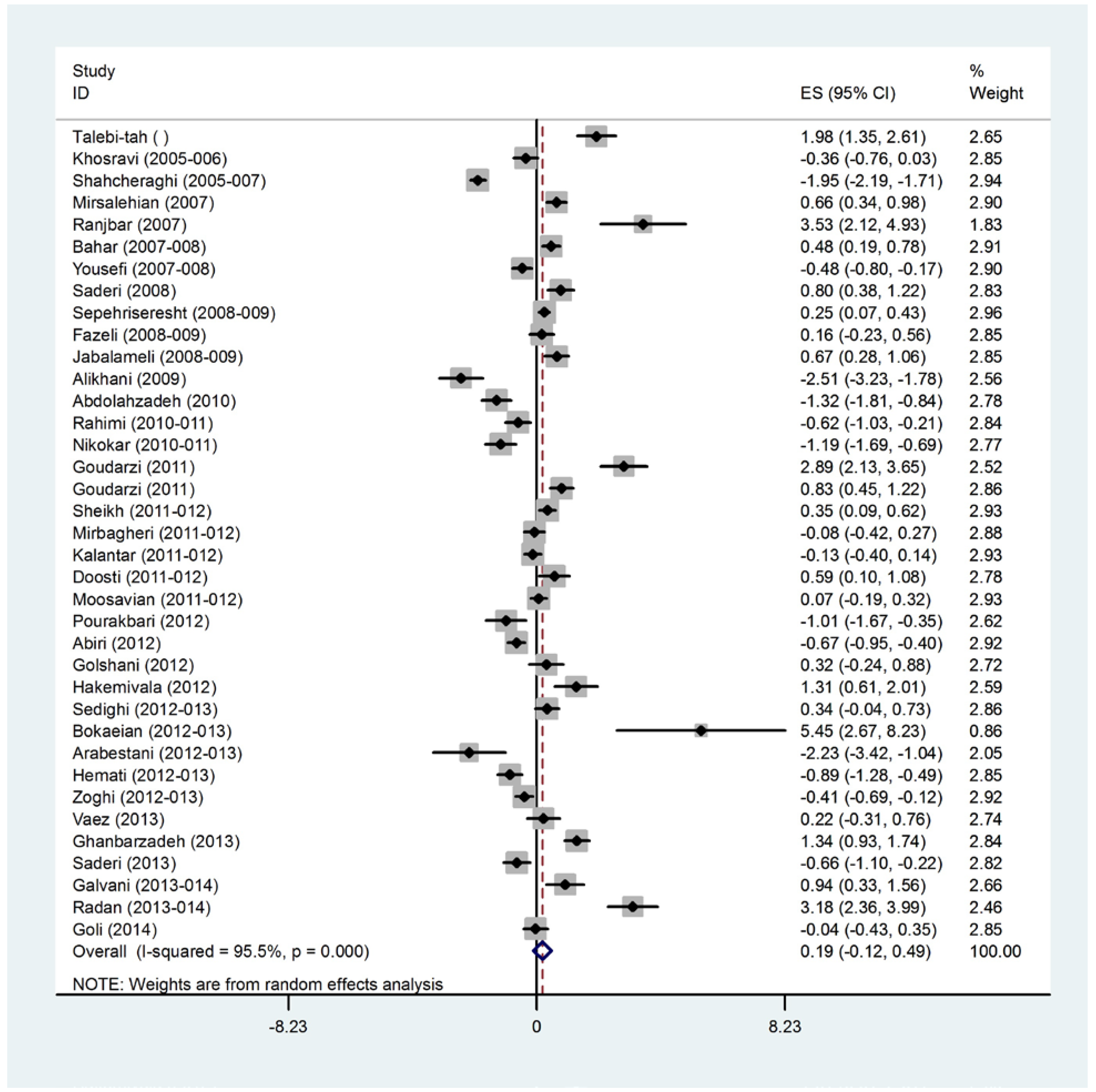
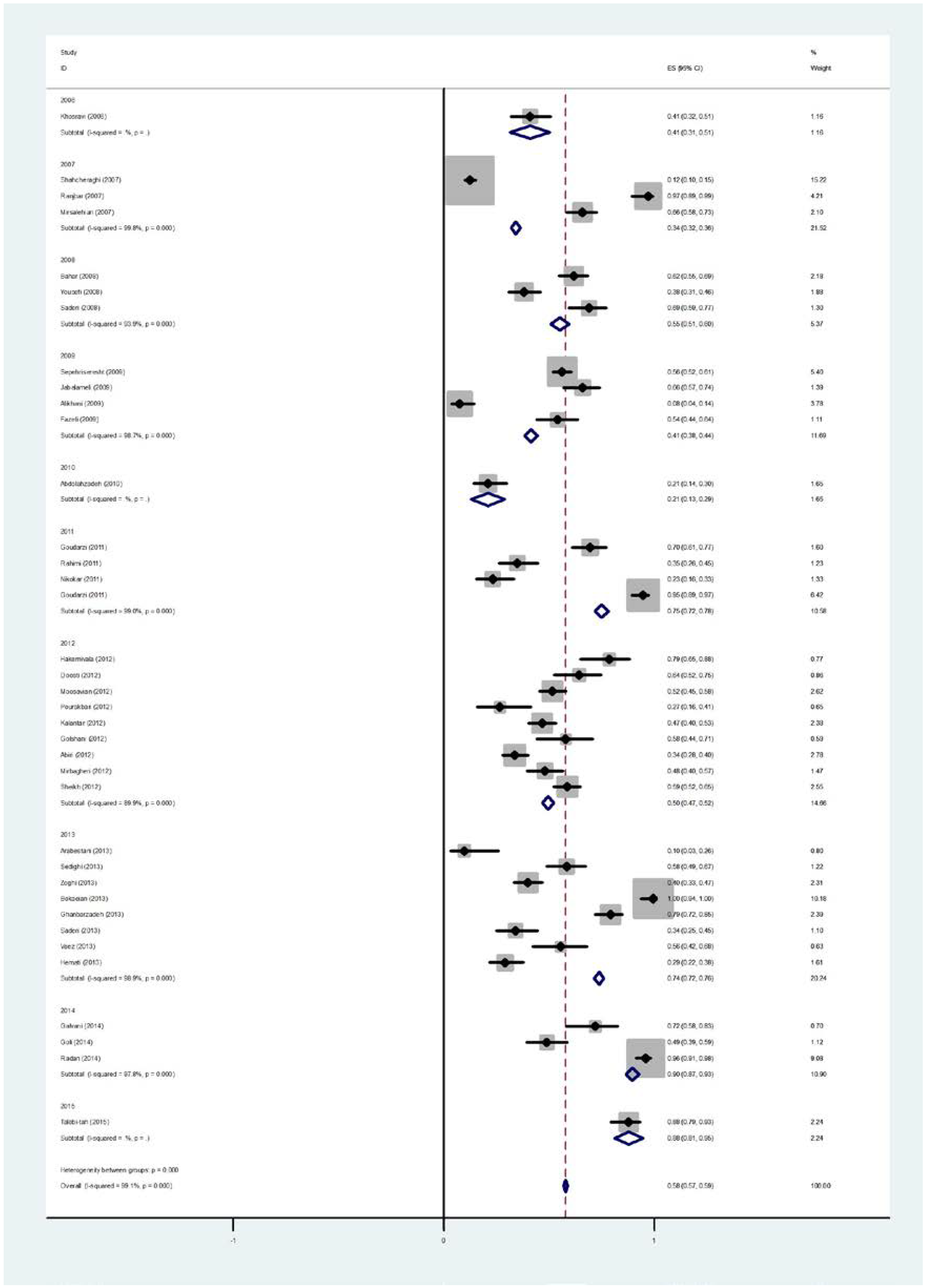
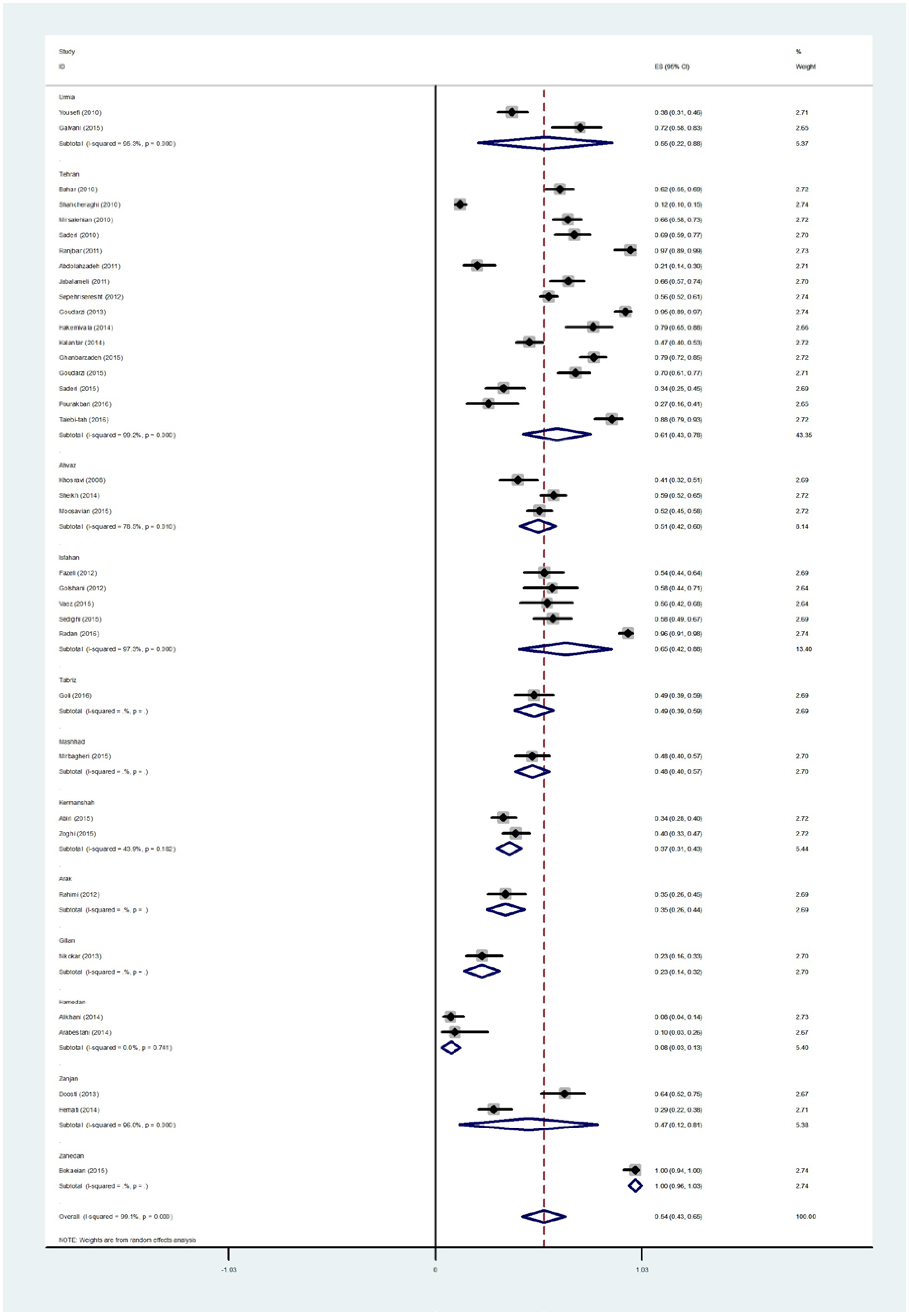
| First author | Publication year | Time of study | Province | Total samples | IRPA prevalence | Reference |
| Galvani | 2015 | 2013–2014 | Urmia | 50 | 36 (72%) | 13 |
| Pourakbari | 2016 | 2012 | Tehran | 45 | 12 (28%) | 14 |
| Talebi-taher | 2016 | Tehran | 91 | 80 (88%) | 15 | |
| Sheikh | 2014 | 2011–2012 | Ahvaz | 223 | 131 (58.7%) | 16 |
| Radan | 2016 | 2013–2014 | Isfahan | 150 | 144 (96%) | 17 |
| Goli | 2016 | 2014 | Tabriz | 100 | 49 (49%) | 18 |
| Mirbagheri | 2015 | 2011–2012 | Mashhad | 131 | 63 (48.5%) | 19 |
| Abiri | 2015 | 2012 | Kermanshah | 225 | 76 (33.7%) | 20 |
| Bahar | 2010 | 2007–2008 | Tehran | 186 | 115 (61.8%) | 21 |
| Shahcheraghi | 2010 | 2005–2007 | Tehran | 610 | 76 (12.4%) | 22 |
| Khosravi | 2008 | 2005–2006 | Ahvaz | 100 | 41 (41%) | 23 |
| Sepehriseresht | 2012 | 2008–2009 | Tehran | 483 | 272 (56%) | 24 |
| Rahimi | 2012 | 2010–2011 | Arak | 100 | 35 (35%) | 25 |
| Nikokar | 2013 | 2010–2011 | Gillan | 86 | 20 (23.3%) | 26 |
| Alikhani | 2014 | 2009 | Hamedan | 106 | 8 (7.5%) | 27 |
| Fazeli | 2012 | 2008–2009 | Isfahan | 98 | 53 (54%) | 28 |
| Golshani | 2012 | 2012 | Isfahan | 50 | 29 (58%) | 29 |
| Vaez | 2015 | 2013 | Isfahan | 54 | 30 (55.6%) | 30 |
| Yousefi | 2010 | 2007–2008 | Urmia | 160 | 61 (38.1%) | 31 |
| Mirsalehian | 2010 | 2007 | Tehran | 170 | 112 (65.9%) | 32 |
| Saderi | 2010 | 2008 | Tehran | 100 | 69 (69%) | 33 |
| Hakemivala | 2014 | 2012 | Tehran | 47 | 37 (78.73%) | 34 |
| Goudarzi | 2013 | 2011 | Tehran | 133 | 126 (94.7%) | 35 |
| Ranjbar | 2011 | 2007 | Tehran | 70 | 68 (97.5%) | 36 |
| Kalantar | 2014 | 2011–2012 | Tehran | 214 | 100(46.7%) | 37 |
| Abdolahzadeh | 2011 | 2010 | Tehran | 100 | 21 (21%) | 38 |
| Doosti | 2013 | 2011–2012 | Zanjan | 70 | 45 (63.8%) | 39 |
| Moosavian | 2015 | 2011–2012 | Ahvaz | 236 | 122 (51.4%) | 40 |
| Ghanbarzadeh | 2015 | 2013 | Tehran | 144 | 114 (79.2%) | 41 |
| Goudarzi | 2015 | 2011 | Tehran | 112 | 85 (70.3%) | 42 |
| Saderi | 2015 | 2013 | Tehran | 88 | 30 (34.1%) | 43 |
| Sedighi | 2015 | 2012–2013 | Isfahan | 106 | 62 (58.5%) | 44 |
| Bokaeian | 2015 | 2012–2013 | Zahedan | 116 | 20 (17.2%) | 45 |
| Arabestani | 2015 | 2012–2013 | Hamedan | 31 | 3 (9.6%) | 46 |
| Jabalameli | 2011 | 2008–2009 | Tehran | 112 | 74 (66%) | 47 |
| Hemati | 2014 | 2012–2013 | Zanjan | 120 | 35 (29.2%) | 48 |
| Zoghi | 2015 | 2012–2013 | Kermanshah | 200 | 80 (40%) | 49 |
© GERMS 2017.
Share and Cite
Vaez, H.; Salehi-Abargouei, A.; Khademi, F. Systematic Review and Meta-Analysis of Imipenem-Resistant Pseudomonas aeruginosa Prevalence in Iran. Germs 2017, 7, 86-97. https://doi.org/10.18683/germs.2017.1113
Vaez H, Salehi-Abargouei A, Khademi F. Systematic Review and Meta-Analysis of Imipenem-Resistant Pseudomonas aeruginosa Prevalence in Iran. Germs. 2017; 7(2):86-97. https://doi.org/10.18683/germs.2017.1113
Chicago/Turabian StyleVaez, Hamid, Amin Salehi-Abargouei, and Farzad Khademi. 2017. "Systematic Review and Meta-Analysis of Imipenem-Resistant Pseudomonas aeruginosa Prevalence in Iran" Germs 7, no. 2: 86-97. https://doi.org/10.18683/germs.2017.1113
APA StyleVaez, H., Salehi-Abargouei, A., & Khademi, F. (2017). Systematic Review and Meta-Analysis of Imipenem-Resistant Pseudomonas aeruginosa Prevalence in Iran. Germs, 7(2), 86-97. https://doi.org/10.18683/germs.2017.1113