Case report
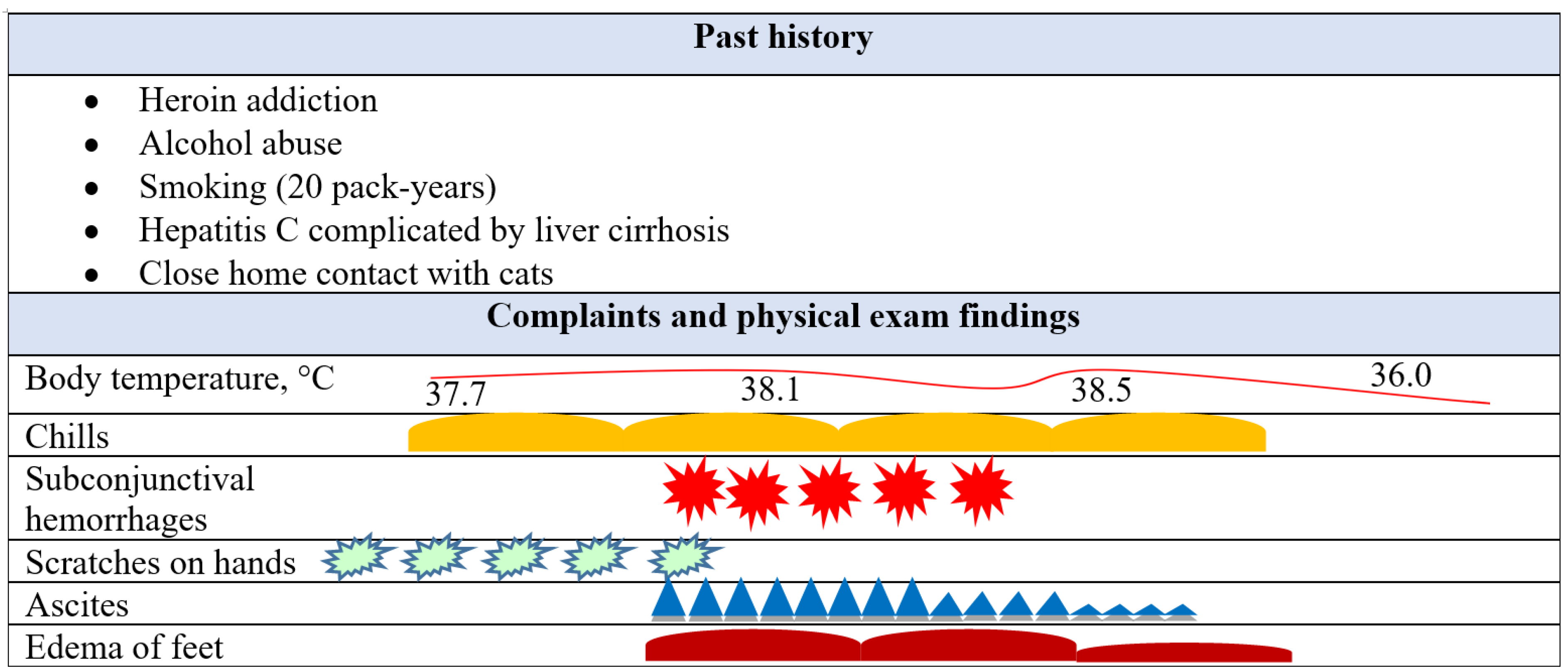
A 37-year-old female, with a BMI of 20.7 kg/m2, unemployed, was admitted to the hospital with complaints of an acute increase in body temperature up to 38.0 °C with chills and severe weakness. Her anamnesis was marked by heavy smoking (20 pack-years, current smoker), long-term history of drug abuse, including 3 years of heroin addiction: her last heroin injection had been done 2 weeks before the admission to the hospital. She had been suffering from alcohol abuse for 19 years; in 2019 hepatitis C virus (HCV) infection complicated by liver cirrhosis (class B according to Child-Pugh) was diagnosed. The patient was referred to an infectious disease specialist, where ursodeoxycholic acid, ademetionine, furosemide, spironolactone and carvedilol were initiated; antiviral treatment was not provided. She took medications irregularly.
Three months before the present hospitalization, the patient had had a COVID-19 infection of moderate severity, she was treated as an outpatient, the prescribed medications included ibuprofen and oral antiviral umifenovir. At the time of admission her antibodies against SARS-CoV-2 were as follows: IgM 1.56 OE/mL (n<2), IgG 200.92 OE/mL (n<10).
The patient was married, had four children from four pregnancies and was living with her husband in a one-room rented apartment. Her family history was unremarkable.
About 3 weeks before the hospitalization she noted an increase in body temperature (up to 37.7 °C) and a pain in the right hip; due to the suspicion of hip abscess she was examined by a surgeon, ultrasound examination of her hip was performed, no abnormalities were revealed and thus, no treatment was provided. But the patient continued to have episodes of fever, accompanied by chills. There was increasing general weakness reported; 3 days before the hospitalization she noticed abdomen enlargement and subcutaneous hematomas on her arms.
On admission, her condition was considered moderately severe, her axillar body temperature was 38.1 °C, blood pressure—100/60 mmHg, pulse rate—110 beats/min, respiratory rate—21/min, on-air oxygen saturation—96%. Multiple telangiectasias were revealed on the face and the chest. Petechial hemorrhages were seen on the conjunctiva of the lower eyelid, subcutaneous hematomas—on the right thigh, elbows of both arms, forearms. There were traces of scratches seen on the skin of the hands, and bilateral edema of the feet. Percussion and auscultation of lungs was unremarkable, heart sounds were muffled, no murmurs revealed. The abdomen was moderately enlarged due to ascites, soft, moderately painful in the right hypochondrium. Percussion size of the liver was 13×11×9 cm, the edge was painful on palpation, the spleen was enlarged (20×10 cm). A neurological examination revealed no significant pathological changes with the exception of the signs corresponding to a mild hepatic encephalopathy.
The blood tests revealed elevated WBC, moderate anemia, thrombocytopenia, a significant increase in serum C-reactive protein (CRP)—155 mg/L and procalcitonin >2 ng/mL, elevated creatinine level with MDRD GFR 28 mL/min/1.73 m2. An increase in total and direct bilirubin, a significant decrease in albumin level and prolonged prothrombin time were seen. In urinalysis leukocyturia 500 cells/mqL (n = 5–15) and erythrocyturia 300 cells/mqL (n = 0–11) were observed. The urine culture upon admission was negative. Toxicological examination of the biological fluids (blood and urine) did not reveal ethanol traces.
Her ECG was normal, chest CT revealed bilateral mild hydrothorax, ultrasound and CT of the abdominal cavity confirmed the presence of ascites, hepatomegaly, splenomegaly and identified a slight expansion of the portal vein up to 13 mm (n < 12 mm). Transthoracic echocardiography (TTE) revealed mitral and tricuspid valve regurgitation of the 1st degree; there were no vegetations or other findings compatible with IE identified.
As her medical history (IDU) and clinical presentation (fever, subconjunctival hemorrhages) maintained a suspicion of IE (three minor modified Duke criteria, 2015), transesophageal echocardiography (TEE) was ordered, two sets of blood (aerobic and anaerobic) were taken for culture 12 h apart, prior to the initiation of antibiotic therapy (ABT).
Oxacillin 2 g 4 times per day iv was given having in mind a high probability of right-sided IE caused by Staphylococcus aureus (S. aureus) in iv drug abusers along with the standard treatment of her liver cirrhosis and heart failure (albumin, furosemide, spironolactone, lactulose, etc.). The IE team decided to withhold from gentamicin use due to the presence of acute kidney injury (AKI) of unknown origin.
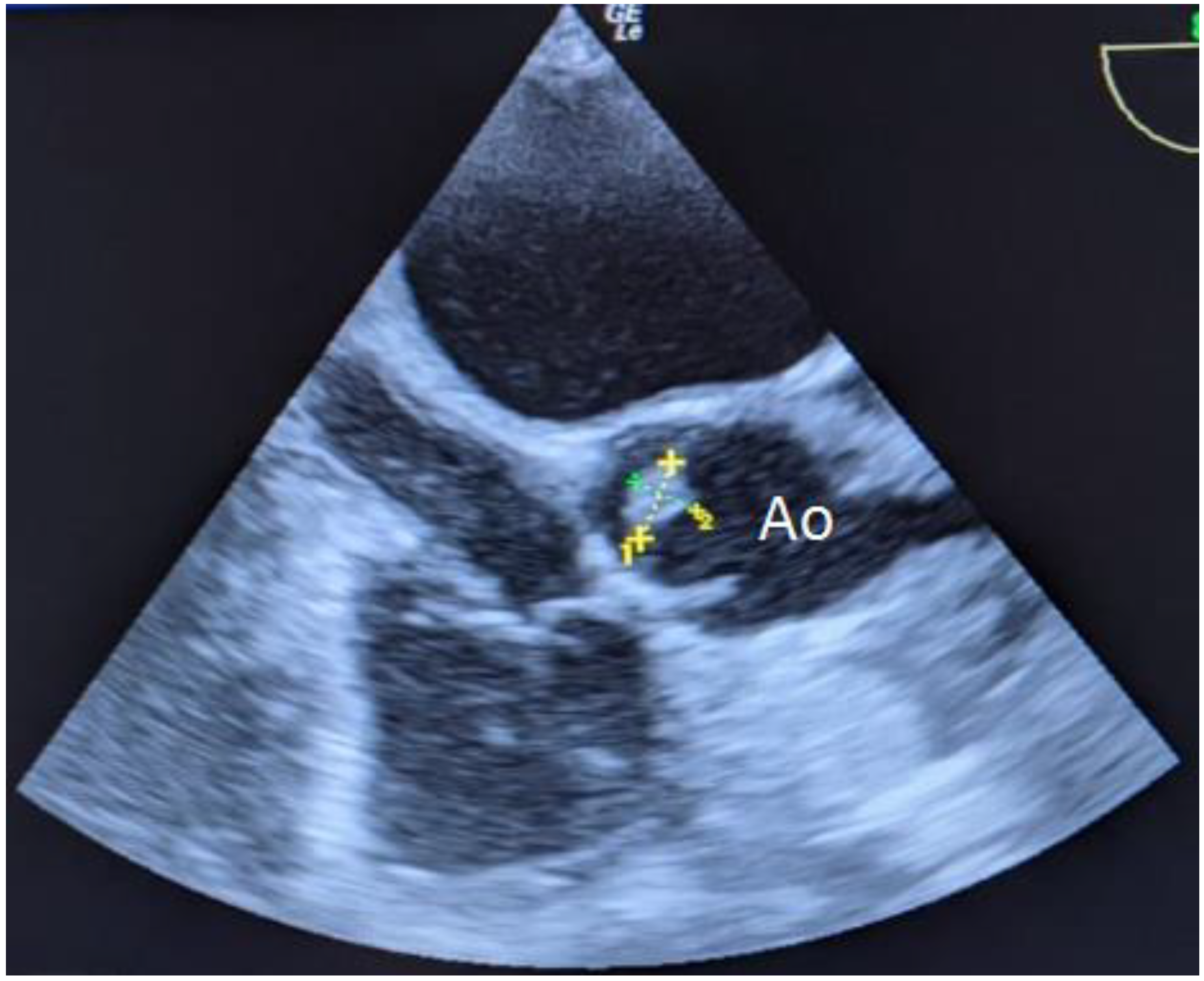
The TEE performed on the 3rd day revealed a hyperechogenic mobile structure of 10×9 mm in size located along the free edge of the noncoronary leaflet of the aortic valve (
Figure 1).
On the 4th day of the presentation, the patient remained febrile and there was no improvement in inflammatory markers seen—
Figure 2 and
Table 1. A preliminary report indicated a positive blood culture with the growth of
P. multocida in 4/4 samples. The isolate was sent to a reference laboratory for reidentification and susceptibility testing.
The patient was reexamined by the IE team. With additional detailed questioning, it turned out that 5 cats live in the patient’s house, one of which had recently scratched her and bit her finger on her left hand. As such episodes had happened before, the patient did not pay special attention to this. Presumably the cat had bitten her about 3 weeks earlier.
Oxacillin was switched to meropenem 1 g 3 times per day iv. Three days later, tigecycline 100 mg loading dose, then 50 mg 2 times per day iv was added. Surgery was not offered due to the high perioperative risk associated with comorbidities. After changing the ABT, the patient’s condition improved: her temperature and WBC returned to normal, CRP level decreased to 28.5 mg/L, peripheral edema, hydrothorax and ascites resolved—
Table 1. The repeated blood culture performed 10 days later was negative.
The result of reidentification in a reference laboratory confirmed the presence of
P. multocida in blood samples, the isolate was susceptible to benzylpenicillin, amoxicillin + clavulanic acid, cefotaxime, ciprofloxacin, levofloxacin; meropenem minimal inhibitory concentration was 0.25 μg/mL (
Table 2). The determination of susceptibility to antibiotics was carried out by the disk diffusion method and the gradient diffusion method using cation-balanced Mueller-Hintnon agar (BD, USA) with the addition of lysed horse blood, final concentration of 5 (E&O Laboratories Ltd., Scotland) and beta-nicotinamide adenine dinucleotide 20 mg/L (Fluka, BioChemika, Sweden) and interpreted in accordance with EUCAST (v 11.0) guidelines [
4]. A control strain of
Haemophilus influenzae ATCC 49766 was used to evaluate the quality of susceptibility testing.
Three weeks later the patient was discharged from the hospital for outpatient treatment with recommendations to continue oral ABT with amoxicillin 1 g TID for up to 4 weeks. Repeated TTE revealed no vegetations or regurgitation on aortic valve. TEE was not done due to the positive clinical response and a high risk of bleeding from varicose veins of the esophagus.
After 3 and 6 months, follow-up telephone contacts revealed the patient’s condition remaining stable, she denied any complaints and reported completion of the recommended course of ABT. There were no readmissions or requests for medical help recorded, except the supervision of her GP, who conducted the treatment of liver cirrhosis and referred her to a drug addiction clinic, to assist in withdrawing from alcohol and drug abuse.
Discussion
We aimed to present a clinical case of left-sided native valve IE caused by P. multocida in a young female with multiple risk factors and comorbidities (iv drug abuse, chronic HCV infection, alcohol addiction and decompensated liver cirrhosis).
P. multocida is widespread in the animal population considered to be a part of the normal microbiota of their oral cavity, nasopharynx, and upper respiratory tract. Zoonotic transmission to humans usually occurs through animal bites or contact with nasal secretions, with
P. multocida being the most common isolate seen in human infections [
5]. The majority of cases with the development of IE have been associated with bites and/or scratches of cats and dogs [
3].
The diagnosis of IE caused by
P. multocida in clinical practice can be challenging, as the pathogen is rarely expected. Thus, it leads to an inadequate or untimely ABT. It is well known that IDU is an independent risk factor for IE; it affects mostly the tricuspid valve, characterized by a high prevalence of
S. aureus in etiology and frequent relapses [
6]. In the described case the initial assumption of right-sided staphylococcal IE turned out to be wrong, since the patient’s epidemiological anamnesis (a close contact with pets, scratches on the skin and cat bites) was not taken into account.
Liver cirrhosis diagnosed in our patient as a complication of untreated HCV infection and long-term alcohol abuse could be considered an additional risk factor of severe
Pasteurella infection. A recent literature review indicated a link between chronic liver diseases and
P. multocida-associated septicemia [
7]. Porter RS et al. also noted a significant increase in mortality among patients with
Pasteurella spp. IE and concomitant liver diseases (62.5% versus 10.7% in a control group) [
3]. It distinguishes this group of patients from others as clinically more complex and requiring special attention and early treatment.
The overall mortality rate in patients with IE associated with
Pasteurella spp. is reported to be 19%, which generally corresponds to this indicator in the general population [
1,
2,
3,
6]. Noteworthy, a particularly high mortality rate (35%) was recorded among patients in the absence of surgical treatment of the affected valve [
3]. At the same time, the potential long-term benefits of valvular surgery in drug dependent individuals with uncomplicated IE remain unclear due to the high risk of recurrence of the disease and the requirement for reoperation.
In our case, the patient’s treatment was complicated by severe concomitant diseases, primarily liver cirrhosis and thrombocytopenia, which significantly increases the perioperative risk. In addition, we observed a fairly rapid positive response to ABT; a 6-month follow-up was completed and there were no complications/relapse of IE revealed.
The choice of ABT for the treatment of
P. multocida infections does not cause difficulties as the isolates usually remain susceptible to most antibiotics [
8]. Nevertheless, rare cases of detection of
P. multocida strains resistant to penicillins have been described [
9,
10]. In the previously cited review, the majority of patients received penicillins once the culture and susceptibility results became available [
3]. By the time we started the therapy, we had no data on the sensitivity of
P. multocida to antibiotics and, as a result, the ABT was not optimal. It is worth mentioning that in our case the choice of ABT was complicated by the presence of AKI.