A Review of Artificial Intelligence Techniques for Low-Carbon Energy Integration and Optimization in Smart Grids and Smart Homes
 , ,
, ,
Abstract
1. Introduction
- Provides a comprehensive analysis of clean and low-carbon energy technologies in smart homes, focusing on energy efficiency, sustainability, and optimization methods.
- Evaluates various optimization techniques, including computational, heuristic, and machine learning-based methods for improving energy management and load balancing.
- Discusses the role of AI and computational techniques in predictive modeling, demand forecasting, and intelligent scheduling for smart home energy optimization.
- Highlights emerging trends such as IoT, blockchain, and decentralized energy systems for smart home energy management.
2. Materials and Methods
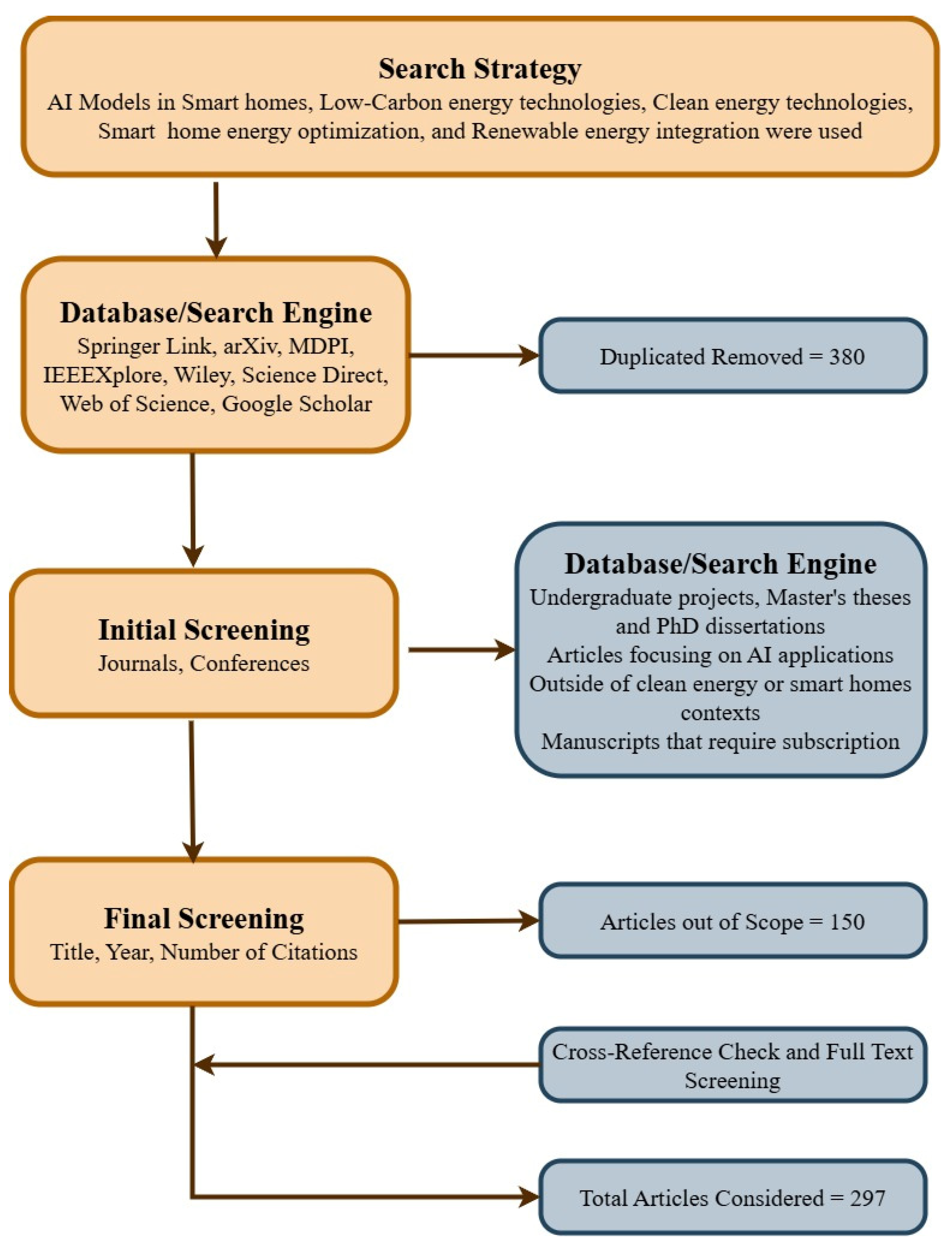
2.1. PRISMA-Based Literature Search and Information Sources
2.2. Database Search Strategy
- “Smart home” OR “home energy management system” OR HEMS OR SHEMS AND
- “Smart grid” OR microgrid OR “demand response” AND
- “Artificial intelligence” OR “machine learning” OR “deep learning” OR “reinforcement learning” AND
- forecast OR predict OR schedule OR “real-time optimization” AND
- “low-carbon” OR decarbonize OR “renewable energy” OR “carbon emission”. Minor modifications were applied to accommodate database-specific indexing rules and search interfaces. Due to platform limitations, Google Scholar searches were restricted to title-based queries using simplified keyword combinations. The complete database-specific Boolean search strings applied, search fields, year filters, and final search dates are summarized in Table 2.


| Database | Search Fields | Boolean Search String | Year Range | Final Search Date |
|---|---|---|---|---|
| IEEE Xplore | Title, Abstract, Keywords | (full Boolean string) | 2020–2025 | 15 Aug 2025 |
| ScienceDirect | Title, Abstract, Keywords | (full Boolean string) | 2020–2025 | 15 Aug 2025 |
| Web of Science | Topic | (full Boolean string) | 2020–2025 | 15 Aug 2025 |
| SpringerLink | Title, Abstract | (full Boolean string) | 2020–2025 | 15 Aug 2025 |
| Wiley | Title, Abstract | (full Boolean string) | 2020–2025 | 15 Aug 2025 |
| PubMed | Title, Abstract | (adapted string) | 2020–2025 | 15 Aug 2025 |
| Google Scholar | Title only | simplified string | 2020–2025 | 15 Aug 2025 |
2.3. Study Screening and Selection Process
2.4. Eligibility Criteria
2.5. Study Quality and Risk-of-Bias Assessment
3. Clean and Low-Carbon Energy Technologies
3.1. Renewable Energy Technologies
3.1.1. Solar Energy Technologies
3.1.2. Wind Energy
3.1.3. Geothermal Energy: Efficient and Reliable Heating and Cooling
3.1.4. Biomass Energy: A Sustainable and Carbon-Neutral Heating Option
3.2. Energy Storage Systems (ESSs)
3.2.1. Mechanical Energy Storage
3.2.2. Chemical Energy Storage
3.2.3. Electrical Energy Storage
3.2.4. Thermal Energy Storage
3.3. Energy Efficiency Technologies in Smart Homes
4. Integrating Clean and Low-Carbon Energy Technologies with Smart Homes
4.1. Relevance of Clean and Low-Carbon Energy Technologies in Smart Homes
4.2. Implementation of Clean and Low-Carbon Technologies in Smart Homes
4.2.1. Photovoltaic (PV) Systems in Smart Homes
4.2.2. Building-Integrated Photovoltaics (BIPV) in Smart Homes
4.2.3. Low-Carbon Cooling and Heating System in Smart Homes
Examples of Low-Carbon Cooling and Heating Systems
- (1)
- Heat Pumps in Smart Homes
- (2)
- Low-Carbon Boilers and Alternatives
- (3)
- Solar Water Heating
4.3. Energy-Efficient Appliances
- Energy-Efficient Lighting: LED smart bulbs, such as Philips Hue [185], offer energy-efficient lighting solutions that are controlled remotely. These bulbs consume significantly less energy than traditional incandescent bulbs and have a longer lifespan. A study by Lee and Kim demonstrated that integrating smart lighting with occupancy sensors reduces energy usage by up to 30% in residential settings [186]. This integration of smart lighting systems with motion sensors and home automation platforms allows lights to turn off automatically when no one is present, further enhancing energy savings.
- Smart Appliances: Modern smart appliances, such as refrigerators, washing machines, and dishwashers, are designed to be energy-efficient and controlled via smartphone applications. These appliances often feature energy-saving modes that automatically adjust their operation based on energy availability and demand. For instance, smart washing machines know how to schedule cycles during off-peak hours when electricity rates are lower, contributing to overall energy savings [187]. Furthermore, the implementation of ML algorithms in these appliances allows for predictive maintenance and optimized energy use, enhancing their efficiency [188].
- HEMSs are integral to the smart home ecosystem, allowing for the centralized control of various energy-efficient appliances. These systems monitor energy consumption in real time and provide insights into usage patterns, enabling homeowners to make informed decisions about their energy consumption [189]. By integrating renewable energy sources, such as solar panels, with HEMSs, homeowners are able to further enhance their energy efficiency and sustainability [190,191].
- Energy Monitoring Systems: Smart homes equipped with energy monitoring systems allow homeowners to track their energy usage in real time. This capability enables users to identify high consumption patterns and make adjustments to reduce waste. Continuous data collection helps optimize energy use patterns and leads to significant cost savings on utility bills ranging from 5% to 22% [18].
4.4. IoT, Blockchain, and Decentralized Systems in Smart Home Management
5. Optimization Methods Used in Energy Management of Smart Homes
5.1. Comparison of AI Techniques and Traditional Methods in Smart Home Energy Optimization
5.2. Specific Optimization Techniques Used in Smart Homes
5.3. Hybrid Optimization Techniques
5.4. Comparative Analysis of Optimization Methods for Smart Home Energy Management
5.5. Statistical Comparison of the Studies in Table 4
5.6. Contextual Factors Influencing Method Selection
- ❖
- Home Size: Larger homes may require more robust optimization techniques like MILP or GA, which can handle a broader set of appliances and more complex demand-response scenarios. Smaller homes might benefit from lighter methods like ACO or PSO that are computationally efficient [236].
- ❖
- Appliance Types: Homes with a mix of high- and low-power appliances (e.g., HVAC and washing machines) may benefit from a method like MILP or FLS, which handles mixed energy demands. Homes with simpler, low-power appliances might use PSO or ACO for efficient scheduling with real-time energy tariffs [220,247].
- ❖
6. Conclusions
- Machine learning (ML), deep learning, and heuristic algorithms have proven essential for enabling predictive energy management, demand-side optimization, and adaptive scheduling in smart homes. Specifically, ML models like Gradient Boosting were shown to significantly improve energy consumption predictions, achieving high accuracy scores (>0.95) in several studies. These models illustrate the potential of ML in enhancing energy efficiency by predicting demand and optimizing usage in real-time.
- The integration of renewable energy sources with AI-optimized energy storage systems plays a crucial role in improving sustainability by reducing dependence on conventional power grids. In approximately 40% of the reviewed studies, energy storage systems paired with renewable energy sources demonstrated substantial savings and increased operational efficiency. AI-powered HEMSs enable real-time monitoring, energy forecasting, and adaptive control, leading to both reduced energy costs and enhanced user comfort.
- Optimization algorithms, such as genetic algorithms (GAs), particle swarm optimization (PSO), and mixed-integer linear programming (MILP), have been widely applied across various energy management tasks, from load scheduling to multi-objective optimization. Among the optimization techniques reviewed, WOA stood out in 40% of the studies for its remarkable ability to reduce grid reliance by 46.6% and energy costs by 57.7% in real-time applications. This highlights WOA’s significant impact on dynamic, real-time energy management. Similarly, the cuckoo optimization algorithm (COA), used predominantly in renewable energy systems, yielded energy cost savings between 57% and 80%, appearing in roughly 30% of the studies. Furthermore, the Adaptive Coati Optimization Algorithm demonstrated its ability to balance cost reduction with improved comfort, showing a 20% increase in user satisfaction while reducing electricity costs.
- The incorporation of blockchain technology for peer-to-peer (P2P) energy trading, combined with IoT-assisted smart grids and decentralized energy systems, further improves the efficiency and scalability of energy management solutions in smart homes. These technologies empower consumers and enable the more efficient distribution of energy across networks.
Author Contributions
Funding
Institutional Review Board Statement
Informed Consent Statement
Data Availability Statement
Acknowledgments
Conflicts of Interest
Abbreviations
| Abbreviations | Meaning |
| AI | Artificial Intelligence |
| ANN | Artificial Neural Network |
| BIPV | Building-Integrated Photovoltaics |
| DNN | Deep Neural Network |
| ESS | Energy Storage System |
| FLS | Fuzzy Logic System |
| GA | Genetic Algorithm |
| HEMS | Home Energy Management System |
| HVAC | Heating, Ventilation, and Air Conditioning |
| IoT | Internet of Things |
| MILP | Mixed-Integer Linear Programming |
| ML | Machine Learning |
| PSO | Particle Swarm Optimization |
| PV | Photovoltaics |
| RES | Renewable Energy Source |
| SHEMS | Smart Home Energy Management System |
| WOA | Whale Optimization Algorithm |
Appendix A
| Technology Type | Description | Benefits | Challenges | Gaps | Potential Solutions | Source |
|---|---|---|---|---|---|---|
| Solar Energy | PV panels convert sunlight directly into electricity. Solar thermal systems capture heat for water or space heating. Solar energy is widely regarded as a transformative solution for residential energy needs, reducing dependency on grid power and aligning with sustainability goals. Solar PV cost is approximately USD 0.89–1.01 million/MW. | Renewable and abundant Low maintenance Reduce electricity bills Sustainable and eco-friendly | Intermittent energy source (dependent on sunlight) High initial installation cost Space requirements | Limited capacity for areas with low sunlight or inconsistent weather patterns. | Integration with energy storage systems (ESSs) like lithium-ion batteries or thermal storage to store excess energy for low sunlight periods. Explore BIPV (building-integrated photovoltaics) to address space limitations in urban settings. | [255,256,257] |
| Wind Energy | Small-scale wind turbines generate electricity by converting the kinetic energy of the wind, often integrated with smart home systems. Wind energy reduces greenhouse gas emissions and enhances energy security. Incentive policies have encouraged adoption despite challenges. Wind (onshore) cost is approximately USD 1.3–2.2 million/MW. | Renewable and clean Low operating costs It can be integrated with storage systems for reliability | Intermittent energy source (dependent on wind) Noise concerns Requires large open space | Inconsistent wind speeds, space constraints in urban areas. | Use Vertical-Axis Wind Turbines (VAWTs) for urban areas. Combine wind and solar energy with ESS to reduce intermittency. Develop predictive algorithms for better integration. | [258,259,260] |
| Geothermal Energy | Geothermal heat pumps (GHPs) use the Earth’s internal heat for space heating and cooling. Geothermal energy provides a stable energy source, reduces residential carbon footprints, and has a long operational life with low emissions. Geothermal cost is approximately USD 20,000 to USD 30,000 for home systems, and USD 2500 to USD 5000 per kW utility scale. | Reliable and continuous Efficient for heating and cooling Low operational costs | High installation cost Suitable for specific geographical locations Limited scalability in some areas | Not effective in regions lacking natural geothermal resources. | Develop modular geothermal systems with advanced drilling technologies to reduce costs. Combine with solar thermal systems for hybrid solutions. | [258,261,262] |
| Biomass Energy | Derived from organic materials such as plant and animal byproducts or organic waste. Biomass systems, such as pellet stoves or boilers, offer a sustainable alternative to fossil fuels, particularly for rural areas. Biomass cost is approximately USD 89.21 per MWh. | Sustainable, reduces carbon emissions, supports rural economies. | Resource availability, emissions, efficiency concerns. | Emissions from combustion can affect air quality. | Use advanced biomass conversion technologies like gasification and pyrolysis for cleaner energy production. Integrate IoT-based systems for optimized combustion and minimal waste. | [263,264,265]. |
| Reference | Type of ESS | Summary | Potential Solutions | Examples |
|---|---|---|---|---|
| [266,267] | Mechanical Storage | Mechanical energy storage systems, such as flywheels and compressed air energy storage (CAES), store energy in the form of kinetic or potential energy. Flywheels use rotational inertia for short-term energy storage, while CAES use compressed air to store energy in large underground caverns. These systems offer high round-trip efficiency, fast response times, and provide grid stabilization, but are generally constrained by system complexity, size, and higher capital costs. | Develop compact CAES systems, reduce material costs for flywheels. |
|
| [268,269,270] | Chemical Storage | Chemical energy storage systems, including batteries (e.g., lithium-ion or sodium–sulfur) and fuel cells, store electrical energy in chemical form and release it through electrochemical reactions. Batteries offer high energy density and fast discharge rates, while fuel cells convert chemical energy directly to electricity. These systems are widely used in smart homes for their high-power density and scalability. However, challenges include higher initial costs, limited cycle life, and environmental impact of materials used. | Improve battery chemistry, reduce environmental impact of materials. |
|
| [80,271] | Electrical Energy Storage | Electrical energy storage systems, such as supercapacitors and superconducting magnetic energy storage (SMES), store energy in electric or magnetic fields. Supercapacitors store energy through electrostatic charge, providing rapid charge and discharge cycles, ideal for managing short-duration, high-power demands. SMES utilizes superconducting coils to store energy as magnetic fields, offering high efficiency and fast response times. These systems are effective for stabilizing smart home energy loads but are limited by their high capital cost and power rating constraints. | Develop cost-effective superconducting materials, enhance charge capacity. |
|
| [272,273] | Thermal Storage | Thermal energy storage systems store energy in the form of heat or cold. Phase change materials (PCMs) and water tanks are common in smart homes to support HVAC systems, enabling the transfer of thermal energy to meet heating or cooling demands. PCMs store and release energy as they undergo phase transitions (e.g., from solid to liquid), while water-based systems provide seasonal storage capabilities. These systems improve energy efficiency and reduce reliance on grid-based heating or cooling but may have limitations in response time and thermal insulation. | Improve PCMs for quicker thermal response, better insulation for efficiency. |
|
| Ref | Summary | Optimization Methods Used | Result | Problem Formulation and Constraints |
|---|---|---|---|---|
| [97] | In this study, an optimized smart home energy management system (OSHEMS) was examined that ensured dependable load delivery while reducing grid reliance and energy costs. | The Home Energy Management Whale Optimization Algorithm (HEMWOA) was used. | Experimental results demonstrated a considerable decrease in grid reliance (46.6%) and energy expenses (57.7%) compared to non-scheduled scenarios. | Encircling the prey phase: Bubble net attacking phase: behavioral model
Home energy cost objective: where and denote the current and updated whale positions at iteration , is the best solution found so far, is a randomly selected solution, is the distance vector, and and are dimensionless coefficient vectors controlling exploitation and exploration; and defines the spiral shape, and all position vectors are expressed in units consistent with the decision variables. The objective equation defines the total daily electricity cost of the smart home by accounting for flexible and non-flexible appliance energy consumption, on-site photovoltaic generation, battery contribution, and time-varying electricity prices over a 24 h scheduling horizon. |
| [274] | This paper framed the energy planning problem (EPP) as an optimization challenge aimed at determining the best schedules to reduce energy consumption costs and demand, while improving user comfort. | The grey wolf optimizer (GWO) was modified and tailored to solve the EPP in an optimal manner, efficiently achieving its goals. | To evaluate the effectiveness of the proposed method, its performance using the GWO with RESs was assessed in three phases: first, by comparing it with original methods without RESs; second, with methods that incorporate RESs; and third, by benchmarking against state-of-the-art approaches. The results demonstrated the method’s robust ability to tackle the EPP and optimize its objectives. | : , : , , , where and denote the current and updated solution vectors at iteration itr, , , and are the positions of the three leading wolves, and are coefficient vectors controlling exploration and exploitation, and are random vectors uniformly distributed in , and is a linearly decreasing control parameter. The objective equation defines the multi-objective fitness function, where is the energy bill, is the peak-to-average ratio, is the average waiting time ratio, – are weighting coefficients, and and are normalization constants used to balance competing objectives in smart-home scheduling. |
| [275] | The study focused on sensor optimization in smart environments and aimed to improve activity recognition while managing power consumption and cost constraints. The method used spatial and temporal contexts represented by an ontology model for sensor mapping and activity recognition. | Sensor optimization was used. | The study focused on optimizing sensors in smart homes for activity recognition by using spatial and temporal data, removing inactive sensors, and pairing redundant ones while maintaining accuracy even in multi-resident environments with concurrent activities. | Using Mutual Information: where denotes the joint probability of sensor label and activity , and and are their corresponding marginal probabilities; quantifies the strength of association between a sensor and an activity, selects the most informative sensor label for activity represents the set of sensors, and denotes the set of activities. The equations above collectively define a mutual-information-based spatial noise elimination strategy that identifies informative sensors while removing redundant or irrelevant sensor data. |
| [29] | The objective of the proposed system was to optimize the energy usage of SUB appliances to efficiently managed load demand. This leads to a reduction in the peak-to-average ratio (PAR) and a subsequent decrease in electricity costs, all while ensured that user comfort remained a top priority. | The improved sine cosine algorithm (ISCA) was evaluated against the grasshopper optimization algorithm (GOA). | This study compared the performance of the improved sine cosine algorithm (ISCA) with the grasshopper optimization algorithm (GOA) for optimizing energy consumption in smart urban buildings (SUBs). The proposed method achieves significant improvements in electricity cost, peak-to-average ratio (PAR), and waiting time, with reductions of 29.16%, 51.51%, and 35.07%, respectively. In comparison, GOA showed improvements of 13.72%, 38.00%, and 13.97%. The results demonstrated that ISCA outperforms both the unscheduled scenario and GOA, offering benefits for both utilities and consumers. | -th dimension where denotes the position vector of the -th grasshopper, , , and represent the social interaction, gravity, and wind-advection components, respectively; , , and are random weighting coefficients, is a decreasing control parameter, and are the upper and lower bounds of the -th decision variable, is the social interaction function, and is the target position in dimension . The velocity update rule equation introduces a velocity-based refinement mechanism that enhances convergence by adaptively balancing exploration and exploitation using global and personal best positions. |
| [276] | Specifically, the model permitted the integration of distributed renewable energy systems (DRESs) and takes TOU into account. Additionally, the cuckoo optimization technique is used to solve the load scheduling model. An equivalent MILP model to the load scheduling problem is created and solved in order to validate the cuckoo algorithm’s performance. Cuckoo and its equivalent MILP model are compared in terms of optimality and time performance through a series of exercises. | The cuckoo optimization technique was used for various operating conditions and scheduling criteria. | The cuckoo results, based on real data from an Egyptian academic building, demonstrated that under specific conditions, the building could achieve energy cost savings of 57% to 80%. | Subject to: : , ∀i, k : where , , and denote individual objective functions associated with energy cost, peak load reduction, and user discomfort, respectively, and , , and are non-negative weighting coefficients satisfying . represents the energy consumed by appliance of category at time , is the required operating duration, and is the rated power. The scheduling window is determined by the preferred start time and flexibility parameter . denotes non-schedulable load demand, is the grid supply, represents photovoltaic generation, and quantifies the aggregated discomfort metric minimized in the final optimization stage. |
| The research proposed a new methodology for demand-side management and also used the Support Vector Regression technique to forecast a dispersed generation for the next day. The K-means clustering technique was used to identify the user comfort levels, which were validated by numerical simulations using actual data from a smart house. | Elite Non-dominated Sorting Genetic Algorithm II was used. | When comparing smart homes with and without distributed generation and battery banks, the effectiveness of the suggested AI combination was demonstrated by a 51.4% cost decrease. | : where denotes the voltage-dependent power output of a photovoltaic panel, and are the cut-in and open-circuit voltages, respectively, and and are linear approximation coefficients. represents the total PV system output power, is the number of PV panels, and is the fill factor computed from the maximum power point voltage , current , open-circuit voltage , and short-circuit current . The optimization function defines the dominance relations used in multi-objective optimization, where and represent objective functions, is the solution space, and denotes the set of non-dominated (Pareto-optimal) solutions. | |
| [277] | The study assessed the approach’s efficacy during three operational periods (60, 12, and 24 min). All things considered, the Adaptive Coati Optimization algorithm presents a viable way to manage energy costs in smart homes while boosting user satisfaction and yielding financial gains. | The Adaptive Coati Optimization method was introduced. | According to the findings, tariff rates have been decreased by up to 30%, which has resulted in a 20% rise in user satisfaction and a 25% improvement in cost utilization. | where denotes the initialized decision variable for index and dimension , and are the lower and upper bounds, and is a uniformly distributed random number. The objective minimizes the total operational cost, where is a weighting coefficient and represents the cost associated with component at index . denotes the total processing time composed of interaction and fixed components, constrained by a threshold . The total time equality constraint and the total energy/amount equality constraint enforce consistency between scheduled and unscheduled total time and energy (or amount), respectively, while the index bounds constraint and the variable bounds ensure the feasibility of the indices and decision variables. |
| [278] | Optimization algorithms, including GA, CSO, and BPSO, were used to flatten energy demand profiles by considering user preferences, time considerations, and pricing signals. The effectiveness of these algorithms was compared using MATLAB simulations to identify the most effective one. | Optimization algorithms, including GA, CSO, and BPSO, were used. | GA, CSO, BPSO, VOA, and EWOA are key algorithms in reducing peak-to-average ratio (PAR) of energy consumption. VOA outperforms other algorithms without RESs, while EWOA, incorporating RESs, saved 73.8% of PAR. EWOA-based DSM costs less than non-scheduled consumption. | where is the energy consumed by appliance during hour (kWh), is the electricity price at hour (currency/kWh), is the operating cost of appliance at hour (currency), is the grid-supplied energy at hour (kWh), is the renewable energy supplied at hour (kWh), is the total daily grid energy (kWh), is the number of appliances, is the number of scheduled devices/decision variables, and is a binary status variable indicating whether appliance is OFF (0) or ON (1) at hour (dimensionless). |
| [240] | The study explored a multi-objective hybrid optimization technique for equitable workload distribution between on peak and off-peak hours, and the concept of real-time rescheduling among home appliances using a dynamic programming strategy. It evaluated the methodology’s performance in relation to real-time pricing, time-of-use pricing, and crucial peak pricing. | A multi-objective hybrid optimization technique was used. | The proposed optimization method demonstrated relevance in reduced costs, with HAG achieving a minimum PAR of 2.22 and a cost reduction of 24.06% during scheduling, 46.14% under TOU tariff, and 29.5% in CPP cases. | where denotes the candidate set associated with decision element (dimensionless set), is the selected time index/value for state (time unit consistent with the scheduling horizon, e.g., minutes or hours), and represent appliance ON and OFF timing states (dimensionless conditions), and is a binary selection variable indicating whether a candidate is chosen; is the scheduled load power at time (kW), is the objective/target load power at time (kW), is the electricity price at time (currency/kWh), is the power demand of appliance at time (kW), is the ON/OFF status of appliance at time (dimensionless), and is the number of appliances. |
| [15] | Real-time environment and energy data were collected from embedded devices and smart meters, training a deep learning model for energy and thermal comfort prediction. The model was deployed on embedded devices for edge inference, and the whale optimization algorithm optimized occupant comfort and energy use, triggering proactive control commands using the Open Connectivity Foundation standard. | The whale optimization algorithm was used to optimize occupant comfort and energy use. | The Open Connectivity Foundation (OCF) standard was utilized for communication, and real-time OCF-based optimal actuator control tests showed effectiveness, achieving cost savings of 35.98% to 38.22%. | where and are the current and best solution position vectors at iteration , respectively, expressed in the units of the decision variables; is the distance vector with the same units as ; and are coefficient vectors controlling the search behavior of the optimization algorithm; and denotes the iteration index (dimensionless). In the energy cost formulation, and denote the variations in temperature (°C) and humidity (%), respectively, and represent the energy cost coefficients associated with temperature and humidity control (e.g., kWh per unit change), and and are dimensionless weighting factors reflecting the relative importance of temperature and humidity in the total energy cost. |
| [32] | Smart residential homes face challenges in energy management, including efficient scheduling of electric vehicle charging and discharging, utilization of PV resources, and efficient grid power generation. | This work presented a fuzzy logic-based real-time energy management system. | The proposed energy management controller’s effectiveness was assessed on a secondary distribution system, delivering results in a mere 52 ms computational time. | Transformer (DT) loading indicator rules Incentive membership functions (fuzzy) Charging membership functions (fuzzy) where and denote EV charging and discharging power at time (kW), is the maximum EV charging/discharging power (kW), is the EV state of charge at time (dimensionless, 0–1), and are SOC limits (dimensionless), is the EV battery capacity (kWh), is the time-step duration (h), is the remaining charging time (h), is the distribution transformer loading in per-unit (dimensionless), Incentive is the incentive level (cents), and is a normalized charging measure (dimensionless, 0–1); denotes fuzzy membership degree (dimensionless). |
| [279] | The Intelligent Smart Energy Management System (ISEMS) aims to accurately estimate energy availability and plan for the future in a smart grid environment incorporating renewable energy. | The Support Vector Machine regression model based on PSO showed superior performance accuracy. | The experimental setup for ISEMS was demonstrated, and evaluated in various configurations, and IoT integration was implemented for user comfort monitoring. | where is the number of samples (dimensionless), is the measured value in its physical unit (e.g., kW or kWh), and is the corresponding predicted value in the same unit, while MAE and RMSE retain the unit of and MAPE is reported as a percentage. |
| [280] | The management method was divided into two phases based on charging constraints and initial charge status. Stage A includes three operational states based on PV generation availability, while Stage B predicts five operational states. This advanced control strategy ensures precise energy absorption by EVs, minimizes residential electricity costs, and synchronizes electrical load profiles. | The system integrated EVs and optimizing residential electricity expenses using TOU cost, usage fluctuations, PV generation patterns, and EV variables. | The proposed plan shows a significant reduction in residential electricity expenses and normalization of power load characteristics, with the proposed plan for intelligent households using both EVs and PV generation outperforming EV-only households. | Stage A: Load EV interaction Stage B: PV Load EV interaction Mode 4 (PV to load) Mode 5 (PV to EV) Mode 6 (PV + Grid–EV coordination) Mode7 (PV-assisted load balancing) Mode 8 (High PV penetration) Total daily cost function where is the baseline household load at time (kW), is the updated load after coordination (kW), is the average load over the scheduling horizon (kW), denotes grid-to-EV power exchange (kW), represents EV-induced load variation (kW), is photovoltaic generation power (kW), is PV power supplied to the household load (kW), is PV power supplied to EV charging (kW), is the electricity price at time (currency/kWh), and denotes the hourly time index over a 24 h horizon. |
| [281] | This paper used historical weather data to predict PV power outcomes, analyzing the benefits of HEMSs with PV and battery ESSs for peak load shaving and grid stability. | This paper proposed an intelligent HEMS with three adjustable strategies to maximize economic benefits and consumer comfort. It introduces a novel objective function focusing on satisfying users’ needs, integrating a tri-objective model into an algorithm. | The proposed model significantly reduced electricity bill expenditure by 39.81% and maintained grid balance by reducing peak load by 50.37%, resulting in a 1.6-fold improvement in user comfort index. | photovoltaics Battery Tariff/objective index where indicates whether appliance is ON in time slot (dimensionless), is the operating duration in slots (dimensionless), is the start slot index (dimensionless), and define the allowable start-time window (dimensionless), is the number of appliances (dimensionless), and the horizon is divided into 48 slots (e.g., 30 min intervals); is PV output power at slot (kW), is PV efficiency (dimensionless), is PV array area (m2), is solar irradiance (kW/m2 or W/m2, use one consistently), and is PV cell/ambient temperature (°C); is battery state of charge at slot (dimensionless or kWh depending on definition), is the self-discharge/retention factor (dimensionless), and and are charged and discharged energy per slot (kWh); is a dimensionless tariff index, are dimensionless weights, and , , and are normalized performance measures scaled by their corresponding maxima. |
| [282] | The study employed a data analytics platform utilizing ANN and a PSO algorithm to collect real-time ambient data and control air conditioner operation, predicting power consumption, indoor temperature, and humidity accurately. | A PSO algorithm was used. | The intelligent cooling management system, tested in a smart home environment using an 8000 BTU air conditioner, predicted air conditioner behavior and ambient data, indicating potential energy savings in smart home applications, with validation results proving its effectiveness. | ; Particle swarm optimization (PSO) update rules Position update: where is the predicted mean vote comfort index of particle at time (dimensionless), is a comfort penalty term (same unit as the fitness value), is the average objective cost of particle at time (e.g., currency), is the penalized fitness value (currency), is the personal best fitness of particle , and is the global best fitness among all particles; and are the position and velocity vectors of particle at iteration (with units matching the decision variables), is the inertia weight (dimensionless), and are cognitive and social acceleration coefficients (dimensionless), and are random numbers uniformly distributed in (dimensionless), is the number of particles, and is the maximum number of iterations. |
| [283] | Demand-side management (DSM) is a crucial aspect of microgrid and smart grid technology, aimed at controlling requirements while maintaining client trust. The research focused on helping households manage their power plans. | The HBA + DMO technique, combining Honey Badger Optimization (HBA) and Dwarf Mongoose Optimization (DMO), was used. | The proposed approach collects energy data for reporting, monitoring, and engagement, with a computational time of approximately 213.42. This can help reduce waiting times and improve user comfort in various settings. | Index bounds Decision-variable bound where is a bounded decision variable (dimensionless), is a weighting coefficient (dimensionless), is the cost associated with appliance/state sat index (currency), is an aggregate index formed by stationary moving and fixed components , , and (same unit as ), is the corresponding threshold (same unit as ), and denote the total scheduled and unscheduled values of , and denote the total scheduled and unscheduled power/energy metric (kW or kWh as defined in the study), is the total number of indices, is the number of appliances/states, and is the index variable. |
| [284] | The model integrated renewable energy, PV systems, wind power, and an energy storage system to ensured coordinated electricity flow in residential houses. It used demand response schemes and a dynamic model for the System Performance Index. It also introduced a Dynamic Distributed Energy Storage Strategy and a Wild Mice Colony optimization algorithm. | A Wild Mice Colony optimization algorithm was used. | The strategy of DDESS could significantly reduced energy consumption by over 100% of load demand, optimize the energy system, and ensure synchronization, thereby minimizing EC costs from the PG. | Cost components Optimization objective function where is the total demand energy at time (kWh), , , , and denote energy contributions from wind, photovoltaic, grid import, and dispatchable/source component, respectively (kWh), is the total local operating energy supply (kWh), and is the net utility-grid exchange (kWh, positive for import and negative for export); , , , and are the corresponding cost terms (currency), and are electricity price rates for grid and DER energy (currency/kWh), is the number of time steps (dimensionless), and are index variables (dimensionless), and is the number of considered components/cases at step |
| [223] | Smart home users face high monthly energy consumption bills and struggle to optimize devices, increasing energy demand and accelerating global greenhouse effects. Uneven usage of non-shiftable appliances can exceed power limits, leading to short blackouts. To address these challenges, a mobile application has been developed to effectively control energy consumption in smart homes. | The PSO algorithm was used. | Two tests were carried out: one with and one without the PSO algorithm being used. The outcome demonstrated that the PSO algorithm outperforms the others in terms of energy consumption optimization. | It is a common practice to test optimization problems using the Ackley equation [11]. Based on the author, the recommended unknown variable values inside the Ackley equation are a = 20; b = 0.2; c = 2π. is a -dimensional decision vector, denotes the -th decision variable, is the problem dimensionality, and , , and are predefined constants controlling the shape of the function; following standard practice in optimization benchmarking, the recommended parameter values are , , and , yielding a multimodal landscape commonly used to evaluate global optimization performance. |
| [285] | This paper proposes a flexible smart home energy management framework, considering various technologies like CHP units, PV generation units, and electric vehicles, to optimize energy payment and user satisfaction. | The proposed model uses a multi-criteria decision making (MCDM) approach and a mixed-integer linear programming (MILP) problem, solved by the CPLEX solver in the GAMS environment. | The study revealed significant disparities in energy payments when the flexibility limit falls below 40%, affecting end-user satisfaction and self-sufficiency, with variations of 27.4%, 100%, and 56.64%, respectively. | Where Thermal energy cost , , , , , , , denote the electricity, thermal, and gas cost components (currency). |
| [15] | Real-time environment and energy data were collected from embedded devices and smart meters, training a deep learning model for energy and thermal comfort prediction. The model was deployed on embedded devices for edge inference, with the WOA optimizing occupant comfort and energy use. | The whale optimization algorithm was introduced. | The whale optimization algorithm generates results for a fuzzy logic controller, which activates control commands for proactive response. Real-time OCF-based experiments confirm system efficacy, achieving cost savings of 35.98% to 38.22%. | Optimization update equations where and denote the current and best solution vectors at iteration , respectively, is the distance vector with units consistent with the decision variables, and and are dimensionless coefficient vectors controlling the optimization process; and represent deviations of indoor temperature (°C) and humidity (%) from their comfort bounds and , and are energy conversion coefficients (kWh per unit deviation), and are dimensionless weighting factors, and Price denotes the electricity tariff (currency/kWh). |
| [286] | This paper investigates the integration of attention networks in home energy management systems (HEMSs) to improve energy consumption optimization. It examines the AMpds2 dataset and compares its performance across various forecasting methodologies, using metrics like RMSE and MAE, and advanced optimizers. | The proposed solution uses attention networks to dynamically allocate energy consumption significance, focusing on the AMpds2 dataset and assesses performance across various time series forecasting methodologies. | The study analyzed 16 hyperparameter combinations across four-time series models and found that transformers improved energy and load pattern forecasting accuracy by 4%, using Python 3.2 and the matplotlib library. | The gradient used to update the parameter is computed in the following manner. Alternatively, the comprehensive update equation is expressed as: Attention mechanism (linear projections) Step 2 where denotes the model parameter at iteration , is the gradient of the objective function, is the instantaneous gradient, and are first- and second-moment estimates, and are decay coefficients (dimensionless), is a scaling factor, and is the learning rate; is the input feature matrix, , , and are learnable projection matrices, , , and are the query, key, and value matrices, and denotes the similarity score for the -th query. |
| [287] | The paper proposed a flexible approach for aggregators in distribution systems, utilizing load flexibility resources to enable real-time appliance rescheduling and shifting to meet demands. | A new Reinforced Learning Quantum Inspired Grey Wolf Optimization (RLQIGWO) was used. | RLQIGWO, a grey wolf optimizer, integrated reinforcement learning and quantum mechanics principles achieved better performance in load balancing, resource utilization, and task execution, enhancing energy management strategies. | Wolves encircle prey using the following equations: Reinforced-Learning-based position update Quantum-inspired based position update where and denote the current and updated position vectors of a search agent, represents the prey (best solution), , , and are the leading wolf positions, and and are coefficient vectors controlling exploration and exploitation (dimensionless); denotes the action–value function in reinforcement learning, is the learning rate, is the discount factor, and is the received reward; is a quantum state with probability amplitudes and , is a random rotation angle, and are the lower and upper bounds of the -th decision variable, and all position vectors are expressed in units consistent with the optimization variables. |
| [219] | The paper proposed a demand response method for managing residential energy consumption, aiming to reduce costs, the peak-to-average ratio, and imports, addressing the growing energy consumption in the residential sector. | Manta ray foraging optimization (MRFO) and long-term memory MRFO (LMMRFO) algorithms were used. | The proposed plan effectively reduced electricity costs and maximized profit through case studies and comparative studies, demonstrating the legality and effectiveness of LMMRFO and MRFO. | Manta Ray foraging optimization Chain harvesting: Cyclone foraging Foraging in somersault Long term memory Manta Ray foraging optimization where denotes the position of the -th manta ray in the -th dimension at iteration , is the best solution found so far, is the population size, are random numbers, and are adaptive coefficients controlling exploration and exploitation, is the somersault factor, and are the lower and upper bounds of the -th variable, is the fitness function, is the memory length, and all position variables are expressed in units consistent with the decision space. |
| [288] | The study explored the modeling of smart buildings using non-responsive devices and renewable photovoltaic sources, incorporating the KNX protocol for energy management and integrating batteries for energy storage and peak load. | The whale optimization algorithm (WOA) was used. | The study demonstrated that strategic battery charging and discharging management and photovoltaic unit utilization significantly reduced operating costs, as demonstrated through a 30 modified system test system. | Total cost function where and denote the current and best solution vectors at iteration , respectively, is the distance vector with units consistent with the decision variables, and are dimensionless coefficient vectors controlling exploration and exploitation, is a linearly decreasing control parameter, and is a random vector uniformly distributed in ; is the electricity price at time (currency/kWh), is the time-step duration (h), is the scheduled exported or shifted energy at time (kWh, negative sign indicating cost reduction), is the aggregated daily operational cost for day (currency), is the total number of time steps, and is the number of days considered. |
| [289] | This study proposed an improved grasshopper optimization algorithm, termed Outpost Multi-population GOA, which enhances local exploitation and global exploration through outpost and multi-population mechanisms, and experimental results show that it outperforms conventional algorithms in high-dimensional optimization and achieves strong performance in a real-world lithology prediction task. | Outpost Multi-population Grasshopper Optimization Algorithm (OMGOA) was used. | The study showed that the proposed Outpost Multi-population Grasshopper Optimization Algorithm (OMGOA) consistently outperformed standard GOA and other metaheuristic methods in complex and high-dimensional optimization tasks, while also achieving strong and reliable performance in real-world lithology prediction. | Mathematical formula for proposed OMGOA method where denotes the objective function and represents the updated elite position. |
| [290] | Gradient Boosting was used in SHEMS to enhance its intelligence by analyzing complex datasets, detecting patterns, and making data-driven decisions for energy optimization. This enabled it to adapt to dynamic usage patterns, predict future consumption trends, and identify energy savings opportunities. | Gradient Boosting was used. | The Gradient Boosting algorithm outperformed other ML algorithms in predicting energy consumption for smart homes, with a score of 0.95, an RMSE of 6.8, and an MAE of 5.2. | Compute Pseudo-Residuals Fit Weak Learner to Pseudo-Residuals: Update Model: Output Final Model: where and denote the input features and target value of the -th sample, is the ensemble prediction after boosting iterations, is a differentiable loss function, are the pseudo-residuals at iteration , is the weak learner fitted to the residuals, is the learning rate (dimensionless), is the number of training samples, and is the total number of boosting stages. |
| [291] | The power scheduling problem in a smart home (PSPSH) aims to reduce electricity costs, balance power consumption during peak periods, and maximize user satisfaction, but achieving optimal solutions is often limited by specific constraints. | This paper employed the grey wolf optimizer (GWO). | The proposed BMO-PSPSH approach outperforms 17 state-of-the-art algorithms on their datasets and four algorithms on the proposed datasets, achieving superior performance across nearly all power consumption and dynamic pricing scenarios. | where and denote the current and updated positions of a search agent at iteration itr, respectively, represents the best (prey) position found so far, is the distance vector, and and are dimensionless coefficient vectors controlling exploitation and exploration; denotes the set of candidate solutions, is the corresponding neighboring solution set, and all position vectors are expressed in units consistent with the decision variables of the optimization problem. |
| [292] | This research proposed a novel HEM system that integrates battery energy storage systems (BESSs), PV systems, and electric vehicles (EVs) using an MILP approach to reduce electricity costs. | The research used mixed-integer linear programming (MILP). | The results showed a significant 46.38% reduction in electricity costs for multiple smart homes compared to a traditional scenario without PV, BESS, or EV integration. | Cost minimization objective (kWh), respectively, and at time , and (kWh), spans a 24 h scheduling horizon. |
| [293] | They aimed to develop a smart home energy management system (HEMS) to efficiently operate residential electrical appliances. | The model used genetic algorithm (GA) optimization, with results demonstrating its effectiveness. | The results highlighted the model’s effectiveness. | s.t: Water Heater Modeling Air Conditioning System Modeling (kW), (h), (kW), and , , , and , , and is the equivalent thermal resistance of the building envelope (°C/kW). |
| [294] | This study aimed to solve the PSPSH by minimizing electricity bills, improving user comfort, and maintaining power system performance using the GWO-MCA method. Its impact on five other optimization algorithms was also evaluated. | This paper combined the Min-Conflict Local Search Algorithm (MCA) with the grey wolf optimizer (GWO). | GWO-MCA outperformed all compared MCA-based methods and three state-of-the-art hybrid methods in solving PSPSH. It also outperforms 20 other state-of-the-art methods across most datasets. | GWO-MCA , denotes a set of thresholds or criteria used during the optimization process. |
| [295] | This study aimed to develop cities that face increasing uncertainty, necessitating smart devices and apps for security, requiring strict measures to protect personal information and prevent illegal access, and requiring reliable computing for the IoT. | The whale optimization algorithm with deep convolutional neural networks was used. | This research showcased the effectiveness of the proposed approach in defending smart home systems from safety risks, advancing IoT security in a growing connected world. | Searching: , , the associated evaluation criteria used in the multi-criteria decision framework. |
| [296] | This study aimed to optimize energy management in smart buildings with electric vehicles by considering risk, economic factors, and practical constraints like production limits and flexible loads. | The whale optimization algorithm was used. | The results showed that a positive consumer attitude reduced net costs, with the battery used during favorable price periods. Price risk indicators also impact users’ electricity purchasing strategies differently. | Besieging the prey: Bubble attack calculation (operation phase): Searching for the prey (exploration phase): , is indoor temperature (°C), and all position vectors are expressed in units consistent with the decision variables. |
References
- González-Álvarez, M.A.; Montañés, A. CO2 Emissions, Energy Consumption, and Economic Growth: Determining the Stability of the 3E Relationship. Econ. Model. 2023, 121, 106195. [Google Scholar] [CrossRef] [Scilit]
- Buildings—Energy System—IEA. Available online: https://www.iea.org/energy-system/buildings (accessed on 2 November 2025).
- Share of Electricity in Total Final Energy Consumption in the Net Zero Scenario, 2005–2030—Charts—Data & Statistics—IEA. Available online: https://www.iea.org/data-and-statistics/charts/share-of-electricity-in-total-final-energy-consumption-in-the-net-zero-scenario-2005-2030 (accessed on 9 January 2026).
- The Triple Challenge of the Energy Transition. Available online: https://www.caf.com/traducciones/traducciones_en/the-triple-challenge-of-the-energy-transition/ (accessed on 9 January 2026).
- Ezugwu, A.E.; Taiwo, O.; Egwuche, O.S.; Abualigah, L.; Van Der Merwe, A.; Pal, J.; Saha, A.K.; Alzahrani, A.I.; Alblehai, F.; Greeff, J.; et al. Smart Homes of the Future. Trans. Emerg. Telecommun. Technol. 2025, 36, e70041. [Google Scholar] [CrossRef] [Scilit]
- Shabha, G.; Barber, F.; Laycock, P. A Qualitative Assessment of the Impact of Smart Homes and Environmentally Beneficial Technologies on the UK 2050 Net-Zero Carbon Emission Target. Smart Sustain. Built Environ. 2023, 12, 341–360. [Google Scholar] [CrossRef] [Scilit]
- Jafarizadeh, H.; Yamini, E.; Zolfaghari, S.M.; Esmaeilion, F.; Assad, M.E.H.; Soltani, M. Navigating Challenges in Large-Scale Renewable Energy Storage: Barriers, Solutions, and Innovations. Energy Reports 2024, 12, 2179–2192. [Google Scholar] [CrossRef] [Scilit]
- Schell, E.E.; Winslow, D.; Shrestha, P. (Eds.) Food Justice Activism and Pedagogies; Lexington: Lanham, MD, USA, 2023; Part III; pp. 183–262. [Google Scholar] [CrossRef] [Scilit]
- Ma, M.; Zhou, N.; Feng, W.; Yan, J. Challenges and Opportunities in the Global Net-Zero Building Sector. Cell Rep. Sustain. 2024, 1, 100154. [Google Scholar] [CrossRef] [Scilit]
- World Energy Transitions Outlook 2023. Available online: https://www.irena.org/Digital-Report/World-Energy-Transitions-Outlook-2023 (accessed on 3 January 2026).
- Renewable Electricity—Renewables 2025—Analysis—IEA. Available online: https://www.iea.org/reports/renewables-2025/renewable-electricity (accessed on 10 January 2026).
- Executive Summary—The Future of Geothermal Energy—Analysis—IEA. Available online: https://www.iea.org/reports/the-future-of-geothermal-energy/executive-summary (accessed on 10 January 2026).
- Njema, G.G.; Ouma, R.B.O.; Kibet, J.K. A Review on the Recent Advances in Battery Development and Energy Storage Technologies. J. Renew. Energy 2024, 2024, 2329261. [Google Scholar] [CrossRef] [Scilit]
- Paramati, S.R.; Shahzad, U.; Doğan, B. The Role of Environmental Technology for Energy Demand and Energy Efficiency: Evidence from OECD Countries. Renew. Sustain. Energy Rev. 2022, 153, 111735. [Google Scholar] [CrossRef] [Scilit]
- Khan, Q.W.; Ahmad, R.; Rizwan, A.; Khan, A.N.; Lee, K.T.; Kim, D.H. Optimizing Energy Efficiency and Comfort in Smart Homes through Predictive Optimization: A Case Study with Indoor Environmental Parameter Consideration. Energy Reports 2024, 11, 5619–5637. [Google Scholar] [CrossRef] [Scilit]
- About Energy Efficiency|UNEP—UN Environment Programme. Available online: https://www.unep.org/topics/energy/energy-efficiency/about-energy-efficiency (accessed on 10 January 2026).
- United for Efficiency (U4E)|UNEP—UN Environment Programme. Available online: https://www.unep.org/topics/energy/energy-efficiency/united-efficiency-u4e (accessed on 10 January 2026).
- Das, L.; Anand, P.; Anjum, A.; Aarif, M.; Maurya, N.; Rana, A. The Impact of Smart Homes on Energy Efficiency and Sustainability. In Proceedings of the 2023 10th IEEE Uttar Pradesh Section International Conference on Electrical, Electronics and Computer Engineering (UPCON), Gautam Buddha Nagar, India, 1–3 December 2023. [Google Scholar]
- Min, J.; Yan, G.; Abed, A.M.; Elattar, S.; Amine Khadimallah, M.; Jan, A.; Elhosiny Ali, H. The Effect of Carbon Dioxide Emissions on the Building Energy Efficiency. Fuel 2022, 326, 124842. [Google Scholar] [CrossRef] [Scilit]
- Hakawati, B.; Mousa, A.; Draidi, F. Smart Energy Management in Residential Buildings: The Impact of Knowledge and Behavior. Sci. Rep. 2024, 14, 1702. [Google Scholar] [CrossRef] [Scilit]
- Smart Home Market Size, Share, and Trends Analysis 2032. Available online: https://www.databridgemarketresearch.com/reports/global-smart-home-market (accessed on 10 January 2026).
- Oyebode, D.; Arafat, Y.; Hasan, M.; Hossain, A.; Imon, K.A.; Majid, A. Investigating the role of data analytics in monitoring and managing energy consumption in smart homes, aiming to enhance efficiency and reduce costs. Nanotechnol. Percept. 2024, 20, 228–247. [Google Scholar] [CrossRef] [Scilit]
- Biswas, P.; Rashid, A.; Biswas, A.; Al Nasim, M.A.; Chakraborty, S.; Gupta, K.D.; George, R. AI-Driven Approaches for Optimizing Power Consumption: A Comprehensive Survey. Discov. Artif. Intell. 2024, 4, 116. [Google Scholar] [CrossRef] [Scilit]
- Elhabyb, K.; Baina, A.; Bellafkih, M.; Deifalla, A.F. Machine Learning Algorithms for Predicting Energy Consumption in Educational Buildings. Int. J. Energy Res. 2024, 2024, 6812425. [Google Scholar] [CrossRef] [Scilit]
- Alexa+. Available online: https://www.amazon.com/alexaplus (accessed on 1 January 2026).
- Smart Home|Xiaomi Global. Available online: https://www.mi.com/global/smart-home/ (accessed on 1 January 2026).
- Choose Google Home: Seamless Control Enhanced Features for Your Home. Available online: https://home.google.com/about-google-home/ (accessed on 1 January 2026).
- H L, G.; M, S.; Ravi, V.; J, S.; Roy, K.S. Challenges and Future Scope. In Securing Future: Introduction to Zero Trust in Cybersecurity; Springer: Cham, Switzerland, 2024; pp. 77–82. [Google Scholar] [CrossRef] [Scilit]
- Naji Alhasnawi, B.; Jasim, B.H.; Naji Alhasnawi, A.; Hussain, F.F.K.; Homod, R.Z.; Hasan, H.A.; Ibrahim Khalaf, O.; Abbassi, R.; Bazooyar, B.; Zanker, M.; et al. A Novel Efficient Energy Optimization in Smart Urban Buildings Based on Optimal Demand Side Management. Energy Strategy Rev. 2024, 54, 101461. [Google Scholar] [CrossRef] [Scilit]
- Raza, A.; Jingzhao, L.; Ghadi, Y.; Adnan, M.; Ali, M. Smart Home Energy Management Systems: Research Challenges and Survey. Alex. Eng. J. 2024, 92, 117–170. [Google Scholar] [CrossRef] [Scilit]
- Malik, S.; Malik, S.; Singh, I.; Gupta, H.V.; Prakash, S.; Jain, R.; Acharya, B.; Hu, Y.C. Deep Learning Based Predictive Analysis of Energy Consumption for Smart Homes. Multimed. Tools Appl. 2024, 84, 10665–10686. [Google Scholar] [CrossRef] [Scilit]
- Usman, H.M.; ElShatshat, R.; El-Hag, A.H. Energy Management for Smart Residential Homes: A Real-Time Fuzzy Logic Approach. Electr. Power Syst. Res. 2025, 238, 111057. [Google Scholar] [CrossRef] [Scilit]
- Li, Y.; Antwi-Afari, M.F.; Anwer, S.; Mehmood, I.; Umer, W.; Mohandes, S.R.; Wuni, I.Y.; Abdul-Rahman, M.; Li, H. Artificial Intelligence in Net-Zero Carbon Emissions for Sustainable Building Projects: A Systematic Literature and Science Mapping Review. Buildings 2024, 14, 2752. [Google Scholar] [CrossRef] [Scilit]
- Raj, N.; Sinha, A.; Bharddwaj, S.; Yadav, A.L. AI-Powered Energy Consumption Optimization for Smart Homes Using IoT. In Proceedings of the 2024 International Conference on Computational Intelligence and Computing Applications (ICCICA), Samalkha, India, 23–24 May 2024. [Google Scholar]
- Aguilar, J.; Garces-Jimenez, A.; R-Moreno, M.D.; García, R. A Systematic Literature Review on the Use of Artificial Intelligence in Energy Self-Management in Smart Buildings. Renew. Sustain. Energy Rev. 2021, 151, 111530. [Google Scholar] [CrossRef] [Scilit]
- Siswipraptini, P.C.; Aziza, R.N.; Siregar, R.R.A.; Ramadhan, A. Smart Home Energy Management Systems: A Systematic Review of Architecture, Communication, and Algorithmic Trends. J. Syst. Manag. Sci. 2024, 14, 129–146. [Google Scholar] [CrossRef] [Scilit]
- Khan, M.A.; Sabahat, Z.; Farooq, M.S.; Saleem, M.; Abbas, S.; Ahmad, M.; Mazhar, T.; Shahzad, T.; Saeed, M.M. Optimizing Smart Home Energy Management for Sustainability Using Machine Learning Techniques. Discov. Sustain. 2024, 5, 430. [Google Scholar] [CrossRef] [Scilit]
- Al-Taie, R.R.; Hesselbach, X. Cost-Effective Power Management for Smart Homes: Innovative Scheduling Techniques and Integrating Battery Optimization in 6G Networks. Electronics 2024, 13, 4231. [Google Scholar] [CrossRef] [Scilit]
- ur Rehman, U.; Faria, P.; Gomes, L.; Vale, Z. Future of Energy Management Models in Smart Homes: A Systematic Literature Review of Research Trends, Gaps, and Future Directions. Process Integr. Optim. Sustain. 2025, 9, 1169–1198. [Google Scholar] [CrossRef] [Scilit]
- Fiorini, L.; Aiello, M. Automatic Optimal Multi-Energy Management of Smart Homes. Energy Informatics 2022, 5, 68. [Google Scholar] [CrossRef] [Scilit]
- Korkut Pata, U. Does Energy Policy Uncertainty Matter for Renewable Energy and Energy Efficiency Technologies? An Affordable and Clean Energy Perspective. Geosci. Front. 2024, 15, 101932. [Google Scholar] [CrossRef] [Scilit]
- Tsimisaraka, R.S.M.; Xiang, L.; Andrianarivo, A.R.N.A.; Josoa, E.Z.; Khan, N.; Hanif, M.S.; Khurshid, A.; Limongi, R.; Tsimisaraka, R.S.M.; Xiang, L.; et al. Impact of Financial Inclusion, Globalization, Renewable Energy, ICT, and Economic Growth on CO2 Emission in OBOR Countries. Sustainability 2023, 15, 6534. [Google Scholar] [CrossRef] [Scilit]
- Reinoso-Avecillas, F.Z.; Moreno-Gamboa, F.; Nieto-Londoño, C. Renewable Energy Technology Diffusion Model: Evaluation of Financial Incentives in the Electricity Market of Ecuador. Int. J. Thermofluids 2024, 24, 100884. [Google Scholar] [CrossRef] [Scilit]
- Bamisile, O.; Cai, D.; Adun, H.; Dagbasi, M.; Ukwuoma, C.C.; Huang, Q.; Johnson, N.; Bamisile, O. Towards Renewables Development: Review of Optimization Techniques for Energy Storage and Hybrid Renewable Energy Systems. Heliyon 2024, 10, e37482. [Google Scholar] [CrossRef] [Scilit] [PubMed]
- Pandiyan, P.; Saravanan, S.; Usha, K.; Kannadasan, R.; Alsharif, M.H.; Kim, M.-K.K. Technological Advancements toward Smart Energy Management in Smart Cities. Energy Rep. 2023, 10, 648–677. [Google Scholar] [CrossRef] [Scilit]
- Maka, A.O.M.; Alabid, J.M. Solar Energy Technology and Its Roles in Sustainable Development. Clean Energy 2022, 6, 476–483. [Google Scholar] [CrossRef] [Scilit]
- Fernandez, M.I.; Go, Y.I.; Wong, D.M.L.L.; Früh, W.-G.G. Review of Challenges and Key Enablers in Energy Systems towards Net Zero Target: Renewables, Storage, Buildings, & Grid Technologies. Heliyon 2024, 10, e40691. [Google Scholar] [CrossRef] [Scilit]
- Ukoba, K.; Yoro, K.O.; Eterigho-Ikelegbe, O.; Ibegbulam, C.; Jen, T.C. Adaptation of Solar Energy in the Global South: Prospects, Challenges and Opportunities. Heliyon 2024, 10, e28009. [Google Scholar] [CrossRef] [Scilit]
- Bamisile, O.; Acen, C.; Cai, D.; Huang, Q.; Staffell, I. The Environmental Factors Affecting Solar Photovoltaic Output. Renew. Sustain. Energy Rev. 2025, 208, 115073. [Google Scholar] [CrossRef] [Scilit]
- Alkhalidi, A.; Khawaja, M.K.; Ismail, S.M. Solid-State Batteries, Their Future in the Energy Storage and Electric Vehicles Market. Sci. Talks 2024, 11, 100382. [Google Scholar] [CrossRef] [Scilit]
- Belloni, E.; Bianchini, G.; Casini, M.; Faba, A.; Intravaia, M.; Laudani, A.; Lozito, G.M. An Overview on Building-Integrated Photovoltaics: Technological Solutions, Modeling, and Control. Energy Build. 2024, 324, 114867. [Google Scholar] [CrossRef] [Scilit]
- Liu, Y.; Zhang, Z.; Wu, T.; Xiang, W.; Qin, Z.; Shen, X.; Peng, Y.; Shen, W.; Li, Y.; Han, L. Cost Effectivities Analysis of Perovskite Solar Cells: Will It Outperform Crystalline Silicon Ones? Nano-micro Lett. 2025, 17, 219. [Google Scholar] [CrossRef] [Scilit]
- Wang, H.; Xiong, B.; Zhang, Z.; Zhang, H.; Azam, A. Small Wind Turbines and Their Potential for Internet of Things Applications. iScience 2023, 26, 107674. [Google Scholar] [CrossRef] [Scilit] [PubMed]
- Jurasz, J.; Bochenek, B.; Wieczorek, J.; Jaczewski, A.; Kies, A.; Figurski, M. Energy Potential and Economic Viability of Small-Scale Wind Turbines. Energy 2025, 322, 135608. [Google Scholar] [CrossRef] [Scilit]
- McKenna, R.; Lilliestam, J.; Heinrichs, H.U.; Weinand, J.; Schmidt, J.; Staffell, I.; Hahmann, A.N.; Burgherr, P.; Burdack, A.; Bucha, M.; et al. System Impacts of Wind Energy Developments: Key Research Challenges and Opportunities. Joule 2025, 9, 101799. [Google Scholar] [CrossRef] [Scilit]
- Stephan, A. Environmental Effects of Urban Wind Energy Harvesting: A Review. Build. Cities 2025, 6, 1–24. [Google Scholar] [CrossRef] [Scilit]
- Where Wind Power Is Harnessed—U.S. Energy Information Administration (EIA). Available online: https://www.eia.gov/energyexplained/wind/where-wind-power-is-harnessed.php (accessed on 30 December 2025).
- Ghigo, A.; Faraggiana, E.; Giorgi, G.; Mattiazzo, G.; Bracco, G. Floating Vertical Axis Wind Turbines for Offshore Applications among Potentialities and Challenges: A Review. Renew. Sustain. Energy Rev. 2024, 193, 114302. [Google Scholar] [CrossRef] [Scilit]
- Pietrykowski, K.; Kasianantham, N.; Ravi, D.; Jan Gęca, M.; Ramakrishnan, P.; Wendeker, M. Sustainable Energy Development Technique of Vertical Axis Wind Turbine with Variable Swept Area—An Experimental Investigation. Appl. Energy 2023, 329, 120262. [Google Scholar] [CrossRef] [Scilit]
- Udo, W.S.; Kwakye, J.M.; Ekechukwu, D.E.; Ogundipe, O.B. Optimizing Wind Energy Systems Using Machine Learning for Predictive Maintenance and Efficiency Enhancement. Comput. Sci. IT Res. J. 2023, 4, 386–397. [Google Scholar] [CrossRef] [Scilit]
- Aryanfar, Y.; Alcaraz, J.L.G.; Blanco Fernandez, J.; Georgiev, A.G.; Keçebaş, A.; Ragab, A.E.; Ahmad, S. Optimization and Assessment of a Hybrid Geothermal Heat Pump and Wind Turbine System in Izmir, Turkey: A 4E Analysis Approach. Heliyon 2024, 10, e40975. [Google Scholar] [CrossRef] [Scilit]
- Beckers, K.F.; Rangel-Jurado, N.; Chandrasekar, H.; Hawkins, A.J.; Fulton, P.M.; Tester, J.W. Techno-Economic Performance of Closed-Loop Geothermal Systems for Heat Production and Electricity Generation. Geothermics 2022, 100, 102318. [Google Scholar] [CrossRef] [Scilit]
- Nath, F.; Mahmood, M.N.; Ofosu, E.; Khanal, A. Enhanced Geothermal Systems: A Critical Review of Recent Advancements and Future Potential for Clean Energy Production. Geoenergy Sci. Eng. 2024, 243, 213370. [Google Scholar] [CrossRef] [Scilit]
- Franzmann, D.; Heinrichs, H.; Stolten, D. Global Geothermal Electricity Potentials: A Technical, Economic, and Thermal Renewability Assessment. Renew. Energy 2025, 250, 123199. [Google Scholar] [CrossRef] [Scilit]
- El Haj Assad, M.; Ahmadi, M.H.; Sadeghzadeh, M.; Yassin, A.; Issakhov, A. Renewable Hybrid Energy Systems Using Geothermal Energy: Hybrid Solar Thermal–Geothermal Power Plant. Int. J. Low-Carbon Technol. 2020, 16, 518–530. [Google Scholar] [CrossRef] [Scilit]
- Millinger, M.; Hedenus, F.; Zeyen, E.; Neumann, F.; Reichenberg, L.; Berndes, G. Diversity of Biomass Usage Pathways to Achieve Emissions Targets in the European Energy System. Nat. Energy 2025, 10, 226–242. [Google Scholar] [CrossRef] [Scilit]
- Ibitoye, S.E.; Mahamood, R.M.; Jen, T.-C.; Loha, C.; Akinlabi, E.T. An Overview of Biomass Solid Fuels: Biomass Sources, Processing Methods, and Morphological and Microstructural Properties. J. Bioresour. Bioprod. 2023, 8, 333–360. [Google Scholar] [CrossRef] [Scilit]
- Erdiwansyah; Gani, A.; Zaki, M.; Mamat, R.; Nizar, M.; Rosdi, S.M.; Yana, S.; Sarjono, R.E. Analysis of Technological Developments and Potential of Biomass Gasification as a Viable Industrial Process: A Review. Case Stud. Chem. Environ. Eng. 2023, 8, 100439. [Google Scholar] [CrossRef] [Scilit]
- Foroozandeh, Z.; Ramos, S.; Soares, J.; Canizes, B. Energy Storage Management System for Smart Home: An Economic Analysis. In Proceedings of the 2021 IEEE PES Innovative Smart Grid Technologies—Asia (ISGT Asia), Brisbane, Australia, 5–8 December 2021. [Google Scholar] [CrossRef] [Scilit]
- Li, F.; Wang, D.; Liu, D.; Yang, S.; Sun, K.; Liu, Z.; Yu, H.; Qin, J. A Comprehensive Review on Energy Storage System Optimal Planning and Benefit Evaluation Methods in Smart Grids. Sustainability 2023, 15, 9584. [Google Scholar] [CrossRef] [Scilit]
- Rahman, M.A.; Kim, J.H.; Hossain, S. Recent Advances of Energy Storage Technologies for Grid: A Comprehensive Review. Energy Storage 2022, 4, e322. [Google Scholar] [CrossRef] [Scilit]
- Rezaeimozafar, M.; Monaghan, R.F.D.; Barrett, E.; Duffy, M. A Review of Behind-the-Meter Energy Storage Systems in Smart Grids. Renew. Sustain. Energy Rev. 2022, 164, 112573. [Google Scholar] [CrossRef] [Scilit]
- Saldarini, A.; Longo, M.; Brenna, M.; Zaninelli, D. Battery Electric Storage Systems: Advances, Challenges, and Market Trends. Energies 2023, 16, 7566. [Google Scholar] [CrossRef] [Scilit]
- Energy Storage Legislation Updates in the European Union and United Kingdom—Publications. Available online: https://www.morganlewis.com/pubs/2025/03/energy-storage-legislation-updates-in-the-european-union-and-united-kingdom (accessed on 10 January 2026).
- NetZeroCities. Available online: https://netzerocities.app/resource-3647 (accessed on 11 January 2026).
- Matos, C.; Rosales-Asensio, E.; Carta, J.A.; Cabrera, P. Flywheels in Renewable Energy Systems: An Analysis of Their Role in Managing Intermittency. J. Energy Storage 2025, 122, 116674. [Google Scholar] [CrossRef] [Scilit]
- Jankowski, M.; Pałac, A.; Sornek, K.; Goryl, W.; Żołądek, M.; Homa, M.; Filipowicz, M. Status and Development Perspectives of the Compressed Air Energy Storage (CAES) Technologies—A Literature Review. Energies 2024, 17, 2064. [Google Scholar] [CrossRef] [Scilit]
- Wan, M.; Ji, W.; Wan, J.; He, Y.; Li, J.; Liu, W.; Jurado, M.J. Compressed Air Energy Storage in Salt Caverns in China: Development and Outlook. Adv. Geo-Energy Res. 2023, 9, 54–67. [Google Scholar] [CrossRef] [Scilit]
- Zhang, Y.; Zhang, W.; Li, R.; Wang, H.; He, X.; Li, X.; Du, J.; Zhang, X. Thermodynamic and Economic Analysis of a Novel Compressed Air Energy Storage System Coupled with Solar Energy and Liquid Piston Energy Storage and Release. Energy 2024, 311, 133394. [Google Scholar] [CrossRef] [Scilit]
- Elalfy, D.A.; Gouda, E.; Kotb, M.F.; Bureš, V.; Sedhom, B.E. Comprehensive Review of Energy Storage Systems Technologies, Objectives, Challenges, and Future Trends. Energy Strategy Rev. 2024, 54, 101482. [Google Scholar] [CrossRef] [Scilit]
- Madhavi, R.; Vairavasundaram, I. Analysis on Energy Storage Systems Utilising Sodium/Lithium/Hydrogen for Electric Vehicle Applications. Int. J. Hydrogen Energy 2024, 77, 526–544. [Google Scholar] [CrossRef] [Scilit]
- Autuori, J.; Arbaoui, T.; Ouazene, Y.; Yalaoui, F. Optimizing Energy Consumption Considering Residential Solar Panels Generation and Battery Storage in Smart Homes. J. Energy Storage 2024, 94, 112122. [Google Scholar] [CrossRef] [Scilit]
- Santos, A.L.; Alves, W.; Ferreira, P. Challenges Faced by Lithium-Ion Batteries in Effective Waste Management. Sustainability 2025, 17, 2893. [Google Scholar] [CrossRef] [Scilit]
- Machín, A.; Morant, C.; Márquez, F. Advancements and Challenges in Solid-State Battery Technology: An In-Depth Review of Solid Electrolytes and Anode Innovations. Batteries 2024, 10, 29. [Google Scholar] [CrossRef] [Scilit]
- Ikeuba, A.I.; Iwuji, P.C.; Nabuk, I.-I.E.; Obono, O.E.; Charlie, D.; Etim, A.A.; Nwabueze, B.I.; Amajama, J. Advances on Lithium, Magnesium, Zinc, and Iron-Air Batteries as Energy Delivery Devices—a Critical Review. J. Solid State Electrochem. 2024, 28, 2999–3025. [Google Scholar] [CrossRef] [Scilit]
- Aghmadi, A.; Mohammed, O.A. Energy Storage Systems: Technologies and High-Power Applications. Batteries 2024, 10, 141. [Google Scholar] [CrossRef] [Scilit]
- Sadeghi, A.; Morandi, A.; Yazdani-Asrami, M. Electromagnetic, Cooling, and Strain-Based Multi-Objective Optimization of Superconducting Magnetic Energy Storage Unit for Power Grid Applications. J. Energy Storage 2024, 97, 112917. [Google Scholar] [CrossRef] [Scilit]
- Khaleel, M.; Yusupov, Z.; Nassar, Y.; El-khozondar, H.J.; Ahmed, A.; Alsharif, A. Technical Challenges and Optimization of Superconducting Magnetic Energy Storage in Electrical Power Systems. e-Prime—Adv. Electr. Eng. Electron. Energy 2023, 5, 100223. [Google Scholar] [CrossRef] [Scilit]
- Fatih Guven, A.; Abdelaziz, A.Y.; Mahmoud Samy, M.; Barakat, S. Optimizing Energy Dynamics: A Comprehensive Analysis of Hybrid Energy Storage Systems Integrating Battery Banks and Supercapacitors. Energy Convers. Manag. 2024, 312, 118560. [Google Scholar] [CrossRef] [Scilit]
- Ahmed, S.F.; Rafa, N.; Mehnaz, T.; Ahmed, B.; Islam, N.; Mofijur, M.; Hoang, A.T.; Shafiullah, G.M. Integration of Phase Change Materials in Improving the Performance of Heating, Cooling, and Clean Energy Storage Systems: An Overview. J. Clean. Prod. 2022, 364, 132639. [Google Scholar] [CrossRef] [Scilit]
- Rahmanparast, A.; Bacak, A.; Camci, M.; Karakoyun, Y.; Acikgoz, O.; Dalkilic, A.S. A Comparison of Heating and Cooling Systems Having Radiant and Ventilation Systems Regarding Thermal Comfort. J. Therm. Anal. Calorim. 2024, 149, 13551–13579. [Google Scholar] [CrossRef] [Scilit]
- Thirumalaivasan, N.; Gopi, S.; Karthik, K.; Nangan, S.; Kanagaraj, K.; Rajendran, S. Nano-PCM Materials: Bridging the Gap in Energy Storage under Fluctuating Environmental Conditions. Process Saf. Environ. Prot. 2024, 189, 1003–1021. [Google Scholar] [CrossRef] [Scilit]
- Ali, S.A.; Habib, K.; Younas, M.; Rahman, S.; Das, L.; Rubbi, F.; Mulk, W.U.; Rezakazemi, M. Advancements in Thermal Energy Storage: A Review of Material Innovations and Strategic Approaches for Phase Change Materials. Energy Fuels 2024, 38, 19336–19392. [Google Scholar] [CrossRef] [Scilit]
- Khajevand-dalasmi, M.; Ahadi, A.; Sheikholeslami, M.; Mohseni, N. Hybrid Systems: Integrating Solar Thermal with Other Renewable Sources. In Next Generation Renewable Thermal Energy Harvesting, Conversion and Storage Technologies; Elsevier: Amsterdam, The Netherlands, 2026; pp. 149–176. [Google Scholar] [CrossRef] [Scilit]
- Ukpene, P.C.; Apaokueze, T.N. The Impact of Smart Home Technologies on Energy Efficiency, Cost Savings, and Environmental Benefits. J. Energy Eng. Thermodyn. 2024, 4, 21–32. [Google Scholar] [CrossRef] [Scilit]
- Malysheva, A.A.; Rawat, B.; Singh, N.; Jena, P.C. Kapil Energy Efficiency Assessment in Smart Homes: A Comparative Study of Energy Efficiency Tests. BIO Web Conf. 2024, 86, 01083. [Google Scholar] [CrossRef] [Scilit]
- Ali, A.O.; Elmarghany, M.R.; Hamed, A.M.; Sabry, M.N.; Abdelsalam, M.M. Optimized Smart Home Energy Management System: Reducing Grid Consumption and Costs through Real-Time Pricing and Hybrid Architecture. Case Stud. Therm. Eng. 2024, 64, 105410. [Google Scholar] [CrossRef] [Scilit]
- Listewnik, K.; Formela, P. Multi-Criterion Analysis of Selected Power Management Strategies in Smart Home Systems. Sci. J. Gdyn. Marit. Univ. 2022, 123, 79–93. [Google Scholar] [CrossRef] [Scilit]
- Nasa, D.; Sharma, P.; Ramprasath, D.M. Improved Energy Efficiency in IoT Based Smart Energy Meter Reading and Billing System. In Proceedings of the International Conference on Recent Trends in Data Science and its Applications (ICRTDA 2023), Chennai, India, 30–31 March 2023. [Google Scholar]
- Saadawi, E.M.; Abohamama, A.S.; Alrahmawy, M.F. IoT-Based Optimal Energy Management in Smart Homes Using Harmony Search Optimization Technique. Res. Sq. 2022. [Google Scholar] [CrossRef] [Scilit]
- Zhao, S.; Chen, S.Z.; Alsenani, T.R.; Alotaibi, B.; Abuhussain, M. Residential Energy Consumption and Price Forecasting in Smart Homes Based on the Internet of Energy. Sustain. Energy Technol. Assess. 2025, 73, 104081. [Google Scholar] [CrossRef] [Scilit]
- Parvathareddy, S.; Yahya, A.; Amuhaya, L.; Samikannu, R.; Suglo, R.S. Transforming Mining Energy Optimization: A Review of Machine Learning Techniques and Challenges. Front. Energy Res. 2025, 13, 1569716. [Google Scholar] [CrossRef] [Scilit]
- Fakhar, M.Z.; Yalcin, E.; Bilge, A. A Survey of Smart Home Energy Conservation Techniques. Expert Syst. Appl. 2023, 213, 118974. [Google Scholar] [CrossRef] [Scilit]
- Kim, D.; Yoon, Y.; Lee, J.; Mago, P.J.; Lee, K.; Cho, H. Design and Implementation of Smart Buildings: A Review of Current Research Trend. Energies 2022, 15, 4278. [Google Scholar] [CrossRef] [Scilit]
- Aliero, M.S.; Qureshi, K.N.; Pasha, M.F.; Jeon, G. Smart Home Energy Management Systems in Internet of Things Networks for Green Cities Demands and Services. Environ. Technol. Innov. 2021, 22, 101443. [Google Scholar] [CrossRef] [Scilit]
- Ohanu, C.P.; Rufai, S.A.; Oluchi, U.C. A Comprehensive Review of Recent Developments in Smart Grid through Renewable Energy Resources Integration. Heliyon 2024, 10, e25705. [Google Scholar] [CrossRef] [Scilit]
- Ramesh, S. Renewable Energy Technologies. In The Political Economy of Contemporary Human Civilisation, Volume II: From Quantum Computing and Nuclear Fusion to War and Conflict; Springer Nature: Cham, Switzerland, 2025; pp. 183–218. ISBN 978-3-031-84185-9. [Google Scholar]
- McCarthy, S.; Ertiö, T.; Fitzgerald, C.; Kahma, N. Digital Sustainability for Energy-Efficient Behaviours: A User Representation and Touchpoint Model. Inf. Syst. Front. 2024, 26, 2077–2101. [Google Scholar] [CrossRef] [Scilit]
- Moreno, L.V.; Ruiz, M.L.M.; Hernández, J.M.; Duboy, M.Á.V.; Lindén, M. The Role of Smart Homes in Intelligent Homecare and Healthcare Environments. In Ambient Assisted Living and Enhanced Living Environments; Elsevier: Amsterdam, The Netherlands, 2016; ISBN 9780128052822. [Google Scholar]
- Mallinson, D.J.; Shafi, S. Smart Home Technology: Challenges and Opportunities for Collaborative Governance and Policy Research. Rev. Policy Res. 2022, 39, 330–352. [Google Scholar] [CrossRef] [Scilit]
- Olabi, A.G.; Elsaid, K.; Obaideen, K.; Abdelkareem, M.A.; Rezk, H.; Wilberforce, T.; Maghrabie, H.M.; Sayed, E.T. Renewable Energy Systems: Comparisons, Challenges and Barriers, Sustainability Indicators, and the Contribution to UN Sustainable Development Goals. Int. J. Thermofluids 2023, 20, 100498. [Google Scholar] [CrossRef] [Scilit]
- Wang, W.; Yuan, B.; Sun, Q.; Wennersten, R. Application of Energy Storage in Integrated Energy Systems — A Solution to Fluctuation and Uncertainty of Renewable Energy. J. Energy Storage 2022, 52, 104812. [Google Scholar] [CrossRef] [Scilit]
- Gazieva, L.; Aygumov, T.; Zaripova, R. The Role of Smart Technologies in the Development of Cost-Effective and Sustainable Energy. E3S Web Conf. 2023, 451, 01007. [Google Scholar] [CrossRef] [Scilit]
- Chang, L.; Li, Z.; Tian, X.; Su, J.; Chang, X.; Xue, Y.; Li, Z.; Jin, X.; Wang, P.; Sun, H. A Two-Stage Distributionally Robust Low-Carbon Operation Method for Antarctic Unmanned Observation Station Integrating Virtual Energy Storage and Hydrogen Waste Heat Recovery. Appl. Energy 2025, 400, 126578. [Google Scholar] [CrossRef] [Scilit]
- Yu, Y.; Shi, J. Environmental Regulation, Low-Carbon Technology Progress and Energy Efficiency. Front. Environ. Sci. 2022, 10, 1012229. [Google Scholar] [CrossRef] [Scilit]
- Adelekan, O.A.; Ilugbusi, B.S.; Adisa, O.; Obi, O.C.; Awonuga, K.F.; Asuzu, O.F.; Ndubuisi, N.L. Energy transition policies: A global review of shifts towards renewable sources. Eng. Sci. Technol. J. 2024, 5. [Google Scholar] [CrossRef] [Scilit]
- Tadrak, W.; Patterson, J.; Chatzivasileiadi, A. Exploring the Potential of Scaling up Smart Local Energy Systems to Transform Clusters of Housing: Insights from a Case Study in Wales, UK. J. Phys. Conf. Ser. 2023, 2600, 022011. [Google Scholar] [CrossRef] [Scilit]
- Mondal, D.; Pandit, P.V. Smart Microgrids: Revolutionizing Core Electrical Infrastructure for Energy Efficiency. Acta Energ. 2023, 1, 28–38. [Google Scholar] [CrossRef] [Scilit]
- Chen, X. Smart Home Powered by New Energy: Energy Management Systems (EMS) Technologies and Future Prospects. Highlights Sci. Eng. Technol. 2023, 76, 337–345. [Google Scholar] [CrossRef] [Scilit]
- Sanislav, T.; Mois, G.D.; Zeadally, S.; Folea, S.; Hedesiu, H. A Smart Platform for Monitoring and Managing Energy Harvesting in Household Systems. Energies 2024, 17, 5977. [Google Scholar] [CrossRef] [Scilit]
- Tippe, M.; Wigger, H.; Brand-Daniels, U.; Vogt, T. Operationalising User Behaviour: A Study on the Life Cycle Assessment of Smart Home Technologies. Energy Sustain. Soc. 2025, 15, 1. [Google Scholar] [CrossRef] [Scilit]
- Abd-Elsalam, A.; El-Amary, N.H.; Swief, R.A.; Beshr, E. Smart Home Energy Management Based on Renewable Energy Resources. J. Adv. Res. Appl. Sci. Eng. Technol. 2024, 38, 177–191. [Google Scholar] [CrossRef] [Scilit]
- Gonzalez-Gil, P.; Martinez, J.A.; Skarmeta, A. A Prosumer-Oriented, Interoperable, Modular and Secure Smart Home Energy Management System Architecture. Smart Cities 2022, 5, 53. [Google Scholar] [CrossRef] [Scilit]
- Bibri, S.E.; Alexandre, A.; Sharifi, A.; Krogstie, J. Environmentally Sustainable Smart Cities and Their Converging AI, IoT, and Big Data Technologies and Solutions: An Integrated Approach to an Extensive Literature Review. Energy Inform. 2023, 6, 9. [Google Scholar] [CrossRef] [Scilit]
- Bagdadee, A.H.; Rahman, M.S.; Al Mamoon, I.; Dewi, D.A.; Muzahidul Islam, A.K.M.; Zhang, L. Empowering Smart Homes by IoT-Driven Hybrid Renewable Energy Integration for Enhanced Efficiency. Sci. Rep. 2025, 15, 41491. [Google Scholar] [CrossRef] [Scilit]
- Fu, W.; Yang, N.; Li, Z. Editorial: Smart Energy System for Carbon Reduction and Energy Saving: Planning, Operation and Equipments. Front. Energy Res. 2024, 12, 1444585. [Google Scholar] [CrossRef] [Scilit]
- Hadi, H.A.; Kassem, A.; Amoud, H.; Nadweh, S. Improve Power Quality and Stability of Grid—Connected PV System by Using Series Filter. Heliyon 2024, 10, e39757. [Google Scholar] [CrossRef] [Scilit]
- Felez, R.; Felez, J. Advanced Energy Management for Residential Buildings Optimizing Costs and Efficiency Through Thermal Energy Storage and Predictive Control. Appl. Sci. 2025, 15, 880. [Google Scholar] [CrossRef] [Scilit]
- Nuhel, A.K.; Al Jayed Utsho, M.R.; Al Amin, M.; Rafi, F.F.; Sazid, M.M.; Roy, P.H. Grid-Tied Rooftop Solar PV System with the Integration of Smart Metering Scheme. In Proceedings of the 2022 International Conference on Augmented Intelligence and Sustainable Systems (ICAISS), Trichy, India, 24–26 November 2022; pp. 1352–1358. [Google Scholar]
- Ben Arab, M.; Rekik, M.; Krichen, L. Suitable Various-Goal Energy Management System for Smart Home Based on Photovoltaic Generator and Electric Vehicles. J. Build. Eng. 2022, 52, 104430. [Google Scholar] [CrossRef] [Scilit]
- Osório, G.J.; Gough, M.; Lotfi, M.; Santos, S.F.; Espassandim, H.M.D.; Shafie-khah, M.; Catalão, J.P.S. Rooftop Photovoltaic Parking Lots to Support Electric Vehicles Charging: A Comprehensive Survey. Int. J. Electr. Power Energy Syst. 2021, 133, 107274. [Google Scholar] [CrossRef] [Scilit]
- Baliyan, A.; Mwakitalima, I.J.; Jamil, M.; Rizwan, M. Intelligent Energy Management System for a Smart Home Integrated with Renewable Energy Resources. Int. J. Photoenergy 2022, 2022, 9607545. [Google Scholar] [CrossRef] [Scilit]
- Hua, L.G.; Ali Shah, S.H.; Alghamdi, B.; Hafeez, G.; Ullah, S.; Murawwat, S.; Ali, S.; Khan, M.I. Smart Home Load Scheduling System with Solar Photovoltaic Generation and Demand Response in the Smart Grid. Front. Energy Res. 2024, 12, 1322047. [Google Scholar] [CrossRef] [Scilit]
- Khoiruddin, M.; Retnoningsih, E.; Rofiah, S. Smart Home System for Controlling Household Appliances Utilizing Photovoltaic Technology. PIKSEL Penelit. Ilmu Komput. Sist. Embed. Log. 2024, 12, 127–138. [Google Scholar] [CrossRef] [Scilit]
- Meteier, Q.; El Kamali, M.; Angelini, L.; Abou Khaled, O. A Recommender System for Increasing Energy Efficiency of Solar-Powered Smart Homes. Sensors 2023, 23, 7974. [Google Scholar] [CrossRef] [Scilit]
- Chinnathambi, N.; Nagappan, K.; Samuel, C.R.; Tamilarasu, K. Internet of Things-based Smart Residential Building Energy Management System for a Grid-connected Solar Photovoltaic-powered DC Residential Building. Int. J. Energy Res. 2021, 46, 1497–1517. [Google Scholar] [CrossRef] [Scilit]
- Bahramara, S. Robust Optimization of the Flexibility-Constrained Energy Management Problem for a Smart Home with Rooftop Photovoltaic and an Energy Storage. J. Energy Storage 2021, 36, 102358. [Google Scholar] [CrossRef] [Scilit]
- Tutkun, N.; Scarcello, L.; Mastroianni, C. Improved Low-Cost Home Energy Management Considering User Preferences with Photovoltaic and Energy-Storage Systems. Sustainability 2023, 15, 8739. [Google Scholar] [CrossRef] [Scilit]
- Călin, A.M.; Cotfas, D.T.; Cotfas, P.A. A Review of Smart Photovoltaic Systems Which Are Using Remote-Control, AI, and Cybersecurity Approaches. Appl. Sci. 2024, 14, 7838. [Google Scholar] [CrossRef] [Scilit]
- Building-Integrated Photovoltaics Market Size Report, 2030. Available online: https://www.grandviewresearch.com/industry-analysis/building-integrated-photovoltaics-bipv-market (accessed on 9 January 2026).
- Baghoolizadeh, M.; Nadooshan, A.A.; Dehkordi, S.A.H.H.; Rostamzadeh-Renani, M.; Rostamzadeh-Renani, R.; Afrand, M. Multi-Objective Optimization of Annual Electricity Consumption and Annual Electricity Production of a Residential Building Using Photovoltaic Shadings. Int. J. Energy Res. 2022, 46, 21172–21216. [Google Scholar] [CrossRef] [Scilit]
- Jin, S.; Zhang, H.; Huang, X.; Yan, J.; Yu, H.; Gao, N.; Jia, X.; Wang, Z. Solar Energy Utilization Potential in Urban Residential Blocks: A Case Study of Wuhan, China. Sustainability 2023, 15, 5988. [Google Scholar] [CrossRef] [Scilit]
- Barichello, J.; Mariani, P.; Vesce, L.; Spadaro, D.; Citro, I.; Matteocci, F.; Bartolotta, A.; Di Carlo, A.; Calogero, G. Bifacial Dye-Sensitized Solar Cells for Indoor and Outdoor Renewable Energy-Based Application. J. Mater. Chem. C 2023, 12, 2317–2349. [Google Scholar] [CrossRef] [Scilit]
- Devi, M.; Muralidharan, S.; Elakiya, R.; Monica, M. Design and Implementation of a Smart Home Energy Management System Using IoT and Machine Learning. E3S Web Conf. 2023, 387, 04005. [Google Scholar] [CrossRef] [Scilit]
- Chen, Y.; Li, W.; Wang, X. An Investigation into the Risk Assessment of Building-Integrated Photovoltaic Residential Project Development Utilizing the DEMATEL-ANP Methodology: A Chinese Case Study. Buildings 2024, 14, 623. [Google Scholar] [CrossRef] [Scilit]
- Bošnjaković, M.; Katinić, M.; Čikić, A.; Muhič, S. Building Integrated Photovoltaics Overview of Barriers and Opportunities. Therm. Sci. 2023, 27, 1433–1451. [Google Scholar] [CrossRef] [Scilit]
- Wolniak, R.; Grebski, W. The Usage of Smart Thermostats in Smart Home. Sci. Pap. Silesian Univ. Technol. Organ. Manag. Ser. 2023, 2023, 759–769. [Google Scholar] [CrossRef] [Scilit]
- Larsen, S.P.; Gram-Hanssen, K.; Madsen, L.V. In Control or Being Controlled? Investigating the Control of Space Heating in Smart Homes. Sustainability 2023, 15, 9489. [Google Scholar] [CrossRef] [Scilit]
- Jun, Z.; Biao, Q.; Chao, F.; Yipeng, Q.; Jialiang, S.; Lichun, M.; Lu, W. The Explore of the Implementation Path of Low-Carbon Smart Energy Systems in Zero-Carbon Parks. E3S Web Conf. 2023, 466, 02012. [Google Scholar]
- Ohenhen, P.E.; Chidolue, O.; Umoh, A.A.; Ngozichukwu, B.; Fafure, A.V.; Ilojianya, V.I.; Ibekwe, K.I. Sustainable Cooling Solutions for Electronics: A Comprehensive Review: Investigating the Latest Techniques and Materials, Their Effectiveness in Mechanical Applications, and Associated Environmental Benefits. World J. Adv. Res. Rev. 2024, 21, 957–972. [Google Scholar] [CrossRef] [Scilit]
- 7 Low Carbon Heating Options for Your Home|GreenMatch. Available online: https://www.greenmatch.co.uk/heating/low-carbon (accessed on 4 January 2026).
- Lamb, N.; Elmes, D. Increasing Heat Pump Adoption: Analysing Multiple Perspectives on Preparing Homes for Heat Pumps in the UK. Carbon Neutrality 2024, 3, 10. [Google Scholar] [CrossRef] [Scilit]
- Han, Z.; Wang, K.; Dai, L.; Li, K.; Wang, X. Recent Application of Heat Pump Systems for Environmental Control in Livestock Facilities–A Review. Agriculture 2024, 14, 2309. [Google Scholar] [CrossRef] [Scilit]
- Jiao, F.; Li, G.; Zhang, C.; Liu, J. Study on the Coupling of Air-Source Heat Pumps (ASHPs) and Passive Heating in Cold Regions. Buildings 2024, 14, 2410. [Google Scholar] [CrossRef] [Scilit]
- Geothermal Heat Pumps|Department of Energy. Available online: https://www.energy.gov/energysaver/geothermal-heat-pumps (accessed on 8 January 2026).
- Geothermal Heat Pumps—U.S. Energy Information Administration (EIA). Available online: https://www.eia.gov/energyexplained/geothermal/geothermal-heat-pumps.php (accessed on 8 January 2026).
- Wei, S.; Wang, H.B.; Tian, Y.F.; Man, X.; Wang, Y.; Zhou, S.Y. Energy Efficiency Optimization Analysis of a Ground Source Heat Pump System Based on Neural Networks and Genetic Algorithms. Geotherm. Energy 2024, 12, 43. [Google Scholar] [CrossRef] [Scilit]
- Jung, Y.; Oh, J.; Han, U.; Lee, H. A Comprehensive Review of Thermal Potential and Heat Utilization for Water Source Heat Pump Systems. Energy Build. 2022, 266, 112124. [Google Scholar] [CrossRef] [Scilit]
- Behzadi, A.; Gram, A.; Thorin, E.; Sadrizadeh, S. A Hybrid Machine Learning-Assisted Optimization and Rule-Based Energy Monitoring of a Green Concept Based on Low-Temperature Heating and High-Temperature Cooling System. J. Clean. Prod. 2023, 384, 135535. [Google Scholar] [CrossRef] [Scilit]
- Sezen, K. Performance Analysis of a Novel Solar Assisted Air Source Heat Pump. In Proceedings of the 5th International Conference on Applied Engeneering and Natural Sciences, Konya, Turkey, 10–12 July 2023. [Google Scholar] [CrossRef] [Scilit]
- Li, X.; Liu, S.; Wang, Y. Optimal Control Study of Solar-Air Source Heat Pump Coupled Heating System Operation. J. Phys. Conf. Ser. 2023, 2474, 012015. [Google Scholar] [CrossRef] [Scilit]
- Elwardany, M. Enhancing Steam Boiler Efficiency through Comprehensive Energy and Exergy Analysis: A Review. Process Saf. Environ. Prot. 2024, 184, 1222–1250. [Google Scholar] [CrossRef] [Scilit]
- Electric Combi Boiler: Your Complete Guide (2025). Available online: https://homenergyguide.co.uk/electric-combi-boiler/ (accessed on 13 January 2026).
- Hsiao, C.-J.; Hu, J.-L. Biomass and Circular Economy: Now and the Future. Biomass 2024, 4, 720–739. [Google Scholar] [CrossRef] [Scilit]
- di Gaeta, A.; Sannino, R.; Giglio, V. Dynamic Modelling and Control of a Micro-CHP System Based on a Light-Duty SI-ICE Fuelled by Methane and Green Hydrogen Blends for Hybrid Energy Grid Applications. Energy Convers. Manag. X 2025, 25, 100809. [Google Scholar] [CrossRef] [Scilit]
- Krinitsky, M.; Averbukh, M. Control and Managing of Individual Solar Water Heating Systems in an Apartment Complex. Electronics 2024, 13, 2305. [Google Scholar] [CrossRef] [Scilit]
- (PDF) Solar-Thermal Heating Potential in the UK: A Techno-Economic Whole-Energy System Analysis. Available online: https://www.researchgate.net/publication/355060315_Solar-thermal_heating_potential_in_the_UK_A_techno-economic_whole-energy_system_analysis (accessed on 13 January 2026).
- Tschopp, D.; Tian, Z.; Berberich, M.; Fan, J.; Perers, B.; Furbo, S. Large-Scale Solar Thermal Systems in Leading Countries: A Review and Comparative Study of Denmark, China, Germany and Austria. Appl. Energy 2020, 270, 114997. [Google Scholar] [CrossRef] [Scilit]
- Li, X.L.; Wang, X.; Wang, Y.L. Experimental Study of Coupled Solar and Air Source Heat Pump Heating System. J. Phys. Conf. Ser. 2023, 2488, 012011. [Google Scholar] [CrossRef] [Scilit]
- Khamraev, S.I. Study of the Combined Solar Heating System of Residential Houses. BIO Web Conf. 2023, 71, 02017. [Google Scholar] [CrossRef] [Scilit]
- Homepage|ENERGY STAR. Available online: https://www.energystar.gov/ (accessed on 1 January 2026).
- ENERGY STAR Home Upgrade|ENERGY STAR. Available online: https://www.energystar.gov/products/energy_star_home_upgrade (accessed on 1 January 2026).
- Jo, H.-C.; Park, H.-A.; Kwon, S.-Y.; Cho, K.-H. Home Energy Management Systems (HEMSs) with Optimal Energy Management of Home Appliances Using IoT. Energies 2024, 17, 3009. [Google Scholar] [CrossRef] [Scilit]
- Vérez, D.; Borri, E.; Cabeza, L.F. Trends in Research on Energy Efficiency in Appliances and Correlations with Energy Policies. Energies 2022, 15, 3047. [Google Scholar] [CrossRef] [Scilit]
- Olatunde, T.M.; Okwandu, A.C.; Akande, D.O. Reviewing the Impact of Energy-Efficient Appliances on Household Consumption. Int. J. Sci. Technol. Res. Arch. 2024, 6, 001–011. [Google Scholar] [CrossRef] [Scilit]
- Harun, S.A.; Fauzi, M.A.; Kasim, N.M.; Wider, W. Determinants of energy efficient appliances among malaysian households: Roles of theory of planned behavior, social interaction and appliance quality. Asian Econ. Financ. Rev. 2022, 12, 212. [Google Scholar] [CrossRef] [Scilit]
- Gangakhedkar, R.; Kaur, J.; Karthik, M. Purchase Intention on Energy Efficient Household Appliances—A Meta-Analysis of the Studies Based on Theory of Planned Behaviour. Int. J. Sustain. Econ. 2023, 15, 1–25. [Google Scholar] [CrossRef] [Scilit]
- Sarikaya, T.; Partal, S.Z. A Case Study of Load Scheduling For Home Energy Management with Integrated Renewable Energy. Int. J. Eng. Manag. Res. 2022, 12, 27–34. [Google Scholar] [CrossRef] [Scilit]
- Wang, M.; Abdalla, M.A.A. Optimal Energy Scheduling Based on Jaya Algorithm for Integration of Vehicle-to-Home and Energy Storage System with Photovoltaic Generation in Smart Home. Sensors 2022, 22, 1306. [Google Scholar] [CrossRef] [Scilit] [PubMed]
- Kurniawan, I.; Sumitra, I.D. A Smart Home Architecture for Energy Conservation and Multiple Energy Source Management. J. Adv. Res. Appl. Sci. Eng. Technol. 2023, 31. [Google Scholar] [CrossRef] [Scilit]
- Andreadou, N.; Kotsakis, E.; Masera, M. Interoperability Testing of a Smart Home Automation System under Explicit Demand Response Schemes. Energies 2022, 15, 7952. [Google Scholar] [CrossRef] [Scilit]
- Larionova, Y.V.; Sharma, D.; Nijhawan, G.; Kumari, N.; Devi, S. The Economic Viability of Smart Home Investments: A Cost-Benefit Analysis. BIO Web Conf. 2024, 86, 01086. [Google Scholar] [CrossRef] [Scilit]
- Al-Naima, F.M.; Kareem, H.H. A prototype design of a dedicated smart home energy management system. MEST J. 2023, 11, 1–11. [Google Scholar] [CrossRef] [Scilit]
- Iqbal, F.; Altaf, A.; Waris, Z.; Aray, D.G.; Flores, M.A.L.; Díez, I.d.l.T.; Ashraf, I. Blockchain-Modeled Edge-Computing-Based Smart Home Monitoring System with Energy Usage Prediction. Sensors 2023, 23, 5263. [Google Scholar] [CrossRef] [Scilit]
- Smart Lights and Home Security|Philips Hue. Available online: https://www.philips-hue.com/en-us (accessed on 1 January 2026).
- Quyen, H.M.; Truong, N.X.; Anh, V.T. A Low-Cost IoT—Enabled Smart Lighting System for Energy Efficiency in Domestic Use. J. Sci. Technol.—HaUI 2023, 59, 171–176. [Google Scholar] [CrossRef] [Scilit]
- Mehmood, A.; Lee, K.T.; Kim, D.H. Energy Prediction and Optimization for Smart Homes with Weather Metric-Weight Coefficients. Sensors 2023, 23, 3640. [Google Scholar] [CrossRef] [Scilit]
- Cotti, L.; Guizzardi, D.; Barricelli, B.R.; Fogli, D. Enabling End-User Development in Smart Homes: A Machine Learning-Powered Digital Twin for Energy Efficient Management. Future Internet 2024, 16, 208. [Google Scholar] [CrossRef] [Scilit]
- Condon, F.; Martínez, J.M.; Eltamaly, A.M.; Kim, Y.C.; Ahmed, M.A. Design and Implementation of a Cloud-IoT-Based Home Energy Management System. Sensors 2023, 23, 176. [Google Scholar] [CrossRef] [Scilit]
- Esmaeili Shayan, M. Application of IoT and Non-Intrusive Load Monitoring Techniques in Microgrid Energy Management and Monitoring Systems. Iran. J. Energy Environ. 2024, 15, 287–293. [Google Scholar] [CrossRef] [Scilit]
- Khoshniyyat, S.; Majidzadeh, M. Sharing Strategy Development of a Cloud Energy Storage System in Energy Management of a Microgrid Considering Sustainable and Telecommunication-Assisted Architecture. IET Gener. Transm. Distrib. 2023, 17, 1750–1765. [Google Scholar] [CrossRef] [Scilit]
- Jaber Al-Reshidi, E.; Ramadan, R.A.; Aboshosha, B.W.; Salem, M.; Alayba, A.M. Real-Time Home Energy Management with IoT and Blockchain. Eng. Technol. Appl. Sci. Res. 2024, 14, 14014–14021. [Google Scholar] [CrossRef] [Scilit]
- Li, J.; Herdem, M.S.; Nathwani, J.; Wen, J.Z. Methods and Applications for Artificial Intelligence, Big Data, Internet of Things, and Blockchain in Smart Energy Management. Energy AI 2023, 11, 100208. [Google Scholar] [CrossRef] [Scilit]
- Elhajj, M.; El Attar, A.; Mikati, A. Integrating IoT and Blockchain for Smart Urban Energy Management: Enhancing Sustainability through Real-Time Monitoring and Optimization. Clust. Comput. 2025, 28, 960. [Google Scholar] [CrossRef] [Scilit]
- Casquiço, M.; Mataloto, B.; Ferreira, J.C.; Monteiro, V.; Afonso, J.L.; Afonso, J.A. Blockchain and Internet of Things for Electrical Energy Decentralization: A Review and System Architecture. Energies 2021, 14, 8043. [Google Scholar] [CrossRef] [Scilit]
- Mansour, S.; Kamal, N.F. Decentralized Private Peer-to-Peer Energy Trading Using Public Blockchains. In Proceedings of the 2024 4th International Conference on Smart Grid and Renewable Energy (SGRE), Doha, Qatar, 8–10 January 2024. [Google Scholar]
- Alskaif, T.; Crespo-Vazquez, J.L.; Sekuloski, M.; Van Leeuwen, G.; Catalao, J.P.S. Blockchain-Based Fully Peer-to-Peer Energy Trading Strategies for Residential Energy Systems. IEEE Trans. Ind. Informatics 2022, 18, 231–241. [Google Scholar] [CrossRef] [Scilit]
- Condon, F.; Franco, P.; Martínez, J.M.; Eltamaly, A.M.; Kim, Y.C.; Ahmed, M.A. EnergyAuction: IoT-Blockchain Architecture for Local Peer-to-Peer Energy Trading in a Microgrid. Sustainability 2023, 15, 13203. [Google Scholar] [CrossRef] [Scilit]
- Kumari, A.; Sukharamwala, U.C.; Tanwar, S.; Raboaca, M.S.; Alqahtani, F.; Tolba, A.; Sharma, R.; Aschilean, I.; Mihaltan, T.C. Blockchain-Based Peer-to-Peer Transactive Energy Management Scheme for Smart Grid System. Sensors 2022, 22, 4826. [Google Scholar] [CrossRef] [Scilit]
- Ejiyi, C.J.; Cai, D.; Thomas, D.; Obiora, S.; Mensah, E.O.; Acen, C.; Eze, F.O.; Sam, F.; Zhang, Q.; Bamisile, O.O. Comprehensive Review of Artificial Intelligence Applications in Renewable Energy Systems: Current Implementations and Emerging Trends. J. Big Data 2025, 12, 169. [Google Scholar] [CrossRef] [Scilit]
- Ngcobo, A.; Mendu, B.; Monchusi, B.B. An Overview of Optimization and Learning Algorithms for Energy Management in Smart Homes. Future Sustain. 2025, 3, 14–20. [Google Scholar] [CrossRef] [Scilit]
- Liu, X. Energy Optimization in the Smart Home; Dean & Francis Press: Anaheim, CA, USA, 2024; Volume 1. [Google Scholar]
- Youssef, H.; Kamel, S.; Hassan, M.H.; Yu, J.; Safaraliev, M. A Smart Home Energy Management Approach Incorporating an Enhanced Northern Goshawk Optimizer to Enhance User Comfort, Minimize Costs, and Promote Efficient Energy Consumption. Int. J. Hydrogen Energy 2024, 49, 644–658. [Google Scholar] [CrossRef] [Scilit]
- Ikram, A.I.; Ullah, A.; Datta, D.; Islam, A.; Ahmed, T. Optimizing Energy Consumption in Smart Homes: Load Scheduling Approaches. IET Power Electron. 2024. [Google Scholar] [CrossRef] [Scilit]
- Huang, Y.; He, G.; Pu, Z.; Zhang, Y.; Luo, Q.; Ding, C. Multi-Objective Particle Swarm Optimization for Optimal Scheduling of Household Microgrids. Front. Energy Res. 2023, 11, 1354869. [Google Scholar] [CrossRef] [Scilit]
- Saleptsis, M.; Mussetta, M.; Leva, S. An Overview of Optimization Methods for Home Energy Management Systems. In Proceedings of the 2024 IEEE International Conference on Environment and Electrical Engineering and 2024 IEEE Industrial and Commercial Power Systems Europe (EEEIC/I&CPS Europe), Rome, Italy, 17–20 June 2024. [Google Scholar] [CrossRef] [Scilit]
- Shao, K.; Fu, H.; Wang, B. An Efficient Combination of Genetic Algorithm and Particle Swarm Optimization for Scheduling Data-Intensive Tasks in Heterogeneous Cloud Computing. Electronics 2023, 12, 3450. [Google Scholar] [CrossRef] [Scilit]
- Shirsat, G.; Mukherjee, A.; Soni, A. Comparative Study of Genetic Algorithm and Particle Swarm Optimization for Load Scheduling and Cost Minimization in Energy Management of IoT-Based Smart Homes. In Proceedings of the Intelligent Computing Techniques for Smart Energy Systems, Jaipur, India, 15–17 December 2025; Tripathi, A., Soni, A., Tiwari, M., Swarnkar, A., Sahariya, J., Eds.; Springer Nature: Singapore, 2025; pp. 103–117. [Google Scholar]
- Mahjoub, S.; Labdai, S.; Chrifi-Alaoui, L.; Marhic, B.; Delahoche, L. Short-Term Occupancy Forecasting for a Smart Home Using Optimized Weight Updates Based on GA and PSO Algorithms for an LSTM Network. Energies 2023, 16, 1641. [Google Scholar] [CrossRef] [Scilit]
- Makhadmeh, S.N.; Khader, A.T.; Al-Betar, M.A.; Naim, S.; Abasi, A.K.; Alyasseri, Z.A.A. Optimization Methods for Power Scheduling Problems in Smart Home: Survey. Renew. Sustain. Energy Rev. 2019, 115, 109362. [Google Scholar] [CrossRef] [Scilit]
- Liu, S.; Xie, Z.; Hu, Z.; Liu, S.; Xie, Z.; Hu, Z. Research on Distributed Smart Home Energy Management Strategies Based on Non-Intrusive Load Monitoring (NILM). Electronics 2025, 14, 1719. [Google Scholar] [CrossRef] [Scilit]
- Ho, H.T.; Nguyen, T.T.H.; Huy, D.N.M.; Nguyen, L.V. Bio-Inspired Algorithms in NLP Techniques: Challenges, Limitations and Its Applications. Comput. Mater. Contin. 2025, 83, 3945–3973. [Google Scholar] [CrossRef] [Scilit]
- Erdiwansyah; Mamat, R.; Syafrizal; Ghazali, M.F.; Basrawi, F.; Rosdi, S.M. Emerging Role of Generative AI in Renewable Energy Forecasting and System Optimization. Sustain. Chem. Clim. Action 2025, 7, 100099. [Google Scholar] [CrossRef] [Scilit]
- AI-Powered Smart Grids: How They Are Revolutionizing Energy Distribution (Latest Stats)|PatentPC. Available online: https://patentpc.com/blog/ai-powered-smart-grids-how-they-are-revolutionizing-energy-distribution-latest-stats (accessed on 4 January 2026).
- Islam, S.M.A.; Hossain, M.R.; Jubair, M. Intelligent Energy Management: Leveraging an Effective Machine Learning for Predictive Appliance Energy Optimization in Smart Homes. Eur. J. Artif. Intell. Mach. Learn. 2024, 3, 18–26. [Google Scholar] [CrossRef] [Scilit]
- Pirouz, B.; Guerriero, F. Comparing Artificial Intelligence Techniques for Predicting Energy Consumption and Renewable Energy Production. In Proceedings of the 2024 IEEE International Conference on Big Data (BigData), Washington, DC, USA, 15–18 December 2024; pp. 4663–4672. [Google Scholar] [CrossRef] [Scilit]
- Rhali, N.; Said, Y.; Joukhrane, Z. A Comparative Analysis between AI and Traditional Methods in Management Control. Int. J. Res. Econ. Financ. 2025, 2, 21–29. [Google Scholar] [CrossRef] [Scilit]
- Lai, M. The Role of Artificial Intelligence in Smart Homes: A Survey-Based Study on Adoption, Problems, and Expectations. Interdiscip. Humanit. Commun. Stud. 2025, 1, 1–11. [Google Scholar] [CrossRef] [Scilit]
- Youssef, H.; Kamel, S.; Hassan, M.H. Smart Home Energy Management and Power Trading Optimization Using an Enhanced Manta Ray Foraging Optimization. Sci. Rep. 2023, 13, 22163. [Google Scholar] [CrossRef] [Scilit]
- Hasanlu, F.; Fallah-Sabet, A.; Fereidunian, A. An MILP Formulation for Energy Scheduling of Self-Sufficient Smart Home Considering Household Appliances, and Investigating Its Energy Behavior. Iran. J. Energy Environ. 2024, 15, 255–264. [Google Scholar] [CrossRef] [Scilit]
- Gomes, I.L.R.; Ruano, M.G.; Ruano, A. Minimizing the Operation Costs of a Smart Home Using a HEMS with a MILP-Based Model Predictive Control Approach. IFAC-PapersOnLine 2023, 56, 8720–8725. [Google Scholar] [CrossRef] [Scilit]
- Gad, A.G. Particle Swarm Optimization Algorithm and Its Applications: A Systematic Review. Arch. Comput. Methods Eng. 2022, 29, 2531–2561. [Google Scholar] [CrossRef] [Scilit]
- Lee, K.P.; Chng, C.W.; Tong, D.L.; Tseu, K.L. Optimizing Energy Consumption on Smart Home Task Scheduling Using Particle Swarm Optimization. Procedia Comput. Sci. 2023, 220, 195–201. [Google Scholar] [CrossRef] [Scilit]
- Menos-aikateriniadis, C.; Lamprinos, I.; Georgilakis, P.S. Particle Swarm Optimization in Residential Demand-Side Management: A Review on Scheduling and Control Algorithms for Demand Response Provision. Energies 2022, 15, 2211. [Google Scholar] [CrossRef] [Scilit]
- Youssef, H.; Kamel, S.; Hassan, M.H.; Nasrat, L.; Jurado, F. An Improved Bald Eagle Search Optimization Algorithm for Optimal Home Energy Management Systems. Soft Comput. 2024, 28, 1367–1390. [Google Scholar] [CrossRef] [Scilit]
- Chhabra, A.; Hussien, A.G.; Hashim, F.A. Improved Bald Eagle Search Algorithm for Global Optimization and Feature Selection. Alex. Eng. J. 2023, 68, 141–180. [Google Scholar] [CrossRef] [Scilit]
- Rahim, S.; Iqbal, Z.; Shaheen, N.; Khan, Z.A.; Qasim, U.; Khan, S.A.; Javaid, N. Ant Colony Optimization Based Energy Management Controller for Smart Grid. In Proceedings of the 2016 IEEE 30th International Conference on Advanced Information Networking and Applications (AINA), Crans-Montana, Switzerland, 23–25 March 2016. [Google Scholar]
- Siregar, Y.; Pinem, M.; Saputra, S.A. Performance Comparison of Ant Colony Optimization and Symbiotic Organism Search In Smart Home Energy Management Systems. In Proceedings of the 2024 8th International Conference on Electrical, Telecommunication and Computer Engineering (ELTICOM), Medan, Indonesia, 21–22 November 2024. [Google Scholar] [CrossRef] [Scilit]
- Isaac, D.; Kumar, A. Optimal Energy Scheduling Using ANT Colony Approach with Consideration of Consumers Preferences in a Residential Smart Home. In Decarbonisation and Digitization of the Energy System: Proceedings of the 2nd International Conference on Smart Grid Energy Systems and Control, SGESC 2023; Kumar, A., Singh, S.N., Kumar, P., Eds.; Springer Nature: Singapore, 2024; pp. 79–88. [Google Scholar]
- Yadav, R.K.; Bhadoria, V.S.; Hrisheekesha, P.N. Demand Side Management Using Ant Colony Optimization Algorithm in Renewable Energy Integrated Smart Grid. J. Intell. Fuzzy Syst. 2024, 46, 7627–7642. [Google Scholar] [CrossRef] [Scilit]
- Acun, F.; Çunkaş, M. Low-Cost Fuzzy Logic-Controlled Home Energy Management System. J. Electr. Syst. Inf. Technol. 2023, 10, 31. [Google Scholar] [CrossRef] [Scilit]
- Nur-E-Alam, M.; Abedin, T.; Samsudin, N.A.; Petrů, J.; Barnawi, A.B.; Soudagar, M.E.M.; Khan, T.M.Y.; Bashir, M.N.; Islam, M.A.; Yap, B.K.; et al. Optimization of Energy Management in Malaysian Microgrids Using Fuzzy Logic-Based EMS Scheduling Controller. Sci. Rep. 2025, 15, 995. [Google Scholar] [CrossRef] [Scilit]
- Ghadi, Y. Optimization of Analyzing Fuzzy Control for Smart Home Energy in a Smart Grid Environment. ICIC Express Lett. Part B Appl. 2020, 11, 803–814. [Google Scholar] [CrossRef]
- Beheshtikhoo, A.; Pourgholi, M.; Khazaee, I. Design of Type-2 Fuzzy Logic Controller in a Smart Home Energy Management System with a Combination of Renewable Energy and an Electric Vehicle. J. Build. Eng. 2023, 68, 106097. [Google Scholar] [CrossRef] [Scilit]
- Kontogiannis, D.; Bargiotas, D.; Daskalopulu, A. Fuzzy Control System for Smart Energy Management in Residential Buildings Based on Environmental Data. Energies 2021, 14, 752. [Google Scholar] [CrossRef] [Scilit]
- El Makroum, R.; Khallaayoun, A.; Lghoul, R.; Mehta, K.; Zörner, W. Home Energy Management System Based on Genetic Algorithm for Load Scheduling: A Case Study Based on Real Life Consumption Data. Energies 2023, 16, 2698. [Google Scholar] [CrossRef] [Scilit]
- Nasab, M.A.; Zand, M.; Eskandari, M.; Sanjeevikumar, P.; Siano, P. Optimal Planning of Electrical Appliance of Residential Units in a Smart Home Network Using Cloud Services. Smart Cities 2021, 4, 1173–1195. [Google Scholar] [CrossRef] [Scilit]
- Obi, C.E.; Gantassi, R.; Choi, Y. Artificial Intelligence-Driven Digital Twin for Dynamic Pricing Model in Hybrid Optimization. IEEE Access 2025, 13, 184286–184296. [Google Scholar] [CrossRef] [Scilit]
- Cavazos, J.; Moss, J.E.B.; O’Boyle, M.F.P. Hybrid Optimizations: Which Optimization Algorithm to Use? In Compiler Construction, Proceedings of the 15th International Conference, CC 2006, Held as Part of the Joint European Conferences on Theory and Practice of Software, ETAPS 2006, Vienna, Austria, 30–31 March 2006; Springer: Berlin/Heidelberg, Germany, 2006. [Google Scholar]
- El-Afifi, M.I.; Sedhom, B.E.; Eladl, A.A.; Elgamal, M.; Siano, P. Demand Side Management Strategy for Smart Building Using Multi-Objective Hybrid Optimization Technique. Results Eng. 2024, 22, 102265. [Google Scholar] [CrossRef] [Scilit]
- Rajesh, P.; Shajin, F.H.; Kannayeram, G. A Novel Intelligent Technique for Energy Management in Smart Home Using Internet of Things. Appl. Soft Comput. 2022, 128, 109442. [Google Scholar] [CrossRef] [Scilit]
- Xu, R.; Khan, S.; Jin, W.; Khan, A.N.; Khan, Q.W.; Lim, S.; Kim, D.H. A Decentralized Federated Learning Based Interoperable and Heterogeneity Aware Predictive Optimization Method for Energy and Comfort in Smart Homes Environment. Appl. Soft Comput. 2024, 161, 111689. [Google Scholar] [CrossRef] [Scilit]
- Nasrollahzadeh, S.; Maadani, M.; Pourmina, M.A. Optimal Motion Sensor Placement in Smart Homes and Intelligent Environments Using a Hybrid WOA-PSO Algorithm. J. Reliab. Intell. Environ. 2022, 8, 345–357. [Google Scholar] [CrossRef] [Scilit]
- Delgado, D.B.M.; Costa e Silva Neto, I.; Carvalho, M. Strategies for Multigeneration in Residential Energy Systems: An Optimization Approach. Sustainability 2025, 17, 1016. [Google Scholar] [CrossRef] [Scilit]
- Samsami, R. Comparison between Genetic Algorithm (GA), Particle Swarm Optimization (PSO) and Ant Colony Optimization (ACO) Techniques for NOx Emission Forecasting in Iran. World Appl. Sci. J. 2013, 28, 1996–2002. [Google Scholar]
- Karagiannopoulos, P.S.; Manousakis, N.M.; Kalkanis, K.; Psomopoulos, C.S. Investigation of Home Appliances Industry and Devices Obsolescence Considering Energy Consumption. Sci. Rep. 2024, 14, 18096. [Google Scholar] [CrossRef] [Scilit]
- Ul Hassan, C.A.; Iqbal, J.; Ayub, N.; Hussain, S.; Alroobaea, R.; Ullah, S.S. Smart Grid Energy Optimization and Scheduling Appliances Priority for Residential Buildings through Meta-Heuristic Hybrid Approaches. Energies 2022, 15, 1752. [Google Scholar] [CrossRef] [Scilit]
- Torkan, R.; Ilinca, A.; Ghorbanzadeh, M. A Genetic Algorithm Optimization Approach for Smart Energy Management of Microgrid. Renew. Energy 2022, 197, 852–863. [Google Scholar] [CrossRef] [Scilit]
- Liu, M.; Yan, P.; Liu, P.; Qiao, J.; Yang, Z. An Improved Particle-Swarm-Optimization Algorithm for a Prediction Model of Steel Slab Temperature. Appl. Sci. 2022, 12, 11550. [Google Scholar] [CrossRef] [Scilit]
- Kesarkar, S.; Priolkar, J. Load Scheduling for Residential Consumer Loads Using Mixed Integer Linear Programming. Int. Organ. Res. Dev. 2022, 10, 161–169. [Google Scholar] [CrossRef]
- Usanova, K.I.; Rao, D.S.; Pandey, S.; Sharma, P.; Deorari, R.; Vyas, A. Fuzzy Logic-Based Energy Management in Sustainable Management for Renewable Integration. E3S Web Conf. 2024, 537, 08003. [Google Scholar] [CrossRef] [Scilit]
- Wei, L.; An, G. Optimization of Building Integrated Energy Scheduling Using an Improved Genetic Whale Algorithm. Sci. Rep. 2024, 14, 2386. [Google Scholar] [CrossRef] [Scilit]
- Pothireddy, K.M.R.; Vuddanti, S.; Salkuti, S.R. Impact of Demand Response on Optimal Sizing of Distributed Generation and Customer Tariff. Energies 2022, 15, 190. [Google Scholar] [CrossRef] [Scilit]
- Chatuanramtharnghaka, B.; Deb, S.; Singh, K.R.; Ustun, T.S.; Kalam, A. Reviewing Demand Response for Energy Management with Consideration of Renewable Energy Sources and Electric Vehicles. World Electr. Veh. J. 2024, 15, 412. [Google Scholar] [CrossRef] [Scilit]
- Proskuryakova, L. The Contribution of Low-Carbon Energy Technologies to Climate Resilience. Climate 2023, 11, 231. [Google Scholar] [CrossRef] [Scilit]
- Elavarasan, R.M.; Nadarajah, M.; Shafiullah, G.M. Multi-Criteria Decision Analysis of Clean Energy Technologies for Envisioning Sustainable Development Goal 7 in Australia: Is Solar Energy a Game-Changer? Energy Convers. Manag. 2024, 321, 119007. [Google Scholar] [CrossRef] [Scilit]
- How Much Investment Do You Need For A Solar Farm?—Coldwell Energy. Available online: https://coldwellenergy.com/how-much-investment-do-you-need-for-a-solar-farm/ (accessed on 15 January 2026).
- Xuan, H.; Liu, Q.; Wang, L. The Impact of Incentive Policies on Shipowners’ Adoption Behavior of Clean Energy Technologies: Evidence from China. Mar. Policy 2024, 167, 106277. [Google Scholar] [CrossRef] [Scilit]
- Hassan, Q.; Algburi, S.; Sameen, A.Z.; Salman, H.M.; Jaszczur, M. A Review of Hybrid Renewable Energy Systems: Solar and Wind-Powered Solutions: Challenges, Opportunities, and Policy Implications. Results Eng. 2023, 20, 101621. [Google Scholar] [CrossRef] [Scilit]
- How Much Does Renewable Energy Cost? (Know The Cost)|AGIC ENERGY. Available online: https://agicenergy.com/how-much-does-renewable-energy-cost-know-the-cost/?utm_source (accessed on 30 December 2025).
- Umar, M.; Awosusi, A.A.; Adegboye, O.R.; Ojekemi, O.S. Geothermal Energy and Carbon Emissions Nexus in Leading Geothermal-Consuming Nations: Evidence from Nonparametric Analysis. Energy Environ. 2024, 35, 2726–2752. [Google Scholar] [CrossRef] [Scilit]
- Renewable Energy Cost: Evaluation of Various Energy Forms. Available online: https://luxpowertek.com/blog/renewable-energy-cost/?utm_source (accessed on 30 December 2025).
- Ferrari, G.; Pezzuolo, A.; Nizami, A.-S.; Marinello, F. Bibliometric Analysis of Trends in Biomass for Bioenergy Research. Energies 2020, 13, 3714. [Google Scholar] [CrossRef] [Scilit]
- Woon, K.S.; Phuang, Z.X.; Taler, J.; Varbanov, P.S.; Chong, C.T.; Klemeš, J.J.; Lee, C.T. Recent Advances in Urban Green Energy Development towards Carbon Emissions Neutrality. Energy 2023, 267, 126502. [Google Scholar] [CrossRef] [Scilit]
- Types of Energy Ranked by Cost Per Megawatt Hour—Solar Power Guide—Infographic. Available online: https://solarpower.guide/solar-energy-insights/energy-ranked-by-cost?utm_source= (accessed on 30 December 2025).
- Mahmoud, M.; Ramadan, M.; Olabi, A.G.; Pullen, K.; Naher, S. A Review of Mechanical Energy Storage Systems Combined with Wind and Solar Applications. Energy Convers. Manag. 2020, 210, 112670. [Google Scholar] [CrossRef] [Scilit]
- Wang, Q.; Li, Y.; Zhang, Q.; Wang, D. A Comparative Analysis for Various Scaled Mechanical Energy Storage Technologies Applied to Power Systems with a High Share of Renewable Energy Sources. Energy Storage Sci. Technol. 2025, 14, 854. [Google Scholar] [CrossRef]
- Mitali, J.; Dhinakaran, S.; Mohamad, A.A. Energy Storage Systems: A Review. Energy Storage Sav. 2022, 1, 166–216. [Google Scholar] [CrossRef] [Scilit]
- Wickramaarachchi, K.; Minakshi, M. Status on Electrodeposited Manganese Dioxide and Biowaste Carbon for Hybrid Capacitors: The Case of High-Quality Oxide Composites, Mechanisms, and Prospects. J. Energy Storage 2022, 56, 106099. [Google Scholar] [CrossRef] [Scilit]
- Whittingham, M.S.; Savinell, R.F.; Zawodzinski, T. Introduction: Batteries and Fuel Cells. Chem. Rev. 2004, 104, 4243–4244. [Google Scholar] [CrossRef] [Scilit]
- Rekioua, D. Energy Storage Systems for Photovoltaic and Wind Systems: A Review. Energies 2023, 16, 3893. [Google Scholar] [CrossRef] [Scilit]
- ESHBI Ch12 Thermal Energy Storage Technologies—Ho & Ambrosini—Studocu. Available online: https://www.studocu.com/in/document/ramaiah-institute-of-technology/operating-systems/eshb-ch12-thermal-ho-tghnhgh/120298746 (accessed on 15 January 2026).
- Ayalew, B.S.; Andrzejczyk, R. Recent Advancements in Latent Thermal Energy Storage and Their Applications for HVAC Systems in Commercial and Residential Buildings in Europe—Analysis of Different EU Countries’ Scenarios. Energies 2025, 18, 4000. [Google Scholar] [CrossRef] [Scilit]
- Makhadmeh, S.N.; Al-Betar, M.A.; Al-Obeidat, F.; Alomari, O.A.; Abasi, A.K.; Tubishat, M.; Elgamal, Z.; Alomoush, W. A Multi-Objective Grey Wolf Optimizer for Energy Planning Problem in Smart Home Using Renewable Energy Systems. Sustain. Oper. Comput. 2024, 5, 88–101. [Google Scholar] [CrossRef] [Scilit]
- Shrinidhi, L.; Kadiresan, N.; Parameswaran, L. A Novel Approach for Context-Aware Sensor Optimization in a Smart Home. Procedia Comput. Sci. 2022, 215, 350–360. [Google Scholar] [CrossRef] [Scilit]
- Shaban, A.; Maher, H.; Elbayoumi, M.; Abdelhady, S. A Cuckoo Load Scheduling Optimization Approach for Smart Energy Management. Energy Rep. 2021, 7, 4705–4721. [Google Scholar] [CrossRef] [Scilit]
- Balavignesh, S.; Kumar, C.; Sripriya, R.; Senjyu, T. An Enhanced Coati Optimization Algorithm for Optimizing Energy Management in Smart Grids for Home Appliances. Energy Rep. 2024, 11, 3695–3720. [Google Scholar] [CrossRef] [Scilit]
- Jasim, A.M.; Jasim, B.H.; Flah, A.; Bolshev, V.; Mihet-Popa, L. A New Optimized Demand Management System for Smart Grid-Based Residential Buildings Adopting Renewable and Storage Energies. Energy Rep. 2023, 9, 4018–4035. [Google Scholar] [CrossRef] [Scilit]
- Krishna Rao, C.; Sahoo, S.K.; Yanine, F.F. IoT Enabled Intelligent Energy Management System Employing Advanced Forecasting Algorithms and Load Optimization Strategies to Enhance Renewable Energy Generation. Unconv. Resour. 2024, 4, 100101. [Google Scholar] [CrossRef] [Scilit]
- Jing, T.; Zhao, Y. Optimizing Energy Consumption in Smart Buildings: A Model for Efficient Energy Management and Renewable Integration. Energy Build. 2024, 323, 114754. [Google Scholar] [CrossRef] [Scilit]
- Song, Z.; Guan, X.; Cheng, M. Multi-Objective Optimization Strategy for Home Energy Management System Including PV and Battery Energy Storage. Energy Rep. 2022, 8, 5396–5411. [Google Scholar] [CrossRef] [Scilit]
- Sirisumrannukul, S.; Intaraumnauy, T.; Piamvilai, N. Optimal Control of Cooling Management System for Energy Conservation in Smart Home with ANNs-PSO Data Analytics Microservice Platform. Heliyon 2024, 10, e26937. [Google Scholar] [CrossRef] [Scilit]
- Balavignesh, S.; Kumar, C.; Ueda, S.; Senjyu, T. Optimization-Based Optimal Energy Management System for Smart Home in Smart Grid. Energy Rep. 2023, 10, 3733–3756. [Google Scholar] [CrossRef] [Scilit]
- Wang, L.; Li, D. Optimizing Domestic Energy Management with a Wild Mice Colony-Inspired Algorithm: Enhancing Efficiency and Coordination in Smart Grids through Dynamic Distributed Energy Storage. Heliyon 2024, 10, e35462. [Google Scholar] [CrossRef] [Scilit] [PubMed]
- Dorahaki, S.; MollahassaniPour, M.; Rashidinejad, M. Optimizing Energy Payment, User Satisfaction, and Self-Sufficiency in Flexibility-Constrained Smart Home Energy Management: A Multi-Objective Optimization Approach. e-Prime—Adv. Electr. Eng. Electron. Energy 2023, 6, 100385. [Google Scholar] [CrossRef] [Scilit]
- Nutakki, M.; Mandava, S. Optimizing Home Energy Management: Robust and Efficient Solutions Powered by Attention Networks. Heliyon 2024, 10, e26397. [Google Scholar] [CrossRef] [Scilit]
- Premkumar, M.; Ravichandran, S.; Hourani, A.O.; Alghamdi, T.A.H. Optimizing Residential Flexibility for Sustainable Energy Management in Distribution Networks. Energy Rep. 2024, 12, 4696–4716. [Google Scholar] [CrossRef] [Scilit]
- Sun, G. Optimizing Power System Efficiency and Costs in Smart Buildings with Renewable Resources. Ain Shams Eng. J. 2024, 15, 103014. [Google Scholar] [CrossRef] [Scilit]
- Yu, X.; Zunu, P.; Yu, X.; Zunu, P. An Enhanced Grasshopper Optimization Algorithm with Outpost and Multi-Population Mechanisms for Dolomite Lithology Prediction. Biomimetics 2025, 10, 494. [Google Scholar] [CrossRef] [Scilit]
- G, K.; Ediga, P.; S, A.; P, A.; T, S.; Mittal, A.; Rajvanshi, S.; Habelalmateen, M.I. Smart Energy Management: Real-Time Prediction and Optimization for IoT-Enabled Smart Homes. Cogent Eng. 2024, 11, 2390674. [Google Scholar] [CrossRef] [Scilit]
- Makhadmeh, S.N.; Al-Betar, M.A.; Alyasseri, Z.A.A.; Abasi, A.K.; Khader, A.T.; Damaševičius, R.; Mohammed, M.A.; Abdulkareem, K.H. Smart Home Battery for the Multi-Objective Power Scheduling Problem in a Smart Home Using Grey Wolf Optimizer. Electronics 2021, 10, 447. [Google Scholar] [CrossRef] [Scilit]
- Prum, P.; Charoen, P.; Khan, M.A.; Bayati, N.; Charoenlarpnopparut, C. Energy Management Scheme for Optimizing Multiple Smart Homes Equipped with Electric Vehicles. Energies 2024, 17, 254. [Google Scholar] [CrossRef] [Scilit]
- Zaid, A.C.A. Genetic-Based Optimized Energy Management at Smart Home Considering the Increase Consumer Convenience and Priority. Power Syst. Technol. 2024, 48, 116–147. [Google Scholar] [CrossRef] [Scilit]
- Makhadmeh, S.N.; Khader, A.T.; Al-Betar, M.A.; Naim, S.; Abasi, A.K.; Alyasseri, Z.A.A. A Novel Hybrid Grey Wolf Optimizer with Min-Conflict Algorithm for Power Scheduling Problem in a Smart Home. Swarm Evol. Comput. 2021, 60, 100793. [Google Scholar] [CrossRef] [Scilit]
- Jothi, K.R.; Vaithiyanathan, B. Developing a Hybrid Approach with Whale Optimization and Deep Convolutional Neural Networks for Enhancing Security in Smart Home Environments’ Sustainability Through IoT Devices. Sustainability 2024, 16, 11040. [Google Scholar] [CrossRef] [Scilit]
- Yan, Z.; Duan, X.; Chang, Y.; Xu, Z.; Sobhani, B. Optimal Energy Management in Smart Buildings with Electric Vehicles Based on Economic and Risk Aspects Using Developed Whale Optimization Algorithm. J. Clean. Prod. 2023, 415, 137710. [Google Scholar] [CrossRef] [Scilit]
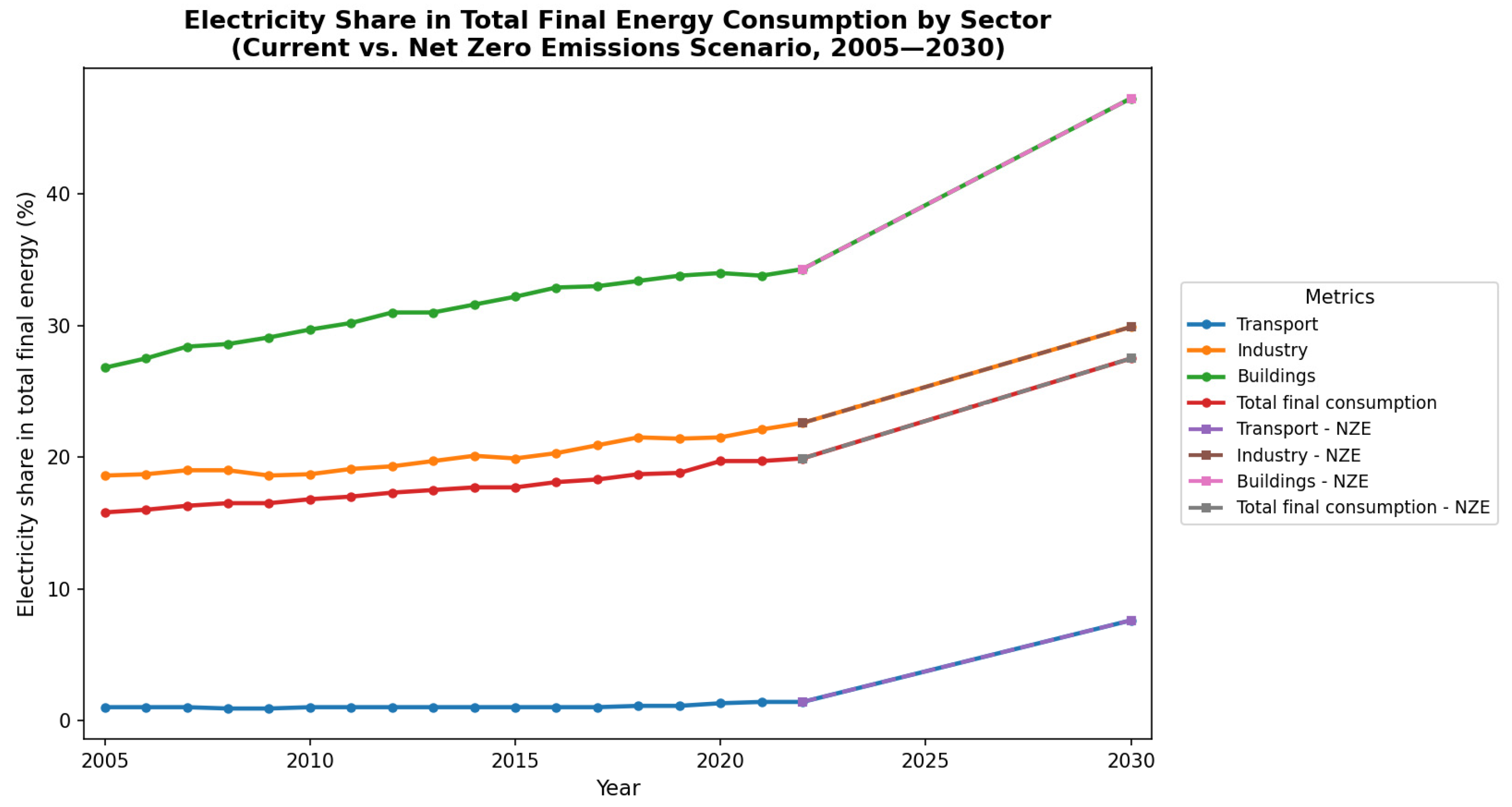
| Study | Key Characteristics | Limitations | Our Review Contribution |
|---|---|---|---|
| [34] | Combines AI with IoT for real-time energy optimization in smart homes. | Does not integrate renewable energy sources; scalability not addressed. | Highlights the importance of integrating renewable energy sources for comprehensive energy optimization. |
| [35] | Systematic review of AI-based energy self-management in smart buildings, organized using the Autonomous Cycles of Data Analysis Tasks (monitoring, analysis, decision-making). | Most existing studies concentrate on decision-making tasks (optimization and control), with limited attention to full autonomous cycles, feature engineering, and multi-agent integration. | Emphasizes the need for AI systems to incorporate renewable energy sources for sustainability. |
| [36] | Analyzes 93 articles on smart home energy management systems, focusing on architecture, algorithms, and applications. | Many systems are conceptual; limited practical implementation with renewable energy integration. | Suggests pathways for practical implementation and integration of renewable energy in smart home systems. |
| [37] | Develops a multivariate LSTM model for smart home energy consumption prediction, achieving strong predictive accuracy (MSE of 0.02284, RMSE of 0.15113, MAE of 0.184, MAPE of 0.123, and R2 of 0.694), demonstrating improved performance over previous methods. | Limited to household-level prediction without considering renewable integration, demand response, grid interaction, or carbon impacts; lacks discussion of scalability, interpretability, and real-time deployment. | Highlights the importance of integrating battery storage systems (ESS) for better load management and grid independence, emphasizing real-time adaptability in energy management systems. |
| [38] | Presents an Optimal Power Management System (OPMS) designed for smart homes in 6G environments. It integrates RESs and battery optimization through scheduling techniques and uses Multi-Access Edge Computing (MEC) to reduce latency and improve the system’s responsiveness. | Faces challenges in large-scale applications, particularly due to the high computational cost and complexity of real-time energy management in extensive smart cities. | Suggests using MEC and AI-based heuristics to improve scalability and efficiency in real-time energy management. |
| [39] | Systematic literature review from 2018 to 2024 on smart home energy management models. Focuses on energy optimization, AI/ML models, demand-side management, renewable energy integration, and user behavior. | Lack of focus on integrating user behavior and data privacy concerns HEMSs. Does not explore P2P energy trading or local-level energy trading. | Provides a holistic view of smart home energy systems and identifies significant gaps in existing models: lack of user-centric design, real-time adaptability, and privacy concerns. Proposes future directions focusing on AI and ML integration, scalability, and user behavior integration. |
| Criteria | Inclusion | Exclusion |
|---|---|---|
| Publication Date | Studies published between 2020 and 2025 | Studies published before 2020 or after 2025 |
| Study Type | Peer-reviewed journal articles, conference papers, and systematic reviews | Undergraduate projects, master’s theses, PhD dissertations, and non-peer-reviewed sources |
| Focus Area | Studies focusing on AI models for optimizing energy management in smart homes | Studies unrelated to energy management or smart homes |
| Language | Published in English | Non-English publications |
| Relevance to Review | Studies addressing AI in the context of low-carbon energy technologies for smart homes | Studies focusing on AI applications outside smart home energy management or clean energy |
| Technology Focus | Studies addressing AI models (e.g., ML, DL, and PSO) integrated with renewable energy sources | Studies that do not address AI, renewable energy, or smart home systems |
| Geographical Scope | Global studies with relevance to urban or residential smart homes | Studies focused on non-residential buildings or geographic regions not applicable to smart homes |
| Energy Optimization Focus | Studies analyzing energy efficiency, renewable energy integration, and sustainability | Studies not related to energy efficiency or low-carbon technologies |
| Ref | Method | Strengths | Weaknesses | Use Cases | Cost Reduction Rate (%) | Carbon Emission Reduction (%) | Computation Time/Complexity | Key Experimental Conditions/Notes |
|---|---|---|---|---|---|---|---|---|
| [229] | Ant Colony Optimization (ACO) | Effective for dynamic scheduling; balances energy costs with comfort | Computationally intensive; may require fine-tuning for optimal performance | Scheduling of home appliances, especially in smart grids with real-time pricing | ~2.2 (monthly bill: unscheduled USD 217.88 → ACO USD 213.05) | N/R | N/R | , PAR 1.95); ACO balances (USD 213.05, PAR 1.60); no renewables; nonlinear problem. a |
| [248] | Multi-objective Genetic Algorithm (MOGA) | Good for balancing multiple objectives; robust optimization | Can be slow to converge; high computational cost for large problems | Load scheduling, demand-side management, and integrating renewable energy | N/R | N/R | N/R | Microgrid (MG) with renewable energies (e.g., wind as compromise between cost/pollution); demand response (DR) programs, reactive loads, reserve scheduling; uncertainties in renewables/load; baselines: no DR/reactive loads (higher generation/reservation/startup costs and pollution); key result: 16% reduction in reservation costs with DR participation; multi-objective: minimize cost + GHG emissions; stochastic programming; no exact overall cost % or emission % reported. b |
| [249] | Improved Particle Swarm Optimization (XPSO) | Simple implementation; good for continuous optimization problems | Can get stuck in local minima without proper tuning | Appliance scheduling based on environmental factors (e.g., temperature, humidity) | N/R | N/R | N/R | Steel slab temperature prediction in reheating furnace; simulation data sets (random furnace temps 1000–1300 °C, billet sizes); measured data sets from actual furnace; baselines: PSO, IPSO, IPSO2, HPSO, CPSO (for benchmarks); WOA, IA, GWO, DE, ABC (for prediction); metrics: MAE < 1 °C, RMSE < 1.2 °C for XPSO; focus on accuracy/robustness, not energy, no cost/emission data reported. c |
| [250] | Mixed-Integer Linear Programming (MILP) | Precise optimization for cost reduction and load balancing | Computationally expensive; less suitable for real-time applications | Energy scheduling in homes with diverse appliances and energy tariffs | 10.2 (only grid); 46.4 (grid + solar); 21.4 (grid + solar + storage with discharge) | N/R | <10 s/high (exact solver for MILP) | Residential smart home; 7 shiftable appliances; day-ahead RTP from Indian energy exchange; 24 h horizon; user time preferences/energy requirements; scenarios: only grid, grid + 1 kW PV, grid + PV + 0.5 kW storage (charge/discharge); baselines: unoptimized (cost 117.86 Rs, PAR 2.5062); results: optimized costs/PAR reductions as above; multi-objective (cost + PAR minimization); no carbon data reported. d |
| [251] | Fuzzy Logic System (FLS) | Handles uncertainty well; adaptable for real-world scenarios | Requires expert knowledge for system design; less effective in highly dynamic environments | Energy management with uncertain demand patterns and supply conditions | N/R | N/R | N/R | Smart grids with renewables (solar, wind, biomass); simulated data for performance metrics; real-world validation from operational installations; baselines: traditional PID controllers; results: 20% increase in renewable consumption, 15% decrease in grid frequency variations (stability), 25% enhancement in energy storage SOC (reliability), 22% overall system efficiency improvement; vs. PID: 10% less frequency deviations, 15% better SOC, 12% efficiency boost; sensitivity analysis shows robustness to parameter variations; focus on grid stability, renewable integration, and sustainability. e |
| [252] | Improved Genetic Whale Optimization Algorithm (WOA) | Excellent for load scheduling and minimizing energy costs | Requires parameter tuning; may not be as flexible as other methods | Scheduling in residential buildings with renewable energy sources | Costs reduced by ~92.896 yuan/day average | Emissions reduced by ~0.091 tons/day | N/R | Building-integrated energy system (gas turbines, wind/solar, ground source heat pumps, EV, central air-conditioning, energy storage); regional complex building evaluation; multi-objective (economic efficiency + minimal carbon emissions); pre-processed regional data; baselines: traditional scheduling (higher costs/emissions); optimized balances economy/environment; promotes “zero scenery waste”; no specific computation details reported. f |
| [195] | Hybrid Grey Wolf Optimizer and PSO | Incorporates weather metrics for improved accuracy | Complexity in integration with multiple factors | Energy prediction and optimization | Up to 30 (savings through energy trading over original expenses) | Minimized environmental impact | Transaction processing: ~1 s per transaction; confirmation immediate; throughput ~95% | Smart homes with solar panels and wind turbines; datasets: 20/50/100/200 houses over 365 days + Saudi Arabia weather-based case study (50 houses); real-time data collection via IoT; EWMA for consumption/production prediction; P2P trading via blockchain/smart contracts; baselines: traditional grid management (higher costs, no trading; revenue/costs compared); results: reduced energy costs, positive net revenue/savings; secure transactions. g |
Disclaimer/Publisher’s Note: The statements, opinions and data contained in all publications are solely those of the individual author(s) and contributor(s) and not of MDPI and/or the editor(s). MDPI and/or the editor(s) disclaim responsibility for any injury to people or property resulting from any ideas, methods, instructions or products referred to in the content. |
© 2026 by the authors. Licensee MDPI, Basel, Switzerland. This article is an open access article distributed under the terms and conditions of the Creative Commons Attribution (CC BY) license.
Share and Cite
Olagundoye, O.O.; Bamisile, O.; Joseph Ejiyi, C.; Bamisile, O.; Ni, T.; Onyango, V. A Review of Artificial Intelligence Techniques for Low-Carbon Energy Integration and Optimization in Smart Grids and Smart Homes. Processes 2026, 14, 464. https://doi.org/10.3390/pr14030464
Olagundoye OO, Bamisile O, Joseph Ejiyi C, Bamisile O, Ni T, Onyango V. A Review of Artificial Intelligence Techniques for Low-Carbon Energy Integration and Optimization in Smart Grids and Smart Homes. Processes. 2026; 14(3):464. https://doi.org/10.3390/pr14030464
Chicago/Turabian StyleOlagundoye, Omosalewa O., Olusola Bamisile, Chukwuebuka Joseph Ejiyi, Oluwatoyosi Bamisile, Ting Ni, and Vincent Onyango. 2026. "A Review of Artificial Intelligence Techniques for Low-Carbon Energy Integration and Optimization in Smart Grids and Smart Homes" Processes 14, no. 3: 464. https://doi.org/10.3390/pr14030464
APA StyleOlagundoye, O. O., Bamisile, O., Joseph Ejiyi, C., Bamisile, O., Ni, T., & Onyango, V. (2026). A Review of Artificial Intelligence Techniques for Low-Carbon Energy Integration and Optimization in Smart Grids and Smart Homes. Processes, 14(3), 464. https://doi.org/10.3390/pr14030464