Article

Application of the ADM–PVSDM Model for Interpreting Breakthrough Curves and Scaling Liquid-Phase Adsorption Systems Under Continuous Operation


by
Samuel Aguirre-Contreras
1,
María Victoria López-Ramón
2,
Inmaculada Velo-Gala
3,
Miguel Angel Álvarez-Merino
2,
María del Pilar Fernández-Poyatos
2,
Carlos Gilberto Aguilar-Madera
4,
Erika Padilla-Ortega
1,
Saul Alejandro Aguilar-Maruri
1 and
Raúl Ocampo-Pérez
1,*
1
Centro de Investigación y Estudios de Posgrado, Facultad de Ciencias Químicas, Universidad Autónoma de San Luis Potosí, San Luis Potosí 78260, Mexico
2
Departamento de Química Inorgánica y Orgánica, Facultad de Ciencias Experimentales, Universidad de Jaén, 23071 Jaén, Spain
3
Departamento de Química Inorgánica, Facultad de Farmacia, Universidad de Granada, 18071 Granada, Spain
4
Facultad de Ciencias de la Tierra, Universidad Autónoma de Nuevo León, Monterrey 67755, Nuevo León, Mexico
*
Author to whom correspondence should be addressed.
Processes 2026, 14(1), 92; https://doi.org/10.3390/pr14010092 (registering DOI)
Submission received: 19 November 2025 / Revised: 9 December 2025 / Accepted: 19 December 2025 / Published: 26 December 2025
(This article belongs to the Section Separation Processes)

Abstract

Fixed-bed adsorption is widely employed in the scaling-up of liquid-phase adsorption processes because it offers significant operational advantages over batch systems. However, conventional approaches for scaling up adsorption columns are subject to important limitations. In this regard, the Axial Dispersion Model (ADM) coupled with the Pore Volume and Surface Diffusion Model (PVSDM) provides a framework capable of overcoming these constraints. In this study, ADM–PVSDM was applied predictively using equilibrium relationships and diffusion coefficients obtained from batch experiments. Model validity was assessed against nine experimental breakthrough curves, yielding an average deviation of 7.6% in breakthrough time. Furthermore, the model successfully predicted system behavior across a feed-flux range of 18–174 g h−1m−2. The integration of ADM–PVSDM was supported by the characterization of the Mass Transfer Zone (MTZ), which underpins the scaling approach proposed herein. The predicted breakthrough curves were also used to estimate MTZ length and velocity, which ranged from 0.97 to 8.7 cm and from 0.56 × 10⁻³ to 20 × 10−3 cm min−1, respectively, with mean percentage deviations of 6.4% and 7.3%. These predictions enabled the development of a methodology which is capable of scaling adsorption columns over a wide operational range while requiring substantially fewer experiments compared to conventional scaling methods. Finally, it was demonstrated that commonly used empirical models, such as the Bohart–Adams model, failed to predict breakthrough curves with sufficient accuracy, thus rendering them unsuitable for developing this scaling methodology.

1. Introduction

Wastewater can be contaminated by a broad spectrum of agents, some occurring naturally and others originating from human activities. Of particular concern are anthropogenic sources, including industrial, agricultural, and municipal discharges. These pollutants comprise inorganic compounds such as heavy metals, salts, acids, phosphates, sulfates, nitrates, and even radioactive substances [1]. Moreover, a wide variety of organic compounds, including surfactants, fertilizers, pesticides, pharmaceuticals, dyes, and solvents, also contribute to water pollution [2]. A striking example is the textile industry, which consumes large amounts of dyes that are subsequently released into wastewater. Global production of synthetic dyes is estimated at 7 × 10⁷ tons annually, and approximately 10% is discharged into the environment via industrial effluents [3]. Moreover, the increasing demand for textile fibers has led to a corresponding rise in dye consumption [4]. Other industries, including food, cosmetics, and paper manufacturing, also contribute to dye pollution [5]. Organic dyes are typically classified according to their application method, with categories such as disperse, direct, acid, reactive, and basic dyes, among others [6]. Many of these substances are classified as hazardous due to their high toxicity and resistance to biodegradation. Moreover, even at concentrations as low as 1 mg L−1, they can significantly reduce light penetration in aquatic systems, thereby suppressing photosynthetic activity [7]. Consequently, their effective removal during wastewater treatment is crucial to minimizing ecological risks.
Traditional wastewater treatment systems primarily rely on biological processes to degrade organic matter and remove certain classes of contaminants [8]. However, to ensure compliance with water quality standards, additional advanced chemical or physicochemical treatments are often required. Among these, adsorption has emerged as one of the most widely applied tertiary treatment methods. It involves the preferential accumulation of target substances on the surface of a solid material, a technology particularly attractive for water purification due to its cost-effectiveness, high efficiency, operational simplicity, and low energy demand [9]. Numerous studies have focused on the removal of emerging contaminants, heavy metals, and various organic pollutants using adsorption techniques [10]. However, relatively few have addressed the development of scalable methodologies for industrial implementation. A key design challenge lies in transitioning from batch to continuous systems, as fixed-bed adsorption offers significant advantages for industrial applications. These include complete pollutant removal from effluents, reduced adsorbent usage, and the elimination of additional separation steps between the adsorbent and the liquid phase [11].
Adsorption is a mass-transfer process in which contaminant molecules migrate through the liquid phase toward the external surface of the adsorbent particles, predominantly by convective transport [12]. The evolution of contaminant concentration depends on the operating mode of the system. In batch adsorption, the system is closed; therefore, the concentration of contaminants in the liquid phase progressively decreases as adsorption proceeds until equilibrium is reached. In contrast, in continuous (dynamic) adsorption, the feed enters the column at a constant concentration, and the concentration within the column approaches a steady state. Once at the particle surface, the molecules diffuse or permeate into the internal pores of the adsorbent, a mechanism that depends on the material’s structural characteristics [13,14]. Adsorption occurs only when the molecules reach the active sites within the adsorbent. In batch systems, the entire mass of the adsorbent contributes to pollutant removal. In contrast, fixed-bed systems exhibit a non-uniform removal pattern as a function of the time and column length: only a portion of the packed material actively participates in adsorption at a given time. This behavior is due to the bed’s dynamics: particles near the inlet become saturated first, while downstream particles may contact only already-treated effluent. As time progresses, the adsorbent particles near the inlet become saturated, and pollutant removal shifts progressively to downstream particles. The region within the bed where active adsorption occurs is known as the Mass Transfer Zone (MTZ). Characterizing this zone is essential for the development of scale-up methodologies [15]. Traditional scaling approaches such as the Mass Transfer Zone Model (MTZM) and the Length of Unused Bed (LUB) model rely on experimental breakthrough curves, which must exhibit a constant pattern indicative of a well-defined MTZ. Additionally, critical operating conditions such as flow rate, influent concentration, and particle size must be precisely replicated. However, these methods often require lengthy experiments and are limited to specific operational parameters. Consequently, the development of a mathematical model capable of characterizing the MTZ as a function of variable operating conditions would significantly enhance the scalability of adsorption column design.
Several studies on the modeling of breakthrough curves have recently been reported in the literature. García-Mateos et al. [16] investigated the adsorption of paracetamol on activated carbon in packed beds using the Linear Driving Force (LDF) model and a mass-balance approach to describe intraparticle transport. The LDF model was unable to accurately reproduce the breakthrough curves, whereas the proposed mass balance provided a more satisfactory description. However, this approach relies on the use of an effective diffusion coefficient, an empirical parameter that lumps together volume and surface diffusion within the pores, and assumes an average adsorbed amount within the particles, which does not fully capture the true spatial distribution of adsorbate. Apiratikul and Chu [17] modeled fixed-bed adsorption using the Bohart–Adams, Thomas, and Yoon–Nelson models, which are widely applied in the literature. Their study proposed modified equations to better represent the asymmetry commonly observed in breakthrough curves, which is an important contribution. Nevertheless, these models remain simplified or empirical correlations whose parameters are obtained by numerical fitting of experimental data. As a result, they provide limited insight into how operating conditions influence the underlying adsorption mechanisms and mass-transfer phenomena.
To formulate a model capable of describing the Mass Transfer Zone (MTZ) as a function of operating variables, it is essential that the modeling framework accurately represents the phenomena occurring within adsorption beds. The Pore Volume Surface Diffusion Model (PVSDM) provides such a foundation by describing the transport of molecules from the external surface of adsorbent particles to their internal active sites. Since diffusive processes typically dominate intraparticle mass transfer, the PVSDM incorporates both pore volume and surface diffusion, making it suitable for the vast majority of porous adsorbents. Moreover, it can be applied to a wide range of contaminants, including organic molecules (dyes, pharmaceuticals, pesticides) as well as inorganic species such as heavy metals, fluoride, and nitrates. A complementary description is required to represent the hydrodynamics of the liquid phase within the packed bed. The Axial Dispersion Model (ADM) accounts for advection, dispersion, and convection through the porous medium and therefore provides a realistic representation of flow behavior in fixed beds. The coupling of ADM and PVSDM enables the MTZ to be described as a function of key operating variables, such as flow rate, bed height, column diameter, particle size, feed concentration, and adsorbent properties, which is not possible when relying solely on traditional scaling approaches (MTZM or LUB). These methods generally require a large number of breakthrough experiments and are constrained by their underlying assumptions.
Modeling the MTZ as a function of operating conditions thus provides a more flexible and optimal design strategy, overcoming the limitations of conventional scaling methods. Furthermore, if the ADM-PVSDM is parameterized using equilibrium and adsorption-rate data, the number of required breakthrough experiments can be significantly reduced. Such data are relatively simple to obtain and are widely reported, making this approach advantageous for predictive column design.
The objective of this study is to develop a scaling method for adsorption systems that enables the design of fixed beds under various operating conditions using mathematical models based on equilibrium and kinetic data that incorporate all relevant mass transport mechanisms. Consequently, the breakthrough curves will be predicted by the model, and the experimental data will be utilized to validate the model. A key challenge addressed in this work is the transition from batch to continuous systems for industrial implementation, as fixed-bed adsorption offers significant advantages for industrial applications. The proposed system for developing the above is Indigo Carmine adsorption on Bone Char. Indigo Carmine is a dye with diverse applications in medicine and is widely used as a denim dye. However, it can cause damage at a concentration of 5 µg L−1 [18,19]; meanwhile, Bone Char is a sustainable material with suitable properties for removing dyes and other contaminants [20,21].

2. Materials and Methods

2.1. Adsorbate

Indigo Carmine (IC) was supplied by Sigma-Aldrich (Saint Louis, MO, USA) (85% dye content). The compound’s characteristic color is due to the indigo chromophore group, which is a conjugated C=C system replaced by two C=O and N=H groups. In addition, the molecule is ionic due to its two sulfonate groups [22]. The molecule has a pKa value of 12.6. However, the sulfonate groups impart negative charge over a wide pH range, including pH = 7 [23,24]. The concentration in the aqueous solution was determined using UV-Vis spectroscopy (Shimadzu UV-1900) at a wavelength of 610.5 nm, ranging from 1 to 25 mg L−1.

2.2. Adsorbent

The commercial Bone Char (BC) used was supplied by BRIMAC® (Reynosa, México) and contains 8–11% carbon and 70–76% hydroxyapatite. The material was sieved to obtain particles with an effective diameter of 0.22 mm. The selected fraction was then repeatedly washed with deionized water and dried at 110 °C for 24 h. Finally, the material was stored in a closed container.
The textural properties of bone char (BC) were obtained using N2 physisorption at 77 K with a Micromeritics ASAP 2020 instrument. The specific surface area was calculated using the Brunauer–Emmett–Teller (BET) model. Additionally, the average pore diameter (Dp) was evaluated using the following equation, where the total pore volume (Vp) is obtained at a relative pressure (P/P0) of 0.98.
D p = 4 V p S B E T
The surface charge distribution and the point zero charge (pHPZC) were determined using the potentiometric titration method developed by Kuzin and Loskutov [25,26].

2.3. Experimental Setup for Adsorption Kinetics and Equilibrium Data

Adsorption equilibrium and kinetic studies were performed in a rotating basket reactor with a total capacity of 1 L (17 cm height, 10 cm diameter). The reactor is equipped with internal baffles to ensure complete mixing and is coupled to a rotating basket driven by an external motor. The entire assembly is placed inside an isothermal bath with a recirculation system that maintains the temperature at 298 K. A schematic of the experimental setup is provided in Figure S1 (Supplementary Material). The adsorbent material was placed in the baskets, and the preconditioned solution, maintained at 25 °C and pH 7, was rapidly introduced to initiate the experiment. The pH was carefully adjusted by adding drops of 0.1 N NaOH or 0.1 N HCl. Subsequently, 1 mL aliquots were collected at predetermined time intervals (1, 5, 10, 15, 30, 60, 90, 180, 240, 300, 360, 480, 650, 900, 1100, and 1380 min). All experiments were conducted in triplicate. The effect of mixing intensity was examined by varying the basket rotation speed between 30 and 300 rpm. Similarly, the influence of initial adsorbate concentration was assessed over a range of 20 to 422 mg L−1. In all experiments, the BC dosage was fixed at 0.5 g L−1. The amount adsorbed at each time interval was determined using the following mass balance equation:
q ( t ) = V 0 C A 0 ( V 0 i i ( t ) V i + V D ( t ) ) C A ( t ) i i ( t ) V i C A i m
Once the concentration was kept constant, the amount adsorbed at that instant was considered as the amount adsorbed at equilibrium, calculated with the following expression:
q e = V 0 C A 0 ( V 0 i N V i + V D ( t ) ) C A e i N V i C A i m

2.4. Experimental Setup for Dynamic Adsorption

The experimental system is depicted in Figure S2. It consisted of a feed solution container equipped with a magnetic stirrer and plate, a peristaltic pump, an acrylic column (10 cm in height with an internal diameter of 1.1 cm or 18 cm in height with an internal diameter of 2.5 cm), 2 mm glass beads, an effluent collection container, and flexible tubing with connectors.
The flow was controlled with a set point in the peristaltic pump. Nevertheless, the flow rate was measured manually directly at the column outlet using a graduated cylinder and a stopwatch. The measurement was taken continuously during the experiments to ensure that it remained constant. The adsorption columns were packed with BC, with layers of glass beads placed above and below the adsorbent bed to ensure uniform flow distribution. The bed void fraction, ε b , was estimated considering the adsorbent and fixed bed volume ε b = 1 V A V R . Prior to each experiment, the packed bed was conditioned by circulating deionized water through the column for 24 h to prevent the formation of preferential flow channels. After conditioning, the column was fed with an IC solution at the desired concentration, and the adsorption run was initiated upon contact between the solution and the BC. Effluent samples were collected at regular intervals until the outlet concentration approached that of the influent.
The effects of bed height, influent concentration, and flow rate were systematically investigated over the ranges 1.3–3.8 cm, 80–422 mg L−1, and 0.7–3.3 mL min−1, respectively, using a column with an internal diameter of 1.1 cm. Additional experiments were performed using the 2.5 cm internal diameter column (bed height: 2.4 cm; flow rate: 1.3–1.6 mL min−1) to increase the contact time and enable a more detailed characterization of the MTZ. To characterize the breakthrough curves, the adsorption capacities at breakthrough and saturation were calculated using the following equations:
q b =   Q C A F m 0 t b ( 1 C A | z = L b C A F ) d t
q s = Q C A F m 0 t s ( 1 C A | z = L b C A F ) d t
The breakthrough and saturation time were fixed at C A | z = L b / C A F = 0.05 and C A | z = L b / C A F = 0.95 , respectively. Finally, the amount of adsorbent material required per liter of treated solution, known as the adsorbent use rate (Ur), was estimated as follows, as well as the empty bed contact time (EBCT):
U r = m Q t b  
E B C T = V b Q

3. Mathematical Modeling

3.1. Adsorption Equilibrium Modeling

The equilibrium data were interpreted using the Langmuir, Freundlich and Redlich–Peterson isotherms, which are written as:
q e = q m K   C A e 1 + K C A e
q e = k   C A e 1 / n
q e = a   C A e 1 + b C A e β
The isotherm constants involved in the above equations were calculated by applying non-linear fittings using the STATISTICA 7 software. In this sense, the objective function (OF1) was minimized using the Rosenbrock and quasi-Newton methods, and the percentage deviation (% Dev) was evaluated according to Equation (12).
O F 1 = ( q e e x p q e c a l ) 2
D e v = 1 N i N | q e e x p q e c a l q e e x p | × 100 %

3.2. Fixed Bed Adsorption Modeling

To model the adsorption in packed beds, it is common to use kinetic-type models. In this regard, various models have been reported in the literature [27,28]. Depending on the assumptions made about the fixed bed, different models can be obtained to describe the breakthrough curves. Another approach found in the literature is the focus on diffusive models, which are presented below.

3.2.1. Common Breakthrough Curve Models

These models have been documented since the last century and are extensively employed to delineate experimental rupture curves. The majority of these models are based on chemical kinetics, which constitutes an empirical approach. The application of these models typically involves the implementation of linear or non-linear regression techniques, which involve the adjustment of model parameters to achieve the desired prediction of natural data. The most common models are Bohart and Adams, Thomas and Yoon–Nelson models. The equations for these models are:
ln ( C A F C A 1 ) = k B A N 0 L b A b Q k B A C A t
ln ( C A F C A 1 ) = k T q s m Q k T C A t
ln ( C A F C A 1 ) = k Y N τ 0.5 k Y N t
It can be demonstrated that Thomas model (Equation (14)) can be rearranged by considering the following equivalence N 0 L b A b = q s m , which yields the same equation of Bohart and Adams’ model, where k B A = k T [29]. Moreover, the Yoon–Nelson equation is mathematically equivalent to the Thomas and Bohart–Adams models, as illustrated in Equations (13)–(15) [30]. The Bohart–Adams model facilitates its application in a predictive mode due to its theoretical fundamentals, a process that will be demonstrated below. This requires interpreting dynamic lab data with the kinetic model from which the Bohart–Adams equation was developed; i.e., considering the quasi-chemical reaction rate:
q ¯ t = k B A C A ( q e q ¯ )
This model suggests a rectangular or irreversible adsorption isotherm. Therefore, the solution of this equation necessitates the value of the amount adsorbed at equilibrium in each experiment. The solution to this equation for kinetic experiments is obtained by adjusting the reaction rate constant, kBA, minimizing the percentage deviation (Equation (12)). Utilizing these kBA values, the prediction of breakthrough curves can be conducted with the Bohart–Adams equation without the necessity for adjustment of any additional parameters with the experimental breakthrough curves. Thus, Equation (13) can be transformed into the following equation using the surface velocity ( u = Q / A b ):
C A C A F = e k B A C A F t e k B A C A F t + e k B A N 0 L B u 1
Now, the following equations can be used to estimate N0 (the adsorption capacity per bed volume) and u, the superficial velocity:
N 0 = ρ p q s ( 1 ε b )
u = ε b v z

3.2.2. Axial Dispersion and Pore Volume Surface Diffusion Model

The modeling of dynamic adsorption requires the establishment of equations that describe the flow of the liquid phase and the porous packed solid phase. In the liquid phase, axial dispersion phenomena and convective transport to the BC particles are considered. The main assumptions are constant axial velocity, absence of radial velocity, and concentration gradients, and mass convective transport to the particles is described by a transport coefficient, kLb. Based on the above, the mass balance for the liquid phase is:
ε b C A t = ε b v z C A z + ε b D z 2 C A z 2 ( 1 ε b ) ρ p S k Lb ( C A C A r | r = R P )
t =   0 ;   z ;   C A = 0
t   0 ;   z = 0 ;   C A   = C A F
t     0 ;   z = L b ; C A z = 0
The Axial Dispersion Model (ADM) is constituted by Equations (20)–(23), where the axial dispersion coefficient, Dz, and the convective transport coefficient, kLb, were calculated using the following correlations and definitions [31,32,33,34]:
N S h = 1.09   ε b 2 3 ( R e S c ) 1 3
N S h = 2 R p k L b D AB
N R e = 2 R p v z ε b ρ w μ w
v Z = Q π R b 2 ε b
N S c = μ w ρ w D A B
N P e = ( 1 ε b Re   Sc ) 1 / 6
  N P e = 2 R p v z D z
The ADM describes the transport of solute molecules driven by flow within the bed. However, once these molecules reach the external surface of the adsorbent particles, additional equations are required to describe their transport inside the porous structure. This internal transport occurs through both pore volume and surface diffusion; therefore, the Pore Volume Surface Diffusion Model (Equations (31)–(34)) is considered the most suitable model to represent this process.
ε p C A r t + ρ p q r t = 1 r 2 r [ r 2 ( D ep C A r r + D s ρ p q r r ) ]
C A r r | r = 0 = 0
D ep C A r r | r = R P + D s ρ p q r r = k Lb ( C A C A r | r = R P )
C A r = 0   t = 0   0     r     R P
As previously mentioned, the solute molecules can be found in the volume or surface of the pores with a certain concentration C A r , o q r , respectively. To ascertain this distribution, it is posited that there is an instantaneous local equilibrium in the pores. Consequently, utilizing the equilibrium relationship (Section 3.1), it is sufficient to evaluate only the concentration in one phase, thereby defining the remaining phase:
q r = f ( C A r )
The values employed for void fraction and particle density were sourced from the existing literature on commercial bone charcoal [35], with values of 0.46 and 1.53 g cm−3, respectively. Therefore, the pore volume diffusion coefficient was calculated using Equation (36) [36].
D e p = D A B   ε p τ
The tortuosity factor was calculated with Equation (37) [37,38], and the molecular diffusion coefficient, D A B , was calculated with the Wilke–Chang correlation [39], obtaining a value of 4.64 ×   10 10 m2 s−1. The value of the pore volume diffusion coefficient obtained was 4.14 ×   10 11 m2 s−1.
τ = ( 2 ε p ) 2 ε p
The final parameter necessary to predict the breakthrough curves is the surface diffusion coefficient, designated here as D s . In order to ascertain the value of this parameter, the kinetic experiments were interpreted using the PVSDM, with the objective function being minimized:
O F 2 = 1 N i N | C A e x p ( t ) C A c a l ( t ) C A e x p ( t ) | × 100   %
To apply PVSDM to kinetic experiments, it is necessary to use the balance for the liquid phase in the batch reactor:
V d C A d t = m S k L ( C A C A r | r = R P )
t = 0   C A = C A 0
Furthermore, the batch’s reactor convective coefficient, k L , was estimated with the method of Furusawa and Smith [40]:
[ d ( C A C A 0 ) d t ] t = 0 = m S k L V
Equations (20)–(23) and (31)–(34) constitute the ADM-PVSDM, which encompasses axial dispersion, convective transport, intraparticle diffusion mechanisms, and adsorption on active sites. The ADM-PSVSDM was solved in COMSOL 5.5 Multiphysics®, using the MUMPS and Linear Direct Solver, with an absolute tolerance of 0.001. The mesh utilized was extremely fine.

4. Scale-Up Methods for Fixed Bed Columns

The design of adsorption columns has been carried out using scaling methods established since the last century. The efficacy of these methods is evident, as they do not necessitate the modeling of breakthrough curves. Instead, they are based on experimental breakthrough curves obtained in test columns, and by characterizing these curves, an industrial-sized column can be designed. The disadvantage of these methods is that scaling can only be performed under the conditions in which the tests were conducted. These methods and equations have been reported in the literature [41].

4.1. Mass Transfer Zone Model (MTZM)

The methodology involves the experimental characterization of the mass transfer zone under conditions that promote scaling. Once this information has been obtained, it is possible to proceed with the design of a larger adsorption column, on the assumption that the MTZ will remain constant during scaling [42]. The Mass Transfer Zone (MTZ) is the specific region within the fixed bed where the adsorption process occurs. Consequently, as the flow passes through this zone, the concentration, CA, decreases from the feeding concentration, CAF, to zero. At the beginning of the operation, the MTZ initially extends from the inlet of the bed to a certain length along its height. As the operation time progresses, the particles packed in the MTZ begin to saturate, promoting the axial movement of the MTZ. It is imperative to acknowledge that the MTZ requires a certain duration to fully form and subsequently attain a steady state, characterized by constant length and velocity. To ascertain the length (LMTZ) and velocity (vMTZ) of the MTZ, it is necessary to establish the breakthrough (tb) and saturation (ts) times. The breakthrough time is defined as the time at which the MTZ reaches the end of the bed. Therefore, the time at which C A | z = L b / C A F = 0.05 is set as tb. Following the achievement of the tb, the MTZ continues to advance until it completely exits the bed. At this time, all packed particles are saturated and the exit concentration, C A | z = L b , is practically equal to CAF. This time was fixed when C A | z = L b / C A F = 0.95 . Therefore, the difference between ts and tb, is the time (tMTZ) it takes for the MTZ to move a distance equal to its length (LMTZ). Thus, the vMTZ can be estimated as:
v M T Z =   L MTZ t M T Z
Another way to estimate the vMTZ is to consider the total path of the MTZ through the entire bed, where the time taken for the MTZ to traverse the entire bed is equal to the ideal or stoichiometric breakthrough tst:
v M T Z =   L b t s t
The ideal breakthrough time would be obtained with an instantaneous adsorption rate, which implies an LMTZ tending to zero. It can thus be concluded that the ideal breakthrough curve is a step from C A | z = L b / C A F = 0 , to C A | z = L b / C A F = 1 instantaneously at tst. As ideal breakthrough curves are not to be found, the actual breakthrough curves are at best symmetric sigmoidal, and the tst corresponds to a concentration C A | z = L b / C A F = 0.5 . To calculate the tst of a real curve that exhibits some degree of asymmetry, it is necessary to estimate the symmetry factor (Fs).
t s t = t b + F s   t M T Z
F s = t b t s ( 1 C A | z = L b C A F ) d t t s t b
The Fs for a symmetrical breakthrough curve is approximately 0.5. This is the case for a rapid adsorption rate, and when the diffusion process controls the adsorption rate, the Fs value is <0.5. Once the tst is calculated, vMTZ can be evaluated with Equation (43), and with Equation (42) the LMTZ is calculated. Equations (42)–(45) compose the procedure of the Mass Transfer Zone Model to scale an adsorption column. With this procedure, it only remains to apply the following equation to extrapolate the tb and thus scale the bed length, Lb:
t b = L b v M T Z L M T Z v M T Z   F s

4.2. Length of Unused Bed Model (LUB)

It is important to note that the operation of a fixed bed ceases once the MTZ reaches the bed outlet. Consequently, the majority of the MTZ remains unsaturated, signifying an unused length of the bed, LUN. This length is obtained from an experimental breakthrough curve, which is obtained under the conditions desired for scaling the column, such as flow, particle size, and concentration [43,44]. Considering the concept of an ideal breakthrough curve, there is a stoichiometric distance within the MTZ that corresponds to a stoichiometric breakthrough time (Equation (44)):
L U N = L B L s t  
The unused length constitutes part of the MTZ, thus the velocity at which it moves within the bed remains consistent with the velocity of the MTZ, vMTZ:
v M T Z =   L b t s t = L s t t b
Equations (47) and (48) can be combined to estimate LUN based on the experimental data from the breakthrough curve:
L U N =   L b ( 1 t b t s t )
Finally, the scaling breakthrough time can be extrapolated by knowing LUN, which is assumed to be constant in the scaling. By leaving Equation (49) as a function of vMTZ, we obtain the scaling equation:
t b =   1 v M T Z ( L b L U N )
It is evident that a relationship exists between the unused length and the MTZ. Consequently, the LUB and MTZM-based models are equivalent, and the equations are related by the following equivalence:
L U N   =   F s   L M T Z

5. Results and Discussion

5.1. Physicochemical Characterization of Bone Char

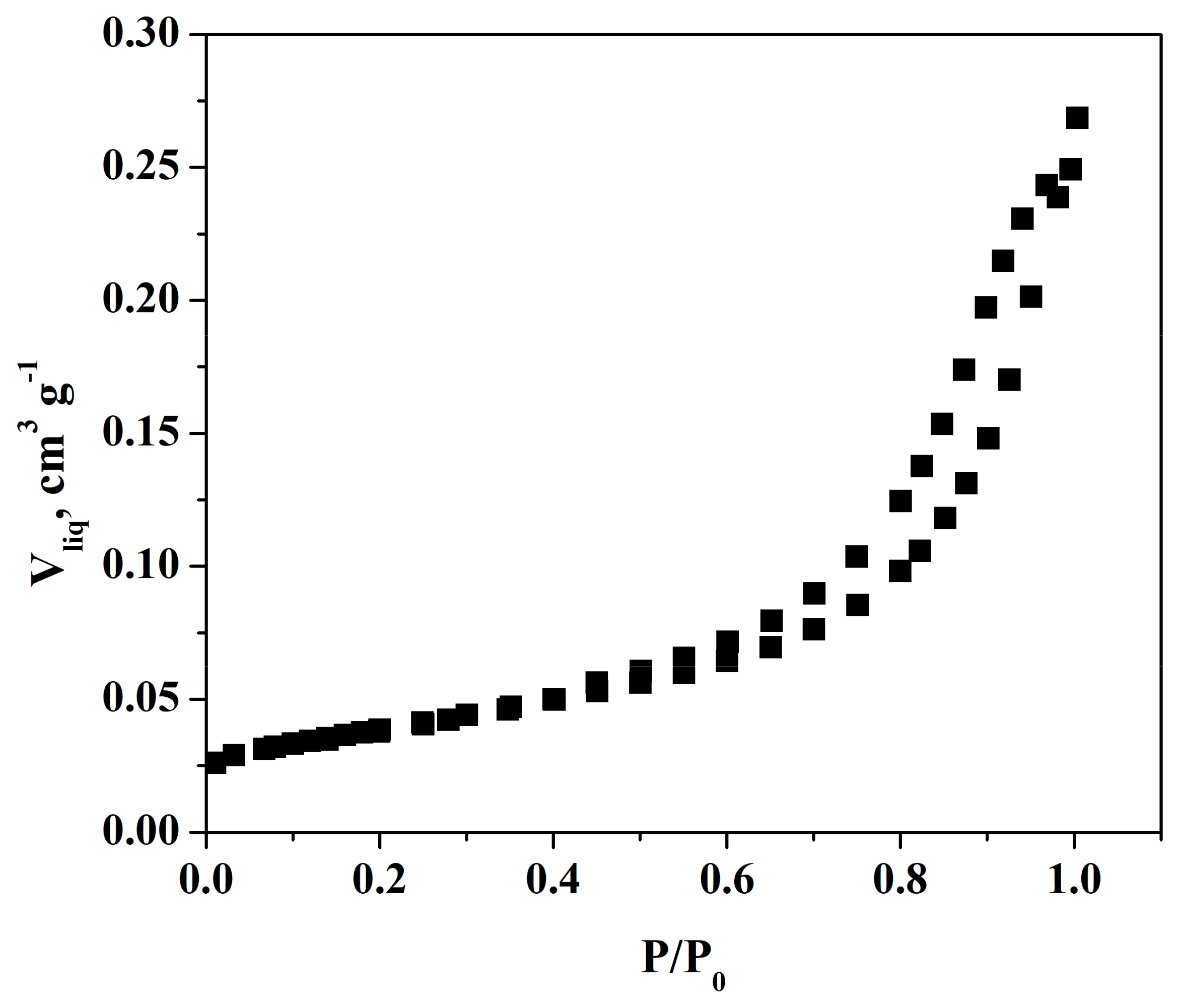
The adsorption–desorption data obtained from the N2 isotherm at 77 K are presented in Figure 1. The isotherm obtained is of type IV classification, accompanied by an H3-type hysteresis loop [45]. This phenomenon is attributable to the presence of a mesoporous material, due to the presence of hydroxyapatite laminae [46]. The specific area obtained with the BET method was found to be 90 m2 g−1, the pore volume was determined to be 0.242 cm3 g−1, and the average pore diameter was calculated to be 10.75 nm. These results are consistent with those reported in the literature for bone char [47,48,49]. The surface charge distribution (Figure S3) revealed that pHPZC is approximately 10.1, suggesting a predominantly basic surface. In the event of the pH being lower than pHPZC, the BC surface will be positive. Consequently, at a neutral pH, the BC will have a dominant positive charge.

5.2. Adsorption Equilibrium

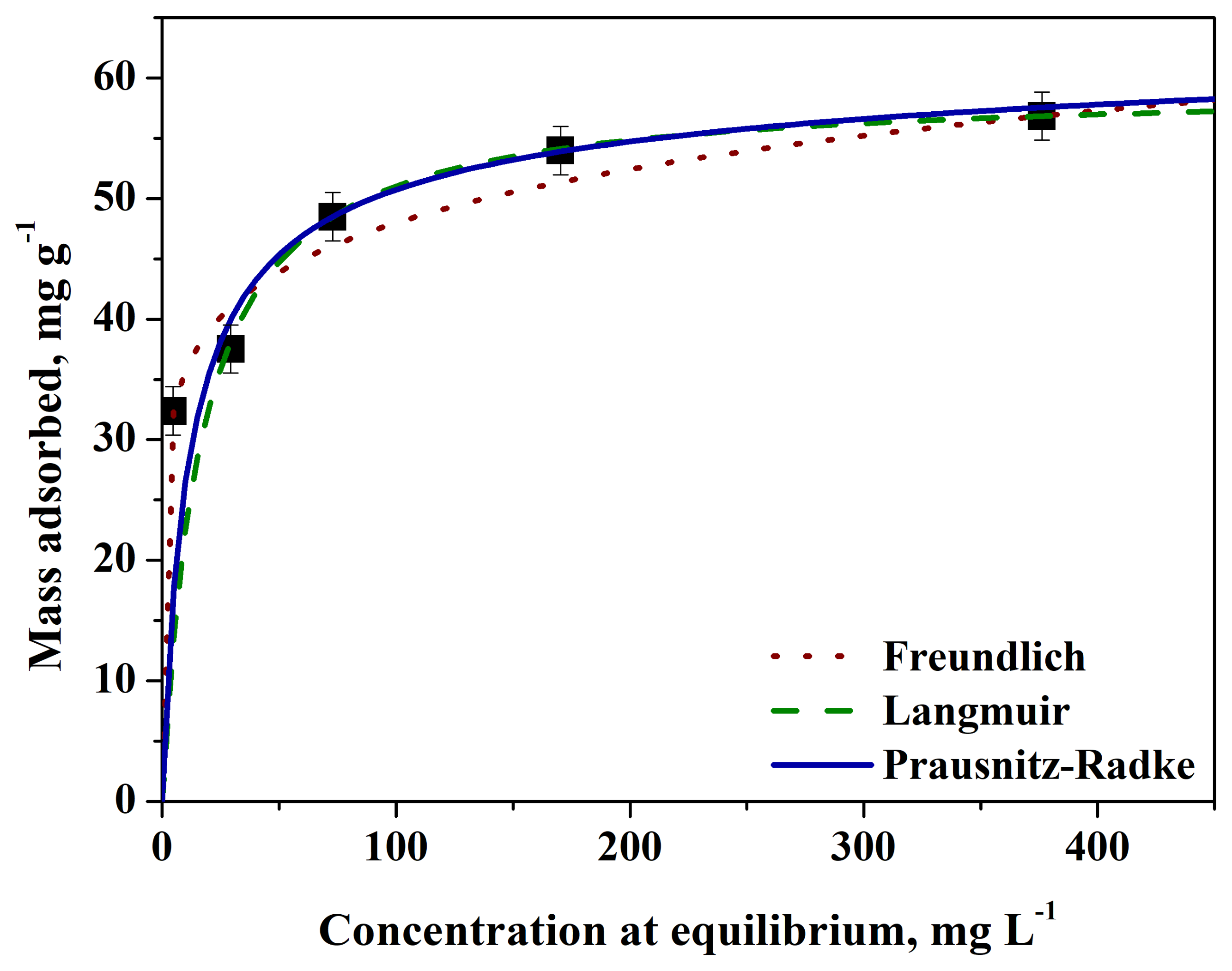
The adsorption equilibrium data are displayed in Figure 2. All experiments were conducted at pH = 7. The maximum adsorption capacity was found to be 56.8 mg g−1. However, at low equilibrium concentrations (4.6 mg L−1), the minimum adsorption capacity was 32.4 mg g−1. The substantial adsorption capacities observed at concentrations close zero are indicative of a system characterized by a high degree of affinity. According to the Giles classification, the system is designated as type H [50].
It is well established that the surface of bone charcoal can form positive or negative charges by protonation reactions of the hydroxyl groups on the surface [51]. In this instance, given that BC exhibits a positive surface charge at pH7, electrostatic interaction between the protonated hydroxyl groups of the hydroxyapatite and the sulfonate groups of the IC is to be anticipated [52,53]. Such attractions have been reported in the adsorption of fluoride, metals and organic compounds on BC [54,55]. However, given that BC contains up to 11% carbon, it is probable that some π-π interactions would occur between the carbon contained within the material and the electrons from the aromatic rings of the IC. The Freundlich, Langmuir and Prausnitz–Radke models were used for interpreting the experimental data in Figure 2, and the fit parameters obtained presented in Table 1. As demonstrated in Figure 2, the Langmuir and Prausnitz–Radke models exhibit a high degree of fitting to the experimental data at concentrations greater than 29 mg L−1. In contrast, the Freundlich isotherm provides an accurate interpretation of data at concentrations that are approximately zero. However, this is only the result of the experiment involving a lower concentration. This phenomenon can be attributed to the fact that as the equilibrium concentration increases, the adsorbed molecules tend to saturate the material, forming a monolayer or a maximum adsorbed amount. This phenomenon is addressed within the framework of the Langmuir and Prausnitz–Radke isotherm, yet it is not encompassed within the scope of the Freundlich isotherm. The percentage deviations of the three models are less than 12%, which means that, depending on the concentration range to be described, the Langmuir, Prausnitz–Radke or Freundlich models can be used.

5.3. Bohart–Adams Breakthrough Curves Prediction

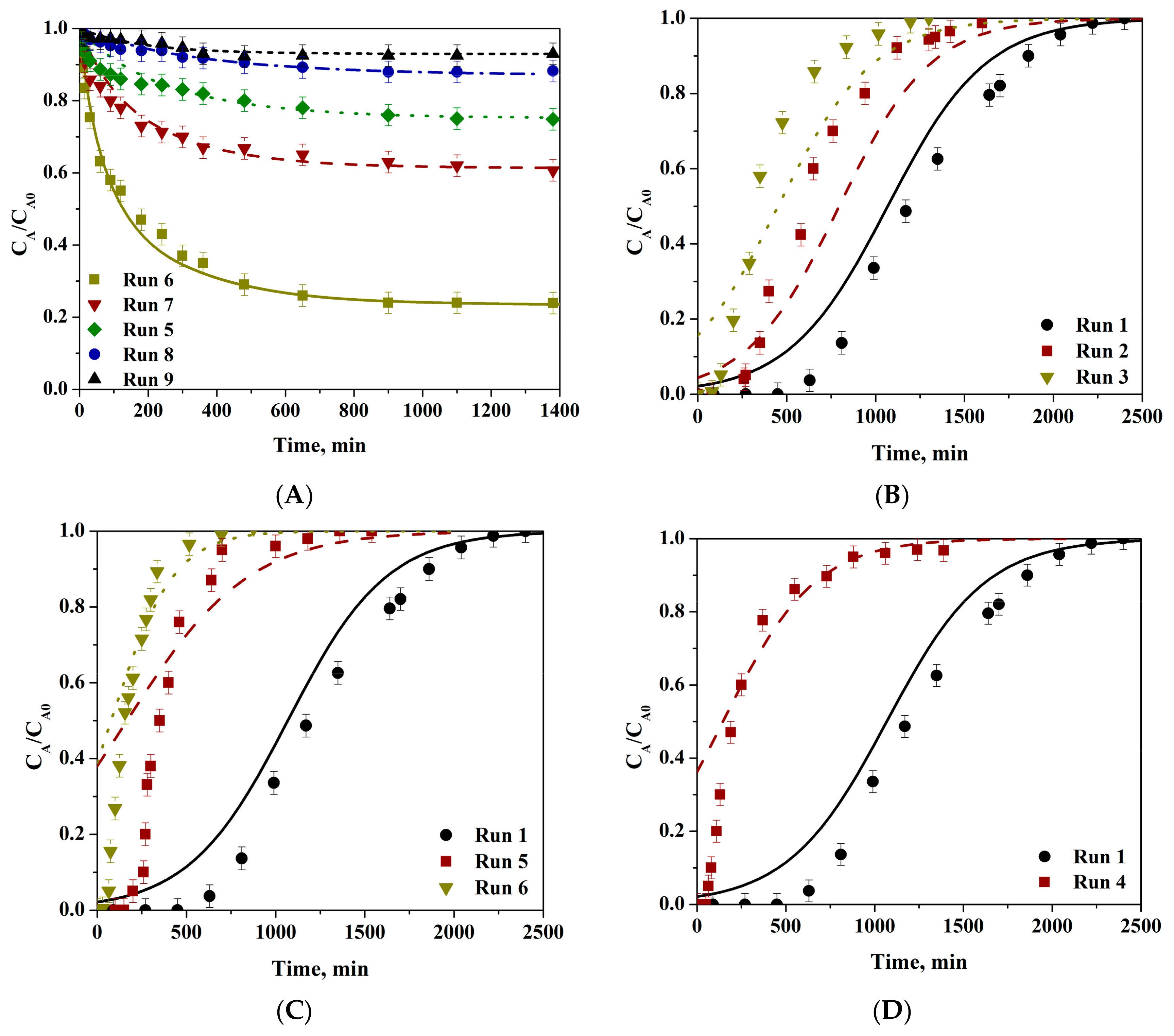
To obtain the prediction of the breakthrough curves using the Bohart–Adams model, it is necessary to obtain values for the reaction rate constant kBA (Section 3.2.1). These values are obtained by fitting the kinetic experiments with Equation (16). The conditions of the experiments performed are shown in Table 2. The suitability of the model for kinetic experiments 5–9 is demonstrated in Figure 3A, which indicates that Equation (16) can accurately describe the adsorption rate data, with an average deviation percentage of 6.5%.
The fitted values of kBA are presented in Table 2, and it is evident that these values demonstrate a decreasing trend with increasing initial concentration. Consequently, the respective value corresponding to the feed concentration in the breakthrough curves will be utilized for prediction. Utilizing these values, the prediction of the breakthrough curves can be conducted with the Bohart–Adams equation without the necessity for adjustment of any additional parameters.
The prediction was conducted to ascertain the effect of flow, concentration and bed height, respectively (Section 2.4). The experimental conditions for the breakthrough curves are presented in Table 3. The Bohart–Adams predictions and the experimental data are presented in Figure 3B–D. Regarding the effect of flow, it is notable that in Run 1 the predicted curve displays a congruent shape with the experimental data. However, it should be noted that the breakthrough time deviates from the experimental value by 59%. As illustrated in Experiments 2 and 3, the prediction is accompanied by a significant margin of error. This error is such that the breakthrough curves even begin at a concentration that exceeds the breakthrough concentration. This phenomenon is also observed in the context of the effects of bed height and concentration. This finding indicates that the Bohart–Adams model is unable to predict breakthrough curves using only the information obtained from kinetic experiments. This discrepancy can be attributed to a variety of factors. Firstly, it is important to note that the isotherm considered by the Bohart–Adams kinetic model is of a rectangular form, thus representing a constant value of qe. This assertion is not supported by the isotherms obtained, which demonstrate that the experimental equilibrium data corresponds to a Langmuir-type shape (see Figure 2). Conversely, the kinetic model considers a quasi-chemical reaction rate, neglecting any mass transport process. This indicates that adsorption on the active sites would be faster than any mass transport process. Consequently, there are no concentration gradients within the adsorbent particles, and the value of q ¯ in Equation (16) is homogeneous throughout the particle. This consideration is not applicable to this adsorption system, nor to any adsorption system with a porous material, or to any system that presents mass transfer phenomena. Consequently, the Bohart–Adams model is unable to predict the breakthrough curves for porous materials through kinetic experiments. The application of the Bohart–Adams equation typically involves the fitting of the reaction rate constant to the experimental breakthrough curves. Consequently, even if the fit of breakthrough curves is achieved, the obtained values of the reaction rate constant are subject to error and do not accurately represent the reaction rate. In this sense, the Bohart–Adams can be suitable to predict breakthrough curves through kinetic experiments in the case of adsorbents that do not present mass transfer phenomena, or systems that present a fast adsorption rate. In addition to the considerations previously discussed, axial dispersion was neglected. The latter may have the least effect on the prediction of the breakthrough curves.

5.4. ADM-PVSDM Breakthrough Curves Prediction

As with the Bohart–Adams model, predicting breakthrough curves requires the interpretation of batch experiments using a kinetic model. However, since the PVSDM considers both external and intraparticular diffusion, a more in-depth transport analysis can be performed [56].

5.4.1. Adsorption Rate

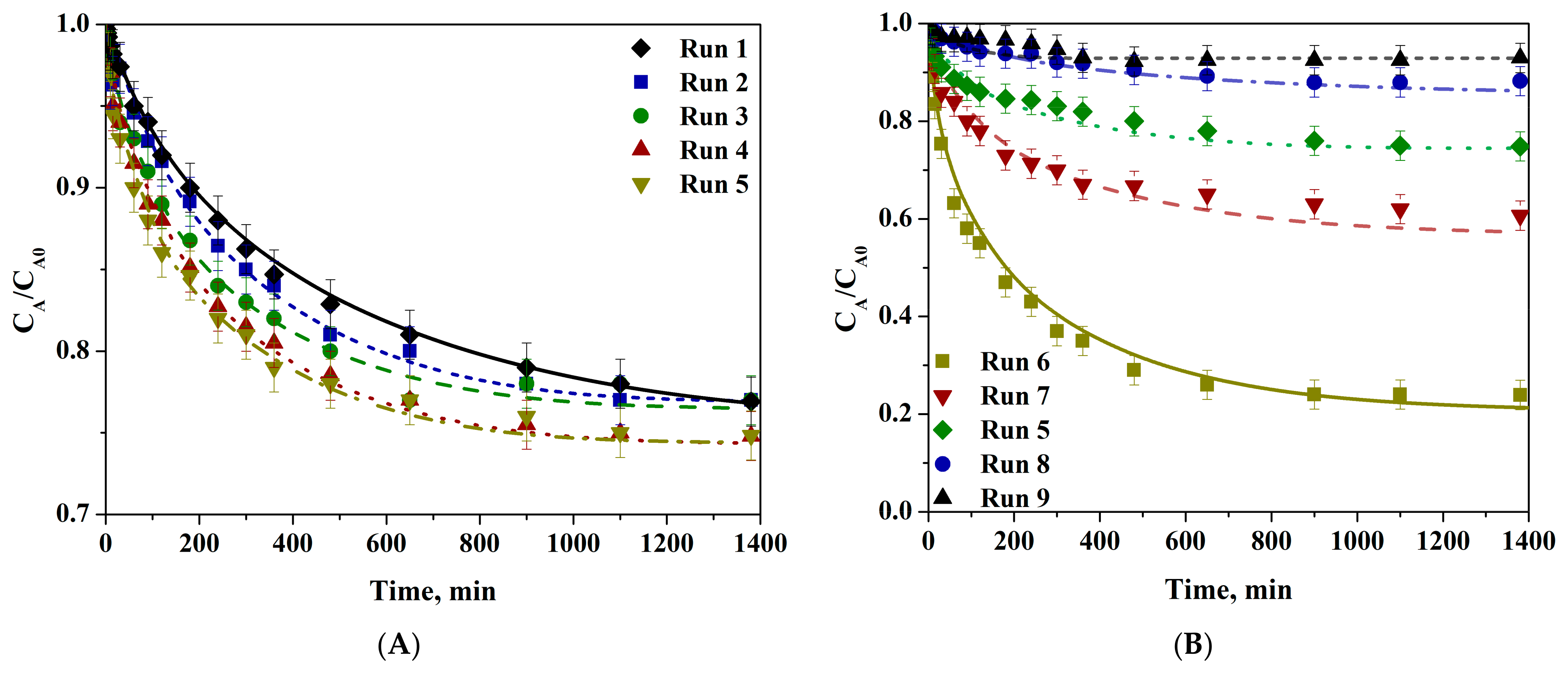
To elucidate the transport mechanism controlling the adsorption rate, 9 experiments were performed, evaluating the effect of agitation speed and initial concentration. The decay curves obtained are shown in Figure 4. The parameters obtained from the model are presented in Table 2. The values obtained for the external transport coefficient ranged between 0.40   × 10 3 cm s−1 and 5.07   × 10 3 cm s−1, while the surface diffusion coefficient values ranged only between and 0.70   × 10 9 cm2 s−1 and 2.10   × 10 9 cm2 s−1. Similar values have been reported elsewhere [57,58,59].
Stirring Speed Effect
The adsorption process begins with external mass transfer, in which solute molecules move from the bulk liquid to the outer surface of the adsorbent particles through convective transport. By maintaining the same particle size and controlling the temperature in the experiments, we can study the rate of external transport by varying the stirring speed. As illustrated in Figure 4A, the experimental design varied the stirring speed from 30 to 300 RPM while keeping the initial concentration constant. Increasing the stirring speed from 30 to 300 RPM accelerates the initial decay of the curves, reducing the time required to reach equilibrium from 1400 to 1000 min. The turbulent flow regime for rotating basket reactors is attained for N R e > 10 4 , such that at 150 RPM this regime is reached (See Table 2) [60]. However, the Sherwood Number (NSh) continues to increase significantly in value for stirring speeds higher than 150 RPM, from 8.30 to 27.2, a value that is 3.3 times higher at 300 RPM. As demonstrated in Figure 4, the curves at 200 RPM and 300 RPM are superimposed, indicating that the agitation speed has been optimized to the point that it no longer exerts an influence on mass transport. Ultimately, the external transport coefficient, kL, attains a maximum value of 2.91   × 10 3 cm s−1. Consequently, to ascertain that external transport does not impede the adsorption rate, the following experiments were conducted at 300 RPM.
Effect of Initial Concentration
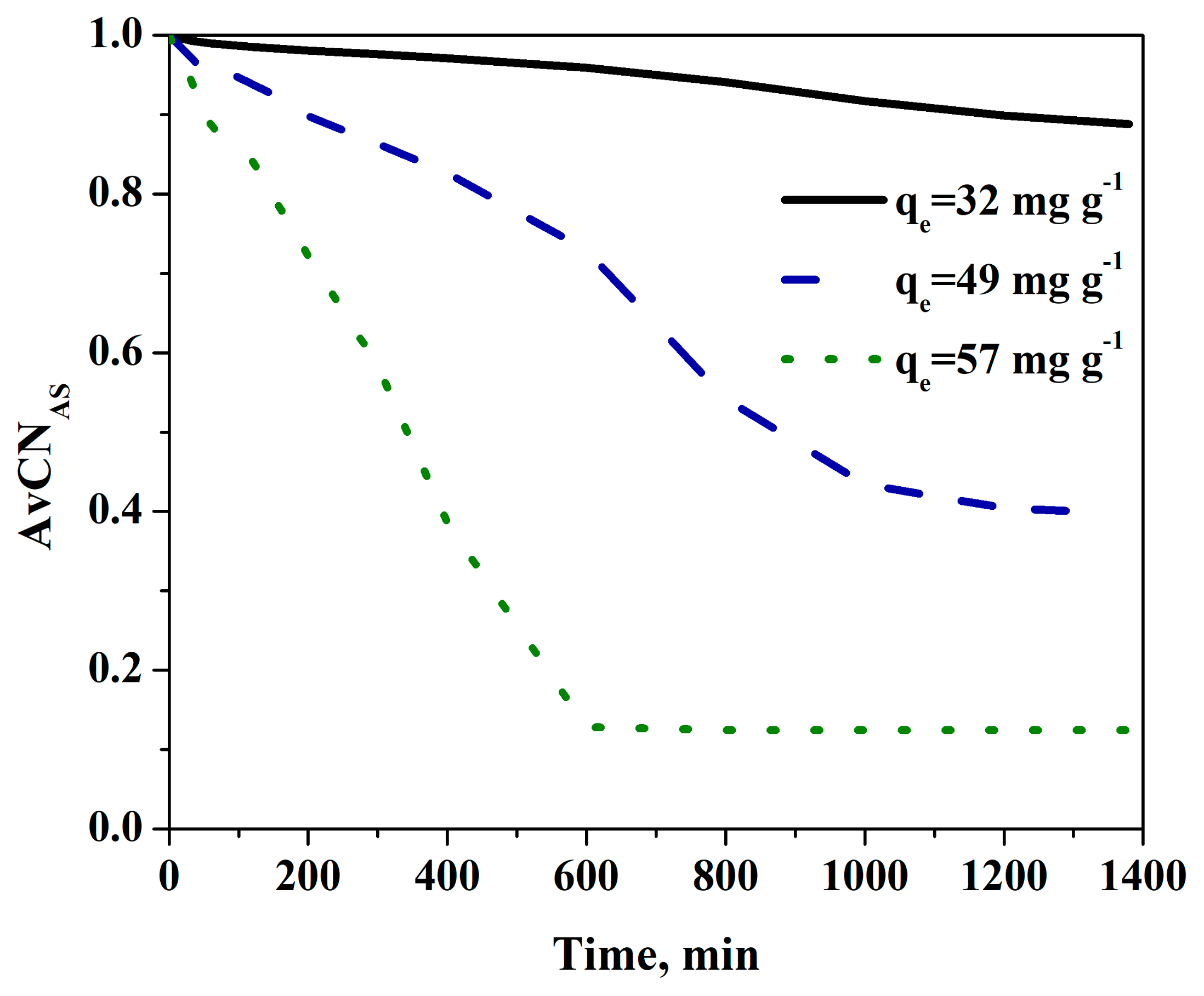
The decay curves obtained by varying the initial concentration are shown in Figure 4B. For concentrations lower than 200 mg L−1, the typical shape of a process controlled by intraparticle transport is observed. Conversely, at concentrations higher than 200 mg L−1, the curves tend to overlap, indicating BC saturation. This finding reinforces the prevailing notion that the adsorption rate is governed by intraparticle transport, pore volume diffusion or surface diffusion. As the initial concentration varies, the amount adsorbed also varies, it is possible to conduct an analysis of these two mechanisms. The average radial contribution of surface diffusion to total intraparticle transport was evaluated (Equation (52)) [60], and the results are presented in Figure 5.
AvCN As = 0 R P D s ρ p q r D s ρ p q r + D ep C Ar r d r 0 R P d r
The maximum amount adsorbed obtained was 56.8 mg g−1, which corresponds to the saturation zone of the material, according to the equilibrium relationship (Figure 2), while the minimum was 32.4 mg g−1. As demonstrated in Figure 5, for the saturation zone, surface diffusion contributes almost entirely to the total intraparticle transport during the entire adsorption process. This indicates that the magnitude of the concentration gradient in the solid phase is greater than that of the concentration gradient in the pore volume, as the number of IC molecules on the BC surface increases. It can be concluded that surface diffusion is the controlling step for concentrations at saturation or greater than 183 mg L−1 (Figure 2) since intra-particle transport controls the adsorption rate. Conversely, Figure 5 demonstrates that when the amount adsorbed diminishes, or for concentrations below 4 mg L−1 (as illustrated in Figure 2), diffusion in the pore volume can account for up to 90% of the total transport. This finding suggests that the rate of adsorption is governed by either the quantity adsorbed or the concentration of the liquid phase. This behavior has previously been described in the context of the adsorption of metronidazole on activated carbon [61]. Based on the above, it is necessary to consider both surface diffusion and volume pore in the breakthrough curves prediction.

5.4.2. ADM-PVSDM Validation

After studying the equilibrium and adsorption rate, dynamic adsorption can be predicted using the ADM-PVSDM, using the equilibrium ratio and intraparticle coefficients obtained. To validate the model, nine breakthrough curves were obtained by varying the feed concentration (CAF) from 80 mg L−1 to 422 mg L−1, the bed height (Lb) from 1.3 cm to 3.8 cm, and the flow rate (Q) from 0.7 mL min−1 to 3.3 mL min−1. As detailed in Table 3, the operating parameters, the calculation of EBCT, Ur, qb qsat, as well as the estimation of NSh, NPe and kLb and Dz numbers are outlined in Section 2.4 and Section 3.2.2.
For a packed bed at constant temperature, the NSh is chiefly dependent on the NRe (Equation (24)). The NRe values obtained varied between 0.05 and 0.63, giving NSh values between 9.10 and 19.5 for the dynamic experiments. The NSh describes the influence of convective transport towards the particles external surface, consequently, convective transport has the capacity to influence the intraparticle transport [60]. Therefore, the surface diffusion coefficient employed to predict the breakthrough curves was the one corresponding to this range of NSh values; i.e., experiments 4 and 5 of kinetic study. Conversely, the qsat values obtained ranged from 35.99 mg g−1 to 53.02 mg g−1. The saturation capacity at equilibrium (56.8 mg g−1) is defined as the maximum capacity of the BC. In breakthrough curves, this capacity was reached at up to 93.3% saturation of the material. It is evident from these results that the adsorption rate is sufficiently rapid to permit dynamic adsorption application.
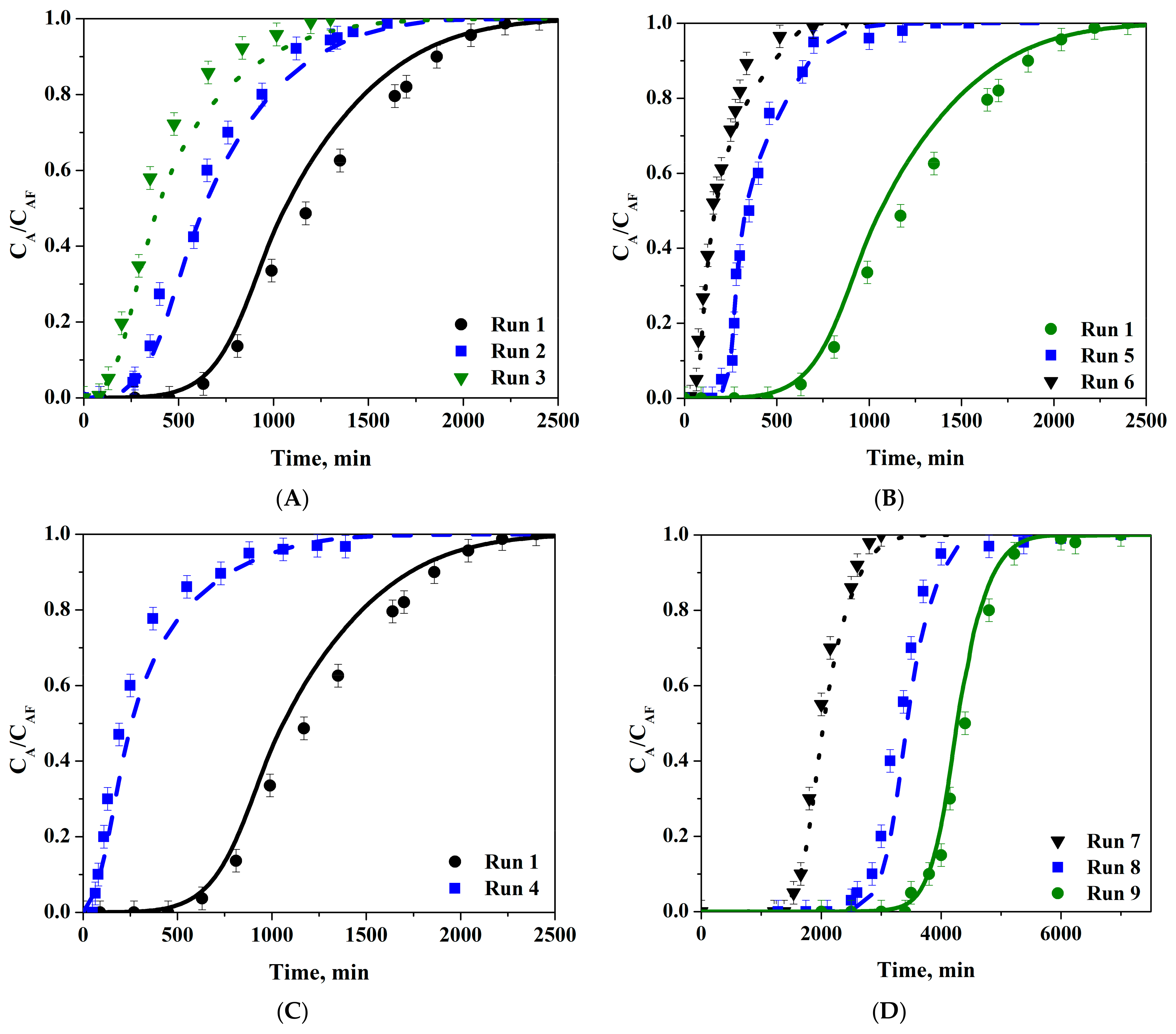
Increasing the feed load to a packed column accelerates the saturation of the material. This can be achieved by increasing either the flow rate or the feed concentration. As shown in Figure 6A,B, increasing the flow rate and concentration shifts the breakthrough curves to the left, indicating rapid saturation. Conversely, reducing the amount of adsorbent material can reduce operation time. This is demonstrated in Figure 6C, where the amount packed was reduced, thereby decreasing the bed height. Overall, Figure 6 demonstrates the validity of the ADM-PVSDM for predicting breakthrough curves under different operating conditions.
Breakthrough time is one of the key operating parameters in adsorption columns. When the concentration at the bed outlet reaches a minimum reference value, according to some standard or by process design, a bypass to a second column is activated to regenerate the material from the exhausted column. Accurate determination of the breakthrough time is imperative to ensure the efficient operation of adsorption systems. The breakthrough times predicted by the ADM-PVSDM are displayed in Table 4, along with the deviation percentages in comparison to the experimental values. As can be noted, the maximum percentage deviation was 13.6%, and the average was 7.6% for the nine experiments performed. The results obtained lend support to the validity of the model prediction with regard to the adsorption of IC on BC.

5.5. Fixed Bed Column Scale-Up

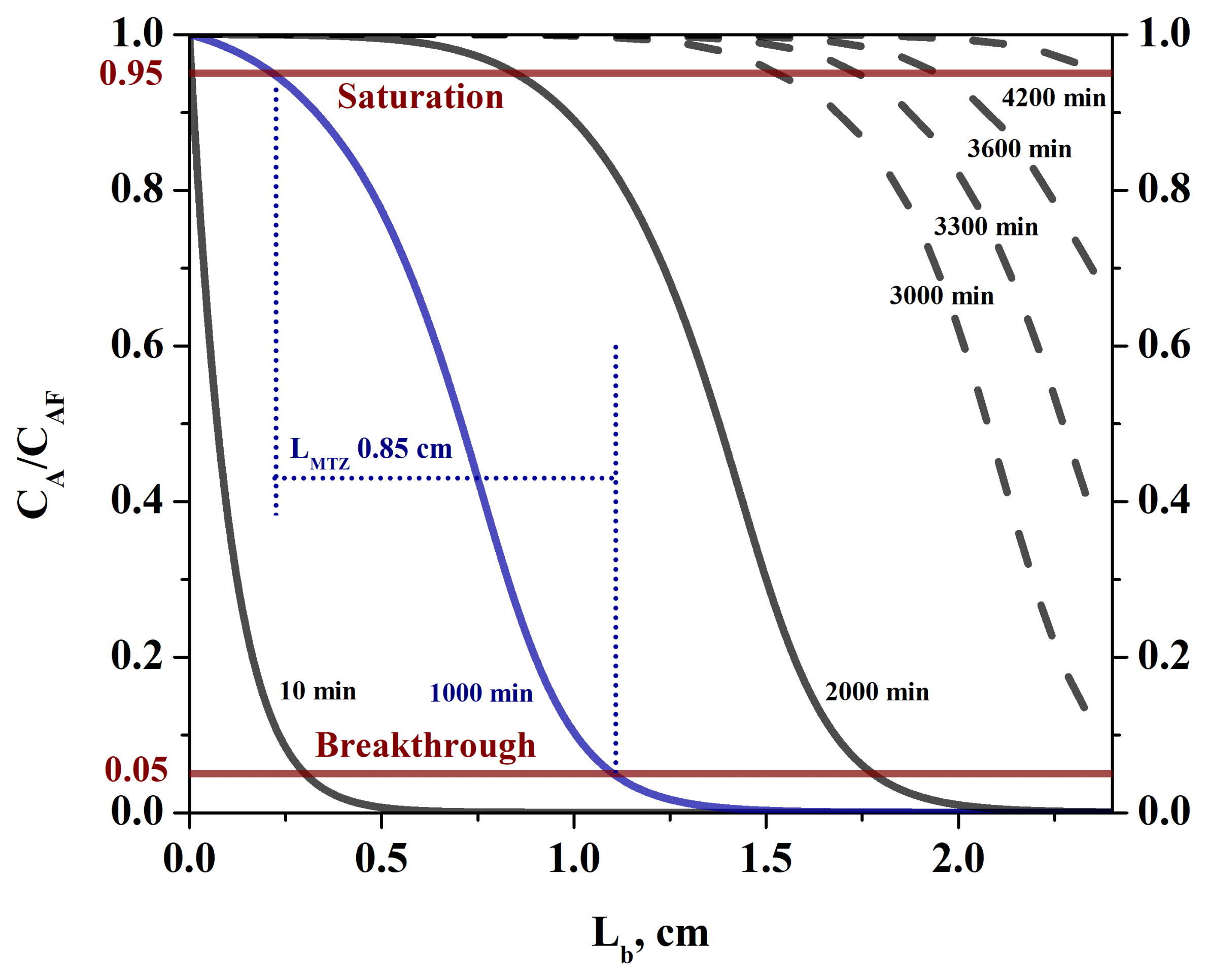
Scale-up methods have been demonstrated to be effective and are based on experimental breakthrough curves. However, it is essential that these methods achieve constant pattern condition (see Section 4) [62,63]. The constant pattern condition is met when Lb > LMTZ. This means that the length of the LMTZ must be shorter than the length of the packed bed. Meeting this condition requires an EBCT large enough for the MTZ to settle, advance and leave the fixed bed. In practice, performing experiments that meet this condition takes significant time. For experiments 1–6 the constant pattern condition was not fulfilled, and, therefore, experiments 7–9 were performed where this condition was fulfilled. As demonstrated in Figure 6D, the breakthrough curves that satisfy this condition exhibit a greater operational time in comparison to the preceding rupture curves. It is noteworthy that the prediction of the ADM-PVSDM for the constant pattern condition was equally valid. The LMTZ obtained for experiment 7 was 2.20 cm (See Table 4), which was established with an EBCT of 4.90 min. This LMTZ obtained was the lowest for the experiments with a 0.55 cm radius column, and for this reason, in order to continue increasing the EBCT, experiments 8 and 9 were performed on a 1.25 cm radius column. In these experiments, EBCT values of 7.20 min and 9.40 min were achieved, and the LMTZ length was 1 cm, thus exhibiting a 54% decrease. This phenomenon can be attributed to the fact that increasing the radius of the column results in an increase in its cross-sectional area. Consequently, by maintaining the same feed concentration, and even increasing the flow rate, the feed mass flux is reduced (see below for further details on the feed mass flux, NA). It has been demonstrated that a reduction in feed mass flux facilitates enhanced processing of the load by the bed, as evidenced by a decline in the LMTZ. In order to provide an illustration of the ZTM, the concentration profiles in the packed bed for Run 9 were plotted. Figure 7 shows these profiles and represents the LZTM predicted by the model.
On the other hand, scale-up methods are restricted to specific operating conditions and do not take advantage of the information provided by mathematical models. In this case, the ADM-PVSDM was able to adequately predict the breakthrough curves under different experimental conditions using the equilibrium isotherm and diffusion coefficients obtained in batch experiments. The experimental breakthrough curves only served to demonstrate the validation of the model. To take advantage of the model’s validity, we must evaluate the ADM-PVSDM’s prediction of the MTZ characterization as well. The equations to characterize the mass transfer zone were presented in Section 4, and the obtained values of FS, LMTZ and vMTZ for the experimental curves and the curves predicted by the ADM-PVSDM are given in Table 4. The ADM-PVSDM was able to predict the LMTZ with low percentage deviations, with an average of 6.4%. Table 4 also provides a comprehensive overview of the vMTZ values, both for the experimental curves and the ADM-PVSDM predictions. The range of values obtained was from 0.564 ×   10 3 cm min−1 to 20.3 ×   10 3 cm min−1. The mean value of these parameters is 9.2 times lower than the axial velocity of the liquid phase, vz (see Table 3). In a similar way, the values predicted by the ADM-PVSDM were accurate, with an average percentage deviation of 7.3%. As the aforementioned scale-up methods are based on the MTZ, ADM-PVSDM predictions can be utilized to apply said scaling methods and to design an adsorption column. Additionally, given the validity of ADM-PVSDM under various operating conditions, the design of columns can be tailored to suit different conditions.
In order to demonstrate this, an additional parameter will be used to facilitate the use of the information obtained. Breakthrough curves are contingent on flow, concentration, and column geometry; therefore, it is expedient to summarize this information in a single parameter, the feed mass flux:
N A = Q   C A F π   R b 2
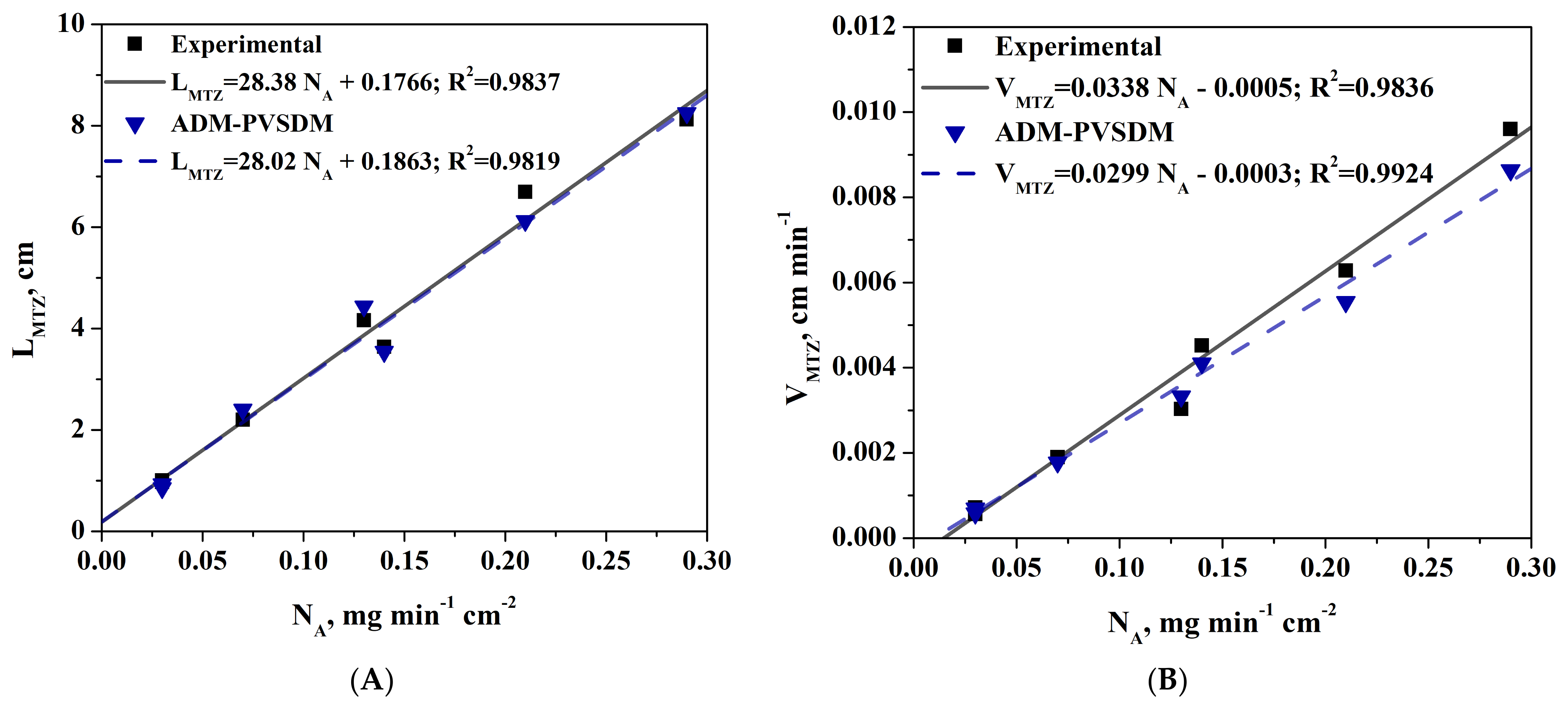
It is thus possible to normalize and compare different operating conditions—for example differing volumetric flows and column geometries—by calculating the operating mass flux. This is due to the fact that the same mass flux can correspond to different combinations of volumetric flow, column radius, and concentrations. Moreover, this is advantageous since the LMTZ and vMTZ were found to be associated with NA. Figure 8 illustrates the relationship that has been obtained. It is important to note that experiments 5 and 6 were excluded from the analysis due to their high concentration. It is evident that a linear relationship exists between LMTZ and vMTZ with NA. This relationship is predicted by the ADM-PVSDM. In this sense, depending on the desired flux or flux range for treatment within an adsorption column, the LMTZ and vMTZ can be calculated, and then apply a scaling method such as MTZM or LUB models. This enables a flexible design to be made for different loads.
The flux values utilized in the experimental setup ranged from 0.03 mg min−1 cm−2 to 0.77 mg min−1 cm−2 (See Table 4). The experiments with the major deviation are the runs 5 and 6, where NA were the major values (0.38 mg min−1 cm−2 and 0.77 mg min−1 cm−2). This indicates that the accuracy of the prediction begins to decrease when the feed flow increases beyond these values. For this reason, the relation between NA and LMTZ and vMTZ (Figure 8) was made in the range of 0.03 mg min−1 cm−2 to 0.29 mg min−1 cm−2, where the deviation percentage was less than 10%, ensuring that the prediction is reliable. This range of operation corresponds in design units of 18 to 174 g h−1 m−2. For instance, if the objective is to design a process with a load of 60 g h−1 m−2 (0.1 mg min−1 cm−2), the obtained information indicates that the LMTZ and vMTZ will have values of 3.0 cm and 2.69 ×   10 3 cm min−1 respectively (Figure 8). Accordingly, by employing the scaling equation of MTZM (Equation (46)) and utilizing the mean of the obtained FS, the bed height required for a specified breakthrough time can be determined, in accordance with the requirements of the process.
t b = L b   ( c m ) 2.69   × 10 3   c m   m i n 1 3.0   c m 2.69   × 10 3   c m   m i n 1 ( 0.36 )
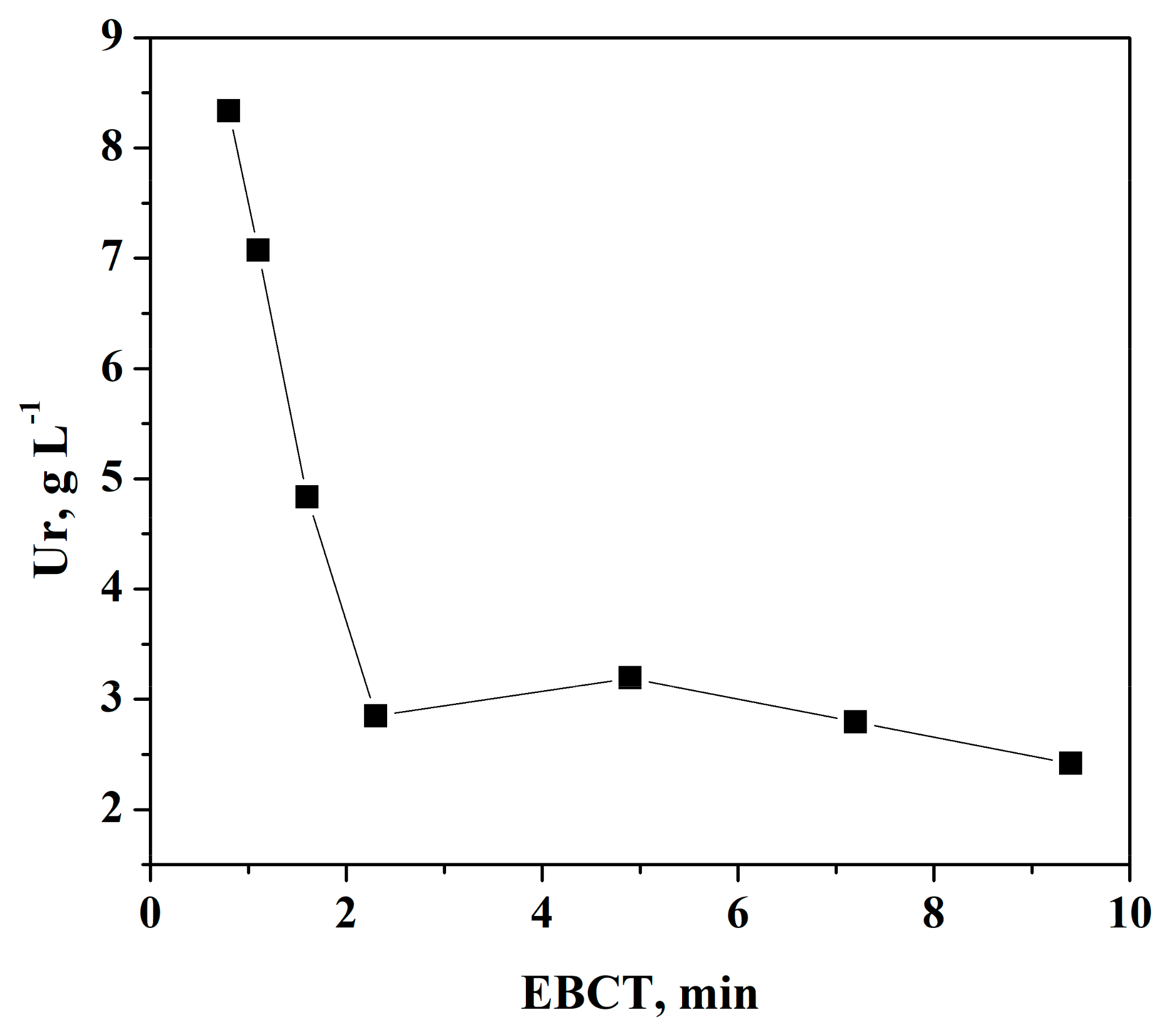
In accordance with the aforementioned example, it is important to note that the recommended height of adsorption beds varies between 2 and 4 m [64]. However, it is important to note that the bed length has a significant impact on the EBCT, and the adsorbent use ratio (Ur) is contingent on this parameter. As illustrated in Figure 9, the experimental findings have been presented in the form of dependence. It is evident from these results that an EBCT greater than 2 min is required to ensure a consumption of less than 3 g of adsorbent per liter of treated solution. Continuing with the design example, we can propose a column length of 3 m and a cross-sectional area of 5 m2 (with a radius of 1.26 m) in accordance with the recommendations [64]. The adsorption columns are designed to treat up to 2000 bed volumes, consequently, given a length of 3 m and a radius of 1.26 m, the volume to be treated would be 30,000 m3. Assuming a typical velocity of 5 m h−1, the volumetric flow rate is determined to be 25 m3 h−1 (5 m2 cross-sectional area).
Q = u   A b = ( 5   m h ) ( 5 m 2 ) = 25 m 3 h
Finally, using Equation (53), the feed concentration can be determined (12 mg L−1).
C A F = N A π R b 2 Q = ( 60 g h   m 2 ) π   ( 1.26   m ) 2 25 m 3 h = 12 g m 3
These conditions give us an EBCT of 36 min, which is optimal for reducing the amount of adsorbent material used (see Figure 9). According to Equation (54), it would take 77 days to exhaust the bed, which is normal for industrial processes of this type [41].
t b = 3000   ( c m ) 2.69   × 10 3   c m   m i n 1 3.0   c m 2.69   × 10 3   c m   m i n 1 ( 0.36 ) = 1.111 × 10 5   m i n
In the event that a process is to be designed with a specific feed concentration, flow rate, or breakthrough time, Equations (53) and (54) can be employed in reverse to estimate the height or radius of the column. In such cases, it is essential to ensure that the column length and radius comply with the stipulated design recommendations.
To this end, the integration of the predictions of the ADM-PVSDM with the MTZM or LUB methods enables the execution of multiple designs under varying operating conditions, thereby facilitating the optimization of the design. This is a limitation when applying the MTZM or LUB methods conventionally, as previously mentioned. Furthermore, the number and duration of experiments is reduced by utilizing the relationship between the feed mass flux and the MTZ. As is widely acknowledged, the design of an adsorption process necessitates a comprehensive study of the regeneration of the material. It is noteworthy that the proposed methodology can be applied to conduct packed bed experiments in the laboratory or on a pilot scale, since the ADM-PVSDM and scaling methods such as MTZM are also valid in these cases. The technical feasibility of the proposed methodology is contingent upon the accurate analysis of equilibrium and adsorption rate, since the ADM-PVSDM is predicated on this information. In this regard, it is imperative to develop a system with minimal experimental error so that the models describing these adsorption stages are valid. In the absence of the aforementioned factors, the model’s dynamic predictions will be subject to inaccuracy, manifesting in elevated percentages of deviation. Moreover, this methodology demands proficiency in numerical solution of equations. However, contemporary software and computer hardware facilitate this process, rendering it relatively straightforward. Furthermore, ADM-PVSDM is based on mass transport phenomena present in porous materials, such as bone char or activated carbon. In this sense, this model is limited to these systems. For adsorbent materials that exhibit other mass transport phenomena (such as permeation) or that do not exhibit mass transport phenomena (materials where diffusion does not control the adsorption rate), the adsorption process must be described using a model that represents these phenomena. In this way, it could be coupled with scaling models (MTZM or LUB) as proposed in this work.

6. Conclusions

The ADM-PVSDM demonstrated a capacity to predict the fixed-bed adsorption of IC on BC. Modeling was performed based on equilibrium and adsorption rate studies. Utilizing the equilibrium relationship and diffusion coefficients from batch adsorption experiments, it was feasible to predict adsorption in fixed beds without the necessity for additional fixed parameters when employing the ADM-PVSDM. The experimental breakthrough curves provided validation for the predictions, with an average percentage deviation of 7.6%. Furthermore, the developed model enabled prediction of the length and velocity of the MTZ, with average percentage deviations of 6.4% and 7.3%, respectively, in the range of 0.03 mg min−1 cm−2 to 0.29 mg min−1 cm−2. As the fundamental basis of scale-up methods is the MTZ, it is possible to integrate the ADM-PVSDM with these methods. In this manner, the ADM-PVSDM can be employed to eliminate the limitations of scale-up methods. This process is facilitated by the utilization of feed mass flux, which is associated with the MTZ. In the final section of the text, an example of how to use this methodology to calculate an adsorption column was provided. In summary, the work presents a robust and accurate methodology based on the ADM-PVSDM that allows the prediction and efficient scaling-up of dynamic adsorption systems, overcoming the limitations of traditional methods and offering a valuable tool for the design and industrial implementation of adsorption columns in wastewater treatment.

Supplementary Materials

The following supporting information can be downloaded at: https://www.mdpi.com/article/10.3390/pr14010092/s1, Figure S1: Experimental batch system; Figure S2: Experimental dynamic system; Figure S3: pHPZC curve.

Author Contributions

Conceptualization, S.A.-C. and R.O.-P.; methodology, S.A.-C., M.V.L.-R., I.V.-G. and M.A.Á.-M.; data curation, S.A.-C., R.O.-P. and M.d.P.F.-P.; writing—original draft preparation, S.A.-C., R.O.-P. and E.P.-O.; writing—review and editing, S.A.-C., R.O.-P., S.A.A.-M., C.G.A.-M. and M.d.P.F.-P.; supervision, R.O.-P. All authors have read and agreed to the published version of the manuscript.

Funding

This research was funded by Secretaria de Ciencia, Humanidades, Tecnología e Innovación, SECIHTI, Mexico, scholarship number 1034192. This work was also supported by the Ministerio de Ciencia, Innovación y Universidades del Gobierno de España MCIN/AEI/10.13039/501100011033 [PID2022-142169OB-I00 project, 2022].

Data Availability Statement

The original contributions presented in this study are included in the article/Supplementary Material. Further inquiries can be directed to the corresponding author.

Conflicts of Interest

The authors declare no conflicts of interest.

Abbreviations

The following abbreviations are used in this manuscript:
a Redlich–Peterson isotherm constant L g−1
A b Perpendicular area to the inlet flow in fixed bed, cm2
ADMAxial dispersion model
AvCN As Average radial contribution of surface diffusion to the total intraparticle mass transfer
b Redlich–Peterson isotherm constant Lβ g−β
C A Bulk IC concentration, mg L−1
C A 0 Initial concentration of IC, mg L−1
C A c a l IC concentration calculated by PVSDM, mg L−1
C A e Bulk concentration of IC at equilibrium, mg L−1
C A e x p IC concentration determined experimentally, mg L−1
C A F Column feed concentration of IC, mg L−1
C A i IC concentration determined experimentally at time “i”, mg L−1
C A r IC concentration inside pores of the particle, mg L−1
C A r | r = R P IC concentration at the external surface of particles of BC, mg L−1
C A | z = L b IC concentration at the end of the bed, mg L−1
D A B Molecular diffusion coefficient, cm2 s−1
D ep Pore Volume diffusion coefficient, cm2 s−1
D e v Average percentage deviation, %
D p Average pore diameter, nm
D s Surface Diffusion coefficient, cm2 s−1
D z Axial dispersion coefficient, cm2 s−1
E B C T Empty bed contact time, min
F s Symmetry Factor
K Langmuir isotherm parameter, L mg−1
k Freundlich isotherm parameter, L1/n mg−1/n−1 g−1
k B A Bohart–Adams reaction rate constant, L mg−1 min−1
k L Convective mass transport coefficient in batch, cm s−1
k Lb Convective mass transport coefficient in column, cm s−1
k T Thomas reaction rate constant, L mg−1 min−1
k Y N Yoon–Nelson constant, min−1
L b Column length, cm
L MTZ Length of the mass transfer zone, cm
L M T Z p r e d Length of the mass transfer zone predicted by the ADM-PVSDM, cm
L s t Length equivalent to the stoichiometric breakthrough time, cm
L U N Length unused in fixed bed, cm
m Adsorbent mass, g
m b Adsorbent mass packed, g
M T Z Mass transfer zone
N Total number of samples or experiments
n Freundlich isotherm parameter
N A Column feed mass flux, mg min−1 cm−2
N S c Schmidt number
N S h Sherwood number
N R e Reynolds number
N P e Peclet number
N 0 Adsorption capacity per bed volume, mg cm3
O F 1 Objective function 1, mg2 g−2
O F 2 Objective function 2, %
PVSDMPore volume surface diffusion model
Q Volumetric flow rate, mL min−1
q Mass of IC adsorbed, mg g−1
q b Adsorption capacity at breakthrough time, mg g−1
q e Mass of IC adsorbed at equilibrium, mg g−1
q e c a l Mass of IC adsorbed at equilibrium calculated by an isotherm model, mg g−1
q e e x p Mass of IC adsorbed at equilibrium determined experimentally, mg g−1
q r Mass of IC adsorbed inside the particle of BC at position r, mg g−1
q s Adsorption capacity at saturation time, mg g−1
q ¯ Average mass of IC adsorbed inside the particle of BC, mg g−1
r Intraparticle radial distance, cm
R b Inner radius of column, cm
R P Radius of BC particles, cm
S External specific area of particles of BC, cm2 g−1
S B E T Specific surface area calculated with the BET model, m2 g−1
t Time, min
t b Breakthrough time, min
t b p r e d Breakthrough time predicted by the ADM-PVSDM, min
t M T Z Time the MTZ takes to move his length ( L MTZ ), min
t s Saturation time, min
t s t Stoichiometric breakthrough time, min
u Superficial velocity, cm s−1
U r Adsorbent use rate, g L−1
V A Volume adsorbent particles packed ( V A = m b ρ p ) , mL
V 0 Initial volume of the liquid phase, mL
V b Fixed bed volume, mL
V D Volume of NaOH or HCl drops, mL
V i Volume of sample “i”, mL
V p Total pore volume, cm3 g−1
v M T Z Velocity of the mass transfer zone, cm min−1
v M T Z p r e d Velocity of the mass transfer zone predicted by the ADM-PVSDM, cm min−1
v z Axial velocity, cm s−1
x RSSCT scaling parameter
z Axial distance, cm
Greek Symbols
β Redlich–Peterson isotherm constant
ε b Void fraction of the fixed bed
ε p Void fraction of the BC particles
ρ p BC particle density, g cm−3
ρ w Water density, g cm−3
μ w Water viscosity, cP
τ Tortuosity factor
τ 0.5 Time for C A | z = L b / C A F = 0.5 inbreakthrough curves

References

  1. Khan, S.; Malik, A. Environmental and Health Effects of Textile Industry Wastewater. In Environmental Deterioration and Human Health, 1st ed.; Malik, A., Grohmann, E., Akhtar, R., Eds.; Springer: Dordrecht, The Netherlands, 2014; pp. 55–71. [Google Scholar] [CrossRef]
  2. Singh, R.P.; Singh, P.K.; Gupta, R.; Singh, R.L. Treatment and Recycling of Wastewater from Textile Industry. In Advances in Biological Treatment of Industrial Waste Water and the Recycling for a Sustainable Future, 1st ed.; Singh, R.L., Singh, R.P., Eds.; Springer: Singapore, 2019; pp. 225–266. [Google Scholar] [CrossRef]
  3. Verma, R.K.; Sankhla, M.S.; Rathod, N.V.; Sonone, S.; Parihar, K.; Singh, G.K. Eradication of Fatal Textile Industrial Dyes by Wastewater Treatment. Biointerface Res. Appl. Chem. 2021, 12, 567–587. [Google Scholar] [CrossRef]
  4. Burkinshaw, S.M.; Salihu, G. The wash-off of dyeings using interstitial water. Part 4: Disperse and reactive dyes on polyester/cotton fabric. Dye. Pigment. 2013, 99, 548–560. [Google Scholar] [CrossRef]
  5. Bal, G.; Thakur, A. Distinct approaches of removal of dyes from wastewater: A review. Mater. Today Proc. 2022, 50, 1575–1579. [Google Scholar] [CrossRef]
  6. Benkhaya, S.; M’ rabet, S.; El Harfi, A. A review on classifications, recent synthesis and applications of textile dyes. Inorg. Chem. Commun. 2020, 115, 107891. [Google Scholar] [CrossRef]
  7. Naga Babu, A.; Srinivasa Reddy, D.; Sharma, P.; Suresh Kumar, G.; Ravindhranath, K.; Mohan, G.V.K. Removal of Hazardous Indigo Carmine Dye from Waste Water Using Treated Red Mud. Mater. Today Proc. 2019, 17, 198–208. [Google Scholar] [CrossRef]
  8. Shindhal, T.; Rakholiya, P.; Varjani, S.; Pandey, A.; Hao Ngo, H.; Guo, W.; Yong Ng, H.; Taherzadeh, M.J. A critical review on advances in the practices and perspectives for the treatment of dye industry wastewater. Bioengineered 2021, 12, 70–87. [Google Scholar] [CrossRef]
  9. Agarwala, R.; Mulky, L. Adsorption of Dyes from Wastewater: A Comprehensive Review. ChemBioEng Rev. 2023, 10, 326–335. [Google Scholar] [CrossRef]
  10. Kumar, P.S.; Joshiba, G.; Femina, C.; Varshini, P.; Priyadharshini, S.; Karthick, M.S.; Jothirani, R. A critical review on recent developments in the low-cost adsorption of dyes from wastewater. Desalination Water Treat. 2019, 172, 395–416. [Google Scholar] [CrossRef]
  11. Dichiara, A.B.; Weinstein, S.J.; Rogers, R.E. On the Choice of Batch or Fixed Bed Adsorption Processes for Wastewater Treatment. Ind. Eng. Chem. Res. 2015, 54, 8579–8586. [Google Scholar] [CrossRef]
  12. Leyva-Ramos, R.; Geankoplis, C.J. Model simulation and analysis of surface diffusion of liquids in porous solids. Chem. Eng. Sci. 1985, 40, 799–807. [Google Scholar] [CrossRef]
  13. Álvarez-Álvarez, J.A.; Aguilar-Aguilar, A.; Robledo-Cabrera, A.; Ocampo-Perez, R.; Leyva-Ramos, R.; Padilla-Ortega, E. Contribution of halloysite as nanotubular clay mineral on mechanism and adsorption rate of Cd(II) onto nanocomposites alginate-halloysite. Environ. Res. 2023, 216, 114772. [Google Scholar] [CrossRef]
  14. Leyva-Ramos, R.; Geankoplis, C.J. Diffusion in liquid-filled pores of activated carbon. I. Pore volume diffusion. Can. J. Chem. Eng. 1994, 72, 262–271. [Google Scholar] [CrossRef]
  15. Gabelman, A. Adsorption basics: Part 1. Chem. Eng. Prog. 2017, 113, 48–53. [Google Scholar]
  16. García-Mateos, F.J.; Ruiz-Rosas, R.; Marqués, M.D.; Cotoruelo, L.M.; Rodriguez-Mirasol, J.; Cordero, T. Removal of paracetamol on biomass-derived activated carbon: Modeling the fixed bed breakthrough curves using batch adsorption experiments. Chem. Eng. J. 2015, 279, 18–30. [Google Scholar] [CrossRef]
  17. Apiratikul, R.; Chu, K.H. Improved fixed bed models for correlating asymmetric adsorption breakthrough curves. J. Water Process Eng. 2021, 40, 101810. [Google Scholar] [CrossRef]
  18. Güler, M.; Çetintaş, S.; Bingöl, D. Cinnamon bark as low-cost and eco-friendly adsorbent for the removal of indigo carmine and malachite green dyestuffs. Int. J. Environ. Anal. Chem. 2021, 101, 735–757. [Google Scholar] [CrossRef]
  19. Gupta, T.B.; Lataye, D.H. Adsorption of Indigo Carmine Dye onto Acacia Nilotica (Babool) Sawdust Activated Carbon. J. Hazard. Toxic. Radioact. Waste 2017, 21, 04017013. [Google Scholar] [CrossRef]
  20. Li, Y.; Liu, J.; Wei, B.; Zhang, X.; Liu, X.; Han, L. A comprehensive review of bone char: Fabrication procedures, physicochemical properties, and environmental application. Sci. Total Environ. 2024, 954, 176375. [Google Scholar] [CrossRef]
  21. Kaseva, M.E. Optimization of regenerated bone char for fluoride removal in drinking water: A case study in Tanzania. J. Water Health 2006, 4, 139–147. [Google Scholar] [CrossRef]
  22. Ristea, M.-E.; Zarnescu, O. Indigo Carmine: Between Necessity and Concern. J. Xenobiot. 2023, 13, 509–528. [Google Scholar] [CrossRef]
  23. Adel, M.; Ahmed, M.A.; Mohamed, A.A. Effective removal of indigo carmine dye from wastewaters by adsorption onto mesoporous magnesium ferrite nanoparticles. Environ. Nanotechnol. Monit. Manag. 2021, 16, 100550. [Google Scholar] [CrossRef]
  24. Donneys-Victoria, D.; Marriaga-Cabrales, N.; Machuca-Martínez, F.; Benavides-Guerrero, J.; Cloutier, S.G. Indigo carmine and chloride ions removal by electrocoagulation. Simultaneous production of brucite and layered double hydroxides. J. Water Process Eng. 2020, 33, 101106. [Google Scholar] [CrossRef]
  25. Rivera-Utrilla, J.; Bautista-Toledo, I.; Ferro-García, M.A.; Moreno-Castilla, C. Activated carbon surface modifications by adsorption of bacteria and their effect on aqueous lead adsorption. J. Chem. Technol. Biotechnol. 2001, 76, 1209–1215. [Google Scholar] [CrossRef]
  26. Fiol, N.; Villaescusa, I. Determination of sorbent point zero charge: Usefulness in sorption studies. Environ. Chem. Lett. 2009, 7, 79–84. [Google Scholar] [CrossRef]
  27. Xu, Z.; Cai, J.; Pan, B. Mathematically modeling fixed-bed adsorption in aqueous systems. J. Zhejiang Univ. Sci. A 2013, 14, 155–176. [Google Scholar] [CrossRef]
  28. Hu, Q.; Yang, X.; Huang, Y.; Li, Y.; Hao, L.; Pei, Q.; Pei, X. A critical review of breakthrough models with analytical solutions in a fixed-bed column. J. Water Process Eng. 2024, 59, 105065. [Google Scholar] [CrossRef]
  29. Chu, K.H. Fixed bed sorption: Setting the record straight on the Bohart–Adams and Thomas models. J. Hazard. Mater. 2010, 177, 1006–1012. [Google Scholar] [CrossRef]
  30. Chu, K.H. Breakthrough curve analysis by simplistic models of fixed bed adsorption: In defense of the century-old Bohart-Adams model. Chem. Eng. J. 2020, 380, 122513. [Google Scholar] [CrossRef]
  31. Rastegar, S.O.; Gu, T. Empirical correlations for axial dispersion coefficient and Peclet number in fixed-bed columns. J. Chromatogr. A 2017, 1490, 133–137. [Google Scholar] [CrossRef]
  32. Athalye, A.M.; Gibbs, S.J.; Lightfoot, E.N. Predictability of chromatographic protein separations. J. Chromatogr. A 1992, 589, 71–85. [Google Scholar] [CrossRef]
  33. Smith, E.H.; Weber, W.J. Evaluation of mass-transfer parameters for adsorption of organic compounds from complex organic matrixes. Environ. Sci. Technol. 1989, 23, 713–722. [Google Scholar] [CrossRef]
  34. Wilson, E.J.; Geankoplis, C.J. Liquid Mass Transfer at Very Low Reynolds Numbers in Packed Beds. Ind. Eng. Chem. Fundam. 1966, 5, 9–14. [Google Scholar] [CrossRef]
  35. Medellín Castillo, N.A. Removal of Fluorides in Aqueous Solution by Adsorption on Various Materials. Ph.D. Thesis, Universidad Autónoma de San Luis Potosí, San Luis Potosí, México, 2006. [Google Scholar]
  36. Mudhoo, A.; Otero, M.; Chu, K.H. Insights into adsorbent tortuosity across aqueous adsorption systems. Particuology 2024, 88, 71–88. [Google Scholar] [CrossRef]
  37. Valderrama, C.; Gamisans, X.; de las Heras, X.; Farrán, A.; Cortina, J.L. Sorption kinetics of polycyclic aromatic hydrocarbons removal using granular activated carbon: Intraparticle diffusion coefficients. J. Hazard. Mater. 2008, 157, 386–396. [Google Scholar] [CrossRef] [PubMed]
  38. Pauletto, P.S.; Dotto, G.L.; Salau, N.P.G. Diffusion mechanisms and effect of adsorbent geometry on heavy metal adsorption. Chem. Eng. Res. Des. 2020, 157, 182–194. [Google Scholar] [CrossRef]
  39. Wilke, C.; Chang, P. Correlation of diffusion coefficients in dilute solutions. AIChE 1955, 1, 264–270. [Google Scholar] [CrossRef]
  40. Furusawa, T.; Smith, J.M. Fluid-Particle and Intraparticle Mass Transport Rates in Slurries. Ind. Eng. Chem. Fundam. 1973, 12, 197–203. [Google Scholar] [CrossRef]
  41. Worch, E. Adsorption Technology in Water Treatment, 1st ed.; DE GRUYTER: Berlin, Germany, 2012; pp. 197–207. [Google Scholar] [CrossRef]
  42. Michaels, A.S. Simplified Method of Interpreting Kinetic Data in Fixed-Bed Ion Exchange. Ind. Eng. Chem. 1952, 44, 1922–1930. [Google Scholar] [CrossRef]
  43. Lukchis, G.M. Adsorption Systems. Pt. 1: Design by Mass-transfer Zone Concept. Chem. Eng. N. Y. 1973, 80, 111–116. [Google Scholar]
  44. Collins, J.J. The LUB/equilibrium section concept for fixed-bed adsorption. Chem. Eng. Prog. Symp. Ser. 1967, 63, 31–35. [Google Scholar]
  45. Rouquerol, J.; Rouquerol, F.; Sing, K. Adsorption by Powders and Porous Solids, 1st ed.; Academic Press: London, UK, 1999; pp. 93–115. [Google Scholar] [CrossRef]
  46. Sing, K.S.W. Reporting physisorption data for gas/solid systems with special reference to the determination of surface area and porosity (Recommendations 1984). Pure Appl. Chem. 1985, 57, 603–619. [Google Scholar] [CrossRef]
  47. Wang, H.; Luo, P. Preparation, Kinetics, and Adsorption Mechanism Study of Microcrystalline Cellulose-Modified Bone Char as an Efficient Pb (II) Adsorbent. Water Air Soil. Pollut. 2020, 231, 328. [Google Scholar] [CrossRef]
  48. Wang, M.; Liu, Y.; Yao, Y.; Han, L.; Liu, X. Comparative evaluation of bone chars derived from bovine parts: Physicochemical properties and copper sorption behavior. Sci. Total Environ. 2020, 700, 134470. [Google Scholar] [CrossRef] [PubMed]
  49. Patel, S.; Han, J.; Qiu, W.; Gao, W. Synthesis and characterisation of mesoporous bone char obtained by pyrolysis of animal bones, for environmental application. J. Environ. Chem. Eng. 2015, 3, 2368–2377. [Google Scholar] [CrossRef]
  50. Giles, C.H.; Smith, D.; Huitson, A. A general treatment and classification of the solute adsorption isotherm. I. Theoretical. J. Colloid. Interface Sci. 1974, 47, 755–765. [Google Scholar] [CrossRef]
  51. Medellin-Castillo, N.A.; Leyva-Ramos, R.; Ocampo-Perez, R.; Cruz, R.F.G.D.; Aragon-Piña, A.; Martinez-Rosales, J.M.; Guerrero-Coronado, R.M.; Fuentes-Rubio, L. Adsorption of Fluoride from Water Solution on Bone Char. Ind. Eng. Chem. Res. 2007, 46, 9205–9212. [Google Scholar] [CrossRef]
  52. Ip, A.W.M.; Barford, J.P.; McKay, G. A comparative study on the kinetics and mechanisms of removal of Reactive Black 5 by adsorption onto activated carbons and bone char. Chem. Eng. J. 2010, 157, 434–442. [Google Scholar] [CrossRef]
  53. Li, Y.; Wang, M.; Liu, J.; Han, L.; Qin, Q.; Liu, X. Adsorption/desorption behavior of ionic dyes on sintered bone char. Mater. Chem. Phys. 2023, 297, 127405. [Google Scholar] [CrossRef]
  54. Coltre, D.S.D.C.; Cionek, C.A.; Meneguin, J.G.; Maeda, C.H.; Braga, M.U.C.; Araujo, A.C.D.; Gauze, G.D.F.; Barros, M.A.S.D.D.; Arroyo, P.A. Study of dye desorption mechanism of bone char utilizing different regenerating agents. SN Appl. Sci. 2020, 2, 2150. [Google Scholar] [CrossRef]
  55. Medellin-Castillo, N.A.; Gonzalez-Fernández, L.A.; Thiodjio-Sendja, B.; Aguilera-Flores, M.M.; Leyva-Ramos, R.; Reyes-López, S.Y.; León Martínez, L.D.; Maia-Dias, J. Bone char for water treatment and environmental applications: A review. J. Anal. Appl. Pyrolysis 2023, 175, 106161. [Google Scholar] [CrossRef]
  56. Hart, A.; Porbeni, D.W.; Omonmhenle, S.; Peretomode, E. Waste bone char-derived adsorbents: Characteristics, adsorption mechanism and model approach. Environ. Technol. Rev. 2023, 12, 175–204. [Google Scholar] [CrossRef]
  57. Díaz-Blancas, V.; Aguilar-Madera, C.G.; Flores-Cano, J.V.; Leyva-Ramos, R.; Padilla-Ortega, E.; Ocampo-Pérez, R. Evaluation of mass transfer mechanisms involved during the adsorption of metronidazole on granular activated carbon in fixed bed column. J. Water Process Eng. 2020, 36, 101303. [Google Scholar] [CrossRef]
  58. González-Fernández, L.A.; Aguirre-Contreras, S.; Medellín-Castillo, N.A.; Sánchez-Polo, M.; Navarro-Frómeta, A.E.; Leyva-Ramos, R.; Vilasó-Cadre, J.E.; Ocampo-Perez, R. Mathematical modelling of kinetic and breakthrough curves for Cd(II) adsorption onto Sargassum biomass using the Diffusion—Permeation Model. J. Water Process Eng. 2025, 77, 108473. [Google Scholar] [CrossRef]
  59. Ocampo-Pérez, R.; Leyva-Ramos, R.; Rivera-Utrilla, J.; Flores-Cano, J.V.; Sánchez-Polo, M. Modeling adsorption rate of tetracyclines on activated carbons from aqueous phase. Chem. Eng. Res. Des. 2015, 104, 579–588. [Google Scholar] [CrossRef]
  60. Aguirre-Contreras, S.; Leyva-Ramos, R.; Ocampo-Pérez, R.; Aguilar-Madera, C.G.; Flores-Cano, J.V.; Medellín-Castillo, N.A. Mathematical modeling of breakthrough curves for 8-hydroxyquinoline removal from fundamental equilibrium and adsorption rate studies. J. Water Process Eng. 2023, 54, 103967. [Google Scholar] [CrossRef]
  61. Díaz-Blancas, V.; Ocampo-Pérez, R.; Leyva-Ramos, R.; Alonso-Dávila, P.A.; Moral-Rodríguez, A.I. 3D modeling of the overall adsorption rate of metronidazole on granular activated carbon at low and high concentrations in aqueous solution. Chem. Eng. J. 2018, 349, 82–91. [Google Scholar] [CrossRef]
  62. Benjelloun, M.; Miyah, Y.; Akdemir Evrendilek, G.; Zerrouq, F.; Lairini, S. Recent Advances in Adsorption Kinetic Models: Their Application to Dye Types. Arab. J. Chem. 2021, 14, 103031. [Google Scholar] [CrossRef]
  63. Geankoplis, C.J. Transport Processes and Separation Process Principies, 4th ed.; Prentice Hall: Englewood Cliffs, NJ, USA, 2003; pp. 773–832. [Google Scholar]
  64. McCabe, W.L.; Smith, J.C.; Harriot, P. Unit Operations of Chemical Engineering, 7th ed.; McGraw-Hill: Columbus, OH, USA, 2007; pp. 875–922. [Google Scholar]
Figure 1. Adsorption–desorption isotherm of N2 at 77 K on Bone Char.
Processes 14 00092 g001
Figure 2. Equilibrium data for IC adsorption on BC at pH = 7.
Processes 14 00092 g002
Figure 3. Bohart–Adams model prediction: (A) Quasi-chemical kinetic model application; (B) Volumetric flow rate effect; (C) Feed concentration effect; (D) Bed height effect.
Processes 14 00092 g003
Figure 4. Experimental decay curves: (A) Effect of stirring speed on the overall adsorption rate; (B) Effect of initial concentration on the overall adsorption rate. The lines correspond to the PVSDM.
Processes 14 00092 g004
Figure 5. Contribution of surface diffusion to the total intraparticle mass transport as a function of time and the adsorbed mass at equilibrium.
Processes 14 00092 g005
Figure 6. ADM-PVSDM predictions and their validation: (A) Volumetric flow rate effect; (B) Feed concentration effect; (C) Bed height effect; (D) Breakthrough curves with constant pattern condition.
Processes 14 00092 g006
Figure 7. Concentration profiles within the adsorption column Run 9. The dashed curves represent profiles after breakthrough time.
Processes 14 00092 g007
Figure 8. Relationship between MTZ and NA: (A) LMTZ; (B) vMTZ.
Processes 14 00092 g008
Figure 9. Usage adsorbent rate as function of EBCT.
Processes 14 00092 g009
Table 1. Parameters of equilibrium relationships.
LangmuirFreundlichPrausnitz–Radke
qm
mg g−1
K
L mg−1
Dev
%
k
L1/n mg−1/n−1 g−1
nDev
%
a
L g−1
b
Lβ mg−β
βDev
%
59.30.061612.326.67.823.835.610.1230.95511.1
Table 2. Experimental conditions of the kinetic experiments and parameters of the Bohart–Adams and PVSDM models.
RUNCA0
mg L−1
Ce
mg L−1
qe
mg g−1
RPM k BA × 10 4
L mg−1 min−1
Desv *
%
k L × 10 3
cm s−1
D s × 10 9
cm2 s−1
NSh N Re × 10 4 Desv **
%
194.572.643.6030 0.40.972.90.21.42
299.476.545.7050 0.5825.40.340.45
3103.879.947.70150 0.892.018.31.011.76
492.36946.40200 0.992.19.21.682.11
597.472.948.503000.457.82.912.127.22.011.76
621.14.632.403005.832.65.071.9747.42.0111.25
748.429.337.503001.337.22.881.9626.92.014.87
820818354.003000.147.20.390.73.62.011.01
9404.6376.156.803000.147.70.461.984.262.010.55
* Percentage deviation of the Bohart–Adams kinetic model (Equation (16)). ** Percentage deviation of the PVSDM.
Table 3. Operating conditions and transport parameters of dynamic experiments.
RUNCAF
mg L−1
mb
g
Lb
cm
Rb
cm
εbQ
cm3 min−1
EBCT
min
Ur,
g L−1
qb
mg
g−1
qsat
mg
g−1
NReNShNPe v z × 10 2
cm s−1
k L × 10 3
cm s−1
D z   × 10 3
cm2 s−1
180.03.03.80.550.461.62.302.8511.9445.990.3015.11.746.091.621.56
286.13.03.80.550.462.31.604.8327.5353.020.4417.21.818.831.842.16
382.93.03.80.550.463.31.107.0724.1546.060.6319.51.8612.712.093.03
486.01.01.30.550.471.60.808.3311.6535.990.3014.81.745.961.591.52
52063.03.80.550.461.72.108.4817.7539.740.3315.61.756.621.671.67
64223.03.80.550.461.72.1035.310.4640.150.3315.61.756.611.671.67
791.03.03.80.550.460.74.903.1934.5345.440.1411.81.502.841.260.84
893.011.02.41.250.391.67.202.7939.2449.460.0710.41.011.431.120.56
995.011.02.51.250.411.39.402.4235.9446.180.059.101.131.070.980.47
Table 4. Characterization of experimental and ADM-PVSDM-predicted mass transfer zones.
RUNNA
mg min−1 cm−2
tb
min
ts
min
FSLMTZ
cm
v MTZ × 10 3
cm min−1
tbpred
min
tsatpred
min
FSpredLMTZpred
cm
v MTZpred × 10 3
cm min−1
Desv
tb
%
Desv LMTZ
%
Desv VMTZ
%
10.1365420290.444.163.0361519500.404.443.325.966.639.83
20.2127013360.326.696.2828513900.376.125.545.568.4911.7
30.291299750.328.129.6013510900.338.258.634.651.5310.1
40.14658800.263.644.52579200.313.544.1012.32.649.18
50.382027000.374.919.86229.57790.315.219.4813.66.053.89
60.77654780.328.7120.3735300.308.4018.412.33.619.41
70.07154027000.422.201.90153028800.422.401.780.659.096.26
80.03260040000.371.000.714286042000.450.930.69410.07.002.84
90.03350052200.400.970.564363051000.460.850.5783.7112.42.53
Disclaimer/Publisher’s Note: The statements, opinions and data contained in all publications are solely those of the individual author(s) and contributor(s) and not of MDPI and/or the editor(s). MDPI and/or the editor(s) disclaim responsibility for any injury to people or property resulting from any ideas, methods, instructions or products referred to in the content.