
Previous Article in Journal
Mixed Size-Biased Log-Normal Distribution with Truncated Normal Prior and Its Application in Insurance Ratemaking
 
 
Due to scheduled maintenance work on our servers, there may be short service disruptions on this website between 11:00 and 12:00 CEST on March 28th.
This is an early access version, the complete PDF, HTML, and XML versions will be available soon.
Article

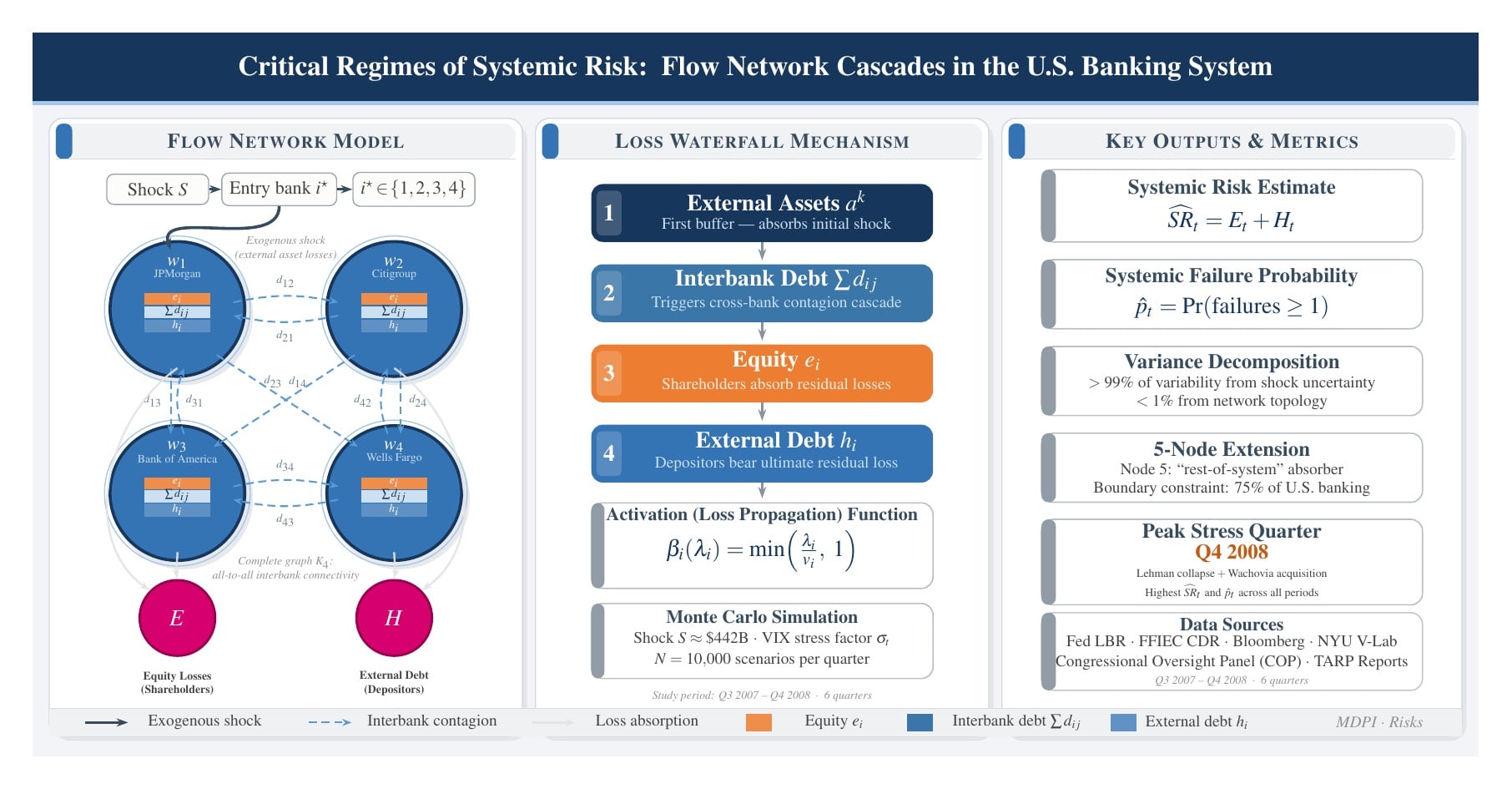
Critical Regimes of Systemic Risk: Flow Network Cascades in the U.S. Banking System

by
Samuel Montañez Jacquez
1,*,
Luis Alberto Quezada Téllez
2,
Rodrigo Morales Mendoza
3,
Ernesto Moya-Albor
1,*,
Guillermo Fernández Anaya
4 and
Milagros Santos Moreno
5
1
Facultad de Ingeniería, Universidad Panamericana, Augusto Rodin 498, Ciudad de México 03920, Mexico
2
Escuela Superior de Apan, Universidad Autónoma del Estado de Hidalgo, Carretera Apan-Calpulalpan Km. 8. Colonia Chimalpa Tlalayote, Apan 43900, Hidalgo, Mexico
3
Department of Economics, Ave Maria University, 5050 Ave Maria Blvd., Ave Maria, FL 34142, USA
4
Mathematics and Physics Department, Universidad Iberoamericana Ciudad de Mexico, Prolongacion Paseo de la Reforma, Zedec Sta Fe, Alvaro Obregon, Mexico City 01376, Mexico
5
Engineering Department, Instituto Tecnológico y de Estudios Superiores de Occidente, Periferico Sur Manuel Gomez Morin #8585, Col. ITESO, Tlaquepaque 45604, Jalisco, Mexico
*
Authors to whom correspondence should be addressed.
Risks 2026, 14(4), 73; https://doi.org/10.3390/risks14040073
Submission received: 25 January 2026 / Revised: 10 March 2026 / Accepted: 17 March 2026 / Published: 26 March 2026

Abstract

Systemic risk in banking systems arises from losses transmitted through networks of contractual exposures. Yet, most widely used measures rely on market-implied volatility and equity prices rather than structural balance sheet fragilities. This paper develops a flow network framework that models systemic risk as a capacity-constrained loss-diffusion process governed by flow conservation, contractual seniority, and interbank topology. Using regulatory balance sheet data for four major U.S. banks across six quarters of the 2007–2008 financial crisis, we simulate millions of unit-consistent cascade scenarios to characterize the distribution of bank failures and aggregate losses. Despite severe macro-financial stress, the system remains in a subcritical contagion regime, exhibiting frequent single-bank failures, virtually no multi-bank cascades, and quasi-stationary aggregate losses concentrated around USD 420–430B.We extend the model to a stochastic setting in which the initial shock magnitude is randomized while propagation mechanics remain deterministic. The resulting loss distribution remains tightly concentrated and scales approximately linearly with shock size, suggesting that uncertainty in shock realizations does not induce nonlinear cascade amplification. Applying an efficient network benchmark, we estimate that 10–23% of expected systemic loss is attributable to suboptimal network architecture, implying potential gains from structural policy intervention. A comparison with SRISK reveals early divergence and convergence only at peak stress, highlighting the complementary roles of structural and market-based systemic risk measures. Finally, a graph neural network trained on synthetic flow network data fails to reproduce threshold-driven cascade dynamics, underscoring the importance of considering network structures vis-à-vis data-driven approaches.
Keywords: systemic risk; flow networks; interbank contagion; graph neural networks; percolation; financial networks systemic risk; flow networks; interbank contagion; graph neural networks; percolation; financial networks
Graphical Abstract