The Role of Cytokines in Traumatic Brain Injury


 ,
,
Abstract
1. Introduction
2. IL-1
3. IL-6
4. IL-10
5. IL-17
6. TNF-α
7. Other Cytokines
8. Pediatric TBI
9. Genetic Polymorphisms
10. Conclusions
Funding
Data Availability Statement
Conflicts of Interest
References
- Maas, A.I.R.; Menon, D.K.; Adelson, P.D.; Andelic, N.; Bell, M.J.; Belli, A.; Bragge, P.; Brazinova, A.; Büki, A.; Chesnut, R.M.; et al. Traumatic brain injury: Integrated approaches to improve prevention, clinical care, and research. Lancet Neurol. 2017, 16, 987–1048. [Google Scholar] [CrossRef]
- Visser, K.; Koggel, M.; Blaauw, J.; van der Horn, H.J.; Jacobs, B.; van der Naalt, J. Blood-based biomarkers of inflammation in mild traumatic brain injury: A systematic review. Neurosci. Biobehav. Rev. 2022, 132, 154–168. [Google Scholar] [CrossRef] [PubMed]
- Abikenari, M.; Ha, J.H.; Liu, J.; Ren, A.; Cho, K.B.; Lim, J.; Kim, L.H.; Medikonda, R.; Choi, J.; Lim, M. The immunological landscape of traumatic brain injury: Insights from pathophysiology to experimental models. Front. Neurol. 2025, 16, 1668480. [Google Scholar] [CrossRef]
- Dalla Libera, A.L.; Regner, A.; de Paoli, J.; Centenaro, L.; Martins, T.T.; Simon, D. IL-6 polymorphism associated with fatal outcome in patients with severe traumatic brain injury. Brain Inj. 2011, 25, 365–369. [Google Scholar] [CrossRef] [PubMed]
- Waters, R.J.; Murray, G.D.; Teasdale, G.M.; Stewart, J.; Day, I.; Lee, R.J.; Nicoll, J.A. Cytokine gene polymorphisms and outcome after traumatic brain injury. J. Neurotrauma 2013, 30, 1710–1716. [Google Scholar] [CrossRef]
- Sinh, S.; Monsoori, N.; Mukhopadhyay, A.; Sharma, B. Effect of IL-6-174 G/C polymorphism in predicting disability and functional outcome in patients with severe traumatic brain injury (STBI). J. Neurosurg. 2014, 122, 673. [Google Scholar]
- Vedantam, A.; Brennan, J.; Levin, H.S.; McCarthy, J.J.; Dash, P.K.; Redell, J.B.; Yamal, J.-M.; Robertson, C.S. Early versus Late Profiles of Inflammatory Cytokines after Mild Traumatic Brain Injury and Their Association with Neuropsychological Outcomes. J. Neurotrauma 2021, 38, 53–62. [Google Scholar] [CrossRef] [PubMed]
- Rastogi, R.; Geng, X.; Li, F.; Ding, Y. NOX Activation by Subunit Interaction and Underlying Mechanisms in Disease. Front. Cell. Neurosci. 2017, 10, 301. [Google Scholar] [CrossRef]
- Zhu, L.; Huang, S.; Chen, W.; Li, K.; Sheng, J. Cytokines and related signaling pathways in traumatic brain injury. Front. Immunol. 2026, 17, 1738589. [Google Scholar] [CrossRef] [PubMed]
- Singh, P.K.; Maurya, S.; Saadi, A.; Zhang, T.; Lieb, A.; Shekh-Ahmad, T. Selective inhibition of NOX2 after status epilepticus attenuates epileptogenesis and cognitive impairment: A sex-dependent study. Redox Biol. 2025, 86, 103830. [Google Scholar] [CrossRef]
- Kalogirou, E.; Voulgaris, S.; Alexiou, G.A. Coagulopathy prediction in traumatic brain injury. Adv. Clin. Chem. 2025, 126, 199–231. [Google Scholar] [CrossRef]
- Undén, J.; Ingebrigtsen, T.; Romner, B.; Scandinavian Neurotrauma Committee (SNC). Scandinavian guidelines for initial management of minimal, mild and moderate head injuries in adults: An evidence and consensus-based update. BMC Med. 2013, 11, 50. [Google Scholar] [CrossRef]
- Bazarian, J.J.; Biberthaler, P.; Welch, R.D.; Lewis, L.M.; Barzo, P.; Bogner-Flatz, V.; Brolinson, P.G.; Büki, A.; Chen, J.Y.; Christenson, R.H.; et al. Serum GFAP and UCH-L1 for prediction of absence of intracranial injuries on head CT (ALERT-TBI): A multicentre observational study. Lancet Neurol. 2018, 17, 782–789. [Google Scholar] [CrossRef]
- Zhao, Q.; Li, H.; Li, H.; Xie, F.; Zhang, J. Research progress of neuroinflammation-related cells in traumatic brain injury: A review. Medicine 2023, 102, e34009. [Google Scholar] [CrossRef]
- Ozen, I.; Ruscher, K.; Nilsson, R.; Flygt, J.; Clausen, F.; Marklund, N. Interleukin-1 Beta neutralization attenuates traumatic brain injury-induced microglia activation and neuronal changes in the Globus Pallidus. Int. J. Mol. Sci. 2020, 21, 387. [Google Scholar] [CrossRef] [PubMed]
- Helmy, A.; Guilfoyle, M.R.; Carpenter, K.L.; Pickard, J.D.; Menon, D.K.; Hutchinson, P.J. Recombinant human interleukin-1 receptor antagonist in severe traumatic brain injury: A phase II randomized control trial. J. Cereb. Blood Flow Metab. 2014, 34, 845–851. [Google Scholar] [CrossRef] [PubMed]
- Lindblad, C.; Rostami, E.; Helmy, A. Interleukin-1 Receptor Antagonist as Therapy for Traumatic Brain Injury. Neurotherapeutics 2023, 20, 1508–1528. [Google Scholar] [CrossRef] [PubMed]
- Yue, J.K.; Kobeissy, F.H.; Jain, S.; Sun, X.; Phelps, R.R.L.; Korley, F.K.; Gardner, R.C.; Ferguson, A.R.; Huie, J.R.; Schneider, A.L.C.; et al. Neuroinflammatory Biomarkers for Traumatic Brain Injury Diagnosis and Prognosis: A TRACK-TBI Pilot Study. Neurotrauma. Rep. 2023, 4, 171–183. [Google Scholar] [CrossRef]
- Davis, A.C.; Godbout, J.P. Neuroimmune dynamics and cytokines in traumatic brain injury. Trends Immunol. 2026, 47, 77–91. [Google Scholar] [CrossRef]
- Edwards, K.A.; Pattinson, C.L.; Guedes, V.A.; Peyer, J.; Moore, C.; Davis, T.; Devoto, C.; Turtzo, L.C.; Latour, L.; Gill, J.M. Inflammatory Cytokines Associate With Neuroimaging After Acute Mild Traumatic Brain Injury. Front. Neurol. 2020, 11, 348. [Google Scholar] [CrossRef]
- Edwards, K.A.; Gill, J.M.; Pattinson, C.L.; Lai, C.; Brière, M.; Rogers, N.J.; Milhorn, D.; Elliot, J.; Carr, W. Interleukin-6 is associated with acute concussion in military combat personnel. BMC Neurol. 2020, 20, 209. [Google Scholar] [CrossRef]
- Nitta, M.E.; Savitz, J.; Nelson, L.D.; Teague, T.K.; Hoelzle, J.B.; McCrea, M.A.; Meier, T.B. Acute elevation of serum inflammatory markers predicts symptom recovery after concussion. Neurology 2019, 93, e497–e507. [Google Scholar] [CrossRef]
- Cáceres, E.; Divani, A.A.; Olivella-Gomez, J.; Di Napoli, M.; Reyes, L.F. Interleukin-6 and its association with outcome in traumatic brain injury: A prospective cohort. Scand. J. Trauma Resusc. Emerg. Med. 2025, 33, 131. [Google Scholar] [CrossRef] [PubMed]
- Li, X.M.; Liu, Z.W.; Liu, W.Y.; Su, G.J.; Huang, X.J. Prognostic value of procalcitonin and IL-6 with a composite model in moderate-severe traumatic brain injury. J. Clin. Neurosci. 2025, 140, 111516. [Google Scholar] [CrossRef] [PubMed]
- Huang, H.; Fu, G.; Lu, S.; Chen, S.; Huo, J.; Ran, Y.; Xiao, C.; Chen, J.; Pi, D.; Zhou, F.; et al. Plasma profiles of inflammatory cytokines in children with moderate to severe traumatic brain injury: A prospective cohort study. Eur. J. Pediatr. 2024, 183, 3359–3368. [Google Scholar] [CrossRef]
- Tsitsipanis, C.; Miliaraki, M.; Paflioti, E.; Lazarioti, S.; Moustakis, N.; Ntotsikas, K.; Theofanopoulos, A.; Ilia, S.; Vakis, A.; Simos, P.; et al. Inflammation biomarkers IL-6 and IL-10 may improve the diagnostic and prognostic accuracy of currently authorized traumatic brain injury tools. Exp. Ther. Med. 2023, 26, 364. [Google Scholar] [CrossRef]
- Ooi, S.Z.Y.; Spencer, R.J.; Hodgson, M.; Mehta, S.; Phillips, N.L.; Preest, G.; Manivannan, S.; Wise, M.P.; Galea, J.; Zaben, M. Interleukin-6 as a prognostic biomarker of clinical outcomes after traumatic brain injury: A systematic review. Neurosurg. Rev. 2022, 45, 3035–3054. [Google Scholar] [CrossRef]
- Tsakiris, C.; Siempis, T.; Lianos, G.D.; Vlachodimitropoulou, L.; Voulgaris, S.; Alexiou, G.A. Blood biomarkers: A new solution to the silent pandemic of traumatic brain injury. Biomark. Med. 2023, 17, 783–785. [Google Scholar] [CrossRef]
- Smith-Bindman, R.; Chu, P.W.; Firdaus, H.A.; Stewart, C.; Malekhedayat, M.; Alber, S.; Bolch, W.E.; Mahendra, M.; de González, A.B.; Miglioretti, D.L. Projected Lifetime Cancer Risks From Current Computed Tomography Imaging. JAMA Intern. Med. 2025, 185, 710–719. [Google Scholar] [CrossRef]
- Khosh-Fetrat, M.; Kosha, F.; Ansari-Moghaddam, A.; Guest, P.C.; Vahedian-Azimi, A.; Barreto, G.E.; Sahebkar, A. Determining the value of early measurement of interleukin-10 in predicting the absence of brain lesions in CT scans of patients with mild traumatic brain injury. J. Neurol. Sci. 2023, 446, 120563. [Google Scholar] [CrossRef] [PubMed]
- Koivikko, P.; Posti, J.P.; Mohammadian, M.; Lagerstedt, L.; Azurmendi, L.; Hossain, I.; Katila, A.J.; Menon, D.; Newcombe, V.F.J.; Hutchinson, P.J.; et al. Potential of heart fatty-acid binding protein, neurofilament light, interleukin-10 and S100 calcium-binding protein B in the acute diagnostics and severity assessment of traumatic brain injury. Emerg. Med. J. 2022, 39, 206–212. [Google Scholar] [CrossRef] [PubMed]
- Li, T.; Zhang, Y.M.; Han, D.; Hua, R.; Guo, B.N.; Hu, S.Q.; Yan, X.L.; Xu, T. Involvement of IL-17 in Secondary Brain Injury After a Traumatic Brain Injury in Rats. Neuromol. Med. 2017, 19, 541–554. [Google Scholar] [CrossRef]
- Zamora, R.; Forsberg, J.A.; Shah, A.M.; Unselt, D.; Grey, S.; Lisboa, F.A.; Billiar, T.R.; Schobel, S.A.; Potter, B.K.; Elster, E.A.; et al. Central role for neurally dysregulated IL-17A in dynamic networks of systemic and local inflammation in combat casualties. Sci. Rep. 2023, 13, 6618. [Google Scholar] [CrossRef]
- Zhang, M.; Xie, J.; Ma, Y.; Wang, L.; Liu, L.; Zhang, P.; Dai, Z.; Zhang, Q.; Yin, W. TNF-α in traumatic brain injury: A bidirectional effect in regulating neuroimmune and inflammatory responses. Cell.Mol. Life Sci. 2025, 82, 372. [Google Scholar] [CrossRef]
- Crespo, A.R.; Da Rocha, A.B.; Jotz, G.P.; Schneider, R.F.; Grivicich, I.; Pinheiro, K.; Zanoni, C.; Regner, A. Increased serum sFas and TNFalpha following isolated severe head injury in males. Brain Inj. 2007, 21, 441–447. [Google Scholar] [CrossRef]
- Rindler, R.S.; Robertson, H.; De Yampert, L.; Khatri, V.; Texakalidis, P.; Eshraghi, S.; Grey, S.; Schobel, S.; Elster, E.A.; Boulis, N.; et al. Predicting Vasospasm and Early Mortality in Severe Traumatic Brain Injury: A Model Using Serum Cytokines, Neuronal Proteins, and Clinical Data. Neurosurgery 2024, 96, 1133–1145. [Google Scholar] [CrossRef]
- Baticulon, R.E.; Sy, J.J.; Haizel-Cobbina, J.; Du, L.; Figueredo, L.; Hounjet, C.; Mitchell, R.; Shlobin, N.A.; Dewan, M.C. Global Epidemiology of Pediatric Traumatic Brain Injury: Systematic Review and Meta-Analysis. Neurosurgery 2025. [Google Scholar] [CrossRef] [PubMed]
- Black, L.I.; Zablotsky, B. Concussions and Brain Injuries in Children: United States, 2020; NCHS Data Brief, No 423; National Center for Health Statistics: Hyattsville, MD, USA, 2021. [CrossRef]
- Pearce, M.S.; Salotti, J.A.; Little, M.P.; McHugh, K.; Lee, C.; Kim, K.P.; Howe, N.L.; Ronckers, C.M.; Rajaraman, P.; Sir Craft, A.W.; et al. Radiation exposure from CT scans in childhood and subsequent risk of leukaemia and brain tumours: A retrospective cohort study. Lancet 2012, 380, 499–505. [Google Scholar] [CrossRef] [PubMed] [PubMed Central]
- Komiotis, C.; Mavridis, I.; Pyrgelis, E.-S.; Agapiou, E.; Meliou, M.; Birbilis, T. The Role of Interleukins in Pediatric Traumatic Brain Injury: A Narrative Synthesis. J. Clin. Med. 2026, 15, 186. [Google Scholar] [CrossRef]
- Ryan, E.; Kelly, L.; Stacey, C.; Huggard, D.; Duff, E.; McCollum, D.; Leonard, A.; Boran, G.; Doherty, D.R.; Bolger, T.; et al. Mild-to-severe traumatic brain injury in children: Altered cytokines reflect severity. J. Neuroinflamm. 2022, 19, 36. [Google Scholar] [CrossRef]
- Lo, T.Y.; Jones, P.A.; Minns, R.A. Combining coma score and serum biomarker levels to predict unfavorable outcome following childhood brain trauma. J. Neurotrauma 2010, 27, 2139–2145. [Google Scholar] [CrossRef]
- Chiaretti, A.; Genovese, O.; Aloe, L.; Antonelli, A.; Piastra, M.; Polidori, G.; Di Rocco, C. Interleukin 1beta and interleukin 6 relationship with paediatric head trauma severity and outcome. Childs Nerv. Syst. 2005, 21, 185–194. [Google Scholar] [CrossRef]
- Lele, A.V.; Alunpipatthanachai, B.; Qiu, Q.; Clark-Bell, C.; Watanitanon, A.; Moore, A.; Chesnut, R.M.; Armstead, W.; Vavilala, M.S. Plasma Levels, Temporal Trends and Clinical Associations between Biomarkers of Inflammation and Vascular Homeostasis after Pediatric Traumatic Brain Injury. Dev. Neurosci. 2019, 41, 177–192. [Google Scholar] [CrossRef]
- Guerini, F.R.; Agliardi, C.; Zanzottera, M.; Caronni, A.; Antolini, L.; Derchi, C.C.; Atzori, T.; Bolognesi, E.; Navarro, J.; Clerici, M.; et al. The Role of Cytokine Gene Polymorphisms in Rehabilitation Outcome After Traumatic Brain Injury. Cells 2025, 14, 1056. [Google Scholar] [CrossRef]

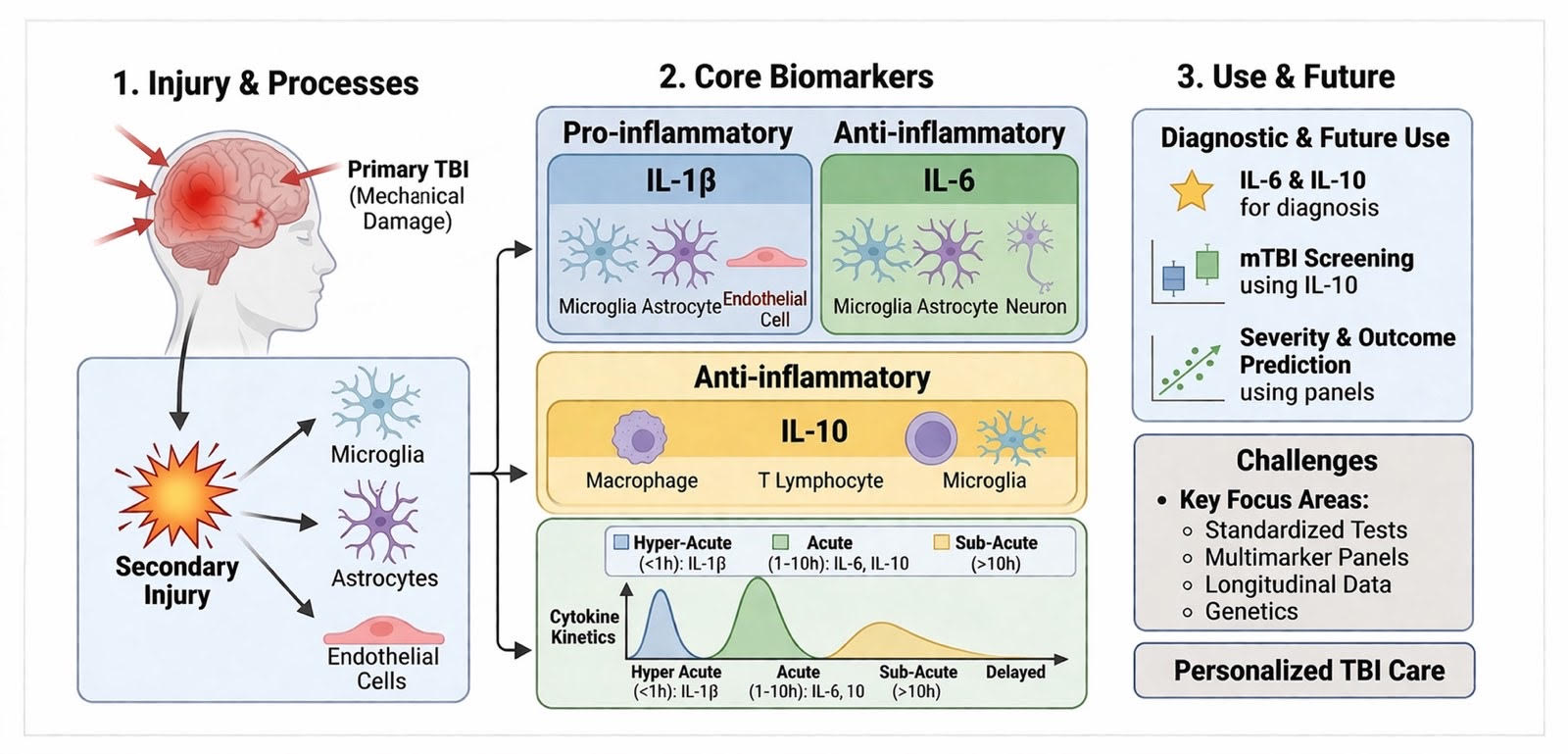
| Cytokine | Main Cellular Sources | Biological Role | Clinical Relevance |
|---|---|---|---|
| IL-1β | Microglia, astrocytes, endothelial cells | Potent pro-inflammatory mediator; BBB disruption; microglial activation | Discriminates TBI vs. controls and CT+ vs. CT−; limited prognostic value for long-term outcome |
| IL-6 | Microglia, astrocytes, neurons, endothelial cells | Inflammation, BBB disruption, metabolic regulation | Strong association with injury severity, CT/MRI positivity, mortality, and functional outcome |
| IL-10 | Macrophages, T lymphocytes, microglia | Anti-inflammatory; limits immune-mediated damage | Reflects injury severity; potential tool to exclude CT lesions in selected mTBI populations |
| IL-17A | Th17 cells, γδ T cells, innate immune cells | Neutrophil recruitment; BBB disruption | Elevated in serum and effluent in TBI; possible therapeutic target |
| TNF-α | Microglia, macrophages, neurons | Dual role: pro-inflammatory and neurotrophic | Elevated in TBI and CT+ cases; inconsistent association with outcome |
| IL-8 | Microglia, astrocytes, endothelial cells | Chemotaxis, inflammation | Altered levels reported; possible association with pediatric outcomes |
| IL-9 | T cells | Immune modulation | Low levels associated with post-traumatic vasospasm |
| IL-15 | Monocytes, macrophages, endothelial cells | T-cell and NK-cell activation | Discriminates TBI severity, CT status, and functional outcome |
| Phase | Timeframe | Biomarker(s) | Kinetic Description and Duration |
|---|---|---|---|
| Hyper-Acute | <1 h | IL-1β | Rapidly upregulated mRNA and protein levels in the cortex and deep brain regions. |
| Acute | 3–24 h | IL-6, IL-10, TNF-α | IL-6: Rapid upregulation following tissue injury, staying elevated through the first 24 h. IL-10: Increased levels reported specifically on day 1. TNF-α: Significant elevation measured at a mean of 10.2 h post-injury. |
| Sub-Acute | Days 1–7 | IL-8, IL-15, IL-17A | IL-8: Baseline elevation at admission; levels remain significantly higher in non-survivors through days 5 to 7. IL-17A: Sustained elevation in both serum and effluent. |
| Delayed | Weeks | IL-9 | Characterized by a later immune modulation profile; low levels are linked to post-traumatic vasospasm which typically appears days after the initial injury. |
Disclaimer/Publisher’s Note: The statements, opinions and data contained in all publications are solely those of the individual author(s) and contributor(s) and not of MDPI and/or the editor(s). MDPI and/or the editor(s) disclaim responsibility for any injury to people or property resulting from any ideas, methods, instructions or products referred to in the content. |
© 2026 by the authors. Licensee MDPI, Basel, Switzerland. This article is an open access article distributed under the terms and conditions of the Creative Commons Attribution (CC BY) license.
Share and Cite
Vlachodimitropoulou, L.; Lampros, M.; Alexiou, G.A.; Zikou, A.K.; Voulgaris, S.; Voulgari, P.V. The Role of Cytokines in Traumatic Brain Injury. Biomedicines 2026, 14, 879. https://doi.org/10.3390/biomedicines14040879
Vlachodimitropoulou L, Lampros M, Alexiou GA, Zikou AK, Voulgaris S, Voulgari PV. The Role of Cytokines in Traumatic Brain Injury. Biomedicines. 2026; 14(4):879. https://doi.org/10.3390/biomedicines14040879
Chicago/Turabian StyleVlachodimitropoulou, Lamprini, Marios Lampros, George A. Alexiou, Anastasia K. Zikou, Spyridon Voulgaris, and Paraskevi V. Voulgari. 2026. "The Role of Cytokines in Traumatic Brain Injury" Biomedicines 14, no. 4: 879. https://doi.org/10.3390/biomedicines14040879
APA StyleVlachodimitropoulou, L., Lampros, M., Alexiou, G. A., Zikou, A. K., Voulgaris, S., & Voulgari, P. V. (2026). The Role of Cytokines in Traumatic Brain Injury. Biomedicines, 14(4), 879. https://doi.org/10.3390/biomedicines14040879