Tularemia: Historical Perspectives and Current Challenges of a Re-Emerging Zoonosis

 and
and
Abstract
1. Introduction
2. History
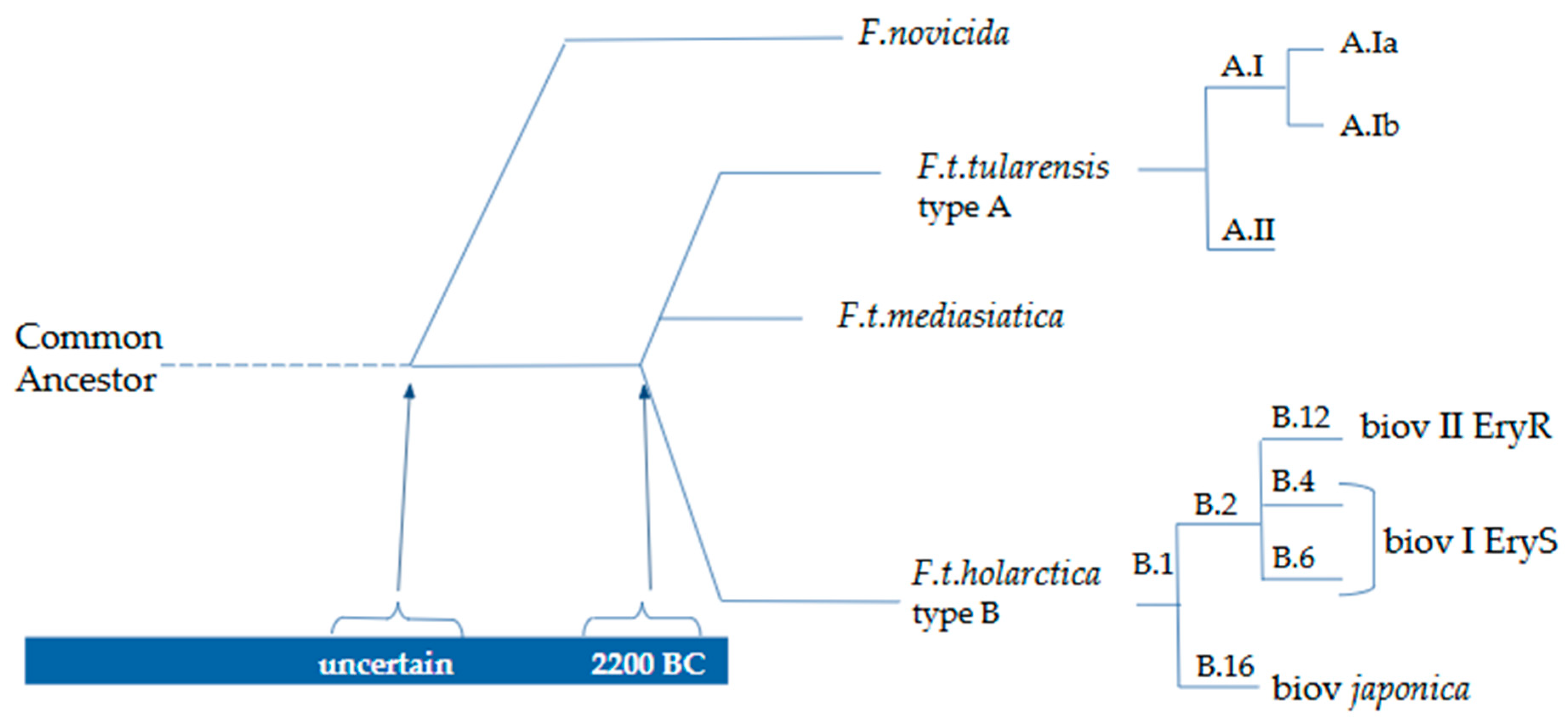
3. Francisella tularensis
4. Epidemiology
5. Ecology and Transmission
6. One Health
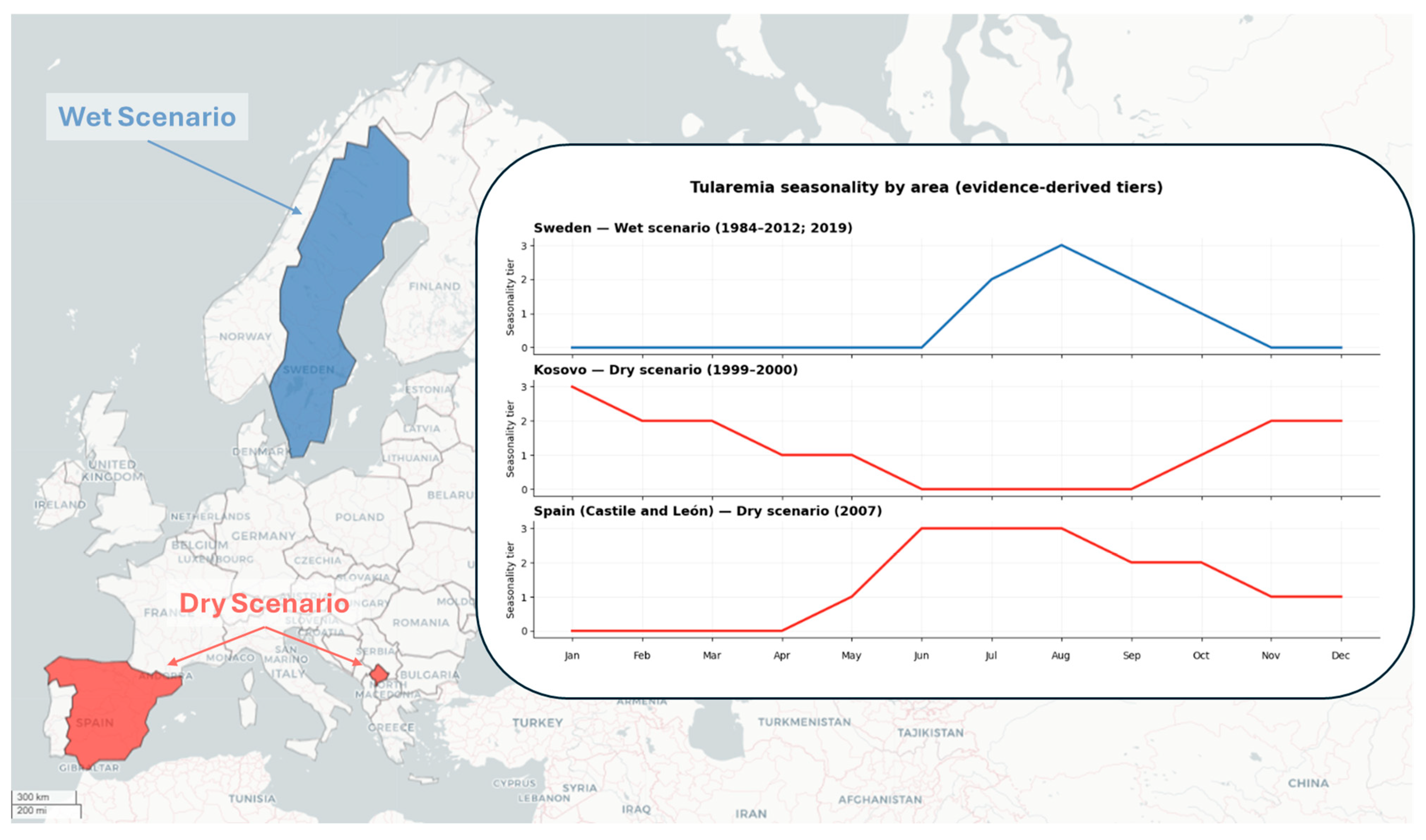
7. Ecological Modeling Framework for Tularemia “Wet” and “Dry” Cycles
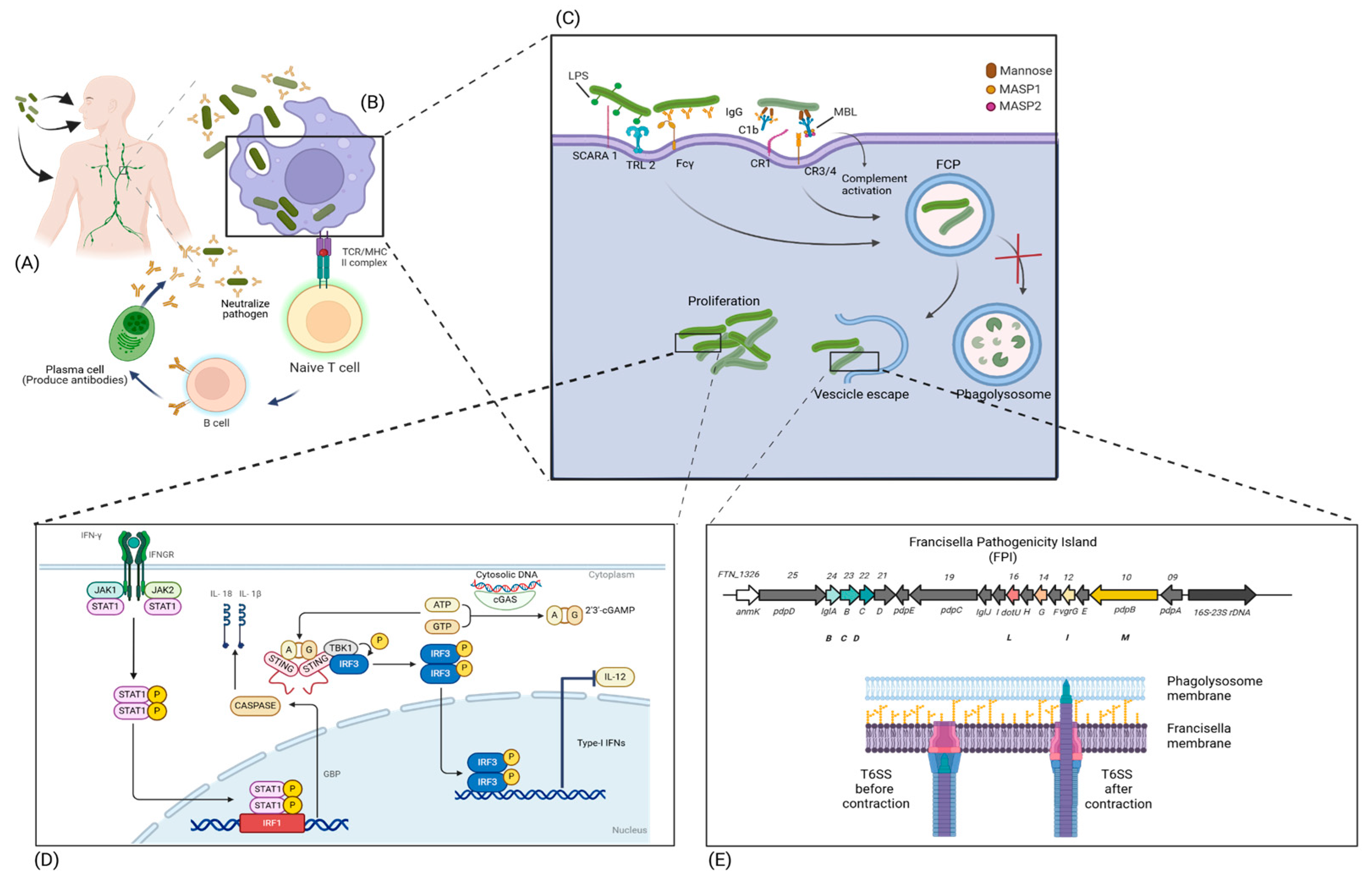
8. Francisella tularensis Entry the Phagocytic Cells and Virulence Factors
9. Host Innate and Adaptive Immune Response
10. Modes of Transmission and Clinical Forms of Tularemia
11. Francisella tularensis as a Possible Biological Weapon
12. Diagnosis
13. Prophylaxis and Therapy
13.1. Vaccines

| Vaccines | Killed | Live | Subunits |
|---|---|---|---|
| Formalin-inactivated or heat-killed bacterial vaccine: highly reactogenic poorly protective [145]. Phenol-inactivated vaccine: some protection to macaques [146]. Inactivated LVS with IL-12 as adjuvant by inhalation almost fully protected mice against a fatal inhalation challenge [150]. Mice immunized via inhalation route with paraformaldehyde- inactivated LVS + cholera toxin B: protected through a Th1 type-mediated mechanism [151]. | LVS from type B F. holarctica strain blue bacterial colony: quite reactogenic, but effective even against typhoidal [149] and partly against pneumonic tularemia [147]. GMP LVS not substantially different from 1962 LVS [152]. Promising are live vaccines obtained by deletion of genes encoding virulence factors, such as cplB [153] guaBA [154] and aroD [155]. | Tul4 and FpoA proteins with CpG adjuvant may induce specific cell-mediated and humoral immunity [156]. Polysaccharide antigen O of LPS linked to different protein components (tetanus toxoid, BSA, and Pseudomonas aeruginosa toxin A): highly immunogenic, but only partially protective [142]. | |
| Antibodies | Polyclonal | Monoclonal | |
| Animal immune sera substantially failed to register a clear antibody-induced protection [157,158,159]. Mice immune sera transferred to other mice 24 h before a fatal inhalation challenge were fully protective. The protection was dependent on FcγR, IFN-γ, neutrophils and macrophages, but not complement [160]. | Monoclonal antibodies against LPS LSV are fully protective if ip or in administered within one hour of lethal LVS intradermal challenge [161]. A monoclonal antibody anti-LPS LVS fully protects against a challenge with LVS and partly against a challenge with Schu S4 strain [162]. |
13.2. Protective Antibodies
13.3. Antibiotics
13.3.1. Post-Exposure Prophylaxis
13.3.2. Therapy
13.3.3. Characteristics of Antibiotics
Aminoglycosides
Chloramphenicol
Tetracyclines
Quinolones
Antibiotic Microbial Resistance
14. Tularemia and Plague: Similar Pathogens, Different Bacteria
15. Current Challenges
16. Conclusions
Author Contributions
Funding
Institutional Review Board Statement
Informed Consent Statement
Data Availability Statement
Conflicts of Interest
References
- Sharma, R.; Patil, R.D.; Singh, B.; Chakraborty, S.; Chandran, D.; Dhama, K.; Gopinath, D.; Jairath, G.; Rialch, A.; Mal, G.; et al. Tularemia—A re-emerging disease with growing concern. Vet. Q. 2023, 43, 1–16. [Google Scholar] [CrossRef] [PubMed]
- Pareek, A.; Malani, P.; Pareek, A.; Singhal, R.; McMahon, L.R.; Apostolopoulos, V.; Chuturgoon, A. Global resurgence of tularemia: Challenges and strategic public health imperatives. New Microbes New Infect. 2025, 66, 101605. [Google Scholar] [CrossRef] [PubMed]
- Nelson, C.A.; Brown, J.; Riley, L.; Dennis, A.; Oyer, R.; Brown, C. Lack of Tularemia Among Health Care Providers with Close Contact with Infected Patients—A Case Series. Open Forum Infect. Dis. 2019, 7, ofz499. [Google Scholar] [CrossRef]
- Oyston, P.C.; Sjostedt, A.; Titball, R.W. Tularaemia: Bioterrorism defence renews interest in Francisella tularensis. Nat. Rev. Microbiol. 2004, 2, 967–978. [Google Scholar] [CrossRef]
- Jellison, W.L. Tularemia: Dr. Edward Francis and His First 23 Isolates of Francisella tularensis. Bull. Hist. Med. 1972, 46, 477–485. [Google Scholar] [PubMed]
- McCoy, G.W. A plague-like disease of rodents. Public Health Bull. 1911, 43, 53–71. [Google Scholar]
- McCoy, G.W.; Chapin, C.W. Bacterium tularense, the cause of a plaguelike disease of rodents. Public Health Bull. 1912, 53, 17–23. [Google Scholar]
- Wherry, W.B.; Lamb, B.H. Infection of man with Bacterium tularense. J. Infect. Dis. 1914, 15, 331–340. [Google Scholar] [CrossRef]
- Dorofeev, K.A. On classification of tularemic bacteriae. Symp. Res. Work. Inst. Epidemiol. Microbiol. Chita 1947, 1, 177–178. [Google Scholar]
- Olsufiev, N.G.; Emelyanova, O.S.; Dunayeva, T.N. Comparative study of strains of B. tularense. II. Evaluation of criteria of virulence of Bacterium tularense in the old and the new world and their taxonomy. J. Hyg. Epidemiol. Mikrobiol. Immunol. 1959, 3, 138–149. [Google Scholar]
- Tärnvik, A.; Berglund, L. Tularaemia. Eur. Respir. J. 2003, 21, 361–373. [Google Scholar] [CrossRef]
- Nelson, C.A.; Sjöstedt, A. Tularemia: A Storied History, An Ongoing Threat. Clin. Infect. Dis. 2024, 78, S1–S3. [Google Scholar] [CrossRef] [PubMed]
- Ohara, S. Studies on Yato-Byo (Ohara’s disease, tularemia in Japan), Report I. Japan J. Exp. Med. 1954, 24, 69–79. [Google Scholar]
- Telford, S.R., III; Goethert, H.K. Ecology of Francisella tularensis. Annu. Rev. Entomol. 2020, 65, 351–372. [Google Scholar] [CrossRef] [PubMed]
- Maurin, M. Francisella tularensis as a potential agent of bioterrorism? Expert. Rev. Anti Infect. Ther. 2015, 13, 141–144. [Google Scholar] [CrossRef]
- Ellis, J.; Oyston, P.C.; Green, M.; Titball, R.W. Tularemia. Clin. Microbiol. Rev. 2002, 15, 631–646. [Google Scholar] [CrossRef] [PubMed]
- Kingry, L.C.; Petersen, J.M. Comparative review of Francisella tularensis and Francisella novicida. Front. Cell. Infect. Microbiol. 2014, 4, 35. [Google Scholar] [CrossRef]
- Svensson, K.; Granberg, M.; Karlsson, L.; Neubauerova, V.; Forsman, M.; Johansson, A. A real-time PCR array for hierarchical identification of Francisella isolates. PLoS ONE 2009, 4, e8360. [Google Scholar] [CrossRef] [PubMed]
- Johansson, A.; Farlow, J.; Larsson, P.; Dukerich, M.; Chambers, E.; Byström, M.; Fox, J.; Chu, M.; Forsman, M.; Sjöstedt, A.; et al. Worldwide genetic relationships among Francisella tularensis isolates determined by multiple-locus variable-number tandem repeat analysis. J. Bacteriol. 2004, 186, 5808–5818. [Google Scholar] [CrossRef]
- Carvalho, C.L.; Lopes de Carvalho, I.; Zé-Zé, L.; Núncio, M.S.; Duarte, E.L. Tularaemia: A challenging zoonosis. Comp. Immunol. Microbiol. Infect. Dis. 2014, 37, 85–96. [Google Scholar] [CrossRef]
- Öhrman, C.; Sahl, J.W.; Sjödin, A.; Uneklint, I.; Ballard, R.; Karlsson, L.; McDonough, R.F.; Sundell, D.; Soria, K.; Bäckman, S.; et al. Reorganized Genomic Taxonomy of Francisellaceae Enables Design of Robust Environmental PCR Assays for Detection of Francisella tularensis. Microorganisms 2021, 9, 146. [Google Scholar] [CrossRef]
- Köppen, K.; Rydzewski, K.; Doellinger, J.; Myrtennäs, K.; Forsman, M.; Appelt, S.; Scholz, H.; Heuner, K. Phenotypic and genotypic discrimination of Francisella tularensis ssp. holarctica clades. Int. J. Med. Microbiol. 2023, 313, 151583. [Google Scholar] [CrossRef] [PubMed]
- Degabriel, M.; Valeva, S.; Boisset, S.; Henry, T. Pathogenicity and virulence of Francisella tularensis. Virulence 2023, 14, 2274638. [Google Scholar] [CrossRef]
- Whipp, M.J.; Davis, J.M.; Lum, G.; de Boer, J.; Zhou, Y.; Bearden, S.W.; Petersen, J.M.; Chu, M.C.; Hogg, G. Characterization of a novicida-like subspecies of Francisella tularensis isolated in Australia. J. Med. Microbiol. 2003, 52, 839–842. [Google Scholar] [CrossRef]
- Forsman, M.; Sandström, G.; Sjöstedt, A. Analysis of 16S ribosomal DNA sequences of Francisella strains and utilization for determination of the phylogeny of the genus and for identification of strains by PCR. Int. J. Syst. Evol. Microbiol. 1994, 44, 38–46. [Google Scholar] [CrossRef]
- Maurin, M. Francisella tularensis, Tularemia and Serological Diagnosis. Front. Cell. Infect. Microbiol. 2020, 10, 512090. [Google Scholar] [CrossRef]
- Eden, J.S.; Rose, K.; Ng, J.; Shi, M.; Wang, Q.; Sintchenko, V.; Holmes, E.C. Francisella tularensis ssp. holarctica in Ringtail Possums, Australia. Emerg. Infect. Dis. 2017, 23, 1198–1201. [Google Scholar] [CrossRef] [PubMed]
- Jackson, J.; McGregor, A.; Cooley, L.; Ng, J.; Brown, M.; Ong, C.W.; Darcy, C.; Sintchenko, V. Francisella tularensis subspecies holarctica, Tasmania, Australia, 2011. Emerg. Infect. Dis. 2012, 18, 1484–1486. [Google Scholar] [CrossRef]
- Sjöstedt, A. Tularemia: History, epidemiology, pathogen physiology, and clinical manifestations. Ann. N. Y. Acad. Sci. 2007, 1105, 1–29. [Google Scholar] [CrossRef] [PubMed]
- Sholeh, M.; Moradkasani, S.; Esmaeili, S. Epidemiology of tularemia in the countries of the WHO Eastern Mediterranean Region (EMRO): A systematic review and meta-analysis. PLoS Negl. Trop. Dis. 2024, 18, e0012141. [Google Scholar] [CrossRef]
- Christensen, C.E.; Horsholt, K.; Aftab, H.; Lichscheidt, E.D.; Larsen, C.S.; Lebech, A.M.; Ebdrup, L.; Helleberg, M. Tularæmi [Tularaemia]. Ugeskr. Læger 2025, 187, V11240819. (In Danish) [Google Scholar] [CrossRef]
- Staples, J.E.; Kubota, K.A.; Chalcraft, L.G.; Mead, P.S.; Petersen, J.M. Epidemiologic and molecular analysis of human tularemia, United States, 1964–2004. Emerg. Infect. Dis. 2006, 12, 1113–1118. [Google Scholar] [CrossRef] [PubMed]
- Faber, M.; Heuner, K.; Jacob, D.; Grunow, R. Tularemia in Germany-A Re-emerging Zoonosis. Front. Cell. Infect. Microbiol. 2018, 8, 40. [Google Scholar] [CrossRef] [PubMed]
- Nothdurfter, S.; Linde, J.; Sting, R.; Tomaso, H.; Heuner, K.; Meincke, M.; Brockmann, S.O.; Wagner-Wiening, C. Epidemiology of Tularemia among Humans and Animals, Baden-Wuerttemberg, Germany, 2012–2022. Emerg. Infect. Dis. 2025, 31, 678–688. [Google Scholar] [CrossRef]
- Hestvik, G.; Warns-Petit, E.; Smith, L.A.; Fox, N.J.; Uhlhorn, H.; Artois, M.; Hannant, D.; Hutchings, M.R.; Mattsson, R.; Yon, L.; et al. The status of tularemia in Europe in a one-health context: A review. Epidemiol. Infect. 2015, 143, 2137–2160. [Google Scholar] [CrossRef] [PubMed]
- European Centre for Disease Prevention and Control. Tularaemia; Annual Epidemiological Report for 2019; ECDC: Stockholm, Sweden, 2021. [Google Scholar]
- European Food Safety Authority (EFSA); European Centre for Disease Prevention and Control (ECDC). The European Union One Health 2021 Zoonoses Report. EFSA J. 2022, 20, 7666. [Google Scholar] [CrossRef]
- European Food Safety Authority (EFSA); European Centre for Disease Prevention and Control (ECDC). The European Union One Health 2023 Zoonoses report. EFSA J. 2024, 22, e9106. [Google Scholar] [CrossRef]
- Brunet, C.D.; Hennebique, A.; Peyroux, J.; Pelloux, I.; Caspar, Y.; Maurin, M. Presence of Francisella tularensis subsp. holarctica DNA in the Aquatic Environment in France. Microorganisms 2021, 9, 1398. [Google Scholar] [CrossRef]
- Buettcher, M.; Egli, A.; Albini, S.; Altpeter, E.; Labutin, A.; Guidi, V.; Tonolla, M.; Lienhard, R.; Opota, O.; Schmid, P.; et al. Tularemia on the rise in Switzerland? A one health approach is needed! Infection 2024, 52, 1165–1169. [Google Scholar] [CrossRef]
- Seiwald, S.; Simeon, A.; Hofer, E.; Weiss, G.; Bellmann-Weiler, R. Tularemia Goes West: Epidemiology of an Emerging Infection in Austria. Microorganisms 2020, 8, 1597. [Google Scholar] [CrossRef]
- Dwibedi, C.; Birdsell, D.; Lärkeryd, A.; Myrtennäs, K.; Öhrman, C.; Nilsson, E.; Karlsson, E.; Hochhalter, C.; Rivera, A.; Maltinsky, S.; et al. Long-range dispersal moved Francisella tularensis into Western Europe from the East. Microb. Genom. 2016, 2, e000100. [Google Scholar] [CrossRef] [PubMed]
- Splettstoesser, W.D.; Piechotowski, I.; Buckendahl, A.; Frangoulidis, D.; Kaysser, P.; Kratzer, W.; Kimmig, P.; Seibold, E.; Brockmann, S.O. Tularemia in Germany: The tip of the iceberg? Epidemiol. Infect. 2009, 137, 736–743. [Google Scholar] [CrossRef] [PubMed]
- D’Alessandro, D.; Napoli, C.; Nusca, A.; Bella, A.; Funari, E. Human tularemia in Italy. Is it a re-emerging disease? Epidemiol. Infect. 2015, 143, 2161–2169. [Google Scholar] [CrossRef] [PubMed]
- Mattatia, C.; Agyeman, P.K.A.; Schöbi, N.; Aebi, S.; Duppenthaler, A.; Büttcher, M.; Aebi, C. Seroepidemiology of Human Tularemia-Systematic Review and Meta-analysis of Seroprevalence Studies. Open Forum Infect. Dis. 2023, 11, ofad636. [Google Scholar] [CrossRef]
- Porsch-Ozcürümez, M.; Kischel, N.; Priebe, H.; Splettstösser, W.; Finke, E.J.; Grunow, R. Comparison of enzyme-linked immunosorbent assay, Western blotting, microagglutination, indirect immunofluorescence assay, and flow cytometry for serological diagnosis of tularemia. Clin. Vaccine Immunol. 2004, 11, 1008–1015. [Google Scholar] [CrossRef]
- Tobudic, S.; Nedomansky, K.; Poeppl, W.; Müller, M.; Faas, A.; Mooseder, G.; Allerberger, F.; Stanek, G.; Burgmann, H. Seroprevalence for Coxiella burnetii, Francisella tularensis, Brucella abortus and Brucella melitensis in Austrian adults: A cross-sectional survey among military personnel and civilians. Ticks Tick-Borne Dis. 2014, 5, 315–317. [Google Scholar] [CrossRef] [PubMed]
- Siller, A.; Chitimia-Dobler, L.; Wilhelm, F.; Amato, M.; Borde, J.P.; Cadamuro, J.; Schennach, H.; Fraunberger, P.; Willeit, P.; Dobler, G.; et al. Francisella tularensis surveillance-infection-induced seroprevalences in Western Austria 2025. Int. J. Infect. Dis. 2026, 163, 108218. [Google Scholar] [CrossRef]
- Rigaud, E.; Jaulhac, B.; Garcia-Bonnet, N.; Hunfeld, K.P.; Féménia, F.; Huet, D.; Goulvestre, C.; Vaillant, V.; Deffontaines, G.; Abadia-Benoist, G. Seroprevalence of seven pathogens transmitted by the Ixodes ricinus tick in forestry workers in France. Clin. Microbiol. Infect. 2016, 22, 735.e1–735.e9. [Google Scholar] [CrossRef]
- Rossow, H.; Ollgren, J.; Hytonen, J.; Rissanen, H.; Huitu, O.; Henttonen, H.; Kuusi, M.; Vapalahti, O. Incidence and seroprevalence of tularaemia in Finland, 1995 to 2013: Regional epidemics with cyclic pattern. Euro. Surveill. 2015, 20, 21209. [Google Scholar] [CrossRef]
- Żukiewicz-Sobczak, W.; Zwoliński, J.; Chmielewska-Badora, J.; Galińska, E.M.; Cholewa, G.; Krasowska, E.; Zagórski, J.; Wojtyła, A.; Tomasiewicz, K.; Kłapeć, T. Prevalence of antibodies against selected zoonotic agents in forestry workers from eastern and southern Poland. Ann. Agric. Environ. Med. 2014, 21, 767–770. [Google Scholar] [CrossRef]
- Zákutná, Ľ.; Dorko, E.; Rimárová, K.; Kizeková, M. Pilot Cross-Sectional Study of Three Zoonoses (Lyme Disease, Tularaemia, Leptospirosis) among Healthy Blood Donors in Eastern Slovakia. Cent. Eur. J. Public Health 2015, 23, 100–106. [Google Scholar] [CrossRef] [PubMed]
- Schulze, C.; Heuner, K.; Myrtennäs, K.; Karlsson, E.; Jacob, D.; Kutzer, P.; Große, K.; Forsman, M.; Grunow, R. High and novel genetic diversity of Francisella tularensis in Germany and indication of environmental persistence. Epidemiol. Infect. 2016, 144, 3025–3036. [Google Scholar] [CrossRef] [PubMed]
- Kuehn, A.; Schulze, C.; Kutzer, P.; Probst, C.; Hlinak, A.; Ochs, A.; Grunow, R. Tularaemia seroprevalence of captured and wild animals in Germany: The fox (Vulpes vulpes) as a biological indicator. Epidemiol. Infect. 2013, 141, 833–840. [Google Scholar] [CrossRef]
- Martinot, M.; Lemmet, T.; Barthel, A.; Suntharasarma, P.; Mohseni-Zadeh, M.; Gregorowicz, G.; Boyer, P.; Hansmann, Y.; Gerber, V. Unusual increase in tularemia incidence in Alsace, Northeastern France in 2024. Ticks Tick-Borne Dis. 2025, 16, 102545. [Google Scholar] [CrossRef]
- Hopla, C.E.; Hopla, A.K. Tularemia. In Handbook of Zoonoses, 2nd ed.; Beran, G.W., Steele, J.H., Eds.; CRC Press, Inc.: Boca Raton, FL, USA, 1994; pp. 113–126. [Google Scholar]
- Kaya, E.; Üçer, H. Tularemia research activity: A bibliometric analysis between 1980 and 2020. Infection 2022, 50, 1507–1515. [Google Scholar] [CrossRef]
- Rijks, J.M.; Tulen, A.D.; Notermans, D.W.; Reubsaet, F.A.G.; de Vries, M.C.; Koene, M.G.J.; Swaan, C.M.; Maas, M. Tularemia Transmission to Humans, the Netherlands, 2011–2021. Emerg. Infect. Dis. 2022, 28, 883–885. [Google Scholar] [CrossRef]
- O’Toole, D.; Williams, E.S.; Woods, L.W.; Mills, K.; Boerger-Fields, A.; Montgomery, D.L.; Jaeger, P.; Edwards, W.H.; Christensen, D.; Marlatt, W. Tularemia in range sheep: An overlooked syndrome? J. Vet. Diagn. Investig. 2008, 20, 508–513. [Google Scholar] [CrossRef]
- Meinkoth, K.R.; Morton, R.J.; Meinkoth, J.H. Naturally occurring tularemia in a dog. J. Am. Vet. Med. Assoc. 2004, 225, 545–547, 538. [Google Scholar] [CrossRef]
- Nordstoga, A.; Handeland, K.; Johansen, T.B.; Iversen, L.; Gavier-Widén, D.; Mattsson, R.; Wik-Larssen, K.; Afset, J.E.; Næverdal, R.; Lund, A. Tularaemia in Norwegian dogs. Vet. Microbiol. 2014, 173, 318–322. [Google Scholar] [CrossRef]
- Maurin, M.; Hennebique, A.; Brunet, C.; Pondérand, L.; Pelloux, I.; Boisset, S.; Caspar, Y. Non-vaccinal prophylaxis of tularemia. Front. Microbiol. 2024, 15, 1507469. [Google Scholar] [CrossRef] [PubMed]
- Kwit, N.A.; Schwartz, A.; Kugeler, K.J.; Mead, P.S.; Nelson, C.A. Human tularaemia associated with exposure to domestic dogs-United States, 2006–2016. Zoonoses Public Health 2019, 66, 417–421. [Google Scholar] [CrossRef] [PubMed]
- Larson, M.A.; Fey, P.D.; Hinrichs, S.H.; Iwen, P.C. Francisella tularensis bacteria associated with feline tularemia in the United States. Emerg. Infect. Dis. 2014, 20, 2068–2071. [Google Scholar] [CrossRef] [PubMed]
- Marx, G.E.; Curren, E.; Olesen, M.; Cronquist, L.; Schlosser, L.; Nichols, M.; Bye, M.; Cote, A.; McCormick, D.W.; Nelson, C.A. Tularemia from veterinary occupational exposure. Clin. Infect. Dis. 2024, 78, S71–S75. [Google Scholar] [CrossRef]
- Sahin, M. Francisella tularensis in Vektörleri ve Doğal Rezervuarları. In Francisella tularensis ve Tularemi; Gürcan, Ş., Ed.; Nobel Tıp Kitabevleri: İstanbul, Türkiye, 2009; pp. 139–160. [Google Scholar]
- Padeshki, P.I.; Ivanov, I.N.; Popov, B.; Kantardjiev, T.V. The role of birds in dissemination of Francisella tularensis: First direct molecular evidence for bird-to-human transmission. Epidemiol. Infect. 2010, 138, 376–379. [Google Scholar] [CrossRef] [PubMed]
- Reese, S.M.; Dietrich, G.; Dolan, M.C.; Sheldon, S.W.; Piesman, J.; Petersen, J.M.; Eisen, R.J. Transmission dynamics of Francisella tularensis subspecies and clades by nymphal Dermacentor variabilis (Acari: Ixodidae). Am. J. Trop. Med. Hyg. 2010, 83, 645–652. [Google Scholar] [CrossRef]
- Reese, S.M.; Petersen, J.M.; Sheldon, S.W.; Dolan, M.C.; Dietrich, G.; Piesman, J.; Eisen, R.J. Transmission efficiency of Francisella tularensis by adult american dog ticks (Acari: Ixodidae). J. Med. Entomol. 2011, 48, 884–890. [Google Scholar] [CrossRef]
- Lundström, J.O.; Andersson, A.C.; Bäckman, S.; Schäfer, M.L.; Forsman, M.; Thelaus, J. Transstadial transmission of Francisella tularensis holarctica in mosquitoes, Sweden. Emerg. Infect. Dis. 2011, 17, 794–799. [Google Scholar] [CrossRef]
- Ozanic, M.; Marecic, V.; Abu Kwaik, Y.; Santic, M. The Divergent Intracellular Lifestyle of Francisella tularensis in Evolutionarily Distinct Host Cells. PLoS Pathog. 2015, 11, e1005208. [Google Scholar] [CrossRef]
- Kaysser, P.; Seibold, E.; Mätz-Rensing, K.; Pfeffer, M.; Essbauer, S.; Splettstoesser, W.D. Re-emergence of tularemia in Germany: Presence of Francisella tularensis in different rodent species in endemic areas. BMC Infect. Dis. 2008, 8, 157. [Google Scholar] [CrossRef]
- Simşek, H.; Taner, M.; Karadenizli, A.; Ertek, M.; Vahaboğlu, H. Identification of Francisella tularensis by both culture and real-time TaqMan PCR methods from environmental water specimens in outbreak areas where tularemia cases were not previously reported. Eur. J. Clin. Microbiol. Infect. Dis. 2012, 31, 2353–2357. [Google Scholar] [CrossRef]
- Janse, I.; van der Plaats, R.Q.J.; de Roda Husman, A.M.; van Passel, M.W.J. Environmental Surveillance of Zoonotic Francisella tularensis in the Netherlands. Front. Cell. Infect. Microbiol. 2018, 8, 140. [Google Scholar] [CrossRef]
- Thelaus, J.; Andersson, A.; Broman, T.; Bäckman, S.; Granberg, M.; Karlsson, L.; Kuoppa, K.; Larsson, E.; Lundmark, E.; Lundström, J.O.; et al. Francisella tularensis subspecies holarctica occurs in Swedish mosquitoes, persists through the developmental stages of laboratory-infected mosquitoes and is transmissible during blood feeding. Microb. Ecol. 2014, 67, 96–107. [Google Scholar] [CrossRef]
- Forsman, M.; Henningson, E.W.; Larsson, E.; Johansson, T.; Sandström, G. Francisella tularensis does not manifest virulence in viable but non-culturable state. FEMS Microbiol. Ecol. 2000, 31, 217–224. [Google Scholar] [CrossRef] [PubMed]
- Abd, H.; Johansson, T.; Golovliov, I.; Sandström, G.; Forsman, M. Survival and Growth of Francisella tularensis in Acanthamoeba castellanii. Appl. Environ. Microbiol. 2003, 69, 600–606. [Google Scholar] [CrossRef]
- Buse, H.Y.; Schaefer, F.W., III; Rice, E.W. Enhanced survival but not amplification of Francisella spp. in the presence of free-living amoebae. Acta Microbiol. Immunol. Hung. 2017, 64, 17–36. [Google Scholar] [CrossRef]
- Hennebique, A.; Peyroux, J.; Brunet, C.; Martin, A.; Henry, T.; Knezevic, M.; Santic, M.; Boisset, S.; Maurin, M. Amoebae Can Promote the Survival of Francisella Species in the Aquatic Environment. Emerg. Microbes Infect. 2021, 10, 277–290. [Google Scholar] [CrossRef] [PubMed]
- Cantlay, S.; Garrison, N.L.; Patterson, R.; Wagner, K.; Kirk, Z.; Fan, J.; Primerano, D.A.; Sullivan, M.L.G.; Franks, J.M.; Stolz, D.B.; et al. Phenotypic and transcriptional characterization of F. tularensis LVS during transition into a viable but non-culturable state. Front. Microbiol. 2024, 15, 1347488. [Google Scholar] [CrossRef]
- Schaudinn, C.; Rydzewski, K.; Meister, B.; Grunow, R.; Heuner, K. Francisella tularensis subsp. holarctica wild-type is able to colonize natural aquatic ex vivo biofilms. Front. Microbiol. 2023, 14, 1113412. [Google Scholar] [CrossRef]
- Sadiku, I.; Namani, S.; Ndrejaj Berisha, V.; Ponosheci Biçaku, A.; Hyseni, S. Tularemia in children during the last outbreak in Kosovo. J. Infect. Dev. Ctries. 2022, 16, 1364–1369. [Google Scholar] [CrossRef]
- Burckhardt, F.; Hoffmann, D.; Jahn, K.; Heuner, K.; Jacob, D.; Vogt, M.; Bent, S.; Grunow, R.; Zanger, P. Oropharyngeal Tularemia from Freshly Pressed Grape Must. N. Engl. J. Med. 2018, 379, 197–199. [Google Scholar] [CrossRef] [PubMed]
- Magnarelli, L.; Levy, S.; Koski, R. Detection of antibodies to Francisella tularensis in cats. Res. Vet. Sci. 2007, 82, 22–26. [Google Scholar] [CrossRef] [PubMed]
- Kleo, K.; Schäfer, D.; Klar, S.; Jacob, D.; Grunow, R.; Lisdat, F. Immunodetection of inactivated Francisella tularensis bacteria by using a quartz crystal microbalance with dissipation monitoring. Anal. Bioanal. Chem. 2012, 404, 843–851. [Google Scholar] [CrossRef]
- Sullivan, A.P.; Nicholson, C.; Bradbury-Squires, D.J.; King, A.; Daley, P. Two cases of tularemia in hunters from rural Newfoundland. J. Assoc. Med. Microbiol. Infect. Dis. Can. 2022, 7, 135–139. [Google Scholar] [CrossRef]
- Parhizgari, N.; Piazak, N.; Mostafavi, E. Vector-borne diseases in Iran: Epidemiology and key challenges. Future Microbiol. 2021, 16, 51–69. [Google Scholar] [CrossRef]
- How Tularemia Spreads. Available online: https://www.cdc.gov/tularemia/causes/index.html (accessed on 22 December 2025).
- Olin, G. The occurrence and mode of transmission of tularemia in Sweden. APMIS 1942, 19, 220–247. [Google Scholar] [CrossRef]
- Kutlu, M.; Ergin, Ç.; Karadenizli, A.; Sayın Kutlu, S. An outbreak of tularemia in southwestern Turkey. J. Infect. Dev. Ctries. 2021, 15, 812–817. [Google Scholar] [CrossRef] [PubMed]
- Hennebique, A.; Boisset, S.; Maurin, M. Tularemia as a waterborne disease: A review. Emerg. Microbes Infect. 2019, 8, 1027–1042. [Google Scholar] [CrossRef]
- Golovliov, I.; Bäckman, S.; Granberg, M.; Salomonsson, E.; Lundmark, E.; Näslund, J.; Busch, J.D.; Birdsell, D.; Sahl, J.W.; Wagner, D.M.; et al. Long-Term Survival of Virulent Tularemia Pathogens outside a Host in Conditions That Mimic Natural Aquatic Environments. Appl. Environ. Microbiol. 2021, 87, e02713-20. [Google Scholar] [CrossRef]
- Wawszczak, M.; Banaszczak, B.; Rastawicki, W. Tularaemia—A diagnostic challenge. Ann. Agric. Environ. Med. 2022, 29, 12–21. [Google Scholar] [CrossRef] [PubMed]
- Antonello, R.M.; Giacomelli, A.; Riccardi, N. Tularemia for clinicians: An up-to-date review on epidemiology, diagnosis, prevention and treatment. Eur. J. Intern. Med. 2025, 135, 25–32. [Google Scholar] [CrossRef]
- Jenzora, A.; Jansen, A.; Ranisch, H.; Lierz, M.; Wichmann, O.; Grunow, R. Seroprevalence study of Francisella tularensis among hunters in Germany. FEMS Immunol. Med. Microbiol. 2008, 53, 183–189. [Google Scholar] [CrossRef]
- Yeşilyurt, M.; Kılıç, S.; Celebi, B.; Gül, S. Tularemi: Avcılar Gerçekten Bir Risk Grubu mu? [Tularemia: Are hunters really a risk group?]. Mikrobiyoloji Bul. 2012, 46, 153–155. [Google Scholar]
- Allue, M.; Sopeña, C.R.; Gallardo, M.T.; Mateos, L.; Vian, E.; Garcia, M.J.; Ramos, J.; Berjon, A.C.; Viña, M.C.; Garcia, M.P.; et al. Tularaemia outbreak in Castilla y León, Spain, 2007, an update. Eurosurveillance 2008, 13, 18948. [Google Scholar] [CrossRef] [PubMed]
- Petersen, J.M.; Schriefer, M.E.; Carter, L.G.; Zhou, Y.; Sealy, T.; Bawiec, D.; Yockey, B.; Urich, S.; Zeidner, N.S.; Avashia, S.; et al. Laboratory analysis of tularemia in wild-trapped, commercially traded prairie dogs, Texas, 2002. Emerg. Infect. Dis. 2004, 10, 419–425. [Google Scholar] [CrossRef] [PubMed]
- Avashia, S.B.; Petersen, J.M.; Lindley, C.M.; Schriefer, M.E.; Gage, K.L.; Cetron, M.; DeMarcus, T.A.; Kim, D.K.; Buck, J.; Montenieri, J.A.; et al. First reported prairie dog-to-human tularemia transmission, Texas, 2002. Emerg. Infect. Dis. 2004, 10, 483–486. [Google Scholar] [CrossRef]
- Rydén, P.; Sjöstedt, A.; Johansson, A. Effects of climate change on tularaemia disease activity in Sweden. Glob. Health Action 2009, 2, 2063. [Google Scholar] [CrossRef]
- Mínguez-González, O.; Gutiérrez-Martín, C.B.; Martínez-Nistal, M.D.C.; Esquivel-García, M.D.R.; Gómez-Campillo, J.I.; Collazos-Martínez, J.Á.; Fernández-Calle, L.M.; Ruiz-Sopeña, C.; Tamames-Gómez, S.; Martínez-Martínez, S.; et al. Tularemia Outbreaks in Spain from 2007 to 2020 in Humans and Domestic and Wild Animals. Pathogens 2021, 10, 892. [Google Scholar] [CrossRef]
- Reintjes, R.; Dedushaj, I.; Gjini, A.; Jorgensen, T.R.; Cotter, B.; Lieftucht, A.; D’Ancona, F.; Dennis, D.T.; Kosoy, M.A.; Mulliqi-Osmani, G.; et al. Tularemia outbreak investigation in Kosovo: Case control and environmental studies. Emerg. Infect. Dis. 2002, 8, 69–73. [Google Scholar] [CrossRef] [PubMed]
- Berrada, Z.L.; Goethert, H.K.; Telford, S.R., III. Raccoons and skunks as sentinels for enzootic tularemia. Emerg. Infect. Dis. 2006, 12, 1019–1021. [Google Scholar] [CrossRef]
- Desvars-Larrive, A.; Liu, X.; Hjertqvist, M.; Sjöstedt, A.; Johansson, A.; Rydén, P. High-risk regions and outbreak modelling of tularemia in humans. Epidemiol. Infect. 2017, 145, 482–490. [Google Scholar] [CrossRef]
- Kulldorff, M. A spatial scan statistic. Commun. Stat. Theory Methods 1997, 26, 1481–1496. [Google Scholar] [CrossRef]
- Rouco, C.; Luque-Larena, J.J.; Vidal, D.; Mougeot, F. Vole outbreaks may induce a tularemia disease pit that prevents Iberian hare population recovery in NW Spain. Sci. Rep. 2023, 13, 3898. [Google Scholar] [CrossRef]
- Ariza-Miguel, J.; Johansson, A.; Fernández-Natal, M.I.; Martínez-Nistal, C.; Orduña, A.; Rodríguez-Ferri, E.F.; Hernández, M.; Rodríguez-Lázaro, D. Molecular investigation of tularemia outbreaks, Spain, 1997–2008. Emerg. Infect. Dis. 2014, 20, 754–761. [Google Scholar] [CrossRef]
- Dryselius, R.; Hjertqvist, M.; Mäkitalo, S.; Lindblom, A.; Lilja, T.; Eklöf, D.; Lindström, A. Large outbreak of tularaemia, central Sweden, July to September 2019. Eurosurveillance 2019, 24, 1900603. [Google Scholar] [CrossRef]
- Grunow, R.; Finke, E.J. A procedure for differentiating between the intentional release of biological warfare agents and natural outbreaks of disease: Its use in analyzing the tularemia outbreak in Kosovo in 1999 and 2000. Clin. Microbiol. Infect. 2002, 8, 510–521. [Google Scholar] [CrossRef]
- Luque-Larena, J.J.; Mougeot, F.; Roig, D.V.; Lambin, X.; Rodríguez-Pastor, R.; Rodríguez-Valín, E.; Anda, P.; Escudero, R. Tularemia Outbreaks and Common Vole (Microtus arvalis) Irruptive Population Dynamics in Northwestern Spain, 1997–2014. Vector-Borne Zoonotic Dis. 2015, 15, 568–570. [Google Scholar] [CrossRef] [PubMed]
- Herrero-Cófreces, S.; Mougeot, F.; Lambin, X.; Luque-Larena, J.J. Linking Zoonosis Emergence to Farmland Invasion by Fluctuating Herbivores: Common Vole Populations and Tularemia Outbreaks in NW Spain. Front. Vet. Sci. 2021, 8, 698454. [Google Scholar] [CrossRef] [PubMed]
- Schwartz, J.T.; Barker, J.H.; Long, M.E.; Kaufman, J.; McCracken, J.; Allen, L.A. Natural IgM mediates complement-dependent uptake of Francisella tularensis by human neutrophils via complement receptors 1 and 3 in nonimmune serum. J. Immunol. 2012, 189, 3064–3077. [Google Scholar] [CrossRef] [PubMed]
- Pierini, L.M. Uptake of serum-opsonized Francisella tularensis by macrophages can be mediated by class a scavenger receptors. Cell. Microbiol. 2006, 8, 1361–1370. [Google Scholar] [CrossRef] [PubMed]
- Schulert, G.S.; Allen, L.A. Differential infection of mononuclear phagocytes by Francisella tularensis: Role of the macrophage mannose receptor. J. Leukoc. Biol. 2006, 80, 563–571. [Google Scholar] [CrossRef]
- Chung, L.K.; Bliska, J.B. Yersinia versus host immunity: How a pathogen evades or triggers a protective response. Curr. Opin. Microbiol. 2016, 29, 56–62. [Google Scholar] [CrossRef]
- Barker, J.R.; Chong, A.; Wehrly, T.D.; Yu, J.J.; Rodriguez, S.A.; Liu, J.; Celli, J.; Arulanandam, B.P.; Klose, K.E. The Francisella tularensis pathogenicity island encodes a secretion system that is required for phagosome escape and virulence. Mol. Microbiol. 2009, 74, 1459–1470. [Google Scholar] [CrossRef] [PubMed]
- WHO Guidelines on Tularaemia; World Health Organization: Geneva, Switzerland, 2007.
- World Health Organization. Public Health Response to Biological and Chemical Weapons, WHO Guidance; World Health Organization: Geneva, Switzerland, 2004. [Google Scholar]
- Maurin, M.; Gyuranecz, M. Tularaemia: Clinical aspects in Europe. Lancet Infect. Dis. 2016, 16, 113–124. [Google Scholar] [CrossRef]
- Biological and chemical terrorism: Strategic plan for preparedness and response. Recommendations of the CDC Strategic Planning Workgroup. MMWR Recomm. Rep. 2000, 49, 1–14.
- Dennis, D.T.; Inglesby, T.V.; Henderson, D.A.; Bartlett, J.G.; Ascher, M.S.; Eitzen, E.; Fine, A.D.; Friedlander, A.M.; Hauer, J.; Layton, M.; et al. Working Group on Civilian Biodefense. Tularemia as a biological weapon: Medical and public health management. JAMA 2001, 285, 2763–2773. [Google Scholar] [CrossRef]
- World Health Organization. Health Aspects of Chemical and Biological Weapons; World Health Organization: Geneva, Switzerland, 1970; p. 98. [Google Scholar]
- Kaufmann, A.F.; Meltzer, M.I.; Schmid, G.P. The economic impact of a bioterrorist attack: Are prevention and postattack intervention programs justifiable? Emerg. Infect. Dis. 1997, 3, 83–94. [Google Scholar] [CrossRef]
- Gürcan, S. Epidemiology of tularemia. Balkan Med. J. 2014, 31, 3–10. [Google Scholar] [CrossRef]
- Kantardjiev, T.; Ivanov, I.; Velinov, T.; Padeshki, P.; Popov, B.; Nenova, R.; Mincheff, M. Tularemia outbreak, Bulgaria, 1997–2005. Emerg. Infect. Dis. 2006, 12, 678–680. [Google Scholar] [CrossRef] [PubMed]
- Brown, S.L.; McKinney, F.T.; Klein, G.C.; Jones, W.L. Evaluation of a safranin-O-stained antigen microagglutination test for francisella tularensis antibodies. J. Clin. Microbiol. 1980, 11, 146–148. [Google Scholar] [CrossRef] [PubMed]
- Viljanen, M.K.; Nurmi, T.; Salminen, A. Enzyme-linked immunosorbent assay (ELISA) with bacterial sonicate antigen for IgM, IgA, and IgG antibodies to Francisella tularensis: Comparison with bacterial agglutination test and ELISA with lipopolysaccharide antigen. J. Infect. Dis. 1983, 148, 715–720. [Google Scholar] [CrossRef]
- Bevanger, L.; Maeland, J.A.; Kvan, A.I. Comparative analysis of antibodies to Francisella tularensis antigens during the acute phase of tularemia and eight years later. Clin. Diagn. Lab. Immunol. 1994, 1, 238–240. [Google Scholar] [CrossRef]
- Mechaly, A.; Vitner, E.; Levy, H.; Weiss, S.; Bar-David, E.; Gur, D.; Koren, M.; Cohen, H.; Cohen, O.; Mamroud, E.; et al. Simultaneous Immunodetection of Anthrax, Plague, and Tularemia from Blood Cultures by Use of Multiplexed Suspension Arrays. J. Clin. Microbiol. 2018, 56, e01479-17. [Google Scholar] [CrossRef]
- Petersen, J.M.; Schriefer, M.E.; Gage, K.L.; Montenieri, J.A.; Carter, L.G.; Stanley, M.; Chu, M.C. Methods for enhanced culture recovery of Francisella tularensis. Appl. Environ. Microbiol. 2004, 70, 3733–3735. [Google Scholar] [CrossRef] [PubMed]
- Zeidner, N.S.; Carter, L.G.; Monteneiri, J.A.; Petersen, J.M.; Schriefer, M.; Gage, K.L.; Hall, G.; Chu, M.C. An outbreak of Francisella tularensis in captive prairie dogs: An immunohistochemical analysis. J. Vet. Diagn. Investig. 2004, 16, 150–152. [Google Scholar] [CrossRef] [PubMed]
- Fulop, M.; Leslie, D.; Titball, R. A rapid, highly sensitive method for the detection of Francisella tularensis in clinical samples using the polymerase chain reaction. Am. J. Trop. Med. Hyg. 1996, 54, 364–366. [Google Scholar] [CrossRef] [PubMed]
- Sjöstedt, A.; Eriksson, U.; Berglund, L.; Tärnvik, A. Detection of Francisella tularensis in ulcers of patients with tularemia by PCR. J. Clin. Microbiol. 1997, 35, 1045–1048. [Google Scholar] [CrossRef]
- Johansson, A.; Berglund, L.; Eriksson, U.; Göransson, I.; Wollin, R.; Forsman, M.; Tärnvik, A.; Sjöstedt, A. Comparative analysis of PCR versus culture for diagnosis of ulceroglandular tularemia. J. Clin. Microbiol. 2000, 38, 22–26. [Google Scholar] [CrossRef]
- Versage, J.L.; Severin, D.D.; Chu, M.C.; Petersen, J.M. Development of a multitarget real-time TaqMan PCR assay for enhanced detection of Francisella tularensis in complex specimens. J. Clin. Microbiol. 2003, 41, 5492–5499. [Google Scholar] [CrossRef]
- Kugeler, K.J.; Pappert, R.; Zhou, Y.; Petersen, J.M. Real-time PCR for Francisella tularensis types A and B. Emerg. Infect. Dis. 2006, 12, 1799–1801. [Google Scholar] [CrossRef]
- Shevtsov, A.; Dauletov, A.; Izbanova, U.; Kairzhanova, A.; Tursunbay, N.; Kiyan, V.; Vergnaud, G. Development of a Real-Time PCR Assay for the Detection of Francisella spp. and the Identification of F. tularensis subsp. Mediasiatica. Microorganisms 2024, 12, 2345. [Google Scholar] [CrossRef]
- Clarridge, J.E., III. Impact of 16S rRNA gene sequence analysis for identification of bacteria on clinical microbiology and infectious diseases. Clin. Microbiol. Rev. 2004, 17, 840–862. [Google Scholar] [CrossRef]
- Regoui, S.; Hennebique, A.; Girard, T.; Boisset, S.; Caspar, Y.; Maurin, M. Optimized MALDI TOF Mass Spectrometry Identification of Francisella tularensis Subsp. holarctica. Microorganisms 2020, 8, 1143. [Google Scholar] [CrossRef] [PubMed]
- De Vries, M.C.; Hoeve-Bakker, B.J.A.; van den Beld, M.J.C.; Hendriks, A.C.A.; Harpal, A.S.D.; Noomen, R.C.E.A.; Reubsaet, F.A.G. Identification of Francisella tularensis Subspecies in a Clinical Setting Using MALDI-TOF MS: An In-House Francisella Library and Biomarkers. Microorganisms 2023, 11, 905. [Google Scholar] [CrossRef]
- Plotkin, S.A. Correlates of vaccine-induced immunity. Clin. Infect. Dis. 2008, 47, 401–409. [Google Scholar] [CrossRef]
- Harrell, J.E.; Roy, C.J.; Gunn, J.S.; McLachlan, J.B. Current vaccine strategies and novel approaches to combatting Francisella infection. Vaccine 2024, 42, 2171–2180. [Google Scholar] [CrossRef]
- Tran, K.A.; Pernet, E.; Sadeghi, M.; Downey, J.; Chronopoulos, J.; Lapshina, E.; Tsai, O.; Kaufmann, E.; Ding, J.; Divangahi, M. BCG immunization induces CX3CR1hi effector memory T cells to provide cross-protection via IFN-γ-mediated trained immunity. Nat. Immunol. 2024, 25, 418–431. [Google Scholar] [CrossRef]
- D’Amelio, R.; Tagliabue, A.; Nencioni, L.; Di Addario, A.; Villa, L.; Manganaro, M.; Boraschi, D.; Le Moli, S.; Nisini, R.; Matricardi, P.M. Comparative analysis of immunological responses to oral (Ty21a) and parenteral (TAB) typhoid vaccines. Infect. Immun. 1988, 56, 2731–2735. [Google Scholar] [CrossRef]
- Foshay, L.; Hesselbrock, W.H.; Wittenberg, H.J.; Rodenberg, A.H. Vaccine prophylaxis against tularemia in man. Am. J. Public Health Nations Health 2011, 32, 1131–1145. [Google Scholar] [CrossRef] [PubMed]
- Coriell, L.L.; King, E.O.; Smith, M.G. Studies on Tularemia: IV. Observations on Tularemia in Normal and Vaccinated Monkeys. J. Immunol. 1948, 58, 183–202. [Google Scholar] [CrossRef] [PubMed]
- Cross, A.S.; Calia, F.M.; Edelman, R. From rabbits to humans: The contributions of Dr. Theodore E. Woodward to tularemia research. Clin. Infect. Dis. 2007, 45, S61–S67. [Google Scholar] [CrossRef]
- Wayne Conlan, J.; Oyston, P.C. Vaccines against Francisella tularensis. Ann. N. Y. Acad. Sci. 2007, 1105, 325–350. [Google Scholar] [CrossRef] [PubMed]
- Burke, D.S. Immunization against tularemia: Analysis of the effectiveness of live Francisella tularensis vaccine in prevention of laboratory-acquired tularemia. J. Infect. Dis. 1977, 135, 55–60. [Google Scholar] [CrossRef]
- Baron, S.D.; Singh, R.; Metzger, D.W. Inactivated Francisella tularensis live vaccine strain protects against respiratory tularemia by intranasal vaccination in an immunoglobulin A-dependent fashion. Infect. Immun. 2007, 75, 2152–2162. [Google Scholar] [CrossRef] [PubMed]
- Bitsaktsis, C.; Rawool, D.B.; Li, Y.; Kurkure, N.V.; Iglesias, B.; Gosselin, E.J. Differential requirements for protection against mucosal challenge with Francisella tularensis in the presence versus absence of cholera Toxin B and inactivated F. tularensis. J. Immunol. 2009, 182, 4899–4909. [Google Scholar] [CrossRef]
- Mulligan, M.J.; Stapleton, J.T.; Keitel, W.A.; Frey, S.E.; Chen, W.H.; Rouphael, N.; Edupuganti, S.; Beck, A.; Winokur, P.L.; El Sahly, H.M.; et al. Tularemia vaccine: Safety, reactogenicity, “Take” skin reactions, and antibody responses following vaccination with a new lot of the Francisella tularensis live vaccine strain—A phase 2 randomized clinical Trial. Vaccine 2017, 35, 4730–4737. [Google Scholar] [CrossRef]
- Alam, A.; Bröms, J.E.; Kumar, R.; Sjöstedt, A. The Role of ClpB in Bacterial Stress Responses and Virulence. Front. Mol. Biosci. 2021, 8, 668910. [Google Scholar] [CrossRef]
- Marohn, M.E.; Barry, E.M. Live attenuated tularemia vaccines: Recent developments and future goals. Vaccine 2013, 31, 3485–3491. [Google Scholar] [CrossRef]
- Cunningham, A.L.; Mann, B.J.; Qin, A.; Santiago, A.E.; Grassel, C.; Lipsky, M.; Vogel, S.N.; Barry, E.M. Characterization of Schu S4 aro mutants as live attenuated tularemia vaccine candidates. Virulence 2020, 11, 283–294. [Google Scholar] [CrossRef]
- Oh, H.; Kim, C.Y.; Kim, C.H.; Hur, G.H.; Park, J.H. A Synthetic Tul4 and FopA peptide cocktail of Francisella tularensis Induces Humoral and Cell-Mediated immune responses in mice. J. Microbiol. Biotechn 2016, 26, 1613–1619. [Google Scholar] [CrossRef] [PubMed]
- Foshay, L. Tularemia: A Summary of Certain Aspects of the Disease Including Methods for Early Diagnosis and The Results of Serum Treatment in 600 Patients. Medicine 1940, 19, 1–84. [Google Scholar] [CrossRef]
- Foshay, L. A comparative study of the treatment of tularemia with immune serum, hyperimmune serum and streptomycin. Am. J. Med. 1946, 1, 180–188. [Google Scholar] [CrossRef]
- Francis, E.; Felton, L.D. Antitularemic serum. Public Health Rep. 1942, 57, 44–55. [Google Scholar] [CrossRef]
- Kirimanjeswara, G.S.; Golden, J.M.; Bakshi, C.S.; Metzger, D.W. Prophylactic and therapeutic use of antibodies for protection against respiratory infection with Francisella tularensis. J. Immunology. 2007, 179, 532–539. [Google Scholar] [CrossRef] [PubMed]
- Lu, Z.; Roche, M.I.; Hui, J.H.; Unal, B.; Felgner, P.L.; Gulati, S.; Madico, G.; Sharon, J. Generation and characterization of hybridoma antibodies for immunotherapy of tularemia. Immunol. Lett. 2007, 112, 92–103. [Google Scholar] [CrossRef]
- Savitt, A.G.; Mena-Taboada, P.; Monsalve, G.; Benach, J.L. Francisella tularensis infection-derived monoclonal antibodies provide detection, protection, and therapy. Clin. Vaccine Immunol. 2009, 16, 414–422. [Google Scholar] [CrossRef] [PubMed]
- Eneslätt, K.; Rietz, C.; Rydén, P.; Stöven, S.; House, R.V.; Wolfraim, L.A.; Tärnvik, A.; Sjöstedt, A. Persistence of cell-mediated immunity three decades after vaccination with the live vaccine strain of Francisella tularensis. Eur. J. Immunol. 2011, 41, 974–980. [Google Scholar] [CrossRef] [PubMed]
- Elkins, K.L.; Kurtz, S.L.; Pascalis, R.D. Progress, challenges, and opportunities in Francisella vaccine development. Expert Rev. Vaccines 2016, 15, 1183–1196. [Google Scholar] [CrossRef]
- Saunders, D.L.; Pierson, B.C.; Haller, J.; Norris, S.; Cardile, A.P.; Reisler, R.B.; Okwesili, A.C.; Boudreau, E.; Rusnak, J.; Danner, D.K.; et al. Longitudinal phase 2 clinical trials of live, attenuated tularemia vaccine in healthy research laboratory workers. Front. Bacteriol. 2024, 2, 1289461. [Google Scholar] [CrossRef]
- Barrigan, L.M.; Tuladhar, S.; Brunton, J.C.; Woolard, M.D.; Chen, C.; Saini, D.; Frothingham, R.; Sempowski, G.D.; Kawula, T.H.; Frelinger, J.A. Infection with Francisella tularensis LVS clpB leads to an altered yet protective immune response. Infect. Immun. 2013, 81, 2028–2042. [Google Scholar] [CrossRef]
- Golovliov, I.; Twine, S.M.; Shen, H.; Sjostedt, A.; Conlan, W. A ΔclpB Mutant of Francisella tularensis Subspecies holarctica Strain, FSC200, Is a More Effective Live Vaccine than F. tularensis LVS in a Mouse Respiratory Challenge Model of Tularemia. PLoS ONE 2013, 8, e78671. [Google Scholar] [CrossRef]
- De Pascalis, R.; Frey, B.; Rice, H.M.; Bhargava, V.; Wu, T.H.; Peterson, R.L.; Conlan, J.W.; Sjöstedt, A.; Elkins, K.L. Working correlates of protection predict SchuS4-derived-vaccine candidates with improved efficacy against an intracellular bacterium, Francisella tularensis. NPJ Vaccines 2022, 7, 95. [Google Scholar] [CrossRef]
- Shoudy, L.E.; Namjoshi, P.; Giordano, G.; Kumar, S.; Bowling, J.D.; Gelhaus, C.; Barry, E.M.; Hazlett, A.J.; Hazlett, B.A.; Cooper, K.L.; et al. The O-Ag Antibody Response to Francisella Is Distinct in Rodents and Higher Animals and Can Serve as a Correlate of Protection. Pathogens 2021, 10, 1646. [Google Scholar] [CrossRef]
- Skyberg, J.A. Immunotherapy for tularemia. Virulence 2013, 4, 859–870. [Google Scholar] [CrossRef][Green Version]
- Forestal, C.A.; Malik, M.; Catlett, S.V.; Savitt, A.G.; Benach, J.L.; Sellati, T.J.; Furie, M.B. Francisella tularensis has a significant extracellular phase in infected mice. J. Infect. Dis. 2007, 196, 134–137. [Google Scholar] [CrossRef] [PubMed]
- Foshay, L.; Ruchman, I.; Nicholes, P.S. Antitularense serum: Correlation between protective capacity for white rats and precipitable antibody content. J. Clin. Investig. 1947, 26, 756–760. [Google Scholar] [CrossRef]
- Larson, C.L. A serum protection test in tularemic infections in white rats. Public Health Rep. 1947, 62, 1793–1799. [Google Scholar] [CrossRef] [PubMed]
- Rhinehart-Jones, T.R.; Fortier, A.H.; Elkins, K.L. Transfer of immunity against lethal murine Francisella infection by specific antibody depends on host gamma interferon and T cells. Infect. Immun. 1994, 62, 3129–3137. [Google Scholar] [CrossRef] [PubMed]
- Klimpel, G.R.; Eaves-Pyles, T.; Moen, S.T.; Taormina, J.; Peterson, J.W.; Chopra, A.K.; Niesel, D.W.; Carness, P.; Haithcoat, J.L.; Kirtley, M.; et al. Levofloxacin rescues mice from lethal intra-nasal infections with virulent Francisella tularensis and induces immunity and production of protective antibody. Vaccine 2008, 26, 6874–6882. [Google Scholar] [CrossRef]
- Anda, P.; Pearson, A.; Tärnvik, A. Treatment. In WHO Guidelines on Tularaemia; World Health Organization: Geneva, Switzerland, 2007; pp. 21–26. [Google Scholar]
- Mason, W.L.; Eigelsbach, H.T.; Little, S.F.; Bates, J.H. Treatment of tularemia, including pulmonary tularemia, with gentamicin. Am. Rev. Respir. Dis. 1980, 121, 39–45. [Google Scholar] [CrossRef]
- Maurin, M.; Mersali, N.F.; Raoult, D. Bactericidal activities of antibiotics against intracellular Francisella tularensis. Antimicrob. Agents Chemother. 2000, 44, 3428–3431. [Google Scholar] [CrossRef]
- Enderlin, G.; Morales, L.; Jacobs, R.F.; Cross, J.T. Streptomycin and alternative agents for the treatment of tularemia: Review of the literature. Clin. Infect. Dis. 1994, 19, 42–47. [Google Scholar] [CrossRef] [PubMed]
- Pérez-Castrillón, J.L.; Bachiller-Luque, P.; Martín-Luquero, M.; Mena-Martín, F.J.; Herreros, V. Tularemia epidemic in northwestern Spain: Clinical description and therapeutic response. Clin. Infect. Dis. 2001, 33, 573–576. [Google Scholar] [CrossRef]
- Ciammaruconi, A.; Di Spirito, M.; Pascolini, C.; Molinari, F.; Rozov, O.; Cavalli, M.; Campoli, G.; Totaro, N.; Recchia, E.; Chimienti, S.; et al. Plagued by the Past, Pressed by the Present: A One Health Perspective on Yersinia pestis. Biomedicines 2025, 13, 2555. [Google Scholar] [CrossRef]
- Ritter, D.B.; Gerloff, R.K. Deoxyribonucleic acid hybridization among some species of the genus Pasteurella. J. Bacteriol. 1966, 92, 1838–1839. [Google Scholar] [CrossRef]
- Larsson, P.; Oyston, P.C.; Chain, P.; Chu, M.C.; Duffield, M.; Fuxelius, H.H.; Garcia, E.; Hälltorp, G.; Johansson, D.; Isherwood, K.E.; et al. The complete genome sequence of Francisella tularensis, the causative agent of tularemia. Nat. Genet. 2005, 37, 153–159. [Google Scholar] [CrossRef]
- Parkhill, J.; Wren, B.; Thomson, N.; Titball, R.W.; Holden, M.T.G.; Prentice, M.B.; Sebaihia, M.; James, K.D.; Churcher, C.; Mungall, K.L.; et al. Genome sequence of Yersinia pestis, the causative agent of plague. Nature 2001, 413, 523–527. [Google Scholar] [CrossRef] [PubMed]
- Butler, T. Plague and tularemia. Pediatr. Clin. N. Am. 1979, 26, 355–366. [Google Scholar] [CrossRef]
- Leal-Balbino, T.C.; de Oliveira, M.B.M.; de Barros, M.P.S.; Sobreira, M.; da Mota Silveira-Filho, V. Plague and Tularemia. In Arthropod Borne Diseases; Marcondes, C., Ed.; Springer: Cham, Switzerland, 2017. [Google Scholar] [CrossRef]
- Merhej, V.; Royer-Carenzi, M.; Pontarotti, P.; Raoult, D. Massive comparative genomic analysis reveals convergent evolution of specialized bacteria. Biol. Direct 2009, 4, 13. [Google Scholar] [CrossRef]
- Trevisanato, S.I. Did an epidemic of tularemia in Ancient Egypt affect the course of world history? Med. Hypotheses 2004, 63, 905–910. [Google Scholar] [CrossRef]
- Trevisanato, S.I. The ‘Hittite plague’, an epidemic of tularemia and the first record of biological warfare. Med. Hypotheses 2007, 69, 1371–1374. [Google Scholar] [CrossRef] [PubMed]
- Trevisanato, S.I. The biblical plague of the Philistines now has a name, tularemia. Med. Hypotheses 2007, 69, 1144–1146. [Google Scholar] [CrossRef] [PubMed]
- Martín-Serradilla, J.I.; Guerrero-Peral, A.L.; Laherrán, E. Was the ‘Hittite plague’ an epidemic of tularemia? Med. Hypotheses 2008, 71, 154–155. [Google Scholar] [CrossRef]
- Light-Maka, I.; Hermes, T.R.; Bianco, R.A.; Semerau, L.; Kosintsev, P.; Alekseeva, V.; Kim, D.; Hanage, W.P.; Herbig, A.; Jeong, C.; et al. Bronze Age Yersinia pestis genome from sheep sheds light on hosts and evolution of a prehistoric plague lineage. Cell 2025, 188, 5748–5762.e18. [Google Scholar] [CrossRef] [PubMed]
- Svensson, K.; Larsson, P.; Johansson, D.; Byström, M.; Forsman, M.; Johansson, A. Evolution of subspecies of Francisella tularensis. J. Bacteriol. 2005, 187, 3903–3908. [Google Scholar] [CrossRef]
- Wang, W.; Zhang, R.; Yang, G.; Wang, Y. New insights into the evolutionary origin of Francisella tularensis subsp. holarctica. J. Infect. Public Health 2025, 18, 102878. [Google Scholar] [CrossRef] [PubMed]


| Case Definitions | Suspect Case | Presumptive Case | Confirmed Case |
|---|---|---|---|
| Exposure history with suggestive clinical symptoms | Suggestive clinical symptoms and detection of F. tularensis antigen or DNA in a biological sample or with a single positive serological result. | Identification of F. tularensis in culture by antigen or DNA detection, or serological confirmation based on paired serum specimens showing a fourfold difference in antibody titers when tube or microagglutination assay are used, or statistically significant increase in titers when ELISA is used, with at least one serum sample testing positive. | |
| Laboratory diagnosis | Culture | Molecular | Immunological |
| Growth in cysteine/cystine rich agar for 24–48 h: recognition by antigen/DNA identification | Conventional PCR for FopA/tul4 genes Multitarget real-time TaqMan for ISFtu2 element, 23kDa, FopA, tul4 genes | For Antibody identification:
|
| Post-Exposure Prophylaxis | Ciprofloxacin 500 mg or Doxycycline 100 mg | orally: twice a day for 15 days starting no more than 24 h after the accident |
| Therapy for adults | Gentamicin 2.5 mg/kg | parenterally: twice a day for 10 days or more according to the clinical response |
| Streptomycin 2 g/day | intramuscularly: twice a day for 10 days or more according to the clinical response | |
| Ciprofloxacin 800–1000 mg/day (in less severe forms and mass casualty settings) | intravenously or orally: twice a day for 10–14 days | |
| Doxycycline at 100 mg (in less severe forms and mass casualty settings) | orally: twice a day for at least 15 days | |
| Therapy for children | Gentamicin 5–6 mg/kg | parenterally: twice a day and monitored by serum concentration for at least 10 days |
| Streptomycin 15 mg/kg | intramuscularly: twice a day (up to 2 g daily) for at least 10 days | |
| Ciprofloxacin 15 mg/kg (in milder forms and areas endemic for tularemia type B) | orally: twice daily (no more than 1 g daily) for at least 10 days |
| Characteristics | Francisella tularensis | Yersinia pestis |
|---|---|---|
| Disease | Tularemia | Plague |
| Transmission | Vector bite, inhalation, contact, ingestion | Vector bite, inhalation, contact |
| Main Reservoirs | Rodents, Lagomorphs | Rodents, Lagomorphs |
| Average incubation period | 3–5 days | 2–3 days |
| Mortality rate | 1–30% | 15–70% |
| Macrophage multiplication site | Cytoplasm | Phagolysosomes |
| Growth within amoebae | Yes | Yes |
| Genome size | 1.8 Mb | 4.65 Mb |
| Motility | No | No |
| Intracellular | Facultative | Facultative |
| Ecosystems | Terrestrial Foci | Terrestrial and water Foci |
| Approved vaccines | No | No |
| Approved protective antibodies | No | No |
| Effective Antibiotics | Aminoglycosides, Tetracyclines, Chloramphenicol, Quinolones | Aminoglycosides, Tetracyclines, Chloramphenicol, Quinolones |
Disclaimer/Publisher’s Note: The statements, opinions and data contained in all publications are solely those of the individual author(s) and contributor(s) and not of MDPI and/or the editor(s). MDPI and/or the editor(s) disclaim responsibility for any injury to people or property resulting from any ideas, methods, instructions or products referred to in the content. |
© 2026 by the authors. Licensee MDPI, Basel, Switzerland. This article is an open access article distributed under the terms and conditions of the Creative Commons Attribution (CC BY) license.
Share and Cite
Di Spirito, M.; Pascolini, C.; Salemi, S.; Spagnolo, F.; Luca, V.; Molinari, F.; Rozov, O.; Lista, F.; D’Amelio, R.; Fillo, S. Tularemia: Historical Perspectives and Current Challenges of a Re-Emerging Zoonosis. Biomedicines 2026, 14, 695. https://doi.org/10.3390/biomedicines14030695
Di Spirito M, Pascolini C, Salemi S, Spagnolo F, Luca V, Molinari F, Rozov O, Lista F, D’Amelio R, Fillo S. Tularemia: Historical Perspectives and Current Challenges of a Re-Emerging Zoonosis. Biomedicines. 2026; 14(3):695. https://doi.org/10.3390/biomedicines14030695
Chicago/Turabian StyleDi Spirito, Maria, Chiara Pascolini, Simonetta Salemi, Ferdinando Spagnolo, Vincenzo Luca, Filippo Molinari, Orr Rozov, Florigio Lista, Raffaele D’Amelio, and Silvia Fillo. 2026. "Tularemia: Historical Perspectives and Current Challenges of a Re-Emerging Zoonosis" Biomedicines 14, no. 3: 695. https://doi.org/10.3390/biomedicines14030695
APA StyleDi Spirito, M., Pascolini, C., Salemi, S., Spagnolo, F., Luca, V., Molinari, F., Rozov, O., Lista, F., D’Amelio, R., & Fillo, S. (2026). Tularemia: Historical Perspectives and Current Challenges of a Re-Emerging Zoonosis. Biomedicines, 14(3), 695. https://doi.org/10.3390/biomedicines14030695