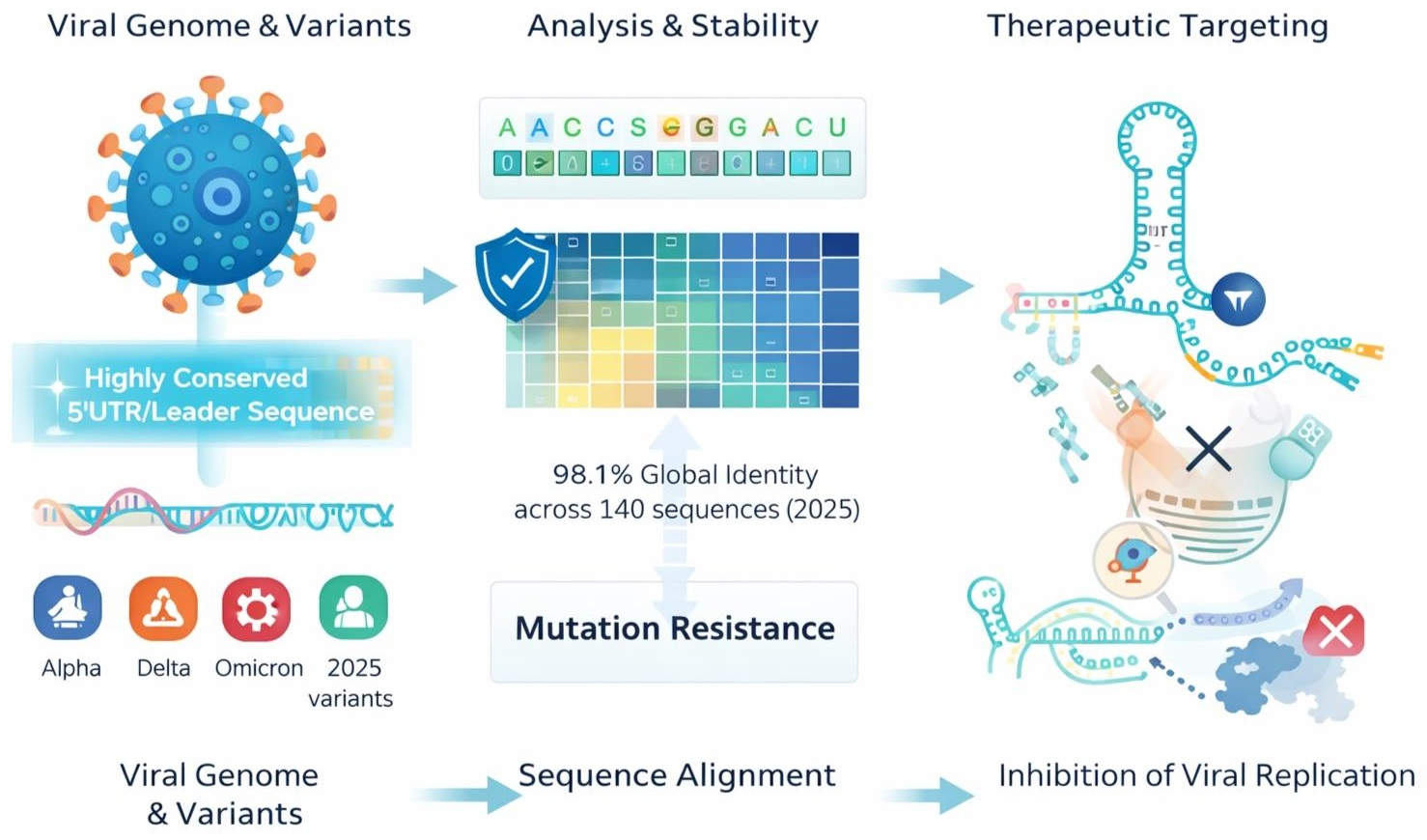
Beyond Variant Evolution: Structurally and Functionally Conserved Regions in the 5′UTR of SARS-CoV-2 as Resilient Antiviral Targets


Abstract
1. Introduction
2. Materials and Methods
2.1. Sequence Acquisition
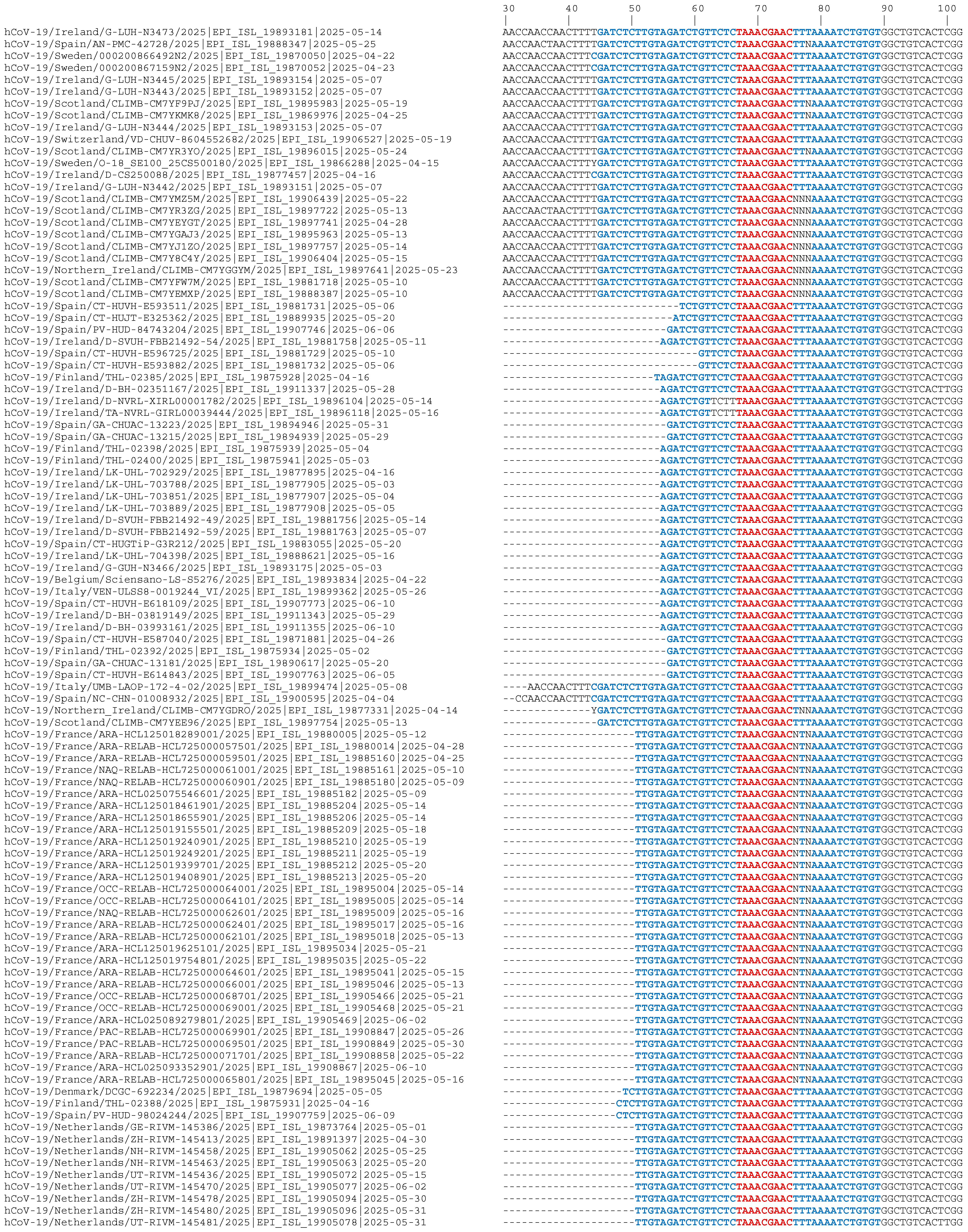
2.2. Comparative Sequence Alignment and Conservation Mapping
2.3. Secondary Structure Prediction and Pseudoknot Formation
3. Results
4. Discussion
5. Conclusions
Supplementary Materials
Funding
Institutional Review Board Statement
Informed Consent Statement
Data Availability Statement
Acknowledgments
Conflicts of Interest
Abbreviations
| SARS-CoV-2 | severe acute respiratory syndrome coronavirus 2 |
| 5′UTR | 5′ untranslated region |
| sgRNAs | subgenomic RNAs |
| siRNAs | small interfering RNAs |
| miRNAs | microRNAs |
| HCV | hepatitis C virus |
| LNA | locked nucleic acid |
| VOCs | variants of concern |
| TRS | transcription regulatory sequence |
| ASOs | antisense oligonucleotides |
| GISAID | Global Initiative of Sharing All Influenza Data |
| MSA | multiple sequence alignment |
References
- Aram, C.; Firuzpour, F.; Barancheshmeh, M.; Kamali, M.J. Unveiling the translational and therapeutic potential of small interfering RNA molecules in combating SARS-CoV-2: A review. Int. J. Biol. Macromol. 2025, 318, 145203. [Google Scholar] [CrossRef] [PubMed]
- Lee, Y.; Tsai, H.; Yeh, C.; Fang, C.; Chan, M.W.Y.; Wu, T.; Shen, C. RNA Interference Approach Is a Good Strategy against SARS-CoV-2. Viruses 2022, 15, 100. [Google Scholar] [CrossRef]
- Donia, A.; Bokhari, H. RNA interference as a promising treatment against SARS-CoV-2. Int. Microbiol. 2021, 24, 123–124. [Google Scholar] [CrossRef] [PubMed]
- Hasan, M.; Ashik, A.I.; Chowdhury, M.B.; Tasnim, A.T.; Nishat, Z.S.; Hossain, T.; Ahmed, S. Computational prediction of potential siRNA and human miRNA sequences to silence orf1ab associated genes for future therapeutics against SARS-CoV-2. Inform. Med. Unlocked 2021, 24, 100569. [Google Scholar] [CrossRef] [PubMed]
- Baldassarre, A.; Paolini, A.; Bruno, S.P.; Felli, C.; Tozzi, A.E.; Masotti, A. Potential use of noncoding RNAs and innovative therapeutic strategies to target the 5′UTR of SARS-CoV-2. Epigenomics 2020, 12, 1349–1361. [Google Scholar] [CrossRef]
- Pandey, A.K.; Verma, S. An in silico analysis of effective siRNAs against COVID-19 by targeting the leader sequence of SARS-CoV-2. Adv. Cell Gene Ther. 2021, 4, e107. [Google Scholar] [CrossRef]
- Tolksdorf, B.; Nie, C.; Niemeyer, D.; Rohrs, V.; Berg, J.; Lauster, D.; Adler, J.M.; Haag, R.; Trimpert, J.; Kaufer, B.; et al. Inhibition of SARS-CoV-2 Replication by a Small Interfering RNA Targeting the Leader Sequence. Viruses 2021, 13, 2030. [Google Scholar] [CrossRef]
- Kim, D.; Lee, J.; Yang, J.; Kim, J.W.; Kim, V.N.; Chang, H. The Architecture of SARS-CoV-2 Transcriptome. Cell 2020, 181, 914–921.e10. [Google Scholar] [CrossRef]
- Sawicki, S.G.; Sawicki, D.L.; Siddell, S.G. A contemporary view of coronavirus transcription. J. Virol. 2007, 81, 20–29. [Google Scholar] [CrossRef]
- Cameron, C.E.; Götte, M.; Raney, K.D. Viral Genome Replication; Springer: New York, NY, USA, 2009; p. 636. [Google Scholar]
- Brian, D.A.; Baric, R.S. Coronavirus genome structure and replication. Curr. Top. Microbiol. Immunol. 2005, 287, 1–30. [Google Scholar]
- Li, B.J.; Tang, Q.; Cheng, D.; Qin, C.; Xie, F.Y.; Wei, Q.; Xu, J.; Liu, Y.; Zheng, B.J.; Woodle, M.C.; et al. Using siRNA in prophylactic and therapeutic regimens against SARS coronavirus in Rhesus macaque. Nat. Med. 2005, 11, 944–951. [Google Scholar] [CrossRef] [PubMed]
- Wu, C.J.; Huang, H.W.; Liu, C.Y.; Hong, C.F.; Chan, Y.L. Inhibition of SARS-CoV replication by siRNA. Antivir. Res. 2005, 65, 45–48. [Google Scholar] [CrossRef]
- Anglero-Rodriguez, Y.I.; Lempp, F.A.; Subramanian, M.; McIninch, J.; Schlegel, M.K.; Bohan, D.; Wong, E.; Brown, C.R.; Foster, D.J.; Castoreno, A.B.; et al. High resistance barrier and prophylactic protection in preclinical models of SARS-CoV-2 with two siRNA combination. Nucleic Acids Res. 2025, 53, gkae1195. [Google Scholar] [CrossRef] [PubMed]
- Wyatt, J.R.; Puglisi, J.D.; Tinoco, I.J. RNA folding: Pseudoknots, loops and bulges. Bioessays 1989, 11, 100–106. [Google Scholar] [CrossRef] [PubMed]
- Hollar, A.; Bursey, H.; Jabbari, H. Pseudoknots in RNA Structure Prediction. Curr. Protoc. 2023, 3, e661. [Google Scholar] [CrossRef]
- Brierley, I.; Pennell, S.; Gilbert, R.J.C. Viral RNA pseudoknots: Versatile motifs in gene expression and replication. Nat. Rev. Microbiol. 2007, 5, 598–610. [Google Scholar] [CrossRef]
- Aruda, J.; Grote, S.L.; Rouskin, S. Untangling the pseudoknots of SARS-CoV-2: Insights into structural heterogeneity and plasticity. Curr. Opin. Struct. Biol. 2024, 88, 102912. [Google Scholar] [CrossRef]
- Bowden-Reid, E.; Ledger, S.; Zhang, Y.; Di Giallonardo, F.; Aggarwal, A.; Stella, A.O.; Akerman, A.; Milogiannakis, V.; Walker, G.; Rawlinson, W.; et al. Novel siRNA therapeutics demonstrate multi-variant efficacy against SARS-CoV-2. Antivir. Res. 2023, 217, 105677. [Google Scholar] [CrossRef]
- Medeiros, I.G.; Khayat, A.S.; Stransky, B.; Santos, S.; Assumpcao, P.; de Souza, J.E.S. A small interfering RNA (siRNA) database for SARS-CoV-2. Sci. Rep. 2021, 11, 8849. [Google Scholar] [CrossRef]
- Khanali, J.; Azangou-Khyavy, M.; Asaadi, Y.; Jamalkhah, M.; Kiani, J. Nucleic Acid-Based Treatments Against COVID-19: Potential Efficacy of Aptamers and siRNAs. Front. Microbiol. 2021, 12, 758948. [Google Scholar] [CrossRef]
- Kandwal, S.; Fayne, D. Genetic conservation across SARS-CoV-2 non-structural proteins—Insights into possible targets for treatment of future viral outbreaks. Virology 2023, 581, 97–115. [Google Scholar] [CrossRef]
- Ding, L.; Tang, S.; Wyatt, T.A.; Knoell, D.L.; Oupicky, D. Pulmonary siRNA delivery for lung disease: Review of recent progress and challenges. J. Control. Release 2021, 330, 977–991. [Google Scholar] [CrossRef]



| Country | Sequence Number | Intra-Country Identity (%) | Intra-Country Minimal Identity (%) | Mean Identity vs. Others (%) |
|---|---|---|---|---|
| France | 35 | 99.99 | 99.79 | 98.57 |
| Spain | 23 | 97.85 | 76.37 | 97.98 |
| Scotland | 22 | 98.99 | 89.65 | 98.48 |
| Ireland | 21 | 99.94 | 99.6 | 98.69 |
| Netherlands | 9 | 99.96 | 99.8 | 98.87 |
| Germany | 6 | 82.8 | 71.34 | 86.9 |
| Finland | 5 | 99.84 | 99.6 | 98.84 |
| Denmark | 3 | 99.58 | 99.36 | 98.81 |
| England | 3 | 100 | 100 | 99.02 |
| Northern Ireland | 3 | 90.8 | 85.92 | 94.89 |
| Sweden | 3 | 99.87 | 99.8 | 99.11 |
| Italy | 2 | 100 | 100 | 98.95 |
| Wales | 2 | 100 | 100 | 99.02 |
| Belgium | 1 | 100 1 | 100 | 98.95 |
| Canary Islands | 1 | 100 1 | 100 | 98.9 |
| Switzerland | 1 | 100 1 | 100 | 99.1 |
Disclaimer/Publisher’s Note: The statements, opinions and data contained in all publications are solely those of the individual author(s) and contributor(s) and not of MDPI and/or the editor(s). MDPI and/or the editor(s) disclaim responsibility for any injury to people or property resulting from any ideas, methods, instructions or products referred to in the content. |
© 2026 by the author. Licensee MDPI, Basel, Switzerland. This article is an open access article distributed under the terms and conditions of the Creative Commons Attribution (CC BY) license.
Share and Cite
Masotti, A. Beyond Variant Evolution: Structurally and Functionally Conserved Regions in the 5′UTR of SARS-CoV-2 as Resilient Antiviral Targets. Biomedicines 2026, 14, 622. https://doi.org/10.3390/biomedicines14030622
Masotti A. Beyond Variant Evolution: Structurally and Functionally Conserved Regions in the 5′UTR of SARS-CoV-2 as Resilient Antiviral Targets. Biomedicines. 2026; 14(3):622. https://doi.org/10.3390/biomedicines14030622
Chicago/Turabian StyleMasotti, Andrea. 2026. "Beyond Variant Evolution: Structurally and Functionally Conserved Regions in the 5′UTR of SARS-CoV-2 as Resilient Antiviral Targets" Biomedicines 14, no. 3: 622. https://doi.org/10.3390/biomedicines14030622
APA StyleMasotti, A. (2026). Beyond Variant Evolution: Structurally and Functionally Conserved Regions in the 5′UTR of SARS-CoV-2 as Resilient Antiviral Targets. Biomedicines, 14(3), 622. https://doi.org/10.3390/biomedicines14030622