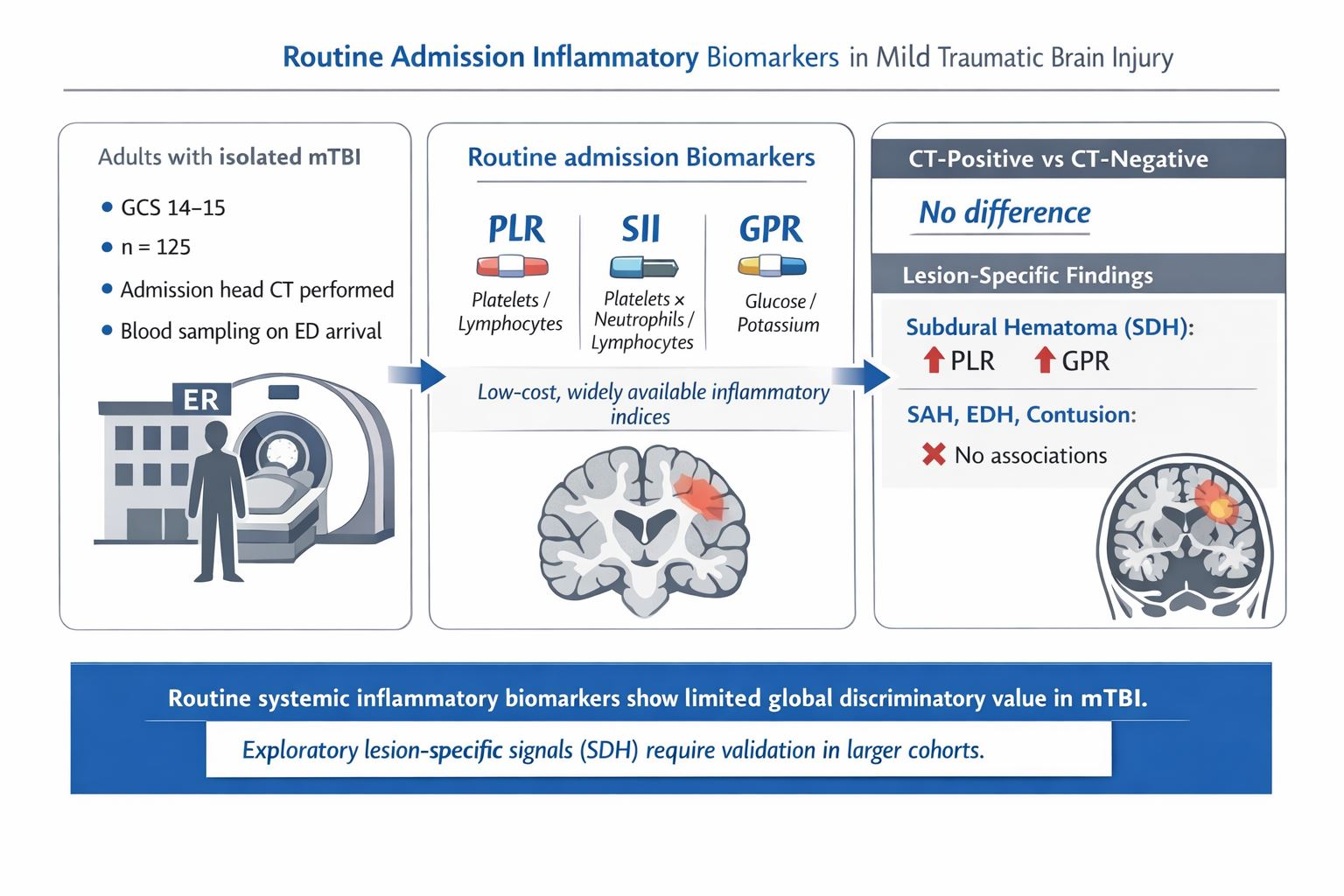
Correlation of Routine Admission Inflammatory Biomarkers with Individual Traumatic Brain Lesion Types in Mild Traumatic Brain Injury



Abstract
1. Introduction
2. Materials and Methods
2.1. Patient Search and Study Design
2.2. Inclusion Criteria
2.3. Exclusion Criteria
2.4. Data Collection
2.5. Outcomes
2.6. Statistical Analysis
3. Results
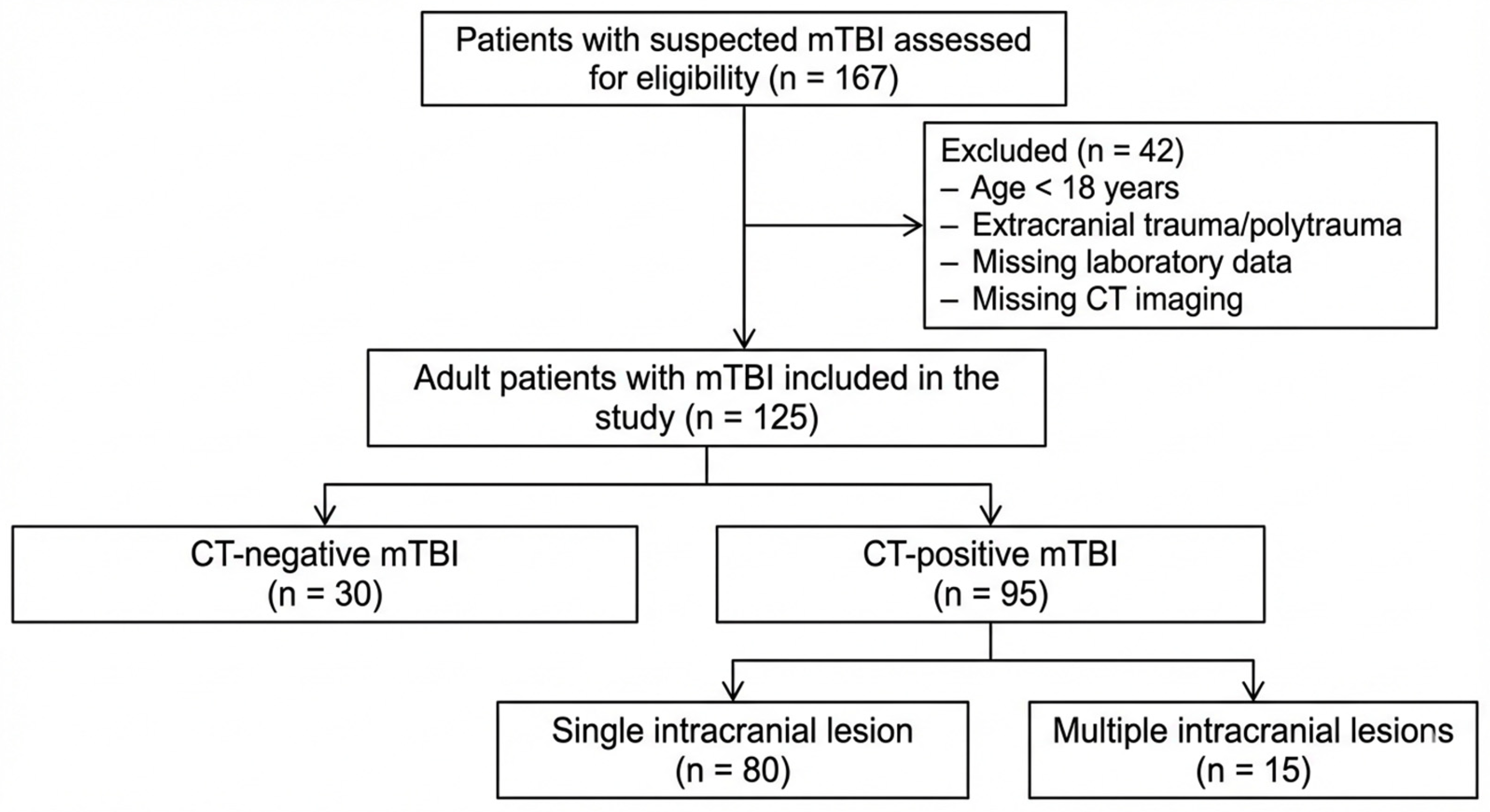
3.1. Baseline Characteristics
3.2. CT Positive vs. CT-Negative mTBI
3.3. Comparison of Admission Inflammatory Indexes Across Intracranial Trauma Subgroups, Including Both Single and Multiple Lesions
3.4. Comparison of Admission Inflammatory Indexes Across Patients with Single Traumatic Intracranial Lesions
3.5. Comparison of Admission Inflammatory Between Patients with Single vs. Multiple Traumatic Intracranial Lesions
4. Discussion
5. Conclusions
Author Contributions
Funding
Institutional Review Board Statement
Informed Consent Statement
Data Availability Statement
Conflicts of Interest
Abbreviations
| BBB | Blood–brain barrier |
| CDR | Clinical decision rule |
| CI | Confidence interval |
| CT | Computed tomography |
| EDH | Epidural hematoma |
| GCS | Glasgow Coma Scale |
| GPR | Glucose-to-potassium ratio |
| IL | Interleukin |
| mTBI | Mild traumatic brain injury |
| NLR | Neutrophil-to-lymphocyte ratio |
| PECARN | Pediatric Emergency Care Applied Research Network |
| PLR | Platelet-to-lymphocyte ratio |
| SAH | Subarachnoid hemorrhage |
| SDH | Subdural hematoma |
| SII | Systemic immune-inflammation index |
| TBI | Traumatic brain injury |
References
- Lefevre-Dognin, C.; Cogné, M.; Perdrieau, V.; Granger, A.; Heslot, C.; Azouvi, P. Definition and epidemiology of mild traumatic brain injury. Neurochirurgie 2021, 67, 218–221. [Google Scholar] [CrossRef]
- Stiell, I.G.; Clement, C.M.; Rowe, B.H.; Schull, M.J.; Brison, R.; Cass, D.; Eisenhauer, M.A.; McKnight, R.D.; Bandiera, G.; Holroyd, B.; et al. Comparison of the Canadian CT Head Rule and the New Orleans Criteria in patients with minor head injury. JAMA 2005, 294, 1511–1518. [Google Scholar] [CrossRef]
- Papa, L.; Stiell, I.G.; Clement, C.M.; Pawlowicz, A.; Wolfram, A.; Braga, C.; Draviam, S.; Wells, G.A. Performance of the Canadian CT Head Rule and the New Orleans Criteria for predicting any traumatic intracranial injury on computed tomography in a United States Level I trauma center. Acad. Emerg. Med. 2012, 19, 2–10. [Google Scholar] [CrossRef]
- Smith-Bindman, R.; Chu, P.W.; Firdaus, H.A.; Stewart, C.; Malekhedayat, M.; Alber, S.; Bolch, W.E.; Mahendra, M.; de González, A.B.; Miglioretti, D.L. Projected lifetime cancer risks from current computed tomography imaging. JAMA Intern. Med. 2025, 185, 710–719. [Google Scholar] [CrossRef] [PubMed]
- Silvestro, S.; Raffaele, I.; Quartarone, A.; Mazzon, E. Innovative insights into traumatic brain injuries: Biomarkers and new pharmacological targets. Int. J. Mol. Sci. 2024, 25, 2372. [Google Scholar] [CrossRef] [PubMed]
- Puravet, A.; Oris, C.; Pereira, B.; Kahouadji, S.; Gonzalo, P.; Masson, D.; Durif, J.; Sarret, C.; Sapin, V.; Bouvier, D. Serum GFAP and UCH-L1 for the identification of clinically important traumatic brain injury in children in France: A diagnostic accuracy substudy. Lancet Child Adolesc. Health 2025, 9, 47–56. [Google Scholar] [CrossRef] [PubMed]
- Bazarian, J.J.; Biberthaler, P.; Welch, R.D.; Lewis, L.M.; Barzo, P.; Bogner-Flatz, V.; Brolinson, P.G.; Büki, A.; Chen, J.Y.; Christenson, R.H.; et al. Serum GFAP and UCH-L1 for prediction of absence of intracranial injuries on head CT (ALERT-TBI): A multicentre observational study. Lancet Neurol. 2018, 17, 782–789. [Google Scholar] [CrossRef]
- Karamian, A.; Farzaneh, H.; Khoshnoodi, M.; Maleki, N.; Rohatgi, S.; Ford, J.N.; Romero, J.M. Accuracy of GFAP and UCH-L1 in predicting brain abnormalities on CT scans after mild traumatic brain injury: A systematic review and meta-analysis. Eur. J. Trauma Emerg. Surg. 2025, 51, 68. [Google Scholar] [CrossRef]
- Lagares, A.; de la Cruz, J.; Terrisse, H.; Mejan, O.; Pavlov, V.; Vermorel, C.; Payen, J.-F.; Maignan, M.; Viglino, D.; Jacquin, L.; et al. An automated blood test for GFAP and UCH-L1 to predict the absence of intracranial lesions on head CT in adult patients with mild traumatic brain injury (BRAINI). eBioMedicine 2024, 110, 105477. [Google Scholar] [CrossRef]
- Komiotis, C.; Mavridis, I.; Pyrgelis, E.-S.; Agapiou, E.; Meliou, M.; Birbilis, T. The role of interleukins in pediatric traumatic brain injury: A narrative synthesis. J. Clin. Med. 2026, 15, 186. [Google Scholar] [CrossRef]
- Woodcock, T.; Morganti-Kossmann, M.C. The role of markers of inflammation in traumatic brain injury. Front. Neurol. 2013, 4, 18. [Google Scholar] [CrossRef] [PubMed]
- Johnson, N.H.; Hadad, R.; Taylor, R.R.; Pilar, J.R.; Salazar, O.; Llompart-Pou, J.A.; Dietrich, W.D.; Keane, R.W.; Pérez-Bárcena, J.; Vaccari, J.P.d.R. Inflammatory biomarkers of traumatic brain injury. Pharmaceuticals 2022, 15, 660. [Google Scholar] [CrossRef] [PubMed]
- Tsitsipanis, C.; Miliaraki, M.; Paflioti, E.; Lazarioti, S.; Moustakis, N.; Ntotsikas, K.; Theofanopoulos, A.; Ilia, S.; Vakis, A.; Simos, P.; et al. Inflammation biomarkers IL-6 and IL-10 may improve diagnostic and prognostic accuracy of currently authorized traumatic brain injury tools. Exp. Ther. Med. 2023, 26, 364. [Google Scholar] [CrossRef] [PubMed]
- Alexiou, G.A.; Lianos, G.D.; Tzima, A.; Sotiropoulos, A.; Nasios, A.; Metaxas, D.; Zigouris, A.; Zika, J.; Mitsis, M.; Voulgaris, S. Neutrophil-to-lymphocyte ratio as a predictive biomarker for computed tomography scan use in mild traumatic brain injury. Biomark. Med. 2020, 14, 1085–1090. [Google Scholar] [CrossRef]
- Lampros, M.; Alexiou, G.A.; Symeou, S.; Vlachodimitropoulou, L.; Zerva, A.; Voulgaris, S. Admission blood glucose and neutrophil-to-lymphocyte ratio for differentiating CT-positive from CT-negative mild traumatic brain injury. Biomark. Med. 2026, 1, 1–9. [Google Scholar] [CrossRef]
- Unal, A.; Dogan, A. Comparison of glucose/potassium ratio and revised trauma score in predicting mortality in isolated blunt head trauma. Sci. Rep. 2025, 15, 33463. [Google Scholar] [CrossRef]
- Ghozy, S.; El-Qushayri, A.E.; Varney, J.; Kacimi, S.E.O.; Bahbah, E.I.; Morra, M.E.; Shah, J.; Kallmes, K.M.; Abbas, A.S.; Elfil, M.; et al. The Prognostic Value of Neutrophil-to-Lymphocyte Ratio in Patients with Traumatic Brain Injury: A Systematic Review. Front. Neurol. 2022, 13, 1021877. [Google Scholar] [CrossRef]
- Alexiou, G.A.; Sotiropoulos, A.; Lianos, G.D.; Zigouris, A.; Metaxas, D.; Nasios, A.; Michos, E.; Mitsis, M.; Pachatouridis, D.; Voulgaris, S. Blood Glucose Levels May Aid the Decision for CT Scan in Minor Head Trauma. Diseases 2019, 2019, 1065254. [Google Scholar] [CrossRef]
- Rau, C.-S.; Kuo, S.C.-H.; Tsai, C.-H.; Chou, S.-E.; Su, W.-T.; Hsu, S.-Y.; Hsieh, C.-H. Cell subtypes in adult trauma patients with stress-induced hyperglycemia. Diagnostics 2023, 13, 3451. [Google Scholar] [CrossRef]
- Postolache, T.T.; Wadhawan, A.; Can, A.; Lowry, C.A.; Woodbury, M.; Makkar, H.; Hoisington, A.J.; Scott, A.J.; Potocki, E.; Benros, M.E.; et al. Inflammation in traumatic brain injury. J. Alzheimer’s Dis. 2020, 74, 1–28. [Google Scholar] [CrossRef]
- Simon, D.W.; McGeachy, M.J.; Bayır, H.; Clark, R.S.B.; Loane, D.J.; Kochanek, P.M. The far-reaching scope of neuroinflammation after traumatic brain injury. Nat. Rev. Neurol. 2017, 13, 171–191, Erratum in Nat. Rev. Neurol. 2017, 13, 572. [Google Scholar] [CrossRef] [PubMed]
- Ho, L.; Zhao, W.; Dams-O’Connor, K.; Tang, C.Y.; Gordon, W.; Peskind, E.R.; Yemul, S.; Haroutunian, V.; Pasinetti, G.M. Elevated plasma MCP-1 concentration following traumatic brain injury as a potential “predisposition” factor associated with an increased risk for subsequent development of Alzheimer’s disease. J. Alzheimer’s Dis. 2012, 31, 301–313. [Google Scholar] [CrossRef]
- Zhang, W.; Xiao, D.; Mao, Q.; Xia, H. Role of neuroinflammation in neurodegeneration development. Signal Transduct. Target. Ther. 2023, 8, 267. [Google Scholar] [CrossRef] [PubMed]
- Vlachos, N.; Lampros, M.G.; Lianos, G.D.; Voulgaris, S.; Alexiou, G.A. Blood biomarkers predicting coagulopathy in traumatic brain injury: A systematic review. Biomark. Med. 2022, 16, 935–945. [Google Scholar] [CrossRef] [PubMed]
- Lampros, M.G.; Alexiou, G.A.; Voulgaris, S. Coagulopathy in traumatic brain injury: The emerging role of biomarkers. J. Neurosurg. 2025, 142, 1836–1837. [Google Scholar] [CrossRef]
- Reyes, J.; Spitz, G.; Major, B.P.; O’Brien, W.T.; Giesler, L.P.; Bain, J.W.; Xie, B.; Rosenfeld, J.V.; Law, M.; Ponsford, J.L.; et al. Utility of acute and subacute blood biomarkers in CT-negative isolated mild traumatic brain injury. Neurology 2023, 101, e1992–e2004, Erratum in 2024, 103, e209596. [Google Scholar] [CrossRef]
- Melo, J.R.T.; Masini, M.H.H.; de Oliveira, J.G.; Veiga, J.C.E. Performance of the neutrophil–lymphocyte ratio as a predictor of severity and mortality in children and adolescents with traumatic brain injury. Childs Nerv. Syst. 2024, 40, 4251–4257. [Google Scholar] [CrossRef]
- Srinivasan, S.; Hegde, A.; Ballal, V.; Johnson, S.; Nair, R.; Raju, B.; Kanneganti, Y.; Baxi, U.; Subramanian, S.; Nayak, R.; et al. Neutrophil-lymphocyte ratio: A novel outcome prognosticator following traumatic brain injury: A retrospective analysis. World Neurosurg. X 2025, 26, 100442. [Google Scholar] [CrossRef]
- Zhuang, D.; Sheng, J.; Peng, G.; Li, T.; Cai, S.; Din, F.; Li, L.; Huang, M.; Tian, F.; Li, K.; et al. Neutrophil-to-lymphocyte ratio predicts early growth of traumatic intracerebral haemorrhage. Ann. Clin. Transl. Neurol. 2021, 8, 1601–1609. [Google Scholar] [CrossRef]
- Ilyas, M.F.; Lado, A.; Budiono, E.A.; Suryaputra, G.P.; Ramadhana, G.A.; Novika, R.G.H. Platelet-to-lymphocyte ratio as a prognostic marker in adult traumatic brain injury: A systematic review. Surg. Neurol. Int. 2024, 15, 205. [Google Scholar] [CrossRef]
- Li, W.; Deng, W. Platelet-to-lymphocyte ratio predicts short-term mortality in moderate-to-severe traumatic brain injury. Sci. Rep. 2022, 12, 13976. [Google Scholar] [CrossRef]
- Arslan, K.; Sahin, A.S. Prognostic value of systemic immune-inflammation index, neutrophil–lymphocyte ratio and platelet–lymphocyte ratio in traumatic brain injury. Medicine 2024, 103, e39007. [Google Scholar] [CrossRef] [PubMed]
- Wang, T.; Yang, Z.; Zhou, B.; Chen, Y. Relationship between NLR and PLR ratios and the occurrence and prognosis of progressive hemorrhagic injury in patients with traumatic brain injury. J. Investig. Surg. 2025, 38, 2470453. [Google Scholar] [CrossRef]
- Alexiou, G.A.; Tzima, A.; Lianos, G.D.; Lampros, M.; Sotiropoulos, A.; Rizos, D.; Ygropoulou, O.; Zika, J.; Alexiou, E.-S.; Voulgaris, S. Neutrophil-to-lymphocyte ratio in the prediction of coagulopathy in traumatic brain injury. Biomark. Med. 2022, 16, 163–168. [Google Scholar] [CrossRef] [PubMed]
- Chen, L.; Xia, S.; Zuo, Y.; Lin, Y.; Qiu, X.; Chen, Q.; Feng, T.; Xia, X.; Shao, Q.; Wang, S. Systemic immune inflammation index and peripheral blood carbon dioxide concentration at admission predict poor prognosis in patients with severe traumatic brain injury. Front. Immunol. 2023, 13, 1034916. [Google Scholar] [CrossRef] [PubMed]
- Parenrengi, M.A.; Suryaningtyas, W.; Dariansyah, A.D.; Utomo, B.; Taryana, G.O.; Kusumo, C.; Brilliantika, S.P. Utility of systemic immune-inflammation index, neutrophil-to-lymphocyte ratio and platelet-to-lymphocyte ratio in pediatric traumatic brain injury. Pediatr. Neurosurg. 2024, 15, 456. [Google Scholar] [CrossRef]
- Chen, J.; Fu, J.; Liu, J.; Lu, Y.; Han, D.; Zeng, J.; Zou, Z.; Li, Q.; Zhang, K.; Wei, X.; et al. Association of systemic immune inflammation index (SII) and platelet-to-lymphocyte ratio (PLR) with coagulopathy and prognosis in patients with traumatic brain injury. J. Inflamm. Res. 2025, 18, 5637–5653. [Google Scholar] [CrossRef]
- Xu, H.; Wu, W.; Zhu, Q.; Wang, J.; Ding, P.; Zhuang, Z.; Li, W.; Gao, Y.; Hang, C. Systemic immune-inflammation index predicts prognosis of traumatic brain injury. World Neurosurg. 2024, 183, e22–e27. [Google Scholar] [CrossRef]
- Shi, J.; Dong, B.; Mao, Y.; Guan, W.; Cao, J.; Zhu, R.; Wang, S. Traumatic brain injury and hyperglycemia: A potentially modifiable risk factor. Oncotarget 2016, 7, 71052–71061. [Google Scholar] [CrossRef]
- Gribnau, A.; van Zuylen, M.L.; Coles, J.P.; Plummer, M.P.; Hermanns, H.; Hermanides, J. Cerebral glucose metabolism following TBI: Changes in plasma glucose, glucose transport and alternative pathways of glycolysis—A translational narrative review. Int. J. Mol. Sci. 2024, 25, 2513. [Google Scholar] [CrossRef]
- Garcia-Ballestas, E.; Villafañe, J.; Nuñez-Baez, K.; Perdomo, W.A.F.; Duran, M.A.; Janjua, T.; Moscote-Salazar, L.R.; Agrawal, A. Glycemic control in traumatic brain injury: A systematic review and meta-analysis. Clin. Neurol. Neurosurg. 2024, 245, 108504. [Google Scholar] [CrossRef]
- Yao, P.; Wu, L.; Yao, H.; Shen, W.; Hu, P. Acute hyperglycemia exacerbates neuroinflammation via the ChREBP/HIF-1α pathway. Eur. J. Med. Res. 2024, 29, 546. [Google Scholar] [CrossRef] [PubMed]
- Bosarge, P.L.; Shoultz, T.H.; Griffin, R.L.; Kerby, J.D. Stress-induced hyperglycemia is associated with higher mortality in severe traumatic brain injury. J. Trauma Acute Care Surg. 2015, 79, 289–294. [Google Scholar] [CrossRef]
- Quintana-Pajaro, L.; Padilla-Zambrano, H.S.; Ramos-Villegas, Y.; Lopez-Cepeda, D.; Andrade-Lopez, A.; Hoz, S.; Moscote-Salazar, L.R.; Joaquim, A.F.; Perdomo, W.A.F.; Janjua, T. Cerebral traumatic injury and glucose metabolism: A scoping review. Egypt. J. Neurosurg. 2023, 38, 62. [Google Scholar] [CrossRef]
- Yuan, T.; He, H.; Liu, Y.; Wang, J.; Kang, X.; Fu, G.; Xie, F.; Li, A.; Chen, J.; Wang, W. Association between blood glucose levels and Glasgow Outcome Score in patients with traumatic brain injury: Secondary analysis of a randomized trial. Trials 2022, 23, 38. [Google Scholar] [CrossRef] [PubMed]
- Rovlias, A.; Kotsou, S. Influence of hyperglycemia on neurological outcome in severe head injury. Neurosurgery 2000, 46, 335–343. [Google Scholar] [CrossRef]
- Wang, J.; Hong, C.; Feng, Q.; Wu, B.; Li, S.; Yan, C.; Gao, H. Glucose–potassium ratio: A prognostic biomarker enhancing outcome prediction in mild-to-moderate traumatic brain injury. Front. Neurol. 2025, 16, 1577390. [Google Scholar] [CrossRef]
- Arbona-Lampaya, A.; Odeh-Couvertier, A.; Sánchez Jiménez, R.; Labat Álvarez, E. Meningeal enhancement following traumatic brain injury: A mini review. Front. Neurol. 2025, 16, 1617126. [Google Scholar] [CrossRef]
- Okonkwo, D.O.; Yue, J.K.; Puccio, A.M.; Panczykowski, D.M.; Inoue, T.; McMahon, P.J.; Sorani, M.D.; Yuh, E.L.; Lingsma, H.F.; Maas, A.I.; et al. GFAP-BDP as an acute diagnostic marker in traumatic brain injury: Results from the prospective Transforming Research and Clinical Knowledge in Traumatic Brain Injury study. J. Neurotrauma 2013, 30, 1490–1497. [Google Scholar] [CrossRef]
- Posti, J.P.; Takala, R.S.; Runtti, H.; Newcombe, V.F.; Outtrim, J.; Katila, A.J.; Frantzén, J.; Ala-Seppälä, H.; Coles, J.P.; Hossain, I.; et al. The levels of glial fibrillary acidic protein and ubiquitin C-terminal hydrolase-L1 during the first week after a traumatic brain injury: Correlations with clinical and imaging findings. Neurosurgery 2016, 79, 456–464. [Google Scholar] [CrossRef]
- Papa, L.; Brophy, G.M.; Welch, R.D.; Lewis, L.M.; Braga, C.F.; Tan, C.N.; Ameli, N.J.; Lopez, M.A.; Haeussler, C.A.; Giordano, D.I.M.; et al. Time course and diagnostic accuracy of glial and neuronal blood biomarkers GFAP and UCH-L1 in a large cohort of trauma patients with and without mild traumatic brain injury. JAMA Neurol. 2016, 73, 551–560. [Google Scholar] [CrossRef]


| Variable | All Patients (n = 125) | CT-Positive (n = 95) | CT-Negative (n = 30) | p Value |
|---|---|---|---|---|
| Age, years, mean ± SD | 59.6 ± 22.6 | 60.0 ± 21.5 | 57.1 ± 28.3 | 0.953 |
| Male sex, n (%) | 67 (53.6%) | 54 (56.8%) | 13 (43.3%) | 0.214 |
| Estimated time since injury (min), mean ± SD | 85.9 ± 110.2 | 84.1 ± 104.7 | 97.9 ± 173.8 | 0.853 |
| Anticoagulant use, n (%) | 21 (16.8%) | 18 (18.9%) | 3 (10.0%) | 0.401 |
| Antiplatelet use, n (%) | 19 (15.2%) | 17 (17.9%) | 2 (6.7%) | 0.241 |
| Recent alcohol/substance use, n (%) | 24 (19.2%) | 21 (22.1%) | 3 (10.0%) | 0.187 |
| Biomarker | CT-Positive (95% CI) | CT-Negative (95% CI) | p Value |
|---|---|---|---|
| PLR | 159.19 (137.82–180.55) | 155.18 (111.44–198.91) | 0.793 |
| GPR | 31.87 (29.32–34.41) | 29.50 (23.18–35.81) | 0.531 |
| SII | 1635.2 (1272.1–1998.4) | 1137.6 (659.4–1615.8) | 0.291 |
| Lesion Subtype | Cohort | Biomarker | Lesion Present (Mean, 95% CI) | Lesion Absent (Mean, 95% CI) | p Value | q Value (FDR) |
|---|---|---|---|---|---|---|
| Contusion | All lesions: | PLR | 125 (84.7–165) | 131 (91.1–205) | 0.419 | 0.838 |
| GPR | 28.9 (24.4–38.6) | 28.0 (23.8–33.4) | 0.392 | 0.784 | ||
| SII | 1503 (551–2100) | 957 (621–2040) | 0.968 | 0.968 | ||
| Single lesions only: | PLR | 164 (95.5–306) | 118 (87.6–179) | 0.842 | 0.903 | |
| GPR | 30.7 (26.2–37.1) | 26.8 (22.4–33.3) | 0.786 | 0.987 | ||
| SII | 1740 (606–3949) | 1024 (598–1974) | 0.500 | 0.858 | ||
| Subdural hematoma (SDH) | All lesions | PLR | 213 (125–303) | 118 (87.6–179) | 0.061 | 0.244 |
| GPR | 31.1 (27.2–36.4) | 26.6 (22.6–32.7) | 0.016 | 0.064 | ||
| SII | 1760 (957–2832) | 1024 (598–1974) | 0.071 | 0.284 | ||
| Single lesions only: | PLR | 213 (110–323) | 118 (87.6–179) | 0.018 | 0.072 | |
| GPR | 33.3 (29.5–35.7) | 26.5 (22.4–31.7) | 0.015 | 0.060 | ||
| SII | 1975 (1348–3823) | 1024 (598–1974) | 0.064 | 0.256 | ||
| Subarachnoid hemorrhage (SAH) | All lesions: | PLR | 120 (90.4–198) | 131 (87.6–205) | 0.711 | 0.903 |
| GPR | 29.3 (24.4–41.0) | 28.0 (23.3–33.3) | 0.528 | 0.704 | ||
| SII | 1024 (598–2810) | 957 (621–2040) | 0.571 | 0.968 | ||
| Single lesions only: | PLR | 118 (87.6–198) | 131 (87.6–205) | 0.590 | 0.903 | |
| GPR | 30.7 (24.7–41.3) | 28.1 (23.3–33.3) | 0.512 | 0.987 | ||
| SII | 830 (598–2100) | 957 (621–2040) | 0.721 | 0.858 | ||
| Epidural hematoma (EDH) | All lesions: | PLR | 131 (96.7–282) | 125 (90.1–184) | 0.903 | 0.948 |
| GPR | 25.6 (22.4–30.9) | 28.3 (23.8–35.6) | 0.987 | 0.987 | ||
| SII | 1191 (599–2910) | 1024 (598–2100) | 0.858 | 0.968 | ||
| Single lesions only: | PLR | 131 (96.7–282) | 125 (90.1–184) | 0.903 | 0.903 | |
| GPR | 25.6 (22.4–30.9) | 28.3 (23.8–35.6) | 0.987 | 0.987 | ||
| SII | 1191 (599–2910) | 1024 (598–2100) | 0.858 | 0.858 |
| Biomarker | Single Intracranial Trauma (95%CI) | Multiple Intracranial Traumas (95%CI) | p-Value |
|---|---|---|---|
| PLR | 118 (87.6–179) | 213 (110–323) | 0.012 |
| SII | 1024 (598–1974) | 1760 (957–2832) | 0.021 |
| GPR | 26.8 (22.4–33.3) | 28.9 (24.4–38.6) | 0.087 |
Disclaimer/Publisher’s Note: The statements, opinions and data contained in all publications are solely those of the individual author(s) and contributor(s) and not of MDPI and/or the editor(s). MDPI and/or the editor(s) disclaim responsibility for any injury to people or property resulting from any ideas, methods, instructions or products referred to in the content. |
© 2026 by the authors. Licensee MDPI, Basel, Switzerland. This article is an open access article distributed under the terms and conditions of the Creative Commons Attribution (CC BY) license.
Share and Cite
Lampros, M.; Vlachodimitropoulou, L.; Voulgaris, S.; Alexiou, G.A. Correlation of Routine Admission Inflammatory Biomarkers with Individual Traumatic Brain Lesion Types in Mild Traumatic Brain Injury. Biomedicines 2026, 14, 365. https://doi.org/10.3390/biomedicines14020365
Lampros M, Vlachodimitropoulou L, Voulgaris S, Alexiou GA. Correlation of Routine Admission Inflammatory Biomarkers with Individual Traumatic Brain Lesion Types in Mild Traumatic Brain Injury. Biomedicines. 2026; 14(2):365. https://doi.org/10.3390/biomedicines14020365
Chicago/Turabian StyleLampros, Marios, Labrini Vlachodimitropoulou, Spyridon Voulgaris, and George A. Alexiou. 2026. "Correlation of Routine Admission Inflammatory Biomarkers with Individual Traumatic Brain Lesion Types in Mild Traumatic Brain Injury" Biomedicines 14, no. 2: 365. https://doi.org/10.3390/biomedicines14020365
APA StyleLampros, M., Vlachodimitropoulou, L., Voulgaris, S., & Alexiou, G. A. (2026). Correlation of Routine Admission Inflammatory Biomarkers with Individual Traumatic Brain Lesion Types in Mild Traumatic Brain Injury. Biomedicines, 14(2), 365. https://doi.org/10.3390/biomedicines14020365