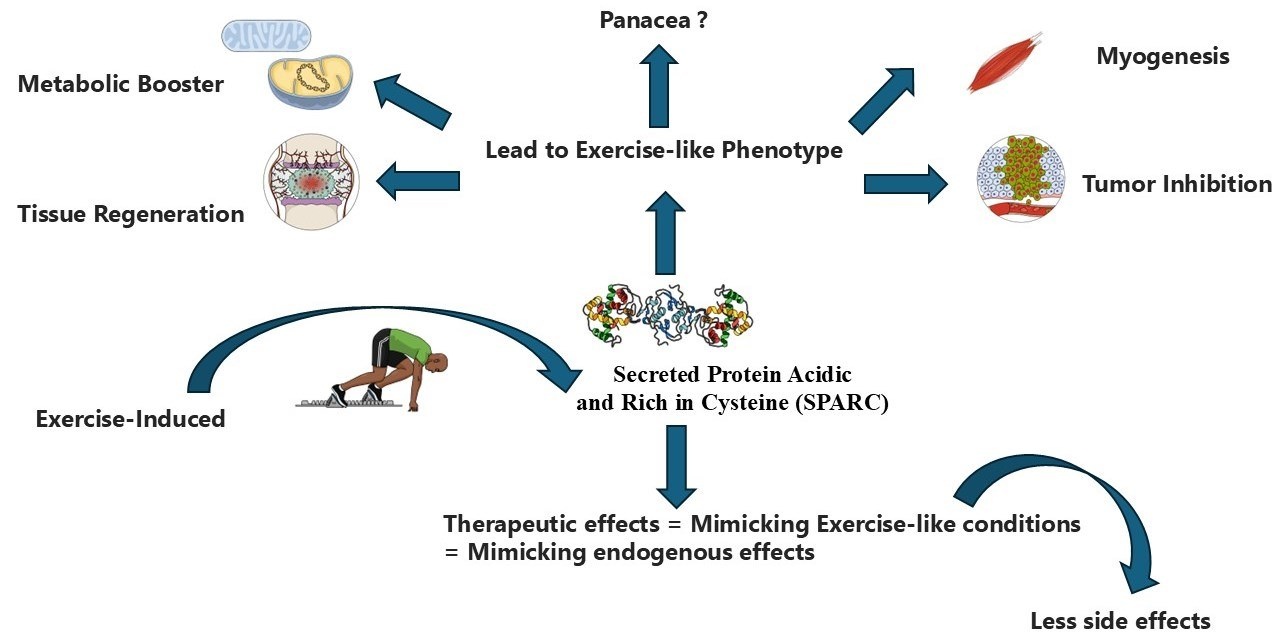
Exploring SPARC over Other Exerkines/Myokines: A Strategic Approach Towards Novel Exercise-Mimicking Therapies

 ,
,  , and
, and
Abstract
Author Contributions
Funding
Institutional Review Board Statement
Acknowledgments
Conflicts of Interest
References
- Klonoff, D.C.; Berard, L.; Franco, D.R.; Gentile, S.; Gomez, O.V.; Hussein, Z.; Jain, A.B.; Kalra, S.; Anhalt, H.; Mader, J.K.; et al. Advance Insulin Injection Technique and Education with FITTER Forward Expert Recommendations. Mayo Clin. Proc. 2025, 100, 682–699. [Google Scholar] [CrossRef] [Scilit] [PubMed]
- Di Gioia, L.; Di Molfetta, S.; Caruso, I.; Caporusso, M.; Sorice, G.P.; Cignarelli, A.; Natalicchio, A.; Perrini, S.; Laviola, L.; Giorgino, F. Efficacy and safety of once-weekly basal insulin therapy in people with type 1 diabetes: A systematic review and meta-analysis. Diabetes Obes. Metab. 2026, 28, 210–220. [Google Scholar] [CrossRef] [Scilit]
- Levy, A.T.; Weingarten, S.J.; Robinson, K.; Suner, T.; McLaren, R.A., Jr.; Saad, A.; Al-Kouatly, H.B. Recombinant erythropoietin for the treatment of iron deficiency anemia in pregnancy: A systematic review. Int. J. Gynaecol. Obs. 2025, 168, 35–42. [Google Scholar] [CrossRef] [Scilit]
- Vandewalle, J.; Luypaert, A.; De Bosscher, K.; Libert, C. Therapeutic Mechanisms of Glucocorticoids. Trends Endocrinol. Metab. 2018, 29, 42–54. [Google Scholar] [CrossRef] [Scilit]
- Jacunski, M.; Melville, P.; Currie, G.P. Exercise: The panacea in management of many ills. Now is the time to engage. J. R. Coll. Physicians Edinb. 2021, 51, 120–122. [Google Scholar] [CrossRef] [Scilit]
- Raun, S.H.; Buch-Larsen, K.; Schwarz, P.; Sylow, L. Exercise-A Panacea of Metabolic Dysregulation in Cancer: Physiological and Molecular Insights. Int. J. Mol. Sci. 2021, 22, 3469. [Google Scholar] [CrossRef] [Scilit]
- Kavanagh, T. Exercise—The modern panacea. Ir. Med. J. 1979, 72, 24–27. [Google Scholar] [PubMed]
- Riedl, I.; Yoshioka, M.; Nishida, Y.; Tobina, T.; Paradis, R.; Shono, N.; Tanaka, H.; St-Amand, J. Regulation of skeletal muscle transcriptome in elderly men after 6 weeks of endurance training at lactate threshold intensity. Exp. Gerontol. 2010, 45, 896–903. [Google Scholar] [CrossRef] [Scilit] [PubMed]
- Recchia, F.; Leung, C.K.; Yu, A.P.; Leung, W.; Yu, D.J.; Fong, D.Y.; Montero, D.; Lee, C.H.; Wong, S.H.S.; Siu, P.M. Dose-response effects of exercise and caloric restriction on visceral adiposity in overweight and obese adults: A systematic review and meta-analysis of randomised controlled trials. Br. J. Sports Med. 2023, 57, 1035–1041. [Google Scholar] [CrossRef] [Scilit]
- Yu, C.; Sun, R.; Yang, W.; Gu, T.; Ying, X.; Ye, L.; Zheng, Y.; Fan, S.; Zeng, X.; Yao, S. Exercise ameliorates osteopenia in mice via intestinal microbial-mediated bile acid metabolism pathway. Theranostics 2025, 15, 1741–1759. [Google Scholar] [CrossRef] [Scilit]
- Hrubeniuk, T.J.; Bouchard, D.R.; Goulet, E.D.B.; Gurd, B.; Sénéchal, M. The ability of exercise to meaningfully improve glucose tolerance in people living with prediabetes: A meta-analysis. Scand. J. Med. Sci. Sports 2020, 30, 209–216. [Google Scholar] [CrossRef] [Scilit]
- Clemente-Suárez, V.J.; Rubio-Zarapuz, A.; Belinchón-deMiguel, P.; Beltrán-Velasco, A.I.; Martín-Rodríguez, A.; Tornero-Aguilera, J.F. Impact of Physical Activity on Cellular Metabolism Across Both Neurodegenerative and General Neurological Conditions: A Narrative Review. Cells 2024, 13, 1940. [Google Scholar] [CrossRef] [Scilit]
- Bellini, A.; Scotto di Palumbo, A.; Nicolò, A.; Bazzucchi, I.; Sacchetti, M. Exercise Prescription for Postprandial Glycemic Management. Nutrients 2024, 16, 1170. [Google Scholar] [CrossRef] [Scilit]
- Valero, T. Mitochondrial biogenesis: Pharmacological approaches. Curr. Pharm. Des. 2014, 20, 5507–5509. [Google Scholar] [CrossRef] [Scilit]
- Nieman, D.C.; Pence, B.D. Exercise immunology: Future directions. J. Sport Health Sci. 2020, 9, 432–445. [Google Scholar] [CrossRef] [Scilit] [PubMed]
- Chastin, S.F.M.; Abaraogu, U.; Bourgois, J.G.; Dall, P.M.; Darnborough, J.; Duncan, E.; Dumortier, J.; Pavón, D.J.; McParland, J.; Roberts, N.J.; et al. Effects of Regular Physical Activity on the Immune System, Vaccination and Risk of Community-Acquired Infectious Disease in the General Population: Systematic Review and Meta-Analysis. Sports Med. 2021, 51, 1673–1686. [Google Scholar] [CrossRef] [Scilit] [PubMed]
- Hojman, P.; Gehl, J.; Christensen, J.F.; Pedersen, B.K. Molecular Mechanisms Linking Exercise to Cancer Prevention and Treatment. Cell Metab. 2018, 27, 10–21. [Google Scholar] [CrossRef] [Scilit] [PubMed]
- McTiernan, A.; Friedenreich, C.M.; Katzmarzyk, P.T.; Powell, K.E.; Macko, R.; Buchner, D.; Pescatello, L.S.; Bloodgood, B.; Tennant, B.; Vaux-Bjerke, A.; et al. Physical Activity in Cancer Prevention and Survival: A Systematic Review. Med. Sci. Sports Exerc. 2019, 51, 1252–1261. [Google Scholar] [CrossRef] [Scilit] [PubMed]
- Chow, L.S.; Gerszten, R.E.; Taylor, J.M.; Pedersen, B.K.; van Praag, H.; Trappe, S.; Febbraio, M.A.; Galis, Z.S.; Gao, Y.; Haus, J.M.; et al. Exerkines in health, resilience and disease. Nat. Rev. Endocrinol. 2022, 18, 273–289. [Google Scholar] [CrossRef] [Scilit]
- Zunner, B.E.M.; Wachsmuth, N.B.; Eckstein, M.L.; Scherl, L.; Schierbauer, J.R.; Haupt, S.; Stumpf, C.; Reusch, L.; Moser, O. Myokines and Resistance Training: A Narrative Review. Int. J. Mol. Sci. 2022, 23, 3501. [Google Scholar] [CrossRef] [Scilit]
- Gomarasca, M.; Banfi, G.; Lombardi, G. Myokines: The endocrine coupling of skeletal muscle and bone. Adv. Clin. Chem. 2020, 94, 155–218. [Google Scholar] [CrossRef] [Scilit]
- Bradshaw, A.D.; Bassuk, J.A.; Francki, A.; Sage, E.H. Expression and purification of recombinant human SPARC produced by baculovirus. Mol. Cell Biol. Res. Commun. 2000, 3, 345–351. [Google Scholar] [CrossRef] [Scilit]
- Atorrasagasti, C.; Onorato, A.M.; Mazzolini, G. The role of SPARC (secreted protein acidic and rich in cysteine) in the pathogenesis of obesity, type 2 diabetes, and non-alcoholic fatty liver disease. J. Physiol. Biochem. 2023, 79, 815–831. [Google Scholar] [CrossRef] [Scilit] [PubMed]
- Yu, L.; Zheng, Y.; Liu, B.J.; Kang, M.H.; Millar, J.C.; Rhee, D.J. Secreted protein acidic and rich in cysteine (SPARC) knockout mice have greater outflow facility. PLoS ONE 2020, 15, e0241294. [Google Scholar] [CrossRef] [Scilit] [PubMed]
- Watkins, G.; Douglas-Jones, A.; Bryce, R.; Mansel, R.E.; Jiang, W.G. Increased levels of SPARC (osteonectin) in human breast cancer tissues and its association with clinical outcomes. Prostaglandins Leukot. Essent. Fat. Acids 2005, 72, 267–272. [Google Scholar] [CrossRef] [Scilit]
- Rosset, E.M.; Bradshaw, A.D. SPARC/osteonectin in mineralized tissue. Matrix Biol. 2016, 52–54, 78–87. [Google Scholar] [CrossRef] [Scilit] [PubMed]
- Schwarzbauer, J.E.; Spencer, C.S. The Caenorhabditis elegans homologue of the extracellular calcium binding protein SPARC/osteonectin affects nematode body morphology and mobility. Mol. Biol. Cell 1993, 4, 941–952. [Google Scholar] [CrossRef] [Scilit] [PubMed]
- Pottgiesser, J.; Maurer, P.; Mayer, U.; Nischt, R.; Mann, K.; Timpl, R.; Krieg, T.; Engel, J. Changes in calcium and collagen IV binding caused by mutations in the EF hand and other domains of extracellular matrix protein BM-40 (SPARC, osteonectin). J. Mol. Biol. 1994, 238, 563–574. [Google Scholar] [CrossRef] [Scilit]
- Kehlet, S.N.; Manon-Jensen, T.; Sun, S.; Brix, S.; Leeming, D.J.; Karsdal, M.A.; Willumsen, N. A fragment of SPARC reflecting increased collagen affinity shows pathological relevance in lung cancer—Implications of a new collagen chaperone function of SPARC. Cancer Biol. Ther. 2018, 19, 904–912. [Google Scholar] [CrossRef] [Scilit]
- Aoi, W.; Naito, Y.; Takagi, T.; Tanimura, Y.; Takanami, Y.; Kawai, Y.; Sakuma, K.; Hang, L.P.; Mizushima, K.; Hirai, Y.; et al. A novel myokine, secreted protein acidic and rich in cysteine (SPARC), suppresses colon tumorigenesis via regular exercise. Gut 2013, 62, 882–889. [Google Scholar] [CrossRef] [Scilit]
- Ghanemi, A.; Melouane, A.; Yoshioka, M.; St-Amand, J. Secreted Protein Acidic and Rich in Cysteine (Sparc) KO Leads to an Accelerated Ageing Phenotype Which Is Improved by Exercise Whereas SPARC Overexpression Mimics Exercise Effects in Mice. Metabolites 2022, 12, 125. [Google Scholar] [CrossRef] [Scilit]
- Ghanemi, A.; Yoshioka, M.; St-Amand, J. Secreted Protein Acidic and Rich in Cysteine (SPARC)-Mediated Exercise Effects: Illustrative Molecular Pathways against Various Diseases. Diseases 2023, 11, 33. [Google Scholar] [CrossRef] [Scilit]
- Ghanemi, A.; Mac-Way, F. Obesity and Bone Mineral Density Protection Paradox in Chronic Kidney Disease: Secreted Protein Acidic and Rich in Cysteine as a Piece of the Puzzle? Life 2023, 13, 2172. [Google Scholar] [CrossRef] [Scilit]
- Ghanemi, A.; Yoshioka, M.; St-Amand, J. Secreted Protein Acidic and Rich in Cysteine as A Regeneration Factor: Beyond the Tissue Repair. Life 2021, 11, 38. [Google Scholar] [CrossRef] [Scilit] [PubMed]
- Yang, H.; Xiang, Y.; Wang, J.; Ke, Z.; Zhou, W.; Yin, X.; Zhang, M.; Chen, Z. Modulating the blood-brain barrier in CNS disorders: A review of the therapeutic implications of secreted protein acidic and rich in cysteine (SPARC). Int. J. Biol. Macromol. 2025, 288, 138747. [Google Scholar] [CrossRef] [Scilit] [PubMed]
- Ghanemi, A.; Yoshioka, M.; St-Amand, J. Secreted Protein Acidic and Rich in Cysteine (SPARC) to Manage Coronavirus Disease-2019 (COVID-19) Pandemic and the Post-COVID-19 Health Crisis. Medicines 2023, 10, 32. [Google Scholar] [CrossRef] [Scilit]
- Motamed, K. SPARC (osteonectin/BM-40). Int. J. Biochem. Cell Biol. 1999, 31, 1363–1366. [Google Scholar] [CrossRef] [Scilit]
- Ghanemi, A.; Melouane, A.; Yoshioka, M.; St-Amand, J. Secreted protein acidic and rich in cysteine and bioenergetics: Extracellular matrix, adipocytes remodeling and skeletal muscle metabolism. Int. J. Biochem. Cell Biol. 2019, 117, 105627. [Google Scholar] [CrossRef] [Scilit] [PubMed]
- Huang, Q.; Wu, M.; Wu, X.; Zhang, Y.; Xia, Y. Muscle-to-tumor crosstalk: The effect of exercise-induced myokine on cancer progression. Biochim. Biophys. Acta Rev. Cancer 2022, 1877, 188761. [Google Scholar] [CrossRef] [Scilit]
- Ghanemi, A.; Yoshioka, M.; St-Amand, J. Genetic Expression between Ageing and Exercise: Secreted Protein Acidic and Rich in Cysteine as a Potential "Exercise Substitute" Antiageing Therapy. Genes 2022, 13, 950. [Google Scholar] [CrossRef] [Scilit]
- Ghanemi, A.; Yoshioka, M.; St-Amand, J. Secreted Protein Acidic and Rich in Cysteine as an Exercise-Induced Gene: Towards Novel Molecular Therapies for Immobilization-Related Muscle Atrophy in Elderly Patients. Genes 2022, 13, 1014. [Google Scholar] [CrossRef] [Scilit]
- Ghanemi, A.; Yoshioka, M.; St-Amand, J. Secreted Protein Acidic and Rich in Cysteine as a Molecular Physiological and Pathological Biomarker. Biomolecules 2021, 11, 1689. [Google Scholar] [CrossRef] [Scilit] [PubMed]
- Kos, K.; Wilding, J.P. SPARC: A key player in the pathologies associated with obesity and diabetes. Nat. Rev. Endocrinol. 2010, 6, 225–235. [Google Scholar] [CrossRef] [Scilit] [PubMed]
- Ghanemi, A.; Yoshioka, M.; St-Amand, J. Measuring Exercise-Induced Secreted Protein Acidic and Rich in Cysteine Expression as a Molecular Tool to Optimize Personalized Medicine. Genes 2021, 12, 1832. [Google Scholar] [CrossRef] [Scilit]
- Edalat Haghi, F.A.; Koushkie Jahromi, M. Exercise as Precision Medicine: Targeting HER2/CD44-Driven Therapy Resistance in Breast Cancer (A Mini Review). Integr. Cancer Ther. 2026, 25, 15347354251407216. [Google Scholar] [CrossRef] [Scilit]
- Bae, J.H.; Kwak, S.E.; Lee, J.H.; Yangjie, Z.; Song, W. Does exercise-induced apelin affect sarcopenia? A systematic review and meta-analysis. Hormones 2019, 18, 383–393. [Google Scholar] [CrossRef] [Scilit] [PubMed]
- Vinel, C.; Lukjanenko, L.; Batut, A.; Deleruyelle, S.; Pradère, J.P.; Le Gonidec, S.; Dortignac, A.; Geoffre, N.; Pereira, O.; Karaz, S.; et al. The exerkine apelin reverses age-associated sarcopenia. Nat. Med. 2018, 24, 1360–1371. [Google Scholar] [CrossRef] [Scilit]
- Alizadeh Pahlavani, H. Exercise Therapy for People with Sarcopenic Obesity: Myokines and Adipokines as Effective Actors. Front. Endocrinol. 2022, 13, 811751. [Google Scholar] [CrossRef] [Scilit]
- Rolland, Y.; Dray, C.; Vellas, B.; Barreto, P.S. Current and investigational medications for the treatment of sarcopenia. Metabolism 2023, 149, 155597. [Google Scholar] [CrossRef] [Scilit]
- Geng, L.; Lam, K.S.L.; Xu, A. The therapeutic potential of FGF21 in metabolic diseases: From bench to clinic. Nat. Rev. Endocrinol. 2020, 16, 654–667. [Google Scholar] [CrossRef] [Scilit]
- Tezze, C.; Romanello, V.; Sandri, M. FGF21 as Modulator of Metabolism in Health and Disease. Front. Physiol. 2019, 10, 419. [Google Scholar] [CrossRef] [Scilit]
- Allen, S.J.; Watson, J.J.; Shoemark, D.K.; Barua, N.U.; Patel, N.K. GDNF, NGF and BDNF as therapeutic options for neurodegeneration. Pharmacol. Ther. 2013, 138, 155–175. [Google Scholar] [CrossRef] [Scilit] [PubMed]
- Gao, L.; Zhang, Y.; Sterling, K.; Song, W. Brain-derived neurotrophic factor in Alzheimer’s disease and its pharmaceutical potential. Transl. Neurodegener. 2022, 11, 4. [Google Scholar] [CrossRef] [Scilit]
- Zuccato, C.; Cattaneo, E. Huntington’s disease. Handb. Exp. Pharmacol. 2014, 220, 357–409. [Google Scholar] [CrossRef] [Scilit]
- Engin, A. The Mechanism of Leptin Resistance in Obesity and Therapeutic Perspective. Adv. Exp. Med. Biol. 2024, 1460, 463–487. [Google Scholar] [CrossRef] [Scilit] [PubMed]
- Wu, D.; Li, L.; Yang, M.; Liu, H.; Yang, G. Elevated plasma levels of SPARC in patients with newly diagnosed type 2 diabetes mellitus. Eur. J. Endocrinol. 2011, 165, 597–601. [Google Scholar] [CrossRef] [Scilit] [PubMed]
Disclaimer/Publisher’s Note: The statements, opinions and data contained in all publications are solely those of the individual author(s) and contributor(s) and not of MDPI and/or the editor(s). MDPI and/or the editor(s) disclaim responsibility for any injury to people or property resulting from any ideas, methods, instructions or products referred to in the content. |
© 2026 by the authors. Licensee MDPI, Basel, Switzerland. This article is an open access article distributed under the terms and conditions of the Creative Commons Attribution (CC BY) license.
Share and Cite
Ghanemi, A.; Yoshioka, M.; Guimarães, R.d.F.; St-Amand, J. Exploring SPARC over Other Exerkines/Myokines: A Strategic Approach Towards Novel Exercise-Mimicking Therapies. Biomedicines 2026, 14, 302. https://doi.org/10.3390/biomedicines14020302
Ghanemi A, Yoshioka M, Guimarães RdF, St-Amand J. Exploring SPARC over Other Exerkines/Myokines: A Strategic Approach Towards Novel Exercise-Mimicking Therapies. Biomedicines. 2026; 14(2):302. https://doi.org/10.3390/biomedicines14020302
Chicago/Turabian StyleGhanemi, Abdelaziz, Mayumi Yoshioka, Roseane de Fátima Guimarães, and Jonny St-Amand. 2026. "Exploring SPARC over Other Exerkines/Myokines: A Strategic Approach Towards Novel Exercise-Mimicking Therapies" Biomedicines 14, no. 2: 302. https://doi.org/10.3390/biomedicines14020302
APA StyleGhanemi, A., Yoshioka, M., Guimarães, R. d. F., & St-Amand, J. (2026). Exploring SPARC over Other Exerkines/Myokines: A Strategic Approach Towards Novel Exercise-Mimicking Therapies. Biomedicines, 14(2), 302. https://doi.org/10.3390/biomedicines14020302