Endoscopic Ultrasound and Endoscopic Retrograde Cholangiopancreatography for Bile Duct Stones—Avoiding the Avoidable

 , , , ,
  , ,
, ,  , , , , , , and
Abstract
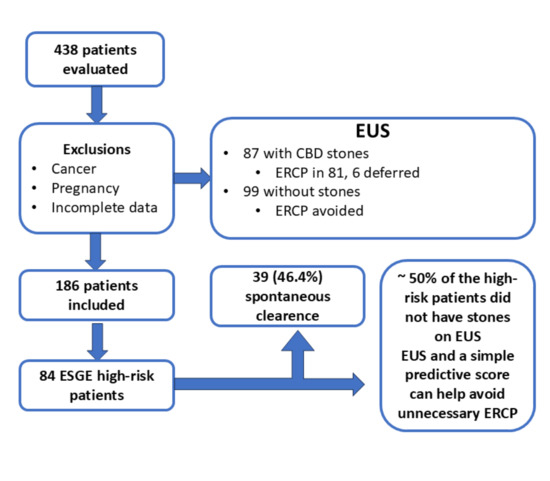
1. Introduction
2. Materials and Methods
Statistical Analysis
3. Results
3.1. Subgroup Analysis of Patients with AP
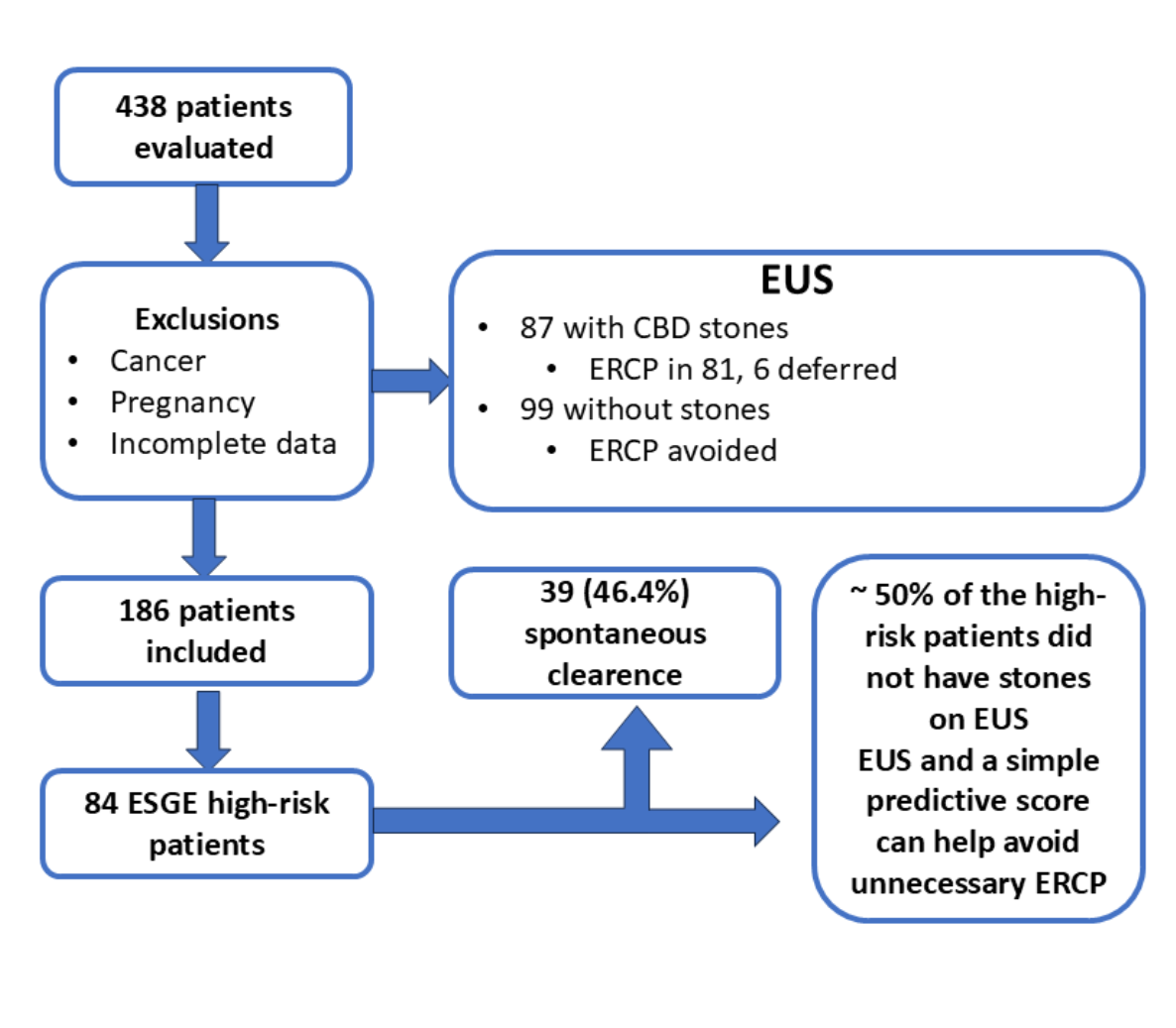
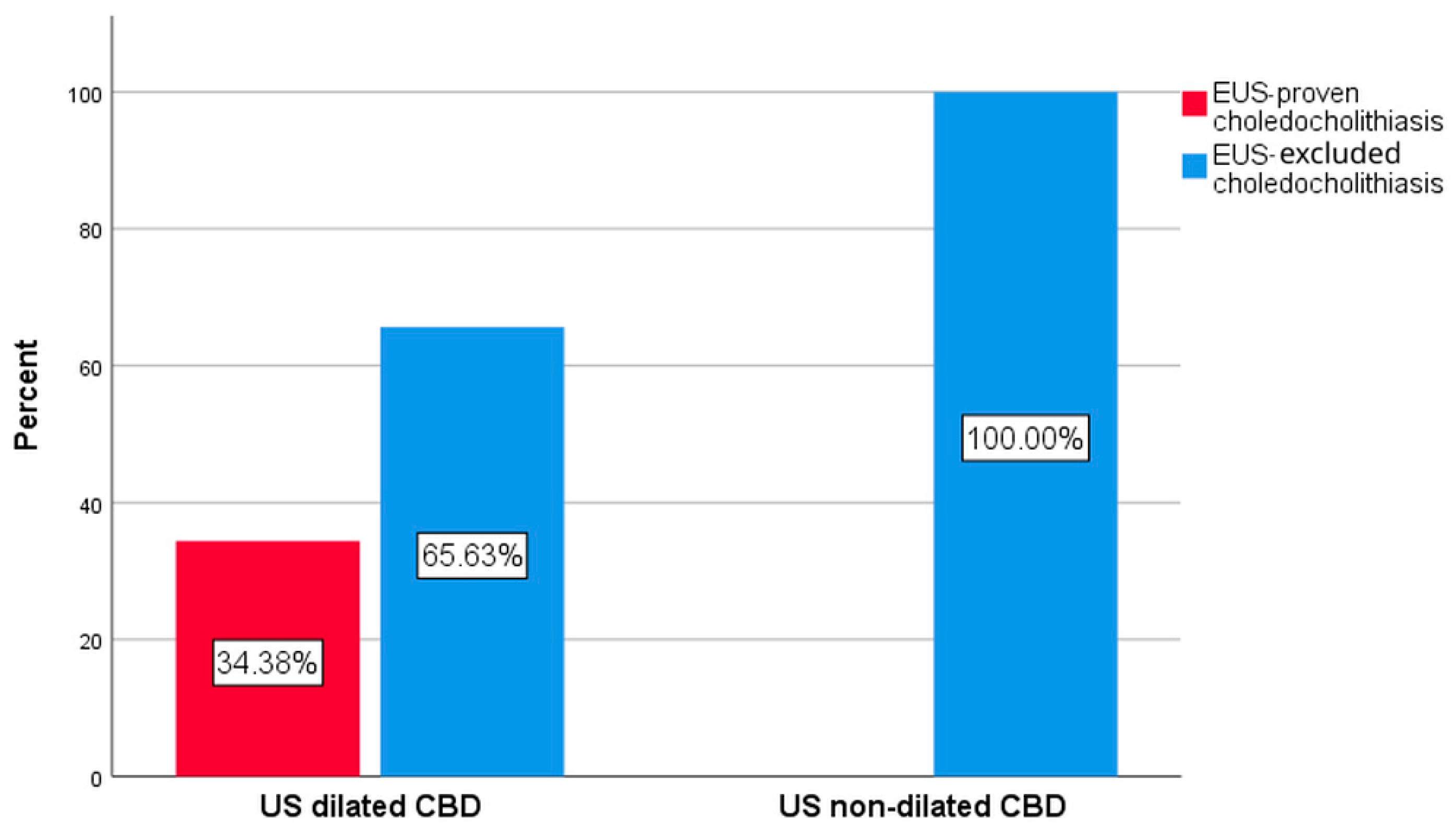
3.2. Subgroup Analysis of Patients with a High Risk for Choledocholithiasis
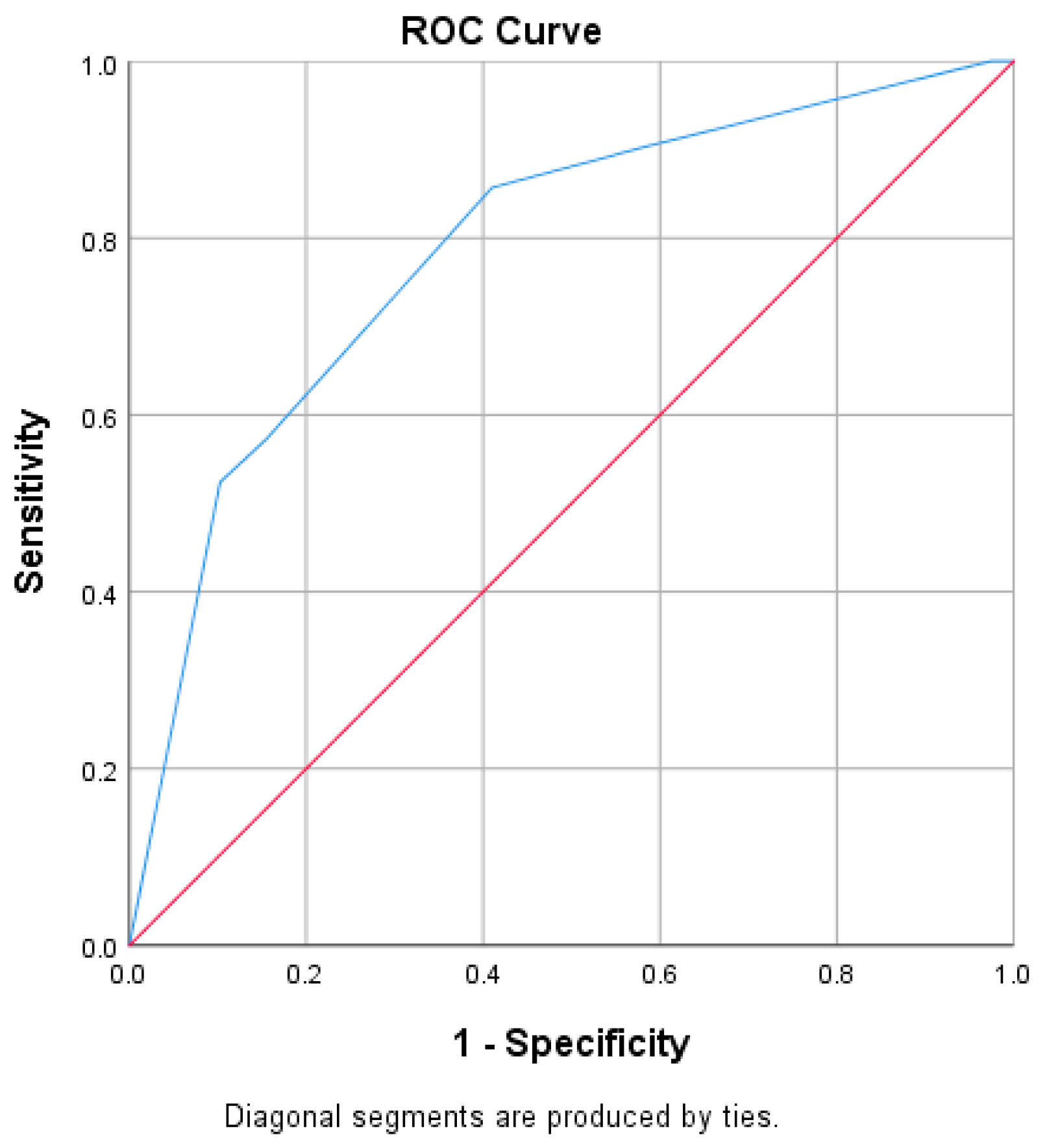
Scoring System
4. Discussion
5. Conclusions
Author Contributions
Funding
Institutional Review Board Statement
Informed Consent Statement
Data Availability Statement
Conflicts of Interest
Abbreviations
| CBD | Common bile duct |
| ERCP | Endoscopic retrograde cholangiopancreatography |
| EUS | Endoscopic ultrasound |
| ESGE | European Society for Gastrointestinal Endoscopy |
| ASGE | American Society for Gastrointestinal Endoscopy |
| PPV | Positive predictive value |
| NPV | Negative predictive value |
| OR | Odds ratio |
| CI | Confidence interval |
| ROC | Receiver operating characteristic |
| IQR | Interquartile range |
| AP | Acute pancreatitis |
| CT | Computed tomography |
| US | Ultrasonography |
| MRCP | Magnetic resonance cholangiopancreatography |
| AST | Aspartate aminotransferase |
| ALT | Alanine aminotransferase |
| GGT | Gamma-glutamyl transferase |
| ALP | Alkaline phosphatase |
| WBC | White blood cells |
References
- Gianpiero Manes, A.; Paspatis, G.; Aabakken, L.; Anderloni, A.; Arvanitakis, M.; Ah-Soune, P.; Barthet, M.; Domagk, D.; Dumonceau, J.-M.; Gigot, J.-F.; et al. Endoscopic Management of Common Bile Duct Stones: European Society of Gastrointestinal Endoscopy (ESGE) Guideline. Endoscopy 2019, 51, 472–491. [Google Scholar] [CrossRef]
- Li, S.; Guizzetti, L.; Ma, C.; Shaheen, A.A.; Dixon, E.; Ball, C.; Wani, S.; Forbes, N. Epidemiology and Outcomes of Choledocholithiasis and Cholangitis in the United States: Trends and Urban-Rural Variations. BMC Gastroenterol. 2023, 23, 254. [Google Scholar] [CrossRef]
- Fujita, N.; Yasuda, I.; Endo, I.; Isayama, H.; Iwashita, T.; Ueki, T.; Uemura, K.; Umezawa, A.; Katanuma, A.; Katayose, Y.; et al. Evidence-Based Clinical Practice Guidelines for Cholelithiasis 2021. J. Gastroenterol. 2023, 58, 801–833. [Google Scholar] [CrossRef]
- Buxbaum, J.L.; Abbas Fehmi, S.M.; Sultan, S.; Fishman, D.S.; Qumseya, B.J.; Cortessis, V.K.; Schilperoort, H.; Kysh, L.; Matsuoka, L.; Yachimski, P.; et al. ASGE Guideline on the Role of Endoscopy in the Evaluation and Management of Choledocholithiasis. Gastrointest. Endosc. 2019, 89, 1075. [Google Scholar] [CrossRef]
- Stanciu, C.; Sfarti, C.; Chiriac, S.; Balan, G.G.; Trifan, A. A Half Century of Endoscopic Retrograde Colangiopancreatography: Reflections of the Past, Present and Future. J. Gastrointest. Liver Dis. 2018, 27, 357–360. [Google Scholar] [CrossRef]
- Freeman, M.L.; DiSario, J.A.; Nelson, D.B.; Fennerty, M.B.; Lee, J.G.; Bjorkman, D.J.; Overby, C.S.; Aas, J.; Ryan, M.E.; Bochna, G.S.; et al. Risk Factors for Post-Ercp Pancreatitis: A Prospective, Multicenter Study. Gastrointest. Endosc. 2001, 54, 425–434. [Google Scholar] [CrossRef]
- Availability of CT and MRI Units in Hospitals—Products Eurostat News—Eurostat. Available online: https://ec.europa.eu/eurostat/web/products-eurostat-news/-/ddn-20200724-1 (accessed on 4 January 2025).
- Cotton, P.B. ERCP Is Most Dangerous for People Who Need It Least. Gastrointest. Endosc. 2001, 54, 535–536. [Google Scholar] [CrossRef]
- Chiriac, S.; Sfarti, C.V.; Stanciu, C.; Cojocariu, C.; Zenovia, S.; Nastasa, R.; Trifan, A. The Relation between Post-Endoscopic Retrograde Cholangiopancreatography Pancreatitis and Different Cannulation Techniques: The Experience of a High-Volume Center from North-Eastern Romania. Life 2023, 13, 1410. [Google Scholar] [CrossRef]
- Vilmann, P.; Jacobsen, G.K.; Henriksen, F.W.; Hancke, S. Endoscopic Ultrasonography with Guided Fine Needle Aspiration Biopsy in Pancreatic Disease. Gastrointest. Endosc. 1992, 38, 172–173. [Google Scholar] [CrossRef]
- Radlinski, M.J.; Strand, D.S.; Shami, V.M. Evolution of Interventional Endoscopic Ultrasound. Gastroenterol. Rep. 2022, 11, goad038. [Google Scholar] [CrossRef]
- Shi, C.; Hong, J.; Bai, B.; Li, S.; Chen, L.; Ding, H.; Xu, Z.; Bao, J.; Mei, Q. Morphological Consistency between EUS and ERCP in Diagnosing Biliary Sludge and Microlithiasis. Gut 2024, 74, 505–506. [Google Scholar] [CrossRef]
- Meeralam, Y.; Al-Shammari, K.; Yaghoobi, M. Diagnostic Accuracy of EUS Compared with MRCP in Detecting Choledocholithiasis: A Meta-Analysis of Diagnostic Test Accuracy in Head-to-Head Studies. Gastrointest. Endosc. 2017, 86, 986–993. [Google Scholar] [CrossRef]
- ASGE Standards of Practice Committee; Forbes, N.; Coelho-Prabhu, N.; Al-Haddad, M.A.; Kwon, R.S.; Amateau, S.K.; Buxbaum, J.L.; Calderwood, A.H.; Elhanafi, S.E.; Fujii-Lau, L.L.; et al. Adverse Events Associated with EUS and EUS-Guided Procedures. Gastrointest. Endosc. 2022, 95, 16–26. [Google Scholar] [CrossRef]
- Miura, F.; Okamoto, K.; Takada, T.; Strasberg, S.M.; Asbun, H.J.; Pitt, H.A.; Gomi, H.; Solomkin, J.S.; Schlossberg, D.; Han, H.S.; et al. Tokyo Guidelines 2018: Initial Management of Acute Biliary Infection and Flowchart for Acute Cholangitis. J. Hepatobiliary Pancreat. Sci. 2018, 25, 31–40. [Google Scholar] [CrossRef]
- Banks, P.A.; Bollen, T.L.; Dervenis, C.; Gooszen, H.G.; Johnson, C.D.; Sarr, M.G.; Tsiotos, G.G.; Vege, S.S.; Windsor, J.A.; Horvath, K.D.; et al. Classification of Acute Pancreatitis—2012: Revision of the Atlanta Classification and Definitions by International Consensus. Gut 2013, 62, 102–111. [Google Scholar] [CrossRef]
- Buxbaum, J.L.; Buitrago, C.; Lee, A.; Elmunzer, B.J.; Riaz, A.; Ceppa, E.P.; Al-Haddad, M.; Amateau, S.K.; Calderwood, A.H.; Fishman, D.S.; et al. ASGE Guideline on the Management of Cholangitis. Gastrointest. Endosc. 2021, 94, 207–221. [Google Scholar] [CrossRef]
- Varone, A.; Mendoza, A.; Gelbard, R.; Tracy, B.; Poulose, B. Suspected Common Bile Duct Stones: Which Test Is Best? Surg. Endosc. 2025, 39, 6525–6529. [Google Scholar] [CrossRef]
- Silva-Santisteban, A.; Shah, I.; Chandnani, M.; Wadhwa, V.; Tsai, L.; Bezuidenhout, A.F.; Berzin, T.M.; Pleskow, D.; Sawhney, M. Prospective Assessment of the Accuracy of ASGE and ESGE Guidelines for Choledocholithiasis. Endosc. Int. Open 2023, 11, E599–E606. [Google Scholar] [CrossRef]
- Lin, M.Y.; Lee, C.T.; Hsieh, M.T.; Ou, M.C.; Wang, Y.S.; Lee, M.C.; Chang, W.L.; Sheu, B.S. Endoscopic Ultrasound Avoids Adverse Events in High Probability Choledocholithiasis Patients with a Negative Computed Tomography. BMC. Gastroenterol. 2022, 22, 94. [Google Scholar] [CrossRef]
- Jacob, J.S.; Lee, M.E.; Chew, E.Y.; Thrift, A.P.; Sealock, R.J. Evaluating the Revised American Society for Gastrointestinal Endoscopy Guidelines for Common Bile Duct Stone Diagnosis. Clin. Endosc. 2020, 54, 269–274. [Google Scholar] [CrossRef]
- Sirinawasatien, A.; Chanchairungcharoen, J.; Yaowmaneerat, T.; Jiratham-opas, J.; Chanpiwat, K.; Chantarojanasiri, T.; Attasaranya, S.; Laohavichitra, K.; Wannaprasert, J.; Ratanachu-ek, T. The use of endoscopic ultrasound in tandem with endoscopic retrograde cholangiopancreatography in the 2019 American Society for Gastrointestinal Endoscopy guideline for patients at high risk of choledocholithiasis can help to avoid diagnostic endoscopic retrograde cholangiopancreatography in individuals without ascending cholangitis. DEN Open 2025, 5, e70058. [Google Scholar] [CrossRef]
- Tenner, S.; Vege, S.S.; Sheth, S.G.; Sauer, B.; Yang, A.; Conwell, D.L.; Yadlapati, R.H.; Gardner, T.B. American College of Gastroenterology Guidelines: Management of Acute Pancreatitis. Am. J. Gastroenterol. 2024, 119, 419–437. [Google Scholar] [CrossRef]
- Correia, F.P.; Coelho, H.; Francisco, M.; Alexandrino, G.; Branco, J.C.; Canena, J.; Horta, D.; Lourenço, L.C. Predictive Factors of Spontaneous Common Bile Duct Clearance and Unnecessary ERCP in Patients with Choledocholithiasis. Clin. Res. Hepatol. Gastroenterol. 2025, 49, 102515. [Google Scholar] [CrossRef]
- Facciorusso, A.; Crinò, S.F.; Gkolfakis, P.; Spadaccini, M.; Arvanitakis, M.; Beyna, T.; Bronswijk, M.; Dhar, J.; Ellrichmann, M.; Gincul, R.; et al. Diagnostic work-up of bile duct strictures: European Society of Gastrointestinal Endoscopy (ESGE) Guideline. Endoscopy 2025, 57, 166–185, Correction in Endoscopy 2025, 57, C17. https://doi.org/10.1055/a-2664-6269. [Google Scholar] [CrossRef]



| Characteristic | Value |
|---|---|
| Age, median (IQR) | 60 (43–73) |
| Sex, women/men, n (%) | 117 (62.9)/69 (37.1) |
| Acute pancreatitis, n (%) | 44 (23.7) |
| Cholangitis, n (%) | 71 (38.2) |
| Grade I | 51 (27.4) |
| Grade II | 15 (8.1) |
| Grade III | 5 (2.7) |
| US CBD diameter, median (IQR) | 9 (1–11) |
| CT CBD diameter, median (IQR) | 10 (9–12) |
| EUS CBD diameter, median (IQR) | 8 (6–11) |
| ERCP CBD diameter, median (IQR) | 12 (9–14) |
| US choledocholithiasis, n (%) | 1 (0.5) |
| CT choledocholithiasis, n (%) | 12 (6.5) |
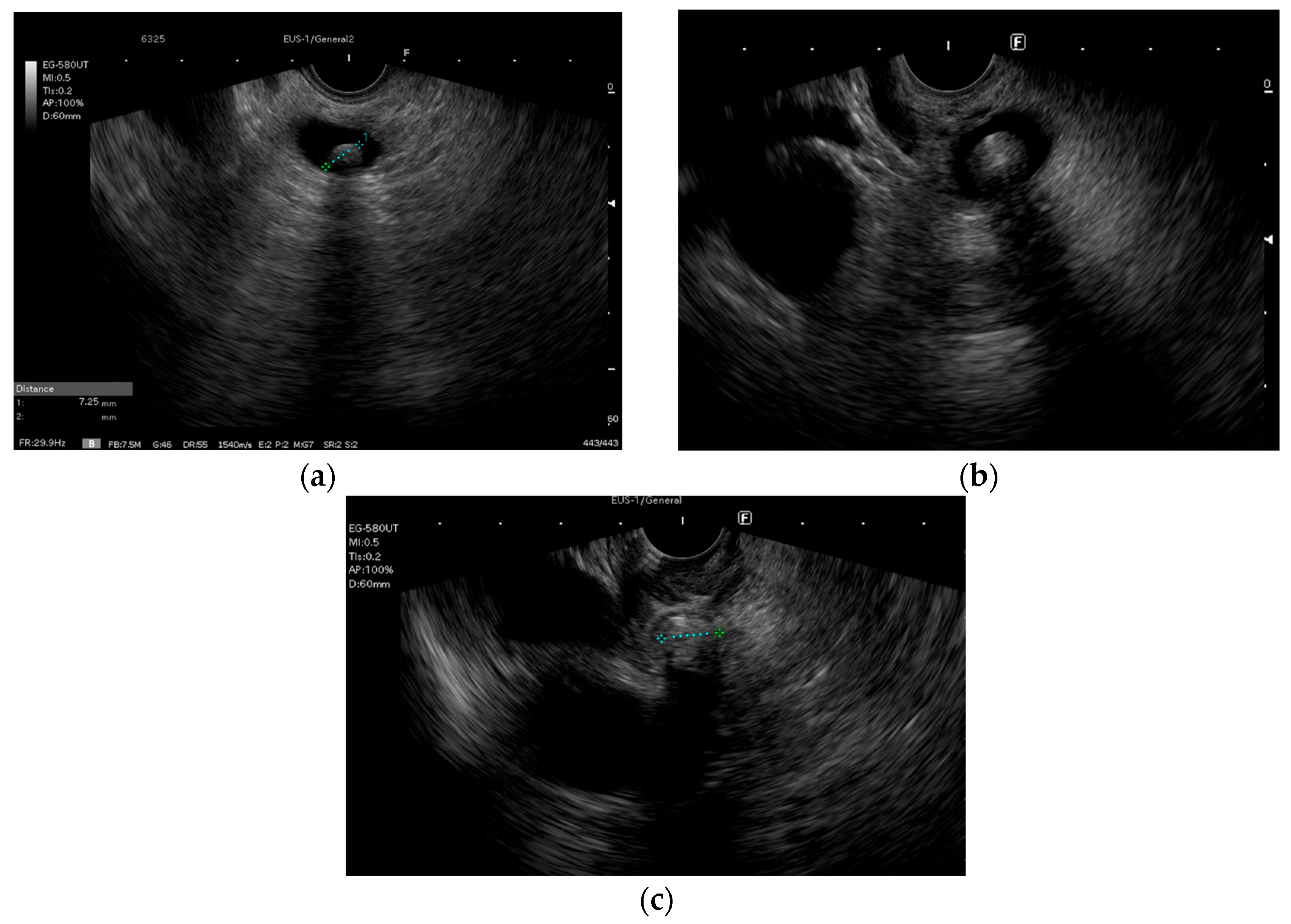
| EUS choledocholithiasis, n (%) | 87 (46.8) |
| Lithiasis risk, n (%) | |
| Low risk | 10 (5.4) |
| Intermediate risk | 92 (49.5) |
| High risk | 84 (45.2) |
| ERCP, n (%) | 81 (43) |
| Same-session EUS and ERCP, n (%) | 66 (81.5) |
| Separate-session EUS and ERCP, n (%) | 15 (18.5) |
| ERCP-related complications, n (%) | |
| PEP | 3 (3.7) |
| Bleeding | 9 (11.1) |
| ALT U/L, median (IQR) | 126 (54–318) |
| AST U/L, median (IQR) | 81 (36–211) |
| ALP U/L, median (IQR) | 177 (109–325) |
| GGT U/L, median (IQR) | 331 (120–520) |
| Bilirubin mg/dL, median (IQR) | 2 (0.87–5.11) |
| Lipase U/L, median (IQR) | 45 (26–123) |
| Characteristic | EUS-Proven Choledocholithiasis, n = 87 | EUS-Excluded Choledocholithiasis n = 99 | p-Value |
|---|---|---|---|
| Age, median (IQR) | 66 (43–74) | 59 (42–72) | 0.468 |
| Sex, women/men, n (%) | 61 (52.1)/26 (37.7) | 56 (47.9)/43 (62.3) | 0.056 |
| Acute pancreatitis, n (%) | 11 (25) | 33 (75) | 0.001 |
| Cholangitis, n (%) | 40 (45.9) | 31 (31.3) | 0.04 |
| Grade I | 29 (72.5) | 22 (70.9) | |
| Grade II | 8 (20) | 7 (22.5) | |
| Grade III | 3 (7.5) | 2 (6.4) | |
| US CBD diameter, median (IQR) | 10 (8–12) | 7 (5.7–10) | <0.001 |
| US dilated CBD, n (%) | |||
| CT CBD diameter, median (IQR) | 12 (9.5–13.5) | 9.2 (5.2–10.7) | 0.001 |
| EUS CBD diameter, median (IQR) | 10 (8–13) | 6 (5–8) | <0.001 |
| US choledocholithiasis, n (%) | 1 (100) | 0 | 0.451 |
| CT choledocholithiasis, n (%) | 7 (58.3) | 5 (41.7) | 0.098 |
| Lithiasis risk, n (%) | |||
| Low risk | 1 (10) | 9 (9) | |
| Intermediate risk | 41 (44.6) | 51 (55.4) | |
| High risk | 45 (53.6) | 39 (46.4) | |
| ALT, U/L, median (IQR) | 114.5 (43.5–330) | 129 (58–273) | 0.497 |
| AST U/L, median (IQR) | 87 (29.7–212.2) | 73 (40–208) | 0.203 |
| ALP U/L, median (IQR) | 201 (107.2–350.7) | 167 (110–290) | 0.600 |
| GGT U/L, median (IQR) | 278.5 (88.7–575.2) | 346 (120–496) | 0.327 |
| Bilirubin mg/dL, median (IQR) | 2.24 (0.8–5.3) | 2 (0.9–4.7) | 0.600 |
| Lipase U/L, median (IQR) | 30.5 (20.7–60.5) | 68 (36–841) | <0.001 |
| WBC × 109/L, median (IQR) | 8.6 (7.3–11.8) | 10.4 (8–14) | 0.042 |
| CRP mg/dL, median (IQR) | 1.7 (0.7–2.2) | 2 (0.65–9.7) | 0.042 |
| Hospitalization days, median (IQR) | 8 (5–11) | 8 (5–10) | 0.468 |
| Creatinine mg, median (IQR) | 0.7 (0.6–0.9) | 0.78 (0.6–1) | 0.197 |
| Characteristic | EUS-Proven Choledocholithiasis, n = 11 | EUS-Excluded Choledocholithiasis n = 33 | p-Value |
|---|---|---|---|
| Age, median (IQR) | 71 (24–77) | 58 (52–70) | 0.99 |
| Sex, women/men, n (%) | 9 (81.8)/2 (18.2) | 17 (51.5)/16 (48.5) | 0.077 |
| Cholangitis, n (%) | 7 (63.6) | 18 (54.5) | |
| Grade I | 3 (42.8) | 13 (72.2) | |
| Grade II | 4 (57.1) | 4 (22.2) | |
| Grade III | 0 | 1 (5.5) | |
| US CBD diameter, median (IQR) | 7 (7–14) | 5.2 (4–8.2) | 0.803 |
| US non-dilated CBD, n (%) | 0 (0) | 12 (36.4) | 0.02 |
| CT CBD diameter, mean ± SD | 12.5 ± 3.5 | 10.2 ± 3.8 | 0.422 |
| EUS CBD diameter, median (IQR) | 7.5 (7–12) | 4.2 (2.6–6) | 0.014 |
| US choledocholithiasis, n (%) | 0 | 0 | NA |
| CT choledocholithiasis, n (%) | 1 (9) | 1 (3) | 0.105 |
| Lithiasis risk, n (%) | 0.854 | ||
| Low risk | 0 | 0 | |
| Intermediate risk | 4 (36.4) | 11 (33.3) | |
| High risk | 7 (63.6) | 22 (66.7) | |
| ALT, U/L, mean ± SD | 167.6 ± 104.5 | 249.6 ± 191.9 | 0.084 |
| AST U/L, mean ± SD | 147.4 ± 167.2 | 213 ± 192.1 | 0.319 |
| ALP U/L, mean ± SD | 226.7 ± 200 | 286 ± 183 | 0.368 |
| GGT U/L, mean ± SD | 326 ± 236.8 | 468.9 ± 345.3 | 0.211 |
| Bilirubin mg/dL, mean ± SD | 4.3 ± 2.8 | 3.4 ± 2.8 | 0.340 |
| Lipase U/L, median (IQR) | 106 (18–302) | 571.7 (217.4–1956.5) | 0.037 |
| WBC × 109/L, median (IQR) | 4.3 (3.9–5.5) | 8.5 (6.9–11) | 0.005 |
| CRP mg/dL, median (IQR) | 0.26 (0.13–0.86) | 0.89 (0.43–3.6) | 0.164 |
| Hospitalization days, median (IQR) | 8 (6.5–10.5) | 8 (6.2–8) | 0.340 |
| Creatinine mg, mean ± SD | 0.8 ± 0.3 | 3.8 ± 1.7 | 0.573 |
| Characteristic | EUS-Proven Choledocholithiasis, n = 45 | EUS-Excluded Choledocholithiasis n = 39 | p-Value |
|---|---|---|---|
| Age, median (IQR) | 67 (43–75) | 54 (37–67) | 0.178 |
| Sex, women/men, n (%) | 30 (66.7)/15 (33.3) | 18 (46.2)/21 (53.8) | 0.058 |
| Pancreatitis, n (%) | 7 (15.6) | 22 (56.4) | <0.001 |
| Cholangitis, n (%) | 40 (88.8) | 28 (71.7) | 0.047 |
| Grade I | 29 (72.5) | 21 (75) | |
| Grade II | 8 (20) | 5 (17.8) | |
| Grade III | 3 (7.5) | 2 (7.1) | |
| US CBD diameter, median (IQR) | 10 (7–12) | 8.5 (5.8–11) | 0.108 |
| US non-dilated CBD, n (%) | 5 (11.1) | 12 (30.8) | 0.056 |
| CT CBD diameter, median (IQR) | 12 (11–13) | 9.5 (7–12) | 0.002 |
| EUS CBD diameter, median (IQR) | 10 (9–13) | 6.4 (5–8) | 0.001 |
| US choledocholithiasis, n (%) | 0 | 0 | NA |
| CT choledocholithiasis, n (%) | 5 (31.3) | 3 (17.6) | 0.438 |
| ALT U/L, median (IQR) | 234 (78–330) | 272 (147–365) | 0.99 |
| AST U/L, median (IQR) | 120 (84–294) | 214 (68–322) | 0.382 |
| ALP U/L, median (IQR) | 376 (257–583) | 254 (166–364) | 0.99 |
| GGT U/L, median (IQR) | 430 (254–1322) | 413 (347–620) | 0.189 |
| Bilirubin mg/dL, median (IQR) | 6.2 (2.7–9.8) | 4.5 (2.3–6.7) | 0.662 |
| Lipase U/L, median (IQR) | 25 (15–31) | 279 (31–2080) | <0.001 |
| WBC × 109/L, median (IQR) | 8.5 (6.6–10) | 11.6 (7.1–14) | 0.382 |
| CRP mg/dL, median (IQR) | 1.9 (1–3.1) | 3.1 (0.8–9.1) | 0.382 |
| Hospitalization days, median (IQR) | 8 (6–9.5) | 8 (6–10) | 0.817 |
| Creatinine mg, median (IQR) | 0.7 (0.5–1.1) | 0.7 (0.6–1) | 0.662 |
| Variable | Definition | Assigned Points |
|---|---|---|
| Acute pancreatitis | Present at admission or during evaluation | −2 |
| Cholangitis | Clinical cholangitis (Tokyo 2018 criteria), any grade | +2 |
| CBD diameter on EUS | <8 mm | 0 |
| 8.0–9.9 mm | +1 | |
| ≥10 mm | +2 | |
| Suggested risk interpretation | ||
| Total Score | Estimated Probability of CBD Stones | Clinical Implication |
| ≤0 (Low risk) | Very low likelihood | Avoid ERCP; EUS or observation appropriate |
| 1–2 (Intermediate risk) | Moderate likelihood | EUS recommended; ERCP only if confirmed |
| ≥3 (High risk) | High likelihood | Consider same-session EUS → ERCP |
Disclaimer/Publisher’s Note: The statements, opinions and data contained in all publications are solely those of the individual author(s) and contributor(s) and not of MDPI and/or the editor(s). MDPI and/or the editor(s) disclaim responsibility for any injury to people or property resulting from any ideas, methods, instructions or products referred to in the content. |
© 2026 by the authors. Licensee MDPI, Basel, Switzerland. This article is an open access article distributed under the terms and conditions of the Creative Commons Attribution (CC BY) license.
Share and Cite
Chiriac, S.; Sfarti, C.; Minea, H.; Zenovia, S.; Girleanu, I.; Huiban, L.; Muzica, C.; Rotaru, A.; Stafie, R.; Nastasa, R.; et al. Endoscopic Ultrasound and Endoscopic Retrograde Cholangiopancreatography for Bile Duct Stones—Avoiding the Avoidable. Biomedicines 2026, 14, 91. https://doi.org/10.3390/biomedicines14010091
Chiriac S, Sfarti C, Minea H, Zenovia S, Girleanu I, Huiban L, Muzica C, Rotaru A, Stafie R, Nastasa R, et al. Endoscopic Ultrasound and Endoscopic Retrograde Cholangiopancreatography for Bile Duct Stones—Avoiding the Avoidable. Biomedicines. 2026; 14(1):91. https://doi.org/10.3390/biomedicines14010091
Chicago/Turabian StyleChiriac, Stefan, Catalin Sfarti, Horia Minea, Sebastian Zenovia, Irina Girleanu, Laura Huiban, Cristina Muzica, Adrian Rotaru, Remus Stafie, Robert Nastasa, and et al. 2026. "Endoscopic Ultrasound and Endoscopic Retrograde Cholangiopancreatography for Bile Duct Stones—Avoiding the Avoidable" Biomedicines 14, no. 1: 91. https://doi.org/10.3390/biomedicines14010091
APA StyleChiriac, S., Sfarti, C., Minea, H., Zenovia, S., Girleanu, I., Huiban, L., Muzica, C., Rotaru, A., Stafie, R., Nastasa, R., Stratina, E., Ciuntu, B. M., Avram, R., & Trifan, A. (2026). Endoscopic Ultrasound and Endoscopic Retrograde Cholangiopancreatography for Bile Duct Stones—Avoiding the Avoidable. Biomedicines, 14(1), 91. https://doi.org/10.3390/biomedicines14010091