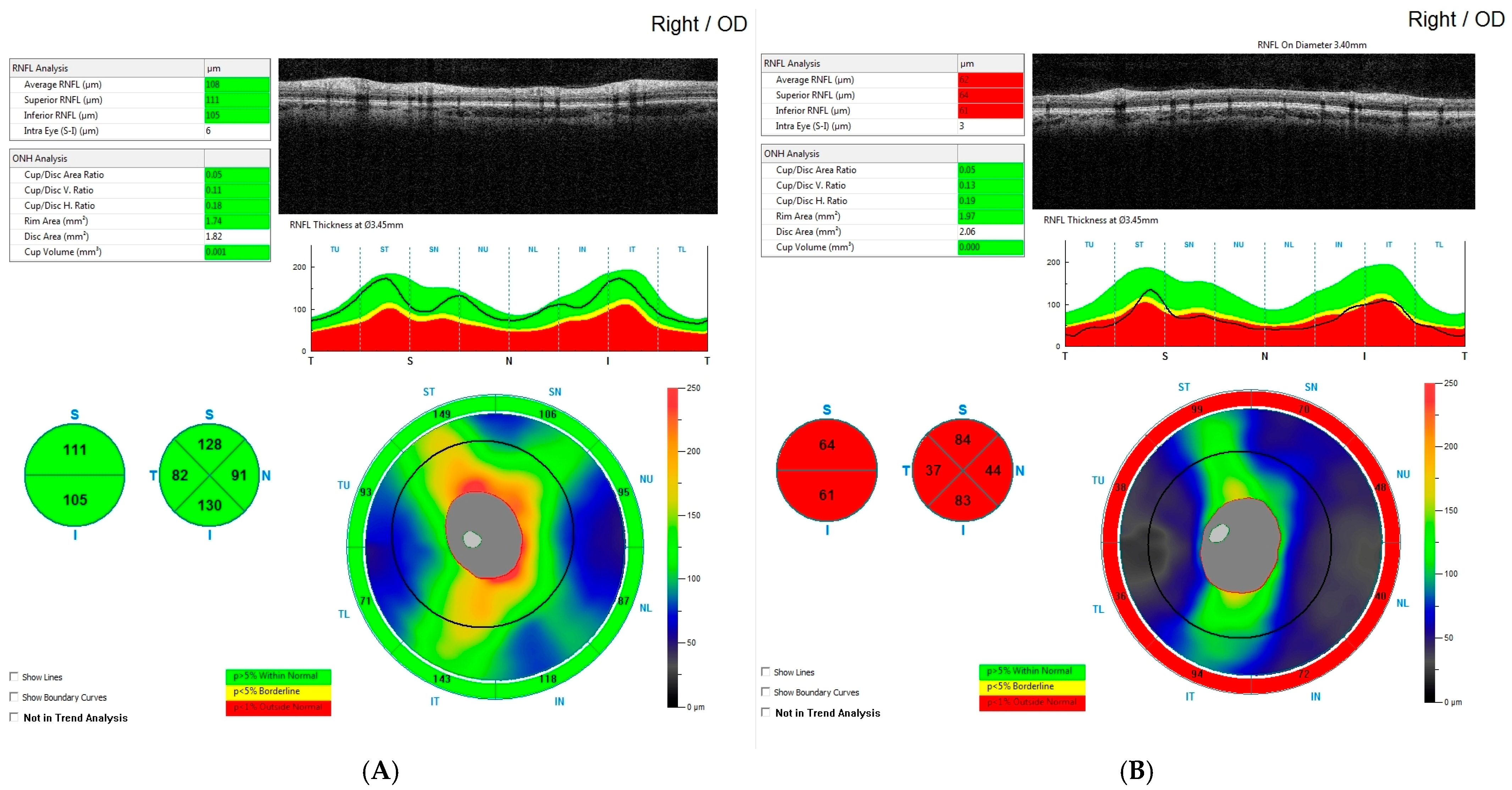


Correlation Between Endocrine and Other Clinical Factors with Peripapillary Retinal Nerve Fiber Layer Thickness After Surgical Treatment of Pediatric Craniopharyngioma
 , ,
, ,
Abstract
1. Introduction
2. Materials and Methods
3. Statistical Analysis
4. Results
5. Discussion
6. Conclusions
Author Contributions
Funding
Institutional Review Board Statement
Informed Consent Statement
Data Availability Statement
Conflicts of Interest
References
- Louis, D.N.; Ohgaki, H.; Wiestler, O.D.; Cavenee, W.K.; Burger, P.C.; Jouvet, A.; Scheithauer, B.W.; Kleihues, P. The 2007 WHO Classification of Tumours of the Central Nervous System. Acta Neuropathol. 2007, 114, 97–109. [Google Scholar] [CrossRef] [PubMed]
- Müller, H.L.; Merchant, T.E.; Warmuth-Metz, M.; Martinez-Barbera, J.P.; Puget, S. Craniopharyngioma. Nat. Rev. Dis. Primers 2019, 5, 75. [Google Scholar] [CrossRef] [PubMed]
- Bogusz, A.; Müller, H.L. Childhood-onset craniopharyngioma: Latest insights into pathology, diagnostics, treatment, and follow-up. Expert Rev. Neurother. 2018, 18, 793–806. [Google Scholar] [CrossRef]
- Moszczyńska, E.; Prokop-Piotrkowska, M.; Bogusz-Wójcik, A.; Grajkowska, W.; Szymańska, S.; Szalecki, M. Ki67 as a prognostic factor of craniopharyngioma’s recurrence in paediatric population. Childs Nerv. Syst. 2020, 36, 1461–1469. [Google Scholar] [CrossRef]
- Bogusz, A.; Boekhoff, S.; Warmuth-Metz, M.; Calaminus, G.; Eveslage, M.; Müller, H.L. Posterior hypothalamus-sparing surgery improves outcome after childhood craniopharyngioma. Endocr. Connect. 2019, 8, 481–492. [Google Scholar] [CrossRef] [PubMed]
- Schmutzer-Sondergeld, M.; Quach, S.; Niedermeyer, S.; Teske, N.; Ueberschaer, M.; Schichor, C.; Kunz, M.; Thon, N. Risk-benefit analysis of surgical treatment strategies for cystic craniopharyngioma in children and adolescents. Front. Oncol. 2024, 14, 1274705. [Google Scholar] [CrossRef]
- González-Gallego, C.; Molina, P.; Hostalot, C.; Oliva, A.; Blanco, A.; de Pablo, P.P.; Comas, S.; Carrato, C.; Valassi, E.; Puig-Domingo, M. Modern treatment of craniopharyngioma to improve outcomes: Evidence of a change of paradigm. Endocrine 2025, 89, 20–29. [Google Scholar] [CrossRef]
- Sowithayasakul, P.; Beckhaus, J.; Boekhoff, S.; Friedrich, C.; Calaminus, G.; Müller, H.L. Vision-related quality of life in patients with childhood-onset craniopharyngioma. Sci. Rep. 2023, 13, 19599. [Google Scholar] [CrossRef]
- Clark, A.J.; Cage, T.A.; Aranda, D.; Parsa, A.T.; Auguste, K.I.; Gupta, N. Treatment-related morbidity and the management of pediatric craniopharyngioma: A systematic review. J. Neurosurg. Pediatr. 2012, 10, 293–301. [Google Scholar] [CrossRef]
- Wan, M.J.; Zapotocky, M.; Bouffet, E.; Bartels, U.; Kulkarni, A.V.; Drake, J.M. Long-term visual outcomes of craniopharyngioma in children. J. Neurooncol. 2018, 137, 645–651. [Google Scholar] [CrossRef]
- Alboqami, M.N.; Albaiahy, A.K.S.; Bukhari, B.H.; Alkhaibary, A.; Alharbi, A.; Khairy, S.; Alassiri, A.H.; AlSufiani, F.; Alkhani, A.; Aloraidi, A. Craniopharyngioma: A comprehensive review of the clinical presentation, radiological findings, management, and future Perspective. Heliyon 2024, 10, e32112. [Google Scholar] [CrossRef]
- Mediero, S.; Noval, S.; Bravo-Ljubetic, L.; Contreras, I.; Carceller, F. Visual Outcomes, Visual Fields, and Optical Coherence Tomography in Paediatric Craniopharyngioma. Neuro-Ophthalmology 2015, 39, 132–139. [Google Scholar] [CrossRef]
- Lee, G.I.; Park, K.A.; Oh, S.Y.; Kong, D.S.; Hong, S.D. Inner and outer retinal layer thickness alterations in pediatric and juvenile craniopharyngioma. Sci. Rep. 2021, 11, 2840. [Google Scholar] [CrossRef] [PubMed]
- Meyer, D.R. Compressive Optic Neuropathy. Ophthalmology 2007, 114, 199. [Google Scholar] [CrossRef]
- Pang, Y.; Tan, Z.; Chen, X.; Liao, Z.; Yang, X.; Zhong, Q.; Huang, B.; Zhong, Q.; Zhong, J.; Mo, W. Evaluation of preoperative visual pathway impairment in patients with non-functioning pituitary adenoma using diffusion tensor imaging coupled with optical coherence tomography. Front. Neurosci. 2023, 17, 1057781. [Google Scholar] [CrossRef] [PubMed]
- Rodriguez-Beato, F.Y.; De Jesus, O. Compressive Optic Neuropathy; StatPearls: Treasure Island, FL, USA, 2025. Available online: https://www.ncbi.nlm.nih.gov/books/NBK560583/ (accessed on 30 November 2025).
- Santorini, M.; Ferreira De Moura, T.; Barraud, S.; Litré, C.F.; Brugniart, C.; Denoyer, A.; Djerada, Z.; Arndt, C. Comparative Evaluation of Two SD-OCT Macular Parameters (GCC, GCL) and RNFL in Chiasmal Compression. Eye Brain 2022, 14, 35–48. [Google Scholar] [CrossRef] [PubMed]
- Danesh-Meyer, H.V.; Papchenko, T.; Savino, P.J.; Law, A.; Evans, J.; Gamble, G.D. In Vivo Retinal Nerve Fiber Layer Thickness Measured by Optical Coherence Tomography Predicts Visual Recovery after Surgery for Parachiasmal Tumors. Investig. Ophthalmol. Vis. Sci. 2008, 49, 1879. [Google Scholar] [CrossRef]
- Garcia, T.; Sanchez, S.; Litré, C.F.; Radoi, C.; Delemer, B.; Rousseaux, P.; Ducasse, A.; Arndt, C. Prognostic value of retinal nerve fiber layer thickness for postoperative peripheral visual field recovery in optic chiasm compression: Clinical article. J. Neurosurg. 2014, 121, 165–169. [Google Scholar] [CrossRef]
- Qiao, N.; Li, C.; Xu, J.; Ma, G.; Kang, J.; Jin, L.; Cao, L.; Liu, C.; Zhang, Y.; Gui, S. Prognostic Utility of Optical Coherence Tomography for Visual Outcome After Extended Endoscopic Endonasal Surgery for Adult Craniopharyngiomas. Front. Oncol. 2022, 11, 764582. [Google Scholar] [CrossRef]
- Solari, D.; Cennamo, G.; Amoroso, F.; Frio, F.; Donna, P.; D’enza, A.I.; Melenzane, A.; Somma, T.; Tranfa, F.; Cavallo, L.M. Predicting the early visual outcomes in sellar-suprasellar lesions compressing the chiasm: The role of SD-OCT series of 20 patients operated via endoscopic endonasal approach. J. Neurosurg. Sci. 2022, 66, 362–370. [Google Scholar] [CrossRef]
- Toumi, E.; Almairac, F.; Mondot, L.; Themelin, A.; Decoux-Poullot, A.-G.; Paquis, P.; Chevalier, N.; Baillif, S.; Nahon-Esteve, S.; Martel, A. Benefit of Optical Coherence Tomography–Angiography in Patients Undergoing Transsphenoidal Pituitary Adenoma Surgery: A Prospective Controlled Study. Diagnostics 2024, 14, 1747. [Google Scholar] [CrossRef]
- Moon, C.H.; Lee, S.H.; Kim, B.T.; Hwang, S.C.; Ohn, Y.H.; Park, T.K. Diagnostic Ability of Retinal Nerve Fiber Layer Thickness Measurements and Neurologic Hemifield Test to Detect Chiasmal Compression. Investig. Ophthalmol. Vis. Sci. 2012, 53, 5410. [Google Scholar] [CrossRef]
- Bialer, O.Y.; Goldenberg-Cohen, N.; Toledano, H.; Snir, M.; Michowiz, S. Retinal NFL thinning on OCT correlates with visual field loss in pediatric craniopharyngioma. Can. J. Ophthalmol. 2013, 48, 494–499. [Google Scholar] [CrossRef]
- Meyer, J.; Diouf, I.; King, J.; Drummond, K.; Stylli, S.; Kaye, A.; Kalincik, T.; Danesh-Meyer, H.; Symons, R.C.A. A comparison of macular ganglion cell and retinal nerve fibre layer optical coherence tomographic parameters as predictors of visual outcomes of surgery for pituitary tumours. Pituitary 2022, 25, 563–572. [Google Scholar] [CrossRef]
- Phal, P.M.; Steward, C.; Nichols, A.D.; Kokkinos, C.; Desmond, P.M.; Danesh-Meyer, H.; Sufaro, Y.Z.; Kaye, A.H.; Moffat, B.A. Assessment of Optic Pathway Structure and Function in Patients With Compression of the Optic Chiasm: A Correlation With Optical Coherence Tomography. Investig. Ophthalmol. Vis. Sci. 2016, 57, 3884. [Google Scholar] [CrossRef] [PubMed]
- Rakusiewicz-Krasnodębska, K.; Bogusz-Wójcik, A.; Moszczyńska, E.; Jaworski, M.; Kowalczyk, P.; Hautz, W. Evaluation of the Effect of Optic Nerve Compression by Craniopharyngioma on Retinal Nerve Fiber Layer Thickness in Pediatric Patients. Cancers 2025, 17, 2574. [Google Scholar] [CrossRef]
- Akashi, A.; Kanamori, A.; Ueda, K.; Matsumoto, Y.; Yamada, Y.; Nakamura, M. The Detection of Macular Analysis by SD-OCT for Optic Chiasmal Compression Neuropathy and Nasotemporal Overlap. Investig. Ophthalmol. Vis. Sci. 2014, 55, 4667. [Google Scholar] [CrossRef]
- Yang, L.; Qu, Y.; Lu, W.; Liu, F. Evaluation of Macular Ganglion Cell Complex and Peripapillary Retinal Nerve Fiber Layer in Primary Craniopharyngioma by Fourier-Domain Optical Coherence Tomography. Med. Sci. Monit. 2016, 22, 2309–2314. [Google Scholar] [CrossRef]
- Indaram, M.; Ali, F.S.; Levin, M.H. In search of a treatment for radiation-induced optic neuropathy. Curr. Treat. Options Neurol. 2015, 17, 325. [Google Scholar] [CrossRef] [PubMed]
- Colliander, R.; Sharma, S.; Shlobin, N.A.; Fernandez, L.G.; LoPresti, M.A.; Lam, S.; DeCuypere, M. Visual outcomes after treatment of craniopharyngioma in children: A systematic review. Childs Nerv. Syst. 2024, 40, 1641–1659. [Google Scholar] [CrossRef] [PubMed]
- Müller, H.L.; Gebhardt, U.; Teske, C.; Faldum, A.; Zwiener, I.; Warmuth-Metz, M.; Pietsch, T.; Pohl, F.; Sörensen, N.; Calaminus, G. Post-operative hypothalamic lesions and obesity in childhood craniopharyngioma: Results of the multinational prospective trial KRANIOPHARYNGEOM 2000 after 3-year follow-up. Eur. J. Endocrinol. 2011, 165, 17–24. [Google Scholar] [CrossRef]
- Moon, C.H.; Hwang, S.C.; Kim, B.T.; Ohn, Y.H.; Park, T.K. Visual Prognostic Value of Optical Coherence Tomography and Photopic Negative Response in Chiasmal Compression. Investig. Ophthalmol. Vis. Sci. 2011, 52, 8527. [Google Scholar] [CrossRef]
- Budenz, D.L.; Anderson, D.R.; Varma, R.; Schuman, J.; Cantor, L.; Savell, J.; Greenfield, D.S.; Patella, V.M.; Quigley, H.A.; Tielsch, J. Determinants of Normal Retinal Nerve Fiber Layer Thickness Measured by Stratus OCT. Ophthalmology 2007, 114, 1046–1052, Erratum in Ophthalmology 2008, 115, 472. PMID: 17210181; PMCID: PMC2916163.. [Google Scholar] [CrossRef]
- Pérez-Cambrodí, R.J.; Gómez-Hurtado Cubillana, A.; Merino-Suárez, M.L.; Piñero-Llorens, D.P.; Laria-Ochaita, C. Optic neuritis in pediatric population: A review in current tendencies of diagnosis and management. J. Optom. 2014, 7, 125–130. [Google Scholar] [CrossRef]
- Aguirre Maqueda, M.; Zavala Romero, L.; Monroy Córdoba, R.; Soto, J.M.M.; Torres-Ríos, J.A.; Herrera, D.B.; Camacho, A.R.; Jiménez, S.M. Effects and Assessment of the Optic Pathway After Management with Stereotactic Radiosurgery for Intracranial Tumors: A Comprehensive Literature Review. Cureus 2023, 15, e43538. [Google Scholar] [CrossRef] [PubMed]
- Hayreh, S.S. Pathogenesis of optic disc edema in raised intracranial pressure. Prog. Retin. Eye Res. 2016, 50, 108–144. [Google Scholar] [CrossRef] [PubMed]
- Menke, M.N.; Feke, G.T.; Trempe, C.L. OCT Measurements in Patients with Optic Disc Edema. Investig. Ophthalmol. Vis. Sci. 2005, 46, 3807. [Google Scholar] [CrossRef] [PubMed]
- Savini, G. Detection and Quantification of Retinal Nerve Fiber Layer Thickness in Optic Disc Edema Using Stratus OCT. Arch. Ophthalmol. 2006, 124, 1111. [Google Scholar] [CrossRef]
- Ahuja, S.; Anand, D.; Dutta, T.K.; Roopesh Kumar, V.R.; Kar, S.S. Retinal nerve fiber layer thickness analysis in cases of papilledema using optical coherence tomography—A case control study. Clin. Neurol. Neurosurg. 2015, 136, 95–99. [Google Scholar] [CrossRef]
- Pahuja, A.; Dhiman, R.; Aggarwal, V.; Aalok, S.P.; Saxena, R. Evaluation of Peripapillary and Macular Optical Coherence Tomography Angiography Characteristics in Different Stages of Papilledema. J. Neuro-Ophthalmol. 2024, 44, 53–60. [Google Scholar] [CrossRef]
- Lee, T.H.; Ji, Y.S.; Park, S.W.; Heo, H. Retinal ganglion cell and axonal loss in optic neuritis: Risk factors and visual functions. Eye 2017, 31, 467–474. [Google Scholar] [CrossRef]
- Kupersmith, M.J.; Sibony, P.; Mandel, G.; Durbin, M.; Kardon, R.H. Optical Coherence Tomography of the Swollen Optic Nerve Head: Deformation of the Peripapillary Retinal Pigment Epithelium Layer in Papilledema. Investig. Ophthalmol. Vis. Sci. 2011, 52, 6558. [Google Scholar] [CrossRef] [PubMed]
- Chisari, C.G.; Toro, M.D.; Cimino, V.; Rejdak, R.; Luca, M.; Rapisarda, L.; Avitabile, T.; Posarelli, C.; Rejdak, K.; Reibaldi, M.; et al. Retinal Nerve Fiber Layer Thickness and Higher Relapse Frequency May Predict Poor Recovery after Optic Neuritis in MS Patients. J. Clin. Med. 2019, 8, 2022. [Google Scholar] [CrossRef] [PubMed]
- Sood, G.; Samanta, R.; Kumawat, D.; Agrawal, A.; Singh, A. Clinical profile and retinal nerve fibre layer thickness of optic disc oedema patients at a tertiary care institute in North India. Ther. Adv. Ophthalmol. 2022, 14, 25158414211072634. [Google Scholar] [CrossRef]
- Ogmen, B.E.; Ugurlu, N.; Faki, S.; Polat, S.B.; Ersoy, R.; Cakir, B. Retinal layers in prolactinoma patients: A spectral-domain optical coherence tomography study. Int. Ophthalmol. 2021, 41, 1373–1379. [Google Scholar] [CrossRef] [PubMed]
- Nalcacioglu-Yuksekkaya, P.; Sen, E.; Yilmaz, S.; Elgin, U.; Gunaydin, S.; Aycan, Z. Decreased Retinal Nerve Fiber Layer Thickness in Patients with Congenital Isolated Growth Hormone Deficiency. Eur. J. Ophthalmol. 2014, 24, 873–878. [Google Scholar] [CrossRef]
- Baudet, M.L.; Rattray, D.; Martin, B.T.; Harvey, S. Growth Hormone Promotes Axon Growth in the Developing Nervous System. Endocrinology 2009, 150, 2758–2766. [Google Scholar] [CrossRef]



| Craniopharyngioma (CP) Patient Characteristics | Study Cohort (Patients) | Study Cohort (Eyes) |
|---|---|---|
| n (%) 38 (100%) | n (%) 73 (100%) | |
| Sex, female/male | 16 (42%)/22 (58%) | 31 (42%)/42 (58%) |
| Place of birth, city/country | 28 (74%)/10 (26%) | 53 (73%)/20 (27%) |
| Mean age at CP diagnosis, years (range) | 8.5 (1.9–16) | |
| Mean age at OCT examination, years (range) | 10.3 (4–17) | |
| The reason for requesting diagnostics | ||
| Headache | 17 (45%) | 32 (44%) |
| Visual impairment | 10 (26%) | 19 (26%) |
| Short stature | 3 (8%) | 6 (8%) |
| Symptoms at CP diagnosis | ||
| Headache | 26 (68%) | 51 (70%) |
| Vomiting | 17 (45%) | 32 (44%) |
| Impaired visual acuity | 22 (58%) | 41 (56%) |
| Field of vision restriction | 7 of 23 (30%) | 14 of 43 (33%) |
| Optic disc oedema | 12 (32%) | 22 (30%) |
| Atrophy of the optic nerve disc | 4 (11%) | 7 (10%) |
| Strabismus | 9 (24%) | 17 (23%) |
| Double vision | 2 (5%) | 4 (5%) |
| The blindness of one eye | 2 (5%) | 2 (3%) |
| Drowsiness/disturbance of consciousness | 16 (42%) | 31 (42%) |
| Apathy | 14 (37%) | 27 (37%) |
| Epileptic seizure | 5 (13%) | 10 (14%) |
| Loss of consciousness | 0 | 0 |
| Memory disorders | 4 (11%) | 8 (11%) |
| Neurological symptoms | 10 (26%) | 19 (26%) |
| Growth retardation | 16 (42%) | 31 (40%) |
| Delayed puberty | 3 of 9 at pubertal age (33%) | 6 of 18 at pubertal age (33%) |
| GH deficiency | 5 of 6 (83%) | 10 of 12 (83%) |
| Hypothyroidism | 13 (34%) | 25 (34%) |
| Adrenal insufficiency | 6 of 24 (25%) | 12 of 49 (24%) |
| Arginine vasopressin deficiency | 3 (8%) | 6 (8%) |
| Hyperprolactinemia | 6 of 26 (23%) | 12 of 50 (24%) |
| Craniopharyngioma (CP) Patient Characteristics | Study Cohort (Patients) | Study Cohort (Eyes) |
|---|---|---|
| n (%) | n (%) | |
| Tumor location | ||
| Intrasellar and suprasellar | 24 (63%) | 46 (63%) |
| Suprasellar | 14 (37%) | 27 (37%) |
| Intrasellar | 0 (0) | 0 (0) |
| Median tumor volume, cm3 (range) | 35.2 (1.8–213.7) | |
| Median maximum tumor diameter, mm (range) | 44.2 (19–98) | |
| Tumor morphology solid/cystic | 4 (11%)/34 (89%) | 7 (10%)/66 (90%) |
| Calcifications | 37 (97%) | 71 (97%) |
| Invading the third ventricle | 29 (76%) | 55 (78%) |
| Cavernous sinus infiltration | 2 (5%) | 4 (5%) |
| Hydrocephalus | 16 (42%) | 29 (40%) |
| Ventriculoperitoneal shunt | 6 (16%) | 12 (16%) |
| Bifrontal craniotomy/transcortical-transforaminal craniotomy | 31 (87%)/5 (13%) | 63 (86%)/10 (14%) |
| Degree of surgical resection (gross total resection/subtotal resection) | 23 (61%)/15 (39%) | 46 (63%)/27 (37%) |
| Rosenthal fibers in histopathology examination | 5 (13%) | 9 (12%) |
| SIADH after surgery | 20 (53%) | 39 (53%) |
| The end of AVD after surgery | 4 (11%) | 8 (11%) |
| Progression | 5 (13) | 9 (12%) |
| Recurrence | 4 (11%) | 7 (10%) |
| Reoperation | 7 (8%) | 13 (18%) |
| Radiotherapy | 10 (24%) | 19 (26%) |
| Memory disorder after surgery | 14 (37%) | 27 (37%) |
| Hyperfagia after surgery | 19 (50%) | 37 (51%) |
| Clinical Factor | RNFL Parameter | Effect | Comparison of Medians | p-Value |
|---|---|---|---|---|
| Age below 5 years at the time of diagnosis | IN | Thinner when the diagnosis below 5 years of age | 79 μm vs. 121 | 0.02 |
| NU | Thinner when the diagnosis below 5 years of age | 56 μm vs. 96 μm | 0.02 | |
| Place of birth, city/country | infRNFL | Thinner when born in the country | 74 μm vs. 85 μm | 0.03 |
| IT | Thinner when born in the country | 112 μm vs. 130 μm | 0.03 | |
| IN | Thinner when born in the country | 78 μm vs. 130 μm | 0.04 | |
| NU | Thinner when born in the country | 29 μm vs. 37 μm | 0.04 | |
| SN | Thinner when born in the country | 79 μm vs. 90 μm | 0.004 | |
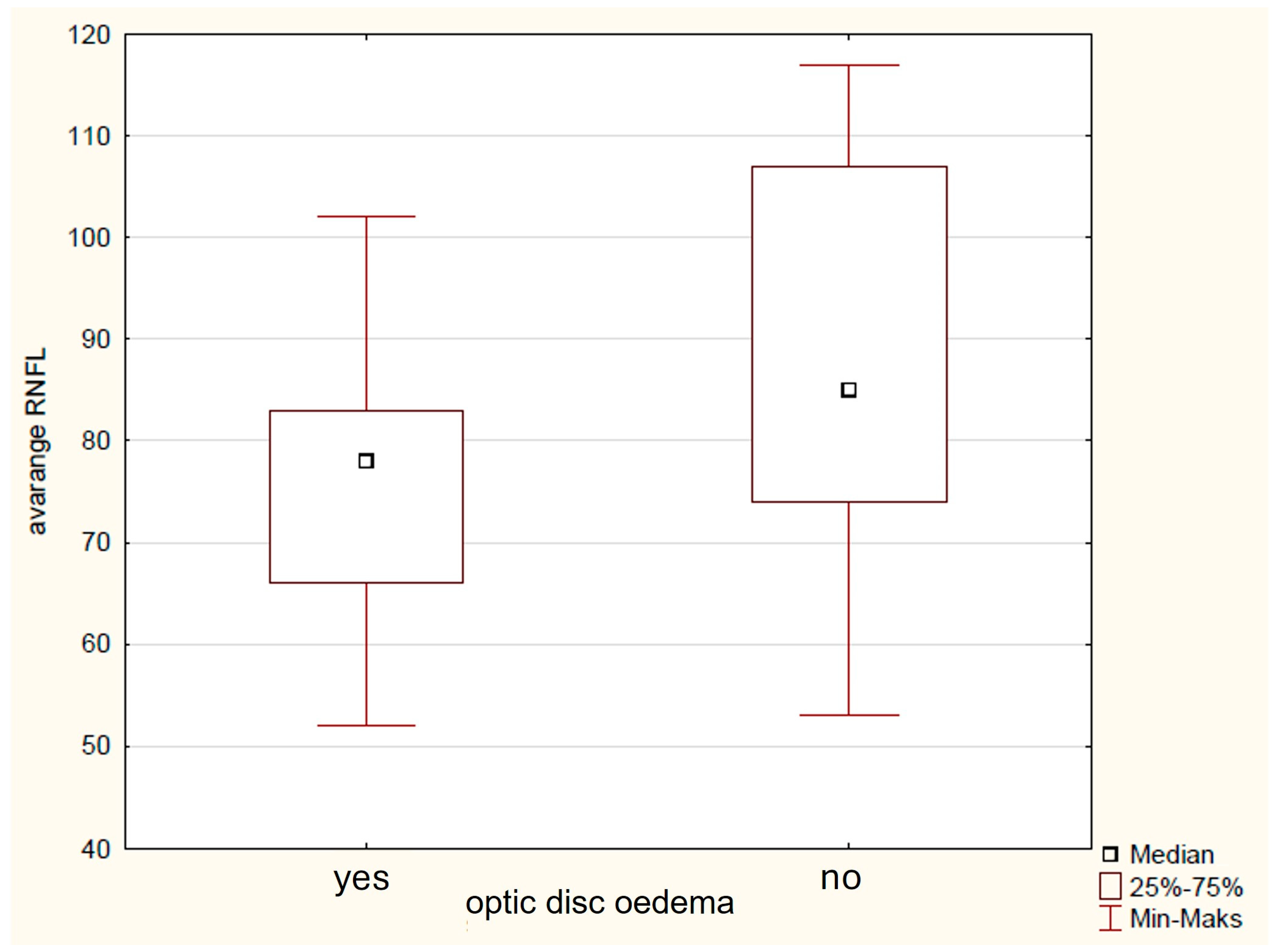
| Optic disc oedema (yes/no) | avgRNFL | Thinner with optic disc oedema | 75 μm vs. 85 μm | 0.02 |
| supRNFL | Thinner with optic disc oedema | 78 μm vs. 87 μm | 0.03 | |
| infRNFL | Thinner with optic disc oedema | 74 μm vs. 83 μm | 0.03 | |
| IN | Thinner with optic disc oedema | 91 μm vs. 112 μm | 0.04 | |
| NL | Thinner with optic disc oedema | 52 μm vs. 67 μm | 0.04 | |
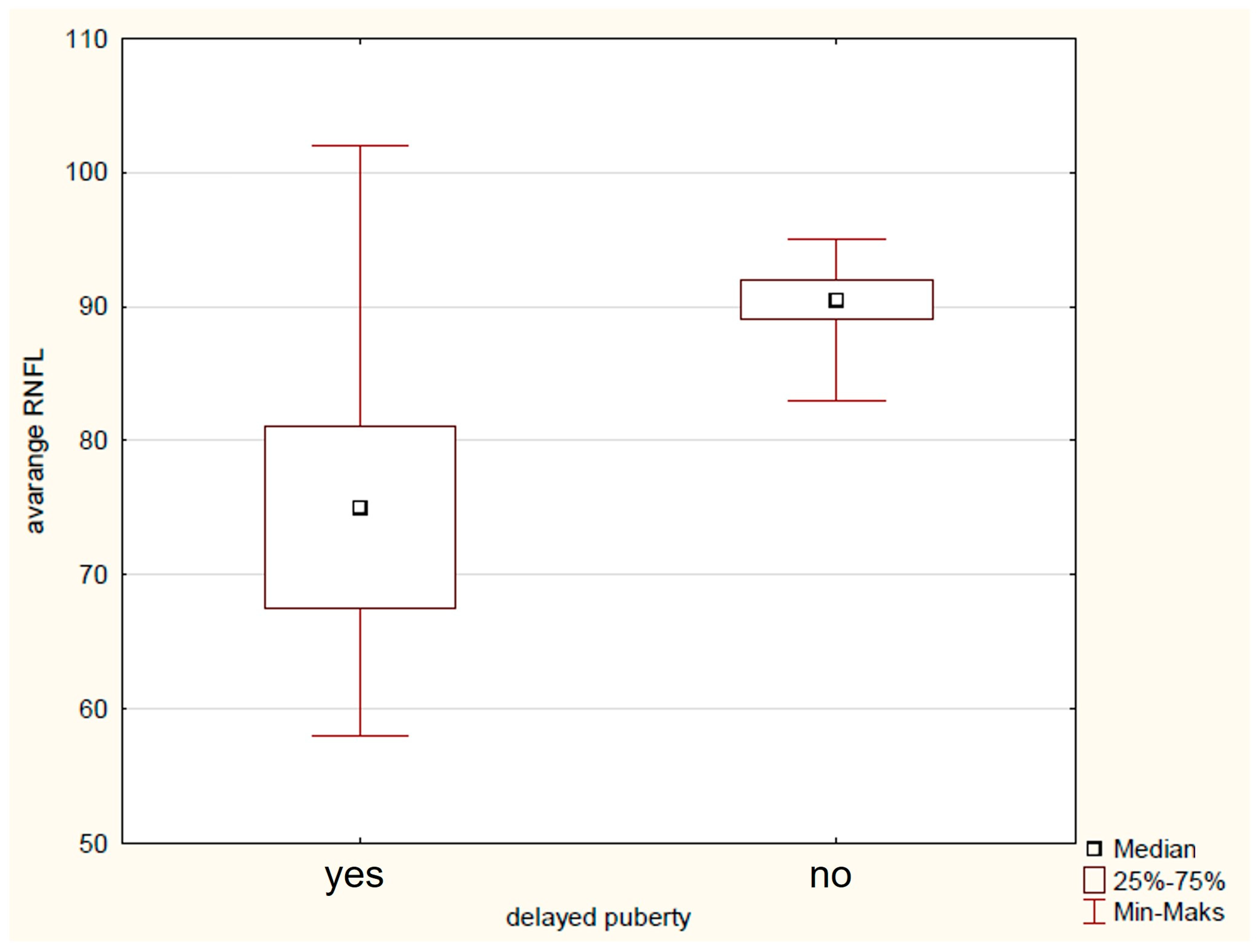
| Delayed puberty before surgery | avgRNFL | Thinner when delayed puberty before surgery | 75 μm vs. 91 μm | 0.005 |
| supRNFL | Thinner when delayed puberty before surgery | 77 μm vs. 92 μm, | 0.007 | |
| infRNFL | Thinner when delayed puberty before surgery | 74 μm vs. 90 μm | 0.007 | |
| ST | Thinner when delayed puberty before surgery | 109 μm vs. 129 μm | 0.03 | |
| TU | Thinner when delayed puberty before surgery | 62 μm vs. 78 μm | 0.007 | |
| IT | Thinner when delayed puberty before surgery | 101 μm vs. 135 μm | 0.007 | |
| NL | Thinner when delayed puberty before surgery | 52 μm vs. 67 μm | 0.02 | |
| SN | Thinner when delayed puberty before surgery | 81 μm vs. 91 μm | 0.02 | |
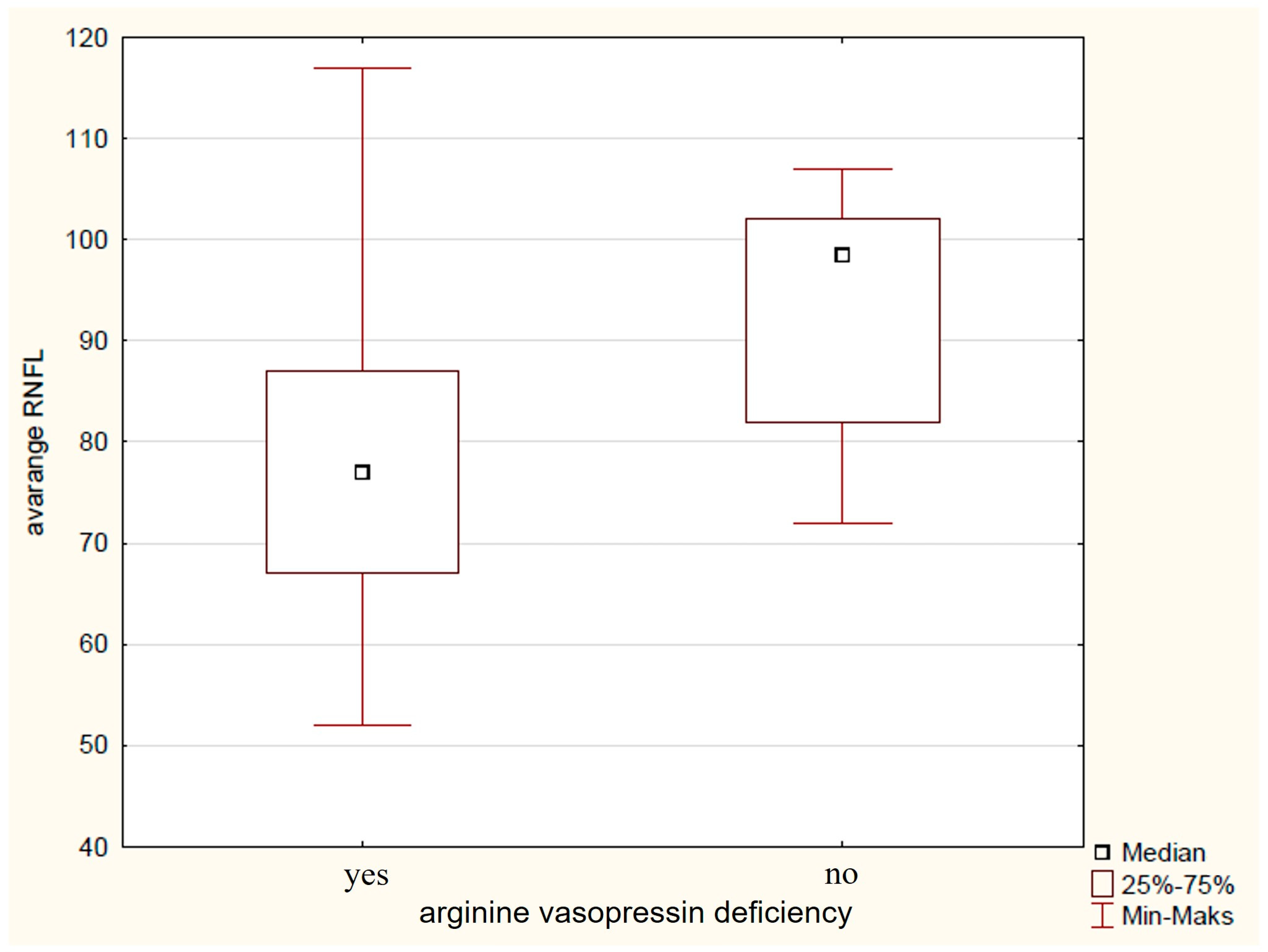
| Arginine vasopressin deficiency (AVD) before surgery | avgRNFL | Thinner when AVD before surgery | 77 μm vs. 98 μm | 0.02 |
| supRNFL | Thinner when AVD before surgery | 78 μm vs. 102 μm | 0.04 | |
| infRNFL | Thinner when AVD before surgery | 76 μm vs. 95 μm | 0.006 | |
| IN | Thinner when AVD before surgery | 78 μm vs. 119 μm | 0.04 | |
| NU | Thinner when AVD before surgery | 57 μm vs. 78 μm | 0.04 | |
| SN | Thinner when AVD before surgery | 81 μm vs. 123 μm | 0.008 | |
| ST, TU, TL, IT, NL | Thinner when AVD before surgery | n.s. | n.s. | |
| Growth hormone deficiency (GHD) before surgery | avgRNFL | Thinner when GHD before surgery | 73 μm vs. 96 | 0.03 |
| infRNFL | Thinner when GHD before surgery | 66 μm vs. 91 μm | 0.03 | |
| IN | Thinner when GHD before surgery | 63 μm vs. 112 μm | 0.03 | |
| NL | Thinner when GHD before surgery | 49 μm vs. 72 μm | 0.03 | |
| NU | Thinner when GHD before surgery | 58 μm vs. 83 μm | 0.03 | |
| SN | Thinner when GHD before surgery | 83 μm vs. 127 μm | 0.03 | |
| Hyperprolactinemia before surgery | infRNFL | Thinner when hyperprolactinemia is present before surgery | 66 μm vs. 78 μm | 0.03 |
| IN | Thinner when hyperprolactinemia is present before surgery | 64 μm vs. 80 μm | 0.03 | |
| NL | Thinner when hyperprolactinemia is present before surgery | 43 μm vs. 53 μm | 0.003 | |
| Hypothalamic involvement [32] | TL | Thinner when no hypothalamic involvement | 34 μm vs. 50 μm | 0.001 |
| NL | Thinner when no hypothalamic involvement | 42 μm vs. 56 μm | 0.04 | |
| SIADH after surgery | NL | Thinner when SIADH occurs after surgery | 49 μm vs. 61 μm | 0.01 |
| The end of AVD after surgery | IT | Thinner when continuous AVD after surgery | 98 μm vs. 115 μm | 0.04 |
| Memory disorder after surgery | TL | Thinner when there is a memory disorder after surgery | 55 μm vs. 48 μm | 0.03 |
| Hyperfagia after surgery | IN | Thinner when hyperphagia occurs after surgery | 73 μm vs. 90 μm | 0.002 |
| At the Time of Diagnosis: |
|---|
|
|
|
|
| Frequency of examinations: |
|
|
|
|
|
Disclaimer/Publisher’s Note: The statements, opinions and data contained in all publications are solely those of the individual author(s) and contributor(s) and not of MDPI and/or the editor(s). MDPI and/or the editor(s) disclaim responsibility for any injury to people or property resulting from any ideas, methods, instructions or products referred to in the content. |
© 2026 by the authors. Licensee MDPI, Basel, Switzerland. This article is an open access article distributed under the terms and conditions of the Creative Commons Attribution (CC BY) license.
Share and Cite
Bogusz-Wójcik, A.; Rakusiewicz-Krasnodębska, K.; Hautz, W.; Jaworski, M.; Kowalczyk, P.; Moszczyńska, E. Correlation Between Endocrine and Other Clinical Factors with Peripapillary Retinal Nerve Fiber Layer Thickness After Surgical Treatment of Pediatric Craniopharyngioma. Biomedicines 2026, 14, 239. https://doi.org/10.3390/biomedicines14010239
Bogusz-Wójcik A, Rakusiewicz-Krasnodębska K, Hautz W, Jaworski M, Kowalczyk P, Moszczyńska E. Correlation Between Endocrine and Other Clinical Factors with Peripapillary Retinal Nerve Fiber Layer Thickness After Surgical Treatment of Pediatric Craniopharyngioma. Biomedicines. 2026; 14(1):239. https://doi.org/10.3390/biomedicines14010239
Chicago/Turabian StyleBogusz-Wójcik, Agnieszka, Klaudia Rakusiewicz-Krasnodębska, Wojciech Hautz, Maciej Jaworski, Paweł Kowalczyk, and Elżbieta Moszczyńska. 2026. "Correlation Between Endocrine and Other Clinical Factors with Peripapillary Retinal Nerve Fiber Layer Thickness After Surgical Treatment of Pediatric Craniopharyngioma" Biomedicines 14, no. 1: 239. https://doi.org/10.3390/biomedicines14010239
APA StyleBogusz-Wójcik, A., Rakusiewicz-Krasnodębska, K., Hautz, W., Jaworski, M., Kowalczyk, P., & Moszczyńska, E. (2026). Correlation Between Endocrine and Other Clinical Factors with Peripapillary Retinal Nerve Fiber Layer Thickness After Surgical Treatment of Pediatric Craniopharyngioma. Biomedicines, 14(1), 239. https://doi.org/10.3390/biomedicines14010239