


Abstract
Introduction: Primary renal lymphoma is extremely rare, accounting for less than 1% of all lymphomas. Objectives: The aim of this study was to describe a group of patients with primary renal lymphoma diagnosed in hematology and oncology centers aligned with the Polish Lymphoma Research Group (PLRG). Patients and methods: This was a retrospective analysis of adult patients with primary renal lymphoma diagnosed at PLRG centers. Results: Thirty-two patients were diagnosed in seven centers over 24 years (2000–2023). The most common type of lymphoma was diffuse large B-cell lymphoma (DLBCL). The median progression-free survival (PFS) after first-line treatment was 2.1 (95% CI: 1.07–4.18) years, while the median overall survival (OS) was 6.3 (95% CI: 1.82–6.34) years. The median age at diagnosis was 63.3 years old, and 59.4% of the patients were females. In multivariate Cox regression for PFS, only creatinine > 1.5 mg/dL (HR 10.2, 95% CI: 2.08–50.09, p = 0.004) and hemoglobin (Hgb) < 10 g/dL (HR 8.39, 95% CI: 1.88–37.49) were associated with inferior PFS. Patients who achieved complete remission (CR) after first-line of treatment had significantly longer PFS (median 4.18, 95% CI: 2.02–4.18 vs. median 0.73, 95% CI: 0.50–0.79, p = 0.004) and OS (median not reached vs. median 1.49, 95% CI: 0.43–6.33, p = 0.001). Patients treated with nephrectomy had longer OS (median not reached vs. median 5.07, 95% CI: 1.32–5.08, p = 0.05). However, in multivariate Cox regression for OS, only hypoalbuminemia was an independent factor for inferior survival (HR 5.44, 95% CI: 1.12–26.38, p = 0.04). Conclusions: Primary renal lymphoma is an extremely rare type of lymphoma with a poor prognosis. The prognosis may improve with future advances in treatment, including nephrectomy.
1. Introduction
Malignant lymphomas can arise in extranodal organs, initially without infiltration of the lymphoid organs, like lymph nodes, spleen, Waldeyer’s ring or thymus. These lymphomas are called primary extranodal lymphomas, and they account for about one-third of all non-Hodgkin lymphomas (NHL) [1]. Secondary renal involvement in NHL is relatively common in advanced, disseminated stages and can be seen in up to 30–60% of NHL patients [2]. Primary renal lymphoma (PRL) is, however, very rare. The incidence of PRL remains elusive, since a significant proportion of cases probably remain undiagnosed due to asymptomatic course or unspecific symptoms.
PRL is defined as the primary, isolated involvement of one kidney or both kidneys without affecting/involvement of other organs, and with the absence of extensive nodal disease [3]. However, involvement of PRL disease may be observed. A definitive diagnosis may be made solely by histological examination of the renal biopsy specimen. PRL is usually diagnosed in middle-aged or elderly patients. Most cases are high-grade lymphomas, and the great majority of the cases described so far are of B-cell origin, with only few T-cell lymphomas reported [4]. Patients may be asymptomatic or can present with back pain, weight loss, hematuria and palpable abdominal mass. It has been suggested that flank pain is one of the most common symptoms of PRL [5].
In the reports published so far, the most common therapy for patients with PRL was chemotherapy, most frequently six to eight cycles of the CHOP regimen (cyclophosphamide, daunorubicin, vincristine and prednisone) in combination with rituximab—an anti-CD20 monoclonal antibody [6]. Reported 1-year mortality rates for PRL were as high as 75%, with median survival time ranging between 8 months and 3 years [7]. The 5-year overall survival (OS) rate did not exceed 50% [8].
To date, more than 700 cases have been reported in the literature. Due to the limited number of studies, which report few PRL patients, the data on PRL are scarce. The aim of our study was to analyze the medical history of PRL patients diagnosed and treated at Polish Lymphoma Research Group (PLRG) centers in the years 2000–2023, examining incidence, sex distribution, histological diagnosis, risk factors, different therapies and their impact on progression-free survival (PFS) and OS.
2. Patients and Methods
We retrospectively analyzed 32 patients with PRL, hospitalized in seven Polish hematological/oncological centers between January 2000 and December 2023. Data were collected from the local medical records.
Cases diagnosed between 2000 and 2007 were classified according to the World Health Organization (WHO) classification from 2001 [9], those diagnosed between 2008 and 2022 were classified according to the WHO 4th edition classification [10], and those diagnosed in 2023 were classified according to the WHO 5th edition classification [11].
PRL was defined as involving one kidney or two kidneys, with the absence of known extrarenal organ involvement and the absence of extensive lymph node involvement (sizes of more than 4 cm were excluded from the study). However, single involvement of PRL disease may be present [3].
According to current Lugano criteria, complete response (CR) was defined as a complete resolution of all target lesions by computer tomography (CT) scans, and, when applicable, with complete normalization of fluorodeoxyglucose (FDG)-positron emission tomography (PET) uptake in all areas (Deauville score of 1–3). Partial response (PR) was defined as a decrease in the sum of the products of diameters (SPD) of target lesions by ≥50%, with no increase in the size of any lesion and no appearance of new lesions [12].
The study was performed in accordance with the local ethics committee. The collected data did not include any personally identifiable information; therefore, informed consent from the patients was not required.
3. Statistical Analysis
The nominal variables were presented as frequencies and percentages (of all patients with data available), whereas continuous variables were reported as mean ± standard deviation or median with interquartile range depending on the analyzed variable distribution. The median follow-up was calculated using the reverse Kaplan–Meier estimator. The median PFS and OS were calculated using the Kaplan–Meier method. The median follow-up was calculated using the reverse Kaplan–Meier estimator. Prognostic factors were initially evaluated using univariate and multivariate Cox Proportional Hazards models. Kaplan–Meier curves were visualized and compared using the log-rank test. p-values lower than 0.05 were considered statistically significant. All statistical analyses were conducted using Statistica version 13.1 (TIBCO, Palo Alto, CA, USA).
4. Results
Thirty-two patients were included in the study. The median age at the diagnosis was 63.3 (53.8–69.9). Most patients (59.4%) were females. At diagnosis, the most frequent complaint was abdominal or lumbar pain (28.1%), followed by systemic symptoms (21.9%). A smaller proportion reported hematuria (15.6%), two patients (6.3%) reported fatigue as the main complaint, one (3.1%) presented with symptoms of hyponatremia, and one (3.1%) with local lymphadenopathy. However, it is noteworthy that 18.8% of lymphoma cases were detected incidentally in ultrasonography (USG) or CT scans performed for other reasons. Overall, systemic symptoms were present in half of the patients (50.0%), and local lymph node involvement was found in more than half of the cases (59.4%). Fifteen patients (46.9%) had lymphoma infiltration of tissue surrounding the kidneys. Notably, the left kidney emerged as the most common site of primary tumor localization (50.0%), with 25% in the right kidney, and 6.3% in both kidneys (see Table 1). The mean tumor’s largest diameter was 9.5 ± 4.4 cm. Eighteen (56.3%) patients had the largest tumor diameter > 5 cm. Elevated serum lactate dehydrogenase (LDH) activity was observed in 18 (56.3%) patients, and elevated serum b2-microglobulin (β-2M) concentration was observed in seven (21.9%) patients. Five (15.6%) patients had moderate to severe anemia (hemoglobin Hgb < 10 g/dL), seven (21.9%) had creatinine levels > 1.5 mg/dL and 10 (31.3%) patients developed hypoalbuminemia.
Table 1.
Characteristics of the study group. The data are presented as frequencies (percentage) unless otherwise specified.
The diagnosis was confirmed by histopathological exam: 11 patients had nephrectomy, 10 patients had surgical kidney biopsy and 11 had regional lymph node biopsy.
The histopathological diagnoses were as follows: diffuse large B-cell lymphoma (DLBCL) in 18 patients (56.3%), followed by marginal zone lymphoma (MZL) in eight patients (25%), four patients (12.5%) with follicular lymphoma (FL), one patient with Hodgkin lymphoma (HL) and one with high-grade B-cell lymphoma (HGBL). The detailed characteristics of the study cohort are provided in Table 1.
Treatment strategies varied, with 65.6% of patients having received immunochemotherapy (21 patients) as the sole intervention and 25.0% undergoing a combination of immunochemotherapy and radical surgery as the primary therapeutic approach (eight patients). Two patients with DLBCL underwent only radical surgery, and one patient had a partial renal resection in combination with immunochemotherapy. During chemotherapy, a granulocyte colony-stimulating factor (G-CSF) was administered to 15 (46.9%) patients. After the first-line treatment, all 32 patients were assessed for response: 21 (65.6%) patients achieved CR, five (15.6%) PR and four (12.5%) experienced progressive disease (PD).
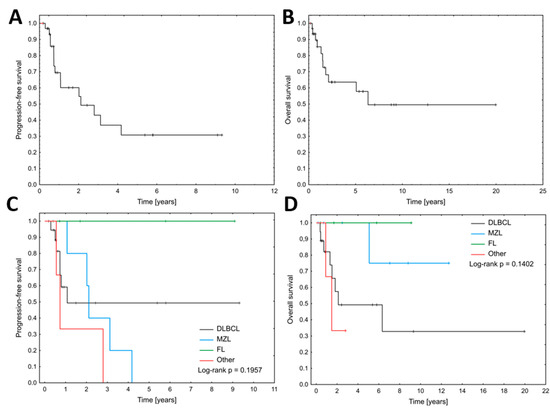
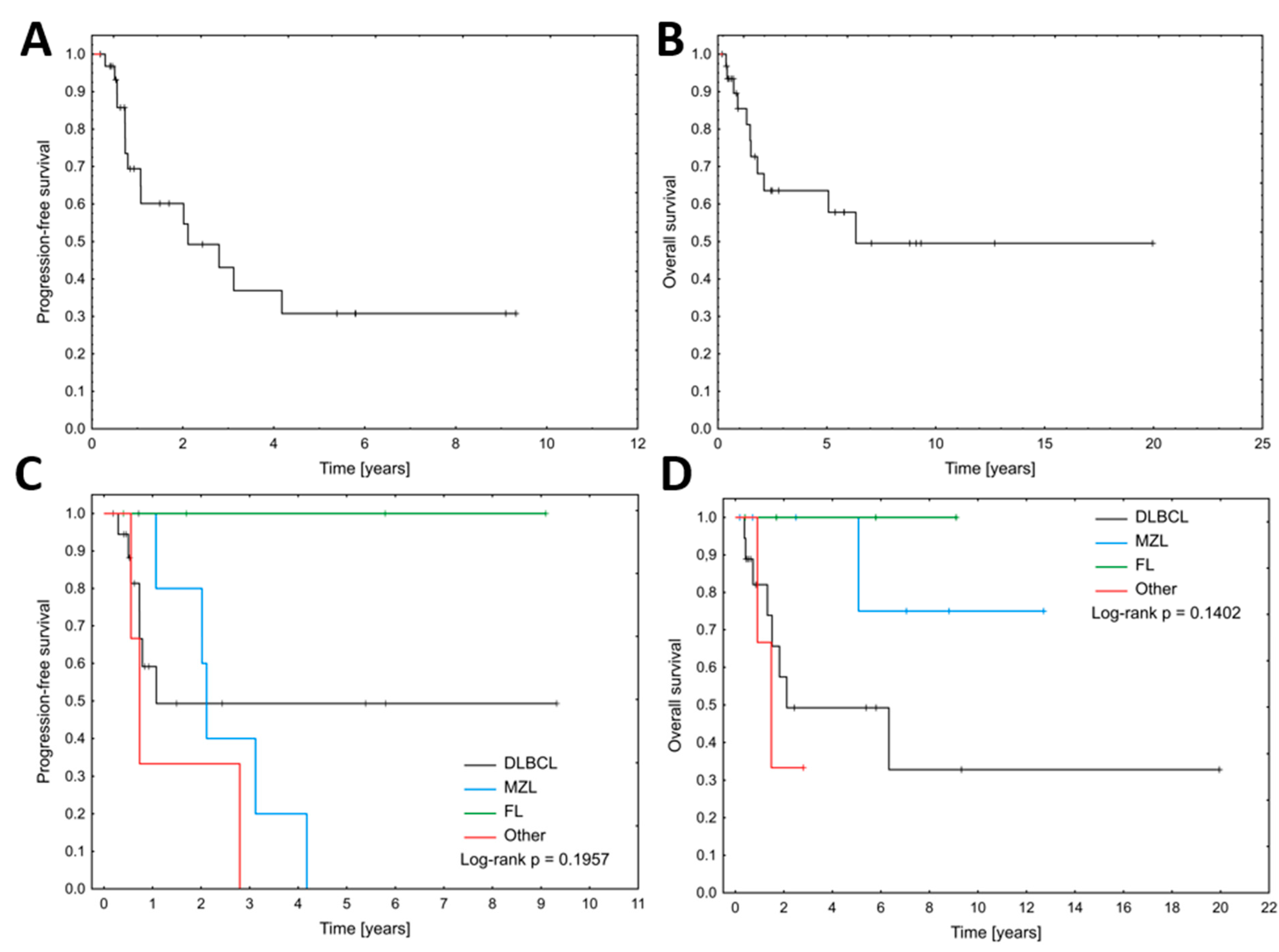
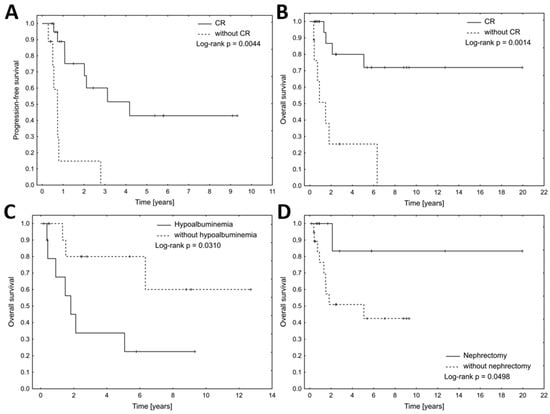
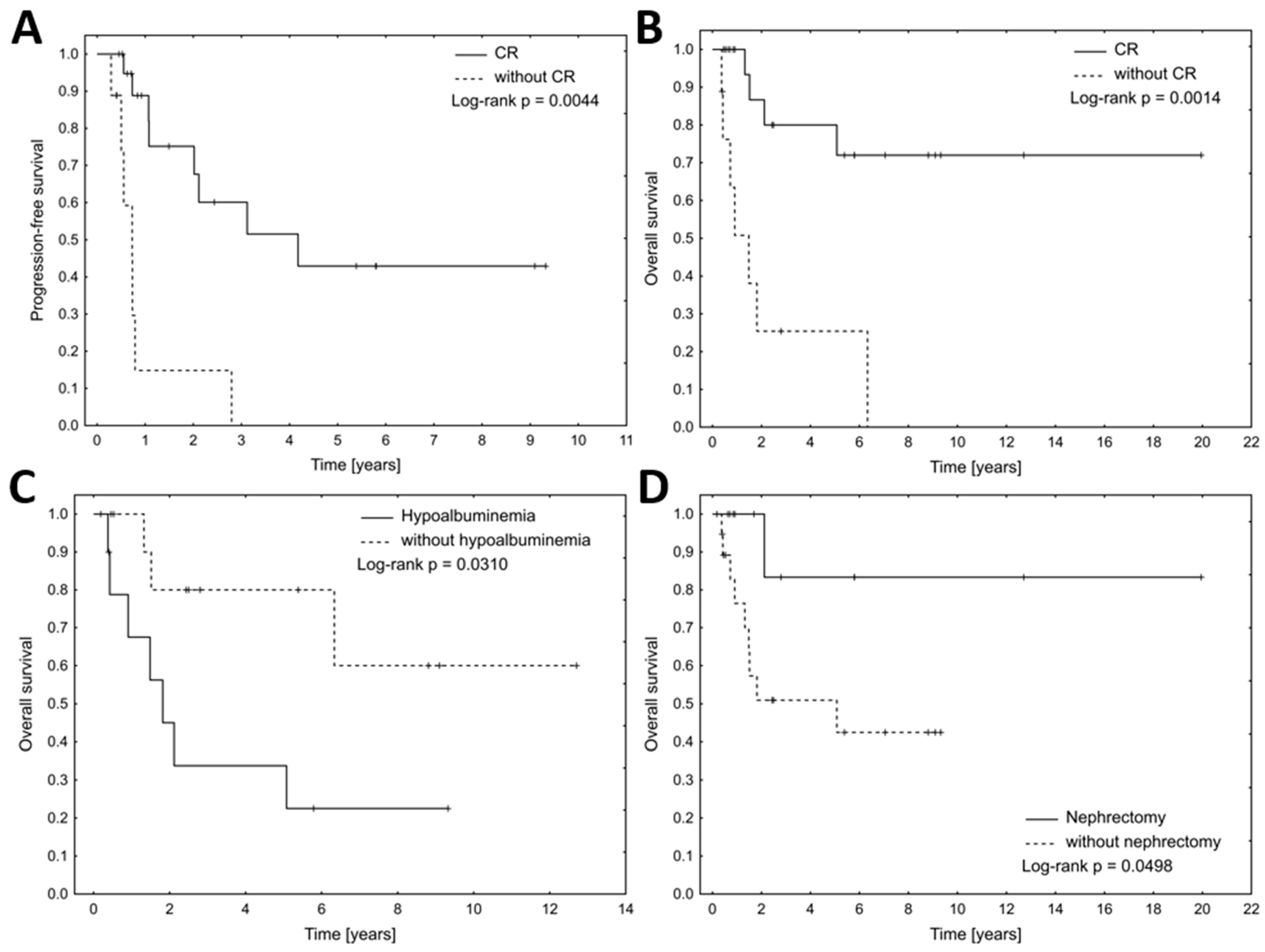
With a median follow-up of 5.39 years (95% CI: 2.43–8.81), 17 out of 32 patients experienced relapse or progression between 3 to 32 months after the end of the first-line treatment. The median PFS in the whole study cohort was 2.11 years (95% CI: 1.07–4.18). Ten patients died (nine from the lymphoma, one from causes unrelated to the lymphoma). Eighteen patients remain alive, with data missing for four patients. Median OS was 6.33 (95% CI: 1.82–6.34) years (Figure 1A,B). There were no statistically significant differences in median PFS and OS between histopathological lymphoma types (p = 0.2 and p = 0.14, respectively) (Figure 1C,D). In multivariate Cox regression for PFS, only serum creatinine concentration > 1.5 mg/dL (HR 10.2, 95% CI: 2.08–50.09, p = 0.004) and Hgb < 10 g/dL (HR 8.39, 95% CI: 1.88–37.49) were significantly associated with inferior PFS (Table 2). Additionally, patients who achieved CR after the first line of treatment had longer PFS (median 4.18, 95% CI: 2.02–4.18 vs. median 0.73, 95% CI: 0.50–0.79, p = 0.004) and OS (median not reached vs. median 1.49, 95% CI: 0.43–6.33, p = 0.001) (Figure 2A,B). Furthermore, patients who underwent nephrectomy, either as the only therapeutic procedure or in association with immunochemotherapy, had significantly longer OS than patients who received only conservative treatment (median not reached vs. median 5.07, 95% CI: 1.32–5.08, p = 0.0498, Figure 2D), however, in multivariate Cox regression for OS, only hypoalbuminemia was associated with inferior survival (HR 5.44, 95% CI: 1.12–26.38, p = 0.04, Figure 2C).
Figure 1.
Median progression-free survival (A) and overall survival (B) for all 32 cases of primary renal lymphoma. Median progression-free survival (C) and overall survival (D) between histopathological lymphoma types.
Table 2.
Univariate and multivariate Cox regression analysis for progression-free survival and overall survival of patients with primary renal lymphoma. Factors with p < 0.1 were entered into multivariate analysis.
Figure 2.
Median progression-free survival (A) and overall survival (B) for patients with and without complete remission. Median overall survival (C) for patients with and without hypoalbuminemia. Median overall survival (D) for patients with and without nephrectomy.
In our cohort, central nervous system (CNS) relapses occurred in five (27.8%) patients, all of which were lethal. Three patients had high CNS-IPI (international prognostic index) scores and received CNS prophylaxis, one had an intermediate CNS-IPI score and one had a low CNS-IPI score. Patients with low and intermediate scores did not receive any kind of CNS prophylaxis. CNS prophylaxis procedures were given only to patients with high CNS-IPI scores. Two patients had three cycles of intrathecal treatment of methotrexate alone (both had CNS relapse). Two patients had two cycles of high-dose intravenous methotrexate treatment given at the end of the immunochemotherapy (one had CNS relapse).
5. Discussion
Since the first report in 1989, where the first patient with PRL was diagnosed by open kidney biopsy, more than 700 cases have been reported in the medical literature [13]. During the literature search, Stallone et al. [14] reported 29 cases of PRL up to the year 2000 [15,16,17,18]. PRL is an extremely rare type of lymphoma, with an estimated incidence of 0.7% of all extranodal lymphomas [16]. The present study reports 32 cases of PRL diagnosed in seven PLRG centers in Poland between 2000 and 2023. The biggest studies so far reported 121 cases by Lee et al. [19] and 599 in a population-based analysis using the SEER program [20]. According to this analysis, PRL had male predominance, with a male:female (M:F) ratio of 1.6:1 (72:45; unknown, four patients), unlike in our study, where 59.4% of all cases were females. The median age of the patients in the group of 121 patients was 55 years, while in our cohort, the patients were slightly older, with a median age of 63.3 years.
According to published data, the most common histological subtype of PRL is DLBCL, with MZL as the second most common [21]. In our group, the histological subtypes were similarly distributed with a predominance of DLBCL (56.3% of cases), followed by MZL in 21.9%. Another common type of PRL was FL, identified in 12.5% of cases. Moreover, there was one case of HL and one of HGBL. This distribution aligns with previous reports, which described individual cases of other types of lymphomas [22,23,24].
In previously reported series, most patients presented with abdominal and flank pain (62%). Fever of unknown etiology was the most prevalent symptom in younger patients (56%), while weight loss and gross hematuria were the main symptoms in older patients (37%) [22]. In our group, the initial symptoms were similar but were reported less frequently. At diagnosis, 28% of our patients complained about abdominal or flank pain and 22% had B-symptoms, including unexplained fever, weight loss and night sweats. Hematuria was less frequently reported (15.6%). We cannot exclude the possibility that this discrepancy results from the limitations of the retrospective character of the study, with incomplete medical records concerning relevant symptoms reported by the patients. It was observed that the symptoms may be more severe. In a study by Lubas et al., renal infiltration of mantle cell lymphoma (MCL) caused subacute membranoproliferative glomerulonephritis and acute kidney injury [25].
As the kidney does not contain lymphoid tissue, the primary renal localization of lymphoma was initially debated. Although PRL is usually suspected after completing a series of imaging exams, it can be diagnosed definitively by kidney biopsy. While contrast-enhanced CT is the best method for diagnosing a kidney tumor, ultrasound is usually the first imaging technique used by physicians when suspecting abdominal pathology. In two-thirds of patients, CT scans show isodense or hyperdense bilateral masses with irregular borders or encapsulated masses, along with retroperitoneal lymphadenopathy [26]. Tumor diameters can vary, mostly ranging from 1 to 4.5 cm [24]. In our population, tumor sizes were much larger, with a mean size of 9.5 ± 4.4. Moreover, 18 patients (56.3%) had a tumor size greater than 5 cm. We also observed that local lymph node involvement was common (57.9%), typically affecting the retroperitoneal ones. Fifteen patients (46.9%) had lymphoma infiltration into the surrounding kidney tissue. Literature data suggest that local lymph node infiltration may be seen in up to 25–30% of PRL patients [16,17,26]. This data suggest that our group may have been diagnosed at a later stage of the disease. It was consistent with our findings that the asymptomatic onset of the disease was more frequent in our series compared to previously published ones.
According to previously published data, PRL is usually unilateral but may also be bilateral in a proportion of patients [24]. In our series, two cases out of 32 cases (6.25%) had bilateral involvement. In unilateral cases, left kidney involvement predominated (50.0%), with 25% involving the right kidney. Previous data showed that bilateral PRL is usually observed in younger patients, with these studies also showing shorter survival times in patients with bilateral PRL compared to those with unilateral PRL [24]. In our study, however, different data were observed: patients with bilateral involvement were older. Nevertheless, consistent with previous reports, survival in our patients with bilateral renal involvement was short due to the progressiveness of the disease.
Because of the rarity of PRL, no clinical studies have been specifically designed for its treatment, nor are there formal recommendations for this group of NHL. Therefore, the clinical practice is usually based on the results of trials designed for the general lymphoma population and the corresponding histological subtypes. That said, immunochemotherapy remains the cornerstone of treatment for B-cell PRL, with R-CHOP-like regimens being recommended by experts for PRL with aggressive histology [5]. The role of surgical treatment in PRL has not been well established, although Chen X. et al. reported better outcomes for patients who underwent surgery [24]. The utility of radiotherapy in PRL has not been firmly established either. Treatment strategies for our patients varied. Out of the 32 patients, 31 (96.9%) were treated with chemotherapy, either alone or in combination with immunotherapy. A total of 65.6% of patients received immunochemotherapy as the sole intervention, while 25.0% underwent a combination of immunochemotherapy and radical surgery as the primary therapeutic approach. All patients responded to this treatment. Two patients (6.3%) underwent nephrectomy alone, and another received a partial nephrectomy in association with immunochemotherapy. Our data showed that nephrectomy was associated with a significant improvement in OS. Further investigation should be conducted to determine whether histological sub-type and rituximab have any impact on this conclusion.
According to previously published data, patients with NHL with renal involvement are at a higher risk of CNS relapse. In a retrospective study by Villa et al. [27], among 2656 DLBCL patients, 52 had primary and secondary renal involvement at diagnosis, with 20 (36%) experiencing CNS relapse shortly after the end of treatment. Similar findings were observed in our study. CNS relapses were reported in five (27.8%) patients, all of which were lethal. Although our cohort was too small for statistical conclusions, our results strongly suggest that patients with PRL are at an elevated risk of CNS involvement. Additionally, based on our results, two out of five patients who relapsed did not have high CNS-IPI scores. We suspect that CNS-IPI is not sufficient for the decision of prophylaxis in this group of patients. In our opinion, due to poor prognosis, CNS should be additionally examined in the diagnosis of PRL by CNS imaging, such as magnetic resonance imaging (MRI) and lumbar punction with cerebrospinal fluid (CSF) examination. Moreover, both patients treated with intrathecal methotrexate had CNS relapse, which may suggest that it is not a sufficient option in this group.
In our study, we also aimed to establish prognostic factors for OS and PFS. Only CR was significantly associated with longer PFS (p = 0.001) and OS (p = 0.002). Additionally, nephrectomy was associated with longer OS (p = 0.0498), whereas hypoalbuminemia, creatinine > 1.5 mg/dL and Hgb < 10 g/dL were related to inferior OS. Previous reports are single-center observations, with small sample sizes, and were not powered enough to analyze prognostic factors relative to survival parameters. We did not observe a statistically significant impact of the histological sub-type on the survival parameters, likely due to the small size of our population and potentially differing therapeutical strategies for aggressive vs. indolent lymphomas.
According to previously published data, PRL typically has a poor clinical course, with the median OS of less than one year in all studies [7,19,20,24]. In our study, the median PFS was 2.11 years, while the median OS was 6.33 years. Despite treatment, the overall mortality rate was 17.1% during the entire follow-up period. Ten out of 32 patients died after treatment, and seven had relapsed by the end of treatment. The mortality rate was especially high in patients with bilateral disease, reaching 100%. Available case reports and case series have demonstrated a median OS of 6 months before the rituximab era [23,28]. Recent data show that OS and PFS may vary, as rituximab has significantly improved the outcome of patients with aggressive B-cell lymphoma, leading to better PFS and OS [7].
The main limitation of the present study is its retrospective nature and the limited number of patients included, which renders statistical analysis challenging. Additionally, changing therapeutical strategies over the period covered by the analysis (2000–2023), particularly the introduction of anti-CD20 monoclonal antibodies for the treatment of B-cell NHL, adds complexity to the interpretation of the results. For some patients, the available clinical records lacked a complete set of lab test data, which diminished the statistical power of the analysis. Finally, the presence of CD5 immunohistochemical staining and cell of origin in pathology results in DLBCL patients was another limitation. Nevertheless, we believe that our findings may be useful for clinical practice and may contribute to future studies aimed at developing recommendations for managing this very rare type of extranodal lymphoma, including the potential benefits of nephrectomy.
6. Conclusions
PRL is an extremely rare type of extranodal lymphoma, with a generally poor prognosis. Early detection and personalized treatment approaches in managing this rare and complex lymphoma subtype are of utmost importance. Current clinical practice is generally based on guidelines for nodal NHL, but our observations suggest that radical tumorectomy, when feasible, may improve the patients’ survival outcomes. There is hope that new therapeutical approaches, such as bi-specific monoclonal antibodies or chimeric antigen receptor T-cell (CAR T-cell) therapies, will further improve the outcomes for this challenging group of lymphomas. Further studies are needed to develop optimal treatment protocols and establish clearer guidelines for cases involving this rare organ involvement.
Author Contributions
Conceptualization, A.M.-K.; Methodology, A.G.; Validation, J.R.-J.; Formal analysis, J.H.; Investigation, K.W.; Data curation, J.D.-S. and E.P.-K.; Writing—original draft, M.W. and D.W.; Writing—review & editing, D.M. All authors have read and agreed to the published version of the manuscript.
Funding
This research received no external funding.
Institutional Review Board Statement
The study was conducted in accordance with the Declaration of Helsinki.
Informed Consent Statement
Informed consent was obtained from all subjects involved in the study.
Data Availability Statement
The original contributions presented in this study are included in the article. Further inquiries can be directed to the corresponding author.
Conflicts of Interest
The authors declare no conflicts of interest.
References
- Bokhari, S.R.A.; Inayat, F.; Bokhari, M.R.; Mansoor, A. Primary renal lymphoma: A comprehensive review of the pathophysiology, clinical presentation, imaging features, management and prognosis. BMJ Case Rep. 2020, 13, e235076. [Google Scholar] [CrossRef] [Scilit]
- Kohn, M.; Karras, A.; Zaidan, M.; Bénière, C.; de Fréminville, J.-B.; Laribi, K.; Perrin, M.C.; Malphettes, M.; Le Calloch, R.; Anglaret, B.; et al. Lymphomas with kidney involvement: The French multicenter retrospective LyKID study. Leuk. Lymphoma 2020, 61, 887–895. [Google Scholar] [CrossRef] [Scilit] [PubMed]
- Alonso, F.V.; Ramos, C.S.; Prados, F.J.V.; Geler, M.P.; Carazo, E.R.; Massare, P.B.; Padilla, C.F.; Herrera, F.R.; Olmo, J.M.C.; Buñuel, M.T. Primary renal lymphoma: Report of three new cases and literature review. Arch. Esp. Urol. 2009, 62, 461–465. [Google Scholar]
- Cheng, X.; Huang, Z.; Li, D.; Wang, Y. Enormous primary renal diffuse large B-cell lymphoma: A case report and literature review. J. Int. Med. Res. 2019, 47, 2728–2739. [Google Scholar] [CrossRef] [Scilit]
- Ahmad, A.H.; Maclennan, G.T.; Listinsky, C. Primary renal lymphoma: A rare neoplasm that may present as a primary renal mass. J. Urol. 2005, 173, 239. [Google Scholar] [CrossRef] [Scilit] [PubMed]
- Al-Salam, S.; Shaaban, A.; Alketbi, M.; Haq, N.U.; Abouchacra, S. Acute kidney injury secondary to renal large B-cell lymphoma: Role of early renal biopsy. Int. Urol. Nephrol. 2011, 43, 237–240. [Google Scholar] [CrossRef] [Scilit] [PubMed]
- Porcaro, A.B.; D’Amico, A.; Novella, G.; Curti, P.; Ficarra, V.; Antoniolli, S.Z.; Martignoni, G.; Matteo, B.; Malossini, G. Primary lymphoma of the kidney. Report of a case and update of the literature. Arch. Ital. Urol. Androl. 2002, 74, 44–47. [Google Scholar] [PubMed]
- Ladha, A.; Haider, G. Primary renal lymphoma. J. Coll. Physicians Surg. Pak. 2008, 18, 584–585. [Google Scholar]
- Vardiman, J.W.; Harris, N.L.; Brunning, R.D. The World Health Organization (WHO) classification of the myeloid neoplasms. Blood 2002, 100, 2292–2302. [Google Scholar] [CrossRef] [Scilit]
- Vardiman, J.W.; Thiele, J.; Arber, D.A.; Brunning, R.D.; Borowitz, M.J.; Porwit, A.; Harris, N.L.; Le Beau, M.M.; Hellström-Lindberg, E.; Tefferi, A.; et al. The 2008 revision of the World Health Organization (WHO) classification of myeloid neoplasms and acute leukemia: Rationale and important changes. Blood 2009, 114, 937–951. [Google Scholar] [CrossRef] [Scilit] [PubMed]
- Li, W. The 5th Edition of the World Health Organization Classification of Hematolymphoid Tumors. In Leukemia [Internet]; Li, W., Ed.; Exon Publications: Brisbane, Australia, 2022; Chapter 1. [Google Scholar]
- Barrington, S.F.; Mikhaeel, N.G.; Kostakoglu, L.; Meignan, M.; Hutchings, M.; Müeller, S.P.; Schwartz, L.H.; Zucca, E.; Fisher, R.I.; Trotman, J.; et al. Role of imaging in the staging and response assessment of lymphoma: Consensus of the International Conference on Malignant Lymphomas Imaging Working Group. J. Clin. Oncol. 2014, 32, 3048–3058. [Google Scholar] [CrossRef] [Scilit] [PubMed]
- Agochukwu, N.Q.; Kilchevsky, A.; Hesse, D. Primary renal large B-cell lymphoma imitating invasive renal cell carcinoma with inferior vena cava tumor thrombus. Urol. Case Rep. 2018, 18, 84–86. [Google Scholar] [CrossRef] [Scilit] [PubMed]
- Stallone, G.; Infante, B.; Manno, C.; Campobasso, N.; Pannarale, G.; Schena, F.P. Primary renal lymphoma does exist: Case report and review of the literature. J. Nephrol. 2000, 13, 367–372. [Google Scholar]
- Chen, L.; Richendollar, B.; Bunting, S.; Campbell, S.; Zhou, M. Lymphomas and lymphoproliferative disorders clinically presenting as renal carcinoma: A clinicopathological study of 14 cases. Pathology 2013, 45, 657–663. [Google Scholar] [CrossRef] [Scilit] [PubMed]
- Hagihara, M.; Hua, J.; Iwaki, Y.; Inoue, M.; Sato, T. Primary renal lymphoma: A case report and literature review. Intern. Med. 2015, 54, 2655–2659. [Google Scholar] [CrossRef] [Scilit] [PubMed]
- Zhao, K.; Zhang, Q.; Cong, R.; Wang, Y.; Wang, Z.; Song, N. Primary renal lymphoma: A case report and review of the literature. AME Case Rep. 2020, 4, 8. [Google Scholar] [CrossRef] [Scilit]
- Geramizadeh, B.; Shojazadeh, A.; Marzban, M. Primary renal non-Hodgkin’s lymphoma: A narrative review of literature. Urologia 2022, 89, 185–194. [Google Scholar] [CrossRef] [Scilit] [PubMed]
- Lee, S.B.; Yoon, Y.M.; Hong, R. Primary renal lymphoma presenting as renal failure: A case report and review of literature from 1989. World J. Clin. Cases 2023, 11, 7113–7126. [Google Scholar] [CrossRef] [Scilit]
- Taneja, A.; Kumar, V.; Chandra, A.B. Primary renal lymphoma: A population-based analysis using the SEER program (1973-2015). Eur. J. Haematol. 2020, 104, 390–399. [Google Scholar] [CrossRef] [Scilit] [PubMed]
- Rissman, C.M.; Dagrosa, L.M.; Pettus, J.R.; Dillon, J.L.; Sverrisson, E.F. Primary renal lymphoma: An unusual finding following radical nephrectomy. Clin. Nephrol. Case Stud. 2017, 5, 1–4. [Google Scholar] [CrossRef] [Scilit]
- Jindal, B.; Sharma, S.C.; Das, A.; Banerjee, A. Indolent behaviour of low-grade B cell lymphoma of mucosa-associated lymphoid tissue arising in the kidney. Urol. Int. 2001, 67, 91–93. [Google Scholar] [CrossRef] [Scilit] [PubMed]
- Geetha, N.; Shahid, A.; Rajan, V.; Rajan, V. Primary renal lymphoma-a case report. Ecancermedicalscience 2014, 8, 466. [Google Scholar]
- Chen, X.; Hu, D.; Fang, L. Primary renal lymphoma: A case report and literature review. Oncol. Lett. 2016, 12, 4001–4008. [Google Scholar] [CrossRef] [Scilit] [PubMed]
- Lubas, A.; Mróz, A.; Smoszna, J.; Niemczyk, S. Membranoproliferative glomerulonephritis, mantle cell lymphoma infiltration, and acute kidney injury. Int. Urol. Nephrol. 2013, 45, 1489–1494. [Google Scholar] [CrossRef] [Scilit] [PubMed]
- Larrañaga, N.; de Salazar, A.; Oyarzún, A.; Espil, G.; Kozima, S. CTMD imaging patterns of renal lymphoma. Rev. Argent. Radiol. 2015, 79, 134–138. [Google Scholar] [CrossRef] [Scilit]
- Villa, D.; Connors, J.M.; Shenkier, T.N.; Gascoyne, R.D.; Sehn, L.H.; Savage, K.J. Incidence and risk factors for central nervous system relapse in patients with diffuse large B-cell lymphoma: The impact of the addition of rituximab to CHOP chemotherapy. Ann. Oncol. 2010, 21, 1046–1052. [Google Scholar] [CrossRef] [Scilit] [PubMed]
- Dotan, E.; Aggarwal, C.; Smith, M.R. Impact of rituximab (Rituxan) on the treatment of B-cell non-Hodgkin’s lymphoma. Pharm. Ther. 2010, 35, 148–157. [Google Scholar] [PubMed]

Disclaimer/Publisher’s Note: The statements, opinions and data contained in all publications are solely those of the individual author(s) and contributor(s) and not of MDPI and/or the editor(s). MDPI and/or the editor(s) disclaim responsibility for any injury to people or property resulting from any ideas, methods, instructions or products referred to in the content. |
© 2025 by the authors. Licensee MDPI, Basel, Switzerland. This article is an open access article distributed under the terms and conditions of the Creative Commons Attribution (CC BY) license (https://creativecommons.org/licenses/by/4.0/).