

Allogeneic Hematopoietic Stem Cell Transplantation as a Therapeutic Approach for Hereditary Diseases


Abstract
1. Introduction
2. Historical Background
3. Allogeneic Hematopoietic Stem Cell Transplantation for the Treatment of Various Groups of Hereditary Disorders (Table 1)
3.1. Allogeneic HSCT for the Treatment of Hemoglobinopathies

| Disorder | Survival Outcomes | Key Limitations/Complications |
|---|---|---|
| Sickle Cell Disease | High survival with HLA-identical sibling donors; best outcomes in early childhood. | Graft rejection, acute/chronic GVHD, transplant-related toxicity; reduced benefit in adults with organ damage. |
| β-Thalassemia | Highest survival in patients transplanted before adolescence; reduced survival in adults with advanced disease. | Graft failure or recurrence of native hematopoiesis; GVHD, alloimmunization, and iron overload increasing risk. |
| Primary Immunodeficiencies | Excellent outcomes in infants with SCID; variable survival in broader PID cohorts. | GVHD, graft rejection, infectious complications; long-term endocrine, fertility, and malignancy risks. |
| MPS I | Improved cognitive outcomes when transplanted pre-symptomatically. | Limited effect on established skeletal or cardiac pathology; insufficient neurological benefit if delayed. |
| Krabbe Disease | Better outcomes when HSCT is performed in the neonatal period; variable benefit in later-onset forms. | Persistent neurodevelopmental deficits; high dependence on timing; notable mortality in some cohorts. |
| Niemann–Pick Type B | Potential improvement in hepatic and pulmonary function. | Minimal impact on neurological disease; higher risk profile compared to ERT; use is highly restricted. |
| Metachromatic Leukodystrophy | Survival depends on disease stage at transplantation, with best results in early or pre-symptomatic cases. | Limited efficacy once neurodegeneration is established; progression may continue despite HSCT. |
3.2. Allogeneic HSCT for the Treatment of Inherited Primary Immunodeficiencies
- Combined immunodeficiencies
- Combined immunodeficiencies with additional phenotypic features
- B-cell deficiencies, agammaglobulinemia, or hypogammaglobulinemia
- Immune dysregulation disorders
- Congenital defects of phagocytes (quantitative or functional)
- Defects of innate immunity
- Autoinflammatory diseases
- Complement system deficiencies
- Bone marrow functional disorders
- Phenocopies of primary immunodeficiencies
3.3. Allogeneic HSCT for the Treatment of Lysosomal Storage Disorders
4. Procedure for Allogeneic Hematopoietic Stem Cell Transplantation in the Treatment of Hereditary Disorders
- Confirm the patient’s diagnosis through molecular-genetic testing.
- Assess disease stage and severity, as HSCT is most effective in many disorders, such as lysosomal storage diseases (LSDs), when performed prior to the onset of neurological symptoms.
- Evaluate the patient’s somatic condition, since individuals with severe multi-organ failure may have contraindications to myeloablative conditioning and an increased risk of mortality.
- Consider the patient’s age and weight, as transplantation outcomes tend to be more favorable at younger ages.
- Review the availability of alternative therapies, since for certain hereditary disorders, enzyme replacement therapy (ERT) or gene therapy may represent the most effective treatment option.
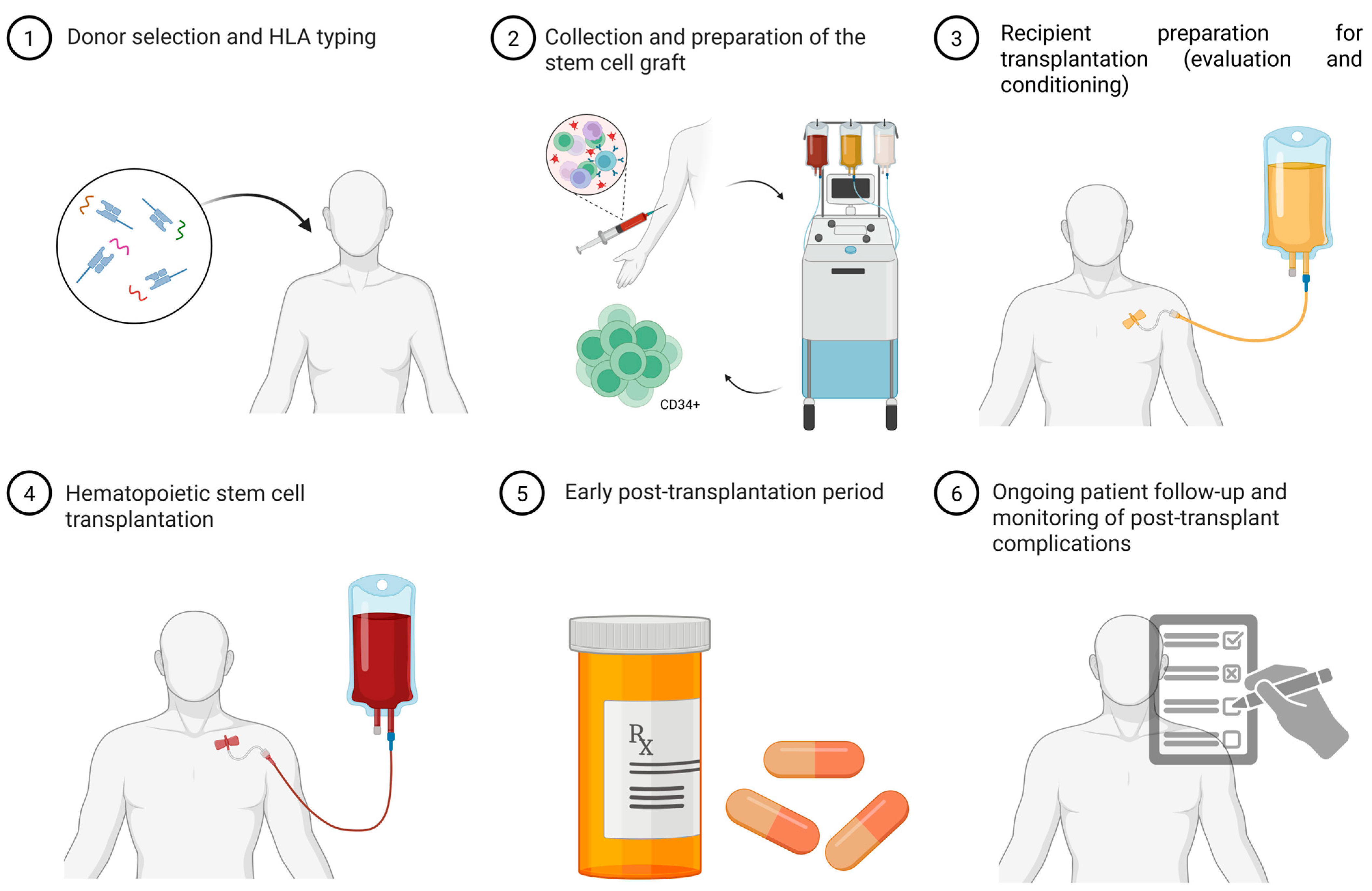
5. Steps of Allogeneic HSCT (Figure 2)
- Donor Selection and HLA Typing. Determining indications for HSCT, HLA typing is performed for the patient and their immediate relatives (parents and siblings). Selection of the donor and graft source must consider several clinical factors, including disease type and stage, remission status, and transplantation urgency. While an HLA-identical related donor (sibling) remains preferred, survival outcomes are comparable when using an HLA-matched unrelated donor. In the absence of a fully matched related or unrelated donor, haploidentical transplantation from a related donor may be considered. Recent data suggest that, under certain conditions, haploidentical HSCT can achieve comparable efficacy and graft-versus-host disease risk to fully matched donor transplantation.
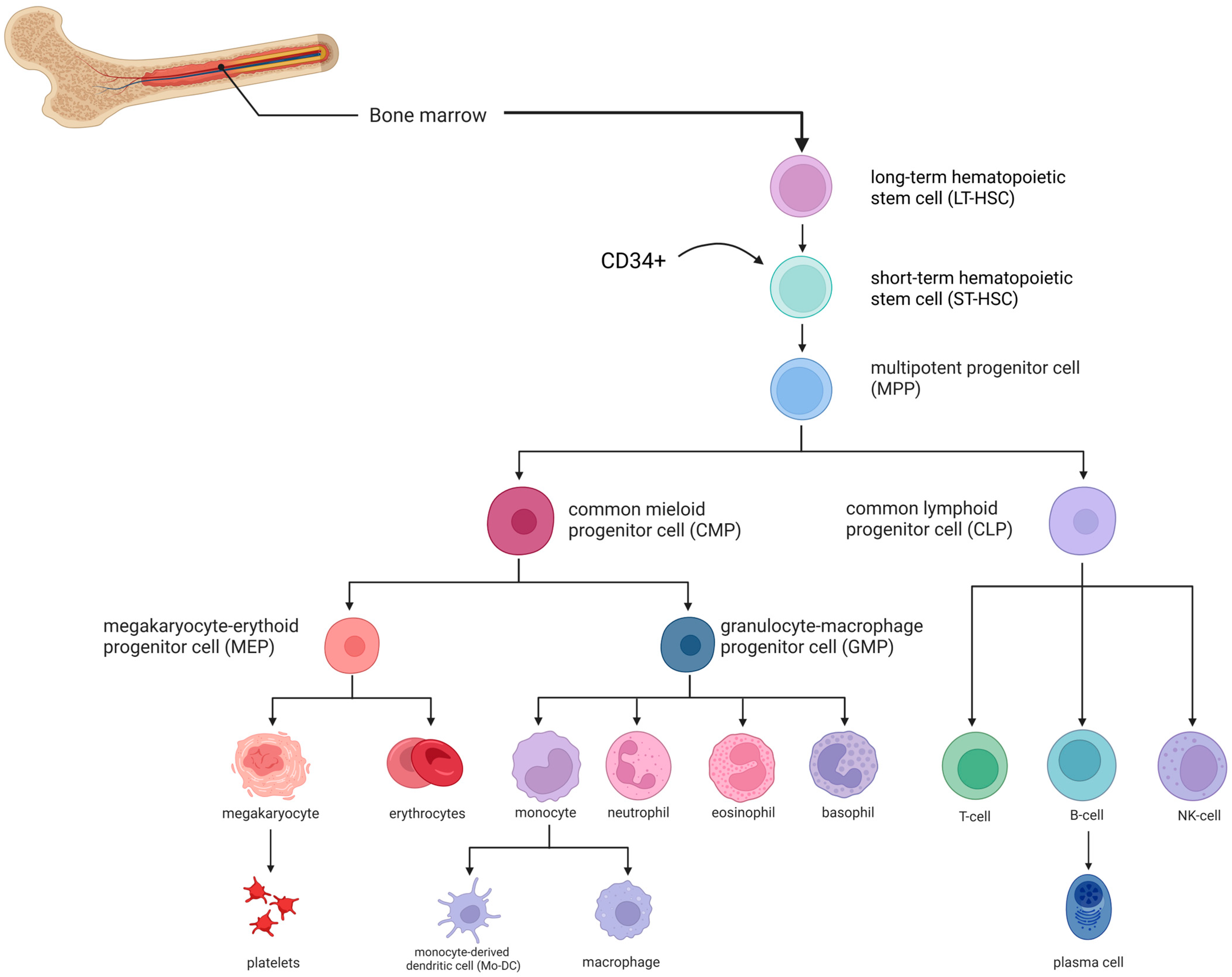
- Graft Collection and Preparation. Peripheral blood stem cells (PBSC) have increasingly become the preferred source of hematopoietic stem cells (HSCs) over bone marrow. To maximize the CD34+ stem cell pool, donors are often mobilized with recombinant granulocyte colony-stimulating factor (G-CSF) or, less commonly, plerixafor, a reversible CXCR4 antagonist, which stimulates leukopoiesis and mobilizes HSCs into peripheral blood. Collection is performed via apheresis. In some centers, graft manipulation is performed, such as T-cell depletion through TCRαβ/CD19 elimination, as previously described [58].
- Recipient Conditioning. After comprehensive evaluation, indication confirmation, and planning, the recipient undergoes conditioning. Conditioning involves chemotherapy and/or total body irradiation (TBI) to induce myelo- and immunosuppression. This step creates bone marrow niches for donor HSC engraftment and prevents graft-versus-host reactions. Conditioning regimens are classified as myeloablative, non-myeloablative, reduced-intensity, and immunoablative.
- Myeloablative conditioning employs high-dose chemotherapy and/or TBI, almost completely eradicating the recipient’s bone marrow; this is standard for hemoglobinopathies.
- Non-myeloablative conditioning uses minimal chemotherapy doses, preserving endogenous hematopoiesis and relying partly on the graft-versus-leukemia effect. This approach is rare and mainly for non-malignant diseases or patient’s intolerant to toxic regimens.
- Reduced-intensity conditioning partially suppresses bone marrow while significantly reducing immune activity, suitable for patients with comorbidities or older age.
- Immunoablative conditioning primarily suppresses a hyperactive or pathological immune system, partially preserving marrow function. This regimen is widely used in non-malignant disorders involving immune overactivation, such as aplastic anemia.
- 4.
- Stem Cell Transplantation and Engraftment. At this stage, the selected CD34+ cells are infused into the patient via a central venous catheter.
- 5.
- Early Post-Transplant Period. Engraftment typically occurs between 14 and 28 days [63,64]. During this period, colony-stimulating factors are administered, and additional transfusions may be provided to support hematopoiesis. To reduce graft rejection and acute GVHD risk, a combination of chemotherapy and immunosuppressive therapy is initiated. Successful haploidentical transplantation is enhanced by the use of antithymocyte globulin during conditioning, post-transplant cyclophosphamide for in vivo T-cell depletion, or a combination thereof [65,66]. After allo-HSCT, the emergence of immune tolerance can be tracked through T cells, early NK-cell reconstitution, and cytokine profiles. Higher levels of donor-derived regulatory T cells (CD4+CD25+FoxP3+) are linked to reduced GVHD risk and better immune control. In the early post-transplant phase, changes in cytokines such as IL-10, TGF-β, and others reflect the balance between immune activation and regulation [67,68]. Supportive measures include transfusions and G-CSF to stimulate leukopoiesis. In the context of chemotherapy-induced aplasia, continuous microbiological monitoring is critical, requiring prophylactic antimicrobial therapy, including antifungal agents, as well as timely initiation of antibacterial and antiviral treatments. Bone marrow aspirates are performed to evaluate myelogram and chimerism. In cases of suboptimal chimerism, immunosuppressive therapy intensity is adjusted, or donor lymphocyte infusions (DLI) are administered when feasible [69].
- 6.
- Long-Term Follow-Up. Post-transplant follow-up involves monitoring for disease manifestations, chimerism status, signs of acute (≤100 days) and chronic (>100 days) GVHD, vaccination, functional recovery measures, and assessment of long-term prognosis and quality of life.

6. Relevance of Allogeneic HSCT
7. Conclusions
Author Contributions
Funding
Institutional Review Board Statement
Informed Consent Statement
Data Availability Statement
Acknowledgments
Conflicts of Interest
References
- Siddiqi, F.; Wolfe, J.H. Stem Cell Therapy for the Central Nervous System in Lysosomal Storage Diseases. Hum. Gene Ther. 2016, 27, 749–757. [Google Scholar] [CrossRef]
- Cheng, H.; Zheng, Z.; Cheng, T. New Paradigms on Hematopoietic Stem Cell Differentiation. Protein Cell 2020, 11, 34–44. [Google Scholar] [CrossRef] [PubMed]
- Zhang, P.; Zhang, C.; Li, J.; Han, J.; Liu, X.; Yang, H. The Physical Microenvironment of Hematopoietic Stem Cells and Its Emerging Roles in Engineering Applications. Stem Cell Res. Ther. 2019, 10, 327. [Google Scholar] [CrossRef] [PubMed]
- Xu, L.-P.; Huang, X.-J. Current Status and Development of Hematopoietic Stem Cell Transplantation in China: A Report from Chinese Hematopoietic Stem Cell Transplantation Register Group. Chin. Med. J. (Engl.) 2011, 124, 2548–2555. [Google Scholar]
- Lv, M.; Huang, X.-J. Allogeneic Hematopoietic Stem Cell Transplantation in China: Where We Are and Where to Go. J. Hematol. Oncol. 2012, 5, 10. [Google Scholar] [CrossRef]
- Chapman, M.S.; Wilk, C.M.; Boettcher, S.; Mitchell, E.; Dawson, K.; Williams, N.; Müller, J.; Kovtonyuk, L.; Jung, H.; Caiado, F.; et al. Clonal Dynamics after Allogeneic Haematopoietic Cell Transplantation. Nature 2024, 635, 926–934. [Google Scholar] [CrossRef]
- Kolb, H.-J. Graft-Versus-Leukemia Effects of Transplantation and Donor Lymphocytes. Blood 2008, 112, 4371–4383. [Google Scholar] [CrossRef]
- Tomblyn, M.; Chiller, T.; Einsele, H.; Gress, R.; Sepkowitz, K.; Storek, J.; Wingard, J.R.; Young, J.-A.H.; Boeckh, M.A. Guidelines for Preventing Infectious Complications Among Hematopoietic Cell Transplantation Recipients: A Global Perspective. Biol. Blood Marrow Transplant. 2009, 15, 1143–1238. [Google Scholar] [CrossRef]
- Copelan, E.A. Hematopoietic Stem-Cell Transplantation. N. Engl. J. Med. 2006, 354, 1813–1826. [Google Scholar] [CrossRef]
- Osgood, E.E.; Riddle, M.C.; Mathews, T.J. Aplastic Anemia Treated with Daily Transfusions and Intravenous Marrow: Case Report. Ann. Intern. Med. 1939, 13, 357–367. [Google Scholar] [CrossRef]
- Thomas, E.D.; Lochte, H.L.; Lu, W.C.; Ferrebee, J.W. Intravenous Infusion of Bone Marrow in Patients Receiving Radiation and Chemotherapy. N. Engl. J. Med. 1957, 257, 491–496. [Google Scholar] [CrossRef] [PubMed]
- Thomas, E.D.; Buckner, C.D.; Clift, R.A.; Fefer, A.; Johnson, F.L.; Neiman, P.E.; Sale, G.E.; Sanders, J.E.; Singer, J.W.; Shulman, H.; et al. Marrow Transplantation for Acute Nonlymphoblastic Leukemia in First Remission. N. Engl. J. Med. 1979, 301, 597–599. [Google Scholar] [CrossRef]
- Gatti, R.; Meuwissen, H.; Allen, H.; Hong, R.; Good, R. Immunological Reconstitution of Sex-Linked Lymphopenic Immunological Deficiency. Lancet 1968, 292, 1366–1369. [Google Scholar] [CrossRef]
- Hobbs, J.R.; Hugh-Jones, K.; Barrett, A.J.; Byrom, N.; Chambers, D.; Henry, K.; James, D.C.; Lucas, C.F.; Rogers, T.R.; Benson, P.F.; et al. Reversal of Clinical Features of Hurler’s Disease and Biochemical Improvement after Treatment by Bone-Marrow Transplantation. Lancet 1981, 318, 709–712. [Google Scholar] [CrossRef]
- Johnson, F.L.; Look, A.T.; Gockerman, J.; Ruggiero, M.R.; Dalla-Pozza, L.; Billings, F.T. Bone-Marrow Transplantation in a Patient with Sickle-Cell Anemia. N. Engl. J. Med. 1984, 311, 780–783. [Google Scholar] [CrossRef]
- Harteveld, C.L.; Achour, A.; Arkesteijn, S.J.G.; ter Huurne, J.; Verschuren, M.; Bhagwandien-Bisoen, S.; Schaap, R.; Vijfhuizen, L.; El Idrissi, H.; Koopmann, T.T. The Hemoglobinopathies, Molecular Disease Mechanisms and Diagnostics. Int. J. Lab. Hematol. 2022, 44 (Suppl. S1), 28–36. [Google Scholar] [CrossRef]
- Isah, I.Z.; Udomah, F.P.; Erhabor, O.; Aghedo, F.; Uko, E.K.; Okwesili, A.N.; Buhari, H.A.; Onuigwe, F.U.; Abdulrahaman, Y.; Adamu, M.; et al. Foetal Haemoglobin Levels in Sickle Cell Disease (SCD) Patients in Sokoto, Nigeria. Br. J. Med. Health Sci. 2013, 1, 36–47. [Google Scholar]
- Rumyantsev, A.G.; Tokarev, Y.N.; Smetanina, N.S.; Maksimov, V.A. Gemoglobinopatii i Talassemicheskie Sindromy [Hemoglobinopathies and Thalassemic Syndromes]; Prakticheskaya Meditsina: Moscow, Russia, 2023; 272p. (In Russian) [Google Scholar]
- Gluckman, E.; Cappelli, B.; Bernaudin, F.; Labopin, M.; Volt, F.; Carreras, J.; Simões, B.P.; Ferster, A.; Dupont, S.; de la Fuente, J.; et al. Sickle Cell Disease: An International Survey of Results of HLA-Identical Sibling Hematopoietic Stem Cell Transplantation. Blood 2017, 129, 1548–1556. [Google Scholar] [CrossRef]
- Zaidman, I.; Rowe, J.M.; Khalil, A.; Ben-Arush, M.; Elhasid, R. Allogeneic Stem Cell Transplantation in Congenital Hemoglobinopathies Using a Tailored Busulfan-Based Conditioning Regimen: Single-Center Experience. Biol. Blood Marrow Transplant. 2016, 22, 1043–1048. [Google Scholar] [CrossRef] [PubMed]
- Kanter, J.; Liem, R.I.; Bernaudin, F.; Bolaños-Meade, J.; Fitzhugh, C.D.; Hankins, J.S.; Murad, M.H.; Panepinto, J.A.; Rondelli, D.; Shenoy, S.; et al. American Society of Hematology 2021 Guidelines for Sickle Cell Disease: Stem Cell Transplantation. Blood Adv. 2021, 5, 3668–3689. [Google Scholar] [CrossRef]
- Spellman, S.R.; Xu, K.; Oloyede, T.; Ahn, K.W.; Akhtar, O.; Bolon, Y.-T.; Broglie, L.; Bloomquist, J.; Bupp, C.; Chen, M.; et al. Current Activity Trends and Outcomes in Hematopoietic Cell Transplantation and Cellular Therapy—A Report from the CIBMTR. Transplant Cell Ther. 2025, 31, 505–532, Erratum in Transplant Cell Ther. 2025, ahead of print. https://doi.org/10.1016/j.jtct.2025.09.001. [Google Scholar] [CrossRef]
- Jagasia, M.; Perales, M.-A.; Schroeder, M.A.; Ali, H.; Shah, N.N.; Chen, Y.-B.; Fazal, S.; Dawkins, F.W.; Arbushites, M.C.; Tian, C.; et al. Ruxolitinib for the Treatment of Steroid-Refractory Acute GVHD (REACH1): A Multicenter, Open-Label Phase 2 Trial. Blood 2020, 135, 1739–1749. [Google Scholar] [CrossRef]
- Yousuf, R.; Jahan, D.; Sinha, S.; Haque, M. Haematopoietic Stem Cell Transplantation in Thalassaemia Major: A Narrative Review. Adv. Hum. Biol. 2023, 13, 313. [Google Scholar] [CrossRef]
- Baronciani, D.; Angelucci, E.; Potschger, U.; Gaziev, J.; Yesilipek, A.; Zecca, M.; Orofino, M.G.; Giardini, C.; Al-Ahmari, A.; Marktel, S.; et al. Hemopoietic Stem Cell Transplantation in Thalassemia: A Report from the European Society for Blood and Bone Marrow Transplantation Hemoglobinopathy Registry, 2000–2010. Bone Marrow Transplant. 2016, 51, 536–541. [Google Scholar] [CrossRef]
- Rahal, I.; Galambrun, C.; Bertrand, Y.; Garnier, N.; Paillard, C.; Frange, P.; Pondarré, C.; Dalle, J.H.; de Latour, R.P.; Michallet, M.; et al. Late Effects after Hematopoietic Stem Cell Transplantation for β-Thalassemia Major: The French National Experience. Haematologica 2018, 103, 125–134. [Google Scholar] [CrossRef]
- Meissner, B.; Lang, P.; Bader, P.; Hoenig, M.; Müller, I.; Meisel, R.; Greil, J.; Sauer, M.G.; Metzler, M.; Corbacioglu, S.; et al. Finding a Balance in Reduced Toxicity Hematopoietic Stem Cell Transplantation for Thalassemia: Role of Infused CD3+ Cell Count and Immunosuppression. Bone Marrow Transplant. 2024, 59, 587–596. [Google Scholar] [CrossRef]
- Mulas, O.; Mola, B.; Caocci, G.; La Nasa, G. Conditioning Regimens in Patients with β-Thalassemia Who Underwent Hematopoietic Stem Cell Transplantation: A Scoping Review. J. Clin. Med. 2022, 11, 907. [Google Scholar] [CrossRef]
- Korula, A.; Pn, N.; Devasia, A.; Lakshmi, K.M.; Abraham, A.; Sindhuvi, E.; George, B.; Srivastava, A.; Mathews, V. Second Hematopoietic Stem Cell Transplant for Thalassemia Major: Improved Clinical Outcomes with a Treosulfan-Based Conditioning Regimen. Biol. Blood Marrow Transplant. 2018, 24, 103–108. [Google Scholar] [CrossRef] [PubMed]
- Caocci, G.; Orofino, M.G.; Vacca, A.; Piroddi, A.; Piras, E.; Addari, M.C.; Caria, R.; Pilia, M.P.; Origa, R.; Moi, P.; et al. Long-Term Survival of Beta Thalassemia Major Patients Treated with Hematopoietic Stem Cell Transplantation Compared with Survival with Conventional Treatment. Am. J. Hematol. 2017, 92, 1303–1310. [Google Scholar] [CrossRef] [PubMed]
- Tangye, S.G.; Al-Herz, W.; Bousfiha, A.; Cunningham-Rundles, C.; Franco, J.L.; Holland, S.M.; Klein, C.; Morio, T.; Oksenhendler, E.; Picard, C.; et al. Human Inborn Errors of Immunity: 2022 Update on the Classification from the International Union of Immunological Societies Expert Committee. J. Clin. Immunol. 2022, 42, 1473–1507. [Google Scholar] [CrossRef] [PubMed]
- Pai, S.-Y.; Logan, B.R.; Griffith, L.M.; Buckley, R.H.; Parrott, R.E.; Dvorak, C.C.; Kapoor, N.; Hanson, I.C.; Filipovich, A.H.; Jyonouchi, S.; et al. Transplantation Outcomes for Severe Combined Immunodeficiency, 2000–2009. N. Engl. J. Med. 2014, 371, 434–446. [Google Scholar] [CrossRef] [PubMed]
- Mitchell, R.; Nivison-Smith, I.; Anazodo, A.; Tiedemann, K.; Shaw, P.; Teague, L.; Fraser, C.; Carter, T.; Tapp, H.; Alvaro, F.; et al. Outcomes of Hematopoietic Stem Cell Transplantation in Primary Immunodeficiency: A Report from the Australian and New Zealand Children’s Haematology Oncology Group and the Australasian Bone Marrow Transplant Recipient Registry. Biol. Blood Marrow Transplant. 2013, 19, 338–343. [Google Scholar] [CrossRef] [PubMed][Green Version]
- Dell’oRso, G.; Bagnasco, F.; Giardino, S.; Pierri, F.; Ferrando, G.; Di Martino, D.; Micalizzi, C.; Guardo, D.; Volpi, S.; Sabatini, F.; et al. Hematopoietic Stem Cell Transplantation for Inborn Errors of Immunity: 30-Year Single-Center Experience. Front. Immunol. 2023, 14, 1103080. [Google Scholar] [CrossRef]
- Pira, G.L.; Malaspina, D.; Girolami, E.; Biagini, S.; Cicchetti, E.; Conflitti, G.; Broglia, M.; Ceccarelli, S.; Lazzaro, S.; Pagliara, D.; et al. Selective Depletion of αβ T Cells and B Cells for Human Leukocyte Antigen-Haploidentical Hematopoietic Stem Cell Transplantation: A Three-Year Follow-Up of Procedure Efficiency. Biol. Blood Marrow Transplant. 2016, 22, 2056–2064. [Google Scholar] [CrossRef]
- Merli, P.; Algeri, M.; Galaverna, F.; Bertaina, V.; Lucarelli, B.; Boccieri, E.; Becilli, M.; Quagliarella, F.; Rosignoli, C.; Biagini, S.; et al. TCRαβ/CD19 Cell–Depleted HLA-Haploidentical Transplantation to Treat Pediatric Acute Leukemia: Updated Final Analysis. Blood 2024, 143, 279–289. [Google Scholar] [CrossRef] [PubMed]
- Gavrilova, T. Considerations for Hematopoietic Stem Cell Transplantation in Primary Immunodeficiency Disorders. World J. Transplant. 2019, 9, 48–57. [Google Scholar] [CrossRef]
- Laberko, A.; Sultanova, E.; Gutovskaya, E.; Shipitsina, I.; Shelikhova, L.; Kurnikova, E.; Muzalevskii, Y.; Kazachenok, A.; Pershin, D.; Voronin, K.; et al. Mismatched Related vs. Matched Unrelated Donors in TCRαβ/CD19-Depleted HSCT for Primary Immunodeficiencies. Blood 2019, 134, 1755–1763. [Google Scholar] [CrossRef]
- Ghimire, S.; Weber, D.; Mavin, E.; Wang, X.N.; Dickinson, A.M.; Holler, E. Pathophysiology of GvHD and Other HSCT-Related Major Complications. Front. Immunol. 2017, 8, 79. [Google Scholar] [CrossRef]
- Qu, Y.; Liu, H.; Wei, L.; Nie, S.; Ding, W.; Liu, S.; Liu, H.; Jiang, H. The Outcome of Allogeneic Hematopoietic Stem Cell Transplantation from Different Donors in Recipients with Mucopolysaccharidosis. Front. Pediatr. 2022, 10, 877735. [Google Scholar] [CrossRef]
- Hampe, C.S.; Wesley, J.; Lund, T.C.; Orchard, P.J.; Polgreen, L.E.; Eisengart, J.B.; McLoon, L.K.; Cureoglu, S.; Schachern, P.; McIvor, R.S. Mucopolysaccharidosis Type I: Current Treatments, Limitations, and Prospects for Improvement. Biomolecules 2021, 11, 189. [Google Scholar] [CrossRef]
- Gardin, A.; Castelle, M.; Pichard, S.; Cano, A.; Chabrol, B.; Piarroux, J.; Roubertie, A.; Nadjar, Y.; Guemann, A.; Tardieu, M.; et al. Long Term Follow-Up after Haematopoietic Stem Cell Transplantation for Mucopolysaccharidosis Type I-H: A Retrospective Study of 51 Patients. Bone Marrow Transplant. 2023, 58, 295–302. [Google Scholar] [CrossRef]
- Muenzer, J.; Wraith, J.E.; Clarke, L.A.; the International Consensus Panel on the Management and Treatment of Mucopolysaccharidosis I. Mucopolysaccharidosis I: Management and Treatment Guidelines. Pediatrics 2009, 123, 19–29. [Google Scholar] [CrossRef]
- de Ru, M.H.; Boelens, J.J.; Das, A.M.; Jones, S.A.; van der Lee, J.H.; Mahlaoui, N.; Mengel, E.; Offringa, M.; O’Meara, A.; Parini, R.; et al. Enzyme Replacement Therapy and/or Hematopoietic Stem Cell Transplantation at Diagnosis in Patients with Mucopolysaccharidosis Type I: Results of a European Consensus Procedure. Orphanet J. Rare Dis. 2011, 6, 55. [Google Scholar] [CrossRef]
- Wright, M.D.; Poe, M.D.; DeRenzo, A.; Haldal, S.; Escolar, M.L. Developmental Outcomes of Cord Blood Transplantation for Krabbe Disease. Neurology 2017, 89, 1365–1372. [Google Scholar] [CrossRef] [PubMed]
- Escolar, M.L.; Poe, M.D.; Provenzale, J.M.; Richards, K.C.; Allison, J.; Wood, S.; Wenger, D.A.; Pietryga, D.; Wall, D.; Champagne, M.; et al. Transplantation of Umbilical-Cord Blood in Babies with Infantile Krabbe’s Disease. N. Engl. J. Med. 2005, 352, 2069–2081. [Google Scholar] [CrossRef]
- Kwon, J.M.; Matern, D.; Kurtzberg, J.; Wrabetz, L.; Gelb, M.H.; Wenger, D.A.; Ficicioglu, C.; Waldman, A.T.; Burton, B.K.; Hopkins, P.V.; et al. Consensus Guidelines for Newborn Screening, Diagnosis and Treatment of Infantile Krabbe Disease. Orphanet J. Rare Dis. 2018, 13, 30. [Google Scholar] [CrossRef] [PubMed]
- Quarello, P.; Spada, M.; Porta, F.; Vassallo, E.; Timeus, F.; Fagioli, F. Hematopoietic Stem Cell Transplantation in Niemann–Pick Disease Type B Monitored by Chitotriosidase Activity. Pediatr. Blood Cancer 2018, 65, e26811. [Google Scholar] [CrossRef]
- Shah, A.J.; Kapoor, N.; Crooks, G.M.; Parkman, R.; Weinberg, K.I.; Wilson, K.; Kohn, D.B. Successful Hematopoietic Stem Cell Transplantation for Niemann–Pick Disease Type B. Pediatrics 2005, 116, 1022–1025. [Google Scholar] [CrossRef]
- Lachmann, R.H.; Diaz, G.A.; Wasserstein, M.P.; Armstrong, N.M.; Yarramaneni, A.; Kim, Y.; Kumar, M. Olipudase Alfa Enzyme Replacement Therapy for Acid Sphingomyelinase Deficiency (ASMD): Sustained Improvements in Clinical Outcomes after 6.5 Years of Treatment in Adults. Orphanet J. Rare Dis. 2023, 18, 94. [Google Scholar] [CrossRef]
- Boucher, A.A.; Miller, W.; Shanley, R.; Ziegler, R.; Lund, T.; Raymond, G.; Orchard, P.J. Long-Term Outcomes after Allogeneic Hematopoietic Stem Cell Transplantation for Metachromatic Leukodystrophy: The Largest Single-Institution Cohort Report. Orphanet J. Rare Dis. 2015, 10, 94. [Google Scholar] [CrossRef] [PubMed]
- Wynn, R.F.; Wraith, J.E.; Mercer, J.; Frcpi, A.O.; Bsc, K.T.; Thornley, M.; Church, H.J.; Bigger, B.W. Improved Metabolic Correction in Patients with Lysosomal Storage Disease Treated with Hematopoietic Stem Cell Transplant Compared with Enzyme Replacement Therapy. J. Pediatr. 2009, 154, 609–611. [Google Scholar] [CrossRef]
- Tricoli, L.; Sase, S.; Hacker, J.; Pham, V.; Smith, S.; Chappell, M.; Breda, L.; Hurwitz, S.; Tanaka, N.; Castracani, C.C.; et al. Effective Gene Therapy for Metachromatic Leukodystrophy Achieved with Minimal Lentiviral Genomic Integrations. bioRxiv 2024, 2024.03.14.584404. [Google Scholar] [CrossRef] [PubMed]
- Yasuda, E.; Mackenzie, W.G.; Ruhnke, K.D.; Shimada, T.; Mason, R.W.; Zustin, J.; Martin, P.L.; Thacker, M.M.; Orii, T.; Sai, Y.; et al. Long-Term Follow-Up of Post Hematopoietic Stem Cell Transplantation for Hurler Syndrome: Clinical, Biochemical, and Pathological Improvements. Mol. Genet. Metab. Rep. 2015, 2, 65–76. [Google Scholar] [CrossRef]
- Selvanathan, A.; Ellaway, C.; Wilson, C.; Owens, P.; Shaw, P.J.; Bhattacharya, K. Effectiveness of Early Hematopoietic Stem Cell Transplantation in Preventing Neurocognitive Decline in Mucopolysaccharidosis Type II: A Case Series. JIMD Rep. 2018, 41, 81–89. [Google Scholar] [CrossRef]
- Snowden, J.A.; Sánchez-Ortega, I.; Corbacioglu, S.; Basak, G.W.; Chabannon, C.; de la Camara, R.; Dolstra, H.; Duarte, R.F.; Glass, B.; Greco, R.; et al. European Society for Blood and Marrow Transplantation (EBMT). Indications for Haematopoietic Cell Transplantation for Haematological Diseases, Solid Tumours and Immune Disorders: Current Practice in Europe, 2022. Bone Marrow Transplant. 2022, 57, 1217–1239. [Google Scholar] [CrossRef]
- Greco, R.; Ruggeri, A.; McLornan, D.P.; Snowden, J.A.; Alexander, T.; Angelucci, E.; Averbuch, D.; Bazarbachi, A.; Hazenberg, M.D.; Kalwak, K.; et al. Indications for Haematopoietic Cell Transplantation and CAR-T for Haematological Diseases, Solid Tumours and Immune Disorders: 2025 EBMT Practice Recommendations. Bone Marrow Transplant. 2025, 60, 1499–1525. [Google Scholar] [CrossRef] [PubMed]
- Chen, J.; Larochelle, A.; Fricker, S.; Bridger, G.; Dunbar, C.E.; Abkowitz, J.L. Mobilization as a Preparative Regimen for Hematopoietic Stem Cell Transplantation. Blood 2006, 107, 3764–3771. [Google Scholar] [CrossRef]
- Ruutu, T.; Volin, L.; Beelen, D.W.; Trenschel, R.; Finke, J.; Schnitzler, M.; Holowiecki, J.; Giebel, S.; Markiewicz, M.; Uharek, L.; et al. Reduced-Toxicity Conditioning with Treosulfan and Fludarabine in Allogeneic Hematopoietic Stem Cell Transplantation for Myelodysplastic Syndromes: Final Results of an International Prospective Phase II Trial. Haematologica 2011, 96, 1344–1350. [Google Scholar] [CrossRef]
- Kantulaeva, A.K.; Gutovskaya, E.I.; Laberko, A.L.; Radygina, S.A.; Kozlovskaya, S.N.; Livshits, A.M.; Shelikhova, L.N.; Balashov, D.N.; Maschan, M.A. Hematopoietic Stem Cell Transplantation with TCRαβ+/CD19+ Graft Depletion for Hemophagocytic Lymphohistiocytosis. Pediatr. Hematol. Immunopathol. 2020, 19, 38–45. [Google Scholar] [CrossRef]
- Ringdén, O.; Ringdén, O.; Hägglund, H.; Runde, V.; Basu, O.; Kroschinsky, F.; Stockschläder, M.; Potter, M.N. Faster Engraftment of Peripheral Blood Progenitor Cells Compared to Bone Marrow from Unrelated Donors. Bone Marrow Transplant. 1998, 21 (Suppl. S3), S81–S84. [Google Scholar] [PubMed]
- Mehta, R.S.; Saliba, R.M.; Alsfeld, L.C.; Jorgensen, J.L.; Wang, S.A.; Anderlini, P.; Al-Atrash, G.; Bashir, Q.; Ciurea, S.O.; Hosing, C.M.; et al. Bone Marrow versus Peripheral Blood Grafts for Haploidentical Hematopoietic Cell Transplantation with Post-Transplantation Cyclophosphamide. Transplant Cell Ther. 2021, 27, 1003.e1–1003.e13. [Google Scholar] [CrossRef]
- Wang, Y.; Liu, D.; Liu, K.; Xu, L.; Zhang, X.; Han, W.; Chen, H.; Chen, Y.; Wang, F.; Wang, J.; et al. Long-Term Follow-Up of Haploidentical Hematopoietic Stem Cell Transplantation without In Vitro T Cell Depletion for the Treatment of Leukemia. Cancer 2013, 119, 978–985. [Google Scholar] [CrossRef] [PubMed]
- Luznik, L.; O’Donnell, P.V.; Symons, H.J.; Chen, A.R.; Leffell, M.S.; Zahurak, M.; Gooley, T.A.; Piantadosi, S.; Kaup, M.; Ambinder, R.F.; et al. HLA-Haploidentical Bone Marrow Transplantation for Hematologic Malignancies Using Nonmyeloablative Conditioning and High-Dose, Post-Transplantation Cyclophosphamide. Biol. Blood Marrow Transplant. 2008, 14, 641–650. [Google Scholar] [CrossRef]
- Rujkijyanont, P.; Morris, C.; Kang, G.; Gan, K.; Hartford, C.; Triplett, B.; Dallas, M.; Srinivasan, A.; Shook, D.; Pillai, A.; et al. Risk-Adapted Donor Lymphocyte Infusion Based on Chimerism and Donor Source in Pediatric Leukemia. Blood Cancer J. 2013, 3, e137. [Google Scholar] [CrossRef]
- Mathews, J.A.; Borovsky, D.T.; Reid, K.T.; Murphy, J.M.; Colpitts, S.J.; Carreira, A.S.; Moya, T.A.; Chung, D.C.; Novitzky-Basso, I.; Mattsson, J.; et al. Single Cell Profiling of Hematopoietic Stem Cell Transplant Recipients Reveals TGF-β1 and IL-2 Confer Immunoregulatory Functions to NK Cells. iScience 2024, 27, 111416. [Google Scholar] [CrossRef]
- Chan, Y.L.T.; Zuo, J.; Inman, C.; Croft, W.; Begum, J.; Croudace, J.; Kinsella, F.; Maggs, L.; Nagra, S.; Nunnick, J.; et al. NK Cells Produce High Levels of IL-10 Early after Allogeneic Stem Cell Transplantation and Suppress Development of Acute GVHD. Eur. J. Immunol. 2018, 48, 316–329. [Google Scholar] [CrossRef] [PubMed]
- BMT CTN. Protocol: CL-0304, Version 4.0; Clinical Trial Protocol; BMT Clinical Trials Network: Durham, NC, USA, 2022.
- Haines, H.L.; Bleesing, J.J.; Davies, S.M.; Hornung, L.; Jordan, M.B.; Marsh, R.A.; Filipovich, A.H. Outcomes of Donor Lymphocyte Infusion for Treatment of Mixed Donor Chimerism after a Reduced-Intensity Preparative Regimen for Pediatric Patients with Nonmalignant Diseases. Biol. Blood Marrow Transplant. 2015, 21, 288–292. [Google Scholar] [CrossRef] [PubMed]
- Pappas, K.B. Newborn Screening. Pediatr. Clin. N. Am. 2023, 70, 1013–1027. [Google Scholar] [CrossRef]
- Kelly, N.; Makarem, D.C.; Wasserstein, M.P. Screening of newborns for disorders with high benefit–risk ratios should be mandatory. J. Law Med. Ethics 2016, 44, 231–240. [Google Scholar] [CrossRef]

| Lysosomal Storage Diseases Amenable to Allo-HSCT | Gene, Inheritance Type | Global Prevalence | Optimal Timing for Transplantation | 5-Year Survival Rate * | Indications | Common Side Effects | Contraindications | Alternative Treatment Options | Worldwide Newborn Screening |
|---|---|---|---|---|---|---|---|---|---|
| MPS I (Hurler syndrome) | IDUA, AR | 1:100,000 | Before 2 years of age (prior to neurological symptoms) | 70–80% | Severe form without marked CNS involvement | GVHD, infections | Skeletal deformities, heart valve defects, severe CNS damage | ERT (Laronidase, preferably combined with HSCT), symptomatic therapy | Yes |
| Krabbe disease | GALC, AR | 1:100,000 | Within 30 days of life (pre-symptomatic stage) | 70–80% | Pre-symptomatic stage in late infantile or juvenile forms | GVHD, cognitive and motor dysfunction | Severe neurological symptoms in late diagnosis | Symptomatic therapy | Yes (USA) |
| Niemann-Pick disease, type B | SMPD1, AR | 1:250,000 | Before onset of neurological symptoms | No average data | Severe liver and lung involvement | GVHD, infections | Presence of neurological symptoms | ERT (Olipudase alfa) | Yes (EMA) |
| Metachromatic leukodystrophy | ARSA, AR | 1:40,000–100,000 | Pre-symptomatic or early symptomatic stages | 57–74% | Late infantile or early juvenile forms (rarely adult form) | GVHD, infections, neurological complications | Advanced neurological impairment | Gene therapy (Atidarsagene autotemcel), symptomatic therapy | Yes (EMA) |
| Adrenoleukodystrophy | ABCD1, X-linked recessive | 1:20,000 (males) | Before severe brain damage (Loes score < 9) | 85–90% | Childhood cerebral form (highest efficacy) | GVHD, endocrine disorders | Severe cerebral involvement (Loes score >9) | Gene therapy (Elivaldogene autotemcel), symptomatic therapy (including HRT) | Yes (USA) |
| Gaucher disease | GBA, AR | 1:50,000 | Before onset of neurological symptoms | <60% | Visceral involvement | GVHD, infections | Severe neurological symptoms | ERT (Imiglucerase), SRT | Yes |
Disclaimer/Publisher’s Note: The statements, opinions and data contained in all publications are solely those of the individual author(s) and contributor(s) and not of MDPI and/or the editor(s). MDPI and/or the editor(s) disclaim responsibility for any injury to people or property resulting from any ideas, methods, instructions or products referred to in the content. |
© 2025 by the authors. Licensee MDPI, Basel, Switzerland. This article is an open access article distributed under the terms and conditions of the Creative Commons Attribution (CC BY) license (https://creativecommons.org/licenses/by/4.0/).
Share and Cite
Nagieva, S.; Smirnikhina, S. Allogeneic Hematopoietic Stem Cell Transplantation as a Therapeutic Approach for Hereditary Diseases. Biomedicines 2025, 13, 2903. https://doi.org/10.3390/biomedicines13122903
Nagieva S, Smirnikhina S. Allogeneic Hematopoietic Stem Cell Transplantation as a Therapeutic Approach for Hereditary Diseases. Biomedicines. 2025; 13(12):2903. https://doi.org/10.3390/biomedicines13122903
Chicago/Turabian StyleNagieva, Sabina, and Svetlana Smirnikhina. 2025. "Allogeneic Hematopoietic Stem Cell Transplantation as a Therapeutic Approach for Hereditary Diseases" Biomedicines 13, no. 12: 2903. https://doi.org/10.3390/biomedicines13122903
APA StyleNagieva, S., & Smirnikhina, S. (2025). Allogeneic Hematopoietic Stem Cell Transplantation as a Therapeutic Approach for Hereditary Diseases. Biomedicines, 13(12), 2903. https://doi.org/10.3390/biomedicines13122903