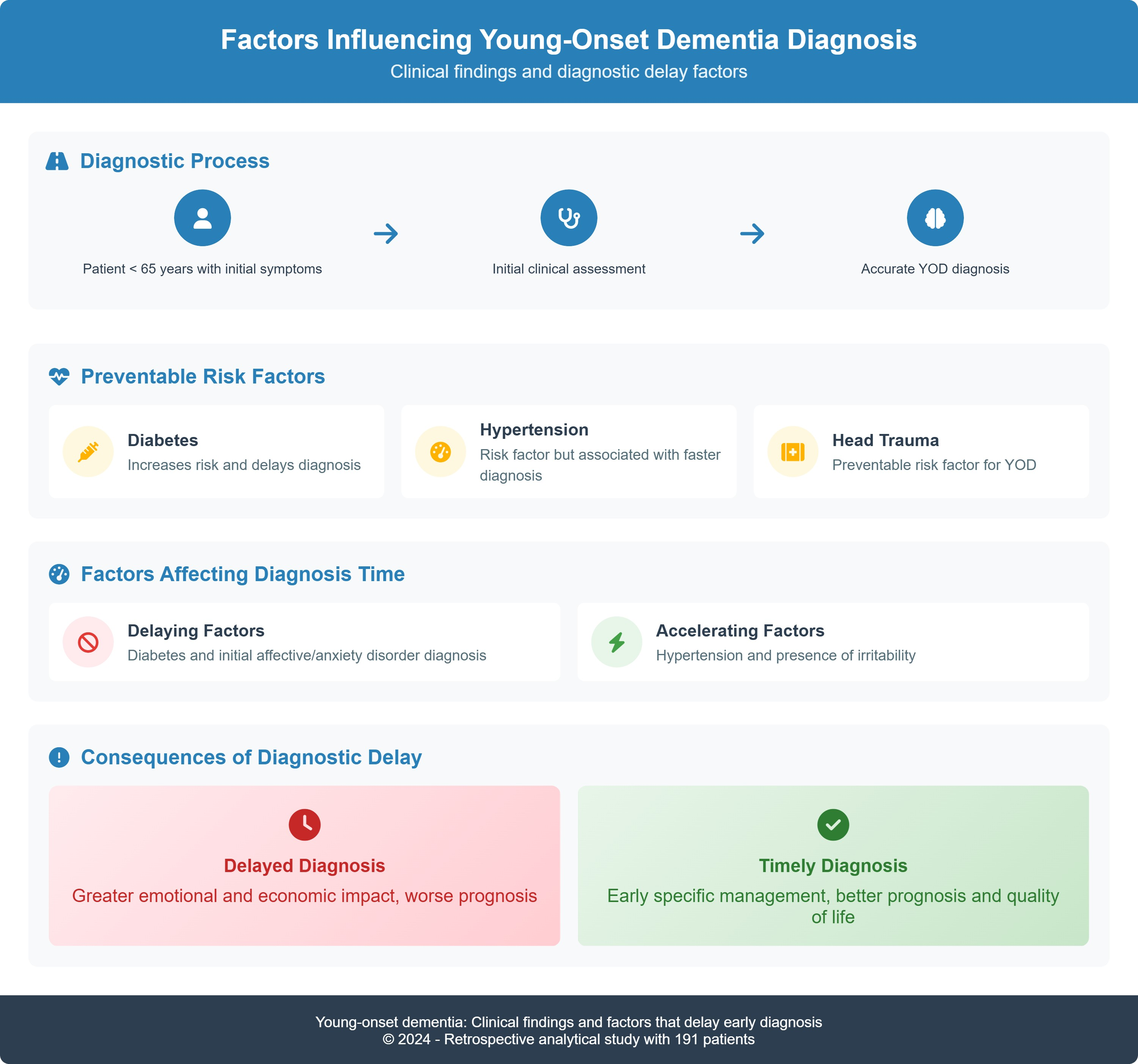


Young-Onset Dementia: Clinical Findings and Factors That Delay Early Diagnosis—A Retrospective Observational Study
 , , ,
, , ,
Abstract
1. Introduction
2. Materials and Methods
2.1. Study Design
2.2. Population and Sample
2.3. Variables
2.4. Statistical Analysis
2.5. Ethical Considerations
3. Results
4. Discussion
4.1. Diagnostic Time
4.2. Symptoms
4.3. Predictors of Diagnostic Delay
5. Conclusions
Limitations
Author Contributions
Funding
Institutional Review Board Statement
Informed Consent Statement
Data Availability Statement
Acknowledgments
Conflicts of Interest
Abbreviations
| AD | Alzheimer’s disease |
| AIREN | Association Internationale pour la Recherche et l’Enseignement en Neurosciences |
| bvFTD | Behavioral variant FTD |
| DSM-5 | Diagnostic and Statical Manual Disorders- 5 |
| EOAD | Early-onset Alzheimer’s disease |
| FTD | Frontotemporal dementia |
| HBP | High blood pressure |
| ICD-10 | International Statistical Classification of Diseases and Related Health Problems-10 |
| LBD | Lewy body dementia |
| LOD | Late onset dementia |
| MRI | Magnetic resonance imaging |
| MD | Mixed dementia |
| NINCDS-ADRDA | National Institute of Neurological and Communicative Disorders and Stroke, Alzhei-mer’s Disease and Related Disorders Association |
| NINDS | National Institute of Neurological Disorders and Stroke |
| PET | Positron emission tomography |
| PSP | Progressive supranuclear paralysis |
| TBI | Traumatic brain injury |
| T2DM | Type 2 diabetes mellitus |
| VaD | Vascular dementia |
| YOD | Young-onset dementia |
References
- van Hezik-Wester, V.J.; Handels, R.L.H.; Wolfs, C.A.G.; Kanters, T.A. Caregiver Burden and Quality of Life Across Alzheimer’s Disease Severity Stages. Alzheimer Dis. Assoc. Disord. 2023, 37, 134. [Google Scholar] [CrossRef]
- Nichols, E.; Steinmetz, J.D.; Vollset, S.E.; Fukutaki, K.; Chalek, J.; Abd-Allah, F.; Abdoli, A.; Abualhasan, A.; Abu-Gharbieh, E.; Akram, T.T.; et al. Estimation of the Global Prevalence of Dementia in 2019 and Forecasted Prevalence in 2050: An Analysis for the Global Burden of Disease Study 2019. Lancet Public Health 2022, 7, e105–e125. [Google Scholar] [CrossRef] [PubMed]
- International, A.D.; Patterson, C. World Alzheimer Report 2018: The State of the Art of Dementia Research: New Frontiers; Alzheimer’s Disease International (ADI): London, UK, 2018. [Google Scholar]
- Hendriks, S.; Peetoom, K.; Bakker, C.; van der Flier, W.M.; Papma, J.M.; Koopmans, R.; Verhey, F.R.J.; de Vugt, M.; Köhler, S.; Young-Onset Dementia Epidemiology Study Group. Global Prevalence of Young-Onset Dementia: A Systematic Review and Meta-Analysis. JAMA Neurol. 2021, 78, 1080–1090. [Google Scholar] [CrossRef] [PubMed]
- Jefferies, K.; Agrawal, N. Early-Onset Dementia. Adv. Psychiatr. Treat. 2009, 15, 380–388. [Google Scholar] [CrossRef]
- Orgeta, V.; Mukadam, N.; Sommerlad, A.; Livingston, G. The Lancet Commission on Dementia Prevention, Intervention, and Care: A Call for Action. Ir. J. Psychol. Med. 2019, 36, 85–88. [Google Scholar] [CrossRef]
- Ministerio de Salud y Protección Social. Boletín de Salud Mental: Demencia (Boletín de Salud Mental No. 3). Subdirección de Enfermedades No Transmisibles. 2017. Available online: https://www.minsalud.gov.co/sites/rid/Lists/BibliotecaDigital/RIDE/VS/PP/ENT/Boletin-demencia-salud-mental.pdf (accessed on 9 October 2025).
- Pinilla-Monsalve, G.D.; Vergara-Aguilar, J.P.; Machado-Noguera, B.; Gutiérrez-Baquero, J.; Cabezas-Vargas, Z.; Bejarano-Hernández, J. Estudio de la epidemiología neurológica en Colombia a partir de información administrativa (ESENCIA). Resultados preliminares 2015–2017. Salud UIS 2021, 53, e:21025. [Google Scholar] [CrossRef]
- Collins, J.D.; Henley, S.M.D.; Suárez-González, A. A systematic review of the prevalence of depression, anxiety, and apathy in frontotemporal dementia, atypical and young-onset Alzheimer’s disease, and inherited dementia. Int. Psychogeriatr. 2023, 35, 457–476. [Google Scholar] [CrossRef] [PubMed]
- Borelli-Millott, L.F.; Loi, S.M.; Velakoulis, D.; Goh, A.M.Y. A thematic analysis of psychotic symptoms in young-onset dementia. Int. Psychogeriatr. 2024, 36, 465–473. [Google Scholar] [CrossRef] [PubMed]
- Parker, M.; Barlow, S.; Hoe, J.; Aitken, L. Persistent barriers and facilitators to seeking help for a dementia diagnosis: A systematic review of 30 years of the perspectives of carers and people with dementia. Int. Psychogeriatr. 2020, 32, 611–634. [Google Scholar] [CrossRef] [PubMed]
- Lu, K.Q.; Lu, K.J.; Ji, Z.J. Comparative analysis of the burden of young-onset and late-onset dementia in China from 1990 to 2021: A study based on GBD 2021 data. J. Prev. Alzheimers Dis. 2025, 24, 100307. [Google Scholar] [CrossRef] [PubMed]
- Elahi, A.; Frechette, T. Repetitive transcranial magnetic stimulation for early-onset Alzheimer’s disease—A case report. Clin. Neurophysiol. Pract. 2023, 8, 161–163. [Google Scholar] [CrossRef] [PubMed] [PubMed Central]
- Battaglia, S.; Nazzi, C.; Fullana, M.A.; di Pellegrino, G.; Borgomaneri, S. ‘Nip it in the bud’: Low-frequency rTMS of the prefrontal cortex disrupts threat memory consolidation in humans. Behav. Res. Ther. 2024, 178, 104548. [Google Scholar] [CrossRef] [PubMed]
- Di Lazzaro, V.; Bella, R.; Benussi, A.; Bologna, M.; Borroni, B.; Capone, F.; Chen, K.S.; Chen, R.; Chistyakov, A.V.; Classen, J.; et al. Diagnostic contribution and therapeutic perspectives of transcranial magnetic stimulation in dementia. Clin. Neurophysiol. 2021, 132, 2568–2607. [Google Scholar] [CrossRef] [PubMed]
- Battaglia, S.; Nazzi, C.; Di Fazio, C.; Borgomaneri, S. The role of pre-supplementary motor cortex in action control with emotional stimuli: A repetitive transcranial magnetic stimulation study. Ann. N. Y. Acad. Sci. 2024, 1536, 151–166. [Google Scholar] [CrossRef] [PubMed]
- CIE-10; International Statistical Classification of Diseases and Related Health Problems, 10th Revision. World Health Organization: Geneva, Switzerland, 1992.
- Jack, C.R.; Andrews, S.J.; Beach, T.G.; Buracchio, T.; Dunn, B.; Graf, A.; Hansson, O.; Ho, C.; Jagust, W.; McDade, E.; et al. Revised Criteria for the Diagnosis and Staging of Alzheimer’s Disease. Nat. Med. 2024, 30, 2121–2124. [Google Scholar] [CrossRef]
- Román, G.C.; Tatemichi, T.K.; Erkinjuntti, T.; Cummings, J.L.; Masdeu, J.C.; Garcia, J.H.; Amaducci, L.; Orgogozo, J.M.; Brun, A.; Hofman, A. Vascular Dementia: Diagnostic Criteria for Research Studies. Neurology 1993, 43, 250–260. [Google Scholar] [CrossRef] [PubMed]
- Rascovsky, K.; Hodges, J.R.; Knopman, D.; Mendez, M.F.; Kramer, J.H.; Neuhaus, J.; van Swieten, J.C.; Seelaar, H.; Dopper, E.G.P.; Onyike, C.U.; et al. Sensitivity of Revised Diagnostic Criteria for the Behavioural Variant of Frontotemporal Dementia. Brain 2011, 134, 2456–2477. [Google Scholar] [CrossRef] [PubMed]
- Ali, F.; Martin, P.R.; Botha, H.; Ahlskog, J.E.; Bower, J.H.; Masumoto, J.Y.; Maraganore, D.; Hassan, A.; Eggers, S.; Boeve, B.F.; et al. Sensitivity and Specificity of Diagnostic Criteria for Progressive Supranuclear Palsy. Mov. Disord. 2019, 34, 1144–1153. [Google Scholar] [CrossRef]
- VandeVrede, L.; Cho, H.; Sanderson-Cimino, M.; Wekselman, F.; Cobigo, Y.; Gorno-Tempini, M.L.; Heuer, H.W.; Kramer, J.H.; Lario Lago, A.; Leichter, D.; et al. Detection of Alzheimer Neuropathology in Alzheimer and Non-Alzheimer Clinical Syndromes With Blood-Based Biomarkers. JAMA Neurol. 2025, 82, 344–354. [Google Scholar] [CrossRef]
- Coyle-Gilchrist, I.T.S.; Dick, K.M.; Patterson, K.; Vázquez Rodríquez, P.; Wehmann, E.; Wilcox, A.; Lansdall, C.J.; Dawson, K.E.; Wiggins, J.; Mead, S.; et al. Prevalence, Characteristics, and Survival of Frontotemporal Lobar Degeneration Syndromes. Neurology 2016, 86, 1736–1743. [Google Scholar] [CrossRef]
- McCormick, L.; Bodla, A.P.; Rubin, R.T. Very Early Onset Dementias: Importance of Differentiating from Schizophrenia Spectrum Disorders. PLoS Ment. Health 2024, 1, e0000107. [Google Scholar] [CrossRef]
- Draper, B.; Cations, M.; White, F.; Trollor, J.; Loy, C.; Brodaty, H.; Sachdev, P.; Gonski, P.; Demirkol, A.; Cumming, R.G.; et al. Time to Diagnosis in Young-Onset Dementia and Its Determinants: The INSPIRED Study. Int. J. Geriatr. Psychiatry 2016, 31, 1217–1224. [Google Scholar] [CrossRef]
- Zapata-Restrepo, L.; Rivas, J.; Miranda, C.; Miller, B.L.; Ibanez, A.; Allen, I.E.; Possin, K. The Psychiatric Misdiagnosis of Behavioral Variant Frontotemporal Dementia in a Colombian Sample. Front. Neurol. 2021, 12, 729381. [Google Scholar] [CrossRef]
- O’Malley, M.; Parkes, J.; Stamou, V.; LaFontaine, J.; Oyebode, J.; Carter, J. Young-Onset Dementia: Scoping Review of Key Pointers to Diagnostic Accuracy. BJPsych Open 2019, 5, e48. [Google Scholar] [CrossRef] [PubMed]
- Livingston, G.; Huntley, J.; Liu, K.Y.; Costafreda, S.G.; Selbæk, G.; Alladi, S.; Ames, D.; Banerjee, S.; Burns, A.; Brayne, C.; et al. Dementia Prevention, Intervention, and Care: 2024 Report of the Lancet Standing Commission. Lancet 2024, 404, 572–628. [Google Scholar] [CrossRef]
- Javanshiri, K.; Waldö, M.L.; Friberg, N.; Sjövall, F.; Wickerström, K.; Haglund, M.; Englund, E. Atherosclerosis, Hypertension, and Diabetes in Alzheimer’s Disease, Vascular Dementia, and Mixed Dementia: Prevalence and Presentation. J. Alzheimer’s Dis. 2018, 65, 1247–1258. [Google Scholar] [CrossRef]
- Gottesman, R.F.; Egle, M.; Groechel, R.C.; Mughal, A. Blood Pressure and the Brain: The Conundrum of Hypertension and Dementia. Cardiovasc. Res. 2024, 120, 2360–2372. [Google Scholar] [CrossRef] [PubMed]
- Lennon, M.J.; Lam, B.C.P.; Lipnicki, D.M.; Crawford, J.D.; Peters, R.; Schutte, A.E.; Brodaty, H.; Thalamuthu, A.; Rydberg-Sterner, T.; Najar, J.; et al. Use of Antihypertensives, Blood Pressure, and Estimated Risk of Dementia in Late Life: An Individual Participant Data Meta-Analysis. JAMA Netw. Open 2023, 6, e2333353. [Google Scholar] [CrossRef]
- Asken, B.M.; Bove, J.M.; Bauer, R.M.; Tanner, J.A.; Casaletto, K.B.; Staffaroni, A.M.; VandeVrede, L.; Alosco, M.L.; Mez, J.B.; Stern, R.A.; et al. Clinical Implications of Head Trauma in Frontotemporal Dementia and Primary Progressive Aphasia. Alzheimer’s Res. Ther. 2024, 16, 193. [Google Scholar] [CrossRef] [PubMed]
- Gardner, R.C.; Burke, J.F.; Nettiksimmons, J.; Kaup, A.; Barnes, D.E.; Yaffe, K. Dementia Risk After Traumatic Brain Injury vs Nonbrain Trauma: The Role of Age and Severity. JAMA Neurol. 2014, 71, 1490–1497. [Google Scholar] [CrossRef]
- Makino, K.; Lee, S.; Katayama, O.; Tomida, K.; Yamaguchi, R.; Yamagiwa, D.; Shimada, H. Prediction of Dementia Risk by Instrumental Activities of Daily Living Limitations and Its Impact on Dementia Onset in Combination with Mild Cognitive Impairment: A Population-Based Longitudinal Study. BMC Public Health 2025, 25, 1535. [Google Scholar] [CrossRef] [PubMed]
- Ismail, Z.; Gatchel, J.; Bateman, D.R.; Barcelos-Ferreira, R.; Cantillon, M.; Jaeger, J.; Donovan, N.J.; Mortby, M.E. Affective and Emotional Dysregulation as Pre-Dementia Risk Markers: Exploring the Mild Behavioral Impairment Symptoms of Depression, Anxiety, Irritability, and Euphoria. Int. Psychogeriatr. 2018, 30, 185–196. [Google Scholar] [CrossRef]
- Ramli, Y. Clinical Approach to Probable Mixed Vascular Dementia and Progressive Supranuclear Palsy. Rom. J. Neurol. Rev. Romana Neurol. 2024, 23, 324–328. [Google Scholar] [CrossRef]
- Loi, S.M.; Goh, A.M.Y.; Mocellin, R.; Malpas, C.B.; Parker, S.; Eratne, D.; Farrand, S.; Kelso, W.; Evans, A.; Walterfang, M.; et al. Time to Diagnosis in Younger-Onset Dementia and the Impact of a Specialist Diagnostic Service. Int. Psychogeriatr. 2022, 34, 367–375. [Google Scholar] [CrossRef] [PubMed]
- Barbiellini Amidei, C.; Fayosse, A.; Dumurgier, J.; Machado-Fragua, M.D.; Tabak, A.G.; van Sloten, T.; Kivimäki, M.; Dugravot, A.; Sabia, S.; Singh-Manoux, A. Association Between Age at Diabetes Onset and Subsequent Risk of Dementia. JAMA 2021, 325, 1640–1649. [Google Scholar] [CrossRef]
- Shang, X.; Hill, E.; Zhu, Z.; Liu, J.; Ge, B.Z.; Wang, W.; He, M. The Association of Age at Diagnosis of Hypertension With Brain Structure and Incident Dementia in the UK Biobank. Hypertension 2021, 78, 1463–1474. [Google Scholar] [CrossRef] [PubMed]


| Initial Diagnosis | Final Diagnosis | p Value Chi 2 * | ||||
|---|---|---|---|---|---|---|
| EOAD (n = 102) n (%) | MD (n = 7) n (%) | FTD (n = 35) n (%) | PSP (n = 10) n (%) | VaD (n = 37) n (%) | ||
| Dementia (n = 112) | 67 (65.7) | 3 (43.0) | 19 (54.3) | 5 (50.0) | 18 (48.7) | 0.0001 |
| Bipolar disorder (n = 22) | 11 (10.8) | 0 (0.0) | 6 (17.1) | 0 (0.0) | 5 (13.5) | |
| Anxiety disorder (n = 18) | 9 (8.8) | 0 (0.0) | 4 (11.4) | 1 (10.0) | 4 (10.8) | |
| Other (n = 16) | 5 (4.9) | 1 (14.3) | 2 (5.7) | 1 (10.0) | 7 (18.9) | |
| Schizophrenia (n = 14) | 6 (5.9) | 3 (42.6) | 2 (5.7) | 0 (0.0) | 3 (8.1) | |
| Mild cognitive impairment (n = 6) | 4 (3.9) | 0 (0.0) | 2 (5.7) | 0 (0.0) | 0 (0.0) | |
| Parkinson disease (n = 3) | 0 (0.0) | 0 (0.0) | 0 (0.0) | 3 (30.0) | 0 (0.0) | |
| Diagnosis | EOAD (n = 102) | MD (n = 7) | FTD (n = 35) | PSP (n = 10) | VaD (n = 37) | Global (n = 191, %) |
|---|---|---|---|---|---|---|
| n (%) | n (%) | n (%) | n (%) | n (%) | ||
| High blood pressure (n = 48) | 11 (10.8) | 5 (71.4) | 8 (22.9) | 1 (10.0) | 23 (62.2) | (25.1) |
| Hypothyroidism (n = 21) | 10 (9.8) | 0 (0.0) | 3 (8.6) | 0 (0.0) | 8 (21.6) | (11.0) |
| Traumatic brain injury (n = 17) | 7 (6.9) | 0 (0.0) | 2 (5.7) | 3 (30.0) | 5 (13.5) | (8.9) |
| Type 2 Diabetes mellitus (n = 15) | 1 (1.0) | 2 (28.6) | 5 (14.3) | 1 (10.0) | 6 (16.2) | (7.9) |
| Dyslipidemia (n = 12) | 6 (5.9) | 2 (28.6) | 1 (2.9) | 1 (10.0) | 2 (5.4) | (6.3) |
| Epilepsy (n = 12) | 6 (5.9) | 0 (0.0) | 1 (2.9) | 0 (0.0) | 5 (13.5) | (6.3) |
| Mental disorder (n = 12) | 8 (7.8) | 1 (14.3) | 2 (5.7) | 0 (0.0) | 1 (2.7) | (6.3) |
| Heart disease (n = 11) | 1 (1.0) | 0 (0.0) | 1 (2.9) | 0 (0.0) | 9 (24.3) | (5.8) |
| Brain vascular disease (n = 9) | 0 (0.0) | 1 (14.3) | 0 (0.0) | 0 (0.0) | 8 (21.6) | (4.7) |
| Chronic kidney disease (n = 5) | 0 (0.0) | 1 (14.3) | 1 (2.9) | 0 (0.0) | 3 (8.1) | (2.6) |
| Other (n = 24) | 11 (10.8) | 0 (0.0) | 3 (8.6) | 1 (10.0) | 9 (24.3) | (12.6) |
| Initial Symptoms | EOAD (n = 102) n (%) | MD (n = 7) n (%) | FTD (n = 35) n (%) | PSP (n = 10) n (%) | VaD (n = 37) n (%) | Global (n = 191, %) |
|---|---|---|---|---|---|---|
| Memory (n = 96) | 70 (68.3) | 3 (42.9) | 9 (25.7) | 2 (20.0) | 12 (32.4) | (50.1) |
| Depression (n = 57) | 29 (28.0) | 0 (0.0) | 11 (31.4) | 1 (10.0) | 16 (44.1) | (29.8) |
| Delusion (n = 45) | 24 (23.5) | 3 (42.9) | 7 (20.0) | 2 (20.0) | 9 (24.3) | (23.5) |
| Anxiety (n = 42) | 21 (20.8) | 1 (14.3) | 11 (31.4) | 3 (30.0) | 6 (16.2) | (22.1) |
| Sleep disorder (n = 34) | 20 (19.6) | 0 (0.0) | 4 (11.4) | 1 (10.0) | 9 (24.3) | (17.8) |
| Irritability (n = 28) | 17 (16.8) | 1 (14.3) | 3 (8.6) | 0 (0.0) | 7 (18.9) | (14.7) |
| Movement disorder (n = 23) | 4 (4.0) | 0 (0.0) | 4 (11.4) | 8 (80.0) | 7 (18.9) | (12.1) |
| Apathy (n = 15) | 5 (4.9) | 1 (14.3) | 4 (11.4) | 2 (20.0) | 3 (8.1) | (7.8) |
| Language disorder (n = 13) | 8 (7.8) | 0 (0.0) | 2 (5.7) | 1 (10.0) | 2 (5.4) | (6.8) |
| Self-care (n = 9) | 6 (5.9) | 0 (0.0) | 1 (2.9) | 0 (0.0) | 2 (5.4) | (4.7) |
| Appetite/eating (n = 4) | 3 (2.9) | 0 (0.0) | 1 (2.9) | 0 (0.0) | 0 (0.0) | (2.1) |
| Current Symptoms | EOAD (n = 102) n (%) | MD (n = 7) n (%) | FTD (n = 35) n (%) | PSP (n = 10) n (%) | VaD (n = 37) n (%) | Global (n = 191, %) |
|---|---|---|---|---|---|---|
| Memory (n = 181) | 100 (98.0) | 6 (85.7) | 32 (91.4) | 8 (80.0) | 35 (94.6) | (94.7) |
| Instrumental activities (n = 177) | 94 (92.0) | 6 (85.7) | 35 (100) | 10 (100) | 32 (86.5) | (92.6) |
| Orientation (n = 154) | 86 (84.3) | 6 (85.7) | 27 (77.1) | 8 (80.0) | 27 (73.0) | (80.6) |
| Anxiety (n = 151) | 76 (74.5) | 4 (57.1) | 33 (94.3) | 10 (100) | 28 (75.7) | (79.1) |
| Basic daily activities (n = 149) | 77 (75.5) | 4 (57.1) | 34 (97.1) | 9 (90.0) | 25 (67.6) | (78.0) |
| Depression/dysphoria (n = 132) | 62 (60.8) | 1 (14.3) | 30 (85.7) | 10 (100) | 29 (78.4) | (69.1) |
| Irritability/lability (n = 128) | 59 (57.8) | 5 (71.4) | 27 (77.1) | 10 (100) | 27 (73.0) | (67.0) |
| Nighttime behaviors (n = 106) | 48 (47.1) | 4 (57.1) | 30 (85.7) | 6 (60.0) | 18 (48.6) | (55.5) |
| Apathy/indifference (n = 105) | 52 (51.0) | 2 (28.6) | 34 (97.1) | 7 (70.0) | 10 (27.0) | (55.0) |
| Agitation/aggression (n = 85) | 43 (42.2) | 2 (28.6) | 20 (57.1) | 6 (60.0) | 14 (37.8) | (44.5) |
| Appetite/eating (n = 82) | 36 (35.3) | 2 (28.6) | 23 (65.7) | 5 (50.0) | 16 (43.2) | (42.9) |
| Delusions (n = 79) | 40 (39.2) | 3 (42.9) | 19 (54.3) | 2 (20.0) | 15 (40.5) | (41.3) |
| Hallucinations (n = 62) | 26 (25.5) | 5 (71.4) | 15 (42.9) | 2 (20.0) | 14 (37.8) | (32.5) |
| Disinhibition (n = 61) | 32 (31.4) | 2 (28.6) | 16 (45.7) | 2 (20.0) | 9 (24.3) | (31.9) |
| Motor disturbance (n = 56) | 20 (19.6) | 1 (14.3) | 8 (22.9) | 10 (100) | 17 (45.9) | (29.3) |
| Elation/euphoria (n = 17) | 9 (8.8) | 0 (0.0) | 4 (11.4) | 1 (10.0) | 3 (8.1) | (8.9) |
| Predictors | Non Standardized Coefficients | Standardized Coefficients | t | Sig. | 95% Confidence Interval for B | Collinearity Statistics | |||
|---|---|---|---|---|---|---|---|---|---|
| B | Dev. Error | Beta | Lower Limit | Upper Limit | Tolerance | VIF | |||
| (Constant) | 1.609 | 0.255 | 6.301 | 0.0001 * | 1.105 | 2.112 | |||
| Symptom onset/first consultation time | 0.918 | 0.062 | 0.710 | 14.723 | 0.0001 * | 0.795 | 1.042 | 0.985 | 1.015 |
| Affective disorder | 1.101 | 0.481 | 0.112 | 2.291 | 0.023 | 0.152 | 2.050 | 0.954 | 1.048 |
| Anxiety disorder | 1.389 | 0.540 | 0.126 | 2.574 | 0.011 | 0.324 | 2.454 | 0.964 | 1.038 |
| Type 2 diabetes mellitus | 2.604 | 0.612 | 0.229 | 4.251 | 0.0001* | 1.395 | 3.812 | 0.794 | 1.260 |
| High blood pressure | −0.776 | 0.393 | −0.106 | −1.972 | 0.050 | −1.552 | 0.001 | 0.795 | 1.258 |
| Irritability | −0.897 | 0.423 | −0.103 | −2.122 | 0.035 | −1.731 | −0.063 | 0.969 | 1.032 |
Disclaimer/Publisher’s Note: The statements, opinions and data contained in all publications are solely those of the individual author(s) and contributor(s) and not of MDPI and/or the editor(s). MDPI and/or the editor(s) disclaim responsibility for any injury to people or property resulting from any ideas, methods, instructions or products referred to in the content. |
© 2025 by the authors. Licensee MDPI, Basel, Switzerland. This article is an open access article distributed under the terms and conditions of the Creative Commons Attribution (CC BY) license (https://creativecommons.org/licenses/by/4.0/).
Share and Cite
Rivas, J.; Hernández, M.; Erazo, J.M.; Arango, O.; Cortés, P.; Lasso, J.; Giraldo, S.; Miranda, C. Young-Onset Dementia: Clinical Findings and Factors That Delay Early Diagnosis—A Retrospective Observational Study. Biomedicines 2025, 13, 2793. https://doi.org/10.3390/biomedicines13112793
Rivas J, Hernández M, Erazo JM, Arango O, Cortés P, Lasso J, Giraldo S, Miranda C. Young-Onset Dementia: Clinical Findings and Factors That Delay Early Diagnosis—A Retrospective Observational Study. Biomedicines. 2025; 13(11):2793. https://doi.org/10.3390/biomedicines13112793
Chicago/Turabian StyleRivas, Juan, Mauricio Hernández, Jose Miguel Erazo, Oscar Arango, Paulina Cortés, Jennifer Lasso, Simon Giraldo, and Carlos Miranda. 2025. "Young-Onset Dementia: Clinical Findings and Factors That Delay Early Diagnosis—A Retrospective Observational Study" Biomedicines 13, no. 11: 2793. https://doi.org/10.3390/biomedicines13112793
APA StyleRivas, J., Hernández, M., Erazo, J. M., Arango, O., Cortés, P., Lasso, J., Giraldo, S., & Miranda, C. (2025). Young-Onset Dementia: Clinical Findings and Factors That Delay Early Diagnosis—A Retrospective Observational Study. Biomedicines, 13(11), 2793. https://doi.org/10.3390/biomedicines13112793