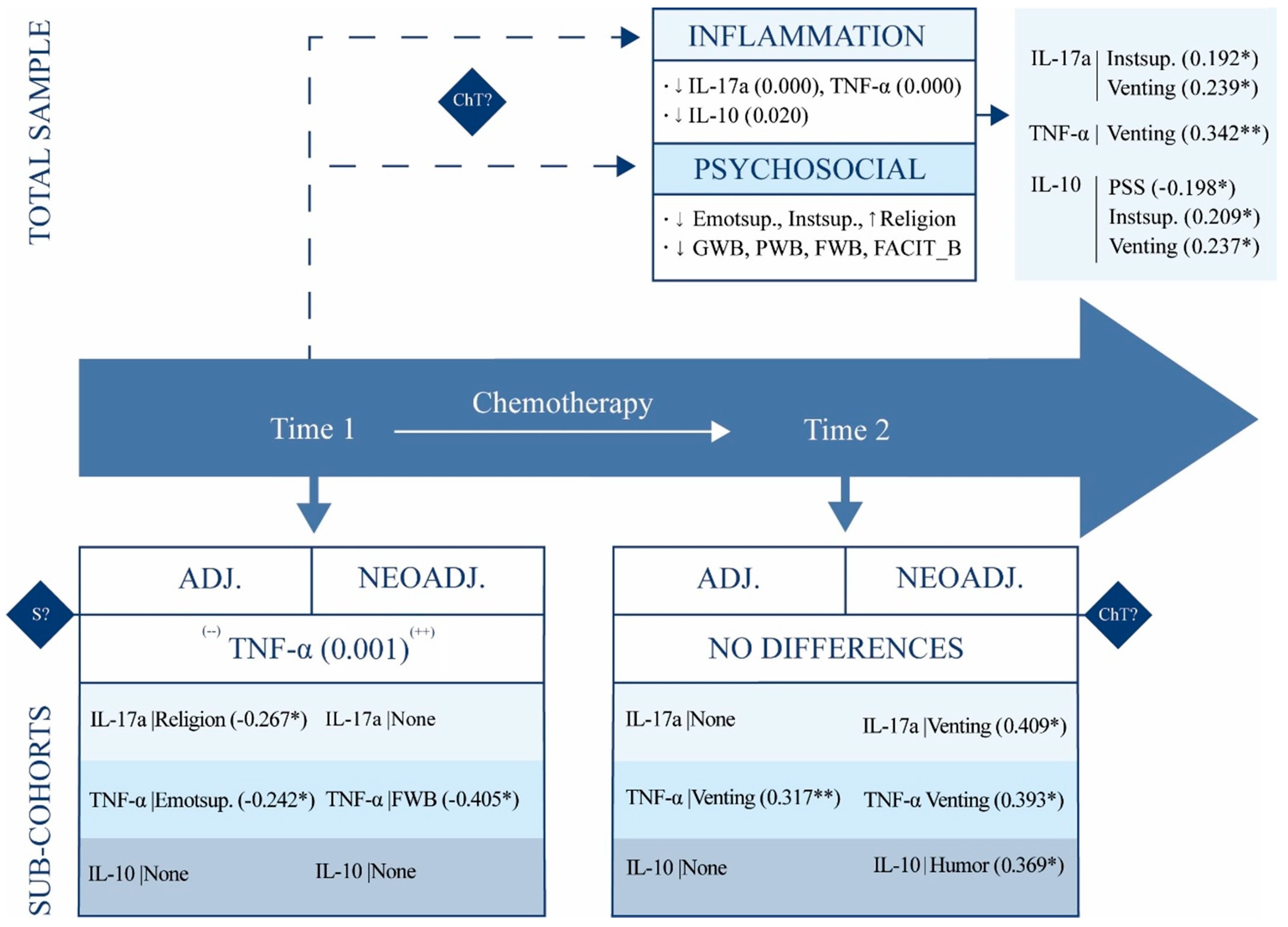


The Inflammatory Footprint of Anti-Breast Cancer Treatments and Psychosocial Factors in Women Undergoing Chemotherapy

 ,
,  and
and
Abstract
1. Introduction
2. Materials and Methods
2.1. Study Design
2.2. Study Population
2.3. Materials and Measures
2.3.1. Sociodemographic and Medical Data Form
2.3.2. Psychosocial Measures
2.3.3. Biological Markers
2.4. Procedures
2.5. Statistical Analysis
3. Results
3.1. Descriptives from Time 1 and Time 2
3.2. Comparative Analyses Between Time 1 and Time 2 Assessments
3.2.1. Comparative Analysis Between the Total Samples
3.2.2. Comparative Analysis Between the Adjuvant Subsamples
3.2.3. Comparative Analysis Between the Neoadjuvant Subsamples
3.3. Comparative Analyses Between Adjuvant and Neoadjuvant Cohorts
3.3.1. Comparative Analysis at Time 1
3.3.2. Comparative Analyses at Time 2
3.4. Bivariate Analysis
3.4.1. Bivariate Analysis Between Inflammatory Biomarkers
3.4.2. Bivariate Analysis of Inflammatory and Psychosocial Markers at Time 2 in the Total Sample and Treatment Sub-Cohorts
4. Discussion
4.1. The Influence of Anti-BC Treatment on Inflammation and Immunomodulation
4.1.1. Time 1
4.1.2. From Time 1 to Time 2
4.1.3. Time 2
4.2. Longitudinal Analysis of Psychosocial Variables from Time 1 to Time 2
4.3. The Interplay Between Psychosocial and Biological Factors in BC
4.3.1. Perceived Stress and Inflammation
4.3.2. Coping and Inflammation
Venting
Instrumental and Emotional Support
5. Conclusions
Author Contributions
Funding
Institutional Review Board Statement
Informed Consent Statement
Data Availability Statement
Acknowledgments
Conflicts of Interest
Abbreviations
| Accepta. | Acceptance coping |
| AchT | After chemotherapy |
| ActiveC. | Active coping |
| BC | Breast cancer |
| BChT | Before chemotherapy |
| BCOPE | Brief Cope Questionnaire |
| Bhdiseng. | Behavioral disengagement coping |
| CNS | Central nervous system |
| CRP | C-reactive Protein |
| Emotsup. | Emotional support coping |
| EWB | Emotional well-being |
| FACIT | Functional Assessment of Chronic Illness Therapy questionnaire |
| FACT-B | Functional Assessment of Cancer Therapy—Breast Cancer questionnaire |
| FACT-G | Functional Assessment of Cancer Therapy—General Module questionnaire |
| FWB | Functional well-being |
| GWB | General well-being |
| IFNγ | Interferon gamma9 |
| IL | Interleukin |
| Instsup. | Instrumental support coping |
| K | Kurtosis |
| ODC | Oncology day care unit |
| Plan. | Planning coping |
| Positref. | Positive reframing coping |
| PSS | Perceived Stress Scale |
| PWB | Physical well-being |
| Sblaming | Self-blaming coping |
| Sdistrac. | Self-distraction coping |
| Sk | Skewness |
| Subuse. | Substance use coping |
| SWB | Social well-being |
| TGF-β | Transforming growth factor beta |
| Th | T helper cells |
| TME | Tumor microenvironment |
| TNF-α | Tumor necrosis factor alpha |
Appendix A
| t Student | ||||||||
| Adjuvant Cohort (n = 73) | Neoadjuvant Cohort (n = 33) | |||||||
| M | SD | M | SD | t | df | p | d | |
| Psychosocial markers | ||||||||
| PSS Total Score | 36.10 | 6.36 | 35.76 | 5.37 | −0.266 | 104 | 0.791 | −0.056 |
| BCOPE ActiveC. Plan. Instsup. Emotsup. Religion Positref. Sblaming Accepta. Venting Denial Sdistrac. Humor | 6.33 5.53 5.66 6.18 4.96 5.64 2.72 6.70 4.10 2.78 6.10 4.70 | 1.31 1.57 2.70 1.65 2.10 1.76 1.10 1.24 1.49 1.12 1.36 2.02 | 6.21 5.42 5.58 6.24 4.42 5.15 2.30 6.94 4.00 2.58 6.36 3.82 | 1.39 1.35 1.48 1.54 2.21 1.72 0.77 1.03 1.39 0.90 1.32 2.07 | −0.432 −0.348 −0.163 0.189 −1.19 −1.34 −2.20 0.97 −0.31 −0.92 0.94 −2.06 | 103 104 104 104 104 104 85.76 104 104 104 104 | 0.667 0.729 0.871 0.850 0.236 0.182 0.030 0.334 0.755 0.358 0.345 0.042 | 0.091 −0.073 −0.034 0.040 −0.250 −0.282 −0.406 0.204 −0.066 −0.194 0.199 −0.433 |
| FACT-G GWB PWB SWB EWB FWB | 86.34 25.99 21.60 19.05 19.70 | 12.46 2.60 4.39 4.15 4.64 | 84.69 26.30 20.79 17.76 19.85 | 11.56 2.99 4.08 4.61 4.00 | −0.643 0.554 −0.904 −1.44 0.161 | 104 104 104 104 104 | 0.521 0.581 0.368 0.153 0.873 | −0.135 −0.116 −0.190 −0.302 0.034 |
| FACT-B Total Score | 30.89 | 5.57 | 31.88 | 4.85 | 0.879 | 104 | 0.382 | 0.184 |
| Inflammatory biomarkers | ||||||||
| IL-17a | 13.81 | 11.11 | 16.78 | 14.21 | 1.06 | 50.40 | 0.293 | 0.245 |
| IFNγ | 0.99 | 1.35 | 1.08 | 1.81 | 0.27 | 104 | 0.786 | 0.057 |
| TNF-α | 1.54 | 1.70 | 2.57 | 2.13 | 2.68 | 104 | 0.001 | 0.561 |
| IL-10 | 2.11 | 1.78 | 2.29 | 2.52 | 0.25 | 104 | 0.806 | 0.052 |
| IL-6 | 6.90 | 34.31 | 3.35 | 2.95 | −0.59 | 104 | 0.555 | −0.123 |
| IL-4 | 4.29 | 18.68 | 1.75 | 1.91 | −0.78 | 104 | 0.439 | −0.163 |
| IL-2 | 0.81 | 1.22 | 1.06 | 1.09 | 0.98 | 102 | 0.331 | 0.207 |
Appendix B
| t Student | ||||||||
| Adjuvant Cohort (n = 73) | Neoadjuvant Cohort (n = 33) | |||||||
| M | SD | M | SD | t | df | p | d | |
| Psychosocial markers | ||||||||
| PSS Total Score | 34.61 | 5.20 | 35.82 | 6.15 | 1.041 | 103 | 0.300 | 0.219 |
| BCOPE ActiveC. Plan. Instsup. Emotsup. Religion Positref. Sblaming Accepta. Venting Denial Sdistrac. Bhdiseng. Subuse. Humor | 6.29 5.38 5.25 5.71 5.26 5.70 2.53 6.78 3.95 2.74 6.05 2.14 2.00 4.68 | 1.25 1.41 1.58 1.70 2.08 1.56 0.78 1.17 1.23 1.03 1.67 0.45 0.00 2.05 | 6.21 6.45 4.61 5.97 5.12 5.39 2.52 6.79 3.91 3.06 5.94 2.24 2.09 4.42 | 1.29 1.48 1.14 1.63 2.13 1.58 1.09 1.24 1.44 1.43 1.56 0.56 0.38 2.05 | −0.285 0.236 −2.357 0.732 −0.316 −0.927 −0.102 0.028 −0.132 1.157 −0.335 1.032 1.359 −0.606 | 104 104 83.37 104 104 104 85.76 104 104 47.43 0.104 104 32.00 104 | 0.776 0.814 0.021 0.466 0.753 0.356 0.919 0.928 0.895 0.253 0.738 0.305 0.184 0.546 | −0.060 0.050 −0.439 0.154 −0.066 −0.194 −0.021 0.006 −0.028 0.275 −0.070 0.216 0.426 −127 |
| FACT-G GWB PWB SWB EWB FWB | 82.03 21.93 21.58 19.55 18.97 | 13.50 5.49 4.13 3.42 4.66 | 82.52 22.21 24.15 18.64 17.72 | 20.29 4.23 17.19 4.11 4.52 | 0.146 0.260 1.212 −1.193 −1.1485 | 104 104 104 104 104 | 0.884 0.795 0.228 0.236 0.141 | 0.031 0.055 0.254 −0.250 −0.312 |
| FACT-B Total Score | 27.10 | 6.44 | 17.45 | 4.65 | 0.288 | 104 | 0.774 | 0.060 |
| Inflammatory biomarkers | ||||||||
| IL-17a | 8.63 | 9.89 | 8.75 | 10.81 | 0.054 | 104 | 0.957 | 0.011 |
| IFNγ | 0.69 | 1.26 | 0.83 | 1.53 | 480 | 104 | 0.632 | 0.101 |
| TNF-α | 1.01 | 1.49 | 0.94 | 1.48 | −0.240 | 104 | 0.811 | −0.050 |
| IL-10 | 1.36 | 1.64 | 1.31 | 1.87 | −0.142 | 103 | 0.888 | −0.030 |
| IL-6 | 6.95 | 31.98 | 2.83 | 6.30 | −0.732 | 104 | 0.466 | −0.153 |
| IL-4 | 0.86 | 1.19 | 1.16 | 1.42 | 1.126 | 104 | 0.259 | 0.238 |
| IL-2 | 1.20 | 1.81 | 0.81 | 1.45 | −1.087 | 103 | 0.280 | −0.230 |
References
- Zhou, Y.; Jia, N.; Ding, M.; Yuan, K. Effects of exercise on inflammatory factors and IGF system in breast cancer survivors: A meta-analysis. BMC Women’s Health 2022, 22, 507. [Google Scholar] [CrossRef]
- Crusz, S.; Balkwill, F. Inflammation and cancer: Advances and new agents. Nat. Rev. Clin. Oncol. 2015, 12, 584–596. [Google Scholar] [CrossRef]
- Habanjar, O.; Bingula, R.; Decombat, C.; Diab-Assaf, M.; Caldefie-Chezet, F.; Delort, L. Crosstalk of Inflammatory Cytokines within the Breast Tumor Microenvironment. Int. J. Mol. Sci. 2023, 24, 4002. [Google Scholar] [CrossRef] [PubMed]
- Landskron, G.; De la Fuente, M.; Thuwajit, P.; Thuwajit, C.; Hermoso, M.A. Chronic inflammation and cytokines in the tumor microenvironment. J. Immunol. Res. 2014, 2014, 149185. [Google Scholar] [CrossRef]
- Nicolini, A.; Carpi, A.; Rossi, G. Cytokines in breast cancer. Cytokine Growth Factor. Rev. 2006, 17, 325–337. [Google Scholar] [CrossRef]
- Obeagu, E. Inflammatory blood markers in breast cancer: A narrative review from early detection to therapy response. Ann. Med. Surg. 2025, 87, 5906–5911. [Google Scholar] [CrossRef] [PubMed]
- Jabeen, S.; Zucknick, M.; Nome, M.; Dannenfelser, R.; Fleischer, T.; Kumar, S.; Lüders, T.; Von der Lippe Gythfeldt, H.; Troyanskaya, O.; Kyte, J.A.; et al. Serum cytokine levels in breast cancer patients during neoadjuvant treatment with bevacizumab. Oncoimmunology 2018, 7, e1457598. [Google Scholar] [CrossRef] [PubMed]
- Karpisheh, V.; Ahmadi, M.; Abbaszadeh-Goudarzi, K.; Mohammadpour, S.M.; Barshidi, A.; Mohammadi, H.; Mohammadi, A.; Yousefi, M.; Jadidi-Niaragh, F. The role of Th17 cells in the pathogenesis and treatment of breast cancer. Cancer Cell Int. 2022, 22, 108. [Google Scholar] [CrossRef]
- Tzang, B.S.; Chen, V.C.; Hsieh, C.C.; Wang, W.K.; Weng, Y.P.; Ho, H.Y.; Hsu, Y.T.; Hsaio, H.; Weng, J.; Chen, Y.L. Differential associations of proinflammatory and anti-inflammatory cytokines with depression severity from noncancer status to breast cancer course and subsequent chemotherapy. BMC Cancer 2020, 20, 686. [Google Scholar] [CrossRef]
- Ciurescu, S.; Buciu, V.; Șerban, D.; Borozan, F.; Tomescu, L.; Cobec, I.M.; Ilaș, D.G.; Sas, I. Role of Cytokines in Breast Cancer: A Systematic Review and Meta-Analysis. Biomedicines 2025, 13, 2203. [Google Scholar] [CrossRef]
- Jabeen, S.; Espinoza, J.A.; Torland, L.A.; Zucknick, M.; Kumar, S.; Haakensen, V.D.; Lüders, T.; Engebraaten, O.; Børresen-Dale, A.L.; Kyte, J.A.; et al. Noninvasive profiling of serum cytokines in breast cancer patients and clinicopathological characteristics. Oncoimmunology 2019, 8, e1537691. [Google Scholar] [CrossRef]
- Kaur, R.P.; Vasudeva, K.; Singla, H.; Benipal, R.P.; Khetarpal, P.; Munshi, A. Analysis of pro-and anti-inflammatory cytokine gene variants and serum cytokine levels as prognostic markers in breast cancer. J. Cell Physiol. 2018, 233, 9716–9723. [Google Scholar] [CrossRef]
- Kawaguchi, K.; Sakurai, M.; Yamamoto, Y.; Suzuki, E.; Tsuda, M.; Kataoka, T.R.; Hirata, M.; Nishie, M.; Nojiri, T.; Kumazoe, M.; et al. Alteration of specific cytokine expression patterns in patients with breast cancer. Sci. Rep. 2019, 9, 2924. [Google Scholar] [CrossRef]
- Malik, S.; Waquar, S.; Idrees, N.; Malik, A. Impending role of inflammatory markers and their specificity and sensitivity in breast cancer patients. Sci. Rep. 2024, 14, 15117. [Google Scholar] [CrossRef]
- Yi, M.; Li, T.; Niu, M.; Zhang, H.; Wu, Y.; Wu, K.; Dai, Z. Targeting cytokine and chemokine signaling pathways for cancer therapy. Signal Transduct. Target. Ther. 2024, 9, 176. [Google Scholar] [CrossRef]
- Valdés-Ferrada, J.; Muñoz-Durango, N.; Pérez-Sepulveda, A.; Muñiz, S.; Coronado-Arrázola, I.; Acevedo, F.; Soto, J.A.; Bueno, S.M.; Sánchez, C.; Kalergis, A.M. Peripheral blood classical monocytes and plasma interleukin 10 are associated to neoadjuvant chemotherapy response in breast cancer patients. Front. Immunol. 2020, 11, 1413. [Google Scholar] [CrossRef] [PubMed]
- Baghaie, L.; Haxho, F.; Leroy, F.; Lewis, B.; Wawer, A.; Minhas, S.; Harless, W.; Szewczuk, M. Contemporaneous Perioperative Inflammatory and Angiogenic Cytokine Profiles of Surgical Breast, Colorectal, and Prostate Cancer Patients: Clinical Implications. Cells 2023, 4, 2767. [Google Scholar] [CrossRef]
- Bulska-Będkowska, W.; Czajka-Francuz, P.; Cisoń-Jurek, S.; Owczarek, A.J.; Francuz, T.; Chudek, J. Predictive Role of Soluble IL-6R, TNF-R1/2, and Cell Adhesion Molecules Serum Levels in the Preoperative and Adjuvant Therapy in Women with Nonmetastatic Breast Cancer: A Preliminary Study. J. Interferon Cytokine Res. 2022, 42, 557–567. [Google Scholar] [CrossRef] [PubMed]
- Radin, A.S.; Bower, J.E.; Irwin, M.R.; Asher, A.; Hurvitz, S.A.; Cole, S.W.; Crespi, C.M.; Ganz, P.A. Acute health-related quality of life outcomes and systemic inflammatory markers following contemporary breast cancer surgery. npj Breast Cancer 2022, 8, 91. [Google Scholar] [CrossRef]
- Perez-Gonzalez, O.; Cuellar-Guzman, L.; Soliz, J.; Cata, J. Impact of regional anesthesia on recurrence, metastasis, and immune response in breast cancer surgery: A systematic review of the literature. Reg. Anesth. Pain. Med. 2017, 42, 751–756. [Google Scholar] [CrossRef] [PubMed]
- van den Heuvel, S.A.; van der Wal, S.E.; Bronkhorst, E.M.; Warlé, M.C.; Ronday, M.; Plat, J.; van Alfen, N.; Joosten, L.A.; Lerou, J.G.; Vissers, K.C.; et al. Acute cytokine response during breast cancer surgery: Potential role of dexamethasone and lidocaine and relationship with postoperative pain and complications–analysis of three pooled pilot randomized controlled trials. J. Pain. Res. 2020, 13, 1243–1254. [Google Scholar] [CrossRef] [PubMed]
- Lindholm, A.; Abrahamsen, M.L.; Buch-Larsen, K.; Marina, D.; Andersson, M.; Helge, J.W.; Schwarz, P.; Dela, F.; Gillberg, L. Pro-inflammatory cytokines increase temporarily after adjuvant treatment for breast cancer in postmenopausal women: A longitudinal study. Breast Cancer Res. 2024, 26, 142. [Google Scholar] [CrossRef]
- Bower, J.; Ganz, P.; Irwin, M.; Cole, S.; Carroll, J.; Kuhlman, K.; Petersen, L.; Garet, D.; Asher, A.; Hurvitz, S.; et al. Acute and chronic effects of adjuvant therapy on inflammatory markers in breast cancer patients. JNCI Cancer Spectr. 2022, 6, pkac052. [Google Scholar] [CrossRef]
- Gilmore, N.; Belcher, E.; Lin, P.J.; Kleckner, A.; Kadambi, S.G.; Loh, K.P.; Mohamed, M.R.; Mustian, K.M.; Corso, S.W.; Esparaz, B.; et al. Association of changes of pro-inflammatory markers with physical function in women with breast cancer receiving chemotherapy. J. Clin. Oncol. 2021, 39, 562. [Google Scholar] [CrossRef]
- Cheung, Y.T.; Ng, T.; Shwe, M.; Ho, H.K.; Foo, K.M.; Cham, M.T.; Lee, J.A.; Fan, G.; Tan, Y.P.; Yong, W.A.; et al. Association of proinflammatory cytokines and chemotherapy-associated cognitive impairment in breast cancer patients: A multi-centered, prospective, cohort study. Ann. Oncol. 2015, 26, 1446–1451. [Google Scholar] [CrossRef]
- Janelsins, M.M.; Lei, L.; Netherby-Winslow, C.; Kleckner, A.; Kerns, S.; Gilmore, N.; Belcher, E.; Thompson, B.; Werner, Z.; Hopkins, J.; et al. Relationships between cytokines and cognitive function from pre- to post-chemotherapy in patients with breast cancer. J. Neuroimmunol. 2022, 362, 577769. [Google Scholar] [CrossRef] [PubMed]
- Lyon, D.; Cohen, R.; Chen, H.; Kelly, D.; McCain, N.; Starkweather, A.; Ahn, H.; Sturgill, J.; Jackson-Cook, C. Relationship of systemic cytokine concentrations to cognitive function over two years in women with early-stage breast cancer. J. Neuroimmunol. 2016, 301, 74–82. [Google Scholar] [CrossRef]
- Antoni, M.; Lutgendorf, S.; Cole, S.; Dhabhar, F.; Sephton, S.; McDonald, P.; Stefanek, M.; Sood, A. The influence of bio-behavioural factors on tumour biology: Pathways and mechanisms. Nat. Rev. Cancer 2006, 6, 240–248. [Google Scholar] [CrossRef]
- Antoni, M.; Dhabhar, F. The impact of psychosocial stress and stress management on immune responses in patients with cancer. Cancer 2019, 125, 1417–1431. [Google Scholar] [CrossRef] [PubMed]
- Falcinelli, M.; Thaker, P.; Lutgendorf, S.; Conzen, S.; Flaherty, R.; Flint, M. The role of psychological stress in cancer initiation: Clinical relevance and potential molecular mechanisms. Cancer Res. 2021, 81, 5131–5140. [Google Scholar] [CrossRef]
- Glaser, R.; Kiecolt-Glaser, J. Stress-induced immune dysfunction: Implications for health. Nat. Rev. Immunol. 2005, 5, 243–251. [Google Scholar] [CrossRef]
- Greten, F.; Grivennikov, S. Inflammation and Cancer: Triggers, Mechanisms, and Consequences. Immunity 2019, 51, 27–41. [Google Scholar] [CrossRef] [PubMed]
- Kautz, M. Applications of psychoneuroimmunology models of toxic stress in prevention and intervention efforts across early development. Brain, Behav. Immun.-Health 2021, 16, 100322. [Google Scholar] [CrossRef] [PubMed]
- Kemeny, M.; Shestyuk, A. Emotions, the Neuroendocrine and Immune Systems, and Health. In Handbook of Emotions, 3rd ed.; Lewis, M., Haviland-Jones, J., Barrett, L., Eds.; The Guilford Press: New York, NY, USA, 2008; pp. 661–675. [Google Scholar]
- Lutgendorf, S.; Sood, A.; Antoni, M. Host factors and cancer progression: Biobehavioral signaling pathways and interventions. J. Clin. Oncol. 2010, 28, 4094. [Google Scholar] [CrossRef]
- Lutgendorf, S.; Sood, A. Biobehavioral factors and cancer progression: Physiological pathways and mechanisms. Psychosom. Med. 2011, 73, 724–730. [Google Scholar] [CrossRef]
- Mathew, A.; Doorenbos, A.; Li, H.; Jang, M.; Park, C.; Bronas, U. Allostatic load in cancer: A systematic review and mini meta-analysis. Biol. Res. Nurs. 2021, 23, 341–361. [Google Scholar] [CrossRef]
- Zhang, L.; Pan, J.; Chen, W.; Jiang, J.; Huang, J. Chronic stress-induced immune dysregulation in cancer: Implications for initiation, progression, metastasis, and treatment. Am. J. Cancer Res. 2020, 10, 1294–1307. [Google Scholar]
- Wang, Y.; Li, J.; Shi, J.; Que, J.; Liu, J.; Lappin, J.; Leung, J.; Ravindran, A.; Chen, W.; Qiao, Y.; et al. Depression and anxiety in relation to cancer incidence and mortality: A systematic review and meta-analysis of cohort studies. Mol. Psychiatry 2020, 25, 1487–1499. [Google Scholar] [CrossRef]
- Chang, A.; Sloan, E.K.; Antoni, M.H.; Knight, J.M.; Telles, R.; Lutgendorf, S.K. Biobehavioral Pathways and Cancer Progression: Insights for Improving Well-Being and Cancer Outcomes. Integr. Cancer Ther. 2022, 21, 15347354221096081. [Google Scholar] [CrossRef] [PubMed]
- Chu, L.E.; LeRoy, A.S.; Fagundes, C.P.; Murdock, K.W. Psychoneuroimmunology and Cancer: Mechanisms Explaining Incidence, Progression, and Quality-of-Life Difficulties. In Psychological Aspects of Cancer; Steel, J., Carr, B., Eds.; Springer: Cham, Switzerland, 2021. [Google Scholar]
- Reed, R.; Raison, C. Stress and the Immune System. In Environmental Influences on the Immune System; Esser, C., Ed.; Springer: Berlin/Heidelberg, Germany, 2016; pp. 97–126. [Google Scholar]
- Slavich, G. Psychoneuroimmunology of stress and mental health. In The Oxford Handbook of Stress and Mental Health; Harkness, K., Hayden, E.P., Eds.; Oxford University Press: Oxford, UK, 2020; pp. 519–546. [Google Scholar]
- Cheng, L.; Meiser, B. The relationship between psychosocial factors and biomarkers in cancer patients: A systematic review of the literature. Eur. J. Oncol. Nurs. 2019, 41, 88–96. [Google Scholar] [CrossRef]
- Eckerling, A.; Ricon-Becker, I.; Sorski, L.; Sandbank, E.; Ben-Eliyahu, S. Stress and cancer: Mechanisms, significance and future directions. Nat. Rev. Cancer 2021, 21, 767–785. [Google Scholar] [CrossRef]
- Fagundes, C.; Murdock, K.; Chirinos, D.; Green, P. Biobehavior-al pathways to cancer incidence, progression, and quality of life. Curr. Dir. Psychol. Sci. 2017, 26, 548–553. [Google Scholar] [CrossRef]
- Feller, L.; Khammissa, R.; Ballyram, R.; Chandran, R.; Lemmer, J. Chronic psychosocial stress in relation to cancer. Middle East. J. Cancer 2019, 10, 1–8. [Google Scholar]
- Moraes, L.; Miranda, M.; Loures, L.; Mainieri, A.; Mármora, C. A systematic review of psychoneuroimmunology-based interventions. Psychol. Health Med. 2018, 23, 635–652. [Google Scholar] [CrossRef]
- Straub, R.; Cutolo, M. Psychoneuroimmunology developments in stress research. Wien. Med. Wochenschr. 2018, 168, 76–84. [Google Scholar] [CrossRef]
- Dantzer, R.; Cohen, S.; Russo, S.; Dinan, T. Resilience and immunity. Brain Behav. Immun. 2018, 74, 28–42. [Google Scholar] [CrossRef]
- Blevins, C.; Sagui, S.; Bennett, J. Inflammation and positive affect: Examining the stress-buffering hypothesis with data from the National Longitudinal Study of Adolescent to Adult Health. Brain Behav. Immun. 2017, 61, 21–26. [Google Scholar] [CrossRef]
- Shields, G.; Spahr, C.; Slavich, G. Psychosocial interventions and immune system function: A systematic review and meta-analysis of randomized clinical trials. JAMA Psychiatry 2020, 77, 1031–1043. [Google Scholar] [CrossRef] [PubMed]
- Weihs, K.; Enright, T.; Simmens, S. Close relationships and emotional processing predict decreased mortality in women with breast cancer: Pre-liminary evidence. Psychosom. Med. 2008, 70, 117–124. [Google Scholar] [CrossRef]
- Bower, J.; Ganz, P.; Irwin, M.; Kwan, L.; Breen, E.; Cole, S. Inflammation and behavioral symptoms after breast cancer treatment: Do fatigue, depression, and sleep disturbance share a common underlying mechanism? J. Clin. Oncol. 2011, 29, 3517–3522. [Google Scholar] [CrossRef]
- Bower, J.; Kamen, M.; Taylor, S.; Fahey, J. Finding positive meaning and its association with natural killer cell cytotoxicity among participants in a bereavement-related disclosure intervention. Ann. Behav. Med. 2003, 25, 146–155. [Google Scholar] [CrossRef]
- Bower, J.; Low, C.; Moskowitz, J.; Sepah, S.; Epel, E. Benefit finding and physical health: Positive psychological changes and enhanced allostasis. Soc. Pers. Psychol. Compass 2007, 2, 223–244. [Google Scholar] [CrossRef]
- Bower, J.; Meyerowitz, B.; Desmond, K.; Bernaards, C.; Rowland, J.; Ganz, P. Perceptions of positive meaning and vulnerability following breast cancer: Predictors and outcomes among long-term breast cancer survivors. Ann. Behav. Med. 2005, 29, 236–245. [Google Scholar] [CrossRef]
- Czekierda, K.; Banik, A.; Park, C.; Luszczynska, A. Meaning in life and physical health: Systematic review and meta-analysis. Health Psychol. Rev. 2017, 11, 387–418. [Google Scholar] [CrossRef]
- Frazier, P.; Tennen, H.; Gavian, M.; Park, C.; Tomich, P.; Tashiro, T. Does self-reported post-traumatic growth reflect genuine positive change? Psychol. Sci. 2009, 20, 912–919. [Google Scholar] [CrossRef] [PubMed]
- Marsland, A.; Pressman, S.; Cohen, S. Positive affect and immune function. Psychoneuroimmunology 2007, 2, 761–779. [Google Scholar]
- Moreno, P.; Moskowitz, A.; Ganz, P.; Bower, J. Positive affect and inflammatory activity in breast cancer survivors: Examining the role of affective arousal. Psychosom. Med. 2016, 78, 532–541. [Google Scholar] [CrossRef] [PubMed]
- Roepke, A.; Jayawickreme, E.; Riffle, O. Meaning and health: A systematic review. Appl. Res. Qual. Life 2014, 9, 1055–1079. [Google Scholar] [CrossRef]
- Ryff, C.; Singer, B.; Dienberg Love, G. Positive health: Connecting well–being with biology. Phil. Trans. R. Soc. Lond. B 2014, 359, 1383–1394. [Google Scholar] [CrossRef]
- Appleton, A.; Buka, S.; Loucks, E.; Gilman, S.; Kubzansky, L. Divergent associations of adaptive and maladaptive emotion regulation strategies with inflammation. Health Psychol. 2013, 32, 748–756. [Google Scholar] [CrossRef]
- Ospina, L.; Beck-Felts, K.; Ifrah, C.; Lister, A.; Messer, S.; Russo, S.; Gross, J.; Kimhy, D. Inflammation and emotion regulation: Findings from the MIDUS II study. Brain Behav. Imm–Health 2022, 26, 100536. [Google Scholar] [CrossRef]
- Hullett, J.; Armer, J. A Systematic Review of Spiritually Based Interventions and Psychoneuroimmunological Outcomes in Breast Cancer Survivorship. Integr. Cancer Ther. 2016, 15, 405–423. [Google Scholar] [CrossRef]
- Lee, B.; Newberg, A. Religion and health: A review and critical analysis. Zygon 2005, 40, 443–468. [Google Scholar] [CrossRef]
- Luecken, L.; Compas, B. Stress, coping and immune function in breast cancer. Ann. Behav. Med. 2002, 24, 336–344. [Google Scholar] [CrossRef] [PubMed]
- Spiegel, D.; Fawzy, F. Psychosocial interventions and prognosis in cancer. In The Link Between Religion and Health: Psychoneuroimmunology and the Faith Factor; Koenig, H.G., Cohen, H.J., Eds.; Oxford University Press: Oxford, UK, 2002; pp. 84–100. [Google Scholar]
- Wright, F.; Kober, K.; Cooper, B.; Paul, S.; Conley, Y.; Hammer, M.; Levine, J.; Miaskowski, C. Higher levels of stress and different coping strategies are associated with greater morning and evening fatigue severity in oncology patients receiving chemotherapy. Support. Care Cancer 2020, 28, 4697–4706. [Google Scholar] [CrossRef] [PubMed]
- Almeida, S.S.; Oliveira, M.A.; Medeiros, R.; Guerra, M.P.; Pariante, C.M.; Fernandes, L. Emotional, inflammatory, and genetic factors of resilience and vulnerability to depression in patients with premenopausal breast cancer: A longitudinal study protocol. PLoS ONE 2023, 18, e0279344. [Google Scholar] [CrossRef] [PubMed]
- Cohen, S.; Kamarck, T.; Mermelstein, R. A global measure of perceived stress. J. Health Soc. Behav. 1983, 24, 385–396. [Google Scholar] [CrossRef]
- Mota-Cardoso, R.; Araújo, A.; Ramos, R.C.; Gonçalves, G.; Ramos, M. O Stress nos Professores Portugueses: Estudo IPSSO; Porto Editora: Porto, Portugal, 2002. [Google Scholar]
- Carver, C.S.; Scheier, M.F.; Weintraub, J.K. Assessing coping strategies: A theoretically based approach. J. Pers. Soc. Psychol. 1989, 56, 2. [Google Scholar] [CrossRef]
- Pais-Ribeiro, J.; Rodrigues, A. Questões acerca do coping: A propósito do estudo de adaptação do Brief Cope. Psicologia, Saúde Doenças 2004, 5, 3–15. [Google Scholar]
- Cella, D.F.; Tulsky, D.S.; Gray, G.; Sarafian, B.; Linn, E.; Bonomi, A.; Silberman, M.; Yellen, S.B.; Winicour, P.; Brannon, J.; et al. The Functional Assessment of Cancer Therapy scale: Development and validation of the general measure. J. Clin. Oncol. 1993, 11, 570–579. [Google Scholar] [CrossRef]
- Brady, M.; Cella, D.; Mo, F.; Bonomi, A.; Tulsky, D.; Lloyd, S.; Deasy, S.; Cobleigh, M.; Shiomoto, G. Reliability and validity of the Functional Assessment of Cancer Therapy-Breast quality-of-life instrument. J. Clin. Oncol. 1997, 15, 974–986. [Google Scholar] [CrossRef] [PubMed]
- Kline, M. Principles and Practice of Structural Equation Modeling; The Guilford Press: New York, NY, USA, 2005. [Google Scholar]
- Hill, A. The environment and disease: Association or causation? Proc. R. Soc. Med. 1965, 58, 295–300. [Google Scholar] [CrossRef]
- McEwen, B.S. Physiology and neurobiology of stress and adaptation: Central role of the brain. Physiol. Rev. 2007, 87, 873–904. [Google Scholar] [CrossRef]
- Miller, G.; Chen, E.; Cole, S. Health psychology: Developing biologically plausible models linking the social world and physical health. Ann. Rev. Psychol. 2009, 60, 501–524. [Google Scholar] [CrossRef]
- Esquivel-Velázquez, M.; Ostoa-Saloma, P.; Palacios-Arreola, M.I.; Nava-Castro, K.E.; Castro, J.I.; Morales-Montor, J. The role of cytokines in breast cancer development and progression. J. Interferon Cytokine Res. 2015, 35, 1–16. [Google Scholar] [CrossRef]
- Kamel, M.; Shouman, S.; El-Merzebany, M.; Kilic, G.; Veenstra, T.; Saeed, M.; Wagih, M.; Diaz-Arrastia, C.; Patel, D.; Salama, S. Effect of tumour necrosis factor-alpha on estrogen metabolic pathways in breast cancer cells. J. Cancer 2012, 3, 310–321. [Google Scholar] [CrossRef]
- Connolly, E.C.; Freimuth, J.; Akhurst, R.J. Complexities of TGF-β targeted cancer therapy. Int. J. Biol. Sci. 2012, 8, 964. [Google Scholar] [CrossRef]
- Balkwill, F. Tumour necrosis factor and cancer. Nat. Rev. Cancer 2009, 9, 361–371. [Google Scholar] [CrossRef]
- Hamed, E.A.; Zakhary, M.M.; Maximous, D.W. Apoptosis, angiogenesis, inflammation, and oxidative stress: Basic interactions in patients with early and metastatic breast cancer. J. Cancer Res. Clin. Oncol. 2012, 138, 999–1009. [Google Scholar] [CrossRef] [PubMed]
- Baumgarten, S.C.; Frasor, J. Minireview: Inflammation: An instigator of more aggressive estrogen receptor (ER) positive breast cancers. Mol. Endocrinol. 2012, 26, 360–371. [Google Scholar] [CrossRef] [PubMed]
- Alotaibi, M.R.; Hassan, Z.K.; Al-Rejaie, S.S.; Alshammari, M.A.; Almutairi, M.M.; Alhoshani, A.R.; Alanazi1, W.A.; Hafez1, M.M.; Al-Shabanah, O.A. Characterization of apoptosis in a breast cancer cell line after IL-10 silencing. Asian Pac. J. Cancer Prev. 2018, 19, 777–783. [Google Scholar]
- Hamidullah, C.B.; Konwar, R. Role of interleukin-10 in breast cancer. Breast Cancer Res. Treat. 2012, 133, 11–21. [Google Scholar] [CrossRef]
- Fasoulakis, Z.; Kolios, G.; Papamanolis, V.; Kontomanolis, E.N. Interleukins Associated with Breast Cancer. Cureus 2018, 10, e3549. [Google Scholar] [CrossRef] [PubMed]
- Carlini, V.; Noonan, D.M.; Abdalalem, E.; Goletti, D.; Sansone, C.; Calabrone, L.; Albini, A. The multifaceted nature of IL-10: Regulation, role in immunological homeostasis and its relevance to cancer, COVID-19 and post-COVID conditions. Front. Immunol. 2023, 14, 1161067. [Google Scholar] [CrossRef] [PubMed]
- Lacourt, T.E.; Koncz, Z.; Tullos, E.A.; Tripathy, D. A detailed description of the distress trajectory from pre-to post-treatment in breast cancer patients receiving neoadjuvant chemotherapy. Breast Cancer Res. Treat. 2022, 197, 299–305. [Google Scholar] [CrossRef]
- Bloom, J.R.; Kessler, L. Emotional support following cancer: A test of the stigma and social activity hypotheses. J. Health Soc. Behav. 1994, 35, 118–133. [Google Scholar] [CrossRef]
- Costa-Requena, G.; Ballester-Arnal, R.; Gil, F. The influence of demographic and clinical variables on perceived social support in cancer patients. Rev. Psicopatología Y Psicol. Clínica 2015, 20, 25–32. [Google Scholar]
- Bolger, N.; Foster, M.; Vinokur, A.D.; Ng, R. Close relationships and adjustments to a life crisis: The case of breast cancer. J. Pers. Soc. Psychol. 1996, 70, 283–2940. [Google Scholar] [CrossRef]
- Toledo, G.; Ochoa, C.Y.; Farias, A.J. Religion and spirituality: Their role in the psychosocial adjustment to breast cancer and subsequent symptom management of adjuvant endocrine therapy. Support. Care Cancer 2021, 29, 3017–3024. [Google Scholar] [CrossRef]
- Ho, P.J.; Gernaat, S.A.; Hartman, M.; Verkooijen, H.M. Health-related quality of life in Asian patients with breast cancer: A systematic review. BMJ Open 2018, 8, e020512. [Google Scholar] [CrossRef] [PubMed]
- Muzzatti, B.; Bomben, F.; Flaiban, C.; Piccinin, M.; Annunziata, M.A. Quality of life and psychological distress during cancer: A prospective observational study involving young breast cancer female patients. BMC Cancer 2020, 20, 758. [Google Scholar] [CrossRef] [PubMed]
- Yfantis, A.; Intas, G.; Tolia, M.; Nikolaou, M.; Tsoukalas, N.; Lymperi, M.; Kyrgias, G.; Zografos, G.; Kontos, M. Health-related quality of life of young women with breast cancer. Review of the literature. J. BUON 2018, 23, 1–6. [Google Scholar] [PubMed]
- Hoyt, M.; Stanton, A.; Bower, J.; Thomas, K.; Litwin, M.; Breen, E.; Irwin, M. Inflammatory biomarkers and emotional approach coping in men with prostate cancer. Brain Behav. Immun. 2013, 32, 173–179. [Google Scholar] [CrossRef] [PubMed]


| M | SD | Min. | Max. | N | (%) | |
|---|---|---|---|---|---|---|
| Sociodemographic variables | ||||||
| Age (years) | 42.09 | 5.45 | 27 | 51 | ||
| Marital Status | ||||||
| Single | 9 | 8.5 | ||||
| Married | 71 | 67.0 | ||||
| Divorced | 9 | 8.5 | ||||
| Partnership | 17 | 16.0 | ||||
| Education Level (years) | 11.28 | 4.54 | 1 | 22 | ||
| Profession | ||||||
| Qualified job | 32 | 30.2 | ||||
| Non-qualified job | 64 | 60.4 | ||||
| Unemployed | 3 | 2.8 | ||||
| Housewife | 7 | 6.6 | ||||
| Professional Status | ||||||
| At work | 21 | 19.8 | ||||
| On sick leave | 75 | 69.6 | ||||
| Unemployed/housewife | 10 | 10.6 | ||||
| Medical information | ||||||
| Time since diagnosis (months) | 3.27 | 1.58 | 1 | 8 | ||
| Disease Stage | ||||||
| I | 2 | 1.9 | ||||
| II | 43 | 40.6 | ||||
| III | 61 | 57.5 | ||||
| Type of Treatment | ||||||
| Neoadjuvant | 33 | 31.2 | ||||
| Adjuvant | 73 | 68.8 |
| T1: BChT | T2: AChT | T1-T2 Comparison | ||||||
|---|---|---|---|---|---|---|---|---|
| M | SD | M | SD | t | df | p | d | |
| Psychosocial variables | ||||||||
| PSS | 35.97 | 6.07 | 35.04 | 5.51 | 1.628 | 104 | 0.114 | 0.159 |
| BCOPE ActiveC. Plan. Emotsup. Instsup. Religion Positref. Sblaming Accepta. Venting Denial Sdistrac. Bhdiseng. Subuse. Humor | 6.30 5.50 6.20 5.63 4.79 5.49 2.58 6.77 4.07 2.71 6.18 2.20 2.09 4.42 | 1.33 1.50 1.61 2.38 2.14 1.75 1.02 1.18 1.46 1.06 1.34 0.54 0.97 2.07 | 6.25 5.41 5.79 5.05 5.21 5.60 2.53 6.78 3.93 2.84 6.02 2.17 2.03 4.60 | 1.25 1.43 1.67 1.48 2.09 1.57 0.89 1.19 1.30 1.17 1.63 0.49 0.22 2.05 | 0.321 0.564 2.191 2.374 −2.481 −0.609 0.541 −0.071 0.815 −0.886 0.859 0.491 0.681 −1.026 | 104 105 105 105 105 105 105 105 105 105 105 105 105 105 | 0.749 0.574 0.031 0.019 0.015 0.544 0.589 0.943 0.417 0.378 0.392 0.624 0.497 0.310 | 0.031 0.055 0.213 0.231 −0.241 −0.059 0.053 −0.007 0.079 −0.086 0.083 0.048 0.066 −0.099 |
| FACIT-G GWB PWB SWB EWB FWB | 85.83 26.08 21.35 18.65 19.75 | 12.16 2.72 4.29 4.32 4.43 | 82.18 22.02 22.38 19.26 18.52 | 15.83 5.11 10.16 3.65 4.71 | 2.575 8.396 −1.023 −1.691 2.623 | 105 105 105 105 105 | 0.011 0.000 0.309 0.094 0.010 | 0.250 0.815 −0.099 −0.164 0.255 |
| FACT-B | 31.20 | 5.36 | 27.21 | 9.92 | 6.500 | 105 | 0.000 | 0.631 |
| Inflammatory biomarkers | ||||||||
| IL-17a IFNγ TNF-α IL-10 IL-6 IL-4 IL-2 | 14.73 1.02 1.86 2.16 5.80 3.50 0.89 | 12.17 1.50 1.90 3.42 28.51 15.55 1.18 | 8.67 0.74 0.99 1.34 5.66 0.95 1.02 | 10.13 1.34 1.42 1.70 26.78 1.26 1.54 | 4.140 1.478 3.777 2.360 0.164 1.674 −0.845 | 104 105 105 104 105 105 102 | 0.000 0.142 0.000 0.020 0.870 0.097 0.400 | 0.402 0.144 0.367 0.230 0.016 0.163 −0.083 |
| IL-17a | IFNγ | TNF-α | IL-10 | IL-6 | IL-4 | IL-2 | |
|---|---|---|---|---|---|---|---|
| IL-17a | |||||||
| IFNγ | 0.726 ** | ||||||
| TNF-α | 0.673 ** | 0.861 ** | |||||
| IL-10 | 0.600 ** | 0.728 ** | 0.706 ** | ||||
| IL-6 | 0.022 | 0.074 | 0.116 | 0.028 | |||
| IL-4 | 0.668 ** | 0.682 ** | 0.650 ** | 0.528 ** | −0.013 | ||
| IL-2 | 0.603 ** | 0.730 ** | 0.668 ** | 0.710 ** | −0.012 | 0.582 ** |
| Total Sample (N = 106) | Adjuvant Cohort (n = 73) | Neoadjuvant Cohort (n = 33) | |
|---|---|---|---|
| IL-17a |
|
|
|
| TNF-α |
|
|
|
| IL-10 |
|
|
|
Disclaimer/Publisher’s Note: The statements, opinions and data contained in all publications are solely those of the individual author(s) and contributor(s) and not of MDPI and/or the editor(s). MDPI and/or the editor(s) disclaim responsibility for any injury to people or property resulting from any ideas, methods, instructions or products referred to in the content. |
© 2025 by the authors. Licensee MDPI, Basel, Switzerland. This article is an open access article distributed under the terms and conditions of the Creative Commons Attribution (CC BY) license (https://creativecommons.org/licenses/by/4.0/).
Share and Cite
Oliveira, M.A.; Almeida, S.S.; Martins, G.; Godinho, I.; Palmeira, C.; Sousa, M.E.; Fernandes, L.; Medeiros, R.; Guerra, M.P. The Inflammatory Footprint of Anti-Breast Cancer Treatments and Psychosocial Factors in Women Undergoing Chemotherapy. Biomedicines 2025, 13, 2563. https://doi.org/10.3390/biomedicines13102563
Oliveira MA, Almeida SS, Martins G, Godinho I, Palmeira C, Sousa ME, Fernandes L, Medeiros R, Guerra MP. The Inflammatory Footprint of Anti-Breast Cancer Treatments and Psychosocial Factors in Women Undergoing Chemotherapy. Biomedicines. 2025; 13(10):2563. https://doi.org/10.3390/biomedicines13102563
Chicago/Turabian StyleOliveira, Magda A., Susana S. Almeida, Gabriela Martins, Inês Godinho, Carlos Palmeira, Maria Emília Sousa, Lia Fernandes, Rui Medeiros, and Marina Prista Guerra. 2025. "The Inflammatory Footprint of Anti-Breast Cancer Treatments and Psychosocial Factors in Women Undergoing Chemotherapy" Biomedicines 13, no. 10: 2563. https://doi.org/10.3390/biomedicines13102563
APA StyleOliveira, M. A., Almeida, S. S., Martins, G., Godinho, I., Palmeira, C., Sousa, M. E., Fernandes, L., Medeiros, R., & Guerra, M. P. (2025). The Inflammatory Footprint of Anti-Breast Cancer Treatments and Psychosocial Factors in Women Undergoing Chemotherapy. Biomedicines, 13(10), 2563. https://doi.org/10.3390/biomedicines13102563