Article

Environmental Monitoring of Celecoxib, Ketoprofen, and Meloxicam in Pharmaceutical Wastewater by SPE-Assisted Micellar Electrokinetic Chromatography


by
Alhumaidi B. Alabbas
and
Sherif A. Abdel-Gawad
*
Department of Pharmaceutical Chemistry, College of Pharmacy, Prince Sattam Bin Abdulaziz University, Al-Kharj 11942, Saudi Arabia
*
Author to whom correspondence should be addressed.
Chemosensors 2026, 14(3), 69; https://doi.org/10.3390/chemosensors14030069
Submission received: 27 January 2026 / Revised: 10 March 2026 / Accepted: 11 March 2026 / Published: 13 March 2026

Abstract

The continuous discharge of pharmaceutical residues into aquatic environments has raised significant environmental concerns due to their persistence and incomplete removal during wastewater treatment. Non-steroidal anti-inflammatory drugs (NSAIDs) are among the most frequently detected pharmaceutical contaminants in industrial effluents. In this study, a sensitive and selective analytical method was developed for the simultaneous determination of ketoprofen (KTP), meloxicam (MEL), and celecoxib (CEL) in pharmaceutical wastewater using micellar electrokinetic chromatography (MEKC) combined with off-line solid-phase extraction (SPE). A high-volume SPE procedure (1000 mL sample) followed by evaporation and reconstitution provided a theoretical enrichment factor of approximately 10,000. Under optimised conditions, complete separation was achieved in less than 10 min. The method exhibited excellent linearity over a range of 0.5–20 µg/mL (r2 > 0.999), with limits of detection in wastewater ranging from 14 to 18 ng/L. Accuracy and precision complied with ICH Q2(B) guidelines, and recoveries from spiked wastewater samples ranged from approximately 99% to 101%, indicating efficient extraction and minimal analyte loss. The validated method was successfully applied to real pharmaceutical wastewater samples, demonstrating its suitability for the routine monitoring of trace-level NSAIDs in complex industrial matrices.

1. Introduction

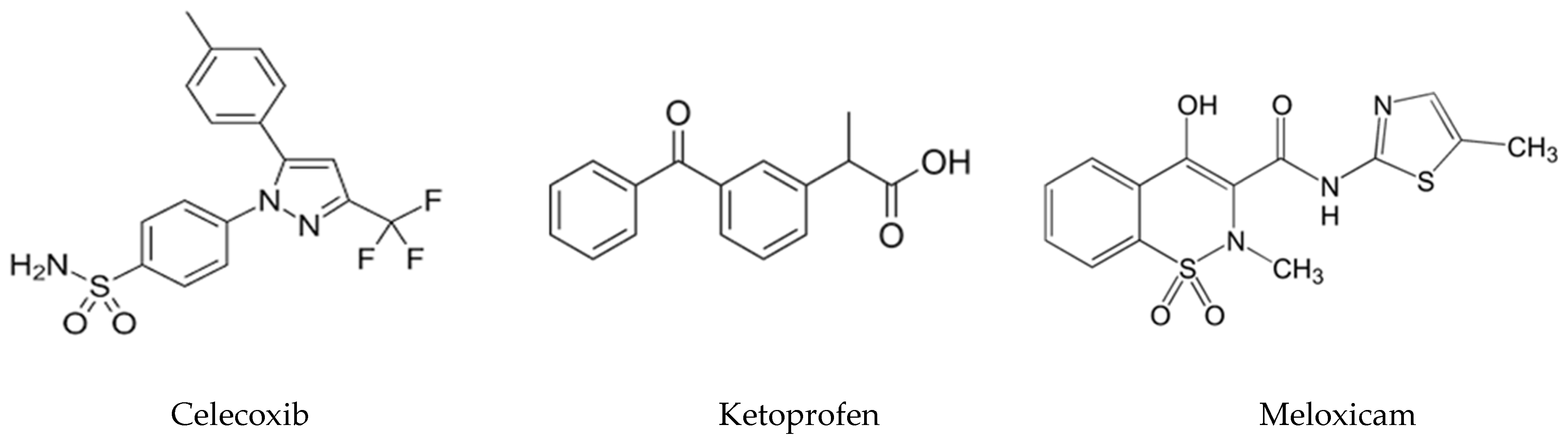
Non-steroidal anti-inflammatory drugs (NSAIDs) are among the most extensively consumed pharmaceutical compounds worldwide due to their analgesic and anti-inflammatory properties. Their widespread use, combined with incomplete removal during wastewater treatment, has resulted in their frequent detection in aquatic environments. In addition to municipal discharges, pharmaceutical manufacturing facilities represent a direct and potentially concentrated source of NSAID contamination in industrial effluents. Continuous release of these compounds raises environmental concerns and highlights the need for sensitive and reliable analytical methods capable of monitoring trace levels in complex wastewater matrices [1,2]. Celecoxib (CEL), meloxicam (MEL), and ketoprofen (KTP) represent therapeutically important NSAIDs with different cyclooxygenase selectivity profiles. While KTP is a classical non-selective NSAID, CEL and MEL exhibit preferential or selective COX-2 inhibition. The chemical structure of the studied drugs is given in Figure 1.
Due to their widespread consumption and incomplete removal during wastewater treatment processes, these pharmaceuticals are continuously discharged into aquatic environments through effluents originating from households, hospitals, and pharmaceutical manufacturing facilities [3].
Despite their therapeutic efficacy, NSAIDs are associated with toxicological risks, including gastrointestinal, renal, and cardiovascular adverse effects, particularly for COX-2 selective inhibitors [4,5,6]. In addition, their persistence and resistance to degradation contribute to environmental contamination and potential ecotoxicity [7]. Therefore, sensitive monitoring of these pharmaceuticals in wastewater effluents is essential.
The quantification of the investigated drugs in various sample forms was conducted utilising a range of analytical techniques, including liquid chromatography coupled with mass spectrometric detection (LC-MS/MS) [8,9], voltametric methods [10,11], UV-spectrophotometry [12], and thin-layer chromatography (TLC) [13]. A variety of techniques for assessing NSAIDs in aquatic environments have been established, including LC-MS/MS [14,15] and gas chromatography mass spectrometry (GC-MS/MS) [16]. Conversely, the capillary electrophoresis (CE) technique, when combined with various pre-concentration methods, has been utilized to analyze these compounds in water samples [17,18,19].
Capillary electrophoresis (CE) has emerged as a significant analytical tool for the analysis of NSAIDs in recent years, attributed to its high separation efficiency, rapid analysis, minimal sample and reagent consumption, and, consequently, reduced costs. The introduction of micellar electrokinetic capillary chromatography (MEKC) by Terabe et al. [20] has significantly expanded the application scope of CE. The MEKC technique has demonstrated efficacy in analysing NSAIDs across various sample types [21,22,23,24,25].
This work integrates high-volume off-line SPE (1000 mL) with MEKC, achieving significant preconcentration and enhanced sensitivity for complex pharmaceutical industrial wastewater. Unlike earlier CE/MEKC methods, which focus on on-column stacking and are typically used for surface or mineral waters, this approach enables ng/L-level detection with cost-effective instrumentation, reduced solvent use, and short analysis times. It offers a practical alternative to LC–MS/MS for routine industrial monitoring.
The exposure of the local environment to industrial effluents containing NSAIDs poses a significant threat to the well-being of all living organisms. This assertion indicates the importance of monitoring and quantifying the studied NSAIDs in pharmaceutical industrial effluent. This study aims to develop a reliable analytical method for the accurate, sensitive, and selective determination of pharmaceuticals in industrial wastewater.

2. Materials and Methods

2.1. Chemicals, Reagents and Standard Solutions

All chemicals utilized were of analytical grade, and the solvents employed were of HPLC quality. The chemicals listed below were supplied by Merck, Darmstadt, Germany. Acetonitrile (ACN), 1 M hydrochloric acid, methanol (MeOH), tris(hydroxymethyl)aminomethane (Tris), sodium hydroxide (NaOH), and sodium octanesulfonate (SOS). All work was conducted using ultrapure water sourced from the Milli-Q Plus system, Millipore Bedford, MA, USA.
The NSAIDs under examination were supplied by Bio Vision (Milpitas, CA, USA). We received a certificate indicating that the purity levels of CEL, KTP, and MEL were 99.75%, 100.15%, and 99.91%, respectively. The appropriate amount of each drug was dissolved in MeOH to prepare stock standard solutions (1000 μg/mL) of each NSAID, which were subsequently stored in the dark at 4 °C. Working standard solutions were freshly prepared by diluting the stock solutions with 50% ACN in water to achieve a concentration of 100 μg/mL. The target background electrolyte (BGE) consists of a 10 mM Tris buffer with 60 mM SOS and 20% (v/v) acetonitrile. It was adjusted to a pH of 11.0 using sodium hydroxide. The prepared BGE underwent degassing in an ultrasonic bath for a minimum of 15 min prior to utilization.

2.2. Instrumentation

The experiments were carried out by utilizing an Agilent CE system (Waldbronn, Germany) that was outfitted with a diode array and the multiple wavelength detectors G1315 C/D and G1365 C/D connected to a computer loaded with Agilent ChemStation Software (version B.04.03, Agilent Technologies, Waldbronn, Germany).
An uncoated fused silica capillary with a 50 µm inner diameter and a length of 70 cm was utilised for separation purposes. The effective length measured was 60 cm. Peak areas, migration times, peak heights, peak widths, resolution parameters, signal-to-noise ratios, and diode array spectral data were analysed using Agilent ChemStation software. The pH of the solutions was measured using a Mettler Toledo pH meter (Greifensee, Switzerland).

2.3. Real Samples Collection

Real wastewater samples free of the studied drugs, as well as other real wastewater samples suspected to contain these drugs, were collected from a pharmaceutical plant situated in the Al-Kharj district (Riyadh, Saudi Arabia). To prevent sample deterioration, the samples were stored in opaque glass vials at 4 °C until analysis to prevent analyte degradation.

2.4. Capillary Preconditioning

The preconditioning method for new capillaries consisted of a 15 min flush with a 0.1 M NaOH solution, followed by a 5 min flush with deionized water, and finally a 10 min flush using a BGE solution. A pre-injection flush lasting 3 min with a BGE solution was conducted prior to each injection.

2.5. Electrophoretic Conditions

To achieve optimal separation, a voltage of +25 kV was applied at room temperature for the separation of the studied drugs. The sample solution was injected hydrodynamically for a duration of 5 s at a pressure of 34.5 mbar (0.5 psi). The detection of the studied drugs using DAD was carried out at 214 nm.

2.6. Method Validation

ICH-Q2B criteria were utilized for the assay validation [26].

2.6.1. Linearity

Various aliquots of the investigated NSAIDs (5–200 µg) were transferred to a series of 10 mL volumetric flasks with accuracy and independence. To reach a concentration of 0.5–20 µg/mL for each medication under investigation, the volume of each flask was then adjusted with 50% ACN in water. The BGE served as the elution solution in the electrophoretic analysis of the samples.

2.6.2. Accuracy

The recovery percentage of an analyte from a defined quantity serves as a measure of accuracy. The results from nine samples containing 1, 5, and 15 µg/mL of each drug under investigation were analyzed using the procedure under linearity.

2.6.3. Precision

For multiple statistically significant experiments, precision is shown as the percentage relative standard deviation of the inter- and intra-day precision. Each drug was tested at three concentrations (1, 5, and 15 µg/mL) three times, either on the same day (intra-day) or over three consecutive days (inter-day).

2.6.4. LOD and LOQ

The limit of quantification (LOQ) is defined as the minimum quantity of a drug that can be effectively and reliably determined, while the limit of detection (LOD) refers to the minimum amount that can be identified above background noise. The LOQ and LOD are determined by identifying concentrations that yield peaks with heights ten and three times the baseline noise, respectively. The S/N ratio was measured by the CE software (D version) according to the analyte standard in solvent and matrix.

2.6.5. Robustness

Minor changes to the proposed technique can be utilized to assess its robustness. The modification of the acetonitrile concentration (±1%) in the BGE facilitated this achievement. A ±1 kV variation in the applied voltage was implemented.

2.7. Applications

For the SPE procedure, 200 mg, 6 mL Oasis HLB cartridges from Waters, Milford, MA, USA, were utilized. The SPE conditions were adjusted in this study with respect to sample pH, loading volume, and elution solvent to maximize analyte recovery and minimize matrix interferences prior to MEKC analysis. The cartridge was prepared by the gradual addition of five millilitres of MeOH. Subsequently, it was equilibrated with five milliliters of high purity water, which was adjusted to a pH of 2.0 through the careful addition of 1 M HCl dropwise.
Prior to spiking experiments, an unspiked wastewater sample (1000 mL) was subjected to the complete SPE–MEKC procedure to experimentally verify the absence of the target NSAIDs. No detectable peaks were observed at the characteristic migration times of KTP, MEL, or CEL. The electropherograms were further evaluated to ensure the absence of co-migrating interferences. Subsequently, one liter of the verified wastewater sample was adjusted to pH 2.0 using 1 M HCl. After that, it was spiked with 0.5 µg of each drug under investigation and loaded onto the cartridge at a flow rate of 5 mL/min. Subsequently, it was washed with 5 mL at pH 2.0 of 5% MeOH solution in water dropwise, followed by air drying for 5 min. The analytes were subsequently eluted using 2 × 5 mL of MeOH in a dropwise manner. The eluate was evaporated using a rotary evaporator at 40 °C until the solvent was completely removed. The reconstitution was performed using 100 μL of 50% ACN in water, followed by vortexing for 30 s to ensure complete dissolution.
The wastewater sample suspected of containing NSAIDs (unspiked) underwent the same pre-treatment procedures, excluding the spiking of the sample with the studied NSAIDs. It was subsequently analyzed using capillary electrophoresis under identical conditions. The calibration in the matrix was performed by spiking five blank wastewater samples, free of NSAIDs, with varying amounts of NSAIDs to achieve concentrations ranging from 50 to 2000 ng/L. The prepared samples undergo the previously described SPE procedure. The processed samples are injected following reconstitution, and a calibration curve was plotted using the initial, un-concentrated levels in relation to the final peak areas.
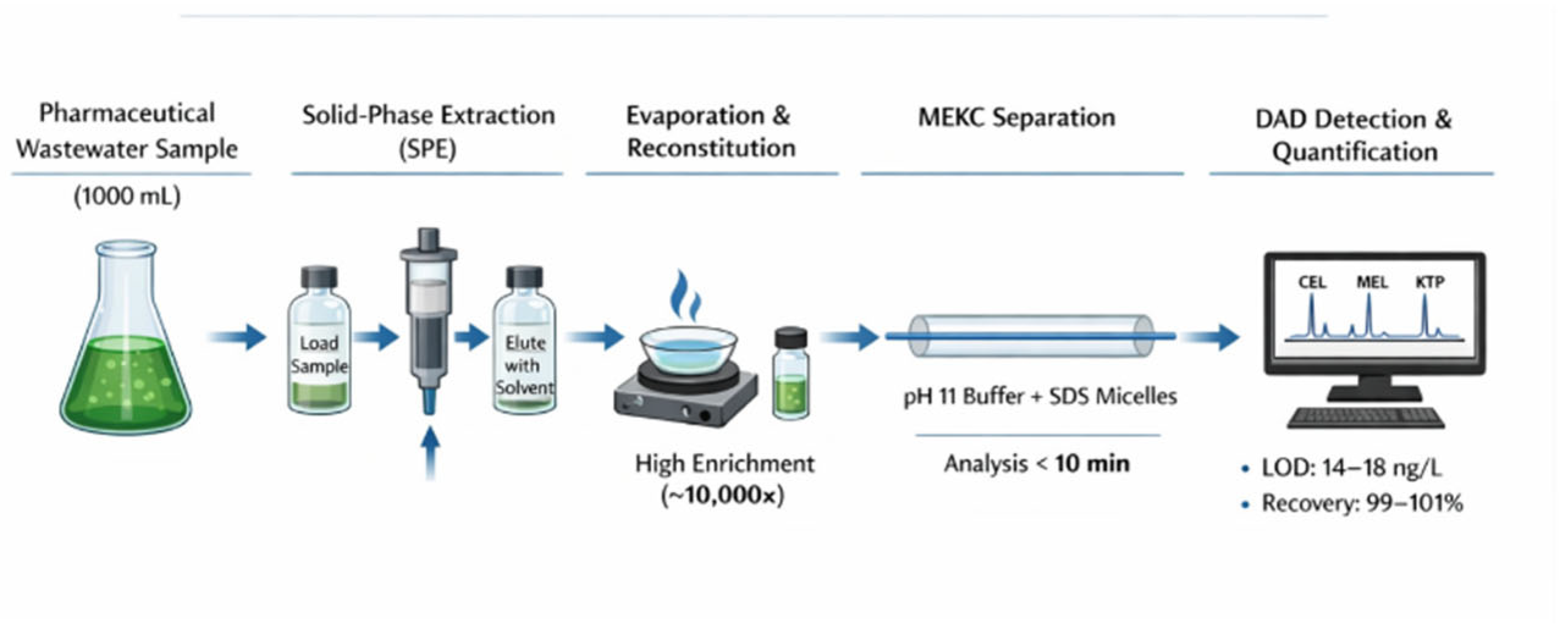
The overall analytical workflow employed in the present study is summarized in Scheme 1.

3. Results and Discussion

3.1. Optimizing the Method

The quality of separation in MEKC is significantly affected by various experimental parameters, such as the pH of the background electrolyte (BGE), surfactant concentration, organic modifier content, and applied voltage. These parameters together affect electro-osmotic flow (EOF), ionization of analytes, micelle production, and interactions between analytes and micelles. In the end, they control migration behavior, resolution, and peak efficiency.

3.1.1. BGE pH’s Impact

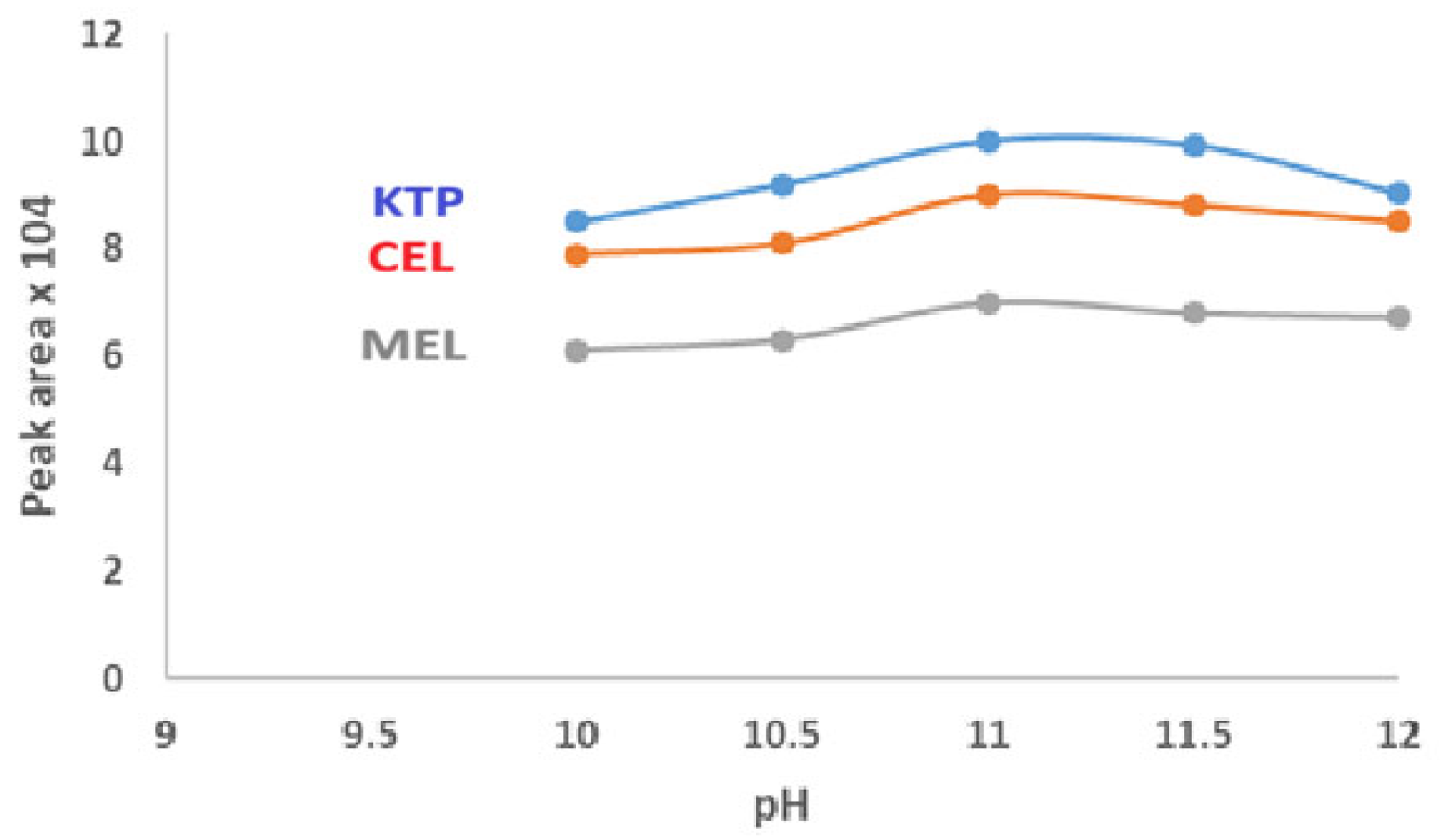
The pH of the background electrolyte is very important for capillary electrophoretic separations because it controls both the ionization state of the analytes and the magnitude of the EOF. In this study, the pH of BGE was varied over the range of pH 10.0 12.0 to study its effect on separation efficiency. The BGE was made up of 10 mM Tris buffer, 60 mM sodium octanesulfonate (SOS), and 20% (v/v) acetonitrile (ACN). The concentration of each analyte was kept at 5 µg/mL. Figure 2 shows that raising the pH level increase peak area and improve separation efficiency up to pH 11.0. There was no noticeable improvement in performance at higher pH levels (>11.0), and the peak shape got a little worse. Consequently, pH 11.0 was designated as the ideal BGE pH for ensuing analyses.
The influence of pH on separation can be rationalized based on the acid dissociation constants of the analytes. KTP (pKa ≈ 4.0) and MEL (pKa ≈ 4.1) are fully ionized at pH 11.0 and therefore migrate as anions. In contrast, CEL (pKa ≈ 11.1) remains largely neutral under these alkaline conditions. This difference in ionization state affects their effective electrophoretic mobility and interaction with the negatively charged SOS micelles, contributing to the observed resolution. Moreover, SOS micelles remain stable under strongly alkaline conditions, ensuring consistent micellar partitioning and reproducible MEKC separation.

3.1.2. Surfactant Concentration’s Effect

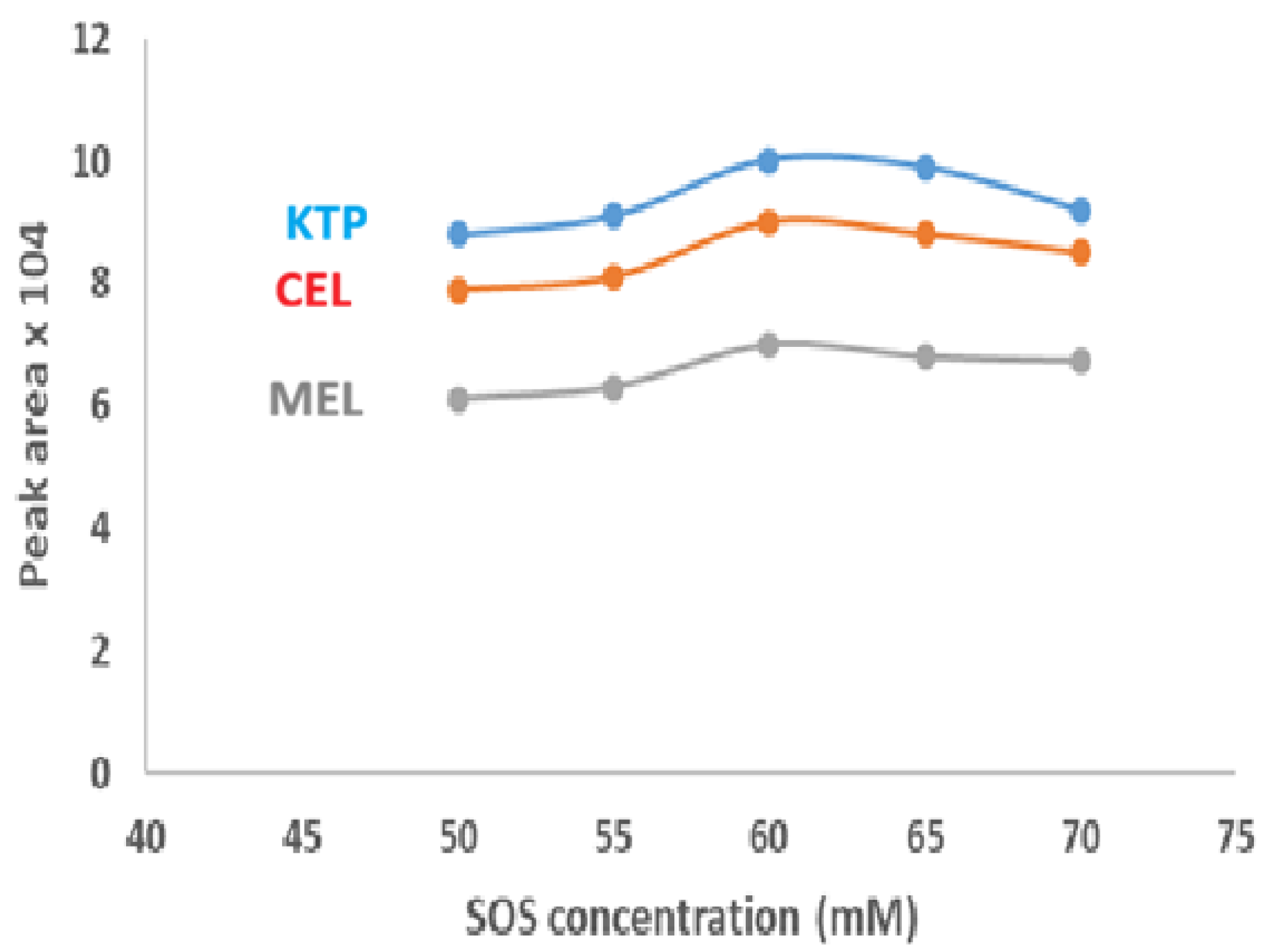
The concentration of surfactant is a vital parameter in MEKC, as it regulates micelle formation, dimensions, and quantity, thus affecting analyte distribution between the aqueous phase and the micellar pseudostationary phase. The concentration of SOS was checked to study its effect on separation performance. It was varied between 50 and 70 mM, keeping everything else the same. As illustrated in Figure 3, increasing SOS concentration resulted in a progressive enhancement of peak area up to 60 mM, suggesting improved analyte solubilization and partitioning into the micellar pseudostationary phase. Beyond this concentration, a decline in peak area was observed. This reduction may be attributed to increased buffer viscosity and stronger micelle–analyte interactions at higher surfactant concentrations, which can decrease effective electrophoretic mobility and broaden peaks. As a result, a surfactant concentration of 60 mM SOS was chosen as the best for the procedure being presented.
The critical micelle concentration (CMC) of SOS in pure aqueous solution at 25 °C is reported to be approximately 120–150 mM [27]. Nevertheless, the CMC of ionic surfactants is significantly influenced by solvent composition and ionic strength. The presence of 20% (v/v) acetonitrile and 10 mM Tris buffer reduces the effective CMC due to decreased solvent polarity and enhanced hydrophobic interactions. Therefore, the selected concentration of 60 mM SOS was sufficient to promote stable micelle formation under the applied mixed-solvent alkaline conditions, ensuring effective micellar electrokinetic separation.

3.1.3. Influence of Organic Modifier and Applied Voltage

In MEKC, adding an organic modifier like acetonitrile has a big effect on both the characteristics of the micelles and the way in which the analyte is distributed. ACN affects the stability, viscosity, and solubility of micelles, which in turn affects the shape of the peaks and the effectiveness of the separation. ACN concentrations between 15% and 25% (v/v) was checked, and the best peak symmetry and efficiency were found at 20% (v/v) ACN. The voltage that is delivered is also very important for electrophoretic separations. Increasing the voltage usually speeds up migration times, but too much voltage might cause Joule heating, which makes peaks wider and lowers resolution. The voltage levels between 20 and 30 kV was checked. A voltage of 25 kV was the best balance between analysis time, resolution, and peak efficiency.

3.2. Separation of the Analyzed NSAIDs

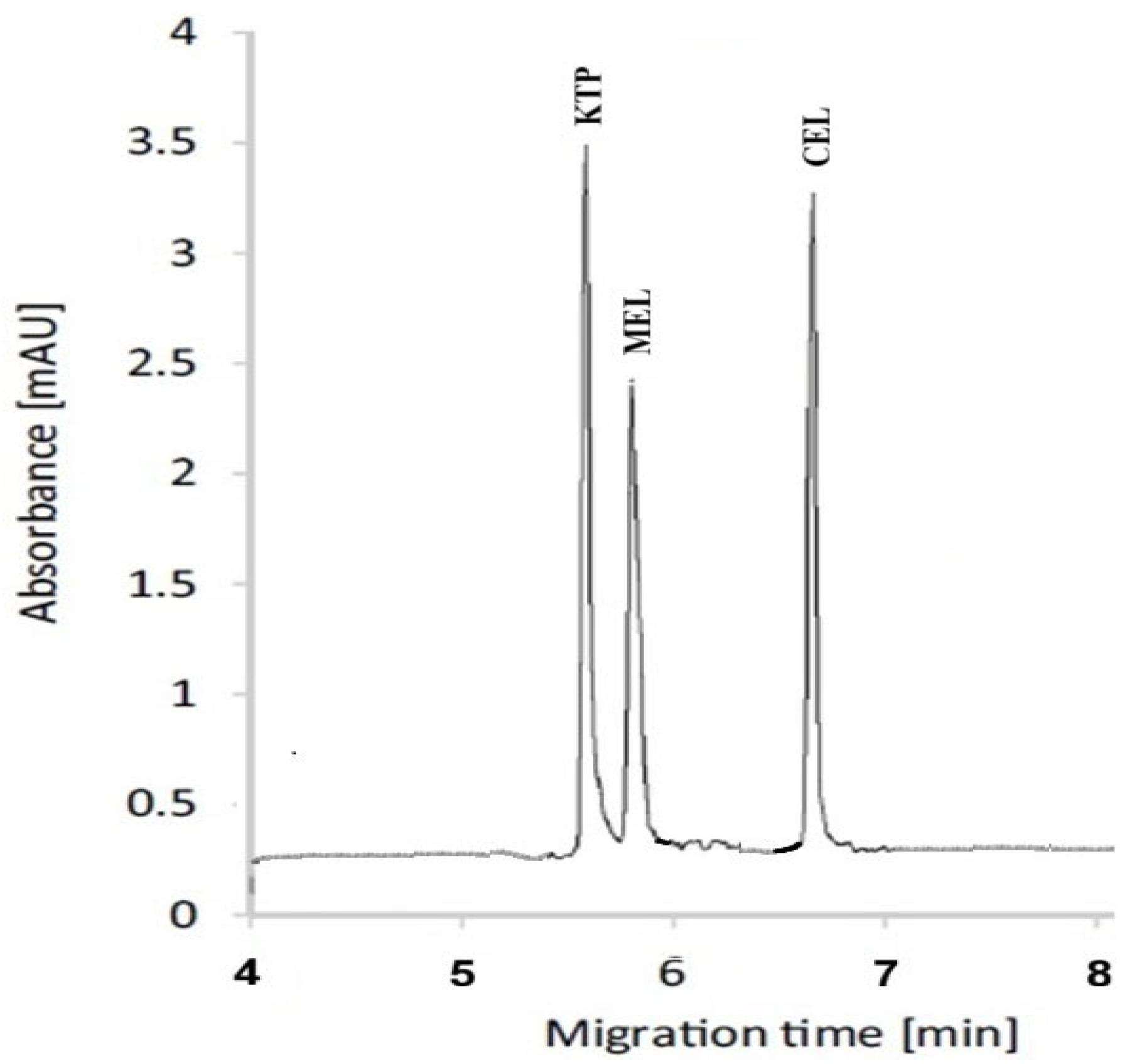
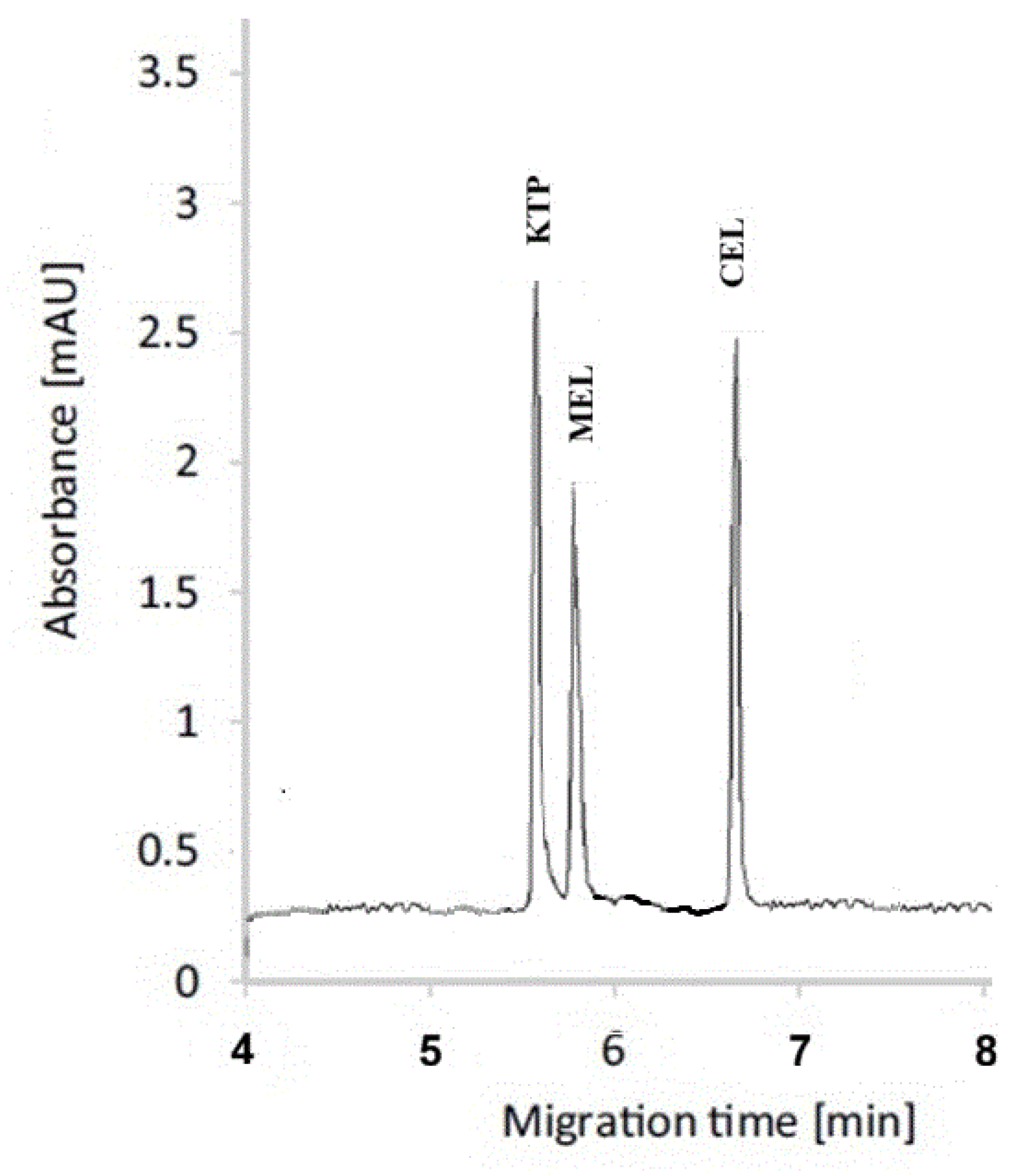
After optimizing all experimental parameters, a standard mixture of CEL, KTP, and MEL, each at a concentration of 5 µg/mL, was evaluated under the chosen MEKC conditions. Figure 4 shows the ensuing electropherogram, which shows that the three analytes are separated at the baseline and have clear, symmetrical peaks.
The resolution of the separated peaks is determined in relation to the adjacent peak, as outlined in Equation (1):
R A , B   =   \ f r a c { 2 ( t B     t A ) } { W A   +   W B }
In this context, RA,B represents the resolution of adjacent pair peaks, while tA and tB denote the migration times of these peaks. Additionally, WA and WB refer to the widths of the respective peaks. The resolution factor values indicate acceptable resolution (Table 1).

3.3. Method Validation

The ICH Q2(B) guidelines [26] were used to check the method performance. For all of the medications examined, there was a linear relationship between the peak area and the analyte concentration in the range of 0.5–20 µg/mL. This is how the regression equations were found:
PA (KTP) = 1.0038 C + 0.175 r = 0.9996
PA (CEL) = 0.8879 C + 0.195 r = 0.9999
PA (MEL) = 0.7622 C 0.16 r = 0.9996
where PA is the peak area before multiplication by 104, C is the concentration (µg/mL) and r is the correlation coefficient. As shown in Table 1, the approach showed great repeatability, accuracy, and moderate precision, with relative standard deviation values that were within acceptable ranges. Robustness testing, which involved small changes in applied voltage and ACN content, showed that these adjustments did not have significant impacts on how well the analysis worked. No noticeable changes in migration times or peak shapes were observed throughout repeated analytical runs, indicating stable capillary performance under the selected alkaline conditions (pH 11.0).
The LOD and LOQ results showed that the approach is sensitive enough to be used to analyze NSAIDs in the environment.

3.4. Method Application

3.4.1. Quantification of NSAIDs in Wastewater Samples

Because wastewater matrices are so complicated and MEKC is so sensitive to matrix interferences, it is very important to choose a sample pre-treatment method carefully. Solid-phase extraction (SPE) was chosen because it cleans up better, uses less solvent, and can enrich samples more than liquid–liquid extraction and protein precipitation methods. The theoretical volumetric enrichment factor (~10,000) was calculated based on the ratio between the initial wastewater sample volume (1000 mL) and the final reconstitution volume (100 µL) after SPE and solvent evaporation. The obtained enrichment factor made it possible to accurately measure CEL, KTP, and MEL at very low levels (in the µg/L and ng/L ranges), which is very important for environmental monitoring. Oasis HLB cartridges were used because they had a good blend of hydrophilic and lipophilic characteristics, which made them better at recovering than other examined sorbents. Optimizing the SPE parameters, such as the sample’s pH, loading flow rate, washing composition, and elution solvent, led to the effective removal of matrix interferences including salts and humic compounds, while keeping the analytes of interest. Given the broad retention characteristics of Oasis HLB sorbent, the proposed extraction protocol is expected to be adaptable to other environmental water matrices with higher organic content following matrix-specific validation. Table 2 shows the analytical results from spiked wastewater sample.
It is important to distinguish between overall method accuracy and SPE recovery efficiency. The accuracy results presented in Table 1 were obtained using standard solutions prepared in solvent and reflect the intrinsic performance of the MEKC separation and quantification system, in accordance with ICH Q2(B) guidelines. In contrast, the recovery values in Table 2 were derived from spiked wastewater samples processed through the complete SPE–evaporation–reconstitution procedure, thereby reflecting the extraction efficiency of the sample preparation step. The recoveries (approximately 99–101%) indicate efficient analyte retention and minimal loss during sample processing. Real wastewater samples were analysed by the proposed method, and the results are showed in Table 3 and Figure 5.
The electropherogram of the real wastewater samples exhibited a stable baseline with minimal background interference. The target NSAIDs were well resolved with symmetrical and sharp peaks under the optimised MEKC conditions. No significant matrix co-migration was observed, confirming the selectivity of the proposed SPE–MEKC method in complex industrial wastewater matrices.
The selectivity of the method was further supported by the absence of interfering peaks at the migration times of the investigated NSAIDs in matrix blank samples processed under identical SPE–MEKC conditions. In addition, peak identification in wastewater samples was established by comparing the migration times of the detected peaks with those obtained from reference standard solutions analyzed under the same electrophoretic conditions. The well-resolved peaks and consistent migration times indicate that the developed SPE–MEKC method provides adequate selectivity for the determination of ketoprofen, meloxicam, and celecoxib in the investigated pharmaceutical wastewater samples.

3.4.2. Statistical Comparison with a Reference Method

A statistical comparison was made between the suggested SPE-MEKC method and reference LC-MS/MS methods to see how reliable it was. As shown in Table 4, the computed Student’s t and F values were lower than the equivalent tabular values at the 95% confidence level. This means that there was no statistically significant difference in accuracy or precision between the two procedures.
To further contextualise the analytical performance and practical applicability of the proposed SPE–MEKC method, a comparative evaluation with representative LC–MS/MS and CE-based approaches reported in the literature is presented in Table 5.
The comparative evaluation demonstrates several practical advantages of the proposed SPE–MEKC method. Compared with LC–MS/MS approaches, the present method requires substantially lower organic solvent consumption, involves simpler and more accessible instrumentation, and reduces operational cost, while still achieving ng/L-level detection limits through high-volume preconcentration. Unlike previously reported CE/MEKC methods that primarily rely on on-column stacking and are mainly applied to surface or mineral waters, the present work integrates high-volume off-line SPE (1000 mL) with MEKC to achieve substantial preconcentration and improved sensitivity in complex pharmaceutical industrial wastewater. The method combines cost-effective instrumentation, reduced solvent consumption, and short analysis time with ng/L-level detection capability, thereby providing a practical alternative to LC–MS/MS for routine industrial monitoring.
Certain limitations should also be considered. The reliance on an off-line extraction step increases total sample preparation time relative to direct injection or purely on-column stacking methods. In addition, operation under alkaline conditions (pH 11.0) necessitates appropriate capillary conditioning to maintain long-term reproducibility. Despite these considerations, the developed methodology offers a balanced combination of sensitivity, cost-effectiveness, environmental sustainability, and practical applicability for routine monitoring of pharmaceutical effluents.

4. Conclusions

A sensitive, selective, and cost-effective SPE–MEKC method was successfully developed and validated for the simultaneous determination of ketoprofen, meloxicam, and celecoxib in pharmaceutical industrial wastewater. The integration of high-volume solid-phase extraction (1000 mL) with micellar electrokinetic chromatography provided a theoretical enrichment factor of approximately 10,000, enabling ng/L-level detection limits (14–18 ng/L) with short analysis time (<10 min) and low solvent consumption. The method demonstrated excellent linearity (0.5–20 µg/mL, r2 > 0.999), high precision (RSD < 1.2%), satisfactory robustness, and near-quantitative recovery (99–101%) in spiked wastewater samples.
Application to real effluent samples confirmed its reliability for routine trace-level environmental monitoring in complex industrial matrices. Compared with LC–MS/MS techniques, the proposed approach offers reduced operational cost, simpler instrumentation, and improved sustainability, making it particularly suitable for routine screening laboratories. Future studies may extend this strategy to additional emerging pharmaceutical contaminants to further support environmental risk assessment efforts.

Author Contributions

Conceptualization, S.A.A.-G. and A.B.A.; Data Curation, S.A.A.-G. and A.B.A.; Formal Analysis, S.A.A.-G.; Investigation, S.A.A.-G. and A.B.A.; Methodology, S.A.A.-G.; Resources, S.A.A.-G. and A.B.A.; Software, S.A.A.-G. and A.B.A.; Supervision, S.A.A.-G.; Validation, S.A.A.-G.; Visualization, S.A.A.-G.; Writing—Original draft, S.A.A.-G.; Writing—Review and Editing, S.A.A.-G. and A.B.A. All authors have read and agreed to the published version of the manuscript.

Funding

The authors extend their appreciation to Prince Sattam bin Abdulaziz University for funding this research work through the project number (PSAU/2025/03/34679).

Institutional Review Board Statement

Not applicable.

Informed Consent Statement

Not applicable.

Data Availability Statement

The datasets used and/or analyzed during the current study are available from the corresponding author on reasonable request.

Conflicts of Interest

The authors declare that they have no competing interests that could have impacted the research reported in this manuscript.

References

  1. Simmons, D.L.; Botting, R.M.; Hla, T. Cyclooxygenase isozymes: The biology of prostaglandin synthesis and inhibition. Pharmacol. Rev. 2004, 56, 387–437. [Google Scholar] [CrossRef]
  2. Rainsford, K.D. Anti-inflammatory drugs in the 21st century. In Inflammation in the Pathogenesis of Chronic Diseases; Subcellular Biochemistry; Springer: Dordrecht, The Netherlands, 2013; Volume 42, pp. 3–27. [Google Scholar]
  3. National Center for Biotechnology Information (NCBI). PubChem Compound Summary for Ketoprofen (CID 3825), Meloxicam (CID 54677470), and Celecoxib (CID 2662); National Library of Medicine (US): Bethesda, MD, USA, 2025. Available online: https://pubchem.ncbi.nlm.nih.gov (accessed on 14 December 2025).
  4. Harirforoosh, S.; Asghar, W.; Jamali, F. Adverse effects of nonsteroidal antiinflammatory drugs: An update of gastrointestinal, cardiovascular and renal complications. J. Pharm. Pharm. Sci. 2014, 16, 821–847. [Google Scholar] [CrossRef]
  5. McGettigan, P.; Platona, A.; Henry, D.A. Renal and cardiovascular toxicity of non-steroidal anti-inflammatory drugs. Inflammopharmacology 2000, 8, 1–18. [Google Scholar] [CrossRef]
  6. Solomon, D.H.; Husni, M.E.; Libby, P.A.; Yeomans, N.D.; Lincoff, A.M.; Lϋscher, T.F.; Menon, V.; Brennan, D.M.; Wisniewski, L.M.; Nissen, S.E.; et al. The risk of major NSAID toxicity with celecoxib, ibuprofen, or naproxen: A secondary analysis of the precision trial. Am. J. Med. 2017, 130, 1415–1422.e4. [Google Scholar] [CrossRef]
  7. Lin, J.-Y.; Zhang, Y.; Bian, Y.; Zhang, Y.-X.; Du, R.-Z.; Li, M.; Tan, Y.; Feng, X.-S. Non-steroidal anti-inflammatory drugs (NSAIDs) in the environment: Recent updates on the occurrence, fate, hazards and removal technologies. Sci. Total Environ. 2023, 904, 166897. [Google Scholar] [CrossRef]
  8. Pietruk, M.; Jedziniak, P.; Olejnik, M. LC-MS/MS determination of 21 non-steroidal anti-inflammatory drugs residues in animal milk and muscles. Molecules 2021, 26, 5892. [Google Scholar] [CrossRef] [PubMed]
  9. Jedziniak, P.; Szprengier-Juszkiewicz, T.; Pietruk, K.; Śledzińska, E.; Żmudzki, J. Determination of non-steroidal anti-inflammatory drugs and their metabolites in milk by liquid chromatography–tandem mass spectrometry. Anal. Bioanal. Chem. 2012, 403, 2955–2963. [Google Scholar] [CrossRef]
  10. Cebula, Z.; Niedziałkowski, P.; Ossowski, T. Electrochemical behavior and determination of ketoprofen at glassy-carbon electrode. Appl. Biosci. 2018, 1, 7–8. [Google Scholar]
  11. Arkan, E.; Karimi, Z.; Shamsipur, M.; Saber, R. Electrochemical determination of celecoxib on a graphene based carbon ionic liquid electrode modified with gold nanoparticles and its application to pharmaceutical analysis. Anal. Sci. 2013, 29, 855–860. [Google Scholar] [CrossRef]
  12. Kormosh, Z.; Hunka, I.; Basel, Y. Spectrophotometric determination of ketoprofen and its application in pharmaceutical analysis. Acta Pol. Pharm. 2009, 66, 3–9. [Google Scholar]
  13. Gumułka, P.; Dąbrowska, M.; Starek, M. TLC-densitometric determination of five coxibs in pharmaceutical preparations. Processes 2020, 8, 620. [Google Scholar] [CrossRef]
  14. Zhao, L.; Liang, N.; Lun, X.; Chen, X.; Hou, X. LC-QTOF-MS method for the analysis of residual pharmaceuticals in wastewater: Application to a comparative multiresidue trace analysis between spring and winter water. Anal. Methods 2014, 6, 6956–6962. [Google Scholar] [CrossRef]
  15. Triñanes, S.; Casais, M.C.; Mejuto, M.C.; Cela, R. Selective determination of COXIBs in environmental water samples by mixed-mode solid phase extraction and liquid chromatography quadrupole time-of-flight mass spectrometry. J. Chromatogr. A 2015, 1420, 35–45. [Google Scholar] [CrossRef]
  16. Shin, H.; Oh, J. Simultaneous determination of non-steroidal anti-inflammatory drugs in river water by gas chromatography-mass spectrometry. J. Sep. Sci. 2012, 35, 541–547. [Google Scholar] [CrossRef]
  17. Botello, I.; Borrull, F.; Aguilar, C.; Calull, M. Electrokinetic Supercharging Focusing in Capillary Zone Electrophoresis of Weakly Ionizable Analytes in Environmental and Biological Samples. Electrophoresis 2010, 31, 2964–2973. [Google Scholar] [CrossRef] [PubMed]
  18. Macià, A.; Borrull, F.; Calull, M.; Aguilar, C. Analysis of Nonsteroidal Anti-Inflammatory Drugs in Water Samples Using Microemulsion Electrokinetic Capillary Chromatography Under Ph-Suppressed Electroosmotic Flow with an On-Column Preconcentration Technique. Chromatographia 2006, 63, 149–154. [Google Scholar] [CrossRef]
  19. Hsu, C.H.; Cheng, Y.J.; Singco, B.; Huang, H.Y. Analyses of Non-Steroidal Anti-Inflammatory Drugs by On-Line Concentration Capillary Electrochromatography Using Poly(stearyl Methacrylate-Divinylbenzene) Monolithic Columns. J. Chromatogr. A 2011, 1218, 350–358. [Google Scholar] [CrossRef]
  20. Terabe, S.; Otsuka, K.; Ichikawa, K.; Tsuchiya, A.; Ando, T. Electrokinetic Separation with Micellar Solutions and Open-Tubular Capillaries. Anal. Chem. 1984, 56, 111–113. [Google Scholar] [CrossRef]
  21. Maijó, I.; Borrull, F.; Aguilar, C.; Calull, M. On-Column Preconcentration of Anti-Inflammatory Drugs in River Water by Anion-Selective-Exhaustive Injection-Sweeping-MEKC. Chromatographia 2011, 73, 83–91. [Google Scholar] [CrossRef]
  22. Macià, A.; Borrull, F.; Calull, M.; Aguilar, C. Different Sample Stacking Strategies to Analyze Some Nonsteroidal Anti-Inflammatory Drugs by Micellar Electrokinetic Capillary Chromatography in Mineral Waters. J. Chromatogr. A 2006, 1117, 234–254. [Google Scholar] [CrossRef]
  23. Mardones, C.; Ríos, A.; Valcárcel, M. Determination of Nonsteroidal Anti-Inflammatory Drugs in Biological Fluids by Automatic by On-Line Integration of Solid-Phase Extraction and Capillary Electrophoresis. Electrophoresis 2001, 22, 484–490. [Google Scholar] [CrossRef] [PubMed]
  24. Alatawi, H.; Hogan, A.; Albalawi, I.; Alsefri, S.; Moore, E. Efficient determination of non-steroidal anti-inflammatory drugs by micellar electrokinetic chromatography in wastewater. Anal. Methods 2023, 15, 1402–1409. [Google Scholar] [CrossRef] [PubMed]
  25. Varga, I.; Bilandžić, N.; Morović, S.; Košutić, K. Pharmaceuticals in Food and Water: Monitoring, Analytical Methods of Detection and Quantification, and Removal Strategies. Separations 2026, 13, 21. [Google Scholar] [CrossRef]
  26. International Conference on Harmonisation of Technical Requirements for Registration of Pharmaceuticals for Human Use. Validation of Analytical Procedures: Text and Methodology Q2 (B); ICH Harmonized Tripartite Guideline; ICH: Geneva, Switzerland, 2005.
  27. Alasiri, H. Determining Critical Micelle Concentrations of Surfactants Based on Viscosity Calculations from Coarse-Grained Molecular Dynamics Simulations. Energy Fuels 2019, 33, 2408–2412. [Google Scholar] [CrossRef]
Figure 1. Chemical structures of the selected NSAIDs.
Chemosensors 14 00069 g001
Scheme 1. SPE-MEKC workflow for NSAID determination in pharmaceutical wastewater.
Chemosensors 14 00069 sch001
Figure 2. pH’s impact on capillary electrophoretic efficiency.
Chemosensors 14 00069 g002
Figure 3. Impact of SOS concentration on capillary electrophoretic performance.
Chemosensors 14 00069 g003
Figure 4. Capillary electrophoretic separation patterns of the studied NSAIDs.
Chemosensors 14 00069 g004
Figure 5. An electrophoregram describing the separation of the studied drugs in real wastewater samples.
Chemosensors 14 00069 g005
Table 1. Validation results of the proposed capillary electrophoretic method.
ParameterKTPMELCEL
Accuracy (Mean * ± SD)99.79 ± 0.3199.75 ± 0.65100.20 ± 0.81
Resolution factor (Rs) -RKTP/MEL = 3.20RMEL/CEL = 9.70
Precision:
Repeatability * (RSD%)
Intermediate precision * (RSD%)
0.64
0.99
0.73
1.11
0.73
1.09
Robustness:
Elution liquid composition
Applied voltage
100.23 ± 0.29
99.22 ± 0.79
99.28 ± 0.38
99.27 ± 0.85
100.47 ± 1.03
98.91 ± 1.14
Linearity range (µg/mL)
Slope
Intercept
Correlation coefficient (r)
0.5–20
1.0038
0.175
0.9996
0.5–20
0.7622
−0.11
0.9996
0.5–20
0.8879
0.195
0.9998
LOD in solvent (µg/mL)
LOD in matrix (µg/mL)
LOQ in solvent (µg/mL)
LOQ in matrix (µg/mL)
0.13
0.14 × 10⁻⁴ (14.00 ng/L)
0.42
0.45 × 10⁻⁴ (45.00 ng/L)
0.15
0.18 × 10⁻⁴ (18.00 ng/L)
0.50
0.60 × 10⁻⁴ (50.00 ng/L)
0.14
0.15 × 10⁻⁴ (15.00 ng/L)
0.48
0.50 × 10⁻⁴ (50.00 ng/L)
* Average of three readings.
Table 2. Determination of studied NSAIDs in spiked wastewater.
SampleAdded Before Extraction (ng/L)Found KTP (ng/L)Found MEL (ng/L)Found CEL (ng/L)KTP
Recovery% ± S.D.
MEL
Recovery% ± S.D.
CEL
Recovery% ± S.D.
Sample 1100.0101.0
100.0
103.0
102.0
100.0
100.0
100.0
103.0
102.0
101.33 ± 1.25100.67 ± 0.94101.78 ± 1.25
Sample 2200.0198.0
201.0
203.0
202.0
200.0
203.0
201.0
199.0
198.0
100.33 ± 1.03100.83 ± 0.6299.66 ± 0.62
Sample 3300.0301.0
302.0
297.0
299.0
297.0
300.0
302.0
299.0
303.0
99.99 ± 0.7299.56 ± 0.42100.44 ± 0.56
Table 3. Determination of studied NSAIDs in real wastewater samples (unspiked).
SampleFound KTP * (ng/L)Found MEL * (ng/L)Found CEL * (ng/L)
Real wastewater sample 1400300600
Real wastewater sample 2520910400
Real wastewater sample 3700560480
* Average of three readings.
Table 4. Statistical comparison between the determination of standard solutions of NSAIDs by the proposed method and the reference-reported methods.
ItemKTPMELReference Method [14] *CELReference Method [15]
Mean ± SD99.79 ± 0.3199.75 ± 0.6599.97 ± 0.53100.20 ± 0.8199.81± 0.59
RSD0.310.650.530.810.59
Variance0.100.430.280.650.35
n55555
F-value (6.39)2.991.52-1.90-
Student’s t-test (2.31)0.660.58-0.92-
* The reference form of liquid chromatography coupled to quadrupole time-of-flight mass spectrometry (LC-QTOF MS) was performed on using the C18 reversed-phase column (4.6 mm × 200 mm, 5 μm) as the stationary phase. The mobile phase was acetonitrile (A) and 20 mM ammonium acetate in water (adjusted to pH 3.5 by the addition of acetic acid) (B) in ratio 85:15, v/v at isocratic elution conditions with flow rate of 1.0. mL/min. The reference LC-QTOF MS was performed on using C18 (2.1 × 100 mm, 1.7 µm) as stationary phase and Water + 0.1% formic acid (A) and acetonitrile + 0.1% formic acid (B) as mobile phase with flow rate 0.5 mL/min.
Table 5. Comparison of the proposed SPE–MEKC method with representative LC–MS/MS and CE-based methods for NSAID determination in water samples.
MethodMatrixLOD (ng/L)Analysis Time (min)Sample Volume (mL)Organic Solvent Consumption per RunInstrumental Cost
LC-QTOF-MS (Ref. [14])Wastewater1–1015–20100–500High (mL-scale mobile phase)Very high
LC-QTOF-MS (Ref. [15])Environmental water0.5–510–15200–500High (mL-scale mobile phase)Very high
MEKC + on-column preconcentration (Ref. [21])River water50–20012–18≤50Very low (µL-scale BGE)Moderate
MEKC + stacking strategies (Ref. [22])Mineral water20–10010–15≤50Very low (µL-scale BGE)Moderate
Proposed SPE–MEKC (This work)Pharmaceutical wastewater14–18<101000Low (limited SPE elution + µL-scale BGE)Moderate
Disclaimer/Publisher’s Note: The statements, opinions and data contained in all publications are solely those of the individual author(s) and contributor(s) and not of MDPI and/or the editor(s). MDPI and/or the editor(s) disclaim responsibility for any injury to people or property resulting from any ideas, methods, instructions or products referred to in the content.