Coordinator Leadership in the Relationship Between Burnout and Nurses’ Intention to Leave: A Cross-Sectional Study

 , , , , , and
Highlights
- Interpersonal conflicts, workload, and organizational constraints are key work-related factors linked to burnout among nurses.
- Burnout is related to nurses’ intention to leave the profession, with ethical leadership of nurse coordinators emerging as a partial mediator in this relationship.
- Ethical leadership by nurse coordinators may represent an organizational resource linked to a weaker relationship between burnout and nurses’ intention to leave.
- Interventions targeting work environment conditions and leadership development may be linked to improvements in nurses’ well-being and workforce retention.
Abstract
1. Introduction
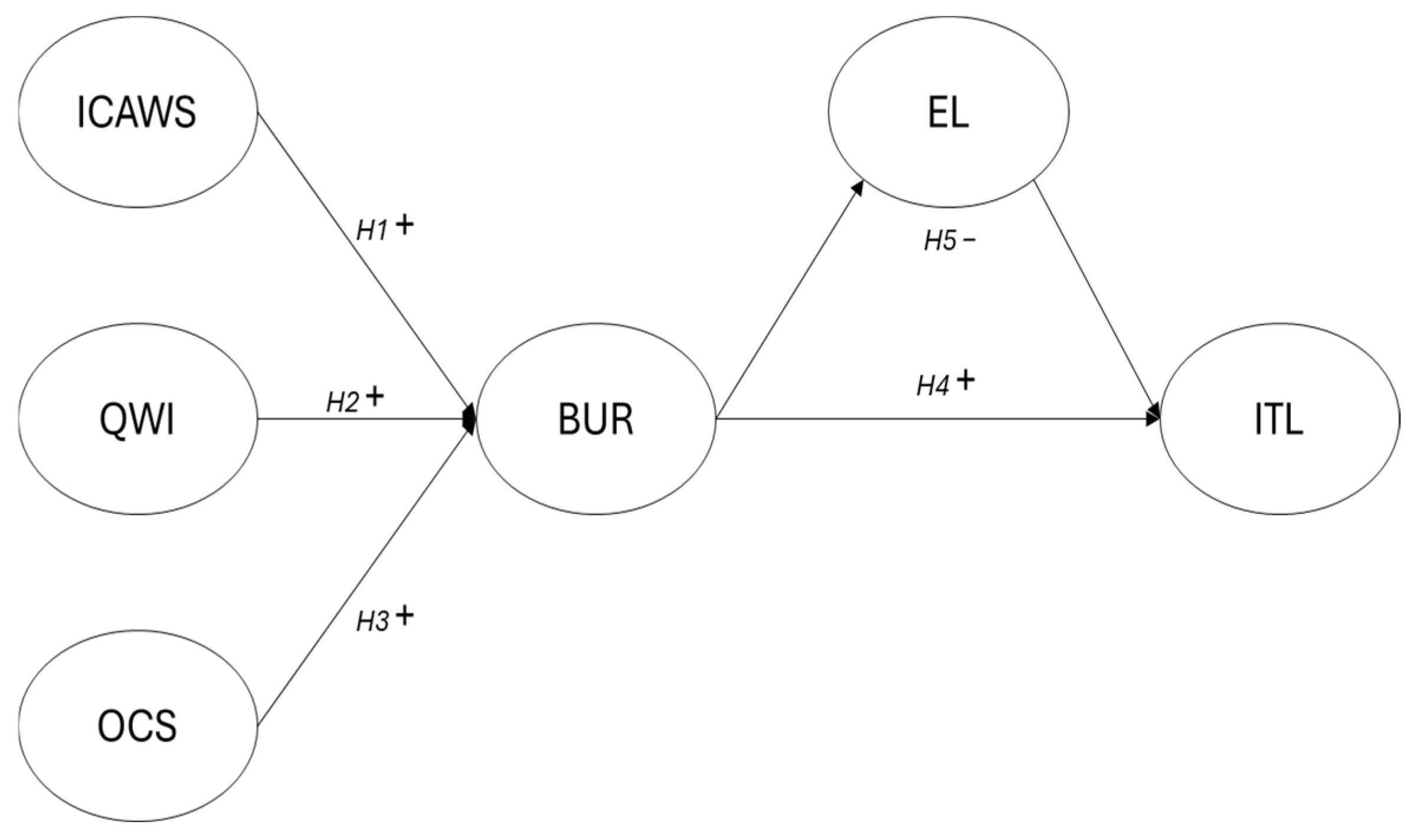
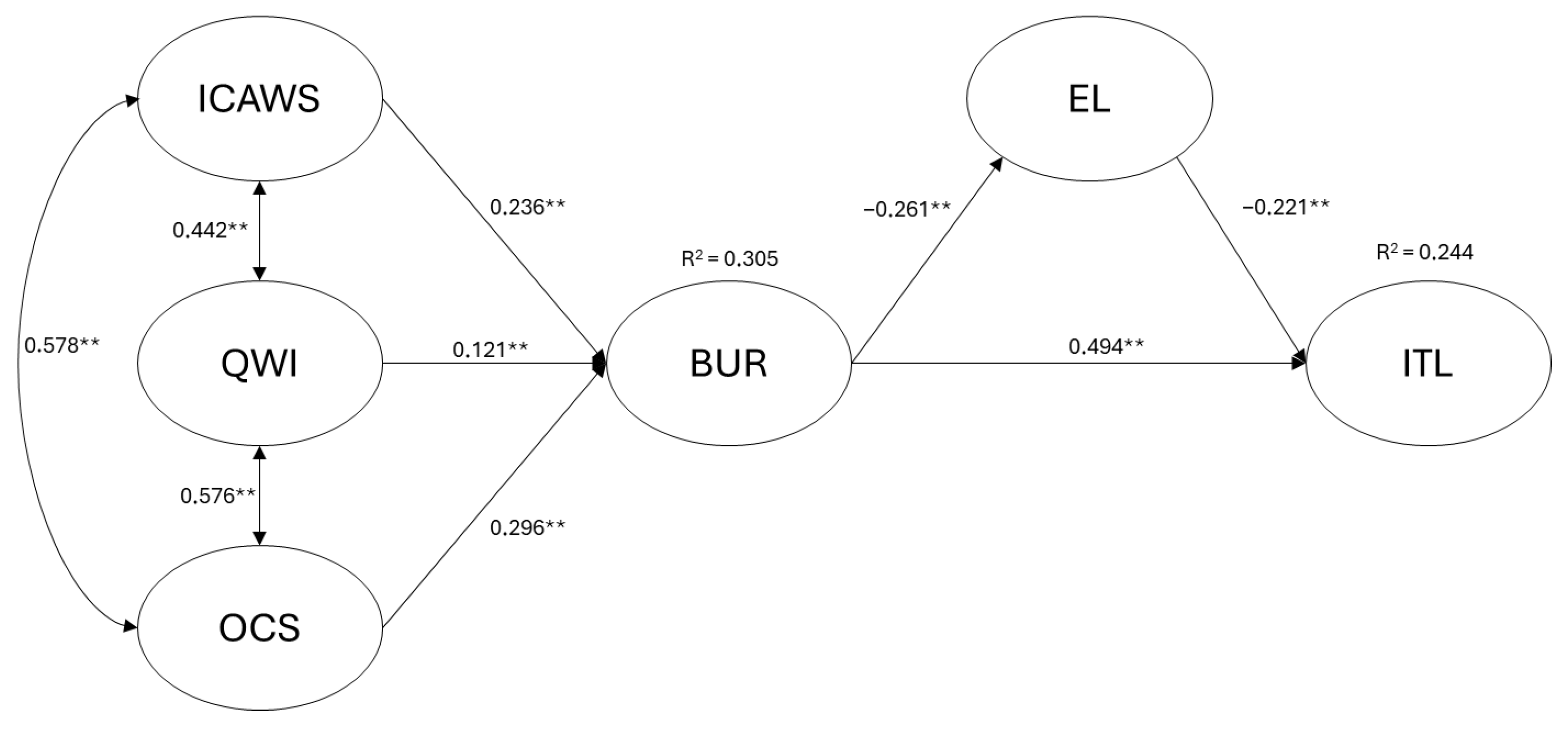
- H1, H2, H3: Nurses’ burnout levels are explained by interpersonal conflicts (ICAWS), workload (QWI), and organizational constraints (OCS);
- H4: Nurses’ burnout explains the variability in their intention to leave work (ITL);
- H5: Ethical leadership style (EL) mediates the relationship between burnout and nurses’ intention to leave work (ITL).
2. Materials and Methods
2.1. Participants and Procedure
2.2. Instruments
2.3. Statistical Analysis
2.4. Ethical Considerations
3. Results
3.1. Correlations Among Study Variables
3.2. Structural Equation Model Results
4. Discussion
Limitations
5. Conclusions
Author Contributions
Funding
Institutional Review Board Statement
Informed Consent Statement
Data Availability Statement
Conflicts of Interest
Abbreviations
| BUR | Burnout |
| CFI | Comparative Fit Index |
| EL | Ethical Leadership |
| ELS | Ethical Leadership Scale |
| ICAWS | Interpersonal Conflict at Work Scale |
| ISW | Interpersonal Strain at Work |
| ITL | Intention to Leave |
| MBI-GS | Maslach Burnout Inventory–General Survey |
| OCS | Organizational Constraints Scale |
| QWI | Quantitative Workload Inventory |
| RMSEA | Root Mean Square Error of Approximation |
| SD | Standard Deviation |
| SEM | Structural Equation Modeling |
| SRMR | Standardized Root Mean Square Residual |
| TLI | Tucker–Lewis Index |
References
- World Health Organization. State of the World’s Nursing 2020: Investing in Education, Jobs and Leadership, 1st ed.; World Health Organization: Geneva, Switzerland, 2020. [Google Scholar]
- Notarnicola, I.; Duka, B.; Grosha, E.; Gioiello, G.; Zega, M.; Caruso, R.; Carrodano, S.; Rocco, G.; Stievano, A. Regional Inequities in the Distribution of the Nursing Workforce in Italy. Nurs. Rep. 2025, 15, 235. [Google Scholar] [CrossRef]
- Chang, H.E.; Cho, S. Turnover intention and retention of newly licensed nurses in their first job: A longitudinal study. Int. Nurs. Rev. 2023, 70, 338–344. [Google Scholar] [CrossRef]
- De Oliveira, D.R.; Griep, R.H.; Portela, L.F.; Rotenberg, L. Intention to leave profession, psychosocial environment and self-rated health among registered nurses from large hospitals in Brazil: A cross-sectional study. BMC Health Serv. Res. 2017, 17, 21. [Google Scholar] [CrossRef]
- Enea, M.; Maniscalco, L.; De Vries, N.; Boone, A.; Lavreysen, O.; Baranski, K.; Miceli, S.; Savatteri, A.; Mazzucco, W.; Fruscione, S.; et al. Exploring the reasons behind nurses’ intentions to leave their hospital or profession: A cross-sectional survey. Int. J. Nurs. Stud. Adv. 2024, 7, 100232. [Google Scholar] [CrossRef]
- Maslach, C.; Leiter, M.P. Understanding the burnout experience: Recent research and its implications for psychiatry. World Psychiatry 2016, 15, 103–111. [Google Scholar] [CrossRef] [PubMed]
- Bruyneel, A.; Dauvergne, J.E.; Bouckaert, N.; Caillet, A.; Sermeus, W.; Poiroux, L.; Heede, K.V.D. Association of Burnout and Intention-To-Leave the Job With Objective Nursing Workload and Nursing Working Environment: A Cross-Sectional Study Among Intensive Care Nurses. J. Clin. Nurs. 2025, 34, 4281–4292. [Google Scholar] [CrossRef] [PubMed]
- LeClaire, M.; Poplau, S.; Linzer, M.; Brown, R.; Sinsky, C. Compromised Integrity, Burnout, and Intent to Leave the Job in Critical Care Nurses and Physicians. Crit. Care Explor. 2022, 4, e0629. [Google Scholar] [CrossRef]
- Ungur, A.-P.; Bârsan, M.; Socaciu, A.-I.; Râjnoveanu, A.G.; Ionuț, R.; Goia, L.; Procopciuc, L.M. A Narrative Review of Burnout Syndrome in Medical Personnel. Diagnostics 2024, 14, 1971. [Google Scholar] [CrossRef]
- Dall’Ora, C.; Ball, J.; Reinius, M.; Griffiths, P. Burnout in nursing: A theoretical review. Hum. Resour. Health 2020, 18, 41. [Google Scholar] [CrossRef]
- Wu, Y.; Xu, L.; Sun, P. Theoretical construction of nurses’ work situation conflict: A system hierarchical model. BMC Nurs. 2025, 24, 205. [Google Scholar] [CrossRef]
- Vallone, F.; Zurlo, M.C. Stress, interpersonal and inter-role conflicts, and psychological health conditions among nurses: Vicious and virtuous circles within and beyond the wards. BMC Psychol. 2024, 12, 197. [Google Scholar] [CrossRef]
- Van Bogaert, P.; Kowalski, C.; Weeks, S.M.; Van Heusden, D.; Clarke, S.P. The relationship between nurse practice environment, nurse work characteristics, burnout and job outcome and quality of nursing care: A cross-sectional survey. Int. J. Nurs. Stud. 2013, 50, 1667–1677. [Google Scholar] [CrossRef]
- Wójcik, G.; Wontorczyk, A.; Barańska, I. Job Demands, Resources and Burnout Among Polish Nurses During the Late Wave of COVID-19 Pandemic: The Mediating Role of Emotional Labor. Front. Psychiatry 2022, 13, 931391. [Google Scholar] [CrossRef] [PubMed]
- Zaghini, F.; Biagioli, V.; Proietti, M.; Badolamenti, S.; Fiorini, J.; Sili, A. The role of occupational stress in the association between emotional labor and burnout in nurses: A cross-sectional study. Appl. Nurs. Res. 2020, 54, 151277. [Google Scholar] [CrossRef]
- Nogueira, L.D.S.; Sousa, R.M.C.D.; Guedes, E.D.S.; Santos, M.A.D.; Turrini, R.N.T.; Cruz, D.D.A.L.M.D. Burnout and nursing work environment in public health institutions. Rev. Bras. Enferm. 2018, 71, 336–342. [Google Scholar] [CrossRef] [PubMed]
- Heistad, A.; Goldsworthy, S.; Reilly, S.; Perez, G. How do intensive work environments affect nurses’ absenteeism and turnover intent? Appl. Nurs. Res. 2022, 66, 151608. [Google Scholar] [CrossRef] [PubMed]
- Sasso, L.; Bagnasco, A.; Catania, G.; Zanini, M.; Aleo, G.; Watson, R.; RN4CAST@IT Working Group. Push and pull factors of nurses’ intention to leave. J. Nurs. Manag. 2019, 27, 946–954. [Google Scholar] [CrossRef]
- Bakker, A.B.; Demerouti, E. The Job Demands-Resources model: State of the art. J. Manag. Psychol. 2007, 22, 309–328. [Google Scholar] [CrossRef]
- Demerouti, E.; Bakker, A.B.; Nachreiner, F.; Schaufeli, W.B. The job demands-resources model of burnout. J. Appl. Psychol. 2001, 86, 499–512. [Google Scholar] [CrossRef]
- Jian, Q.; Wang, X.; Al-Smadi, H.M.; Waheed, A.; Badulescu, A.; Samad, S. Proposing a Robust Model to Reduce Employees’ Turnover Intentions in an Ethical Leadership Framework: Empirical Evidence from the Healthcare Sector. Int. J. Environ. Res. Public Health 2022, 19, 8939. [Google Scholar] [CrossRef]
- Wang, E.; Hu, H.; Mao, S.; Liu, H. Intrinsic motivation and turnover intention among geriatric nurses employed in nursing homes: The roles of job burnout and pay satisfaction. Contemp. Nurse 2019, 55, 195–210. [Google Scholar] [CrossRef]
- Van Der Heijden, B.; Brown Mahoney, C.; Xu, Y. Impact of Job Demands and Resources on Nurses’ Burnout and Occupational Turnover Intention Towards an Age-Moderated Mediation Model for the Nursing Profession. Int. J. Environ. Res. Public Health 2019, 16, 2011. [Google Scholar] [CrossRef]
- Kohnen, D.; De Witte, H.; Schaufeli, W.B.; Dello, S.; Bruyneel, L.; Sermeus, W. Engaging leadership and nurse well-being: The role of the work environment and work motivation—A cross-sectional study. Hum. Resour. Health 2024, 22, 8. [Google Scholar] [CrossRef]
- Notarnicola, I.; Duka, B.; Grosha, E.; Gioiello, G.; Rocco, G.; Stievano, A. Exploring the Role of Nurse Leadership Through a Systems Thinking Lens: A Systematic Review of Conceptual and Empirical Evidence. J. Adv. Nurs. 2026, 82, 2036–2047. [Google Scholar] [CrossRef]
- Lambert, J.R.; Brown, L.W.; Lambert, T.A.; Torres Nava, C. The Effect of Ethical Leadership on Nurse Bullying, Burnout, and Turnover Intentions. J. Nurs. Manag. 2024, 2024, 3397854. [Google Scholar] [CrossRef]
- McKenna, J.; Jeske, D. Ethical leadership and decision authority effects on nurses’ engagement, exhaustion, and turnover intention. J. Adv. Nurs. 2021, 77, 198–206. [Google Scholar] [CrossRef]
- Khanian, A.; Homayuni, A.; Jamshidian, Z.; Salehi, A. Investigating the correlation between organizational ethics and professional ethics with job burnout and organizational commitment: A cross-sectional study in the nursing staff. BMC Nurs. 2024, 23, 560. [Google Scholar] [CrossRef] [PubMed]
- Barkhordari-Sharifabad, M.; Ashktorab, T.; Atashzadeh-Shoorideh, F. Ethical leadership outcomes in nursing: A qualitative study. Nurs. Ethics 2018, 25, 1051–1063. [Google Scholar] [CrossRef] [PubMed]
- Kim, S.; Jeong, S.H.; Seo, M.H. Nurses’ ethical leadership and related outcome variables: Systematic review and meta-analysis. J. Nurs. Manag. 2022, 30, 2308–2323. [Google Scholar] [CrossRef] [PubMed]
- Huang, N.; Qiu, S.; Yang, S.; Deng, R. Ethical Leadership and Organizational Citizenship Behavior: Mediation of Trust and Psychological Well-Being. Psychol. Res. Behav. Manag. 2021, 14, 655–664. [Google Scholar] [CrossRef]
- Zeng, D.; Wang, B.; Chen, W. Inclusive leadership can improve nurses’ psychological ownership and reduce their turnover intention under the normalization of COVID-19 prevention. Front. Psychol. 2023, 13, 1100172. [Google Scholar] [CrossRef]
- Lee, H.-F.; Chiang, H.-Y.; Kuo, H.-T. Relationship between authentic leadership and nurses’ intent to leave: The mediating role of work environment and burnout. J. Nurs. Manag. 2019, 27, 52–65. [Google Scholar] [CrossRef] [PubMed]
- Marques, T.; Crespo, C.F.; Pina ECunha, M.; Caçador, M.; Dias, S.S. Responsible leadership and turnover intentions in health-care professionals: The mediating role of burnout. Leadersh. Health Serv. 2023, 36, 562–578. [Google Scholar] [CrossRef]
- Bedi, A.; Alpaslan, C.M.; Green, S. A Meta-analytic Review of Ethical Leadership Outcomes and Moderators. J. Bus. Ethics 2016, 139, 517–536. [Google Scholar] [CrossRef]
- Barbaranelli, C. Assessing Counterproductive Work Behavior: A study on the dimensionality of CWB-Checklist. Test. Psychom. Methodol. Appl. Psychol. 2013, 30, 235–248. [Google Scholar] [CrossRef]
- Fida, R.; Paciello, M.; Barbaranelli, C.; Tramontano, C.; Fontaine, R.G. The role of irritability in the relation between job stressors, emotional reactivity, and counterproductive work behaviour. Eur. J. Work Organ. Psychol. 2014, 23, 31–47. [Google Scholar] [CrossRef]
- Spector, P.E.; Jex, S.M. Development of four self-report measures of job stressors and strain: Interpersonal Conflict at Work Scale, Organizational Constraints Scale, Quantitative Workload Inventory, and Physical Symptoms Inventory. J. Occup. Health Psychol. 1998, 3, 356–367. [Google Scholar] [CrossRef]
- Borgogni, L.; Consiglio, C.; Alessandri, G.; Schaufeli, W.B. “Don’t throw the baby out with the bathwater!” Interpersonal strain at work and burnout. Eur. J. Work Organ. Psychol. 2012, 21, 875–898. [Google Scholar] [CrossRef]
- Borgogni, L.; Consiglio, C. Job burnout: Evoluzione di un costrutto. G. Ital. Psicol. 2005, 32, 23–60. [Google Scholar] [CrossRef]
- Maslach, C.; Jackson, S.E.; Leiter, M.P. Maslach Burnout Inventory Manual; California Consulting Psychological Press Inc.: Palo Alto, CA, USA, 1996. [Google Scholar]
- Schaufeli, W.B. Maslach burnout inventory-general survey (MBI-GS). In Maslach Burnout Inventory Manual; California Consulting Psychological Press Inc.: Palo Alto, CA, USA, 1996. [Google Scholar]
- Brown, M.E.; Treviño, L.K.; Harrison, D.A. Ethical leadership: A social learning perspective for construct development and testing. Organ. Behav. Human Decis. Process. 2005, 97, 117–134. [Google Scholar] [CrossRef]
- Bothma, C.F.C.; Roodt, G. The validation of the turnover intention scale. SA J. Hum. Resour. Manag. 2013, 11, 12. [Google Scholar] [CrossRef]
- Hu, L.; Bentler, P.M. Cutoff criteria for fit indexes in covariance structure analysis: Conventional criteria versus new alternatives. Struct. Equ. Model. A Multidiscip. J. 1999, 6, 1–55. [Google Scholar] [CrossRef]
- Muthén, L.K.; Muthén, B.O. Mplus: Statistical Analysis with Latent Variables; User’s Guide, Version 7; Muthén et Muthén: Los Angeles, CA, USA, 2012. [Google Scholar]
- World Medical Association. World Medical Association Declaration of Helsinki: Ethical Principles for Medical Research Involving Human Subjects. JAMA 2013, 310, 2191–2194. [Google Scholar] [CrossRef]
- Wu, F.; Lao, Y.; Feng, Y.; Zhu, J.; Zhang, Y.; Li, L. Worldwide prevalence and associated factors of nursing staff turnover: A systematic review and meta-analysis. Nurs. Open 2024, 11, e2097. [Google Scholar] [CrossRef]
- Bae, S. Noneconomic and economic impacts of nurse turnover in hospitals: A systematic review. Int. Nurs. Rev. 2022, 69, 392–404. [Google Scholar] [CrossRef]
- De Cordova, P.B.; Johansen, M.L.; Grafova, I.B.; Crincoli, S.; Prado, J.; Pogorzelska-Maziarz, M. Burnout and intent to leave during COVID-19: A cross-sectional study of New Jersey hospital nurses. J. Nurs. Manag. 2022, 30, 1913–1921. [Google Scholar] [CrossRef]
- Labrague, L.J.; De Los Santos, J.A.A.; Falguera, C.C.; Nwafor, C.E.; Galabay, J.R.; Rosales, R.A.; Firmo, C. Predictors of nurses’ turnover intention at one and five years’ time. Int. Nurs. Rev. 2020, 67, 191–198. [Google Scholar] [CrossRef] [PubMed]
- Peters, M. Time to solve persistent, pernicious and widespread nursing workforce shortages. Int. Nurs. Rev. 2023, 70, 247–253. [Google Scholar] [CrossRef] [PubMed]
- Ivziku, D.; De Maria, M.; Ferramosca, F.M.P.; Greco, A.; Tartaglini, D.; Gualandi, R. What determines physical, mental and emotional workloads on nurses? A cross-sectional study. J. Nurs. Manag. 2022, 30, 4387–4397. [Google Scholar] [CrossRef]
- Marć, M.; Bartosiewicz, A.; Burzyńska, J.; Chmiel, Z.; Januszewicz, P. A nursing shortage—A prospect of global and local policies. Int. Nurs. Rev. 2019, 66, 9–16. [Google Scholar] [CrossRef] [PubMed]
- Makaroff, K.S.; Storch, J.; Pauly, B.; Newton, L. Searching for ethical leadership in nursing. Nurs. Ethics 2014, 21, 642–658. [Google Scholar] [CrossRef]
- Mahran, H.; Al Fattah, M.; Saleh, N. Effect of Ethical Leadership on Nurses Job Performance. Sohag J. Nurs. Sci. 2022, 1, 11–20. [Google Scholar] [CrossRef]
- Toscano, F.; Galanti, T.; Cortini, M. Reducing Nurses’ Emotional Exhaustion and Turnover Intentions: The Role of Prosocial Orientation and Perceived Patient Gratitude in a Moderated Mediation Model. J. Nurs. Manag. 2025, 2025, 4445460. [Google Scholar] [CrossRef] [PubMed]
- Martín-Parrilla, M.Á.; Durán-Gómez, N.; Montanero-Fernández, J.; Casas-Méndez, C.; López-Jurado, C.F.; Cáceres, M.C. Assessing Emotional Intelligence and Reducing Burnout in Nursing Students Through Simulation-Based Learning Experiences: An Experimental Design. Int. J. Ment. Health Nurs. 2025, 34, e70151. [Google Scholar] [CrossRef] [PubMed]
- Badolamenti, S.; Sili, A.; Caruso, R.; Fida, R. What do we know about emotional labour in nursing? A narrative review. Br. J. Nurs. 2017, 26, 48–55. [Google Scholar] [CrossRef] [PubMed]



| Variable | Scale | Authors | N. of Items | Dimensions | Response Format |
|---|---|---|---|---|---|
| Interpersonal Conflicts | Interpersonal Conflict at Work Scale (ICAWS) | [36,37,38] | 4 | Single | 5-point Likert scale (1 = “Never or Almost Never” to 5 = “Very Often/Always”) |
| Organizational Constraints | Organizational Constraints Scale (OCS) | [36,37,38] | 9 | Single | 5-point Likert scale (1 = “Never or Almost Never” to 5 = “Very Often/Always”) |
| Burnout | Maslach Burnout Inventory–General Survey (MBI-GS) and Interpersonal Strain at Work (ISW) | [39,40,41,42] | 15 | 3 (Emotional Exhaustion, Cynicism, Interpersonal Strain) | 7-point Likert scale (0 = “Never” to 6 = “Always”) |
| Ethical Leadership | Ethical Leadership Scale (ELS) | [43] | 10 | Single | 5-point Likert scale (1 = “Strongly Disagree” to 5 = “Strongly Agree”) |
| Turnover Intention | Turnover Intention Scale (TIS) | [44] | 6 | Single | 5-point Likert scale (1 = “Never” to 5 = “Always”) |
| Variable | N | % | M | SD |
|---|---|---|---|---|
| Gender | ||||
| Female | 510 | 76.3 | ||
| Male | 158 | 23.7 | ||
| Age | 665 | 42.40 | 10.73 | |
| Professional Title | ||||
| Bachelor’s degree | 396 | 59.3 | ||
| Regional Certificate | 185 | 27.7 | ||
| University Diploma in Nursing | 87 | 13.0 | ||
| Work experience | 665 | 17.26 | 10.57 | |
| Years in the organization | 657 | 10.90 | 10.60 | |
| Overtime hours (monthly) | 660 | 9.90 | 9.13 | |
| Absences (yearly) | 667 | 6.72 | 14.40 |
| Variables | M | SD | α | ICAWS | QWI | OCS | BUR | EL |
|---|---|---|---|---|---|---|---|---|
| ICAWS | 2.28 | (0.81) | 0.828 | |||||
| QWI | 3.05 | (1.08) | 0.894 | 0.442 ** | ||||
| OCS | 2.57 | (0.82) | 0.894 | 0.578 ** | 0.576 ** | |||
| BUR | 2.17 | (1.22) | 0.955 | 0.461 ** | 0.396 ** | 0.502 ** | ||
| EL | 3.66 | (1.00) | 0.936 | −0.340 ** | −0.218 ** | −0.410 ** | −0.261 ** | |
| ITL | 2.92 | (0.79) | 0.695 | 0.243 ** | 0.234 ** | 0.373 ** | 0.494 ** | −0.221 ** |
Disclaimer/Publisher’s Note: The statements, opinions and data contained in all publications are solely those of the individual author(s) and contributor(s) and not of MDPI and/or the editor(s). MDPI and/or the editor(s) disclaim responsibility for any injury to people or property resulting from any ideas, methods, instructions or products referred to in the content. |
© 2026 by the authors. Licensee MDPI, Basel, Switzerland. This article is an open access article distributed under the terms and conditions of the Creative Commons Attribution (CC BY) license.
Share and Cite
Zaghini, F.; Marti, F.; Gonzalez, C.I.A.; Lo Monaco, M.; Bartoli, D.; Figura, M.; Gioiello, G. Coordinator Leadership in the Relationship Between Burnout and Nurses’ Intention to Leave: A Cross-Sectional Study. Healthcare 2026, 14, 858. https://doi.org/10.3390/healthcare14070858
Zaghini F, Marti F, Gonzalez CIA, Lo Monaco M, Bartoli D, Figura M, Gioiello G. Coordinator Leadership in the Relationship Between Burnout and Nurses’ Intention to Leave: A Cross-Sectional Study. Healthcare. 2026; 14(7):858. https://doi.org/10.3390/healthcare14070858
Chicago/Turabian StyleZaghini, Francesco, Flavio Marti, Cesar Ivan Aviles Gonzalez, Marika Lo Monaco, Davide Bartoli, Mariachiara Figura, and Giovanni Gioiello. 2026. "Coordinator Leadership in the Relationship Between Burnout and Nurses’ Intention to Leave: A Cross-Sectional Study" Healthcare 14, no. 7: 858. https://doi.org/10.3390/healthcare14070858
APA StyleZaghini, F., Marti, F., Gonzalez, C. I. A., Lo Monaco, M., Bartoli, D., Figura, M., & Gioiello, G. (2026). Coordinator Leadership in the Relationship Between Burnout and Nurses’ Intention to Leave: A Cross-Sectional Study. Healthcare, 14(7), 858. https://doi.org/10.3390/healthcare14070858