
Exploring Gender Differences in Adolescent Psychiatric Disorders: A Decade of Research

 , ,
, ,
Highlights
- Adolescence is a developmental phase characterised by profound biological, emotional and social changes and these changes make adolescents particularly vulnerable to the emergence of psychiatric disorders. In this context, gender differences in psychiatric disorders are of increasing clinical interest.
- This review reports on the main gender differences in psychiatric disorders in adolescence. The results demonstrate the need to develop gender-sensitive clinical approaches in psychiatric disorders in order to facilitate prevention, diagnosis and targeted interventions.
- It is crucial that mental health professionals adopt a personalised and culturally sensitive approach that takes into account the adolescent’s gender identity and social context. Furthermore, it is necessary that screening, assessment and care protocols are updated to intercept early signs of distress based on gender-specific modes of expression.
Abstract
1. Introduction
Gender Differences and Mental Health
2. Materials and Methods
2.1. Stage 1: Identify the Research Question
2.2. Stage 2: Search Strategy
- ‘gender differences in adolescent mental health’;
- ‘adolescent psychopathology and gender differences’;
- ‘adolescent mental health and sex differences’.
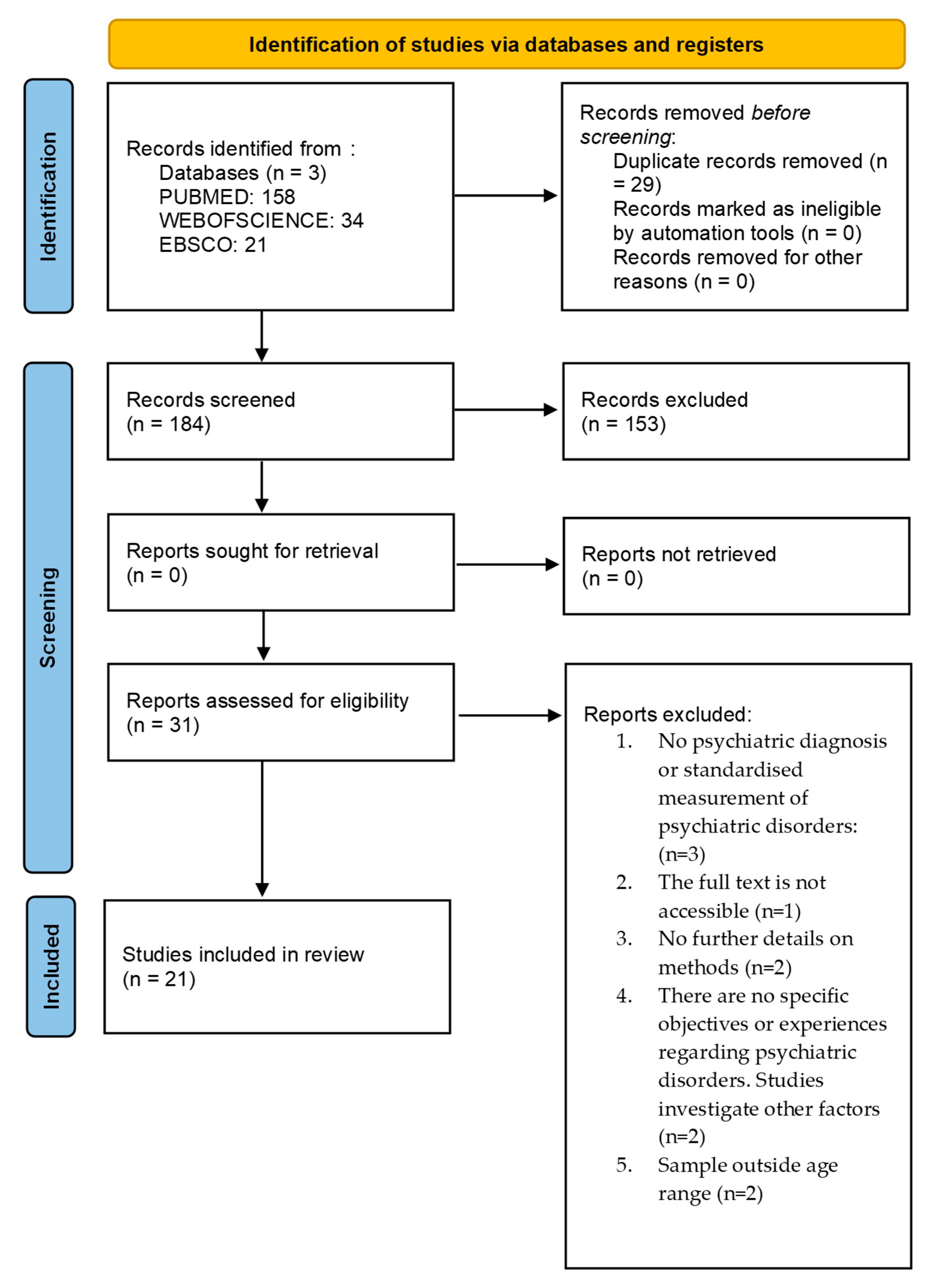
2.3. Stage 3: Inclusion and Exclusion Criteria (Figure 1)
- Studies on a sample of adolescents aged between 10 and 19 years;
- Studies on a sample with a diagnosis of a psychiatric disorder;
- Studies on a sample with a standardised and validated assessment of psychopathological symptoms;
- Studies involving an analysis of gender differences in psychiatric disorders;
- Studies on a sample with an age outside the range 10–19 years;
- Studies that do not report a psychiatric diagnosis or a standardised and validated assessment of psychopathological symptoms;
- Studies that do not consider gender in the analysis of psychiatric disorders;
- Studies that rely on data reported exclusively by parents or caregivers, without directly involving adolescents;

2.4. Detailed Description of Data Recording
2.5. Stage 5: Collate, Summarise, and Report Results
3. Results
3.1. Mood Disorders (Table 1)

| Authors/Years | N, Age, Period of Life | Objective | Measures | Specific Findings |
|---|---|---|---|---|
| Gemma Knowles, Charlotte Gayer-Anderson, Stephanie Beards, Rachel Blakey, Samantha Davis, Katie Lowis, Daniel Stanyon, Aisha Ofori, Alice Turner, Schools Working Group, Vanessa Pinfold, Ioannis Bakolis, Ulrich Reininghaus, Seeromanie Harding, Craig Morgan, 2021 [25] | 4353 adolescents (11–14 years) | Estimating the extent and nature of adolescents’ mental health problems | - Self-report Strength and Difficulties Questionnaire (SDQ) - Short Mood and Emotion Questionnaire (SMFQ) - Generalised Anxiety Disorder Scale (GAD-7) - Development and Adolescent Well-being Assessment | The weighted estimate of mental health problems was 18.6%. Each mental health problem was more common among girls than boys |
| Jun Mo Sunga, Yeon Jung Kim, 2020 [26] | The total number of participants in waves 2, 3 and 4 was 2280 and 2108, respectively (overall mean age about 12.92 years) | Examining gender differences in adolescents’ mental health and the factors influencing them | - Depression subscale of the Korean version of the Symptom Checklist-90-Revised - The scales for attention deficit, aggression and somatic symptoms developed by Cho and Lim (2003) - The social withdrawal scales developed by Kim and Kim (1998) - The Smartphone Addiction Scales developed by Lee et al. (2002) - Korean version of the Conflict Tactics Scale - The school adjustment scales developed by Jung (2009) | Girls show higher scores in depression and somatic symptoms (p < 0.001). Boys show a significant prevalence in attention deficit symptoms (p < 0.01 and p < 0.001). |
| Sophia M Liles, Anna L Olsavsky, Diane Chen, Connor Grannis, Kristen R Hoskinson, Scott F Leibowitz, Eric E Nelson, Charis J Stanek, John F Strang, Leena Nahata, 2024 [27] | 75 adolescents (aged between 12 and 18 years) | Examine the prevalence of internalising symptoms (depression, generalised anxiety, separation anxiety, social anxiety) among transgender/non-binary adolescents | - Children’s Depression Inventory (CDI) - Screen for Child Anxiety Related Emotional Disorders (SCARED) - Child and Adolescent Symptom Inventory-5 (CASI-5) | Most adolescents reported high symptoms of: depression (59 per cent), generalised anxiety (75 per cent), separation anxiety (52 per cent) and social anxiety (78 per cent) |
| Massimo Apicella, Giulia Serra, Maria Elena Iannoni, Monia Trasolini, Gino Maglio, Elisa Andracchio, Stefano Vicari, 2023 [28] | 341 adolescents (aged between 6 and 18 years) | Examining gender differences among adolescents diagnosed with a major depressive episode with mixed characteristics | - Schedule for Affective Disorders and Schizophrenia for School-Age Children-Present and Lifetime Version (K SADS-PL) - Semi-structured diagnostic interview - Children Depression Rating Scale-Revised (CDRS-R) - K-SADS Mania Rating Scale (KMRS) - Child Depression Inventory (CDI) - Clinical Global Assessment Scale (CGAS) - Multidimensional Anxiety Scale for Children (MASC) - Child Behavior Checklist (CBCL) - Columbia Suicide Severity Rating Scale (C-SSRS) | Depression severity was significantly higher in women than in men |
| Yuchen Li, Jingwen Jiang, Thorhildur Halldorsdottir, Hongru Zhu, Elizabeth Bertone-Johnson, Unnur A Valdimarsdóttir, Xiaobo Zhou, Wei Zhang, Donghao Lu, 2023 [29] | 21,239 adolescents (aged 10–19 years) | Exploring the relation ship between premenstrual disorders and gender differences in depressive and anxiety symptoms | - Questionnaire based on theCalendar of Premenstrual Experiences - The 9-item Patient Health Questionnaire (PHQ-9) - 7-item Generalized Anxiety Disorder scale (GAD-7) - Suicidal Behaviors Questionnaire-Revised (SBQ-R) | Premenstrual disorders may contribute to the gender gap in mental health in adolescence |
| Zheng Zhang, Andi Qiu, Xiangyan Zhang, Yixin Zhao, Lu Yuan, Jing Yi, Qi Zhang, Haidong Liu, Ruoheng Lin, Xiangbin Zhang, 2024 [30] | 3769 adolescents (average age: 16.41 ± 1.67 years) | Examining gender differences in psychopathological symptoms | - Middle School Students Mental Health Scale (MSSMHS) | Significant gender differences in psychological symptoms between boys and girls. Depression and anxiety emerged as the main symptoms for boys and girls. |
| Yeosun Yoon, Mia Eisenstadt, Suzet Tanya Lereya, Jessica Deighton, 2023 [12] | 8612 adolescents (aged 11–14 years) | Investigating emerging developmental trends related to gender differences in mental health problems | - Self-report Strengths and Difficulties Questionnaire (SDQ) - Short Warwick and Edinburgh Wellbeing Scale (SWEMWBS) | The girls had lower emotional difficulties and subjective well-being than the boys and both deteriorated over the years. |
| Evgeniya Yu Privodnova, Nadezhda B Semenova, Olga S Kornienko, Aleksandra V Varshal, Helena R Slobodskaya, 2024 [31] | 12,882 adolescents (aged between 11 and 18 years) | Examining gender differences and secular trends in adolescents’ mental health | - Strengths and Difficulties Questionnaire (SDQ) | Significant increase in emotional symptoms and internalising problems (p < 0.001) among girls compared to boys |
| Ingibjorg E Thorisdottir, Bryndis B Asgeirsdottir, Rannveig Sigurvinsdottir, John P Allegrante, Inga D Sigfusdottir, 2017 [32] | The number of participants (age 14–15) in each year was as follows: 2006 n = 7232 2009 n = 7377 2010 n = 7125 2012 n = 7202 2014 n = 6966 2016 n = 7041 | Investigating trends in depression and anxiety symptoms among adolescents | - Symptom Check List 90 (SCL-90) | Increase in symptoms compared to previous cohorts: - depression +6.8% girls, +1.6% boys - anxiety +8.6% girls, +1.3% boys |
| Olympia L K Campbell, David Bann, Praveetha Patalay, 2021 [6] | 566,829 adolescents (15 years) | Analysing data for 4 mental health outcomes: psychological distress, life satisfaction, eudaimonia and hedonia in adolescents | - Programme for International Student Assessment (PISA) | Girls have worse mental health than boys, particularly in life satisfaction and psychological distress |
3.2. Eating Disorders (Table 2)
| Authors/Years | N, Age, Period of Life | Objective | Measures | Specific Findings |
|---|---|---|---|---|
| Yuanyuan Wang, Zhihao Ma, Su Lu, Zhizhou Duan, Amanda Wilson, Yinwei Jia, Yong Yang, Runsen Chen, 2023 [33] | 11,440 adolescents (average age 14.74 years) | Investigating eating disorder-related behaviour among adolescents | - Mini International Neuropsychiatric Interview-Criteria for Anorexia Nervosa - Reported Deficits Questionnaire (PDQ-5) - Generalised Anxiety Disorder-7 (GAD-7) - Patient Health Questionnaire-9 (PHQ-9) - 36-Item Short-Form Survey (36-SF) | Male adolescents reported lower anxiety symptoms and a lower likelihood of adopting dietary restrictions than girls |
| Hannah J White, Emma Haycraft, Deborah J Wallis, Jon Arcelus, Newman Leung, Caroline Meyer, 2015 [34] | 527 adolescents (average age 15.9 years) | Examining the Mealtime Emotions Measure for adolescents (MEM-A), gender differences in emotions experienced at mealtimes and levels of eating psychopathology | - Mealtime Emotions Measure-Adolescents (MEM-A) - Eating Disorder Examination Questionnaire (EDE-Q) - Hospital and Anxiety Depression Scale (HADS) - Project-EAT Atmosphere of family meals | Associations between emotional responses to meals and eating psychopathology |
3.3. Externalising and Neurobehavioural Disorders (Table 3)
| Authors/Years | N, Age, Period of Life | Objective | Measures | Specific Findings |
|---|---|---|---|---|
| Karin Boson, Mats Anderberg, Johan Melander Hagborg, Peter Wennberg, Mikael Dahlberg, 2022 [35] | 455 adolescents (average age 17 years) | Assessing trends in mental distress and associated risk factors after 1 year of treatment for substance use, analysing gender differences. | - Structured interviews - Bivariate analyses - Logistic regressions | Girls had higher levels of symptoms such as anxiety and depression and more frequent access to psychiatric treatment, with depression and suicidal ideation. |
| Melanie S Askari, Caroline G Rutherford, Pia M Mauro, Noah T Kreski, Katherine M Keyes, 2022 [36] | 304,542 adolescents | Estimating the structure of internalising and externalising symptoms and potential temporal dynamics in their association. | - Monitoring the Future (MTF) - Annual cross-sectional surveys | Reduction in externalising symptoms: from −0.06 in 2011 to −0.13 in 2012. |
3.4. Self-Injurious Behaviour and Suicidality (Table 4)
| Authors/Years | N, Age, Period of Life | Objective | Measures | Specific Findings |
|---|---|---|---|---|
| Villar-Cabeza, F., Lombardini, F., Sánchez-Fernández, B., Vila-Grifoll, M., Esnaola-Letemendia, E., Vergé-Muñoz, M., Navarro-Marfisis, M.C., Castellano-Tejedor, C., 2022 [37] | 92 adolescents (aged between 13 and 17 years) | Investigates whether gender differences exist among adolescents with suicidal behaviour | - Millon Adolescent Clinical Inventory (MACI) | 78% of women were hospitalised for a suicide attempt compared to 58% of men. Half of the women and almost half of the men reported a relational trigger as the cause of their suicidal behaviour. |
| Raffaela M Flury, Lara Brockhus, Martin Müller, Jonathan Henssler, Aristomenis K Exadaktylos, Jolanta Klukowska-Rötzler, 2022 [38] | 612 adolescents (aged between 16 and 18 years) | Analysing gender differences in mental health problems among adolescents | - Swiss Emergency Triage Scale (SETS) - Final diagnosis according to ICD-10 | The most frequent diagnoses in adolescents - Reactions to severe stress and adjustment disorders (19.1%); - Alcohol use disorders (17.6%); - Intentional self-harm (17.3%); - Affective disorders (13.7%) |
| Gabriele Torino, Silvia Leone, Samuele Cortese, Gwen Dieleman, Suzanne Gerritsen, Deborah Maffezzoni, Donato Martella, Rocco Micciolo, Swaran Singh, Cathy Street, Amanda Tuffrey, Leanne Walker, Manuel Zamparini, Giovanni de Girolamo, 2024 [39] | 230 adolescents (aged between 16 and 18 years) | Monitor time trends in general health, social functioning, detect gender differences and identify factors associated with Suicidal Thinking and Behaviour (TSI) | - Health of the Nation Outcome Scales for Children and Adolescents (HoNOSCA) - Achenbach’s Empirical Evaluation System (ASEBA) - Assessment of development and well-being (DAWBA) - Transition Readiness and Appropriateness Measure (TRAM) | Females had higher HoNOSCA scores than males (worse physical, behavioural and emotional condition) |
| Carolyn M Porta, Ryan J Watson, Marion Doull, Marla E Eisenberg, Nathan Grumdahl, Elizabeth Saewyc, 2018 [40] | Adolescents: from a low of 17,278 in 2001 to a high of 19,504 in 2010 (mean age 16.7 years) | Examining emotional distress and suicidal tendencies among male and female students | - Minnesota Student Survey (MSS) | The results reveal a general improvement in youth mental health trends; however, disparities between heterosexual and sexual minority youth have not narrowed over time. |
3.5. Personality Disorders (Table 5)
| Authors/Years | N, Age, Period of Life | Objective | Measures | Specific Findings |
|---|---|---|---|---|
| Marie-Céline Gouwy, Lize Verbeke, Kim Dierckx, Lore Van Damme, Olivier Colins, Barbara De Clercq, 2022 [41] | 237 adolescents (average age = 15.8 years) | Investigating higher psychopathology scores in girls compared to boys | - The Massachusetts Youth Screening Instrument-Second Version (MAYSI-2) - Dimensional Personality Symptom Itempool (DIPSI) | Results show higher rates of psychopathology in girls than boys, particularly for anxiety-depressive, angry-irritable and post-traumatic symptoms |
| Ilaria Maria Antonietta Benzi, Andrea Fontana, Rossella Di Pierro, Laura Parolin, Karin Ensink, 2023 (STUDY 1) [42] | 725 adolescents (average age 16.22) | Exploring gender differences in psychopathology and maladaptive personality traits | - Borderline Personality Feature Scale for Children-11 (BPFSC-11) - Pathological Narcissism Inventory (PNI) | Girls showed higher scores in borderline traits and general psychopathology; boys showed higher scores in grandiose narcissism |
| Ilaria Maria Antonietta Benzi, Andrea Fontana, Rossella Di Pierro, Laura Parolin, Karin Ensink, 2023 (STUDY 2) [42] | 974 adolescents (average age 16.68) | Examining the structure of gender differences in borderline and narcissistic personality traits | - Youth Self Report (YSR) | Borderline traits were positively associated with general psychopathology, indicating that higher levels of these traits correspond to a higher p-factor |
3.6. Integrative Summary of Evidence
4. Discussion
- Mood disorders:
- Eating disorders:
- Externalising and neurobehavioural disorders:
- Self-injurious behaviour and suicidality:
- Personality disorders:
4.1. Barriers to Mental Health Equality: The Role of Gendered Cultural and Social Norms
4.2. Limitations of the Literature and Future Directions
5. Conclusions
Author Contributions
Funding
Institutional Review Board Statement
Informed Consent Statement
Data Availability Statement
Conflicts of Interest
References
- Sawyer, S.M.; Azzopardi, P.S.; Wickremarathne, D.; Patton, G.C. The age of adolescence. Lancet Child Adolesc. Health 2018, 2, 223–228. [Google Scholar] [CrossRef]
- World Health Organization. Adolescent Health. 2024. Available online: https://www.who.int/health-topics/adolescent-health/#tab=tab_1 (accessed on 1 July 2025).
- Merikangas, K.R.; He, J.-P.; Burstein, M.; Swanson, S.A.; Avenevoli, S.; Cui, L.; Benjet, C.; Georgiades, K.; Swendsen, J. Lifetime prevalence of mental disorders in U.S. adolescents: Results from the National Comorbidity Survey Replication Adolescent Supplement (NCS-A). J. Am. Acad. Child Adolesc. Psychiatry 2010, 49, 980–989. [Google Scholar] [CrossRef]
- Solmi, M.; Radua, J.; Olivola, M.; Croce, E.; Soardo, L.; Salazar de Pablo, G.; Il Shin, J.; Kirkbride, J.B.; Jones, P.; Kim, J.H.; et al. Age at onset of mental disorders worldwide: Large-scale meta-analysis of 192 epidemiological studies. Mol. Psychiatry 2022, 27, 281–295. [Google Scholar] [CrossRef]
- Erskine, H.E.; Moffitt, T.E.; Copeland, W.E.; Costello, E.J.; Ferrari, A.J.; Patton, G.; Degenhardt, L.; Vos, T.; Whiteford, H.A.; Scott, J.G. A heavy burden on young minds: The global burden of mental and substance use disorders in children and youth. Psychol. Med. 2014, 45, 1551–1563. [Google Scholar] [CrossRef] [PubMed]
- Campbell, O.; Bann, D.; Patalay, P. The gender gap in adolescent mental health: A cross-national investigation of 566,829 adolescents across 73 countries. SSM—Popul. Health 2021, 13, 100742. [Google Scholar] [CrossRef] [PubMed]
- Bøe, T.; Heiervang, E.R.; Stormark, K.M.; Lundervold, A.; Hysing, M. Prevalence of psychiatric disorders in Norwegian 10-14-year-olds: Results from a cross-sectional study. PLoS ONE 2021, 16, e0248864. [Google Scholar] [CrossRef]
- Kirkcaldy, B.; Siefen, G.; Furnham, A. Gender, anxiety-depressivity and self-image among adolescents. Eur. Psychiatry 2003, 18, 50–58. [Google Scholar] [CrossRef] [PubMed]
- Bölte, S.; Neufeld, J.; Marschik, P.B.; Williams, Z.J.; Gallagher, L.; Lai, M.C. Sex and gender in neurodevelopmental conditions. Nat. Rev. Neurol. 2023, 19, 136–159. [Google Scholar] [CrossRef]
- Bauer, G.R. Sex and Gender Multidimensionality in Epidemiologic Research. Am. J. Epidemiol. 2023, 192, 122–132. [Google Scholar] [CrossRef]
- Nielsen, M.W.; Stefanick, M.L.; Peragine, D.; Neilands, T.B.; Ioannidis, J.P.A.; Pilote, L.; Prochaska, J.J.; Cullen, M.R.; Einstein, G.; Klinge, I.; et al. Gender-related variables for health research. Biol. Sex Differ. 2021, 12, 23. [Google Scholar] [CrossRef]
- Yoon, Y.; Eisenstadt, M.; Lereya, S.T.; Deighton, J. Gender difference in the change of adolescents’ mental health and subjective wellbeing trajectories. Eur. Child Adolesc. Psychiatry 2023, 32, 1569–1578. [Google Scholar] [CrossRef]
- Global prevalence and burden of depressive and anxiety disorders in 204 countries and territories in 2020 due to the COVID-19 pandemic. Lancet 2021, 398, 1700–1712. [CrossRef] [PubMed]
- Kessler, R.C.; Berglund, P.; Demler, O.; Jin, R.; Merikangas, K.R.; Walters, E.E. Lifetime prevalence and age-of-onset distributions of DSM-IV disorders in the National Comorbidity Survey Replication. Arch. Gen. Psychiatry 2005, 62, 593–602. [Google Scholar] [CrossRef]
- Usall, J.; Ochoa, S. Sex differences and gender influence in psychosis. Arch. Women’s Ment. Health 2024, 27, 659–660. [Google Scholar] [CrossRef] [PubMed]
- Damato, F.M.; Ricci, P.; Rinaldi, R. Informed consent and compulsory treatment on individuals with severe eating disorders: A bio-ethical and juridical problem. Clin. Ter. 2023, 174, 365–369. [Google Scholar] [CrossRef] [PubMed]
- Zahn-Waxler, C.; Shirtcliff, E.A.; Marceau, K. Disorders of childhood and adolescence: Gender and psychopathology. Annu. Rev. Clin. Psychol. 2008, 4, 275–303. [Google Scholar] [CrossRef]
- Salk, R.H.; Hyde, J.S.; Abramson, L.Y. Gender differences in depression in representative national samples: Meta-analyses of diagnoses and symptoms. Psychol. Bull. 2017, 143, 783–822. [Google Scholar] [CrossRef]
- Angold, A.; Costello, E.J. Puberty and depression. Child Adolesc. Psychiatr. Clin. N. Am. 2006, 15, 919–937. [Google Scholar] [CrossRef]
- Nolen-Hoeksema, S. Gender differences in depression. Curr. Dir. Psychol. Sci. 2001, 10, 173–176. [Google Scholar] [CrossRef]
- Twenge, J.M.; Martin, G.N. Gender differences in associations between digital media use and psychological well-being: Evidence from three large datasets. J. Adolesc. 2020, 79, 91–102. [Google Scholar] [CrossRef]
- Mental Health Foundation. The Impact of Social Media on Young People’s Mental Health; Mental Health Foundation: London, UK, 2021. [Google Scholar]
- Yu, Y.; Mohi; Debroy, A.; Cao, X.; Rudolph, K.; Wang, Y. Principles of Safe AI companions for Youth: Parent and expert Perspectives. arXiv 2025. [Google Scholar] [CrossRef]
- Lee, N.T. Health and AI: Advancing Responsible and Ethical AI for All Communities. Brookings 2025. Available online: https://www.brookings.edu/articles/health-and-ai-advancing-responsible-and-ethical-ai-for-all-communities/ (accessed on 1 July 2025).
- Knowles, G.; Gayer-Anderson, C.; Beards, S.; Blakey, R.; Davis, S.; Lowis, K.; Stanyon, D.; Ofori, A.; Turner, A.; Schools Working Group. Mental distress among young people in inner cities: The Resilience, Ethnicity and AdolesCent Mental Health (REACH) study. J. Epidemiol. Community Health 2021, 75, 515–522. [Google Scholar] [CrossRef]
- Sung, J.M.; Kim, Y.J. Sex differences in adolescent mental health profiles in South Korea. Arch. Psychiatr. Nurs. 2020, 34, 563–571. [Google Scholar] [CrossRef]
- Liles, S.M.; Olsavsky, A.L.; Chen, D.; Grannis, C.; Hoskinson, K.R.; Leibowitz, S.F.; Nelson, E.E.; Stanek, C.J.; Strang, J.F.; Nahata, L. Depression and anxiety in transgender and non-binary adolescents: Prevalence and associations between adolescent and caregiver reports. Eur. J. Pediatr. 2024, 183, 4711–4719. [Google Scholar] [CrossRef]
- Apicella, M.; Serra, G.; Iannoni, M.E.; Trasolini, M.; Maglio, G.; Andracchio, E.; Vicari, S. Gender Differences in the Psychopathology of Mixed Depression in Adolescents with a Major Depressive Episode. Curr. Neuropharmacol. 2023, 21, 1343–1354. [Google Scholar] [CrossRef] [PubMed]
- Li, Y.; Jiang, J.; Halldorsdottir, T.; Zhu, H.; Bertone-Johnson, E.; Valdimarsdóttir, U.A.; Zhou, X.; Zhang, W.; Lu, D. Premenstrual disorders and gender differences in adolescent mental health. J. Affect. Disord. 2023, 340, 930–937. [Google Scholar] [CrossRef]
- Zhang, Z.; Qiu, A.; Zhang, X.; Zhao, Y.; Yuan, L.; Yi, J.; Zhang, Q.; Liu, H.; Lin, R.; Zhang, X. Gender differences in the mental symptom network of high school students in Shanghai, China: A network analysis. BMC Public Health 2024, 24, 2719. [Google Scholar] [CrossRef]
- Privodnova, E.Y.; Semenova, N.B.; Kornienko, O.S.; Varshal, A.V.; Slobodskaya, H.R. Gender differences in Russian adolescent mental health from 1999 to 2021. J. Res. Adolesc. 2024, 34, 222–234. [Google Scholar] [CrossRef] [PubMed]
- Thorisdottir, I.E.; Asgeirsdottir, B.B.; Sigurvinsdottir, R.; Allegrante, J.P.; Sigfusdottir, I.D. The increase in symptoms of anxiety and depressed mood among Icelandic adolescents: Time trend between 2006 and 2016. Eur. J. Public Health 2017, 27, 856–861. [Google Scholar] [CrossRef]
- Wang, Y.; Ma, Z.; Lu, S.; Duan, Z.; Wilson, A.; Jia, Y.; Yang, Y.; Chen, R. Associations between sex differences, eating disorder behaviors, physical and mental health, and self-harm among Chinese adolescents. J. Eat. Disord. 2023, 11, 30. [Google Scholar] [CrossRef]
- White, H.J.; Haycraft, E.; Wallis, D.J.; Arcelus, J.; Leung, N.; Meyer, C. Development of the Mealtime Emotions Measure for adolescents (MEM-A): Gender differences in emotional responses to family mealtimes and eating psychopathology. Appetite 2015, 85, 76–83. [Google Scholar] [CrossRef]
- Boson, K.; Anderberg, M.; Melander Hagborg, J.; Wennberg, P.; Dahlberg, M. Adolescents with substance use problems in outpatient treatment: A one-year prospective follow-up study focusing on mental health and gender differences. Subst. Abus. Treat. Prev. Policy 2022, 17, 53. [Google Scholar] [CrossRef] [PubMed]
- Askari, M.S.; Rutherford, C.G.; Mauro, P.M.; Kreski, N.T.; Keyes, K.M. Structure and trends of externalizing and internalizing psychiatric symptoms and gender differences among adolescents in the US from 1991 to 2018. Soc. Psychiatry Psychiatr. Epidemiol. 2022, 57, 737–748. [Google Scholar] [CrossRef]
- Villar-Cabeza, F.; Lombardini, F.; Sánchez-Fernández, B.; Vila-Grifoll, M.; Esnaola-Letemendia, E.; Vergé-Muñoz, M.; Navarro-Marfisis, M.C.; Castellano-Tejedor, C. Gender differences in adolescents with suicidal behaviour: Personality and psychopathology. Rev. Psicol. Clin. Niños Adolesc. 2022, 9, 16–25. [Google Scholar] [CrossRef]
- Flury, R.M.; Brockhus, L.; Müller, M.; Henssler, J.; Exadaktylos, A.K.; Klukowska-Rötzler, J. Presentations to the Emergency Department for Problems Related to Mental Health: Sex Differences in Adolescents. Int. J. Environ. Res. Public Health 2022, 19, 13196. [Google Scholar] [CrossRef] [PubMed]
- Torino, G.; Leone, S.; Cortese, S.; Dieleman, G.; Gerritsen, S.; Maffezzoni, D.; Martella, D.; Micciolo, R.; Singh, S.; Street, C.; et al. Publisher Correction: Prospective analysis of sex differences and factors associated with suicidal thoughts and behaviours in young people from the MILESTONE Italian sample. Sci. Rep. 2024, 14, 29527. [Google Scholar] [CrossRef]
- Porta, C.M.; Watson, R.J.; Doull, M.; Eisenberg, M.E.; Grumdahl, N.; Saewyc, E. Trend disparities in emotional distress and suicidality among sexual minority and heterosexual Minnesota adolescents from 1998 to 2010. J. Sch. Health 2018, 88, 605–614. [Google Scholar] [CrossRef]
- Gouwy, M.C.; Verbeke, L.; Dierckx, K.; Van Damme, L.; Colins, O.; De Clercq, B. Toward a Better Understanding of Gender Differences in Psychopathology in Detained Adolescents: The Role of Maladaptive Personality Traits. J. Forensic Psychol. Res. Pract. 2022, 24, 296–313. [Google Scholar] [CrossRef]
- Benzi, I.M.A.; Fontana, A.; Di Pierro, R.; Parolin, L.; Ensink, K. Unpacking the p-factor. Associations Between Maladaptive Personality Traits and General Psychopathology in Female and Male Adolescents. Res. Child Adolesc. Psychopathol. 2024, 52, 473–486. [Google Scholar] [CrossRef]
- Kaye-Tzadok, A.; Kim, S.S.; Main, G. Children’s subjective well-being in relation to gender—What can we learn from dissatisfied children? Child. Youth Serv. Rev. 2017, 80, 96–104. [Google Scholar] [CrossRef]
- Piccinelli, M.; Wilkinson, G. Gender differences in depression: Critical review. Br. J. Psychiatry 2000, 177, 486–492. [Google Scholar] [CrossRef]
- Ge, X.; Conger, R.D.; Elder, G.H., Jr. Pubertal transition, stressful life events, and the emergence of gender differences in adolescent depressive symptoms. Dev. Psychol. 2001, 37, 404–417. [Google Scholar] [CrossRef]
- Rößner-Ruff, V.; Krieger, J.; Graef-Calliess, E.N. Male depression—Actual a male specific disorder or potentially a new subtype of depression? Eur. Psychiatry 2017, 41, S324. [Google Scholar] [CrossRef]
- Santiago-Menendez, M.; Campbell, A. Sadness and anger: Boys, girls, and crying in adolescence. Psychol. Men Masculinity 2013, 14, 400–410. [Google Scholar] [CrossRef]
- American Psychiatric Association. Diagnostic and Statistical Manual of Mental Disorders (DSM-5-TR); American Psychiatric Association: Washington, DC, USA, 2022. [Google Scholar]
- World Health Organization. WHO International Classification of Diseases, 11th ed.; WHO: Geneva, Switzerland, 2022; Available online: https://www.who.int/standards/classifications/classification-of-diseases (accessed on 1 July 2025).
- Ferrara, R.; Nappo, R.; Ansermet, F.; Ricci, P.; Massoni, F.; Carbone, G.; Sparaci, A.; Nonnis, E.; Ricci, L.; Ricci, S. The impact of DSM-5 on the diagnosis of autism spectrum disorder. Psychiatr. Ann. 2021, 51, 38–46. [Google Scholar] [CrossRef]
- Niu, L.; Sheffield, P.; Li, Y. Pubertal timing, neighborhood income, and mental health in boys and girls: Findings from the Adolescent Brain Cognitive Development Study. Soc. Sci. Med. 2023, 334, 116220. [Google Scholar] [CrossRef] [PubMed]
- Essau, C.A.; de la Torre-Luque, A. Comorbidity Between Internalising and Externalising Disorders Among Adolescents: Symptom Connectivity Features and Psychosocial Outcome. Child Psychiatry Hum. Dev. 2023, 54, 493–507. [Google Scholar] [CrossRef]
- Boeninger, D.K.; Masyn, K.E.; Feldman, B.J.; Conger, R.D. Sex differences in developmental trends of suicide ideation, plans, and attempts among European American adolescents. Suicide Life-Threat. Behav. 2010, 40, 451–464. [Google Scholar] [CrossRef]
- Freeman, A.; Mergl, R.; Kohls, E.; Székely, A.; Gusmão, R.; Arensman, E.; Koburger, N.; Hegerl, U.; Rummel-Kluge, C. A cross-national study on gender differences in suicide intent. BMC Psychiatry 2017, 17, 234. [Google Scholar] [CrossRef]
- Pitman, A.; Krysinska, K.; Osborn, D.; King, M. Suicide in young men. Lancet 2012, 379, 2383–2392. [Google Scholar] [CrossRef]
- Kranzler, A.; Fehling, K.B.; Anestis, M.D.; Selby, E.A. Emotional dysregulation, internalising symptoms, and self-injurious and suicidal behavior: Structural equation modeling analysis. Death Stud. 2016, 40, 358–366. [Google Scholar] [CrossRef] [PubMed]
- Wolff, J.C.; Thompson, E.; Thomas, S.A.; Nesi, J.; Bettis, A.H.; Ransford, B.; Scopelliti, K.; Frazier, E.A.; Liu, R.T. Emotion dysregulation and non-suicidal self-injury: A systematic review and meta-analysis. Eur. Psychiatry 2019, 59, 25–36. [Google Scholar] [CrossRef]
- Shiner, R.L. The development of personality disorders: Perspectives from normal personality development in childhood and adolescence. Dev. Psychopathol. 2009, 21, 715–734. [Google Scholar] [CrossRef]
- Morey, L.C.; Berghuis, H.; Bender, D.S.; Verheul, R.; Krueger, R.F.; Skodol, A.E. Toward a model for assessing level of personality functioning in DSM-5, Part II: Empirical articulation of a core dimension of personality pathology. J. Pers. Assess. 2011, 93, 347–353. [Google Scholar] [CrossRef]
- Sharp, C.; Fonagy, P. Practitioner review: Borderline personality disorder in adolescence—Recent conceptualisation, intervention, and implications for clinical practice. J. Child Psychol. Psychiatry 2015, 56, 1266–1288. [Google Scholar] [CrossRef]
- Sharp, C.; Vanwoerden, S.; Wall, K. Adolescence as a sensitive period for the development of personality disorder. Psychiatr. Clin. N. Am. 2018, 41, 669–683. [Google Scholar] [CrossRef] [PubMed]
- Leadbeater, B.J.; Kuperminc, G.P.; Blatt, S.J.; Hertzog, C. A multivariate model of gender differences in adolescents’ internalizing and externalizing problems. Dev. Psychol. 1999, 35, 1268–1282. [Google Scholar] [CrossRef]
- Rickwood, D.J.; Deane, F.P.; Wilson, C.J. When and how do young people seek professional help for mental health problems? Med. J. Aust. 2007, 187, S35–S39. [Google Scholar] [CrossRef]
- Burke, S.M. Commentary: Gender diversity and adolescent mental health—A reflection on Potter et al. (2020). J. Child Psychol. Psychiatry 2021, 62, 180–183. [Google Scholar] [CrossRef]
- Gunnar, M.R. Editorial: Placing research in context—What participant and study characteristics should be routinely reported in studies of child and adolescent mental health? J. Child Psychol. Psychiatry 2024, 65, 121–123. [Google Scholar] [CrossRef] [PubMed]
Disclaimer/Publisher’s Note: The statements, opinions and data contained in all publications are solely those of the individual author(s) and contributor(s) and not of MDPI and/or the editor(s). MDPI and/or the editor(s) disclaim responsibility for any injury to people or property resulting from any ideas, methods, instructions or products referred to in the content. |
© 2026 by the authors. Licensee MDPI, Basel, Switzerland. This article is an open access article distributed under the terms and conditions of the Creative Commons Attribution (CC BY) license.
Share and Cite
Ricci, L.; Ricci, P.; Avallone, A.; Calderaro, M.; Cafiero, G.; Iovino, L.; Ferrara, R. Exploring Gender Differences in Adolescent Psychiatric Disorders: A Decade of Research. Healthcare 2026, 14, 225. https://doi.org/10.3390/healthcare14020225
Ricci L, Ricci P, Avallone A, Calderaro M, Cafiero G, Iovino L, Ferrara R. Exploring Gender Differences in Adolescent Psychiatric Disorders: A Decade of Research. Healthcare. 2026; 14(2):225. https://doi.org/10.3390/healthcare14020225
Chicago/Turabian StyleRicci, Lidia, Pasquale Ricci, Angiola Avallone, Monica Calderaro, Giorgia Cafiero, Leonardo Iovino, and Rosaria Ferrara. 2026. "Exploring Gender Differences in Adolescent Psychiatric Disorders: A Decade of Research" Healthcare 14, no. 2: 225. https://doi.org/10.3390/healthcare14020225
APA StyleRicci, L., Ricci, P., Avallone, A., Calderaro, M., Cafiero, G., Iovino, L., & Ferrara, R. (2026). Exploring Gender Differences in Adolescent Psychiatric Disorders: A Decade of Research. Healthcare, 14(2), 225. https://doi.org/10.3390/healthcare14020225