Feasibility of Recruiting Psychiatrically Hospitalized Adults for a Randomized Controlled Trial of an Animal-Assisted Intervention
 ,
,  , , , and
Abstract
1. Introduction
2. Materials and Methods
2.1. Design
2.2. Intervention
- (1)
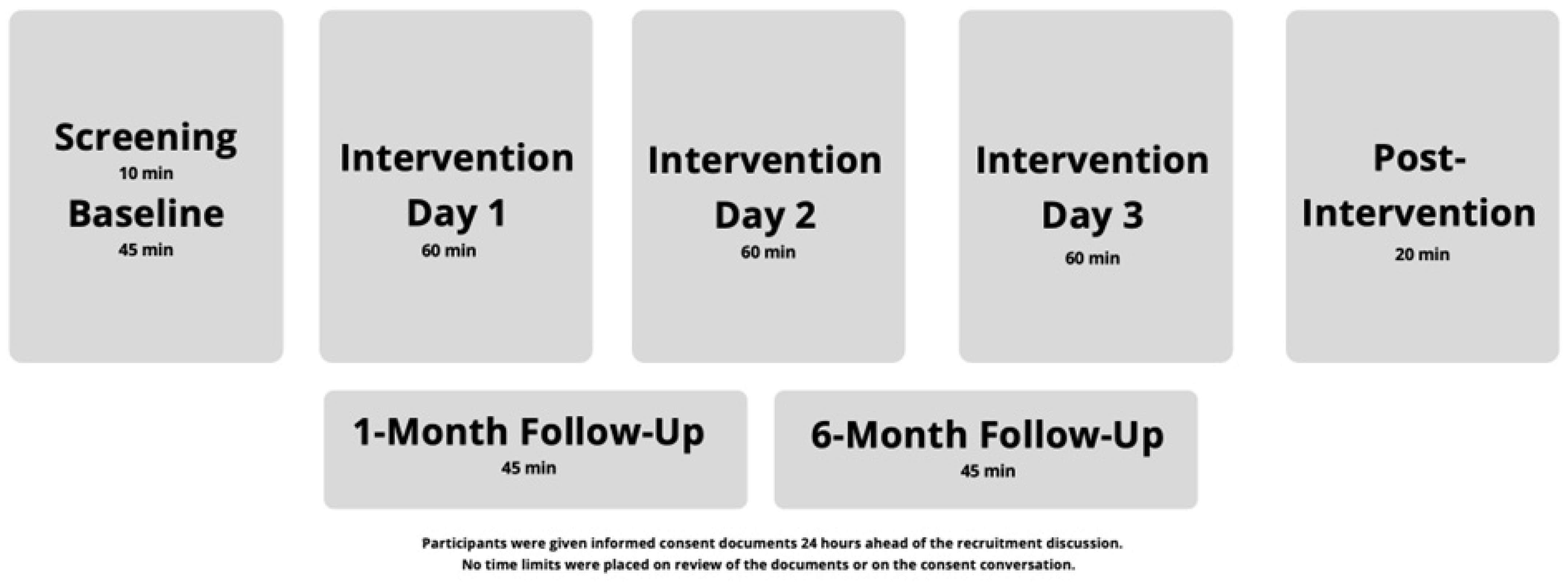
- AAI: Participants took part in a 20 min, non-scripted interaction with a DOC therapy dog and handler team on three consecutive days. The handlers were provided with specific general conversation topics to facilitate intervention fidelity and consistency.
- (2)
- CC: Participants interacted with a therapy dog handler who visited them without a dog and conducted a 20 min, informal social interaction as described above. The sessions were repeated on three consecutive days.
- (3)
- TU: Participants received treatment as usual without any additional intervention. They engaged in their usual activities, such as watching television during the 20 min “intervention” period.
2.3. Participants
2.4. Measures
2.5. Setting
2.6. Recruitment Procedures: Participant Identification and Consent
2.7. Laying the Groundwork
2.7.1. Strong Relationship with Clinical Staff
2.7.2. Program Popularity
2.7.3. Recruitment Uptake Outcomes
3. Results
3.1. Recruitment Challenges and Mitigating Strategies
3.1.1. COVID-19
3.1.2. Mitigating Strategy: Communication with Sponsor
3.2. Early Discharge, Intensive Treatment
3.3. Working with a Volunteer Research Workforce
4. Discussion
4.1. Contextualizing Our Findings
4.2. Implications for a Larger RCT
5. Conclusions
Author Contributions
Funding
Data Availability Statement
Conflicts of Interest
References
- Hariton, E.; Locascio, J.L. Randomised controlled trials: The gold standard for effectiveness research. BJOG 2018, 125, 1716. [Google Scholar] [CrossRef] [Scilit]
- Shadish, W.R.; Cook, T.D.; Campbell, D.T. Statistical conclusion validity and internal validity. In Experimental and Quasi-Experimental Designs for Generalized Causal Inference; Houghton Mifflin Company: Boston, MA, USA, 2002; p. 55. [Google Scholar]
- Walker, S.; Mackay, E.; Barnett, P.; Rains, L.S.; Leverton, M.; Dalton-Locke, C.; Trevillion, K.; Lloyd-Evans, B.; Johnson, S. Clinical and social factors associated with increased risk for involuntary psychiatric hospitalisation: A systematic review, meta-analysis, and narrative synthesis. Lancet Psychiatry 2019, 6, 1039–1053. [Google Scholar] [CrossRef] [Scilit]
- Kessler, R.C.; Foster, C.L.; Saunders, W.B.; Stang, P.E. Social consequences of psychiatric disorders, I: Educational attainment. Am. J. Psychiatry 1995, 152, 1026–1032. [Google Scholar] [CrossRef] [Scilit]
- Kessler, R.C.; Walters, E.E.; Forthofer, M.S. The social consequences of psychiatric disorders, III: Probability of marital stability. Am. J. Psychiatry 1998, 155, 1092–1096. [Google Scholar] [CrossRef] [Scilit]
- Wood, L.; Alsawy, S. Patient experiences of psychiatric inpatient care: A systematic review of qualitative evidence. J. Psychiatr. Intensive Care 2016, 12, 35–43. [Google Scholar] [CrossRef] [Scilit]
- Johansson, I.M.; Lundman, B. Patients’ experience of involuntary psychiatric care: Good opportunities and great losses. J. Psychiatr. Ment. Health Nurs. 2002, 9, 639–647. [Google Scholar] [CrossRef] [Scilit] [PubMed]
- Shields, M.C.; Davis, K.A. Inpatient Psychiatric Care in the United States: Former Patients’ Perspectives on Opportunities for Quality Improvement. J. Patient Exp. 2024, 11, 23743735241257810. [Google Scholar] [CrossRef] [Scilit] [PubMed]
- Borge, L.; Fagermoen, M.S. Patients’ core experiences of hospital treatment: Wholeness and self-worth in time and space. J. Ment. Health 2008, 17, 193–205. [Google Scholar] [CrossRef] [Scilit]
- Polacek, M.J.; Allen, D.E.; Damin-Moss, R.S.; Schwartz, A.J.A.; Sharp, D.; Shattell, M.; Souther, J.; Delaney, K.R. Engagement as an element of safe inpatient psychiatric environments. J. Am. Psychiatr. Nurses Assoc. 2015, 21, 181–190. [Google Scholar] [CrossRef] [Scilit]
- Ikai, S.; Uchida, H.; Mizuno, Y.; Tani, H.; Nagaoka, M.; Tsunoda, K.; Mimura, M.; Suzuki, T. Effects of chair yoga therapy on physical fitness in patients with psychiatric disorders: A 12-week single-blind randomized controlled trial. J. Psychiatr. Res. 2017, 94, 194–201. [Google Scholar] [CrossRef] [Scilit]
- Martland, R.; Onwumere, J.; Stubbs, B.; Gaughran, F. A feasibility study of high intensity interval training intervention in inpatient mental health settings. Psychiatry Res. Commun. 2024, 4, 100173. [Google Scholar] [CrossRef] [Scilit]
- Sheaves, B.; Freeman, D.; Isham, L.; McInerney, J.; Nickless, A.; Yu, L.M.; Rek, S.; Bradley, J.; Reeve, S.; Attard, C.; et al. Stabilising sleep for patients admitted at acute crisis to a psychiatric hospital (OWLS): An assessor-blind pilot randomised controlled trial. Psychol. Med. 2018, 48, 1694–1704. [Google Scholar] [CrossRef] [Scilit] [PubMed]
- Boden, M.T.; Gaudiano, B.A.; Walser, R.D.; Timko, C.; Faustman, W.; Yasmin, S.; Cronkite, R.C.; Bonn-Miller, M.O.; McCarthy, J.F. Feasibility and challenges of inpatient psychotherapy for psychosis: Lessons learned from a Veterans’ health administration pilot randomized controlled trial. BMC Res. Notes 2016, 9, 376. [Google Scholar] [CrossRef] [Scilit] [PubMed]
- Tyrberg, M.J.; Carlbring, P.; Lundgren, T. Implementation of acceptance and commitment therapy training in a psychiatric ward: Feasibility, lessons learned and potential effectiveness. J. Psychiatr. Intensive Care 2017, 13, 73–82. [Google Scholar] [CrossRef] [Scilit]
- Gaudiano, B.A.; Ellenberg, S.; Johnson, J.E.; Mueser, K.T.; Miller, I.W. Effectiveness of acceptance and commitment therapy for inpatients with psychosis: Implementation feasibility and acceptability from a pilot randomized controlled trial. Schizophr. Res. 2023, 261, 72–79. [Google Scholar] [CrossRef] [Scilit] [PubMed]
- Jacobsen, P.; Peters, E.; Robinson, E.J.; Chadwick, P. Mindfulness-based crisis interventions (MBCI) for psychosis within acute inpatient psychiatric settings: A feasibility randomised controlled trial. BMC Psychiatry 2020, 20, 193. [Google Scholar] [CrossRef] [Scilit]
- Davidson, L.; Hammond, V.; Maguire, T. The implementation of a ‘Living with Voices’ group in a psychiatric intensive care unit: A pilot study. J. Psychiatr. Intensive Care 2009, 5, 89–94. [Google Scholar] [CrossRef] [Scilit]
- Wood, L.; Byrne, R.; Enache, G.; Morrison, A.P. A brief cognitive therapy intervention for internalised stigma in acute inpatients who experience psychosis: A feasibility randomised controlled trial. Psychiatry Res. 2018, 262, 303–310. [Google Scholar] [CrossRef] [Scilit]
- Sharma, G.; Schlosser, L.; Jones, B.D.; Blumberger, D.M.; Gratzer, D.; Husain, M.O.; Mulsant, B.H.; Rappaport, L.; Stergiopoulos, V.; Husain, M.I. Brief app-based cognitive behavioral therapy for anxiety symptoms in psychiatric inpatients: Feasibility randomized controlled trial. JMIR Form. Res. 2022, 6, e38460. [Google Scholar] [CrossRef] [Scilit]
- Fine, A.H.; Tedeschi, P.; Morris, K.N.; Elvolve, E. Forward thinking: The evolving field of human-animal interactions. In Handbook on Animal-Assisted Therapy: Foundations and Guidelines for Animal-Assisted Interventions, 5th ed.; Fine, A.H., Ed.; Elsevier Academic Press: New York, NY, USA, 2019; pp. 24–25, 34–37. [Google Scholar]
- Chandler, C.K. Animal Assisted Therapy in Counseling; Routledge: Oxford, UK, 2012. [Google Scholar]
- Barker, S.B.; Dawson, K.S. The effects of animal-assisted therapy on anxiety ratings of hospitalized psychiatric patients. Psychiatr. Serv. 1998, 49, 797–801. [Google Scholar] [CrossRef] [Scilit]
- Barker, S.B.; Pandurangi, A.K.; Best, A.M. Effects of animal-assisted therapy on patients’ anxiety, fear, and depression before ECT. J. ECT 2003, 19, 38–44. [Google Scholar] [CrossRef] [Scilit]
- Nathans-Barel, I.; Feldman, P.; Berger, B.; Modai, I.; Silver, H. Animal-Assisted Therapy Ameliorates Anhedonia in Schizophrenia Patients: A Controlled Pilot Study. Psychother. Psychosom. 2004, 74, 31–35. [Google Scholar] [CrossRef] [Scilit]
- Kamioka, H.; Okada, S.; Tsutani, K.; Park, H.; Okuizumi, H.; Handa, S.; Oshio, T.; Park, S.J.; Kitayuguchi, J.; Abe, T.; et al. Effectiveness of animal-assisted therapy: A systematic review of randomized controlled trials. Complement. Ther. Med. 2014, 22, 371–390. [Google Scholar] [CrossRef] [Scilit]
- Lee, H.; Herbert, R.D.; Lamb, S.E.; Moseley, A.M.; McAuley, J.H. Investigating causal mechanisms in randomised controlled trials. Trials 2019, 20, 524. [Google Scholar] [CrossRef] [Scilit]
- Lang, U.E.; Jansen, J.B.; Wertenauer, F.; Gallinat, J.; Rapp, M.A. Reduced anxiety during dog assisted interviews in acute schizophrenic patients. Eur. J. Integr. Med. 2010, 2, 123–127. [Google Scholar] [CrossRef] [Scilit]
- Rodriguez, K.E.; Green, F.L.; Binfet, J.T.; Townsend, L.; Gee, N.R. Complexities and considerations in conducting animal-assisted intervention research: A discussion of randomized controlled trials. Hum.-Anim. Interact. 2023, 2, 1–6. [Google Scholar] [CrossRef] [Scilit]
- Finistrella, M.; Flores, P.; Frediani, G. Animal-assisted therapy in patients affected by schizophrenia and schizophrenic-related disorders: A scoping review. Adv. Med. Psychol. Public Health 2024, 1, 53–61. [Google Scholar] [CrossRef]
- Evlat, G.; Wood, L.; Glover, N. A systematic review of the implementation of psychological therapies in acute mental health inpatient settings. Clin. Psychol. Psychother. 2021, 28, 1574–1586. [Google Scholar] [CrossRef] [Scilit] [PubMed]
- Teresi, J.A.; Yu, X.; Stewart, A.L.; Hays, R.D. Guidelines for designing and evaluating feasibility studies. Med. Care 2022, 60, 95–103. [Google Scholar] [CrossRef] [Scilit]
- Eldridge, S.M.; Chan, C.L.; Campbell, M.J.; Bond, C.M.; Hopewell, S.; Thabane, L.; Lancaster, G.A. CONSORT 2010 statement: Extension to randomised pilot and feasibility trials. BMJ 2016, 355, i5239. [Google Scholar] [CrossRef] [Scilit] [PubMed]
- Gee, N.R.; Townsend, L.; Friedmann, E.; Barker, S.; Thakre, T.P.; Mueller, M. A pilot randomized controlled trial to examine the impact of a therapy dog intervention on loneliness in adult patients hospitalized in a psychiatric unit. Front. Psychiatry 2025, 16, 1582767. [Google Scholar] [CrossRef] [Scilit] [PubMed]
- Barker, S.B.; Vokes, R.A.; Barker, R.T. Animal-Assisted Interventions in Health Care Settings: A Best Practices Model for Establishing New Programs; Purdue University Press: West Lafayette, IN, USA, 2019. [Google Scholar]
- Julious, S.A. Sample size of 12 per group rule of thumb for a pilot study. Pharm. Stat. 2005, 4, 287–291. [Google Scholar] [CrossRef] [Scilit]
- Chodosh, J.; Orlando Edelen, M.; Buchanan, J.L.; Yosef, J.A.; Ouslander, J.G.; Berlowitz, D.R.; Streim, J.E.; Saliba, D. Nursing home assessment of cognitive impairment: Development and testing of a brief instrument of mental status. J. Am. Geriatr. Soc. 2008, 56, 2069–2075. [Google Scholar] [CrossRef] [Scilit]
- Russell, D.W. UCLA Loneliness Scale (Version 3): Reliability, validity, and factor structure. J. Pers. Assess. 1996, 66, 20–40. [Google Scholar] [CrossRef] [Scilit] [PubMed]
- Wongpakaran, N.; Wongpakaran, T.; Pinyopornpanish, M.; Simcharoen, S.; Suradom, C.; Varnado, P.; Kuntawong, P. Development and validation of a 6-item revised UCLA Loneliness Scale (RULS-6) using Rasch analysis. Br. J. Health Psychol. 2020, 25, 233–256. [Google Scholar] [CrossRef] [Scilit] [PubMed]
- McComb, S.E.; Goldberg, J.O.; Flett, G.L.; Rose, A.L. The double jeopardy of feeling lonely and unimportant: State and trait loneliness and feelings and fears of not mattering. Front. Psychol. 2020, 11, 563420. [Google Scholar] [CrossRef] [Scilit] [PubMed]
- Butterworth, P.; Leach, L.S.; Pirkis, J.; Kelaher, M. Poor mental health influences risk and duration of unemployment: A prospective study. Soc. Psychiatry Psychiatr. Epidemiol. 2012, 47, 1013–1021. [Google Scholar] [CrossRef] [Scilit]
- Franke, A.G.; Schmidt, P.; Neumann, S. Association Between Unemployment and Mental Disorders: A Narrative Update of the Literature. Int. J. Env. Res. Public Health 2024, 21, 1698. [Google Scholar] [CrossRef] [Scilit]
- Westermann, K.; Woud, M.L.; Cwik, J.C.; Graz, C.; Nyhuis, P.W.; Margraf, J.; Blackwell, S.E. Feasibility of computerised positive mental imagery training as a treatment adjunct in in-patient mental health settings: Randomised controlled trial. BJPsych Open 2021, 7, e203. [Google Scholar] [CrossRef] [Scilit]
- Townsend, L.; Heatwole, J.K.; Gee, N.R. Reactivation of a Hospital-Based Therapy Dog Visitation Program during the COVID-19 Pandemic. Animals 2022, 12, 1842. [Google Scholar] [CrossRef] [Scilit] [PubMed]
- Centers for Disease Control and Prevention. Animals and COVID-19. Available online: https://www.cdc.gov/coronavirus/2019-ncov/daily-life-coping/animals.html (accessed on 5 June 2022).
- American Veterinary Medical Association. Animal Assisted Interventions: Guidelines. Available online: https://www.avma.org/resources-tools/avma-policies/animal-assisted-interventions-guidelines (accessed on 5 June 2022).
- Townsend, L.; Towsley, N.; Gee, N.R. “Dogs on Call”: A Community-Engaged Human Subjects Training with Hospital Based Therapy Dog Teams. J. Empir. Res. Hum. Res. Ethics 2023, 18, 363–371. [Google Scholar] [CrossRef] [Scilit] [PubMed]



| Inclusion Criteria |
| English speaking |
| Age 18+ |
| Projected hospital admission for 5 days |
| Access to phone after discharge |
| Ability to provide informed consent as measured by: |
| BIMS score ≥ 13 |
| Not requiring guardianship |
| Clinical judgment of healthcare team |
| Exclusion Criteria |
| Allergy to or fear of dogs |
| COVID-19+ |
| On contact precautions |
| Variable | Category | n (%) |
|---|---|---|
| Gender | ||
| Woman | 34 (47.2) | |
| Man | 30 (41.7) | |
| Non-binary | 7 (9.7) | |
| Missing | 1 (1.4) | |
| Marital Status | ||
| Single | 37 (51.4) | |
| Married | 20 (27.8) | |
| Divorced | 11 (15.3) | |
| Widowed | 3 (4.2) | |
| Missing | 1 (1.4) | |
| Race | ||
| White | 42 (58.3) | |
| Black | 22 (30.6) | |
| Asian | 4 (5.6) | |
| American Indian/Alaskan Native | 2 (2.8) | |
| Missing | 2 (2.8) | |
| Hispanic/Latine Background | ||
| No | 65 (90.3) | |
| Yes | 3 (4.2) | |
| Missing | 4 (5.6) | |
| Education | ||
| <High school | 5 (6.9) | |
| High school/GED | 20 (27.8) | |
| Some college | 25 (34.7) | |
| Bachelor’s degree | 13 (18.0) | |
| Graduate degree | 9 (12.5) | |
| Employment | ||
| Student | 3 (4.2) | |
| Unemployed (not looking for work) | 15 (20.8) | |
| Unemployed (looking for work) | 20 (27.8) | |
| Self-employed | 2 (2.8) | |
| Employed part-time | 7 (9.7) | |
| Employed full-time | 14 (19.4) | |
| Retired | 8 (11.0) | |
| Missing | 3 (4.2) |
| Author | Year | Intervention | Intervention Length | Site | Number of Admissions or Charts Reviewed | Potential Eligible | Number Screened or Approached | Number Consented | Number Randomized | Recruitment Rate (%) (Consented/Potential Eligible) |
|---|---|---|---|---|---|---|---|---|---|---|
| Ikai [11] | 2017 | Chair yoga vs. treatment as usual (TU) | 2x weekly for 12 weeks | Japan | ----- | 64 | 60 | 56 | ----- | |
| Gaudiano [16] | 2023 | Acceptance and Commitment Therapy (ACT) | 50-min sessions | US | 534 | 144 | 100 | 62 | 46 | 43.06 |
| vs. time and attention control | minimum of 3 individual and 3 group sessions | |||||||||
| variable depending on length of stay | ||||||||||
| Boden [14] | 2016 | ACT vs. TU | 4 individual sessions | US Veterans hospital | 429 | 67 | 67 | 29 | 18 | 43.28 |
| Jacobsen [17] | 2020 | Mindfulness-based Crisis Intervention (BMCI) | 1-5 individual sessions | UK | 676 | 302 | 175 | 50 | 50 | 16.56 |
| vs. social activity control | patients with psychosis | |||||||||
| Martland [12] | 2024 | High Intensity Interval Training (HIIT) | 2x weekly for 12 weeks | UK | ----- | 76 | 30 | 29 | 19 | 38.16 |
| vs. TU exercise at hospital gym | ||||||||||
| Sharma [20] | 2022 | Cognitive Behavioral Therapy (CBT) app | free app access for 6 days | Canada | ----- | 33 | 28 | 24 | 20 | 72.73 |
| vs. TU | minimum use of 10 min daily | |||||||||
| Sheaves [13] | 2018 | CBT-based insomnia treatment | ≥5 sessions over a 2-week window | UK | 109 | 61 | 61 | 40 | 40 | 65.57 |
| vs. TU | ||||||||||
| Westermann [43] | 2021 | Positive mental imagery vs. cognitive control | 8 15-min sessions over 2 weeks | Germany | ----- | 59 | 59 | 57 | 57 | 96.61 |
| compared to TU | ||||||||||
| Wood [6] | 2018 | CBT-based anti-stigma intervention | 2 h over 2 weeks | UK | ----- | 45 | 45 | 30 | 30 | 66.67 |
Disclaimer/Publisher’s Note: The statements, opinions and data contained in all publications are solely those of the individual author(s) and contributor(s) and not of MDPI and/or the editor(s). MDPI and/or the editor(s) disclaim responsibility for any injury to people or property resulting from any ideas, methods, instructions or products referred to in the content. |
© 2026 by the authors. Licensee MDPI, Basel, Switzerland. This article is an open access article distributed under the terms and conditions of the Creative Commons Attribution (CC BY) license.
Share and Cite
Townsend, L.; Gee, N.R.; Friedmann, E.; Mueller, M.K.; Thakre, T.P.; Barker, S.B. Feasibility of Recruiting Psychiatrically Hospitalized Adults for a Randomized Controlled Trial of an Animal-Assisted Intervention. Healthcare 2026, 14, 154. https://doi.org/10.3390/healthcare14020154
Townsend L, Gee NR, Friedmann E, Mueller MK, Thakre TP, Barker SB. Feasibility of Recruiting Psychiatrically Hospitalized Adults for a Randomized Controlled Trial of an Animal-Assisted Intervention. Healthcare. 2026; 14(2):154. https://doi.org/10.3390/healthcare14020154
Chicago/Turabian StyleTownsend, Lisa, Nancy R. Gee, Erika Friedmann, Megan K. Mueller, Tushar P. Thakre, and Sandra B. Barker. 2026. "Feasibility of Recruiting Psychiatrically Hospitalized Adults for a Randomized Controlled Trial of an Animal-Assisted Intervention" Healthcare 14, no. 2: 154. https://doi.org/10.3390/healthcare14020154
APA StyleTownsend, L., Gee, N. R., Friedmann, E., Mueller, M. K., Thakre, T. P., & Barker, S. B. (2026). Feasibility of Recruiting Psychiatrically Hospitalized Adults for a Randomized Controlled Trial of an Animal-Assisted Intervention. Healthcare, 14(2), 154. https://doi.org/10.3390/healthcare14020154