Unmet Healthcare Needs in COPD: A Text Network Analysis and Topic Modeling of Pre/Post-COVID-19 Research Trends


Highlights
- Research on COPD increasingly recognizes that patients face barriers not only in treatment but also in diagnosis, rehabilitation, and access to medicines.
- Since COVID-19, studies have shifted toward digital tools, remote support, and fairer access to medication and services.
- Improving care for people with COPD means building health systems that see the whole person—addressing medical needs alongside access, affordability, and support.
- Expanding digital care options, strengthening rehabilitation programs, and ensuring fair access to treatment can help people with COPD live healthier, more stable lives.
Abstract
1. Introduction
2. Materials and Methods
2.1. Study Design
2.2. Literature Search
2.3. Eligibility Criteria
2.4. Study Selection
2.5. Data Preprocessing
2.6. Generation of Keyword Network
2.7. Topic Modeling
2.8. Topic Trend Analysis Before and After COVID-19
2.9. Ethics Statement
3. Results
3.1. Article Selection and Temporal Distribution
3.2. Keyword Network Analysis
3.3. Topic Modeling of Unmet Healthcare Needs in COPD
3.4. Topic Trends Before and After the COVID-19 Pandemic
4. Discussion
5. Conclusions
Supplementary Materials
Author Contributions
Funding
Institutional Review Board Statement
Informed Consent Statement
Data Availability Statement
Acknowledgments
Conflicts of Interest
Abbreviations
| UHC | Universal Health Coverage |
| COPD | Chronic Obstructive Pulmonary Disease |
| 5A | Availability, Accessibility, Affordability, Acceptability, Accommodation (Penchansky & Thomas model) |
| COVID-19 | Coronavirus Disease 2019 |
| TNA | Text Network Analysis |
| PubMed | (Proper noun—U.S. National Library of Medicine database) |
| Embase | (Proper noun—Elsevier biomedical database) |
| CINAHL | Cumulative Index to Nursing and Allied Health Literature |
| MeSH | Medical Subject Headings |
| PRISMA | Preferred Reporting Items for Systematic Reviews and Meta-Analyses |
| NetMiner | (Software name—not expanded abbreviation) |
| PFNet | PathFinder Network |
| LDA | Latent Dirichlet Allocation |
| c_v | Coherence metric for topic modeling (not acronym-based) |
| UMass | University of Massachusetts coherence metric |
| SPSS | Statistical Package for the Social Sciences |
| IBM | International Business Machines |
| IRB | Institutional Review Board |
Appendix A
Appendix A.1. Full Search Strategies
- PubMed (searched 12 March 2025)
- Embase (searched 13 March 2025)
- CINAHL (searched 15 March 2025)
Appendix A.2. Custom Dictionaries for Text Preprocessing
- (a)
- Synonym Dictionary (examples)
| Representative Term | Synonyms Consolidated |
| diagnosis | diagnostic, detection |
| therapy | treatment, intervention |
| medication | drug, pharmacotherapy |
| exacerbation | flare-up, acute worsening |
| guideline | protocol, recommendation |
- (b)
- Stopword Dictionary (examples)
- (c)
- Compound-term Dictionary (examples)
| Compound Term | Notes |
| pulmonary rehabilitation | standardized as single term |
| health-related quality of life | standardized as single term |
| primary care | standardized as single term |
| mobile health (mHealth) | standardized as single term |
References
- Rosenberg, M.; Kowal, P.; Rahman, M.M.; Okamoto, S.; Barber, S.L.; Tangcharoensathien, V. Better data on unmet healthcare need can strengthen global monitoring of universal health coverage. BMJ 2023, 382, e075476. [Google Scholar] [CrossRef]
- Park, C.; Kim, H.W. Determinants of unmet medical demands within single-person households: A sample selection probit analysis of the 2022 community health survey. Health Soc. Welf. Rev. 2025, 45, 221–239. [Google Scholar] [CrossRef]
- Vreman, R.A.; Heikkinen, I.; Schuurman, A.; Sapede, C.; Garcia, J.L.; Hedberg, N.; Athanasiou, D.; Grueger, J.; Leufkens, H.G.M.; Goettsch, W.G. Unmet medical need: An introduction to definitions and stakeholder perceptions. Value Health 2019, 22, 1275–1282. [Google Scholar] [CrossRef]
- Vogelmeier, C.F.; Criner, G.J.; Martinez, F.J.; Anzueto, A.; Barnes, P.J.; Bourbeau, J.; Celli, B.R.; Chen, R.; Decramer, M.; Fabbri, L.M.; et al. Global strategy for the diagnosis, management, and prevention of chronic obstructive lung disease 2017 report. GOLD executive summary. Am. J. Respir. Crit. Care Med. 2017, 195, 557–582. [Google Scholar] [CrossRef]
- Agrawal, R.; Moghtader, S.; Ayyala, U.; Bandi, V.; Sharafkhaneh, A. Update on management of stable chronic obstructive pulmonary disease. J. Thorac. Dis. 2019, 11, S1800–S1809. [Google Scholar] [CrossRef] [PubMed]
- Liddy, C.; Blazkho, V.; Mill, K. Challenges of self-management when living with multiple chronic conditions: Systematic review of the qualitative literature. Can. Fam. Physician 2014, 60, 1123–1133. [Google Scholar] [PubMed]
- Calverley, P.M. COPD: What is the unmet need. Br. J. Pharmacol. 2008, 155, 487–493. [Google Scholar] [CrossRef]
- Clari, M.; Ivziku, D.; Casciaro, R.; Matarese, M. The unmet needs of people with chronic obstructive pulmonary disease: A systematic review of qualitative findings. COPD J. Chronic Obstr. Pulm. Dis. 2018, 15, 79–88. [Google Scholar] [CrossRef]
- Al-Moamary, M.S.; Köktūrk, N.; Idrees, M.M.; Şen, E.; Juvelekian, G.; Saleh, W.A.; Zoumot, Z.; Behbehani, N.; Hatem, A.; Masoud, H.H.; et al. Unmet need in the management of chronic obstructive pulmonary disease in the Middle East and Africa region: An expert panel consensus. Respir. Med. 2021, 189, 106641. [Google Scholar] [CrossRef]
- Archer-Diaby, L. Physiological comorbidity care: The unmet need in patients with chronic lung diseases. EMJ Respir. 2020. [Google Scholar] [CrossRef]
- Penchansky, R.; Thomas, J.W. The concept of access: Definition and relationship to consumer satisfaction. Med. Care 1981, 19, 127–140. [Google Scholar] [CrossRef]
- Tiotiu, A.; Chong Neto, H.; Bikov, A.; Kowal, K.; Steiropoulos, P.; Labor, M.; Cherrez-Ojeda, I.; Badellino, H.; Emelyanov, A.; Garcia, R.; et al. Impact of the COVID-19 pandemic on the management of chronic noninfectious respiratory diseases. Expert. Rev. Respir. Med. 2021, 15, 1035–1048. [Google Scholar] [CrossRef] [PubMed]
- So, J.Y.; O’Hara, N.N.; Kenaa, B.; Williams, J.G.; de Borja, C.L.; Slejko, J.F.; Zafari, Z.; Sokolow, M.; Zimand, P.; Deming, M.; et al. Population decline in COPD admissions during the COVID-19 pandemic. Am. J. Med. 2021, 134, 1252–1259.e3. [Google Scholar] [CrossRef]
- Berghaus, T.M.; Karschnia, P.; Haberl, S.; Schwaiblmair, M. Disproportionate decline in admissions for exacerbated COPD during the COVID-19 pandemic. Respir. Med. 2022, 191, 106120. [Google Scholar] [CrossRef]
- Lamba, M.; Madhusudhan, M. Network text analysis. In Text Mining for Information Professionals; Madhusudhan, M., Ed.; Springer: Cham, Switzerland, 2022; pp. 139–372. [Google Scholar] [CrossRef]
- Page, M.J.; McKenzie, J.E.; Bossuyt, P.M.; Boutron, I.; Hoffmann, T.C.; Mulrow, C.D.; Shamseer, L.; Tetzlaff, J.M.; Akl, E.A.; Brennan, S.E.; et al. The PRISMA 2020 statement: An updated guideline for reporting systematic reviews. BMJ 2021, 372, n71. [Google Scholar] [CrossRef]
- Cyram Inc. NetMiner, Version 4.4; Cyram Inc.: Seongnam, Republic of Korea, 2025. [Google Scholar]
- Ryu, D.; Park, H.; Sok, S. Patterns and trends in infection control nursing research: Text network analysis. BMC Nurs. 2025, 17, 1406. [Google Scholar] [CrossRef]
- Song, M.; Moon, J.E.; Jang, A. Text network analysis of research topics and trends on simulations using virtual patients in nursing education. Comput. Inform. Nurs. 2023, 1, 639–646. [Google Scholar] [CrossRef]
- Schvaneveldt, R.W.; Dearholt, D.W.; Durso, F.T. Graph theoretic foundations of Pathfinder networks. Comput. Math. Appl. 1989, 15, 337–345. [Google Scholar] [CrossRef]
- Zhang, J.; Luo, Y. Degree centrality, betweenness centrality, and closeness centrality in social network. In Proceedings of the MSAM2017, Bangkok, Thailand, 26–27 March 2017; Atlantis Press: Dordrecht, The Netherlands, 2017; pp. 300–303. [Google Scholar] [CrossRef]
- Blei, D.M.; Ng, A.Y.; Jordan, M.I. Latent dirichlet allocation. J. Mach. Learn. Res. 2003, 3, 993–1022. [Google Scholar]
- Griffiths, T.L.; Steyvers, M. Finding scientific topics. Proc. Natl. Acad. Sci. USA 2004, 101, 5228–5235. [Google Scholar] [CrossRef]
- Röder, M.; Both, A.; Hinneburg, A. Exploring topic coherence measures. In Proceedings of the WSDM, Shanghai, China, 2–6 February 2015; ACM: New York, NY, USA, 2015; pp. 399–408. [Google Scholar] [CrossRef]
- World Health Organization. WHO Director-General’s Opening Remarks at the Media Briefing on COVID-19—11 March 2020; WHO: Geneva, Switzerland, 2020.
- Rahman, M.M.; Rosenberg, M.; Flores, G.; Parsell, N.; Akter, S.; Alam, M.A.; Rahman, M.M.; Edejer, T. A systematic review and meta-analysis of unmet needs for healthcare and long-term care among older people. Health Econ. Rev. 2022, 12, 60. [Google Scholar] [CrossRef]
- Uribe-Toril, J.; Ruiz-Real, J.L.; Nievas-Soriano, B.J. A study of eHealth from the perspective of social sciences. Healthcare 2021, 9, 108. [Google Scholar] [CrossRef]
- Cao, J.; Lim, Y.; Sengoku, S.; Guo, X.; Kodama, K. International trends in mobile health research. JMIR Mhealth Uhealth 2021, 9, e31097. [Google Scholar] [CrossRef]
- World Health Organization. Access to NCD Medicines: COVID-19 and Structural Factors; WHO: Geneva, Switzerland, 2023.
- Bhutani, M.; Price, D.B.; Winders, T.A.; Worth, H.; Gruffydd-Jones, K.; Tal-Singer, R.; Correia-de-Sousa, J.; Dransfield, M.T.; Peché, R.; Stolz, D.; et al. Quality Standard Position Statements for Health System Policy Changes in Diagnosis and Management of COPD: A Global Perspective. Adv. Ther. 2022, 39, 2302–2322. [Google Scholar] [CrossRef] [PubMed]
- Landers, A.; Pitama, S.G.; Green, S.C.; Beckert, L. Policy, system and service design influence on healthcare inequities for people with end-of-life chronic obstructive airways disease, their support people and health professionals. BMC Health Serv. Res. 2024, 24, 1190. [Google Scholar] [CrossRef] [PubMed]
- Suda, K.J.; Kim, K.C.; Hernandez, I.; Gellad, W.F.; Rothenberger, S.; Campbell, A.; Malliart, L.; Tadrous, M. The global impact of COVID-19 on drug purchases: A cross-sectional time series analysis. J. Am. Pharm. Assoc. 2022, 62, 766–774.e6. [Google Scholar] [CrossRef]
- Awucha, N.E.; Janefrances, O.C.; Meshach, A.C.; Henrietta, J.C.; Daniel, A.I.; Chidiebere, N.E. Impact of COVID-19 on access to essential medicines in Nigeria. Am. J. Trop. Med. Hyg. 2020, 103, 1630–1634. [Google Scholar] [CrossRef]
- Ponce, S.A.; Wilkerson, M.; Le, R.; Nápoles, A.M.; Strassle, P.D. Inability to get needed health care during the COVID-19 pandemic among a nationally representative, diverse population of U.S. adults with and without chronic conditions. BMC Public Health 2023, 23, 1868. [Google Scholar] [CrossRef] [PubMed]
- Kates, J.; Gerolamo, A.; Pogorzelska-Maziarz, M. Impact of COVID-19 on the hospice workforce. Public Health Nurs. 2021, 38, 459–463. [Google Scholar] [CrossRef]
- Radbruch, L.; Knaul, F.M.; de Lima, L.; de Joncheere, C.; Bhadelia, A. Palliative care in COVID-19. Lancet 2020, 395, 1467–1469. [Google Scholar] [CrossRef]
- Oliver, D. Let’s not forget care homes when COVID-19 is over. BMJ 2020, 369, m1629. [Google Scholar] [CrossRef] [PubMed]



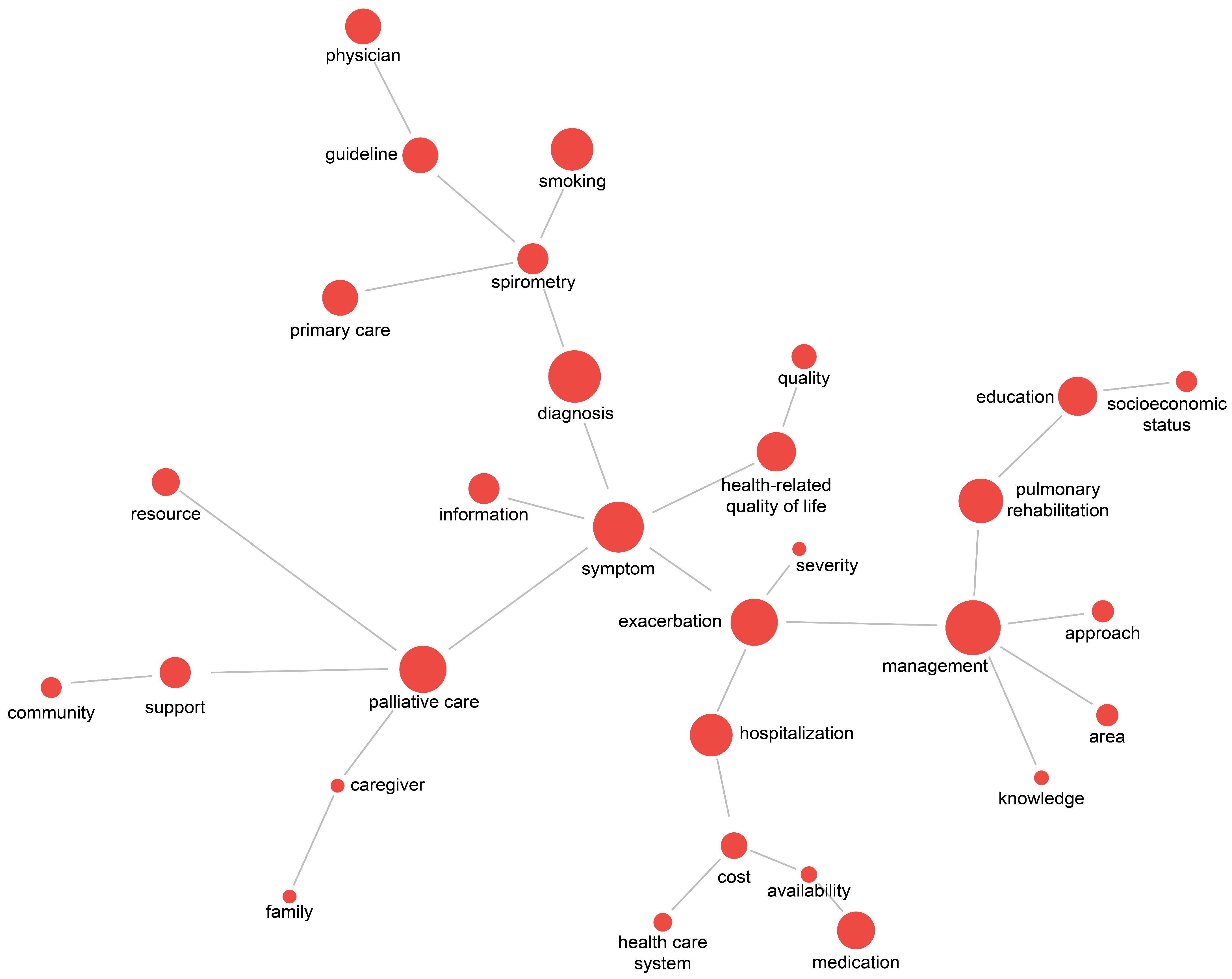
| Keyword | Frequency | Degree Centrality | Betweenness Centrality | Closeness Centrality |
|---|---|---|---|---|
| Management | 133 | 0.172 | 0.370 | 0.305 |
| Diagnosis | 114 | 0.069 | 0.296 | 0.305 |
| Symptom | 111 | 0.172 | 0.700 | 0.377 |
| Exacerbation | 110 | 0.138 | 0.628 | 0.367 |
| Palliative care | 102 | 0.138 | 0.315 | 0.305 |
| PR | 91 | 0.069 | 0.133 | 0.244 |
| Hospitalization | 80 | 0.069 | 0.246 | 0.293 |
| Smoking | 80 | 0.035 | 0.000 | 0.203 |
| Education | 76 | 0.069 | 0.069 | 0.200 |
| HRQoL | 75 | 0.069 | 0.069 | 0.282 |
| Medication | 74 | 0.035 | 0.000 | 0.166 |
| Primary care | 70 | 0.035 | 0.000 | 0.203 |
| Physician | 70 | 0.035 | 0.000 | 0.172 |
| Guideline | 68 | 0.069 | 0.069 | 0.206 |
| Information | 65 | 0.035 | 0.000 | 0.276 |
| Support | 65 | 0.069 | 0.069 | 0.240 |
| Spirometry | 63 | 0.138 | 0.259 | 0.252 |
| Resource | 62 | 0.035 | 0.000 | 0.236 |
| Cost | 55 | 0.103 | 0.197 | 0.240 |
| Quality | 51 | 0.035 | 0.000 | 0.221 |
| Approach | 50 | 0.035 | 0.000 | 0.236 |
| Area | 50 | 0.035 | 0.000 | 0.236 |
| Community | 50 | 0.035 | 0.000 | 0.195 |
| SES | 49 | 0.035 | 0.000 | 0.168 |
| Healthcare system | 47 | 0.035 | 0.000 | 0.195 |
| Availability | 46 | 0.069 | 0.069 | 0.197 |
| Knowledge | 45 | 0.035 | 0.000 | 0.236 |
| Severity | 43 | 0.035 | 0.000 | 0.271 |
| Caregiver | 43 | 0.069 | 0.069 | 0.240 |
| Family | 43 | 0.035 | 0.000 | 0.195 |
| Title | Top Keywords (Probability) | Healthcare Access | |
|---|---|---|---|
| Topic 1 | Socioeconomic Inequalities in COPD Outcomes | SES (0.044) hospitalization (0.039) primary care (0.012) residence (0.009) predictor (0.009) insurance (0.008) smoking (0.008) | Availability Accessibility Affordability |
| Topic 2 | Early Diagnosis and Symptom Management | exacerbation (0.059) diagnosis (0.040) symptom (0.032) smoking (0.030) spirometry (0.030) guideline (0.020) primary care (0.012) | Availability Acceptability |
| Topic 3 | Guideline-Based Information and Technology Use | management (0.023) physician (0.021) guideline (0.015) adherence (0.013) information (0.012) mobile Health (0.012) technology (0.011) | Acceptability Accommodation |
| Topic 4 | Integrated Care for Advanced COPD | palliative care (0.063) caregiver (0.022) symptom (0.016) support (0.015) HRQoL (0.014) management (0.013) breathlessness (0.011) | Availability Accommodation Acceptability |
| Topic 5 | Improving Access to Pulmonary Rehabilitation | PR (0.162) referral (0.020) exacerbation (0.017) cost (0.016) exercise (0.013) hospitalization (0.013) benefit (0.012) | Availability Accessibility Accommodation Affordability |
| Topic 6 | Availability and Equity of COPD Medications | medication (0.048) availability (0.027) medicine (0.026) LMICs (0.012) region (0.011) affordability (0.011) cost (0.010) | Availability Affordability |
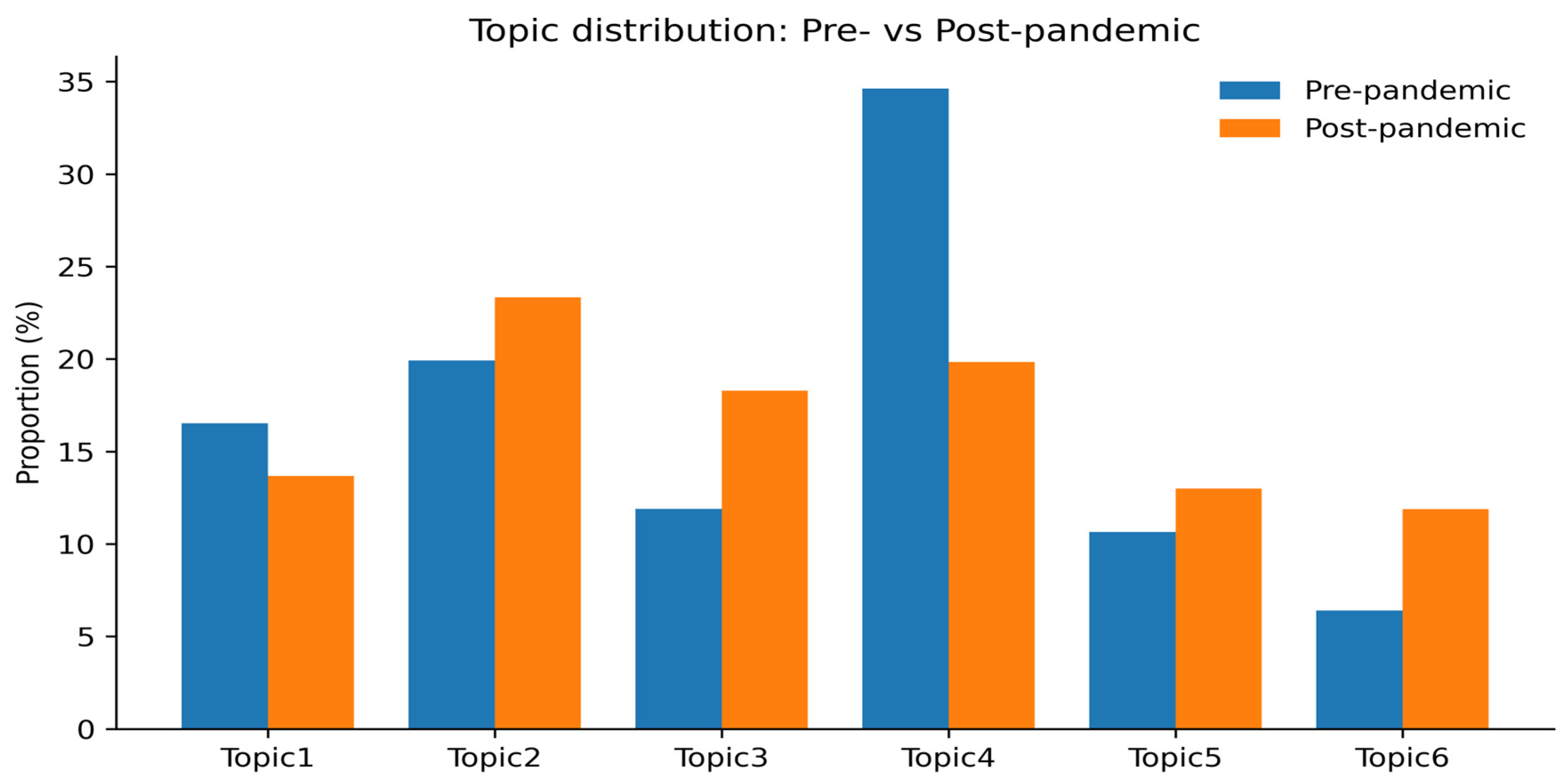
| Pre-Pandemic n (%) | Post-Pandemic n (%) | Total n (%) | χ2 (p) | |
|---|---|---|---|---|
| Topic 1 | 40 (15.7) | 25 (12.8) | 65 (15.3) | 12.50 (0.029) |
| Topic 2 | 50 (19.6) | 42 (21.4) | 92 (21.4) | |
| Topic 3 | 34 (13.3) | 38 (19.4) | 72 (14.7) | |
| Topic 4 | 82 (32.2) | 40 (20.4) | 122 (28.2) | |
| Topic 5 | 32 (12.6) | 28 (14.3) | 60 (11.6) | |
| Topic 6 | 17 (6.7) | 23 (11.7) | 40 (8.8) |
Disclaimer/Publisher’s Note: The statements, opinions and data contained in all publications are solely those of the individual author(s) and contributor(s) and not of MDPI and/or the editor(s). MDPI and/or the editor(s) disclaim responsibility for any injury to people or property resulting from any ideas, methods, instructions or products referred to in the content. |
© 2025 by the authors. Licensee MDPI, Basel, Switzerland. This article is an open access article distributed under the terms and conditions of the Creative Commons Attribution (CC BY) license.
Share and Cite
Yun, S.Y.; Song, M.O. Unmet Healthcare Needs in COPD: A Text Network Analysis and Topic Modeling of Pre/Post-COVID-19 Research Trends. Healthcare 2026, 14, 82. https://doi.org/10.3390/healthcare14010082
Yun SY, Song MO. Unmet Healthcare Needs in COPD: A Text Network Analysis and Topic Modeling of Pre/Post-COVID-19 Research Trends. Healthcare. 2026; 14(1):82. https://doi.org/10.3390/healthcare14010082
Chicago/Turabian StyleYun, So Young, and Mi Ok Song. 2026. "Unmet Healthcare Needs in COPD: A Text Network Analysis and Topic Modeling of Pre/Post-COVID-19 Research Trends" Healthcare 14, no. 1: 82. https://doi.org/10.3390/healthcare14010082
APA StyleYun, S. Y., & Song, M. O. (2026). Unmet Healthcare Needs in COPD: A Text Network Analysis and Topic Modeling of Pre/Post-COVID-19 Research Trends. Healthcare, 14(1), 82. https://doi.org/10.3390/healthcare14010082