Digitally Enabled Discharge Quality After Neurosurgical Traumatic Brain Injury: A 10-Year Cohort from a Brazilian Public Tertiary Center

 ,
,  , , and
Highlights
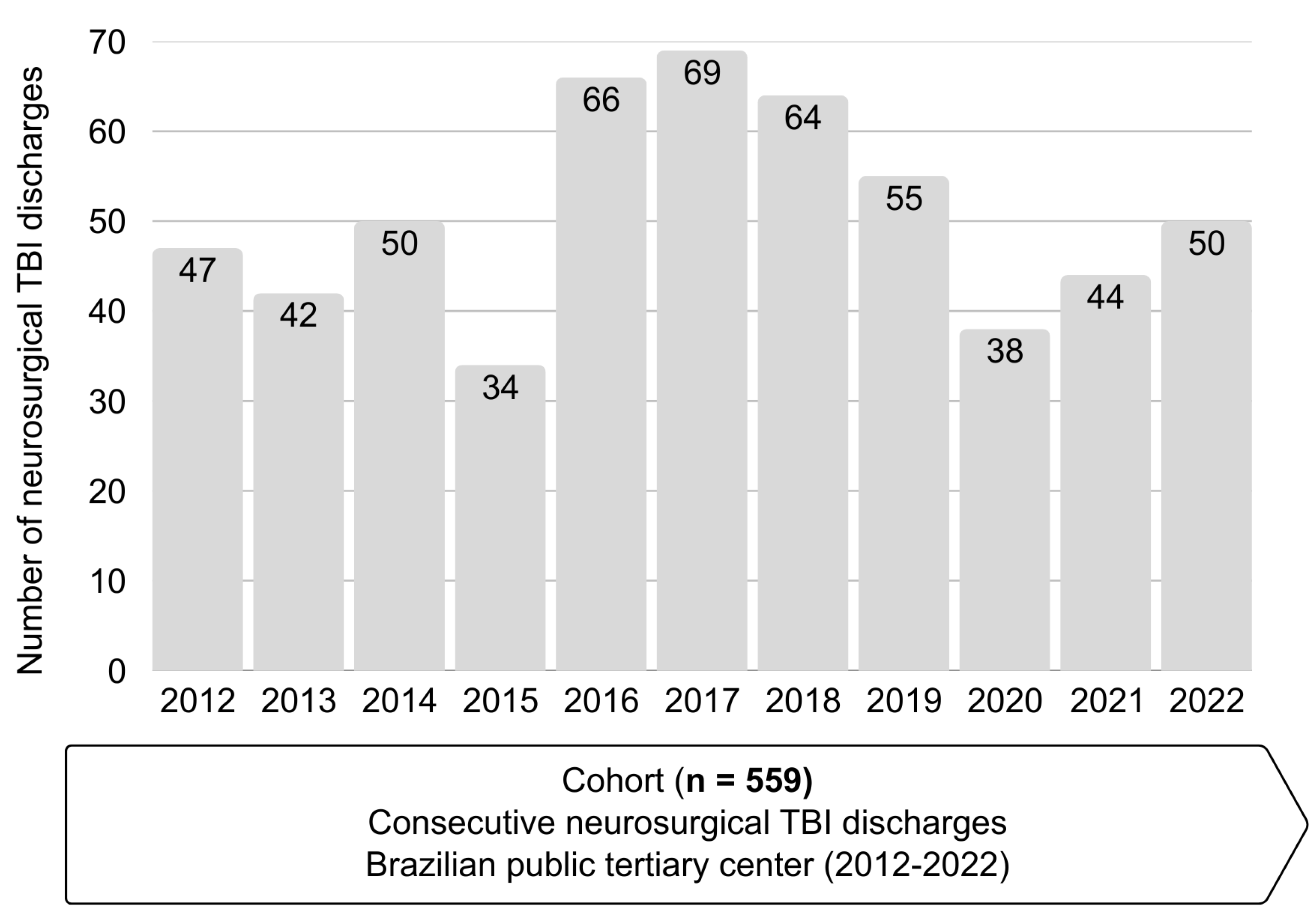
- In a 10-year cohort of 559 neur
- surgical TBI discharges at a Brazilian public tertiary center, warning sign counseling was documented in 16.1% (95% CI 13.2–19.5) and palliative care referrals were 0%.
- EHR documentation exposed specific, digitally fixable gaps in the discharge process that can be measured as process quality indicators.
- EHR discharge order sets with mandatory fields, CDS prompts for palliative care screening, and QR-coded patient handouts can standardize counseling and trigger appropriate referrals.
- The low, precisely estimated baseline provides a pragmatic target for quality improvement and a monitorable metric for resource-constrained hospitals.
Abstract
1. Introduction
2. Materials and Methods
2.1. Study Design and Setting
2.2. Participants
2.3. Data Sources and Variables
2.4. Outcomes
2.5. Statistical Analysis
2.6. Software and Reproducibility
2.7. Use of Generative AI
2.8. Ethics
3. Results
3.1. Cohort Characteristics
3.2. Discharge Process Quality
3.3. Table and Figure
4. Discussion
5. Conclusions
Author Contributions
Funding
Institutional Review Board Statement
Informed Consent Statement
Data Availability Statement
Acknowledgments
Conflicts of Interest
References
- James, S.L.; Theadom, A.; Ellenbogen, R.G.; Bannick, M.S.; Montjoy-Venning, W.; Lucchesi, L.R.; Abbasi, N.; Abdulkader, R.; Abraha, H.N.; Adsuar, J.C.; et al. Global, regional, and national burden of traumatic brain injury and spinal cord injury, 1990–2016. Lancet Neurol. 2019, 18, 56–87. [Google Scholar] [CrossRef]
- Maas, A.I.R.; Menon, D.K.; Manley, G.T.; Abrams, M.; Åkerlund, C.; Andelic, N.; Aries, M.; Bashford, T.; Bell, M.J.; Bodien, Y.G.; et al. Traumatic brain injury: Progress and challenges in prevention, clinical care, and research. Lancet Neurol. 2022, 21, 1004–1060. [Google Scholar] [CrossRef] [PubMed]
- Dewan, M.C.; Rattani, A.; Gupta, S.; Baticulon, R.E.; Hung, Y.-C.; Punchak, M.; Agrawal, A.; Adeleye, A.O.; Shrime, M.G.; Rubiano, A.M.; et al. Estimating the global incidence of traumatic brain injury. J. Neurosurg. 2018, 130, 1080–1097. [Google Scholar] [CrossRef]
- Coleman, E.A. Falling through the cracks: Challenges and opportunities for improving transitional care. J. Am. Geriatr. Soc. 2003, 51, 549–555. [Google Scholar] [CrossRef] [PubMed]
- Agency for Healthcare Research and Quality (AHRQ). Strategy 4: Care Transitions from Hospital to Home (IDEAL Discharge Planning). 2020. Available online: https://www.ahrq.gov/patient-safety/patients-families/engagingfamilies/strategy4/index.html (accessed on 6 November 2025).
- National Institute for Health and Care Excellence (NICE). Head Injury: Assessment and Early Management (NG232); Recommendation 1.10 (Discharge Advice); National Institute for Health and Care Excellence (NICE): London, UK, 2023; Available online: https://www.nice.org.uk/guidance/ng232 (accessed on 6 November 2025).
- American College of Surgeons (ACS). Trauma Quality Programs Best Practices Guidelines: Geriatric Trauma/Transitions of Care; ACS: Chicago, IL, USA, 2023. Available online: https://www.facs.org/media/ubyj2ubl/best-practices-guidelines-geriatric-trauma.pdf (accessed on 6 November 2025).
- Jack, B.W.; Chetty, V.K.; Anthony, D.; Greenwald, J.L.; Sanchez, G.M.; Johnson, A.E.; Forsythe, S.R.; O’Donnell, J.K.; Paasche-Orlow, M.K.; Manasseh, C.; et al. A reengineered hospital discharge program to decrease readmissions. Ann. Intern. Med. 2009, 150, 178–187. [Google Scholar] [CrossRef]
- Kripalani, S.; LeFevre, F.; Phillips, C.O.; Williams, M.V.; Basaviah, P.; Baker, D.W. Deficits in communication and information transfer between hospital-based and primary care physicians. JAMA 2007, 297, 831–841. [Google Scholar] [CrossRef]
- Mehta, R.L.; Pauly, R.P.; Chan, C.T.; Vercaigne, L.M.; Gauthier, T.P.; Perl, J.; Pierratos, A.; Silver, S.A.; Nesrallah, G.E.; Copland, M.; et al. Assessing the impact of introducing an electronic discharge summary system. BMC Health Serv. Res. 2017, 17, 624. [Google Scholar] [CrossRef]
- Schnipper, J.L.; Hamann, C.; Ndumele, C.D.; Liang, C.L.; Carty, M.G.; Karson, A.S.; Bhan, I.; Coley, C.M.; Poon, E.G.; Turchin, A.; et al. Effect of an electronic medication reconciliation application and process redesign on potential adverse drug events: A cluster-randomized trial. Arch. Intern. Med. 2009, 169, 771–780. [Google Scholar] [CrossRef]
- Davies, G.; Kean, S.; Chattopadhyay, I. Improving the quality of electronic discharge summaries from medical wards: A quality improvement project. Future Healthc. J. 2021, 8, e113–e116. [Google Scholar] [CrossRef]
- Powers, E.M.; Shiffman, R.N.; Melnick, E.R.; Hickner, A.; Sharifi, M. Efficacy and unintended consequences of hard-stop alerts in EHR systems: A systematic review. J. Am. Med. Inform. Assoc. 2018, 25, 1556–1561. [Google Scholar] [CrossRef] [PubMed]
- Bright, T.J.; Wong, A.; Dhurjati, R.; Bristow, E.; Bastian, L.; Coeytaux, R.R.; Samsa, G.; Hasselblad, V.; Williams, J.W.; Musty, M.D.; et al. Effect of clinical decision-support systems: A systematic review. Ann. Intern. Med. 2012, 157, 29–43. [Google Scholar] [CrossRef]
- Bates, D.W.; Saria, S.; Ohno-Machado, L.; Shah, A.; Escobar, G. Big data in health care: Using analytics to identify and manage high-risk and high-cost patients. Health Aff. 2014, 33, 1123–1131. [Google Scholar] [CrossRef] [PubMed]
- Oh, S.; Choi, H.; Oh, E.G.; Lee, J.Y. Effectiveness of discharge education using teach-back method on readmission among heart failure patients: A systematic review and meta-analysis. Patient Educ. Couns. 2023, 107, 107559. [Google Scholar] [CrossRef]
- Ma, G.; Jiang, P.; Miao, C.; Huang, Y.; Li, H.; Zhao, Y. Association between pre-hospital e-education via QR code and hospital stay in inguinal hernia patients undergoing general anaesthesia: A retrospective study. J. Multidiscip. Healthc. 2024, 17, 6131–6142. [Google Scholar] [CrossRef] [PubMed]
- Jesus, T.S.; Stern, B.Z.; Lee, D.; Zhang, M.; Struhar, J.; Heinemann, A.W.; Jordan, N.; Deutsch, A. Systematic review of contemporary interventions for improving discharge support and transitions of care from the patient experience perspective. PLoS ONE 2024, 19, e0299176. [Google Scholar] [CrossRef] [PubMed]
- Callen, J.L.; Alderton, M.; McIntosh, J. Evaluation of electronic discharge summary systems—A literature review. Int. J. Med. Inform. 2008, 77, 613–620. [Google Scholar] [CrossRef]
- Tremoulet, P.D.; Shah, P.D.; Acosta, A.A.; Grant, C.W.; Kurtz, J.T.; Mounas, P.; Kirchhoff, M.; Wade, E. Usability of Electronic Health Record–Generated Discharge Summaries: Heuristic Evaluation. J. Med. Internet Res. 2021, 23, e25657. [Google Scholar] [CrossRef]
- Cam, H.; Aydin, A.; Erdogan, A. Communication at hospital discharge of older patients: A qualitative study. BMC Health Serv. Res. 2023, 23, 1112. [Google Scholar] [CrossRef]
- Patra, K.P.; Jeus, O. Sentinel events. In StatPearls; StatPearls Publishing: Treasure Island, FL, USA, 2023. [Google Scholar]
- Clopper, C.J.; Pearson, E.S. The use of confidence or fiducial limits illustrated in the case of the binomial. Biometrika 1934, 26, 404–413. [Google Scholar] [CrossRef]
- Brown, L.D.; Cai, T.T.; DasGupta, A. Interval estimation for a binomial proportion. Stat. Sci. 2001, 16, 101–133. [Google Scholar] [CrossRef]
- Weissman, D.E.; Meier, D.E. Identifying patients in need of a palliative care assessment in the hospital setting. J. Palliat. Med. 2011, 14, 17–23. [Google Scholar] [CrossRef] [PubMed]
- Downar, J.; Goldman, R.; Pinto, R.; Englesakis, M.; Adhikari, N.K. The “surprise question” and identification of palliative care needs among seriously ill patients. CMAJ 2017, 189, E484–E493. [Google Scholar] [CrossRef]
- Courtright, K.R.; Madden, V.; Bayes, B.; Chowdhury, M.; Whitman, C.; Small, D.S.; Harhay, M.O.; Parra, S.; Cooney-Zingman, E.; Ersek, M.; et al. Default palliative care consultation for seriously ill hospitalized patients: A pragmatic cluster randomized trial. JAMA 2024, 331, 224–232. [Google Scholar] [CrossRef]
- Earl, T.; Katapodis, N.; Schneiderman, S. Care Transitions. In Making Healthcare Safer III: A Critical Analysis of Existing and Emerging Patient Safety Practices; Agency for Healthcare Research and Quality: Rockville, MD, USA, 2020. Available online: https://www.ncbi.nlm.nih.gov/books/NBK555526/pdf/Bookshelf_NBK555526.pdf (accessed on 6 November 2025).
- Centers for Disease Control and Prevention (CDC). Traumatic Brain Injury & Concussion: Discharge Instructions (Adults); CDC: Atlanta, GA, USA, 2021. Available online: https://www.cdc.gov/traumaticbraininjury/pdf/tbi_patient_instructions-a.pdf (accessed on 6 November 2025).
- Kwok, R.; Dinh, M.; Dinh, D.; Chu, M. Improving adherence to asthma clinical guidelines and discharge documentation from emergency departments: Implementation of a dynamic and integrated electronic decision support system. Emerg. Med. Australas. 2009, 21, 31–37. [Google Scholar] [CrossRef]
- Patterson, B.W.; Pulia, M.S.; Ravi, S.; Hoonakker, P.L.T.; Schoofs Hundt, A.; Wiegmann, D.; Wirkus, E.J.; Johnson, S.; Carayon, P. Scope and influence of electronic health record-integrated clinical decision support in the emergency department: A systematic review. Ann. Emerg. Med. 2019, 74, 285–296. [Google Scholar] [CrossRef] [PubMed]
- Muhindo, M.K.; Bress, J.; Kalanda, R.; Armas, J.; Danziger, E.; Kamya, M.R.; Butler, L.M.; Ruel, T.D. Implementation of a newborn clinical decision support software (NoviGuide) in a rural district hospital in Eastern Uganda: Feasibility and acceptability study. JMIR Mhealth Uhealth 2021, 9, e23737. [Google Scholar] [CrossRef] [PubMed]


| Characteristic | Value | |
|---|---|---|
| Demographics | Age, years, median (IQR) | 66.0 (47.0–79.5) |
| Age, years, mean (SD) | 61.0 (23.1) | |
| Male sex, % | 78.5 | |
| Care under SUS, % | 93.2 | |
| Principal diagnosis | Subdural hematoma (SDH), % | 61.2 |
| Epidural/extradural hematoma (EDH), % | 14.9 | |
| Other TBI presentations, % | 10.0 | |
| Procedures | Hematoma drainage, % | 82.2 |
| Decompressive craniotomy/craniectomy, % | 18.9 | |
| Discharge process | Warning sign counseling documented, % (n/N; 95% CI) | 16.1 (89/559; 13.2–19.5) |
| Palliative care referral documented, % (n/N) | 0.0 (0/559) | |
Disclaimer/Publisher’s Note: The statements, opinions and data contained in all publications are solely those of the individual author(s) and contributor(s) and not of MDPI and/or the editor(s). MDPI and/or the editor(s) disclaim responsibility for any injury to people or property resulting from any ideas, methods, instructions or products referred to in the content. |
© 2025 by the authors. Licensee MDPI, Basel, Switzerland. This article is an open access article distributed under the terms and conditions of the Creative Commons Attribution (CC BY) license.
Share and Cite
Guimarães, R.S.S.; Guimarães, V.R.; Barros, C.M.; Brigagão, M.R.P.L.; Rego, F. Digitally Enabled Discharge Quality After Neurosurgical Traumatic Brain Injury: A 10-Year Cohort from a Brazilian Public Tertiary Center. Healthcare 2026, 14, 32. https://doi.org/10.3390/healthcare14010032
Guimarães RSS, Guimarães VR, Barros CM, Brigagão MRPL, Rego F. Digitally Enabled Discharge Quality After Neurosurgical Traumatic Brain Injury: A 10-Year Cohort from a Brazilian Public Tertiary Center. Healthcare. 2026; 14(1):32. https://doi.org/10.3390/healthcare14010032
Chicago/Turabian StyleGuimarães, Roberto Salvador Souza, Victoria Ragognete Guimarães, Carlos Marcelo Barros, Maísa Ribeiro Pereira Lima Brigagão, and Francisca Rego. 2026. "Digitally Enabled Discharge Quality After Neurosurgical Traumatic Brain Injury: A 10-Year Cohort from a Brazilian Public Tertiary Center" Healthcare 14, no. 1: 32. https://doi.org/10.3390/healthcare14010032
APA StyleGuimarães, R. S. S., Guimarães, V. R., Barros, C. M., Brigagão, M. R. P. L., & Rego, F. (2026). Digitally Enabled Discharge Quality After Neurosurgical Traumatic Brain Injury: A 10-Year Cohort from a Brazilian Public Tertiary Center. Healthcare, 14(1), 32. https://doi.org/10.3390/healthcare14010032