


Inclusion in Neglected Tropical Disease Programmes: A Review of Inclusive Approaches for Control and Elimination
 ,
,
Abstract
1. Introduction
1.1. Objective
- Define the Concept: To provide a clear and comprehensive definition of inclusion as it relates to NTDs, considering the various components and dimensions of the concept. Additionally, consider the cross sections of disability inclusion within NTD programming as well as the intersectionality between disability inclusion and NTDs.
- Explore the Dimensions: Examine the different dimensions of inclusion, including but not limited to access to healthcare, social participation, gender equity, and their interplay in the context of NTDs.
- Identify Research Gaps: Identify gaps in the existing literature, highlighting areas where further research is needed to advance the understanding of inclusion in NTD programmes and policies.
1.2. Significance
2. Methodology
2.1. Search Strategy
2.2. Screening and Eligibility
2.3. Data Extraction and Synthesis
2.4. Ethical Considerations
3. Results and Findings
3.1. Social and Economic Inequalities in NTD Programmes
3.1.1. Racism
3.1.2. Poverty
3.1.3. Displacement
3.2. Gender Equity in NTD Programmes
3.3. Inclusion in Intervention Delivery and Health System Integration
3.4. Inclusion in Health Systems to Combat NTDs
3.5. Inclusion of Community Members in NTD Programmes
4. Discussion
Practical Implementation of Inclusion in NTD Programming
5. Limitations
Recommendations for Future Research
6. Conclusions
Author Contributions
Funding
Institutional Review Board Statement
Informed Consent Statement
Data Availability Statement
Conflicts of Interest
Abbreviations
| CDD | Community Directed Distributers |
| CSO | Civil Society Organization |
| DMDI | Disease Management, Disability, and Inclusion |
| MDA | Mass Drug Administration |
| NTDs | Neglected Tropical Diseases |
| SDGs | Sustainable Development Goals |
References
- World Health Organization. A Road Map for Neglected Tropical Diseases 2021–2030; WHO: Geneva, Switzerland, 2021; Available online: https://www.who.int/publications/i/item/9789240010352 (accessed on 9 June 2025).
- Hotez, P.J. What Constitutes a Neglected Tropical Disease? PLoS Neglected Trop. Dis. 2020, 14, e0008001. [Google Scholar] [CrossRef] [PubMed]
- Branda, F.; Ali, A.Y.; Ceccarelli, G.; Albanese, M.; Binetti, E.; Giovanetti, M.; Ciccozzi, M.; Scarpa, F. Assessing the Burden of Neglected Tropical Diseases in Low-Income Communities: Challenges and Solutions. Viruses 2025, 17, 29. [Google Scholar] [CrossRef]
- World Health Organization. Neglected Tropical Diseases—Key Facts; WHO: Geneva, Switzerland, 2024; Available online: https://www.who.int/health-topics/neglected-tropical-diseases#tab=tab_1 (accessed on 9 June 2025).
- Reed, S.L.; McKerrow, J.H. Why Funding for Neglected Tropical Diseases Should Be a Global Priority. Clin. Infect. Dis. 2018, 67, 323–326. [Google Scholar] [CrossRef]
- Houweling, T.A.; Karim-Kos, H.E.; Kulik, M.C.; Stolk, W.A.; Haagsma, J.A.; Lenk, E.J.; Richardus, J.H.; de Vlas, S.J. Socioeconomic Inequalities in Neglected Tropical Diseases: A Systematic Review. PLoS Neglected Trop. Dis. 2016, 10, e0004546. [Google Scholar] [CrossRef] [PubMed]
- Kuper, H. Neglected tropical diseases and disability-what is the link? Trans. R. Soc. Trop. Med. Hyg. 2019, 113, 839–844. [Google Scholar] [CrossRef] [PubMed]
- Kuper, H. Disability, mental health, stigma and discrimination, and neglected tropical diseases. Trans. R. Soc. Trop. Med. Hyg. 2020, 115, 145–146. [Google Scholar] [CrossRef]
- Koschorke, M.; Al-Haboubi, Y.H.; Tseng, P.-C.; Semrau, M.; Eaton, J. Mental health, stigma, and neglected tropical diseases: A review and systematic mapping of the evidence. Front. Trop. Dis. 2022, 3, 808955. [Google Scholar] [CrossRef]
- Kollmann, K.M.; Abrahamsson, S.; Jesudason, T. Why disability inclusion is essential for trachoma elimination. Community Eye Health J. 2020, 33, 10–11. [Google Scholar]
- Ochola, E.A.; Karanja, D.M.S.; Elliott, S.J. The impact of Neglected Tropical Diseases (NTDs) on health and wellbeing in sub-Saharan Africa (SSA): A case study of Kenya. PLoS Neglected Trop. Dis. 2021, 15, e0009131. [Google Scholar] [CrossRef]
- World Health Organization. Global Report on Health Equity for Persons with Disabilities; World Health Organization: Geneva, Switzerland, 2022; Available online: https://www.who.int/publications/i/item/9789240063600 (accessed on 9 June 2025).
- Dean, L.; Ozano, K.; Adekeye, O.; Dixon, R.; Fung, E.G.; Gyapong, M.; Isiyaku, S.; Kollie, K.; Kukula, V.; Lar, L.; et al. Neglected Tropical Diseases as a ‘litmus test’ for Universal Health Coverage? Understanding who is left behind and why in Mass Drug Administration: Lessons from four country contexts. PLoS Neglected Trop. Dis. 2019, 13, e0007847. [Google Scholar] [CrossRef]
- Braveman, P.; Gruskin, S. Defining equity in health. J. Epidemiol. Community Health 2003, 57, 254–258. [Google Scholar] [CrossRef]
- Cornwall, A. Unpacking ‘Participation’: Models, meanings and practices. Community Dev. J. 2008, 43, 269–283. [Google Scholar] [CrossRef]
- World Health Organization. Disability and Health Fact Sheet; World Health Organization: Geneva, Switzerland, 2023; Available online: https://www.who.int/news-room/fact-sheets/detail/disability-and-health (accessed on 9 June 2025).
- Sun, N.; Amon, J.J. Addressing Inequity: Neglected Tropical Diseases and Human Rights. Health Hum. Rights 2018, 20, 11–25. Available online: https://pubmed.ncbi.nlm.nih.gov/30008549/ (accessed on 9 June 2025).
- Trachoma Coalition. Reaching the Furthest Behind First: Disability Inclusion Essential to Universal Trachoma Programmes; Trachoma Coalition: London, UK, 2020. [Google Scholar]
- CBM Global. Mental Health of People with NTDs: Towards a Person-Centred Approach; CBM Global: Hamburg, Germany, 2022. [Google Scholar]
- United Nations. Leave No One Behind: Inclusion of Persons with Disabilities in the 2030 Agenda for Sustainable Development; UN Department of Economic and Social Affairs: New York, NY, USA, 2019; Available online: https://www.un.org/development/desa/disabilities/ (accessed on 9 June 2025).
- World Bank. Disability Inclusion Overview; World Bank: Washington, DC, USA, 2024; Available online: https://www.worldbank.org/en/topic/disability (accessed on 10 June 2025).
- United Nations Enable. Factsheet on Persons with Disabilities; United Nations: New York, NY, USA, 2021. Available online: https://www.un.org/development/desa/disabilities/resources/factsheet-on-persons-with-disabilities.html (accessed on 10 June 2025).
- UN Sustainable Development Group. Leave no One Behind: A UN Framework for the 2030 Agenda; United Nations: New York, NY, USA, 2016. [Google Scholar]
- Sukhera, J. Narrative Reviews: Flexible, Rigorous, and Practical. J. Grad. Med. Educ. 2022, 14, 414–419. [Google Scholar] [CrossRef]
- Kaushik, P.; Pati, P.K.; Khan, M.L.; Khare, P.K. Flow Diagram for Systematic Literature Review Using SALSA Framework. Environ. Sci. Policy 2022, 130, 55–64. [Google Scholar]
- Greenhalgh, T.; Thorne, S.; Malterud, K. Time to challenge the spurious hierarchy of systematic over narrative reviews? Eur. J. Clin. Investig. 2018, 48, e12931. [Google Scholar] [CrossRef] [PubMed]
- Ferrari, R. Writing narrative-style literature reviews. Med. Writ. 2015, 24, 230–235. [Google Scholar] [CrossRef]
- da Conceição, J.R.; Lopes, C.P.G.; Ferreira, E.I.; Epiphanio, S.; Giarolla, J. Neglected Tropical Diseases and Systemic Racism, Especially in Brazil: From Socio-Economic Aspects to the Development of New Drugs. Acta Trop. 2022, 235, 106654. [Google Scholar] [CrossRef]
- Simionato de Assis, I.; Arcoverde, M.A.M.; Ramos, A.C.V.; Alves, L.S.; Berra, T.Z.; Arroyo, L.H.; Queiroz, A.A.R.D.; Santos, D.T.D.; Belchior, A.D.S.; Alves, J.D.; et al. Social Determinants, Their Relationship with Leprosy Risk and Temporal Trends in a Tri-Border Region in Latin America. PLoS Neglected Trop. Dis. 2018, 12, e0006407. [Google Scholar] [CrossRef]
- Dyal, J.W.; Grant, M.P.; Broadwater, K.; Bjork, A.; Waltenburg, M.A.; Gibbins, J.D.; Hale, C.; Silver, M.; Fischer, M.; Steinberg, J.; et al. COVID-19 Among Workers in Meat and Poultry Processing Facilities—19 States, April 2020. MMWR Morb. Mortal. Wkly. Rep. 2020, 69, 557–561. [Google Scholar] [CrossRef] [PubMed]
- Mackey, T.K.; Ayers, C.K.; Kondo, K.K.; Saha, S.; Advani, S.M.; Young, S.D.; Spencer, H.; Rusek, M.; Anderson, J.; Veazie, S.; et al. Racial and Ethnic Disparities in COVID-19-Related Infections, Hospitalizations, and Deaths: A Systematic Review. Ann. Intern. Med. 2021, 174, 362–373. [Google Scholar] [CrossRef] [PubMed]
- Minority Rights Group; Vidas Negras com Deficiência Importam. The Situation of Black People with Disabilities in Brazil; Minority Rights Group: London, UK; VNDI: São Paulo, Brazil, 2022. [Google Scholar]
- Polack, S.; Delgado Ramos, V.; Sepúlveda Köptcke, L.; de Araujo Morais, I.; Reichenberger, V.; Scherer, N.; Veloso de Albuquerque, M.D.S.; Kuper, H.; Lyra, T.M.; Moran de Brito, C.M. Disability Inclusion in the Brazilian Health System: Results of a Health System Assessment. Glob. Health Action 2025, 18, 2550793. [Google Scholar] [CrossRef] [PubMed]
- Clark, J.; Davis, E.L.; Prada, J.M.; Gass, K.; Krentel, A.; Hollingsworth, T.D. How Correlations Between Treatment Access and Surveillance Inclusion Impact Neglected Tropical Disease Monitoring and Evaluation—A Simulated Study. PLoS Neglected Trop. Dis. 2023, 17, e0011582. [Google Scholar] [CrossRef] [PubMed]
- Magalhães, A.R.; Codeço, C.T.; Svenning, J.-C.; Escobar, L.E.; Van de Vuurst, P.; Gonçalves-Souza, T. Neglected Tropical Diseases Risk Correlates with Poverty and Early Ecosystem Destruction. Infect. Dis. Poverty 2023, 12, 32. [Google Scholar] [CrossRef]
- Houweling, T.A.J.; Kristensen, T.K.; Dada, N.; D’Amico, G. Socio-Economic Inequality in Neglected Tropical Disease Risk. Trans. R. Soc. Trop. Med. Hyg. 2016, 110, 79–82. [Google Scholar]
- United Nations High Commissioner for Refugees. Working with Persons with Disabilities in Forced Displacement; UNHCR: Geneva, Switzerland, 2019. [Google Scholar]
- UNHCR. Guidance: Identification of Persons with Disabilities at Registration Using the Washington Group Questions; UNHCR: Geneva, Switzerland, 2022. [Google Scholar]
- Elmukashfi ShamsEldin Elobied, H.; Bushra Masaad Ahmed, M.; Balla Ahmed, A.M.; Abdelrahman Hassan Salih, R.; Mohammed Mokhtar Ahmed, S.; Mahgoub, A.M.A.; Hashim Abdelmagid Mohamed, A.; Hamid Abdallah Elamin, E.; Osman Khalafalla El-Haj, A.-R.M.; Hamed Abd-Allah, M.A.-H.; et al. Healthcare Accessibility, Utilisation and Quality of Life among Internally Displaced Persons in Somalia: A Cross-Sectional Study. Confl. Health 2025, 19, 11. [Google Scholar] [CrossRef]
- Kelley-Hope, L.; Harding-Esch, E.M.; Willems, J.; Ahmed, F.; Sanders, A.M. Conflict–Climate–Displacement: A Cross-Sectional Ecological Study Determining the Burden, Risk and Need for Strategies for Neglected Tropical Disease Programmes in Africa. BMJ Open 2023, 13, e071557. [Google Scholar] [CrossRef]
- Harvey, D.; Shu’aibu, J.; Debam, M.T.; Aba, A.K.; Torres-Vitolas, C.A. How can the neglected tropical disease community be inclusive and equitable in programme delivery? Reaching refugees and internally displaced persons through integrating a ‘leave no one behind’ approach. Int. Health 2022, 14, ii33–ii37. [Google Scholar] [CrossRef]
- Adams, M.W.; Sutherland, E.G.; Eckert, E.L.; Saalim, K.; Reithinger, R. Leaving no one behind: Targeting mobile and migrant populations with health interventions for disease elimination—A descriptive systematic review. BMC Med. 2022, 20, 172. [Google Scholar] [CrossRef]
- International Disability Alliance. Advancing Disability-Inclusive Strategies at the Global Refugee Forum; IDA: New York, NY, USA, 2023. [Google Scholar]
- Women’s Refugee Commission; UNHCR. Translating Disability-Inclusive Policy into Practice in Humanitarian Settings; WRC: New York, NY, USA, 2020; Available online: https://www.womensrefugeecommission.org/wp-content/uploads/2020/04/Disability-Inclusion-Translating-Policy-into-Practice-in-Humanitarian-Action.pdf (accessed on 9 June 2025).
- Rust, J.; Clark, A.; Woodgate, M.; Koch, C.; Mohammed, T.; Steinmann, P.; Krentel, A.; Torres-Vitolas, C.A.; Carlin, A.; Pavluck, A. Innovate to eliminate: A prerequisite in NTD programmes. Int. Health 2022, 14, ii20–ii24. [Google Scholar] [CrossRef]
- Elrha. Investing in Inclusive WASH: Examining Barriers and Value in Humanitarian Response; Elrha: London, UK, 2023. [Google Scholar]
- United Nations Children’s Fund (UNICEF). Including Children with Disabilities in Humanitarian Action: WASH; UNICEF: New York, NY, USA, 2022. [Google Scholar]
- Sangare, M.; Diabate, A.F.; Coulibaly, Y.I.; Tanapo, D.; Thera, S.O.; Dolo, H.; Dicko, I.; Coulibaly, O.; Sall, B.; Traore, F.; et al. Understanding the barriers and facilitators related to never treatment during mass drug administration among mobile and migrant populations in Mali: A qualitative exploratory study. BMJ Glob. Health 2024, 9, e015671. [Google Scholar] [CrossRef]
- Obani, P. Inclusiveness in Humanitarian Action: Access to Water, Sanitation and Hygiene for People with Disabilities. Int. J. Disaster Risk Reduct. 2023, 96, 104937. [Google Scholar] [CrossRef]
- Theobald, S.; MacPherson, E.E.; Dean, L.; Jacobson, J.; Ducker, C.; Gyapong, M.; Hawkins, K.; Elphick-Pooley, T.; MacKenzie, C.; Kelly-Hope, L.; et al. 20 years of gender mainstreaming in health: Lessons and reflections for the neglected tropical diseases community. BMJ Glob. Health 2017, 2, e000512. [Google Scholar] [CrossRef]
- Cohn, D.A.; Kelly, M.P.; Bhandari, K.; Zoerhoff, K.L.; Batcho, W.E.; Drabo, F.; Negussu, N.; Marfo, B.; Goepogui, A.; Lemoine, J.F.; et al. Gender equity in mass drug administration for neglected tropical diseases: Data from 16 countries. Int. Health 2019, 11, 370–378. [Google Scholar] [CrossRef] [PubMed]
- Rilkoff, H.; Tukahebwa, E.M.; Fleming, F.M.; Leslie, J.; Cole, D.C. Exploring Gender Dimensions of Treatment Programmes for Neglected Tropical Diseases in Uganda. PLoS Neglected Trop. Dis. 2013, 7, e2312. [Google Scholar] [CrossRef]
- Mushi, V. Implementation challenges of community directed treatment with ivermectin program for control of onchocerciasis in Ulanga, Tanzania. East Afr. Health Res. J. 2021, 5, 123–128. [Google Scholar] [CrossRef] [PubMed]
- University of Washington START Center. Neglected Tropical Diseases: Women and Girls in Focus; START Center: Seattle, WA, USA, 2021; Available online: http://uwstartcenter.org/projects/ntdwomenandgirls/ (accessed on 9 June 2025).
- World Health Organization. World Bank. In World Report on Disability; WHO: Geneva, Switzerland, 2011; Available online: https://www.who.int/teams/noncommunicable-diseases/sensory-functions-disability-and-rehabilitation/world-report-on-disability (accessed on 11 June 2025).
- Wharton-Smith, A.; Rassi, C.; Batisso, E.; Ortu, G.; King, R.; Endriyas, M.; Counihan, H.; Hamade, P.; Getachew, D. Gender-Related Factors Affecting Health Seeking for Neglected Tropical Diseases: Findings from a Qualitative Study in Ethiopia. PLoS Neglected Trop. Dis. 2019, 13, e0007840. [Google Scholar] [CrossRef]
- Geyer, R.E.; Ibikounlé, M.; Emmanuel-Fabula, M.; Roll, A.; Avokpaho, E.; Elijan, A.; Wèkè, L.C.; Togbevi, C.I.; Chabi, F.; Houngbégnon, P.; et al. Gender norms and mass deworming program access in Comé, Benin: A qualitative assessment of gender-associated opportunities and challenges to achieving high mass drug administration coverage. PLOS Neglected Trop. Dis. 2020, 14, e0008153. [Google Scholar] [CrossRef]
- Arney, J.K.; Headland, M.K.; Bertone, A.M.; Meite, A.; Ettiegne-Traore, V.; Asemanyi-Mensah, K.; Dede Teiko Dzathor, I.; Kargbo-Labour, I.; Jalloh, U.; Houck, P.; et al. Synthesis of findings from the literature and a qualitative research study on the impacts of gender, disability, and ethnicity in Neglected Tropical Diseases programs. PLoS Neglected Trop. Dis. 2023, 17, e0011782. [Google Scholar] [CrossRef]
- George, N.S.; David, S.C.; Nabiryo, M.; Sunday, B.A.; Olanrewaju, O.F.; Yangaza, Y.; Shomuyiwa, D.O. Addressing neglected tropical diseases in Africa: A health equity perspective. Glob. Health Res. Policy 2023, 8, 30. [Google Scholar] [CrossRef]
- Ochola, E.; Karanja, S.; Elliott, S. Local tips, global impact: Community-driven measures as avenues of inclusion for NTD control in western Kenya. Infect. Dis. Poverty 2022, 11, 65. [Google Scholar] [CrossRef]
- Piotrowski, H.; Gwani, N.; Yashiyi, J.; Oluwole, A.; Ayuba, S.; Surakat, M.; Adekeye, O.; Lar, L.; Kevin, D.G.; Lawong, B.D.; et al. Promoting equity through inclusive learning, planning and implementation of mass drug administration in Nigeria. Int. Health 2023, 15, i63–i74. [Google Scholar] [CrossRef]
- Dean, L.; Tolhurst, R.; Nallo, G.; Kollie, K.; Bettee, A.; Theobald, S. A health-systems journey towards more people-centred care: Lessons from neglected tropical disease programme integration in Liberia. Health Policy Plan. 2023, 38, 420–430. [Google Scholar] [CrossRef]
- World Health Organization. Collaboration for the Control of Neglected Tropical Diseases. 2024. Available online: https://www.who.int/teams/control-of-neglected-tropical-diseases/collaboration (accessed on 11 June 2025).
- Amazigo, U.; Leak, S.G.; Zoure, H.G.; Okoronkwo, C.; Diop Ly, M.; Isiyaku, S.; Crump, A.; Okeibunor, J.C.; Boatin, B. Community-directed distributors—The “foot soldiers” in the fight to end NTDs. PLoS Neglected Trop. Dis. 2021, 15, e0009588. [Google Scholar] [CrossRef] [PubMed]
- Banda, G.T.; Deribe, K.; Davey, G. How can we better integrate the prevention, treatment, control and elimination of neglected tropical diseases with other health interventions? A systematic review. BMJ Glob. Health 2021, 6, e006968. [Google Scholar] [CrossRef]
- World Health Organization. Ending NTDs Together Towards 2030: Progress Report; World Health Organization: Geneva, Switzerland, 2024. [Google Scholar]
- Research for Development (R4D). Mobilising Domestic Financing for Neglected Tropical Diseases: Five Lessons for Policy-Makers; R4D Policy Brief: Washington, DC, USA, 2022; Available online: https://r4d.org/blog/5-lessons-in-mobilizing-domestic-financing-for-ntds/ (accessed on 9 June 2025).
- Zongo, K.; Mberu, M.; Assefa, L.; Kucera, T.; Pappa, S.; Amin, A.; Sankar, G. Bridging the last mile: The critical role of local civil society in advancing equity and inclusion for neglected tropical diseases. Int. J. Infect. Dis. 2025, 152, 107789. [Google Scholar] [CrossRef]
- Alderton, D.L.; Ackley, C.; Trueba, M.L. The Psychosocial Impact of Skin-Neglected Tropical Diseases: A Scoping Review. Front. Trop. Dis. 2024, 5, 1421522. [Google Scholar] [CrossRef]
- CBM Global Disability Inclusion. Community-Based Peer Groups and Psychosocial Support in Humanitarian Settings; CBM Global: Bensheim, Germany, 2023; Available online: https://cbm-global.org/resource/community-mental-health-good-practice-guide-inclusive-mhpss-in-humanitarian-emergencies? (accessed on 11 June 2025).
- Seekles, M.L.; Kadima, J.K.; Ding, Y.; Bulambo, C.B.; Kim, J.J.; Kukola, J.K.; Omumbu, P.O.; Mulamba, R.M.; Nganda, M.; Ngenyibungi, S.M.; et al. Mental health, stigma and the quality of life of people affected by neglected tropical diseases of the skin in Kasai Province, Democratic Republic of the Congo: A sex-disaggregated analysis. Int. Health 2023, 15, iii28–iii36. [Google Scholar] [CrossRef]
- Nayak, P.K.; Mackenzie, C.D.; Agarwal, A.; van Wijk, R.; Mol, M.M.; Eaton, J.; Semrau, M.; Valle-Trabadelo, C.; Kaloiya, G.S.; Pratap, A.; et al. A new guide for basic psychological support for persons affected by neglected tropical diseases: A peer support tool suitable for persons with a diagnosis of leprosy and lymphatic filariasis. PLOS Neglected Trop. Dis. 2025, 19, e0011945. [Google Scholar] [CrossRef] [PubMed]
- Badu, E.; Murphy, R.; Agyemang, D.; Jolley, E. Ghana Disability Data Disaggregation Pilot Project: Results of Integrating Disability into Routine Data Collection Systems; Sightsavers: Mumbai, India, 2018. [Google Scholar] [CrossRef]
- Krentel, A.; Gyapong, M.; Mallya, S.; Boadu, N.Y.; Amuyunzu-Nyamongo, M.; Stephens, M.; McFarland, D.A. Review of the factors influencing the motivation of community drug distributors towards the control and elimination of neglected tropical diseases (NTDs). PLoS Neglected Trop. Dis. 2017, 11, e0006065. [Google Scholar] [CrossRef] [PubMed]
- Worrell, C.M.; Brant, T.A.; Javel, A.; Denis, E.; Fayette, C.; Monestime, F.; Knowles, E.; Bennett, C.; Utzinger, J.; Odermatt, P.; et al. Microplanning improves stakeholders’ perceived capacity and engagement to implement lymphatic filariasis mass drug administration. PLoS Neglected Trop. Dis. 2025, 19, e0012105. [Google Scholar] [CrossRef]
- The Guardian. ‘Some of These Diseases Are in the Bible’: Despair as Cuts Halt Progress on Neglected Tropical Diseases. 9 April 2025. Available online: https://www.theguardian.com/global-development/2025/apr/09/despair-as-cuts-halt-progress-on-neglected-tropical-diseases-usaid (accessed on 11 June 2025).
- Baethge, C.; Goldbeck-Wood, S.; Mert95ens, S. SANRA—A scale for the quality assessment of narrative review articles. Res. Integr. Peer Rev. 2019, 4, 5. [Google Scholar] [CrossRef] [PubMed]
- van Wijk, R.; Baudoin, S.J.M.; Ejiogu, B.; Regmi, U.; Duck, M.; Rabiu, I.; Vettel, C.; Broekkamp, H.; Geutjes, R.; Peters, R.M.H.; et al. From words to action: The development of the Neglected Tropical Disease Inclusion Score Card (NISC). Infect. Dis. Poverty 2025, 14, 80. [Google Scholar] [CrossRef] [PubMed]
- Hotopf, I.; Chowdhury, S.; Robert, G.; Sellers, M.E.; Phillip, M.; Fastenau, A.; del Mar Marais, M.; Vettel, C.; Rahman, M.; Singh, R.K.; et al. Community-based models for neglected tropical diseases affecting the skin: A scoping review. Front. Trop. Dis. 2025, 6, 1544842. [Google Scholar] [CrossRef]
- Grant, M.J.; Booth, A. A typology of reviews: An analysis of 14 review types and associated methodologies. Health Inf. Libr. J. 2009, 26, 91–108. [Google Scholar] [CrossRef]
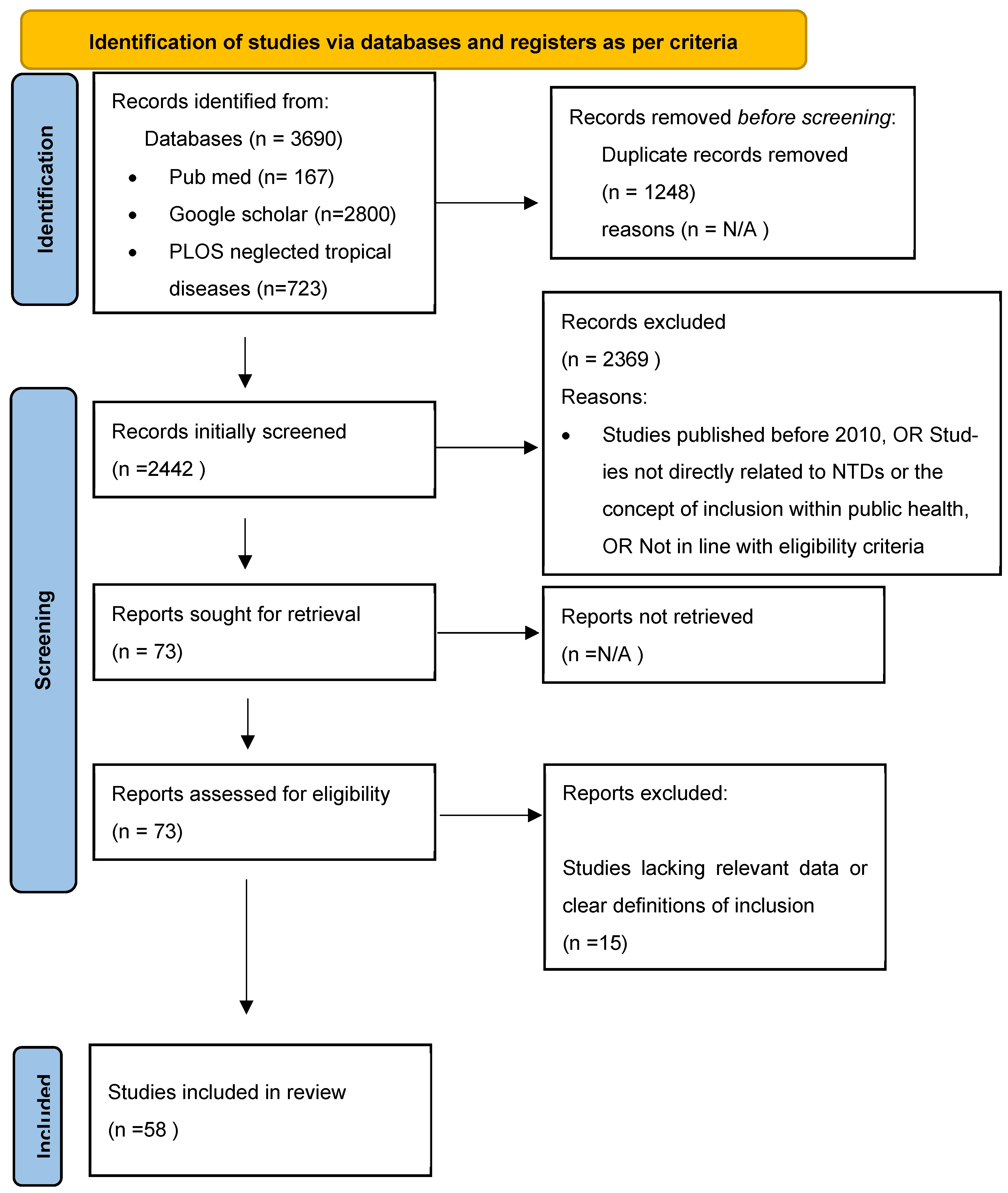
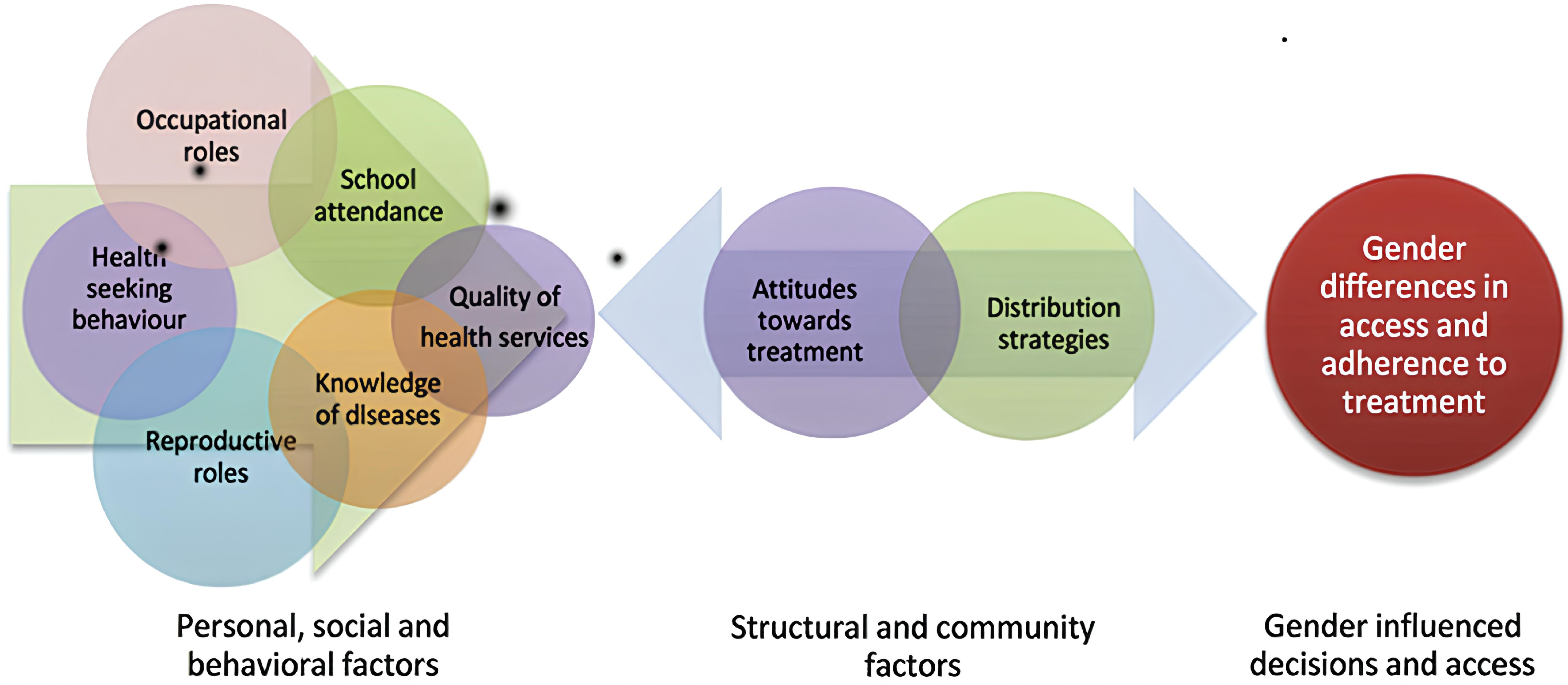
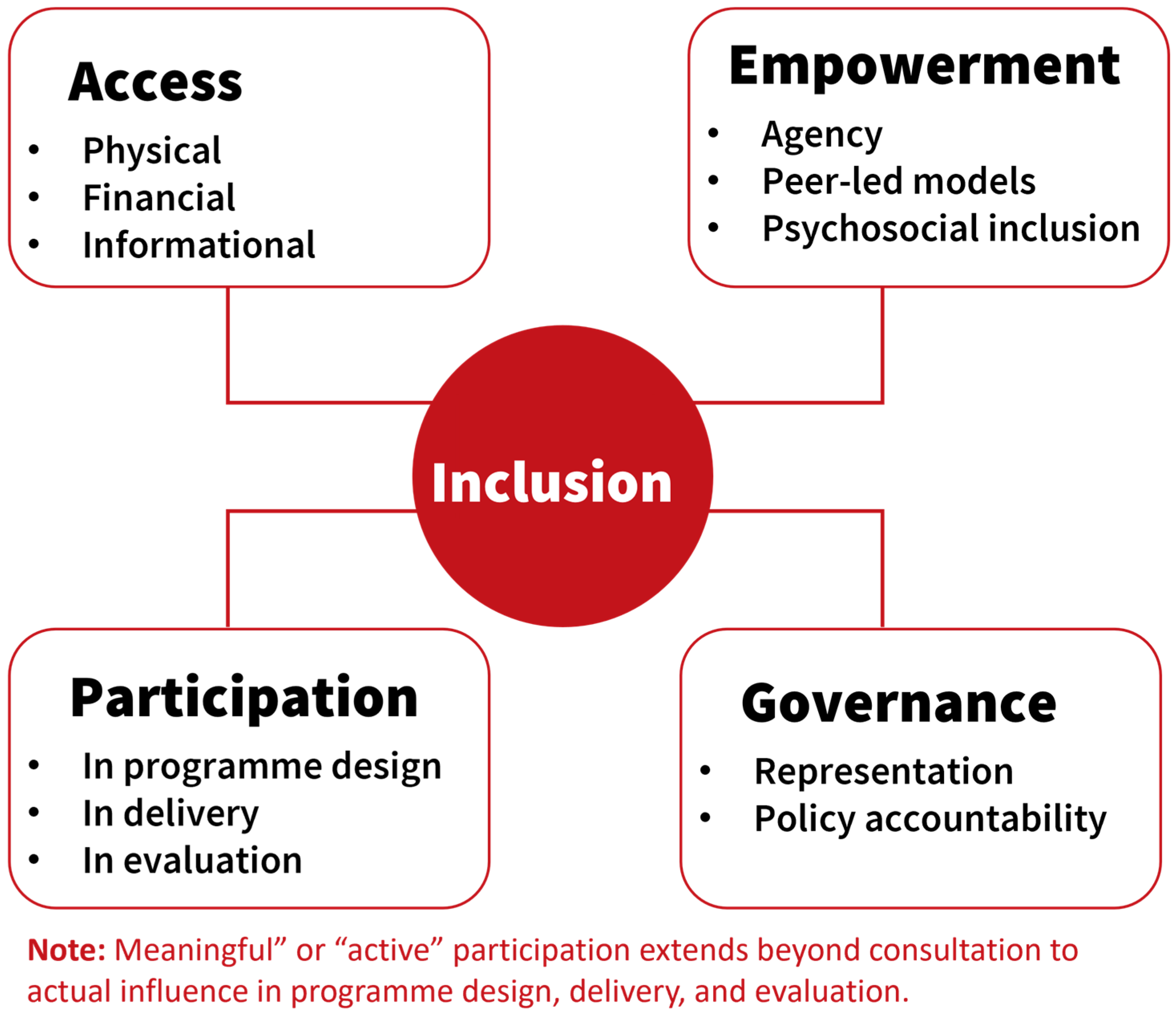

| Eligibility Criteria | |
|---|---|
| Inclusion Criteria | Exclusion Criteria |
| Studies published in English | Studies published in languages other than English |
| Studies published from 2010–2025 | Studies published before 2010 |
| Primary research studies, including quantitative, qualitative, and mixed-methods studies | Review articles, commentaries, and editorials. |
| Studies focusing on NTDs and the concept of inclusion, covering various dimensions of inclusion such as access to healthcare, social participation, and empowerment. Additionally, other public health interventions and how they look at inclusion to plan their projects was also looked at. | Studies not directly related to NTDs or the concept of inclusion within public health |
| Studies that provide clear definitions, frameworks, or models related to inclusion in the context of NTDs. | Studies lacking relevant data or clear definitions of inclusion |
| Theme | Key Method | Geographic Focus | Population Targeted | Main Findings | Publication Year | Sample Type | Study Count |
|---|---|---|---|---|---|---|---|
| 1. Social and Economic Inequalities | Qualitative, Mixed-Methods, Systematic Review | Brazil, Sub-Saharan Africa | Racial minorities, Poor, Displaced | - Social and economic inequalities, including poverty, racism, gender discrimination, and displacement, significantly increase vulnerability to NTDs and limit access to care, especially among marginalised and underserved populations. - To eliminate NTDs effectively, programmes must adopt inclusive, equity-focused approaches that address structural barriers, ensure representation in data systems, and tailor services to meet the diverse needs of affected communities. | 2018–2025 | Mixed: affected populations, national data | 22 |
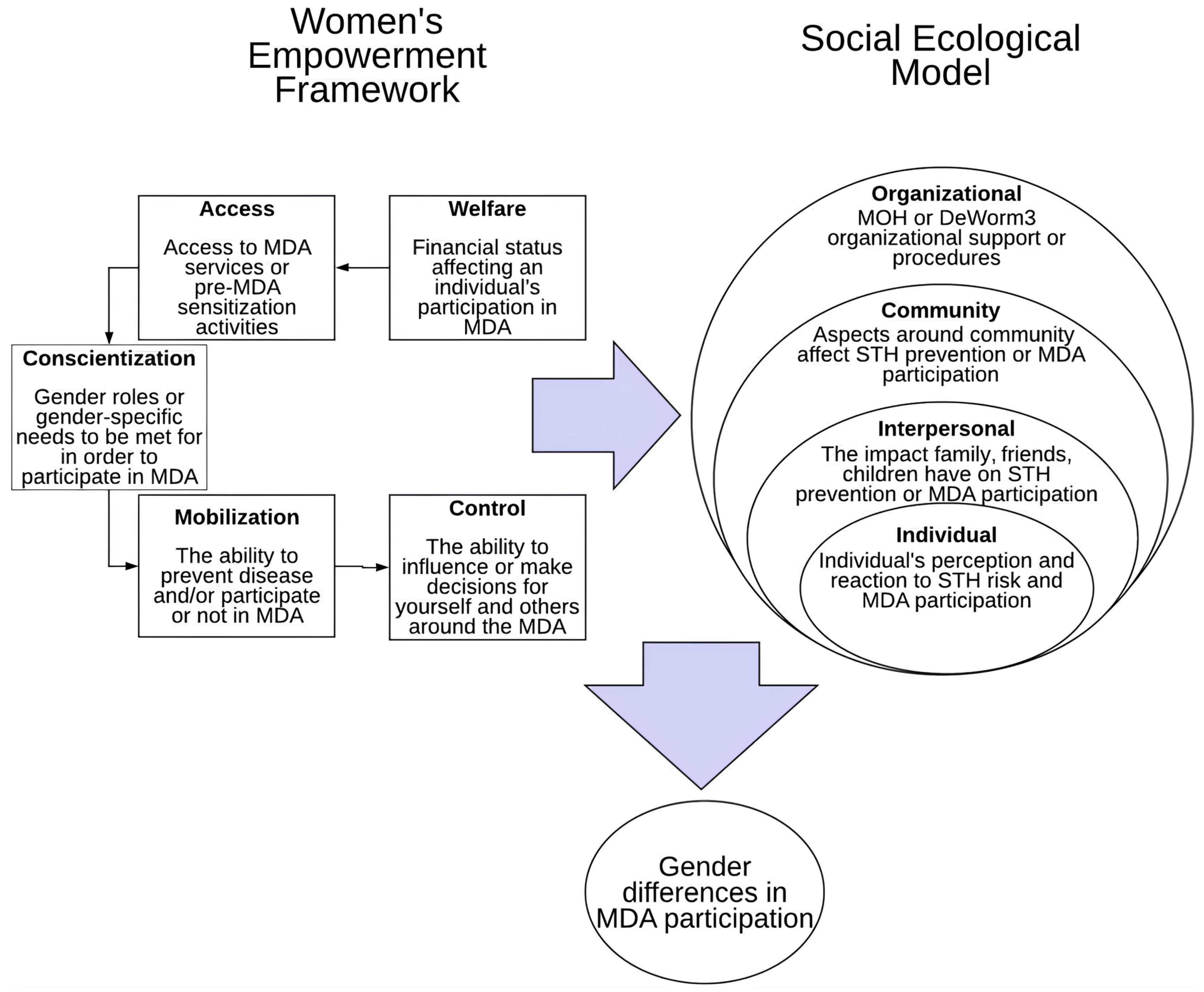
| 2. Gender Equity | Qualitative, Gender Frameworks (Women’s Empowerment Framework (WEF), Socio Ecological Model (SEM). | Uganda, Ethiopia, Benin | Women (esp. pregnant/lactating), Men | - Gender norms, power dynamics, and lack of sex-disaggregated data shape access. - Gender-related barriers, worsened by factors like poverty and disability, limit women’s access to NTD treatment and reduce programme effectiveness. - Adopting gender-responsive strategies improves equity, increases treatment coverage, and supports progress toward universal health goals. | 2011–2023 | Women, Men, Programme implementers | 11 |
| 3. Inclusive Delivery and Intervention | Participatory Action Research, Case Studies | Multi-Country | Migrant workers, Women, Out-of-school youth | - Rigid models miss marginalised groups; inclusive design improves equity - Effective NTD treatment delivery is hindered by weak health systems and lack of community engagement, but participatory, locally driven approaches and strong health-system integration improve coverage, trust, and sustainability. - Empowering communities, integrating NTD services with broader healthcare, and using disaggregated data to identify and reach underserved groups are essential to closing equity gaps and achieving elimination goals. | 2021–2024 | Community members, CDDs, Health workers | 9 |
| 4. Health Systems Inclusion | Systematic Review, Policy Case Study | Liberia, Global Review | Women, Children, Persons with Disabilities | - Integrated, equity-driven systems are needed but are underdeveloped - NTD programmes are moving toward integrated, people-centred models embedded in national health systems, which improve coverage and cost-effectiveness when supported by strong governance, stable financing, and community participation. - Achieving sustainable and equitable NTD care requires embedding intersectional, gender-sensitive planning, reducing donor dependence through domestic resource mobilisation, and centring local civil society in micro-planning and accountability. | 2019–2025 | Health system actors, Policy documents | 8 |
| 5. Inclusion of Community Members in NTD Programmes | Community-Based Participatory Research (CBPR), Programme Evaluation | Multi-country Africa | Affected persons, Community volunteers | - Peer-led groups and Community Directed Distributors (CDDs) empower communities and improve outcomes - Inclusive community engagement with trained, diverse distributors and peer support boosts treatment adherence and participation for marginalised groups in NTD programmes. - Formalising distributor roles, providing disability-focused training, and using detailed data monitoring are essential to prevent exclusion and improve care equity. | 2017–2025 | Persons with disabilities, CDDs, Peer groups | 10 |
Disclaimer/Publisher’s Note: The statements, opinions and data contained in all publications are solely those of the individual author(s) and contributor(s) and not of MDPI and/or the editor(s). MDPI and/or the editor(s) disclaim responsibility for any injury to people or property resulting from any ideas, methods, instructions or products referred to in the content. |
© 2025 by the authors. Licensee MDPI, Basel, Switzerland. This article is an open access article distributed under the terms and conditions of the Creative Commons Attribution (CC BY) license.
Share and Cite
Juma, I.Z.; Oguntoye, O.; Sankar, G.; Weber, J.; Qureshi, B.; Amanyi-Enegela, J. Inclusion in Neglected Tropical Disease Programmes: A Review of Inclusive Approaches for Control and Elimination. Healthcare 2026, 14, 27. https://doi.org/10.3390/healthcare14010027
Juma IZ, Oguntoye O, Sankar G, Weber J, Qureshi B, Amanyi-Enegela J. Inclusion in Neglected Tropical Disease Programmes: A Review of Inclusive Approaches for Control and Elimination. Healthcare. 2026; 14(1):27. https://doi.org/10.3390/healthcare14010027
Chicago/Turabian StyleJuma, Ismat Zehra, Opeoluwa Oguntoye, Girija Sankar, Joerg Weber, Babar Qureshi, and Juliana Amanyi-Enegela. 2026. "Inclusion in Neglected Tropical Disease Programmes: A Review of Inclusive Approaches for Control and Elimination" Healthcare 14, no. 1: 27. https://doi.org/10.3390/healthcare14010027
APA StyleJuma, I. Z., Oguntoye, O., Sankar, G., Weber, J., Qureshi, B., & Amanyi-Enegela, J. (2026). Inclusion in Neglected Tropical Disease Programmes: A Review of Inclusive Approaches for Control and Elimination. Healthcare, 14(1), 27. https://doi.org/10.3390/healthcare14010027



