_MD__MPH_PhD.png)
Inadequate Gestational Weight Gain Among Saudi Mothers and Pregnancy Outcomes: Riyadh Mother and Baby Follow-Up Study (RAHMA Explore)


Abstract
1. Introduction
- Report the prevalence and the degree of inadequacy of gestational weight gain among Saudi women.
- Investigate the effects of the degree of inadequacy of gestational weight gain on the pregnancy outcomes.
2. Methods
2.1. Study Design and Ethical Approval
- (Approval No. 11/062);
- (Approval No. 013–017);
- (Approval No. 13–985).
2.2. Participants and Data Collection
- Prepregnancy body mass index (BMI) was calculated using self-reported weight before pregnancy and height measured at the earliest antenatal visit. BMI categories followed WHO definitions as follows [21]:
- Underweight: If BMI measures ≤ 18.4 kg/m2;
- Normal weight: For BMI ranging from 18.5 to 24.9 kg/m2;
- Overweight: BMI ranges from 25.0 to 29.9 kg/m2;
- Obese: If the BMI is equal to or exceeds 30 kg/m2.
- 2.
- Gestational age was assessed using ultrasound-based measures or date of last menstrual period.
- 3.
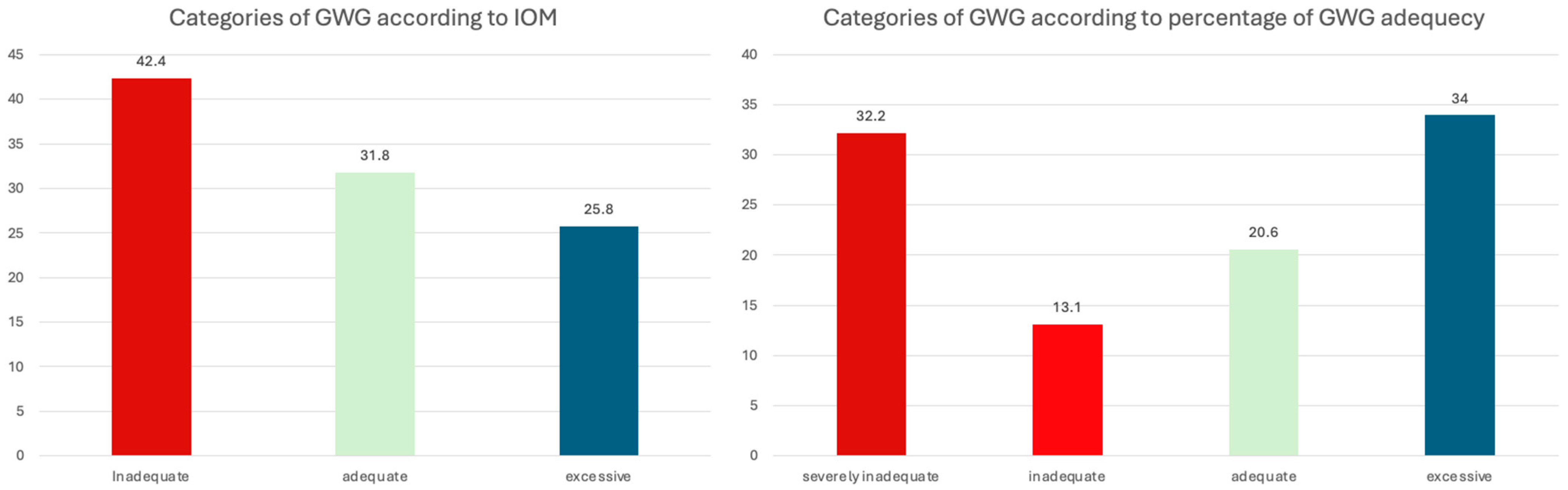
- Gestational weight gain (GWG) was calculated by subtracting the self-reported prepregnancy weight from the mother’s weight at delivery. GWG adequacy was classified based on the IOM predefined ranges. Participants were categorized into three GWG groups: inadequate (less than the IOM range), adequate (within the IOM range), or excessive GWG (exceeded the defined IOM range). IOM defined the ranges of GWG according to the prepregnancy weight BMI as follows [2]:
- Gestational diabetes mellitus (GDM) defined according to WHO diagnostic criteria [27].
- Hypertensive disorders of pregnancy (HTN), different disorders of hypertension during pregnancy were defined according to the report of the American National Working Group on High Blood Pressure in Pregnancy. As the incidence of pre-eclampsia, eclampsia and pregnancy-induced hypertension was low, all groups were analyzed as one group [28].
- Macrosomia, defined as birth weight ≥ 4.0 kg [29].
- Low birth weight (LBW), defined as birth weight < 2.5 kg [30].
2.3. Statistical Analysis
3. Results
4. Discussion
Implications of the Study Results to Practice and Research
- Establishing national clinical guidelines for the management of maternal weight during the preconception, antenatal, and postnatal periods is of paramount importance, especially since current IOM guidelines do not adequately address GWG for women who are classified as obese.
- Given the significant prevalence of obesity and inadequate GWG, along with their adverse outcomes on both mothers and their offspring, it is essential to ensure the provision of adequate infrastructure and personnel to facilitate the consistent implementation of these guidelines.
- It is imperative to provide health education to Saudi women regarding the potential adverse effects of obesity and underweight on their reproductive health. This educational initiative should be integrated into school and university curricula, given that over 90% of women attend these educational institutions.
- Future research should focus on examining community-specific interventions aimed at reducing obesity and promoting healthy weight among women of reproductive age.
- Additionally, investigations should explore the impact of environmental and genetic factors, alongside maternal obesity, on the future health of neonates, children, and adults [49].
- Future research on maternity obesity and GWG in the Saudi community should adopt a national approach including wide geographical areas to insure generalizability of research outcomes.
5. Strengths and Limitations
6. Conclusions
Author Contributions
Funding
Institutional Review Board Statement
Informed Consent Statement
Data Availability Statement
Acknowledgments
Conflicts of Interest
References
- Cunningham, F.G.; Leveno, K.J.; Bloom, S.L.; Spong, C.Y.; Dashe, J.S.; Hoffman, B.L.; Casey, B.M.; Sheffield, J.S. Williams Obstetrics; McGraw-Hill Education: New York, NY, USA, 2014; Volume 7. [Google Scholar]
- Institute of Medicine (US) and National Research Council (US) Committee to Reexamine IOM Pregnancy Weight Guidelines. The National Academies Collection: Reports funded by National Institutes of Health. In Weight Gain During Pregnancy: Reexamining the Guidelines; Rasmussen, K.M., Yaktine, A.L., Eds.; National Academies Press (US) National Academy of Sciences: Washington, DC, USA, 2009. [Google Scholar]
- Sawangkum, P.; Louis, J.M. Gestational Weight Gain: Achieving a Healthier Weight Between Pregnancies. Obstet. Gynecol. Clin. N. Am. 2020, 47, 397–407. [Google Scholar] [CrossRef]
- Gladstone, R.A.; Pudwell, J.; Nerenberg, K.A.; Grover, S.A.; Smith, G.N. Cardiovascular Risk Assessment and Follow-Up of Women After Hypertensive Disorders of Pregnancy:A Prospective Cohort Study. J. Obstet. Gynaecol. Can. 2019, 41, 1157–1167.e1151. [Google Scholar] [CrossRef]
- Goldstein, R.F.; Abell, S.K.; Ranasinha, S.; Misso, M.; Boyle, J.A.; Black, M.H.; Li, N.; Hu, G.; Corrado, F.; Rode, L.; et al. Association of Gestational Weight Gain With Maternal and Infant Outcomes: A Systematic Review and Meta-analysis. JAMA 2017, 317, 2207–2225. [Google Scholar] [CrossRef]
- Kominiarek, M.A.; Peaceman, A.M. Gestational weight gain. Am. J. Obstet. Gynecol. 2017, 217, 642–651. [Google Scholar] [CrossRef]
- Durst, J.K.; Sutton, A.L.; Cliver, S.P.; Tita, A.T.; Biggio, J.R. Impact of Gestational Weight Gain on Perinatal Outcomes in Obese Women. Am. J. Perinatol. 2016, 33, 849–855. [Google Scholar] [CrossRef]
- Wang, H.; Zhang, Z.; Liu, Y.; Yang, J.; Zhang, J.; Clark, C.; Rodriguez, D.A.; Amirthalingam, P.; Guo, Y. Pre-pregnancy body mass index in mothers, birth weight and the risk of type I diabetes in their offspring: A dose-response meta-analysis of cohort studies. J. Gynecol. Obstet. Hum. Reprod. 2021, 50, 101921. [Google Scholar] [CrossRef] [PubMed]
- Yu, Z.; Han, S.; Zhu, J.; Sun, X.; Ji, C.; Guo, X. Pre-pregnancy body mass index in relation to infant birth weight and offspring overweight/obesity: A systematic review and meta-analysis. PLoS ONE 2013, 8, e61627. [Google Scholar] [CrossRef] [PubMed]
- Tie, H.T.; Xia, Y.Y.; Zeng, Y.S.; Zhang, Y.; Dai, C.L.; Guo, J.J.; Zhao, Y. Risk of childhood overweight or obesity associated with excessive weight gain during pregnancy: A meta-analysis. Arch. Gynecol. Obstet. 2014, 289, 247–257. [Google Scholar] [CrossRef] [PubMed]
- Heslehurst, N.; Vieira, R.; Akhter, Z.; Bailey, H.; Slack, E.; Ngongalah, L.; Pemu, A.; Rankin, J. The association between maternal body mass index and child obesity: A systematic review and meta-analysis. PLoS Med. 2019, 16, e1002817. [Google Scholar] [CrossRef] [PubMed]
- Patro, B.; Liber, A.; Zalewski, B.; Poston, L.; Szajewska, H.; Koletzko, B. Maternal and paternal body mass index and offspring obesity: A systematic review. Ann. Nutr. Metab. 2013, 63, 32–41. [Google Scholar] [CrossRef]
- Wright, L.; Shireby, G.; Morris, T.T.; Davies, N.M.; Bann, D. The association between parental BMI and offspring adiposity: A genetically informed analysis of trios. PLoS Genet. 2025, 21, e1011775. [Google Scholar] [CrossRef]
- Santos Ferreira, D.L.; Williams, D.M.; Kangas, A.J.; Soininen, P.; Ala-Korpela, M.; Smith, G.D.; Jarvelin, M.R.; Lawlor, D.A. Association of pre-pregnancy body mass index with offspring metabolic profile: Analyses of 3 European prospective birth cohorts. PLoS Med. 2017, 14, e1002376. [Google Scholar] [CrossRef]
- Yin, B.; Hu, L.; Wu, K.; Sun, Y.; Meng, X.; Zheng, W.; Zhu, B. Maternal gestational weight gain and adverse pregnancy outcomes in non-diabetic women. J. Obstet. Gynaecol. 2023, 43, 2255010. [Google Scholar] [CrossRef]
- Wen, T.; Lv, Y. Inadequate gestational weight gain and adverse pregnancy outcomes among normal weight women in China. Int. J. Clin. Exp. Med. 2015, 8, 2881–2886. [Google Scholar]
- Wahabi, H.; Fayed, A.; Esmaeil, S.; Alzeidan, R.; Elawad, M.; Tabassum, R.; Hansoti, S.; Magzoup, M.E.; Al-Kadri, H.; Elsherif, E.; et al. Riyadh Mother and Baby Multicenter Cohort Study: The Cohort Profile. PLoS ONE 2016, 11, e0150297. [Google Scholar] [CrossRef]
- Wahabi, H.; Fayed, A.; Esmaeil, S.; Almadhun, A.A. Maternal Nutrition and Gestational Weight Gain Among Saudi Women: Riyadh Mother and Baby Follow Up Study (RAHMA Explore). Healthcare 2025, 13, 1446. [Google Scholar] [CrossRef]
- Wahabi, H.; Esmaeil, S.; Fayed, A. Maternal Prepregnancy Weight and Pregnancy Outcomes in Saudi Women: Subgroup Analysis from Riyadh Mother and Baby Cohort Study (RAHMA). BioMed Res. Int. 2021, 2021, 6655942. [Google Scholar] [CrossRef] [PubMed]
- Fayed, A.; Wahabi, H.A.; Esmaeil, S.; Elkouny, R.; Elmorshedy, H.; Bakhsh, H. Independent effect of gestational weight gain and prepregnancy obesity on pregnancy outcomes among Saudi women: A sub-cohort analysis from Riyadh mother and baby cohort study (RAHMA). PLoS ONE 2022, 17, e0262437. [Google Scholar] [CrossRef] [PubMed]
- World Health Organization. BMI-for-Age (5–19 Years). Available online: https://www.who.int/tools/growth-reference-data-for-5to19-years/indicators/bmi-for-age (accessed on 12 October 2025).
- Connor Gorber, S.; Tremblay, M.; Moher, D.; Gorber, B. A comparison of direct vs. self-report measures for assessing height, weight and body mass index: A systematic review. Obes. Rev. 2007, 8, 307–326. [Google Scholar] [CrossRef] [PubMed]
- Tomeo, C.A.; Rich-Edwards, J.W.; Michels, K.B.; Berkey, C.S.; Hunter, D.J.; Frazier, A.L.; Willett, W.C.; Buka, S.L. Reproducibility and validity of maternal recall of pregnancy-related events. Epidemiology 1999, 10, 774–777. [Google Scholar] [CrossRef]
- Shin, D.; Chung, H.; Weatherspoon, L.; Song, W.O. Validity of prepregnancy weight status estimated from self-reported height and weight. Matern. Child Health J. 2014, 18, 1667–1674. [Google Scholar] [CrossRef]
- Whitaker, K.M.; Wilcox, S.; Liu, J.; Blair, S.N.; Pate, R.R. Provider Advice and Women’s Intentions to Meet Weight Gain, Physical Activity, and Nutrition Guidelines During Pregnancy. Matern. Child Health J. 2016, 20, 2309–2317. [Google Scholar] [CrossRef]
- Perumal, N.; Wang, D.; Darling, A.M.; Liu, E.; Wang, M.; Ahmed, T.; Christian, P.; Dewey, K.G.; Kac, G.; Kennedy, S.H.; et al. Suboptimal gestational weight gain and neonatal outcomes in low and middle income countries: Individual participant data meta-analysis. BMJ 2023, 382, e072249. [Google Scholar] [CrossRef]
- World Health Organization. Diagnostic criteria and classification of hyperglycaemia first detected in pregnancy: A World Health Organization Guideline. Diabetes Res. Clin. Pract. 2014, 103, 341–363. [Google Scholar] [CrossRef]
- Report of the National High Blood Pressure Education Program Working Group on High Blood Pressure in Pregnancy. Am. J. Obstet. Gynecol. 2000, 183, S1–S22. [CrossRef]
- Macrosomia: ACOG Practice Bulletin Summary, Number 216. Obstet. Gynecol. 2020, 135, 246–248. [CrossRef] [PubMed]
- Cutland, C.L.; Lackritz, E.M.; Mallett-Moore, T.; Bardají, A.; Chandrasekaran, R.; Lahariya, C.; Nisar, M.I.; Tapia, M.D.; Pathirana, J.; Kochhar, S.; et al. Low birth weight: Case definition & guidelines for data collection, analysis, and presentation of maternal immunization safety data. Vaccine 2017, 35, 6492–6500. [Google Scholar] [CrossRef] [PubMed]
- Cheng, T.S.; Ali, N.; Elbarazi, I.; Al-Rifai, R.H.; Al-Maskari, F.; Loney, T.; Ahmed, L.A. Sociodemographic determinants of prepregnancy body mass index and gestational weight gain: The Mutaba’ah study. Obes. Sci. Pract. 2022, 8, 308–319. [Google Scholar] [CrossRef]
- Darling, A.M.; Wang, D.; Perumal, N.; Liu, E.; Wang, M.; Ahmed, T.; Christian, P.; Dewey, K.G.; Kac, G.; Kennedy, S.H.; et al. Risk factors for inadequate and excessive gestational weight gain in 25 low- and middle-income countries: An individual-level participant meta-analysis. PLoS Med. 2023, 20, e1004236. [Google Scholar] [CrossRef]
- Goldstein, R.F.; Abell, S.K.; Ranasinha, S.; Misso, M.L.; Boyle, J.A.; Harrison, C.L.; Black, M.H.; Li, N.; Hu, G.; Corrado, F.; et al. Gestational weight gain across continents and ethnicity: Systematic review and meta-analysis of maternal and infant outcomes in more than one million women. BMC Med. 2018, 16, 153. [Google Scholar] [CrossRef]
- El Masri, D.; Alemayohu, M.A.; Loperfido, F.; Bianco, I.; Ferrara, C.; Cerbo, R.M.; Ghirardello, S.; Monti, M.C.; Maccarini, B.; Sottotetti, F.; et al. Associations of maternal lifestyle factors with inadequate pregnancy weight gain: Findings from the baseline data of the LIMIT prospective cohort study. Eur. J. Nutr. 2024, 63, 2911–2920. [Google Scholar] [CrossRef]
- Sun, Y.; Shen, Z.; Zhan, Y.; Wang, Y.; Ma, S.; Zhang, S.; Liu, J.; Wu, S.; Feng, Y.; Chen, Y.; et al. Effects of pre-pregnancy body mass index and gestational weight gain on maternal and infant complications. BMC Pregnancy Childbirth 2020, 20, 390. [Google Scholar] [CrossRef]
- Lim, S.X.; Wadhawan, S.; DeVilbiss, E.A.; Clayton, P.K.; Wagner, K.A.; Gleason, J.L.; Chen, Z.; Zhang, C.; Grantz, K.L.; Grewal, J. Maternal Adherence to Healthy Dietary Patterns During Pregnancy and Gestational Weight Gain. Nutrients 2025, 17, 2707. [Google Scholar] [CrossRef]
- O’Brien, E.C.; Alberdi, G.; McAuliffe, F.M. The influence of socioeconomic status on gestational weight gain: A systematic review. J. Public Health 2018, 40, 41–55. [Google Scholar] [CrossRef]
- Devlieger, R.; Ameye, L.; Nuyts, T.; Goemaes, R.; Bogaerts, A. Reappraisal of Gestational Weight Gain Recommendations in Obese Pregnant Women: A Population-Based Study of 337,590 Births. Obes. Facts 2020, 13, 333–348. [Google Scholar] [CrossRef] [PubMed]
- Robillard, P.Y. Epidemiological evidence that severe obese women (pre-pregnancy BMI ≥ 40 kg/m2) should lose weight during their pregnancy. J. Matern. Neonatal Med. 2022, 35, 6618–6623. [Google Scholar] [CrossRef] [PubMed]
- Wilkins, E.G.; Sun, B.; Thomas, A.S.; Alabaster, A.; Greenberg, M.; Sperling, J.D.; Walton, D.L.; Alves, J.; Gunderson, E.P. Low gestational weight gain (+2.0 to 4.9 kg) for singleton-term gestations associated with favorable perinatal outcomes for all prepregnancy obesity classes. AJOG Glob. Rep. 2023, 3, 100246. [Google Scholar] [CrossRef]
- Mustafa, H.J.; Seif, K.; Javinani, A.; Aghajani, F.; Orlinsky, R.; Alvarez, M.V.; Ryan, A.; Crimmins, S. Gestational weight gain below instead of within the guidelines per class of maternal obesity: A systematic review and meta-analysis of obstetrical and neonatal outcomes. Am. J. Obstet. Gynecol. MFM 2022, 4, 100682. [Google Scholar] [CrossRef] [PubMed]
- Santos, S.; Voerman, E.; Amiano, P.; Barros, H.; Beilin, L.J.; Bergström, A.; Charles, M.A.; Chatzi, L.; Chevrier, C.; Chrousos, G.P.; et al. Impact of maternal body mass index and gestational weight gain on pregnancy complications: An individual participant data meta-analysis of European, North American and Australian cohorts. BJOG Int. J. Obstet. Gynaecol. 2019, 126, 984–995. [Google Scholar] [CrossRef]
- Mohammadi, M.; Maroufizadeh, S.; Omani-Samani, R.; Almasi-Hashiani, A.; Amini, P. The effect of prepregnancy body mass index on birth weight, preterm birth, cesarean section, and preeclampsia in pregnant women. J. Matern. Neonatal Med. 2019, 32, 3818–3823. [Google Scholar] [CrossRef]
- Hojeij, B.; Rousian, M.; Sinclair, K.D.; Dinnyes, A.; Steegers-Theunissen, R.P.M.; Schoenmakers, S. Periconceptional biomarkers for maternal obesity: A systematic review. Rev. Endocr. Metab. Disord. 2023, 24, 139–175. [Google Scholar] [CrossRef] [PubMed]
- Lawlor, D.A. The Society for Social Medicine John Pemberton Lecture 2011. Developmental overnutrition—An old hypothesis with new importance? Int. J. Epidemiol. 2013, 42, 7–29. [Google Scholar] [CrossRef]
- Tyrrell, J.; Richmond, R.C.; Palmer, T.M.; Feenstra, B.; Rangarajan, J.; Metrustry, S.; Cavadino, A.; Paternoster, L.; Armstrong, L.L.; De Silva, N.M.; et al. Genetic Evidence for Causal Relationships Between Maternal Obesity-Related Traits and Birth Weight. JAMA 2016, 315, 1129–1140. [Google Scholar] [CrossRef]
- Lim, S.; O’Reilly, S.; Behrens, H.; Skinner, T.; Ellis, I.; Dunbar, J.A. Effective strategies for weight loss in post-partum women: A systematic review and meta-analysis. Obes. Rev. 2015, 16, 972–987. [Google Scholar] [CrossRef]
- Muktabhant, B.; Lawrie, T.A.; Lumbiganon, P.; Laopaiboon, M. Diet or exercise, or both, for preventing excessive weight gain in pregnancy. Cochrane Database Syst. Rev. 2015, 2015, Cd007145. [Google Scholar] [CrossRef] [PubMed]
- Fernandez-Twinn, D.S.; Hjort, L.; Novakovic, B.; Ozanne, S.E.; Saffery, R. Intrauterine programming of obesity and type 2 diabetes. Diabetologia 2019, 62, 1789–1801. [Google Scholar] [CrossRef] [PubMed]



| Adequate Gestation Weight Gain (N = 2221, 42.9%) | Inadequate Gestation Weight Gain (N = 2959, 57.1%) | p-Value | ||||
|---|---|---|---|---|---|---|
| N | % | N | % | |||
| Age (years) | 20–29 | 1115 | 43.90 | 1425 | 56.10 | 0.26 |
| <20 | 49 | 38.89 | 77 | 61.11 | ||
| 30–34 | 585 | 42.67 | 786 | 57.33 | ||
| 35–44 | 456 | 40.90 | 659 | 59.10 | ||
| 45+ | 16 | 57.14 | 12 | 42.86 | ||
| Education | Illiterate | 41 | 37.96 | 67 | 62.04 | 0.20 |
| School | 886 | 44.68 | 1097 | 55.32 | ||
| University and above | 640 | 45.88 | 755 | 54.12 | ||
| Parity | Primiparous | 515 | 45.22 | 624 | 54.78 | 0.18 |
| Multiparous | 1054 | 41.98 | 1457 | 58.02 | ||
| Grand Multiparous | 651 | 42.58 | 878 | 57.42 | ||
| Prepregnancy Body Mass Index | Normal | 567 | 31.29 | 1245 | 68.71 | <0.01 |
| Underweight | 35 | 27.13 | 94 | 72.87 | ||
| Overweight | 805 | 49.94 | 807 | 50.06 | ||
| Obese | 814 | 50.03 | 813 | 49.97 | ||
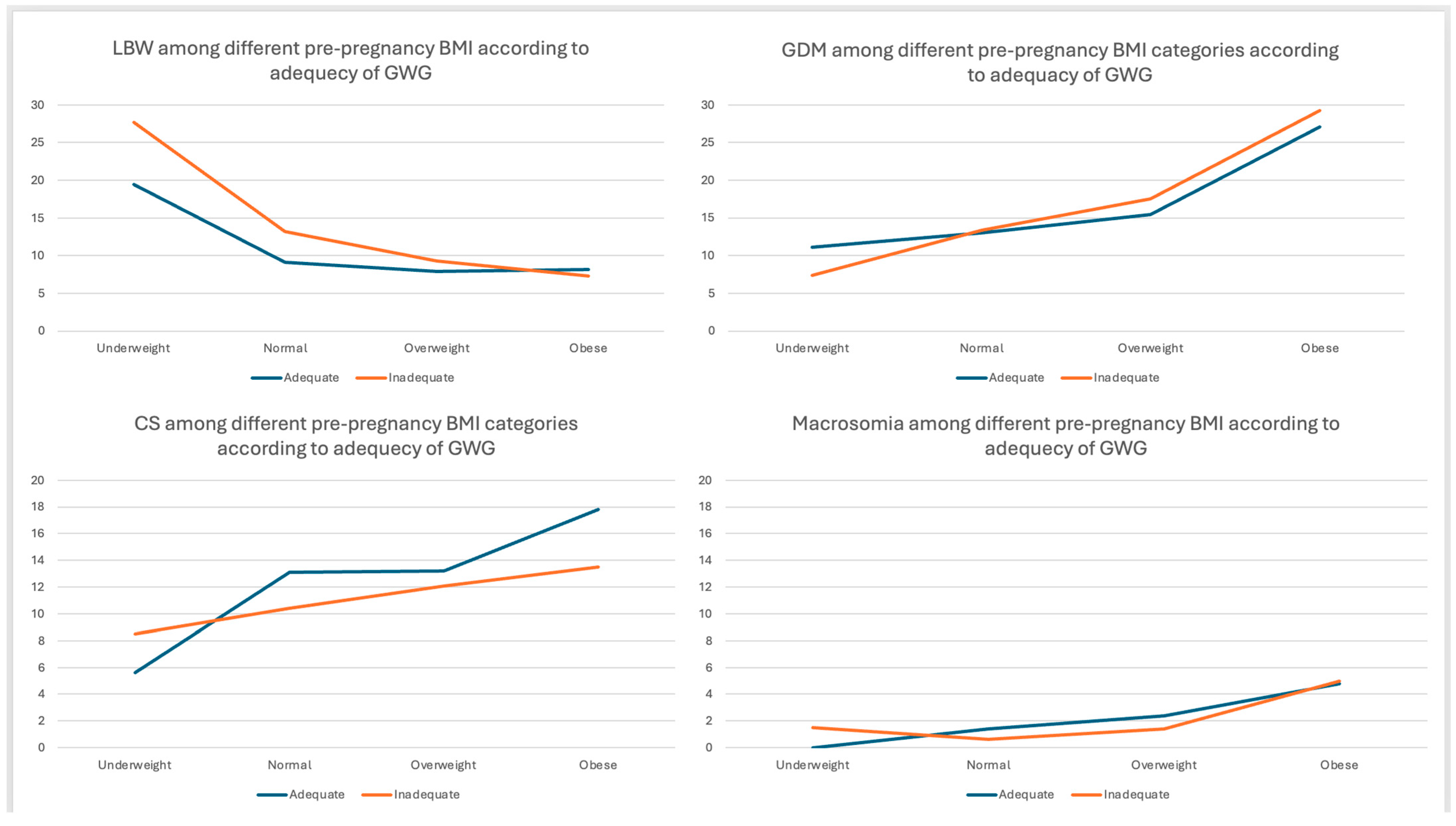
| Underweight (<18.5 kg/m2) | Normal (18.5–24.9 kg/m2) | Overweight (25–29.9 kg/m2) | Obese (30+ kg/m2) | ||||||||||||||
|---|---|---|---|---|---|---|---|---|---|---|---|---|---|---|---|---|---|
| Adequate | Inadequate | Adequate | Inadequate | Adequate | Inadequate | Adequate | Inadequate | ||||||||||
| N | % | N | % | N | N | N | N | N | N | ||||||||
| GDM | normal | 32 | 88.9 | 87 | 92.6 | 489 | 87.0 | 1066 | 86.6 | 670 | 84.6 | 647 | 82.5 | 567 | 72.9 | 548 | 70.8 |
| GDM | 4 | 11.1 | 7 | 7.4 | 73 | 13.0 | 165 | 13.4 | 122 | 15.4 | 137 | 17.5 | 211 | 27.1 | 226 | 29.2 | |
| p-value | 0.50 | 0.80 | 0.27 | 0.36 | |||||||||||||
| HTN | no | 35 | 100.0 | 93 | 98.9 | 559 | 97.9 | 1221 | 98.1 | 793 | 98.1 | 789 | 98.0 | 781 | 95.9 | 784 | 96.3 |
| yes | 0 | 0.0 | 1 | 1.1 | 12 | 2.1 | 24 | 1.9 | 15 | 1.9 | 16 | 2.0 | 33 | 4.1 | 30 | 3.7 | |
| p-value | 0.50 # | 0.80 | 0.82 | 0.51 | |||||||||||||
| Emerg CS | No | 34 | 94.4 | 86 | 91.5 | 497 | 86.9 | 1123 | 89.6 | 703 | 86.8 | 710 | 87.9 | 672 | 82.2 | 707 | 86.5 |
| Yes | 2 | 5.6 | 8 | 8.5 | 75 | 13.1 | 130 | 10.4 | 107 | 13.2 | 98 | 12.1 | 146 | 17.8 | 110 | 13.5 | |
| p-value | 0.57 | 0.08 | 0.51 | 0.01 | |||||||||||||
| LBW < 2500 g | no | 29 | 80.6 | 68 | 72.3 | 520 | 90.9 | 1088 | 86.8 | 746 | 92.1 | 733 | 90.7 | 751 | 91.8 | 757 | 92.7 |
| yes | 7 | 19.4 | 26 | 27.7 | 52 | 9.1 | 165 | 13.2 | 64 | 7.9 | 75 | 9.3 | 67 | 8.2 | 60 | 7.3 | |
| p-value | 0.32 | 0.01 | 0.33 | 0.52 | |||||||||||||
| Macrosomia | No | 28 | 100.0 | 67 | 98.5 | 509 | 98.6 | 1075 | 99.4 | 723 | 97.6 | 722 | 98.6 | 711 | 95.2 | 715 | 95.0 |
| Yes | 0 | 0.0 | 1 | 1.5 | 7 | 1.4 | 7 | 0.6 | 18 | 2.4 | 10 | 1.4 | 36 | 4.8 | 38 | 5.0 | |
| p-value | |||||||||||||||||
| Stillbirth | liveborn | 36 | 100.0 | 93 | 98.9 | 568 | 99.5 | 1245 | 99.4 | 801 | 98.9 | 804 | 99.5 | 810 | 99.0 | 814 | 99.6 |
| stillbirth | 0 | 0.0 | 1 | 1.1 | 3 | 0.5 | 8 | 0.6 | 9 | 1.1 | 4 | 0.5 | 8 | 1.0 | 3 | 0.4 | |
| p-value | 0.41 # | 0.71 | 0.27 | 0.17 | |||||||||||||
| NICU | No | 33 | 91.7 | 92 | 97.9 | 555 | 97.4 | 1194 | 96.1 | 784 | 97.5 | 774 | 96.1 | 767 | 94.6 | 787 | 96.7 |
| Yes | 3 | 8.3 | 2 | 2.1 | 15 | 2.6 | 49 | 3.9 | 20 | 2.5 | 31 | 3.9 | 44 | 5.4 | 27 | 3.3 | |
| p-value | 0.10 | 0.16 | 0.11 | 0.04 | |||||||||||||
| Crude Odds Ratio (95% C.I) | Adjusted Odds Ratio (95% C.I) | |
|---|---|---|
| Low Birth Weight | 1.54 (1.13–2.01) | 1.61 (1.17–2.20) * |
| Emergency Cesarean Section | 0.73 (0.56–0.95) | 0.75 (0.56–0.97) * |
| NICU | 0.60 (0.37–0.98) | 0.59 (0.36–0.97) * |
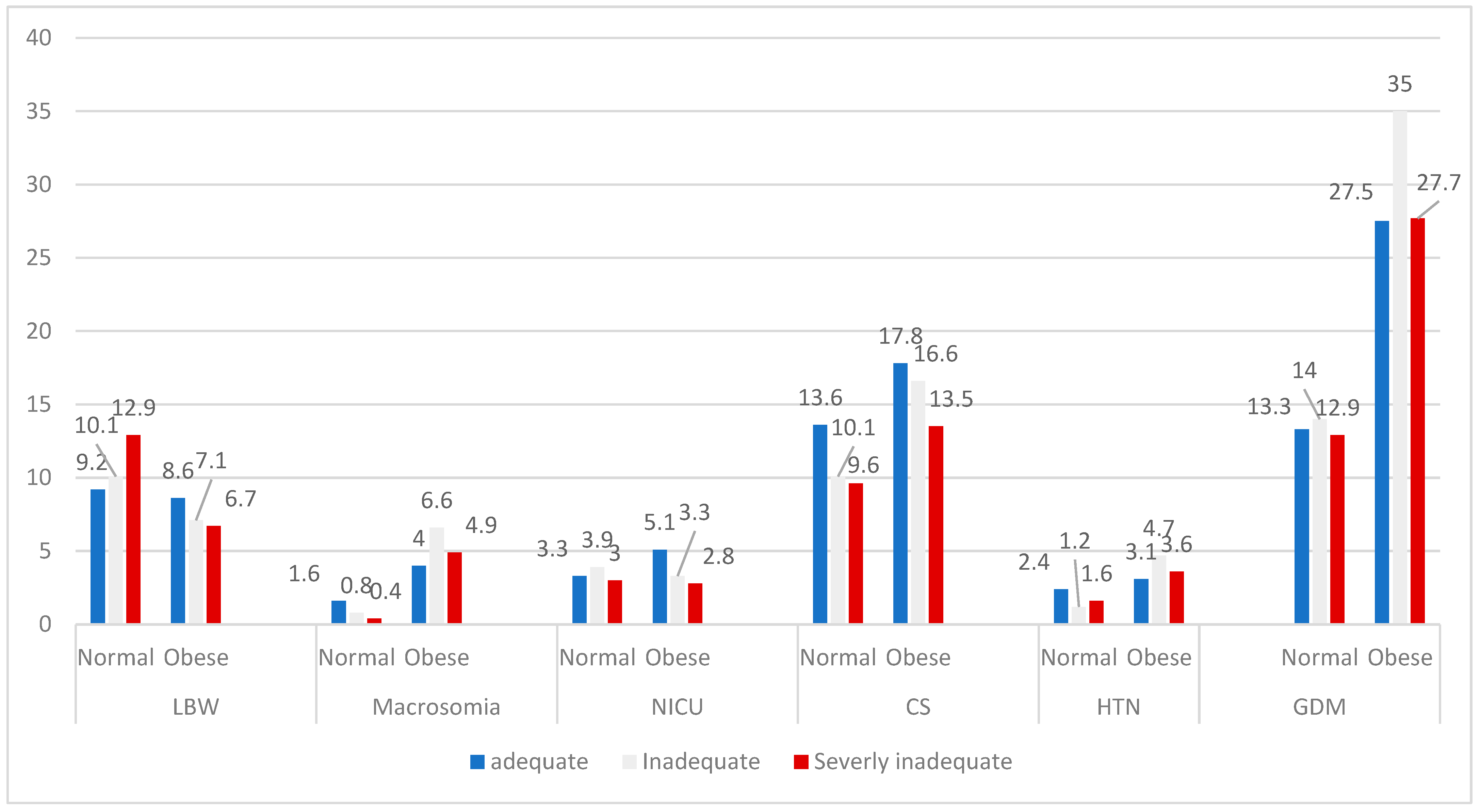
| Normal (18.5–24.9 kg/m2) | Underweight (<18.5 kg/m2) | Overweight (25–29.9 kg/m2) | Obese (30+ kg/m2) | ||||||||||||||||||||||
|---|---|---|---|---|---|---|---|---|---|---|---|---|---|---|---|---|---|---|---|---|---|---|---|---|---|
|
90–125%
(Adequate) |
70–<90%
(Inadequate) |
<70%
(Severe Inadequate) |
90–125%
(Adequate) |
70–<90%
(Inadequate) |
<70%
(Severe Inadequate) |
90–125%
(Adequate) |
70–<90%
(Inadequate) |
<70%
(Severe Inadequate) |
90–125%
(Adequate) |
70–<90%
(Inadequate) |
<70%
(Severe Inadequate) | ||||||||||||||
| N | % | N | % | N | % | N | % | N | % | N | % | N | % | N | % | N | % | N | % | N | % | N | % | ||
| GDM | normal | 463 | 86.7 | 349 | 86.0 | 691 | 87.1 | 24 | 88.9 | 37 | 97.4 | 64 | 90.1 | 428 | 85.3 | 203 | 82.5 | 511 | 83.2 | 251 | 72.5 | 128 | 65.0 | 511 | 72.2 |
| GDM | 71 | 13.3 | 57 | 14.0 | 102 | 12.9 | 3 | 11.1 | 1 | 2.6 | 7 | 9.9 | 74 | 14.7 | 43 | 17.5 | 103 | 16.8 | 95 | 27.5 | 69 | 35.0 | 197 | 27.8 | |
| p-value | 0.85 | 0.34 | 0.54 | 0.11 | |||||||||||||||||||||
| HTN | No | 531 | 97.6 | 406 | 98.8 | 788 | 98.4 | 26 | 100.0 | 37 | 97.4 | 71 | 100.0 | 498 | 98.0 | 248 | 97.6 | 618 | 98.4 | 346 | 96.9 | 201 | 95.3 | 716 | 96.4 |
| yes | 13 | 2.4 | 5 | 1.2 | 13 | 1.6 | 0 | 0.0 | 1 | 2.6 | 0 | 0.0 | 10 | 2.0 | 6 | 2.4 | 10 | 1.6 | 11 | 3.1 | 10 | 4.7 | 27 | 3.6 | |
| p-value | 0.36 | 0.27 | 0.73 | 0.60 | |||||||||||||||||||||
| Emergency CS | No | 472 | 86.4 | 372 | 89.9 | 728 | 90.4 | 25 | 92.6 | 35 | 92.1 | 65 | 91.5 | 449 | 88.2 | 214 | 84.3 | 566 | 89.7 | 295 | 82.2 | 176 | 83.4 | 644 | 86.4 |
| Yes | 74 | 13.6 | 42 | 10.1 | 77 | 9.6 | 2 | 7.4 | 3 | 7.9 | 6 | 8.5 | 60 | 11.8 | 40 | 15.7 | 65 | 10.3 | 64 | 17.8 | 35 | 16.6 | 101 | 13.6 | |
| p-value | 0.06 | 0.98 | 0.08 | 0.15 | |||||||||||||||||||||
| LBW < 2500 g | No | 496 | 90.8 | 372 | 89.9 | 701 | 87.1 | 21 | 77.8 | 30 | 78.9 | 51 | 71.8 | 469 | 92.1 | 237 | 93.3 | 577 | 91.4 | 328 | 91.4 | 196 | 92.9 | 695 | 93.3 |
| Yes | 50 | 9.2 | 42 | 10.1 | 104 | 12.9 | 6 | 22.2 | 8 | 21.1 | 20 | 28.2 | 40 | 7.9 | 17 | 6.7 | 54 | 8.6 | 31 | 8.6 | 15 | 7.1 | 50 | 6.7 | |
| p-value | 0.07 | 0.66 | 0.65 | 0.51 | |||||||||||||||||||||
| Macrosomia | No | 488 | 98.4 | 369 | 99.2 | 698 | 99.6 | 20 | 95.2 | 30 | 100.0 | 51 | 100.0 | 459 | 97.9 | 234 | 98.7 | 568 | 98.8 | 315 | 96.0 | 183 | 93.4 | 663 | 95.1 |
| Yes | 8 | 1.6 | 3 | 0.8 | 3 | 0.4 | 1 | 4.8 | 0 | 0.00 | 0 | 0.00 | 10 | 2.1 | 3 | 1.3 | 7 | 1.2 | 13 | 4.0 | 13 | 6.6 | 34 | 4.9 | |
| p-value | 0.09 | 0.14 | 0.46 | 0.39 | |||||||||||||||||||||
| Stillbirth | liveborn | 544 | 99.6 | 411 | 99.3 | 803 | 99.8 | 26 | 96.3 | 38 | 100.0 | 71 | 100.0 | 504 | 99.0 | 253 | 99.6 | 628 | 99.5 | 356 | 99.2 | 210 | 99.5 | 742 | 99.6 |
| Stillbirth | 2 | 0.4 | 3 | 0.7 | 2 | 0.2 | 1 | 3.7 | 0 | 0.0 | 0 | 0.0 | 5 | 1.0 | 1 | 0.4 | 3 | 0.5 | 3 | 0.8 | 1 | 0.5 | 3 | 0.4 | |
| p-value | 0.45 | 0.13 | 0.49 | 0.65 | |||||||||||||||||||||
| NICU | No | 525 | 96.7 | 394 | 96.1 | 777 | 97.0 | 25 | 92.6 | 37 | 97.4 | 69 | 97.2 | 495 | 97.8 | 248 | 97.6 | 605 | 96.3 | 338 | 94.9 | 202 | 96.7 | 721 | 97.2 |
| Yes | 18 | 3.3 | 16 | 3.9 | 24 | 3.0 | 2 | 7.4 | 1 | 2.6 | 2 | 2.8 | 11 | 2.2 | 6 | 2.4 | 23 | 3.7 | 18 | 5.1 | 7 | 3.3 | 21 | 2.8 | |
| p-value | 0.71 | 0.51 | 0.28 | 0.17 | |||||||||||||||||||||
Disclaimer/Publisher’s Note: The statements, opinions and data contained in all publications are solely those of the individual author(s) and contributor(s) and not of MDPI and/or the editor(s). MDPI and/or the editor(s) disclaim responsibility for any injury to people or property resulting from any ideas, methods, instructions or products referred to in the content. |
© 2025 by the authors. Licensee MDPI, Basel, Switzerland. This article is an open access article distributed under the terms and conditions of the Creative Commons Attribution (CC BY) license (https://creativecommons.org/licenses/by/4.0/).
Share and Cite
Wahabi, H.; Esmaeil, S.; Fayed, A. Inadequate Gestational Weight Gain Among Saudi Mothers and Pregnancy Outcomes: Riyadh Mother and Baby Follow-Up Study (RAHMA Explore). Healthcare 2025, 13, 3258. https://doi.org/10.3390/healthcare13243258
Wahabi H, Esmaeil S, Fayed A. Inadequate Gestational Weight Gain Among Saudi Mothers and Pregnancy Outcomes: Riyadh Mother and Baby Follow-Up Study (RAHMA Explore). Healthcare. 2025; 13(24):3258. https://doi.org/10.3390/healthcare13243258
Chicago/Turabian StyleWahabi, Hayfaa, Samia Esmaeil, and Amel Fayed. 2025. "Inadequate Gestational Weight Gain Among Saudi Mothers and Pregnancy Outcomes: Riyadh Mother and Baby Follow-Up Study (RAHMA Explore)" Healthcare 13, no. 24: 3258. https://doi.org/10.3390/healthcare13243258
APA StyleWahabi, H., Esmaeil, S., & Fayed, A. (2025). Inadequate Gestational Weight Gain Among Saudi Mothers and Pregnancy Outcomes: Riyadh Mother and Baby Follow-Up Study (RAHMA Explore). Healthcare, 13(24), 3258. https://doi.org/10.3390/healthcare13243258