Effects of Third-Wave Cognitive Behavioral Therapy for Healthcare Professionals’ Burnout: A Systematic Review and Meta-Analysis

Highlights
- There has been an increase in the use of third-wave cognitive behavioral therapy (CBT) to address stress and burnout among healthcare professionals
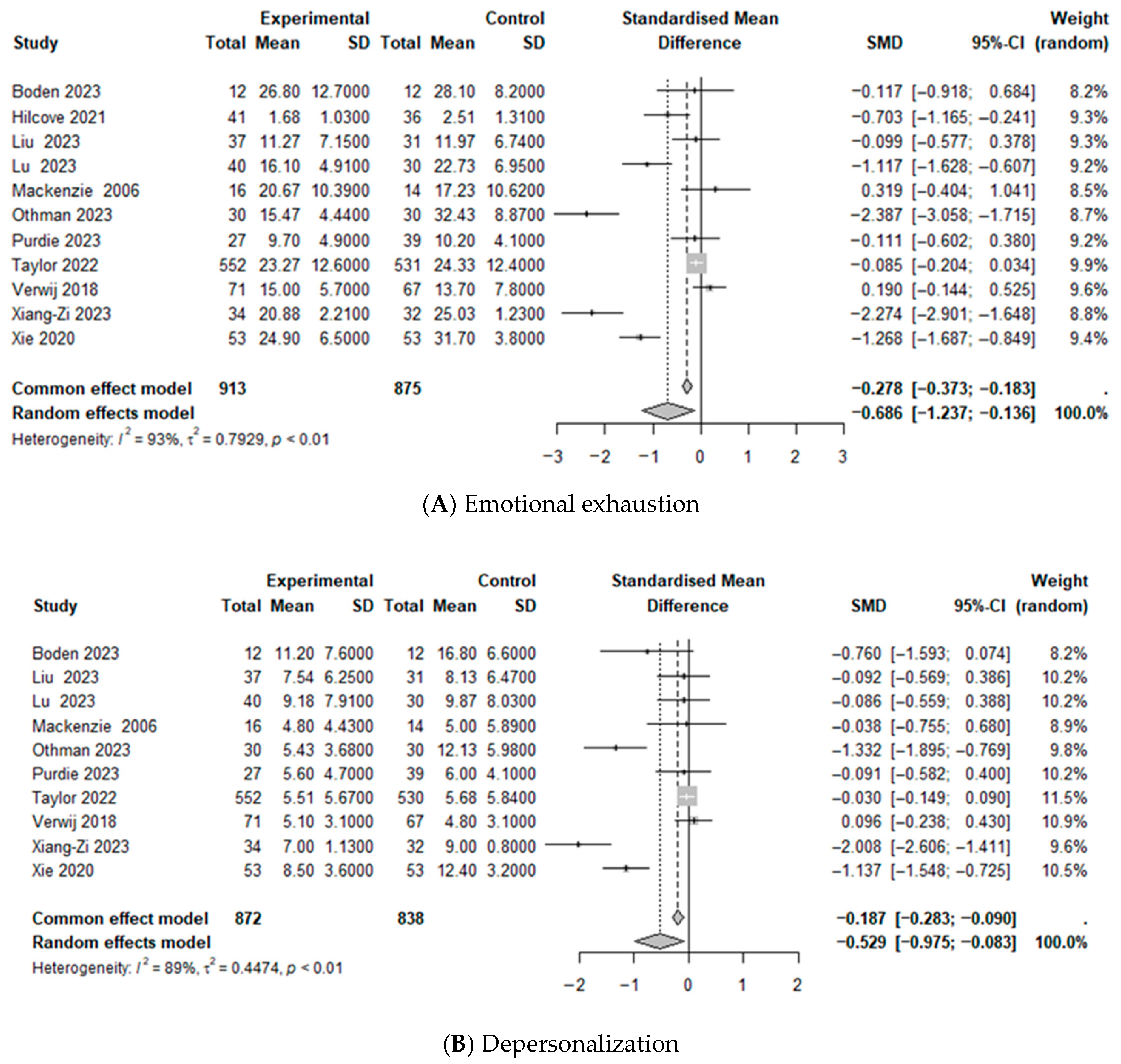
- Emotional exhaustion and depersonalization are the most severe and prevalent burnout dimensions in healthcare settings, but third-wave CBT can significantly reduce these symptoms.
- Limited improvement is observed in personal accomplishment, suggesting influence of organizational factors.
- There is a need for combined psychological and organizational strategies to effectively address all burnout dimensions
Abstract
1. Introduction
2. Methods
2.1. Study Reporting and Registration
2.2. Eligibility Criteria
- Population: HPs providing care in hospitals, including physicians/surgeons, residents, interns, dentists, pharmacists, registered nurses, licensed practical/vocational nurses, and nursing assistants; no minimum requirements for years of professional experience or duration of employment were applied.
- Interventions: Third-wave CBTs (e.g., mindfulness, acceptance, and commitment therapy).
- Comparison: No intervention or alternative interventions.
- Outcome: Burnout (any validated instrument used to measure burnout was accepted for the systematic review; however, for the meta-analysis, only studies that assessed burnout using the Maslach Burnout Inventory [MBI] were included to ensure consistency and comparability of EE, DP, and PA outcomes).
- Study Design: RCTs or quasi-experimental studies.
2.3. Data Sources and Search Strategy
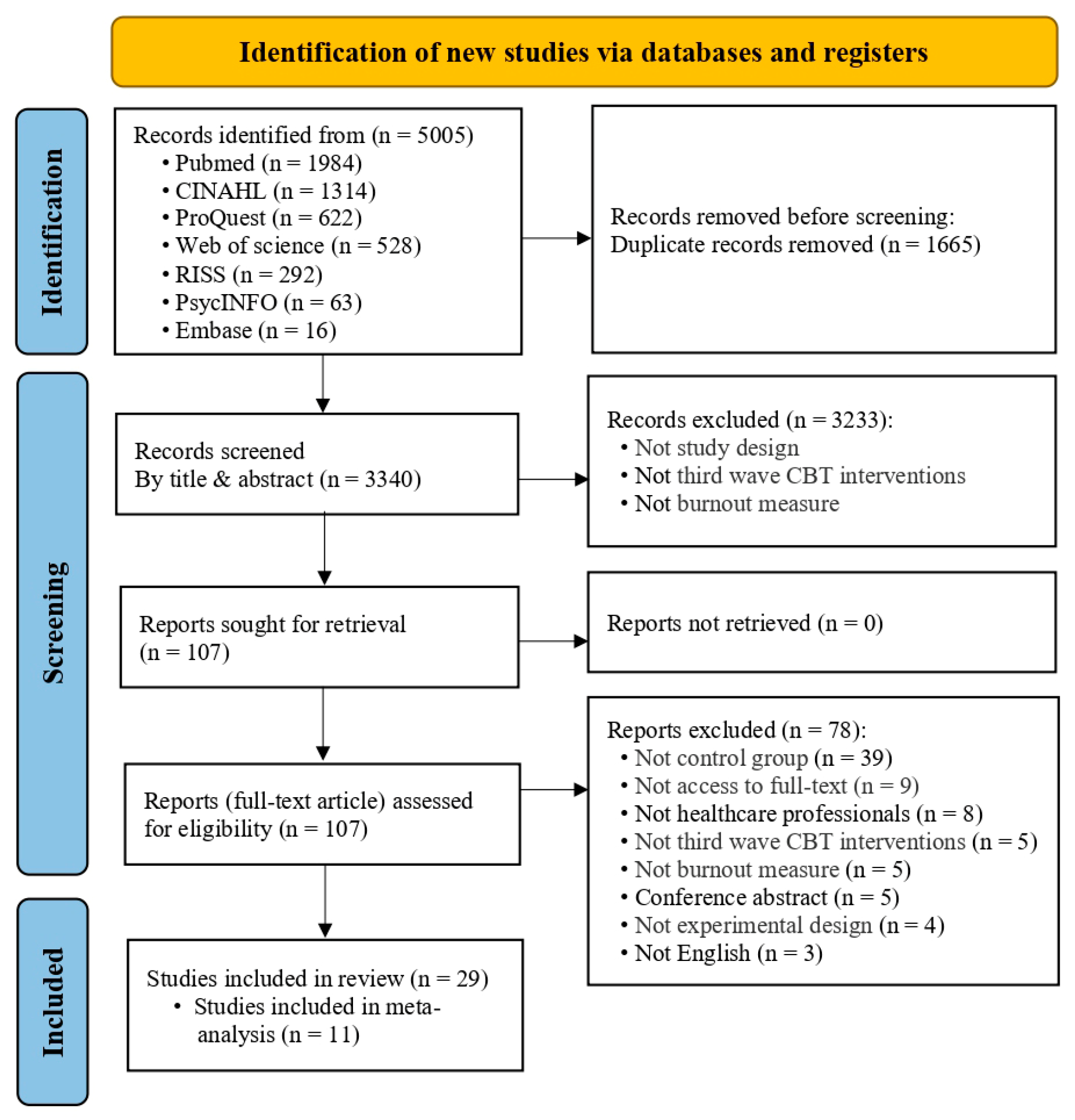
2.4. Study Selection
2.5. Data Extraction
2.6. Assessment of Risk of Bias
2.7. Data Synthesis and Statistical Analysis
2.8. Generative AI Disclosure
3. Results
3.1. Study Characteristics
3.2. Intervention Characteristics
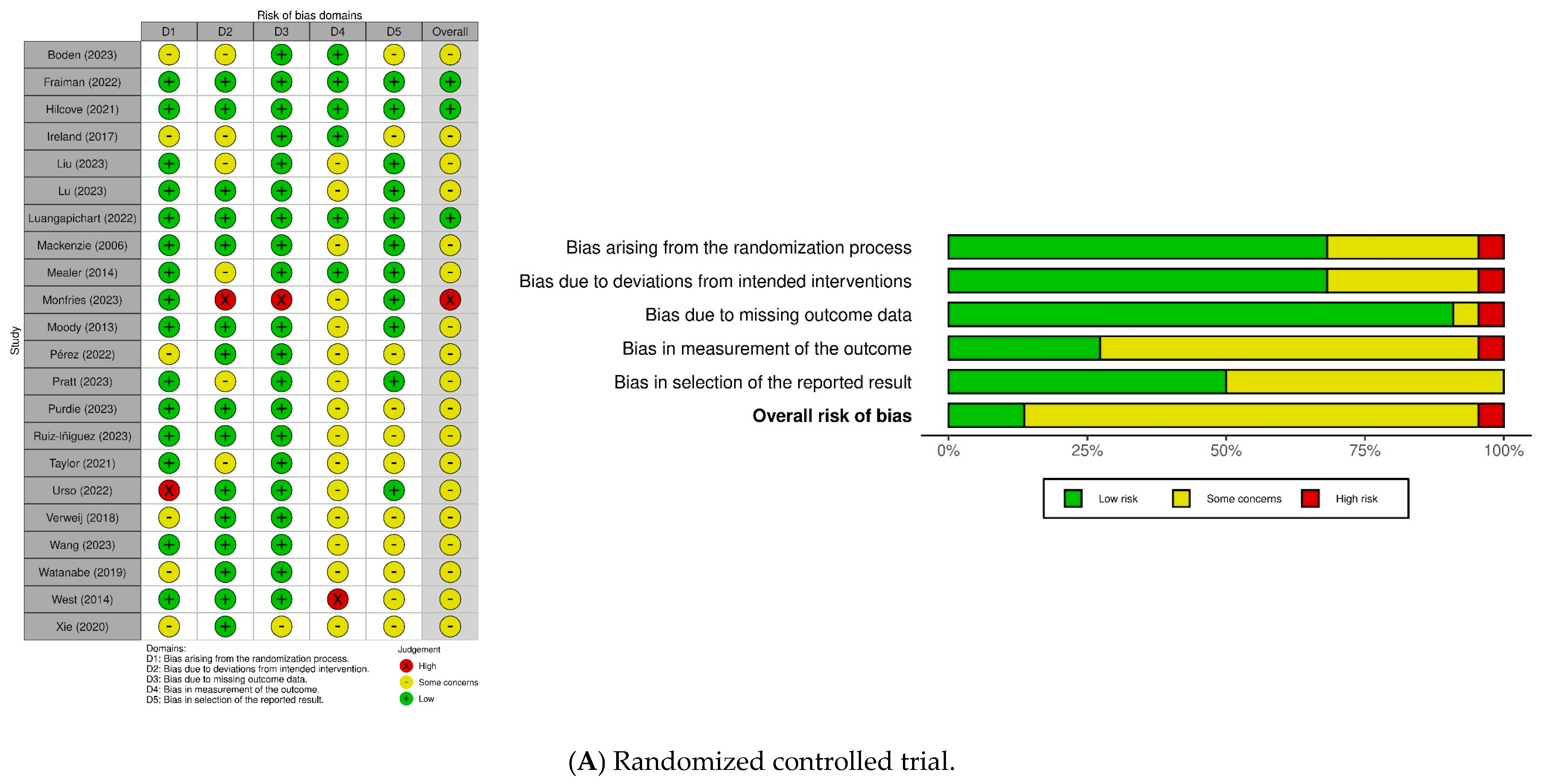
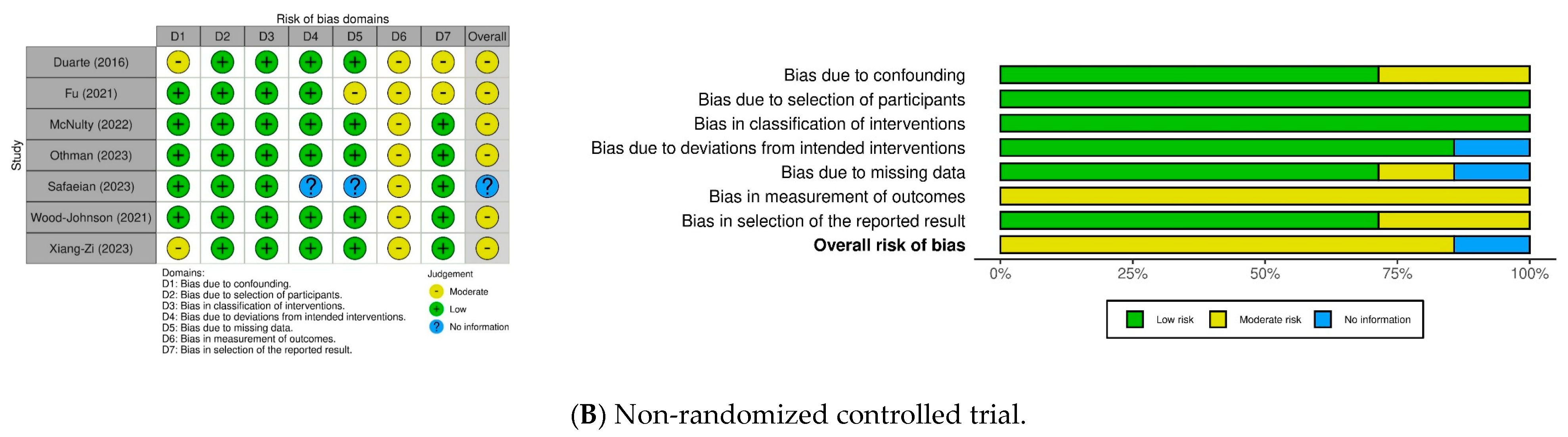
3.3. Risk of Bias
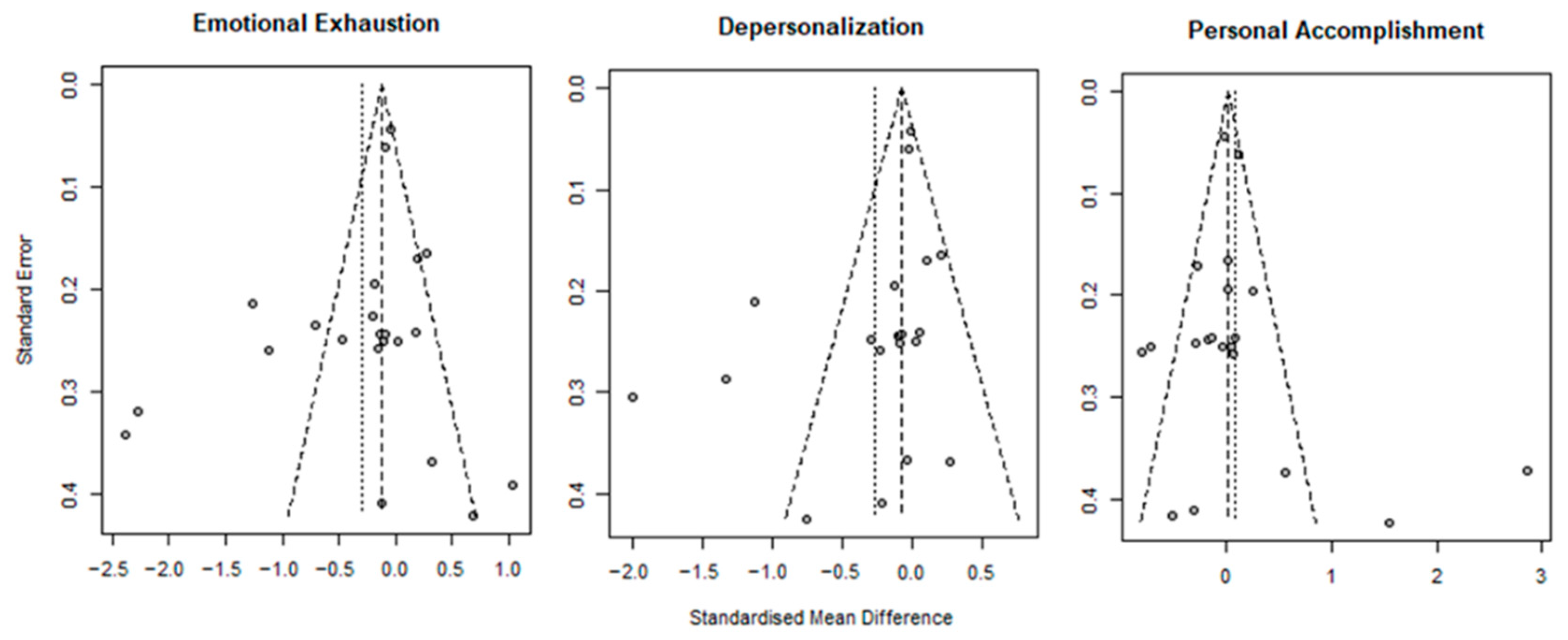
3.4. Meta-Analysis
4. Discussion
Strengths and Limitations
5. Conclusions
Author Contributions
Funding
Institutional Review Board Statement
Informed Consent Statement
Data Availability Statement
Acknowledgments
Conflicts of Interest
Abbreviations
| ACT | Acceptance and commitment |
| CBTs | Cognitive behavioral therapies |
| DP | Depersonalization |
| EE | Emotional exhaustion |
| HPs | Healthcare professionals |
| MBI | Maslach Burnout Inventory |
| PA | Personal accomplishment |
| RCT | Randomized controlled trial |
References
- World Health Organization. International Classification of Diseases, 11th Revision, 2024; (ICD-11): The Global Standard for Diagnostic Health Information. Available online: https://icd.who.int/browse/2024-01/mms/en#129180281 (accessed on 23 January 2025).
- Maslach, C.; Leiter, M.P. Understanding the burnout experience: Recent research and its implications for psychiatry. World Psychiatry 2016, 15, 103–111. [Google Scholar] [CrossRef] [PubMed]
- Maslach, C.; Schaufeli, W.B.; Leiter, M.P. Job burnout. Annu. Rev. Psychol. 2001, 52, 397–422. [Google Scholar] [CrossRef] [PubMed]
- Ghahramani, S.; Lankarani, K.B.; Yousefi, M.; Heydari, K.; Shahabi, S.; Azmand, S. A systematic review and meta-analysis of burnout among healthcare workers during COVID-19. Front. Psychiatry 2021, 12, 758849. [Google Scholar] [CrossRef] [PubMed]
- Smiley, R.A.; Lauer, P.; Bienemy, C.; Berg, J.G.; Shireman, E.; Reneau, K.A.; Alexander, M. The 2017 national nursing workforce survey. J. Nurs. Regul. 2018, 9, S1–S88. [Google Scholar] [CrossRef]
- West, C.P.; Dyrbye, L.N.; Shanafelt, T.D. Physician burnout: Contributors, consequences and solutions. J. Intern. Med. 2018, 283, 516–529. [Google Scholar] [CrossRef]
- Orly, S.; Rivka, B.; Rivka, E.; Dorit, S.-E. Are cognitive-behavioral interventions effective in reducing occupational stress among nurses? Appl. Nurs. Res. 2012, 25, 152–157. [Google Scholar] [CrossRef]
- Strauss, C.; Gu, J.; Montero-Marin, J.; Whittington, A.; Chapman, C.; Kuyken, W. Reducing stress and promoting well-being in healthcare workers using mindfulness-based cognitive therapy for life. Int. J. Clin. Health Psychol. 2021, 21, 100227. [Google Scholar] [CrossRef]
- Dall’Ora, C.; Ball, J.; Reinius, M.; Griffiths, P. Burnout in nursing: A theoretical review. Hum. Resour. Health 2020, 18, 41. [Google Scholar] [CrossRef]
- Kelsey, E.A.; West, C.P.; Cipriano, P.F.; Peterson, C.; Satele, D.; Shanafelt, T.; Dyrbye, L.N. Original research: Suicidal ideation and attitudes toward help seeking in U.S. nurses relative to the general working population. Am. J. Nurs. 2021, 121, 24–36. [Google Scholar] [CrossRef]
- Shah, M.K.; Gandrakota, N.; Cimiotti, J.P.; Ghose, N.; Moore, M.; Ali, M.K. Prevalence of and factors associated with nurse burnout in the US. JAMA Netw. Open 2021, 4, e2036469. [Google Scholar] [CrossRef]
- Othman, S.Y.; Hassan, N.I.; Mohamed, A.M. Effectiveness of mindfulness-based interventions on burnout and self-compassion among critical care nurses caring for patients with COVID-19: A quasi-experimental study. BMC Nurs. 2023, 22, 305. [Google Scholar] [CrossRef] [PubMed]
- Pratt, E.H.; Hall, L.; Jennings, C.; Olsen, M.K.; Jan, A.; Parish, A.; Porter, L.S.; Cox, C.E. Mobile mindfulness for psychological distress and burnout among frontline COVID-19 nurses: A pilot randomized trial. Ann. Am. Thorac. Soc. 2023, 20, 1475–1482. [Google Scholar] [CrossRef] [PubMed]
- Hayes, S.C. Acceptance and commitment therapy, relational frame theory, and the third wave of behavioral and cognitive therapies. Behav. Ther. 2004, 35, 639–665. [Google Scholar] [CrossRef]
- Hayes, S.C.; Strosahl, K.D.; Wilson, K.G. Acceptance and Commitment Therapy: The Process and Practice of Mindful Change; Guilford Press: New York, NY, USA, 2011. [Google Scholar]
- Ellis, A. Changing rational-emotive therapy (RET) to rational emotive behavior therapy (REBT). J. Ration.-Emotive Cogn.-Behav. Ther. 1995, 13, 85–89. [Google Scholar] [CrossRef]
- Beanlands, H.; McCay, E.; Wang, A.; Aiello, A.; Schwind, J.; Martin, L.S.; Mina, E.S.; Rose, D.; Fredericks, S.; Newman, K. Exploring undergraduate nursing students’ experiences of engaging with a Dialectical Behavior Therapy-skills group intervention: Findings of a thematic analysis. Can. J. Nurs. Res. 2021, 53, 39–46. [Google Scholar] [CrossRef]
- Skinner, B.F. Science and Human Behavior; MacMillan: New York, NY, USA, 1953. [Google Scholar]
- Beck, A.T. Cognitive Therapy and the Emotional Disorders; International Universities Press: Madison, CT, USA, 1979. [Google Scholar]
- Hayes, S.C.; Hofmann, S.G. ‘Third-wave’ cognitive and behavioral therapies and the emergence of a process-based approach to intervention in psychiatry. World Psychiatry 2021, 20, 363–375. [Google Scholar] [CrossRef]
- Towey-Swift, K.D.; Lauvrud, C.; Whittington, R. Acceptance and commitment therapy (ACT) for professional staff burnout: A systematic review and narrative synthesis of controlled trials. J. Ment. Health 2023, 32, 452–464. [Google Scholar] [CrossRef]
- Maas genannt Bermpohl, F.; Hülsmann, L.; Martin, A. Efficacy of mindfulness- and acceptance-based cognitive-behavioral therapies for bodily distress in adults: A meta-analysis. Front. Psychiatry 2023, 14, 1160908. [Google Scholar] [CrossRef]
- Schefft, C.; Heinitz, C.; Guhn, A.; Brakemeier, E.-L.; Sterzer, P.; Köhler, S. Efficacy and acceptability of third-wave psychotherapies in the treatment of depression: A network meta-analysis of controlled trials. Front. Psychiatry 2023, 14, 1189970. [Google Scholar] [CrossRef]
- Lee, M.; Cha, C. Interventions to reduce burnout among clinical nurses: Systematic review and meta-analysis. Sci. Rep. 2023, 13, 10971. [Google Scholar] [CrossRef]
- Wang, Q.; Wang, F.; Zhang, S.; Liu, C.; Feng, Y.; Chen, J. Effects of a mindfulness-based interventions on stress, burnout in nurses: A systematic review and meta-analysis. Front. Psychiatry 2023, 14, 1218340. [Google Scholar] [CrossRef] [PubMed]
- Selič-Zupančič, P.; Klemenc-Ketiš, Z.; Onuk Tement, S. The impact of psychological interventions with elements of mindfulness on burnout and well-being in healthcare professionals: A systematic review. J. Multidiscip. Healthc. 2023, 16, 1821–1831. [Google Scholar] [CrossRef] [PubMed]
- Pérez, V.; Menéndez-Crispín, E.J.; Sarabia-Cobo, C.; de Lorena, P.; Fernández-Rodríguez, A.; González-Vaca, J. Mindfulness-based intervention for the reduction of compassion fatigue and burnout in nurse caregivers of institutionalized older persons with dementia: A randomized controlled trial. Int. J. Environ. Res. Public Health 2022, 19, 11441. [Google Scholar] [CrossRef] [PubMed]
- Montgomery, A.; Panagopoulou, E.; Esmail, A.; Richards, T.; Maslach, C. Burnout in healthcare: The case for organisational change. BMJ 2019, 366, l4774. [Google Scholar] [CrossRef]
- Page, M.J.; McKenzie, J.E.; Bossuyt, P.M.; Boutron, I.; Hoffmann, T.C.; Mulrow, C.D.; Shamseer, L.; Tetzlaff, J.M.; Akl, E.A.; Brennan, S.E.; et al. The PRISMA 2020 statement: An updated guideline for reporting systematic reviews. BMJ 2021, 372, 71. [Google Scholar] [CrossRef]
- Saaiq, M.; Ashraf, B. Modifying “pico” question into “picos” model for more robust and reproducible presentation of the methodology employed in a scientific study. World J. Plast. Surg. 2017, 6, 390–392. [Google Scholar]
- Babineau, J. Product review: Covidence (systematic review software). J. Can. Health Libr. Assoc. 2014, 35, 68–71. [Google Scholar] [CrossRef]
- National Evidence-Based Healthcare Collaborating Agency (NECA). NECA Risk of Bias Assessment Tool Manual: AMSTAR 2, ROBIS, RoB 2, ROBINS-I; NECA: Seoul, Republic of Korea, 2021; ISBN 978-89-6834-725-2. [Google Scholar]
- Boden, L.M.; Rodriguez, C.; Kelly, J.D., IV; Khalsa, A.S.; Casper, D.S. Mindfulness applications: Can they serve as a stress, anxiety, and burnout reduction tool in orthopaedic surgery training? A randomized control trial. JBJS Open Access 2023, 8, e22.00114. [Google Scholar] [CrossRef]
- Fraiman, Y.S.; Cheston, C.C.; Cabral, H.J.; Allen, C.; Asnes, A.G.; Barrett, J.T.; Batra, M.; Bernstein, W.; Bleeker, T.; Dietz, P.M.; et al. Effect of a novel mindfulness curriculum on burnout during pediatric internship: A cluster randomized clinical trial. JAMA Pediatr. 2022, 176, 365–372. [Google Scholar] [CrossRef]
- Hilcove, K.; Marceau, C.; Thekdi, P.; Larkey, L.; Brewer, M.A.; Jones, K. Holistic nursing in practice: Mindfulness-based yoga as an intervention to manage stress and burnout. J. Holist. Nurs. 2021, 39, 29–42. [Google Scholar] [CrossRef]
- Ireland, M.J.; Clough, B.; Gill, K.; Langan, F.; O’Connor, A.; Spencer, L. A randomized controlled trial of mindfulness to reduce stress and burnout among intern medical practitioners. Med. Teach. 2017, 39, 409–414. [Google Scholar] [CrossRef] [PubMed]
- Liu, L.; Tian, L.; Jiang, J.; Zhang, Y.; Chi, X.; Liu, W.; Zhao, Y.H.; Sun, P. Effect of an online mindfulness-based stress reduction intervention on postpandemic era nurses’ subjective well-being, job burnout, and psychological adaptation. Holist. Nurs. Pract. 2023, 37, 244–252. [Google Scholar] [CrossRef] [PubMed]
- Lu, F.; Xu, Y.; Yu, Y.; Zhao, R.; Peng, L.; Liu, B.; Li, M. Long-term effects of a tailored mindfulness-based program for Chinese intensive care unit nurses: A randomized parallel-group trial. Nurse Educ. Pract. 2023, 70, 103640. [Google Scholar] [CrossRef] [PubMed]
- Luangapichart, P.; Saisavoey, N.; Viravan, N. Efficacy and feasibility of the minimal therapist-guided four-week online audio-based mindfulness program “Mindful Senses” for burnout and stress reduction in medical personnel: A randomized controlled trial. Healthcare 2022, 10, 2532. [Google Scholar] [CrossRef]
- Mackenzie, C.S.; Poulin, P.A.; Seidman-Carlson, R. A brief mindfulness-based stress reduction intervention for nurses and nurse aides. Appl. Nurs. Res. 2006, 19, 105–109. [Google Scholar] [CrossRef]
- Mealer, M.; Conrad, D.; Evans, J.; Jooste, K.; Solyntjes, J.; Rothbaum, B.; Moss, M. Feasibility and acceptability of a resilience training program for intensive care unit nurses. Am. J. Crit. Care 2014, 23, e97–e105. [Google Scholar] [CrossRef]
- Monfries, N.; Sandhu, N.; Millar, K. A smartphone app to reduce burnout in the emergency department: A pilot randomized controlled trial. Workplace Health Saf. 2023, 71, 181–187. [Google Scholar] [CrossRef]
- Moody, K.; Kramer, D.; Santizo, R.O.; Magro, L.; Wyshogrod, D.; Ambrosio, J.; Castillo, C.; Lieberman, R.; Stein, J. Helping the helpers: Mindfulness training for burnout in pediatric oncology—A pilot program. J. Pediatr. Oncol. Nurs. 2013, 30, 275–284. [Google Scholar] [CrossRef]
- Purdie, D.R.; Federman, M.; Chin, A.; Winston, D.; Bursch, B.; Olmstead, R.; Bulut, Y.; Irwin, M.R. Hybrid delivery of mindfulness meditation and perceived stress in pediatric resident physicians: A randomized clinical trial of in-person and digital mindfulness meditation. J. Clin. Psychol. Med. Settings 2023, 30, 425–434. [Google Scholar] [CrossRef]
- Ruiz-Íñiguez, R.; Carralero Montero, A.; Burgos-Julián, F.A.; Fabelo Roche, J.R.; Santed, M.Á. Comparison of two brief mindfulness interventions for anxiety, stress and burnout in mental health professionals: A randomised crossover trial. Front. Psychol. 2023, 14, 1160714. [Google Scholar] [CrossRef]
- Taylor, H.; Cavanagh, K.; Field, A.P.; Strauss, C. Health care workers’ need for headspace: Findings from a multisite definitive randomized controlled trial of an unguided digital mindfulness-based self-help app to reduce healthcare worker stress. JMIR mHealth uHealth 2022, 10, e31744. [Google Scholar] [CrossRef] [PubMed]
- Urso, C.; Laserna, A.; Feng, L.; Agnite, A.; Jawe, N.; Magoun, C.; Layton, L.S.; Nates, J.L.; Gutierrez, C. Mindfulness as an antidote to burnout for nursing and support staff in an oncological intensive care unit: A pilot study. Holist. Nurs. Pract. 2022, 36, E38–E47. [Google Scholar] [CrossRef] [PubMed]
- Verweij, H.; van Ravesteijn, H.; van Hooff, M.L.M.; Lagro-Janssen, A.L.M.; Speckens, A.E.M. Mindfulness-based stress reduction for residents: A randomized controlled trial. J. Gen. Intern. Med. 2018, 33, 429–436. [Google Scholar] [CrossRef] [PubMed]
- Wang, Q.; Luan, Y.; Liu, D.; Dai, J.; Wang, H.; Zhang, Y.; Wang, S.; Dong, X.; Bi, H. Guided self-help mindfulness-based intervention for increasing psychological resilience and reducing job burnout in psychiatric nurses: A randomized controlled trial. Int. J. Nurs. Pract. 2024, 30, e13204. [Google Scholar] [CrossRef]
- Watanabe, N.; Horikoshi, M.; Shinmei, I.; Oe, Y.; Narisawa, T.; Kumachi, M.; Matsuoka, Y.; Hamazaki, K.; Furukawa, T.A. Brief mindfulness-based stress management program for a better mental state in working populations—Happy Nurse Project: A randomized controlled trial. J. Affect. Disord. 2019, 251, 186–194. [Google Scholar] [CrossRef]
- West, C.P.; Dyrbye, L.N.; Rabatin, J.T.; Call, T.G.; Davidson, J.H.; Multari, A.; Romanski, S.A.; Hellyer, J.M.H.; Sloan, J.A.; Shanafelt, T.D. Intervention to promote physician well-being, job satisfaction, and professionalism: A randomized clinical trial. JAMA Intern. Med. 2014, 174, 527–533. [Google Scholar] [CrossRef]
- Xie, C.; Zeng, Y.; Lv, Y.; Li, X.; Xiao, J.; Hu, X. Educational intervention versus mindfulness-based intervention for ICU nurses with occupational burnout: A parallel, controlled trial. Complement. Ther. Med. 2020, 52, 102485. [Google Scholar] [CrossRef]
- Duarte, J.; Pinto-Gouveia, J. Effectiveness of a mindfulness-based intervention on oncology nurses’ burnout and compassion fatigue symptoms: A non-randomized study. Int. J. Nurs. Stud. 2016, 64, 98–107. [Google Scholar] [CrossRef]
- Fu, C.-Y.; Kao, C.-C.; Wang, R.-H. The effects of an educational program on the Professional Quality of Life and health of nurses: A cluster experimental design. J. Nurs. Res. 2021, 29, e149. [Google Scholar] [CrossRef]
- McNulty, D.S.; LaMonica-Way, C.; Senneff, J.-A. The impact of mindfulness on stress and burnout of new graduate nurses as a component of a nurse residency program. J. Nurs. Adm. 2022, 52, E12–E18. [Google Scholar] [CrossRef]
- Safaeian, M.; Kakavand, A.; Bahrami Hidaji, M.; Mohammadi Shirmahaleh, F.; Ranjbaripour, T. Comparing the effectiveness of mindfulness training with schema therapy on cognitive fusion and job burnout in female nurses. Arch. Hyg. Sci. 2023, 12, 62–69. [Google Scholar] [CrossRef]
- Wood-Johnson, S. Does a Six-Week Online Mindfulness Intervention Affect Burnout in Registered Nurses Working in an Adult Inpatient Rehabilitation Setting During the COVID-19 Pandemic? Doctor of Nursing Practice Scholarly Project. Ph.D. Thesis, DeSales University, Center Valley, PA, USA, 2021. [Google Scholar]
- Xiang-Zi, J.; Jia-Yuan, Z. Mindfulness exercises reduce death anxiety and burnout in intensive care nurses. Death Stud. 2023, 47, 600–605. [Google Scholar] [CrossRef] [PubMed]
- Ong, N.Y.; Teo, F.J.J.; Ee, J.Z.Y.; Yau, C.E.; Thumboo, J.; Tan, H.K.; Ng, Q.X. Effectiveness of mindfulness-based interventions on the well-being of healthcare workers: A systematic review and meta-analysis. Gen. Psychiatry 2024, 37, e101115. [Google Scholar] [CrossRef] [PubMed]
- De Simone, S.; Vargas, M.; Servillo, G. Organizational strategies to reduce physician burnout: A systematic review and meta-analysis. Aging Clin. Exp. Res. 2021, 33, 883–894. [Google Scholar] [CrossRef]
- Aronsson, G.; Theorell, T.; Grape, T.; Hammarström, A.; Hogstedt, C.; Marteinsdottir, I.; Skoog, I.; Träskman-Bendz, L.; Hall, C. A systematic review including meta-analysis of work environment and burnout symptoms. BMC Public Health 2017, 17, 264. [Google Scholar] [CrossRef]
- West, C.P.; Dyrbye, L.N.; Erwin, P.J.; Shanafelt, T.D. Interventions to prevent and reduce physician burnout: A systematic review and meta-analysis. Lancet 2016, 388, 2272–2281. [Google Scholar] [CrossRef]
- Moldovan, F.; Moldovan, L.; Bataga, T. Assessment of labor practices in healthcare using an innovatory framework for sustainability. Medicina 2023, 59, 796. [Google Scholar] [CrossRef]
- Lomas, T.; Medina, J.C.; Ivtzan, I.; Rupprecht, S.; Eiroa-Orosa, F.J. The impact of mindfulness on the well-being and performance of educators: A systematic review of the empirical literature. Teach. Teach. Educ. 2017, 61, 132–141. [Google Scholar] [CrossRef]
- Boot, W.R.; Simons, D.J.; Stothart, C.; Stutts, C. The pervasive problem with placebos in psychology: Why active control groups are not sufficient to rule out placebo effects. Perspect. Psychol. Sci. 2013, 8, 445–454. [Google Scholar] [CrossRef]
- Alrashdi, D.H.; Chen, K.K.; Meyer, C.; Gould, R.L. A systematic review and meta-analysis of online mindfulness-based interventions for university students: An examination of psychological distress and well-being, and attrition rates. J. Technol. Behav. Sci. 2024, 9, 211–223. [Google Scholar] [CrossRef]
- Lippke, S.; Gao, L.; Keller, F.M.; Becker, P.; Dahmen, A. Adherence with online therapy vs face-to-face therapy and with online therapy vs care as usual: Secondary analysis of two randomized controlled trials. J. Med. Internet. Res. 2021, 23, e31274. [Google Scholar] [CrossRef] [PubMed]
- Kumar, R.; Corvisieri, G.; Fici, T.F.; Hussain, S.I.; Tegolo, D.; Valenti, C. Transfer learning for facial expression recognition. Information 2025, 16, 320. [Google Scholar] [CrossRef]
- Musker, M.; Othman, S. Effective interventions to reduce burnout in nurses: A meta-analysis. Complement. Ther. Clin. Pract. 2024, 54, 101827. [Google Scholar] [CrossRef] [PubMed]



| No. | First Author (Year) Country | Study Design | Participants | Sample Size (Female %) | Age (Mean ± SD Years) | Controls | Third Wave CBT Type | Outcome Measures (Variables) | Publication Type | Risk of Bias |
|---|---|---|---|---|---|---|---|---|---|---|
| 1 | Boden (2023) United states [33] | RCT | Orthopedic surgery residents | 24 (E = 12, C = 12) (37.5%) | E: 31.0 ± 2.8 C: 30.6 ± 2.8 | No intervention | Mindfulness | MBI (burnout), PSS (stress), GAD-7 (anxiety) | Journal article | Some concerns |
| 2 | Duarte (2016) Portugal [53] | Quasi experimental | Oncology nurses | 48 (E = 29, C = 19) (90.1%) | E: 38.90 ± 8.34 C: 42.11 ± 8.43 | Wait-list | Mindfulness | ProQOL-5 (burnout, compassion fatigue, secondary traumatic stress), DASS-21 (depression, anxiety, stress), AAQ-II (acceptance), RRS (ruminative responses), FFMQ (mindfulness), SCS (self-compassion), SWL (satisfaction with life) | Journal article | Moderate |
| 3 | Fraiman (2022) United States [34] | RCT | Pediatric resident | 340 (E = 194, C = 146) (75%) | Mean age not provided; 15% were 30 years or older | No intervention | Mindfulness | -Primary: MBI (emotional exhaustion) -Secondary: MBI (depersonalization, personal accomplishment), FFMQ (mindfulness), IRI (empathy) | Journal article | Low |
| 4 | Fu (2021) Taiwan [54] | Quasi experimental | Registered nurses | 124 (E = 67, C = 57) (No percentage of females) | E: 39.01 ± 9.27 C: 37.09 ± 8.53 | No intervention | Mindfulness | ProQOL-5 (burnout, compassion fatigue, secondary traumatic stress), SF-12v2 (mental health, physical health) | Journal article | Moderate |
| 5 | Hilcove (2021) United States [35] | RCT | Nurses and healthcare professionals | 78 (E = 41, C = 37) (95%) | Both groups: 42.41 ± 12.12 (range: 24–69) | No intervention | Mindfulness | MBI (burnout), PSS (stress), SF-36 (vitality), GSQI (sleep quality), BSS (serenity), MAS (mindfulness), Biomarkers (diurnal salivary cortisol, Blood pressure) | Journal article | Low |
| 6 | Ireland (2017) Australia [36] | RCT | Intern doctors | 44 (E = 23, C = 21) (64%) | 26.88 ± 4.79 (range: 22–48) | Active control (weekly 1 h break) | MBSR, MBCT, ACT | CBI (burnout), PSS (stress), | Journal article | Some concerns |
| 7 | Liu (2023) China [37] | RCT | Registered nurses | 68 (E = 31, C = 37) (98.5%) | 38.11 ± 7.81 (range: 24–59) | No intervention | Mindfulness | MBI (burnout), SWB scale, Psychological adaptability questionnaire | Journal article | Some concerns |
| 8 | Lu (2023) China [38] | RCT | ICU nurses | 70 (E = 40, C = 30) (92.2%) | E: 28.33 ± 3.32 C: 27.27 ± 3.76 | Active control (Psycho-educational) | Mindfulness | MBI-HSS (burnout), FFMQ (mindfulness), SAS (anxiety), CESD (depression), PANAS, SWLS (subjective well-being) | Journal article | Some concerns |
| 9 | Luangapichart (2022) Thailand [39] | RCT | Medical personnel | 90 (E = 45, C = 45) (84.4%) | E: 34.07 ± 8.49 (Group A) C: 32.87 ± 7.27 (Group B) | Active control (Group B -Psychological self-help articles) | Mindfulness | CBI (burnout), ST-5 (stress), HADS (anxiety, depression), PHLMS (mindfulness), WHOQOL-BREF (quality of life) | Journal article | Low |
| 10 | Mackenzie (2006) Canada [40] | RCT | Nurses and nurse aides | 30 (E = 16, C = 14) (97%) | E: 48.62 ± 6.52 C: 44.78 ± 8.16 | Wait-list | Mindfulness | MBI (burnout), SRDI (relaxation), JSS (job satisfaction), SWLS (life satisfaction), OLQ (sense of coherence) | Journal article | Some concerns |
| 11 | McNulty (2022) United States [55] | Quasi experimental | Newly graduated nurses | 200 (E = 131, C = 69) (E = 82.4%, C = 86.9%) | E: 27.16 ± 6.79 C: 26.2 ± 6.55 | Active control (NRP without mindfulness) | Mindfulness | OBI, PWLSSI (burnout), PSS (stress), MAAS (mindfulness), turnover rate, CFGNES (overwhelm and stress) | Journal article | Moderate |
| 12 | Mealer (2014) United States [41] | RCT | ICU nurses | 27 (E = 13, C = 14) (E = 92%, C = 86%) | N/A | No intervention | CBT, MBSR | MBI (burnout), CD-RISC (Resilience), HADS (anxiety, depression), PDS (PTSD symptoms) | Journal article | Some concerns |
| 13 | Monfries, (2023) Canada [42] | RCT | Healthcare professionals | 34 (E = 17, C = 17) (81.6% | N/A | Wait-list | Mindfulness and resilience training | MBI (burnout), CDRS (resilience), MAAS (mindfulness) | Journal article | High |
| 14 | Moody (2013) United States [43] | RCT | Pediatric oncology clinical staff | 45 (E = 21, C = 24) (80%) | N/A | No intervention | Mindfulness | -Primary: MBI (emotional exhaustion) -Secondary: BDI (depression), PSS (stress), MAAS (mindfulness) | Journal article | Some concerns |
| 15 | Othman (2023) Egypt [12] | Quasi experimental | Critical care nurses | 60 (E = 30, C = 30) (75%) | N/A | No intervention | Mindfulness | MBI (burnout), FFMQ (mindfulness), SCS (self-compassion) | Journal article | Moderate |
| 16 | Pérez (2022) Spain [27] | RCT | Nurses | 74 (E = 39, C = 35) (89.6%) | 37 ± 9.13 | Wait-list control group | Mindfulness | MBI (burnout), PQLS (quality of life) | Journal article | High |
| 17 | Pratt (2023) United States [13] | RCT | Nurses | 102 (E = 69, C = 33) (94%) | 26.5 (range: 24–32) | Wait-list | Mindfulness | MBI (burnout), PHQ-9 (depression), PSS (stress), Feasibility | Journal article | Some concerns |
| 18 | Purdie (2023) United States [44] | RCT | Pediatric resident physicians. | 66 (E = 27, C = 39) (78.8%) | E: 26 C: 37 | Wait-list | Mindfulness | -Primary: PSS (stress) -Secondary: MBI (burnout), BDI (depression), UCLA Loneliness Scale, PSQI (sleep quality). | Journal article | Some concerns |
| 19 | Ruiz-Iñiguez (2023) Cuba [45] | RCT | Mental health professionals | 104 (E = 52, C = 52) (90.3%) | 41 ± 11.91 | No intervention | Mindfulness | BBQ (burnout), SSS (stress), STAI-S (anxiety) | Journal article | Some concerns |
| 20 | Safaeian (2023) Iran [56] | Quasi experimental | Female nurses | 60 (E = 40, C = 20) (100%) | 28.95 ± 3.18 | No intervention | Mindfulness | Cognitive fusion, MBI (burnout) | Journal article | No information |
| 21 | Taylor (2022) United Kingdom [46] | RCT | Employees within an NHS trust or GP practice | 2182 (E = 1095, C = 1087) (83%) | 40.42 ± 10.92 | Active control (The NHS digital platform for work-related stress, Mood-zone) | Mindfulness | DASS-21 (depression, anxiety, stress), SWEMWBS (Mental well-being), MBI (burnout), FFMQ-15 (mindfulness), SCS-SF (Self-compassion), CLS (compassionate love), PSWQ (worry), RRS (brooding), Sickness absence | Journal article | Some concerns |
| 22 | Urso (2022) United states [47] | RCT | Nurses and patient care technicians | 45 (E = 24, C = 21) (78%) | N/A | No intervention | Mindfulness | DASS-21 (depression, anxiety, stress), MBI-HSS (burnout) | Journal article | Some concerns |
| 23 | Verweij (2018) Netherlands [48] | RCT | Residents from all medical, surgical, and primary care disciplines | 148 (E = 80, C = 68) (88%) | 31.2 ± 4.6 | Wait-list | Mindfulness | -Primary: MBI-HSS, UBOS-C (burnout) -Secondary: PSWQ (worry), FFMQ (mindfulness), SCS (self-compassion), mental health continuum, JSPE (empathy) | Journal article | Some concerns |
| 24 | Wang (2024) China [49] | RCT | Psychiatric nurses | 118 (E = 59, C = 59) (88%) | 32.25 ± 3.56 | Active control (Psychoeducational) | Mindfulness | MBI-HSS (job burnout), FFMQ (mindfulness), CD-RISC (resilience) | Journal article | Some concerns |
| 25 | Watanabe (2019) Japan [50] | RCT | Junior nurses | 80 (E = 40, C = 40) (100%) | 30.1 ± 8.4 | Active control (Psychoeducation group) | Mindfulness | MBI-HSS (burnout), GAD-7 (anxiety), HADS (anxiety, depression), ISI (insomnia), PHQ-9 (depression) | Journal article | Some concerns |
| 26 | West (2014) United States [51] | RCT | Practicing physicians | 74 (E = 37, C = 37) (33.9%) | N/A | No intervention | Mindfulness | Engagement at work, MBI (burnout), PSS (stress), depression, QOL fatigue, PJSS (job satisfaction), JSPE (empathy), Medical Outcomes Study Short-Form Health Survey | Journal article | Some concerns |
| 27 | Wood-Johnson (2021) United States [57] | Quasi experimental | Registered nurses (RNs) | 38 (E = 25, C = 13) (No percentage of females) | 24 to 60 years (No mean age) | No intervention | Mindfulness | MBI (burnout) | Doctoral dissertation | Moderate |
| 28 | Xiang-Zi (2023) China [58] | Quasi experimental | Intensive care unit nurses | 66 (E = 34, C = 32) (72.7%) | 29.72 ± 1.81 | No intervention | Mindfulness | Death anxiety, MBI-HSS (burnout) | Journal article | Moderate |
| 29 | Xie (2020) China [52] | RCT | Intensive care unit nurses | 106 (E = 53, C = 53) (100%) | 27.7 ± 7.7 | Active control (Education-based group) | Mindfulness | MBI (burnout), MAAS (mindfulness), ACQ (acceptance, action) | Journal article | Some concerns |
| No. | First Author (Year) | Source of Intervention | Mode of Delivery | Intervention Period and Intervention Dose | Follow-Up Time Points | Dropout Rate% | Impact of COVID-19 |
|---|---|---|---|---|---|---|---|
| 1 | Boden (2023) [33] | Existing mindfulness programs—Mindfulness based application “Headspace” | Online, through a mobile app (audio) | -Period unspecified -Daily for 2 months (On average, 7.9 ± 6.6 min per day, 2 days per week) | Baseline and post-intervention (after 2 months) | 0% | Not mentioned |
| 2 | Duarte (2016) [53] | Existing mindfulness programs—MBSR by Jon Kabat-Zinn | On-site, group sessions, with supplementary CD for home practice (audio) | -Between 2013 and 2015 -6 weeks (Six 2 h group sessions), with daily home practice of at least 15 min | Pre, post intervention (week 6), and 3-month follow-up | 52% | Not applicable (study conducted before the pandemic) |
| 3 | Fraiman (2022) [34] | Developed Kern’s six-step approach | On-site, group sessions during existing didactic time | -14 June 2017 to 28 February 2019 -6 months (7 h-long sessions), plus optional mindfulness refreshers | Baseline, post-intervention (month 6), and follow-up (month 15) | -19.7% at 6 months -42.6% at 15 months | Not applicable (study conducted before the pandemic) |
| 4 | Fu (2021) [54] | Adaptations of existing programs -Mindfulness respiration (Kabat-Zinn) -Compassion fatigue resiliency (Gentry et al.) | On-site, group sessions with supplementary materials for home practice | -May 2017 to December 2017 -4 weeks (4 sessions 2 h each), plus additional self-practice encouraged | Baseline, end of intervention (4 weeks), 4 weeks post-intervention, and 12 weeks post-intervention | -E: 3% at the end of intervention, 24% at 4 weeks, 42% at 12 weeks -C: 0% at the end of intervention, 11% at 4 weeks, 39% at 12 weeks) | Not applicable (study conducted before the pandemic) |
| 5 | Hilcove (2021) [35] | Adaptations of existing programs -Incorporating elements of Hatha and Raja Yoga, based on principles outlined by Jon Kabat-Zinn | On-site, group sessions with supplementary DVD/CD for home practice | -Period unspecified -6 weeks (weekly sessions, approximately 137 min per week of home practice on average) | Baseline and post-intervention (6 weeks) | 2.5% | Not mentioned |
| 6 | Ireland (2017) [36] | Adapted from well-validated psychological treatment programs for a non-clinical population | On-site, group sessions with additional self-directed practice recommended | -Period unspecified -10 weeks (weekly sessions, with encouragement to practice mindfulness outside of sessions) | Baseline, mid-intervention (week 5), and post-intervention (week 10) | N/A | Not applicable (study conducted before the pandemic) |
| 7 | Liu (2023) [37] | Existing mindfulness programs–MBSR by Jon Kabat-Zinn | Online, Internet and WeChat-an app that allows social networking through text, voice, and video | -July 2022 -8 weeks (Each session lasted 1.5 to 2 h) | Baseline and post-intervention (8 weeks) | 24.44% | Not mentioned |
| 8 | Lu (2023) [38] | Adapted from the standard MBSR program developed by Jon Kabat-Zinn, combined with loving-kindness meditation | On-site group sessions, with participants encouraged to practice mindfulness at home using provided audio resources | -Between 2016 and 2017 -4 weeks (8 sessions, 2 h each), with daily home practice encouraged (at least 20 min per day) | Baseline (T1), post (T2), 2 months post (T3), and 6 months post intervention (T4) | 22.2% | Not applicable (study conducted before the pandemic) |
| 9 | Luangapichart (2022) [39] | Adaptations of existing programs -Incorporating Dynamic Meditation principles by Luangpor Teean Jittasubho | Online, daily guided mindfulness practices via LINE app | -June 2021 to October 2021 -4 weeks (Daily mindfulness practice for 28 days), with each audio session to be repeated at least three times a day | Group A—Baseline (T0), 4 weeks (T1), 8 weeks (T2); Group B-Baseline (T0), 4 weeks (T1), 8 weeks (T2), 12 weeks (T3), and 16 weeks (T4) | 4.4% | The study was conducted during the pandemic, which influenced the recruitment and stress levels of participants. |
| 10 | Mackenzie (2006) [40] | Adapted from traditional MBSR programs as developed by Jon Kabat-Zinn | On-site, group sessions with supplementary materials for home practice | -Period unspecified -4 sessions (30 min each), with recommended daily home practice | Baseline and post-intervention (4 weeks) | 0% | Not applicable (study conducted before the pandemic) |
| 11 | McNulty (2022) [55] | Adaptations of existing programs -From MBSR and related programs, designed specifically for NGNs | Online, virtual delivery via a secure online platform with supplementary email reminders for home practice | -Between April and June 2020 -4 weekly sessions (1 h each) with ongoing daily mindfulness practice encouraged | Baseline (pre-intervention) and 6 months post-intervention | 0% | The COVID-19 pandemic shifted the study to a virtual format and increased participants’ stress levels. |
| 12 | Mealer (2014) [41] | Developed by the authors, incorporating CBT, MBSR, expressive writing, and exercise | On-site, combined with at-home practices | -October 2012 to December 2012 -12 weeks, including a 2-day workshop | Baseline and post-intervention (12 weeks) (No long-term follow-up) | 0% | Not applicable (study conducted before the pandemic) |
| 13 | Monfries, (2023) [42] | Developed modules on mindfulness, self-expertise, mental fitness, mental health, hardiness, and energy management | Online through a smartphone app with self-directed participation (via the Headversity™ App) | -March to June 2021 -12 weeks of self-paced engagement with the app’s content | Baseline and post-intervention (12 weeks) (No long-term follow-up) | 44% | N/A |
| 14 | Moody (2013) [43] | Existing mindfulness programs—MBSR by Jon Kabat-Zinn | On-site, in-person group sessions at the hospital | -Not explicitly stated, but the study began in December 2011 -Total of 15 h of class time (one 6 h session, 6weekly 1 h follow-up sessions, and a final 3 h wrap-up session) | Measurements were taken at baseline and after the 8-week course; qualitative analysis of diaries provided additional insights | 2% | N/A |
| 15 | Othman (2023) [12] | Existing mindfulness programs—MBSR by Jon Kabat-Zinn | Online delivery via WhatsApp | -2 month (8 weeks) -April to June 2021 -2.5 h per session | Baseline and post-intervention, follow up at 8 weeks | 15.5% | During COVID-19, designed to address related stress. Available online |
| 16 | Pérez (2022) [27] | Existing mindfulness programs—MBSR by Jon Kabat-Zinn | Online, using videos, audio downloads, and emails. | -6 weeks -6 session (60 min per session) | Measurements at baseline, six weeks, and three months post-intervention | 0% | N/A |
| 17 | Pratt (2023) [13] | Developed—LIFT: A mindfulness program to reduce symptoms of psychological distress and improve quality of life for intensive care unit (ICU) survivors | Online, through a mobile app with audio and video content | Access to Lift content after randomization for one month (4 weeks) | Baseline and one-month post-enrollment. | 13.7% | The study was conducted during the COVID-19 pandemic but does not mention specific changes due to COVID-19 |
| 18 | Purdie (2023) [44] | Developed—Mindful Awareness Practices (MAPs) developed at UCLA’s Mindful Awareness Research Center | Hybrid, on-site and digital (via secure mobile app) | -6 weeks -6 session (60 min per session) | Baseline and post-intervention | 4.5% | N/A |
| 19 | Ruiz-Iñiguez (2023) [45] | Developed by the authors, guided by works of Kabat-Zinn and Segal | On-site sessions with audio guides for home practice | -January to March 2018 -10 weeks (2.5 h per session) -Plus home practice | Baseline, Posttest1 (week 6), Posttest2 (week 11), 6-month follow-up (week 37–39) | 28.8% | N/A |
| 20 | Safaeian (2023) [56] | Developed based on the Kabat-Zinn and Young et al. for schema therapy | On-site sessions | -Conducted in 2021 -4 weeks -8 Sessions -1 h per session | Baseline, post-test, and 2-month follow-up | N/A | N/A |
| 21 | Taylor (2022) [46] | Developed—Unguided digital mindfulness-based self-help (MBSH) interventions | Online, website and mobile apps | Participants were encouraged to engage in at least one ten-minute mindfulness practice daily for the study duration (4.5 month) | Baseline (Time 1), after the initial intervention period (1.5 months, Time 2), and at post-intervention (4.5 months, Time 3). | 35.1% | N/A |
| 22 | Urso (2022) [47] | Developed—LOTUS (Living Optimally in Times Under Stress) was developed by a yoga therapist and a yoga instructor | Online | -30 September 2019–21 January 2020 -Classes were on-site, 1 h duration with a cadence of once per week for a total of 8 weeks | Baseline and Post-intervention | 6.6% | Due to the COVID-19 pandemic, the second group was not able to receive the MBI |
| 23 | Verweij (2018) [48] | Existing mindfulness programs–MBSR by Jon Kabat-Zinn | On-site, in-person group sessions | Daily practice at home for 45 min | baseline, post-intervention (approximately 3 months later) | 15% | N/A |
| 24 | Wang (2024) [49] | Developed based on mindfulness-based cognitive interventions and mindfulness-based stress reduction programs | Online through WeChat, including audio and text materials. | -January to August 2022 -at home 5 days -8 weeks. | baseline, 4 weeks, and 8 weeks | 16% | N/A |
| 25 | Watanabe (2019) [50] | Bishop’s mindfulness attention regulation combined with Beck’s CBT model. | On-site sessions conducted by senior nurses. | -13 weeks -4 sessions, -30 min per session | Baseline 13 weeks 26 weeks 52 weeks | 5% | N/A |
| 26 | West (2014) [51] | Developed by the study authors, incorporating mindfulness, reflection, shared experience, and small-group learning | On-site sessions facilitated by trained internal medicine physicians. | -September 2010 and June 2012 -1 h biweekly sessions, totaling 19 sessions over 9 months | -Baseline—every 3 months through the 9-month study intervention -3 and 12 months post-study. | 2.7% | N/A |
| 27 | Wood-Johnson (2021) [57] | Adaptations of existing programs -Palouse’s MBSR Program | Online through pre-recorded videos. | -22 February 2021, to 2 April 2021 -6 weeks -three times a week -Varying in length from 2 min to 60 min | -Baseline -3 weeks after intervention | 18.4% | The study was conducted during the COVID-19 pandemic |
| 28 | Xiang-Zi (2023) [58] | Developed specifically for the study, based on existing mindfulness practices | On-site sessions conducted by a qualified psychologist. | -During the nurses’ work hours -45–50 min per session | baseline and post-intervention (2 months after baseline) | 0% | N/A |
| 29 | Xie (2020) [52] | Developed-Based on MBSR, MBCT, ACT, and loving-kindness and compassion meditation | On-site group sessions | -October 2017 to May 2018 -8 weeks | -Baseline -Post-intervention -1 month after intervention -3 months after intervention | 14.15% | N/A |
| Burnout | t | df | p-Value |
|---|---|---|---|
| Emotional exhaustion | −1.46 | 20 | 0.1594 |
| Depersonalization | −2.01 | 18 | 0.0597 |
| Personal accomplishment | 0.37 | 18 | 0.7171 |
| Burnout | N | Common Effects Estimate | Heterogeneity | Random Effects Estimate | ||||
|---|---|---|---|---|---|---|---|---|
| SMD (CI) | p-Value | Q | I2(%) | p-Value | SMD (CI) | p-Value | ||
| EE | 11 | −0.278 (−0.373, −0.183) | <0.0001 | 133.42 | 92.5 | <0.0001 | −0.686 (−1.237, −0.136) | 0.0145 |
| DP | 10 | −0.187 (−0.283, −0.090) | 0.0001 | 83.95 | 89.3 | <0.0001 | −0.529 (−0.975, −0.083) | 0.0202 |
| PA | 10 | 0.113 (0.016, 0.209) | 0.0221 | 85.29 | 89.4 | <0.0001 | 0.311 (−0.319, 0.941) | 0.3338 |
Disclaimer/Publisher’s Note: The statements, opinions and data contained in all publications are solely those of the individual author(s) and contributor(s) and not of MDPI and/or the editor(s). MDPI and/or the editor(s) disclaim responsibility for any injury to people or property resulting from any ideas, methods, instructions or products referred to in the content. |
© 2025 by the authors. Licensee MDPI, Basel, Switzerland. This article is an open access article distributed under the terms and conditions of the Creative Commons Attribution (CC BY) license (https://creativecommons.org/licenses/by/4.0/).
Share and Cite
Han, J.-H.; Lee, M.; Cha, C.; Baek, G. Effects of Third-Wave Cognitive Behavioral Therapy for Healthcare Professionals’ Burnout: A Systematic Review and Meta-Analysis. Healthcare 2025, 13, 3253. https://doi.org/10.3390/healthcare13243253
Han J-H, Lee M, Cha C, Baek G. Effects of Third-Wave Cognitive Behavioral Therapy for Healthcare Professionals’ Burnout: A Systematic Review and Meta-Analysis. Healthcare. 2025; 13(24):3253. https://doi.org/10.3390/healthcare13243253
Chicago/Turabian StyleHan, Jin-Hui, Miran Lee, Chiyoung Cha, and Gumhee Baek. 2025. "Effects of Third-Wave Cognitive Behavioral Therapy for Healthcare Professionals’ Burnout: A Systematic Review and Meta-Analysis" Healthcare 13, no. 24: 3253. https://doi.org/10.3390/healthcare13243253
APA StyleHan, J.-H., Lee, M., Cha, C., & Baek, G. (2025). Effects of Third-Wave Cognitive Behavioral Therapy for Healthcare Professionals’ Burnout: A Systematic Review and Meta-Analysis. Healthcare, 13(24), 3253. https://doi.org/10.3390/healthcare13243253