


Postural Assessment: An Online Survey of Practicing Chiropractors in the UK

 , , ,
, , , 
Abstract
1. Introduction
2. Materials and Methods
2.1. Participants
2.2. Measures and Instrumentation
2.2.1. Theoretical Framework
2.2.2. Questionnaire Development and Pre-Testing
2.2.3. Questionnaire
2.2.4. Data Collection Procedure
2.3. Data Analysis
3. Results
3.1. Quantitative Analysis
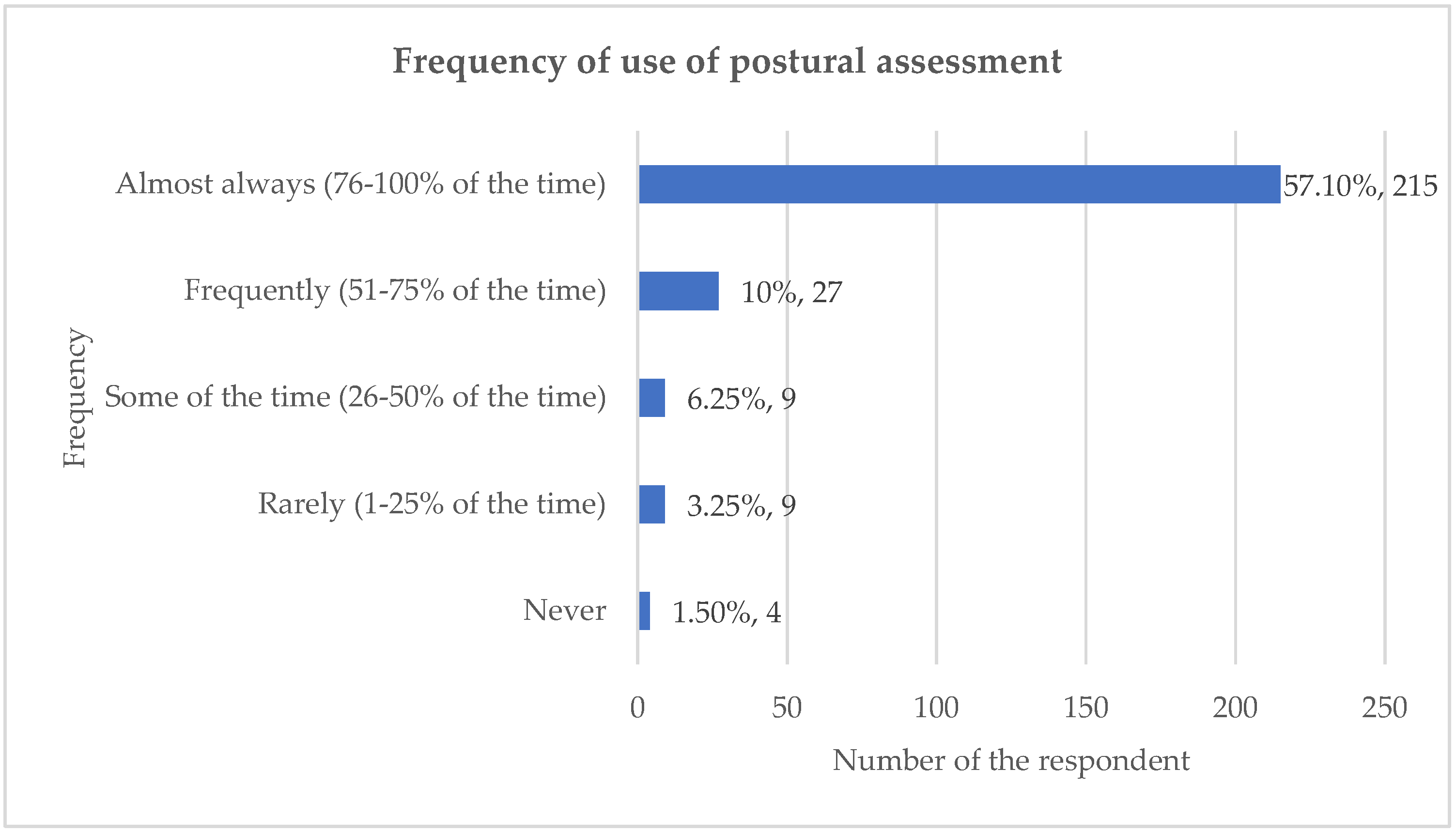
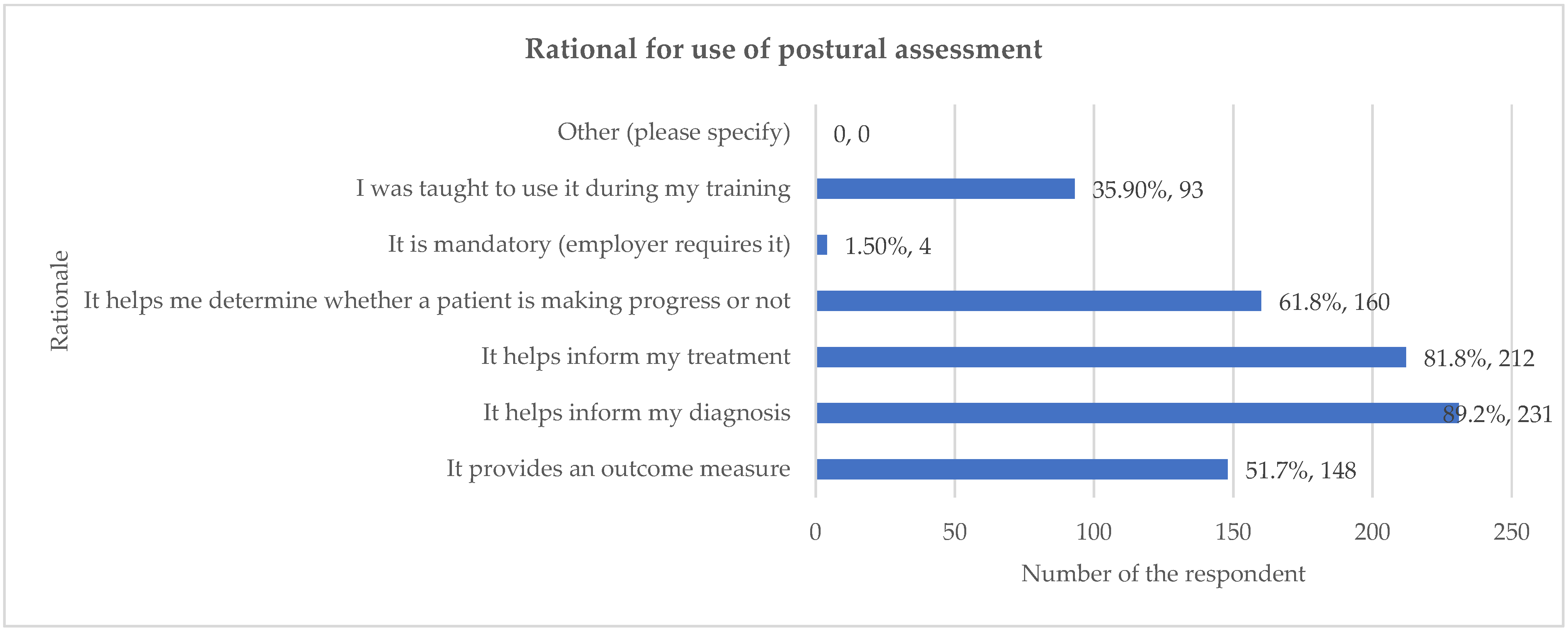
3.1.1. Rationale for the Use of Postural Assessment: Informing Clinical and Patient Management
Informing Clinical Decisions
Informing Patient Management
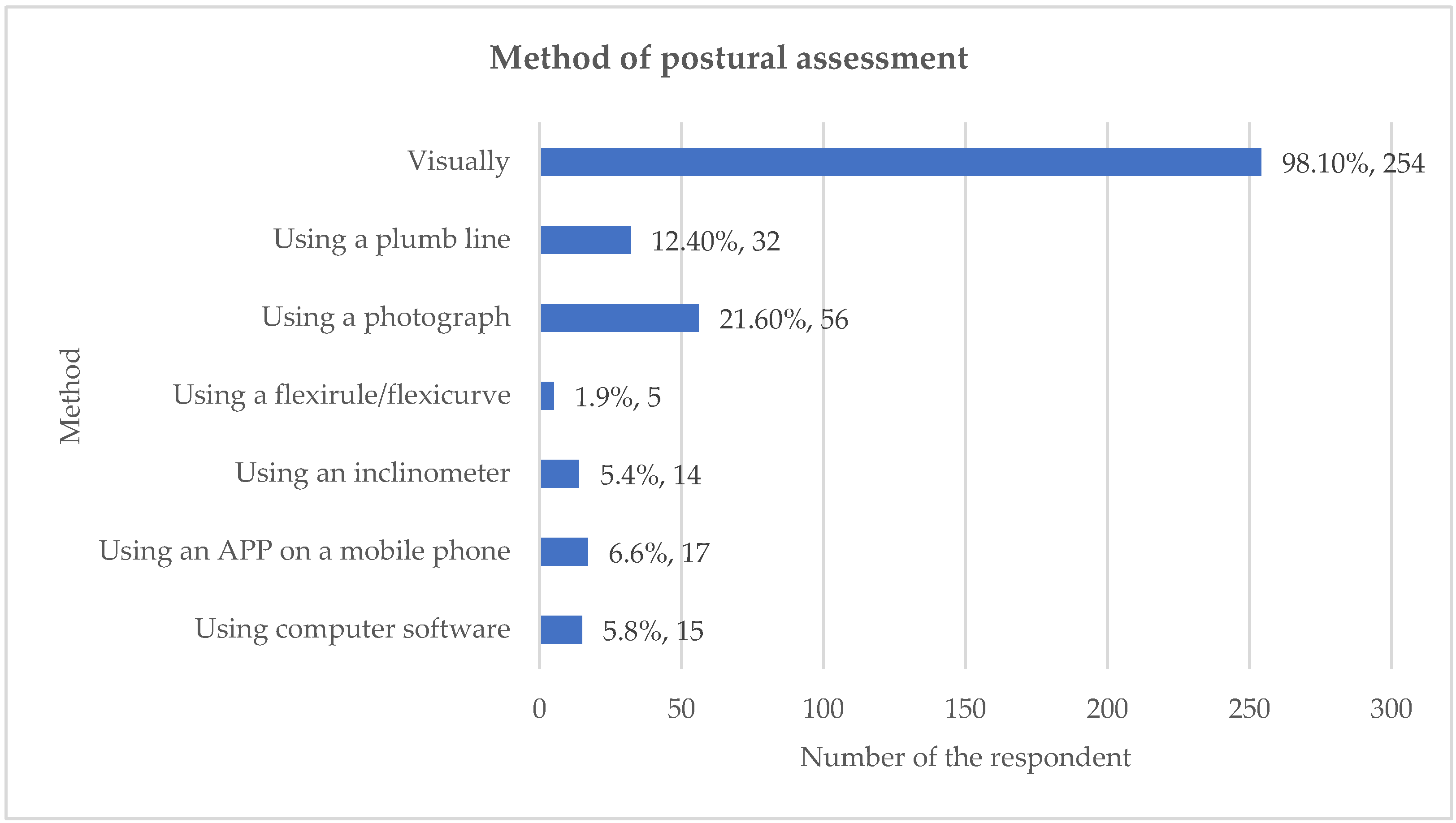
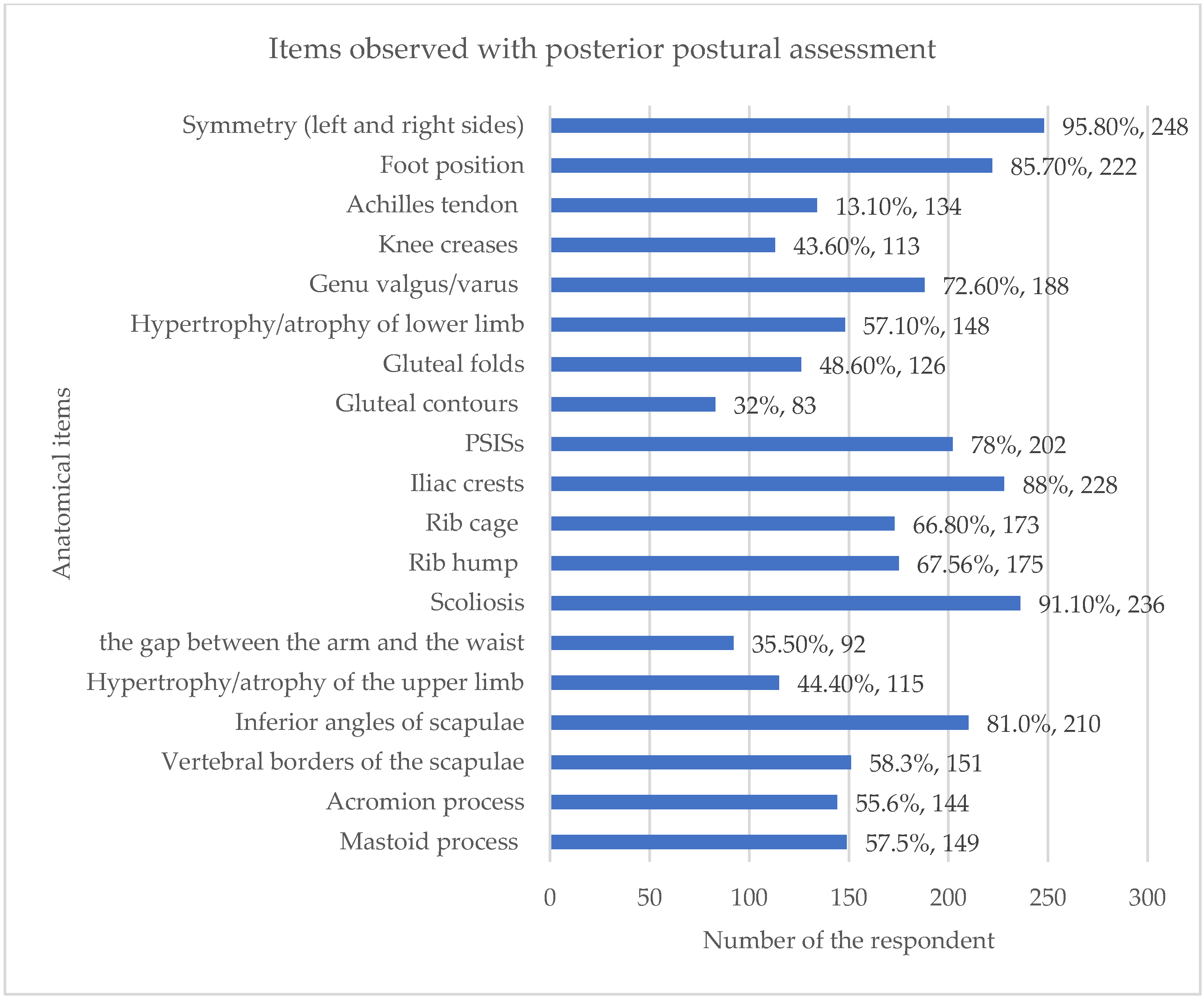
3.1.2. Methods of Assessment and Anatomical Items Observed
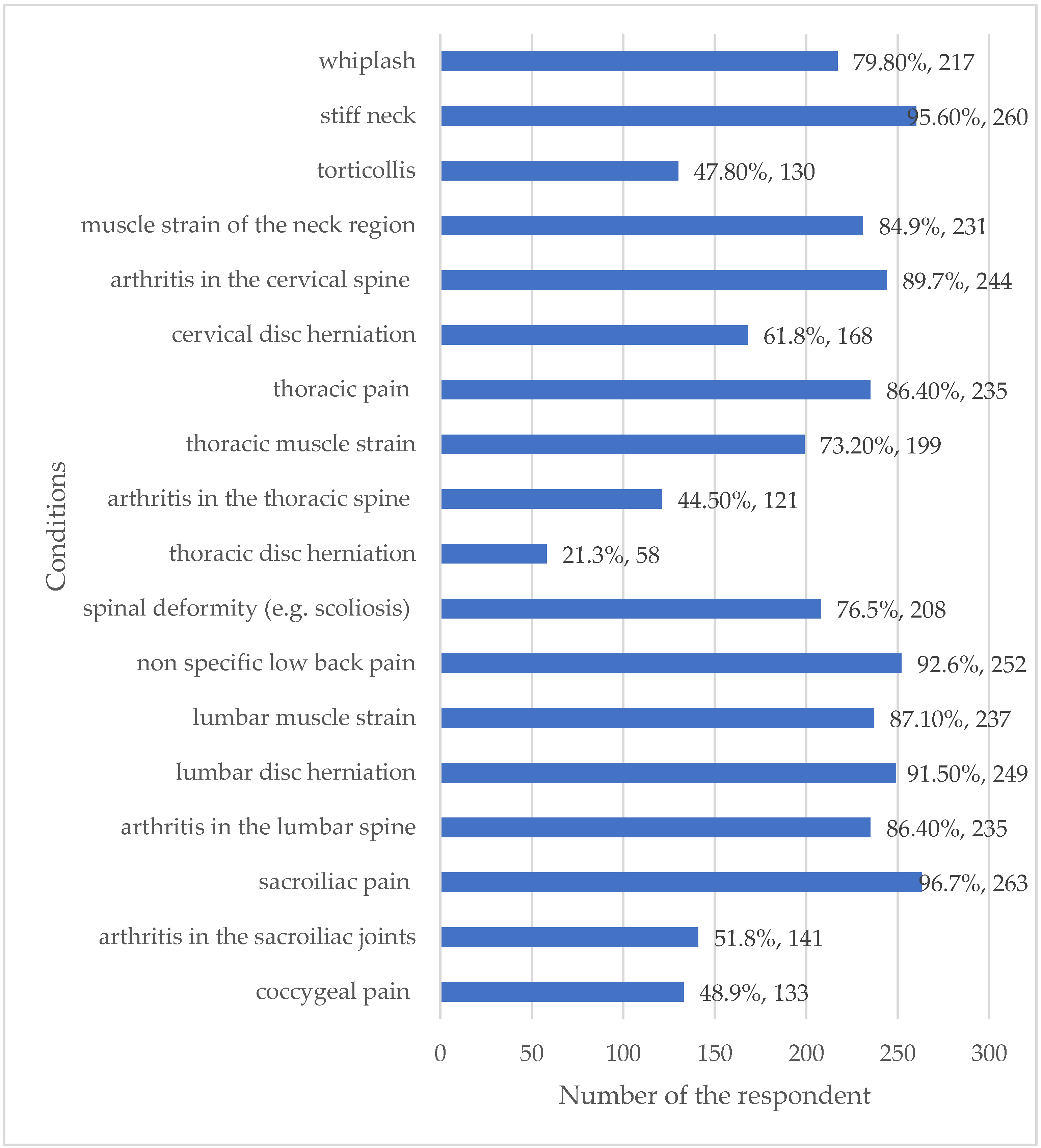
3.1.3. Pathologies Treated and Potential Relationship to Assessment Focus
Comparison Between Variables (Assessment Indices vs. Pathologies)
3.2. Qualitative Analysis
3.2.1. Rationale for the Use for Postural Assessment
“It alerts me to poor postural habits that need to be addressed and advised against”[Participant 132];
“It helps inform my rehabilitation protocols”[Participant 25].
“Patients understand it and think it is important”[Participant 148];
“It helps to educate the patient”[Participant 74].
3.2.2. Methods Used to Carry out Postural Assessment
3.2.3. Positions Used for Postural Assessment
3.2.4. Back and Neck Pathologies Encountered in Clinical Practice
3.2.5. Additional Comments
“How can you assess posture without xray? You can look visually at someone and their structure on xray can be very different to what you expect. You must understand spinal coupling mechanisms and 3D analysis if you wish to correct posture photographs like x-rays can project distortion especially if they are not taken correctly”[Participant 74];
“I combine it with dynamic assessment and gait”[Participant 238].
“I also look for torque, i.e., rotation in the horizontal plane, of the head, shoulder and pelvic girdles in relation to each other and to the position of the feet”[Participant 73].
“It is an absolute must in practice for us and the patient.”[Participant 55];
“I think it is way overrated.”[Participant 253]
“Posture is adapted, neutral and, unique to the individual—to not assess posture is doing an unforgivable disservice to the patient and not fulfilling our remit of neuro-musculoskeletal consultants.”[Participant 257]
4. Discussion
4.1. Key Findings
4.2. Quantitative and Qualitative Data
4.3. Limitations of the Study
5. Conclusions
Supplementary Materials
Author Contributions
Funding
Institutional Review Board Statement
Informed Consent Statement
Data Availability Statement
Acknowledgments
Conflicts of Interest
References
- Harrison, D.E.; Harrison, D.D.; Colloca, C.J.; Betz, J.; Janik, T.J.; Holland, B. Repeatability over time of posture, radiograph positioning, and radiograph line drawing: An analysis of six control groups. J. Manip. Physiol. Ther. 2003, 26, 87–98. [Google Scholar] [CrossRef]
- Houglum, P.A.; Boyle-Walker, K.L.; Houglum, D.E. Rehabilitation of Musculoskeletal Injuries; Human Kinetics: Champaign, IL, USA, 2022. [Google Scholar]
- Martin, D.C.; McGuigan, P.; Matei, R.; Kandasamy, G. Musculoskeletal Healthcare Professionals’ perspectives on objective postural assessment (Expectation and Experience): A UK (Multiprofessional) nationwide survey. Res. Sq. 2024. preprint. [Google Scholar] [CrossRef]
- Kendall, F.P.; McCreary, E.K.; Provance, P.G.; Rodgers, M.M.; Romani, W.A. Muscles: Testing and Function, with Posture and Pain, 5th ed.; Wolters Kluwer Health: Waltham, MA, USA, 2014; pp. 1–554. Available online: https://research.ebsco.com/linkprocessor/plink?id=c096a838-c904-344a-a3d5-a956bd45da2b (accessed on 10 October 2025).
- Johnson, J. Postural Assessment; Human Kinetics: Champaign, IL, USA, 2012. [Google Scholar]
- Magee, D.J. Orthopedic Physical Assessment; Saunders: Philadelphia, PA, USA, 2002. [Google Scholar]
- Page, P.; Frank, C.C.; Lardner, R. Assessment and Treatment of Muscle Imbalance: The Janda Approach; Human Kinetics: Champaign, IL, USA, 2010. [Google Scholar]
- Lederman, E. The fall of the postural-structural-biomechanical model in manual and physical therapies: Exemplified by lower back pain. J. Bodyw. Mov. Ther. 2011, 15, 131–138. [Google Scholar] [CrossRef] [PubMed]
- Bernhardsson, S.; Larsson, A.; Bergenheim, A.; Ho-Henriksson, C.-M.; Ekhammar, A.; Lange, E.; Larsson, M.E.H.; Nordeman, L.; Samsson, K.S.; Bornhöft, L. Digital physiotherapy assessment vs conventional face-to-face physiotherapy assessment of patients with musculoskeletal disorders: A systematic review. PLoS ONE 2023, 18, e0283013. [Google Scholar] [CrossRef]
- Enwemeka, C.S.; Bonet, I.M.; Ingle, J.A.; Prudhithumrong, S.; Ogbahon, F.E.; Gbenedio, N.A. Postural correction in persons with neck pain. I. A survey of neck positions recommended by physical therapists. J. Orthop. Sports Phys. Ther. 1986, 8, 235–239. [Google Scholar] [CrossRef]
- Fedorak, C.; Ashworth, N.; Marshall, J.; Paull, H. Reliability of the visual assessment of cervical and lumbar lordosis: How good are we? Spine 2003, 28, 1857–1859. [Google Scholar] [CrossRef]
- Silva, A.; Punt, D.; Johnson, M. A postal survey gathering information about physiotherapists assessment of head posture for patients with chronic idiopathic neck pain. Eur. J. Pain. 2009, 13, S223. [Google Scholar] [CrossRef]
- Silva, A.G.; Punt, T.D.; Sharples, P.; Vilas-Boas, J.P.; Johnson, M.I. Head posture and neck pain of chronic nontraumatic origin: A comparison between patients and pain-free persons. Arch. Phys. Med. Rehabil. 2009, 90, 669–674. [Google Scholar] [CrossRef] [PubMed]
- Ailliet, L.; Rubinstein, S.M.; de Vet, H.C. Characteristics of chiropractors and their patients in Belgium. J. Manip. Physiol. Ther. 2010, 33, 618–625. [Google Scholar] [CrossRef]
- Hinton, P.M.; McLeod, R.; Broker, B.; MacLellan, C.E. Outcome measures and their everyday use in chiropractic practice. J. Can. Chiropr. Assoc. 2010, 54, 118. [Google Scholar]
- Park, M.J.; Park, J.S. Effect of a posture training program on cobb angle and knowledge of posture of elementary school students. Taehan Kanho Hakhoe Chi 2003, 33, 643–650. [Google Scholar]
- Kritz, M.F.; Cronin, J. Static posture assessment screen of athletes: Benefits and considerations. Strength Cond. J. 2008, 30, 18–27. [Google Scholar] [CrossRef]
- Puhl, A.A.; Reinhart, C.J.; Injeyan, H.S. Diagnostic and treatment methods used by chiropractors: A random sample survey of Canada’s English speaking provinces. J. Can. Chiropr. Assoc. 2015, 59, 279. [Google Scholar]
- Fikar, P.E.; Edlund, K.A.; Newell, D. Current preventative and health promotional care offered to patients by chiropractors in the United Kingdom: A survey. Chiropr. Man. Ther. 2015, 23, 10. [Google Scholar] [CrossRef]
- Van Schaik, P.; Bettany-Saltikov, J.; Warren, J. Clinical acceptance of a low-cost portable system for postural assessment. Behav. Inf. Technol. 2002, 21, 47–57. [Google Scholar] [CrossRef]
- Harrison, D.E.; Harrison, D.D.; Troyanovich, S.J.; Harmon, S. A normal spinal position: It’s time to accept the evidence. J. Manip. Physiol. Ther. 2000, 23, 623–644. [Google Scholar] [CrossRef] [PubMed]
- Newell, D.; Diment, E.; Bolton, J.E. An electronic patient-reported outcome measures system in UK chiropractic practices: A feasibility study of routine collection of outcomes and costs. J. Manip. Physiol. Ther. 2016, 39, 31–41. [Google Scholar] [CrossRef] [PubMed]
- De Looze, M.P.; Toussaint, H.M.; Ensink, J.; Mangnus, C.; Van der Beek, A.J. The validity of visual observation to assess posture in a laboratory simulated, manual material handling task. Ergonomics 1994, 37, 1335–1343. [Google Scholar] [CrossRef] [PubMed]
- Peytchev, A.; Couper, M.P.; McCabe, S.E.; Crawford, S.D. Web survey design: Paging versus scrolling. Int. J. Public Opin. Res. 2006, 70, 596–607. [Google Scholar] [CrossRef]
- Willemsen, P. Omissions and expectations: A new approach to the things we failed to do. Synthese 2018, 195, 1587–1614. [Google Scholar] [CrossRef]
- Zhang, Y.; Wildemuth, B.M. Qualitative analysis of content. In Applications of Social Research Methods to Questions in Information and Library Science; Libraries Unlimited Inc.: Exeter, UK, 2009; Volume 308, pp. 1–12. [Google Scholar]
- Ryan, G.W.; Bernard, H.R. Techniques to identify themes. Field Methods 2003, 15, 85–109. [Google Scholar] [CrossRef]
- Russell, M.L.; Verhoef, M.J.; Injeyan, H.S.; McMorland, D.G. Response rates for surveys of chiropractors. J. Manip. Physiol. Ther. 2004, 27, 43–48. [Google Scholar] [CrossRef]
- Rothstock, S.; González-Ruiz, J.M.; Weiss, H.R.; Turnbull, D.; Krueger, D. Severity and Cobb angle of scoliosis patients quantified with markerless trunk surface topography using k-NN search and multivariate regression analysis. Comput. Methods Biomech. Biomed. Eng. Imaging Vis. 2023, 11, 2433–2439. [Google Scholar] [CrossRef]
- Park, S.C.; Lee, S.; Yoon, J.; Choi, C.H.; Yoon, C.; Ha, Y.C. Validity and reliability of an artificial intelligence-based posture estimation software for measuring cervical and lower-limb alignment versus radiographic imaging. Diagnostics 2025, 15, 1340. [Google Scholar] [CrossRef] [PubMed]
- Nulty, D.D. The adequacy of response rates to online and paper surveys: What can be done? Assess. Eval. High. Educ. 2008, 33, 301–314. [Google Scholar] [CrossRef]
- Fan, W.; Yan, Z. Factors affecting response rates of the web survey: A systematic review. Comput. Hum. Behav. 2010, 26, 132–139. [Google Scholar] [CrossRef]
- Tomaskovic-Devey, D.; Leiter, J.; Thompson, S. Organizational survey nonresponse. Adm. Sci. Q. 1994, 39, 439–457. [Google Scholar] [CrossRef]
- Cook, C.; Heath, F.; Thompson, R.L. A meta-analysis of response rates in web-or internet-based surveys. Educ. Psychol. Meas. 2000, 60, 821–836. [Google Scholar] [CrossRef]

| Question |
|---|
| Q 1. Please tick ONE box to indicate how frequently you use postural assessment with a NEW patient who comes to you with back or neck pain. |
| Almost always (76–100% of the time) |
| Frequently (51–75% of the time) |
| Some of the time (26–50% of the time) |
| Rarely (1–25% of the time) |
| Never |
| Q2. As you answered ‘always’, ‘frequently’ or ‘some of the time’ to the previous question, please tick as many of the statements you agree with. I use postural assessment because: |
| It provides an outcome measure |
| It helps inform my diagnosis |
| It helps inform my treatment |
| It helps me determine whether a patient is making progress or not |
| It is mandatory (employer requires it) |
| I was taught to use it during my training |
| Other (please specify)……………………………………………. |
| Q3. As you answered ‘rarely or ‘never’ to the previous question, please tick any of the following statements you agree with. I rarely or never carry out postural assessments because: |
| I don’t have time |
| Postural assessment is not relevant to my diagnosis or treatment |
| I don’t believe it is accurate or objective |
| My patients don’t like it or it is not appropriate for them |
| I was not taught to use it |
| Other (please specify)……………………………………………. |
| Q4. What methods do you use to carry out postural assessment? You may choose more than one option or tick as many as apply. |
| Visually |
| Using a plumb line |
| Using a photograph |
| Using a flexirule/flexicurve |
| Using an inclinometer |
| Using an APP on a mobile phone |
| Using computer software |
| Other (please specify)……………………………………………. |
| Q5. From which positions do you assess your subject?You may choose more than one option. |
| Both left and right sides |
| Right lateral only |
| Left lateral only |
| Posterior |
| Anterior–Posterior |
| Q6. If you perform POSTERIOR postural assessment with back and neck pain patients, what are the things you observe? You may choose more than one option. |
| Symmetry between left and right sides of the body |
| Foot position |
| Achilles tendon |
| Knee creases |
| Genu valgus/varus |
| Hypertrophy/atrophy of lower limb muscles |
| Gluteal folds |
| Gluteal contours |
| PSISs |
| Iliac crests |
| Rib cage |
| Rib hump |
| Scoliosis |
| Size of the keyhole (gap between the upper limb and thorax) |
| Hypertrophy/atrophy of the upper limb |
| Inferior angles of scapulae |
| Vertebral borders of the scapulae (distance laterally from the spine) |
| Acromion process |
| Mastoid process |
| Other (please specify) ……………………………………………. |
| Q7. If you perform ANTERIOR postural assessment with back and neck pain patients, what are the things you observe? You may choose more than one option. |
| General symmetry between left and right sides of the body |
| Feet |
| Knees |
| Genu valgus/varus |
| Hypertrophy/atrophy of lower limb muscles |
| Greater trochanters |
| ASISs |
| Iliac crests |
| Rib cage |
| Size of the “keyhole” (gap between the upper limb and thorax) |
| Hypertrophy/atrophy of upper limb muscles |
| Clavicles |
| Acromioclavicular joints |
| Muscles of the neck |
| Mastoid processes |
| Facial symmetry |
| Other (please specify) ……………………………………………. |
| Q8. If you perform a LATERAL postural assessment with back and neck pain patients, what are the things you observe? You may choose more than one option. |
| Head position |
| Shape of cervical spine |
| Shape of thoracic spine |
| Shape of lumbar spine |
| Position of pelvis—anterior or posterior pelvic tilt |
| Shoulder position |
| Position of upper limb |
| Position of lower limb—e.g., genu recuravtum/genum flexum |
| Overall body shape |
| Other (please specify) ……………………………………………. |
| Q9. Thinking only about patients with back or neck pain, which sorts of pathologies do you come across commonly in your practice? Please note, the following are only some of the possible pathologies you may commonly come across. (Please tick as many as apply and use the ‘other’ box to add others) |
| whiplash |
| stiff neck |
| torticollis |
| muscle strain of the neck region |
| arthritis in the cervical spine |
| herniation of an intervertebral disc in cervical spine |
| thoracic pain |
| muscle strain of the thoracic region |
| arthritis in the thoracic spine |
| herniation of an intervertebral disc in thoracic spine |
| spinal deformity (e.g., scoliosis) |
| non-specific low back pain |
| muscle strain of the lumbar spine |
| herniation of an intervertebral disc in lumbar spine |
| arthritis in the lumbar spine |
| sacroiliac pain |
| arthritis in the sacroiliac joints |
| coccygeal pain |
| Other (please specify) ……………………………………………. |
| Q10. Is there anything else you would like to say about your use of postural assessment? |
| (please specify) ……………………………………………. |
| Q11. Finally, please select the answer that most closely represents your profession: |
| Chiropractor Osteopath Physiotherapist |
| Sports Therapist |
| Osteopath |
| Physiotherapist |
| Other (please specify) ……………………………………………. |
| Survey Question | Number of Free-Text Responses | Percentage (%) Agreement |
|---|---|---|
| 1. No free-text option | NA | NA |
| 2. As you answered ‘always’, ‘frequently’ or ‘some of the time’ to the previous question, please tick as many of the statements you agree with. I use postural assessment because: R where are the statements they were responding to? | 28 | 21 had 100% agreement 2 had 50% agreement 5 had no agreement |
| 3. As you answered ‘rarely’ or ‘never’ to the previous question, please tick any of the following statements you agree with. I rarely or never carry out postural assessment because: | 0 | NA |
| 4. What methods do you use to carry out postural assessment? You may choose more than one option or tick as many as apply. | 17 | 16 had 100% agreement 1 had no agreement |
| 5. No free-text option | NA | NA |
| 6. If you perform POSTERIOR postural assessment with back and neck pain patients, what are the things you observe? You may choose more than one option. | 31 | 24 had 100% agreement 1 had 40% agreement 1 had 33% agreement 2 had 25% agreement 1 had 20% agreement 2 had zero agreement |
| 7. If you perform ANTERIOR postural assessment with back and neck pain patients, what are the things you observe? You may choose more than one option. | 28 | 26 had 100% agreement 1 had 75% agreement 1 had no agreement |
| 8. LATERAL postural assessment with back and neck pain patients, what are the things you observe? You may choose more than one option. | 18 | 6 had 100% agreement 6 had 50% agreement 1 had 33% agreement 1 had 20% agreement 4 had no agreement |
| 9. Thinking only about patients with back or neck pain, which sort of pathologies do you come across commonly in your practice? Please note, the following are only some of the possible pathologies you may commonly come across. (Please tick as many as apply and use the ‘other’ box to add others). | 41 | 26 had 100% agreement 1 had 83% agreement 1 had 66% agreement 1 had 62.5% agreement 6 had 50% agreement 2 had 33% agreement 3 had no agreement 1 response would not be rated |
| 10. Is there anything else you would like to say about your use of postural assessment? | 66 | 34 had 100% agreement 13 had 50% agreement 2 had 66% agreement 1 had 33% agreement 16 had no agreement |
| 11. No free-text option | NA | NA |
Disclaimer/Publisher’s Note: The statements, opinions and data contained in all publications are solely those of the individual author(s) and contributor(s) and not of MDPI and/or the editor(s). MDPI and/or the editor(s) disclaim responsibility for any injury to people or property resulting from any ideas, methods, instructions or products referred to in the content. |
© 2025 by the authors. Licensee MDPI, Basel, Switzerland. This article is an open access article distributed under the terms and conditions of the Creative Commons Attribution (CC BY) license (https://creativecommons.org/licenses/by/4.0/).
Share and Cite
Johnson, J.; Bettany-Saltikov, J.; van Schaik, P.; Cordry, J.; Newell, D.; Duangkaew, R. Postural Assessment: An Online Survey of Practicing Chiropractors in the UK. Healthcare 2025, 13, 3212. https://doi.org/10.3390/healthcare13243212
Johnson J, Bettany-Saltikov J, van Schaik P, Cordry J, Newell D, Duangkaew R. Postural Assessment: An Online Survey of Practicing Chiropractors in the UK. Healthcare. 2025; 13(24):3212. https://doi.org/10.3390/healthcare13243212
Chicago/Turabian StyleJohnson, Jane, Josette Bettany-Saltikov, Paul van Schaik, Julien Cordry, David Newell, and Roongtip Duangkaew. 2025. "Postural Assessment: An Online Survey of Practicing Chiropractors in the UK" Healthcare 13, no. 24: 3212. https://doi.org/10.3390/healthcare13243212
APA StyleJohnson, J., Bettany-Saltikov, J., van Schaik, P., Cordry, J., Newell, D., & Duangkaew, R. (2025). Postural Assessment: An Online Survey of Practicing Chiropractors in the UK. Healthcare, 13(24), 3212. https://doi.org/10.3390/healthcare13243212