Sexual Satisfaction among Lesbian and Heterosexual Cisgender Women: A Systematic Review and Meta-Analysis



Abstract
1. Background and Rational
2. Methodology
2.1. Study Design
2.2. Search Strategy
2.3. Inclusion and Exclusion Criteria
2.4. Screening and Data Extraction
2.5. Risk of Bias Assessment
2.6. Meta-Analysis
3. Results
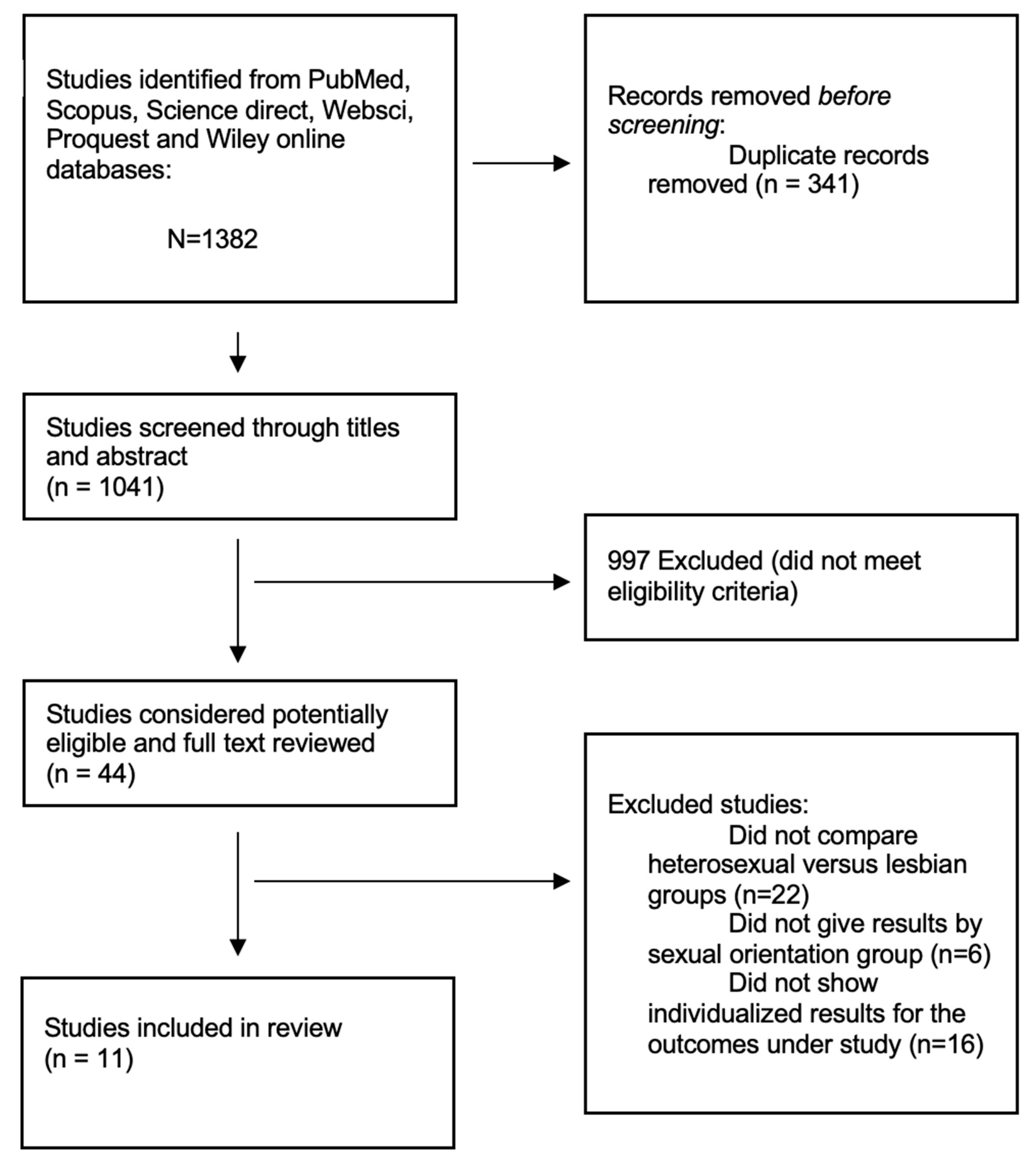
3.1. Search Results and Study Characteristics
3.2. Risk of Bias
3.3. Sexual Satisfaction Results
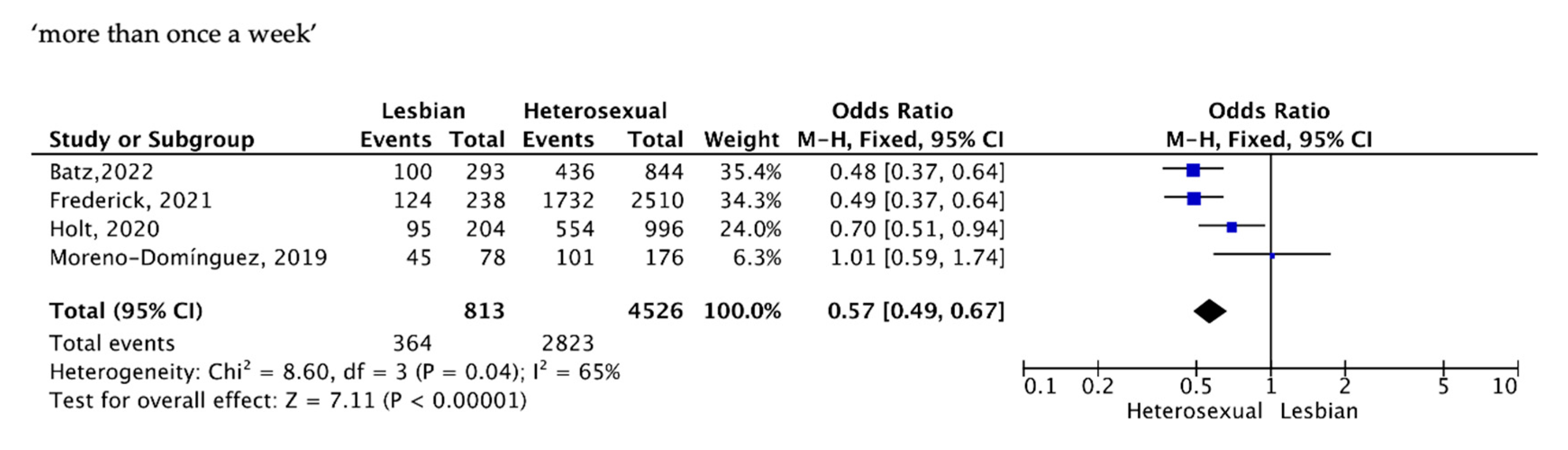
3.4. Frequency of Sexual Intercourse
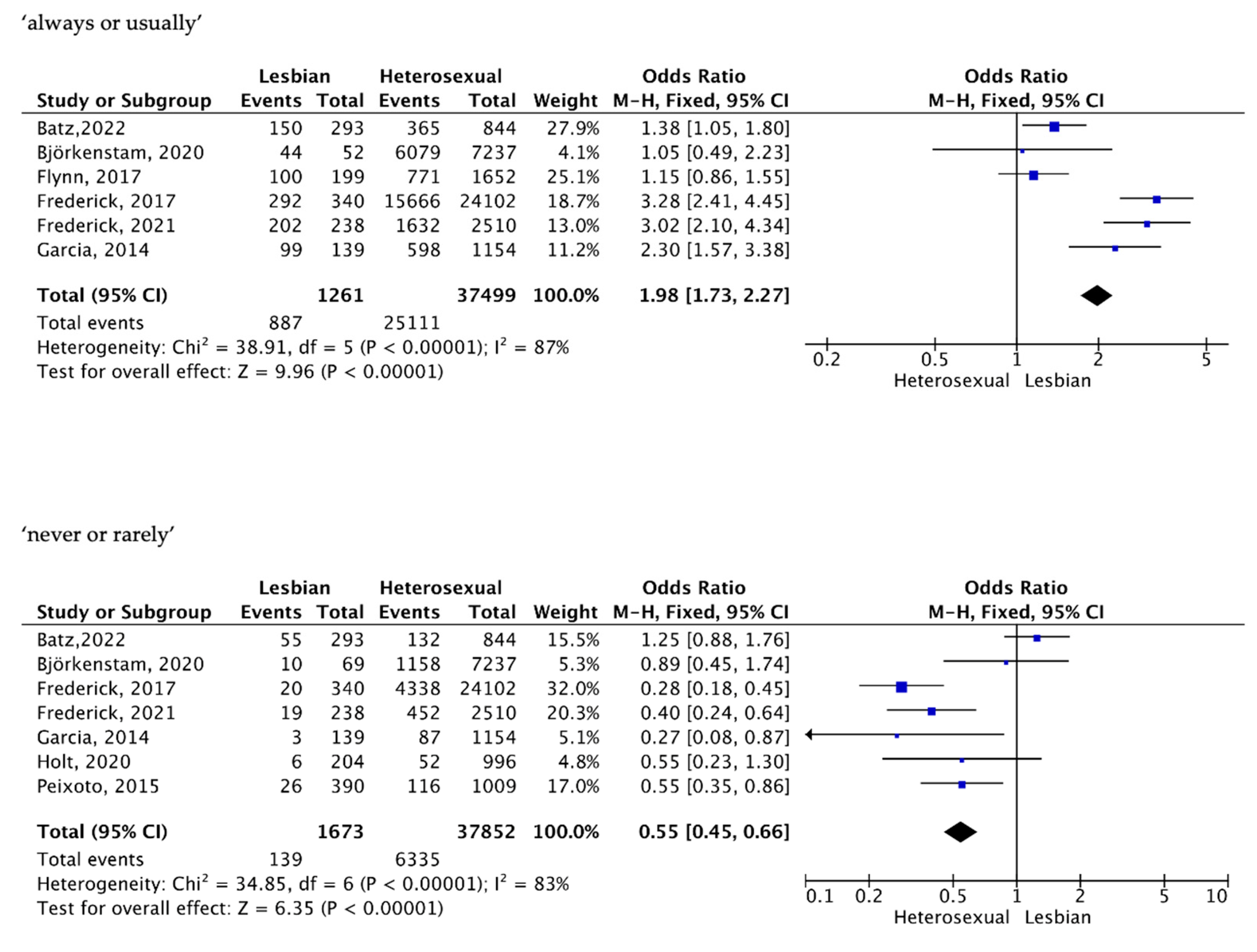
3.5. Orgasm Frequency
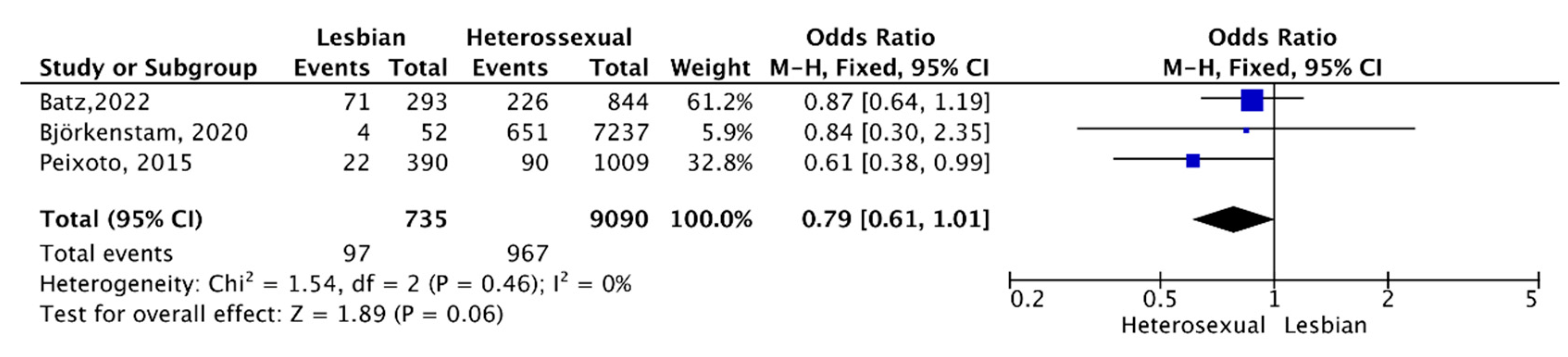
3.6. Arousal Difficulties
4. Discussion
5. Conclusions
Author Contributions
Funding
Institutional Review Board Statement
Informed Consent Statement
Data Availability Statement
Conflicts of Interest
References
- Christian, L.M.; Cole, S.W.; McDade, T.; Pachankis, J.E.; Morgan, E.; Strahm, A.M.; Dush, C.M.K. A biopsychosocial framework for understanding sexual and gender minority health: A call for action. Neurosci. Biobehav. Rev. 2021, 129, 107–116. [Google Scholar] [CrossRef]
- Schuler, M.S.; Rice, C.E.; Evans-Polce, R.J.; Collins, R.L. Disparities in substance use behaviors and disorders among adult sexual minorities by age, gender, and sexual identity. Drug Alcohol. Depend. 2018, 189, 139–146. [Google Scholar] [CrossRef] [PubMed]
- Rice, C.E.; Vasilenko, S.A.; Fish, J.N.; Lanza, S.T. Sexual minority health disparities: An examination of age-related trends across adulthood in a national cross-sectional sample. Ann. Epidemiol. 2019, 31, 20–25. [Google Scholar] [CrossRef] [PubMed]
- Caceres, B.A.; Travers, J.; Sharma, Y. Differences in Multimorbidity among Cisgender Sexual Minority and Heterosexual Adults: Investigating Differences across Age-Groups. J. Aging Health 2021, 33, 362–376. [Google Scholar] [CrossRef] [PubMed]
- Desjardins, G.; Caceres, B.A.; Juster, R.P. Sexual minority health and allostatic load in the National Health and Nutrition Examination Survey: A systematic scoping review with intersectional implications. Psychoneuroendocrinology 2022, 145, 105916. [Google Scholar] [CrossRef]
- Lucassen, M.F.; Stasiak, K.; Samra, R.; Frampton, C.M.; Merry, S.N. Sexual minority youth and depressive symptoms or depressive disorder: A systematic review and meta-analysis of population-based studies. Aust. N. Z. J. Psychiatry 2017, 51, 774–787. [Google Scholar] [CrossRef]
- Krueger, E.A.; Upchurch, D.M. Sexual orientation, social support, and mental health resilience in a U.S. national sample of adults. Behav. Med. 2022, 48, 207–215. [Google Scholar] [CrossRef]
- Murphy, S.; Morrell, J.S. Eating Competence and Dietary Intake of Sexual and Gender Minority College Students. Nutrients 2021, 13, 2388. [Google Scholar] [CrossRef]
- Cao, Z.; Cini, E.; Pellegrini, D.; Fragkos, K.C. The association between sexual orientation and eating disorders-related eating behaviours in adolescents: A systematic review and meta-analysis. Eur. Eat. Disord. Rev. 2023, 31, 46–64. [Google Scholar] [CrossRef]
- Pascoal Pm, S.N.I.; Nm, P. What is sexual satisfaction? Thematic analysis of lay people’s definitions. J. Sex Res. 2014, 51, 22–30. [Google Scholar] [CrossRef]
- World Health Organization. Measuring Sexual Health: Conceptual and Practical Considerations and Related Indicators. World Health Organization: Geneva, Switzerland, 2010. Report No.: WHO/RHR/10.12. Available online: https://apps.who.int/iris/handle/10665/70434 (accessed on 18 April 2023).
- Declaration of Sexual Rights—World Association for Sexual Health (WAS). Available online: https://worldsexualhealth.net/resources/declaration-of-sexual-rights/ (accessed on 18 April 2023).
- Ford, J.V.; Corona Vargas, E.; Finotelli, I., Jr.; Fortenberry, J.D.; Kismödi, E.; Philpott, A.; Rubio-Aurioles, E.; Coleman, E. Why Pleasure Matters: Its Global Relevance for Sexual Health, Sexual Rights and Wellbeing. Int. J. Sex Health 2019, 31, 217–230. [Google Scholar] [CrossRef]
- Millennium-chapter8.pdf. Available online: https://worldsexualhealth.net/wp-content/uploads/2013/08/millennium-chapter8.pdf (accessed on 18 April 2023).
- Meston, C.; Trapnell, P. Development and validation of a five-factor sexual satisfaction and distress scale for women: The Sexual Satisfaction Scale for Women (SSS-W). J. Sex Med. 2005, 2, 66–81. [Google Scholar] [CrossRef]
- Stephenson, K.R.; Meston, C.M. Differentiating components of sexual well-being in women: Are sexual satisfaction and sexual distress independent constructs? J. Sex Med. 2010, 7, 2458–2468. [Google Scholar] [CrossRef] [PubMed]
- Pascoal, P.M.; Shaughnessy, K.; Almeida, M.J. A thematic analysis of a sample of partnered lesbian, gay, and bisexual people’s concepts of sexual satisfaction. Psychol. Sex 2019, 10, 101–118. [Google Scholar] [CrossRef]
- Björkenstam, C.; Mannheimer, L.; Löfström, M.; Deogan, C. Sexual Orientation–Related Differences in Sexual Satisfaction and Sexual Problems—A Population-Based Study in Sweden. J. Sex Med. 2020, 17, 2362–2369. [Google Scholar] [CrossRef] [PubMed]
- Page, M.J.; McKenzie, J.E.; Bossuyt, P.M.; Boutron, I.; Hoffmann, T.C.; Mulrow, C.D.; Shamseer, L.; Tetzlaff, J.M.; Akl, E.A.; Brennan, S.E.; et al. The PRISMA 2020 statement: An updated guideline for reporting systematic reviews. BMJ 2021, 88, 105906. [Google Scholar]
- Cochrane Handbook for Systematic Reviews of Interventions. Available online: https://training.cochrane.org/handbook (accessed on 14 April 2023).
- Critical Appraisal Tools|JBI. Available online: https://jbi.global/critical-appraisal-tools (accessed on 17 April 2023).
- Amos, N.; McCabe, M.P. Self-Perceptions of Sexual Attractiveness: Satisfaction With Physical Appearance is Not of Primary Importance Across Gender and Sexual Orientation. J. Sex Res. 2016, 53, 172–185. [Google Scholar] [CrossRef]
- Batz, F.; Lermer, E.; Hatzler, L.; Vilsmaier, T.; Schröder, L.; Chelariu-Raicu, A.; Behr, J.; Mahner, S.; Buspavanich, P.; Thaler, C.J. The Impact of the COVID-19 Pandemic on Sexual Health in Cis Women Living in Germany. J. Sex Med. 2022, 19, 907–922. [Google Scholar] [CrossRef] [PubMed]
- Flynn, K.E.; Lin, L.; Weinfurt, K.P. Sexual function and satisfaction among heterosexual and sexual minority U.S. adults: A cross-sectional survey. PLoS ONE 2017, 12, e0174981. [Google Scholar] [CrossRef]
- Frederick, D.A.; John, H.K.; St Garcia, J.R.; Lloyd, E.A. Differences in Orgasm Frequency Among Gay, Lesbian, Bisexual, and Heterosexual Men and Women in a U.S. National Sample. Arch. Sex Behav. 2018, 47, 273–288. [Google Scholar] [CrossRef] [PubMed]
- Frederick, D.; Gillespie, B.J.; Lever, J.; Berardi, V.; Garcia, J.R. Sexual Practices and Satisfaction among Gay and Heterosexual Men in Romantic Relationships: A Comparison Using Coarsened Exact Matching in a U.S. National Sample. J. Sex Res. 2021, 58, 545–559. [Google Scholar] [CrossRef] [PubMed]
- Garcia, J.R.; Lloyd, E.A.; Wallen, K.; Fisher, H.E. Variation in Orgasm Occurrence by Sexual Orientation in a Sample of U.S. Singles. J. Sex Med. 2014, 11, 2645–2652. [Google Scholar] [CrossRef] [PubMed]
- Holt, L.L.; Chung, Y.B.; Janssen, E.; Peterson, Z.D. Female Sexual Satisfaction and Sexual Identity. J. Sex Res. 2021, 58, 195–205. [Google Scholar] [CrossRef] [PubMed]
- Joyner, K.; Manning, W.; Prince, B. The Qualities of Same-Sex and Different-Sex Couples in Young Adulthood. J. Marriage Fam. 2019, 81, 487–505. [Google Scholar] [CrossRef] [PubMed]
- Moreno-Domínguez, S.; Raposo, T.; Elipe, P. Body Image and Sexual Dissatisfaction: Differences Among Heterosexual, Bisexual, and Lesbian Women. Front. Psychol. 2019, 10, 903. [Google Scholar] [CrossRef]
- Peixoto, M.M.; Nobre, P. Prevalence of Sexual Problems and Associated Distress Among Lesbian and Heterosexual Women. J. Sex Marital Ther. 2015, 41, 427–439. [Google Scholar] [CrossRef]
- Rausch, D.; Rettenberger, M. Predictors of Sexual Satisfaction in Women: A Systematic Review. Sex Med. Rev. 2021, 9, 365–380. [Google Scholar] [CrossRef]
- del Mar Sánchez-Fuentes, M.; Santos-Iglesias, P.; Sierra, J.C. A systematic review of sexual satisfaction. Int. J. Clin. Health Psychol. 2014, 14, 67–75. [Google Scholar] [CrossRef]
- Shahhosseini, Z.; Gardeshi, Z.H.; Pourasghar, M.; Salehi, F. A Review of Affecting Factors on Sexual Satisfaction in Women. Mater. Sociomed. 2014, 26, 378–381. [Google Scholar] [CrossRef]
- Fahs, B.; Swank, E. Social Identities as Predictors of Women’s Sexual Satisfaction and Sexual Activity. Arch. Sex Behav. 2011, 40, 903–914. [Google Scholar] [CrossRef]
- Freihart, B.K.; Sears, M.A.; Meston, C.M. Relational and Interpersonal Predictors of Sexual Satisfaction. Curr. Sex Health Rep. 2020, 12, 136–142. [Google Scholar] [CrossRef]
- Dundon, C.M.; Rellini, A.H. More than sexual function: Predictors of sexual satisfaction in a sample of women age 40–70. J. Sex Med. 2010, 7, 896–904. [Google Scholar] [CrossRef] [PubMed]
- Buczak-Stec, E.W.; König, H.H.; Hajek, A. Sexual Satisfaction Among Sexual Minority and Heterosexual Middle-Aged and Older Adults. Innov. Aging 2023, 7, igad010. [Google Scholar] [CrossRef] [PubMed]
- Henderson, A.W.; Lehavot, K.; Simoni, J.M. Ecological Models of Sexual Satisfaction among Lesbian/Bisexual and Heterosexual Women. Arch. Sex Behav. 2009, 38, 50–65. [Google Scholar] [CrossRef]
- Shepler, D.K.; Smendik, J.M.; Cusick, K.M.; Tucker, D.R. Predictors of sexual satisfaction for partnered lesbian, gay, and bisexual adults. Psychol. Sex Orientat. Gend. Divers. 2018, 5, 25–35. [Google Scholar] [CrossRef]
- Beaber, T.E.; Werner, P.D. The Relationship Between Anxiety and Sexual Functioning in Lesbians and Heterosexual Women. J. Homosex. 2009, 56, 639–654. [Google Scholar] [CrossRef]
- Coleman, E.M.; Hoon, P.W.; Hoon, E.F. Arousability and sexual satisfaction in lesbian and heterosexual women. J. Sex Res. 1983, 19, 58–73. [Google Scholar] [CrossRef]
- Matthews, A.K.; Hughes, T.L.; Tartaro, J. Sexual Behavior and Sexual Dysfunction in a Community Sample of Lesbian and Heterosexual Women; American Psychological Association: Washington, DC, USA, 2006. [Google Scholar]
- van Rees, B.; Spiering, M.; Laan, E. Orgasmeconsistentie van lesbische en heteroseksuele vrouwen: De rol van clitorale stimulatie. Tijdschr. Voor Seksuol. 2016, 40, 68–75. [Google Scholar]
- Laan, E.T.M.; Klein, V.; Werner, M.A.; van Lunsen, R.H.W.; Janssen, E. In Pursuit of Pleasure: A Biopsychosocial Perspective on Sexual Pleasure and Gender. Int. J. Sex Health 2021, 33, 516–536. [Google Scholar] [CrossRef]
- Cohen, J.N.; Byers, E.S. Beyond lesbian bed death: Enhancing our understanding of the sexuality of sexual-minority women in relationships. J. Sex Res. 2014, 51, 893–903. [Google Scholar] [CrossRef]
- Blair, K.L.; Pukall, C.F.; Smith, K.B.; Cappell, J. Differential Associations of Communication and Love in Heterosexual, Lesbian, and Bisexual Women’s Perceptions and Experiences of Chronic Vulvar and Pelvic Pain. J. Sex Marital Ther. 2015, 41, 498–524. [Google Scholar] [CrossRef] [PubMed]
- Amos, N.; McCabe, M.P. Conceptualizing and measuring perceptions of sexual attractiveness: Are there differences across gender and sexual orientation? Personal. Individ. Differ. 2015, 76, 111–122. [Google Scholar] [CrossRef]
- Horowitz, A.; Spicer, L. “Having Sex” as a Graded and Hierarchical Construct: A Comparison of Sexual Definitions among Heterosexual and Lesbian Emerging Adults in the UK. J. Sex Res. 2011, 50, 139–150. [Google Scholar] [CrossRef] [PubMed]
- Sewell, K.K.; McGarrity, L.A.; Strassberg, D.S. Sexual Behavior, Definitions of Sex, and the Role of Self-Partner Context Among Lesbian, Gay, and Bisexual Adults. J. Sex Res. 2017, 54, 825–831. [Google Scholar] [CrossRef]




| References | Inclusion Criteria | Subjects and Setting Detailed Description | Valid and Reliable Measure of Exposure | Objective and Standard Measure of Condition | Confounding Factors Identified | Strategies for Dealing with Confounding Factors | Valid and Reliable Measure of Outcome | Appropriate Statistical Analysis |
|---|---|---|---|---|---|---|---|---|
| Amos, 2015 [22] | Y | Y | Y | Y | Y | Y | Y | Y |
| Batz, 2022 [23] | Y | Y | Y | Y | Y | N | Y | Y |
| Björkenstam, 2020 [18] | Y | Y | Y | Y | Y | N | Y | Y |
| Flynn, 2017 [24] | Y | Y | Y | Y | Y | N | Y | Y |
| Frederick, 2017 [25] | Y | Y | Y | Y | Y | Y | Y | Y |
| Frederick, 2021 [26] | Y | Y | Y | Y | Y | Y | Y | Y |
| Garcia, 2014 [27] | Y | Y | Y | Y | N | N | Y | Y |
| Holt, 2020 [28] | Y | Y | Y | Y | Y | Y | Y | Y |
| Joyner, 2020 [29] | Y | Y | Y | Y | Y | Y | Y | Y |
| Moreno-Domínguez, 2019 [30] | Y | Y | Y | Y | N | N | Y | Y |
| Peixoto, 2015 [31] | Y | Y | Y | Y | N | N | Y | Y |
| Author | Study Design and Participants | Country | Age Global | Heterosexual Women | Lesbian Women | ||
|---|---|---|---|---|---|---|---|
| N (Age) | % White/ % University Frequency | N (Age) | % White/ % University Frequency | ||||
| Amos, 2015 [22] | Participants included men and women who self-identified as heterosexual, gay, lesbian, or bisexual who lived in Australia, North America, or the UK. Were recruited online via posts to various sub-categories of a social news and entertainment-sharing website, where registered users can submit content to share with others. The posts asked for volunteers between 18 and 65 years old to participate in a survey on sexiness and provided a link to an online questionnaire. Participation was voluntary and no incentive was provided. | Australia, North America, UK | 22.8 y | 468 (--) | --/89% | 246 (--) | --/87% |
| Batz, 2022 [23] | Anonymous nationwide online survey. To spread the questionnaire online, invitations with a link to access the survey were shared via e-mail distribution lists and on social communication networks such as Facebook, Instagram, Twitter, and WhatsApp. Participants were invited to forward the link of the survey (snowball sampling). Cross-sectional study design was carried out during the first confinement in Germany from 20 April to 20 July 2020. Inclusion criteria were a minimum age of 18 years and German language skills. Data collection in 2020. | Germany | -- | 844 (26–35 y) | --/53% | 293 (26–35 y) | --/44% |
| Björkenstam, 2020 [18] | Data from sexual and reproductive health and rights (SRHR) 2017, based on a Swedish national sample of women and men aged between 16 and 84 years. The paper questionnaires were mailed and the respondents also received an information letter on the survey and its purpose. The respondents were also informed that the questionnaire would be supplemented with register data and that participation was voluntary and anonymous. Data collection in 2017. | Sweden | -- | 7237 (45–64 y) | --/52% | 69 (30–44 y) | --/52% |
| Flynn, 2017 [24] | Cross-sectional surveys were administered by KnowledgePanel® (GfK), an online panel that uses address-based probability sampling and is representative of the civilian, noninstitutionalized US population. Eligibility criteria for both samples included age of 18 years or older and ability to read English. Data collection in 2013–2014. | US | 41 y | 1652 (--) | --/-- | 199 (--) | --/-- |
| Frederick, 2017 [25] | Based on secondary analyses of anonymous data collected via a 172 online survey posted on the official website of NBC News for ten days; 18–65 years. Data collection in 2006. | US | -- | 24,102 (33.8 y) | 84%/47% | 340 (36.5 y) | 84%/92% |
| Frederick, 2021 [26] | Secondary analyses of anonymous data collected via an online survey posted on the official news website of NBC News (then called msnbc.com) for ten days. Aged 18 to 65 years; identified as heterosexual or lesbian; indicated they were either dating/seeing only one person, cohabiting, married, or remarried; and were sexually intimate with their partner during the last month. Data collection in 2006. | US | -- | 2510 (35.6 y) | 84%/93% | 238 (35.5 y) | 83%/93% |
| Garcia, 2014 [27] | Online questionnaire of single men and women in the US, internet research panels for population-based cross-sectional surveys. Nationally representative research panels compiled based on demographic distributions reflected in the most recent Current Population Survey. Inclusion criteria required being at least 21 years of age and identifying current relationship status as single. Data collection in 2011. | US | 40–44 y | 1154 (--) | --/-- | 139 (--) | --/-- |
| Holt, 2020 [28] | Participants had to be at least 18 years and currently in a sexual relationship to be eligible for this study. They were recruited online via posts on the Kinsey Confidential website, Facebook, websites and forums for lesbian and bisexual women, and the American Psychological Association listservs of Society for the Psychology of Women and Society for the Psychological Study of Lesbian, Gay, Bisexual, and Transgender Issues. In order to recruit a more balanced sample, special effort was exerted to recruit conservative and religious women. Participants were offered an opportunity to enter to win one of four $25 Amazon gift cards. | US | -- | 996 (32.5 y) | 90%/98% | 204 (34.5 y) | 81%/96% |
| Joyner, 2020 [29] | National Longitudinal Study of Adolescent to Adult Health. By the time of the fourth in-home interview, most respondents were between the ages of 25 and 32 and “currently” in a romantic and/or sexual relationship. Data collection in 2007–2008 | US | -- | 2498 (27.9 y) | 60%/67% | 98 (27.8 y) | 72%/65% |
| Moreno-Domínguez, 2019 [30] | The women were asked to complete a survey prompted by online advertisements on different websites. Postings were added to general community forums and websites of interest to lesbian and bisexual women in Spain. Participation was voluntary and anonymous; no compensation was offered to survey respondents. 18–62 years. Data collection in 2018. | Spain | 25.4 y | 176 (--) | --/-- | 78 (--) | --/-- |
| Peixoto, 2015 [31] | General population who completed an online survey about female sexual problems. The online survey was publicized on several Portuguese LGBT forums, websites, and social networks (focused recruitment). Additionally, an invitation by e-mail was sent via Portuguese universities’ mailing lists. No monetary compensation was given. Data collection in 2012–2013. | Portugal | -- | 1009 (25.7 y) | 67%/-- | 390 26.3 y | --/59% |
| Author | Outcomes | Results | Authors Conclusion | |
|---|---|---|---|---|
| Amos, 2015 [22] | Multidimensional Sexual Self-Concept Questionnaire (MSSCQ) | Sexual satisfaction—mean (sd): HSW 2.7 (1.2) LW 1.9 (1.3); Sexual attractiveness—mean (sd): HSW 31.3 (7.5) LW 29.0 (8.3) | HSW rated their sexual attractiveness more positively than LW. HSW reported a greater level of sexual esteem and sexual satisfaction and a higher frequency of sexual activity than LW. | |
| Batz, 2022 [23] | Frequency of masturbation, frequency of sexual intercourse, sexual arousal, capability to enjoy sexual intercourse, and general satisfaction with sexual life | Frequency of masturbation—mean (sd): HSW 2.4 (1.0) LW 2.5 (1.1); frequency of sexual intercourse—“more that once a week”: HSW 51.6% LW 34.1%; sexual arousal—”easy/very easy” HSW 73.2% L 75.7%; capability to enjoy sexual intercourse—“always”: HSW 43.2% LW 51.2%; capability to enjoy sexual intercourse—“never/occasionally”: HSW 15.6% LW 18.7%; general satisfaction with sexual life—“reasonable/full”: HSW 57.9% L 56.5% | Levels of sexual health were lower among HSW compared to LW. | |
| Björkenstam, 2020 [18] | Lack of interest in sex, felt no pleasure, pain during or after sex, lack of sexual arousal, and no orgasm | Lack of interest in sex: HSW 34% L 37%; felt no pleasure: HSW 9% LW 8%; pain during or after sex: HSW 11% LW 11%; lack of sexual arousal: HSW 9% LW 8%; and no orgasm: HSW 16% LW 15% | LW seemed to have a lower risk for many sexual problems (however not significant). Furthermore, LW had a 7-fold higher risk of experiencing premature orgasm, compared with HSW. Tendencies for lower risk of no orgasm for LW than for HSW. LW seem to be more satisfied. A strong contributor to sexual satisfaction is orgasm ability. | |
| Flynn, 2017 [24] | Sexual function and satisfaction past 30 days (PROMIS SexFS v2)—interest in sexual activity, vaginal discomfort with sexual activity, satisfaction with sex life, and orgasm ability | Interest in sexual activity—mean (sd): HSW 46.6 (45.8–47.5); LW 46.2 (44.6–47.7), vaginal discomfort with sexual activity—mean (sd): HSW 49.3 (48.5, 50.0) LW 45.5 (44.2, 46.9), satisfaction with sex life—mean (sd): HSW 49.4 (48.6, 50.2) LW 47.4 (45.8, 49.1), and orgasm ability—mean (sd): H 46.7 (45.7, 47.6) LW 50.3 (48.2, 52.4) | Among women, we did not find differences in satisfaction by sexual orientation. COVID-19 pandemic and resulting social constraints had a particular impact on the sexual health of LW. | |
| Frederick, 2017 [25] | Orgasm frequency (last month); partner orgasms frequency | Orgasm frequency—“usually always”: HSW 65%, L 86%; orgasm frequency—“never/rarely”: HSW 18% LW 6%; partner orgasm frequency—“usually always”—H 95%; L 87% | LW had three times greater odds than HSW of always experiencing orgasm (OR = 2.98, p < 0.001). LW were more likely to orgasm than HSW, even when controlling for important contributors to orgasm frequency that might vary by sexual orientation (oral sex frequency, acts of sexual variety, and communication, etc.). | |
| Frederick, 2021 [26] | Sexual satisfaction (1–7 scale); own orgasm frequency (0–4 scale); sex frequency; and orgasms in the past month | Sexual satisfaction—mean (sd): HSW 4.5 (1.8), LW 4.6 (1.7); own orgasm frequency—mean (sd): HSW 2.72 (1.23), LW 3.29 (1.04); sex frequency—“more that once a week”: HSW 69% LW 52%; orgasms in past month—“usually always”: HSW 66% LW 85%; and orgasm frequency “never”: HSW 18% LW 8%; | Compared to HSW, LW engaged in more behaviors tied to intimacy and emotional connection. They gave and received oral sex more often, had sex for longer periods of time, and experienced orgasms more routinely. LW were also more likely to engage in manual stimulation of genitals and use sex toys. | |
| Garcia, 2014 [27] | Percentage of sex that includes orgasm | Percentage of sex that includes orgasm—HSW 75%, L 90 %, B 72%; frequency of orgasm—“never”: HSW 7.5%; LW 2.2%; and frequency of orgasm—“usually always”: 51.2%, 71.5% | In their rates of orgasm occurrence, LW had higher average mean occurrence rates than HSW did. LW reported higher mean orgasm occurrence rates and higher intraindividual variation than HSW did; that is, LW responses were more widely distributed than those among HSW. | |
| Holt, 2020 [28] | Frequency of sexual activity (past 12 months); orgasm frequency; arousal difficulties; and sexual problems | Frequency of sexual activity—more that once a week: HSW 55.6% LW 46.6%; orgasm with partner—“most of the time”: HSW 68.4% LW 79.4%; orgasms—“never”: HSW 5.2% LW 2.9%; arousal difficulties—HSW 15.8% LW 8.3%; sexual problems—“not at all”: HSW 47.7% L 57.4% | HSW may be more likely to use the role of sexual activity in the relationship as a key barometer for the sexual health of the relationship; LS thought the use of sex materials and experiences with additional partners were more important than HSW did. Minority sexual identities may reflect an associated comfort with sex positivity and disregard of more traditional, sex-negative values. | |
| Joyner, 2020 [29] | Satisfaction sexual relation (0 to 1) | Satisfaction sexual relation—mean (sd): HSW 0.82 (0.01) LW 0.80 (0.03) | Before and after controlling for a rich set of variables, male and female respondents in same-sex relationships failed to differ from their counterparts in different-sex relationships in their levels of commitment, satisfaction, and emotional intimacy. | |
| Moreno-Domínguez, 2019 [30] | Frequency of sexual activity | Frequency of sexual activity—more that once a week: HSW 65.9% LW 68.3% | No sexual-orientation-based differences were found for frequency of sexual activity, relationship status, or sexual dissatisfaction. However, body dissatisfaction did exert a lesser influence on sexual dissatisfaction in LW compared to HSW. | |
| Peixoto, 2015 [31] | Orgasmic difficulties, lack of sexual desire, arousal difficulties, and sexual pain | Experienced difficulties in reaching orgasm—HSW 11.5% LW 6.7%; lack of sexual desire—HSW 9.8% LW 6.7%; arousal difficulties—HSW 8.9% LW 5.6%; and experienced sexual pain—HSW 13.3% L 9.8% | Findings suggested specificities in frequency of self-perceived sexual problems, according to sexual orientation. Overall, findings indicated that HSW reported more sexual problems than LW did. Current data suggest that LW reported fewer difficulties in reaching orgasm. | |
Disclaimer/Publisher’s Note: The statements, opinions and data contained in all publications are solely those of the individual author(s) and contributor(s) and not of MDPI and/or the editor(s). MDPI and/or the editor(s) disclaim responsibility for any injury to people or property resulting from any ideas, methods, instructions or products referred to in the content. |
© 2023 by the authors. Licensee MDPI, Basel, Switzerland. This article is an open access article distributed under the terms and conditions of the Creative Commons Attribution (CC BY) license (https://creativecommons.org/licenses/by/4.0/).
Share and Cite
Macedo, A.; Capela, E.; Peixoto, M. Sexual Satisfaction among Lesbian and Heterosexual Cisgender Women: A Systematic Review and Meta-Analysis. Healthcare 2023, 11, 1680. https://doi.org/10.3390/healthcare11121680
Macedo A, Capela E, Peixoto M. Sexual Satisfaction among Lesbian and Heterosexual Cisgender Women: A Systematic Review and Meta-Analysis. Healthcare. 2023; 11(12):1680. https://doi.org/10.3390/healthcare11121680
Chicago/Turabian StyleMacedo, Ana, Eunice Capela, and Manuela Peixoto. 2023. "Sexual Satisfaction among Lesbian and Heterosexual Cisgender Women: A Systematic Review and Meta-Analysis" Healthcare 11, no. 12: 1680. https://doi.org/10.3390/healthcare11121680
APA StyleMacedo, A., Capela, E., & Peixoto, M. (2023). Sexual Satisfaction among Lesbian and Heterosexual Cisgender Women: A Systematic Review and Meta-Analysis. Healthcare, 11(12), 1680. https://doi.org/10.3390/healthcare11121680