


Advancements in Dentistry with Artificial Intelligence: Current Clinical Applications and Future Perspectives

 ,
,  ,
,  ,
, 
Abstract
1. Introduction
1.1. Background
1.1.1. Artificial Neural Networks
1.1.2. Machine Learning
1.1.3. Deep Learning
1.1.4. ANNs as Clinical Decision Support Systems
1.1.5. Fuzzy Logic
1.2. Motivation and Contributions
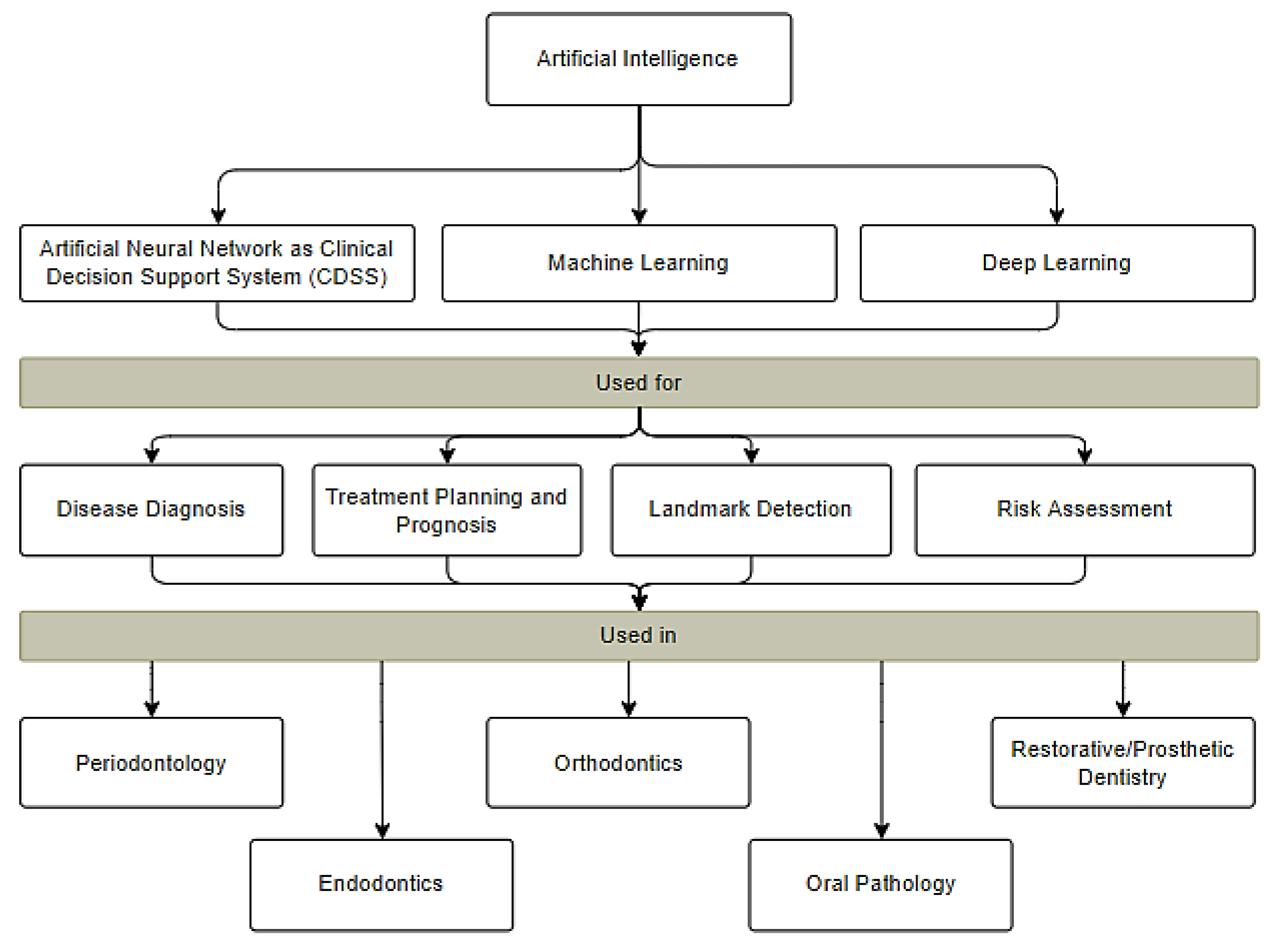
- Identify the development of AI applications that are employed widely in dentistry for different diagnostic tasks such as disease diagnosis, risk assessment, treatment planning, and prognosis and evaluate their diagnostic performance,
- Outline the limitations of the neural networks employed for different diagnostic tasks including disease diagnosis, landmark detection, risk assessment, treatment planning, and prognosis,
- Provide future directions which may have a positive and stimulating impact on the future application of artificial intelligence-based techniques in the field of dentistry.
1.3. Article Organization
2. Methodology
2.1. Research Questions
- RQ1.
- What are the main fields in dentistry in which AI is employed?
- RQ2.
- What are data modalities and features used for diagnosing dental diseases?
- RQ3.
- Which AI techniques (including subfields) are utilized for disease diagnosis in different fields of dentistry?
- RQ4.
- Which outcome measures are used for the performance assessment of models?
- Population: Dental imagery related to radiographs (bitewing, periapical, occlusal, panoramic, cephalograms, cone-beam computed tomography (CBCT)), digital photographs, high-frequency ultrasound images, 3D CBCT images, domain, near-infrared light transillumination (NILT) images, extraoral/intraoral mold images, orthodontic scans, magnetic resonance imaging, water’s view radiographs, hyperspectral images and textual data including electronic health records.
- Intervention: Artificial intelligence, machine learning, deep learning-based models for diagnosis, detection, classification, segmentation, risk assessment, treatment planning, and prognosis.
- Comparison: Reference standard, expert opinions.
- Outcome: Measurable and predictive outcomes that include accuracy, specificity, sensitivity, F1-score, intersection over union (IoU), dice co-efficient, regression co-efficient receiver operating characteristic curve (ROC), and area under the curve (AUC), successful detection rate (SDR).
2.2. Data Sources and Search Strategies
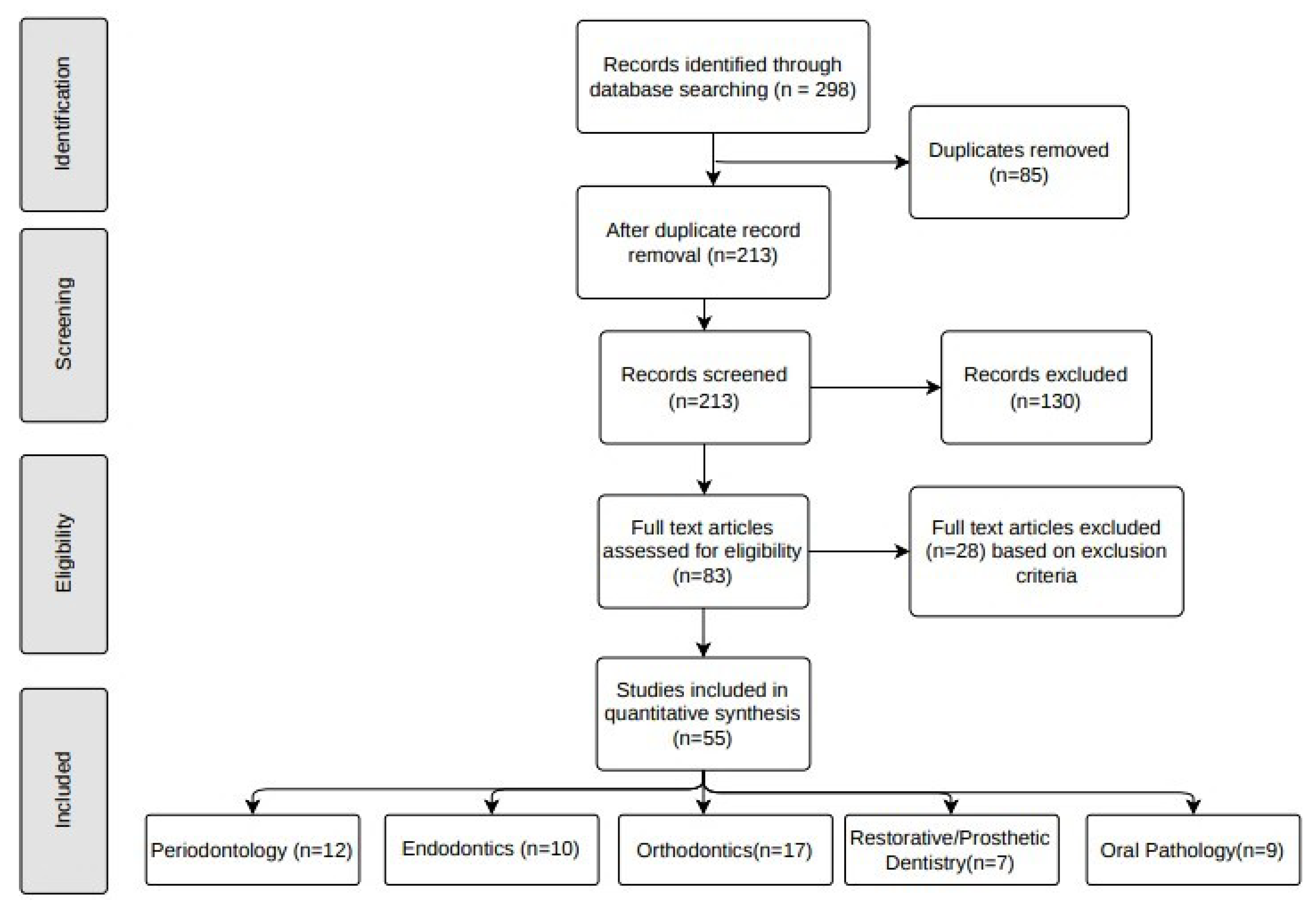
2.3. Selection of Studies
2.4. Eligibility Criteria
- Publications between 2009 and 2022 related to the application of artificial neural networks, machine learning, deep learning, fuzzy logic, expert systems, and clinical support decision systems (CDSS) in dentistry.
- Studies in the English language and with full-text availability.
- Published in a scholarly peer-reviewed journal.
- Publications truly implementing AI including subfields in the context of dental topics.
- Not published in a peer-reviewed journal.
- Unpublished thesis or dissertation studies.
- Studies that did not use artificial intelligence, review articles, and letter to the editor.
2.5. Risk Assessment
3. Applications of Artificial Intelligence in Dentistry
3.1. AI in Periodontology
3.2. AI in Endodontics
3.3. AI in Orthodontics
3.4. AI in Restorative Dentistry and Prosthodontics
3.5. AI in Oral Pathology
4. Limitations and Future Direction
4.1. Limitations
- Computational capability: AI-based techniques require a significant amount of parallel processing power to keep up with the demands. There are certain limitations of computational resources such as RAM and GPU cycles that are required to support such approaches.
- Reliability: It is essential in a clinical setting and involves ethical fairness, the accuracy of the system, and patients’ trust/acceptance of such systems. Limited reliability causes spurious consequences.
- Generalizability: Issues in generalizability are a dominant concern for clinical guidelines, and a precise level of generalizability is required for the application of AI-based models in clinical practices and ensuring that it performs well prospectively.
- Class imbalance: The difference in the number of samples representing each class within the data is referred to as class imbalance. The lack of high-quality and labeled datasets limits the deployment of robust and accurate AI-based models.
- Overfitting: Due to the high complexity in terms of parameters of deep learning models, the models are more likely to overfit with the training data, thus affecting the generalizability of the results.
4.2. Future Directions
4.2.1. Data Augmentation
4.2.2. Cross Center Training
4.2.3. Robotics in Dentistry
4.2.4. Virtual Reality and Augmented Reality
5. Discussion and Conclusion
Author Contributions
Funding
Institutional Review Board Statement
Informed Consent Statement
Data Availability Statement
Conflicts of Interest
References
- Haykin, S. Neural Networks and Learning Machines, 3/E; Pearson Education India: Noida, India, 2009. [Google Scholar]
- Basheer, I.A.; Hajmeer, M. Artificial neural networks: Fundamentals, computing, design, and application. J. Microbiol. Methods 2000, 43, 3–31. [Google Scholar] [CrossRef]
- Baxt, W.G. Application of artificial neural networks to clinical medicine. Lancet 1995, 346, 1135–1138. [Google Scholar] [CrossRef]
- Jain, A.K.; Mao, J.; Mohiuddin, K.M. Artificial neural networks: A tutorial. Computer 1996, 29, 31–44. [Google Scholar] [CrossRef]
- Krois, J.; Ekert, T.; Meinhold, L.; Golla, T.; Kharbot, B.; Wittemeier, A.; Dörfer, C.; Schwendicke, F. Deep learning for the radiographic detection of periodontal bone loss. Sci. Rep. 2019, 9, 8495. [Google Scholar] [CrossRef]
- Lin, P.; Huang, P.; Huang, P.; Hsu, H. Alveolar bone-loss area localization in periodontitis radiographs based on threshold segmentation with a hybrid feature fused of intensity and the H-value of fractional Brownian motion model. Comput. Methods Progr. Biomed. 2015, 121, 117–126. [Google Scholar] [CrossRef]
- Moran, M.B.H.; Faria, M.; Giraldi, G.; Bastos, L.; da Silva Inacio, B.; Conci, A. On using convolutional neural networks to classify periodontal bone destruction in periapical radiographs. In Proceedings of the 2020 IEEE International Conference on Bioinformatics and Biomedicine (BIBM), Seoul, Korea, 16–19 December 2020; pp. 2036–2039. [Google Scholar]
- Zheng, Z.; Yan, H.; Setzer, F.C.; Shi, K.J.; Mupparapu, M.; Li, J. Anatomically constrained deep learning for automating dental CBCT segmentation and lesion detection. IEEE Trans. Autom. Sci. Eng. 2020, 18, 603–614. [Google Scholar] [CrossRef]
- Shankarapillai, R.; Mathur, L.K.; Nair, M.A.; George, R. Periodontitis risk assessment using two artificial neural network algorithms—A comparative study. Int. J. Dental Clin. 2012, 4, 17–21. [Google Scholar]
- Carleo, G.; Cirac, I.; Cranmer, K.; Daudet, L.; Schuld, M.; Tishby, N.; Vogt-Maranto, L.; Zdeborová, L. Machine learning and the physical sciences. Rev. Mod. Phys. 2019, 91, 045002. [Google Scholar] [CrossRef]
- Hinton, G. Deep learning—A technology with the potential to transform health care. JAMA 2018, 320, 1101–1102. [Google Scholar] [CrossRef]
- Stead, W.W. Clinical implications and challenges of artificial intelligence and deep learning. JAMA 2018, 320, 1107–1108. [Google Scholar] [CrossRef]
- Park, W.J.; Park, J.B. History and application of artificial neural networks in dentistry. Eur. J. Dent. 2018, 12, 594–601. [Google Scholar] [CrossRef] [PubMed]
- Tundjungsari, V.; Sofro, A.S.M.; Sabiq, A.; Kardiana, A. Investigating clinical decision support systems success factors with usability testing. Int. J. Adv. Comput. Sci. Appl. 2017, 8. [Google Scholar] [CrossRef]
- Hajek, P. Fuzzy logic from the logical point of view. In Proceedings of the International Conference on Current Trends in Theory and Practice of Computer Science, Milovy, Czech Republic, 23 November–1 December 1995; pp. 31–49. [Google Scholar]
- Trillas, E.; Eciolaza, L. Fuzzy Logic; Springer International Publishing: Berlin, Germany, 2015; Volume 10, pp. 973–978. [Google Scholar]
- Collins, A.; Yao, Y. Machine learning approaches: Data integration for disease prediction and prognosis. In Applied Computational Genomics; Springer: Berlin/Heidelberg, Germany, 2018; pp. 137–141. [Google Scholar]
- Ossowska, A.; Kusiak, A.; Świetlik, D. Artificial Intelligence in Dentistry—Narrative Review. Int. J. Environ. Res. Public Health 2022, 19, 3449. [Google Scholar] [CrossRef] [PubMed]
- Geetha, V.; Aprameya, K.; Hinduja, D.M. Dental caries diagnosis in digital radiographs using back-propagation neural network. Health Inf. Sci. Syst. 2020, 8, 1–14. [Google Scholar] [CrossRef] [PubMed]
- Kositbowornchai, S.; Plermkamon, S.; Tangkosol, T. Performance of an artificial neural network for vertical root fracture detection: An ex vivo study. Dental Traumatol. 2013, 29, 151–155. [Google Scholar] [CrossRef]
- Amasya, H.; Yildirim, D.; Aydogan, T.; Kemaloglu, N.; Orhan, K. Cervical vertebral maturation assessment on lateral cephalometric radiographs using artificial intelligence: Comparison of machine learning classifier models. Dentomaxillofac. Radiol. 2020, 49, 20190441. [Google Scholar] [CrossRef]
- Budiman, J.A. Neural network in developing software for Indentifying arch form. Int. J. Artif. Intell. Appl. 2013, 4, 1–11. [Google Scholar] [CrossRef]
- Papantonopoulos, G.; Takahashi, K.; Bountis, T.; Loos, B.G. Artificial neural networks for the diagnosis of aggressive periodontitis trained by immunologic parameters. PLoS ONE 2014, 9, e89757. [Google Scholar] [CrossRef]
- Choi, H.I.; Jung, S.K.; Baek, S.H.; Lim, W.H.; Ahn, S.J.; Yang, I.H.; Kim, T.W. Artificial intelligent model with neural network machine learning for the diagnosis of orthognathic surgery. J. Craniofac. Surg. 2019, 30, 1986–1989. [Google Scholar] [CrossRef]
- Cui, Q.; Chen, Q.; Liu, P.; Liu, D.; Wen, Z. Clinical decision support model for tooth extraction therapy derived from electronic dental records. J. Prosthet. Dent. 2021, 126, 83–90. [Google Scholar] [CrossRef]
- Javed, S.; Zakirulla, M.; Baig, R.U.; Asif, S.; Meer, A.B. Development of artificial neural network model for prediction of post-streptococcus mutans in dental caries. Comput. Methods Progr. Biomed. 2020, 186, 105198. [Google Scholar] [CrossRef] [PubMed]
- Iwasaki, H. Bayesian belief network analysis applied to determine the progression of temporomandibular disorders using MRI. Dentomaxillofac. Radiol. 2015, 44, 20140279. [Google Scholar] [CrossRef]
- Bas, B.; Ozgonenel, O.; Ozden, B.; Bekcioglu, B.; Bulut, E.; Kurt, M. Use of artificial neural network in differentiation of subgroups of temporomandibular internal derangements: A preliminary study. J. Oral Maxillofac. Surg. 2012, 70, 51–59. [Google Scholar] [CrossRef] [PubMed]
- Li, S.; Guo, Y.; Pang, Z.; Song, W.; Hao, A.; Xia, B.; Qin, H. Automatic Dental Plaque Segmentation Based on Local-to-Global Features Fused Self-Attention Network. IEEE J. Biomed. Health Inform. 2022, 26, 2240–2251. [Google Scholar] [CrossRef] [PubMed]
- Li, W.; Chen, Y.; Sun, W.; Brown, M.; Zhang, X.; Wang, S.; Miao, L. A gingivitis identification method based on contrast-limited adaptive histogram equalization, gray-level co-occurrence matrix, and extreme learning machine. Int. J. Imaging Syst. Technol. 2019, 29, 77–82. [Google Scholar] [CrossRef]
- Ghaedi, L.; Gottlieb, R.; Sarrett, D.C.; Ismail, A.; Belle, A.; Najarian, K.; Hargraves, R.H. An automated dental caries detection and scoring system for optical images of tooth occlusal surface. In Proceedings of the 2014 36th Annual International Conference of the IEEE Engineering in Medicine and Biology Society, Chicago, IL, USA, 26–30 August 2014; pp. 1925–1928. [Google Scholar]
- Berdouses, E.D.; Koutsouri, G.D.; Tripoliti, E.E.; Matsopoulos, G.K.; Oulis, C.J.; Fotiadis, D.I. A computer-aided automated methodology for the detection and classification of occlusal caries from photographic color images. Comput. Biol. Med. 2015, 62, 119–135. [Google Scholar] [CrossRef] [PubMed]
- Chen, S.; Wang, L.; Li, G.; Wu, T.H.; Diachina, S.; Tejera, B.; Kwon, J.J.; Lin, F.C.; Lee, Y.T.; Xu, T.; et al. Machine learning in orthodontics: Introducing a 3D auto-segmentation and auto-landmark finder of CBCT images to assess maxillary constriction in unilateral impacted canine patients. Angle Orthod. 2020, 90, 77–84. [Google Scholar] [CrossRef]
- Niño-Sandoval, T.C.; Perez, S.V.G.; Gonzalez, F.A.; Jaque, R.A.; Infante-Contreras, C. An automatic method for skeletal patterns classification using craniomaxillary variables on a Colombian population. Forens. Sci. Int. 2016, 261, 159-e1. [Google Scholar] [CrossRef]
- Yu, X.; Liu, B.; Pei, Y.; Xu, T. Evaluation of facial attractiveness for patients with malocclusion: A machine-learning technique employing Procrustes. Angle Orthod. 2014, 84, 410–416. [Google Scholar] [CrossRef]
- Orhan, K.; Driesen, L.; Shujaat, S.; Jacobs, R.; Chai, X. Development and validation of a magnetic resonance imaging-based machine learning model for TMJ pathologies. BioMed Res. Int. 2021, 2021, 6656773. [Google Scholar] [CrossRef]
- Riri, H.; Ed-Dhahraouy, M.; Elmoutaouakkil, A.; Beni-Hssane, A.; Bourzgui, F. Extracted features based multi-class classification of orthodontic images. Int. J. Electr. Comput. Eng. 2020, 10, 3558–3567. [Google Scholar] [CrossRef]
- Suhail, Y.; Upadhyay, M.; Chhibber, A. Machine learning for the diagnosis of orthodontic extractions: A computational analysis using ensemble learning. Bioengineering 2020, 7, 55. [Google Scholar] [CrossRef] [PubMed]
- Lee, S.J.; Chung, D.; Asano, A.; Sasaki, D.; Maeno, M.; Ishida, Y.; Kobayashi, T.; Kuwajima, Y.; Da Silva, J.D.; Nagai, S. Diagnosis of Tooth Prognosis Using Artificial Intelligence. Diagnostics 2022, 12, 1422. [Google Scholar] [CrossRef] [PubMed]
- Abdalla-Aslan, R.; Yeshua, T.; Kabla, D.; Leichter, I.; Nadler, C. An artificial intelligence system using machine-learning for automatic detection and classification of dental restorations in panoramic radiography. Oral Surg. Oral Med. Oral Pathol. Oral Radiol. 2020, 130, 593–602. [Google Scholar] [CrossRef]
- Lee, C.T.; Kabir, T.; Nelson, J.; Sheng, S.; Meng, H.W.; Van Dyke, T.E.; Walji, M.F.; Jiang, X.; Shams, S. Use of the deep learning approach to measure alveolar bone level. J. Clin. Periodontol. 2022, 49, 260–269. [Google Scholar] [CrossRef]
- Kim, Y.; Lee, K.J.; Sunwoo, L.; Choi, D.; Nam, C.M.; Cho, J.; Kim, J.; Bae, Y.J.; Yoo, R.E.; Choi, B.S.; et al. Deep Learning in Diagnosis of Maxillary Sinusitis Using Conventional Radiography. Investig. Radiol. 2019, 54, 7–15. [Google Scholar] [CrossRef]
- Lee, J.H.; Kim, D.H.; Jeong, S.N. Diagnosis of cystic lesions using panoramic and cone beam computed tomographic images based on deep learning neural network. Oral Dis. 2020, 26, 152–158. [Google Scholar] [CrossRef]
- Khan, H.A.; Haider, M.A.; Ansari, H.A.; Ishaq, H.; Kiyani, A.; Sohail, K.; Muhammad, M.; Khurram, S.A. Automated feature detection in dental periapical radiographs by using deep learning. Oral Surg. Oral Med. Oral Pathol. Oral Radiol. 2021, 131, 711–720. [Google Scholar] [CrossRef]
- Duong, D.Q.; Nguyen, K.C.T.; Kaipatur, N.R.; Lou, E.H.M.; Noga, M.; Major, P.W.; Punithakumar, K.; Le, L.H. Fully Automated Segmentation of Alveolar Bone Using Deep Convolutional Neural Networks from Intraoral Ultrasound Images. In Proceedings of the 2019 41st Annual International Conference of the IEEE Engineering in Medicine and Biology Society (EMBC), Berlin, Germany, 23–27 July 2019; pp. 6632–6635. [Google Scholar]
- Nguyen, K.; Duong, D.; Almeida, F.; Major, P.; Kaipatur, N.; Pham, T.; Lou, E.; Noga, M.; Punithakumar, K.; Le, L. Alveolar Bone Segmentation in Intraoral Ultrasonographs with Machine Learning. J. Dental Res. 2020, 99, 1054–1061. [Google Scholar] [CrossRef]
- Pauwels, R.; Brasil, D.M.; Yamasaki, M.C.; Jacobs, R.; Bosmans, H.; Freitas, D.Q.; Haiter-Neto, F. Artificial intelligence for detection of periapical lesions on intraoral radiographs: Comparison between convolutional neural networks and human observers. Oral Surg. Oral Med. Oral Pathol. Oral Radiol. 2021, 131, 610–616. [Google Scholar] [CrossRef]
- Orhan, K.; Bayrakdar, I.S.; Ezhov, M.; Kravtsov, A.; Özyürek, T. Evaluation of artificial intelligence for detecting periapical pathosis on cone-beam computed tomography scans. Int. Endod. J. 2020, 53, 680–689. [Google Scholar] [CrossRef] [PubMed]
- Fukuda, M.; Inamoto, K.; Shibata, N.; Ariji, Y.; Yanashita, Y.; Kutsuna, S.; Nakata, K.; Katsumata, A.; Fujita, H.; Ariji, E. Evaluation of an artificial intelligence system for detecting vertical root fracture on panoramic radiography. Oral Radiol. 2019, 36, 337–343. [Google Scholar] [CrossRef] [PubMed]
- Ekert, T.; Krois, J.; Meinhold, L.; Elhennawy, K.; Emara, R.; Golla, T.; Schwendicke, F. Deep Learning for the Radiographic Detection of Apical Lesions. J. Endod. 2019, 45, 917–922.e5. [Google Scholar] [CrossRef] [PubMed]
- Bayraktar, Y.; Ayan, E. Diagnosis of interproximal caries lesions with deep convolutional neural network in digital bitewing radiographs. Clin. Oral Investig. 2021, 26, 623–632. [Google Scholar] [CrossRef] [PubMed]
- Hiraiwa, T.; Ariji, Y.; Fukuda, M.; Kise, Y.; Nakata, K.; Katsumata, A.; Fujita, H.; Ariji, E. A deep-learning artificial intelligence system for assessment of root morphology of the mandibular first molar on panoramic radiography. Dentomaxillofac. Radiol. 2019, 48, 20180218. [Google Scholar] [CrossRef]
- Casalegno, F.; Newton, T.; Daher, R.; Abdelaziz, M.; Lodi-Rizzini, A.; Schürmann, F.; Krejci, I.; Markram, H. Caries Detection with Near-Infrared Transillumination Using Deep Learning. J. Dental Res. 2019, 98, 1227–1233. [Google Scholar] [CrossRef]
- Lee, J.H.; Jeong, S.N. Efficacy of deep convolutional neural network algorithm for the identification and classification of dental implant systems, using panoramic and periapical radiographs. Medicine 2020, 99, e20787. [Google Scholar] [CrossRef]
- Hung, K.F.; Ai, Q.Y.H.; King, A.D.; Bornstein, M.M.; Wong, L.M.; Leung, Y.Y. Automatic detection and segmentation of morphological changes of the maxillary sinus mucosa on cone-beam computed tomography images using a three-dimensional convolutional neural network. Clin. Oral Investig. 2022, 26, 3987–3998. [Google Scholar] [CrossRef]
- Kuwana, R.; Ariji, Y.; Fukuda, M.; Kise, Y.; Nozawa, M.; Kuwada, C.; Muramatsu, C.; Katsumata, A.; Fujita, H.; Ariji, E. Performance of deep learning object detection technology in the detection and diagnosis of maxillary sinus lesions on panoramic radiographs. Dentomaxillofac. Radiol. 2020, 50, 20200171. [Google Scholar] [CrossRef]
- Murata, M.; Ariji, Y.; Ohashi, Y.; Kawai, T.; Fukuda, M.; Funakoshi, T.; Kise, Y.; Nozawa, M.; Katsumata, A.; Fujita, H.; et al. Deep-learning classification using convolutional neural network for evaluation of maxillary sinusitis on panoramic radiography. Oral Radiol. 2018, 35, 301–307. [Google Scholar] [CrossRef]
- Choi, E.; Kim, D.; Lee, J.Y.; Park, H.K. Artificial intelligence in detecting temporomandibular joint osteoarthritis on orthopantomogram. Sci. Rep. 2021, 11, 10246. [Google Scholar] [CrossRef] [PubMed]
- Jeyaraj, P.R.; Nadar, E.R.S. Computer-assisted medical image classification for early diagnosis of oral cancer employing deep learning algorithm. J. Cancer Res. Clin. Oncol. 2019, 145, 829–837. [Google Scholar] [CrossRef] [PubMed]
- Song, Y.; Qiao, X.; Iwamoto, Y.; wei Chen, Y. Automatic Cephalometric Landmark Detection on X-ray Images Using a Deep-Learning Method. Appl. Sci. 2020, 10, 2547. [Google Scholar] [CrossRef]
- Park, J.H.; Hwang, H.W.; Moon, J.H.; Yu, Y.; Kim, H.; Her, S.B.; Srinivasan, G.; Aljanabi, M.N.A.; Donatelli, R.E.; Lee, S.J. Automated identification of cephalometric landmarks:Comparisons between the latest deep-learning methods YOLOV3 and SSD. Angle Orthod. 2019, 89, 903–909. [Google Scholar] [CrossRef]
- Lee, K.S.; Ryu, J.J.; Jang, H.S.; Lee, D.Y.; Jung, S.K. Deep Convolutional Neural Networks Based Analysis of Cephalometric Radiographs for Differential Diagnosis of Orthognathic Surgery Indications. Appl. Sci. 2020, 10, 2124. [Google Scholar] [CrossRef]
- Kim, J.; Lee, H.S.; Song, I.S.; Jung, K.H. DeNTNet: Deep Neural Transfer Network for the detection of periodontal bone loss using panoramic dental radiographs. Sci. Rep. 2019, 9, 17615. [Google Scholar] [CrossRef] [PubMed]
- Li, H.; Zhou, J.; Zhou, Y.; Chen, J.; Gao, F.; Xu, Y.; Gao, X. Automatic and interpretable model for periodontitis diagnosis in panoramic radiographs. In Proceedings of the International Conference on Medical Image Computing and Computer-Assisted Intervention, Lima, Peru, 4–8 October 2020; pp. 2454–2463. [Google Scholar]
- Kim, H.; Shim, E.; Park, J.; Kim, Y.J.; Lee, U.; Kim, Y. Web-based fully automated cephalometric analysis by deep learning. Comput. Methods Progr. Biomed. 2020, 194, 105513. [Google Scholar] [CrossRef]
- Gilmour, L.; Ray, N. Locating Cephalometric X-Ray Landmarks with Foveated Pyramid Attention. In Proceedings of the Third Conference on Medical Imaging with Deep Learning, Montreal, QC, Canada, 6–8 July 2020; Volume 121, pp. 262–276. [Google Scholar]
- Zhong, Z.; Li, J.; Zhang, Z.; Jiao, Z.; Gao, X. An Attention-Guided Deep Regression Model for Landmark Detection in Cephalograms. arXiv 2019, arXiv:1906.07549. [Google Scholar]
- Makaremi, M.; Lacaule, C.; Mohammad-Djafari, A. Deep Learning and Artificial Intelligence for the Determination of the Cervical Vertebra Maturation Degree from Lateral Radiography. Entropy 2019, 21, 1222. [Google Scholar] [CrossRef]
- Yu, H.; Cho, S.; Kim, M.; Kim, W.; Kim, J.; Choi, J. Automated Skeletal Classification with Lateral Cephalometry Based on Artificial Intelligence. J. Dental Res. 2020, 99, 249–256. [Google Scholar] [CrossRef]
- Kök, H.; Acilar, A.M.; İzgi, M.S. Usage and comparison of artificial intelligence algorithms for determination of growth and development by cervical vertebrae stages in orthodontics. Prog. Orthod. 2019, 20, 41. [Google Scholar] [CrossRef] [PubMed]
- Takahashi, T.; Nozaki, K.; Gonda, T.; Ikebe, K. A system for designing removable partial dentures using artificial intelligence. Part 1. Classification of partially edentulous arches using a convolutional neural network. J. Prosthodont. Res. 2021, 65, 115–118. [Google Scholar] [CrossRef] [PubMed]
- Xu, X.; Liu, C.; Zheng, Y. 3D Tooth Segmentation and Labeling Using Deep Convolutional Neural Networks. IEEE Trans. Vis. Comput. Graph. 2019, 25, 2336–2348. [Google Scholar] [CrossRef] [PubMed]
- Sedik, A.; Iliyasu, A.M.; El-Rahiem, B.A.; Samea, M.E.A.; Abdel-Raheem, A.; Hammad, M.; Peng, J.; El-Samie, F.E.A.; El-Latif, A.A.A. Deploying Machine and Deep Learning Models for Efficient Data-Augmented Detection of COVID-19 Infections. Viruses 2020, 12, 769. [Google Scholar] [CrossRef]
- Huang, G.; Jafari, A.H. Enhanced balancing GAN: Minority-class image generation. arXiv 2021, arXiv:2011.00189. [Google Scholar] [CrossRef]
- Krois, J.; Cantu, A.G.; Chaurasia, A.; Patil, R.; Chaudhari, P.K.; Gaudin, R.; Gehrung, S.; Schwendicke, F. Generalizability of deep learning models for dental image analysis. Sci. Rep. 2021, 11, 6102. [Google Scholar] [CrossRef]
- Grischke, J.; Johannsmeier, L.; Eich, L.; Griga, L.; Haddadin, S. Dentronics: Towards robotics and artificial intelligence in dentistry. Dental Mater. 2020, 36, 765–778. [Google Scholar] [CrossRef]
- Fahim, S.; Maqsood, A.; Das, G.; Ahmed, N.; Saquib, S.; Lal, A.; Khan, A.A.G.; Alam, M.K. Augmented Reality and Virtual Reality in Dentistry: Highlights from the Current Research. Appl. Sci. 2022, 12, 3719. [Google Scholar] [CrossRef]
- Monterubbianesi, R.; Tosco, V.; Vitiello, F.; Orilisi, G.; Fraccastoro, F.; Putignano, A.; Orsini, G. Augmented, Virtual and Mixed Reality in Dentistry: A Narrative Review on the Existing Platforms and Future Challenges. Appl. Sci. 2022, 12, 877. [Google Scholar] [CrossRef]

| Search # | Topic | Terms |
|---|---|---|
| 1 | Artificial intelligence | artificial intelligence“[MeSH Terms] OR (“artificial” [All Fields] AND “intelligence”[All Fields]) OR “artificial intelligence”[All Fields] OR (“machine learning”[MeSH Terms] OR “machine learning”[All Fields]) OR (“deep learning”[MeSH Terms] OR (“deep”[All Fields] AND “learning”[All Fields]) OR “deep learning”[All Fields]) OR (“decision support systems, clinical”[MeSH Terms] OR “clinical decision support systems”[All Fields] OR (“fuzzy logic”[MeSH Terms] OR “fuzzy logic”[All Fields]) |
| 2 | Dentistry | “periodontics” OR “endodontics” OR pathology OR “dental health services”[All Fields] OR “dental”[All Fields] OR “dentally”[All Fields] OR “dentals”[All Fields]) AND (“surgery”[MeSH Subheading] OR “surgery”[All Fields] OR “surgical procedures, operative”[MeSH Terms] OR (“surgical”[All Fields] AND “procedures”[All Fields] AND “operative”[All Fields]) OR “maxillofacial”[All Fields] OR (“craniofacial“ [All Fields] OR (“restorative dent”[Journal] OR (“restorative”[All Fields] AND “dentistry”[All Fields]) OR “restorative dentistry”[All Fields]) OR (“dental implants”[MeSH Terms] OR (“dental”[All Fields] AND “implants”[All Fields]) OR “dental implants”[All Fields]) |
| 3 | Search #1 and #2 |
| AI Technique | Diagnostic Tasks | Target Problem | Input Features |
|---|---|---|---|
| ANN as CDSS | Disease Diagnosis (Classification, Segmentation, Localization) | tooth decay detection [19], vertical root fracture [20], Cervical vertebra maturation degree [21,22] | Intraoral radiographs [19,20], cephalograms [21], orthodontic scans [22] |
| Risk Assessment | Bone loss assessment [23], periodontitis risk assessment [9] | Medical records [9,23] | |
| Treatment Planning and prognosis | Surgery type and extraction decision [24], tooth extraction therapy [25], occlusal and dental caries [26], temporomandibular joint disorders [27,28] | cephalograms [24], electronic health records [25,26,28], magnetic resonance images [27] | |
| Machine Learning | Disease Diagnosis (Classification, Segmentation, Localization) | Plaque segmentation [29], gingivitis identification [30], alveolar bone loss [6], scoring lesions [31], occlusal caries lesions [32], maxillary structure assessment [33], sagittal skeletal patterns [34], facial attractiveness [35], temporomandibular joint disorders [36] | Oral endoscopic images [29], digital photographs [30,35], intraoral radiographs [6], occlusal images [31,32], CBCT images [33], cephalograms [34], magnetic resonance images [36] |
| Treatment Planning and Prognosis | Facial and skin mould [37], teeth extraction [38], tooth prognosis [39], dental restorations [40] | Mould images [37], electronic records [38,39], panoramic images [40] | |
| Deep Learning | Disease Diagnosis (Classification, Segmentation, Localization) | Bone loss [5,8,41,42], odontogenic cystic lesion [43], periodontal bone destruction [7,26], bone recession and interradicular radiolucency [44], alveolar bone delineation [45], bone assessment [46], periapical lesions [47,48], vertical root fracture [49], apical lesions [50], interproximal caries [51], distal root assessment [52], proximal and occlusal caries [53], dental implants [54], preserve tooth boundary [23], maxillary sinusitis lesions [42,55,56,57], temporomandibular joint disorders [58], oral cancer [59] | Periapical radiographs [7,41,44,47], panoramic radiographs [5,26,42,43,49,50,54,56,57,58], CBCT images [8,43,48,52,55], high-frequency ultrasound images [45], intraoral ultrasound images [46], bitewing radiographs [51], NILT images [53], digital photographs [23], water’s view radiographs [42], hyperspectral images [59] |
| Landmark detection | Cephalometric landmarks [60,61] | cephalograms [60,61] | |
| Treatment Planning | Differential orthodontic diagnosis [62] | cephalograms [62] |
| AI Application | Author, Year (Ref) | Architecture | Data Modality | Dataset Size Split (Train/Val/Test or Train/Test) | Study Factor | Reference Standard (Ground Truth) | Validation Scheme | Results (Performance Metrics/Values) | Conclusion |
|---|---|---|---|---|---|---|---|---|---|
| Disease segmentation | Li et al., 2022 [29] | CNN | Oral endoscope images | 607 images Train: 320 images Test: 287 images 320/287 | Plaque segmentation | Dentist | NA | Acc: 0.864 IoU: 0.859 | The model is helpful in plaque segmentation on small dataset |
| Li et al., 2019 [30] | A method based on contrast limited adaptive histogram (CLAHE), gray-level co-occurrence matrix (GLCM), and extreme machine learning | Digital photographs | 93 images Train: 73 images Test: 20 images 73/20 | Gingivitis identification | NA | NA | Accuracy: 0.74, Sensitivity: 0.75, Specificity: 0.73, Precision: 0.74 | The method is helpful for gingivitis identification | |
| Disease localization | Lin et al., 2015 [6] | Level segmentation based on Bayesian or KNN or SVM classifier | Periapical Radiographs | 31 images | Alveolar bone loss | NA | Leave one-out | Mean SD True Positive Fraction (TPF): 0.925, True Positive Fraction (FPF): 0.14 | The model localizes bone loss areas with high classification effectiveness |
| Disease detection | Lee et al., 2022 [41] | VGG+Individual CNN | Periapical Radiographs | 1740 images Train: 1218 images, Valid: 417 images, Test: 105 images 1218/417/105 | Bone loss | Three dentists | NA | Acc: 0.99, AUC: 0.98 | The proposed algorithm is helpful in diagnosing periodontal bone loss |
| Krois et al., 2019 [5] | Seven layered deep CNN | Panoramic radiographs | 1750 images, Train: 1400 images, Valid: 350 images, 1400/350 | Bone loss | Three examiners | Ten-fold | Acc: 0.81 | The model shows discrimination ability similar to that of dentists | |
| Kim et al., 2019 [63] | Deep CNN + Transfer learning | Panoramic radiographs | 12,179 images, Train: 11,189 images, Valid: 190 images, Test: 800 images 1189/190/800 | Bone loss | Dental clinicians | NA | AUROC: 0.95, F1-score: 0.75, Sensitivity: 0.77, Specificity: 0.95, PPV: 0.73, NPV: 0.96 | The model is useful in tooth numbering and achieved detection performance superior to that of dental clinicians | |
| Lee et al., 2019 [43] | GoogleNet InceptionV3 + Transfer learning | Panoramic radiographs and CBCT images | 2126 images including 1140 panoramic and 986 CBCT images Train: 1700 images, Test: 426 images, 1700/426 | Odontogenic cyst lesion | NA | NA | Panoramic images: AUC—0.847, Sensitivity—0.882, Specificity—0.77, CBCT images AUC—0. 914, Sensitivity—0.961, Specificity—0.771 | The model provides higher diagnostic performance on CBCT images in effectively detecting and diagnosing cystic lesions | |
| Disease classification | Moran et al., 2020 [7] | ResNet Inception | Periapical radiographs | 467 images, Train: 415 images, Test: 52 images, 415/52 | Periodontal bone destruction | NA | NA | Acc: 0.81, Precision: 0.76, Recall: 0.92, Specificity: 0.71, NPV: 0.90 | The inception model classifies regions based on the presence of periodontal bone destruction with encouraging performance |
| Disease segmentation | Khan et al., 2021 [44] | UNet + DenseNet121 | Periapical radiographs | 200 images, Train: 160 images, Test: 40 images | Bone recession and inter-radicular radioulency | Three experts | NA | mIoU: 0.501, Dice score: 0.569 | Automates the process of detecting the presence and shape of caries |
| Zheng et al., 2021 [8] | Automatically constrained dense U-Net | CBCT images | 100 images | bone lesion identification | Three reviewers | Four-fold | Dice score for different categories: Background: 0.961, Lesion: 0.709, Material: 0.822, Bone: 0.877, Teeth: 0.801 | The model is helpful in detecting the correct shape of the lesion and the bone | |
| Duong et al., 2019 [45] | UNet | High frequency ultrasound images | 35 images, Train: 30 images, Test: 5 images, 30/5 | Alveolar bone assessment | Three experts | NA | Dice Coefficient: 0.75, Sensitivity: 0.77, Specificity: 0.99 | The method yields a higher performance in delineating alveolar bone as compared to experts | |
| Nguyen et al., 2020 [46] | U-Net with ResNet34 encoder | Intraoral ultrasound images | 1100 images, Train: 700 images, Valid: 200 images, Test: 200 images 700/200/200 | Alveolar bone assessment | Three examiners | NA | Dice Coefficient: 0.853, Sensitivity: 0.885, Specificity: 0.998 | The model has the potential to detect and segment alveolar bone automatically | |
| Disease diagnosis | Li et al., 2020 [64] | Mask RCNN + novel caliberation method | Panoramic radiographs | 298 images, Train: 270 images, Test: 28 images 270/28 | Periodontitis prediction | Junior dentist | NA | mAP: 0.826, Dice score: 0.868, F1-score: 0.454, Accuracy: 0.817 | The model is useful for diagnosing the severity degrees of periodontitis |
| Papantonopoulos et al., 2014 [23] | Multilayer Perceptron ANN | Textual | 29 subjects | Aggressive periodontitis | NA | Ten-fold | Accuracy: 0.981 | The model provides effective periodontitis classification | |
| Geetha et al., 2020 [19] | Back propagation Neural Network | Intraoral digital radiographs | 105 images | Dental caries detection | NA | Ten-fold | Accuracy: 0.971, FPR: 2.8%, ROC: 0.987 | The model is helpful for the detection of tooth decay and is independent of visual errors | |
| Risk assessment | Shankarapillai et al. 2012 [9] | Multilayer Feedforward Propagation | Textual | 230 subjects | Periodontitis risk assessment | NA | NA | MSE: 0.132 | The model can be used for effective periodontitis risk prediction |
| AI Application | Author, Year (Ref) | Architecture | Data Modality | Dataset Size Split (Train/Val/Test or Train/Test) | Study Factor | Reference Standard (Ground Truth) | Validation Scheme | Results (Performance Metrics/Values) | Conclusion |
|---|---|---|---|---|---|---|---|---|---|
| Disease detection and classification | Ghaedi et al., 2014 [31] | Circular Hough Transform Based Segmentation | Intraoral optical occlusal tooth surface images | 88 images with blue background | Detect and score caries lesions | International Caries Detection and Assessment System (ICDAS) experts | Ten fold | Accuracy: 0.863, Specificity: 0.983, Sensitivity: 0.83 | The automated system was helpful in detecting and score caries lesions. |
| Berdouses et al., 2015 [32] | Random Forest | Photographic colored images | 103 digital images | Occlusal caries lesions | Two pediatric dentists | Ten-fold | Accuracy: 0.80, Precision: 0.86, Recall: 0.86, F1-score: 0.85, ROC: 0.98 | The model was able to provide detection performance similar to that of trained dentists | |
| Disease Detection | Pauwels et al., 2021 [47] | CNN + Transfer Learning | Intraoral radiographs | 280 images, Train: 168 images, Test 112 images 168/112 | Periapical lesions | 3 oral radiologists | Five-fold | Sensitivity: 0.79, Specificity: 0.88, ROC-AUC: 0.86 | The study explored the potential of CNN-based assessment of periapical lesions and achieved superior performance compared to human observers |
| Fukuda et al., 2020 [49] | DetectNet (CNN) | Panoramic radiographs | 300 images, Train: 240 images, Test: 60 images 240/60 | Vertical root fracture | Three observers | Five-fold | Recall: 0.75, Precision: 0.93, F1-score: 0.83 | The model was useful in identifying teeth with vertical root fracture | |
| Orhan et al., 2020 [48] | Deep CNN (U-Net) | 3D CBCT images | 153 images | Periapical lesions | Two Oral and maxillofacial radiologist | NA | Recall: 0.89, Precision: 0.95, F1-score: 0.93 | The model was able to detect periapical pathosis with 92.8% reliability | |
| Ekert et al. 2019 [50] | 7 layer feed forward CNN | Panoramic radiographs | 85 images, Train: 56 images, Valid: 29 images 56/29 | Apical lesions | Six independent and experienced dentists | Ten-fold | Avg AUC: 0.85, Confidence Interval (CI): 95% | A moderately deep CNN was helpful in detecting apical lesions and can be helpful in reducing dentists’ diagnostic efforts | |
| Disease diagnosis | Bayraktar & Ayan, 2022 [51] | Deep CNN (YOLO) pretrained using DarkNet-53 | Bitewing radiographs | 1000 images, Train: 800 images, Test: 200 images 800/200 | Interproximal caries lesions | Two experienced dentists | Hold-out | Accuracy: 0.945, Sensitivity: 0.722, Specificity: 0.981, PPV: 0.865, NPV: 0.954, AUC: 0.871 | The study shows promising outcomes for detecting caries in bitewing images achieving an accuracy above 90% |
| Disease classification | Hiraiwa et al., 2019 [52] | AlexNet GoogleNet | CBCT images and panoramic images | Training image patches: Single root group: 11,472, Extra root group: 11,004, Testing image patches: Single root group:32, Extra root group—32 | Assessing number of distal roots of mandibular first molars | Two radiologists | Five-fold | Accuracy: 87.4, Sensitivity: 77.3, Specificity: 97.1, PPV: 96.3, NPV: 81.8, AUC: 0.87 | The model achieved detection performance superior to that of dental radiologists in differentiating whether distal root was single or with an extra root |
| Disease segmentation | Casalegno et al., 2019 [53] | Symmetric Autoencoder with skip connections similar to U-Net and encoding path similar to VGG16 | Near Infrared transillumination (TI) images | 217 grayscale images of upper and lower molars and premolars, Train: 185 images, Test: 32 images 185/32 | Proximal and occlusal caries lesion | Two dentists | Monte Carlo | IoU score: Occlusal—0.49, Proximal—0.49, AUROC: Occlusal—0.83, Proximal—0.85 | The proposed system has the potential to support dentists by providing higher throughput in detecting occlusal and proximal lesions |
| Disease diagnosis | Kositbowornchai et al., 2013 [20] | Probabilistic Neural Network | Intraoral radiographs | 200 images (50 sound and 150 vertical root fractures), Train: 120, Test: 80 120/80 | Vertical root fracture detection | N/A | Three-fold | Sensitivity: 0.98, Specificity: 0.905, Accuracy: 0.957 | The model was helpful in diagnosing vertical root fractures using intraoral digital radiographs |
| AI Application | Author, Year (Ref) | Architecture | Data Modality | Dataset Size Split (Train/Val/Test or Train/Test) | Study Factor | Reference Standard (Ground Truth) | Validation Scheme | Results (Performance Metrics/Values) | Conclusion |
|---|---|---|---|---|---|---|---|---|---|
| Disease diagnosis | Chen et al., 2020 [33] | ML-based algorithm based on multisource integration framework | CBCT images | 36 CBCT images, Train: 30 images, Test: 6 images 30/6 | Assess maxillary structure variation | NA | NA | Dice score of maxilla: 0.80 | The method is helpful in assessing maxillary structure variation in unilateral canine impaction |
| Nino-Sandoval et al., 2016 [34] | Support Vector Machine (SVM) | cephalograms | 229 cephalograms | Sagittal (skeletal) patterns | NA | Ten-fold | Accuracy: 0.741 | The non-parametric method has the potential to classify skeletal patterns using craniomaxillary variables | |
| Yu et al., 2014 [35] | Support Vector Regression (SVR) | Colored Photographs | 108 images | Facial attractiveness (most attractive to least attractive) | 69 Orthodontists | NA | Accuracy: 0.718 | The model was helpful in finding close correlation with facial attractiveness from orthodontic photographs | |
| Treatment planning | Riri et al., 2020 [37] | Tree Based Classification | Extraoral intraoral and mould images | 1207 total images, Extraoral: 325 images, Intraoral: 812 images, Mould: 70 images | Facial and skin color features | NA | NA | Accuracy: 0.942, Sensitivity: 0.953, Specificity: 0.996, F1-score: 0.926 | The automatic approach was helpful in classification of orthodontic images with encouraging classification performance |
| Suhail et al., 2020 [38] | Random Forest Ensemble Learning Method | Patient records (medical charts, x-rays, facial photographs) | 287 patient records | Decision making for teeth extraction | Five experts | Five-Fold | Accuracy: 0.944 | The RF ensemble classifier was helpful in extraction and treatment planning | |
| Landmark detection in cephalograms | Song et al., 2020 [60] | Pretrained ResNet-50 using transfer learning | X-Ray images | 400 cephalograms, Train: 150 images, Testing sets: Test set 1—150 images, Test set 2—100 images | Detect cephalometric landmarks | Two experienced doctors | NA | Successful Detection Rate (SDR): Test 1—0.862, Test 2—0.758 | The model was able to achieve satisfying SDR in detecting 19 landmarks |
| Kim et al., 2020 [65] | Two stage DNN with stacked hourglass network | Dataset 1: 2075 cephalograms, Dataset 2: 400 | cephalograms | Detect cephalometric landmarks | Two experts | NA | SDR: Test set 1—0.883, Test set 2—0.77 | The fully automated cephalometric analysis algorithm and web application help in the diagnosis of anatomic landmarks | |
| Gilmour and Ray, 2020 [66] | Pretrained ResNet-50 with foveated pyramid attention algorithm | cephalograms | 400 cephalograms | Detect cephalometric landmarks | NA | Four-fold | SDR: Test set 1—0.883, Test set 2—0.77 | The multiresolution approach was useful in learning features across all scales and is promising for large images | |
| Zhong et al., 2019 [67] | Attention guided deep regression model through 2 stage U-Net | cephalograms | 300 cephalograms Train: 150, images Test: 150 images 150/150 | Detect cephalometric landmarks | Two experienced doctors | Four-fold | SDR: 86.74% | The attention-guided mechanism ensures that smaller searching scopes and high data resolution with minimum information redundancy and the model is generalizable to other landmarks | |
| Park et al., 2019 [61] | YOLOv3 | cephalograms | 1311 cephalograms, Train: 1028 images, Test: 283 images 1028/283 | Detect cephalometric landmarks | One examiner | NA | SDR: 0.804 Computational time: 0.05 s | The model was effective in identifying 80 landmarks with 5% higher accuracy compared to top benchmarks | |
| Disease diagnosis | Makaremi et al., 2019 [68] | Customized CNN | cephalograms | 1870 cephalograms | Cervical vertebra maturation (CVM) degree | Experts | Three-fold | Accuracy: 0.95 | The model was helpful in determining the degree of maturation of CVM and has the potential to be implemented in real world scenario |
| Yu et al., 2020 [69] | Modified DenseNet pretrained with ImageNet weights | Lateral cephalograms | 5890 cephalograms | skeletal classification | Five orthodontic specialists | NA | Sagittal Accuracy: 0.957, Vertical Accuracy: 0.964 | The model shows potential in skeletal orthodontic diagnosis using lateral cephalograms | |
| Treatment plannimng | Lee et al., 2020 [62] | Modified AlexNet | cephalograms | 333 cephalograms, Train: 220 images, Valid: 73 images, Test: 40 images | Differential orthodontic diagnosis | NA | Four-fold | Accuracy: 0.919, Sensitivity: 0.852, Specificity: 0.973, AUC: 0.969 | The study indicates that the DCNNs-based model can be applied for differential diagnosis in orthodontic surgery |
| Disease diagnosis | Amasya et al., 2020 [21] | ANN | cephalograms | 647 cephalograms, Train: 498 images, Test: 149 images 498/149 | Cervical vertebra maturation degree | Two independent observers | NA | Accuracy: 0.869, Sagittal Sensitivity: 0.935, Vertical Specificity: 0.945 | The model was helpful in CVM staging and cervical vertebral morphology classification |
| Kok et al., 2019 [70] | ANN | cephalograms | 300 cephalograms | Cervical vertebrae stages | Orthodontists | Five-fold | AUC: CV1—0.99, CV2—0.96, CV3—0.94, CV4—0.90, CV5—0.91, CV6—0.96 | Compared with machine learning algorithms, ANN provides the most stable results with 2.17 average rank on hand-wrist radiographs | |
| Budiman et al., 2013 [22] | ANN | Orthodontic scans | 190 scanned dental casts | Shape of arch form | Three orthodonotics | NA | Accuracy: 0.763 | ANN has the potential to identify arch forms with encouraging accuracy | |
| Treatment planning and prognosis | Choi et al., 2019 [24] | ANN | cephalogram | 316 cephalograms, Train: 136 images, Valid: 68 images, Test: 112 images | Surgery type and extraction decision | One otthodontist | NA | Accuracy Surgery decision: 0.96, Surgery type and extraction decision: 0.91 | The model was helpful in diagnosing and making surgery type and extraction decision effectively and can be used as auxiliary reference when clinicians make a decision |
| AI Application | Author, Year (Ref) | Architecture | Data Modality | Dataset Size Split (Train/Val/Test or Train/Test) | Study Factor | Reference Standard (Ground Truth) | Validation Scheme | Results (Performance Metrics/Values) | Conclusion |
|---|---|---|---|---|---|---|---|---|---|
| Treatment planning | Lee et al., 2022 [39] | Decision Tree | Electronic records | 94 clinical cases | Tooth prognosis | Three prosthodontists | NA | Accuracy: 0.841 | The model was helpful in determining tooth prognosis for effective treatment planning |
| Disease detection | Abdalla-Aslan et al., 2020 [40] | Cubic SVM based algorithm | Panoramic radiographs | 83 images | Dental restorations | Experienced practitioners | Five-fold | For detection Sensitivity: 0.94, For classification Sensitivity: 0.98 | The model has the potential to detect and classify dental restorations to promote patient’s health |
| Disease diagnosis | Lee et al. 2020 [54] | Fine Tuned and pretrained Deep CNN | Panoramic and periapical radiographs | 10,770 images, Train: 6462 images, Valid: 2154 images, Test: 2154 images 6462/2154/2154 | Dental implants | Periodontists | Ten-fold | AUC:0.971 | The model was helpful in the identification and classification of dental implants with performance similar to that of periodontist |
| Takahashi et al., 2021 [71] | Deep CNN (ResNet152) pretrained with ImageNet weights | Oral photographs | 1,184 images, maxilla: 748 images, mandible: 436 images | Partially edentulous arches | Clincian | NA | Maxilla: Accuracy: 0.995, Recall: 1.00, Precision: 0.25, AUC: 0.99, Mandible Accuracy: 0.997, Precision: 0.25, Recall: 1.00, AUC: 0.98 | The method was helpful in classification of dental arches and can be effective in designing removable partial dentures | |
| Disease segmentation | Xu et al., 2018 [72] | Two Hierarchical CNNs | 3D dental images | 1200 images, Train: 1000, Valid: 50, Testing: 150 1000/50/150 | Preserve teeth boundary | NA | NA | Accuracy: Upper dental model: 0.99, Lower dental model: 0.987 | The label-free mesh simplification method helped preserve the teeth boundary information using the 3D dental model. |
| Treatment Planningand Prognosis | Cui et al., 2020 [25] | Triple Classification algorithm (Extreme Gradient Boost (XGBoost)) | Electronic health records | 4135 records | Tooth extraction therapy | Two prosthodontists | Five-fold | Binary Classification Accuracy: 0.962, Precision: 0.865, Recall: 0.830, Triple Classification Accuracy: 0.924, Precision: 0.879, Recall: 0.836 | The model was helpful in predicting tooth extracting therapy with performance superior to that of prosthodontists |
| Javed et al. 2020 [26] | ANN | Electronic records | 45 records of children | Occlusal caries lesions | NA | Leave one out | Regression co-efficient: 0.99 | The model was helpful in occlusal dentinal caries lesions and the study proposes an iOS app for meticulous prediction of caries |
| AI Application | Author, Year (Ref) | Architecture | Data Modality | Dataset Size Split (Train/Val/Test or Train/Test) | Study Factor | Reference Standard (Ground Truth) | Validation Scheme | Results (Performance Metrics/Values) | Conclusion |
|---|---|---|---|---|---|---|---|---|---|
| Disease diagnosis | Orhan et al., 2021 [36] | ML (KNN and Random Forest (RF)) | Magnetic Resonance Imaging | Temporomandibular disorders | Pathologists | NA | NA | Accuracy: Condylar changes—0.77, Disk displacement—0.74 | The model was found to be optimal in predicting temporomandibular disorders |
| Hung et al., 2022 [55] | Three step CNN based on V-Net and SVR | CBCT images | 445 images, Train: 311 images, Valid: 62 images, Test: 249 images 311/62/249 | Maxillary sinusitis | NA | NA | AUC: Mucosal thickening—0.91, Mucous retention cyst—0.84 | The model helped detect and segment mucosal thickening and mucosal retention cyst using low-dosed CBCT scans | |
| Kuwana et al., 2021 [56] | CNN (DetectNet) | Panoramic radiographs | 1174 images | Maxillary sinus lesions | NA | NA | Maxillary sinusitis: Accuracy—0.90–0.91, Sensitivity—0.81–0.85, Specificity—0.91–0.96, Maxillary sinus cysts: Accuracy—0.97–1.00, Sensitivity—0.80–1.00, Specificity—1.00 | The model was helpful in detecting maxillary sinus lesions | |
| Choi et al., 2021 [58] | CNN (ResNet) | Panoramic radiographs | 1,189 images, Training: 951 images, Testing: 238 images 951/238 | Temporomandibular joint disorders (TMJ) osteoarthritis | Oral and maxillofacial radiologist (OMFR) | Five-fold | Temporal: AUC - 0.93, Geographical external: AUC—0.88 | The model achieved significantly higher diagnostic performance compared to that of radiologists | |
| Kim et al., 2019 [42] | CNN | Water’s view radiographs | 200 images | Maxillary sinusitis | Five radiologists | NA | Accuracy: Upper dental model: 0.99, Lower dental model: 0.987 | The label free mesh simplification method was helpful in preserving the teeth boundary information using 3D dental model | |
| Murata et al., 2019 [57] | AlexNet CNN | Panoramic radiographs | 120 images | Maxillary sinusitis | Two radiologists, Two dentists | NA | Accuracy: 0.875, Sensitivity: 0.867, Specificity: 0.883 | The model shows diagnostic performance similar to the radiologists and superior to the resident dentists | |
| Jeyaraj et al., 2019 [59] | Partitioned CNN (GoogleNet Inception V3) | Hyperspectral images | 600 images | Oral Cancer | Expert oncologist | Seven-fold | Benign tissue Accuracy—0.914, Malign tissue Accuracy—0.945 | The model helped predict cancerous or benign tumor and has the potential to be applied as a workbench for automated classification | |
| Disease prognosis | Iwasaki et al. 2015 [27] | Bayesian Belief Network (BNN) | Magnetic Resonance Imaging | 590 images | Temporomandibular joint disorders (TMJ) | NA | Ten-Fold | Accuracy: 0.99 | The model has the potential to determine the progression of TMD in terms of bone changes, disc displacement and bony space and disc affect with encouraging diagnostic performance |
| Bas et al., 2012 [28] | Back Propagation ANN | Electronic records | 219 records | Clinical symptoms (Temporomandibular joint disorders (TMJ)) | Experienced oral and maxillofacial surgeon | NA | Unilateral with and without reduction: Sensitivity—0.80 & 0.95, Specificity—0.69 & 0.91 | The model was helpful in diagnosing the preliminary subtypes of TMJ and can be useful in the decision-making process |
| Diagnostic Task | Target Problem | Author, Year (Ref.) | Limitations |
|---|---|---|---|
| Disease diagnosis | bone recession and interradicular radiolucency | Khan et al., 2021 [44] | Limited in terms of size |
| temporomandibular joint disorders | Orhan et al., 2021 [36] | Further study is required for identification for the reduction state. | |
| Choi et al., 2021 [58] | The dataset size is rather small and more images are required to improve performance | ||
| maxillary sinusitis lesions | Hung et al., 2022 [55] | The performance can be further improved | |
| Kuwana et al., 2022 [56] | Dataset is small in terms of size. The study also did not include post-operative maxillary sinuses | ||
| Kim et al., 2019 [42] | Dataset is limited in terms of size and only includes maxillary sinus using water view radiographs | ||
| Murata et al., 2019 [57] | Limited dataset in terms of size | ||
| alveolar bone delineation | Duong et al., 2019 [45] | Limited dataset in terms of size | |
| bone assessment | Nguyen et al., 2020 [46] | The model is restricted to detection and segmentation in buccal surfaces | |
| periapical lesions | Orhan et al., 2020 [48] | The model can be influenced with variations i.e., presence of endo-perio lesions or other periodontal defects | |
| bone loss | Lee et al., 2022 [41] | The model is not able to detect vertical defect depth and angulation. The diagnosis also relies on the reliability of examiners | |
| Kim et al., 2019 [63] | Low resolution for the individual tooth in panoramic images as it captures a wide field of view | ||
| Krois et al., 2019 [5] | Limited dataset in terms of size | ||
| Zheng et al., 2021 [8] | The approach is not applicable on unlabeled data | ||
| Papantonopoulos et al., 2014 [23] | The model is not flexible enough to capture nonlinearities in data | ||
| oral cancer | Jeyaraj et al., 2019 [59] | Dataset is limited in terms of size | |
| odontogenic cystic lesion | Lee et al., 2019 [62] | Limited dataset in terms of size | |
| periodontal bone destruction | Moran et al., 2020 [7] | Poor performance in classifying healthy regions due to small dataset | |
| vertical root fracture | Fukuda et al., 2020 [49] | The model is trained on panoramic radiographs with clear vertical root fracture (VRF) lines which impacts the performance | |
| apical lesions | Ekert et al., 2019 [50] | Manually cropped image segments were used for training The sensitivity should be improved before clinical use | |
| interproximal caries | Bayraktar & Ayan, 2022 [51] | Dataset is limited in terms of size. Carious lesions were not classifiedas enamel caries or dental caries | |
| distal root assessment | Hiraiwa et al., 2019 [52] | Image patches are created by manual segmentation which is time-consuming. | |
| proximal and occlusal caries | Casalegno et al., 2019 [53] | Limited dataset in terms of size and ground truth labels | |
| dental implants | Lee et al., 2020 [43] | The proposed study only includes three types of dental implants which limit its practical use | |
| preserve tooth boundary | Takahashi et al., 2021 [71] | Limited dataset in terms of size of maxilla set | |
| Disease diagnosis | tooth decay detection | Geetha et al., 2018 [19] | Small dataset The model does not provide classification based on caries depth |
| alveolar bone loss detection | Lin et al. 2015 [6] | Poor performance on unevenly illuminated images | |
| occlusal caries lesion detection | Berdouses et al., 2015 [32] | The accuracy can be improved further | |
| sagittal skeletal patterns identification | Nino-Sandoval et al., 2016 [34] | Limited class discrimination | |
| vertical root fracture identification | Kositbowornchai et al., 2013 [20] | The proposed model is not applicable on other root fractures in clinical practice | |
| scoring lesions | Ghaedi et al. 2014 [31] | Small dataset Unbalanced number of images, histological verification of the diagnosis was not performed | |
| cervical vertebra maturation degree | Budiman, 2013 [22] | There is an overlap in data distribution that affects the models’ performance | |
| facial attractiveness | Yu et al., 2014 [35] | The model prediction is limited to certain angles and ratios | |
| plaque segmentation | Li et al., 2022 [29] | The model is not generalizable to other caries areas | |
| detect vertical vertebra maturation degree | Amasya et al. 2020 [21] | Hand-wrist radiographs are not considered | |
| maxillary structure assessment | Chen et al., 2020 [33] | The dataset is limited in terms of size |
| Diagnostic Task | Target Problem | Author, Year (Ref.) | Limitations |
|---|---|---|---|
| Treatment planning and prognosis | surgery type and extraction decision | Choi et al., 2019 [24] | The study does not include skeletal asymmetry cases |
| tooth extraction therapy | Cui et al., 2020 [24] | Other factors such as adjacent teeth, subsequent treatments are not considered in this study | |
| orthodontic diagnosis | Lee et al., 2020 [62] | Limited dataset in terms of size | |
| Landmark detection | cephalometric landmark identification | Song et al., 2020 [60] | The computational time still needs further improvement |
| Yu et al., 2020 [69] | Lacks in terms of performance | ||
| Li et al., 2020 [64] | Small dataset Poor performance on radiographs with severe periodontitis with abnormal shape of teeth | ||
| Kim et al., 2020 [65] | Not applicable to all landmarks in clinical situations | ||
| Gilmour and Ray, 2020 [66] | The bottleneck is in terms of storage as each iteration only loads small glimpse of image | ||
| Zhong et al., 2019 [67] | Limited in terms of computational capabilities | ||
| Park et al. 2019 [61] | Intra/inter-examiner reliability statistics and reproducibility comparisons are required | ||
| Risk Assessment | periodontitis risk assessment | Shankarapillai et al., 2012 [9] | Other metrics, i.e., accuracy have not been reported |
Publisher’s Note: MDPI stays neutral with regard to jurisdictional claims in published maps and institutional affiliations. |
© 2022 by the authors. Licensee MDPI, Basel, Switzerland. This article is an open access article distributed under the terms and conditions of the Creative Commons Attribution (CC BY) license (https://creativecommons.org/licenses/by/4.0/).
Share and Cite
Fatima, A.; Shafi, I.; Afzal, H.; Díez, I.D.L.T.; Lourdes, D.R.-S.M.; Breñosa, J.; Espinosa, J.C.M.; Ashraf, I. Advancements in Dentistry with Artificial Intelligence: Current Clinical Applications and Future Perspectives. Healthcare 2022, 10, 2188. https://doi.org/10.3390/healthcare10112188
Fatima A, Shafi I, Afzal H, Díez IDLT, Lourdes DR-SM, Breñosa J, Espinosa JCM, Ashraf I. Advancements in Dentistry with Artificial Intelligence: Current Clinical Applications and Future Perspectives. Healthcare. 2022; 10(11):2188. https://doi.org/10.3390/healthcare10112188
Chicago/Turabian StyleFatima, Anum, Imran Shafi, Hammad Afzal, Isabel De La Torre Díez, Del Rio-Solá M. Lourdes, Jose Breñosa, Julio César Martínez Espinosa, and Imran Ashraf. 2022. "Advancements in Dentistry with Artificial Intelligence: Current Clinical Applications and Future Perspectives" Healthcare 10, no. 11: 2188. https://doi.org/10.3390/healthcare10112188
APA StyleFatima, A., Shafi, I., Afzal, H., Díez, I. D. L. T., Lourdes, D. R.-S. M., Breñosa, J., Espinosa, J. C. M., & Ashraf, I. (2022). Advancements in Dentistry with Artificial Intelligence: Current Clinical Applications and Future Perspectives. Healthcare, 10(11), 2188. https://doi.org/10.3390/healthcare10112188