Article

HiLTS©: Human-in-the-Loop Therapeutic System: A Wireless-Enabled Digital Neuromodulation Testbed for Brainwave Entrainment

Department of Computer Science and Engineering, School of Engineering and Computing, American University of Ras Al Khaimah, Ras Al Khaimah P.O. Box 10021, United Arab Emirates
Technologies 2026, 14(1), 71; https://doi.org/10.3390/technologies14010071
Submission received: 18 December 2025 / Revised: 8 January 2026 / Accepted: 15 January 2026 / Published: 18 January 2026

Abstract

Epileptic seizures arise from abnormally synchronized neural activity and remain a major global health challenge, affecting more than 50 million people worldwide. Despite advances in pharmacological interventions, a significant proportion of patients continue to experience uncontrolled seizures, underscoring the need for alternative neuromodulation strategies. Rhythmic neural entrainment has recently emerged as a promising mechanism for disrupting pathological synchrony, but most existing systems rely on complex analog electronics or high-power stimulation hardware. This study investigates a proof-of-concept digital custom-designed chip that generates a stable 6 Hz oscillation capable of imposing a stable rhythmic pattern onto digitized seizure-like EEG dynamics. Using a publicly available EEG seizure dataset, we extracted and averaged analog seizure waveforms, digitized them to emulate neural front-ends, and directly interfaced the digitized signals with digital output recordings acquired from the chip using a Saleae Logic analyser. The chip’s pulse train was resampled and low-pass-reconstructed to produce an analog 6 Hz waveform, allowing direct comparison between seizure morphology, its digitized representation, and the entrained output. Frequency-domain and time-domain analyses demonstrate that the chip imposes a narrow-band 6 Hz rhythm that overrides the broadband spectral profile of seizure activity. These results provide a proof-of-concept for low-power digital custom-designed entrainment as a potential pathway toward simplified, wearable neuromodulation device for future healthcare diagnostics.

1. Introduction

The semiconductor industry is entering a pivotal era in which open, accessible design methodologies are becoming increasingly important for accelerating innovation in application-specific integrated circuits (ASICs). Despite strong global investment in semiconductor innovation, a widening skills gap in chip design, manufacturing, and system integration threatens long-term progress. Across major regions, shortages of trained engineers are consistently identified as a critical barrier to fully realizing national semiconductor and AI-driven economic strategies [1,2,3,4,5].
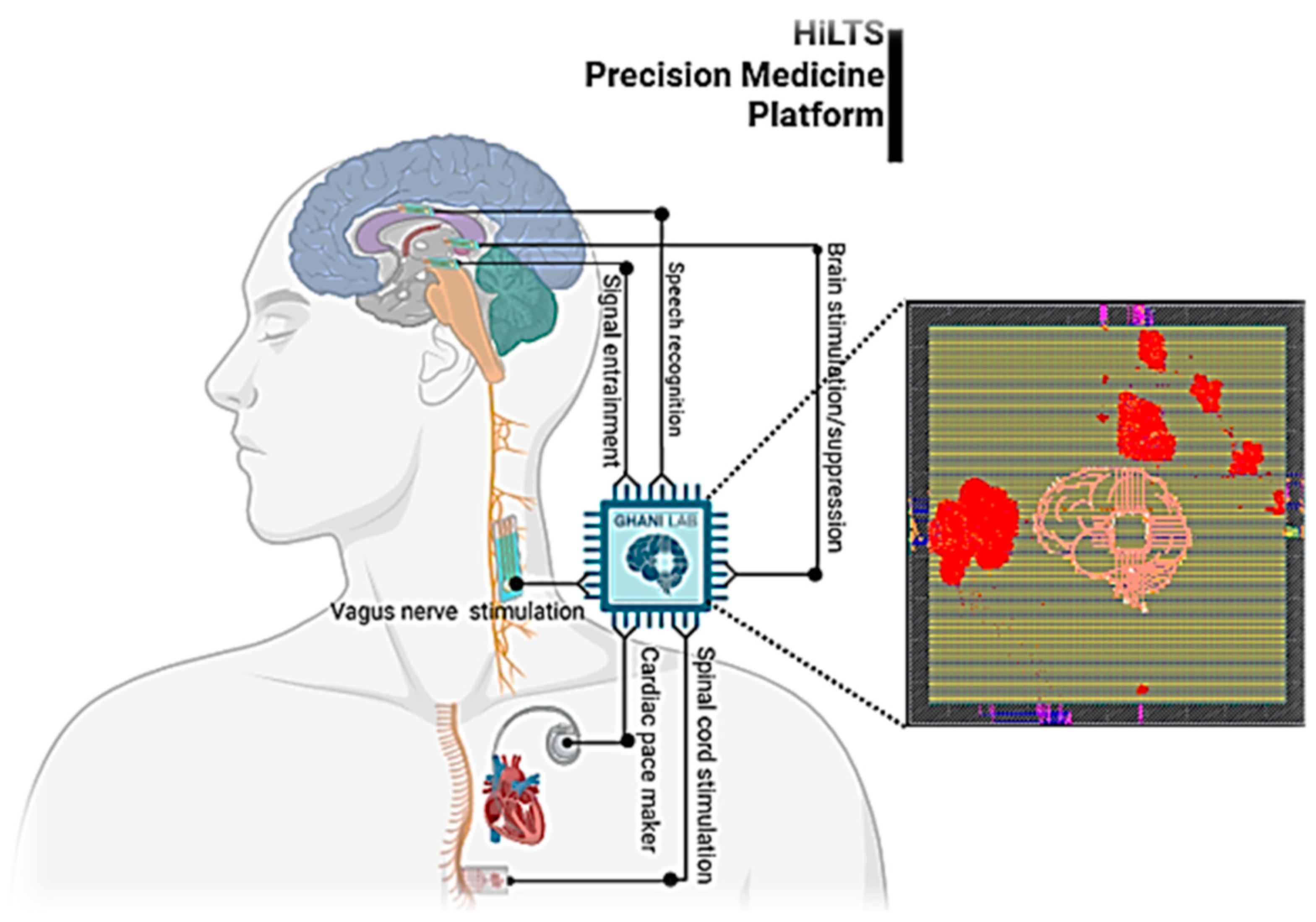
These trends underscore the importance of developing open, reproducible hardware platforms that lower the barrier to entry for custom chip design while enabling domain-specific experimentation. In this context, our laboratory has taped out multiple custom microchips using open-source toolchains, culminating in the development of the novel HiLTS© (Human-in-the-Loop Therapeutic System) platform. HiLTS© is conceived as a modular system-on-chip research testbed that integrates several healthcare-oriented digital hardware blocks, including nerve stimulation controllers, signal processing cores, and embedded control logic. While the full platform incorporates multiple functional modules, this paper focuses exclusively on the seizure detection and rhythmic signal generation core, which is used to investigate digital rhythm generation and entrainment in the context of abnormal neural signals. An overview of the HiLTS© platform architecture is shown in Figure 1, where the layout of individual signal controllers is shown on the right-hand side of the figure, corresponding to health conditions shown on the left-hand side of the figure.
Rhythm and oscillation are fundamental features of many physical, environmental, and biological systems [6]. In the human nervous system, neural activity is organized into oscillatory patterns spanning multiple frequency bands, and the brain exhibits a well-documented tendency to align with external rhythmic stimuli. This phenomenon, commonly referred to as neural entrainment, has been observed in response to sensory, electrical, and cognitive inputs and reflects the capacity of neural populations to phase-align with periodic external drives [7,8,9,10,11]. From an engineering perspective, neural entrainment provides a compelling framework for exploring how externally generated rhythms can influence, reshape, and stabilize irregular biological signals.
Epileptic seizures represent a particularly relevant case of abnormal neural dynamics, as they are commonly associated with excessive or pathological synchronization across neuronal populations. Epilepsy remains one of the most prevalent chronic neurological disorders worldwide, affecting approximately 50 million people, and continues to pose significant challenges in monitoring and management [12,13]. Large-scale epidemiological studies highlight the substantial global and regional burden of epilepsy, including in the Middle East, where prevalence rates are comparable to those reported internationally [14]. A key challenge in epilepsy management is the unpredictability of seizure onset and the need for timely detection and intervention, motivating ongoing research into alternative technological approaches for monitoring and response.
In recent years, rhythmic stimulation and brainwave entrainment have been explored as mechanisms for interacting with neural oscillations. Rather than suppressing activity, entrainment-based approaches aim to apply structured, periodic signals that can influence the temporal organization of neural activity [15,16]. From a signal-processing standpoint, seizures often exhibit broadband spectral content and irregular temporal structure, whereas externally generated oscillators can provide narrowband, phase-stable reference signals. This contrast motivates the investigation of whether a digitally generated rhythm can reshape or dominate the spectral characteristics of a dysregulated signal when coupled through an entrainment mechanism.
In this work, we present an open-source, digitally implemented ASIC platform designed to investigate rhythmic signal generation and entrainment using seizure EEG data as an application-driven test case. Publicly available EEG recordings are used to extract representative seizure waveforms, which are then digitized and interfaced with a custom-designed digital chip fabricated in a SkyWater 130 nm process. The chip generates a stable narrowband oscillation at 6 Hz, selected as a representative low-frequency rhythm for demonstrating digital entrainment behavior rather than as a universal or inherently ‘healthy’ brain rhythm. Hardware-generated pulse trains are captured using a logic analyzer and reconstructed into analog waveforms for direct comparison with the original EEG signals in both time and frequency domains.
The primary contribution of this paper is an engineering proof-of-concept demonstrating that a minimal, low-power digital ASIC can generate stable rhythmic signals and impose a dominant spectral component on a broadband, seizure-like input signal. The work does not claim biological efficacy or clinical intervention; instead, it establishes a reproducible hardware-software co-design for studying digital rhythm generation, signal reshaping, and entrainment using real EEG data. By combining open-source design tools, ASIC fabrication, hardware validation, and IoT-based control, the HiLTS© platform provides a foundation for future research into closed-loop neuromodulation systems that integrate real-time sensing, adaptive frequency selection, and mixed-signal interfaces.
The specific contributions of this paper are as follows:
  • An open-source, digitally implemented neuromodulation testbed for investigating and modulating epileptic seizures through rhythmic signal entrainment.
  • A custom-designed SkyWater 130 nm fabricated chip prototype capable of generating a reference 6 Hz oscillation for seizure entrainment.
  • A complete hardware signal analysis workflow, enabling direct comparison between extracted seizure signals, their digitized representations, and the chip-generated entrained outputs.
  • A system-level framework that lays the foundation for future closed-loop neuromodulation, including real-time EEG acquisition, automated seizure detection, and multi-frequency entrainment.
  • Wireless IoT-based control using a mobile application, demonstrating the feasibility of portable and remotely managed neuromodulation
This paper is organized as follows:
Section 2 presents the software implementation and mathematical framework, followed by dataset preprocessing and the hardware simulation, implementation, and characterization. Section 3 briefly elaborates on the mobile application integration. Section 4 provides a detailed discussion, including limitations and future directions, and Section 5 concludes the paper with a summary.

2. Materials and Methods

2.1. Software Design and Implementation

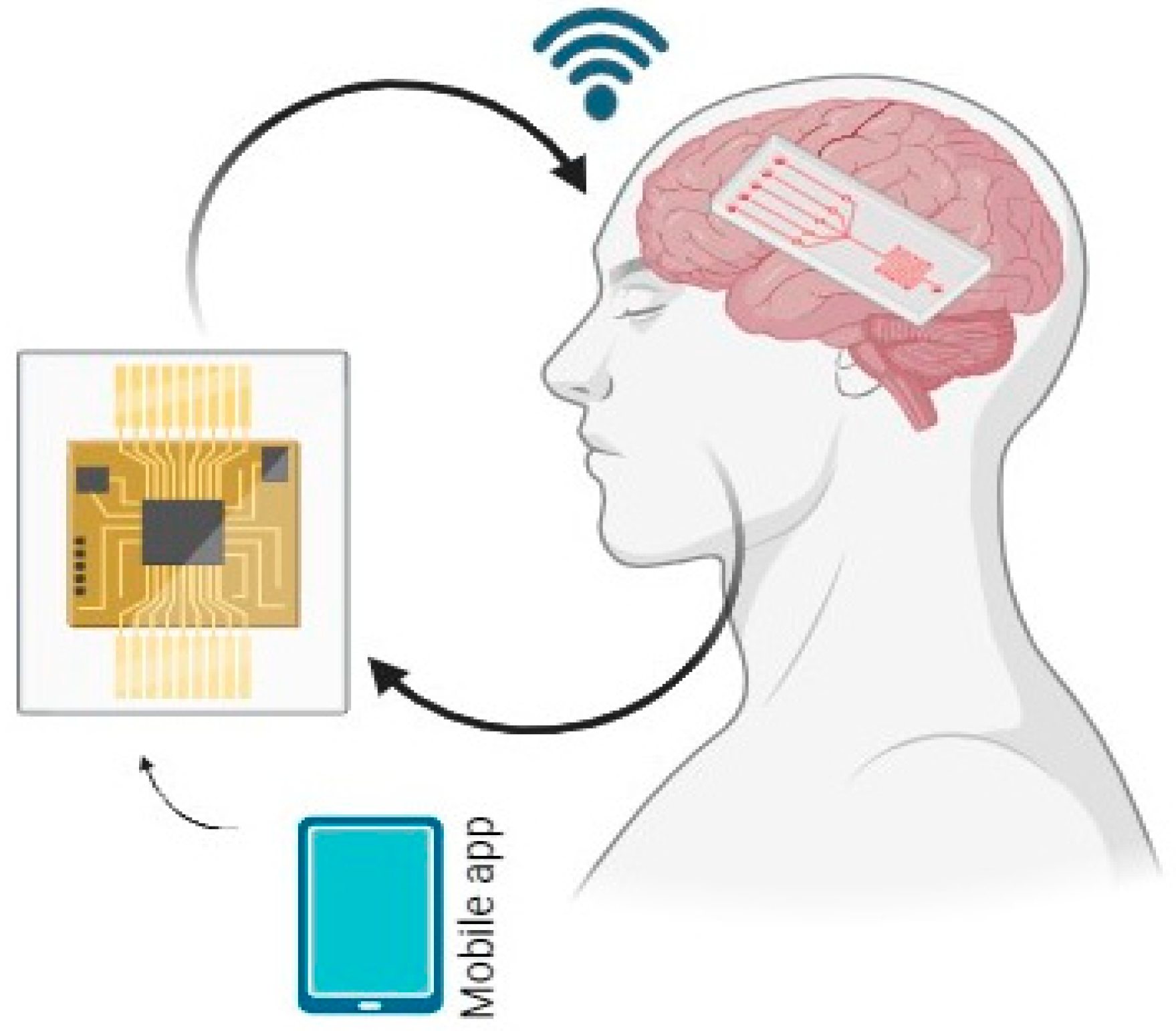
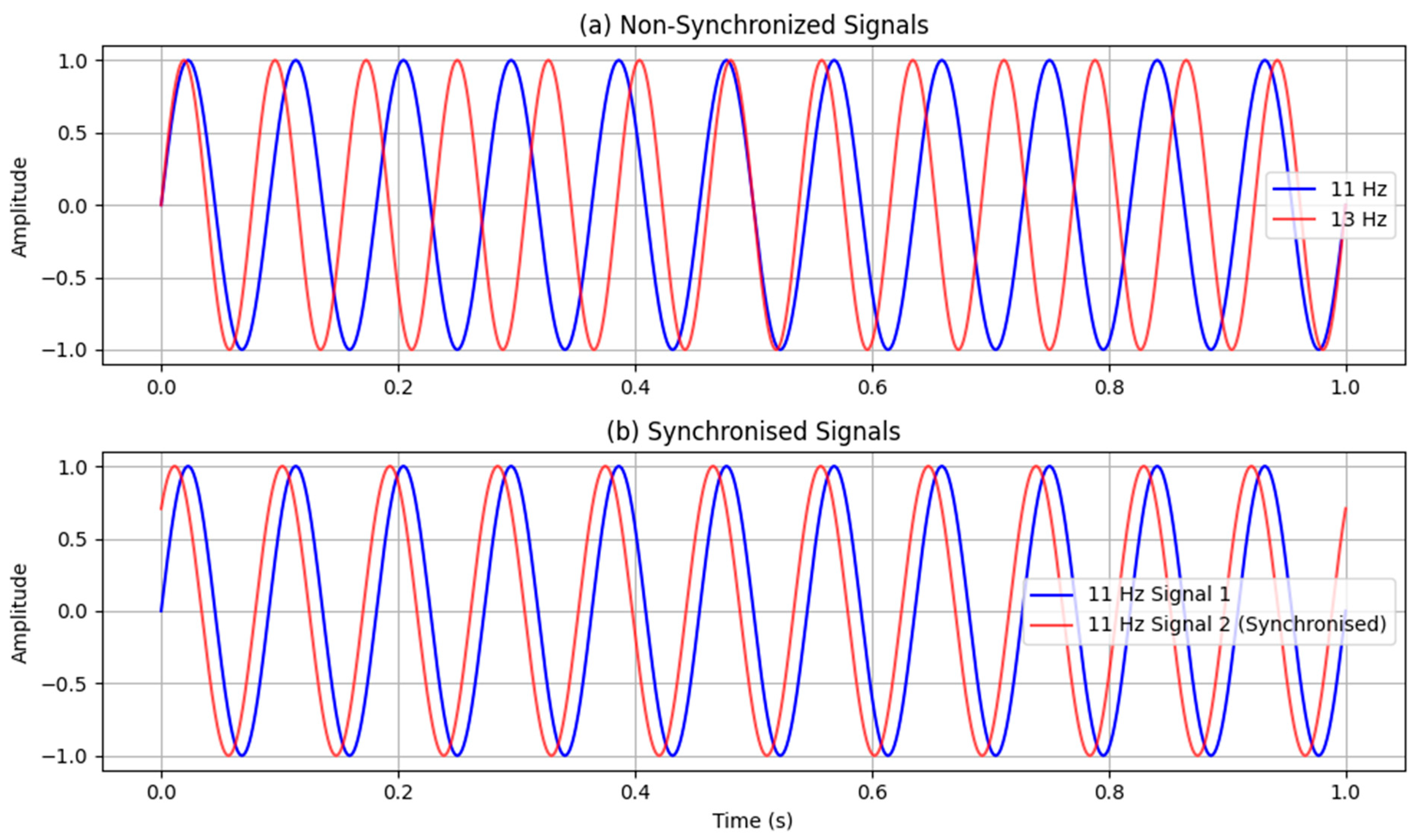
Neural entrainment plays a critical role in coordinating oscillatory activity across brain regions. In epileptic seizures, abnormal neural synchronization often manifests as excessive, uncontrolled oscillatory coupling. By introducing controlled rhythmic stimulation, digitally generated precise frequencies, it may be possible to guide pathological brain rhythms back into stable, physiologically coherent states [17,18,19]. In this framework, a digital frequency-generation chip developed with open-source tools can deliver phase-controlled signals that interact with cortical oscillations, promoting adaptive entrainment rather than pathological suppression or synchronization. Such interventions could restore balance within neural networks, mitigating seizure onset and propagation through frequency-aligned entrainment of cortical rhythms [20]. To illustrate the principle, Figure 2 shows the high-level description of neural signal entrainment using digitally generated oscillatory waveforms through custom designed chip. The concept models how an external periodic signal, produced by a custom-designed frequency-generation chip, can influence and synchronize dysregulated brain activity. To illustrate this principle, the top plot in Figure 3 shows two independent oscillatory signals at 11 Hz (blue) and 13 Hz (red), representing neural populations operating at different intrinsic frequencies. These unsynchronized rhythms where oscillatory pools are not phase or frequency-aligned and therefore exhibit low coherence. In such a state, the peaks and troughs of the signals appear at different times, reflecting the chaotic nature of uncoordinated neural activity often observed in pathological conditions such as epilepsy [21,22,23,24]. Meanwhile, the bottom plot shows two oscillatory signals with the same frequency (11 Hz) but a constant phase offset. This represents a phase-locked, entrained state in which the formerly independent oscillations have aligned under the influence of an external rhythmic drive. The constant phase difference indicates that the two signals are now coherently coupled, oscillating in a stable, synchronized relationship. In the neural context, this state models the successful entrainment of chaotic brain rhythms to an externally applied digital signal, restoring a balanced and regulated oscillatory pattern.
Similar to the brain’s electrical rhythms, signal entrainment involves the synchronization of an oscillatory system to an external periodic signal. In the context of brain waves, entrainment describes how an external rhythm generated by an external device could influence and synchronize with the brain’s native rhythms, potentially bringing the brain wave activity closer to a desired frequency. In the context of this research paper, the brain’s chaotic signal is not in sync with its expected reference rhythm and is hence classified as neural dysregulation. When a frequency with a specific rhythm generated by a custom-designed chip is introduced after the chaotic activity is detected, it works to entrain the chaotic signal by forcing it to align with the chip’s generated frequency, thus bringing the brain signal back to a more regulated rhythm. The entrainment process can be modeled mathematically as a forced oscillator system [25]. The dysregulated signal, before the entrainment, is analogous to a free oscillator. Upon application of the pre-defined chip signal, the system is forced to adjust its phase and frequency to synchronize with the external stimulus. The chaotic signal can be modeled as random fluctuations with no inherent periodicity, and its frequency spectrum is spread across a wide range of values. The dysregulated signal could be represented by Equation (1):
x ( t ) = η ( t ) ,
where η ( t ) represents a random process. This signal fluctuates between positive and negative values without a defined frequency, making it irregular and unpredictable. Once the chaotic signal is detected, a trigger pulse is generated, and the external chip introduces a periodic forcing signal at a specific frequency, which could be modeled as Equation (2):
F ( t ) = A . p u l s e ( t , f c h i p ) .
As shown in Equation (2), the pulse function represents a digital periodic pulse with frequency, fchip, and A as an amplitude, between 0 and 1, and t is the time.
The entrainment of the dysregulated signal with the chip signal can be modeled using a coupled system of equations. As the neural chaotic signal is being forced by the periodic chip signal, a general form for the entrainment equation is given by Equation (3), and by substituting Equation (2), the final expression is shown in Equation (4):
d 2 θ d t 2 + 2 ζ ω 0 d θ d t + ω 0 2 θ = F ( t ) ,
d 2 θ d t 2 + 2 ζ ω 0 d θ d t + ω 0 2 θ = A . p u l s e ( t , f c h i p ) .
As shown in Equation (3), θ(t) is the phase of the signal, ω0 is the natural frequency of the brain signal prior to entrainment, ζ is the damping coefficient described as the internal resistance to entrainment, F(t) is the external forcing term, the chip signal, where ω0 and ζ are chosen based on the system’s natural properties and the chaotic signal’s behaviour. In order to achieve the signal entrainment, the phase synchronization and locking happen when the phase θ(t) of the chaotic signal locks onto the phase of the periodic forcing chip signal, which corresponds to the system’s response reaching a steady state, where the chaotic signal oscillates with the same frequency as the external signal. This phenomenon can be quantified by measuring the phase difference between the chaotic signal and the external signal. As the system entrains, the phase difference decreases, and both signals oscillate together with the same period.

2.2. Dataset Pre-Processing and Analysis

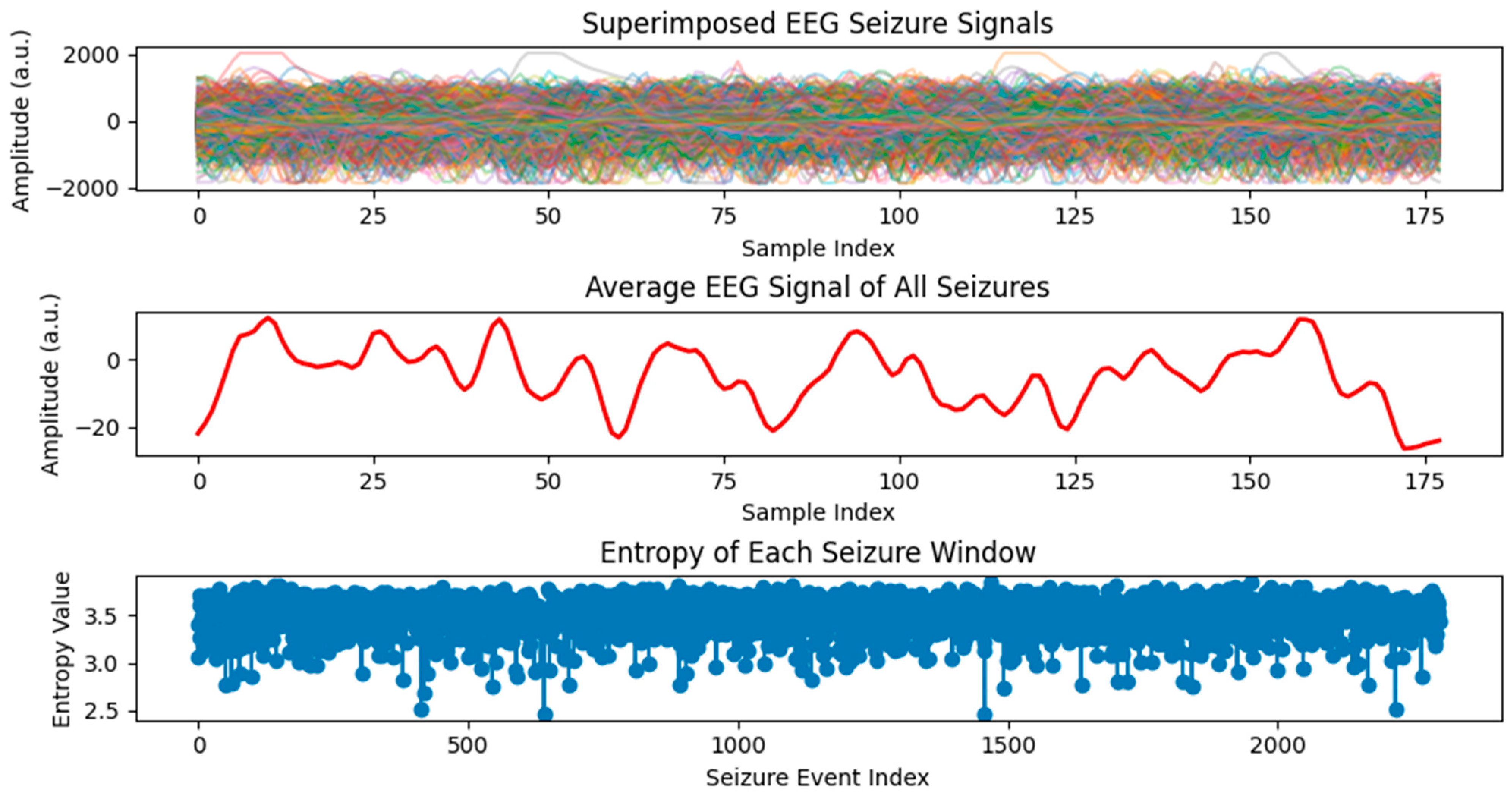
The dataset used in this study consists of EEG recordings from 500 individual subjects, organized into five groups, each corresponding to a different EEG recording condition [26]. Each subject’s EEG data spans 23.6 s and is sampled at a rate of 173.3 Hz, resulting in 4097 data points per subject. These signals are divided into 23 chunks, each representing 1 s of data containing 178 data points. The EEG signals are stored in columns labelled X1 to X178, and the associated response variable, y, is represented in column 179. The y variable indicates the condition under which the EEG was recorded, with five labels ranging from 1 to 5. Label 1 corresponds to seizure activity, label 2 to the tumour region of the brain, label 3 to a healthy brain region, label 4 to eyes closed, and label 5 to eyes open. The goal of this dataset was to investigate and analyze the differences in EEG signals across these conditions, particularly the distinction between seizure and non-seizure activities. In the pre-processing step, the data is extracted from rows where the label ‘1’ indicates seizure events. The dataset can be represented as a matrix X of size M × N, where M is the number of seizure events, and N is the number of time points. After extracting the dataset for seizure events, the plot for both superimposed and average signals is shown in Figure 4, where Xi(t) could be represented as the EEG signal at time t for the ith seizure, and I = 1, 2, …, M represents each seizure event, and t = 1,2,…, N represents the time points. In order to compute the average EEG signal across all seizure events, the mean of the signals was taken from all seizures at each time point. Mathematically, the average EEG signal Savg (t) at time t is given by Equation (5):
S a v g ( t ) = 1 M i = 1 M X i ( t ) .
In Equation (5), M is the total number of seizure events, and Xi(t) is the EEG signal at time t for the ith seizure. The averaging process smooths out individual fluctuations and reveals the general trend of brain activity during a seizure, highlighting common features across different seizure events. It is particularly useful in identifying consistent patterns in the brain’s electrical activity during seizures.
To analyze seizure signals, all the EEG segments that were labelled as seizure activity were extracted from the dataset. Each segment contains 178 samples of the EEG activity, as shown in Figure 4. For the purposes of assessing the variability across seizure events and to determine any shared structural features, all waveforms for the seizure were plotted on the same axes, yielding a superimposition of the signals. This graphical representation highlights the diversity of seizure morphologies, reflected in differences in amplitude, shape, and timing, as well as recurring patterns that appear as darker regions where many signals overlap. In the middle plot, an average seizure waveform was computed by taking the mean across all seizure segments at each sample point. This yields a smooth, representative waveform that captures the dominant temporal structure commonly exhibited during seizure activity in this dataset.
To complement these qualitative observations, Shannon entropy was calculated for each seizure segment as a numerical measure of signal irregularity and complexity. Entropy was chosen because seizure EEG can vary widely in structure: some events exhibit highly rhythmic spikewave discharges, while others are more chaotic or irregular. Entropy, therefore, provides an objective way to quantify this variability. The amplitude values were first normalized into a probability distribution for each seizure segment using a normalized histogram. Then, the Shannon entropy of this distribution was calculated using Equation (6):
H = i = 1 n p i l o g ( p i ) ,
where pi represents the probability associated with the ith amplitude bin. Segments with high entropy correspond to more irregular and less predictable seizure waveforms, whereas low entropy values indicate more structured, stereotyped activity. Plotting entropy across all seizure events reveals how the complexity of seizure dynamics varies from one event to another and provides a quantitative interpretation of the variability observed in the superimposed waveforms.
Taken together, the superimposed seizure plots, the average waveform, and the entropy distribution offer a comprehensive view of both the common underlying structure of seizure EEG activity and the substantial intrinsic variability that exists across individual seizure occurrences.
As EEG signals include noise hence to isolate the relevant brainwave frequencies, a bandpass filter was applied. The filter selectively allowed signals within a specific frequency range to pass while attenuating signals outside this range. For this study, the frequency range from 0.5 Hz to 40.0 Hz was selected, corresponding to the typical physiological brain rhythms delta, theta, alpha, beta and gamma. A Butterworth filter was used to select the desired frequency components, maximizing its flat frequency response in the passband, while minimizing distortion in the filtered signal.
The mathematical representation of a Butterworth filter can be represented by Equation (7):
H ( f ) = 1 1 + ( f / f c ) 2 n .
As shown in Equation (7), H(f) is the frequency response, f is the frequency, fc is the cutoff frequency, and n is the order of the filter. The filter’s transfer function allows frequencies between the lower and upper cutoff frequencies to pass through while attenuating others. After filtering the EEG signals, the power was analyzed in specific frequency bands. The FFT was applied to convert the signal from the time domain to the frequency domain, as shown in expression 8, where the FFT of a signal x(t) is defined as follows:
X ( f ) = x ( t ) e j 2 π f t d t ,
where X(f) is the frequency-domain representation of the signal x(t). The squared magnitude of the FFT gives the power spectrum of the signal, as shown in Equation (9):
P o w e r   ( f ) = | X ( f ) 2 | .
To calculate the band power by summing the squared magnitudes of the FFT coefficients within each frequency band of interest. The power within a specific frequency band is computed as Equation (10), where Pband is the band power for the frequency range:
P b a n d = f l o w f f h i g h P o w e r ( f ) .
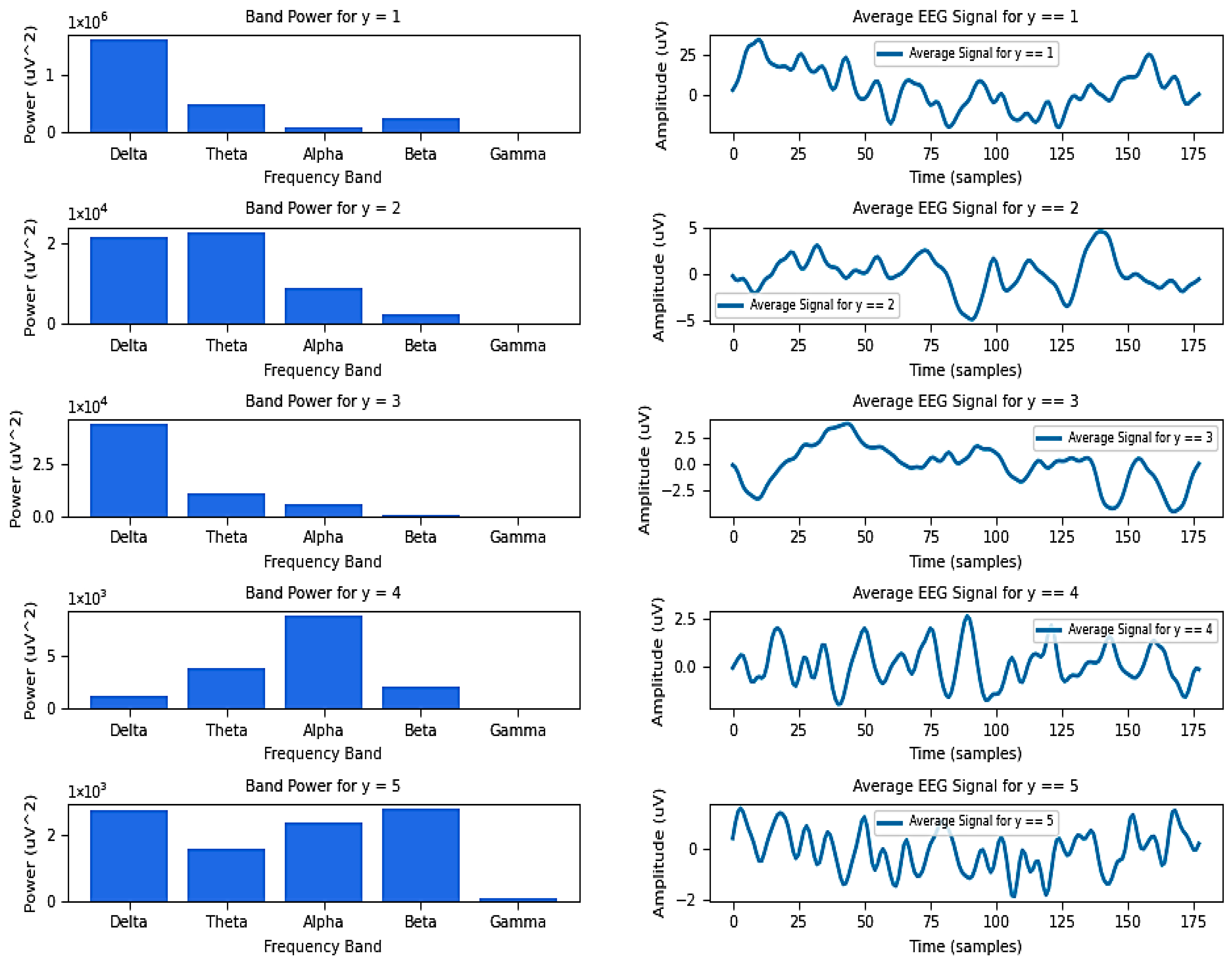
The visualization of the EEG signals and band power is shown in Figure 5.
As shown in Figure 5, the bar plots present the power in the different frequency bands for each class (y = 1 to 5). The x-axis represents the frequency bands, and the y-axis represents the power in microvolts squared (µV2), which is the typical unit for EEG power. The right-hand side plot shows the average EEG signal for each class.
EEG signals were filtered using a zero-phase 4th-order Butterworth bandpass filter with a lower cutoff frequency of 0.5 Hz and an upper cutoff frequency of 40 Hz, selected to isolate physiologically relevant EEG rhythms while attenuating slow baseline drift and high-frequency noise. Filtering was implemented using a forward-backward filtering approach to eliminate phase distortion.
Frequency-domain analysis was performed using the discrete Fourier transform. For each EEG segment, the FFT was computed using 178 samples. The power spectrum was defined as the squared magnitude of the FFT coefficients, and band-specific power was calculated by summing spectral power within standard EEG frequency bands: delta (0.5–4 Hz), theta (4–8 Hz), alpha (8–13 Hz), beta (13–30 Hz), and low gamma (30–40 Hz). For seizure events, Shannon entropy was computed to quantify signal complexity. Entropy was calculated from normalized amplitude histograms with 50 bins for each EEG segment using the standard Shannon entropy formulation.
The analysis performed on the EEG dataset provides important insights into the characteristics of the signals across the five clinical conditions represented by the labels y = 1 to y = 5. Separating the data according to class and then filtering it with a physiologically meaningful bandpass filter, 0.5–40 Hz, isolates the dominant brain rhythms, delta, theta, alpha, beta, and low gamma, removing high-frequency noise and slow drift often seen in raw EEG recordings. Computing the average waveform for each class provides a visual representation of the typical shape of the signals in time and reduces subject-specific variability, emphasizing characteristic signatures of seizure versus non-seizure activity. Running in parallel, the spectral analysis performed through the FFT and band-power computation quantifies the distribution of energy across the major EEG frequency bands.
Seizure activity is not defined by high-frequency content alone but rather by abnormal synchronization, amplitude changes, and shifts in spectral energy. These distinctions are evident in the band-power bar plots: class 1 (seizure) signals show elevated power in the delta–theta range and broader spectral spread, consistent with paroxysmal discharges and hypersynchrony commonly seen during pre- and post-ictal events. In contrast, the non-seizure classes display more stable and band-specific power distributions. Hence, this combination of temporal averaging and frequency-domain analysis establishes that this dataset captures meaningful physiological differences between classes and further confirms that the extracted class-1 signals reflect seizure patterns even when the dominant frequency falls within a traditionally ‘normal’ frequency band. This establishes a reliable baseline against which the biological seizure dynamics will be compared to the behaviour of the hardware rhythm-generation chip used later for signal entrainment.
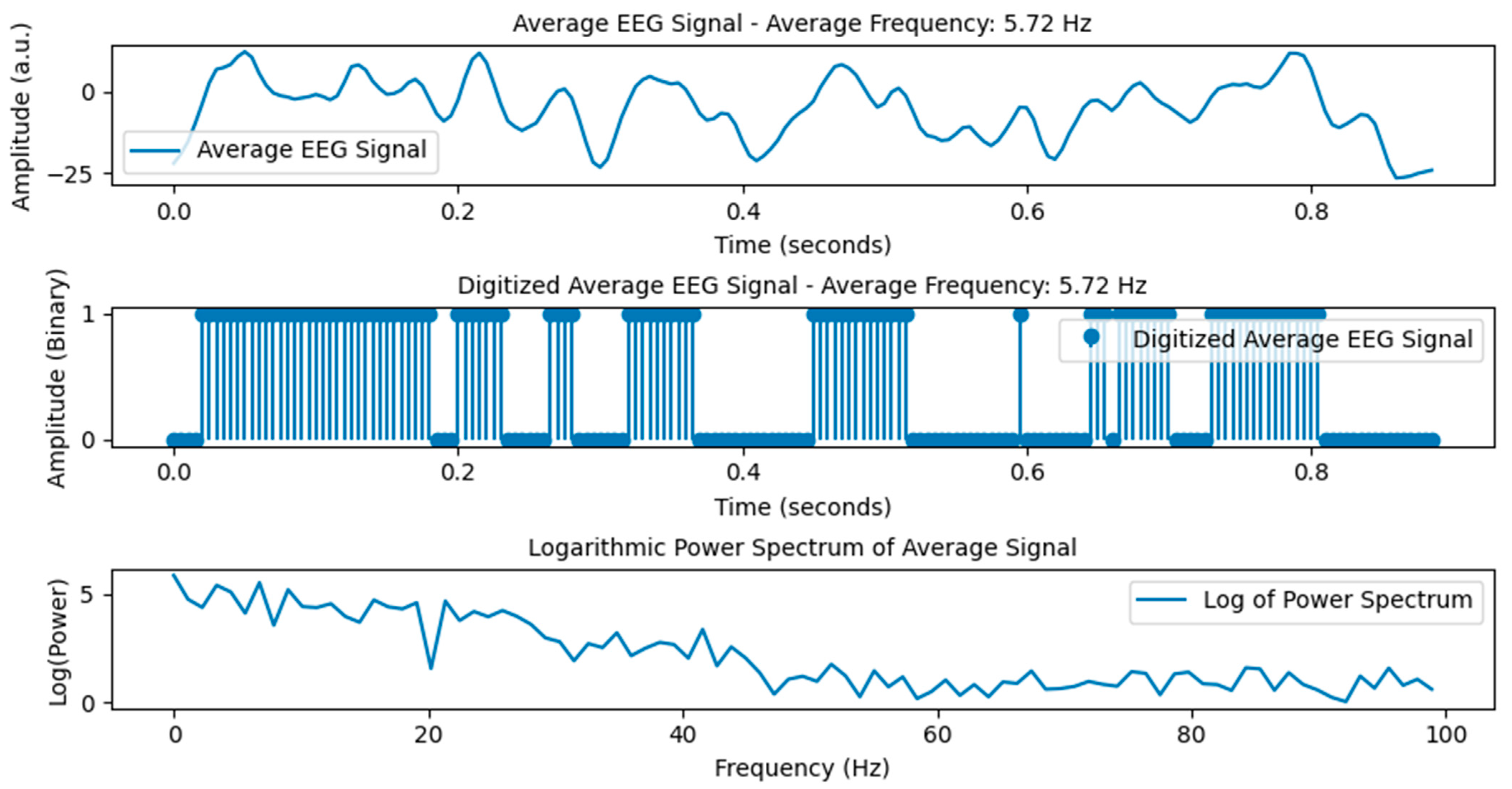
Before evaluating the hardware-level entrainment behaviour of the proposed custom-designed chip, it was necessary to construct a benchmark signal that correctly represents the characteristic dynamics of seizure activity. Each raw EEG trace contains 4097 samples over a duration of 23.6 s, yielding an effective sampling frequency of approximately 173.3 Hz. Three transformations of this benchmark signal were then generated as shown in Figure 6. The top plot shows the analog seizure waveform derived from the dataset. The middle plot presents a digitized version of this signal, produced by applying a mean-based threshold which mimics the comparator circuits used within digital custom-designed hardware, as shown below. The bottom subplot presents the logarithmic power spectrum of the averaged EEG signal, computed using a Fast Fourier Transform (FFT):
D ( n ) = { 1 i f   x ( n ) > μ 0 o t h e r w i s e .
The ‘Average Frequency’ reported in Figure 6 was calculated from the digitized average EEG waveform shown in the top subplot. First, all seizure segments were aligned and averaged sample by sample to produce a representative time-domain waveform. The FFT was then applied to this averaged waveform to compute the power spectrum, shown in the bottom subplot. The average frequency was determined as the power-weighted mean across all frequency components in this spectrum, providing a single value that summarizes the dominant oscillatory activity in the signal.
In this study, digitization was simplified to reflect the design constraints of ultra-low-power digital neuromodulation hardware. The EEG signals were sampled at the dataset’s native sampling frequency of 173.3 Hz, which exceeds the Nyquist requirement for the targeted physiological frequency range (0.5–40 Hz). A binary thresholding operation was used to emulate a comparator-based front-end, a common design choice in event-driven neuromorphic systems. Although the hardware operates internally using 8-bit digital registers for control and timing, the comparator stage reduces the analog input to a 1-bit event stream. This abstraction prioritizes frequency-domain behavior over amplitude fidelity, consistent with demonstrating digital rhythm entrainment rather than high-resolution signal reconstruction.
This illustrates how the biological signal would appear once converted into the binary event domain used by the chip. The third plot shows the logarithmic power spectrum of the seizure waveform, demonstrating its dominant energy distribution across low-frequency bands (4–8 Hz), consistent with rhythmic seizure discharges reported in clinical EEG literature. This frequency-domain characterization is essential because signal entrainment in the hardware is fundamentally a frequency-selection and frequency-stabilization problem.
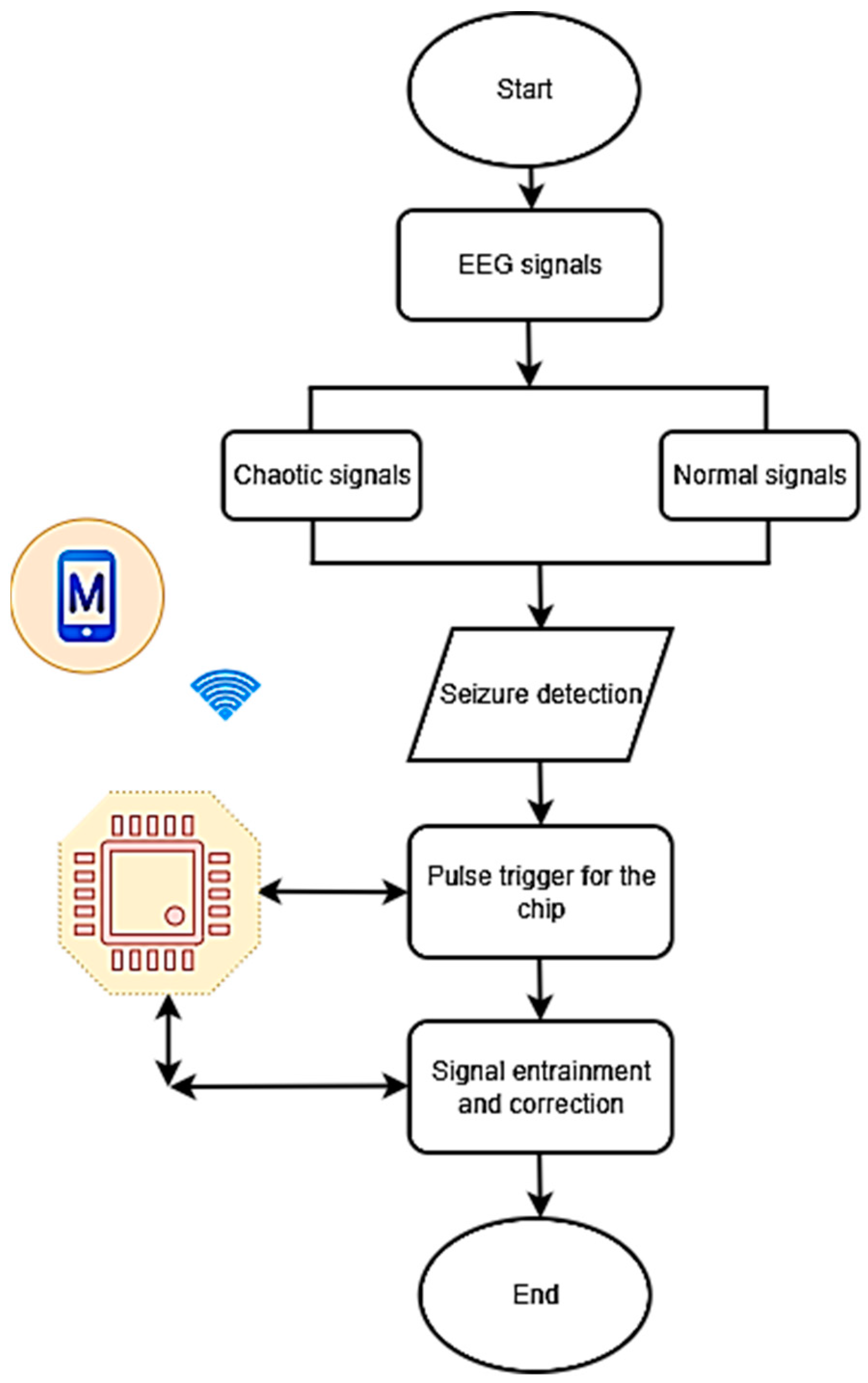
These three representations, analog, binary, and spectral, form the software benchmark against which the behaviour of the neural chip is evaluated. The subsequent simulations in the hardware section of the paper demonstrate how a chaotic seizure signal can be stabilized through an externally generated trigger pulse, after which the system entrains to a target reference rhythm. Together, this validates the system-level concept: seizure activity can be digitally suppressed and replaced with a stable, reference oscillatory pattern through hardware-based frequency entrainment. A flowchart of the system-level implementation is shown in Figure 7.

2.3. Hardware Design and Implementation

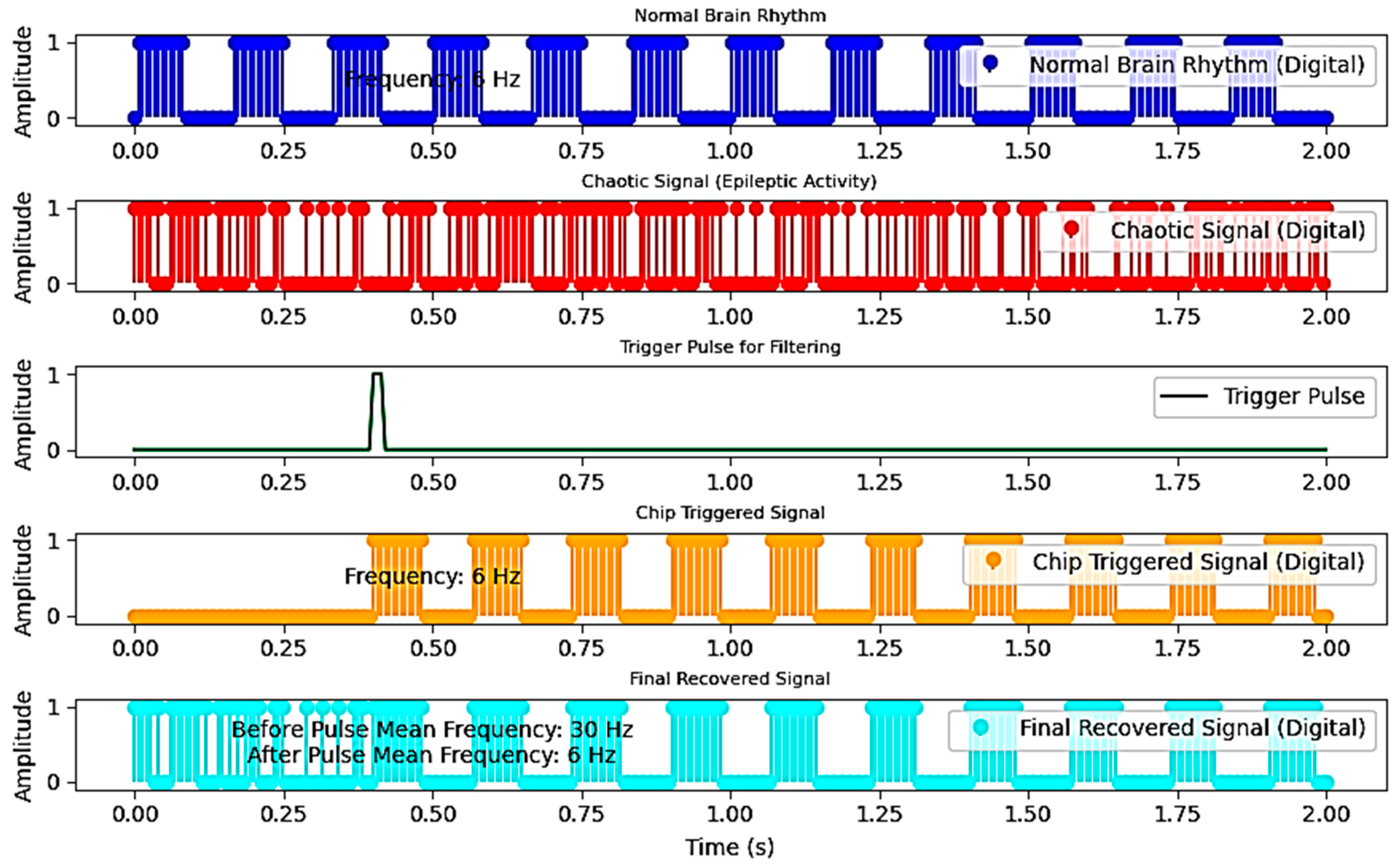
To illustrate the principle of signal entrainment, a pseudo-chaotic signal scenario has been created for hardware emulation, as depicted in Figure 8. The top subplot illustrates the reference brain rhythm at 6 Hz, digitized into a binary pulse. The 6 Hz oscillation was selected as a representative low-frequency rhythm for validating the entrainment mechanism and hence does not imply clinical optimality for all seizure phenotypes. The chaotic second subplot is created from high-frequency random noise to emulate the irregular and unpredictable activity found during epileptic seizures. The third subplot presents the trigger pulse, indicative of the detection of abnormal activity by the seizure detection device, which initiates the entrainment process.
After the trigger pulse, the digital chip generates a controlled 6 Hz rhythm. The recovered signal post-entrainment, shown in the bottom subplot, transitions smoothly from pseudo-chaotic activity to the stable rhythm. The proposed paradigm validates the signal detection and processing logic but also strengthens the scientific principle of chaotic-to-ordered neural entrainment. By emulating both irregular seizure-like activity and controlled rhythmic stimulation, the system shows how focused intervention can be used to reinstate stable brain oscillations principle underpinning the subsequent hardware implementation by means of open-source synthesis tools. The digital representation of pulses allows for the use of digital logic to create a real-world, real-time neurostimulation experiment.
The simulation outlined here serves a critical role in the design and validation of an open-source hardware platform that processes real-time signals, especially in contexts of neurotechnology. In a real-world scenario, a device would be monitoring brain activity continuously. When the system detects seizure activity, it activates the trigger signal, causing the seizure detection paradigm to process the incoming signals. An open-source hardware synthesis tool, Yosys, was used to implement the design in hardware [27]. It serves as the foundation for synthesizing the design into a physical hardware implementation. Yosys is an open-source synthesis tool that takes high-level Verilog designs and translates them into a gate-level netlist that can be used to generate a hardware circuit. By providing this Verilog code in the Yosys format, the system could be implemented on hardware platforms where the chaotic signal detection and synchronization could be applied in real-time. Therefore, the Yosys code is critical for bridging the gap between simulation and physical implementation, ensuring that the design can be validated in both a simulated environment and on actual hardware.
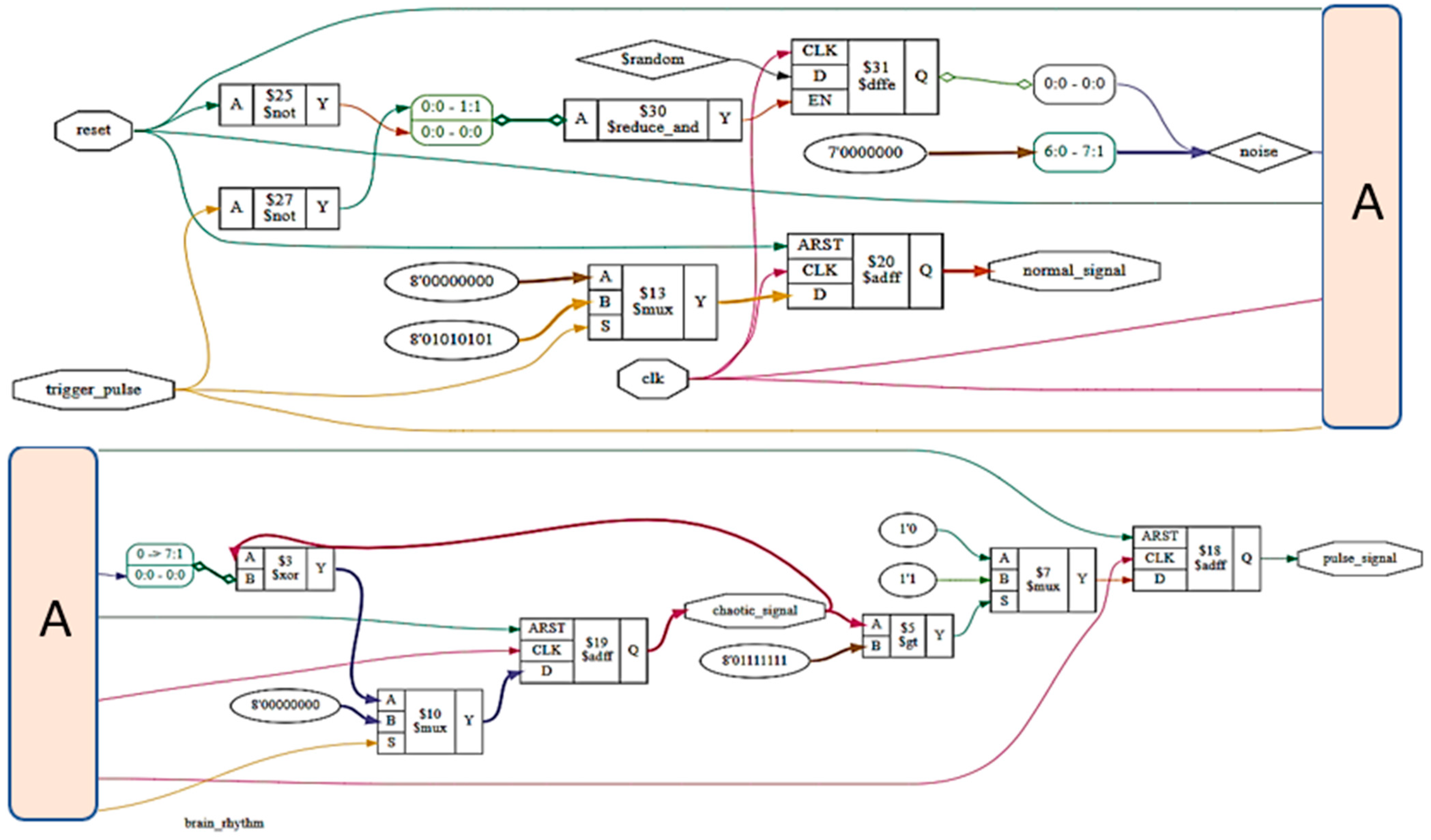
The hardware design synthesis activity diagram is shown in Figure 9, where the trigger pulse is controlled externally through the trigger_pulse input, and when this signal is asserted, the system switches from chaotic to a stable periodic signal that approximates a reference brain rhythm. The chaotic signal is continuously updated based on random noise. When the signal exceeds a certain threshold, which is set to 8′b01111111 in the simulations, the system outputs a pulse, signalling that the chaotic activity has reached a level where intervention is needed. This pulse, once detected, sets the reference signal, called normal_signal in the simulations, to a predefined value that represents the normal brain activity, and the chaotic signal is cleared. The testbench created provides a stimulus to the design by generating a clock signal and controlling the reset and trigger pulse inputs. The testbench simulates the behaviour of the system, applying a reset at the beginning and then allowing the chaotic signal to evolve. After a short period, the trigger pulse is asserted, causing the system to transition to the normal brain rhythm. The detailed output waveform activity is shown in Figure 9.
For this open-source emulation platform, the activity diagram demonstrates how a system can detect chaotic signals and synchronize to a desired known rhythm. The chaotic signal represents an epileptic or irregular brain state, and the normal rhythm represents the target brain activity. The triggering mechanism simulates a medical intervention, such as a neural implant or brain stimulation device, that can restore the brain’s activity to a stable, predictable state, analogous to a known reference 6 Hz rhythm. To further validate the paradigm, utilizing an open-source simulation environment such as Icarus Verilog, we can prototype and test signal correction mechanisms that could be deployed in embedded devices for brainwave monitoring, seizure detection, and entrainment. The open-source nature of the tool allows for flexibility in experimentation and optimization, making it an ideal choice for prototyping before moving to more complex hardware implementations. The goal is to develop a custom-designed embedded platform that can detect irregular brain activity and correct it in real time, helping to manage neurological disorders. The RTL synthesis output waveform is shown in Figure 10.
The main output from Yosys is the synthesized netlist, which details how the different components of the design are interconnected. This netlist contains information about the logic gates and their connections, showing how the chaotic signal generation, pulse detection, and filtering mechanisms work together. The netlist allows designers to verify that the intended logic and functionality have been preserved through the synthesis process. In the context of the brain rhythm generator, the symbols in the Yosys output can be directly related to the various components defined in the design. The rectangles in the output represent the combinational logic used to generate the chaotic signal. Each rectangle corresponds to a specific logical operation defined in the code, helping to visualize how these operations combine to produce the chaotic behaviour.
The D flip-flops (DFFs) shown in the output represent the storage elements used to hold values at each clock cycle. For instance, the chaotic signal and restored signal are all stored in D flip-flops. These components capture the state of their respective signals on the rising edge of the clock, ensuring that the circuit behaves synchronously. Rhombuses, which signify decision points, relate to the logic that determines when the pulse signal is activated. The pulse signal logic checks if the chaotic signal exceeds a certain threshold. This decision-making process is crucial for detecting chaotic behaviour, and the corresponding rhombus in the Yosys output visually represents this conditional logic. The lines connecting these symbols illustrate the flow of signals, such as from the chaotic signal to the pulse signal logic. These connections are critical for understanding how data flows through the circuit and how the different components interact with each other. Overall, the Yosys outputs facilitate a comprehensive understanding of the design, enabling designers to verify correctness, optimize performance, and prepare the design for further stages such as implementation on an ASIC.
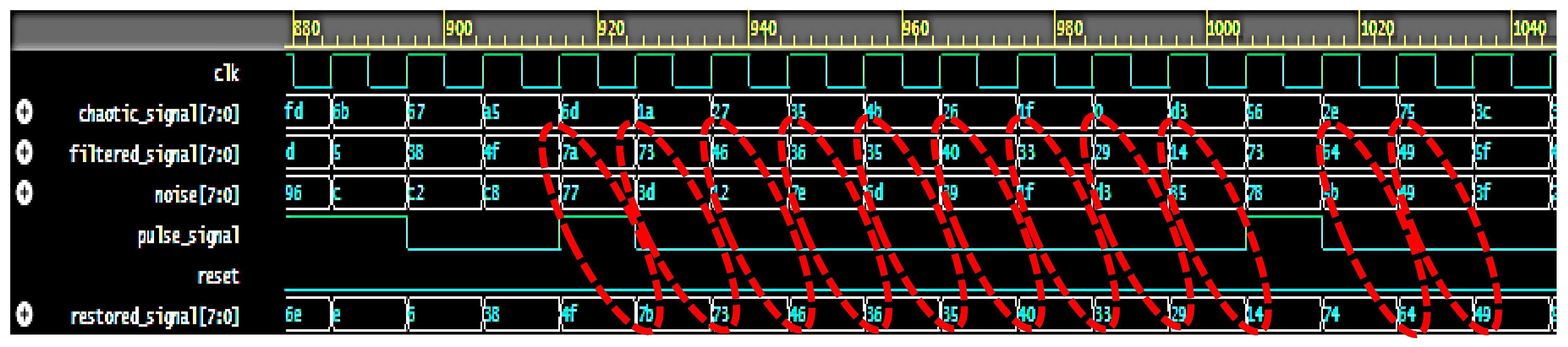
To emulate actual hardware behavior, hardware simulations were performed in System Verilog using a 100 MHz clock, where reset initializes all signals, and the simulation tracks the evolution of chaotic, filtered, and restored signals over time, as shown in Figure 10. This setup shows chaotic_signal fluctuating unpredictably, low_pass_filter smoothing these fluctuations, when the chaotic signal crosses the threshold, and restored_signal aligning with the chip_signal, illustrating how chaotic dynamics can be guided by a regular reference through strong entrainment.
The waveform generated by the simulation in Figure 10 provides a complementary view of the system’s behaviour over time, illustrating how the input signals and output signals evolve during the simulation. The waveform allows for the observation of signal transitions, which is crucial for verifying that the FSM is triggering the expected actions and that the output signals correspond to the correct state at any given moment. The waveform can also provide insights into the timing of various signals, helping to ensure that all transitions occur in the correct sequence and at the right times, which is particularly important in real-time signal processing applications where precise timing can be a matter of critical importance.


2.4. Chip Integration and Verification

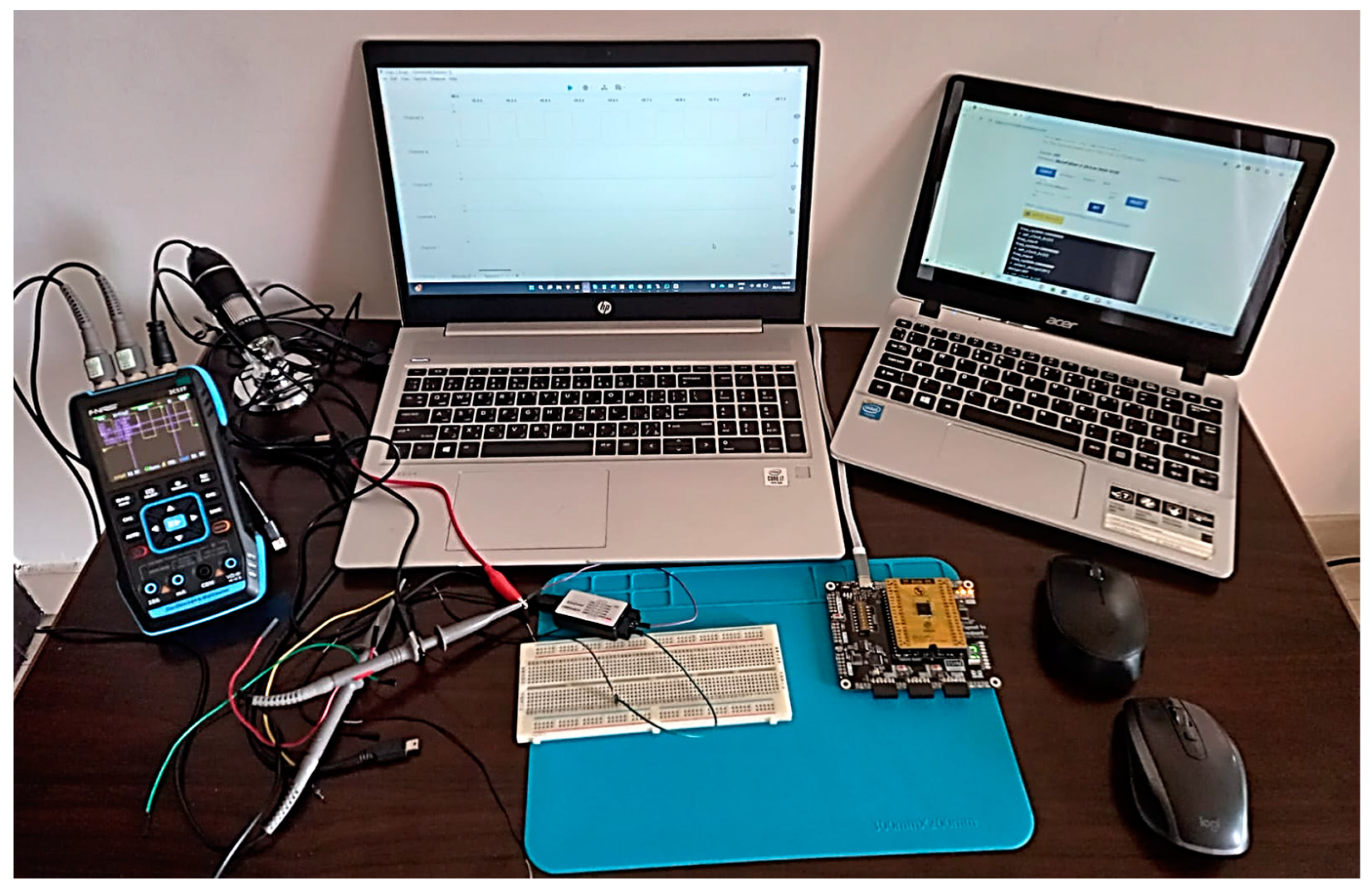
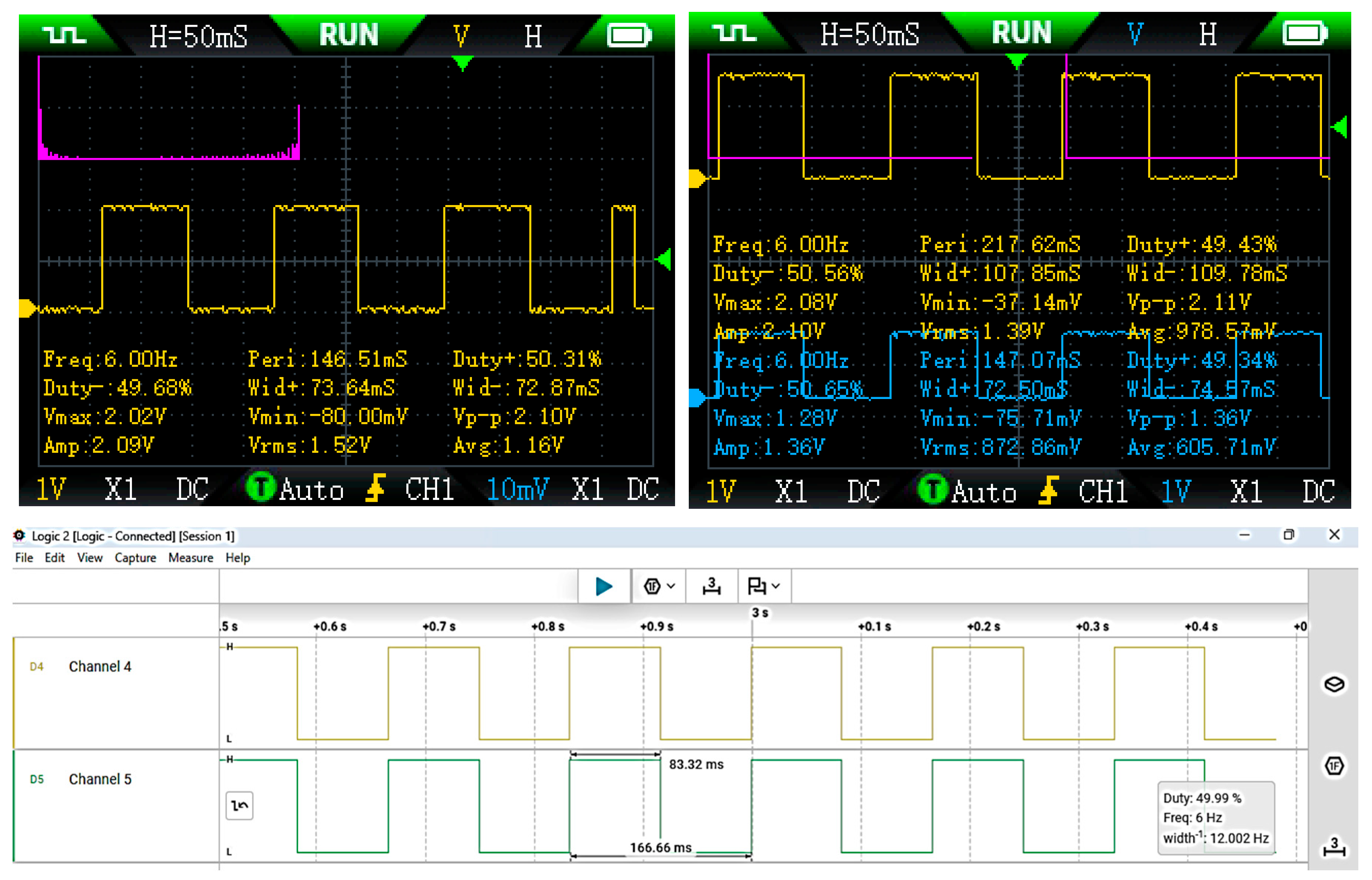
Following the Yosys-based hardware simulations, the custom chip was fabricated through the eFabless platform using the SkyWater 130 nm process, which provides a low-power, cost-effective fabrication flow using open-source PDKs [28]. The fabricated chip implements the chaotic-to-ordered brain rhythm entrainment logic, which was previously validated in software simulations. Verification was performed at multiple levels. Post-fabrication testing involved monitoring the chip output using a Saleae logic analyzer [29] and an oscilloscope to ensure correct frequency generation and trigger pulse timing. Functional verification was carried out by applying digital inputs simulating epileptic seizure events and comparing the chip output to the software simulation benchmarks. The chip successfully produced controlled 6 Hz rhythmic signals following detection of a pseudo-chaotic input, demonstrating correct signal entrainment behavior. Additionally, verification confirmed that the transition from chaotic to ordered signals adhered to the expected waveform profiles, maintaining amplitude, frequency, and timing fidelity. These tests validated that the chip can serve as a practical hardware platform for neuromodulatory applications, capable of stabilizing irregular neural activity through controlled signal generation. The hardware characterization setup is shown in Figure 11, and chip-generated signals are shown in Figure 12.
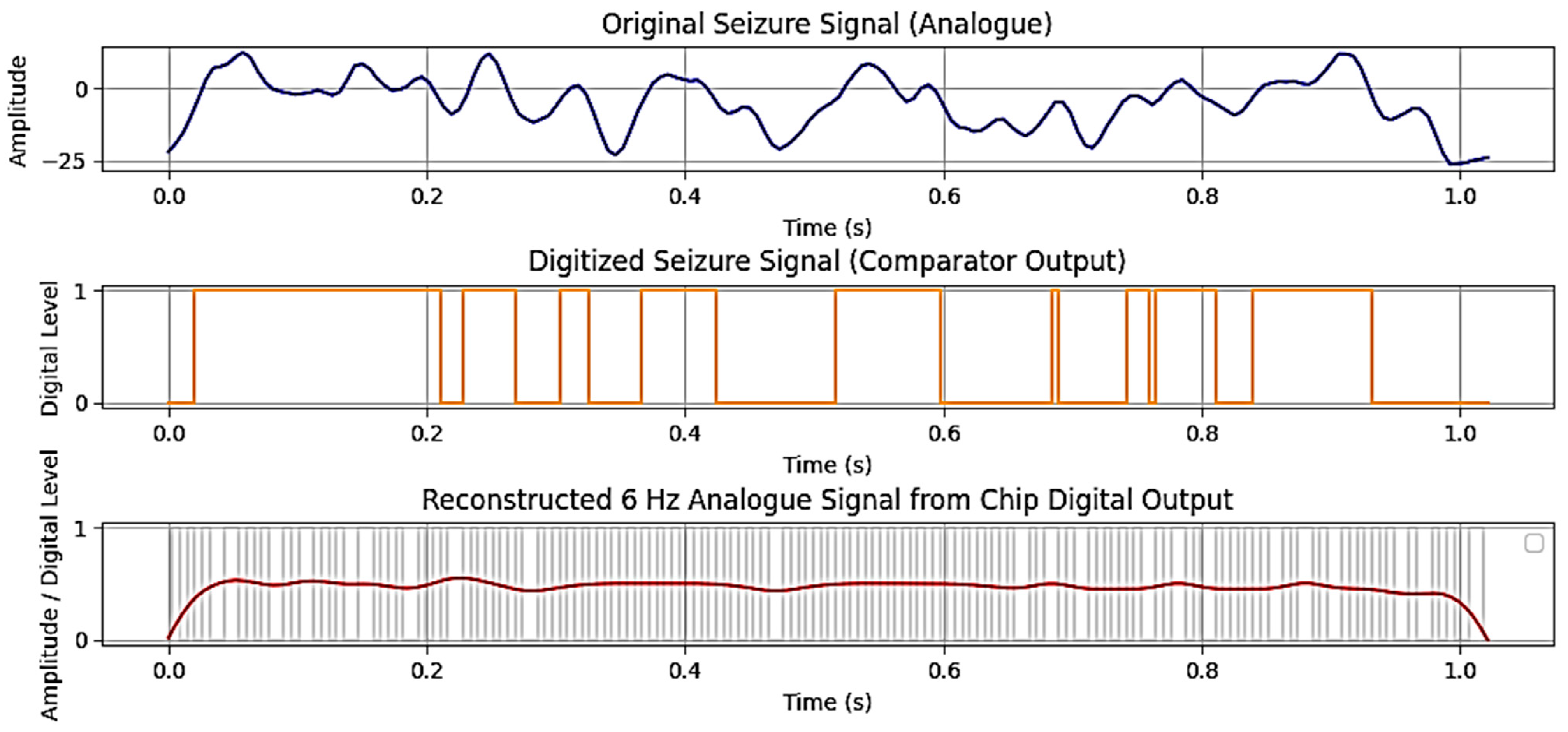
To evaluate the neural chip’s interaction with the seizure signal, digital output from the chip was collected using a Saleae Logic Analyser. The chip output is a digital square-wave–like pattern intended to operate at 6 Hz, and the relevant information is stored in Channel 4 of the CSV file (as shown in Figure 12). Since the neural chip operates in the digital domain, the seizure signal is converted into digital form. A thresholding operation was used to convert the analog seizure waveform into a binary representation. The threshold chosen was the mean value of the waveform. Any EEG amplitude greater than this threshold was assigned a digital high, and any value below was assigned a digital low. To demonstrate how the chip’s 6 Hz rhythm could entrain the seizure activity, the resampled chip digital output was passed through a smoothing filter. This low-pass filtering converts the square-wave-like digital output into a smooth sinusoid-like analog signal, as shown in Figure 13.
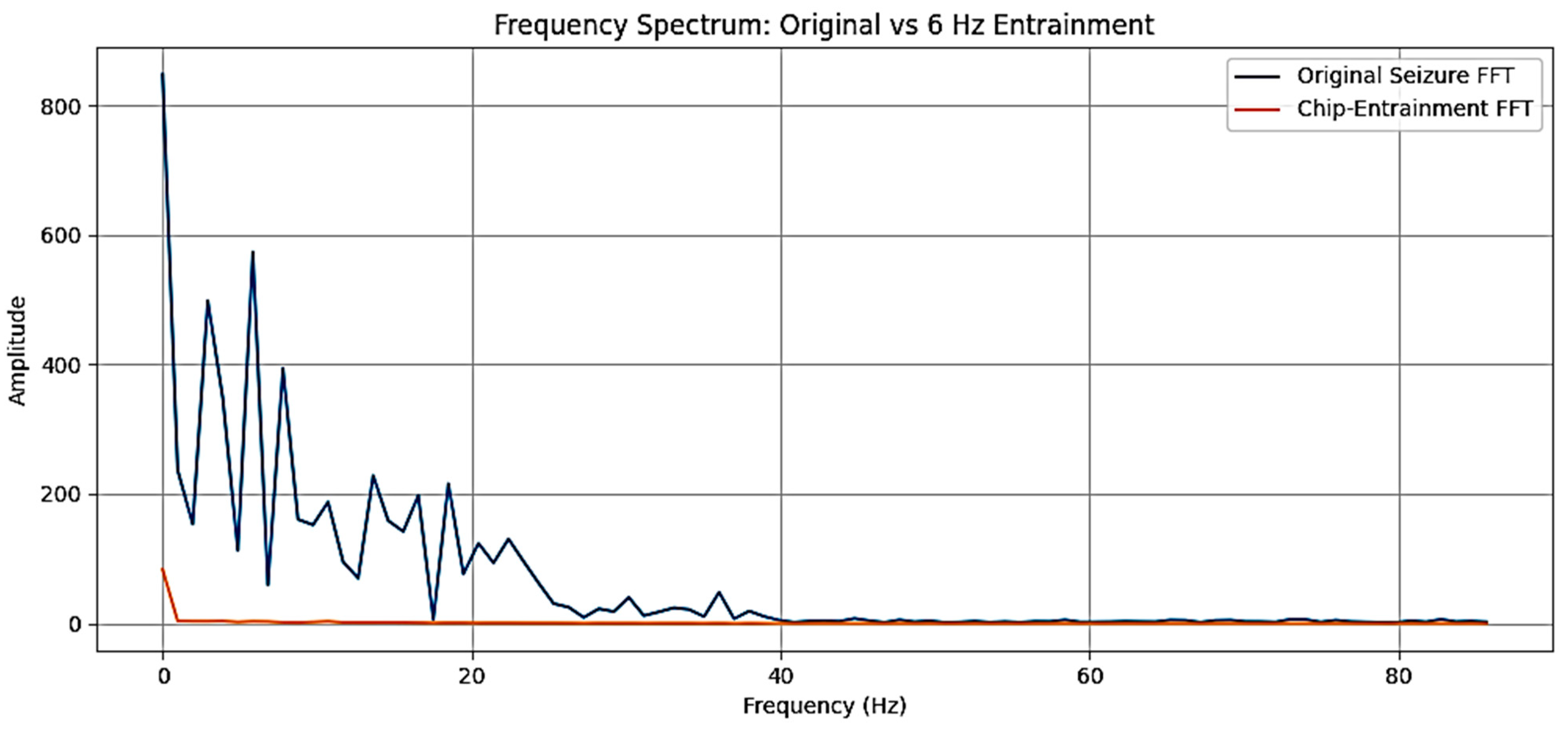
The top plot shows the original averaged seizure signal as a continuous waveform, representing the typical shape of seizure activity. The middle plot shows the digitized version of that waveform after thresholding, displaying how the analog EEG becomes a binary signal when fed into digital hardware. The bottom plot shows two superimposed signals: the actual digital pulses generated from the custom-designed neural chip, overlaid by the reconstructed analog 6 Hz waveform. To further validate the entrainment principle, a frequency-domain analysis was computed using the Fourier transform, as shown in Figure 14. The spectrum of the original seizure waveform shows energy spread across multiple frequencies, which is characteristic of seizure activity. The spectrum of the reconstructed chip-derived analog waveform, however, shows a clear peak at around 6 Hz.

3. IoT Connectivity with Mobile App

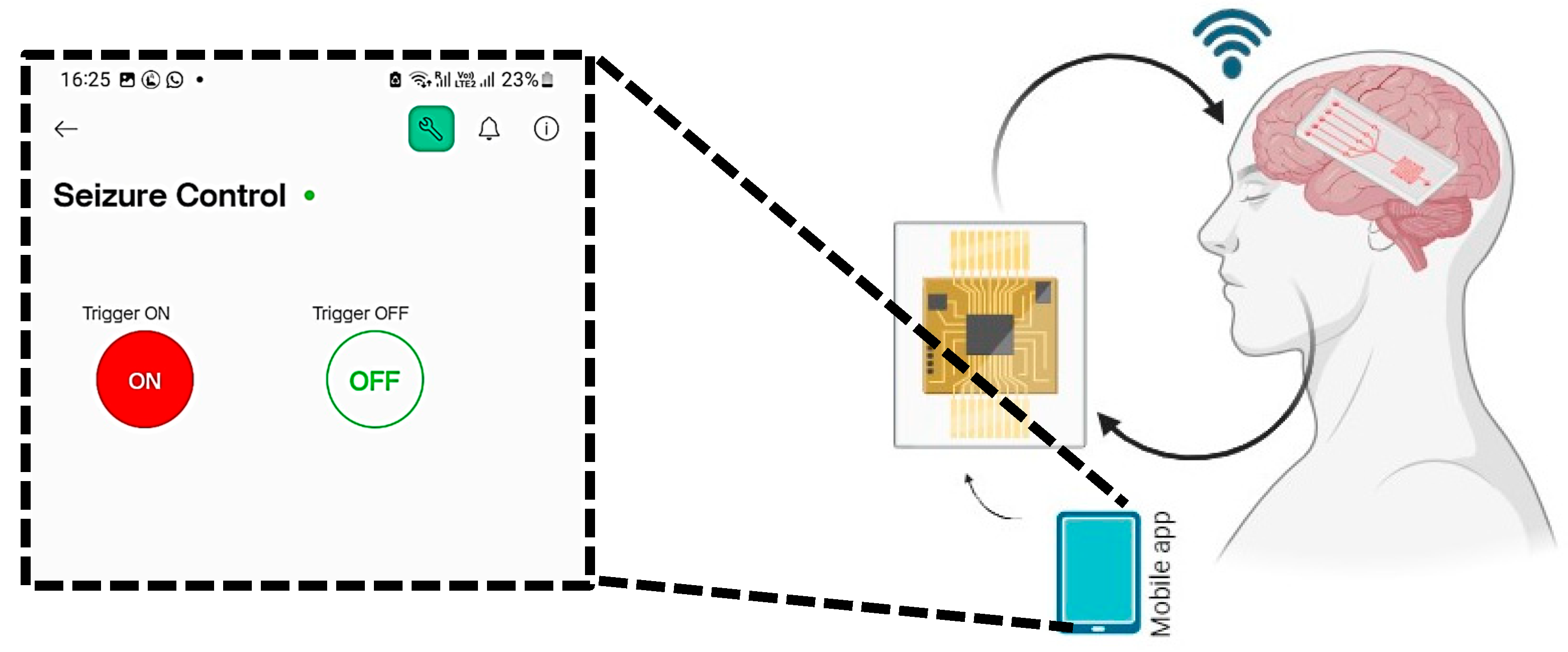
To further enhance the functionality of the HiLTS© platform, a mobile interface was developed using the Blynk IoT framework. The mobile application communicates wirelessly with an Arduino Wi-Fi module, enabling remote control of the neural chip’s pulse generation, as shown in Figure 15. Upon detection and trigger of an epileptic seizure, the clinician can manually trigger the chip entrainment signal through the mobile application. The mobile interface also allows selection of specific output frequencies for the entrainment pulses, facilitating customization for different patient or research requirements. Real-time monitoring of the chip state is provided through the app, allowing confirmation of signal generation and trigger timing. This IoT-enabled integration demonstrates the potential for wireless, portable neuromodulation, allowing user-controlled intervention in real-time brain rhythm regulation.

4. Discussion

The HiLTS© platform presented in this work establishes a foundational architecture for digital neuromodulation hardware, demonstrating that frequency-domain stabilization of seizure-like EEG dynamics can be achieved using a minimal, low-power, custom-designed digital chip [30,31,32,33]. Unlike existing neuromodulation approaches that rely on analog circuitry, high-voltage stimulation hardware, or proprietary platforms, this study demonstrates a fully digital neuromodulation paradigm implemented using a compact custom ASIC.
The proposed digital oscillator produces a stable, narrow-band rhythm that can dominate broadband seizure-like spectral content. By simplifying publicly available EEG seizure waveforms into a comparator-based binary representation, the system isolates frequency-domain dynamics that are most relevant to digital entrainment hardware.
The HiLTS© platform demonstrates that meaningful neural entrainment is possible even without analog front-ends or complex stimulation electronics. This proof-of-concept is particularly valuable for future wearable neuromodulation, where power consumption, silicon area, and system simplicity are critical design constraints. The current implementation integrates several distinct modules, including Vagus nerve stimulation, multiphase back-pain stimulation, seizure detection and entrainment, an SNN-based speech classifier, and a PicoRV32 bare-metal processor within a 4 mm2 silicon die area, with a total power consumption estimate of 0.625 W. For this specific neural entrainment module, it utilizes a single tile measured at 160 × 100 µm2. Since Yosys does not provide built-in power estimation, dynamic power consumption was estimated using a first-order CMOS switching model. At the target operating frequency of 6 Hz, static power was assumed to be negligible. Dynamic power was calculated as p = α C_load V2 f. Using a conservative activity factor (α = 1), a 3.3 V IO supply, and an estimated effective load capacitance of 50 pF per switching node, the resulting power consumption is in the nanowatt range, confirming the ultra-low-power nature of the proposed design. These results collectively highlight the feasibility of creating a compact, multi-functional proof-of-concept engineering testbed for therapeutic interventions.
However, several components remain beyond the scope of the present study. The current prototype is complemented with a mobile IoT interface for manual triggering and does not yet incorporate real-time EEG acquisition, autonomous seizure detection, or a fully closed-loop workflow. Live analog EEG signals were not directly fed into the chip; instead, digitized seizure data were used to emulate neural inputs. To enable complete closed-loop operation, future versions of the hardware will include integrated high-fidelity analog-to-digital (ADC) and digital-to-analog (DAC) conversion stages, allowing the chip to receive real-time physiological input and deliver analog entrainment signals without external reconstruction processes. Such mixed-signal extensions are essential for bridging biological interfaces with the digital neuromodulation core and will form a central part of subsequent development. Further work will focus on fabricating and characterizing the full multi-module system, expanding the entrainment engine to support multiple frequencies, integrating lightweight machine-learning models for autonomous detection and triggering, and performing comprehensive hardware characterization under real biological or neurophysiological conditions. Clinical validation, which is necessary for evaluating long-term safety and efficacy, remains an important future direction but lies outside the scope of the present paper.
Beyond its technical contributions, the HiLTS© platform represents one of the first neurotechnology platforms of its kind to be developed in the United Arab Emirates, and to the best of the authors’ knowledge, no comparable open or academic platform internationally offers such a unified, modular, and extensible architecture for neurotechnology research. Its design philosophy emphasizes openness, reproducibility, and accessibility, making it a valuable foundation for training researchers with hands-on experience in prototyping healthcare devices and enabling future work on wearable diagnostic and therapeutic devices. The framework and methods described herein are currently under consideration for patent protection, further underscoring their novelty and translational potential. The proposed digital entrainment using custom ASIC hardware is a viable and promising approach to modulating pathological neural rhythms. Although the present study focuses primarily on validating the digital entrainment capability of a single-frequency oscillator, the HiLTS© system platform lays the groundwork for future neuromodulation modules that merge open-source hardware, mixed-signal interfaces, IoT connectivity, and real-time neurophysiological feedback into a unified and clinically relevant therapeutic system. No direct benchmarking against analog or commercial neuromodulation devices is presented in this work, as the primary contribution lies in demonstrating a fully digital, open-source entrainment architecture at the ASIC level.

5. Summary

This work presents a novel proof-of-concept digital neuromodulation testbed that can be used to demonstrate frequency-domain stabilization of pathological seizure-like dynamics under controlled lab-based experimental conditions. By combining EEG signal analysis, digital ASIC design, hardware synthesis and simulation validation, and IoT-enabled control, the study establishes the framework for an end-to-end pipeline that bridges open-source design methodologies with real hardware implementation for healthcare engineering. The successful generation of a reference entrainment rhythm and its interaction with digitized seizure signal provides strong evidence that digital-only stimulation architectures can influence seizure-like dynamics without the need for complex analog circuitry. The current prototype serves as a foundational step toward a more advanced precision neuromodulation system. Although the present work demonstrates entrainment using pre-recorded EEG signals and manual IoT-based triggering, it does not yet implement continuous real-time EEG acquisition, closed-loop seizure detection, or multi-frequency stimulation. Future iterations of development will incorporate integrated ADC and DAC modules, expand the entrainment core to support multiple therapeutic bands, and complete the fabrication and characterization of the multi-module HiLTS© platform as a closed-loop, real-time system-on-chip device. These extensions are essential for enabling autonomous, real-time neurostimulation and for establishing the platform as a viable candidate for wearable, implantable, and point-of-care diagnostic applications. Beyond its technical contributions, the HiLTS© platform is the first open, modular, and extensible neuromodulation architecture of its kind, capable of supporting multi-diagnostic and multi-therapeutic research in a unified hardware platform. Rather than restricting access to the technology, which in the authors’ opinion has often been the case in hardware development, its openness and modularity make it well-suited for training researchers and for accelerating innovation in digital neurotechnology and precision medicine. The methods and architecture presented here are the subject of a forthcoming patent application, reflecting the novelty and translational potential of the system.

Funding

This research was partly funded by the AURAK Seed Research Grant, Project Reference No. ENGR/007/26.

Institutional Review Board Statement

Not applicable.

Informed Consent Statement

Not applicable.

Data Availability Statement

No new data were created in this research; however, the author of the paper would be happy to share further information upon request with interested researchers.

Acknowledgments

The author acknowledges the use of Grammarly for Microsoft Office 6.8.263 and ChatGPT-4o mini in the process of translating and improving the clarity and quality of the English language in this manuscript. The author takes full responsibility for the content of this publication. All ideas, including chip design, chip characterization, hardware simulation and synthesis, use of open-source tools, app development, and system-level integration and testing, are the intellectual property of the author of this paper.

Conflicts of Interest

The author declares that at the time the paper was published, they had no known competing financial interests or personal relationships that could have appeared to influence the work reported in this paper. All images and diagrams are indirectly linked to a related patent and are copyrighted material and intellectual property of the author of this paper. To reproduce ideas, images and diagrams based on this work, written permission is required from the author of the paper.

References

  1. Zhang, C.; Gao, Y. University of Chinese Academy of Sciences Implements the ‘One Student, OneChip’ Program, Expanding to Over 300 Universities—Breaking the ‘Shell’ for Chip Talent. China Education News, 10 April 2024. Available online: https://baijiahao.baidu.com/s?id=1807890340534016858 (accessed on 10 December 2025).
  2. Srivastava, K. Empowering Europe’s Semiconductor Future: How ECSA and ECDA Are Bridging Gaps in Talent and Inclusion; SEMI Europe: Berlin, Germany; Available online: https://www.semi.org/sites/semi.org/files/2025-06/05_Kartikey%20Srivastava.pdf (accessed on 10 December 2025).
  3. Rizi, A.D.; Roy, A.; Noor, R.; Kang, H.; Varshney, N.; Jacob, K.; Rivera-Jimenez, S.; Edwards, N.; Sorger, V.J.; Dalir, H.; et al. From Talent Shortage to Workforce Excellence in the CHIPS Act Era. arXiv 2023, arXiv:2308.00215. [Google Scholar] [CrossRef]
  4. Semiconductor Industry Association (SIA); Oxford Economics. America Faces Significant Shortage of Tech Workers in Semiconductor Industry and Throughout U.S. Economy. Semiconductor Industry Association, 25 July 2023. Available online: https://www.semiconductors.org/america-faces-significant-shortage-of-tech-workers-in-semiconductor-industry-and-throughout-u-s-economy/ (accessed on 5 December 2025).
  5. Somshankar Bandyopadhyay. Skills Gap, Data Hurdles, and Ethics Key to Unlocking AI in GCC Retail. Khaleej Times, 22 April 2025. Available online: https://www.khaleejtimes.com/business/ai-gcc-retail-hurdles (accessed on 4 December 2025).
  6. Schiavio, A.; Witek, M.A.G.; Stupacher, J. Meaning-making and creativity in musical entrainment. Front. Psychol. 2024, 14, 1326773. [Google Scholar] [CrossRef]
  7. Hamill, O.P. Pressure Pulsatility Links Cardio-Respiratory and Brain Rhythmicity. J. Integr. Neurosci. 2023, 22, 143. [Google Scholar] [CrossRef]
  8. Schottelkotte, K.M.; Crone, S.A. Forebrain control of breathing: Anatomy and potential functions. Front. Neurol. 2022, 13, 1041887. [Google Scholar] [CrossRef]
  9. Ayyar, V.S.; Sukumaran, S. Circadian rhythms: Influence on physiology, pharmacology, and therapeutic interventions. J. Pharmacokinet. Pharmacodyn. 2021, 48, 321–338. [Google Scholar] [CrossRef]
  10. Barbaresi, M.; Nardo, D.; Fagioli, S. Physiological Entrainment: A Key Mind-Body Mechanism for Cognitive, Motor and Affective Functioning, and Well-Being. Brain Sci. 2024, 15, 3. [Google Scholar] [CrossRef] [PubMed] [PubMed Central]
  11. Weiss, E.; Kann, M.; Wang, Q. Neuromodulation of Neural Oscillations in Health and Disease. Biology 2023, 12, 371. [Google Scholar] [CrossRef]
  12. GBD Epilepsy Collaborators. Global, regional, and national burden of epilepsy, 1990–2021: A systematic analysis for the Global Burden of Disease Study 2021. Lancet Public Health 2025, 10, E203–E227. [Google Scholar] [CrossRef]
  13. Asadi-Pooya, A.A.; Brigo, F.; Lattanzi, S.; Blumcke, I. Adult epilepsy. Lancet 2023, 402, 412–424. [Google Scholar] [CrossRef] [PubMed]
  14. Ajith Goonetilleke, U.K.D. Neurology Care in the UAE. In Healthcare in the United Arab Emirates; Al-Shamsi, H.O., Ed.; Springer: Singapore, 2026. [Google Scholar] [CrossRef]
  15. Cidral-Filho, F.J.; Porter, P.; Donatello, N.N. An Integrative Review of Brainwave Entrainment Benefits for Human Health. Appl. Psychophysiol. Biofeedback 2025, 50, 3–9. [Google Scholar] [CrossRef] [PubMed]
  16. Ingendoh, R.M.; Posny, E.S.; Heine, A. Binaural beats to entrain the brain? A systematic review of the effects of binaural beat stimulation on brain oscillatory activity, and the implications for psychological research and intervention. PLoS ONE 2023, 18, e0286023. [Google Scholar] [CrossRef] [PubMed] [PubMed Central]
  17. Keitel, C.; Quigley, C.; Ruhnau, P. Stimulus-driven brain oscillations in the alpha range: Entrainment of intrinsic rhythms or frequency-following response? J. Neurosci. 2014, 34, 10137–10140. [Google Scholar] [CrossRef] [PubMed] [PubMed Central]
  18. Shin, Y.; Kim, J.S.; Chung, C.K. Proof of Beat Entrainment and its Characteristics. In Proceedings of the 2021 9th International Winter Conference on Brain-Computer Interface (BCI), Gangwon, Republic of Korea, 22–24 February 2021; pp. 1–4. [Google Scholar] [CrossRef]
  19. Mathiopoulou, V.; Habets, J.; Feldmann, L.K.; Busch, J.L.; Roediger, J.; Behnke, J.K.; Schneider, G.-H.; Faust, K.; Kühn, A.A. Gamma entrainment induced by deep brain stimulation as a biomarker for motor improvement with neuromodulation. Nat. Commun. 2025, 16, 2956. [Google Scholar] [CrossRef]
  20. Locke, H.N.; Brooks, J.; Arendsen, L.J.; Jacob, N.K.; Casson, A.; Jones, A.K.; Sivan, M. Acceptability and usability of smartphone-based brainwave entrainment technology used by individuals with chronic pain in a home setting. Br. J. Pain 2020, 14, 161–170. [Google Scholar] [CrossRef] [PubMed] [PubMed Central]
  21. Pinheiro, D.J.L.L.; Oliveira, L.F.; Souza, I.N.O.; Brogin, J.A.F.; Bueno, D.D.; Miranda, I.A.; Da Poian, A.T.; Ferreira, S.T.; Figueiredo, C.P.; Clarke, J.R.; et al. Modulation in phase and frequency of neural oscillations during epileptiform activity induced by neonatal Zika virus infection in mice. Sci. Rep. 2020, 10, 6763. [Google Scholar] [CrossRef]
  22. Espinoso, A.; Andrzejak, R.G. Phase irregularity: A conceptually simple and efficient approach to characterize electroencephalographic recordings from epilepsy patients. Phys. Rev. E 2022, 105, 034212. [Google Scholar] [CrossRef] [PubMed]
  23. Niu, R.; Guo, X.; Wang, J.; Yang, X. The hidden rhythms of epilepsy: Exploring biological clocks and epileptic seizure dynamics. Acta Epileptol. 2025, 7, 1. [Google Scholar] [CrossRef] [PubMed]
  24. Amiri, H.K.; Zarei, M.; Daliri, M.R. Epileptic seizure detection from electroencephalogram signals based on 1D CNN-LSTM deep learning model using discrete wavelet transform. Sci. Rep. 2025, 15, 32820. [Google Scholar] [CrossRef]
  25. Thut, G.; Schyns, P.G.; Gross, J. Entrainment of Perceptually Relevant Brain Oscillations by Non-Invasive Rhythmic Stimulation of the Human Brain. Front. Psychol. 2011, 2, 170. [Google Scholar] [CrossRef]
  26. Available online: https://www.kaggle.com/datasets/chaditya95/epileptic-seizures-dataset?resource=download (accessed on 2 December 2025).
  27. Yosys Logic Synthesis. Available online: https://yosyshq.net/yosys/ (accessed on 2 December 2025).
  28. eFabless. Google SkyWater 130 nm Open Source PDK; eFabless: Palo Alto, CA, USA; Available online: https://chipfoundry.io/efabless (accessed on 1 December 2025).
  29. Saleae. Saleae Logic Analyzer. Available online: https://saleae.com/ (accessed on 1 December 2025).
  30. Ghani, A.; Aina, A.; See, C.H. An Optimised CNN Hardware Accelerator Applicable to IoT End Nodes for Disruptive Healthcare. IoT 2024, 5, 901–921. [Google Scholar] [CrossRef]
  31. Ghani, A.; Dowrick, T.; McDaid, L.J. OSPEN: An open-source platform for emulating neuromorphic hardware. Int. J. Reconfig. Embed. Syst. (IJRES) 2023, 12, 1–8. [Google Scholar] [CrossRef]
  32. Ghani, A. Fundamentals of Low-Power Neuromorphic Circuit Design with Spiking Neural Networks (SNNs). In Innovations in Computer Vision and Data Classification; EAI/Springer Innovations in Communication and Computing; Springer: Cham, Switzerland, 2024. [Google Scholar] [CrossRef]
  33. Ghani, A. Innovations in Computer Vision and Data Classification; EAI/Springer Innovations in Communication and Computing; Springer: Cham, Switzerland, 2024. [Google Scholar] [CrossRef]
Figure 1. An overview of the HiLTS© platform.
Technologies 14 00071 g001
Figure 2. An embedded signal entrainment framework.
Technologies 14 00071 g002
Figure 3. Illustration of neural entrainment using digitally generated oscillatory signals. (a) Independent oscillations at 11 Hz and 13 Hz represent dysregulated brain activity. (b) Phase-locked 11 Hz oscillations illustrate the entrained steady-state achieved when the brain’s rhythm synchronizes with an external chip-generated signal.
Technologies 14 00071 g003
Figure 4. Superimposed seizure EEG signals, average waveform, and entropy distribution.
Technologies 14 00071 g004
Figure 5. Visualization of the EEG signals and corresponding band power.
Technologies 14 00071 g005
Figure 6. The (top) subplot shows the averaged analog EEG signal over time. The (middle) subplot displays the digitized version of this signal, obtained by applying a threshold equal to the mean amplitude of the average signal, resulting in a binary representation. The (bottom) subplot presents the logarithmic power spectrum of the averaged signal, highlighting the distribution of signal power across frequencies (Hz) and emphasizing dominant frequency components during seizure activity.
Technologies 14 00071 g006
Figure 7. A system-level design flow for brainwave entrainment.
Technologies 14 00071 g007
Figure 8. An illustration of the irregular brain signal entrainment with a custom-designed chip.
Technologies 14 00071 g008
Figure 9. RTL synthesis activity diagram from chaotic signal detection to entrainment and back to normal rhythm.
Technologies 14 00071 g009
Figure 10. Hardware simulation of signal entrainment.
Technologies 14 00071 g010
Figure 11. Chip characterization setup.
Technologies 14 00071 g011
Figure 12. Chip-generated control entrainment signals (top) oscilloscope, (bottom) Saleae logic analyzer.
Technologies 14 00071 g012
Figure 13. (Top) seizure signal, (middle) digitized waveform, (bottom) superimposed entrained signals.
Technologies 14 00071 g013
Figure 14. Frequency spectrum of the original seizure and entrained signal.
Technologies 14 00071 g014
Figure 15. An overview of the mobile phone-based app control for chip entrainment signals.
Technologies 14 00071 g015
Disclaimer/Publisher’s Note: The statements, opinions and data contained in all publications are solely those of the individual author(s) and contributor(s) and not of MDPI and/or the editor(s). MDPI and/or the editor(s) disclaim responsibility for any injury to people or property resulting from any ideas, methods, instructions or products referred to in the content.