Article

In Vitro Antioxidant, Photoprotective, and Volatile Compound Profile of Supercritical CO2 Extracts from Dandelion (Taraxacum officinale L.) Flowers

by
Janina Sutkaitienė
,
Michail Syrpas
,
Petras Rimantas Venskutonis
and
Vaida Kitrytė-Syrpa
*
Department of Food Science and Technology, Kaunas University of Technology, Radvilėnų Rd. 19, LT-50254 Kaunas, Lithuania
*
Author to whom correspondence should be addressed.
Plants 2026, 15(1), 99; https://doi.org/10.3390/plants15010099 (registering DOI)
Submission received: 26 November 2025 / Revised: 18 December 2025 / Accepted: 26 December 2025 / Published: 28 December 2025

Abstract

This study aimed to develop a sustainable approach for isolating bioactive lipophilic components from Taraxacum officinale flowers using supercritical carbon dioxide extraction (SFE-CO2) and to assess the effect of adding 5% ethanol (EtOH) as a co-solvent on extraction yield, in vitro antioxidant capacity in CUPRAC and ABTS assays (TEACCUPRAC and TEACABTS), total phenolic (TPC) and flavonoid (TFC) content, β-carotene concentration, and photoprotective potential, expressed as the sun protection factor (SPF). SFE-CO2 at 35 MPa and 40 °C resulted in 50% of the total yield within 15 min, with equilibrium reached after 120 min (final yield of 4.6 g/100 g flowers). Co-solvent addition increased yield by ~50% and shortened extraction time. The EtOH-modified extract exhibited markedly higher antioxidant activity, with a 2-fold increase in TEACCUPRAC (167 mg TE/g E), an 11-fold increase in TEACABTS (194 mg TE/g E), and a 3-fold increase in TPC (91 mg GAE/g E), along with improved recovery of flavonoids and β-carotene. Volatile profiling revealed monoterpenoids, aldehydes, and esters as dominant groups, with carvone (14.0–16.5%) and dill ether (4.2–5.8%) as major contributors to aroma. The SFE-CO2 + 5% EtOH extract achieved the highest SPF value (49.5 at 1 mg/mL; SPF > 6 at >0.1 mg/mL), indicating strong photoprotective potential and potential suitability for natural antioxidant and cosmetic applications.

1. Introduction

Taraxacum officinale (common name dandelion), a member of the Asteraceae family, is a perennial flowering plant that grows in moist soils and is believed to have originated in Europe, but is now distributed across the Northern Hemisphere [1]. Historically, many parts of this edible plant have been consumed in various forms. For example, dandelion roots can be roasted and added to coffee, dandelion leaves can be eaten raw in a salad, and dandelion extracts can provide flavour to various products [2]. Moreover, the various parts of this plant have found multilateral applications in traditional and folk medicinal practices [3]. In fact, the rich phytochemistry of this plant material, which includes polyphenols, flavonoids, phytosterols, polysaccharides, sesquiterpenoids, and carotenoids, among other substances, has been highlighted in several recent reviews [4,5,6]. The biological effects of this vast array of phytochemicals are actively being explored in various areas of human health, with many reviews highlighting their antioxidant [7], anti-inflammatory, antimicrobial, wound-healing [8], or gastrointestinal-protective [8] properties.
Interestingly, several studies have demonstrated that dandelion flowers are a potentially exploitable source of natural antioxidants [9,10,11]. Although many studies have employed conventional (i.e., maceration, Soxhlet, decoction) extraction methods to isolate bioactive compounds from various anatomical parts of T. officinale, studies on intensifying technologies have mainly focused on ultrasound-assisted extraction, enzyme-assisted extraction, or their combination, and to a lesser extent, supercritical fluid extraction (SFE) [12,13]. Moreover, most available studies have focused mainly on polar (aqueous or ethanol-based) extracts from leaves and roots, largely overlooking the lipophilic fraction in flowers. Currently, CO2 is the most widely used supercritical fluid, primarily because it can attain the supercritical state at relatively low pressure (>7.38 MPa) and temperature (>31.1 °C). Additionally, due to its non-toxic and non-flammable nature, low cost, and GRAS status, SFE-CO2 has become a widely adopted sustainable extraction method for extracting biologically active lipophilic fractions from a variety of plant materials and their by-products, offering a cleaner and more environmentally friendly option than conventional solid–liquid extraction techniques with hydrocarbon solvents [14,15]. In addition, by minimising the use of organic solvents, avoiding the need to remove toxic solvent residues, and allowing selective recovery of thermolabile compounds through proper selection of pressure and temperature, SFE-CO2 is particularly well suited for applications in the food, nutraceutical, and pharmaceutical sectors [16]. Furthermore, the addition of polar co-solvents (e.g., ethanol, water) to neat CO2 can further aid in isolating compounds of higher polarity [17]. Despite the interest and potential advantages of this technique, the literature is somewhat limited. Specifically, current research is limited to four recent publications that focus on the extraction and characterisation of T. officinale seeds [18,19,20], supplemented by two additional studies, one using dandelion leaves [21] and another with flowers [22].
Given the growing demand for sustainable, plant-derived ingredients for food, nutraceutical, and cosmetic applications, the present study was aimed to isolate lipophilic constituents from T. officinale flowers using SFE-CO2, with and without ethanol as a co-solvent, and to characterise the resulting extracts in terms of extraction yield, selected phytochemical indices (total phenolic, total flavonoid, and β-carotene content), volatile compound profile, and in vitro antioxidant capacity. In addition to in vitro antioxidant capacity, the photoprotective potential of plant-derived extracts, commonly expressed as the sun protection factor (SPF), is increasingly relevant for ingredients intended for phytodermatological and cosmetic formulations. SPF serves as an in vitro indicator of the material’s ability to attenuate UV radiation and can therefore be used to identify extracts with potential as natural adjuncts or boosters in sunscreen products [23]. Therefore, the photoprotective potential of the SFE-CO2 extracts was evaluated as well by determining SPF values at various concentrations. To the best of our knowledge, this is the first comprehensive study to integrate in vitro antioxidant and photoprotective evaluation with analysis of volatile compound composition in lipophilic dandelion flower extracts obtained by SFE-CO2.

2. Results and Discussion

2.1. Preparation of SFE-CO2 Extracts from T. officinale Flowers

SFE-CO2 is one of the widely used intensifying extraction methods that uses supercritical CO2 to isolate lipids, volatile oils, and other non-polar constituents from various matrices [24,25]. Previously, SFE-CO2 has been used to extract β-amyrin and β-sitosterol from T. officinale leaves [21], and to separate various bioactive compounds from the seeds [18,19,20]. However, information remains scarce on the application of SFE-CO2 to T. officinale flowers and on the characterisation of the resulting extracts.
In this study, SFE-CO2 was performed at 35 MPa and 40 °C, conditions commonly reported as optimal for the recovery of thermolabile compounds from seeds and leaves of T. officinale [18,19,20,21] and from the flowers of other Asteraceae plant species [22]. These parameters ensure maintaining an adequate CO2 density (934.9 kg/m3) for solubilising non-polar compounds while minimising the risk of thermal degradation. The SFE-CO2 kinetics of T. officinale flowers with and without co-solvent addition (Figure 1) demonstrated the characteristic three-stage profile typical of supercritical CO2 extraction of plant materials, which transitions sequentially through an initial rapid extraction phase, a falling extraction rate, and finally a diffusion-controlled equilibrium [26]. For neat CO2, approximately 50% of the final yield was obtained within the first 15 min of the constant extraction-rate period, reflecting the rapid removal of readily accessible, surface-exposed lipophilic compounds such as essential oils and waxes. This was followed by a falling extraction-rate phase, during which approximately 80% of the total yield was reached within 60 min, and subsequently by a diffusion-controlled stage in which equilibrium was reached after 120 min, resulting in a final yield of 4.8 g per 100 g of dandelion flowers (DF) (Figure 1). Incorporating 5% (v/v) EtOH as a co-solvent increased solvent polarity, improved recovery of moderately polar compounds, and reduced matrix–solute interactions, thereby shortening the extraction process with equilibrium reached after 90 min (Figure 1) and increasing the final yield by ~50% to 7.2 g/100 g DF. For the yield comparison purposes, Soxhlet extraction was performed with hexane, amounting to 6.6 g/100 g DF after 6 h, further highlighting the efficiency and time-saving advantages of SFE-CO2, particularly when combined with a polar co-solvent.
Previously, the effectiveness of SFE-CO2 in isolating valuable non-polar T. officinale constituents has been demonstrated mainly in studies on seeds and leaves. For example, Milovanović et al. observed that SFE-CO2 extraction of dandelion seeds at 30–45 MPa yielded 7.4–25.2% depending on the pressure. In contrast, conventional solvent extraction typically requires longer times and higher solvent consumption to achieve similar yields [20]. Simándi et al. reported that SFE-CO2 applied to dandelion leaves across a wide range of pressures (15–45 MPa) and temperatures (35–65 °C) produced high-quality extracts (yields of 1.6–3.4%) with minimal thermal degradation and strong selectivity toward β-amyrin and β-sitosterol, outperforming Soxhlet extraction in both selectivity and environmental impact [21]. To the best of our knowledge, the only available study in which SFE-CO2 was applied to dandelion flowers (at 20 MPa and 50 °C) did not report extract yields [22], and no previous work has examined the extraction kinetics or yields of SFE-CO2, with or without EtOH as a co-solvent, for dandelion flowers. Beyond yield, SFE offers additional advantages such as shorter extraction times due to the high diffusivity and low viscosity of supercritical CO2. Moreover, the selectivity and tunability of CO2 as a solvent enable targeted recovery of lipophilic compounds by adjusting pressure and temperature. Lastly, SFE-CO2 offers multiple environmental benefits, including being non-toxic, non-flammable, and not leaving solvent residues or requiring post-processing steps. Overall, these findings confirm that SFE-CO2, particularly when combined with a polar co-solvent, is a sustainable and efficient alternative to conventional extraction methods for isolating bioactive lipophilic fractions from plant matrices.

2.2. In Vitro Antioxidant and Photoprotective Properties of T. officinale SFE-CO2 Extracts

Evaluating the bioactive properties of plant-derived extracts is crucial for a deeper understanding of their potential applications in health and cosmetic formulations. In this part of the study, the SFE extracts of T. officinale flowers were assessed for their in vitro antioxidant capacity using CUPRAC and ABTS assays, total phenolic content (TPC), total flavonoid content (TFC), and β-carotene concentration (Table 1). The specific phytochemical markers are closely associated with the extract’s ability to neutralise free radicals and contribute to photoprotection. Additionally, the sun protection factor (SPF) of the extracts was determined (Table 2) to explore their potential as natural UV filters.
Co-solvent addition substantially increased the antioxidant capacity of the dandelion flower extracts in comparison to neat SFE-CO2. On an extract mass basis, the TEACCUPRAC value nearly doubled from 84.4 to 169.8 mg TE, whereas the TEACABTS value augmented ~11-fold (from 17.5 to 193.8 mg TE), indicating a substantial enhancement in overall antioxidant potential (ABTS radical scavenging and CUPRAC reducing capacity). This increase is in agreement with the 1.6- to 3-fold higher carotenoid content (from 28.2 to 44.7 mg/g E), TFC (from 13.1 to 23.9 mg QE/g E), and TPC (from 29.1 to 91.3 mg GAE/g E) values. Given the higher SFE-CO2 + 5% EtOH extraction yield, these results translated into proportionally greater values when expressed on a per-mass basis of the plant material (Table 1). The observed assay-dependent improvements in the in vitro antioxidant capacity values are consistent with the methods’ chemistry and the anticipated composition of the extracts. In the CUPRAC assay, antioxidant capacity is quantified as the sample’s overall reducing power, based on its ability to reduce Cu(II) to Cu(I) and thereby form the coloured Cu(I)–neocuproine complex. In contrast, the ABTS assay quantifies the sample’s ability to scavenge the ABTS radical cation, measured as a decrease in absorbance at ~734 nm, and proceeds via electron transfer and/or hydrogen atom transfer mechanisms. In both ABTS and CUPRAC assays, the responses in terms of TEAC values generally increase with the concentration and redox potential of phenolic/flavonoid antioxidants [27,28]. Additionally, CUPRAC performs well at near-neutral pH and can detect both hydrophilic and lipophilic antioxidants, whereas ABTS•+ is particularly sensitive to phenolics and conjugated systems that can delocalise charge. Thus, the stronger ABTS response (11-fold per extract basis) is in line with the 3-fold increase in TPC and the nearly 2-fold increase in TFC after co-solvent addition. Introducing a small fraction of EtOH enhances the polarity and hydrogen-bonding capacity of the supercritical phase, thereby improving the solubility and mass transfer of moderately polar phenolics and flavonoids that are otherwise poorly extracted by neat CO2, with a solvating behaviour resembling that of hexane. In addition, the greater increase in TEACABTS compared with TEACCUPRAC may be attributed to the carotenoid content, since these phytochemicals predominantly act as radical quenchers rather than strong reducing agents.
The findings of this study are consistent with a previous report by Milovanovic et al., in which the authors defatted dandelion seeds using neat SFE-CO2 and subsequently performed a second extraction on the defatted material with EtOH as a co-solvent. They reported that the TPC and TFC of the EtOH-derived extract increased by 4-fold and 5-fold, respectively, while the carotenoid content remained unchanged [18]. Overall, the TPC and TFC values of the tested dandelion flower extracts were above previously reported ranges for SFE-CO2 seed extracts (TPC 5.5–17.1 mg GAE/g E; TFC 0.2–1.3 mg QE/g E) [18,20]. Higher phenolic and flavonoid content in flowers compared with seeds is expected [9,10,11] and is consistent with recently published LC–MS/MS data reporting a total of 4.7–4.9 mg of flavonoids (glycosides, aglycones, biflavones, and flavonolignans) per gram of flowers [29]. Carotenoid levels in Taraxacum species can vary considerably depending on the species, plant part analysed, geographic location, climatic conditions, and other factors [9,10,11]. For instance, carotenoid contents reported for T. officinale leaves ranged from 0.1 mg/g DW in samples collected in Brazil [30] to 0.9 mg/g in those obtained from Poland [31]. Relatively high levels (~1 mg/g dried plant material), comparable to those obtained in this study, have also been reported for Mongolian dandelion (T. formosanum) [32]. Overall, higher carotenoid levels in flowers could be anticipated, as their intense yellow pigmentation is strongly associated with carotenoid accumulation.
Despite the documented in vitro antioxidant capacity of polar dandelion extracts [9,10,11], information on the activity of non-polar fractions from aerial parts other than seeds, particularly flowers, remains very limited. For example, Hu and Kits reported that the ethyl acetate fraction of dandelion flower extract exhibited higher antioxidant activity (94% scavenging at 53 μg/mL) in the stable DPPH radical model compared to the water fraction (52% scavenging at 53 μg/mL). Both fractions also protected supercoiled DNA from damage caused by site-specific and non-site-specific hydroxyl radicals [33].
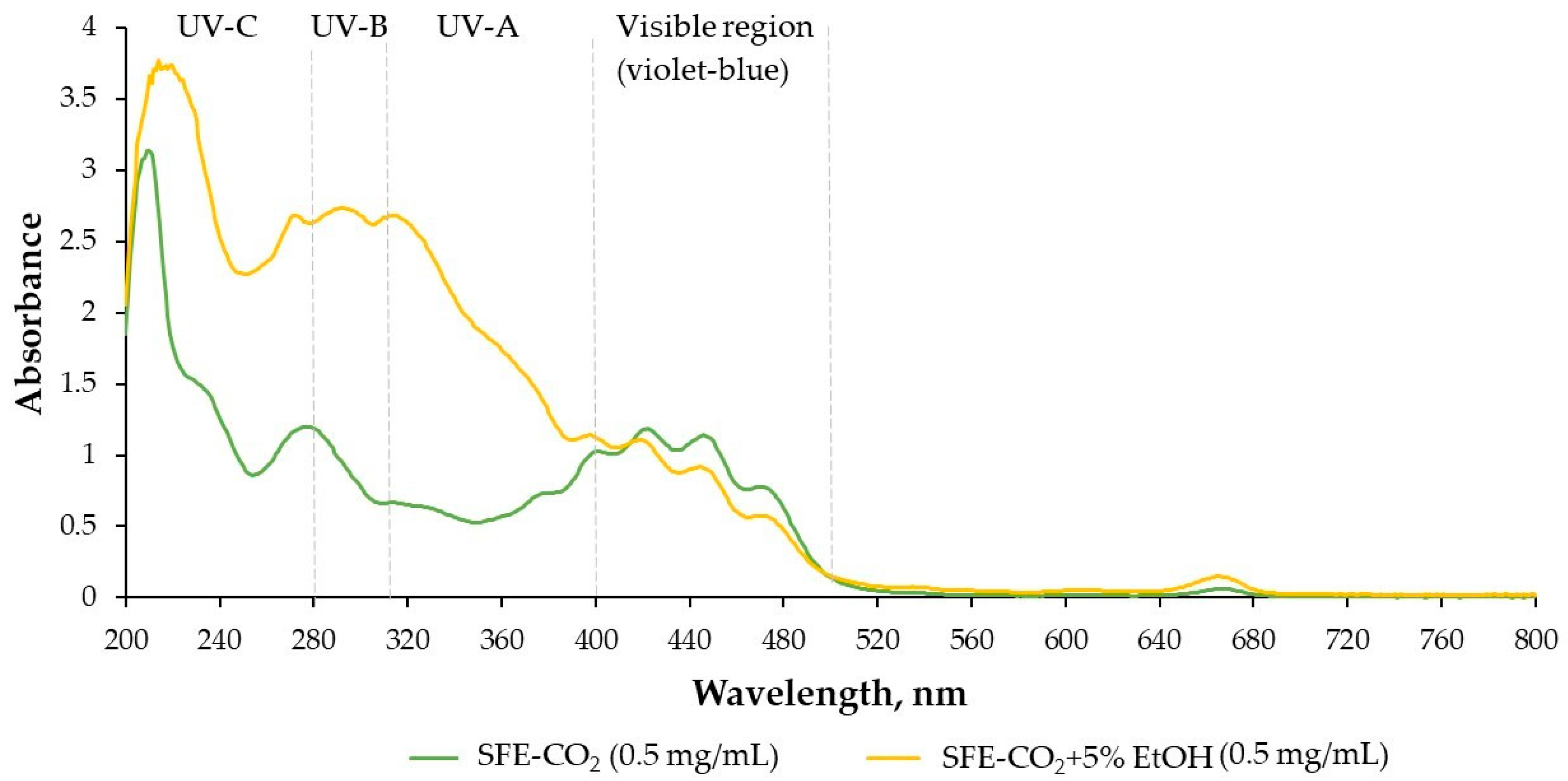
The UV–Vis spectra of T. officinale SFE-CO2 and SFE-CO2 + 5% EtOH extracts (Figure 2) show distinct absorption patterns across the UV and visible ranges, indicating differences in their potential photoprotective properties. The addition of EtOH as a co-solvent produced extracts with much higher absorbance capacity in the UV-C (200–280 nm), UV-B (280–315 nm), and UV-A (315–400 nm) regions, which is consistent with their substantially higher TPC, TFC, and enhanced in vitro antioxidant activity (Table 1). In contrast, the neat SFE-CO2 extract displayed lower UV absorbance, but showed comparatively high intensity in the visible violet-blue region (400–480 nm), contributing to visible-light filtering properties. The photoprotective potential, expressed as SPF values, also showed an apparent concentration-dependent increase (Table 2). For the SFE-CO2 + 5% EtOH extract, SPF rose from ~3.0 at 0.05 mg/mL to 49.5 at 1.00 mg/mL, with corresponding UV-B absorption increasing from 66% to 98%. In comparison, the neat SFE-CO2 extract showed a more modest increase, with SPF values rising from 0.8 to 13.9 over the same concentration range, reaching 93% UVB absorption at 1.00 mg/mL (Table 2).
Although in vitro SPF values cannot be directly equated with in vivo ISO standards, the Mansur method is widely accepted for preliminary screening and aligns reasonably well with standardised SPF concepts. This method evaluates weighted absorbance in the 290–320 nm range, where erythemally effective UV-B radiation is most intense [34]. According to the EU Commission Recommendation 2006/647/EC, sunscreen efficacy is categorised into four levels: low (SPF 6–10), medium (SPF 15–25), high (SPF 30–50), and very high (SPF > 50) [35]. Using this framework for qualitative context, the SFE-CO2 + 5% EtOH extract at 1.00 mg/mL (SPF of 49.5) falls within the upper range of the “high” category, approaching the “very high” threshold (>50), while the neat SFE-CO2 extract provides low to moderate protection across the tested concentrations. The higher TPC, TFC, and carotenoid levels in the EtOH-modified SFE-CO2 extract provide a plausible explanation for its significantly higher SPF values and UV-B absorption potential. Also, the compositional factors driving SPF performance are consistent with trends in the antioxidant assays. Flavonoids, which absorb in the near UV spectrum (bands I–II; 300–400 nm), contribute both direct UV filtering and indirect antioxidant protection, while carotenoids primarily act as singlet oxygen and radical quenchers, absorbing strongly in the visible range, and complement activity of phenolics by mitigating oxidative cascades triggered by UV exposure [36,37,38,39], also acting as anti-inflammatory agents that help reduce photodamage [40]. Therefore, future studies should prioritise targeted profiling and quantification of individual phenolic acids and flavonoids to establish more precise structure–activity relationships leading to the photoprotective effects of T. officinale extracts.
It is important to note that data on the skincare effects of T. officinale extracts, particularly their UV-protective properties, remain very limited, with only a few reports confirming polar-fraction activity. For example, Yang and Li showed that water extracts from dandelion leaves and flowers, but not roots, could effectively protect human dermal fibroblasts from UV-B-induced damage and hydrogen peroxide-induced oxidative stress, primarily by reducing reactive oxygen species generation and inhibiting matrix metalloproteinase activity [41]. In addition, among six extracts prepared from T. officinale stems and leaves using ultrasound-assisted extraction with H2O, EtOH, and EtOH/H2O mixture (50%, v/v), the hydroethanolic stem extract showed the strongest UV-A and UV-B absorption at 10 mg/mL concentration, although its effectiveness was lower than that of chlorogenic acid [42]. To the best of our knowledge, this is the first report on the in vitro photoprotective activity of non-polar dandelion flower extracts.

2.3. Volatile Compound Profile of T. officinale Flowers and SFE-CO2 Extracts

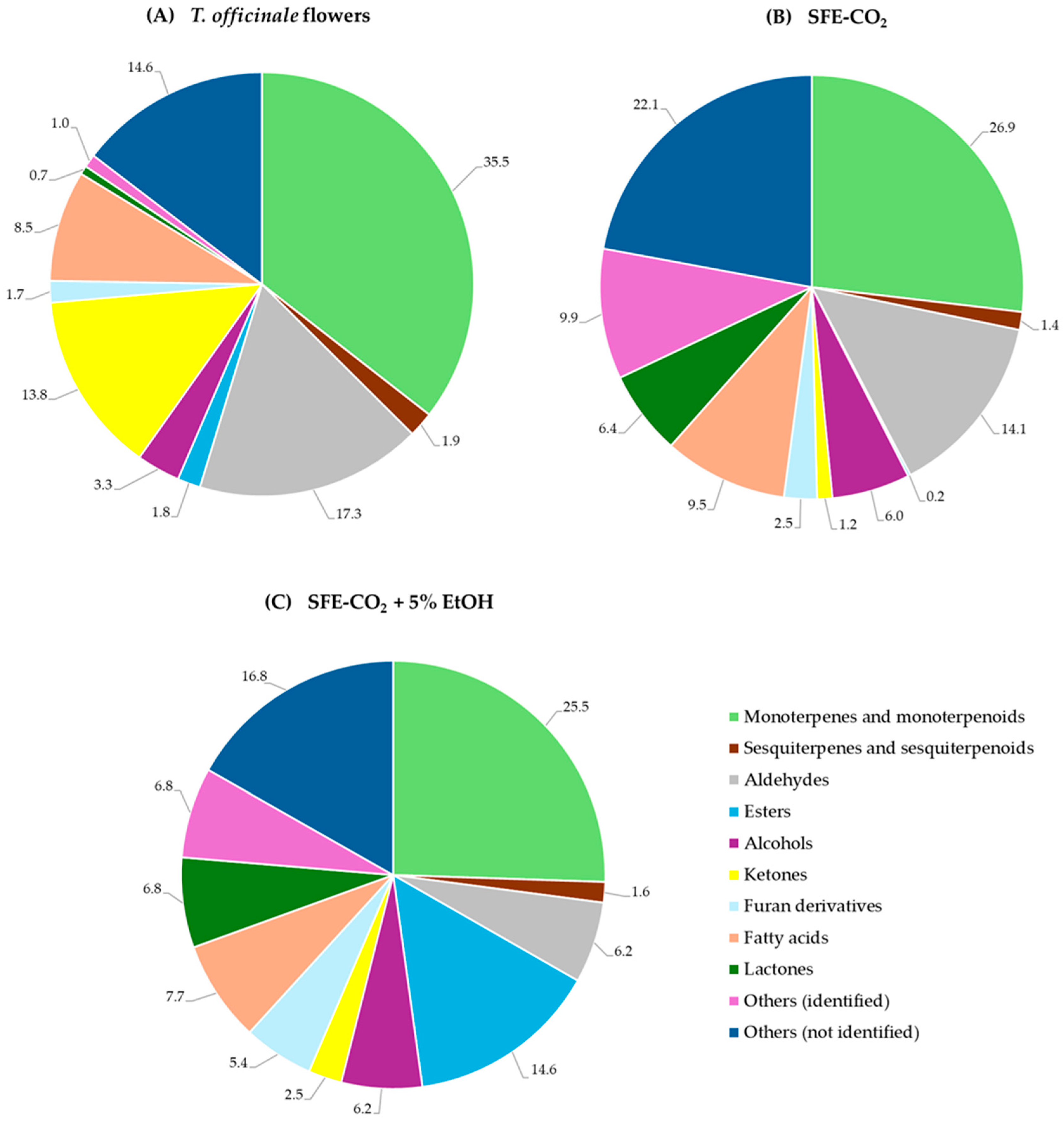
SPME-GC × GC-TOF-MS was employed to compare the composition of volatile compounds in T. officinale flowers and their SFE extracts obtained using neat CO2 and CO2 modified with 5% EtOH, indicating significant qualitative and quantitative differences (Figure 3). Headspace SPME is an equilibrium-based, non-exhaustive technique with significant matrix and analyte-dependent partitioning, which has severe limitations concerning the overall quantification of analytes, as previously highlighted in the literature. As a result, volatile data in this study are reported semi-quantitatively as percentages of the total GC peak area for comparative purposes across samples. No internal or external standards were employed, consistent with reported challenges of surrogate normalization under HS-SPME conditions in complex matrices [43,44,45,46]. The total GC peak area, representing the cumulative abundance of volatile compounds detected in the sample headspace, was highest for the flowers and nearly equivalent for the SFE-CO2 + 5% EtOH extract. In contrast, the neat CO2 extract showed an approximately 26% lower total area (Table 3). A total of 69 volatile compounds, categorised into ten chemical groups (Figure 3), were identified across the T. officinale flowers, SFE-CO2, and SFE-CO2 + 5% EtOH extracts, including 13 monoterpenes and monoterpenoids, 4 sesquiterpenes and sesquiterpenoids, 11 aldehydes, 4 esters, 4 alcohols, 10 ketones, 4 furan derivatives, 5 fatty acids, 5 lactones, and 9 other identified compounds. A substantial portion of the volatile profile was identified, averaging ~82% across all samples, with the unidentified volatile content averaging ~18% of the total GC peak area (Figure 3). Notably, several of these identified volatiles are known for their roles in plant defence, aroma, and pharmacological properties, indicating the value of dandelion and its extracts as potential sources of functional metabolites [10,11].
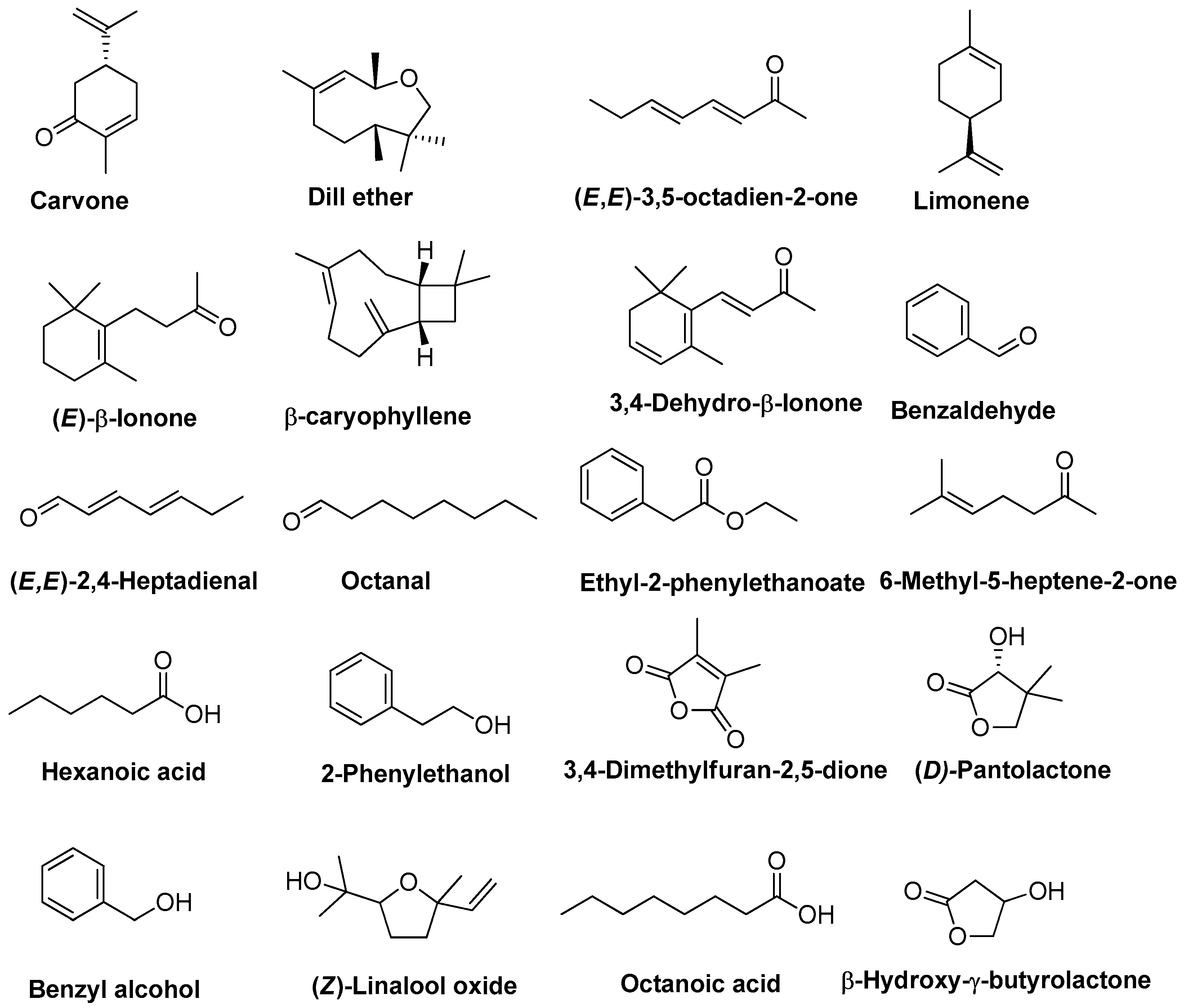
As presented in Figure 3, monoterpenes and monoterpenoids represented the most significant fraction of volatiles, accounting for 35.5% in flowers, 26.9% in SFE-CO2, and 25.5% in SFE-CO2 + 5% EtOH of the total quantified by GC volatiles. Within this class of volatiles, carvone (Figure 4) was the most abundant compound across all three samples. The distinguishing between the two carvone enantiomers cannot be achieved by a standard GC–MS analysis without a chiral column; however, some reports indicate that sweet, spearmint-like, herbal, minty odour-imparting (−)-carvone is more common for aromatic and medicinal plants of the Lamiaceae and Asteraceae families, whereas (+)-carvone is more characteristic of Apiaceae species [47]. As reported in Table 3, its headspace concentration decreased slightly in the SFE extracts (~14%) compared to T. officinale flowers (16.5%). Similar trends were observed for the dill ether (Figure 4), averaging 4.4% in the headspace of SFE extracts, compared with 5.8% in dried flowers. (E)-Dihydrocarvone and estragole exhibited nearly identical behaviour during SFE, both showing an approximate one-third reduction in headspace concentration as compared to the flowers, which moderated their respective herbal, warm, and anisic and spicy notes in the resulting extracts. As reported in Table 3, SFE generally reduced pine, peppery, spicy, and floral flavour notes in the extracts. Specifically, limonene (Figure 4), one of the major headspace components in the flowers (3.8%), was not detected in the SFE-CO2 extract. Although the addition of 5% EtOH allowed for its partial recovery (0.3%), this negligible concentration in the overall volatile profile, coupled with the absence of several other minor monoterpenes (<1% of the total GC peak area), like α-phellandrene, linalool, and β-cyclocitral, indicates a significant reduction in the initial complex terpenic flavour profile of T. officinale flowers. Interestingly, (Z)-linalool oxide (pyranoid) concentration in the headspace was enriched by the neat CO2, increasing nearly 10-fold from a minor constituent in the flowers (0.4%) to a high share of ~4%, partially compensating for the loss of citrus, green, and floral characteristics of the SFE-CO2 extract. However, the addition of 5% EtOH as a co-solvent reduced the relative content of this volatile compound to 2.4%, suggesting a change in solubility favouring other polar constituents in the SFE process. Sesquiterpenes and sesquiterpenoids constituted a minor group of volatiles, whose total contribution remained relatively stable across the different samples (Figure 3), ranging from 1.4% (SFE-CO2) to 1.9% (flowers), providing woody, spicy, and floral base notes.
The percentage of aldehydes ranged from 6.2 to 17.3% in the headspace of the SFE-CO2 + 5% EtOH and flower samples, respectively (Figure 3). Benzaldehyde (Figure 4) was the most abundant aldehyde in the dandelion flowers (8.4%), whose share in the headspace was significantly reduced up to 1% by SFE with or without the addition of polar modifier (Table 3). Benzaldehyde is a key aldehyde identified in multiple monovarietal T. officinale honeys [48,49]. Due to its bitter almond and cherry-like odour, it is used in various scent compositions and as a precursor to several aliphatic fragrance and flavouring ingredients [50]. Interestingly, (E,E)-2,4-heptadienal (Figure 4), which was absent in the flower headspace, was the dominant aldehyde in the neat CO2 extract and, combined with (E,Z)-2,4-heptadienal, amounted to 7.2% of the total GC peak area, imparting a distinct fatty, oily, and vegetable aroma. In contrast, the addition of 5% EtOH as a co-solvent markedly reduced the levels of these fatty dienals, with octanal, nonanal, and decanal being the predominant aldehydes and providing a waxy-citrusy aroma profile to the SFE-CO2 + 5% EtOH extract (Table 3). In a previous report, aldehydes including octanal, phenylacetaldehyde, 2-methylbenzaldehyde, nonanal, pentadecanal, and 10-undecenal have also been reported in the essential oil of dandelion [51].
Table 3. Headspace volatile compound composition (% of the total GC peak area) of T. officinale flowers, SFE-CO2 and SFE-CO2 + 5% EtOH (C) extracts.
CompoundLRIexpLRIlitExact MassFormula% of the Total GC Peak Area Odour Type: Description A
FlowersSFE-CO2SFE-CO2 + 5% EtOH
Monoterpenes and monoterpenoids
α-Phellandrene10061007 [52]136.1252C10H160.84 ± 0.03-ND-NDTerpenic: citrus, herbal, terpenic, green, woody, black pepper
p-Cymene10271020 [53]134.1096C10H140.43 ± 0.01-ND-NDTerpenic: citrus, sweet
Limonene10301024 [53]136.1252C10H163.78 ± 0.23 b-ND0.33 ± 0.10 aTerpenic: terpenic, pine, peppery
Linalool11021095 [53]154.1358C10H18O0.35 ± 0.02-ND-NDFloral: citrus, orange, floral, waxy, rose
(Z)-Linalool oxide (pyranoid)11751170 [53]170.1307C10H18O20.44 ±0.19 a3.97 ± 0.00 c2.36 ± 0.00 bCitrus: citrus, green
Dill ether11931184 [53]152.1201C10H16O5.83 ± 0.02 c4.26 ± 0.00 a4.54 ± 0.00 bHerbal: herbal, dill
(E)-Dihydrocarvone12031200 [53]152.1201C10H16O2.28 ±0.05 b1.47 ± 0.13 a1.50 ± 0.05 aHerbal: warm, herbal
Estragole12051195 [53]148.0888C10H12O2.19 ± 0.07 b1.47 ± 0.13 a1.50 ± 0.05 aAnisic: sweet, phenolic, anise, spicy, green, herbal, minty
Safranal12071196 [53]150.1045C10H14O1.51 ± 0.19 b-ND0.24 ± 0.05 aHerbal: fresh, herbal, phenolic, metallic, rosemary, tobacco, spicy
β-Cyclocitral12281217 [53]152.1201C10H16O0.54 ± 0.07-ND-NDTropical: tropical, saffron, herbal, rose, sweet, tobacco, green, fruity
Carvone12531242 [53]150.1045C10H14O16.46 ± 0.10 b14.10 ±0.17 a14.03 ± 0.06 aHerbal: spicy, green, sweet, spearmint, mint, carraway dill
Thymol12961289 [53]150.1045C10H14O0.16 ± 0.04 a0.91 ± 0.01 c0.56 ± 0.07 bHerbal: herbal, thyme, phenolic, medicinal, camphoreous
(E)-Geranyl acetone14571453 [53]194.1671C13H22O0.73 ± 0.01 b0.69 ± 0.04 b0.46 ± 0.06 aFloral: fresh, green, fruity, waxy, rose, woody, magnolia, tropical
Sesquiterpenes and sesquiterpenoids
β-Caryophyllene14291420 [52]204.1878C15H240.62 ± 0.13 a0.64 ± 0.23 a0.44 ± 0.07 aWoody: woody, spicy
(E)-β-Farnesene14601459 [52]204.1878C15H240.33 ± 0.00 b0.04 ± 0.00 a-NDWoody: woody, citrus, herbal, sweet
3,4-Dehydro-β-ionone14921485 [54]190.1358C13H18O0.12 ± 0.00 a0.33 ± 0.00 b0.57 ± 0.00 cFloral: sweet, floral, fruity, woody
(E)-β-Ionone14941487 [53]192.1514C13H20O0.85 ± 0.02 b0.36 ± 0.11 a0.54 ± 0.08 aFloral: sweet, floral, fruity, woody
Aldehydes
(Z)-2-Heptenal956947 [53]112.0888C7H12O0.41 ± 0.03 a1.33 ± 0.21 b-NDGreen: green, fatty
Benzaldehyde962962 [52]106.0419C7H6O8.44 ± 0.18 c1.02 ± 0.05 b0.72 ± 0.08 aFruity: sweet, bitter, almond, cherry
(E,Z)-2,4-Heptadienal999990 [52]110.0732C7H10O0.68 ± 0.00 a2.60 ± 0.08 b-NDGreen: green, pungent, fruity, spicy
Octanal1004998 [53]128.1201C8H16O3.68 ± 0.21 b1.89 ± 0.00 a1.67 ± 0.00 aAldehydic: aldehydic, waxy, citrus, orange peel, green, herbal, fresh, fatty
(E,E)-2,4-Heptadienal10131005 [53]110.0732C7H10O-ND4.62 ± 0.20 b0.23 ± 0.03 aFatty: fatty, green, oily, aldehydic
Phenylacetaldehyde10481036 [53]120.0575C8H8O0.58 ± 0.21 b0.08 ± 0.00 a0.84 ± 0.00 bGreen: green, sweet, floral, hyacinth, clover, honey, cocoa
(E)-2-Octenal10601049 [53]126.1045C8H14O0.36 ± 0.16-ND-NDFatty: fresh, cucumber, fatty, green, herbal, banana, waxy, green leafy
Nonanal11061103 [52]142.1358C9H18O1.14 ± 0.13 a1.19 ± 0.11 a1.35 ± 0.14 aAldehydic: waxy, aldehydic, rose, fresh, orris, orange peel, fatty, citrus
2,4-Dimethylbenzaldehyde11811180 [55]134.0732C9H10O0.33 ± 0.07 a-ND0.30 ± 0.00 aNaphthyl: naphthyl, cherry, almond
Decanal12091206 [52]156.1514C10H20O1.65 ± 0.19 c0.47 ± 0.12 a1.04 ± 0.07 bAldehydic: sweet, aldehydic, waxy, orange peel, citrus, floral
p-Anisaldehyde12641247 [53]136.0524C8H8O2-ND0.87 ± 0.03-NDAnisic: sweet, powdery, vanilla, anise, woody, coumarinic, creamy, spicy
Esters
Methyl octanoate11261123 [53]158.1307C9H18O20.96 ± 0.05-ND-NDWaxy: waxy, green, sweet, orange, aldehydic, vegetable, herbal
Ethyl octanoate12001196 [53]172.1463C10H20O20.32 ± 0.04 a-ND0.38 ± 0.02 aWaxy: fruity, winey, waxy, sweet, apricot, banana, brandy, pear
Ethyl 2-phenylethanoate12521243 [53]164.0837C10H12O2-ND-ND14.03 ± 0.00Floral: sweet, floral, honey, rose
Methyl dodecanoate15271524 [53]214.1933C13H26O20.47 ± 0.00 b0.18 ± 0.01 a0.17 ± 0.04 aWaxy: waxy, soapy, creamy, coconut
Alcohols
Heptan-1-ol970959 [53]116.1201C7H16O0.75 ± 0.00-ND-NDGreen: musty, pungent, leafy, green, vegetable, fruity, apple, banana
Oct-1-en-3-ol979974 [53]128.1201C8H16O1.07 ± 0.10 b0.11 ± 0.00 a0.10 ± 0.03 aEarthy: earthy, green, oily, vegetable
Benzyl alcohol10391026 [53]108.0575C7H8O0.29 ± 0.00 a2.05 ± 0.34 b2.22 ± 0.09 bFloral: sweet, floral, fruity, chemical
2-Phenylethanol11191116 [54]122.0732C8H10O1.22 ± 0.00 a3.80 ± 0.23 b3.83 ± 0.00 bFloral: sweet, floral, fresh, rose, honey
Ketones
3-Octanone987979 [53]128.1201C8H16O2.72 ± 0.00-ND-NDHerbal: herbal lavender sweet mushroom, fermented, green, vegetable
6-Methyl-5-heptene-2-one988981 [53]126.1045C8H14O2.72 ± 0.00 c0.84 ± 0.04 b0.42 ± 0.03 aCitrus: fruity, apple, musty, ketonic, creamy, cheesy, banana
2-Octanone992988 [53]128.1201C8H16O0.38 ± 0.14-ND-NDEarthy: earthy, weedy, natural, woody, herbal, dairy
3-Octen-2-one10411030 [53]126.1045C8H14O0.61 ± 0.12-ND-NDEarthy: earthy, spicy, herbal, sweet, mushroom, hay, blueberry
(E,E)-3,5-octadien-2-one10741068 [56]124.0888C8H12O3.78 ± 0.11 b-ND0.65 ± 0.05 aFruity: fruity, green, grassy
2-Nonanone10941087 [53]142.1358C9H18O0.73 ± 0.01-ND-NDFruity: fresh, sweet, green, herbal
3,5-Octadien-2-one10961102 [57]124.0888C8H12O0.80 ± 0.16 b-ND0.22 ± 0.00 aFatty: fruity, fatty, mushroom
6-Methyl-3,5-heptadien-2-one11091105 [58]124.0888C8H12O0.81 ± 0.08 b-ND0.24 ± 0.06 aSpicy: green, spicy, cooling, herbal
4-Ketoisophorone11491140 [53]152.0837C9H12O21.00 ± 0.03 b-ND0.42 ± 0.05 aMusty: woody, sweet, tea, tobacco, leafy, citrus, lemon
Hexahydrofarnesyl acetone18451836 B268.2766C13H36O0.25 ± 0.04 a0.31± 0.09 a0.59 ± 0.00 bWoody: woody, floral, jasmine, green
Furan derivatives
2-Pentylfuran992984 [53]138.1045C9H14O0.35 ± 0.06 b0.12 ± 0.02 a0.12 ± 0.00 aFruity: fruity, green, earthy, beany, vegetable, metallic
3,4-Dimethylfuran-2,5-dione10431038 [59]126.0317C6H6O3-ND2.39 ± 0.00 a3.17 ± 0.00 b
2,3-Dihydrobenzofuran12261226 [60]120.0575C8H8O-ND-ND0.92 ± 0.06
Dihydroactinidiolide15471539 [61]180.115C11H16O21.30 ±0.01 b-ND1.14 ± 0.07 aFruity: ripe apricot, fruity, plum, berry, grape, fruit, tropical fruit, woody
Fatty acids
Hexanoic acid10121020 [62]116.0837C6H12O21.92 ± 0.15 b4.64 ± 0.00 c1.43 ± 0.15 aFatty: sour, fatty, sweaty, cheesy
Heptanoic acid 10921097 [63]130.0994C7H14O20.23 ± 0.00 a0.94 ± 0.00 c0.56 ± 0.00 bCheesy: waxy, fermented, fruity
Octanoic acid11941179 [62]144.115C8H16O25.99 ± 0.23 c2.18 ± 0.00 a4.32 ± 0.00 bFatty: fatty, waxy, rancid, oily, vegetable, cheesy
Nonanoic acid12761273 [48]158.1307C9H18O20.33 ± 0.04 a0.53 ± 0.00 b0.30 ± 0.08 aWaxy: waxy, cheesy, dairy
Dodecanoic acid15691565 [53]186.162C12H24O2-ND1.16 ± 0.00 b1.06 ±0.00 aFatty: fatty, coconut, bay
Lactones
γ-Valerolactone957958 [64]100.0524C5H8O20.30 ± 0.11 a0.91 ± 0.00 c0.60 ± 0.02 bHerbal: herbal, warm, tobacco, woody
d-Pantolactone10421032 B130.0630C6H10O3-ND2.18 ± 0.11 a3.17 ± 0.00 b
γ-Caprolactone10601062 [64]114.0681C6H10O20.36 ± 0.16 a-ND0.68 ± 0.00 bTonka: coconut, sweet, tobacco
β-Hydroxy-γ-butyrolactone11801185 B102.0317C4H6O3-ND2.89 ± 0.00 a2.36 ± 0.00 b
γ-Nonalactone13691363 [65]156.1150C9H16O2-ND0.44 ± 0.00-NDCoconut: coconut, creamy, waxy, sweet, buttery, oily
Others (identified)
Maltol11211110 [66]126.0317C6H6O3-ND1.03 ± 0.00 b0.63 ± 0.00 aCaramellic: sweet, caramellic, cotton candy, jammy, fruity, baked bread
N-Formylmorpholine11351133 [67]115.0633C5H9NO2-ND1.56 ± 0.17-NDMild
Benzeneacetonitrile11461134 [53]117.0578C8H7N0.67 ± 0.16 a0.58 ± 0.00 a1.57 ± 0.00 b
2,3-Dihydro-3,5-dihydroxy-6-methyl-4h-pyran-4-one11501140 [68]144.0423C6H8O4-ND0.28 ± 0.00 a1.90 ± 0.08 b
1-Acetylpyrrolidine11791162 B113.0841C6H11NO0.13 ± 0.01 a0.47 ± 0.09 b0.26 ± 0.00 a
Butyl diglycol11941198 [69]162.1256C8H18O3-ND0.76 ± 0.06 a1.05 ± 0.00 b
Benzoic acid 11971196 [70]122.0368C7H6O2-ND2.98 ± 0.00 b1.05 ± 0.00 aBalsamic: balsamic, urine
Benzenacetic acid12621255 [62]136.0524C8H8O2-ND1.81 ± 0.00 b0.14 ± 0.00 a
2,4,6,8-tetramethylundecene13421330 B210.2348C15H300.20 ± 0.10 a0.47 ± 0.00 b0.24 ± 0.05 a
Total GC peak area AU × 106 401.65
± 43.07
294.95
± 26.18
399.18
± 28.16
A: Odour descriptions obtained from The Goodscent Company (http://www.thegoodscentscompany.com/; accessed on 8 September 2025) and Olfactorian (https://olfactorian.com/; accessed on 8 September 2025) databases; B: retention index from PubChem database (https://pubchem.ncbi.nlm.nih.gov/; accessed on 4 August 2025); -ND—not detected. Results are expressed as mean ± SD (n = 3). Different superscript letters in the same column indicate significantly different values (p < 0.05) based on a two-tailed unpaired t-test or a one-way ANOVA and Tukey’s test.
Among the fatty acids (7.7–9.5% of the total GC peak area across different samples), octanoic acid (Figure 4) accounted for the highest percentage in the dandelion flowers (6.0%) and the SFE-CO2 + 5% EtOH extract (4.3%), whereas hexanoic acid (Figure 4) was the most abundant in the neat SFE-CO2 extract (4.6%) (Table 3). As shown in Figure 3, the SFE extracts, particularly those obtained with EtOH as a co-solvent, contained markedly higher proportions of esters, alcohols, lactones, and furan derivatives than the dandelion flowers. For example, esters reached 14.6% of headspace volatiles in the SFE-CO2 + 5% EtOH extract versus only 0.2% in the neat CO2 extract and 1.8% in the flowers (Figure 3), with ethyl 2-phenylethanoate (sweet, floral, honey, rose, balsamic notes) as the major ester in the co-solvent modified extract (Table 3). Jerković et al. reported that ethyl 2-phenylethanoate was also identified in honey produced from T. officinale monofloral honeys [48]. The highest percentage of furan derivatives was also found in the SFE-CO2 + 5% EtOH sample headspace (5.4%), followed by the neat SFE-CO2 extract (2.5%) and flowers (1.7%) (Figure 3). Alcohols (6.1% in SFE extracts vs. 3.3% in flowers) and lactones (6.6% vs. <1%) followed similar trends, with 2-phenylethanol, benzyl alcohol, d-pantolactone, and β-hydroxy-γ-butyrolactone identified as predominant contributors imparting sweet, floral, fresh, honey-like, and fruity notes to the volatile profile of the SFE extracts. Interestingly, ketones were characteristic volatiles of the dandelion flower sample (13.8%), dominated by (E,E)-3,5-octadien-2-one, 3-octanone, and 6-methyl-5-hepten-2-one, which impart green, grassy, woody, and earthy notes, whereas their presence in the headspace of the SFE extracts was very low (Table 3).
To the best of our knowledge, this is one of the most comprehensive analyses of aroma-active components in dandelion flowers and the plant’s supercritical CO2 extracts. Although direct comparisons may not always be feasible, these findings complement and extend the existing knowledge on the volatile profiles of various anatomical parts of dandelion, isolated using a range of extraction techniques and conditions. In the only other study, reporting the volatile profile of SFE extract of dandelion flowers, Schoss et al. reported a total of 11 identified compounds, with heneicosane and phytol contributing ~28% and 8%, respectively, with the extract composition, though remaining largely unidentified, as ~61% of the compounds were not characterised [22]. In another study, Bylka et al. analysed the volatile profile of the essential oil obtained by hydrodistillation from T. officinale flowers and reported the identification of 25 volatile constituents [51]. The authors indicated that the major components included 1,3-dimethylbenzene, 1,2-dimethylbenzene, 1-ethyl-3-methylbenzene, heneicosane, and tricosane, indicating a composition rich in aromatic hydrocarbons and long-chain alkanes [51]. In another study, the n-hexane-soluble compounds from dandelion aerial parts were compared across different growth stages. GC-MS analysis identified 30 biologically active substances in the non-polar fraction, with the main components being phytol (14.7%), lupeol (14.5%), taraxasteryl acetate (11.4%), β-sitosterol (10.3%), α-amyrin (9.0%), β-amyrin (8.3%), and cycloartenol acetate (5.8%) [71]. Moreover, Zhang et al. performed a comprehensive analysis of seven dandelion samples, comprising three T. kok-saghyz and four T. officinale accessions, reporting 105 and 107 volatile compounds in the leaves and roots, respectively [72]. The leaves were characterised by 9 alcohols, 15 aldehydes, 9 acids, 25 esters, 17 ketones, 7 alkenes, 7 aromatic compounds, 4 alkanes, 2 ethers, 3 phenols, 1 furan, 1 pyrazine, and 5 additional compounds. The authors reported that ethyl tetradecanoate, ethyl linolenate, ethyl linoleate, dihydroactinidiolide, ethyl palmitate, β-ionone, 3,5-octadien-2-one, β-ionone 5,6-epoxide, geranyl acetone, benzaldehyde, safranal, 2-pentylfuran, farnesene, and β-elemene were predominant compounds in the tested samples [72]. Lastly, in their review, Yan et al. reported that the non-polar fraction of dandelion roots contained mainly unsaturated fatty acids, and to a far smaller extent, aldehydes, alcohols, sesquiterpenes, and monoterpenes [10].

3. Materials and Methods

3.1. Plant Material and Reagents

Dried T. officinale flowers (DF), purchased from “DKfromlinen” (Kaunas, Lithuania), were ground using an ultra-centrifugal mill ZM 200 (Retsch, Haan, Germany) with a 0.5 mm sieve and stored at room temperature in sealed glass containers until further analysis.
Folin–Ciocalteu’s phenol reagent (2M) from Buchs, Switzerland; Trolox (6-hidroksi-2,5,7,8-tetramethylchroman-2-carboxylic acid, 97%), gallic acid (3,4,5-trihydroxybenzoic acid, 99%), and methanol (≥99.9%) were purchased from Sigma-Aldrich (Steinheim, Germany); Na2CO3 from Chempur, Poland); ABTS reagent ((2,2′-azino-bis-(3-ethylbenzothiazoline-6-sulfuronic acid) diammonium salt, ≥98%), and β-carotene (≥93%) were purchased from Sigma-Aldrich (St. Louis, MO, USA); sodium chloride (NaCl), potassium dihydrophosphate (KH2PO4), sodium hydrophosphate (Na2HPO4), potassium chloride (KCl), and ammonium acetate (CH3COONH4) from Reachem (Bratislava, Slovakia); potassium persulfate (K2S2O8) from Lach-Ner (Neratovice, Czech Republic); neocuproine (2,9-dimethyl-1,10- phenanthroline, ≥98%) from Sigma-Aldrich (Wuxi, China); copper chloride dihydrate (CuCl2∙2H2O) from Thermo Fisher Scientific (Kandel, Germany); aluminium chloride (AlCl3) from UAB “Eurochemicals” (Vilnius, Lithuania); quercetin from Cayman Chemical Company (Ann Arbor, MI, USA); ethanol (96%, food grade) from AB “Vilniaus degtinė” (Vilnius, Lithuania); carbon dioxide and nitrogen gases (99.9%) from “Gaschema” (Jonava, Lithuania). All solvents were of analytical or HPLC-grade.

3.2. SFE-CO2 Extraction of T. officinale Flowers

The SFE-CO2 (with and without the addition of 5% EtOH as co-solvent) of DF was performed using an SFT-110 extraction system (Supercritical Fluid Technologies, Newark, DE, USA). For the extractions, 15.000 ± 0.001 g of ground material (0.5 mm) was placed in a 50 mL cylindrical extractor (38 mm inner diameter, 136 mm length) between two layers of cotton wool to prevent particle transfer to the system. The temperature of the cylindrical extractor was regulated by a heating cover surrounding it. The extraction conditions were as follows: pressure, 35 MPa; temperature, 40 °C; dynamic extraction with continuous supercritical CO2 flow was performed for 195 min, with extraction yield measured every 15 min. Based on previous studies by our research group, each dynamic extraction experiment was preceded by a 10 min static extraction. All experiments were carried out manually using a ball float rotameter to maintain a CO2 flow rate of 1.8–2.2 SL/min (standard litres per minute at standard conditions: PCO2 = 100 kPa, TCO2 = 20 °C, ρCO2 = 0.0018 g/mL) [73,74].
For yield comparison, Soxhlet extraction with hexane (SOX-He) was performed using 3.000 ± 0.001 g of DF (solid-to-liquid ratio 1:83) in an automated Soxhlet extractor EZ100H (Behr Labor-Technik, Düsseldorf, Germany) under reflux at 68 °C and atmospheric pressure, with an extraction rate of 1 cycle/5 min for a total duration of 6 h. After extraction, hexane was removed under nitrogen flow using a Büchi V–850 Rotavapor R–210 (Flawil, Switzerland), and the resulting SOX-He extract was further kept under nitrogen flow for 5 min.
Yields of SFE-CO2, SFE-CO2 + 5% EtOH, and SOX-He extracts were determined gravimetrically (±0.001 g) and expressed in g/100 g DF; extracts were placed in dark glass bottles and stored in the freezer (−20 °C) before the analysis. Extraction experiments were performed in triplicate.

3.3. In Vitro Antioxidant Capacity Assessment

The in vitro antioxidant capacity of DF extracts (E) was assessed using the cupric ion reducing antioxidant capacity (CUPRAC) and the ABTS•+ assays, as reported by our group previously [75,76]. All analyses were performed in quadruplicate, and absorbances were measured using a GENESYS 50 UV-Vis Spectrophotometer (Thermo Fisher Scientific, Waltham, MA, USA).
For the CUPRAC assay, 400 µL of DF extract (SFE-CO2: 0.25 mg/mL; SFE-CO2 + 5% EtOH: 0.125 mg/mL) or blank (EtOH) was mixed with 400 µL of CuCl2 (1 mM) solution, 400 µL of neocuproine (7.5 mM), and 400 µL of NH4Ac buffer (pH 7), then kept in the dark for 30 min and the absorbance was measured at 450 nm. The results were expressed as Trolox equivalent antioxidant capacity for CUPRAC (TEACCUPRAC, mg TE/g E and DF) using a dose-response curve for Trolox (25–200 µmol/L).
For the ABTS assay, 25 µL of DF extract (SFE-CO2: 15 mg/mL; SFE-CO2 + 5% EtOH: 1.5 mg/mL), or blank (EtOH) were added to a 1500 µL ABTS•+ solution in phosphate buffer saline (PBS; 75 mmol/L; pH 7.4) [prepared by mixing 50 mL of ABTS reagent (2 mmol/L PBS) with 200 µL K2S2O8 (70 mmol/L), and after 15–16 h diluting with PBS to obtain the absorbance of AU 0.700 ± 0.010 at 734 nm], mixtures were kept in the dark for 2 h and the absorbance was measured at 734 nm. Results were expressed as mg TE/g E and DF using a dose-response curve for Trolox (0–1500 µmol/L).

3.4. Total Phenolic Content (TPC) Assessment

Briefly, for the TPC evaluation by Folin–Ciocalteu’s assay [75,76], 150 µL of DF extract (SFE-CO2: 2 mg/mL; SFE-CO2 + 5% EtOH: 0.5 mg/mL) or blank (EtOH) was mixed with 750 µL of Folin–Ciocalteu’s reagent (2M, 1:9, v/v) and after 3 min of reaction, 600 µL of Na2CO3 solution (75 g/L), samples were then left in the dark for 2 h, and the absorbance was measured at 760 nm. The results were expressed as mg GAE/g E and DF using a dose-response curve for gallic acid (0–80 µg/mL).

3.5. Total Flavonoid Content (TFC) Assessment

TFC was measured using the AlCl3 colourimetric method reported by Vongsak et al. [77]: 500 µL of DF extract (SFE-CO2: 0.25 mg/mL; SFE-CO2 + 5% EtOH: 0.50 mg/mL) was mixed with 500 µL of 2% AlCl3 solution. The blank sample was prepared by mixing 500 µL of the DF extract and 500 µL of the EtOH. The mixtures were kept at room temperature for 10 min, and the absorbance was measured at 415 nm. Results were expressed as mg of quercetin equivalents (mg QE/g E and DF) using a dose–response curve for quercetin (1–20 µg/mL). Experiments were performed in quadruplicate.

3.6. β-Carotene Content Assessment

Following the procedure of Biswas et al. [78], the β-carotene content in the SFE-CO2 (0.2 mg/mL) and SFE-CO2 + 5% EtOH (0.125 mg/mL) extracts was determined by measuring the absorbance at 450 nm. Results were expressed as mg β-carotene/g E and DF using a dose–response curve for β-carotene (0–10 µg/mL). The experiments were carried out in quadruplicate.

3.7. UV Absorbance Test and Sun Protection Factor (SPF) Determination

The absorbance of SFE-CO2 and SFE-CO2 + 5% EtOH extracts (0.05–1 mg/mL in EtOH) was measured between 200 and 800 nm at every 1 nm, covering the UV-A (315–400 nm) and UV-B (280–315 nm) ranges. The experiments were carried out in quadruplicate. The SPF value was calculated based on the Mansur equation using the absorbance data measured in the range of 290 to 320 nm at every 5 nm, as previously reported elsewhere [75]:
S P F = C F × 290 320 E E   λ × I   λ × A b s   ( λ )
U V B   a b s o r p t i o n , % = 100 ( 100 ÷ S P F )
where: CF: correction factor (10); EE: erythemogenic effect of radiation with wavelength λ; I: solar intensity spectrum; Abs (λ): spectrophotometric absorbance values at wavelength. The values of EE × I are constant and were previously reported by Sayre et al. [79].

3.8. Determination of Volatile Compound Composition by GC × GC-TOF-MS

The volatile compound composition was determined using the modified method of Nagybákay et al. [80]. For the analysis, 0.100 ± 0.001 g of T. officinale flowers, or SFE-CO2, SFE-CO2 + 5% EtOH extracts were placed in a 20 mL SPME vial and subjected to the solid-phase microextraction (SPME) with a DVB/CAR/PDMS fibre at the following conditions: temperature 40 °C, equilibration time 15 min, extraction time 30 min. The analysis of SPME-derived samples was conducted on a comprehensive gas chromatography time-of-flight mass spectrometry (GC × GC-TOF-MS) LECO Pegasus 4D system, consisting of an Agilent 7890A GC system, a Gerstel multipurpose sampler MPS (Gerstel GmbH, Mulheim an der Ruhr, Germany) coupled with a high-speed TOF-MS detector (LECO, St. Joseph, MI, USA). The chromatographic system consisted of a primary column, BPX-5 (30 m, 0.25 mm internal diameter, 0.25 μm film thickness) (SGE Analytical Science, Australia), linked to a secondary column, BPX-50 (2.0 m, 0.10 mm internal diameter, 0.1 μm film thickness). Working conditions were as follows: desorption time 5 min; oven temperature started at 40 °C (hold 1 min) and ramped to 300 °C at 7 °C/min rate (hold 1 min); modulator offset 33 temperature 15 °C; transfer line to MSD 250 °C; the GC injector port temperature set at 180 °C then ramped to 250 °C at 720 °C/min; carrier gas (He) 1 mL/min; splitless injection; TOF-MS acquisition rate 10 spectra/s, mass range 30–500 m/z units; detector voltage 1550 V; ion source temperature 250 °C, solvent delay 400 s. Data from the GC × GC-TOFMS system were collected by ChromaTOF software v.4.22 (LECO) after a solvent peak delay of 360 s. Experiments were performed in triplicate. Volatile compounds were identified by comparing their mass spectra with those of the Adams, NIST, MainLib, and Replib mass spectral libraries (acceptable matches were defined as having a signal-to-noise ratio greater than 50 and a similarity greater than 750). The linear retention indexes (LRI) were calculated using the retention times of the C7-C30 n-alkane series and further compared with previously published data in the literature [52,53,54,55,56,57,58,59,60,61,62,63,64,65,66,67,68,69,70].

3.9. Statistical Analysis

GraphPad Prism 10.6.1. software (2025) was used to calculate mean values and standard deviations, and to evaluate differences between means with significant variation (p < 0.05) using an unpaired t-test or one-way ANOVA and Tukey’s test.

4. Conclusions

The present study demonstrates the effectiveness of SFE-CO2 extraction, particularly with EtOH as a co-solvent, in isolating valuable lipophilic bioactive compounds from T. officinale flowers. The EtOH-modified extracts demonstrated significantly enhanced antioxidant capacity, higher yields of total phenolics, flavonoids, and β-carotene, and superior photoprotective properties, as evidenced by elevated SPF values, as compared to the neat CO2 extract. Additionally, volatile compound profiling revealed a rich, diverse aroma-active composition, with monoterpenoids, aldehydes, and esters contributing to the sensory and potential functional qualities of the SFE-CO2 extracts. Overall, the findings of this study indicate the potential of dandelion flower extracts for the development of natural antioxidant and photoprotective formulations, particularly in the cosmetic and dermatological sectors. As these findings are based on in vitro assays, future studies should focus on in vivo validation of the photoprotective and antioxidant effects to confirm efficacy and safety in real-world applications. Moreover, formulation studies assessing stability, skin penetration, and synergistic interactions with other natural compounds would be valuable for product development. Mechanistic studies exploring the molecular pathways of tyrosinase inhibition and UV protection would enhance targeted applications. Ultimately, evaluating the scalability and economic feasibility of ethanol-modified SFE-CO2 for industrial applications is vital for translating these findings into commercial products.

Author Contributions

Conceptualisation, V.K.-S. and M.S.; methodology, M.S. and V.K.-S.; investigation, J.S. and M.S.; data curation, J.S., M.S. and V.K.-S.; writing—original draft preparation, J.S. and M.S.; writing—review and editing, M.S., P.R.V. and V.K.-S.; visualisation, J.S. and M.S.; supervision, V.K.-S.; project administration, M.S. and V.K.-S.; funding acquisition: P.R.V. All authors have read and agreed to the published version of the manuscript.

Funding

This research received no external funding.

Data Availability Statement

All related data and methods are presented in this paper. Additional inquiries should be addressed to the corresponding author.

Conflicts of Interest

The authors declare no conflicts of interest.

References

  1. Ikram, A.; Khan, R.; Kauser, S.; Khan, A.A.; Arshad, M.T.; Ahmad, M. Taraxacum Officinale (Dandelion). In Edible Flowers; Gupta, A.K., Kumar, V., Naik, B., Mishra, P., Eds.; Academic Press: Cambridge, MA, USA, 2024; pp. 281–300. ISBN 978-0-443-13769-3. [Google Scholar]
  2. Lis, B.; Olas, B. Pro-Health Activity of Dandelion (Taraxacum officinale L.) and Its Food Products—History and Present. J. Funct. Foods 2019, 59, 40–48. [Google Scholar] [CrossRef]
  3. Gruszecki, R.; Walasek-Janusz, M.; Caruso, G.; Pokluda, R.; Tallarita, A.V.; Golubkina, N.; Sękara, A. Multilateral Use of Dandelion in Folk Medicine of Central-Eastern Europe. Plants 2025, 14, 84. [Google Scholar] [CrossRef]
  4. Wu, J.; Sun, J.; Liu, M.; Zhang, X.; Kong, L.; Ma, L.; Jiang, S.; Liu, X.; Ma, W. Botany, Traditional Use, Phytochemistry, Pharmacology and Quality Control of Taraxaci Herba: Comprehensive Review. Pharmaceuticals 2024, 17, 1113. [Google Scholar] [CrossRef]
  5. Hao, F.; Deng, X.; Yu, X.; Wang, W.; Yan, W.; Zhao, X.; Wang, X.; Bai, C.; Wang, Z.; Han, L. Taraxacum: A Review of Ethnopharmacology, Phytochemistry and Pharmacological Activity. Am. J. Chin. Med. 2024, 52, 183–215. [Google Scholar] [CrossRef]
  6. Grauso, L.; Emrick, S.; de Falco, B.; Lanzotti, V.; Bonanomi, G. Common Dandelion: A Review of Its Botanical, Phytochemical and Pharmacological Profiles. Phytochem. Rev. 2019, 18, 1115–1132. [Google Scholar] [CrossRef]
  7. Gonzalez-Castejon, M.; Visioli, F.; Rodriguez-Casado, A. Diverse Biological Activities of Dandelion. Nutr. Rev. 2012, 70, 534–547. [Google Scholar] [CrossRef] [PubMed]
  8. Li, Y.; Chen, Y.; Sun-Waterhouse, D. The Potential of Dandelion in the Fight against Gastrointestinal Diseases: A Review. J. Ethnopharmacol. 2022, 293, 115272. [Google Scholar] [CrossRef] [PubMed]
  9. Zhuang, X.; Shi, W.; Shen, T.; Cheng, X.; Wan, Q.; Fan, M.; Hu, D. Research Updates and Advances on Flavonoids Derived from Dandelion and Their Antioxidant Activities. Antioxidants 2024, 13, 1449. [Google Scholar] [CrossRef]
  10. Yan, Q.; Xing, Q.; Liu, Z.; Zou, Y.; Liu, X.; Xia, H. The Phytochemical and Pharmacological Profile of Dandelion. Biomed. Pharmacother. 2024, 179, 117334. [Google Scholar] [CrossRef] [PubMed]
  11. Fan, M.; Zhang, X.; Song, H.; Zhang, Y. Dandelion (Taraxacum Genus): A Review of Chemical Constituents and Pharmacological Effects. Molecules 2023, 28, 5022. [Google Scholar] [CrossRef]
  12. Jurinjak Tušek, A.; Benković, M.; Belščak Cvitanović, A.; Valinger, D.; Jurina, T.; Gajdoš Kljusurić, J. Kinetics and Thermodynamics of the Solid-Liquid Extraction Process of Total Polyphenols, Antioxidants and Extraction Yield from Asteraceae Plants. Ind. Crops Prod. 2016, 91, 205–214. [Google Scholar] [CrossRef]
  13. Liu, Y.; Shi, Y.; Zou, J.; Zhang, X.; Zhai, B.; Guo, D.; Sun, J.; Luan, F. Extraction, Purification, Structural Features, Biological Activities, Modifications, and Applications from Taraxacum Mongolicum Polysaccharides: A Review. Int. J. Biol. Macromol. 2024, 259, 129193. [Google Scholar] [CrossRef]
  14. Yıldırım, M.; Erşatır, M.; Poyraz, S.; Amangeldinova, M.; Kudrina, N.O.; Terletskaya, N.V. Green Extraction of Plant Materials Using Supercritical CO2: Insights into Methods, Analysis, and Bioactivity. Plants 2024, 13, 2295. [Google Scholar] [CrossRef]
  15. Cheriyan, B.V.; Karunakar, K.K.; Anandakumar, R.; Murugathirumal, A.; Kumar, A.S. Eco-Friendly Extraction Technologies: A Comprehensive Review of Modern Green Analytical Methods. Sust. Chem. Clim. Act. 2025, 6, 100054. [Google Scholar] [CrossRef]
  16. Braga, M.E.M.; Gaspar, M.C.; de Sousa, H.C. Supercritical Fluid Technology for Agrifood Materials Processing. Curr. Opin. Food Sci. 2023, 50, 100983. [Google Scholar] [CrossRef]
  17. Khaw, K.-Y.; Parat, M.-O.; Shaw, P.N.; Falconer, J.R. Solvent Supercritical Fluid Technologies to Extract Bioactive Compounds from Natural Sources: A Review. Molecules 2017, 22, 1186. [Google Scholar] [CrossRef] [PubMed]
  18. Milovanovic, S.; Grzegorczyk, A.; Swiatek, L.; Boguszewska, A.; Kowalski, R.; Tyskiewicz, K.; Konkol, M. Phenolic, Tocopherol, and Essential Fatty Acid-Rich Extracts from Dandelion Seeds: Chemical Composition and Biological Activity. Food Bioprod. Process. 2023, 142, 70–81. [Google Scholar] [CrossRef]
  19. Milovanovic, S.; Tyśkiewicz, K.; Konkol, M.; Grzegorczyk, A.; Salwa, K.; Świątek, Ł. Optimizing Green Extraction Methods for Maximizing the Biological Potential of Dandelion, Milk Thistle, and Chamomile Seed Extracts. Foods 2024, 13, 3907. [Google Scholar] [CrossRef] [PubMed]
  20. Milovanovic, S.; Grzegorczyk, A.; Świątek, Ł.; Dębczak, A.; Tyskiewicz, K.; Konkol, M. Dandelion Seeds as a New and Valuable Source of Bioactive Extracts Obtained Using the Supercritical Fluid Extraction Technique. Sustain. Chem. Pharm. 2022, 29, 100796. [Google Scholar] [CrossRef]
  21. Simándi, B.; Kristo, S.T.; Kéry, Á.; Selmeczi, L.K.; Kmecz, I.; Kemény, S. Supercritical Fluid Extraction of Dandelion Leaves. J. Supercrit. Fluids 2002, 23, 135–142. [Google Scholar] [CrossRef]
  22. Schoss, K.; Kočevar Glavač, N.; Dolenc Koce, J.; Anžlovar, S. Supercritical CO2 Plant Extracts Show Antifungal Activities against Crop-Borne Fungi. Molecules 2022, 27, 1132. [Google Scholar] [CrossRef]
  23. He, H.; Li, A.; Li, S.; Tang, J.; Li, L.; Xiong, L. Natural Components in Sunscreens: Topical Formulations with Sun Protection Factor (SPF). Biomed. Pharmacother. 2021, 134, 111161. [Google Scholar] [CrossRef]
  24. Chemat, F.; Vian, M.A.; Fabiano-Tixier, A.-S.; Nutrizio, M.; Jambrak, A.R.; Munekata, P.E.S.; Lorenzo, J.M.; Barba, F.J.; Binello, A.; Cravotto, G. A Review of Sustainable and Intensified Techniques for Extraction of Food and Natural Products. Green Chem. 2020, 22, 2325–2353. [Google Scholar] [CrossRef]
  25. Azmir, J.; Zaidul, I.S.M.; Rahman, M.M.; Sharif, K.M.; Mohamed, A.; Sahena, F.; Jahurul, M.H.A.; Ghafoor, K.; Norulaini, N.A.N.; Omar, A.K.M. Techniques for Extraction of Bioactive Compounds from Plant Materials: A Review. J. Food Eng. 2013, 117, 426–436. [Google Scholar] [CrossRef]
  26. Sovová, H. Steps of Supercritical Fluid Extraction of Natural Products and Their Characteristic Times. J. Supercrit. Fluids 2012, 66, 73–79. [Google Scholar] [CrossRef]
  27. Apak, R.; Güçlü, K.; Demirata, B.; Özyürek, M.; Çelik, S.E.; Bektaşoğlu, B.; Berker, K.I.; Özyurt, D. Comparative Evaluation of Various Total Antioxidant Capacity Assays Applied to Phenolic Compounds with the CUPRAC Assay. Molecules 2007, 12, 1496–1547. [Google Scholar] [CrossRef]
  28. George, J.; Edwards, D.; Pun, S.; Williams, D. Evaluation of Antioxidant Capacity (ABTS and CUPRAC) and Total Phenolic Content (Folin-Ciocalteu) Assays of Selected Fruit, Vegetables, and Spices. Int. J. Food Sci. 2022, 2022, 2581470. [Google Scholar] [CrossRef] [PubMed]
  29. Jedrejek, D.; Pawelec, S. Comprehensive Qualitative and Quantitative Analysis of Flavonoids in Dandelion (Taraxacum officinale) Flowers and Food Products. J. Agric. Food Chem. 2024, 72, 17368–17376. [Google Scholar] [CrossRef] [PubMed]
  30. De Almeida, L.C.; Salvador, M.R.; Pinheiro-Sant’Ana, H.M.; Della Lucia, C.M.; Teixeira, R.D.B.L.; Cardoso, L.D.M. Proximate Composition and Characterization of the Vitamins and Minerals of Dandelion (Taraxacum officinale) from the Middle Doce River Region—Minas Gerais, Brazil. Heliyon 2022, 8, e11949. [Google Scholar] [CrossRef]
  31. Biel, W.; Jaroszewska, A.; Łysoń, E.; Telesiński, A. The Chemical Composition and Antioxidant Properties of Common Dandelion Leaves Compared to Sea Buckthorn. Can. J. Plant Sci. 2017, 97, 1165–1174. [Google Scholar] [CrossRef]
  32. Kao, T.H.; Loh, C.H.; Inbaraj, B.S.; Chen, B.H. Determination of Carotenoids in Taraxacum formosanum by HPLC–DAD–APCI-MS and Preparation by Column Chromatography. J. Pharm. Biomed. Anal. 2012, 66, 144–153. [Google Scholar] [CrossRef]
  33. Hu, C.; Kitts, D.D. Antioxidant, Prooxidant, and Cytotoxic Activities of Solvent-Fractionated Dandelion (Taraxacum officinale) Flower Extracts in Vitro. J. Agric. Food Chem. 2003, 51, 301–310. [Google Scholar] [CrossRef]
  34. Pelizzo, M.; Zattra, E.; Nicolosi, P.; Peserico, A.; Garoli, D.; Alaibac, M. In Vitro Evaluation of Sunscreens: An Update for the Clinicians. Int. Sch. Res. Not. 2012, 2012, 352135. [Google Scholar] [CrossRef]
  35. Commission Recommendation of 22 September 2006 on the efficacy of sunscreen products and the claims made relating thereto (2006/647/EC). Off. J. Eur. Union 2006, 265, 39–43.
  36. Milutinov, J.; Pavlović, N.; Ćirin, D.; Atanacković Krstonošić, M.; Krstonošić, V. The Potential of Natural Compounds in UV Protection Products. Molecules 2024, 29, 5409. [Google Scholar] [CrossRef] [PubMed]
  37. de Filho, J.M.T.A.; Sampaio, P.A.; Pereira, E.C.V.; de Junior, R.G.O.; Silva, F.S.; Da Silva Almeida, J.R.G.; Rolim, L.A.; Nunes, X.P.; da Cruz Araujo, E.C. Flavonoids as Photoprotective Agents: A Systematic Review. J. Med. Plants Res. 2016, 10, 848–864. [Google Scholar] [CrossRef]
  38. Agati, G.; Tattini, M. Multiple Functional Roles of Flavonoids in Photoprotection. New Phytol. 2010, 186, 786–793. [Google Scholar] [CrossRef]
  39. Li, L.; Chong, L.; Huang, T.; Ma, Y.; Li, Y.; Ding, H. Natural Products and Extracts from Plants as Natural UV Filters for Sunscreens: A Review. Anim. Model. Exp. Med. 2023, 6, 183–195. [Google Scholar] [CrossRef] [PubMed]
  40. Flieger, J.; Raszewska-Famielec, M.; Radzikowska-Büchner, E.; Flieger, W. Skin Protection by Carotenoid Pigments. Int. J. Mol. Sci. 2024, 25, 1431. [Google Scholar] [CrossRef]
  41. Yang, Y.; Li, S. Dandelion Extracts Protect Human Skin Fibroblasts from UVB Damage and Cellular Senescence. Oxid. Med. Cell. Longev. 2015, 2015, 619560. [Google Scholar] [CrossRef]
  42. Xie, P.; Huang, L.; Zhang, C.; Ding, S.; Deng, Y.; Wang, X. Skin-Care Effects of Dandelion Leaf Extract and Stem Extract: Antioxidant Properties, Tyrosinase Inhibitory and Molecular Docking Simulations. Ind. Crop. Prod. 2018, 111, 238–246. [Google Scholar] [CrossRef]
  43. Nolvachai, Y.; Amaral, M.S.S.; Herron, R.; Marriott, P.J. Solid Phase Microextraction for Quantitative Analysis—Expectations beyond Design? Green Anal. Chem. 2023, 4, 100048. [Google Scholar] [CrossRef]
  44. Fortini, M.; Migliorini, M.; Cherubini, C.; Cecchi, L.; Calamai, L. Multiple Internal Standard Normalization for Improving HS-SPME-GC-MS Quantitation in Virgin Olive Oil Volatile Organic Compounds (VOO-VOCs) Profile. Talanta 2017, 165, 641–652. [Google Scholar] [CrossRef]
  45. Burzynski-Chang, E.A.; Ryona, I.; Reisch, B.I.; Gonda, I.; Foolad, M.R.; Giovannoni, J.J.; Sacks, G.L. HS-SPME-GC-MS Analyses of Volatiles in Plant Populations—Quantitating Compound × Individual Matrix Effects. Molecules 2018, 23, 2436. [Google Scholar] [CrossRef]
  46. Alam, M.N.; Pawliszyn, J. Effect of Binding Components in Complex Sample Matrices on Recovery in Direct Immersion Solid-Phase Microextraction: Friends or Foe? Anal. Chem. 2018, 90, 2430–2433. [Google Scholar] [CrossRef]
  47. Bouyahya, A.; Mechchate, H.; Benali, T.; Ghchime, R.; Charfi, S.; Balahbib, A.; Burkov, P.; Shariati, M.A.; Lorenzo, J.M.; Omari, N.E. Health Benefits and Pharmacological Properties of Carvone. Biomolecules 2021, 11, 1803. [Google Scholar] [CrossRef]
  48. Jerković, I.; Marijanović, Z.; Kranjac, M.; Radonić, A. Comparison of Different Methodologies for Detailed Screening of Taraxacum officinale Honey Volatiles. Nat. Prod. Commun. 2015, 10, 1934578X1501000238. [Google Scholar] [CrossRef]
  49. Siegmund, B.; Urdl, K.; Jurek, A.; Leitner, E. “More than Honey”: Investigation on Volatiles from Monovarietal Honeys Using New Analytical and Sensory Approaches. J. Agric. Food Chem. 2018, 66, 2432–2442. [Google Scholar] [CrossRef]
  50. Paula Dionísio, A.; Molina, G.; Souza de Carvalho, D.; dos Santos, R.; Bicas, J.L.; Pastore, G.M. 11-Natural Flavourings from Biotechnology for Foods and Beverages. In Natural Food Additives, Ingredients and Flavourings; Baines, D., Seal, R., Eds.; Woodhead Publishing Series in Food Science, Technology and Nutrition; Woodhead Publishing: Cambridge, UK, 2012; pp. 231–259. ISBN 978-1-84569-811-9. [Google Scholar]
  51. Bylka, W.; Matlawska, I.; Frański, R. Essential Oil Composition of Taraxacum officinale. Acta Physiol. Plant. 2010, 32, 231–234. [Google Scholar] [CrossRef]
  52. Flamini, G.; Cioni, P.L.; Morelli, I. Differences in the Fragrances of Pollen, Leaves, and Floral Parts of Garland (Chrysanthemum coronarium) and Composition of the Essential Oils from Flowerheads and Leaves. J. Agric. Food Chem. 2003, 51, 2267–2271. [Google Scholar] [CrossRef] [PubMed]
  53. Adams, R.P. Identification of Essential Oil Components by Gas Chromatography Mass Spectroscopy; Allured Publishing Corporation: Carol Stream, IL, USA, 2007; ISBN 978-1-932633-21-4. [Google Scholar]
  54. Zhao, C.; Li, X.; Liang, Y.; Fang, H.; Huang, L.-F.; Guo, F. Comparative Analysis of Chemical Components of Essential Oils from Different Samples of Rhododendron with the Help of Chemometrics Methods. Chemometr. Intell. Lab. Syst. 2006, 82, 218–228. [Google Scholar] [CrossRef]
  55. Flamini, G.; Cioni, P.L.; Morelli, I. Essential Oils of Galeopsis pubescens and G. tetrahit from Tuscany (Italy). Flavour Fragr. J. 2004, 19, 327–329. [Google Scholar] [CrossRef]
  56. Beaulieu, J.C.; Grimm, C.C. Identification of Volatile Compounds in Cantaloupe at Various Developmental Stages Using Solid Phase Microextraction. J. Agric. Food Chem. 2001, 49, 1345–1352. [Google Scholar] [CrossRef] [PubMed]
  57. Pino, J.A.; Marbot, R.; Payo, A.; Chao, D.; Herrera, P. Aromatic Plants from Western Cuba VII. Composition of the Leaf Oils of Psidium wrightii Krug et Urb., Lantana involucrata L., Cinnamomum montanum (Sw.) Berchtold et J. Persl. And Caesalpinia violacea (Mill.) Standley. J. Essent. Oil Res. 2006, 18, 170–174. [Google Scholar] [CrossRef]
  58. Qiming, X.; Haidong, C.; Huixian, Z.; Daqiang, Y. Chemical Composition of Essential Oils of Two Submerged Macrophytes, Ceratophyllum demersum L. and Vallisneria spiralis L. Flavour. Fragr. J. 2006, 21, 524–526. [Google Scholar] [CrossRef]
  59. Brandi, F.; Bar, E.; Mourgues, F.; Horváth, G.; Turcsi, E.; Giuliano, G.; Liverani, A.; Tartarini, S.; Lewinsohn, E.; Rosati, C. Study of “Redhaven” Peach and Its White-Fleshed Mutant Suggests a Key Role of CCD4 Carotenoid Dioxygenase in Carotenoid and Norisoprenoid Volatile Metabolism. BMC Plant Biol. 2011, 11, 24. [Google Scholar] [CrossRef]
  60. El-Sayed, A.M.; Heppelthwaite, V.J.; Manning, L.M.; Gibb, A.R.; Suckling, D.M. Volatile Constituents of Fermented Sugar Baits and Their Attraction to Lepidopteran Species. J. Agric. Food Chem. 2005, 53, 953–958. [Google Scholar] [CrossRef]
  61. Zhao, Y.; Li, J.; Xu, Y.; Duan, H.; Fan, W.; Zhao, G. Extraction, Preparation and Identification of Volatile Compounds in Changyu XO Brandy. Chin. J. Chromatogr. 2008, 26, 212–222. [Google Scholar] [CrossRef]
  62. Colahan-Sederstrom, P.M.; Peterson, D.G. Inhibition of Key Aroma Compound Generated during Ultrahigh-Temperature Processing of Bovine Milk via Epicatechin Addition. J. Agric. Food Chem. 2005, 53, 398–402. [Google Scholar] [CrossRef]
  63. Buttery, R.G.; Ling, L.C.; Stern, D.J. Studies on Popcorn Aroma and Flavor Volatiles. J. Agric. Food Chem. 1997, 45, 837–843. [Google Scholar] [CrossRef]
  64. Garcia-Esteban, M.; Ansorena, D.; Astiasarán, I.; Ruiz, J. Study of the Effect of Different Fiber Coatings and Extraction Conditions on Dry Cured Ham Volatile Compounds Extracted by Solid-Phase Microextraction (SPME). Talanta 2004, 64, 458–466. [Google Scholar] [CrossRef]
  65. Xu, Y.; Fan, W.; Qian, M.C. Characterization of Aroma Compounds in Apple Cider Using Solvent-Assisted Flavor Evaporation and Headspace Solid-Phase Microextraction. J. Agric. Food Chem. 2007, 55, 3051–3057. [Google Scholar] [CrossRef]
  66. Fadel, H.H.M.; Abdel Mageed, M.A.; Abdel Samad, A.K.M.E.; Lotfy, S.N. Cocoa Substitute: Evaluation of Sensory Qualities and Flavour Stability. Eur. Food Res. Technol. 2006, 223, 125–131. [Google Scholar] [CrossRef]
  67. Machiels, D. Gas Chromatography-Olfactometry Analysis of the Volatile Compounds of Two Commercial Irish Beef Meats. Talanta 2003, 60, 755–764. [Google Scholar] [CrossRef] [PubMed]
  68. Göğüş, F.; Özel, M.Z.; Lewis, A.C. The Effect of Various Drying Techniques on Apricot Volatiles Analysed Using Direct Thermal Desorption-GC–TOF/MS. Talanta 2007, 73, 321–325. [Google Scholar] [CrossRef]
  69. Varlet, V.; Knockaert, C.; Prost, C.; Serot, T. Comparison of Odor-Active Volatile Compounds of Fresh and Smoked Salmon. J. Agric. Food Chem. 2006, 54, 3391–3401. [Google Scholar] [CrossRef] [PubMed]
  70. Rapior, S.; Breheret, S.; Talou, T.; Pélissier, Y.; Bessière, J.-M. The Anise-like Odor of Clitocybe odora, Lentinellus cochleatus and Agaricus essettei. Mycologia 2002, 94, 373–376. [Google Scholar] [CrossRef]
  71. Ivanov, I.; Petkova, N.; Tumbarski, J.; Dincheva, I.; Badjakov, I.; Denev, P.; Pavlov, A. GC-MS Characterization of n-Hexane Soluble Fraction from Dandelion (Taraxacum officinale Weber Ex F.H. Wigg.) Aerial Parts and Its Antioxidant and Antimicrobial Properties. Z. Naturforsch. C. J. Biosci. 2018, 73, 41–47. [Google Scholar] [CrossRef]
  72. Zhang, N.; Chen, T.; Ye, S.; Gao, S.; Dong, Y. Comparative Analysis with GC–MS of Fatty Acids and Volatile Compounds of Taraxacum kok-saghyz Rodin and Taraxacum officinale as Edible Resource Plants. Separations 2022, 9, 314. [Google Scholar] [CrossRef]
  73. Kitrytė, V.; Narkevičiutė, A.; Tamkutė, L.; Syrpas, M.; Pukalskienė, M.; Venskutonis, P. Consecutive High-Pressure and Enzyme Assisted Fractionation of Blackberry (Rubus fruticosus L.) Pomace into Functional Ingredients: Process Optimization and Product Characterization. Food Chem. 2020, 312, 126072. [Google Scholar] [CrossRef]
  74. Kitrytė, V.; Laurinavičienė, A.; Syrpas, M.; Pukalskas, A.; Venskutonis, P. Modeling and Optimization of Supercritical Carbon Dioxide Extraction for Isolation of Valuable Lipophilic Constituents from Elderberry (Sambucus nigra L.) Pomace. J. CO2 Util. 2020, 35, 225–235. [Google Scholar] [CrossRef]
  75. Nagybákay, N.; Sarapinaitė, L.; Syrpas, M.; Venskutonis, P.; Kitrytė-Syrpa, V. Optimization of Pressurized Ethanol Extraction for Efficient Recovery of Hyperoside and Other Valuable Polar Antioxidant-Rich Extracts from Betula pendula Roth Leaves. Ind. Crops Prod. 2023, 205, 117565. [Google Scholar] [CrossRef]
  76. Kitrytė, V.; Kavaliauskaitė, A.; Tamkutė, L.; Pukalskienė, M.; Syrpas, M.; Venskutonis, P. Zero Waste Biorefining of Lingonberry (Vaccinium vitis-idaea L.) Pomace into Functional Ingredients by Consecutive High Pressure and Enzyme Assisted Extractions with Green Solvents. Food Chem. 2020, 322, 126767. [Google Scholar] [CrossRef] [PubMed]
  77. Vongsak, B.; Sithisarn, P.; Mangmool, S.; Thongpraditchote, S.; Wongkrajang, Y.; Gritsanapan, W. Maximizing Total Phenolics, Total Flavonoids Contents and Antioxidant Activity of Moringa oleifera Leaf Extract by the Appropriate Extraction Method. Ind. Crops Prod. 2013, 44, 566–571. [Google Scholar] [CrossRef]
  78. Biswas, A.K.; Sahoo, J.; Chatli, M.K. A Simple UV-Vis Spectrophotometric Method for Determination of β-Carotene Content in Raw Carrot, Sweet Potato and Supplemented Chicken Meat Nuggets. LWT-Food Sci. Technol. 2011, 44, 1809–1813. [Google Scholar] [CrossRef]
  79. Sayre, R.M.; Agin, P.P.; LeVee, G.J.; Marlowe, E. A Comparison of In Vivo and In Vitro Testing of Sunscreening Formulas. Photochem. Photobiol. 1979, 29, 559–566. [Google Scholar] [CrossRef]
  80. Nagybákay, N.E.; Syrpas, M.; Vilimaitė, V.; Tamkutė, L.; Pukalskas, A.; Venskutonis, P.R.; Kitrytė, V. Optimized Supercritical CO2 Extraction Enhances the Recovery of Valuable Lipophilic Antioxidants and Other Constituents from Dual-Purpose Hop (Humulus lupulus L.) Variety Ella. Antioxidants 2021, 10, 918. [Google Scholar] [CrossRef]
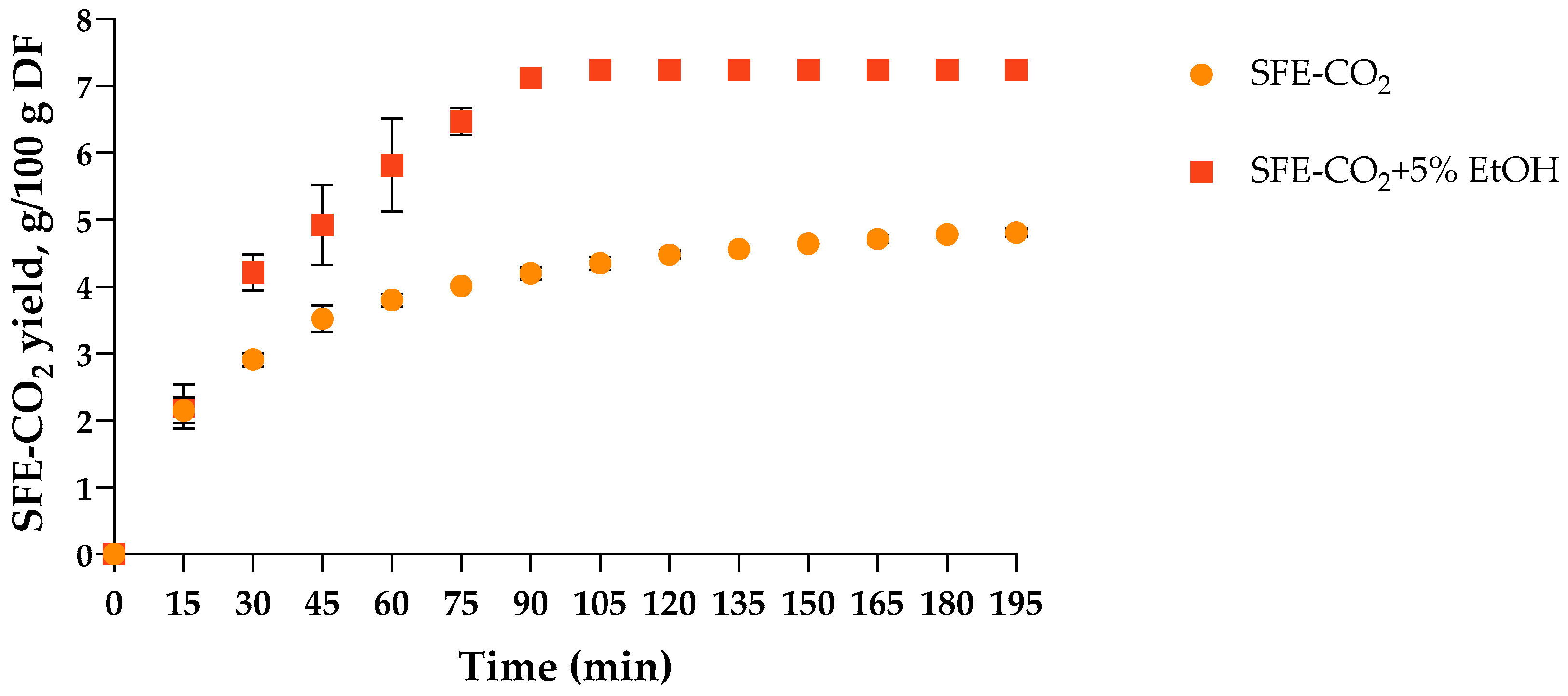
Figure 1. Kinetics of SFE-CO2 extraction of T. officinale flowers with and without EtOH as co-solvent. DF: T. officinale flowers; SFE-CO2: supercritical carbon dioxide extraction. Results are expressed as mean ± SD (n = 3).
Plants 15 00099 g001
Figure 2. UV–Vis spectra of T. officinale SFE-CO2 and SFE-CO2 + 5% EtOH extracts at 0.5 mg/mL concentration.
Plants 15 00099 g002
Figure 3. The composition (% of the total GC peak area) of volatile compound groups in the headspace of T. officinale flowers (A), SFE-CO2 (B), and SFE-CO2 + 5% EtOH (C) extracts. Percentages are displayed rounded to the first decimal place (the corresponding unrounded values sum to 100%).
Plants 15 00099 g003
Figure 4. Structures of major volatiles identified in T. officinale flowers, SFE-CO2 and SFE-CO2 + 5% EtOH extracts.
Plants 15 00099 g004
Table 1. Yields, in vitro cupric ion reducing antioxidant capacity (TEACCUPRAC), ABTS radical scavenging activity (TEACABTS), total phenolic content (TPC), total flavonoid content (TFC), and β-carotene content of extracts obtained from T. officinale flowers under different SFE-CO2 conditions.
SamplesSFE-CO2SFE-CO2 + 5% EtOH
40 °C, 35 MPa, 195 min40 °C, 35 MPa, 195 min
In vitro antioxidant activity:
TEACCUPRACmg TE/g E84.42 ± 0.50 a169.78 ± 0.99 b
mg TE/g DF4.06 ± 0.02 a12.29 ± 0.07 b
TEACABTSmg TE/g E17.54 ± 0.60 a193.80 ± 0.65 b
mg TE/g DF0.84 ± 0.03 a14.03 ± 0.05 b
Total phenolic and flavonoid content:
TPCmg GAE/g E29.12 ± 0.52 a91.30 ± 1.07 b
mg GAE/g DF1.40 ± 0.02 a6.61 ± 0.08 b
TFCmg QE/g E13.11 ± 0.22 a23.91 ± 0.39 b
mg QE/g DF0.63 ± 0.03 a1.73 ± 0.03 b
Pigment content:
β-carotenemg/g E28.16 ± 0.13 a44.71 ± 0.24 b
mg/g DF1.35 ± 0.01 a3.24 ± 0.02 ba
TPC: total phenolic content; GAE: gallic acid equivalents; TFC: total flavonoid content; QE: quercetin equivalents; TEAC: Trolox equivalent antioxidant capacity; CUPRAC: cupric ion reducing antioxidant capacity; ABTS: ABTS•+ scavenging activity; TE: Trolox equivalents; E: extract; DF: T. officinale flowers; SFE-CO2: supercritical carbon dioxide extraction. Values of mg/g DF are calculated considering SFE-CO2 and SFE-CO2 + 5% EtOH yields. Results are expressed as mean ± SD (n = 4). Different superscript letters in the same row indicate significantly different values (p < 0.05) based on a two-tailed unpaired t-test.
Table 2. Sun protection factors (SPFs) of non-polar extracts obtained from T. officinale flowers under different SFE-CO2 conditions.
ExtractConcentration
(mg/mL)
Sun Protection Factor (SPF)UV-B Absorption
%
SFE-CO2
(35 MPa, 40 °C, 195 min)
0.050.83 ± 0.03 a-
0.101.63 ± 0.05 ab39
0.253.84 ± 0.12 cd74
0.507.26 ± 0.24 f86
1.0013.92 ± 0.45 g93
SFE-CO2 + 5% EtOH
(35 MPa, 40 °C, 195 min)
0.052.96 ± 0.10 c66
0.105.62 ± 0.18 e82
0.2513.53 ± 0.44 g93
0.5026.62 ± 0.86 h96
1.0049.51 ± 1.61 i98
Results are expressed as mean ± SD (n = 4). Different superscript letters in the same column indicate significantly different values (p < 0.05) based on a one-way ANOVA and Tukey’s test.
Disclaimer/Publisher’s Note: The statements, opinions and data contained in all publications are solely those of the individual author(s) and contributor(s) and not of MDPI and/or the editor(s). MDPI and/or the editor(s) disclaim responsibility for any injury to people or property resulting from any ideas, methods, instructions or products referred to in the content.