Article

Assessment of Genetic Diversity in Quinoa Landraces Cultivated in the Ecuadorian Highlands Since the Early 1980s


by
Hipatia Delgado
and
Juan Pedro Martín
*
Departamento de Biotecnología-Biología Vegetal, Escuela Técnica Superior de Ingeniería Agronómica, Alimentaria y de Biosistemas, Universidad Politécnica de Madrid, Avda. Puerta de Hierro 2-4, 28040 Madrid, Spain
*
Author to whom correspondence should be addressed.
Plants 2025, 14(5), 635; https://doi.org/10.3390/plants14050635

Submission received: 21 January 2025 / Revised: 14 February 2025 / Accepted: 17 February 2025 / Published: 20 February 2025
(This article belongs to the Section Plant Genetics, Genomics and Biotechnology)

Abstract

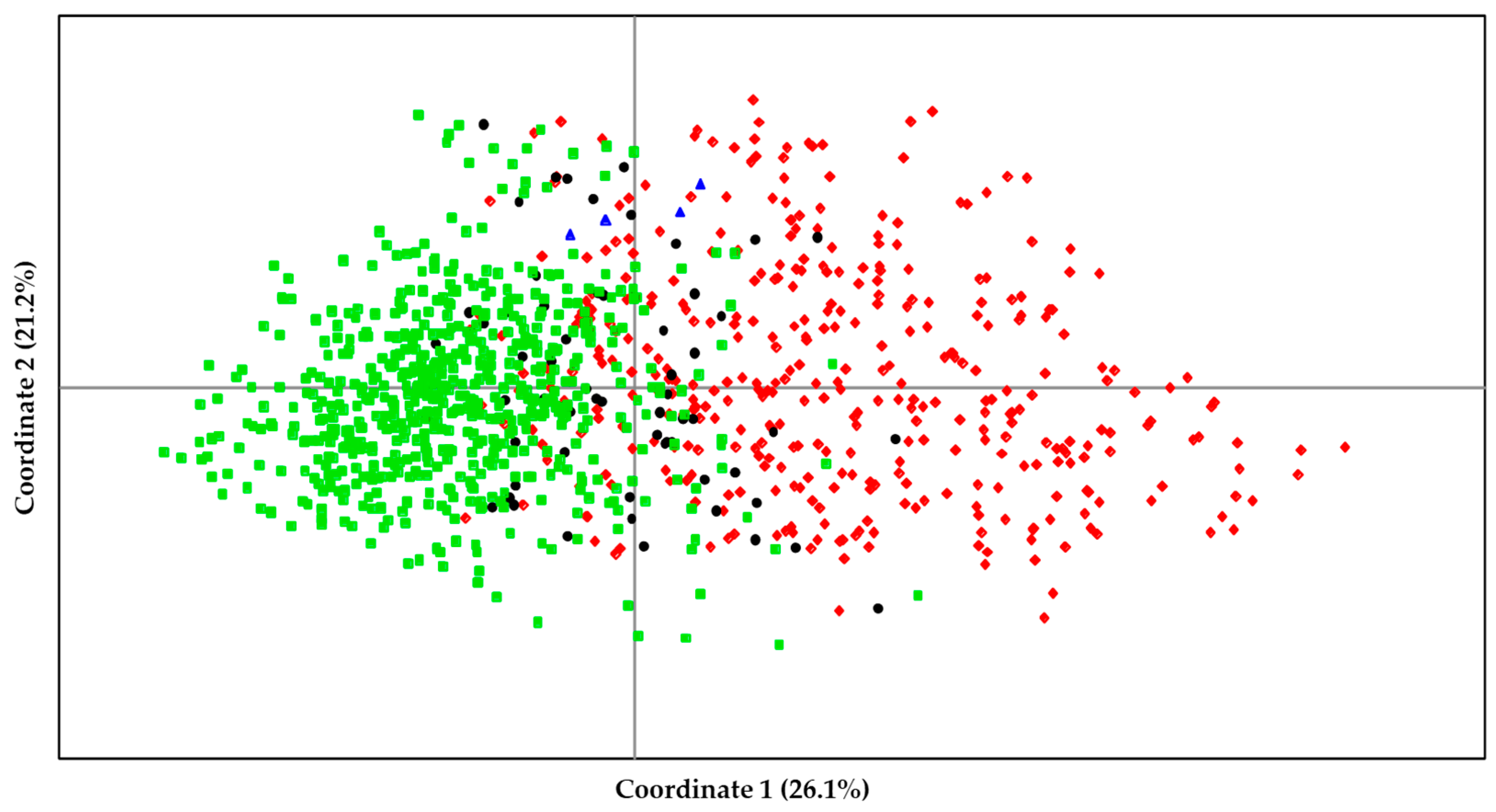
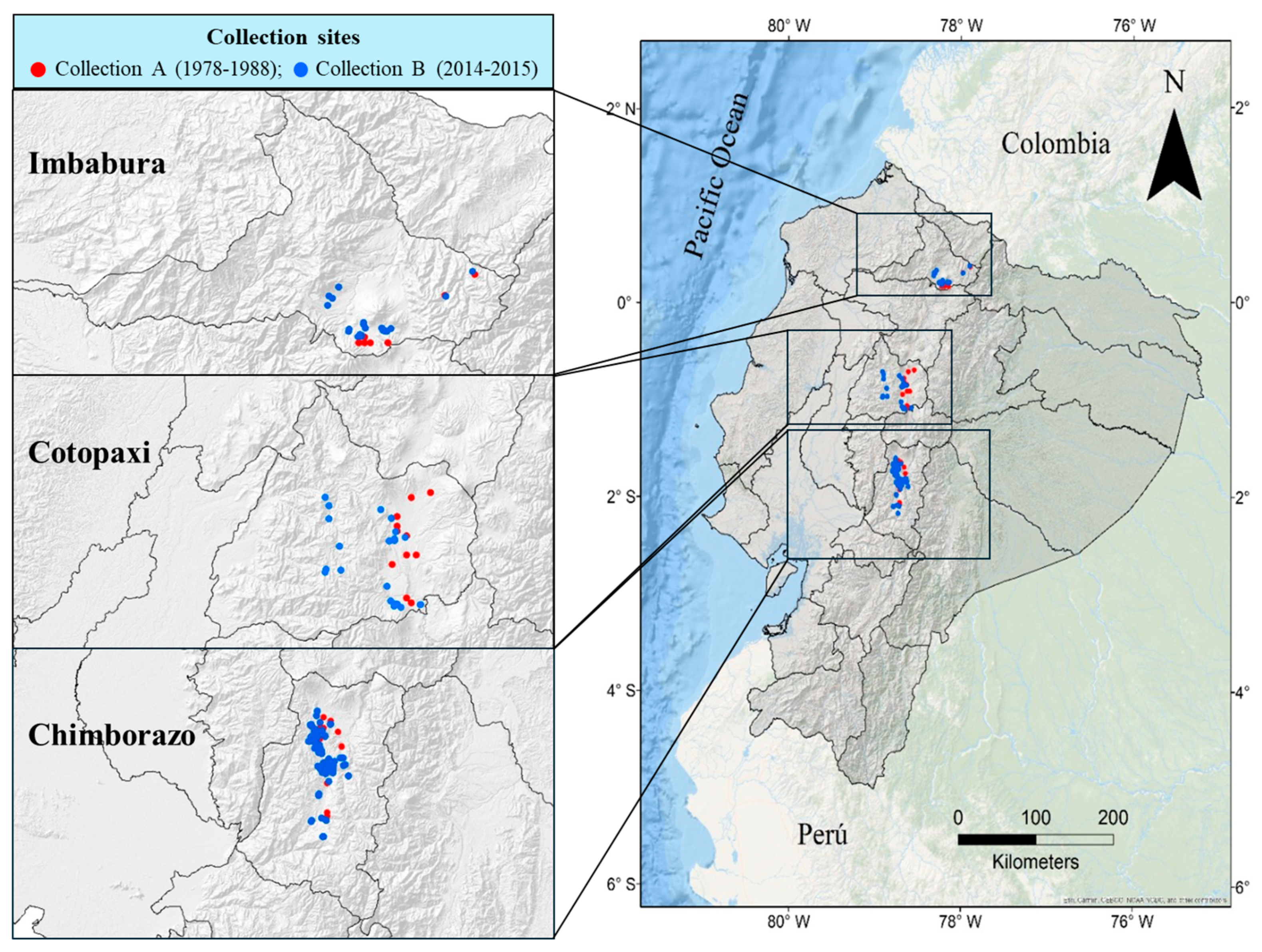
Quinoa (Chenopodium quinoa Willd.) landraces have been cultivated ancestrally in the Andean highlands of Ecuador, where they have had great social and nutritional importance for the native population. Currently, there is scarce information on its genetic diversity and conservation status, and none on the changes that may have occurred in recent decades. In this study, we assessed the genetic diversity of 268 accessions (1340 samples; five per accession) of quinoa landraces collected at two different times (1978–1988 and 2014–2015) in three representative Ecuadorian Andean provinces for this crop (Imbabura, Cotopaxi and Chimborazo) using eight simple sequence repeat (SSR) markers. A total of 124 alleles were found, with a range of 11–24 per locus (mean = 15.5). Averages of expected heterozygosity (He) and Shannon information index (I) were 0.763 and 1.821, respectively. The most informative loci were 3_QAAT050 and 7_QAAT100, with discrimination power (D) values above 92%. Moreover, 1055 different genotypes were found, of which 939 were unique genotypes. This high level of genetic diversity could be explained by the intensive exchange of seeds between farmers in the Andean region. In addition, no significant differences were found in the main genetic diversity parameters between collections and/or provinces. If there is no significant quantitative loss of genetic diversity over the last four decades, this would indicate that indigenous farming communities of this Andean region are preserving their ancestral quinoa germplasm reasonably well. Furthermore, two genetic groups were found with a genetic distance of 0.337. Samples in these groups appear to be related to their provincial origin. This may be due to the different ways in which quinoa landraces are managed and conserved in the different Andean provinces. The results obtained may be very useful for the suitable management and conservation of this ancestral plant genetic resource, both on farm by indigenous farming communities and ex situ by the Germplasm Bank of the Ecuadorian National Institute for Agricultural Research (INIAP).
Keywords: Chenopodium quinoa; genetic structure; genotypic variability; native quinoa; SSR markers Chenopodium quinoa; genetic structure; genotypic variability; native quinoa; SSR markers