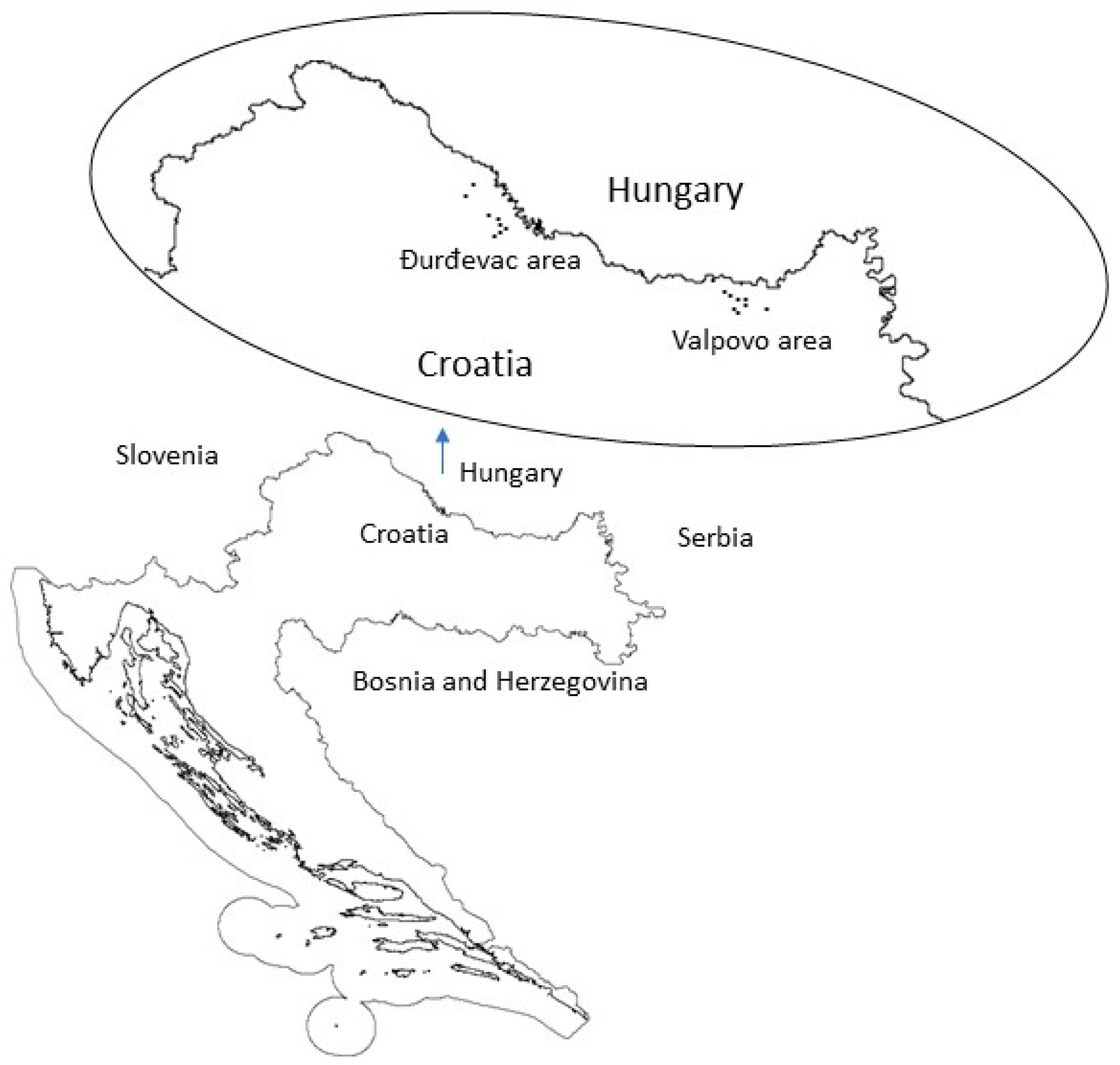
Ethnobotanical Survey of Culturally Important Plants and Mushrooms in North-Western Part of Croatia



Abstract
1. Introduction
2. Results
3. Discussion
4. Materials and Methods
4.1. Study Sites
4.2. Data Collection
4.3. Data Analysis
5. Conclusions
Supplementary Materials
Author Contributions
Funding
Data Availability Statement
Acknowledgments
Conflicts of Interest
References
- Memariani, Z.; Gorji, N.; Moeini, R.; Farzaei, M.H. Chapter Two—Traditional Uses. In Phytonutrients in Food; Nabavi, S.M., Suntar, I., Barreca, D., Khan, H., Eds.; Woodhead Publishing Series in Food Science, Technology and Nutrition; Woodhead Publishing: Cambridge, UK, 2020; pp. 23–66. ISBN 978-0-12-815354-3. [Google Scholar]
- Ekor, M. The Growing Use of Herbal Medicines: Issues Relating to Adverse Reactions and Challenges in Monitoring Safety. Front. Pharmacol. 2014, 4, 177. [Google Scholar] [CrossRef] [PubMed]
- WHO; IUCN; WWF. Guidelines on the Conservation of Medicinal Plants; Castel Cary Press: Somerset, UK, 1993; ISBN 978-2-8317-0136-3. [Google Scholar]
- Leaman, D.J. Sustainable Wild Collection of Medicinal and Aromatic Plants: Development of an International Standard. In Medicinal and Aromatic Plants; Bogers, R.J., Craker, L.E., Lange, D., Eds.; Springer: Dordrecht, The Netherlands, 2006; pp. 97–107. ISBN 978-1-4020-5447-1. [Google Scholar]
- Hosseini, S.H.; Bibak, H.; Ghara, A.R.; Sahebkar, A.; Shakeri, A. Ethnobotany of the Medicinal Plants Used by the Ethnic Communities of Kerman Province, Southeast Iran. J. Ethnobiol. Ethnomed. 2021, 17, 31. [Google Scholar] [CrossRef] [PubMed]
- Manzoor, M.; Ahmad, M.; Zafar, M.; Gillani, S.W.; Shaheen, H.; Pieroni, A.; Al-Ghamdi, A.A.; Elshikh, M.S.; Saqib, S.; Makhkamov, T.; et al. Correction: The Local Medicinal Plant Knowledge in Kashmir Western Himalaya: A Way to Foster Ecological Transition via Community-Centred Health Seeking Strategies. J. Ethnobiol. Ethnomed. 2024, 20, 19. [Google Scholar] [CrossRef] [PubMed]
- Zaman, W.; Ye, J.; Saqib, S.; Liu, Y.; Shan, Z.; Hao, D.; Chen, Z.; Xiao, P. Predicting Potential Medicinal Plants with Phylogenetic Topology: Inspiration from the Research of Traditional Chinese Medicine. J. Ethnopharmacol. 2021, 281, 114515. [Google Scholar] [CrossRef] [PubMed]
- Verpoorte, R. Pharmacognosy in the New Millennium: Leadfinding and Biotechnology. J. Pharm. Pharmacol. 2000, 52, 253–262. [Google Scholar] [CrossRef] [PubMed]
- Tyagi, A.K.; Prasad, S. Drug Discovery Inspired by Mother Nature for Cancer Therapy. Biochem. Physiol. 2014, 4, e128. [Google Scholar] [CrossRef]
- Motti, R. Wild Plants Used as Herbs and Spices in Italy: An Ethnobotanical Review. Plants 2021, 10, 563. [Google Scholar] [CrossRef] [PubMed]
- Ghanimi, R.; Ouhammou, A.; Ahouach, A.; Cherkaoui, M. Ethnobotanical Study on Wild Edible Plants Traditionally Used by Messiwa People, Morocco. J. Ethnobiol. Ethnomed. 2022, 18, 16. [Google Scholar] [CrossRef] [PubMed]
- Asfaw, A.; Lulekal, E.; Bekele, T.; Debella, A.; Tessema, S.; Meresa, A.; Debebe, E. Ethnobotanical Study of Wild Edible Plants and Implications for Food Security. Trees For. People 2023, 14, 100453. [Google Scholar] [CrossRef]
- Sitotaw, R.; Lulekal, E.; Abate, D. Ethnomycological Study of Edible and Medicinal Mushrooms in Menge District, Asossa Zone, Benshangul Gumuz Region, Ethiopia. J. Ethnobiol. Ethnomed. 2020, 16, 11. [Google Scholar] [CrossRef]
- Chauhan, P.P. An Ethnobotanical Survey of Wild Edible Mushrooms—A Potential Resource of Food and Income Generation in Pabbar Valley, Himachal Pradesh, India. Plant Arch. 2021, 21, 267–272. [Google Scholar] [CrossRef]
- Yasin, H.; Zahoor, M.; Yousaf, Z.; Aftab, A.; Saleh, N.; Riaz, N.; Shamsheer, B. Ethnopharmacological Exploration of Medicinal Mushroom from Pakistan. Phytomedicine 2019, 54, 43–55. [Google Scholar] [CrossRef] [PubMed]
- Kumar, A.; Kumar, S.; Komal; Ramchiary, N.; Singh, P. Role of Traditional Ethnobotanical Knowledge and Indigenous Communities in Achieving Sustainable Development Goals. Sustainability 2021, 13, 3062. [Google Scholar] [CrossRef]
- Kor, L.; Fernández-Lucero, M.; Granados Flórez, D.A.; Dawson, T.P.; Diazgranados, M. Bridging Local and Scientific Knowledge for Area-Based Conservation of Useful Plants in Colombia. Ambio 2024, 53, 309–323. [Google Scholar] [CrossRef] [PubMed]
- Hill, R.; Adem, Ç.; Alangui, W.V.; Molnár, Z.; Aumeeruddy-Thomas, Y.; Bridgewater, P.; Tengö, M.; Thaman, R.; Adou Yao, C.Y.; Berkes, F.; et al. Working with Indigenous, Local and Scientific Knowledge in Assessments of Nature and Nature’s Linkages with People. Curr. Opin. Environ. Sustain. 2020, 43, 8–20. [Google Scholar] [CrossRef]
- Cordero, S.; Gálvez, F.; Arenas, J.; Valenzuela, E.R. Does Access to Natural Environments Explain Differences in the Use of Wild Plants between Rural and Urban Populations? Bot. Sci. 2021, 99, 104–123. [Google Scholar] [CrossRef]
- Thomas, E.; Vandebroek, I.; Van Damme, P.; Goetghebeur, P.; Douterlungne, D.; Sanca, S.; Arrazola, S. The Relation between Accessibility, Diversity and Indigenous Valuation of Vegetation in the Bolivian Andes. J. Arid. Environ. 2009, 73, 854–861. [Google Scholar] [CrossRef]
- Nacionalna Klasifikacija Staništa (5. Verzija) Prilog 1. Pravilnika o Popisu Stanišnih Tipova i Karti Staništa. Narodne Novine. 2021. Available online: https://narodne-novine.nn.hr/clanci/sluzbeni/2021_03_27_588.html (accessed on 2 June 2024).
- Šiljković, Ž.; Rimanić, A. Geografski aspekti ekološkog uzgoja ljekovitog bilja u Hrvatskoj. Geoadria 2005, 10, 53–68. [Google Scholar] [CrossRef][Green Version]
- Łuczaj, Ł.; Jug-Dujaković, M.; Dolina, K.; Jeričević, M.; Vitasović-Kosić, I. Insular Pharmacopoeias: Ethnobotanical Characteristics of Medicinal Plants Used on the Adriatic Islands. Front. Pharmacol. 2021, 12, 623070. [Google Scholar] [CrossRef] [PubMed]
- Łuczaj, Ł.; Jug-Dujaković, M.; Dolina, K.; Jeričević, M.; Vitasović-Kosić, I. The Ethnobotany and Biogeography of Wild Vegetables in the Adriatic Islands. J. Ethnobiol. Ethnomed. 2019, 15, 18. [Google Scholar] [CrossRef]
- Vitasović Kosić, I.; Juračak, J.; Łuczaj, Ł. Using Ellenberg-Pignatti Values to Estimate Habitat Preferences of Wild Food and Medicinal Plants: An Example from Northeastern Istria (Croatia). J. Ethnobiol. Ethnomed. 2017, 13, 31. [Google Scholar] [CrossRef] [PubMed]
- Dolina, K.; Jug-Dujaković, M.; Łuczaj, Ł.; Vitasović-Kosić, I. A Century of Changes in Wild Food Plant Use in Coastal Croatia: The Example of Krk and Poljica. Acta Soc. Bot. Pol. 2016, 85, 3508. [Google Scholar] [CrossRef]
- Varga, F.; Šolić, I.; Jug Dujaković, M.; Łuczaj, Ł.; Grdiša, M. The First Contribution to the Ethnobotany of Inland Dalmatia: Medicinal and Wild Food Plants of the Knin Area, Croatia. Acta Soc. Bot. Pol. 2019, 88, 3622. [Google Scholar] [CrossRef]
- Vitasović-Kosić, I.; Hodak, A.; Łuczaj, Ł.; Marić, M.; Juračak, J. Traditional Ethnobotanical Knowledge of the Central Lika Region (Continental Croatia)—First Record of Edible Use of Fungus Taphrina Pruni. Plants 2022, 11, 3133. [Google Scholar] [CrossRef] [PubMed]
- Žuna Pfeiffer, T.; Krstin, L.; Špoljarić Maronić, D.; Hmura, M.; Eržić, I.; Bek, N.; Stević, F. An Ethnobotanical Survey of Useful Wild Plants in the North-Eastern Part of Croatia (Pannonian Region). Plant Biosyst. 2020, 154, 463–473. [Google Scholar] [CrossRef]
- Uranjek, N. Elaborat Zaštite Okoliša—Izgradnja Sunčane Elektrane Valpovo Priključne Snage 6 MW; Grad Valpovo, Croatia, 2022. [Google Scholar]
- Bilandžić, N.; Dokic, M.; Sedak, M.; Varenina, I.; Solomun Kolanovic, B.; Končurat, A.; Šimić, B.; Rudan, N. Content of Five Trace Elements in Different Honey Types from Koprivnica-Križevci County. Slov. Vet. Res. 2012, 49, 167–175. [Google Scholar]
- Király, G.; Hohla, M.; Nikolić, T. Novelties in the Vascular Flora of Croatia. Nat. Croat. 2021, 30, 173–189. [Google Scholar] [CrossRef]
- Jelić Milković, S.; Lončarić, R.; Sudarić, T.; Deže, J.; Lončarić, Z. Economic Potential of Agricultural Residues in the Area of Osijek-Baranja County. In Proceedings of the 56th Croatian & 16th International Symposium on Agriculture, Vodice, Croatia, 5–10 September 2021. [Google Scholar]
- Anonymous. Godišnje Izvješće o Provedbi Plana Razvoja Osječko-Baranjske Županije Za Razdoblje Do 2027. Godine Za 2023, Godinu; Županijska Razvojna Agencija Osječko-Baranjske Županije: Osijek, Croatia, 2024. [Google Scholar]
- Janaćković, P.; Gavrilović, M.; Miletić, M.; Radulović, M.; Kolašinac, S.; Stevanović, Z.D. Small Regions as Key Sources of Traditional Knowledge: A Quantitative Ethnobotanical Survey in the Central Balkans. J. Ethnobiol. Ethnomed. 2022, 18, 70. [Google Scholar] [CrossRef] [PubMed]
- Ferrier, J.; Saciragic, L.; Trakić, S.; Chen, E.C.H.; Gendron, R.L.; Cuerrier, A.; Balick, M.J.; Redžić, S.; Alikadić, E.; Arnason, J.T. An Ethnobotany of the Lukomir Highlanders of Bosnia & Herzegovina. J. Ethnobiol. Ethnomed. 2015, 11, 81. [Google Scholar] [CrossRef]
- Mullalija, B.; Mustafa, B.; Hajdari, A.; Quave, C.L.; Pieroni, A. Ethnobotany of Rural and Urban Albanians and Serbs in the Anadrini Region, Kosovo. Genet. Resour. Crop Evol. 2021, 68, 1825–1848. [Google Scholar] [CrossRef]
- Vitasović-Kosić, I.; Kužir, M. Traditional wild growing and cultivated plants used in the town of Varaždin (Croatia). Krmiva 2018, 60, 83–95. [Google Scholar] [CrossRef]
- Jarić, S.; Popović, Z.; Mačukanović-Jocić, M.; Djurdjević, L.; Mijatović, M.; Karadžić, B.; Mitrović, M.; Pavlović, P. An Ethnobotanical Study on the Usage of Wild Medicinal Herbs from Kopaonik Mountain (Central Serbia). J. Ethnopharmacol. 2007, 111, 160–175. [Google Scholar] [CrossRef]
- Guimbo, I.D.; Mueller, J.G.; Larwanou, M. Ethnobotanical Knowledge of Men, Women and Children in Rural Niger: A Mixed-Methods Approach. Ethnobot. Res. Appl. 2011, 9, 235–242. [Google Scholar] [CrossRef]
- Caldeira, G.I.; Gouveia, L.P.; Serrano, R.; Silva, O.D. Hypericum Genus as a Natural Source for Biologically Active Compounds. Plants 2022, 11, 2509. [Google Scholar] [CrossRef]
- Savić, J.; Mačukanović-Jocić, M.; Jarić, S. Medical Ethnobotany on the Javor Mountain (Bosnia and Herzegovina). Eur. J. Integr. Med. 2019, 27, 52–64. [Google Scholar] [CrossRef]
- Zlatkovic, B.; Nikolic, M.; Drndarevic, M.; Jovanovic, M.; Niketic, M. Revision of the Genus Hypericum L. (Hypericaceae) in Three Herbarium Collections from Serbia. Bull. Am. Mus. Nat. Hist. 2014, 93–127. [Google Scholar] [CrossRef]
- Cavalloro, V.; Robustelli della Cuna, F.S.; Quai, E.; Preda, S.; Bracco, F.; Martino, E.; Collina, S. Walking around the Autonomous Province of Trento (Italy): An Ethnobotanical Investigation. Plants 2022, 11, 2246. [Google Scholar] [CrossRef]
- Ahmad, I.; Shamsi, S.; Zaman, R. A Review on Sour Cherry (Prunus cerasus): A High Value Unani Medicinal Fruit. Int. Res. J. Pharm. 2017, 11, 1–6. [Google Scholar] [CrossRef]
- Tardío, J.; Pardo-De-Santayana, M.; Morales, R. Ethnobotanical Review of Wild Edible Plants in Spain. Bot. J. Linnean Soc. 2006, 152, 27–71. [Google Scholar] [CrossRef]
- Mustafa, B.; Hajdari, A.; Pajazita, Q.; Syla, B.; Quave, C.L.; Pieroni, A. An Ethnobotanical Survey of the Gollak Region, Kosovo. Genet. Resour. Crop Evol. 2012, 59, 739–754. [Google Scholar] [CrossRef]
- Gavrilovic, M.; Milutinović, M.; Dajic Stevanovic, Z.; Janackovic, P. Traditional Use of Cultivated Plants in Mt. Tara (Western Serbia)—An Ethnobotanical Survey. Maced. Pharm. Bull. 2023, 68, 173–174. [Google Scholar] [CrossRef]
- Koleva, V.; Dragoeva, A.; Nanova, Z.; Koynova, T.; Dashev, G. An Ethnobotanical Study on Current Status of Some Medicinal Plants Used in Bulgaria. Int. J. Curr. Microbiol. App. Sci. 2015, 4, 297–305. [Google Scholar]
- Dénes, A.; Papp, N.; Babai, D.; Czúcz, B.; Molnár, Z. Wild Plants Used for Food by Hungarian Ethnic Groups Living in the Carpathian Basin. Acta Soc. Bot. Pol. 2012, 81, 381–396. [Google Scholar] [CrossRef]
- Pathak, R.; Sharma, H. A Review on Medicinal Uses of Cinnamomum verum (Cinnamon). J. Drug Deliv. Ther. 2021, 11, 161–166. [Google Scholar] [CrossRef]
- Shukla, R.; Rai, N.; Singhai, M.; Singhai, A. A Magical Medicinal Fruit of Piper nigrum. World J. Pharm. Res. 2018, 7, 418–425. [Google Scholar]
- Pieroni, A.; Giusti, M.E. Alpine Ethnobotany in Italy: Traditional Knowledge of Gastronomic and Medicinal Plants among the Occitans of the Upper Varaita Valley, Piedmont. J. Ethnobiol. Ethnomed. 2009, 5, 32. [Google Scholar] [CrossRef] [PubMed]
- Ofosu-Bamfo, B.; Yawson, D.; Asare, K.B.; Dadeboe, V.O.; Buabeng, I.K.; Aggrey, J.; Dapillah, D.A.; Boateng, D.K.; Offe, E.; Alhassan, T.A. Plant Diversity and Ethnobotanical Importance of Home Gardens in Ghana’s Middle Belt: A Cross-Sectional Survey of the Sunyani Municipality. J. Ethnobiol. Ethnomed. 2023, 19, 59. [Google Scholar] [CrossRef] [PubMed]
- Agelet, A.; Bonet, M.À.; Vallés, J. Homegardens and Their Role as a Main Source of Medicinal Plants in Mountain Regions of Catalonia (Iberian Peninsula). Econ. Bot. 2000, 54, 295–309. [Google Scholar] [CrossRef]
- Peroni, N.; Hanazaki, N.; Begossi, A.; Zuchiwschi, E.; Lacerda, V.D.; Miranda, T.M. Homegardens in a Micro-Regional Scale: Contributions to Agrobiodiversity Conservation in an Urban-Rural Context. Ethnobiol. Conserv. 2016, 5, 6. [Google Scholar] [CrossRef]
- Elattar, M.M.; Darwish, R.S.; Hammoda, H.M.; Dawood, H.M. An Ethnopharmacological, Phytochemical, and Pharmacological Overview of Onion (Allium cepa L.). J. Ethnopharmacol. 2024, 324, 117779. [Google Scholar] [CrossRef]
- Kianian, F.; Marefati, N.; Boskabady, M.; Ghasemi, S.Z.; Boskabady, M.H. Pharmacological Properties of Allium cepa, Preclinical and Clinical Evidences; A Review. Iran. J. Pharm. Res. 2021, 20, 107–134. [Google Scholar] [CrossRef] [PubMed]
- Khan, F.A.; Mahmood, T.; Ali, M.; Saeed, A.; Maalik, A. Pharmacological Importance of an Ethnobotanical Plant: Capsicum annuum L. Nat. Prod. Res. 2014, 28, 1267–1274. [Google Scholar] [CrossRef] [PubMed]
- Gilca, M.; Tiplica, G.S.; Salavastru, C.M. Traditional and Ethnobotanical Dermatology Practices in Romania and Other Eastern European Countries. Clin. Dermatol. 2018, 36, 338–352. [Google Scholar] [CrossRef] [PubMed]
- Al-Snafi, P.D.A.E. Nutritional and Therapeutic Importance of Daucus carota—A Review. IOSR J. Pharm. 2017, 07, 72–88. [Google Scholar] [CrossRef]
- Menendez-Baceta, G.; Aceituno-Mata, L.; Tardío, J.; Reyes-García, V.; Pardo-de-Santayana, M. Wild Edible Plants Traditionally Gathered in Gorbeialdea (Biscay, Basque Country). Genet. Resour. Crop. Evol. 2012, 59, 1329–1347. [Google Scholar] [CrossRef]
- Hadjichambis, A.C.; Paraskeva-Hadjichambi, D.; Della, A.; Giusti, M.E.; De Pasquale, C.; Lenzarini, C.; Censorii, E.; Gonzales-Tejero, M.R.; Sanchez-Rojas, C.P.; Ramiro-Gutierrez, J.M.; et al. Wild and Semi-Domesticated Food Plant Consumption in Seven Circum-Mediterranean Areas. Int. J. Food. Sci. Nutr. 2008, 59, 383–414. [Google Scholar] [CrossRef] [PubMed]
- Pieroni, A.; Nebel, S.; Santoro, R.F.; Heinrich, M. Food for Two Seasons: Culinary Uses of Non-Cultivated Local Vegetables and Mushrooms in a South Italian Village. Int. J. Food Sci. Nutr. 2005, 56, 245–272. [Google Scholar] [CrossRef] [PubMed]
- Pardo de Santayana, M.; Pieroni, A.; Puri, R.K. The Ethnobotany of Europe, Past and Present. In Berghahn Books; Pardo de Santayana, M., Pieroni, A., Puri, R.K., Eds.; Berghahn Books: Oxford, UK, 2010; pp. 1–15. ISBN 978-1-84545-456-2. [Google Scholar]
- Pieroni, A. Traditional Uses of Wild Food Plants, Medicinal Plants, and Domestic Remedies in Albanian, Aromanian and Macedonian Villages in South-Eastern Albania. J. Herb. Med. 2017, 9, 81–90. [Google Scholar] [CrossRef]
- El Mihyaoui, A.; Esteves da Silva, J.C.G.; Charfi, S.; Candela Castillo, M.E.; Lamarti, A.; Arnao, M.B. Chamomile (Matricaria chamomilla L.): A Review of Ethnomedicinal Use, Phytochemistry and Pharmacological Uses. Life 2022, 12, 479. [Google Scholar] [CrossRef] [PubMed]
- El Hassani, F.Z. Characterization, Activities, and Ethnobotanical Uses of Mentha Species in Morocco. Heliyon 2020, 6, e05480. [Google Scholar] [CrossRef]
- Šarić-Kundalić, B.; Dobeš, C.; Klatte-Asselmeyer, V.; Saukel, J. Ethnobotanical Study on Medicinal Use of Wild and Cultivated Plants in Middle, South and West Bosnia and Herzegovina. J. Ethnopharmacol. 2010, 131, 33–55. [Google Scholar] [CrossRef] [PubMed]
- Saqib, S.; Ullah, F.; Naeem, M.; Younas, M.; Ayaz, A.; Ali, S.; Zaman, W. Mentha: Nutritional and Health Attributes to Treat Various Ailments Including Cardiovascular Diseases. Molecules 2022, 27, 6728. [Google Scholar] [CrossRef] [PubMed]
- Petrisor, G.; Motelica, L.; Craciun, L.N.; Oprea, O.C.; Ficai, D.; Ficai, A. Melissa officinalis: Composition, Pharmacological Effects and Derived Release Systems—A Review. Int. J. Mol. Sci. 2022, 23, 3591. [Google Scholar] [CrossRef] [PubMed]
- Semwal, P.; Rauf, A.; Olatunde, A.; Singh, P.; Zaky, M.Y.; Islam, M.M.; Khalil, A.A.; Aljohani, A.S.M.; Al Abdulmonem, W.; Ribaudo, G. The Medicinal Chemistry of Urtica dioica L.: From Preliminary Evidence to Clinical Studies Supporting Its Neuroprotective Activity. Nat. Prod. Bioprospect. 2023, 13, 16. [Google Scholar] [CrossRef] [PubMed]
- Di Napoli, A.; Zucchetti, P. A Comprehensive Review of the Benefits of Taraxacum officinale on Human Health. Bull. Natl. Res. Cent. 2021, 45, 110. [Google Scholar] [CrossRef]
- Mekonnen, A.B.; Mohammed, A.S.; Tefera, A.K. Ethnobotanical Study of Traditional Medicinal Plants Used to Treat Human and Animal Diseases in Sedie Muja District, South Gondar, Ethiopia. Evid.-Based Complement Altern. Med. 2022, 2022, e7328613. [Google Scholar] [CrossRef] [PubMed]
- Łuczaj, Ł.; Fressel, N.; Perković, S. Wild Food Plants Used in the Villages of the Lake Vrana Nature Park (Northern Dalmatia, Croatia). Acta Soc. Bot. Pol. 2013, 82, 275–281. [Google Scholar] [CrossRef]
- Dimitrova, T. Ethnomycological Research in the Field of Wild Mushrooms and Medicinal Plants. Acta Sci. Nat. 2021, 8, 67–83. [Google Scholar] [CrossRef]
- Tsai, S.-Y.; Tsai, H.-L.; Mau, J.-L. Antioxidant Properties of Agaricus blazei, Agrocybe cylindracea, and Boletus edulis. LWT 2007, 40, 1392–1402. [Google Scholar] [CrossRef]
- Cioacă, L.; Enescu, C.M. Trends in the Evolution of Harvesting of Non-Wood Forest Products in Romania. Res. J. Agric. Sci. 2018, 50, 82–86. [Google Scholar]
- Vitasović-Kosić, I.; Gugić, K.; Dorbić, B. Ethnobotanical use of wild plants and wild mushrooms in folk medicine and human nutrition of the Vitez municipality (Bosnia and Hercegovina). Krmiva 2020, 62, 39–56. [Google Scholar] [CrossRef]
- Rexhepi, B.; Reka, A. Ethno-Mycological Knowledge of Some Wild Medicinal and Food Mushrooms from Osogovo Mountains (North Macedonia). J. Nat. Sci. Math. UT 2020, 5, 10–19. [Google Scholar]
- Zsigmond, A.R.; Varga, K.; Kántor, I.; Urák, I.; May, Z.; Héberger, K. Elemental Composition of Wild Growing Agaricus campestris Mushroom in Urban and Peri-Urban Regions of Transylvania (Romania). J. Food Compos. Anal. 2018, 72, 15–21. [Google Scholar] [CrossRef]
- Dar, A.H.; Wani, A.H.; Bhat, M.Y.; Sheikh, A.R.; Talie, M.D. Conspectus of Traditional Ethnomycological Insights Pertaining to Wild Mushrooms of South Kashmir, India. Phytomed. Plus 2023, 3, 100477. [Google Scholar] [CrossRef]
- Kaur, K.; Kaur, G.; Sandhu, P.K. Macrolepiota Procera. In Phytochemistry and Nutritional Composition of Significant Wild Medicinal and Edible Mushrooms: Traditional Uses and Pharmacology; Sharma, A., Bhardwaj, G., Nayik, G.A., Eds.; Royal Society of Chemistry: London, UK, 2023; pp. 273–301. ISBN 978-1-83767-209-7. [Google Scholar]
- Tolić, S.; Maurović Košćak, L. City of Valpovo Development Strategy 2015–2020; 2015. [Google Scholar]
- Anonymous. Total Program of the Development of the City of Đurđevac for the Period from 2011 to 2013; 2011. [Google Scholar]
- The ISE Code of Ethics. Available online: https://www.ethnobiology.net/what-we-do/core-programs/ise-ethics-program/code-of-ethics/ (accessed on 21 April 2024).
- Nikolić, T. Flora Croatica: Vaskularna Flora Republike Hrvatske; Alfa d.d.: Zagreb, Croatia, 2019. [Google Scholar]
- Flora Croatica Database (FCD). Available online: https://hirc.botanic.hr/fcd/ (accessed on 5 April 2022).
- Javorka, S.; Csapody, V. Iconographia Florae Partis Austro-Orientalis Europae Centralis; Akadémiai Kiadó: Budapest, Hungary, 1975; ISBN 978-963-05-0502-490. [Google Scholar]
- Tardío, J.; Pardo-de-Santayana, M. Cultural Importance Indices: A Comparative Analysis Based on the Useful Wild Plants of Southern Cantabria (Northern Spain)1. Econ. Bot. 2008, 62, 24–39. [Google Scholar] [CrossRef]
- Simanova, A.; Pruse, B.; Kalle, R.; Kochalski, S.; Prakofjewa, J.; Mežaka, I.; Pieroni, A.; Krūzkopa, S.; Holsta, I.; Sõukand, R. Medicinal Plant Use at the Beginning of the 21st Century among the Religious Minority in Latgale Region, Latvia. Ethnobot. Res. Appl. 2020, 20, 21. [Google Scholar] [CrossRef]
- González-Tejero, M.R.; Casares-Porcel, M.; Sánchez-Rojas, C.P.; Ramiro-Gutiérrez, J.M.; Molero-Mesa, J.; Pieroni, A.; Giusti, M.E.; Censorii, E.; de Pasquale, C.; Della, A.; et al. Medicinal Plants in the Mediterranean Area: Synthesis of the Results of the Project Rubia. J. Ethnopharmacol. 2008, 116, 341–357. [Google Scholar] [CrossRef]
- Pirker, H.; Haselmair, R.; Kuhn, E.; Schunko, C.; Vogl, C.R. Transformation of Traditional Knowledge of Medicinal Plants: The Case of Tyroleans (Austria) Who Migrated to Australia, Brazil and Peru. J. Ethnobiol. Ethnomed. 2012, 8, 44. [Google Scholar] [CrossRef] [PubMed]
- Heinrich, M.; Ankli, A.; Frei, B.; Weimann, C.; Sticher, O. Medicinal Plants in Mexico: Healers’ Consensus and Cultural Importance. Soc. Sci. Med. 1998, 47, 1859–1871. [Google Scholar] [CrossRef]
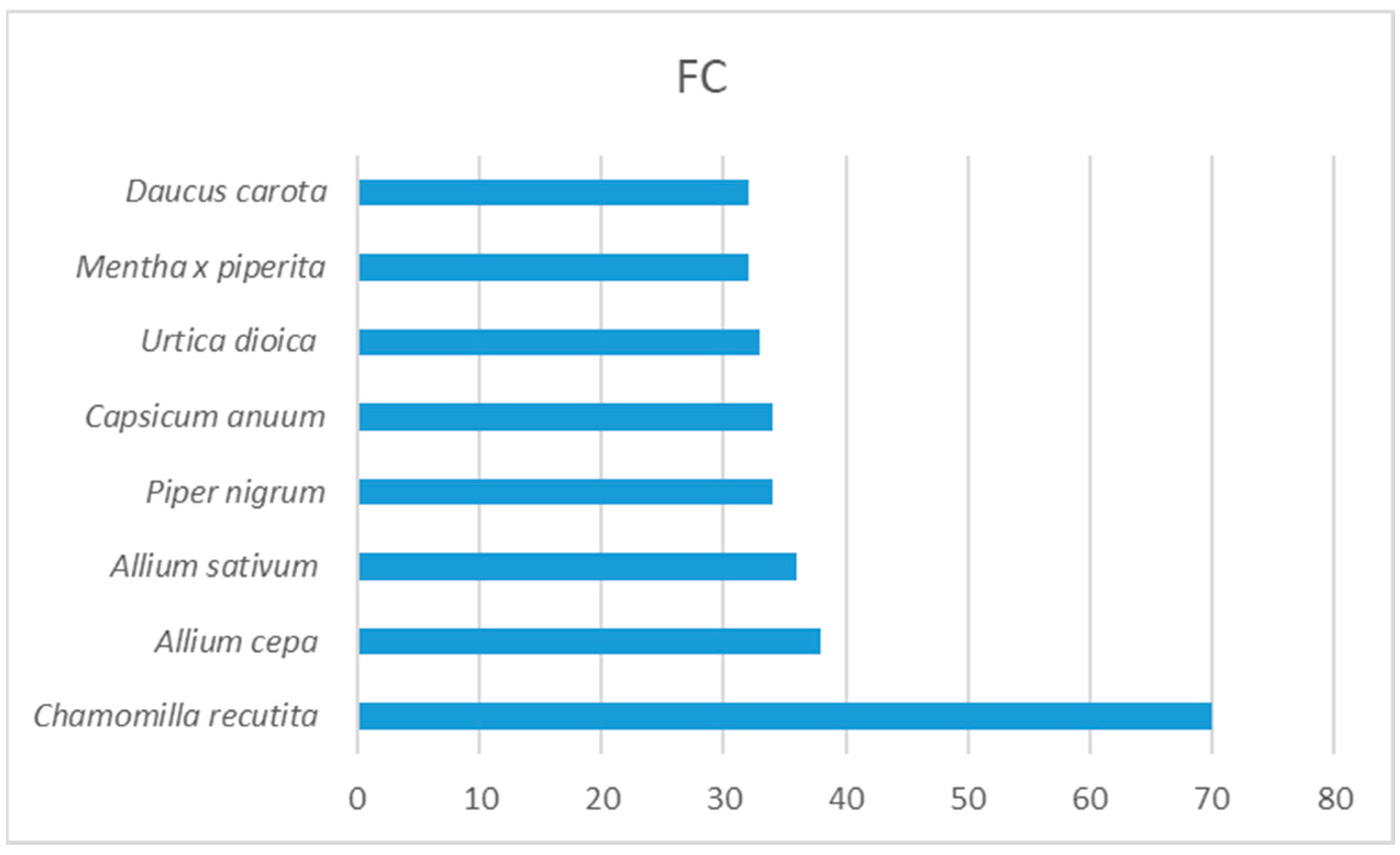
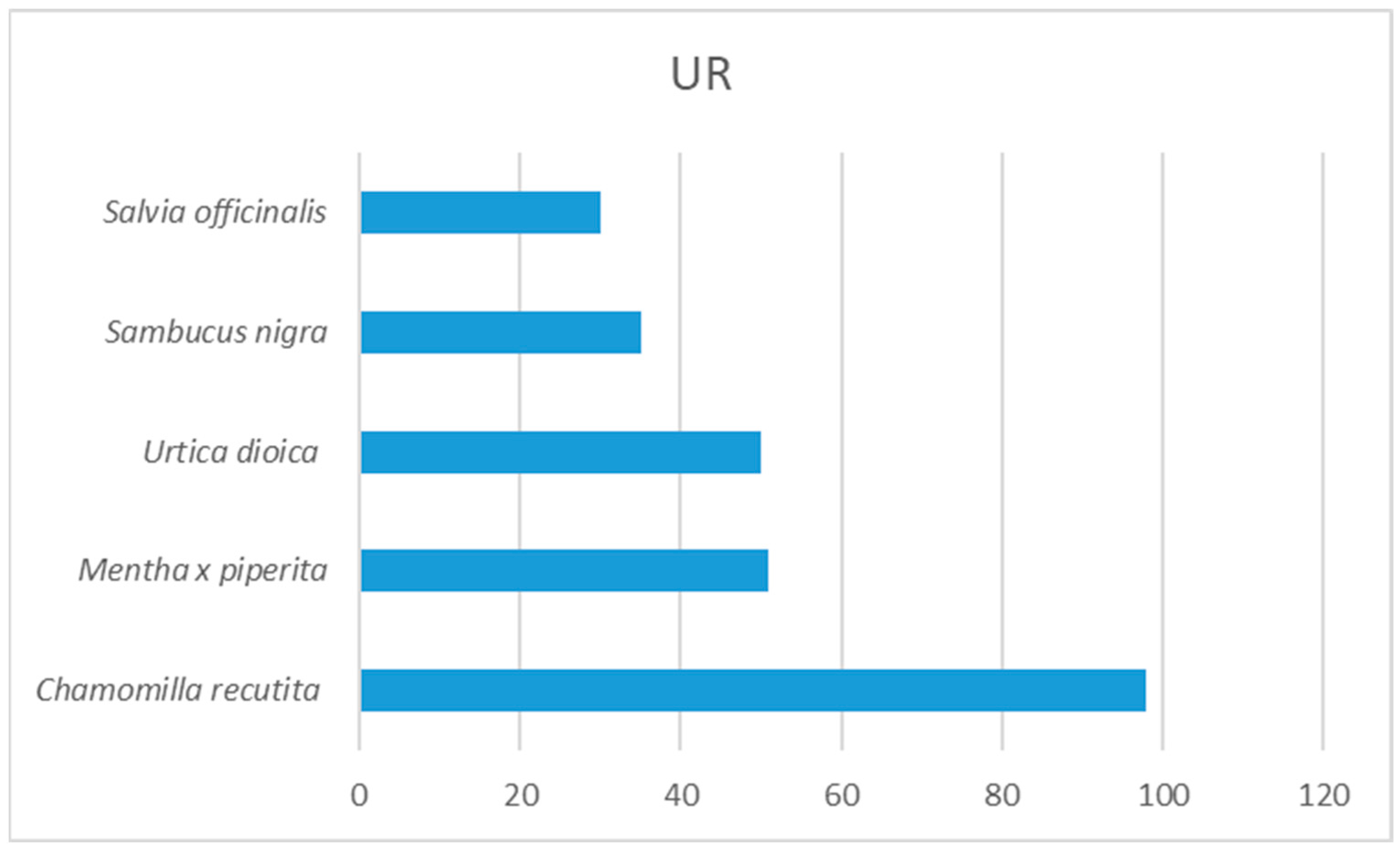


| Botanical Name | Family | Local Name | Part Used | Preparation | Uses | FC | Status |
|---|---|---|---|---|---|---|---|
| Abelmoschus esculentus (L.) Moench * | Malvaceae | bamija | leaf, fruit | spice, winter stores | food, T: diabetes | 1 | c |
| Achillea millefolium L. ** | Asteraceae | stolisnik | flower, leaf | infusion, fresh, ointment, macerate, tincture | D: digestive problems, constipation, diarrhea, stomach pains; X: menstrual problems; L: inflammation; U: urinary tract infection; S: dermatological problems; animal food | 23 | w |
| Aesculus hippocastanum L. ** | Hippocastanaceae | divlji kesten | fruit | ointment, tincture | L: back and shoulder pain; K: varicose veins | 8 | w |
| Alchemilla vulgaris L. ** | Rosaceae | vrkuta | flower, leaf | infusion | D: digestive problems; X: polycystic ovaries; T: hormone imbalance | 4 | c |
| Allium cepa L. ** | Amaryllidaceae | crveni luk | bulb, onion peel | spice, fresh, infusion | R: respiratory problems; K: cardiovascular; food | 38 | c |
| Allium sativum L. ** | Amaryllidaceae | češnjak | bulb, onion peel | raw, chopping, spice | K: hypertension; B: immune system booster; R: otitis; food | 36 | c |
| Allium schoenoprasum L. + | Amaryllidaceae | vlasac | leaf | spice | food | 2 | c |
| Allium ursinum L. * | Amaryllidaceae | medvjeđi luk | leaf | fresh | food | 1 | w |
| Althaea officinalis L. + | Malvaceae | bijeli sljez | root, flower | infusion | R: cough, expectoration | 4 | w |
| Aloe vera L. * | Asparagaceae | aloja | leaf | cream, juice | B: immune system; S: skin redness | 1 | c |
| Anethum graveolens L. + | Apiaceae | kopar | leaf | spice | food | 3 | c |
| Apium graveolens L. ** | Apiaceae | celer | leaf, root | fresh juice, infusion | U: urinary tract infection, detoxification; T: weight loss; X: menstrual irregularity; K: cholesterol | 20 | c |
| Arctostaphylos uva ursi (L.) Spreng. * | Ericaceae | medvjetka | leaf | infusion | U: urinary tract infection | 1 | c |
| Armoracia rusticana P. Gaertn., B. Mey. et Scherb. ** | Brassicaceae | hren | root | decoction, inhalation, spice, sauce | R: sinusitis; L: musculoskeletal; food | 5 | w |
| Aronia sp.* | Rosaceae | aronija | fruit, leaf | jam, infusion, juice, wine, fresh | K: cardiovascular; B: for better blood count; D: digestive problems; food | 10 | c |
| Artemisia absinthium L. * | Asteraceae | gorski pelin | leaf, herb | infusion | D: gastrointestinal problems | 4 | w |
| Artemisia vulgaris L. + | Asteraceae | obični pelin | leaf | infusion | D: nausea, stomach pain, digestive parasites | 6 | w |
| Avena sativa L.* | Poaceae | zob | seed | infusion | D: gastrointestinal problems; L: musculoskeletal; U: urinary tract infection | 2 | c |
| Beta vulgaris var. conditiva L. + | Chenopodiaceae | cikla | root | pickled, fresh juice | B: anemia; food | 2 | c |
| Betula pendula Roth ** | Betulaceae | bijela breza | leaf, buds | infusion | U: urinary tract infection; R sore throat | 2 | w |
| Brassica oleracea L. ** | Brassicaceae | obični kupus | leaf | compression | A: fever; L: joint pain | 4 | c |
| Calendula officinalis L. ** | Asteraceae | ljekoviti neven | flower, leaf | ointment, infusion, macerate, cream, tincture | S: wounds, scars, burns, stretch marks, dry skin, infection; K: hemorrhoids, varicose veins; X: menstrual problems | 24 | c |
| Cannabis sativa L. + | Cannabaceae | sjetvena konoplja | flower | inhalation | P: agitation; L: pain | 2 | c |
| Capsicum anuum L. + | Solanaceae | paprika | fruit | spice | food | 34 | c |
| Carum carvi L. ** | Apiaceae | kim, kumin | seed | spice, infusion, oil | D: gastrointestinal problems; animal food; food | 5 | c |
| Castanea sativa L. * | Fagaceae | pitomi kesten | fruit | boiling | food | 1 | c |
| Centaurium erythraea Rafn * | Gentianaceae | štitasta kičica | herb | infusion | D: gastrointestinal problems | 1 | w |
| Ceratonia siliqua L. * | Fabaceae | rogač | fruit | chopping | D: gastrointestinal problems; R: allergies; food | 1 | c |
| Chamomilla recutita (L.) Rauschert ** | Asteraceae | prava kamilica | flower | infusion, compression, inhalation, cream, ointment | R: sore throat, respiratory problems, cold; F: eye inflammation; S: inflammatory skin reaction, infection; P: insomnia, relaxation, agitation; X: menstrual problem; D: gastrointestinal problems, diarrhea; N: neurological; F: eye inflammation; A: fever | 70 | w |
| Chelidonium majus L. * | Papaveraceae | rosopas | herb, flower | fresh, ointment | S: dermatological problems | 3 | w |
| Cinnamomum verum J. Presl + | Lauraceae | cimet | bark | spice | T: blood sugar level balancing | 14 | p |
| Citrullus lanatus (Thunb.) Matsum. et Nakai * | Cucurbitaceae | lubenica | seed | infusion | U: urinary tract infection | 1 | c |
| Citrus limon (L.) Burm. f. * | Rutaceae | limun | fruit | limoncello | food–drink | 1 | c |
| Coriandrum sativum L. + | Apiaceae | sjetveni korijander | leaf | spice | food | 1 | c |
| Cornus mas L. * | Cornaceae | drijen | fruit | tincture, jam, fresh | D: gastrointestinal problems; food | 2 | w |
| Crataegus monogyna Jackq. + | Rosaceae | bijeli glog | flower | infusion | K: strengthening the heart, hypertension | 1 | w |
| Cucurbita sp. * | Cucurbitaceae | bundeva | fruit, seed | oil | animal food | 1 | c |
| Curcuma longa L. + | Zingiberaceae | kurkuma | root | spice | food | 5 | p |
| Cydonia oblonga Mill. ** | Rosaceae | dunja | leaf, fruit | infusion, fresh | D: gastrointestinal problems; food; space freshener | 4 | c |
| Cymbopogon citratus D.C. Stapf + | Poaceae | limunska trava | stem, leaf | infusion | P: insomnia | 2 | c |
| Daucus carota L. ** | Apiaceae | mrkva | root | fresh juice, maceration, salad, soup | S: oil for sun; F: eyesight; B: immune system; T: lose weight, vitamin A; food | 32 | c |
| Epilobium parviflorum Schreb * | Onagraceae | vrbovica | leaf, herb | infusion | U: urinary tract infection | 1 | w |
| Equisetum arvense L. * | Equisetaceae | poljska preslica | herb | infusion | U: urinary tract infection; D: gastritis | 11 | w |
| Ficus carica L. * | Moraceae | smokva | fruit, leaf | fresh, jam, cream | S: dermatological problems, infection, viral warts; food | 3 | c |
| Foeniculum vulgare Mill. * | Apiaceae | komorač | leaf, seed, root | infusion | D: gastrointestinal problems; U: detoxification | 1 | c |
| Fragaria vesca L. * | Rosaceae | šumska jagoda | fruit | fresh | food | 1 | w |
| Galium mollugo L. * | Rubiaceae | livadna broćika | herb | infusion | U: detoxification | 1 | w |
| Galium verum L. ** | Rubiaceae | prava broćika | herb | infusion | R: respiratory problems; B: immune system; U: detoxification, urinary tract problems | 3 | w |
| Ginkgo biloba L. + | Ginkgoaceae | ginko | leaf | infusion | N: concentration, memory | 3 | c |
| Helianthus annuus L. * | Asteraceae | suncokret | seed | fresh, dry | animal food | 1 | c |
| Helichrysum italicum (Roth) G Don ** | Asteraceae | smilje | flower, leaf | cream, infusion, oil | S: skin care; R: sore throat; P: anxiety | 3 | c |
| Helleborus niger L. * | Ranunculaceae | crni kukurijek | root | fresh | animal food | 1 | w |
| Hypericum perforatum L. * | Clusiaceae | gospina trava | flower | cantarion oil, infusion, cream | N: neurological problems; S: dermatological problems, infection, against insect bites, sunburn; P: antidepressant, calming down | 12 | w |
| Juglans regia L. ** | Juglandaceae | pitomi orah | leaf, fruit | maceration, oil, liqueur, fresh, cake | L: rheumatism; D: gastrointestinal problems, stomach problems; S: hair loss, dermatological problems; N: memory; food | 9 | c |
| Lamium purpureum L. * | Lamiaceae | crvena mrtva kopriva | flower | honey | food | 1 | w |
| Laurus nobilis L. ** | Lauraceae | obični lovor | leaf | spice, infusion, ointment | R: respiratory problems; K: cardiovascular; food | 24 | c |
| Lavandula angustifolia Mill. ** | Lamiaceae | uskolisna lavanda | flower | oil, infusion, repellent, dry flowers, cream | S: stretch marks, burns, scars, dry skin, disinfection; N: neurological problems, headache; P: relaxation, insomnia; space freshener; repellent | 13 | c |
| Lavandula sp. * | Lamiaceae | lavandin | flower | oil, hydrolat | N: neurological problems | 1 | c |
| Levisticum officinale W.D.J. Koch * | Apiaceae | ljekoviti ljupčac | leaf | spice | food | 1 | c |
| Lilium candidum L. * | Liliaceae | bijeli ljiljan | flower, root | compression, tincture | N: neurological problems, S: dermatological problems | 1 | c |
| Linum usitatissimum L. * | Linaceae | lan | seed | mucus | animal food | 1 | c |
| Lycium barbarum L. * | Solanaceae | obični vučac | fruit | fresh, jam | food | 1 | c |
| Malus pumila Mill. * | Rosaceae | jabuka | fruit | compression, infusion | D: gastrointestinal problems; food | 3 | c |
| Malva sylvestris L. * | Malvaceae | šumski sljez | flower, root | infusion | R: respiratory problems, cold | 6 | w |
| Melissa officinalis L. ** | Lamiaceae | ljekoviti matičnjak | flower, leaf | infusion, syrup | P: agitation, anxiety, depression, calming down; D: stomach ache, cleanliness of the oral cavity; N: neurological problems; B: immune system; A: analgesic; U: detoxification; R: for inhalation; K: tachycardia; food | 12 | c |
| Mentha x piperita L. ** | Lamiaceae | paprena metvica | leaf, herb | inhalation, infusion, tincture, syrup, spice, fresh, liqueur | T: hormone imbalance; R: sore throat, for inhalation, sinusitis; D: digestive problems, cleanliness of the oral cavity, cramps; S: acne; N: neurological problems; B: immune system; A: analgesic; U: detoxification; P: calming down; food | 32 | c |
| Mentha sp. * | Lamiaceae | menta | leaf | infusion | D: gastrointestinal problems | 1 | w |
| Mespilus germanica L. * | Rosaceae | mušmula | fruit | fresh | B: immune system; food, animal food | 2 | c |
| Morus alba L. * | Moraceae | bijeli dud | leaf | infusion | D: gastrointestinal problems; K: cardiovascular | 1 | c |
| Morus nigra L. * | Moraceae | crni dud | fruit | fresh | D: gastrointestinal problems; food | 1 | c |
| Nigella sativa L. + | Ranunculaceae | crni kim | seed | oil | D: digestive problems | 2 | c |
| Ocimum basilicum L. ** | Lamiaceae | bosiljak | leaf | spice | U: kidney disease; food | 13 | c |
| Olea europea L. + | Oleaceae | maslina | fruit | oil, raw | S: dry skin, burns, sun protection; D: constipation | 15 | c |
| Origanum majorana L. * | Lamiaceae | vrtni mažuran | leaf, flower | spice | food | 1 | c |
| Origanum vulgare L. ** | Lamiaceae | obični mravinac | leaf | oil, spice | D: digestive problems, gastritis; food | 27 | c |
| Papaver somniferum L. + | Papaveraceae | pitomi mak | flower, seed | spice | food | 9 | c |
| Petasites hybridus (L.) P. Gaertn., B. Mey. et Schreb. * | Asteraceae | obični lopuh | root | fresh | animal food | 1 | w |
| Petroselinum crispum (Mill.) A. W. Hill * | Apiaceae | peršin | herb | infusion, smoothie, fresh | U: urinary tract infection, detoxification, B: immune system; D: digestive | 2 | c |
| Pinus sylvestris L. * | Pinaceae | bor | needles | infusion, syrup | R: respiratory problems; B: immune system | 1 | w |
| Piper nigrum L. + | Piperaceae | crni papar | fruit | spice | food | 34 | p |
| Plantago lanceolata L. * | Plantaginaceae | uskolisni trputac | leaf | compression, infusion | R: respiratory problems; S: bleeding, infection | 4 | w |
| Plantago major L. ** | Plantaginaceae | veliki trputac | leaf, root | syrup, compression, infusion | R: sore throat, respiratory problems; S: bleeding, infection | 7 | w |
| Potentilla anserina L. * | Rosaceae | guščarski petoprst | leaf | fresh | B: anemia | 1 | w |
| Prunus armeniaca L. * | Rosaceae | marelica | fruit | jam | D: for digestion; food | 3 | c |
| Prunus cerasus L. * | Rosaceae | višnja | fruit, twigs | liqueur, fresh, infusion, juice, pie filling, jam | D: gastrointestinal problems; A: analgesic; food | 7 | c |
| Prunus domestica L. * | Rosaceae | šljiva | fruit | schnapps, jam, infusion | D: gastrointestinal problems; food | 5 | c |
| Prunus dulcis (Mill.) D.A.Webb * | Rosaceae | badem | fruit | oil | S: skin care; food | 1 | c |
| Prunus spinosa L. * | Rosaceae | trnina | flower, fruit | infusion, jam | D: gastrointestinal problems; K: cardiovascular | 1 | w |
| Pulmonaria officinalis L. * | Boraginaceae | ljekoviti plućnjak | leaf | infusion | R: respiratory problems | 1 | w |
| Pyrus sp. * | Rosaceae | kruška | fruit | fresh, schnapps | D: gastrointestinal problems | 2 | c |
| Quercus sp. * | Fagaceae | hrast | bark | infusion | D: gastrointestinal problems, gastritis; food for animals | 2 | w |
| Ribes nigrum L. * | Grossulariaceae | crni ribiz | leaf | infusion | D: gastrointestinal problems; K: cardiovascular | 1 | c |
| Ribes rubrum L. * | Grossulariaceae | crveni ribiz | leaf, fruit | infusion, wine, fresh, jam | B: immune system; U: detoxification; food | 2 | c |
| Ribes uva-crispa L. * | Grossulariaceae | ogrozd, trnoviti ribiz | fruit | fresh | food | 1 | c |
| Ricinus communis L. + | Euphorbiaceae | obični ricinus | seed, whole plant | oil, fresh plant | S: allergy, dry skin, acne; K: hemorrhoids; repellents for mice, moles and mosquitoes | 7 | c |
| Robinia pseudoacacia L. * | Fabaceae | bagrem | flower | honey, infusion, fresh | R: respiratory problems, cold; B: immune system; food | 5 | w |
| Rosa canina L. ** | Rosaceae | pasja ruža | fruit | infusion, jam, raw fruit, fresh juice | D: gastrointestinal problems; U anti-infective; R: sore throat, influenza; B: immune system | 17 | w |
| Rosmarinus officinalis L. ** | Lamiaceae | ružmarin | herb, leaf | spice, maceration, fresh | N: for brain; K: for circulation; food | 18 | c |
| Rubus caesius L.* | Rosaceae | modrosiva kupina | fruit, leaf | wine, juice, infusion, fresh, jam | K: cardiovascular; B: immune system; food | 5 | w |
| Rubus idaeus L. * | Rosaceae | malina | fruit, leaf | jam, juice, infusion, fresh | B: immune system; food | 3 | c |
| Rubus plicatus Weihe et Nees + | Rosaceae | nabrana kupina | fruit | fresh, wine | B: anemia | 11 | c |
| Rumex acetosa L. * | Polygonaceae | kiselica | leaf | fresh | food | 1 | w |
| Rumex sp. * | Polygonaceae | štavelj | flower | infusion | D: gastrointestinal problems | 1 | w |
| Ruta graveolens L. * | Rutaceae | ruta | herb | dry, tincture | repellent | 1 | c |
| Salix alba L. * | Salicaceae | bijela vrba | bark | infusion, compression | B: anemia; A: analgesic; food animal | 1 | w |
| Salvia officinalis L. ** | Lamiaceae | ljekovita kadulja | leaf, flower | infusion, gargling, liqueur, juice | R: sore throat, cough, angina; D: gastrointestinal problems; R: respiratory problems; X: menstrual problems; S: anti-infective | 29 | c |
| Sambucus nigra L. ** | Caprifoliaceae | crna bazga | leaf, flower, fruit | juice, infusion, jam, elderflower fritters | R: respiratory problems, allergies, cold, influenza; B: immune system booster; D: gastrointestinal problems | 22 | w |
| Satureja hortensis L. * | Lamiaceae | vrtni čubar | leaf, flower | spice | D: gastrointestinal problems; food | 1 | c |
| Sempervivum tectorum L. * | Crassulaceae | čuvarkuća | herb, leaf | fresh juice | H: earaches; S: after an insect bite, used to remove corns | 6 | c |
| Solanum tuberosum L. * | Solanaceae | krumpir | fresh tuber | compression | A: body temperature, fever | 1 | c |
| Sorbus domestica L. * | Rosaceae | oskoruša | fruit | fresh, liqueur | D: gastrointestinal problems | 1 | w |
| Stevia rebaudiana Bertoni ** | Asteraceae | slatka stevija | leaf | sweetener, spice | food | 2 | c |
| Symphytum officinale L. * | Boraginaceae | gavez | whole plant, root | infusion, tincture, ointment, cream | D: gastrointestinal problems; R: respiratory problems; L: twist, swelling, sprain | 4 | w |
| Syzygium aromaticum (L.) Merr L.M. Perry + | Myrtaceae | klinčić | buds | infusion | D: stomach ache | 1 | p |
| Tanacetum vulgare L. * | Asteraceae | obični vratić | leaf | dry | repellent | 1 | w |
| Taraxacum officinale F. H. Wigg. ** | Cichoriaceae | ljekoviti maslačak | flower, root, whole plant, leaf | infusion, dandelion syrup, honey, compression, cream, salad, root juice | D: gastrointestinal problems; R: respiratory problems; U: urinary tract infection, detoxification; B: immune system; T: for weight loss; S: reducing inflammation, eczema, facial hydration; food | 21 | w |
| Thymus serpyllum L. ** | Lamiaceae | majčina dušica, timijan | herb, leaf | spice, infusion | D: gastrointestinal problems; X: menstrual problems; N: neurological problems; food | 6 | c |
| Tilia cordata Mill. + | Tiliaceae | malolisna lipa | flower | infusion | A: fever; D: digestive problems, diarrhea; R: cold, cough | 5 | w |
| Tilia sp. * | Tiliaceae | lipa | leaf, flower | infusion, juice, honey | R: respiratory problems, cold; N: neurological problems; P: insomnia; B: immune system; food | 18 | w |
| Trifolium repens L. * | Fabaceae | bijela djetelina | flower | infusion | X: genital system | 2 | w |
| Ulmus minor Mill. * | Ulmaceae | poljski brijest | bark | ointment | S: dermatological problem | 1 | w |
| Urtica dioica L. ** | Urticaceae | obična kopriva | leaf, whole plant, flower | raw, sauce, soup, macerate, juice, syrup, infusion, salad, shampoo | B: anemia, immune system booster; D: gastrointestinal problems; L: musculoskeletal; K: cardiovascular; U: urinary tract infection; N: neurological, U: detoxification; R: cold; S: hair loss, natural shampoo, allergies; against aphids, animal food, food | 33 | w |
| Valeriana officinalis L. ** | Valerianaceae | ljekoviti odoljen | root | infusion | P: agitation, insomnia; T: hormone imbalance; X: menstrual problems | 6 | w |
| Valerianella locusta (L.) Laterr. * | Valerianaceae | obični matovilac | leaf | salad | food | 1 | c |
| Verbascum sp. * | Scrophulariaceae | divizma | flower | dry, boiled in milk | D: gastrointestinal problems | 1 | w |
| Verbena officinalis L. * | Verbenaceae | verbena | flower | honey | food | 1 | c |
| Viola odorata L. * | Violaceae | mirisava ljubica | leaf, flower | infusion | R: respiratory problems | 2 | w |
| Viola tricolor L. * | Violaceae | maćuhica | flower | fresh | food | 1 | w |
| Viscum album L. * | Santalaceae | bijela imela | leaf | infusion | K: cardiovascular | 1 | w |
| Zea mays L. * | Poaceae | kukuruz | corn silk | infusion | U: urinary tract infection | 2 | c |
| Zingiber officinale Roscoe + | Zingiberaceae | đumbir | root | infusion, fresh juice, spice | D: heartburn, nausea, flatulence; L: anti-inflammatory | 9 | p |
| Ailment Category | Nur | Nt | Fic | The Most Frequently Mentioned Plants with UR |
|---|---|---|---|---|
| A—general and unspecified | 10 | 8 | 0.22 | Mentha x piperita 3 |
| B—blood, blood-forming organs, and immune mechanisms | 73 | 23 | 0.69 | Rubus plicatus 11, Urtica dioica 7, Allium sativum 7 |
| D—digestive | 184 | 45 | 0.76 | Origanum vulgare 25, Mentha x piperita 25 |
| F—eye | 11 | 2 | 0.9 | Chamomilla recutita 9 |
| H—ear | 4 | 1 | 1 | Sempervivum tectorum 4 |
| K—cardiovascular | 62 | 17 | 0.74 | Urtica dioica 19, Allium sativum 9 |
| L—musculoskeletal | 18 | 10 | 0.47 | Aesculus hippocastanum 3, Armoracia rusticana 3, Brassica oleracea 3, Symphytum officinale 3 |
| N—neurological | 45 | 13 | 0.73 | Chamomilla recutita 10 |
| P—psychological | 31 | 9 | 0.73 | Chamomilla recutita 13 |
| R-–respiratory | 158 | 26 | 0.84 | Chamomilla recutita 30, Salvia officinalis 20 |
| S—skin | 122 | 23 | 0.82 | Calendula officinalis 23, Chamomilla recituta 19 |
| T—endocrine/metabolic and nutritional | 27 | 8 | 0.73 | Cinnamomum verum 14, Apium graveolens 4 |
| U—urological | 71 | 20 | 0.73 | Urtica dioica 10, Equisetum arvense 10 |
| X—female genitals | 35 | 9 | 0.76 | Chamomilla recutita 9 |
| Botanical Name | Local Name | Family | FC |
|---|---|---|---|
| Agaricus campestris L. 1753. | pećurka | Agaricaceae | 11 |
| Agaricus macrosporus (F.H. Møller and Jul. Schff.) Pilat) | kračun, velika pećurka | Agaricaceae | 1 |
| Armillaria mellea (Vahl) P. Kumm., 1871 | puza, medenjača, kljukača | Physalacriaceae | 2 |
| Boletus aereus Bull. ex Fr., 1789. | hajdinski vrganj | Boletaceae | 2 |
| Boletus edulis Bull. ex Fr., 1782. | ljetni vrganj | Boletaceae | 18 |
| Boletus pinophilus Pilát and Dermek | borov vrganj | Boletaceae | 2 |
| Cantharellus cibarius Fr. | lisičarka | Cantharellaceae | 5 |
| Flammulina velutipes (Curtis) Singer | panjevčica | Physalacriaceae | 5 |
| Hygrophorus eburneus (Bull.) Fr. | bijela puževica | Hygrophoraceae | 1 |
| Lactarius deliciosus (L. ex Fr.) S.F. Gray | obična rujnica | Russulaceae | 2 |
| Lactarius piperatus (L.) Pers. | paprena mliječnica | Russulaceae | 2 |
| Langermannia gigantea (Batsch ex Pers.) Rostk. | golema puhara | Agaricaceae | 1 |
| Leccinum aurantiacum (Bull.) Gray 1821 | turčin | Boletaceae | 3 |
| Leccinum pseudoscabrum (Kallenb.) | grabov djed | Boletaceae | 3 |
| Macrolepiota procera (Scop.) Singer | velika sunčanica | Agaricaceae | 10 |
| Pleurotus ostreatus (Jacq. ex Fr.) P. Kumm. 1871 | bukovača | Polyporaceae | 4 |
| Russula vesca Fr. | jestiva krasnica | Russulaceae | 1 |
Disclaimer/Publisher’s Note: The statements, opinions and data contained in all publications are solely those of the individual author(s) and contributor(s) and not of MDPI and/or the editor(s). MDPI and/or the editor(s) disclaim responsibility for any injury to people or property resulting from any ideas, methods, instructions or products referred to in the content. |
© 2024 by the authors. Licensee MDPI, Basel, Switzerland. This article is an open access article distributed under the terms and conditions of the Creative Commons Attribution (CC BY) license (https://creativecommons.org/licenses/by/4.0/).
Share and Cite
Krstin, L.; Katanić, Z.; Benčić, K.; Lončar, L.; Pfeiffer, T.Ž. Ethnobotanical Survey of Culturally Important Plants and Mushrooms in North-Western Part of Croatia. Plants 2024, 13, 1566. https://doi.org/10.3390/plants13111566
Krstin L, Katanić Z, Benčić K, Lončar L, Pfeiffer TŽ. Ethnobotanical Survey of Culturally Important Plants and Mushrooms in North-Western Part of Croatia. Plants. 2024; 13(11):1566. https://doi.org/10.3390/plants13111566
Chicago/Turabian StyleKrstin, Ljiljana, Zorana Katanić, Katarina Benčić, Laura Lončar, and Tanja Žuna Pfeiffer. 2024. "Ethnobotanical Survey of Culturally Important Plants and Mushrooms in North-Western Part of Croatia" Plants 13, no. 11: 1566. https://doi.org/10.3390/plants13111566
APA StyleKrstin, L., Katanić, Z., Benčić, K., Lončar, L., & Pfeiffer, T. Ž. (2024). Ethnobotanical Survey of Culturally Important Plants and Mushrooms in North-Western Part of Croatia. Plants, 13(11), 1566. https://doi.org/10.3390/plants13111566