
Efficacy and Safety of Endoscopic Strictureplasty and Stricturotomy for Crohn’s Disease-Associated Strictures: A Systematic Review and Current Perspective



Abstract
1. Introduction
2. Materials and Methods
2.1. Literature Search
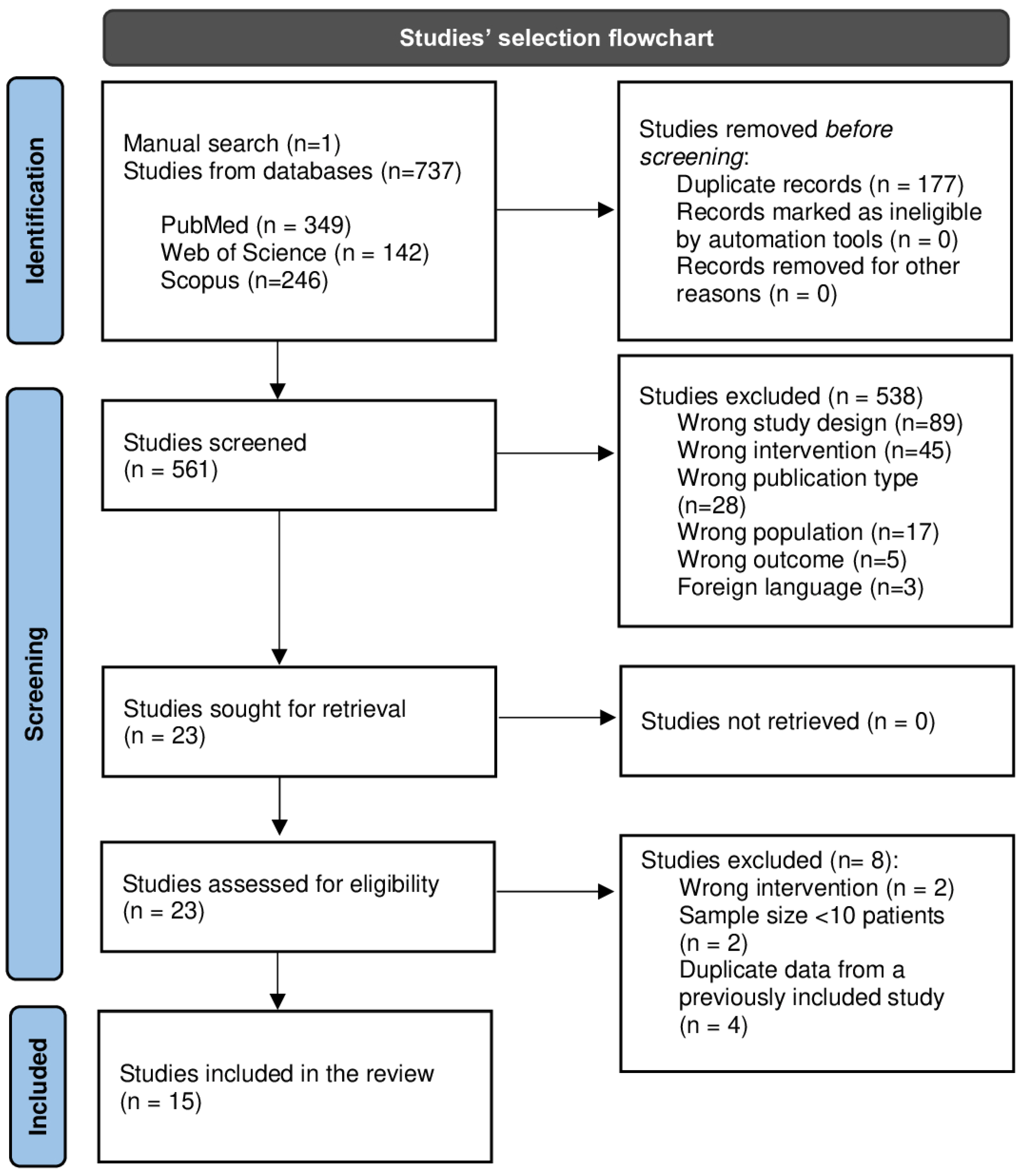
2.2. Study Selection
2.3. Data Extraction
2.4. Outcomes of Interest
2.5. Study Quality Assessment
2.6. Statistical Analysis
2.7. Artificial Intelligence Use Statement
3. Results
3.1. Characteristics of the Included Studies

| Study ID | Study Design | Study Period | Follow Up | Patients | Strictures’ Characteristics | Endoscopic Procedures | Primary Outcomes | |||||
|---|---|---|---|---|---|---|---|---|---|---|---|---|
| N. | Symptomatic | N. | Type | Length | Non- Traversable | Location | ||||||
| Lan, 2017, USA [11] | Retrospective cohort | 2008–2016 | Median: 0.9 year (IQR 0.3–1.8) | n = 85 (85 with IBD, 35 with CD) | NR | 127 | Primary: 59 (69.4%) patients Secondary: 33 (38.8%) patients | Median: 1.5 cm (IQR 1.0–2.0) | 54/127 (42.5%) | Ileocecal valve: 8 (6.3%); pouch inlet: 22 (17.3%); pouch afferent limb: 25 (19.7%); middle of the pouch body: 3 (2.4%); ileal pouch anastomosis: 24 (18.9%); nipple valve of the Kock pouch: 2 (1.6%); ileocolic anastomosis: 22 (17.3%); ileorectal anastomosis: 2 (1.6%); colocolonic anastomosis: 1 (0.8%); distal ileum: 12 (9.4%); anal canal: 5 (3.9%); colon: 1 (0.8%) | ESt + EBD (14 strictures) (n = 272) | Technical success Surgery-free survival |
| Lan, 2018, USA [12] | Retrospective cohort | 2009–2016 | Median: 0.8 year (IQR 0.1–1.6) | n = 185 (21 in the ESt arm: 21 with IBD, 21 with CD) | 15/21 (71.4%) | 45 | Anastomotic | Median: 1.5 cm (IQR 1.0–2.4) | 12/21 (57.1%) | Ileocolonic: 18 (85.7%); ileorectal: 2 (9.5%); colocolonic: 1 (4.8%) | ESt + ESTx (n = 45) | Surgery-free survival Post-procedural complication |
| Lan, 2019, USA [13] | Retrospective cohort | 2008–2016 | NR | NR | NR | 84 | Primary: 47 (56%) Anastomotic: 37 (44%) | NR | NR | NR | ESt (n = NR) | Surgery-free survival |
| Lan, Stocchi, 2019, USA, China [14] | Retrospective cohort | 2010–2017 | Median: 0.8 year (IQR 0.2–1.7) | n = 182 (35 in the ESt arm: 35 with IBD, 35 with CD) | 30/35 (85.7%) | 49 | Anastomotic | Median: 2.0 cm (IQR 1.5–2.5) | 21/31 (67.7%) | Ileocolonic: 35/35 (100%) | ESt (n = 49) | Surgery-free survival Post-procedural complication |
| Lan, 2020, USA [15] | Retrospective cohort | 2001–2016 | Median: 1.8 year (IQR 1.1–2.4) | n = 45 (13 in the ESt arm: 13 with IBD, 13 with CD) | 9/11 (81.8%) | 29 | Primary | Mean ± SD: 2.4 ± 0.9 cm | 13/13 (100%) | Distal ileum: 13/13 (100%) within 15 cm from the ileocecal valve and/or at the ileocecal valve | ESt (n = 29) | Surgery-free survival |
| Mohy-Ud-Din, 2020, USA [16] | Retrospective cohort | 2018–2020 | Mean ± SD: 0.4 ± 0.3 year | n = 11 (11 with IBD, 7 with CD) | 11/11 (100%) | 12 | Primary: 1 (8.3%) Anastomotic: 11 (91.7%) | Mean ± SD: 1.3 ± 0.4 cm | 11/12 (91.7%) | Ileo-colonic: 6 (50%); J-pouch: 2 (17%); anal canal: 2 (17%); rectal cuff: 1 (8%); terminal ileum: 1 (8%) | ESt + ESTx (n = NR) | Technical success |
| Zhang, 2020, USA [17] | Retrospective cohort | 2009–2016 | Median: 0.9 year (IQR 0.3–1.6) | n = 64 (49 with IBD, 25 with CD) | 34/49 (82.9%) | NR | Anastomotic | Mean ± SD: 1.8 ± 0.8 cm | 27/49 (55.1%) | IPA: 24 (48.9%); ileocolonic: 22 (44.9%); ileorectal: 2 (4.1%); colocolonic: 1 (2.0%) | ESt (n = 106) | Technical success Surgery-free survival |
| Lukas, 2022, Czech Republic [18] | Retrospective cohort study | 2018–2021 | Mean ± SD: 1.5 ± 0.8 year | n = 67 (67 with IBD, 60 with CD) | NR | 92 | Primary: 10 (10.9%) Anastomotic: 82 (89.1%) | NR | NR | Primary: anal canal 10 (10.9%) Anastomotic: ileocolonic: 59 (64.1%); colocolonic: 9 (9.8%); ileorectal: 3 (3.3%); IPA: 11 (12.0%) | ESt (n = NR) | Technical success Complications |
| Ning, 2023, China [19] | Multicentre retrospective cohort | 2017–2023 | Median: 1.4 year (IQR 0.8–2.0) | n = 28 (28 with IBD, 28 with CD) | 28/28 (100%) | 57 | Fibrotic | Median: 1 cm (IQR 1.0–1.9) | 57/57 (100%) | Jejunum: 11 (19.3%); ileum: 46 (80.7%) | ESt + ESTx (n = 58) | Technical success Short-term and long-term clinical efficacy |
| Kochhar, 2023, USA [20] | Retrospective cohort | N/A | Mean: 1.1 year | n = 149 (68 in the ESt arm: 68 with IBD, 68 with CD) | NR | NR | Primary: 44 (64.7%) patients Anastomotic: 24 (35.3%) patients | NR | NR | Small bowel: 29/68 (42.6%); colonic: 39/68 (57.4%) | ESt (n = NR) | Time to repeat endoscopic intervention |
| Khan, 2024, USA [21] | Retrospective cohort | 2018–2023 | NR | n = 48 (48 with IBD, 48 with CD) | NR | NR | Primary (NAS): 18 (37.5%) patients Anastomotic (AS): 30 (62.5%) patients | Mean ± SD: NAS: 1.58 ± 0.36 cm; AS: 0.9 ± 0.5 cm | NR | Colon is the most frequent stricture location in both: NAS: 27.7% AS: 33.3% | ESt + EBD (11 patients) (n = NR) | NR |
| Herman, 2024, USA [22] | Retrospective cohort | 2020–2022 | Mean ± SD: 1.1 ± 0.5 year | n = 24 (24 with IBD, 18 with CD) | NR | NR | NR | Mean ± SD: 2.4 ± 1.2 cm | 24/24 (100%) | Anorectal: 17 (71%) Anopouch: 7 (29%) | ESt (n = NR) | Technical success |
| Chaudhary, 2024, USA [23] | Retrospective cohort | 2018–2023 | NR | n = 50 (39 in the ESt arm: 39 with IBD, NR with CD) | NR | NR | Primary: 13 (33.3%) patients Anastomotic: 24 (61.5%) patients | Mean ± SD: 1.2 ± 1 cm | NR | Ileocolonic: 5 (12.8%); ileorectal: 1 (2.5%); inlet and loop ileostomy: 1 (2.5%); anal: 3 (7.6%); cecum: 2 (5.1%); colonic: 14 (35.8%); ileum: 7 (17.9%); ileocecal anastomosis: 1 (2.5%); rectum: 3 (7.6%); recto-sigmoid colon: 2 (5.1%) | ESt (n = NR) | NR |
| Cui, 2025, China [24] | Retrospective cohort | 2020–2024 | NR | n = 11 (11 with IBD, 11 with CD) | NR | 17 | NR | NR | NR | Ileocecal valve: 7 (41.2%) Ileum: 5 (29.4%) Ascending colon: 1 (5.9%) Proximal ascending colon: 1 (5.9%) Duodenum: 2 (11.8%) Rectum: 1 (5.9%) | ESt + EBD (5 patients) (n = 17) | Immediate success Remission time Surgical treatment Re-endoscopic intervention Complications |
| Pal, 2026, India [25] | Randomized control study | 2022–2025 | Median: 1 year (IQR 0.25–3) | n = 101 (51 in the ESt arm; 51 with IBD, 51 with CD) | 51/51 (100%) | NR | Primary: 43 (84.3%) Anastomotic: 8 (15.7%) | Median: 1.5 cm (IQR 0.5–3) | 51/51 (100%) | Upper GI: 2 (3.9%) Ileal: 10 (19.6%) Ileocecal: 13 (25.5%) Ileal + ileocecal: 3 (5.9%) Colonic: 14 (27.5%) Anorectal: 9 (17.6%) | ESt | Clinical recurrence at 1 year |
3.2. Methodological Quality
3.3. Endoscopic Stricturotomy (ESt)
3.4. Endoscopic Strictureplasty (ESTx)
3.5. Additional Evaluated Outcomes
3.6. ESt Versus Previously Established Interventions
4. Discussion
Author Contributions
Funding
Institutional Review Board Statement
Informed Consent Statement
Data Availability Statement
Acknowledgments
Conflicts of Interest
Abbreviations
| CD | Crohn’s disease |
| IBD | Inflammatory bowel disease |
| ESt | Endoscopic stricturotomy |
| ESTx | Endoscopic stricturoplasty |
| EBD | Endoscopic balloon dilation |
| ICR | Ileocecal resection |
| AS | Anastomotic strictures |
| NAS | Non-anastomotic strictures |
Appendix A
Appendix A.1

Appendix A.2
| PubMed | (“endoscopic stricturotomy” OR “endoscopic strictureplasty” OR “endoscopic stricturoplasty” OR “endoscopic strictur*” OR “endoscopic electroincision” OR “needle knife” OR “endoscopic incision” OR “ESt” OR “ESTx”) AND (“IBD” OR “inflammatory bowel diseas*” OR “Crohn*” OR “ulcerative colitis”) |
| Web of Science | |
| Scopus |
Appendix A.3
| Study ID | Patients | Preprocedure Treatments | ||||||||||
|---|---|---|---|---|---|---|---|---|---|---|---|---|
| N. | Disease Phenotype and Location | Pharmacotherapy | Endoscopic | Surgical | ||||||||
| None | 5-ASA | Steroids | Anti-TNF | Other Biologics | Immunomodulators | ATB | Others | EBD | ||||
| Lan, 2017, USA [11] | n = 85 (85 with IBD, 35 with CD) | L1: 32 (37.6%) L2: 3 (3.5%) | Anti-TNF or ant integrin biologics: 23 (27.1%) | 69 (54.3%) of strictures (n= 127) | 77/85 (90.6%) | |||||||
| Lan, 2018, USA [12] | n = 185 (21 in the ESt arm: 21 with IBD, 21 with CD) | NR | 9 (42.9%) | 12/21 (57.1%) | ||||||||
| Lan, 2019, USA [13] | NR | NR | ||||||||||
| Lan, Stocchi, 2019, USA, China [14] | n =182 (35 in the ESt arm: 35 with IBD, 35 with CD) | Perianal disease: 8 patients (22.9%) | 12 (34.3%) | 12 (34.3%) | 18 (51.4%) | 13 (37.1%) | 1 (2.9%) | 8/35 (22.9%) | 1.0 (range: 1.0–2.0) | |||
| Lan, 2020, USA [15] | n = 45 (13 in the ESt arm: 13 with IBD, 13 with CD) | L1 or L3 B2: 13 (100%) Perianal disease: 4 (30.8%) | 6 (46.2%) | 4 (30.8%) | 5 (38.5%) | 5 (38.5%) | ||||||
| Mohy-Ud-Din, 2020, USA [16] | n = 11 (11 with IBD, 7 with CD) | L2: 2 L3: 5 | 3 (27%) | Adalimumab: 2 (18%) IFX: 1 (9%) | Vedolizumab: 4 (36%) Ustekinumab: 1 (9%) | 2 (17%) of strictures (n = 12) | 10/11 (91%) | |||||
| Zhang, 2020, USA [17] | n = 64 (49 with IBD, 25 with CD) | NR | 8 (16.3%) | 9 (18.4%) | 13 (26.5%) | 15 (30.6%) | 13 (26.5%) | NSAIDS:1 (2.0%) | 25/49 (51.0%) | |||
| Lukas, 2022, Czech Republic [18] | n = 67 (67 with IBD, 60 with CD) | NR | 53.3% of the procedures (ESt: 27.2% of the procedures) | |||||||||
| Ning, 2023, China [19] | n = 28 (28 with IBD, 28 with CD) | L1: 24 (85.7%) L3: 4 (14.3%) B2: 25 (89.3%) B3: 3 (10.7%) Perianal: 4 (14.3%) | 1 (3.6%) | 1 (3.6%) | IFX: 1 (3.6%) | IFX + AZA/MTX: 3 (10.7%) MTX: 1 (3.6%) | 1/28 (3.6%) | |||||
| Kochhar, 2023, USA [20] | n = 149 (68 in the ESt arm: 68 with IBD, 68 with CD) | NR | 7 (10%) | 29/52 (56%) | Vedolizumab: 10/52 (19%) Ustekinumab: 13/52 (25%) | 43/68 (63%) | ||||||
| Khan, 2024, USA [21] | n = 48 (48 with IBD, 48 with CD) | NR | NAS patients: 4 (22.2%) AS patients: 7 (23.3) | |||||||||
| Herman, 2024, USA [22] | n = 24 (24 with IBD, 18 with CD) | NR | Budesonide: 2 (8%) Prednisone: 2 (8%) | Adalimumab: 2 (8%) IFX: 4 (16%) | Ustekinumab: 7 (29%) Vedolizumab: 3 (12.5%) | AZA: 3 (12.5%) MTX:1 (4%) | 3/24 (12.5%) | |||||
| Chaudhary, 2024, USA [23] | n = 50 (39 in the ESt arm: 39 with IBD, NR with CD) | NR | 9 (23%) | Balsalazide: 1 (2.5%) Mesalamine: 3 (7.6%) | Budesonide: 2 (5.1%) Prednisone: 3 (7.6%) | Adalimumab: 7 (17.9%) IFX: 4 (10.2%) | Ustekinumab: 4 (10.2%) Vedolizumab: 3 (7.6%) Risankizumab: 5 (12.8%) Romosozumab: 1 (2.5%) | Upadacitinib: 2 (5.1%) | AZA: 4 (10%) | |||
| Cui, 2025, China [24] | n = 11 (11 with IBD, 11 with CD) | NR | 3/11 (27.3%) | |||||||||
| Pal, 2026, India [25] | n = 151 (51 in the ESt arm: 51 with IBD, 51 with CD) | L1: 7 (13.7%) L2: 18 (35.3%) L3: 24 (47.1%) L4: 2 (3.9%) B2: 45 (88.2%) B2+B3: 6 (11.8%) Perianal: 5 (9.8%) | 3 (5.9%) | 4 (7.8%) | Adalimumab: 9 (17.6%) IFX: 6 (11.8%) | Ustekinumab: 5 (9.8%) | AZA: 41 (80.4%) MTX: 2 (3.9%) | 4 (7.8%) | ||||
Appendix A.4
| CASP Checklist | Ning, 2023 [19] | Lan, 2020 [15] | Lukas, 2022 [18] * | Zhang, 2019 [17] | Lan, 2019 [13] * | Mohy-Ud-Din, 2020 [16] | Kochhar, 2023 [20] * | Lan, 2018 [12] | Lan, Stocchi, 2019 [14] | Lan, 2017 [11] | Herman, 2024 [22] | Khan, 2024 [21] * | Chaudhary, 2024 [23] * | Cui, 2025 [24] | Pal, 2026 [25] * | |||
|---|---|---|---|---|---|---|---|---|---|---|---|---|---|---|---|---|---|---|
| Section A: Are the results valid? | 1. Did the study address a clearly focused issue? | ● | ● | ● | ● | ● | ● | ● | ● | ● | ● | ● | ● | ● | ● | ● | ||
| 2. Was the cohort recruited in an acceptable way? | ● | ● | ● | ● | ● | ● | ● | ● | ● | ● | ● | ● | ● | ● | ● | |||
| 3. Was the exposure accurately measured to minimize bias? | ● | ● | ● | ● | ● | ● | ● | ● | ● | ● | ● | ● | ● | ● | ● | |||
| 4. Was the outcome accurately measured to minimize bias? | ● | ● | ● | ● | ● | ● | ● | ● | ● | ● | ● | ● | ● | ● | ● | |||
| 5. Confounding factors: | (a) Have the authors identified all important confounding factors? | ● | ● | ● | ● | ● | ● | ● | ● | ● | ● | ● | ● | ● | ● | ● | ||
| (b) Have they taken account of the confounding factors in the design/analysis? | ● | ● | ● | ● | ● | ● | ● | ● | ● | ● | ● | ● | ● | ● | ● | |||
| 6. Follow up: | (a) Was the follow up of subjects complete enough? | ● | ● | ● | ● | ● | ● | ● | ● | ● | ● | ● | ● | ● | ● | ● | ||
| (b) Was the follow up of subjects long enough? | ● | ● | ● | ● | ● | ● | ● | ● | ● | ● | ● | ● | ● | ● | ● | |||
| Section B: What are the results? | 7. What are the results of this study? | ● | ● | ● | ● | ● | ● | ● | ● | ● | ● | ● | ● | ● | ● | ● | ||
| 8. How precise are the results? | ● | ● | ● | ● | ● | ● | ● | ● | ● | ● | ● | ● | ● | ● | ● | |||
| 9. Do you believe the results? | ● | ● | ● | ● | ● | ● | ● | ● | ● | ● | ● | ● | ● | ● | ● | |||
| Section C: Will the results help locally? | 10.Can the results be applied to the local population? | ● | ● | ● | ● | ● | ● | ● | ● | ● | ● | ● | ● | ● | ● | ● | ||
| 11.Do the results of this study fit with other available evidence? | ● | ● | ● | ● | ● | ● | ● | ● | ● | ● | ● | ● | ● | ● | ● | |||
| 12.What are the implications of this study for practice? | ● | ● | ● | ● | ● | ● | ● | ● | ● | ● | ● | ● | ● | ● | ● | |||
Appendix A.5
| Outcome | Analysis | Subgroup | Subgroup Category | Studies | Pooled Proportion (95% CI) | Heterogeneity (I2) | Heterogeneity (τ2) | Subgroup Differences (p-Value) |
|---|---|---|---|---|---|---|---|---|
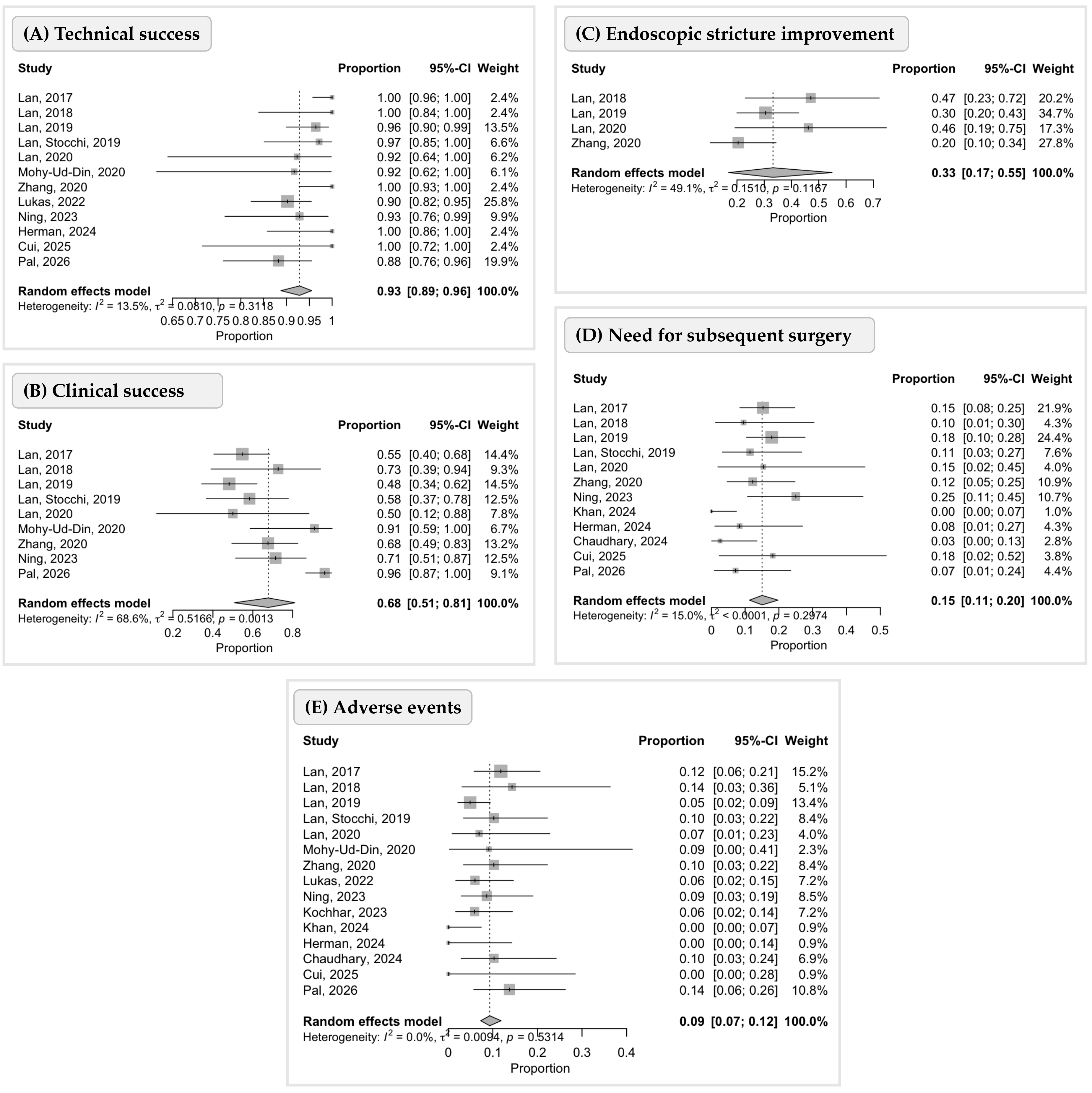
| Technical success | Overall | - | - | 12 | 0.93 (0.89 to 0.96) | 13.5% | 0.08 | - |
| Subgroup | Study type | Full text | 9 | 0.95 (0.90 to 0.97) | 0.0% | 0.00 | 0.21 | |
| Abstract | 3 | 0.91 (0.71 to 0.98) | 38.6% | 0.08 | ||||
| Technique | ESt | 8 | 0.94 (0.87 to 0.97) | 38.7% | 0.25 | 0.80 | ||
| ESt + ESTx | 3 | 0.92 (0.70 to 0.98) | 0.0% | 0.00 | ||||
| ESt + EBD | 1 | 0.96 (0.58 to 0.99) | - | - | ||||
| Clinical success | Overall | - | 9 | 0.68 (0.51 to 0.81) | 68.6% | 0.52 | - | |
| Subgroup | Study type | Full text | 7 | 0.63 (0.53 to 0.72) | 4.5% | 0.01 | 0.57 | |
| Abstract | 2 | 0.80 (0 to 1) | 94.7% | 4.43 | ||||
| Technique | ESt | 6 | 0.65 (0.38 to 0.85) | 75.7% | 0.80 | 0.42 | ||
| ESt + ESTx | 3 | 0.736 (0.48 to 0.89) | 0.0% | 0.00 | ||||
| Endoscopic stricture improvement | Overall | - | 4 | 0.33 (0.17 to 0.55) | 49.1% | 0.15 | - | |
| Subgroup | Study type | Full text | 3 | 0.36 (0.09 to 0.77) | 65.8% | 0.35 | 0.65 | |
| Abstract | 1 | 0.31 (0.21 to 0.42) | - | - | ||||
| Technique | ESt + ESTx | 1 | 0.47 (0.26 to 0.69) | - | - | 0.18 | ||
| ESt | 3 | 0.30 (0.11 to 0.60) | 44.4% | 0.09 | ||||
| Need for subsequent surgery | Overall | - | 12 | 0.15 (0.11 to 0.20) | 15.0% | 0.00 | - | |
| Subgroup | Study type | Full text | 8 | 0.16 (0.12 to 0.20) | 0.0% | 0.00 | 0.17 | |
| Abstract | 4 | 0.08 (0.01 to 0.35) | 65.2% | 0.78 | ||||
| Technique | ESt | 8 | 0.14 (0.11 to 0.19) | 0.0% | 0.00 | 0.63 | ||
| ESt + ESTx | 2 | 0.20 (0.01 to 0.99) | 37.0% | 0.19 | ||||
| ESt + EBD | 2 | 0.06 (0.00 to 1.00) | 75.9% | 3.98 | ||||
| Adverse events | Overall | - | 15 | 0.09 (0.07 to 0.12) | 0.0% | 0.01 | - | |
| Subgroup | Study type | Full text | 9 | 0.11 (0.09 to 0.14) | 0.0% | 0.00 | 0.17 | |
| Abstract | 6 | 0.08 (0.04 to 0.14) | 35.6% | 0.10 | ||||
| Technique | ESt | 10 | 0.09 (0.07 to 0.12) | 0.0% | 0.03 | 0.06 | ||
| ESt + ESTx | 3 | 0.12 (0.05 to 0.23) | 0.0% | 0.00 | ||||
| ESt + EBD | 2 | 0.02 (0.00 to 0.99) | 0.0% | 0.00 |
Appendix A.6
| ESt vs. ICR | |||||||
|---|---|---|---|---|---|---|---|
| Lan, Stocchi, 2019 [14] | Lan, 2020 [15] | ||||||
| ESt | ICR | p-value | ESt | ICR | p-value | ||
| Follow-up | 0.8 year (IQR 0.2–1.7) | 2.2 year (IQR 1.2–4.4) | p < 0.001 | 1.8 year (IQR 1.1–2.4) | 1.5 year (IQR 0.8–4.1) | p = 0.84 | |
| Patient’s characteristics | N | 35/182 | 147/182 | 13/45 | 32/45 | ||
| CD | 35/35 | 147/147 | 13/13 | 32/32 | |||
| Symptomatic | 30/35 (85.7%) | 147 (100%) | p <0.0001 | 9/11 (81.8%) | 30/30 (100%) | p = 0.91 | |
| Previous treatment | 8/35 (22.9%) EBD | 46/147 (31.3%) EBD | p = 0.33 | NR | NR | ||
| Stricture’s characteristics | Type | Anastomotic | Anastomotic | Primary | Primary | ||
| Length | 2.0cm (IQR 1.5–2.5) | 7.0cm (IQR 4.0–10.0) | p <0.001 | 2.4 ± 0.9 cm (SD) | 3.0 ± 1.1 cm (SD) | p = 0.17 | |
| Non-traversable | 21/31 (67.7%) | 49/92 (53.3%) | p = 0.36 | 13/13 (100%) | 11/15 (73.3%) | p = 0.26 | |
| Location | Ileocolonic | Ileocolonic | Distal ileum | Distal ileum | |||
| Efficacy outcomes | Technical success | 34/35 (97.1%) | NR | 13/13 (100%) | 32/32 (100%) | NR | |
| Clinical success | 14/24 (58.3%) patients | 123/147 (83.7%) | p = 0.004 | 3/6 (50.0%) patients | 27/30 (90.0%) patients | p = 0.07 | |
| Endoscopic stricture improvement | NR | NR | 6/13 (46.2%) | 32/32 (100%) | p <0.001 | ||
| Adverse events | Adverse Events | 5/49 (10.2%) procedures | 47/147 (31.9%) | p = 0.003 | 2/29 (6.9%) procedures | 8/32 (25.0%) patients | p = 0.05 |
| Bleeding | 4/49 (8.2%) procedures | NA | NR | NR | |||
| Perforation | 1/49 (2%) procedures | NA | 2/13 (15.4%) patients | NR | |||
| Additional Est/EBD | NR | NR | NR | NR | |||
| Additional surgery | 4/35 (11.3%) | 15/147 (10.2%) | p = 0.83 | 2/13 (15.4%) | 6/32 (18.8%) | p = 0.79 | |
| Stricture-related ER visit | Disease-related: 8/35 (22.9%) | Disease-related: 46/147(31.3%) | p = 0.10 | 0/13 (0%) | 3/32 (9.4%) | p = 0.25 | |
| Stricture-related ER hospitalization | Disease-related: 8/35 (22.9%) | Disease-related: 70/147 (47.6%) | p = 0.008 | 5/13 (38.5%) | 5/32 (15.6%) | p = 0.09 | |
| Escalation of medication | 6/35 (17.1%) | 6/147 (4.1%) | p = 0.005 | 3/13 (23.1%) | 6/32 (18.8%) | p = 0.74 | |
Appendix A.7
| ESt vs. EBD | ||||||||||
|---|---|---|---|---|---|---|---|---|---|---|
| Lan, 2018 [12] | Kochar, 2023 [20] | Pal, 2026 [25] | ||||||||
| ESt | EBD | p-Value | ESt | EBD | p-Value | ESt | EBD | p-Value | ||
| Follow-up | 0.8 year (IQR 0.1–1.6) | 4.0 year (IQR 0.8–6.9) | p < 0.0001 | 1.1 year (mean) | 1.1 year (mean) | 1 year (IQR 0.25–3) | 1 year (IQR 0.25–3) | |||
| Patient’s characteristics | N | 21/185 | 164/185 | 68/149 | 81/149 | 51/101 | 50/101 | |||
| CD | 21/21 | 164/164 | 68/68 | 81/81 | 51/51 | 50/50 | ||||
| Symptomatic | 15/21 (71.4%) | 135/164 (82.3%) | p = 0.23 | NR | NR | 51/51 | 50/50 | |||
| Previous treatment | 12/21 (57.1%) EBD | NR | 43/68 (63%) surgery | 52/81 (65%) surgery | p = 0.86 | 4/51 (7.8%) endotherapy | 4/51 (8%) endotherapy | p = 0.73 | ||
| Stricture’s characteristics | Type | Anastomotic | Anastomotic | Primary: 44/68 (64.7%) Anastomotic: 24/68 (35.3%) | Primary: 48/81 (59%) Anastomotic: 33/81 (41%) | p = 0.61 | Primary: 43 (84.3%) Anastomotic: 8 (15.7%) | Primary: 44 (88%) Anastomotic: 6 (12%) | p = 0.8 | |
| Length | 1.5 cm (IQR 1.0–2.4) | 2.0 cm (IQR 1.0–3.0) | p = 0.13 | NR | NR | 1.5 cm (IQR 0.5-3.0) | 1.5 cm (IQR 1.0-2.8) | p = 0.21 | ||
| Non-traversable | 12/21 (57.1%) | 85 (52.1%) | p = 0.36 | NR | NR | 51 (100%) | 51 (100%) | |||
| Location | Ileocolonic: 18 (85.7%) Ileorectal: 2 (9.5%) Colocolonic: 1 (4.8%) | Ileocolonic: 161 (98.2%) Ileorectal: 2 (1.2%) Colocolonic: 1 (0.6%) | p = 0.02 | Small bowel: 29/68 (42.6%) Colonic: 39/68 (57.4%) | Small bowel: 44/81 (54.3%) Colonic: 37/81 (45.7%) | p = 0.19 | Upper GI: 2 (3.9%) Ileal: 10 (19.6%) Ileocecal: 13 (25.5%) Ileal + ileocecal: 3 (5.9%) Colonic: 14 (27.5%) Anorectal: 9 (17.6%) | Upper GI: 3 (6%) Ileal: 17 (34%) Ileocecal: 8 (16%) Ileal + ileocecal: 1 (2%) Colonic: 9 (18%) Anorectal: 11 (22%) Colonic + anorectal: 1 (2%) | p = 0.43 | |
| Efficacy outcomes | Technical success | 21/21 (100%) | 147/164 (89.5%) | p = 0.25 | NR | NR | 45/51 (88%) | 44/50 (88%) | ||
| Clinical success | 8/11 (72.7%) patients | 59/103 (45.4%) patients | p = 0.08 | NR | NR | 49/51 (96%) | 46/50 (92%) | |||
| Endoscopic stricture improvement | 8/17 (47.1%) patients | 57/163 (35.0%) patients | p = 0.32 | NR | NR | NR | NR | |||
| Adverse events | Adverse Events | NR | NR | NR | NR | 7/51 (13.7%) | 11/50 (22%) | p = 0.31 | ||
| Bleeding | 3/21 (14.3%) 4/45 (8.8%) procedures | 0/164 (0%) 0/478 (0%) procedures | p <0.0001 | 4/68 (5.9%) patients | 1/81 (1.2%) | p = 0.18 | 6/51 (11.8%) | 4/51 (8%) | ||
| Perforation | 0/21 (0%) | 4/164 (2.4%) 5/478 (1.1%) procedures | p = 1.0 | 0/0 (0%) | 0/0 (0%) | 1 (2%) | 1 (2%) | |||
| Additional Est/EBD | 12/21 (57.1%) | 98/164 (59.8%) EBD | p = 0.85 | NR | NR | 12/51 (23.5%) | 26/50 (52%) | p = 0.004 | ||
| Additional Surgery | 2/21 (9.5%) | 55/164 (33.5%) | p = 0.03 | NR | NR | 2/51 (3.9%) | 8/50 (16%) | p = 0.051 | ||
| Stricture-related ER visit | 2/21 (9.5%) | 34/164 (20.7%) | p = 0.33 | NR | NR | 9/51 (17.6%) | 27/50 (54%) | p < 0.001 | ||
| Stricture-related ER hospitalization | 1/21 (4.8%) | 33/164 (20.1%) | p = 0.16 | NR | NR | 8/51 (15.7%) | 19/50 (38%) | p = 0.01 | ||
| Escalation of medication | 3/21 (14.3%) | 53/164 (32.3%) | p = 0.09 | NR | NR | NR | NR | |||
Appendix A.8
| ESt vs. Combined Therapy (ESt and EBD) | |||||
|---|---|---|---|---|---|
| Lan, 2018 [12] * | Chaudhary, 2024 [23] | ||||
| Combined Therapy | ESt | Combined Therapy | p-Value | ||
| Follow-up | 0.4 year (IQR 0.05–1.2) | NR | NR | ||
| Patient’s characteristics | N | 5 | 39/50 | 11/50 | |
| CD | 5 | NR | NR | ||
| Symptomatic | NR | NR | NR | ||
| Previous treatment | NR | NR | NR | ||
| Stricture’s characteristics | Type | Anastomotic | Primary: 13/39 (33.3%) Anastomotic: 24/39 (61.5%) | Primary: 5/11 (45.5%) Anastomotic: 6/11 (54.5%) | p = 0.72 |
| Length | NR | 1.2 ± 1 cm (SD) | 2.76 ± 1.3 cm (SD) | p = 0.19 | |
| Non-traversable | NR | NR | NR | ||
| Location | Ileocolonic: 5 (12.8%); Ileorectal: 1 (2.5%) Inlet and loop ileostomy: 1 (2.5%); Anal: 3 (7.6%); cecum: 2 (5.1%); Colonic: 14 (35.8%); Ileum: 7 (17.9%); Ileocecal anastomosis: 1 (2.5%); Rectum: 3 (7.6%); Recto-sigmoid colon: 2 (5.1%) | Ileorectal: 1 (9%); Anal: 1 (9%); Colonic: 4 (36.3%); Ileum: 1 (9%); Rectum: 4 (36.3%) | p = 0.39 | ||
| Efficacy outcomes | Technical success | 5 (100.0%) | NR | NR | |
| Clinical success | 1/2 (50.0%) | NR | NR | ||
| Endoscopic stricture improvement | 1/2 (50.0%) | NR | NR | ||
| Adverse events | Adverse Events | NR | 4/39 (10.3%) | 0/11 (0%) | p = 0.87 |
| Bleeding | 0 (0.0%) | 3/39 (7.7%) | 0/11 (0%) | p = 0.74 | |
| Perforation | 0 (0.0%) | NR | NR | ||
| Additional Est/EBD | 0 (0.0%) | 15/39 (38.4%) | 7/11 (63.6%) | p = 0.17 | |
| Additional surgery | 0 (0.0%) | 1/39 (2.5%) | 0/11 (0%) | p = 0.99 | |
| Stricture-related ER visit | 0 (0.0%) | NR | NR | ||
| ER-related hospitalization | 0 (0.0%) | NR | NR | ||
| Escalation of medication | 0 (0.0%) | NR | NR | ||
References
- Dehghan, M.; Wong, G.; Neuberger, E.; Kin, C.; Rieder, F.; Park, K.T. Worse outcomes and higher costs of care in fibrostenotic Crohn’s disease: A real-world propensity-matched analysis in the USA. BMJ Open Gastroenterol. 2021, 8, e000781. [Google Scholar] [CrossRef]
- Sleiman, J.; El Ouali, S.; Qazi, T.; Cohen, B.; Steele, S.R.; Baker, M.E.; Rieder, F. Prevention and Treatment of Stricturing Crohn’s Disease-Perspectives and Challenges. Expert Rev. Gastroenterol. Hepatol. 2021, 15, 401–411. [Google Scholar] [CrossRef] [PubMed]
- Burisch, J.; Kiudelis, G.; Kupcinskas, L.; Kievit, H.A.L.; Andersen, K.W.; Andersen, V.; Salupere, R.; Pedersen, N.; Kjeldsen, J.; D’Incà, R.; et al. Natural disease course of Crohn’s disease during the first 5 years after diagnosis in a European population-based inception cohort: An Epi-IBD study. Gut 2019, 68, 423–433. [Google Scholar] [CrossRef] [PubMed]
- Shen, B.; Kochhar, G.; Navaneethan, U.; Farraye, F.A.; Schwartz, D.A.; Iacucci, M.; Bernstein, C.N.; Dryden, G.; Cross, R.; Bruining, D.H.; et al. Practical guidelines on endoscopic treatment for Crohn’s disease strictures: A consensus statement from the Global Interventional Inflammatory Bowel Disease Group. Lancet Gastroenterol. Hepatol. 2020, 5, 393–405. [Google Scholar] [CrossRef] [PubMed]
- Schmoyer, C.J.; Saidman, J.; Bohl, J.L.; Bierly, C.L.; Kuemmerle, J.F.; Bickston, S.J. The Pathogenesis and Clinical Management of Stricturing Crohn Disease. Inflamm. Bowel Dis. 2021, 27, 1839–1852. [Google Scholar] [CrossRef] [PubMed]
- Bettenworth, D.; Bokemeyer, A.; Kou, L.; Lopez, R.; Bena, J.F.; El Ouali, S.; Mao, R.; Kurada, S.; Bhatt, A.; Beyna, T.; et al. Systematic review with meta-analysis: Efficacy of balloon-assisted enteroscopy for dilation of small bowel Crohn’s disease strictures. Aliment. Pharmacol. Ther. 2020, 52, 1104–1116. [Google Scholar] [CrossRef]
- Nasasra, A.; Morrison, T.E.M.; Luberto, A.; Carvello, M.; Williams, K.J.; Davies, J.; Spinelli, A.; Mehta, A.M.; Warusavitarne, J.H. Recurrence rates after strictureplasty for small bowel Crohn’s disease remain high in the era of biologics. Colorectal Dis. 2024, 27, e17224. [Google Scholar] [CrossRef]
- Liu, W.; Zhou, W.; Zhang, Y.; Ge, X.; Qi, W.; Lin, T.; Cao, Q.; Cao, L. Strictureplasty may lead to increased preference in the surgical management of Crohn’s disease: A case-matched study. Tech. Coloproctol. 2024, 28, 40. [Google Scholar] [CrossRef]
- Navaneethan, U.; Lourdusamy, D. Endoscopic Stricturotomy and Strictureplasty. Gastrointest. Endosc. Clin. N. Am. 2022, 32, 687–697. [Google Scholar] [CrossRef]
- Critical Appraisal Skills Programme (CASP). CASP Cohort Study Checklist. Available online: https://casp-uk.net/checklists/casp-cohort-study-checklist/ (accessed on 1 January 2026).
- Lan, N.; Shen, B. Endoscopic Stricturotomy with Needle Knife in the Treatment of Strictures from Inflammatory Bowel Disease. Inflamm. Bowel Dis. 2017, 23, 502–513. [Google Scholar] [CrossRef]
- Lan, N.; Shen, B. Endoscopic Stricturotomy Versus Balloon Dilation in the Treatment of Anastomotic Strictures in Crohn’s Disease. Inflamm. Bowel Dis. 2018, 24, 897–907. [Google Scholar] [CrossRef]
- Lan, N.; Shen, B. Tu2024 Endoscopic Stricturotomy in the Treatment of Crohn’s Disease-Related Primary and Secondary Strictures. Gastrointest. Endosc. 2019, 89, AB662–AB663. [Google Scholar] [CrossRef]
- Lan, N.; Stocchi, L.; Delaney, C.P.; Hull, T.L.; Shen, B. Endoscopic stricturotomy versus ileocolonic resection in the treatment of ileocolonic anastomotic strictures in Crohn’s disease. Gastrointest. Endosc. 2019, 90, 259–268. [Google Scholar] [CrossRef]
- Lan, N.; Hull, T.L.; Shen, B. Endoscopic stricturotomy and ileo-colonic resection in patients with primary Crohn’s disease-related distal ileum strictures. Gastroenterol. Rep. 2020, 8, 312–318. [Google Scholar] [CrossRef]
- Mohy-Ud-Din, N.; Kochhar, G.S. Endoscopic Stricturotomy Is an Efficacious Option for Management of Strictures in Patients with Inflammatory Bowel Disease. Crohns Colitis 360 2020, 2, otaa069. [Google Scholar] [CrossRef] [PubMed]
- Zhang, L.J.; Lan, N.; Wu, X.R.; Shen, B. Endoscopic stricturotomy in the treatment of anastomotic strictures in inflammatory bowel disease (IBD) and non-IBD patients. Gastroenterol. Rep. 2020, 8, 143–150. [Google Scholar] [CrossRef] [PubMed]
- Lukas, M.; Kolar, M.; Vasatko, M.; Lukas, M. Endoscopic Stricturotomy—A Novel Therapeutic Modality for IBD-Related Strictures: First European Experience. Inflamm. Bowel Dis. 2022, 28, S40–S41. [Google Scholar] [CrossRef]
- Ning, S.B.; Yang, H.; Li, B.; Zhang, Y.; Huang, S.; Peng, B.; Lin, H.; Kurban, M.; Li, M.; Guo, Q. Balloon-assisted enteroscopy-based endoscopic stricturotomy for deep small bowel strictures from Crohn’s disease: First cohort study of a novel approach. Dig. Liver Dis. 2023, 55, 1397–1402. [Google Scholar] [CrossRef] [PubMed]
- Kochhar, G.; Dulai, P.; Baker, G.; Abdul-Baki, H.; Chintamaneni, P.; Rubin, D.; El-Hachem, S. Endoscopic Stricturotomy is Superior to Balloon Dilatation for Crohns Disease-Related Strictures. Gastrointest. Endosc. 2023, 97, AB412–AB413. [Google Scholar] [CrossRef]
- Khan, M.Z.; Chaudhary, A.J.; Shahzil, M.; Jaan, A.; Sohail, A.; Manivannan, A.; Asif, H.; Saleem, A.; Faisal, M.S.; Adil, S.A. S1359 Needle-Knife Stricturotomy (NKSt) for IBD-Related Strictures: A Single-Center Experience. Off. J. Am. Coll. Gastroenterol. 2024, 119, S970–S971. [Google Scholar] [CrossRef]
- Herman, K.; Kiran, R.P.; Shen, B. Insulated tip/needle-knife endoscopic stricturotomy is safe and effective for treatment of non-traversable anorectal strictures. Endosc. Int. Open 2024, 12, E231–E236. [Google Scholar] [CrossRef] [PubMed]
- Chaudhary, A.J.; Khan, M.Z.; Jaan, A.; Sohail, A.; Jomaa, D.; Shahzil, M.; Manivannan, A.; Asif, H.; Saleem, A.; Faisal, M.S. S1465 Outcomes of Needle Knife Stricturotomy (NKSt) and NKSt With Balloon Dilation (NKSt-BD) in Patients with IBD Strictures: A Single Center Experience. Off. J. Am. Coll. Gastroenterol. 2024, 119, S1055–S1056. [Google Scholar] [CrossRef]
- Cui, L.; Su, M.; Ding, Y.B.; Wang, M.; Sun, K.W. Preliminary study on the clinical value of endoscopic stricturotomy in the treatment of stricturing Crohn’s disease. World J. Gastrointest. Surg. 2025, 17, 100631. [Google Scholar] [CrossRef] [PubMed]
- Pal, P.; Pooja, K.; Gupta, R.; Tandan, M.; Reddy, D.N. OP19 Who benefits from endotherapy in Crohn’s disease strictures? Predictors of recurrence, need for reintervention, and surgery from the Balloon Dilation versus Endoscopic Stricturotomy for Crohn’s Disease (BEST-CD) randomised controlled trial (NCT05521867). J. Crohn’s Colitis 2026, 20, jjaf231.019. [Google Scholar] [CrossRef]
- Holubar, S.D.; Lavryk, O.; Steele, S.R. Bowel preserving surgery for stricturing jejunoileal Crohn’s disease, part 1: Heineke-Mikulicz strictureplasty, a step-by-step video vignette. Colorectal Dis. 2024, 26, 822–824. [Google Scholar] [CrossRef]
- Ismail, M.S.; Charabaty, A. Management of Crohn’s stricture: Medical, endoscopic and surgical therapies. Frontline Gastroenterol. 2022, 13, 524–530. [Google Scholar] [CrossRef] [PubMed]
- Pokala, A.; Shen, B. Update of endoscopic management of Crohn’s disease strictures. Intest. Res. 2020, 18, 1–10. [Google Scholar] [CrossRef]
- Shen, B.; Kochhar, G.; Navaneethan, U.; Liu, X.; Farraye, F.A.; Gonzalez-Lama, Y.; Bruining, D.; Pardi, D.S.; Lukas, M.; Bortlik, M.; et al. Role of interventional inflammatory bowel disease in the era of biologic therapy: A position statement from the Global Interventional IBD Group. Gastrointest. Endosc. 2019, 89, 215–237. [Google Scholar] [CrossRef]
- Shen, B. Interventional inflammatory bowel disease: Endoscopic therapy of complications of Crohn’s disease. Gastroenterol. Report 2022, 10, goac045. [Google Scholar] [CrossRef]
- Coppola, G.; Principessa, C.; Di Vincenzo, F.; Puca, P.; Del Gaudio, A.; Capobianco, I.; Bartocci, B.; Papa, A.; Cammarota, G.; Lopetuso, L.R.; et al. Endoscopic Management of Strictures in Crohn’s Disease: An Unsolved Case. J. Clin. Med. 2024, 13, 4842. [Google Scholar] [CrossRef]
- Pal, P.; Reddy, D.N. Interventional endoscopy in inflammatory bowel disease: A comprehensive review. Gastroenterol. Rep. 2024, 12, goae075. [Google Scholar] [CrossRef] [PubMed]
- Jaber, F.; Numan, L.; Ayyad, M.; Abuelazm, M.; Imran, M.; AlBarakat, M.M.; Aboutaleb, A.M.; Khan, U.; Alsakarneh, S.; Bilal, M. Efficacy and Safety of Endoscopic Stricturotomy in Inflammatory Bowel Disease-Related Strictures: A Systematic Review and Meta-Analysis. Dig. Dis. Sci. 2024, 69, 4152–4166. [Google Scholar] [CrossRef] [PubMed]
- Schulberg, J.D.; Hamilton, A.L.; Wright, E.K.; Holt, B.A.; Sutherland, T.R.; Ross, A.L.; Vogrin, S.; Kamm, M.A. Repeated endoscopic dilation and needle-knife stricturotomy for Crohn’s disease strictures. Gastrointest. Endosc. 2025, 101, 202–206.e204. [Google Scholar] [CrossRef]
- Rieder, F.; Bettenworth, D.; Ma, C.; Parker, C.E.; Williamson, L.A.; Nelson, S.A.; van Assche, G.; Di Sabatino, A.; Bouhnik, Y.; Stidham, R.W.; et al. An expert consensus to standardise definitions, diagnosis and treatment targets for anti-fibrotic stricture therapies in Crohn’s disease. Aliment. Pharmacol. Ther. 2018, 48, 347–357. [Google Scholar] [CrossRef] [PubMed]
- Page, M.J.; McKenzie, J.E.; Bossuyt, P.M.; Boutron, I.; Hoffmann, T.C.; Mulrow, C.D.; Shamseer, L.; Tetzlaff, J.M.; Akl, E.A.; Brennan, S.E.; et al. The PRISMA 2020 statement: An updated guideline for reporting systematic reviews. BMJ 2021, 372, n71. [Google Scholar] [CrossRef]
| Study ID | ESt | ESTx |
|---|---|---|
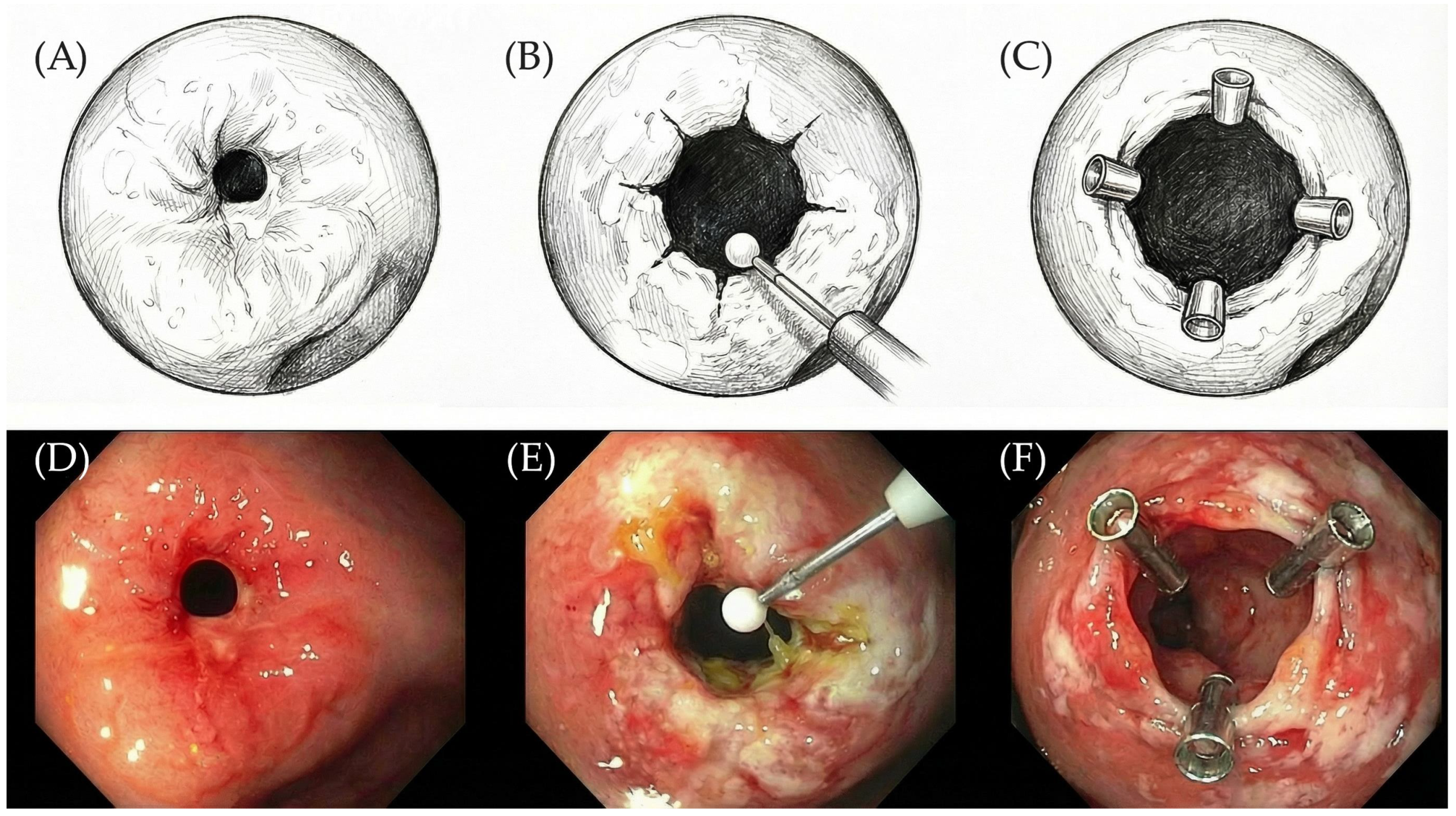
| Lan, 2017 USA [11] | Material: regular needle knife or needle knife with isolated ceramic tip in the setting of electroincision or electrocauterization at the discretion of the endoscopist. Technique: NR All procedures were performed by the same endoscopist (B.S.). | - |
| Lan, 2018 USA [12] | Material: triple- lumen needle knife (Boston Scientific, Marlborough, MA, USA) or a single-use electrosurgical IT knife2 (Olympus Medical Systems, Tokyo, Japan) under the setting of ERCP Endocut on ERBE (USA Incorporated Surgical Systems, Marietta, GA, USA). Technique: strictures were incised in a circumferential or radial fashion until an adequate passage of the scope. All procedures were performed by the same endoscopist (B.S.). | Technique: endoclips were deployed after radial cut to keep treated stricture open and were also used in controlling bleeding for both radial and circumferential cuts. |
| Lan, 2019 USA [13] | NR | NR |
| Lan, Stocchi, 2019 USA, China [14] | Material: triple-lumen needle knife (Boston Scientific, Marlborough, MA, USA) or a single-use electrosurgical IT knife 2 (Olympus Medical Systems, Tokyo, Japan) under the setting of ERCP Endocut (Erbe USA Incorporated Surgical Systems, Marietta, GA, USA). Technique: strictures were incised in a circumferential or radial manner until adequate passage of the endoscope was achieved. All procedures were performed by the same endoscopist (B.S.). | - |
| Lan, 2020 USA [15] | Material: Boston Scientific triple-lumen needle knife (Boston Scientific, Marlborough, MA, USA) or Olympus single-use electrosurgical IT knife 2 (Olympus Medical Systems, Tokyo, Japan) under the setting of ERCP Endocut (ERBE USA Incorporated Surgical Systems, Marietta, GA, USA). Technique: strictures were incised in a circumferential or radial manner until the adequate passage of the scope was achieved. All procedures were performed by the same endoscopist (B.S.). | - |
| Mohy-Ud-Din, 2020 USA [16] | Material: endoscopic Nano knife (Olympus Medical Systems, Tokyo, Japan) with the current setting Endocut-I (ERBE USA, Marietta, GA, USA). Technique: strictures were cut in either radial, horizontal, semicircumferential, or circumferential fashion. All procedures were performed by one endoscopist (G.K.). | Material: Through-the-scope (TTS) clips. Technique: TTS clips deployed at the site of incision in circumferential fashion to prevent the incised edges from coalescing back together, preventing restricture formation, and also helping prevent any delayed bleeding. |
| Zhang, 2020 USA [17] | Material: Boston Scientific triple-lumen needle knife (Boston Scientific, Marlborough, MA, USA) or Olympus single-use electrosurgical IT knife 2 (Olympus Medical Systems, Tokyo, Japan) under the setting of ERCP Endocut (ERBE USA Incorporated Surgical Systems, Marietta, GA, USA). Technique: strictures were incised in a circumferential or radial manner until adequate passage of the scope was achieved. All procedures were performed by one endoscopist (B.S.). | - |
| Lukas, 2022 Czech Republic [18] | NR | NR |
| Ning, 2023 China [19] | Material: double-balloon enteroscope (EN-450P5 or EN-580T; Fujifilm, Tokyo, Japan) or a single-balloon enteroscope (SIF-Q260; Olympus Medical Systems, Tokyo, Japan); hook knife (KD-620UR, Olympus Medical Systems, Tokyo, Japan) or IT knife nano (KD-612 U, Olympus Medical Systems, Tokyo, Japan) with an Erbe machine (Erbe Elektromedizin GmbH, Tuebingen, Germany) using the ESD endoCUT Q setting. Technique: strictures were incised in a radial or circumferential fashion until the scope passed. The procedures were performed by one of the three endoscopists (Q.G., S.N., and Y.Z.). | Material: endoclips, argon plasma coagulation (Erbe Elektromedizin GmbH, Tuebingen, Germany), or high-frequency hemostatic forceps (FD-411UR; Olympus Medical Systems, Tokyo, Japan) were used at the discretion of the endoscopist for hemostasis. |
| Kochhar, 2023, USA [20] | Material: NR. Technique: NR All procedures were performed by one endoscopist. | - |
| Khan, 2024 USA [21] | NR | NR |
| Herman, 2024 USA [22] | Material: upper endoscope (GIF series, Olympus, Tokyo); soft-tip guidewire was used in selected patients with pinhole strictures or adjacent fistulae; IT, IT2 (Olympus, Tokyo), NK (Boston Scientific, 300 Boston Scientific Way Marlborough, MA, USA) and Erbe VIO 300Delectrosurgical generator (ERBE USA, Marietta, GA, USA) with a setting of Endocut mode were used to perform electroincision and/or electrocautery treatment. Technique: NR All procedures were performed by a single endoscopist (B.S.). | - |
| Chaudhary, 2024, USA [23] | NR | NR |
| Cui, 2025 China [24] | Material: single-balloon enteroscope (SIF-Q260, Olympus) and IT knife (KD-611 L; Olympus) Technique: radial incisions were made at the stricture site from shallow to deep under direct visualization. During the procedure, the following precautions were taken: avoided overinflation, controlled the depth of the incision, preserved as much of the muscle layer as possible, and examined the incision site for postoperative bleeding and perforation. All procedures were performed by a single endoscopist (senior chief physician). | - |
| Pal, 2026, India [25] | NR | NR |
| Study ID | Technical Success | Clinical Success | Endoscopic Stricture Improvement | Technical Success Definition | Clinical Success Definition |
|---|---|---|---|---|---|
| Lan, 2017, USA [11] | 85/85 (100%) patients | 29/53 (54.7%) patients | NR | Passage of the gastroscope or pediatric colonoscope without resistance. | Symptomatic improvement. |
| Lan, 2018, USA * [12] | 21/21 (100%) patients | 8/11 (72.7%) patients | 8/17 (47.1%) patients | Passage of endoscope without resistance. | Symptomatic improvement. |
| Lan, 2019, USA [13] | Primary stricture: 45 (95.7%) Anastomotic strictures: 36 (97.3%) | Primary stricture: 15 (46.9%) Anastomotic strictures: 11 (50.0%) | Primary stricture: 15 (35.7%) Anastomotic strictures: 6 (22.2%) | NR | Symptomatic improvement. |
| Lan, Stocchi, 2019, USA, China [14] | 34/35 (97.1%) patients | 14/24 (58.3%) patients | NR | Passage of endoscope without resistance. | Symptomatic improvement. |
| Lan, 2020, USA [15] | 13/13 (100%) patients | 3/6 (50.0%) patients | 6/13 (46.2%) patients | Passage of endoscope without resistance. | Symptomatic improvement. |
| Mohy-Ud-Din, 2020, USA * [16] | 11/12 (92%) procedures | 10/11 (91%) patients | NR | Traversability of the scope without resistance. | Symptom improvement. |
| Zhang, 2020, USA [17] | 49/49 (100%) patients | 23/34 (67.6%) patients | 10/49 (20.4%) patients | Passage of the pediatric colonoscope without resistance. | Symptomatic improvement. |
| Lukas, 2022, Czech Republic [18] | 83 (90.2%) procedures | NR | NR | Ability to pass the scope through the stricture following the procedure. | NR |
| Ning, 2023, China * [19] | 26/28 (92.9%) patients 56/58 (96%) procedures | Short-term: 20/28 (71.4%) patients; long-term: (74.8%) | NR | Ability to pass the scope beyond the stricture after the procedure. | Short-term: the improvement of symptoms at week 8. Long-term: surgery-free rate at 1 year of follow-up. |
| Kochhar, 2023, USA [20] | NR | NR | NR | NR | NR |
| Khan, 2024, USA [21] | NR | NR | NR | NR | NR |
| Herman, 2024, USA [22] | 24/24 (100%) patients | NR | NR | Ability to traverse the strictured site with the endoscope. | NR |
| Chaudhary, 2024, USA [23] | NR | NR | NR | NR | NR |
| Cui, 2025, China [24] | 11/11 (100%) patients | NR | NR | Successful incision of the stricture lesion, allowing the enteroscope to pass smoothly through the stricture. | NR |
| Pal, 2026, India [25] | 45/51 (88%) patients | 49/51 (96%) patients | NR | Ability to pass pediatric colonoscope beyond stricture. | Reduction in CD obstruction Score (CDOS) ≥ 1-point drop. |
| Study ID | Adverse Events | Bleeding | Perforation | Need for Additional Endoscopic Procedures ** | Subsequent Surgery | Stricture-Related ER Visit | Stricture-Related Hospitalization | Escalation of Medication |
|---|---|---|---|---|---|---|---|---|
| Lan, 2017, USA [11] | 10/272 (3.7%) procedures | 9/85 (10.6%) patients | 1/85 (1.2%) patients | 77/127 (60.6%) strictures: 57/127 (44.9%) ESt 14/127 (11.0%) combined EBD + ESt 29/127 (22.8%) EBD | 13/85 (15.3%) patients | 11/85 (12.9%) patients | 18/85 (21.2%) patients | NR |
| Lan, 2018, USA * [12] | NR | 3/21 (14.3%) patients; 4/45 (8.8%) procedures | 0/21 (0%) patients; 0/45 (0%) procedures | 12 (57.1%) patients: 6 ESt, 4 EBD and 2 combined EBD + ESt | 2/21 (9.5%) patients | 2/21 (9.5%) patients | 1/21 (4.8%) patients | 3/21 (14.3%) patients |
| Lan, 2019, USA [13] | Primary strictures: 5 (5.4%); secondary (anastomotic) strictures: 3 (4.2%) | NR | NR | NR | Primary strictures: 7 (14.9%); secondary strictures: 8 (21.6%) | NR | NR | NR |
| Lan, Stocchi, 2019, USA, China [14] | 5/49 (10.2%) procedures | 4/49 (8.2%) procedures | 1/49 (2%) procedures | NR | 4 (11.3%) patients | Disease-related: 8/35 (22.9%) patients | Disease-related: 8/35 (22.9%) patients | 6/35 (17.1%) patients |
| Lan, 2020, USA [15] | 2/29 (6.9%) procedures | NR | 2/13 *** (15.4%) patients | NR | 2/13 (15.4%) patients | 0/13 (0%) patients | 5/13 (38.5%) patients | 3/13 (23.1%) patients |
| Mohy-Ud-Din, 2020, USA * [16] | NR | 1/11 (9%) patients | 0/11 (0%) patients | 4/12 (33%) strictures EBD right after Est (same session); 1/12 (8%) strictures ESt in different sessions | NR | NR | 1/11 (9%) patients | NR |
| Zhang, 2020, USA [17] | NR | 5/106 (4.7%) procedures | 0/49 (0%) patients | NR | 6/49 (12.2%) patients | Disease-related: 7/49 (14.3%) patients | Disease-related: 10/49 (20.4%) patients | NR |
| Lukas, 2022, Czech Republic [18] | 4/67 (6%) patients | 4/67 (6%) patients | NR | NR | NR | NR | NR | NR |
| Ning, 2023, China * [19] | 5/58 (8.6%) procedures | 3/58 (5.2%) procedures | 2/58 (3.4%) procedures | 2/28 (7.1%) patients | 7/28 (25%) patients | NR | NR | NR |
| Kochhar, 2023, USA [20] | NR | 4/68 (5.9%) patients | 0/0 (0%) patients | NR | NR | NR | NR | NR |
| Khan, 2024, USA [21] | 0/48 (0%) patients | NR | NR | 24/48 (50.0%) patients | 0/48 (0%) patients | NR | NR | NR |
| Herman, 2024, USA [22] | 0/24 (0%) patients | 0/24 (0%) patients | 0/24 (0%) patients | 16/24 (66.6%) ESt; 1/24 (4.2%) ESt and surgical reintervention | 2/24 (8.3%) patients | NR | NR | NR |
| Chaudhary, 2024, USA [23] | 4/39 (10.3%) patients | 3/39 (7.7%) patients | NR | 15/39 (38.4%) patients | 1/39 (2.5%) patients | NR | NR | NR |
| Cui, 2025, China [24] | 0/11 (0%) patients | 0/11 (0%) patients | 0/11 (0%) patients | 2/11 (18.2%) patients | 2/11 (18.2%) patients | NR | NR | NR |
| Pal, 2026, India [25] | 7/51 (13.7%) patients | 6/51 (11.8%) patients | 1 (2.0%) patients | 12/51 (23.5%) patients | 2/51 (3.9%) patients | 9/51 (17.6%) patients | 8/51 (15.7%) patients | NR |
Disclaimer/Publisher’s Note: The statements, opinions and data contained in all publications are solely those of the individual author(s) and contributor(s) and not of MDPI and/or the editor(s). MDPI and/or the editor(s) disclaim responsibility for any injury to people or property resulting from any ideas, methods, instructions or products referred to in the content. |
© 2026 by the authors. Licensee MDPI, Basel, Switzerland. This article is an open access article distributed under the terms and conditions of the Creative Commons Attribution (CC BY) license.
Share and Cite
Abreu, E.; Pinho, R.; Magro, F.; Estevinho, M.M. Efficacy and Safety of Endoscopic Strictureplasty and Stricturotomy for Crohn’s Disease-Associated Strictures: A Systematic Review and Current Perspective. Diseases 2026, 14, 121. https://doi.org/10.3390/diseases14040121
Abreu E, Pinho R, Magro F, Estevinho MM. Efficacy and Safety of Endoscopic Strictureplasty and Stricturotomy for Crohn’s Disease-Associated Strictures: A Systematic Review and Current Perspective. Diseases. 2026; 14(4):121. https://doi.org/10.3390/diseases14040121
Chicago/Turabian StyleAbreu, Elisa, Rolando Pinho, Fernando Magro, and Maria Manuela Estevinho. 2026. "Efficacy and Safety of Endoscopic Strictureplasty and Stricturotomy for Crohn’s Disease-Associated Strictures: A Systematic Review and Current Perspective" Diseases 14, no. 4: 121. https://doi.org/10.3390/diseases14040121
APA StyleAbreu, E., Pinho, R., Magro, F., & Estevinho, M. M. (2026). Efficacy and Safety of Endoscopic Strictureplasty and Stricturotomy for Crohn’s Disease-Associated Strictures: A Systematic Review and Current Perspective. Diseases, 14(4), 121. https://doi.org/10.3390/diseases14040121