
The Cognitive Mechanisms of the Positivity Reactivity Effect on Word Recognition Memory



Abstract
1. Introduction
2. Experiment 1
2.1. Methods
2.1.1. Participants
2.1.2. Materials
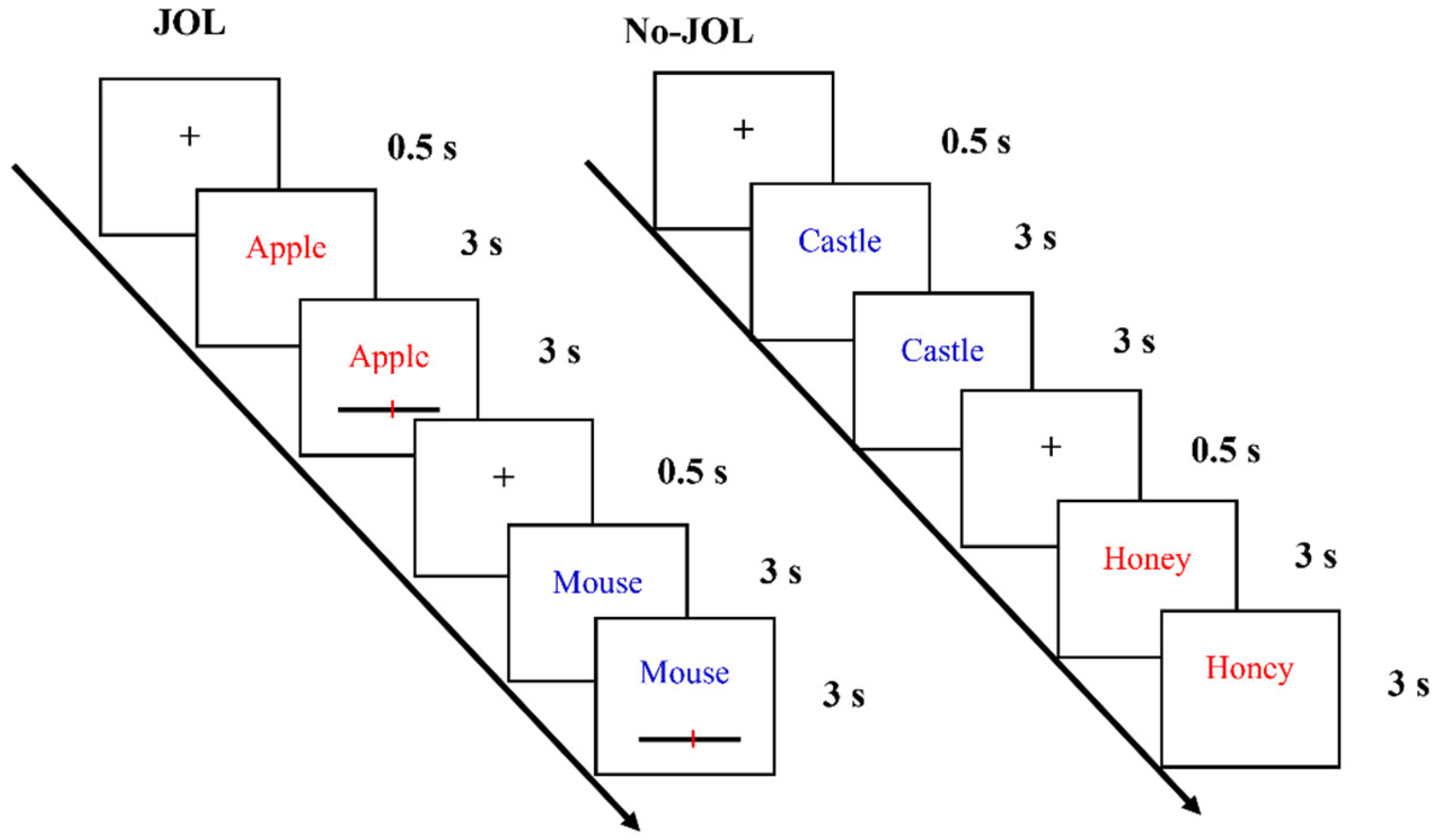
2.1.3. Design and Procedure
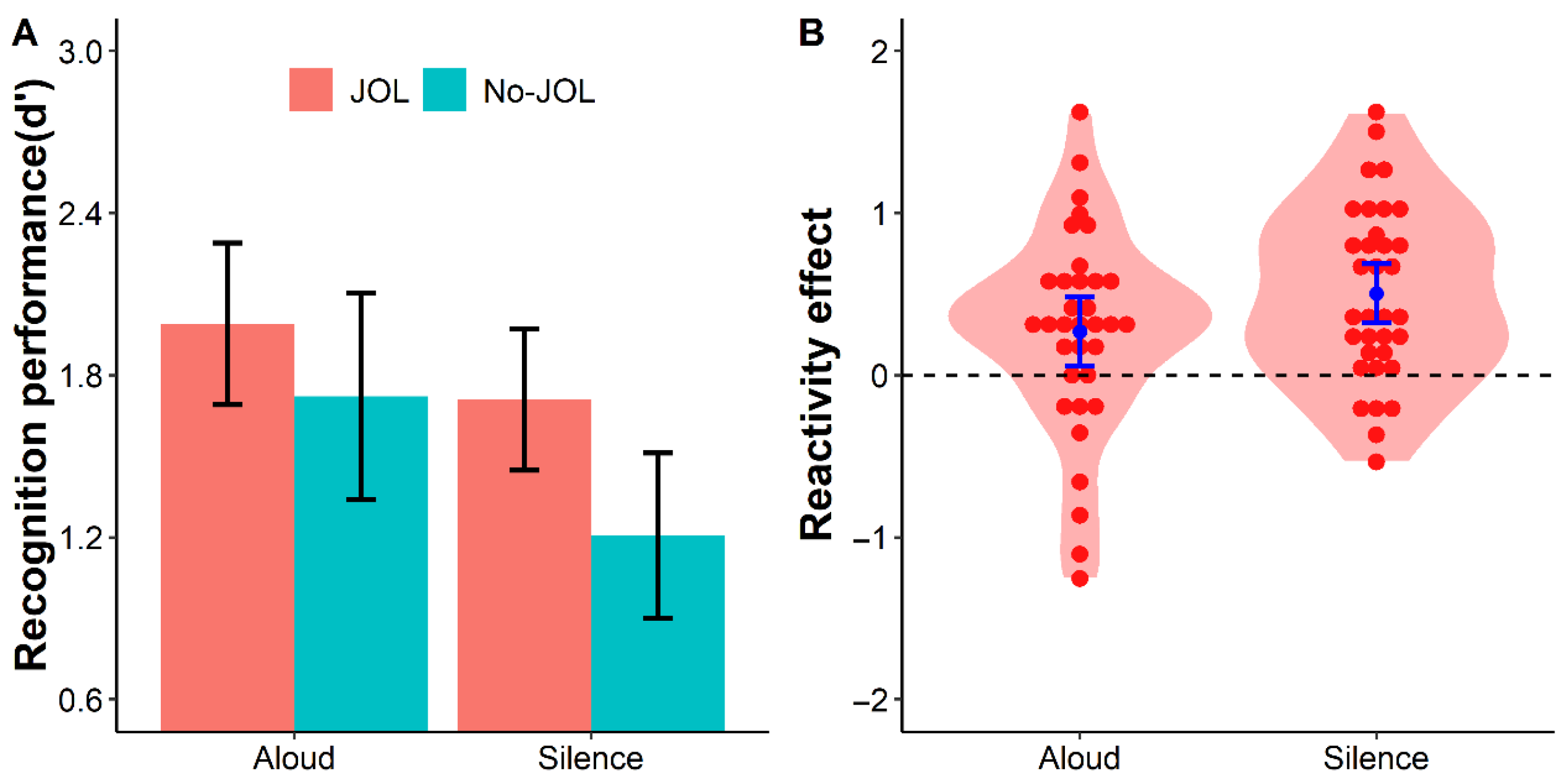
2.2. Results and Discussion
3. Experiment 2
3.1. Methods
3.1.1. Participants
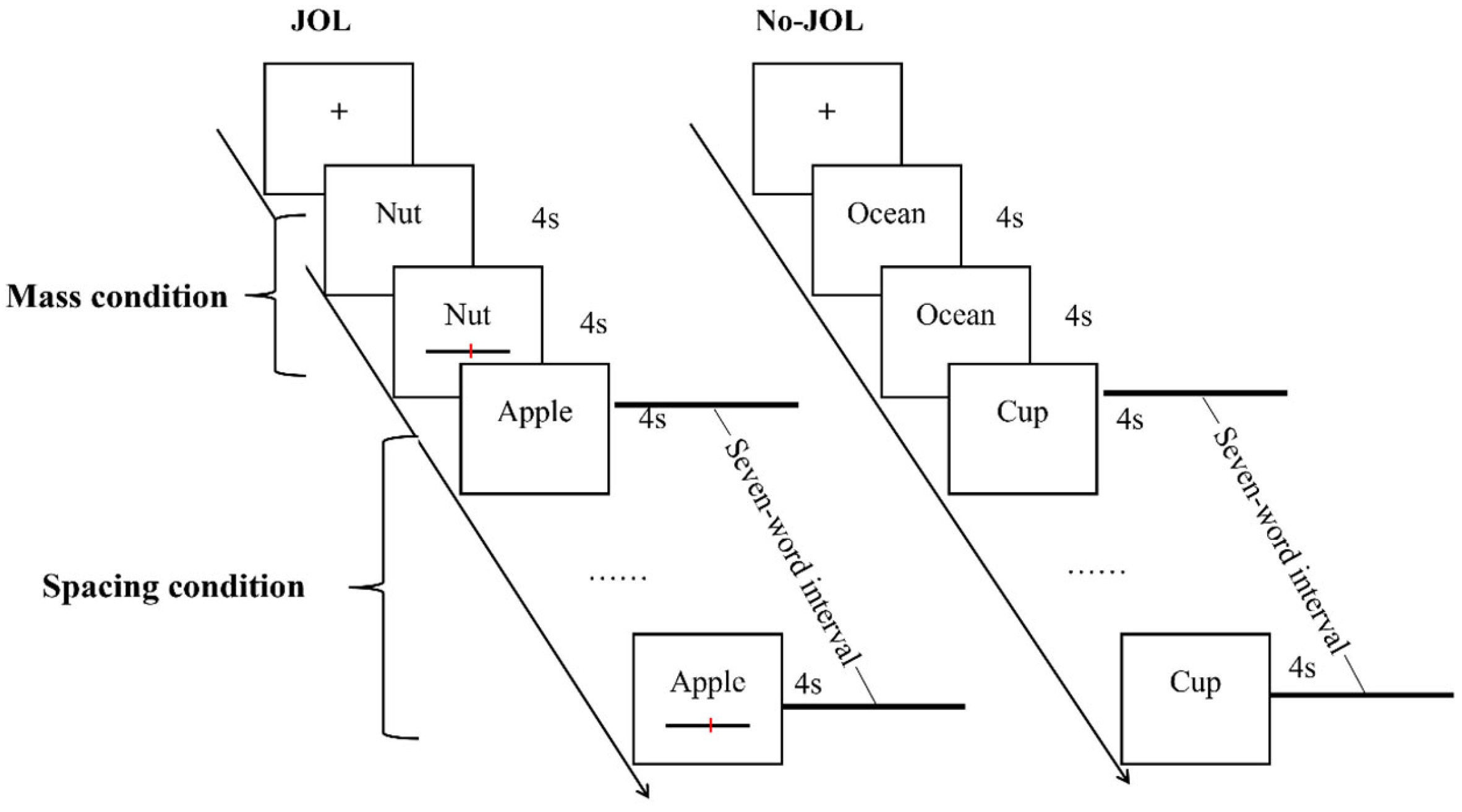
3.1.2. Materials
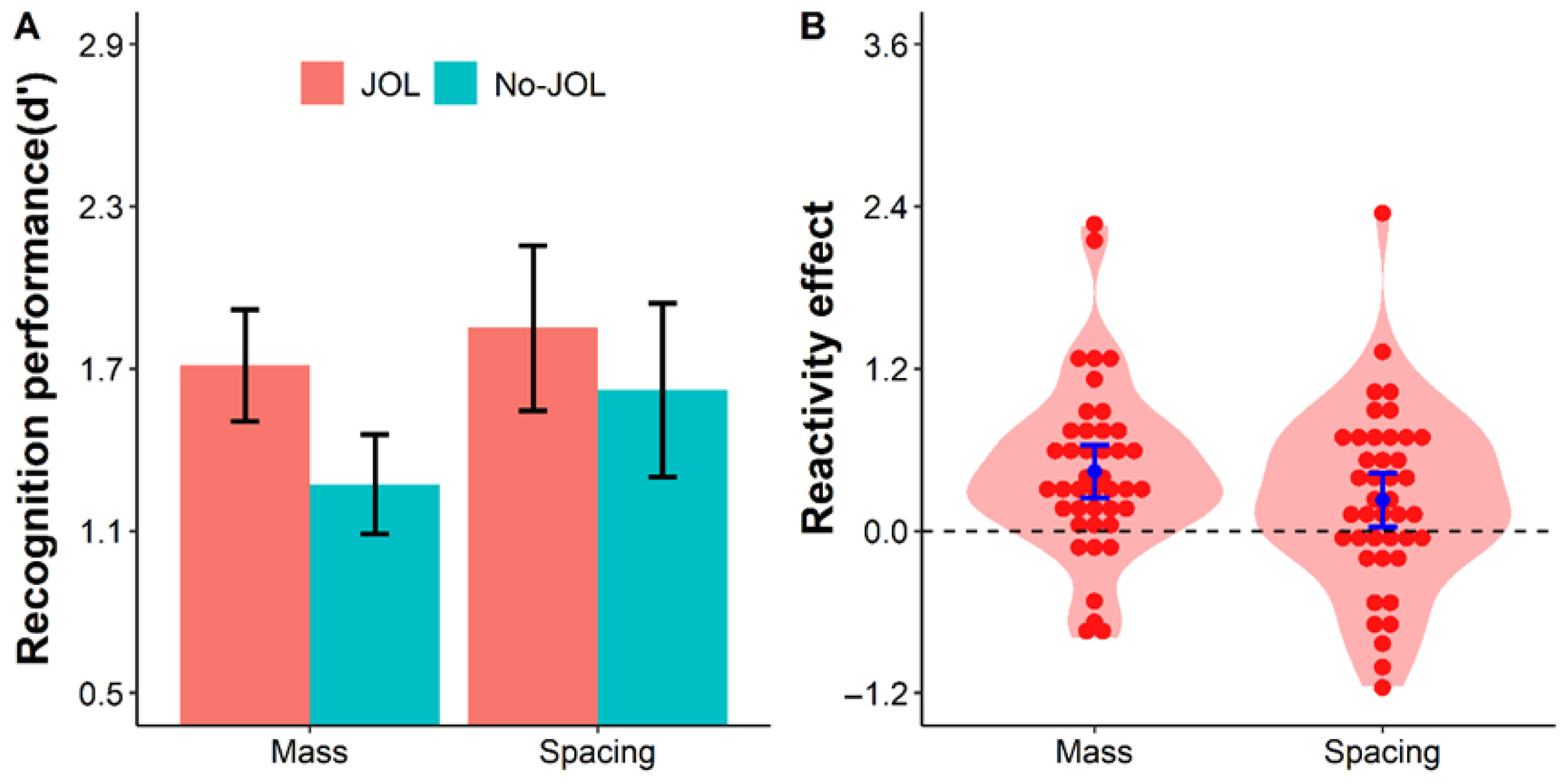
3.2. Results and Discussion
4. Experiment 3
4.1. Methods
4.1.1. Participants
4.1.2. Material, Design, and Procedure
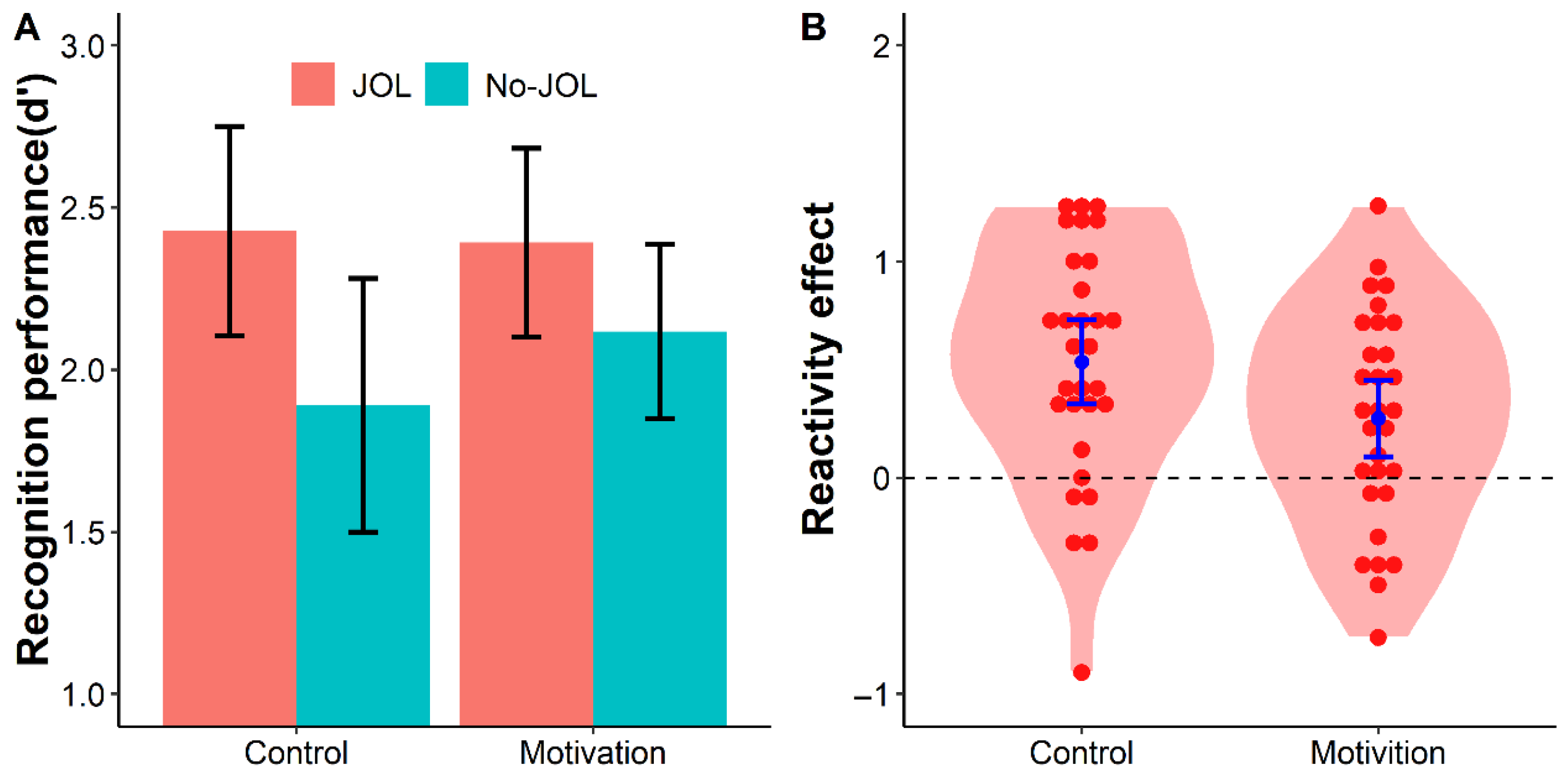
4.2. Results and Discussion
5. General Discussion
5.1. Implications for Mechanism
5.2. Implications for Education
5.3. Limitations and Future Research
6. Conclusions
Author Contributions
Funding
Institutional Review Board Statement
Informed Consent Statement
Data Availability Statement
Conflicts of Interest
Appendix A. JOL Values and Relative Accuracy Results
Appendix A.1. Experiment 1
Appendix A.2. Experiment 2
Appendix A.3. Experiment 3
Appendix B. JOL Values and Relative Accuracy Results

| Experiment | Condition/Group | JOL Hit Rate (M ± SD) | No-JOL Hit Rate (M ± SD) | False Alarm (M ± SD) |
|---|---|---|---|---|
| Experiment 1 | Aloud | 0.82 ± 0.11 | 0.72 ± 0.18 | 0.20 ± 0.15 |
| Silence | 0.75 ± 0.16 | 0.59 ± 0.19 | ||
| Experiment 2 | Mass | 0.80 ± 0.13 | 0.67 ± 0.17 | 0.24 ± 0.14 |
| Spacing | 0.81 ± 0.13 | 0.74 ± 0.17 | ||
| Experiment 3 | Control | 0.86 ± 0.11 | 0.71 ± 0.21 | 0.14 ± 0.10 |
| Motivation | 0.89 ± 0.11 | 0.83 ± 0.13 | 0.17 ± 0.11 |
References
- Allen, M., Badecker, W., & Osterhout, L. (2003). Morphological analysis in sentence processing: An ERP study. Language and Cognitive Processes, 18, 405–430. [Google Scholar] [CrossRef]
- Banks, W. P. (1970). Signal detection theory and human memory. Psychological Bulletin, 74, 81–99. [Google Scholar] [CrossRef]
- Begg, I., & Snider, A. (1987). The generation effect: Evidence for generalized inhibition. Journal of Experimental Psychology: Learning, Memory, and Cognition, 13, 553–563. [Google Scholar] [CrossRef]
- Bjork, R. A., Dunlosky, J., & Kornell, N. (2013). Self-regulated learning: Beliefs, techniques, and illusions. Annual Review of Psychology, 64(1), 417–444. [Google Scholar] [CrossRef]
- Bodner, G. E., Taikh, A., & Fawcett, J. M. (2014). Assessing the costs and benefits of production in recognition. Psychonomic Bulletin & Review, 21, 149–154. [Google Scholar] [CrossRef]
- Cai, Q., & Brysbaert, M. (2010). SUBTLEX-CH: Chinese word and character frequencies based on film subtitles. PLoS ONE, 5, e10729. [Google Scholar] [CrossRef]
- Chang, M., & Brainerd, C. (2024). Judgments of learning reactivity on item-specific and relational processing. Journal of Intelligence, 12(1), 4. [Google Scholar] [CrossRef]
- Cox, K. E., & Guthrie, J. T. (2001). Motivational and cognitive contributions to students’ amount of reading. Contemporary Educational Psychology, 26, 116–131. [Google Scholar] [CrossRef]
- Double, K. S., Birney, D. P., & Walker, S. A. (2018). A meta-analysis and systematic review of reactivity to judgements of learning. Memory, 26, 741–750. [Google Scholar] [CrossRef]
- Dunlosky, J., & Tauber, S. U. K. (2016). The Oxford handbook of metamemory. Oxford University Press. [Google Scholar]
- Faul, F., Erdfelder, E., Lang, A. G., & Buchner, A. (2007). G*Power 3: A flexible statistical power analysis program for the social, behavioral, and biomedical sciences. Behavior Research Methods, 39, 175–191. [Google Scholar] [CrossRef]
- Finn, B. (2008). Framing effects on metacognitive monitoring and control. Memory & Cognition, 36, 813–821. [Google Scholar] [CrossRef] [PubMed]
- Forrin, N. D., MacLeod, C. M., & Ozubko, J. D. (2012). Widening the boundaries of the production effect. Memory & Cognition, 40, 1046–1055. [Google Scholar] [CrossRef] [PubMed]
- Hourihan, K. L., & MacLeod, C. M. (2008). Directed forgetting meets the production effect: Distinctive processing is resistant to intentional forgetting. Canadian Journal of Experimental Psychology, 62, 242–246. [Google Scholar] [CrossRef] [PubMed]
- Jeffreys, H. (1961). Theory of probability (3rd ed.). Oxford University Press. [Google Scholar]
- Jordão, M., Ferreira-Santos, F., Pinho, M. S., & St. Jacques, P. L. (2019). Meta-analysis of aging effects in mind wandering: Methodological and sociodemographic factors. Psychology and Aging, 34, 531–544. [Google Scholar] [CrossRef]
- Kang, S. H. K., & Pashler, H. (2014). Is the benefit of retrieval practice modulated by motivation? Journal of Applied Research in Memory & Cognition, 3, 183–188. [Google Scholar] [CrossRef]
- Kleiner, M., Brainard, D., & Pelli, D. (2007). What’s new in Psychtoolbox-3? Perception, 36(ECVP Abstract Supplement), 14. [Google Scholar]
- Krawietz, S. A., Tamplin, A. K., & Radvansky, G. A. (2012). Aging and mind wandering during text comprehension. Psychology and Aging, 27, 951–958. [Google Scholar] [CrossRef]
- Li, B., Zhao, W., Shi, A., Zhong, Y., Hu, X., Liu, M., Luo, L., & Yang, C. (2023). Does the reactivity effect of judgments of learning transfer to learning of new information? Memory, 31, 918–930. [Google Scholar] [CrossRef]
- Li, B., Zhao, W., Zheng, J., Hu, X., Su, N., Fan, T., Yin, Y., Liu, M., Yang, C., & Luo, L. (2022). Soliciting judgments of forgetting reactively enhances memory as well as making judgments of learning: Empirical and meta-analytic tests. Memory & Cognition, 50, 1061–1077. [Google Scholar] [CrossRef]
- Love, J., Selker, R., Marsman, M., Jamil, T., Dropmann, D., Verhagen, J., Ly, A., Gronau, Q. F., Šmíra, M., Epskamp, S., & Matzke, D. (2019). JASP: Graphical statistical software for common statistical designs. Journal of Statistical Software, 88, 1–17. [Google Scholar] [CrossRef]
- MacLeod, C. M., & Bodner, G. E. (2017). The production effect in memory. Current Directions in Psychological Science, 26, 390–395. [Google Scholar] [CrossRef]
- Mangels, J. A., Picton, T. W., & Craik, F. I. M. (2001). Attention and successful episodic encoding: An event-related potential study. Cognitive Brain Research, 11, 77–95. [Google Scholar] [CrossRef]
- Maxwell, N. P., & Huff, M. J. (2024). Judgment of learning reactivity reflects enhanced relational encoding on cued-recall but not recognition tests. Metacognition and Learning, 19, 189–213. [Google Scholar] [CrossRef]
- Metcalfe, J., & Finn, B. (2013). Metacognition and control of study choice in children. Metacognition and Learning, 8, 19–46. [Google Scholar] [CrossRef]
- Mueller, M. L., Tauber, S. K., & Dunlosky, J. (2013). Contributions of beliefs and processing fluency to the effect of relatedness on judgments of learning. Psychonomic Bulletin & Review, 20, 378–384. [Google Scholar] [CrossRef]
- Myers, S. J., Rhodes, M. G., & Hausman, H. E. (2020). Judgments of learning (JOLs) selectively improve memory depending on the type of test. Memory & Cognition, 48, 745–758. [Google Scholar] [CrossRef]
- Myers, S. J., Rhodes, M. G., & Loaiza, V. M. (2025). Judgments of learning (JOLs) impact item memory but not source memory: Insights into JOL reactivity using a multinomial model. Journal of Experimental Psychology: Learning, Memory, and Cognition, 51(6), 1004–1021. [Google Scholar] [CrossRef]
- Pastötter, B., Schicker, S., Niedernhuber, J., & Bäuml, K.-H. T. (2011). Retrieval during learning facilitates subsequent memory encoding. Journal of Experimental Psychology: Learning, Memory, and Cognition, 37, 287–297. [Google Scholar] [CrossRef]
- Rhodes, M. G., & Tauber, S. K. (2011). The influence of delaying judgments of learning on metacognitive accuracy: A meta-analytic review. Psychological Bulletin, 137(1), 131. [Google Scholar] [CrossRef]
- Sahakyan, L., Delaney, P. F., & Kelley, C. M. (2004). Self-evaluation as a moderating factor of strategy change in directed forgetting benefits. Psychonomic Bulletin & Review, 11(1), 131–136. [Google Scholar] [CrossRef]
- Schmalz, X., Biurrun Manresa, J., & Zhang, L. (2023). What is a Bayes factor? Psychological Methods, 28, 705–718. [Google Scholar] [CrossRef] [PubMed]
- Seli, P., Risko, E. F., Smilek, D., & Schacter, D. L. (2016). Mind-wandering with and without intention. Trends in Cognitive Sciences, 20, 605–617. [Google Scholar] [CrossRef] [PubMed]
- Seli, P., Schacter, D. L., Risko, E. F., & Smilek, D. (2019). Increasing participant motivation reduces rates of intentional and unintentional mind wandering. Psychological Research, 83, 1057–1069. [Google Scholar] [CrossRef] [PubMed]
- Soderstrom, N. C., Clark, C. T., Halamish, V., & Bjork, E. L. (2015). Judgments of learning as memory modifiers. Journal of Experimental Psychology: Learning, Memory, and Cognition, 41(2), 553–558. [Google Scholar] [CrossRef]
- Tauber, S. K., & Witherby, A. E. (2019). Do judgments of learning modify older adults’ actual learning? Psychology and Aging, 34, 836–847. [Google Scholar] [CrossRef]
- Van Strien, J. W., Verkoeijen, P. P. J. L., Van der Meer, N., & Franken, I. H. A. (2007). Electrophysiological correlates of word repetition spacing: ERP and induced band power old/new effects with massed and spaced repetitions. International Journal of Psychophysiology, 66, 205–214. [Google Scholar] [CrossRef]
- Zhang, J., Li, X., & Guo, C. (2020). The neurocognitive features in survival processing: An ERP study. International Journal of Psychophysiology, 149, 35–47. [Google Scholar] [CrossRef]
- Zhao, W. B., Liu, S., Tian, X., Li, B., Shanks, D. R., Yang, C., & Luo, L. (2025). Individual differences in the reactivity effect of judgments of learning: Cognitive factors. Journal of Memory and Language, 140, 104574. [Google Scholar] [CrossRef]
- Zhao, X., Wang, C., Liu, Q., Xiao, X., Jiang, T., Chen, C., & Xue, G. (2015). Neural mechanisms of the spacing effect in episodic memory: A parallel EEG and fMRI study. Cortex, 69, 76–92. [Google Scholar] [CrossRef]


Disclaimer/Publisher’s Note: The statements, opinions and data contained in all publications are solely those of the individual author(s) and contributor(s) and not of MDPI and/or the editor(s). MDPI and/or the editor(s) disclaim responsibility for any injury to people or property resulting from any ideas, methods, instructions or products referred to in the content. |
© 2026 by the authors. Licensee MDPI, Basel, Switzerland. This article is an open access article distributed under the terms and conditions of the Creative Commons Attribution (CC BY) license.
Share and Cite
Li, B.; Yang, C. The Cognitive Mechanisms of the Positivity Reactivity Effect on Word Recognition Memory. J. Intell. 2026, 14, 47. https://doi.org/10.3390/jintelligence14030047
Li B, Yang C. The Cognitive Mechanisms of the Positivity Reactivity Effect on Word Recognition Memory. Journal of Intelligence. 2026; 14(3):47. https://doi.org/10.3390/jintelligence14030047
Chicago/Turabian StyleLi, Baike, and Chunliang Yang. 2026. "The Cognitive Mechanisms of the Positivity Reactivity Effect on Word Recognition Memory" Journal of Intelligence 14, no. 3: 47. https://doi.org/10.3390/jintelligence14030047
APA StyleLi, B., & Yang, C. (2026). The Cognitive Mechanisms of the Positivity Reactivity Effect on Word Recognition Memory. Journal of Intelligence, 14(3), 47. https://doi.org/10.3390/jintelligence14030047