War of Narratives: Christianity, Iconoclasm, and Decoloniality of Race and Religion
Abstract
1. Introduction
- -
- Gurwinder Singh, son of intergenerational bonded laborers, Bauran Kalan village, Patiala district, Panjab
- -
- Father John, Parish Priest of Infant Jesus Catholic Church, Thakarpura village, Patti, Tarn Taran, Panjab (Interview with the author, July 2023)1
2. Mazhabi Sikhs and Christianity in Panjab
2.1. The Ambit of Caste
2.2. Varna, Jāti, and Social Discrimination
Other scholars oppose this view, stating pre-modern scholarship documents “caste as both material oppression and varna ideology,” prevalent prior to the arrival of the British (Chakravarti 2019). They state that Jainism and Buddhism both rejected Brahminical claims to supremacy, and later the bhakti movement in the medieval period “grew from within the Hindu fold and was characterized by a strong anti-hierarchical and anti-ritualistic stand” (Srinivas 2003, p. 458). Bhakti saints endeavored to create an egalitarian society devoid of discrimination, which served as a precursor to modern “anti-caste consciousness” in India (Omvedt 2008; Novetzke 2007; Ram 2008; Chakravarti 2019; Sarkar 2019; Gopani 2023).26 The strong presence of such reformist movements signals the existence of transformative spaces in ancient and precolonial India through which novel articulations of self-critique, reflection, and alternate socio-religious ideologies could emerge. Post-independence after caste was abolished, the lower castes, now divided into Backward Class (BC), Scheduled Caste (SC), and so on, are given reservation quotas in higher educational institutions and government jobs but, as noted before, caste-based oppression continues in contemporary Indian society. It exists among Hindus, Christians, Jains, Sikhs, Buddhists, and Muslims (Elder 1996, p. 22).The ‘rigid caste system’ made up of a collection of such entities is not likely ever to have existed, although, as Ronald Inden (1990) and Nicholas Dirks (2001) point out, its prevalence has been asserted rhetorically by most of India’s published critics—Christian missionaries (Forrester 1980), colonial officials like James Mill (1817), and Indian reformers such as Jawaharlal Nehru (1946)—and elaborated in armchair theorizing by Max Weber (1958), Louis Dumont (1970), and others. The supposition of such a caste system guided the gathering of official information and influenced social policy debates throughout the final century of colonial rule. It continues to preoccupy many recent descriptions of Hindu society.(Marriott 2004, p. 358)
2.3. Umbra of Caste in Sikh Society
2.4. Christianity in Panjab
3. Icons, Iconoclasm, and “Inverted Iconoclasm”
3.1. Of ‘Idols’ and Icons in Christianity: A Dialectical Paradox
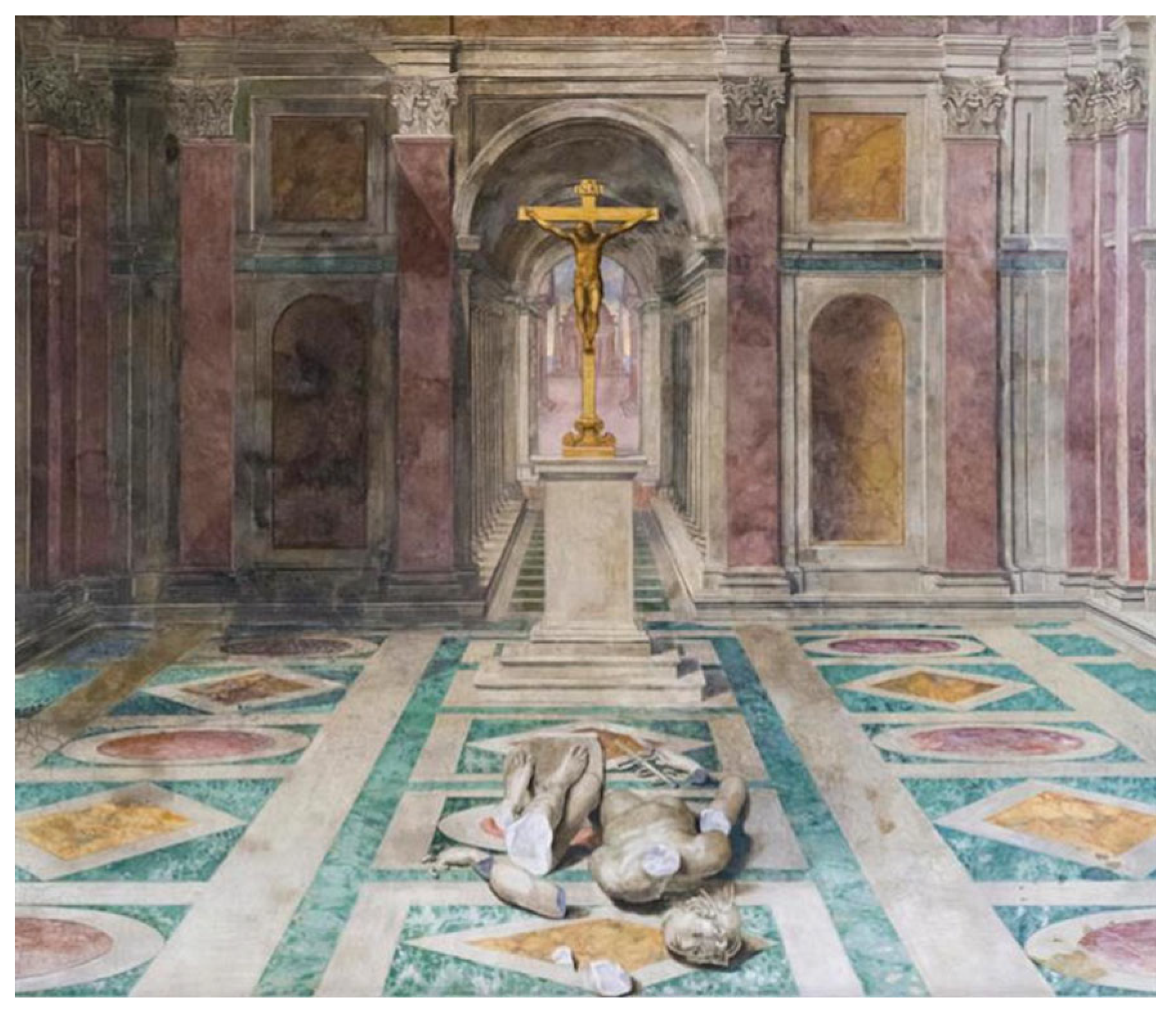
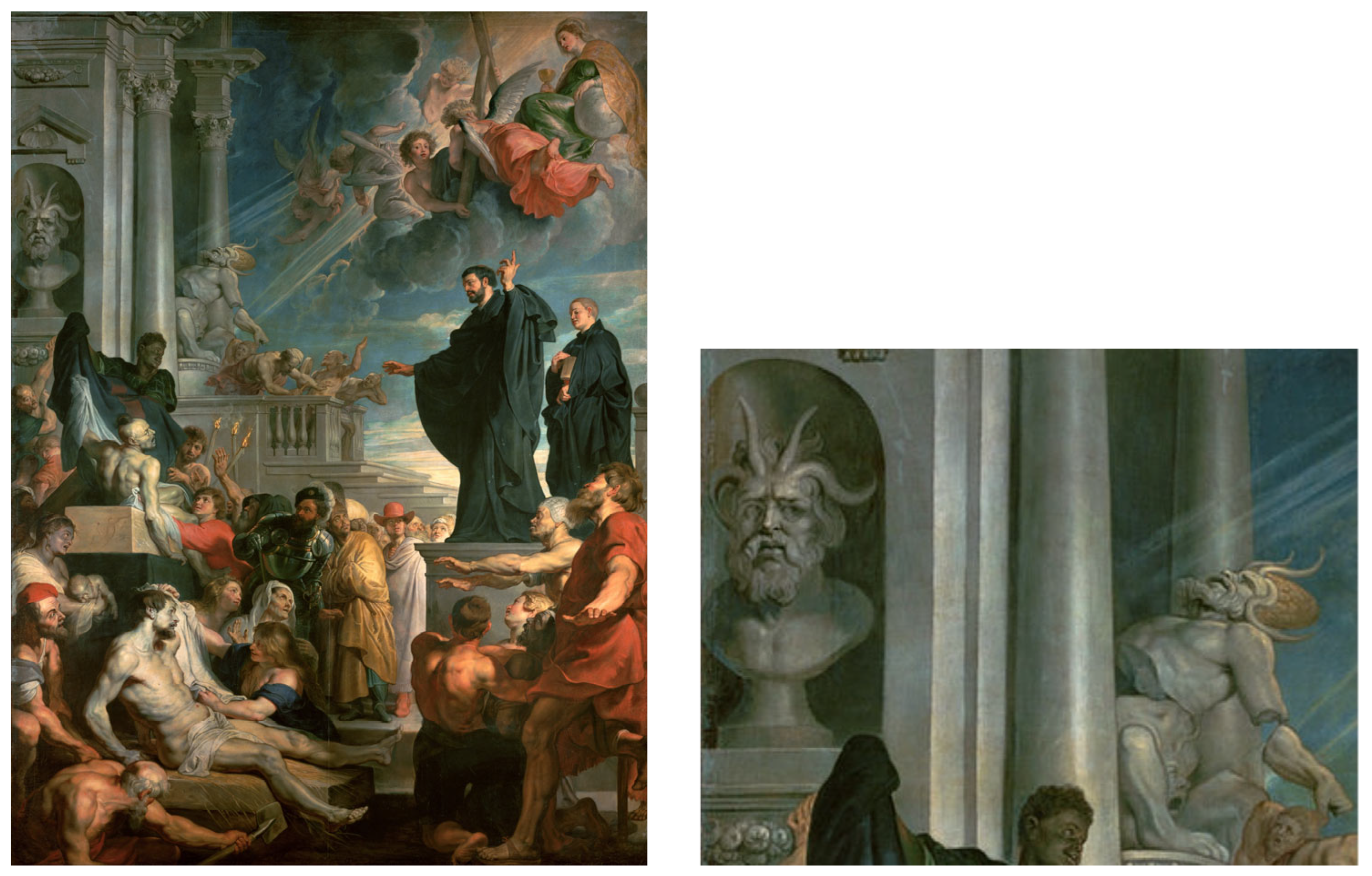
Within this colonial worldview, by extension, non-Christian gods are also ‘morally impure and corrupt,’ rather ‘demonic’ and hence deserve to be represented (if at all) only as broken and decapitated. However, in Rubens’ vision the rendition of Hindu ‘idols’ is perplexingly animated. Similar to the earlier painting by Laureti, “The Triumph of Christian Religion” in which the pagan god’s ruthless dismemberment points to the power ascribed to ‘idols’ that ought to be annihilated; the iconoclasm of Hindu ‘idols’ by Xavier, a Christian missionary in Rubens’ painting also heightens the ‘idols’’ energy by imbuing them with a pulsating quality (Figure 3 and Figure 4). Undermining the lifelessness and inertia attributed to ‘idols,’ in Rubens’ version they express an array of emotions—dismay, distress, grief, and fear, grimacing and writhing in pain like animated entities framed with Christian ideas that stereotyped Indian gods as Satanic creatures fused with elements of Greek satyrs (R. Miller 2018).39The reception of Jesuit images as art is not just a modern art historical question. Around it the Jesuits (and others) drew the line between the European and non-European, good and bad, morally pure and impure, civilized and uncivilized.(Levy 2014, p. 87)
3.2. Anti-Race and Anti-Slavery Iconoclasm in the United States
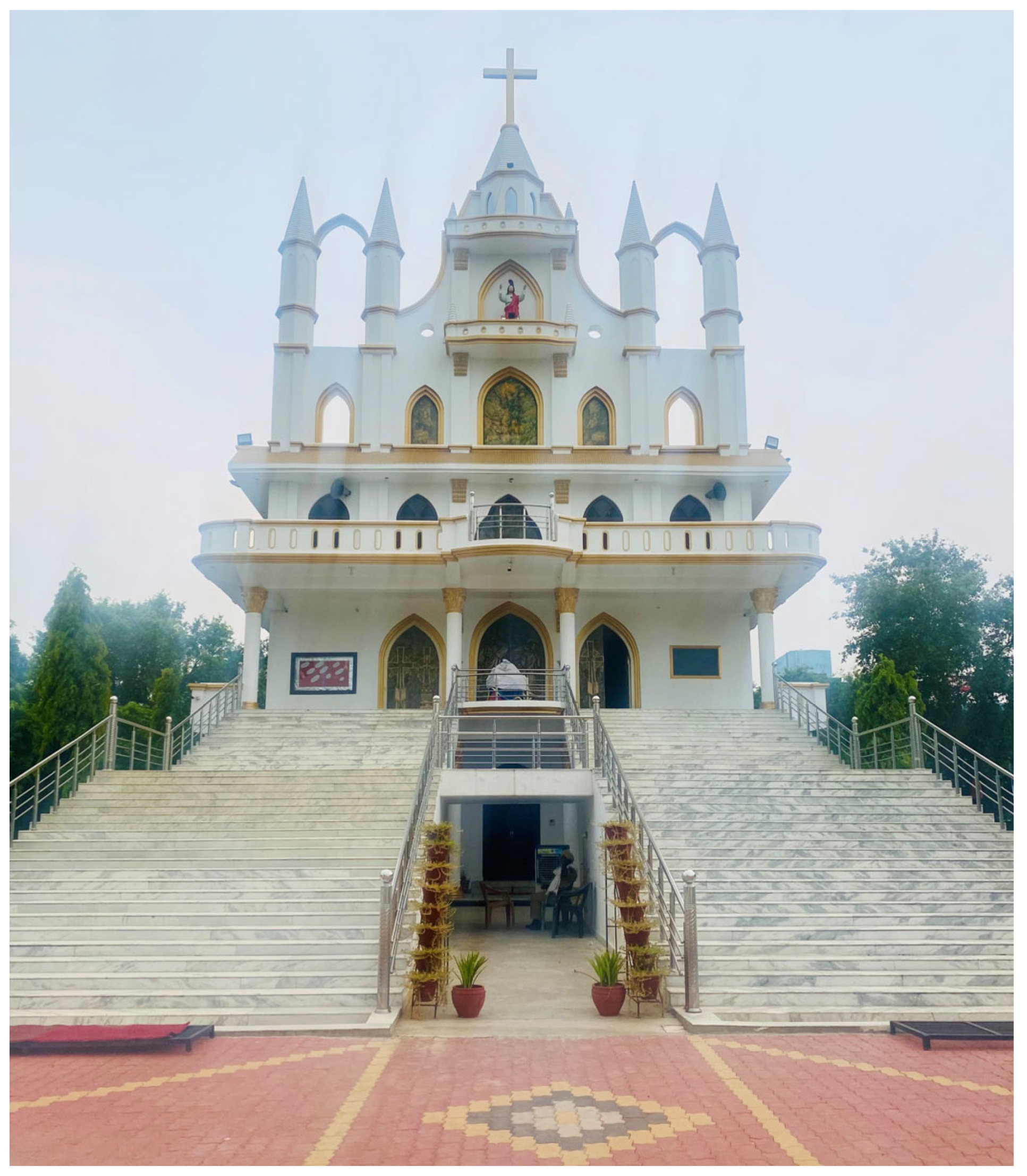
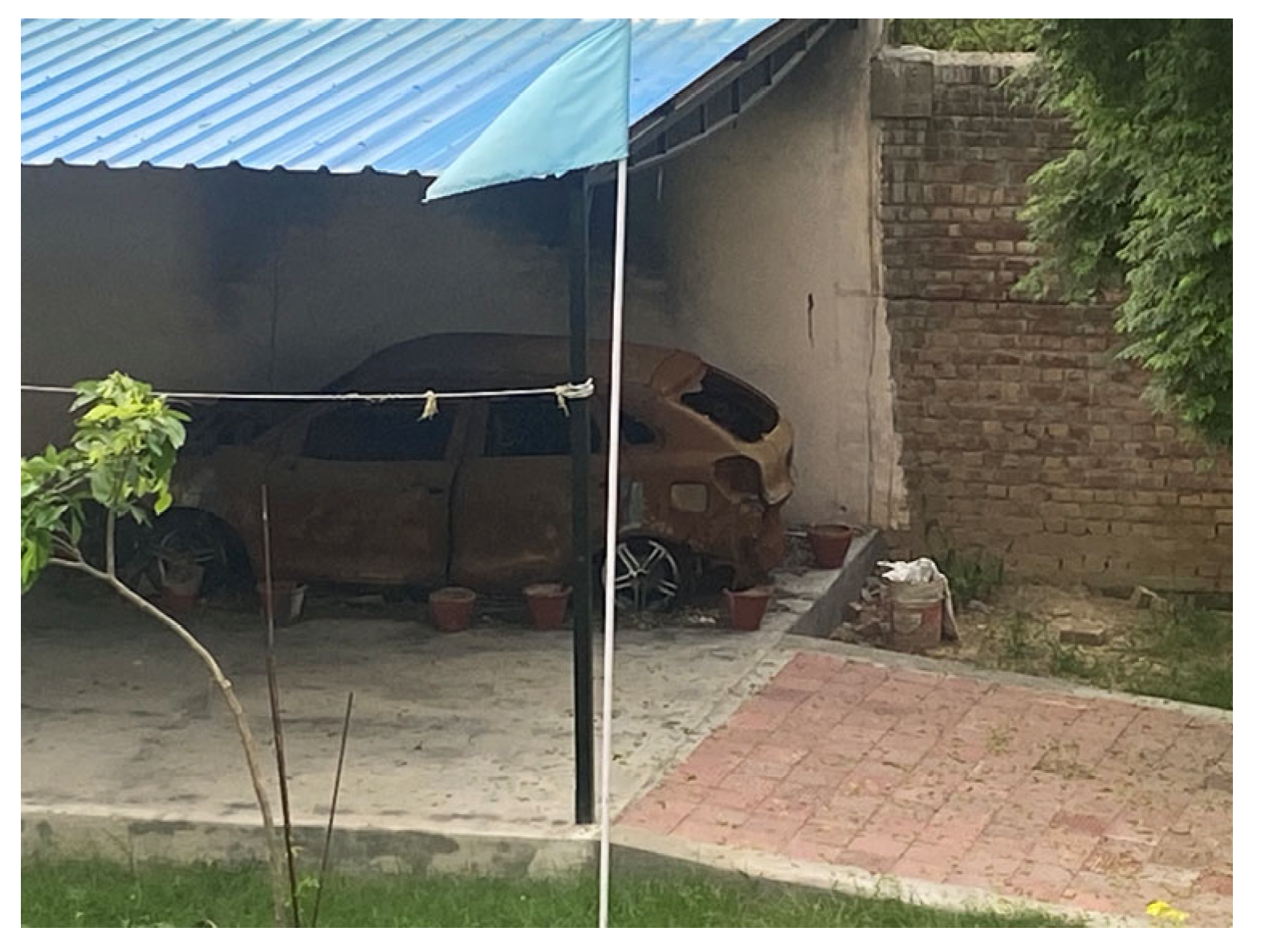
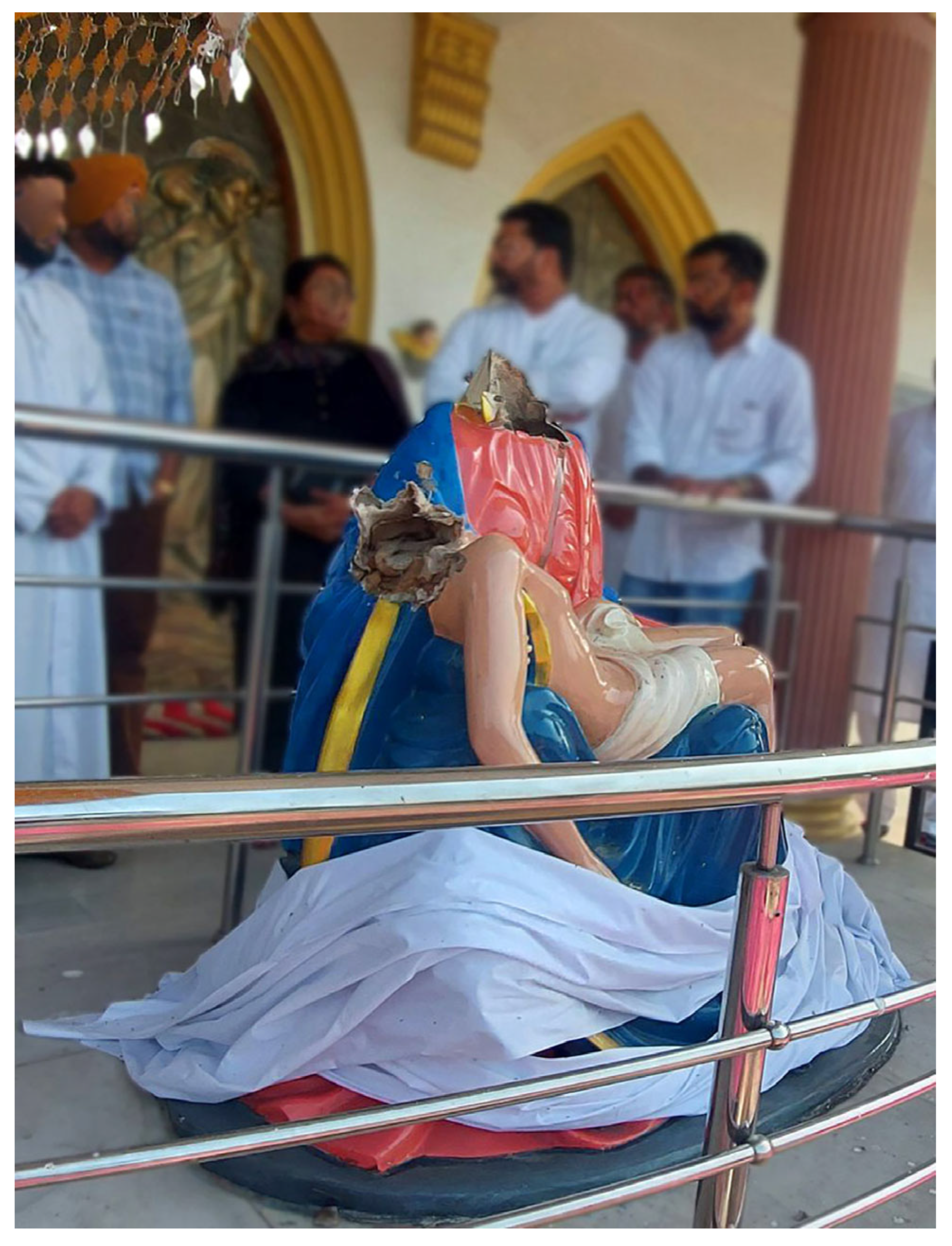
3.3. Tarn Taran Pieta: Inverted Iconoclasm and the Return of the Real
By consecrating a sacred area for Miss Sherwood akin to that of Virgin Mary’s icons, Lal suggests that Dyer reinforces that within colonial lands, native spaces were racially marked and subservient to both political and sacral White spaces. For Dyer, this White, gendered and sanctified space of the Christian missionary that had been desecrated needed to be purified by creating a savage colonial spectacle of power: Profane colonial bodies needed to go on their all fours like they would while visiting a holy shrine to pay obeisance to the invisible yet iconic image of Miss Sherwood. This mandatory ritual of the “crawling lane”, a ceremonial display of brutal British power was ‘festooned’ with a flogging post for anyone that disobeyed the order.56 Through this act, as Lal observes, Dyer aimed to retransform and reinstate the sacrality of the iconic White space, which had been marred by brown bodies with their acquired temporary agency (even if misplaced), and had thus been taught a lesson. The hierarchy needed to be reset and reinforced, through this monument of chastity in which the missionary as a Christian icon was centralized and used to legitimize, sustain, and even justify political oppression, carnage, and dehumanization. Gandhi described it as a site of national humiliation and a great wound on the Indian psyche (Lal 1993). However, Dyer was welcomed in Britain as a “conquering hero” honored with the title of “The Man who saved India,” while Miss Sherwood defended Dyer for his actions, describing him as the “’savior’ of Punjab” (Mani 2018, pp. 135, 42). When images of Mary, or pieta, are placed in churches of Panjab, scarred with colonial trauma of the “master-signifier of whiteness” embedded in “the regime of visibility”, the memory of the land colors them in multiple hues (Hook 2020; Seshadri-Crooks 2000, p. 2).‘We look upon women as sacred or ought to’, he [Dyer] explained, and since the sacred had been rendered profane, the act of desecration would have to be undone. The profane would have to be retransformed into the sacred: ‘I also wanted to keep the street what I call sacred. Therefore I did not want anybody to pass through it.’… Imagining Miss Sherwood as a Virgin of Mary or a Florence Nightingale, Dyer erected a monument to her chastity.(Lal 1993; emphasis mine)
3.4. Tarn Taran Pieta: An Avatar of Lacanian Return of the Real
According to Derek Hook, Lacan describes the real as the non-representational pre-mirror stage that escapes language, materiality, and form, one that “eludes both symbolization and the domestication of the imaginary” (Hook 2020). Lacan propounds that the mirror stage is a period in children’s lives, between six to eighteen months, when they encounter the image in a mirror as theirs, drawing a distinction between the Self (the child’s own body) and Other (persons and objects of the world) (Mambrol 2016). Before this, the infant is from birth in the real stage, defined by a symbiotic relationship with the mother. With the mirror stage, the infant identifies with their mirror image and attains the first realization of bodily autonomy that appears whole even when the infant experiences a fragmented self, as they have not yet mastered the upright posture and full motor control over their body. This causes a radical transformation that despite the fragmentation, their mirror image gives an appearance of a unified form, which becomes the basis of a coherent subjectivity (albeit an alienated one, seeing themself as separate from their mother). Through the mirror stage the infant imagines that they achieve mastery over their own body, which stands in contrast with the feelings of fragmentation but in a place outside of themself.57 From the Imaginary/pre-linguistic stage (where the child does not recognize the demarcation between themself and the objects in the world) the child transitions into the Symbolic, “in the world of predefined social roles and gender differences, the world of subjects and objects, the world of language” (Mambrol 2016). This subjectivity and its appearance of unity of the self is what imparts their image with a sense of agency and subjecthood. Thus begins the lifelong process of identifying the Self in relation to the Other—man/woman, Black/White, and so on (2016).The real becomes that which resists representation, what is pre-mirror, pre-imaginary, pre-symbolic—what cannot be symbolized—what loses it’s ‘reality’ once it is symbolized (made conscious) through language.
Movements such as Black Lives Matter too have shown that something continues to speak in the place where it has been repressed/oppressed (Lau 2021, p. 278). Laclau examines how the real bursts through the clutches of repressive regimes, not as a specifiable object but as something that only exists and shows itself through its “disruptive effects within the Symbolic” (Cates et al., 2018, Laclau 2006, p. 658). The decapitated Tarn Taran pieta exemplifies this rupture, in which the real of colonial trauma of the past ‘shows itself’ in the present threat of neocolonial legacy embodied in the Christian icon, splitting apart and tearing through to make its way in the Symbolic, our world of lived reality. The lack of healing to deal with the trauma of colonialism, especially the Jallianwala Bagh massacre, the crawling lane, and the subsequent partition of the country (1947) (specifically of Panjab) due to British policy of ‘divide and rule’ has stayed with the postcolonial subject.In Jacques Lacan’s words, what has been repressed from the symbolic order—from the realm of language and open discourse, from the stories that we tell about ourselves—returns in the real. In other words, when we repress our colonial and neocolonial histories, they will come back to haunt us all the more.(Rieger 2021, p. 532)
At the root of colonialism and the collective trauma it perpetuated as “a racist exploitative project was a philosophy which claimed that ‘Christianity = civilisation, paganism = savagery’” (2020, p. 15), visually echoing with propagandistic paintings of Laureti and Rubens commissioned by missionaries as discussed earlier (Figure 3 and Figure 4). The missionaries in Panjab do not acknowledge the historical reality of the trauma of British oppression even though it is well known that Christianity worked in tandem with colonial powers in suppressing indigenous cultures by imposing Western practices. In 1913, the German Roman Catholic missiologist, J. Schmidlin, summed up the role of missionaries: “to missionize is to colonize and to colonize is to missionize” (Quoted by Rieger after Bosch, 2021, p. 531). Christian religion in Panjab is marked by a stark denial and de-linking from its past colonial history of oppression in India.60 This erasure of the identity of colonized and its continuation in the form of denouncing the subjecthood of the postcolonial subject causes repression that pulsates as collective trauma in the psyche of Panjab.It is argued that colonialism ended when European powers retreated from their geographical colonial territories and handed back political power. However, it is an error to confine the colonial project to specific geographical areas or historical eras or even deny its ongoing operation… Beyond the decimation of populations and expropriation of land and resources, colonialism also entrenched Eurocentrism and Western knowledges through denigration, subjugation, …. Colonial violence, dehumanisation, alienation, and loss of meaning arising from the systemic violence of the suppression of language, culture, and dignity become internalised through a process described as the colonisation of the mind… In this way, racism and sociopolitical inequalities of the oppressive colonial environment are ‘at the bottom of such intra-psychic difficulties and psychological neuroses’… It is therefore imperative that colonialism is understood to produce a complex set of psycho-social dynamics both at individual, collective, and intergenerational levels.(Masson and Smith 2020, pp. 14–15, emphasis mine)
3.5. Pieta as a Figure of Salvation: Epistemic Violence and the Crypto-Christian Sikh
Given the rapid pace of conversions, even though the Christian vote bank in Panjab has increased, “the condition of Dalit Christians has deteriorated over the last decade” as they are marginalized and “politically powerless,” says Dr. Emanual Nahar, chairman of the Punjab Minorities Commission and himself a Dalit Christian (Nahar 2024). He said that Panjab’s Dalits “had joined the churches seeking liberation and solace in the new community but found their expectations unfulfilled,” further adding, “A change of religion has neither healed their scars nor brought sweeping changes in their socio-economic status” (Nahar 2024). One reason could also be that many Catholic priests and Christian pastors come from privileged castes such as Jat Sikhs (Mahajan and Menon 2022; Nahar 2024), so even within the new religion the Dalit Christian voices remain subjugated.Dalits go there [convert to Christian faith] for another reason, to solve their economic social problems … discrimination in the society is a big factor. I converted many years back and we also took advantage of that conversion, our kids went to convent schools … earlier the church used to connect to poor neighborhoods, and uplifted underprivileged kids through education … Punjab’s Dalit Christians are engulfed within a different problem now. When Panjab’s Dalits become Christians, their Dalit status is finished but neither the government nor the church speaks about it … ‘caste toe saathe saath chaltee hai’ (caste keeps following [us] everywhere)
4. Decoloniality and Contours of Begumpura
Unlike coloniality, Mignolo posits that decoloniality “operates on pluriversality and truth and not in universality and truth” striving for “re-existing” rather than “resisting” European universalism as the latter reproduces the paradigm endlessly, implicating the Other into it (p. 41). To dissipate CMP, Mignolo proposes to de-link “from the imposed dichotomies articulated in the West, namely the knower and the known, the subject and the object, theory and praxis” by staying at the exterior/borderline of the Self/Other binary shaped by the principles of Western epistemologies (p. 42). He delineates that the gesture of de-linking/decentering must be accompanied by a process of re-linking/recentering with their own memories and legacies by resurrecting aesthetic and political indigenous structures that people want to preserve through a process of “decolonial epistemic reconstitutions” to overcome Western hegemony (Mignolo 2017; 2021, p. 6). This model of “indigeneity over decoloniality” allows for multiple “truths” to coexist rebuilding and re-existing under new conditions and modes of being that are your own (Mignolo 2017, p. 39). The act of rebuilding indigeneity implies decolonial de-linking from settlers’ control of lives in which “decoloniality is not an ethnic, national, or religious identification,” but a “political project” (p. 44).If one looks at the transformations of the CMP since its formation in the sixteenth century, one sees mutations (rather than changes) within the continuity of the discursive or narrative orientation of Western modernity and Western civilisation: from, in the nineteenth and twentieth centuries, Christianity (Catholic or Protestant) to secularism, liberalism, and Marxism (in other words, from the Christian the civilising mission) and from ‘progress’ in the nineteenth century to ‘development’ in the second half of the twentieth.
In the current circuits of the making of this indigenous social order, the notion of Begumpura conjures an image of an emancipatory decolonial landscape. One that is delinked from colonial power structures and from exploitative hierarchies of race and caste, and relinked to reinvigorated indigenous epistemes allowing for multiple religious formations to coexist: Deras, Dargahs, Hindu temples, Sikh gurudwaras, Christian churches, among other religious identities to thrive together. This allows for envisioning a space of equality sans manipulation due to hegemony, economic disparity or bracketing through stigmatization, or a dehumanizing rhetoric—a place in which people are not forced to convert under pressure or enticement due to poverty, lack of opportunity or dignity, but by exercising their free will. Following the modern making of this utopian order, Begumpura glimpses through Thakarpura’s villagers’ collective insistence on representing their village as a “space of mutual respect, peace and harmony” with multiple religions and castes living together. It is more evidently articulated in the contemporary idea of the new casteless “Begumpura village” (Mondal 2025) and popular music of Panjab, with albums such as “Begumpura Sher ko Layoo”, “Begumpura Bhajan Mandali”, and “Begumpura” by Kanth Kaler among others that have been keeping the utopian idea alive in Panjab’s contemporary popular consciousness.The regal realm with the sorrowless name:they call it Begumpura, a place with no painNo taxes or cares, nor own property there,no wrongdoing, worry, terror or torture.Oh my brother, I have come to take it as my own,my distant home, where everything is right. …
5. Conclusions
Funding
Institutional Review Board Statement
Informed Consent Statement
Data Availability Statement
Acknowledgments
Conflicts of Interest
Correction Statement
| 1 | In this paper, the name of interviewees from Thakarpura and other parts of Panjab have either been changed or referred to only with their first names to protect their identity. However, original names cited in newspapers and online videos that are publicly available have been retained and accordingly referenced. In common usage the word is spelt as “Punjab”, but I am using Gill’s transliteration of it as “Panjab.” According to him, “Although ‘Punjab’ is the more common rendering, with notable exceptions such as Panjab University in Chandigarh, it is a persistent colonial-era mis-transliteration” (Gill 2019, p. 4). |
| 2 | The word Dalit is understood to be popularized by B.R. Ambedkar, who is considered the modern messiah of the lower castes in India and is also credited for penning down the country’s constitution. The term gained momentum when it was adopted by the Dalit Panther movement in the 1970s (Abraham and Misrahi-Barak 2018, p. 19). Although it continues to be used in popular culture and academia, the term Dalit is seen by some as problematic citing that Ambedkar had rejected it (Manwatkar 2022). |
| 3 | Although peasants are generally associated with the underprivileged and suppressed, in Panjab, Jat Sikhs that are traditionally lower caste farmers acquired a large share of agricultural land and became the dominant landlord class. I will discuss this point in detail in Part 1 of the paper. |
| 4 | “The labourers in debt bondage in Punjab are known as siri. They generally belong to the Scheduled Caste besides enduring long working hours they have no freedom to choose employment, to the right of movement, to use the village commons, and so on. … Sepi, sanjhi and siri are some of the traditional forms of bondage which have received legitimacy from the dominant social structure … Punjab has nearly 100,000 bonded agricultural labourers and nearly three fourths of them hail from a single caste, namely the Mazhabi Sikh” (Singh and Singh 2016, p. 411). |
| 5 | “Gurdev Kaur, an elderly paralysed [Mazhabi Sikh] woman, was lying in a pool of blood after a Jatt mob chopped off her leg. They didn’t stop at that; standing on the roof of her house, they emptied the overhead tank on her while she lay on her charpai. The force of water pushed her to the ground, and flooded the angan, drowning her. The Mazhabi Sikhs of the village Jhaloor watched on helplessly—the Jatts wouldn’t let anyone near her. That was on 5 October 2016 and it was all over a piece of land. Today, she is a martyr with a memorial and a library in her name in the middle of Jhaloor. Five years later, the horrific lynching of a Dalit Sikh near Delhi, allegedly by the Nihangs, is creating another firestorm in Punjab” (Misra and Bhardwaj 2021). Also see, “Sikhi, Sikhs and Caste,” (Special Guest Issue), Religions, MDPI, 2025. Available online: https://www.mdpi.com/journal/religions/special_issues/7W6C2UYGWO (accessed on 28 July 2025). |
| 6 | The word Dalit is a modern rendition of “the descriptive name of Untouchable or ex-Untouchable (now that the practice of untouchability is illegal); Gandhi’s compassionate but patronizing appellation, Harijan (Children of God); and, when appropriate, the official term of Scheduled Caste” (Zelliot 2008, p. 450). Also see Gopal Guru’s “Politics of Naming” (Guru 1998), and Simon Charsley’s, “Untouchable: What is in a Name?” (Charsley 1996). |
| 7 | In many villages of Panjab there are separate gurdwaras (Sikh temples) sometimes numbering seven to eight in a single village belonging to various types of Dalit Sikhs, including Ravidasis, Mazhabi Sikhs besides the dominating Jat community (Sehgal 2022; Misra and Bhardwaj 2021). |
| 8 | Dera it is an alternative space of worship in Panjab for those that are marginalized by mainstream socio-religious and political structure of the society and is popular across all communities such as Hindu, Sikh, and Muslim. There are more than “9000 Sikh as well as non-Sikh Deras in the 12,000 villages of Punjab” (Ram 2007, p. 4067). |
| 9 | Snehi argues that the evolution of Sikh traditions cannot be fully comprehended unless seen through the dialectics and syncretism of bhakti traditions of Nath [Hindu] yogis, Sikhs, and sufi sects as they inform and intersect each other (Snehi 2019). |
| 10 | Lower caste, Balmiki Hindus also face discrimination and throng deras, churches, and Muslim shrines. Since Panjab is a Sikh-dominated state (see I.P. Singh 2021), this study primarily focuses on Mazhabi Sikhs. The focal point of this paper is the Tarn Taran pieta and my ethnographic fieldwork revealed the strain that exists on the ground between Christian missionaries, Jat Sikhs, and Crypto-Christian Sikhs, the latter primarily comprising converted Mazhabi Sikhs. |
| 11 | “‘Today, we are facing a lot of challenges. Christianity is being spread in Punjab on a large scale to weaken us religiously’ … The Akal Takht acting jathedar called for countering the massive conversion of the Sikhs” (Surjit Singh 2022b, 7 June). “Delhi Sikh Gurdwara Management Committee on Tuesday organised a press conference in Amritsar with 12 families, which, according to its functionaries, were lured to join Christianity by so-called Christian pastors and have now returned to the fold of Sikhism” (Surjit Singh 2022a, 31 August). |
| 12 | I am using the term “Crypto-Christian Sikh” primarily to refer to Dalit Sikhs that convert to Christianity but in government records continue to retain their lower caste Sikh status to avail benefits. “Crypto-Christian Sikh” is derived from the term Crypto-Christians that is used to denote people who allegedly convert to Christianity, either freely or by coercion, but keep their Christian beliefs and practices legally hidden. In academia, the term has been used for Christians (crypto-Christians), Jews (crypto-Jews, crypto-Judaism (Lapidot 2018)), Muslims (crypto-idolators (Roggema 2003)), and so on. However, in the case of Dalit Sikh converts that become Crypto-Christian Sikhs, they freely practice their Christian religion and mass conversions are openly carried out in the democratic space of the country, so, I am using the term differently. In the current scenario, the identity of a Crypto-Christian Sikh creates a lack of sociopolitical agency in converted Dalit Sikhs by their decision of not disclosing their religion of practice in official records, which stems from their political choice/and socio-economic compulsion. As I later argue in the paper, this lack of officially embracing Christianity further traps them into their oppressed identities. I would also like to clarify that there is no intention to use the word “crypto” in any discriminatory or devaluing sense but only as an analytical and descriptive term as established in other relevant publications/studies and examined in this paper. |
| 13 | “‘Seven to eight attacks on Christian volunteers, churches, and gatherings were reported. No action has been taken against the people involved in the attacks,’ Hamid Masih, President of Christian Front said” (Sehgal 2022). “On Christmas night, the idol of Jesus Christ was vandalised in Ambala’s Holy Redeemer Church”, “Watch: Jesus Christ’s statue vandalised at Ambala’s oldest church; two suspects caught on cam,” Hindustan Times, 26 December 2021. Available online: https://www.youtube.com/watch?v=OOpKb5OSPZ8 (accessed on 25 November 2023). |
| 14 | Watch the CCTV footage of the incident and also the guard’s testimony in this video. “Security guard at Tarn Taran church that was vandalised describes the night of attack”, The Print, 3 September 2022. Available online: https://www.youtube.com/watch?v=OcK-2cpFUVA (accessed on 2 December 2023). |
| 15 | Father Poochali, a Malayali Christian priest, was in charge of the Infant Jesus Catholic Church but was replaced by Father John after the incident (Interview with the author, July 2023). |
| 16 | I have used the word “statue”, “icon”, and “image” interchangeably depending on the context. See the section, “Of ‘Idols’ and Icons in Christianity: A Dialectical Paradox” for more details. |
| 17 | The term is taken from a conference “Atmospheres of Violence” in which it denotes articulations that produce representations of violence alluding to Fanon’s concept of “atmospheric” violence. “Film and Visual Studies Graduate Student Conference,” Harvard University, 3–5 May 2023. Available online: https://networks.h-net.org/node/73374/announcements/12064190/atmospheres-violence (accessed on 19 September 2023). |
| 18 | This is the first paper that interrogates Christianity in Panjab from a visual studies perspective. It is a multidisciplinary research project that began in 2020 followed by a research trip in July–August 2023. The paper is a result of my preliminary findings and analysis. It is the first step toward mapping contemporary visual histories of Panjab that focus on popular sacred images (icons) of Christianity and its implications. The paper does not lay claim to any final conclusion on this multipronged phenomenon and sees it as one in the making where, as a researcher, I have attempted to capture its nuances from the perspective of Tarn Taran’s pieta. |
| 19 | The term colonialism is described as “the process of European settlement, violent dispossession, and political domination over the rest of the world, including the Americas, Australia, and parts of Africa and Asia” (Kohn and Reddy 2023). In the book, From Idols to Icons, Robin Jensen states that “‘Idolatry’ was associated broadly with the worship of gods other than the God of Israel and more narrowly with the fabrication and veneration of visual images of those ‘false’ gods” (Jensen 2022, p. 72). Jensen further elucidates that the term idol derives from a Latin equivalent used by Christian authors to denote images of polytheistic religions as “a delusion or even a phantom” (Jensen 2022, p. 20). In spite of the disparaging and negative connotation in framing of terms such as ‘idol’ and ‘idolatry’, for this paper, I am using them to make it legible for a wider audience. These terms will however be encased within single quotes to refer to this irony, of the paucity of academic language that remains subservient to linguistic colonialism. |
| 20 | Emily Conroy-Krutz “shows the surprising extent of the early missionary impulse and demonstrates that American evangelical Protestants of the early nineteenth century were motivated by Christian imperialism—an understanding of international relations that asserted the duty of supposedly Christian nations, such as the United States and Britain, to use their colonial and commercial power to spread Christianity” (Conroy-Krutz 2017). |
| 21 | “In May 2021, when archeologists detected what they believed to be 200 unmarked graves at an old school in Canada, it brought new attention to one of the most shameful chapters of that nation’s history. Starting in the 1880s and for much of the 20th century, more than 150,000 children from hundreds of indigenous communities across Canada were forcibly taken from their parents by the government and sent to what were called residential schools. Funded by the state and run by churches, they were designed to assimilate and Christianize indigenous children by ripping them from their parents, their culture, and their community. The children were often referred to as savages and forbidden from speaking their languages or practicing their traditions … many were physically and sexually abused, and thousands of children never made it home” (Cooper 2023). |
| 22 | “‘Religious racism’ is a term that originates from Brazil, where devotees of African diaspora religions have been experiencing increasingly pervasive intolerance over the past several years. This terminology underscores that discrimination against African-based religions is more than mere prejudice against a faith or group of faiths; it is the intersection of religious intolerance and racism … Not only does the term ‘religious racism’ reflect that intolerance against Africana religions follows traditional patterns of racial discrimination, but it also signifies that prejudice against these faiths is typically motivated by anti-Black racism” (Boaz 2021, pp. 2–3). |
| 23 | My usage of the word “West” for the current paper is limited to Britain, USA, Canada, Portugal, and Spain. For the colonial period in context to India, it primarily encompasses Britain, and also Spain and Portugal. In regard to the context of Native Americans in this paper, the term refers to the United States, Canada, and Spain. For the postcolonial contemporary moment of anti-racist and anti-colonial iconoclasm (for example of Serra icons) in 2020, the term “West” mostly applies to the United States. |
| 24 | In the late 1700s, the colonizers developed the concept of casta paintings that show the mixing of three main races: Spanish (White), Native, and African to reinforce their racial stereotypes (“The Casta System” 2020). “Casta paintings, a unique genre that emerged in 18th-century colonial Mexico, … reveal the colonial society’s obsession with the categorization and hierarchy of race” (Valdez n.d.). |
| 25 | In Caste and Devotion: A Casteless Framework for (Some) Forms of Hindu Devotionalism, Akshay Gupta invokes the trope of bhakti to examine the concept of varna through a scriptural perspective. He focuses on Bhagavad Gītā (c. 500 BCE–200 CE) and the Bhāgavata Purāṇa (c. 9th century CE), two influential Hindu sacred texts to understand how they conceptualize the relationship between caste and devotion (bhakti). He articulates “the notion that the varṇa system requires a hierarchical ordering according to ritual purity is challenged—by performing even the tiniest amount of bhakti, a lower varṇa or an outcaste can develop the same level of purity as a brāhmaṇa” (Gupta 2022, p. 639). |
| 26 | “Dalit movement in India has its roots in the reformative Bhakti Movement. The Bhakti Movement was anti-caste, anti-elite, pro-women, pro-poor, anti-Sanskrit, and affirmed that genuine love of God was sufficient to find solutions to social problems” (Sarkar 2019). Novetzke notes that “both in scholarship and within the Indian public sphere, bhakti denotes a ‘movement’ of social protest against caste, class, religious, or gender inequities” (Novetzke 2007, p. 257). Also see, Ganguly (2004) and Burchett (2009) that argue that the bhakti movement did not change the status quo that had crept in the varna order thus raising questions about bhakti’s ambivalence on caste. |
| 27 | “While most writing on caste emanates from South Asia, there are other countries and cultures that operate under this feudal yet enduring system, Japan being one of them. The Japanese group who bear this yoke are called the Burakumin [Japan’s Untouchables], individuals who have for generations inherited their outcaste status largely through the professions of their ancestors … [their] discrimination is all too real” (Gordon 2017, p. 265). Likewise, Amos analyses the evolution of the “Danzaemon outcaste order” and calls Japan a caste society (Amos 2019). Also see, “African Countries,” International Dalit Solidarity Network on how caste system operates in parts of Africa. Available online: https://idsn.org/countries/african-countries/ (accessed on 5 September 2023). |
| 28 | “The Jats were the sturdy owners and cultivators of land. Their pride in manual labor—embodied in the popular phrase dabb ke vaah, te rajj ke khah (till the land deep and eat to your fill)—often erased the distinction between non-manual and manual labor that was a significant marker of the high-pure and the low-polluting in the Hindu caste system” (Puri 2009, p. 36). |
| 29 | “Though Shudras and Ati-shudras were traditionally engaged in manual labour jobs, they were distinguished from each other in terms of the degree of filth/pollution attached with the manual labor/occupation they undertook,” however both face discrimination from the upper three varnas (Ram 2017b, p. 54). |
| 30 | “National Commission for Scheduled Castes Chairman Vijay Sampla on Sunday met Akal Takht Jathedar Giani Harpreet Singh, complaining that the Dalits are not being allowed in parts of Punjab to take the Guru Granth Sahib to their homes for religious programs … ‘Even ‘pathis’ (Sikh priests) are not allowed by gurdwara heads to visit the homes of the Dalits for the recitation of the Guru Granth Sahib’” (“Dalits not allowed” 2021). |
| 31 | In context to Sialkot, Pervaiz and Mahmood affirm: “Initially, missionaries were only interested in the conversion of wealthy individuals of Punjabi society. The purpose behind this inclination towards them was to promote the right image of the Christian community … The poor were viewed with anxiety and a measure of embarrassment by the missionaries who believed that their all efforts of conversion might be prejudiced by the influx of mass of ignorant and despised people. Regardless of this policy of missionaries, individuals from the lower caste started converting to the Christianity, missionaries did not have any other option but to accept them in Christianity” (Pervaiz and Mahmood 2018, pp. 42–43). |
| 32 | In the 8th century the Byzantine emperor Leo III issued an edict declaring images to be ‘idols’, and ordered all such images in churches to be destroyed, augmenting the Byzantine iconoclasm that settled in 9th century when the icons were restored to churches (Noble 2012). The iconoclastic struggle was ultimately settled by political and military authority rather than by theological debate but it marked a watershed in the history of Late Antiquity and the Early Middle Ages, contributing to Western attempts to establish new empires (Denny 2009; Jenkins 2023). |
| 33 | In Image, Icon, Economy, Mondzain explains how the distinction between icon and idol was constituted: “It was during this period that the church was compelled to produce an account of the theological status of the religious image that would nevertheless not be open to even the slightest suspicion of idolatry. The solution arrived at was the dual doctrine of the image, invisible (and thus beyond the charge of idolatry), and the icon, visible, and thus perfectly fitted to be placed at the center of a pedagogical and political strategy serving the temporal power of the church” (Mondzain 2005). |
| 34 | “I do not believe that the world of the primary religions was free from hatred and violence. On the contrary, it was filled with violence and aggression in the most diverse forms, and many of these forms were domesticated, civilized, or even eliminated altogether by the monotheistic religions as they rose to power, since such violence was perceived to be incompatible with the truth they proclaimed. I do not wish to deny this in the least. Yet neither can it be denied that these religions simultaneously brought a new form of hatred into the world” (Assmann 2009, p. 16). |
| 35 | Leone provides a conceptual framework: “On the one hand, one divinity among many becomes the center of an increasingly exclusive cult; on the other hand, this exclusivity unfolds in parallel with the stigmatization of any alternative veneration. The establishment of monolatry is substantiated both in sacred texts, which designate the only god, forbid all others, prescribe the legitimate cult, and condemn deviations … in establishing monolatry, determining formulae for evoking the only transcendence is as essential as destroying any signs that might contaminate it by representing a rival divinity” (Leone 2016, pp. 30–31). |
| 36 | Scholars also bring attention to how such missionary practices allowed the colonial government to gain greater power and control over India, and for allowing the caste system to enter Christians churches (Sigamoney 2020). |
| 37 | Jesuits aligned themselves with Ultramontanism, “a school of thought of the Catholic Church which promoted supreme papal authority in matters of spirituality and governance. Ultramontanism rejected modern ideals in favour of the supremacy of Catholicism and the Catholic Church in public life” (Voisine and Ma 2020). |
| 38 | “The Jesuits’ ceaseless promotion of the cult of Francis Xavier, involving the global dispersal of hagiographic texts, images, and relics, eventually came to fruition with his … canonisation in 1622. After he officially became a saint, the number of churches and chapels dedicated to Xavier world-wide increased dramatically, necessitating a concurrent increase in the number of visual representations of him” (R. Miller 2023, p. 132). |
| 39 | “From the middle of the thirteenth century to the end of the seventeenth century, the ways that Europeans wrote about and visually depicted Hindu gods remained relatively unchanged. These stereotypes were initially created in the Middle Ages by writers such as Marco Polo (1254–1324) … As Rudolf Wittkower writes, these idols were made up of the ‘stock features of the occidental mentality’ with characteristics taken from the iconography of the Christian devil and demons or from creatures of Greco-Roman mythology, such as satyrs” (R. Miller 2018, p. 133). |
| 40 | “According to the Huntington Library’s Early California Population Project, 71,000 burials were performed in California’s missions between 1769 and 1850; the University of California’s Calisphere notes that out of an estimated 300,000 native people living in the area before Spanish colonization, only 30,000 remained by 1860” (Blakemore 2015). |
| 41 | “As Catholic dioceses across the state are getting hit with hundreds of new child sex abuse lawsuits, San Francisco Archbishop Salvatore Cordileone remains the only California bishop yet to release an internal list of priests ‘credibly accused’ of sexually abusing children … ‘When you don’t publish a list and tell people the truth proactively, it’s a lie,’ said Dan McNevin, a clergy sex abuse survivor and local leader for the Survivors Network of those Abused by Priests (SNAP). ‘And this is a religious institution that talks about morality’…while the plaintiff’s attorney Jeff Anderson asked Cordileone to ‘ name your predators’” (Bott et al. 2022). Also, see the film, “Reckoning: An NBC Bay Area investigation” (2024). |
| 42 | “One group in Sacramento is attempting to ‘de-Serra’ the city … Jonathan Cordero, a Ramaytush Ohlone-Chumash activist and professor of sociology at California Lutheran University, … challenging ‘automatic church propaganda,’” argues that “‘conversions were not genuine, but forced, and that church information is not supported historically … The biggest injustice is the retelling of the ‘mission-commune’ myth, Cordero says. ‘That myth gets retold because it serves the interest of Christians and white folks. But if it was found out that [the missions] are on stolen land from native people, maybe they’d have to confront that and maybe do something about it. This results in the legacy of poverty and lack of access to healthcare and education for Native Americans that’s still happening today’” (Escobar 2020). |
| 43 | “They also covered the statue—which shows Serra holding a staff in his right hand while his left hand rests over a Native American child—with red and black plastic before wrapping chains around it and placing signs that read ‘MI$$IONS, PLANTATION$, PRI$ON$’ and ‘Father of Genocide’ on top of Serra’s head” (Castro 2020). Also see, the video of Native American Tribes performing rituals around the image of Serra in LA (Winslow 2020). |
| 44 | “A palimpsest is a tablet or parchment from which writing has been partially or completely erased to make space for another text. This proposed theory investigates in what ways objects are palimpsests (literally and metaphorically), able to concurrently contain multiple meanings as each new one is inscribed over past ones” (Chip 2022). |
| 45 | “‘We are here at the site where the statue of Father Serra stood in Golden Gate Park that was blasphemously torn down,’ the archbishop said on the video. ‘An act of sacrilege occurred here that is an act of the evil one. Evil has made itself present here … I’ve been feeling great distress and sort of a deep wound in my soul when I see these horrendous acts of blasphemy and disparaging of the memory of Serra—who was such a great hero,’ said Cordileone in the clip” (“San Francisco Archbishop” 2020). |
| 46 | “Cordileone said prayers in Latin, remarking that ‘the experts in the field tell me that Latin tends to be more effective against the devil because he doesn’t like the language of the church’” (“Archbishop performs exorcism” 2020). |
| 47 | “A program provided a translation of the Latin, with the prayers referring to Satan and his followers as a ‘cursed dragon and all diabolical legions’ and calling for his ‘proud head’ to be ‘crushed’” (Brown 2020). |
| 48 | In “The (Re)Invention of Biblical Exorcism in Contemporary Roman Catholic Discourses,” Bauer and Doole examine how exorcism is conceptualized and practiced in the Roman Catholic Church today: “We analyse the claims of modern exorcists concerning demons, those they possess, and how they are expelled, and evaluate these against the evidence in the Gospels. We discover that the narratives constructed by modern exorcists involves both a dramatisation of the supernatural that exceeds the exorcisms of Jesus, and the ‘medicalisation’ of exorcism as a means to legitimise the practice as a valid alternative or complement to modern medicine and psychology” (Bauer and Doole 2022, p. 1). |
| 49 | In her essay, “Darshan of the Image,” Diana Eck explains the idea of a murti (Hindu worship images, derisively titled as idols) within a paradigm of iconic and aniconic and how it relates to the idea of Christian icons. “In exploring the nature of images in the Hindu context we must make a further distinction between the iconic and aniconic image. For our purposes, the iconic image is one which is representational; it has a recognizable ‘likeness’ to its mythic subject. The Latin icon or the Greek eikon means ‘likeness’ or ‘image’ and calls to mind the icons of Orthodox Christianity which show a likeness of Christ or Mary. By contrast, the aniconic images are those symbolic forms which, although they refer to a deity, do not attempt any anthropomorphic form or any representational likeness. The plain cross, for example, is aniconic, as is the linga of Shiva or the natural stone salagrama of Vishnu (Eck 1986, p. 43). |
| 50 | According to reports, the icon of Mary at Brooklyn was vandalized by a white man who was captured on camera. Father James Kuroly, the rector and president of Cathedral Prep, called the spray-painted statue “an act of hatred” (Manthan C. 2020). Although this incident took place while demonstrators were “tearing down statues and defacing monuments across the nation to protest against systematic racism and police brutality following the 25 May police killing in Minneapolis of George Floyd,” all incidents of iconoclasm on Christian icons post 2020 should not be seen as exemplifying an anti-racial sentiment (2020). Some acts of defacement may reflect other ideological reasons, such as Catholic Protestant divide on the issue of worship of icons/idols, or even as random acts of vandalism. |
| 51 | Dr. Shaw, an Oxford academic in medieval philosophy called this pieta a “political statement” stressing that devotional art should not be used for political purposes as “it cheapens and desacralizes it and is an offense against God and His Saints who alone should be its subject” (Duke 2020). |
| 52 | This echoes with Kenyan leader Jomo Kenyatta’s pithy quote that when the missionaries arrived, the Africans had the land and the missionaries had the Bible. “They taught us to pray with our eyes closed. When we opened our eyes, they had the land and we had the Bible” (“Corrections and Clarifications” 2009). |
| 53 | “It is white Americans who have murdered our black and brown brothers and sisters. After the genocide and forced removal of Native Americans, the enslavement of millions of Africans, the lynching of more than 4400 of their surviving descendants, it is white Americans who have used their faith as a shield to justify our actions, deny our responsibility, and insist on our innocence” (R. P. Jones 2020, pp. 230–31). |
| 54 | “Global Frontier Missions began with a team of church planters who labored to make disciples of unreached peoples. Although we excel in mobilizing Christians to get involved in missions and training future missionaries, at our heart we seek the end goal of glorifying God through disciple making. We are committed to multiplying not only disciples, but disciple makers. It is common to think of North America and Europe primarily as launching pads for missions to the Global South. However, missions has become ‘from everywhere to everywhere.’” Available online: https://www.globalfrontiermissions.org/church-planting (accessed on 15 December 2023). Also see, Joshua Project. Available online: https://joshuaproject.net/people_groups/dashboard (accessed on 5 June 2024). |
| 55 | “The anomaly of white affect is that it is a self-referential affect that is wholly dependent on others it coopts for its own purposes,” (Martinot n.d.). |
| 56 | For pictures of the “crawling lane” see Vinay Lal’s, “Jallianwala Bagh: The British Empire and the Day of Reckoning” (Lal 2022). |
| 57 | “Alienation, in Lacan, is precisely this ‘lack of being’ through which the infant’s realization (in both senses of the term: forming a distinct concept in the mind and becoming real) lies in an other place. In this sense, the subject is not alienated from something or from itself but rather alienation is constitutive of the subject—the subject is alienated in its very being (Mambrol 2016). |
| 58 | “Fanon writes, ‘When one has grasped the mechanism described by Lacan, one can have no further doubt that the real Other for the white man is and will continue to be the black man. And conversely. Only for the white man Other is perceived on the level of the body image, absolutely as the not-self, that is, the unidentifiable, the unassimilable (Fanon [1967] 1986, p. 161)’” (Drabinski 2019). |
| 59 | In Colonial Trauma and Postcolonial Anxieties, Maureen Sioh argues that “economic decisions reflect unconscious anxieties about survival and dignity experienced in a cycle of repeat trauma tracing back to the original trauma of loss in colonialism” (Sioh 2024). |
| 60 | “Winston Churchill called the 1919 massacre of Indian protesters ‘monstrous.’ Queen Elizabeth said it was ‘distressing.’ Prime Minister David Cameron went with ‘deeply shameful.’ But did they apologize? Not exactly” (Schultz 2019). Despite Britain continuing to ignore confessing its part in the atrocities, it is worth noting that in 2019, Justin Welby, the archbishop of Canterbury apologized, by prostrating himself at the Jallianwala Bagh memorial (Dey 2019). This gesture is laudable and can be seen as a first step toward healing. However, various local churches that I visited in rural Panjab and during conversations with pastors and priests, they seemed oblivious to colonial trauma, dismissing it, and one pastor remarked, “there are always some good people and some bad people, but we should only focus on the good part,” unwilling to recognize the co-optation of colonizers and the missionaries in India. No concerted efforts have been made to acknowledge and work toward collective healing of colonial wounds, which should ideally be a unified project of Akal Thakt, Central Government, and the current missionaries with the people of Panjab. |
| 61 | “Sacrilege cases in Punjab are exacting a grim toll, with two accused dead and another injured in span of just a month. ‘Intolerant radical element emerging among Sikhs’, says expert” (Sethi 2023). “On 4 May, Bakshish Singh was lynched by mob for tearing page from Guru Granth Sahib at local gurdwara. Family claims act ‘unintentional’ and a 19-yr-old was battling mental health issues … Bakshish’s lynching is the latest in a string of cases of ‘instant justice’ doled out by angry protesters and onlookers in incidents of suspected sacrilege in Punjab in the past few years” (Sethi 2024). |
| 62 | “‘There is no place for idol worship in Sikhism as we bow our heads only before the Guru Granth Sahib and no one else,’” Akal Takht jathedar Giani Gurbachan Singh said (“Akal Takht asks” 2015). |
| 63 | “Appropriate visual symbols and music help those from a Sikh background learn how to grow as followers of Christ within their own community … This video serves as a teaching tool for cross-cultural workers” (“Satsung of the” 2012). |
| 64 | Liz Bucar focuses on the ethical implications of religious borrowings, using the term, “religious appropriation: when individuals adopt religious practices without committing to religious doctrines, ethical values, systems of authority, or institutions, in ways that exacerbate existing systems of structural injustice … religious communities or practitioners can also be exploited when others adopt their practices in the name of politics, education, or well-being” (Bucar 2022, pp. 2–3). |
| 65 | Judge and Kaur articulate the “paradox of Sikh identity” marred by the lack of “recognising diversity in the Sikh tradition,” where visual markers such as unshorn hair (kesh) are implicated into the admission process in Sikh colleges creating inclusion and exclusion within the Sikh society playing a role in history and politics of the state (Judge and Kaur 2010, p. 345). |
| 66 | “The other major Christian institutional presence in the Punjab has been the mission or Christian hospital. …‘Medical Missionaries would prove very valuable auxiliaries to the direct work of propagating the Gospel’ … In 1880 the Church of England Zenana Missionary Society began its work in Amritsar by visiting zenanas for both evangelistic and educational purposes, opening schools for girls, and starting St. Catherine’s hospital for women” (Webster 2009, pp. 44, 46). |
| 67 | During my research in Panjab, I not only met several recently converted Christians, but also many third generation Christians that had been following the religion for years. However, the current upsurge in conversions in the last few years has been documented by the media and according to them Mazhabi Sikhs are the most prominent lower caste that are rapidly converting to the Christian religion. |
| 68 | “Christians in the state is [are] treated as coterminous with the scavenging caste” (Judge 2015, p. 60). |
| 69 | Sometimes these triply erased identities have a fourth dimension of conversion from Hindu to Islam to Sikh to Christian, wherein the lower caste people change religions in a bid to escape discrimination but continue to be despised by the upper caste followers in all these religions. See Pervaiz and Mahmood’s, “Mass Conversion To Christianity: A Case Study Of Chuhra Community In Sialkot District (1880–1930)” (Pervaiz and Mahmood 2018). |
| 70 | “Punjab में ईसाई धर्म का बढ़ता असर, क्यों बढ़ रहा है धर्म परिवर्तन | The Last Man,” shows that maximum conversions in Panjab are that of Dalits. The main reasons for Christian conversions highlighted in the report are a lack of basic necessities (education, health services, etc.) and caste discrimination (Sangwan 2024). |
| 71 | “Even in a postmodern (or, post-postmodern, as some have argued) world, we are still formed by the discursive and ideational frameworks of modernity, the most notable of which is how the meaning of ‘Western Christianity’, which has shifted from a geographical reality to a concept that traffics in racial–ethnic–theological concepts” (Loynes 2017, p. 2). |
| 72 | Fraught between the Self/Other, White/Brown frameworks, via Brown Catholic priests Crypto-Christian Sikhs see themselves through a White mirror of Christian icons. “The black subject, subjected to the racist gaze, sees itself in the white mirror that removes the possibility of self-assertion and mastery and instead creates further fragmentation” (Frosh 2013, pp. 146–47). |
| 73 | “‘Caste oppression among Christians in Kerala has led to the formation of many churches meant exclusively for Dalits,’ said historian Dr Sanal Mohan, visiting fellow in Commonwealth Studies at the University of Cambridge. A prominent Dalit church is the Prathyaksha Raksha Daiva Sabha, commonly known as PRDS, founded in 1909 by the Dalit activist and poet Poikayil Yohannan. ‘PRDS was an early movement against caste oppression,’ said Mohan. ‘The World Evangelical Mission, CMS Anglican Church, Salvation Army are some of the exclusive Dalit churches formed later.’ … Earlier this month, the Tamil Nadu Untouchability Eradication Front published a damning report that exposed discrimination by Christians against their Dalit bretheren in the state,” (Ameerudheen 2018). |
| 74 | “There is not only a very strong denominational divide but also membership divide,” Shinde said. “A Methodist will not worship in any Methodist church; he will go to his own specific Methodist church which he is a member of. So, when one Christian who represents the entire community wants to fight an election, he is not accepted by the entire community” (S. Kaur 2023). |
| 75 | Perhaps, considering the volatile political atmosphere and changing demographics, this might change in the near future. Christians in Panjab (majority are from the lower castes) can consolidate their vote bank under upper caste and Jat Sikh Pentecostal pastors, (such as Ankur Narula, Pastor Deol Khojewala, among others) that have shown a phenomenal growth in the last few years, thus replicating the caste domination model in Panjabi Christians. See, I.P. Singh’s “In Punjab, a 1st for Pentecostal churches: Pastor Ankur Narula’s aide appointed chairman of state minorities commission,” (I.P. Singh 2025). |
| 76 | “Given the rising level of social consciousness among dalits, the dominant caste has been finding it difficult, if not impossible, to ignore their demands for a share in the local structures of power … the increasing level of dalit assertion, benefits of affirmative action, remittances, and diversification in the realms of economy have given them a strong sense of equality inspiring to assert for share in the local and state power structures albeit met with stiff resistance put up by the dominant caste” (Ram 2007, pp. 4072–73). |
| 77 | “The Deras not only question the existing dominance of elites [Jat Sikhs] but also challenge their entrenched supremacy in the socio-economic and political structure of the agrarian state. The phenomenon of Dalits assertion through Deras in sociopolitical arena and resistance encounter from dominant strata/caste(s) was ascertained in the cases of Bhaniaranwala and Dera Sacha Sauda…through the Dera Baba Bhure Shah Sappanwala and the resistance that Baba and his followers encountered from the dominant caste of the village” (Singh and Singh 2017, p. 2). “As of now, deras have already emerged as the critical centres of counter-culture paving the way for dalit assertion of their recovered values, customs, traditions, self-respect, and pride. Deras are viewed to have acquired the role of ‘the sole and soul spokesmen … of the dalits’” (A. Kumar 2014, p. 337). |
| 78 | Anna Bochkovskaya recounts that “The long-term conflict in the Sikh community involving lower castes—predominantly, Ravidassias, chamar (cobblers/tanners) followers of the medieval saint Ravidas—and Jats boiled into an open confrontation after the Vienna incident (May 2009), when one of the Ravidassia leaders was killed by radical Sikhs in a local gurdwara” (Bochkovskaya 2016, p. 76). |
| 79 | Ram discusses how the Ravidassia Dharm and identity are based on privileged and exclusionary practices. He explains, “Ravidassia Dharm is the manifestation of a unique process of the relocation of dalit cultural heritage by building on the mythical pre-Aryan socio-cultural heritage of the natives. It designates the natives as Ravidassias/Adi Dharmis (original inhabitants) and their society as Ravidassia Samaj …. To strengthen a separate dalit identity, every Ad Dharmi was asked to celebrate the festivals of adi (native) gurus … and to follow their faith strictly … They were also expected to conduct marriage ceremonies in accordance with its distinct rituals…Ad Dharmis [were asked] to marry only Ad Dharmis, but if someone did marry an outsider, he or she should be brought into the fold of the faith” (Ram 2017a, pp. 60, 62). |
| 80 | “The Ad Dharm report further emphasised that anyone who violates the laws of the Ad Dharm or of the guru, or insults these laws in one way or another, will be liable to punishment…. The report stated in unambiguous terms that the essential teachings of the Ad Dharm will always remain the same and no one dare challenge or change them” (Ram 2017a, p. 63). |
| 81 | “Postcolonial theory has its critics from within its own ranks whose main criticisms are fourfold. First, the assumption that colonialism is over and a postcolonial world is here does not hold up. Second, postcolonialism’s methodological toolkit is too obsolete to deal with emerging world problems. Third, the field’s selective geographic focus has omitted ‘problem areas,’ such as the Middle East. Fourth, postcolonialism’s stance on anti-colonial movements and a struggle-based model of politics is contrary to revolutionary political practice. For these reasons, many critics, including Watson and Wilder; Lazarus; Loomba, Kaul, Bunzl, Burton, and Esty; and Timothy Brennan, in their texts, ‘Re-imagining Postcolonial Studies,’ ‘The Illusion of a Future,’ and At Home in the World, declared postcolonial theory irrelevant to the contemporary human condition” (Niazi 2021). Ananya Chakravarti reveals another aspect of postcolonial scholarship, “I speak as an insider, a whistleblower. I come from precisely this class of upper caste diasporic intellectuals. The big secret of South Asian postcolonial theory is that its obfuscatory language—signalling sophistication to mere mortals—actually hides power. The scholars avow progressivism, but their theories defend privilege in both India and the US … the question is not whether the subaltern can speak—it is whether us double-Brahmins of the academy, who perform progressivism while maintaining caste, will ever allow them to be heard” (Chakravarti 2019). |
References
- Abraham, Joshil K., and Judith Misrahi-Barak, eds. 2018. Introduction: Dalit literatures in India: In, out and beyond. In Dalit Literatures in India, 2nd ed. Abingdon: Routledge, pp. 1–24. [Google Scholar]
- Akal Takht asks Sikhs to refrain from idol worship of gurus. 2015. Hindustan Times. November 30. Available online: https://www.hindustantimes.com/punjab/akal-takht-asks-sikhs-to-refrain-from-idol-worship-of-gurus/story-3cS7g3pLAF33JbKTazJN1N.html (accessed on 1 March 2024).
- Akkara, Anto. 2022. Dalit Cardinal: Pope Francis’s blunt message to Indian church. Indian Currents. June 20. Available online: https://www.indiancurrents.org/article-dalit-cardinal-pope-franciss-blunt-message-to-indian-church-anto-akkara-1239.php (accessed on 19 June 2023).
- A letter to SGPC: Unethical conversion of Sikhs in Punjab. 2021. Asia Samachar. December 24. Available online: https://asiasamachar.com/2021/12/24/42051/ (accessed on 2 February 2022).
- Ameerudheen, TA. 2018. Is the caste system deep-rooted among Christians in India? A Kerala bishop stirs up a hornet’s nest. Scroll.in. April 20. Available online: https://scroll.in/article/876000/is-the-caste-system-deep-rooted-among-christians-in-india-a-kerala-bishop-stirs-up-a-hornets-nest (accessed on 12 September 2023).
- Amos, Timothy. 2019. Caste in Early Modern Japan: Danzaemon and the Edo Outcaste Order. Abingdon: Routledge. [Google Scholar]
- Archbishop performs exorcism at spot where protesters toppled Serra statue. 2020. Los Angeles Times. October 17. Available online: https://www.latimes.com/california/story/2020-10-17/archbishop-performs-exorcism-at-spot-where-protesters-toppled-serra-statue (accessed on 15 January 2024).
- Assmann, Jan. 2009. The Price of Monotheism. Redwood City: Stanford University Press. [Google Scholar]
- Bauer, Nicole M., and J. Andrew Doole. 2022. The (Re) Invention of biblical exorcism in contemporary Roman Catholic discourses. Religion and Theology 29: 1–33. Available online: https://brill.com/view/journals/rt/29/1-2/article-p1_1.xml (accessed on 7 January 2024). [CrossRef]
- Bayly, Susan. 1999. Caste, Society and Politics in India from the Eighteenth Century to the Modern Age. Cambridge: University Press. [Google Scholar]
- Beteille, Andre. 1996. Varna and jati. Sociological Bulletin 45: 15–27. Available online: https://www.jstor.org/stable/23619694?seq=4 (accessed on 17 August 2013). [CrossRef]
- Black Jesus version of Michelangelo’s Pieta divides Catholics on race and politics. 2020. Richmond Free Press. September 24. Available online: https://richmondfreepress.com/news/2020/sep/24/black-jesus-version-michelangelos-pieta-divides-ca/ (accessed on 12 February 2024).
- Blake, John. 2024. Was Jesus a man of color? Why this question matters more than ever. CNN. March 31. Available online: https://www.cnn.com/2024/03/31/us/jesus-christ-skin-color-easter-blake-cec (accessed on 2 December 2024).
- Blakemore, Erin. 2015. Why Are Native Groups Protesting Catholicism’s Newest Saint? Smithsonian Magazine. September 23. Available online: https://www.smithsonianmag.com/history/why-are-native-groups-protesting-catholicisms-newest-saint-180956721/ (accessed on 5 November 2023).
- Boaz, Danielle N. 2021. Banning Black Gods: Law and Religions of the African Diaspora. University Park: Penn State Press. [Google Scholar]
- Bochkovskaya, Anna. 2016. Begumpura Yatras: Constructing the Ravidassia pilgrimage tradition. International Journal of Religious Tourism and Pilgrimage 4: 12. Available online: https://arrow.tudublin.ie/cgi/viewcontent.cgi?article=1163&context=ijrtp (accessed on 15 December 2023).
- Bogdanović, Jelena. 2021. Byzantine architectural form between iconicity and chôra. In Icons of Space: Advances in Hierotopy. Abingdon and London: Routledge, pp. 92–133. [Google Scholar]
- Bott, Michael, Candice Nguyen, Jeremy Carroll, Michael Horn, Alex Bozovic, Grace Galletti, and Roselyn Romero. 2022. SF Archbishop Cordileone Refusing Major Step Towards Transparency in Widening Sex Abuse Scandal. NBC. September 28. Available online: https://www.nbcbayarea.com/investigations/sf-archbishop-cordileone-transparency-sex-abuse-scandal/3015584/ (accessed on 18 June 2023).
- Brar, Kamaldeep. 2022a. Alleged forced conversions: Akal Takht Jathedar meets with church representatives. The Indian Express. September 8. Available online: https://indianexpress.com/article/cities/amritsar/alleged-forced-conversions-akal-takht-jathedar-meets-with-church-representatives-8137777/ (accessed on 3 January 2024).
- Brar, Kamaldeep. 2022b. Dalit or Christian? Caught between two identities in Punjab. The Indian Express. February 9. Available online: https://indianexpress.com/elections/punjab-election-christians-dalit-identities-7763265/ (accessed on 5 January 2024).
- Brar, Kamaldeep. 2022c. Op Blue Star anniversary: Akal Takht Jathedar talks about churches, weapons training for youth. The Indian Express. June 7. Available online: https://indianexpress.com/article/cities/amritsar/operation-blue-star-anniversary-akal-takht-jathedar-7955108/ (accessed on 5 December 2023).
- Brown, Lee. 2020. Archbishop of San Francisco performs exorcism where statue was toppled by protesters. New York Post. October 18. Available online: https://nypost.com/2020/10/18/archbishop-of-san-francisco-performs-exorcism-where-statue-was-toppled/ (accessed on 2 March 2024).
- Brubaker, Leslie. 2013. In Striking Images, Iconoclasms Past and Present. Edited by Stacy Boldrick, Leslie Brubaker and Richard S. Clay. Surrey and England: Ashgate, pp. 13–24. [Google Scholar]
- Brunner, Claudia. 2021. Conceptualizing epistemic violence: An interdisciplinary assemblage for IR. International Politics Reviews 9: 193–212. [Google Scholar] [CrossRef]
- Bucar, Liz. 2022. Stealing My Religion: Not Just Any Cultural Appropriation. Cambridge: Harvard University Press. [Google Scholar]
- Burchett, Patton. 2009. Bhakti rhetoric in the hagiography of ‘untouchable’ saints: Discerning bhakti’s ambivalence on Caste and brahminhood. International Journal of Hindu Studies 13: 115–41. [Google Scholar] [CrossRef]
- Castro, Francisco. 2020. Junipero Serra Statue in Mission Hills Comes Down … for Now. San Fernando Sun. July 1. Available online: https://sanfernandosun.com/2020/07/01/junipero-serra-statue-in-mission-hills-comes-downfor-now/ (accessed on 22 October 2023).
- Cates, Caleb, M. Lane Bruner, and Joseph T. Moss, III. 2018. Recuperating the real: New materialism, object-oriented ontology, and neo-Lacanian Ontical cartography. Philosophy & Rhetoric 51: 151–75. [Google Scholar]
- Cerqueira, Gustavo Melo, and Danielle N. Boaz. 2024. Religious Racism, episode 4 Doctrine of Christian Discovery Podcast Special Season. Podcast. February 20. Available online: https://podcast.doctrineofdiscovery.org/special/s04/ (accessed on 30 May 2025).
- Chaba, Anju Agnihotri. 2023. Amid Amritpal flux, and ahead of bypoll, state gets a new, Christian political outfit: United Punjab Party. The Indian Express. April 6. Available online: https://indianexpress.com/article/political-pulse/punjab-christian-political-outfit-amritpal-singh-8540109/ (accessed on 22 December 2023).
- Chakravarti, Ananya. 2019. Caste Wasn’t a British Construct—And Anyone Who Studies History Should Know That. The Wire. June 30. Available online: https://thewire.in/caste/caste-history-postcolonial-studies (accessed on 2 July 2023).
- Chakravorty, Sanjoy. 2019. The Truth About Us: The Politics of Information from Manu to Modi. Delhi: Hachette India. [Google Scholar]
- Chapman, Henry. 2018. Iconoclasm and Later Prehistory. Abingdon: Routledge. [Google Scholar]
- Charsley, Simon. 1996. Untouchable: What is in a Name? Journal of Royal Anthropological Institute 2: 1–22. Available online: https://www.jstor.org/stable/3034630?seq=4 (accessed on 3 October 2023). [CrossRef]
- Chenault, John. 2022. Western Christianity and the Origins of Antiblackness, Eurocentrism, and White Supremacist Ideology. Electronic Theses and Dissertations. Paper 3835. Available online: https://ir.library.louisville.edu/etd/3835/ (accessed on 15 May 2025).
- Clermont, Betty. 2009. The Neo-Catholics: Implementing Christian Nationalism in America. Atlanta: Clarity Press. [Google Scholar]
- Cohn, Bernard. 1996. Colonialism and Its Forms of Knowledge: The British in India. Princeton: Princeton University Press. [Google Scholar]
- Collett, Nigel. 2005. The Butcher of Amritsar: General Reginald Dyer, 2007 ed. London: A&C Black. [Google Scholar]
- Colwell, Chip. 2022. A palimpsest theory of objects. Current Anthropology 63: 129–57. [Google Scholar] [CrossRef]
- Condos, Mark. 2017. The Insecurity State: Punjab and the Making of Colonial Power in British India. Cambridge: Cambridge University Press. [Google Scholar]
- Conroy-Krutz, Emily. 2017. Christian Imperialism: Converting the World in the Early American Republic. Ithaca: Cornell University Press. [Google Scholar]
- Cooper, Anderson. 2023. Canada’s unmarked graves: How residential schools carried out ‘cultural genocide’ against indigenous children. CBS News. February 12. Available online: https://www.cbsnews.com/news/canada-residential-schools-unmarked-graves-indigenous-children-60-minutes-2023-02-12/ (accessed on 22 December 2023).
- Coronado, Gary. 2020. Activists topple a statue of Father Junipero Serra at Father Serra Park on June 20 in downtown Los Angeles. Los Angeles Times. June 20. Available online: https://www.latimes.com/entertainment-arts/story/2020-06-20/statue-junipero-serra-monument-protest-activists-take-down-los-angeles (accessed on 7 May 2023).
- Corrections and clarifications. 2009. The Guardian. April 17. Available online: https://www.theguardian.com/theguardian/2009/apr/18/corrections-clarifications (accessed on 14 August 2022).
- Currie, Paula. 2024. Social Hierarchy and Purity of Blood in New Spain. Global Insight: A Journal of Critical Human Science and Culture 4: 11–19. Available online: https://globalinsight.journal.library.uta.edu/index.php/globalinsight/article/view/90/43 (accessed on 2 January 2025). [CrossRef]
- Dalits not allowed to take Guru Granth Sahib to homes in parts of Punjab: NCSC Chairman Sampla. 2021. The New Indian Express. June 20. Available online: https://www.newindianexpress.com/nation/2021/Jun/20/dalits-not-allowed-to-take-guru-granth-sahib-to-homes-in-parts-of-punjab-ncsc-sampla-2319078.html (accessed on 15 January 2024).
- Dayal, John. 2024. Christian ‘untouchables’ in 21st century India. UCA News. May 27. Available online: https://www.ucanews.com/news/christian-untouchables-in-21st-century-india/105212 (accessed on 7 July 2024).
- Denny, Christopher. 2009. Iconoclasm, Byzantine and postmodern: Implications for contemporary theological anthropology. Horizons 36: 187–214. [Google Scholar] [CrossRef]
- De Waardt, Hans. 2009. Jesuits, Propaganda and Faith Healing in the Dutch Republic. History 94: 344–59. Available online: https://www.jstor.org/stable/24429055?seq=1 (accessed on 6 May 2022). [CrossRef]
- Dey, Stela. 2019. ‘Ashamed’: Archbishop of Canterbury Lays Down at Jallianwala Memorial. NDTV. September 10. Available online: https://www.ndtv.com/india-news/archbishop-of-canterbury-justin-welby-at-jallianwala-bagh-memorial-lays-down-says-he-is-ashamed-2098759 (accessed on 15 July 2025).
- Dirks, Nicholas B. 2001. Castes of Mind: Colonialism and the Making of Modern India. Princeton: Princeton University Press. [Google Scholar]
- Dotson, Kristie. 2011. Tracking epistemic violence, tracking practices of silencing. Hypatia 26: 236–57. [Google Scholar] [CrossRef]
- Drabinski, John. 2019. Frantz fanon. Stanford Encyclopedia of Philosophy. March 14. Available online: https://plato.stanford.edu/entries/frantz-fanon/?mobile-app=true&theme=dark (accessed on 19 February 2024).
- Duggal, Koonal. 2022. The “Vexed” Status of Guru Images: Visuality, Circulation and Iconographic Conflicts. South Asian Popular Culture 20: 97–117. [Google Scholar] [CrossRef]
- Duke, Barry. 2020. Row erupts over Vatican’s ‘blasphemous’ black Jesus image. Patheos. September 20. Available online: https://www.patheos.com/blogs/thefreethinker/2020/09/row-erupts-over-vaticans-blasphemous-black-jesus-image/ (accessed on 22 September 2023).
- Eck, Diana L. 1986. Darshan of the Image. India International Centre Quarterly 13: 43–53. [Google Scholar]
- Eke, Damian, Ricardo Chavarriaga, and Bernd Stahl. 2025. Decoloniality impact assessment for AI. AI and Society, 1–16. [Google Scholar] [CrossRef]
- Elder, Joe W. 1996. India’s caste system. Education About Asia 1: 20–22. Available online: https://www.asianstudies.org/wp-content/uploads/enduring-stereotypes-about-south-asia-indias-caste-system.pdf (accessed on 15 September 2023).
- Elsner, Jaś. 2012. Iconoclasm as discourse: From antiquity to byzantium. The Art Bulletin 94: 368−94. [Google Scholar] [CrossRef]
- Escobar, Allyson. 2020. Controversial Junípero Serra supported by some Indigenous Catholics, California mission workers. National Catholic Reporter. August 11. Available online: https://www.ncronline.org/news/controversial-jun-pero-serra-supported-some-indigenous-catholics-california-mission-workers (accessed on 15 June 2023).
- Fanon, Frantz. 1986. Black Skins, White Masks. Translated by Charles Lam Markmann. London: Pluto. First published 1967. Available online: https://monoskop.org/images/a/a5/Fanon_Frantz_Black_Skin_White_Masks_1986.pdf (accessed on 29 December 2023).
- Foucault, Michel. 2003. Society Must Be Defended: Lectures at the College de France 1975–1976. London: Penguin. [Google Scholar]
- Freer, Arthur Savile Beresford. 1922. The Early Franciscans & Jesuits: A Study in Contrasts. London: SPCK. [Google Scholar]
- Frosh, Stephen. 2013. Psychoanalysis, colonialism, racism. Journal of Theoretical and Philosophical Psychology 33: 141–54. Available online: https://www.researchgate.net/publication/263924115_Psychoanalysis_colonialism_racism (accessed on 4 January 2022). [CrossRef]
- Ganguly, Debjani. 2004. Buddha, bhakti and superstition: A post-secular reading of dalit conversion. Postcolonial Studies 7: 49–62. [Google Scholar] [CrossRef]
- Gasbarri, Giovanni. 2023. A Fountain of Fire: Idolatry, Alterity, and Ethnicity in Byzantine Book Illumination. Arts 12: 82. [Google Scholar] [CrossRef]
- Gazdar, Haris. 2007. Class, Caste or Race: Veils over Social Oppression in Pakistan. Economic and Political Weekly 42: 86–88. [Google Scholar]
- Gill, Navyug. 2019. Limits of Conversion: Caste, Labor, and the Question of Emancipation in Colonial Panjab. The Journal of Asian Studies 78: 3–22. [Google Scholar] [CrossRef]
- Gopani, Chandraiah. 2023. Democratizing Spiritual Sphere. CASTE: A Global Journal on Social Exclusion 4: 319–35. [Google Scholar] [CrossRef]
- Gordon, June A. 2017. Caste in Japan: The Burakumin. Biography 40: 265–87. [Google Scholar] [CrossRef]
- Guha, Sumit. 2013. Beyond Caste. Leiden: Brill. Available online: https://brill.com/display/book/9789004254855/B9789004254855_003.xml?language=en (accessed on 24 September 2023).
- Gumbel, Andrew. 2015. Junípero Serra’s brutal story in spotlight as pope prepares for canonization. The Guardian. September 23. Available online: https://www.theguardian.com/world/2015/sep/23/pope-francis-junipero-serra-sainthood-washington-california (accessed on 12 January 2024).
- Gupta, Akshay. 2022. Caste and Devotion: A Casteless Framework for (Some) Forms of Hindu Devotionalism. Journal of Religious Ethics 50: 623–44. Available online: https://onlinelibrary.wiley.com/doi/full/10.1111/jore.12416 (accessed on 2 May 2023). [CrossRef]
- Guru, Gopal. 1998. Politics of Naming. Seminar 471: 14–18. [Google Scholar]
- Hackel, Steven W. 2013. Junípero Serra: California’s Founding Father. New York: Hill and Wang. [Google Scholar]
- Hawley, John Stratton, and Juergensmeyer Mark. 1988. Songs of the Saints of India. Oxford: Oxford University Press. [Google Scholar]
- Henn, Alexander. 2014. Hindu-Catholic Encounters in Goa: Religion, Colonialism, and Modernity. Bloomington: Indiana University Press. [Google Scholar]
- Henn, Alexander. 2015. Kristapurāṇa: Translating the name of God in early modern Goa. South Asia Multidisciplinary Academic Journal 12. Available online: https://journals.openedition.org/samaj/4038 (accessed on 14 October 2023). [CrossRef]
- Henn, Alexander Ernst. 2022. Roberto de Nobili and the Myth of the Modern Conceptualization of Religion in Seventeenth-Century India. History of Religions 62: 156–92. [Google Scholar] [CrossRef]
- Hogue, Michael S. 2022. The matrix of whiteness. Currents in Theology and Mission 49: 83–87. Available online: https://www.academia.edu/81646954/Matrix_of_Whiteness_Currents_in_Theology_and_Mission (accessed on 5 June 2024).
- Holson, Laura. 2015. Sainthood of Junípero Serra Reopens Wounds of Colonialism in California. New York Times. September 29. Available online: https://www.nytimes.com/2015/09/30/us/attack-on-statue-of-new-saint-junipero-serra-digs-up-old-conflicts.html (accessed on 17 January 2024).
- Hook, Derek. 2020. Fanon via Lacan, or: Decolonization by Psychoanalytic Means …? Journal of the British Society for Phenomenology 51: 305–19. Available online: https://psychoanalysisandsocialjustice.com/wp-content/uploads/2025/01/hook_fanon_2020.pdf (accessed on 5 December 2023).
- Hurd, Cheryl, Christine Smith, and Sergio Quintana. 2020. Demonstrators Topple Statues in San Francisco’s Golden Gate Park. NBC Bay Area. June 22. Available online: https://www.nbcbayarea.com/news/local/san-francisco/demonstrators-topple-statues-in-san-franciscos-golden-gate-park/2312839/ (accessed on 22 October 2023).
- Inducement & demographic shift, a propaganda pattern amid attacks on Christians in Punjab. 2022. Twocircles.net. October 12. Available online: https://twocircles.net/2022oct12/447198.html (accessed on 2 June 2022).
- I.P. Singh. 2021. Parties in Punjab promise Dalits space, they have it in religion already. Times of India. July 20. Available online: https://timesofindia.indiatimes.com/city/ludhiana/parties-promise-dalits-space-they-have-it-in-religion-already/articleshow/84536916.cms (accessed on 5 May 2023).
- I.P. Singh. 2025. In Punjab, a 1st for Pentecostal churches: Pastor Ankur Narula’s aide appointed chairman of state minorities commission. Times of India. August 14. Available online: https://timesofindia.indiatimes.com/city/chandigarh/in-punjab-a-1st-for-pentecostal-churches-pastor-ankur-narulas-aide-appointed-chairman-of-state-minorities-commission/articleshow/123289428.cms (accessed on 28 November 2025).
- Jayasooriya, Lasni Buddhibhashika. 2017. Caste in Popular Buddhism in Sri Lanka. Journal of Social Sciences and Humanities 2: 32–40. [Google Scholar]
- Jenkins, Philip. 2023. A Storm of Images: Iconoclasm and Religious Reformation in the Byzantine World. Waco: Baylor University Press. [Google Scholar]
- Jensen, Robin M. 2022. From Idols to Icons: The Emergence of Christian Devotional Images in Late Antiquity. Oakland: University of California Press, vol. 12. [Google Scholar]
- Jodhka, Surinder S. 2004. Sikhism and the Caste Question: Dalits and Their Politics in Contemporary Punjab. Contributions to Indian Sociology 38: 165–92. [Google Scholar] [CrossRef]
- Jodhka, Surinder S. 2009. The Ravi Dasis of Punjab: Global Contours of Caste and Religious Strife. Economic and Political Weekly 44: 79–85. [Google Scholar]
- Jodhka, Surinder S. 2012. The problem. Seminar, May, Issue 633. Available online: http://www.india-seminar.com/2012/633/633_the_problem.htm (accessed on 7 June 2022).
- Jodhka, Surinder S., and Ghanshyam Shah. 2010. Comparative contexts of discrimination: Caste and untouchability in South Asia. Economic and Political Weekly 45: 99–106. Available online: https://www.jstor.org/stable/25764189?seq=2 (accessed on 4 May 2022).
- Johnson, Todd M. 1987. Contextualization: A New-Old Idea Illustrations from the Life of an Italian Jesuit in 17th-Century India. International Journal of Frontier Missions 4: 9–20. Available online: https://www.ijfm.com/Archives/PDFs_IJFM/04_1%20PDFs/Johnson_4.pdf (accessed on 28 November 2025).
- Jones, Kevin J. 2023. Cordileone on Serra statue case: Prosecutor signaled attacks against Catholics go unpunished. Catholic News Agency. May 26. Available online: https://www.catholicnewsagency.com/news/254433/archbishop-cordileone-on-serra-statue-case-prosecutor-signaled-attacks-against-catholics-go-unpunished (accessed on 10 December 2023).
- Jones, Robert P. 2020. White Too Long: The Legacy of White Supremacy in American Christianity. New York: Simon and Schuster. [Google Scholar]
- Judge, Paramjit S. 2015. Caste Hierarchy, Dominance, and Change in Punjab. Sociological Bulletin 64: 55–76. Available online: https://www.jstor.org/stable/26290720?seq=3 (accessed on 2 May 2022). [CrossRef]
- Judge, Paramjit S. 2018. Dalit memoirs: A new source of historiography. In Dalits, Subalternity and Social Change in India. Abingdon: Routledge, pp. 59–68. [Google Scholar]
- Judge, Paramjit S., and Manjit Kaur. 2010. The politics of sikh identity: Understanding religious exclusion. Sociological Bulletin 59: 89–110. Available online: https://www.researchgate.net/publication/314385963_The_Politics_of_Sikh_Identity_Understanding_Religious_Exclusion (accessed on 27 November 2023). [CrossRef]
- Juergensmeyer, Mark. 2022. How religious violence ends. Perspectives on Terrorism 16: 38–45. [Google Scholar]
- Kang, Shin Ji. 2016. Postcolonial Reflection on the Christian Mission: The Case of North Korean Refugees in China and South Korea. Social Sciences 5: 67. [Google Scholar] [CrossRef]
- Katzew, Ilona. 2005. Casta Painting: Images of Race in Eighteenth-Century Mexico. New Haven: Yale University Press. [Google Scholar]
- Kaur, Kulbir. 2020. Searching for a New Identity: Christianity, Conversion and Dalit Sikhs. Cultural and Religious Studies 8: 416–28. [Google Scholar]
- Kaur, Kulbir. 2023. Matimen, thugs, soldiers and landlords: Mazhabi Sikhs in the colonial period. Sikh Formations 19: 242–53. [Google Scholar] [CrossRef]
- Kaur, Ravinder. 2022. Disrupting Caste Hegemony in Punjab: A Reading of the Punjabi Dalit Poetry of the Pre-Independence Period. Contemporary Voice of Dalit. [Google Scholar] [CrossRef]
- Kaur, Surinder. 2023. Christians in Northwest India Want a Political Party to Speak for Them. Christianity Today. July 17. Available online: https://www.christianitytoday.com/2023/07/united-punjab-party-christian-india-vote-hindu-nationalism/ (accessed on 23 October 2023).
- Kaur Singh, Nikky-Guninder. 1990. Gurū Gobind Singh’s Idea of Durgā in His Poetry: The Unfathomable Woman As the Image of the Unfathomable Transcendent One. A Further Contribution to URAM Sikh Studies (URAM 2: 16–28). Ultimate Reality and Meaning 13: 243–67. [Google Scholar] [CrossRef]
- Kenna, Margaret E. 1985. Icons in theory and practice: An Orthodox Christian example. History of Religions 24: 345–68. [Google Scholar] [CrossRef]
- Khanna, Ruchika, and Rajmeet Singh. 2024. Why Christianity is growing by leaps and bounds in Sikh-majority Punjab. The Tribune. December 24. Available online: https://www.youtube.com/watch?v=fCmjyFdiLpo (accessed on 28 January 2025).
- Kipling, Rudyard, and Thomas James Wise. 1899. The White Man’s Burden. Available online: https://www.asj.upd.edu.ph/mediabox/archive/ASJ-12-1-1974/bradley-white%20mans%20burden.pdf (accessed on 5 May 2023).
- Kissu, Sagrika. 2025. Punjabi Christian pastors are mixing Bible with bhangra. Making Jesus relatable. The Print. March 24. Available online: https://theprint.in/ground-reports/punjabi-christian-pastors-are-mixing-bible-with-bhangra-making-jesus-relatable/2556867/ (accessed on 5 October 2025).
- Kohn, Margaret, and Kavita Reddy. 2023. Colonialism. In Stanford Encyclopedia of Philosophy, Summer 2024 ed. Edited by Edward N. Zalta and Uri Nodelman. Available online: https://plato.stanford.edu/Entries/Colonialism/ (accessed on 7 January 2024).
- Kumar, Ashutosh. 2014. Deras as sites of electoral mobilisation in Indian Punjab: Examining the reasons that political parties flock to the deras. Asian Ethnicity 15: 335–50. [Google Scholar] [CrossRef]
- Kumar, Raksha. 2022. Religious Conversion in Punjab: Not All Churchgoers Are Christian & That Makes Majority Sikhs Nervous. Article 14, September 6. Available online: https://article-14.com/post/religious-conversion-in-punjab-not-all-churchgoers-are-christian-that-makes-majority-sikhs-nervous-6316b7212f2d7 (accessed on 7 January 2024).
- Laclau, Ernesto. 2006. Why constructing a people is the main task of radical politics. Critical Inquiry 32: 646–80. [Google Scholar] [CrossRef]
- Lal, Vinay. 1993. The Incident of the Crawling Lane: Women in the Punjab Disturbances of 1919. Genders 16: 35–60. Available online: https://southasia.ucla.edu/incident-crawling-lane/ (accessed on 3 January 2024).
- Lal, Vinay. 2022. Jallianwala Bagh: The British Empire and the Day of Reckoning, 14 April. Lal Salaam, a Blog by Vinay Lal. Available online: https://vinaylal.wordpress.com/2022/04/14/jallianwala-bagh-the-british-empire-and-the-day-of-reckoning/ (accessed on 5 January 2024).
- Lapidot, Elad. 2018. Invisible Concealment of Invisibility Crypto-Judaism as a Theological Paradigm of Racial Anti-Semitism. Religions 9: 339. [Google Scholar] [CrossRef]
- Lau, Ursula. 2021. Between Fanon and Lacan: Rupturing spaces for the return of the oppressed. Studies in Gender and Sexuality 22: 278–92. [Google Scholar] [CrossRef]
- Lazali, Karima. 2021. Colonial Trauma: A Study of the Psychic and Political Consequences of Colonial Oppression in Algeria. Hoboken: John Wiley & Sons. [Google Scholar]
- Leone, Massimo. 2016. Smashing Idols: A Paradoxical Semiotics. Signs and Society 4: 30–56. Available online: https://www.cambridge.org/core/journals/signs-and-society/article/smashing-idols-a-paradoxical-semiotics/ED9AD63789CF7DBCCE670D04E9634AEA (accessed on 7 July 2025). [CrossRef]
- Levy, Evonne. 2004. Propaganda and the Jesuit Baroque. Berkeley: University of California Press. [Google Scholar]
- Levy, Evonne. 2014. Early Modern Jesuit Arts and Jesuit Visual Culture: A View from the Twenty-First Century. Journal of Jesuit Studies 1: 66–87. [Google Scholar] [CrossRef]
- Loomba, Ania. 2005. Colonialism/Postcolonialism, 2nd ed. London and New York: Routledge. [Google Scholar]
- Loos, Amanda. 2002. Symbolic, real, imaginary. In The Chicago School of Media Theory. Chicago: The University of Chicago. Available online: https://csmt.uchicago.edu/glossary2004/symbolicrealimaginary.htm#:~:text=The%20Real%3A%20very%20unlike%20our,(made%20conscious)%20through%20language (accessed on 2 March 2022).
- Loynes, Duane Terrence Sr. 2017. A God Worth Worshiping: Toward a Critical Race Theology. Ph.D. dissertation, Marquette University, Milwaukee, WI, USA. Available online: https://epublications.marquette.edu/dissertations_mu/738/ (accessed on 3 June 2024).
- Mahajan, Anilesh, and Sunil Menon. 2022. The Pastors of Punjab. India Today. November 14. Available online: https://www.indiatoday.in/magazine/cover-story/story/20221114-the-pastors-of-punjab-2293284-2022-11-04 (accessed on 14 August 2023).
- Mambrol, Nasrullah. 2016. Lacan’s Concept of Mirror Stage. Literary Theory and Criticism. April 22. Available online: https://literariness.org/2016/04/22/lacans-concept-of-mirror-stage/#:~:text=The%20mirror%20phase%20occurs%20roughly,precedes%20the%20love%20of%20others (accessed on 20 June 2022).
- Mani, Krishnan S. 2018. Jallianwala Bagh Massacre–Bitter Reminder of Indian History. South Asian Law and Economics Review 3: 132–59. Available online: https://thelawbrigade.com/wp-content/uploads/2019/06/Dr.-S.-Krishnan-Mani.pdf (accessed on 3 March 2025).
- Manthan, C. 2020. White Man Caught Vandalizing Virgin Mary Statue in Queens in Possible Hate Crime [VIDEO]. International Business Times. July 11. Available online: https://www.ibtimes.sg/white-man-caught-vandalizing-virgin-mary-statue-queens-possible-hate-crime-video-48286 (accessed on 24 November 2023).
- Manwatkar, Vruttant. 2022. Debate: How Babasaheb Ambedkar Rejected the Word ‘Dalit. The Wire. March 26. Available online: https://thewire.in/caste/debate-how-babasaheb-ambedkar-rejected-the-word-dalit (accessed on 5 May 2025).
- Marriott, McKim. 2004. Varna and Jati. In The Hindu World. Edited by Sushil Mittal and Gene Thursby. New York: Routledge, pp. 357–82. [Google Scholar]
- Martinot, Steve. n.d. White Skin, White Affect: Redundancy, Obsession, and Gratuitous Violence. Berkeley: UC Berkeley. Available online: https://www.ocf.berkeley.edu/~marto/affect.htm (accessed on 2 November 2023).
- Masson, Francine, and Linda Harms Smith. 2020. Colonisation as collective trauma: Fundamental perspectives for social work. In The Routledge Handbook of Postcolonial Social Work. Abingdon: Routledge, pp. 13–26. [Google Scholar]
- Mdingi, Hlulani. 2022. Blackness and the God of the Oppressed. The Ecumenical Review 74: 576–88. Available online: https://onlinelibrary.wiley.com/doi/10.1111/erev.12726 (accessed on 8 March 2024). [CrossRef]
- Mignolo, Walter D. 2017. Coloniality is far from over, and so must be decoloniality. Afterall: A Journal of Art, Context and Enquiry 43: 38–45. [Google Scholar] [CrossRef]
- Mignolo, Walter D. 2021. The Politics of Decolonial Investigations. Durham and London: Duke University Press. [Google Scholar]
- Miller, Emily. 2020. How Jesus became white—And why it’s time to cancel that. RNS. June 24. Available online: https://religionnews.com/2020/06/24/how-jesus-became-white-and-why-its-time-to-cancel-that/ (accessed on 8 September 2023).
- Miller, Rachel. 2018. Peter Paul Rubens’s Investigation of the Origins of Idolatry and Iconoclasm in the Jesuit Church of Antwerp. IKON 11: 127–40. [Google Scholar] [CrossRef]
- Miller, Rachel. 2023. Imagining the World through St Francis Xavier Imagery A Case Study in Quito. In Profiling Saints: Images of Modern Sanctity in a Global World. Edited by Elisa Frei and Eleonora Rai. Refo500 Academic Studies, 97. Göttingen: Vandenhoeck & Ruprecht, pp. 125–50. Available online: https://www.vandenhoeck-ruprecht-verlage.com/media/pdf/d1/65/32/9783647573564_sample.pdf?srsltid=AfmBOoqGXDyel47P9GaovxJWWhODa9oFzw4Ubkoew67cB3G9lPxQVgyb (accessed on 28 November 2025).
- Miller, Rachel. 2024. Goa Dourada: The Tomb of St. Francis Xavier in Portuguese India. In The Routledge Companion to Global Renaissance Art. London: Routledge, pp. 500–15. Available online: https://www.academia.edu/113840454/Goa_Dourada_The_Tomb_of_St_Francis_Xavier_in_Portuguese_India (accessed on 3 March 2025).
- Miller, Robert J. 2019. The doctrine of discovery. The Indigenous Peoples’ Journal of Law, Culture, & Resistance 5: 35–42. Available online: https://escholarship.org/content/qt3cj6w4mj/qt3cj6w4mj.pdf?t=po79hi (accessed on 2 October 2023).
- Misra, Shubhangi. 2021. How Christianity is growing among Mazhabi Sikhs & Valmiki Hindus in Punjab’s villages. The Print. December 2. Available online: https://theprint.in/india/how-christianity-is-growing-among-mazhabi-sikhs-valmiki-hindus-in-punjabs-villages/775047/ (accessed on 9 February 2022).
- Misra, Shubhangi, and Urjita Bhardwaj. 2021. Punjab’s Dalits are shifting state politics, flocking churches, singing Chamar pride. The Print. October 17. Available online: https://theprint.in/feature/punjabs-dalits-are-shifting-state-politics-flocking-churches-singing-chamar-pride/751873 (accessed on 9 February 2022).
- Mitchell, Terry. 2019. Colonial trauma: Complex, continuous, collective, cumulative and compounding effects on the health of Indigenous peoples in Canada and beyond. International Journal of Indigenous Health 14: 74–94. Available online: https://gladue.usask.ca/sites/gladue1.usask.ca/files/2023-06/Mitchell_et.Al_ColonialTrauma_2019.pdf (accessed on 22 May 2023). [CrossRef]
- Mitter, Partha. 1992. Much Maligned Monsters: A History of European Reactions to Indian Art. Chicago: University of Chicago Press. [Google Scholar]
- Mondal, Manisha. 2025. Dalit women reclaiming Punjab’s farmlands. ‘We are born on this land, have a right to it.’. The Print. July 22. Available online: https://theprint.in/ground-reports/dalit-women-reclaiming-punjabs-farmlands-we-are-born-on-this-land-have-a-right-to-it/2697845/ (accessed on 5 November 2025).
- Mondzain, Marie-José. 2005. Image, Icon, Economy: The Byzantine Origins of the Contemporary Imaginary. Redwood City: Stanford University Press. [Google Scholar]
- Mooney, Nicola. 2013. The Yeoman Jats of Punjab: Time, Expertise and the Colonial Construction of Jat Sikh Identity. Anthropologica 55: 277–90. Available online: http://www.jstor.org/stable/24467328 (accessed on 28 November 2025).
- Moore, Ralph E., Jr. 2023. There once were three Black popes—Will there be more? AFRO. January 5. Available online: https://afro.com/there-once-were-three-black-popes-will-there-be-more/ (accessed on 1 March 2024).
- Mukherjee, Pampa. 2022. Dalit votes matter. Millenniumpost. February 4. Available online: https://www.millenniumpost.in/opinion/dalit-votes-matter-467220 (accessed on 25 April 2023).
- Myers, Ella. 2022. The Gratifications of Whiteness: WEB Du Bois and the Enduring Rewards of Anti-Blackness. Oxford: Oxford University Press. [Google Scholar]
- Nahar, Emanual. 2024. Dalit Christians in the State of Punjab: Issues and Problem. Indian Currents. May 20. Available online: https://www.indiancurrents.org/article-dalit-christians-in-the-state-of-punjab-issues-and-problems-prof-emanual-nahar-2111.php (accessed on 3 October 2024).
- Nardini, Giulia. 2017. Roberto Nobili’s Vivāha dharma: A case of cultural translation. In Translating Catechisms, Translating Cultures. Edited by Antje Flüchter and Rouven Wirbser. Leiden: Brill, pp. 223–51. [Google Scholar]
- Niazi, Tarique. 2021. Postcolonial Theory in the 21st Century: Is the Past the Future or Is the Future the Past. CHOICE: Current Reviews for Academic Libraries 58: 537–45. Available online: https://ala-choice.libguides.com/c.php?g=1117036 (accessed on 12 July 2023).
- Nixon, Rob. 2011. Slow Violence and the Environmentalism of the Poor. Cambridge: Harvard University Press. [Google Scholar]
- Nkomazana, Fidelis, and Senzokuhle Doreen Setume. 2016. Missionary colonial mentality and the expansion of Christianity in Bechuanaland Protectorate, 1800 to 1900. Journal for the Study of Religion 29: 29–55. Available online: https://web.archive.org/web/20220615170942id_/http://www.scielo.org.za/pdf/jsr/v29n2/03.pdf (accessed on 28 November 2025).
- Noble, Thomas F. X. 2012. Images, Iconoclasm, and the Carolingians. Philadelphia: University of Pennsylvania Press. [Google Scholar]
- Novetzke, Christian Lee. 2007. Bhakti and Its Public. International Journal of Hindu Studies 11: 255–72. [Google Scholar] [CrossRef]
- Oakes, Kaya. 2022. Not So Sorry The Colonizing Catholic Church, Indigenous Americans, and Problems with Forgiveness. The Revealer. November 11. Available online: https://therevealer.org/the-colonizing-catholic-church-indigenous-americans-and-problems-with-forgiveness/ (accessed on 2 June 2023).
- Ogilvie, James Nicoll. 1915. The Apostles of India. London: Hodder and Stoughton. Available online: https://missiology.org.uk/pdf/e-books/ogilvie_j-n/apostles-of-india_ogilvie.pdf (accessed on 22 September 2023).
- Omvedt, Gail. 1993. Reinventing Revolution: New Social Movements and the Socialist Tradition in India. Armonk: M.E. Sharpe. [Google Scholar]
- Omvedt, Gail. 2008. Seeking Begumpura: The Social Vision of Anticaste Intellectuals. New Delhi: Navayana. [Google Scholar]
- O’Reggio, Trevor. 2022. White Too Long: The Legacy of White Supremacy in American Christianity [review]/Jones, Robert. Andrews University Seminary Studies (AUSS) 59: 150–52. Available online: https://digitalcommons.andrews.edu/cgi/viewcontent.cgi?article=4052&context=auss (accessed on 2 January 2024).
- Pandian, Mathias Samuel Soundra. 2018. Caste and democracy: Three paradoxes. In Dalit Literatures in India. New Delhi: Routledge India, pp. 36–48. [Google Scholar]
- Pervaiz, Huma, and Tahir Mahmood. 2018. Mass Conversion to Christianity: A Case Study of Chuhra Community in Sialkot Distric (1880–1930). Pakistan Vision 19: 40–59. [Google Scholar]
- Pitt-Rivers, Julian. 1971. On the Word ‘Caste’. In The Translation of Culture: Essays to EE Evans-Pritchard. Edited by Thomas O. Biedelman. Reprinted in 2001 by Routledge. Abingdon: Routledge, pp. 231–56. [Google Scholar]
- Pontifical Academy Life (PAL). 2020. An Image That Is Worth a Speech. Black Christ, on Twitter @PontAcadLife. September 12. Available online: https://x.com/PontAcadLife/status/1304834244309643264 (accessed on 25 November 2023).
- Puri, Harish K. 2009. The Scheduled Castes in Sikh community: A historical perspective. In Studies in Inequality and Social Justice: Essays in Honor of Ved Prakash Vatuk. Edited by Kira Hall. Meerut: Archana Publications, pp. 31–63. [Google Scholar]
- Ram, Ronki. 2007. Social Exclusion, Resistance and Deras: Exploring the Myth of Casteless Sikh Society in Punjab. Economic and Political Weekly 42: 4066–74. [Google Scholar]
- Ram, Ronki. 2008. Ravidass Deras and Social Protest: Making Sense of Dalit Consciousness in Punjab (India). The Journal of Asian Studies 67: 1341–64. Available online: https://www.jstor.org/stable/pdf/20203488.pdf (accessed on 22 October 2023). [CrossRef]
- Ram, Ronki. 2017a. The genealogy of a Dalit faith: The Ravidassia Dharm and caste conflicts in contemporary Punjab. Contributions to Indian Sociology 51: 52–78. [Google Scholar] [CrossRef]
- Ram, Ronki. 2017b. Internal caste cleavages among Dalits in Punjab. Economic and Political Weekly 52: 54–57. [Google Scholar]
- Ram, Ronki. 2025. Caste within Caste: Predicament of Political Solidarity among Scheduled Castes in Contemporary Punjab. JSPS 32: 227–56. Available online: https://giss.org/jsps_vol_32/12-ram.pdf (accessed on 22 August 2025).
- Rampal, Nikhil. 2022. Christians have created a mess’—What Punjab church attackers told security guard Tarn Taran. The Print. September 1. Available online: https://theprint.in/india/christians-have-created-a-mess-what-punjab-church-attackers-told-security-guard/1111914/ (accessed on 20 November 2023).
- Rana, Yudhvir. 2021. 101 years later, nobody knows how many people died in Jallianwala Bagh. The Times of India. January 20. Available online: https://timesofindia.indiatimes.com/city/amritsar/101-years-on-no-one-knows-how-many-died-in-jallianwala-bagh/articleshow/80357711.cms (accessed on 15 March 2025).
- Rana, Yudhvir. 2022. Punjab: Christian community gives 15-day ultimatum to arrest vandalism accused. The Times of India. September 22. Available online: https://timesofindia.indiatimes.com/city/amritsar/punjab-christian-community-gives-15-day-ultimatum-to-arrest-vandalism-accused/articleshow/94375745.cms (accessed on 5 May 2023).
- Reckoning: An NBC Bay Area investigation. 2024. NBC Bay Area. March 1. Available online: https://www.nbcbayarea.com/video/investigations/reckoning/3469045/ (accessed on 12 December 2023).
- Reiter, Bernd, ed. 2018. Constructing the Pluriverse: The Geopolitics of Knowledge. Durham: Duke University Press. [Google Scholar]
- Rieger, Jeorg. 2004. Theology and mission between neocolonialism and postcolonialism. Mission Studies 21: 201–27. [Google Scholar] [CrossRef]
- Rieger, Jeorg. 2021. Theology and Mission between Neocolonialism and Postcolonialism. In Critical Readings in the History of Christian Mission. Leiden: Brill, pp. 531–54. [Google Scholar]
- Roggema, Barbara. 2003. Muslims as crypto-idolaters: A theme in the Christian Portrayal of Islam in the Near East. In Christians at the Heart of Islamic Rule: Church Life and Scholarship in ʿAbbasid Iraq. Leiden: Brill, pp. 1–18. [Google Scholar]
- Samarendra, Padmanabh. 2022. Concept of Caste and Practices of Jati: Exploring Roots of Incomparability. In Contemporary Readings in Marxism. Abingdon: Routledge, pp. 341–64. [Google Scholar]
- Sandhu, Kamaljit K. 2022. Demand anti-conversion law in Punjab: Akal Takht Jathedar’s appeal to Sikhs. India Today. September 1. Available online: https://www.indiatoday.in/india/story/punjab-akal-takht-jathedar-giani-harpreet-singh-anti-conversion-law-christians-1995295-2022-09-01 (accessed on 4 March 2024).
- San Francisco Archbishop Holds Exorcism at Golden Gate Park Site Where Serra Statue Was Toppled. 2020. CBS. June 30. Available online: https://www.cbsnews.com/sanfrancisco/news/san-francisco-archbishop-exorcism-golden-gate-park-junipero-serra-statue-toppled/ (accessed on 25 August 2023).
- Sangwan, Sarvapriya. 2024. BBC News Hindi. May 30. Available online: https://www.youtube.com/watch?v=siYQ3DbIv8Y (accessed on 20 March 2024).
- Sarkar, Swapan Kumar. 2019. Bhaktism and Dalit in India: A Case Study. International Journal of Emerging Technologies and Innovative Research 6: 522–24. [Google Scholar]
- Satsung of the Satguru Jesus (Trailer) ਸਤਿਗੁਰੂ ਯਿਸੂ ਦਾ ਸਤਿਸੰਗ—Sikh Contextual Gathering Trailer. 2012. Create International. March 27. Available online: https://www.youtube.com/watch?v=P62_AMvU430 (accessed on 1 May 2022).
- Schultz, Kai. 2019. India Still Awaits Apology from Britain for Massacre in Amritsar 100 Years Ago. New York Times. April 13. Available online: https://www.nytimes.com/2019/04/13/world/asia/jallianwala-bagh-massacre-india-britain.html (accessed on 5 December 2023).
- Sehgal, Manjeet. 2022. Why Punjabi Dalits are turning to Christianity en masse. India Today. November 23. Available online: https://www.indiatoday.in/india/story/why-punjabi-dalits-are-turning-to-christianity-en-masse-ground-report-2300922-2022-11-23 (accessed on 23 September 2023).
- Seshadri-Crooks, Kalpana. 2000. Desiring Whiteness: A Lacanian Analysis of Race. London and New York: Routledge. [Google Scholar]
- Sethi, Chitleen. 2023. Lynching to shooting, ‘instant justice’ is on the rise in Punjab’s sacrilege cases. The Print. May 23. Available online: https://theprint.in/india/lynching-to-shooting-instant-justice-is-on-the-rise-in-punjabs-sacrilege-cases/1588600/ (accessed on 10 March 2024).
- Sethi, Chitleen. 2024. Why Punjab town defied Akal Takht call to boycott last rites of 19-yr-old ‘sacrilege’ accused. The Print. May 20. Available online: https://theprint.in/india/why-punjab-town-defied-akal-takht-call-to-boycott-last-rites-of-19-yr-old-sacrilege-accused/2092765/ (accessed on 25 April 2025).
- Sharma, Neeru. 2012. Caste in Punjab: Political Marginalization and Cultural Assertion of Scheduled Castes in Punjab. Journal of Punjab Studies 19: 27–42. [Google Scholar]
- Sharma, Shakshi. 2023. Proselytisation in Punjab: How Mazhabi Sikhs and Valmiki Hindus are being ‘lured’ into Christianity. News18. April 1. Available online: https://www.news18.com/opinion/proselytisation-in-punjab-how-mazhabi-sikhs-and-valmiki-hindus-are-being-lured-into-christianity-7440811.html (accessed on 20 December 2024).
- Sigamoney, Shakespeare. 2020. The Double Face of Christian Mission and Education in India from Dalit and Decolonial Perspectives. International Review of Mission 109: 40–56. [Google Scholar] [CrossRef]
- Singh, Gurmanpreet, and Kamaljit Singh. 2016. Employment patterns among agricultural labourers in rural Punjab. Social Change 46: 409–27. [Google Scholar] [CrossRef]
- Singh, Sandeep. 2022. We Live in Peace Here’: Village in Tarn Taran Comes to Terms with Church Attack. The Quint. September 5. Available online: https://www.thequint.com/news/india/punjab-church-christians-thakarpura-tarn-taran-conversions-sikhs#read-more (accessed on 15 December 2023).
- Singh, Surabhi. 2023. The Broken: ‘Dalit’ Sikhs Fight Back in Punjab. Religion Unplugged. May 4. Available online: https://www.youtube.com/watch?v=pE_KpS1h2ic (accessed on 15 December 2023).
- Singh, Surinder, and Jasbir Singh. 2017. Deras, Dalit assertion and resistance: A case study of Dera Baba Bhure Shah Sappanwala. Contemporary Voice of Dalit 9: 148–58. [Google Scholar] [CrossRef]
- Singh, Surjit. 2022a. After nihangs booked, church vandalised in Punjab’s Tarn Taran border district. Hindustan Times. August 31. Available online: https://www.hindustantimes.com/cities/chandigarh-news/after-nihangs-booked-church-vandalised-in-punjab-s-tarn-taran-101661926531536.html (accessed on 22 January 2023).
- Singh, Surjit. 2022b. Jathedar says Christianity ‘spreading’, wants Sikhs to get weapons training. Hindustan Times. June 7. Available online: https://www.hindustantimes.com/india-news/jathedar-says-christianity-spreading-wants-sikhs-to-get-weapons-training-101654541160696.html (accessed on 22 January 2023).
- Singha, Sara. 2022. Caste Out: Christian Dalits in Pakistan. The Political Quarterly 93: 488–97. [Google Scholar] [CrossRef]
- Sioh, Maureen. 2024. Colonial Trauma and Postcolonial Anxieties: The Haunted Choices of Economic Development. London: Taylor & Francis. [Google Scholar]
- Snehi, Yogesh. 2019. Spatializing Popular Sufi Shrines in Punjab: Dreams, Memories, Territoriality. New Delhi: Routledge India. [Google Scholar]
- Spivak, Gayatri. 2013. Can the subaltern speak? In Colonial Discourse and post-Colonial Theory: A Reader. Edited by Patrick Williams and Laura Chrisman. New York: Routledge, pp. 66–111. First published 1993. [Google Scholar]
- Srinivas, Mysore Narasimhachar. 2003. An obituary on caste as a system. Economic and Political Weekly 38: 455–59. Available online: https://www.jstor.org/stable/4413162?seq=1 (accessed on 7 March 2024).
- Streets, Heather. 2017. Martial races: The military, race and masculinity in British imperial culture, 1857ߝ1914. In Martial Races. Manchester: Manchester University Press. [Google Scholar]
- Tamari, Tal. 1991. The Development of Caste Systems in West Africa. The Journal of African History 32: 221–50. [Google Scholar] [CrossRef]
- Thambinathan, Vivetha, Elizabeth Anne Kinsella, and Lloy Wylie. 2023. Decolonizing trauma studies: A critically reflexive examination of epistemic trauma and intergenerational memory, and its implications for conflict-fleeing migrant diaspora communities. SSM-Mental Health 3: 100225. Available online: https://www.sciencedirect.com/science/article/pii/S2666560323000403 (accessed on 19 March 2025). [CrossRef]
- The Casta System. 2020. May 4. Available online: https://cowlatinamerica.voices.wooster.edu/2020/05/04/the-casta-system/ (accessed on 9 February 2024).
- Tinsley, Meghan. 2022. Whiteness is an invented concept that has been used as a tool of oppression. The Conversation. July 14. Available online: https://theconversation.com/whiteness-is-an-invented-concept-that-has-been-used-as-a-tool-of-oppression-183387 (accessed on 2 June 2023).
- Twinam, Ann. 2015. Purchasing Whiteness: Pardos, Mulattos, and the Quest for Social Mobility in the Spanish Indies. Redwood City: Stanford University Press. [Google Scholar]
- Vaid, Divya. 2014. Caste in contemporary India: Flexibility and persistence. Annual Review of Sociology 40: 391–410. [Google Scholar] [CrossRef]
- Valdez, Sindy. n.d. Understanding the Mexican Casta System: A Historical and Cultural Perspective. Available online: https://www.indigenousmexico.org/articles/understanding-the-mexican-casta-system-a-historical-and-cultural-perspective (accessed on 3 July 2023).
- Voisine, Nive, and Clayton Ma. 2020. Ultramontanism. The Canadian Encyclopedia. October 26. Available online: https://thecanadianencyclopedia.ca/en/article/ultramontanism (accessed on 10 November 2023).
- Ward, Abigail. 2013. Understanding postcolonial traumas. Journal of Theoretical and Philosophical Psychology 33: 170–84. [Google Scholar] [CrossRef]
- Webster, John C. 2009. Punjabi Christians. Journal of Punjab Studies 16: 35–56. [Google Scholar]
- Wiesner-Hanks, Merry E. 2004. Structures and Meanings in a Gendered Family History. In A Companion to Gender History. Edited by Teresa Meade and Merry Wiesner-Hanks. Maldan: Blackwell, pp. 51–69. [Google Scholar]
- Winslow, Hailey. 2020. Junipero Serra statue covered up in Mission Hills. Fox 11. June 27. Available online: https://www.foxla.com/video/734375 (accessed on 7 June 2023).
- Xavier, Francis. 1543. St. Francis Xavier: Letter from India, to the Society of Jesus at Rome. Fordham University. Available online: https://sourcebooks.web.fordham.edu/mod/1543xavier1.asp (accessed on 3 May 2023).
- Yountae, An. 2020. A Decolonial Theory of Religion. Contending Modernities. February 28. Available online: https://contendingmodernities.nd.edu/decoloniality/a-decolonial-theory-of-religion/ (accessed on 20 December 2023).
- Zelliot, Eleanor. 2008. Dalit literature, language, and identity. In Language in South Asia. Edited by Braj B. Kachru, Yamuna Kachru and Shikaripur Narayanarao Sridhar. Cambridge: Cambridge University Press, pp. 450–65. [Google Scholar]
- Zembylas, Michalinos. 2025. Affective methodologies for a critical study of whiteness: Considerations for white scholars. Contemporary Educational Psychology 80: 102346. Available online: https://www.sciencedirect.com/science/article/abs/pii/S0361476X25000116 (accessed on 5 April 2025). [CrossRef]
- Županov, Ines G. 2015. The pulpit trap: Possession and personhood in colonial Goa. RES: Anthropology and Aesthetics 65: 298–315. Available online: http://www.ineszupanov.com/publications/Zupanov%20RES_May4-1.pdf (accessed on 3 May 2023). [CrossRef]


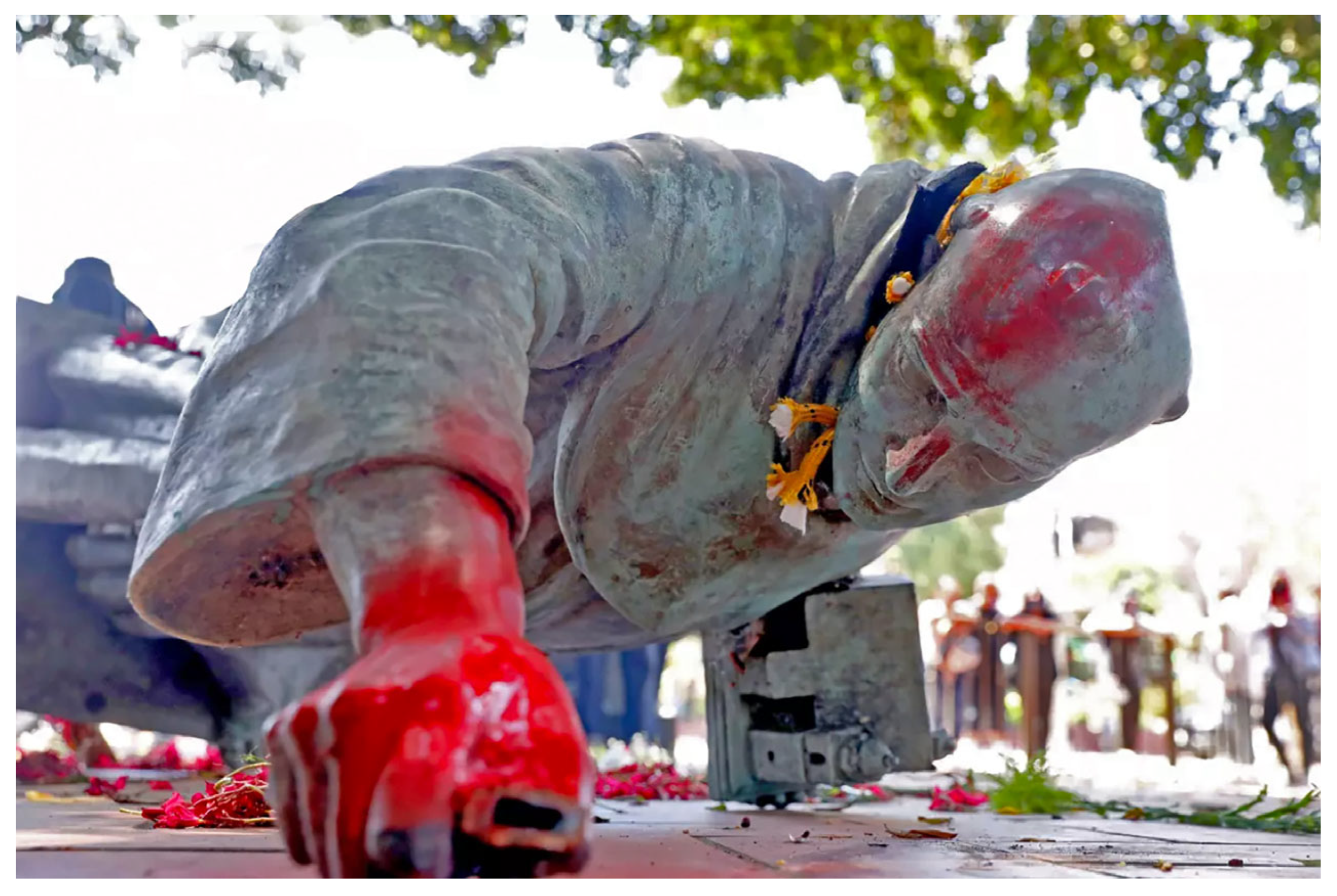
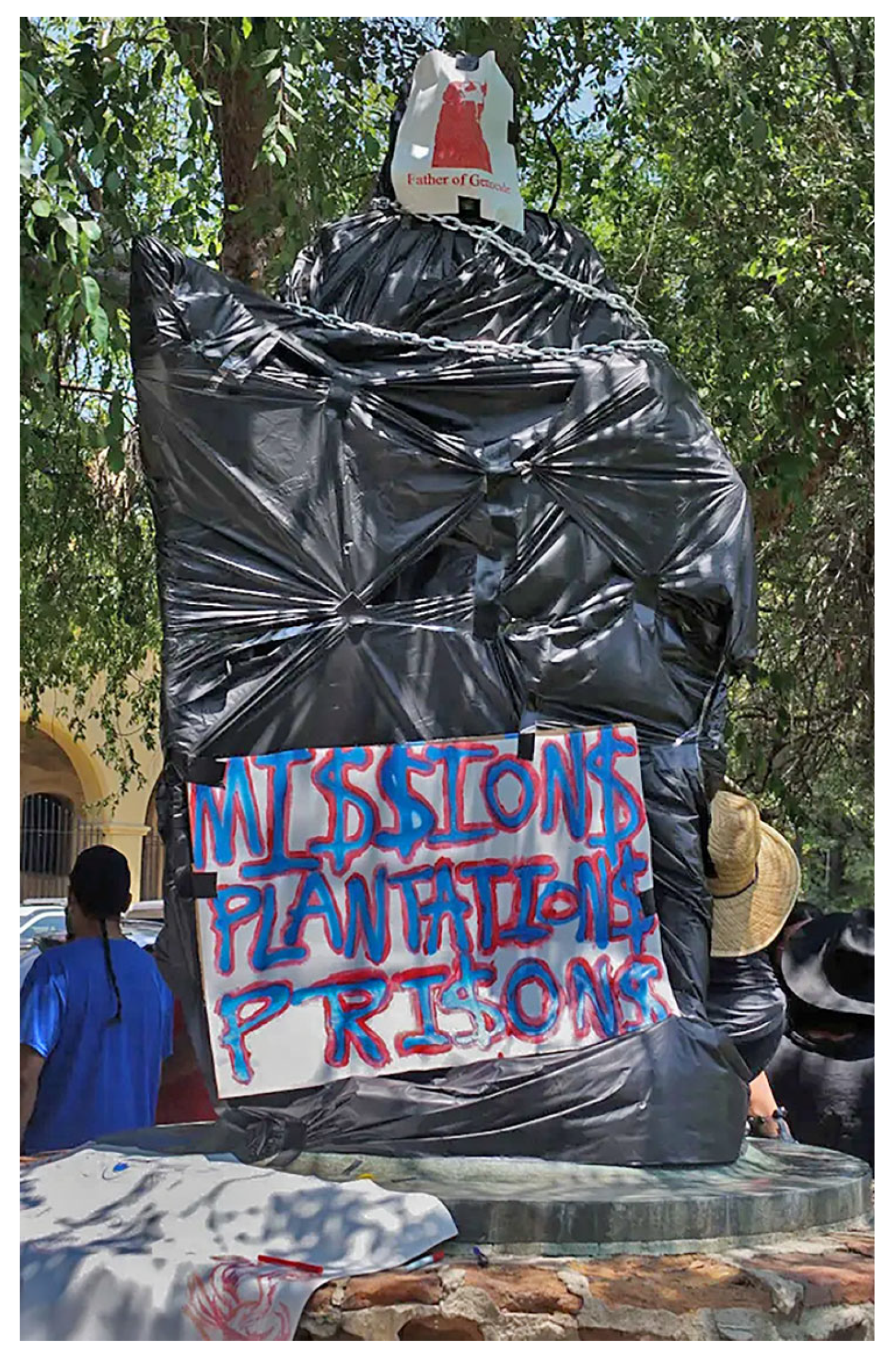
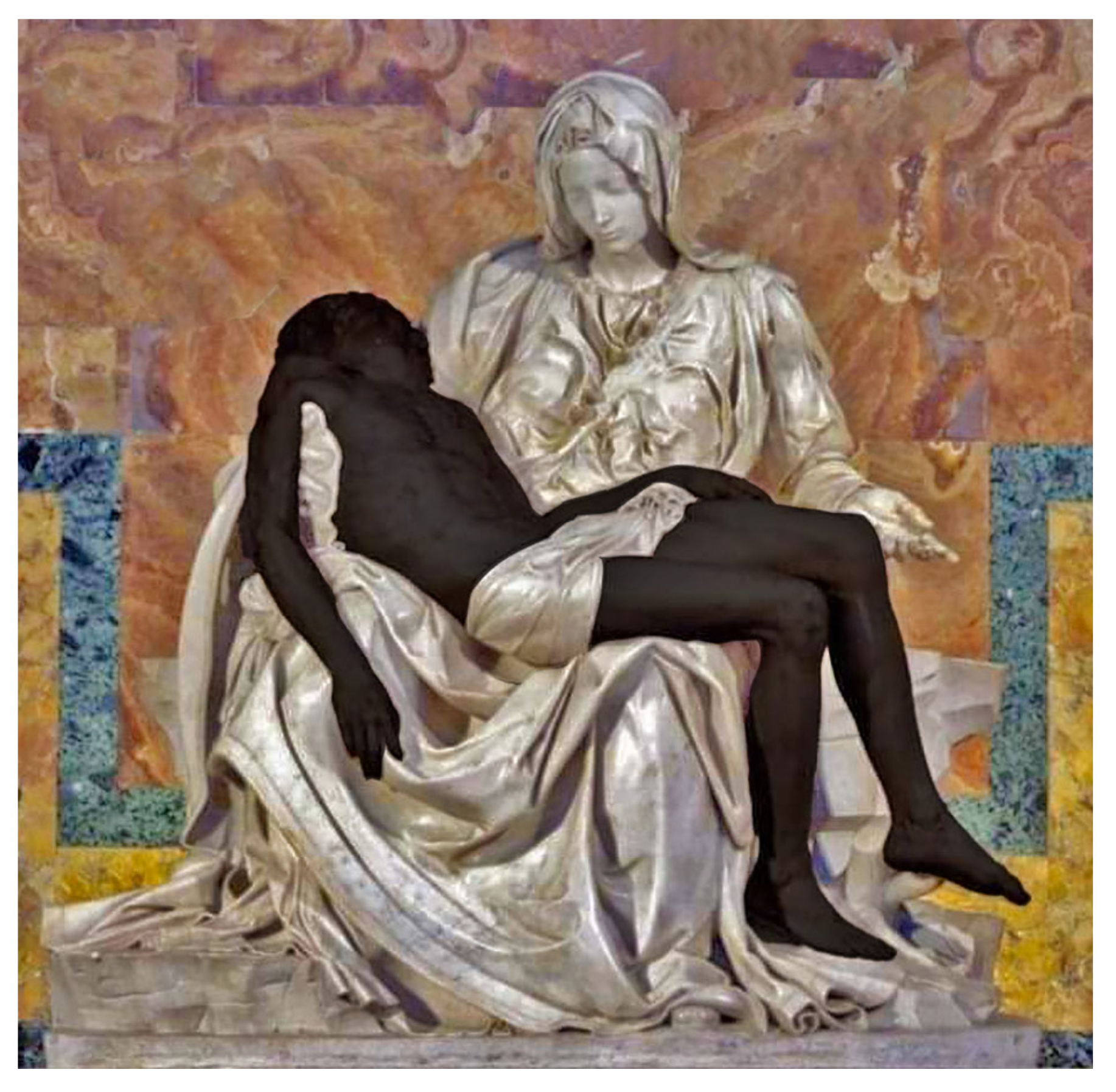

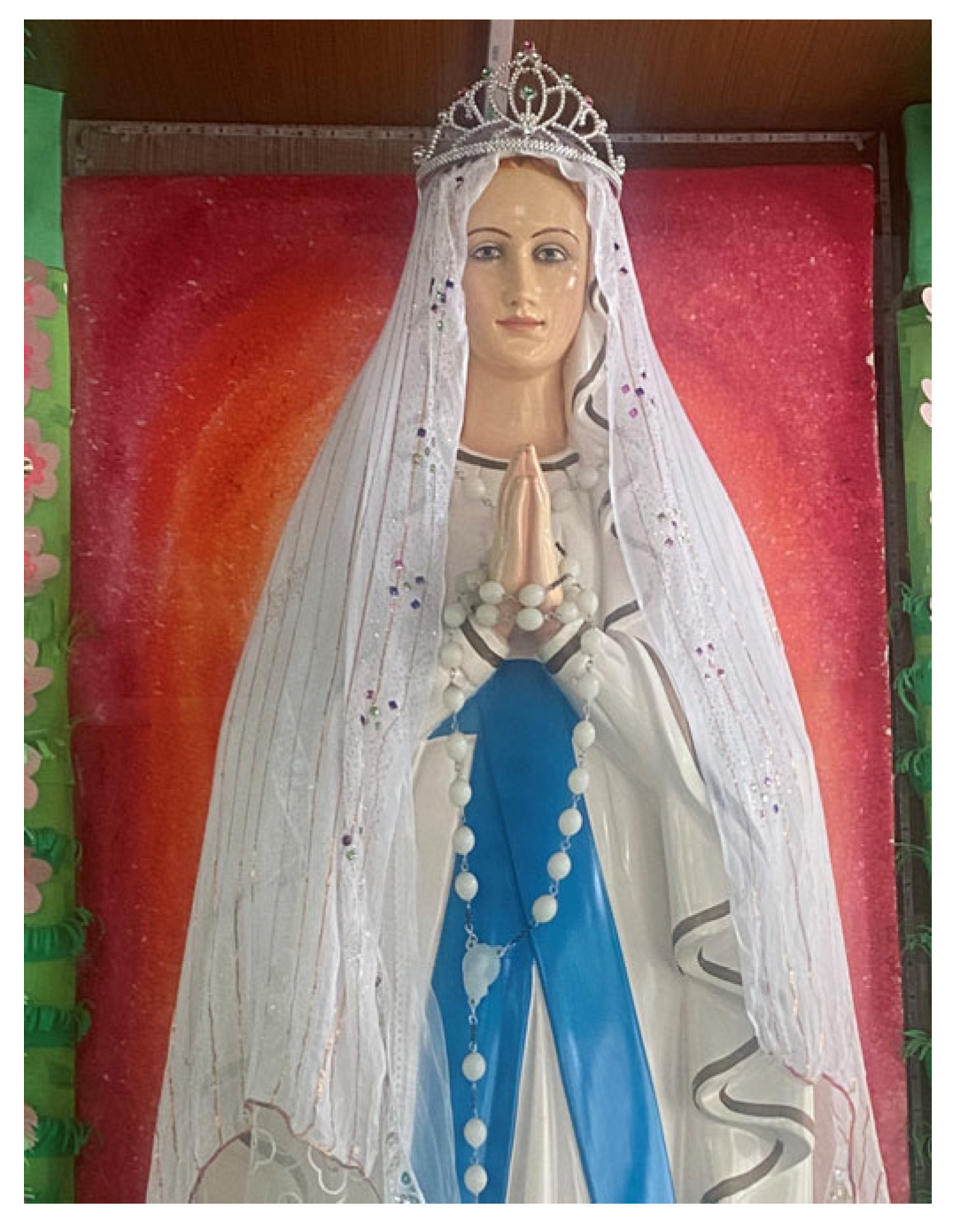
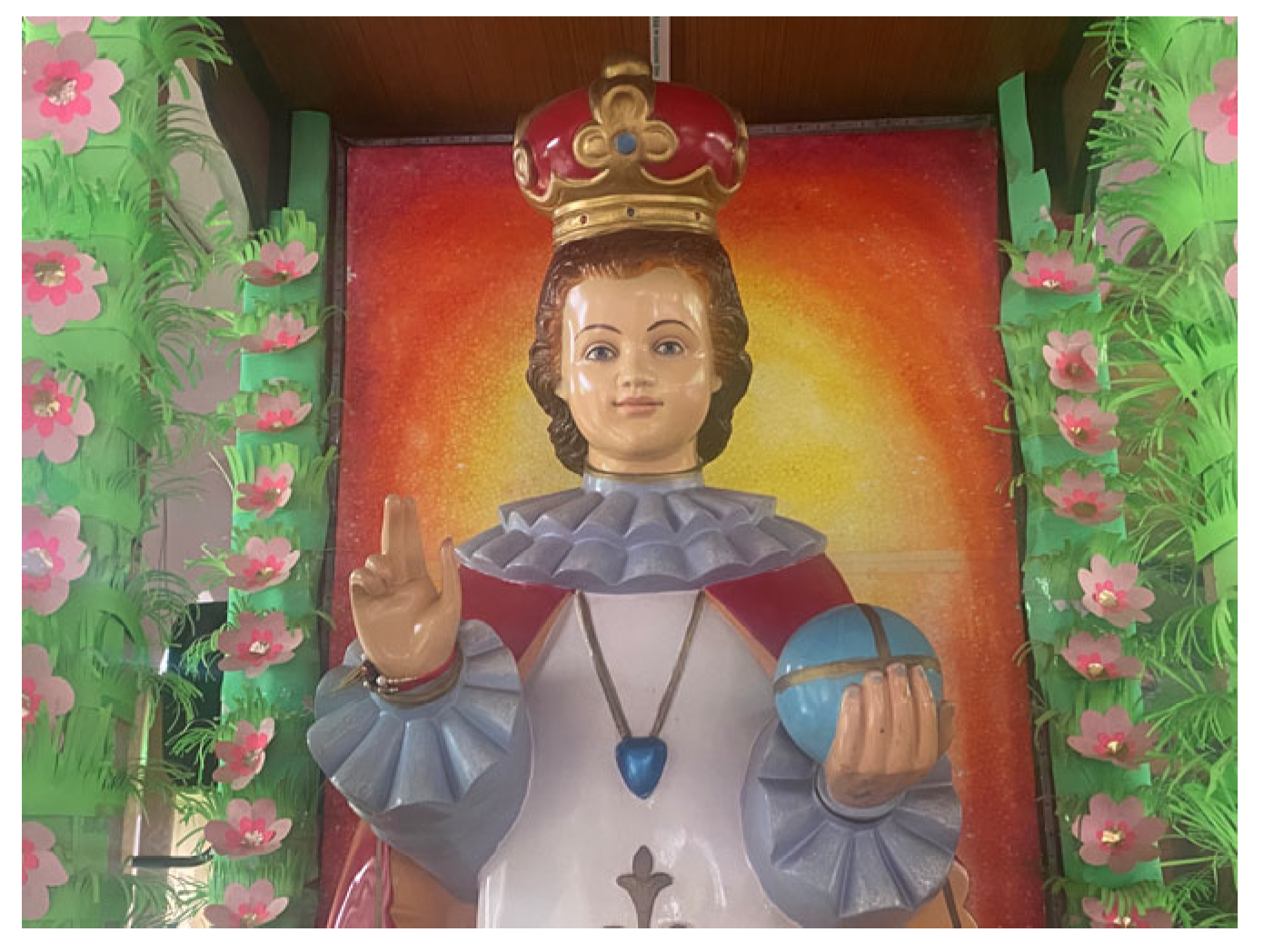
Disclaimer/Publisher’s Note: The statements, opinions and data contained in all publications are solely those of the individual author(s) and contributor(s) and not of MDPI and/or the editor(s). MDPI and/or the editor(s) disclaim responsibility for any injury to people or property resulting from any ideas, methods, instructions or products referred to in the content. |
© 2026 by the author. Licensee MDPI, Basel, Switzerland. This article is an open access article distributed under the terms and conditions of the Creative Commons Attribution (CC BY) license.
Share and Cite
Kakar, S. War of Narratives: Christianity, Iconoclasm, and Decoloniality of Race and Religion. Religions 2026, 17, 168. https://doi.org/10.3390/rel17020168
Kakar S. War of Narratives: Christianity, Iconoclasm, and Decoloniality of Race and Religion. Religions. 2026; 17(2):168. https://doi.org/10.3390/rel17020168
Chicago/Turabian StyleKakar, Shalini. 2026. "War of Narratives: Christianity, Iconoclasm, and Decoloniality of Race and Religion" Religions 17, no. 2: 168. https://doi.org/10.3390/rel17020168
APA StyleKakar, S. (2026). War of Narratives: Christianity, Iconoclasm, and Decoloniality of Race and Religion. Religions, 17(2), 168. https://doi.org/10.3390/rel17020168