1. Introduction
Baojuan (寶卷, “precious scrolls”) are a distinctive genre of Chinese folk religious literature, traditionally performed through ritualized chanting (
xuanjuan 宣卷), circulated in both manuscript and woodblock-printed forms, and designed to fulfill dual roles: facilitating communal devotional rituals and conveying moral–didactic teachings to lay audiences (
Che 1996). From the perspective of dissemination, perhaps the most widely circulated literary texts of any sort during the late Ming dynasty were “precious scrolls”, the literary expression of a lively and widespread alternative religious tradition that managed to flourish in many areas over long periods of time (
Overmyer 1999).
It should be noted that not all texts analyzed in this study bear the term
Baojuan in their titles. Following established scholarly practice (
Ma and Han 1992;
Overmyer 1999;
Che 2000;
Berezkin 2020b), we adopt a functional and contextual definition: a text is classified as a
Baojuan if it exhibits core formal features (e.g., ritual framing, moral narrative structure, performative markers) and/or is historically attested as part of the
xuanjuan tradition, regardless of its self-designation.
The period from the Yuan dynasty to the early Ming dynasty marks the emergence of
Baojuan, with the Ming dynasty being the most critical era in its development and peak (
Che 1996). The block-printing of
Five Books in Six Volumes by Luo Qing (羅清, 1442–1527) during the Zhengde period (1506–1521) of the Ming dynasty serves as a watershed in this progression, for it launched the Luo Teaching into widespread circulation among popular society; the movement surged dramatically during the Wanli era of the Ming dynasty, not only amplifying Luoism’s influence but also challenging the institutional authority of orthodox Buddhism and Daoism (
Ma and Han 1992). The reprint versions of
Five Books in Six Volumes were also made in the late-Ming period in the reign of the last Ming emperor, Chongzhen (1628–1644) (
Yunü Chen 2011;
Liu 2009).
Thus, the study of the Ming
Baojuan holds significant importance within the broader field of
Baojuan studies. And the Ming
Baojuan possess unique academic value: temporally, they represent a pivotal phase in the development of the genre—building upon Yuan dynasty precedents and laying the foundation for its flourishing in the Qing dynasty, thereby offering crucial insights into the historical trajectory of Chinese popular religious literature; spatially, the scattered distribution of extant versions (private collections, local archives, and international institutions) present an ideal case for digital humanities approaches such as spatial mapping and visualization (
Cantwell and Petersen 2021); culturally, the gradual canonization and circulation of Luo Qing’s
Five Books in Six Volumes from the mid-Ming onward reflect the expanding influence of lay religious movements, a phenomenon deeply intertwined with the social fabric and regional dynamics of late imperial China (
ter Haar 2014).
The geographical distribution of the Ming
Baojuan reflects the spatial imprint of their historical transmission processes. This pattern did not emerge randomly but was shaped by concrete socio-religious infrastructures—particularly temple-based networks that served as centers of ritual performance and textual circulation, regional printing hubs that facilitated reproduction and dissemination, and itinerant
xuanjuan reciters who carried their scrolls across different performing places, embedding them in local devotional life. Using currently available published facsimiles of
Baojuan literature combined with geographic spatial visualization analysis techniques for comprehensive investigation is an essential direction for the interdisciplinary expansion of
Baojuan studies and digital humanities. This approach that connects the
Baojuan texts with digital humanities represents a burgeoning academic frontier with significant potential for discovery (
Zheng 2024).
While the geographical distribution of
Baojuan may not be a new topic, many scholars in the past have noted its regional characteristics and employed localized methods to study
Baojuan in specific regions. For instance,
Research on Jingjiang Baojuan by Lu Yongfeng and Che Xilun (
Lu and Che 2008) and Research on
Baojuan in the Changshu Area of Jiangsu Province by Rostislav Berezkin are landmark works focusing on southern
Baojuan (
Berezkin 2020a). Li Yu’s Survey Report primarily investigates the structural forms of Jiexiu
Baojuan (
Y. Li 2010). Shang Lixin’s Research systematically analyzes the historical development, form changes, and interrelations with other folk arts in the Northern folk
Baojuan (
Shang 2015). And the research on Ho-hsi
Baojuan reveals the regional and ethnic features of Ho-hsi Corridor (
Chiao 1993). In summary, the most recognized regional research on Chinese
Baojuan focuses on the Wu Dialect Area in the southern part of China, followed by the studies on the
Baojuan from Ho-hsi, Shanxi and other northern areas, all of which have made significant contributions.
1.1. The Evolution of Baojuan Studies in a Global Context
Since Chinese precious scrolls (
Baojuan) entered the international academic sphere in the first half of the 19th century (
Berezkin 2020b), research in this field has undergone three paradigm shifts.
Firstly, in the foundational phase of
Baojuan studies (1830–1980), the international interest in Chinese precious scrolls is related to early Western missionaries’ specialized studies of Chinese folk customs and beliefs for evangelism, which naturally led them to pay attention to
Baojuan. The earliest international scholar to study
Baojuan was the German missionary Karl Friedrich Gützlaff (1803–1851), who wrote an article summarizing the main content of the
Xiangshan Baojuan—the story of Princess Miaoshan—and also translated part of the preface of this text (
Gützlaff 1833). During this period, it is evident that early Western missionary studies of
Baojuan primarily focused on the relationship between
Baojuan and religious beliefs, but they did not delve deeply into the texts themselves. The first scholar to systematically study the origin and evolution of the
Xiangshan Baojuan narrative was the British sinologist Glen Dudbridge (1938–2017). Dudbridge approached the subject from the perspective of popular literature, with a focus on novels and dramas. He authored a book specifically dedicated to the transformation of the Princess Miaoshan story, in which he identified the underlying female values within the legend—namely, women’s rights to religious faith and spiritual autonomy (
Dudbridge 2004).
In the second phase (1980–2015), the international scholarship on Baojuan began to delve into the social functions of Baojuan texts within the specific context of performance rituals known as xuanjuan (宣卷, the ritualized chanting of Baojuan), while also conducting deeper research into the sectarian Baojuan. In the study of sectarian Baojuan, the most prominent overseas scholar was Daniel L. Overmyer, a Canadian sinologist with a missionary background—his parents had served as missionaries in China. Later, while a professor at the University of British Columbia, he collected numerous Baojuan from the Ming and Qing dynasties and introduced them to the Western academic world (
Overmyer 1999). Overmyer also had students who continued his research; they further observed the ritual functions of Baojuan in folk communities, documenting xuanjuan as an activity of worship focusing on popular folk deities (
Randall 1994). The Russian scholar Elvira S. Stulova (1934–1993) also made significant contributions to the study of Baojuan performance rituals. She was the first foreign scholar to conduct fieldwork on Baojuan in Jiangsu Province, China. Accompanying Chinese scholars she met during her visit, she carried out field research and observed local “preaching” (jiangjing, 講經) rituals in the Jingjiang region (
Stulova 1991). After Stulova, the American scholar Mark Bender also traveled to Jingjiang to investigate the local practice in 1992. Accompanied by Chinese scholars including Professor Che Xilun, Bender conducted fieldwork in Jingjiang (
Bender 2001). Bender’s research approach involved a preliminary comparison between Jingjiang’s “holding gatherings and preaching scriptures” (zuo hui jiangjing, 做會講經) and Suzhou Pingtan (蘇州評彈, a form of storytelling and ballad singing).
Since the 21st century, Japanese scholars have also begun to conduct fieldwork in the Lake Tai region of southern Jiangnan in China, studying the social functions of local
Baojuan chanting and its ritual relationship with regional culture (
Sato 2011). Besides Japanese scholars, Chinese scholars have also paid attention to the
xuanjuan rituals in the Jiangnan region. For example, Chen Yongchao has studied the interactive relationship between the evolution of the narrative in the preaching tradition and local folk rituals (
Yongchao Chen 2011). During this period, scholars also began to pay attention to examining the differences between various historical editions of the same-named
Baojuan within the context of their performance rituals. For example, the prominent Russian scholar Rostislav Berezkin and the French scholar Vincent Goossaert conducted fieldwork on Mount Maoshan to study the different versions of the
Sanmao Baojuan and their associated rituals (
Berezkin and Goossaert 2012). This scholarly interest in Maoshan’s religious traditions builds upon broader investigations, such as Qijun Zheng’s work on the revitalization of Maoshan Daoism through the circulation of the performative texts such as the
Baojuan of the Three Mao Lords during the late Qing and Republican eras (
Zheng 2025). Among Western scholars, Professor Wilt L. Idema is the most renowned for his English translations of
Baojuan literature. His translations are of exceptionally high quality and have had a significant impact on Western academia. Translating
Baojuan into English is crucial because it introduces these materials to international readers who do not read Chinese, enabling
Baojuan to gradually become recognized as part of the world’s literary heritage. In recent years, Idema has paid particular attention to
Baojuan texts circulating in the Ho-hsi region, and in 2015 he published a collected volume of translations of Ho-hsi
Baojuan (
Idema 2015).
Thirdly, the digital humanities transformation phase (2015–present) in the study of religious literature, including
Baojuan research, has brought about methodological breakthroughs. This transformation involves not merely the introduction of new technological tools, but a profound shift in research paradigms (
Hutchings 2015). At its core, digital humanities provide scholars with the capacity to systematically process textual and cultural data, enabling them to move beyond traditional case-by-case interpretation and linear narratives, and instead pursue macro-level analysis and visual representation of religious texts’ transmission networks and the spatial distribution of religious practices. More importantly, as emphasized in the literature, successful digital humanities research must begin with a clear “why”—that is, a well-defined humanistic research question (
Cantwell and Petersen 2021). This shifts
Baojuan studies from mere technical application toward problem-oriented, interdisciplinary collaboration: digital tools are employed to test or challenge academic hypotheses concerning the origins, evolution, functions, and reception history of
Baojuan, thereby enhancing the verifiability and reproducibility of research findings. Thus, the core breakthrough of this third phase lies in the transformation of research thinking—from “text-centered” to “data-driven”, and from “isolated interpretation” to “relational networks”—opening up a new scholarly pathway for understanding the complex ecosystem of Chinese folk religious literature.
1.2. Gaps in Previous Research and the Contribution of This Study
Despite significant scholarly advances, previous research on
Baojuan remains constrained by methodological limitations. While prior studies have yielded rich insights into regional characteristics, textual analysis, and ritual practices, they predominantly adopt localized, case-based approaches, resulting in fragmented understandings of transmission mechanisms and a lack of systematic spatiotemporal synthesis. Moreover, scholarship has largely focused on content interpretation and sectarian classification, paying insufficient attention to the infrastructures of woodblock printing, dissemination routes, and the construction of cultural space—particularly during the pivotal Ming dynasty (
Berezkin 2013). This gap hinders a comprehensive understanding of how socio-geographical factors and discursive elite patronages jointly shaped the diffusion of popular religious literature.
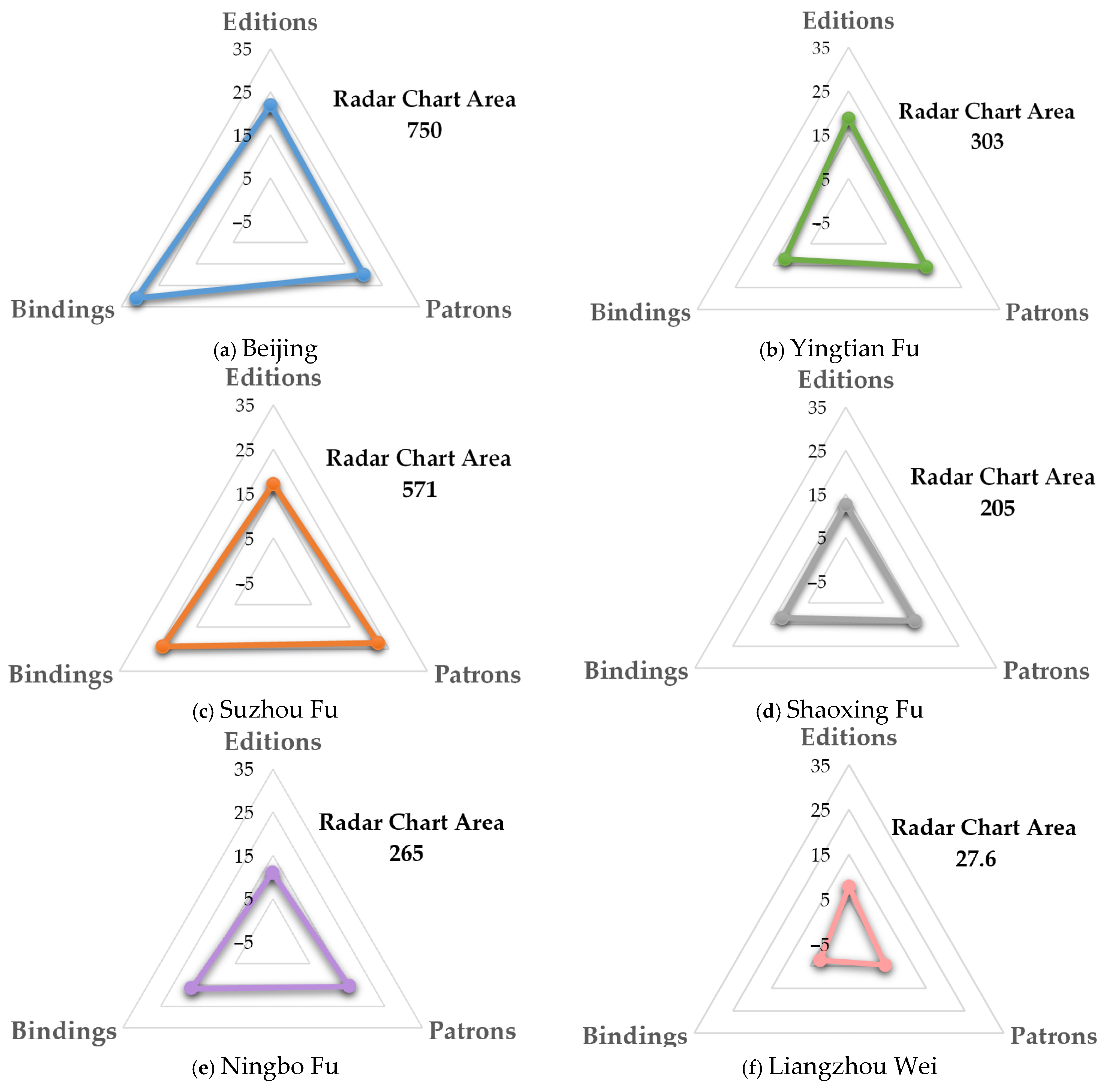
To address these shortcomings, this study proposes an interdisciplinary, data-driven framework that integrates three methodological innovations: (1) composite data modeling using three-dimensional radar charts to capture engraving styles, textual variants, and transmission pathways—a approach informed by recent scholarship on the material evolution of
Baojuan printing formats, which demonstrates that typographic and paratextual features (e.g., colophons, printer’s marks, and binding styles) can serve as reliable indicators of temporal and spatial provenance (
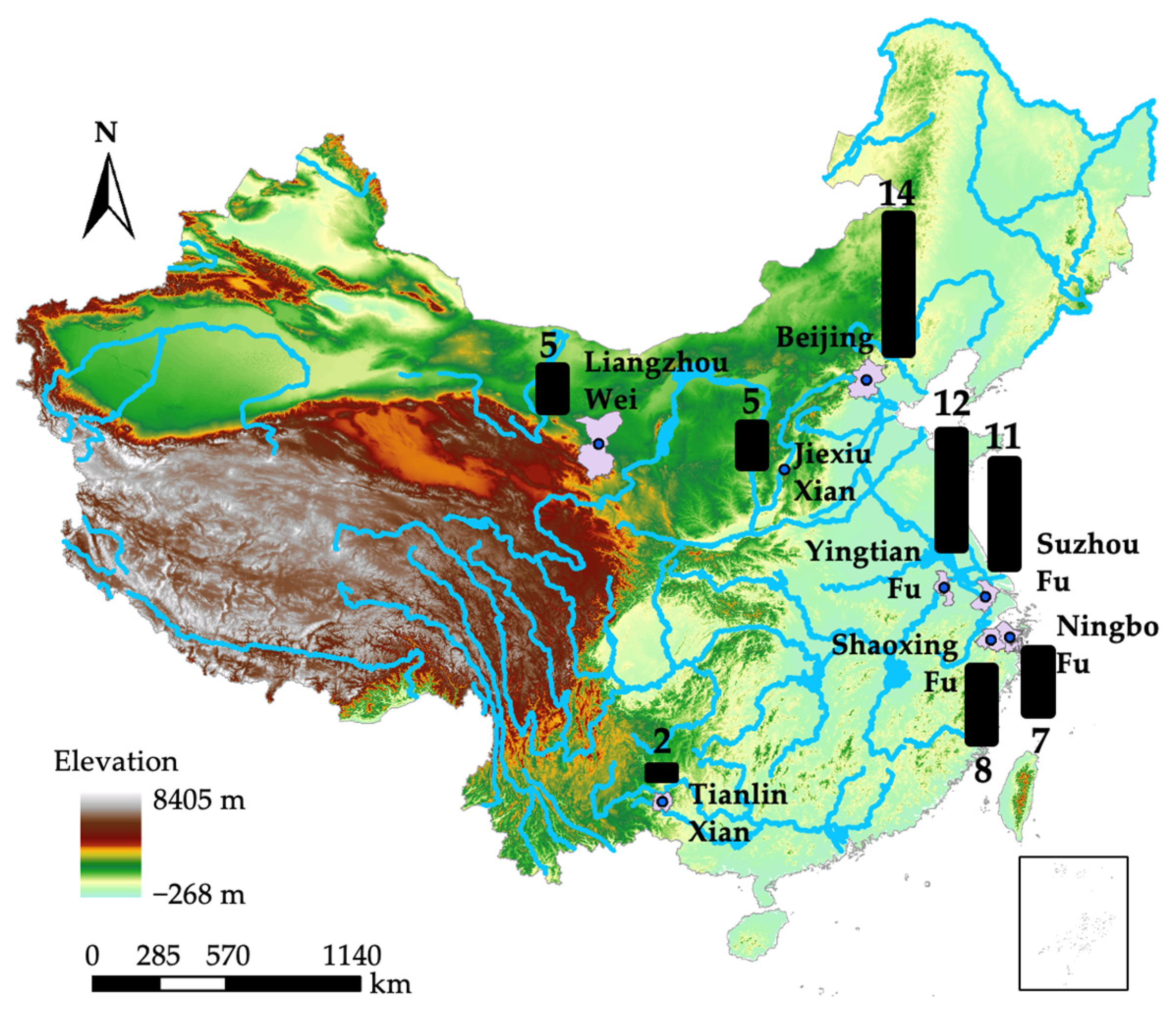
Zhang and Sun 2012); (2) dynamic GIS-based spatial analysis to map the radiation networks of major printing centers, Nanjing, Beijing, and Suzhou, and simulate dissemination routes using hydrological and transportation data; and (3) close reading of representative Ming
Baojuan to reveal how political elites and local gentry discursively shaped publication and circulation patterns.
This study does not seek to overturn the established view of the dissemination of the Ming Baojuan, but rather to quantitatively elucidate the underlying mechanisms, particularly the roles of elite patronage and economic geography, that enabled and shaped this transmission. By integrating spatial visualization with quantitative analysis, the research advances a paradigm shift in Baojuan studies: moving from static “textual archaeology” toward interactive “dissemination simulation.” As a quintessential form of religious narrative and performative text, Baojuan thus becomes a lens through which to model the spatial morphology and cultural ecology of premodern Chinese religious literature, offering a scalable, interdisciplinary framework for future scholarship.
4. Elite Patronage in Ming Baojuan: Discursive Strategies of Sectarian Legitimation
Based on the previous analysis of the geographic distribution of Ming
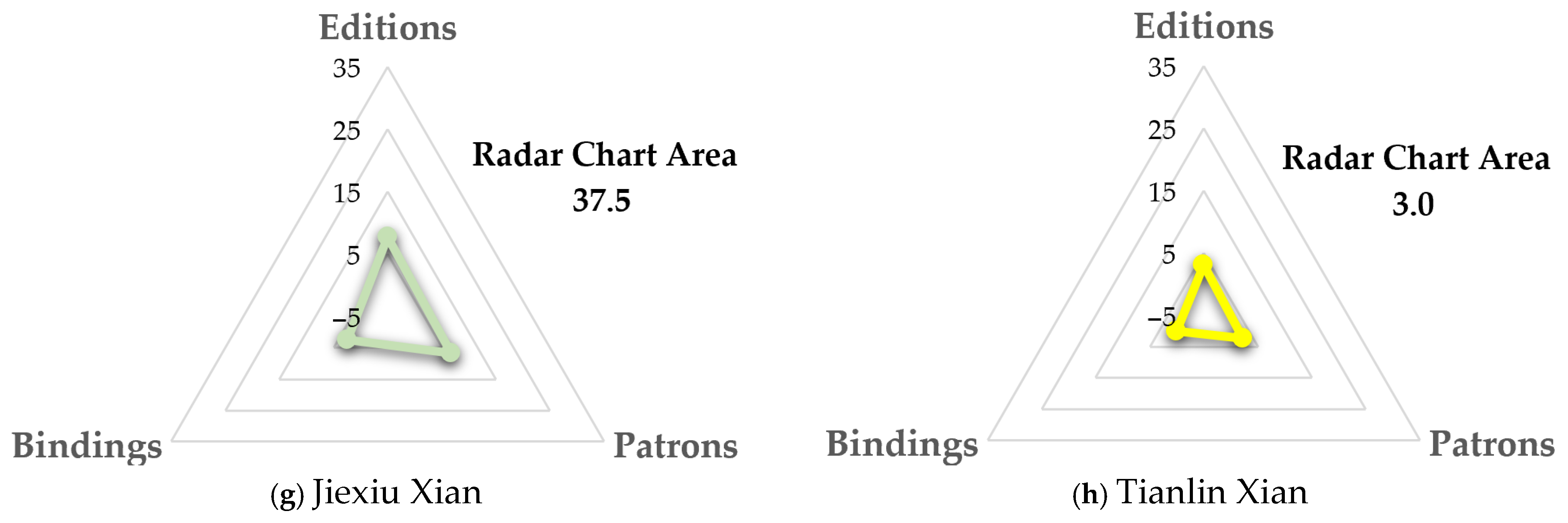
Baojuan printing locations, the three-dimensional radar chart reveals the location with the largest area is Beijing, the political center of Ming China. This reflects the intricate relationship between the
Baojuan publishing industry and the ruling elite—not through verifiable financial sponsorship, but through the strategic invocation of elite authority in textual prefaces.
Baojuan, as a religious literary text tied to merit and belief, often records the names of putative sponsors to showcase accumulated virtue. The most exquisite Ming editions are those attributed to eunuchs of the Imperial Scripture Bureau (
Neijing Chang, 內經廠), though such attributions function primarily as legitimizing devices rather than historical records. Recent scholarship on frontispiece illustrations in sixteenth-century printed
Baojuan has shown how visual programs were deliberately designed to convey orthodoxy and divine sanction, often mimicking courtly artistic conventions (
Berezkin 2025).
While “elite patronage” may take various forms, this section focuses on its discursive dimension—namely, the ways in which elite endorsement articulated in prefaces, colophons, and commendatory verses functioned as a mechanism of sectarian legitimation. It is crucial to emphasize that the attributions of elite patronage found in Ming Baojuan—such as claims of endorsement by imperial eunuchs, dukes, or high-ranking officials—should not be read as verifiable records of historical sponsorship. Rather, they function as integral elements of a broader sectarian legitimation discourse: performative assertions designed to project orthodoxy, invoke institutional authority, and mitigate suspicion from state and local elites. While such claims are often demonstrably fictitious or unverifiable (as discussed below), their rhetorical potency lies precisely in their strategic appropriation of elite identity to bolster the text’s spiritual and social credibility. We term this rhetorical practice “discursive patronage”: a strategic textual strategy whereby sectarian authors invoke the names, titles, or institutional affiliations of elite figures—not to document actual sponsorship, but to construct an aura of orthodoxy, legitimacy, and state tolerance through the symbolic capital of aristocratic or imperial authority.
The publication and circulation of the folk religious
Baojuan in Beijing, the political capital of the Ming Empire, were not solely driven by eunuchs but were significantly facilitated by the patronage of various segments of the elite, reflecting a complex interplay between state power and popular religion. A telling example is found in
The Taishang Zushi Sanshi Yinyou Zonglu (太上祖師三世因由總錄), a devotional text in Luoism, a Chinese folk religious tradition founded by Luo Qing (1442–1527), a revered figure who synthesized elements from Buddhism, Daoism, and folk beliefs. This text claims that prominent figures such as the eunuch Zhang Yong and the Duke of Weiguo, alongside a minister named Dang Shangshu, assisted Luo Qing in composing the
Five Books in Six Volumes. According to the narrative, these texts were presented to the Zhengde Emperor (Zhu Houzhao), who then bestowed the title “Wuwei Zushi” (無為祖師) upon Luo Qing and authorized the imperial printing and distribution of the
Baojuan under the “Imperial Dragon Seal” (Yuzhi Longpai, 御製龍牌)—the ritual tablet bearing dragon motifs that sectarian communities invoked as a symbolic marker of imperial authority. This symbolic authorization led to their dissemination throughout the empire on the 15th day of the 7th month in the 13th year of the Zhengde reign (
Wang 1999).
While this account is highly improbable as a literal historical event—given the Ming Empire’s general hostility towards heterodox sects and the lack of corroborating official records—it holds significant value. It demonstrates the Luoist community’s deliberate effort to construct a narrative of legitimacy by associating their founder and scriptures with imperial authority. This strategic appropriation of state symbols represents a crucial attempt by Luoism to transform from a marginalized belief system into an organized religion with a claim to orthodoxy and widespread recognition.
Other prominent aristocratic figures, such as the Duke of Dingguo, Marquis of Xining, and Marquis of Dingxi, are also frequently invoked in the prefaces of various folk religious
Baojuan. For instance, the preface to a Ming dynasty woodblock edition of the
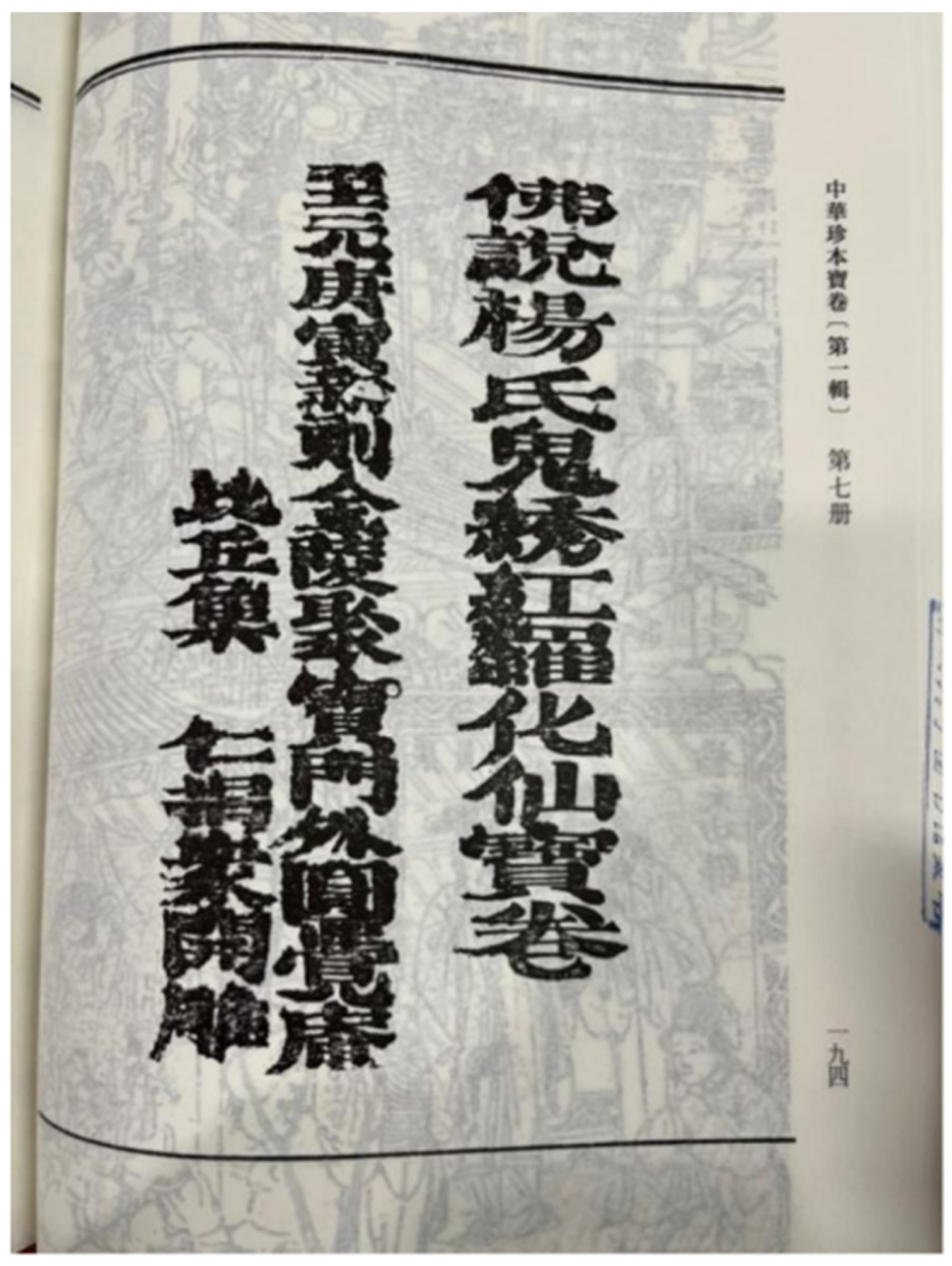
Hun Yuan Hong Yang Piao Gao Zu Lin Fan Jing (混元弘陽飄高祖臨凡經), a copy of which is preserved at Waseda University and reproduced in vol. 7 of
Zhonghua Zhenben Baojuan, states: “The Ancestor also praises the wonderful verses; the Sheng Dynasty’s nation is unified, with the founding hero, the Duke of Dingguo, protecting and promoting the Hunyuan Ancestral Religion.” (
Ma 2014).
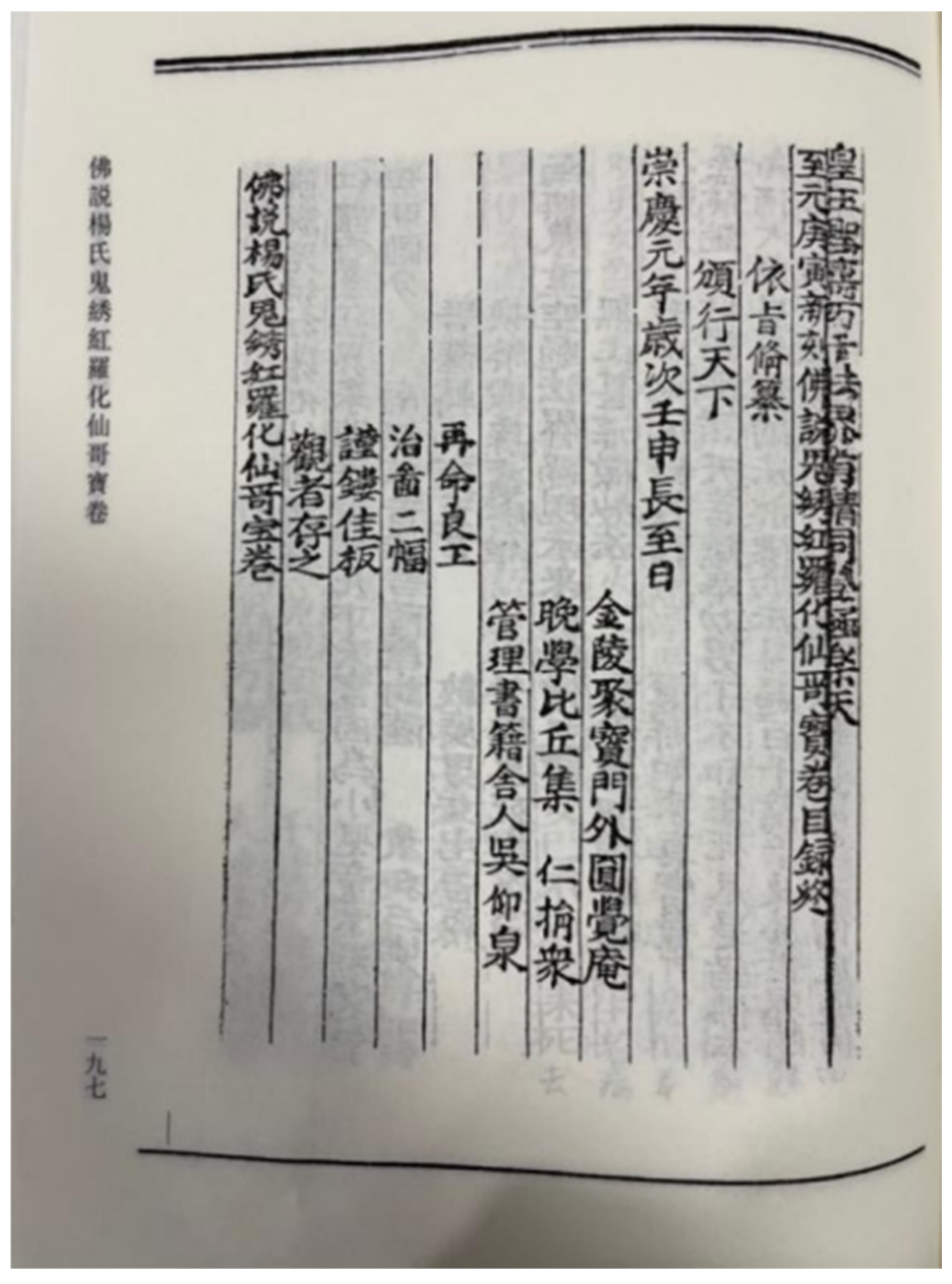
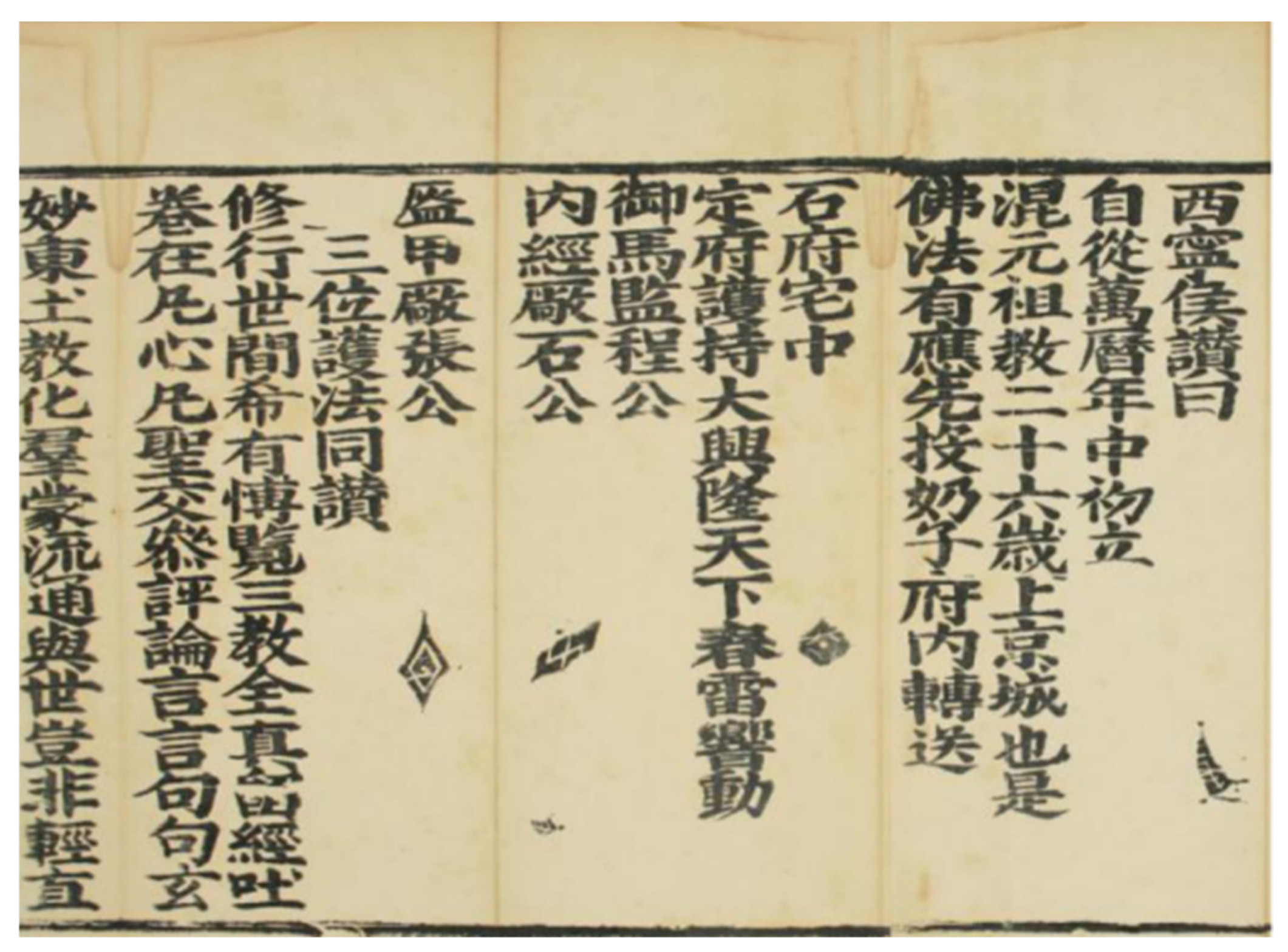
As shown in
Figure 6, it further adds: “The Marquis of Xining praises: ever since the founding of the Hunyuan Patriarchal Teaching in the Wanli era, [Luo Qing] went to the capital at the age of twenty-six. It was indeed a response from the Buddha-Dharma: first he entered the Nai Zi Fu (奶子府, Imperial Wet Nurse Office), and was then transferred to the residence of the Shi family. With the patronage of the Ding Mansion, the teaching greatly flourished throughout the realm—like spring thunder resounding across the land. Such narratives resonate with evidence that vernacular Buddhist stories, including those later codified in
Baojuan, were performed and circulated within Ming palace circles, where eunuchs, wet nurses, and noble households served as key cultural intermediaries” (
Berezkin 2017). Lord Cheng of the Imperial Stables, Lord Shi of the Inner Scripture Factory, and Lord Zhang of the Armor Factory, the three Dharma-protectors, jointly acclaimed: ‘His practice is rare in this world; his teachings encompass the complete truth of the Three Teachings. He leaves scriptures and delivers scrolls, with ordinary mind and sagehood intermingling. Every word and phrase of his discourse is profoundly mysterious—bringing enlightenment to the masses of the Eastern Land, circulating far and wide in the world. “(西寧侯贊曰:自從萬曆年中初立混元祖教,二十六歲上京城。也是佛法有應,先投奶子府內,轉送石府宅中。定府護持,大興隆天下,春雷響動。御馬監程公、內經廠石公、盔甲廠張公,三位護法同贊:修行世間希有,傳覽三教全真;留經吐卷,在凡心、凡聖交參。評論言言句句玄妙,東土教化群蒙,流通於世。)” (
Ma 2014).
The
Xiaoshi Xianxing Baojuan (銷釋顯性寶卷), a Ming dynasty scripture originally published in the Wanli 12 (1584) woodblock edition and later reprinted in Wanli 20 (1592) (see
Zhonghua Zhenben Baojuan, vol. 6; a copy of the 1592 reprint is held at Waseda University), contains a preface written by Jiang Jianyuan, Marquis of Dingxi. The preface states: “In the twentieth year of Wanli, during the renchen year, in the month of Mengdong, on an auspicious day, I, the Military Governor of the Front Army, the Marquis of Dingxi, Jiang Jianyuan, respectfully write this.” (
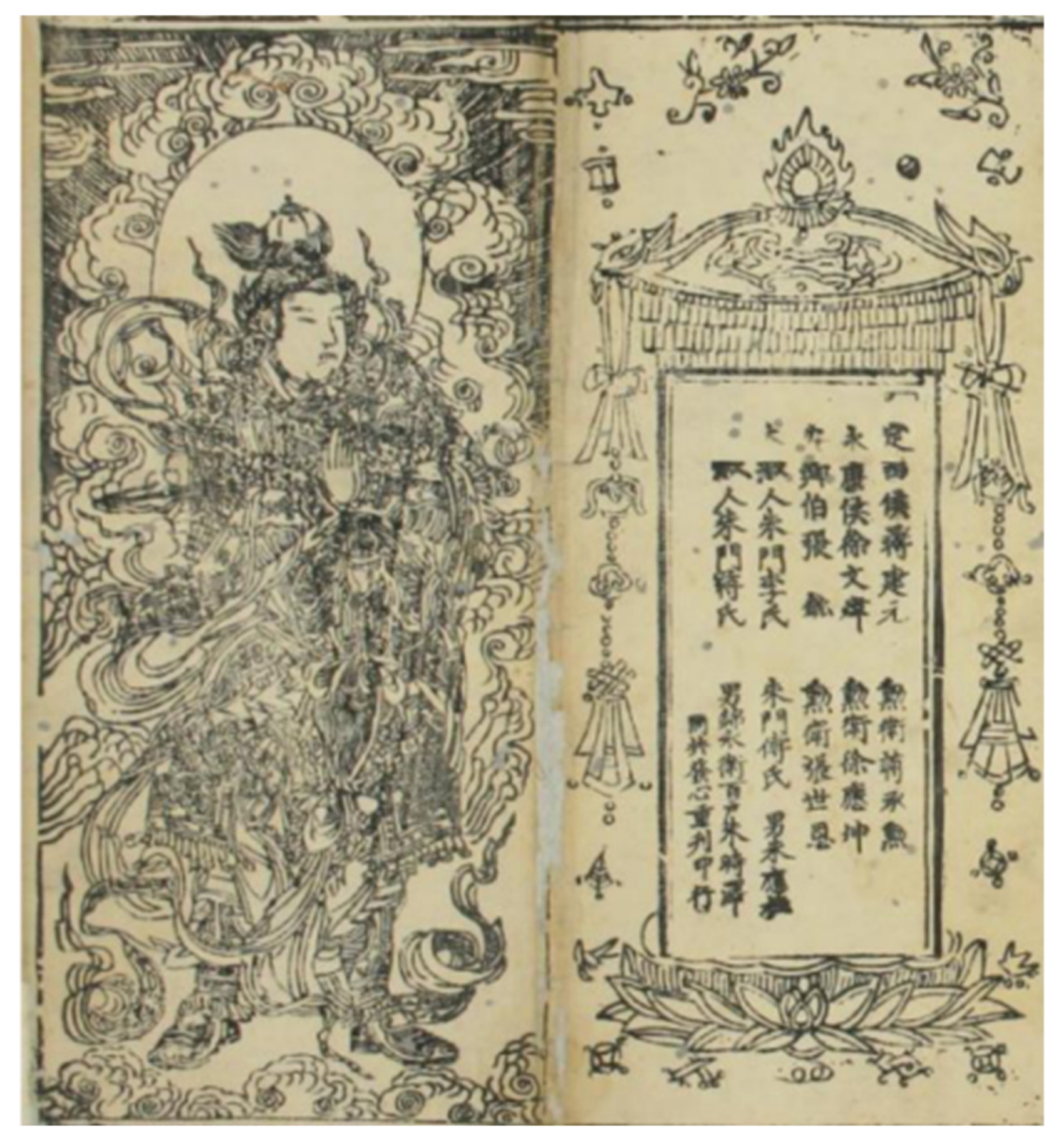
Ma 2012) As shown in
Figure 7, at the end of the
Baojuan: “The Marquis of Dingxi Jiang Jianyuan, the military officer Jiang Chengxun, the Marquis of Yongkang Xu Wenwei, the military officer Xu Yingkun, the Earl of Anxiang Zhang Hong, and the military officer Zhang Shi’en… together contributed their hearts to the block-printing.” (
Ma 2012).
The so-called “Marquis of Dingxi, Jiang Jianyuan,” mentioned in this
Baojuan does not appear in any official Ming dynasty historical records. According to the
Gongchen Shibiao (功臣世表,
Tables of Meritorious Officials) in the
Mingshi (明史,
History of Ming), there was no noble title of “Marquis of Dingxi” during the Ming dynasty (
Zhang 2007). Moreover, major historical sources and reference works, including the
Mingshilu (明實錄,
the Veritable Records of the Ming) and the
Mingren Zhuanji Ziliao Suoyin (明人傳記資料索引,
Index of Ming Biographical Materials), contain no mention of “Jiang Jianyuan,” let alone any record of his ennoblement (
Z. Huang 2016;
Chang 1965). This designation in this
Baojuan is therefore likely fictitious.
While these claims lack corroboration in the Ming official records and may reflect aspirational or symbolic attribution rather than actual elite patronage, they are highly significant. The deliberate invocation of high-ranking nobles and powerful imperial institutions in the preface serves a clear purpose: to construct an aura of legitimacy and state sanction for the text and the religion it represents. By fabricating endorsements from the highest echelons of the Ming elite and key bureaucratic organs, the compilers of the Baojuan were attempting to shield their community from persecution, elevate their sectarian beliefs to the status of orthodox religion, and assure believers of divine and imperial favour. This phenomenon reveals the profound anxiety of folk religious movements regarding their marginal status and their strategic efforts to navigate the perilous boundary between orthodoxy and heterodoxy by appropriating the symbols of imperial authority.
In addition to male aristocrats, royal women were also prominent figures associated with the publication and dissemination of
Baojuan in Ming China. A Ming Jiajing edition of the
Yaoshi Benyuan Gongde Baojuan (藥師本願功德寶卷) includes a dedicatory inscription that records the patronage of Consort De and the Fifth Princess. According to this inscription, in the twenty-second year of the Jiajing era (1543), these two royal women, “with sincere hearts, generously donated funds” (
Pu 2005) for the creation and block-printing of the
Baojuan at the Li Family bookshop on Xichangan Street in Beijing. The funds were used to paint images of sacred beings and to produce printing plates, with the aim of circulating the text to “purify disasters, extend life, and ensure blessings for the world.” (
Pu 2005). While the historical accuracy of this specific record cannot be independently verified by official sources, it reflects a significant social and religious practice: elite women in the Ming court actively engaged in merit-making activities such as funding the publication of religious texts. This pattern aligns with broader evidence of imperial women’s patronage of religious institutions during the Ming, as documented in studies of the Baoming Temple—a Buddhist convent closely tied to palace women and repeatedly supported by empresses and consorts. (
Li and Naquin 1988;
S. Li 2007). Whether or not Consort De and the Fifth Princess personally funded this exact edition, their attribution to this act underscores the important role that female piety and patronage played in the religious landscape of the time. This not only provides insight into the spiritual lives of imperial women but also reveals that the large-scale publication of
Baojuan in Beijing was a socially accepted practice supported by a broad segment of the aristocracy, including women of high status. Therefore, the dissemination of these texts cannot be attributed solely to eunuchs, but rather to a collective culture of religious patronage among the Ming elite.
5. Conclusions
The Baojuan tradition, encompassing both its textual corpus and its performative chanting practice, is recognized as a form of intangible cultural heritage and carries profound historical and cultural significance through its modes of publication and dissemination. The Ming Dynasty, a crucial period for the maturation and widespread dissemination of Baojuan texts, not only exhibits a clear developmental trajectory in the temporal dimension but also presents distinct regional characteristics in terms of geographic distribution. This study innovatively utilizes digital humanities tools, including Geographic Information Systems (GIS) and advanced data visualization techniques, to deeply explore and integrate data on the basic features of Ming Baojuan and the geographical locations of their publication and dissemination. The research visually presents and analyses the transmission trajectories and impact zones of these texts, offering in-depth insights into their underlying causes. Particularly, a case study of sponsorship in the Ming capital, Beijing, is conducted by systematically examining the paratextual materials (such as prefaces and colophons) of Baojuan texts, extracting data on patrons and locations, and integrating this information into the GIS framework. This approach sheds light on numerous specific factors that influenced the transmission of Baojuan, revealing its complex relationship with social hierarchies and political dynamics. While the broad contours of Ming Baojuan dissemination are well recognized, this study provides the first integrated, spatially explicit model demonstrating how discursive patronage of elite endorsement, regional wealth, and infrastructure jointly structured its diffusion—a framework applicable to other forms of premodern religious print culture.
Firstly, the geographical distribution of the printing and dissemination of Baojuan during the Ming Dynasty was largely concentrated along major rivers and canals. This can be attributed to the convenient waterway transportation, the regional prosperity of economic and cultural activities, as well as the influence of overland trade routes such as the Silk Road and other centres of cultural exchange. The synergy of these factors greatly promoted the widespread circulation of Baojuan texts in Ming folk society.
Secondly, the visualization of Baojuan printing locations reveals significant regional differences between the North and South. Overall, the southern regions surpassed the northern regions in terms of the quantity, density, and scale of publications. This disparity is closely related to the economic vitality of the Jiangnan region, the prosperity of its cultural industries, and the flourishing of folk religious beliefs during the Ming period. In the Wu-Yue region, the Baojuan publishing industry had formed a high-density industrial cluster, which not only sustained and further promoted the local economy, culture, and religious life but also became a concrete symbol of regional and cultural identity. Its vitality transcended the material limits of geographical space, revealing a more dynamic and multifaceted cultural significance.
Furthermore, the large-scale publication of popular religious
Baojuan texts in the political centre, Beijing, often invoked the names of emperors, imperial consorts, aristocrats, and powerful eunuchs in their paratexts. However, as argued in
Section 4 (“Elite Patronage in Ming
Baojuan: Discursive Strategies of Sectarian Legitimation”), these attributions should not be interpreted as evidence of actual elite consensus or institutional endorsement. Rather, they represent a deliberate sectarian strategy, what we term “discursive patronage”, through which folk religious communities appropriated elite identities to construct orthodoxy, enhance textual authority, and mitigate state suspicion. This rhetorical practice reveals not widespread elite acceptance, but the acute awareness among marginal religious groups of the symbolic power of imperial and aristocratic legitimacy in navigating the precarious boundary between orthodoxy and heterodoxy. Yet as later Qing officials like Huang Yupian would vehemently argue, such appropriations of imperial symbolism were ultimately deemed deceptive by the state, revealing the fragile and contested nature of sectarian claims to legitimacy (
Y. Huang 1972). Although Huang Yupian wrote in the mid-nineteenth century with a clear anti-sectarian agenda, his records—particularly those referencing
Baojuan circulation in the capital region during the late Ming—offer valuable glimpses into the geographic reach and social embedding of these texts.
Therefore, the visualization of the geographical distribution of Ming Baojuan texts not only provides an intuitive understanding of their spatial patterns but also exemplifies how digital humanities approaches can serve as a powerful analytical lens—enabling researchers to move beyond individual texts and uncover, from a macro-level perspective, the deeper cultural and social dynamics that shaped their dissemination.