Article

Spiritual Alchemy: Centered on the Concept and Iconography of the “Three Corpses 三屍”

School of Philosophy and Sociology, Lanzhou University, Lanzhou 730000, China
Religions 2026, 17(1), 16; https://doi.org/10.3390/rel17010016
Submission received: 24 November 2025 / Revised: 17 December 2025 / Accepted: 18 December 2025 / Published: 24 December 2025

Abstract

Daoist Inner Alchemy (Neidan 內丹) takes the joint perfection of the physical body and the spiritual body as its core pursuit. Therefore, in its practice system, besides physical cultivation, spiritual cultivation is also an indispensable component, and the two together constitute the fundamental principle of “dual cultivating of xing and ming” (Xingming Shuangxiu 性命雙修) in Neidan theories. Spiritual cultivation in Neidan usually includes two aspects: one is the positive cultivation and elevation of inner-nature; the other is the confrontation with destructive spiritual entities. The common saying of “eliminating the Sanshi” (Qu Sanshi 去三屍) in Neidan texts is a typical representative of the latter. The “Three Corpses” (Sanshi 三屍) is an important category in Neidan theory, but relevant academic research remains relatively inadequate. An in-depth exploration of the concept of the Sanshi and its corresponding images helps to deepen the understanding of the theoretical, practical, and philosophical connotations of Neidan.

1. Introduction

Existing studies on Neidan have mainly focused on the cognition of the physical body and the discussion of corresponding cultivation techniques, while the attention paid to the spiritual cultivation aspect in Neidan is relatively insufficient. Based on the core philosophical view of “the unity of body and mind” (Shenxin Yiyuanlun 身心一元) in Daoism, many Neidan practitioners have proposed the fundamental principle of “dual cultivating of xing and ming” (Xingming Shuangxiu 性命雙修), emphasizing that Neidan practice requires the joint refinement and perfection of the physical body level—“life cultivation” (Minggong 命功)—and the spiritual and ideological level—“inner-nature cultivation” (Xinggong 性功). Regarding spiritual cultivation in Neidan, on the one hand, it includes the self-cultivation of inner-nature, which is usually reflected in the visualization of positive spiritual schemas during Neidan meditation and the ethical tendency of tranquility and desirelessness in daily behavior; on the other hand, it points to the elimination of internal or external destructive spiritual entities, which is often referred to as “refining demons” (Lianmo 煉魔) in Neidan theory. Human mental defects as well as desires are personified into ghosts and gods with specific names, forms, and responsibilities, and practitioners need to confront them through mental restraint or special spiritual visualization methods. The Sanshi (三屍) are the main representatives of such negative spiritual entities, and eliminating the Sanshi is generally regarded as one of the key steps in Neidan practice.

2. Academic Review of Sanshi Studies

In Daoist texts, the Sanshi are often collectively referred to as the Three Corpses and Nine Worms (Sanshi jiuchong 三屍九蟲). Currently, academic discussions on the Sanshi are mostly included in relevant studies on “Sanshi jiuchong”, covering four major fields: Daoist medicine studies, cultivation studies, iconography, and Gengshen Belief (Gengshen Xinyang 庚申信仰) studies.
Among the Sanshi jiuchong, the term Jiuchong mainly refers to worm-borne factors of physical damage. This concept is related to ancient China’s understanding of human parasites and other pathogenic organisms, and has always attracted the attention of traditional Chinese medicine researchers, especially Daoist medicine researchers, with the most sufficient relevant studies. Scholars such as Yoshimoto Akiharu 吉元昭治 (Yoshimoto 1992), Lin Fushi 林富士 (Lin 2001), and Gai Jianmin 蓋建民 (Gai 2001) hold that Sanshi jiuchong are mainly related to the ancient understanding of parasitic diseases; Jiang Sheng 薑生 (Sheng Jiang 2010) and Jiang Shoucheng 薑守誠 (Shoucheng Jiang 2008) propose that Sanshi jiuchong correspond to a wider range of pathogenic factors, including not only some parasites but also some bacteria and viruses. Studies by Liu Cunren 柳存仁 (Liu 1971), Zhang Xunliao 張勳燎 (Zhang and Bai 2006) point out that the Sanshi jiuchong mentioned in Daoism have a close connection with pulmonary tuberculosis.
Research on Sanshi jiuchong in cultivation studies also focuses on the Jiuchong. Toshiaki Yamada 山田利明 (Yamada 1989), Shawn Arthur (Arthur 2013), and Huang Yongfeng 黃永鋒 (Y. Huang 2008) have all elaborated on the relationship between Sanshi jiuchong and Daoist elixir ingestion techniques. Scholars such as Joseph Needham (Needham 2011), Cheng Lesong 程樂松 (Cheng 2017), and Yin Zhihua 尹志華 (Z. Yin 2023) have conducted a conceptual history interpretation of the meaning of the Sanshi from the perspective of the body concept in Daoist cultivation, arguing that they represent factors leading to human death. In addition, some scholars have specifically explored the conceptual significance of the Sanshi as demons in Daoist cultivation studies and conducted in-depth theological and cultivation method comparisons between them and the concept of demons in Christianity (Chen and Zhang 2025). Others have examined the relationship between the Sanshi and the Daoist understanding of negative personality traits, as well as the Daoist self-cultivation practices designed to counteract such negative traits (Lu 2024).
The iconographic research results on Sanshi jiuchong mainly come from Catherine Despeux and Shih-shan Susan Huang 黃士珊. In her research on the internal vision diagrams of Neidan practice, Catherine Despeux discussed some images and their meanings related to the Seven Po Souls (Qipo 七魄) and the Sanshi in Daoist atlases (Despeux 2012); in her research themed on Daoist Iconography, Shih-shan Susan Huang 黃士珊 carefully sorted out and analyzed the images and connotations of the Sanshi as well as their iconographic connection with the Qipo, suggesting that the image of the Sanshi may have originated from the descriptions of foreign life in ancient myths (S.-s. S. Huang 2012). In addition, based on iconographic analysis, she also explored the relationship between the Sanshi and the Neidan theory in Daoism (S.-s. S. Huang 2011).
The concept of the Sanshi has also given rise to research related to Gengshen Belief. In Daoism, the religious meaning of the Sanshi has developed into a religious taboo of keeping vigil on Gengshen days (gengshen ri 庚申日) to avoid harm from the Sanshi, and gradually formed the Gengshen Belief prevalent in China, Japan, and Korea. Japanese academic circles once debated the origin of Gengshen Belief: scholars represented by Yanagita Kunio 柳田國男 advocated the indigenous origin theory of Gengshen Belief, while Daoist scholar Kubo Noritada 窪德忠 held the foreign origin theory of Gengshen Belief and wrote monographs such as Gengshen Belief (庚申信仰) and Studies on Gengshen Belief—A History of Sino-Japanese Religious and Cultural Exchanges (庚申信仰の研究 日中宗教文化交渉史), conducting detailed research on Gengshen Belief (Ohanami 1988). Chinese scholar Wang Guiping 汪桂平 specifically explored the folk Gengshen Scripture and Gengshen Associations (gengshen hui 庚申會) in Jiangsu and Zhejiang of China, pointing out that the custom of keeping vigil on Gengshen days has not disappeared in modern China. Although it originated from Daoist concepts, it has evolved into part of local folk beliefs in the process of development, which is significantly different from orthodox religious classics and activities (G. Wang 2012).
In summary, the current academic discussion on the Jiuchong in Sanshi jiuchong is relatively sufficient, but the existing research on the Sanshi, the focus of this paper, is relatively weak and mostly concentrated on the aspects of Iconography and related beliefs. As a core concept of spiritual cultivation in Daoism, the concept of the Sanshi is not only related to the integrity of Daoist cultivation theory but also closely connected with Daoism’s understanding of human spiritual composition and human nature. Clarifying relevant concepts is of great significance for a comprehensive understanding of Daoist Neidan cultivation theory. Starting from this point, this paper takes the images of the Sanshi as clues, combined with relevant texts, to explore the formation and development of the concept and image of the Sanshi in Daoism and their core significance in Neidan.

3. The Sanshi in Neidan Atlas

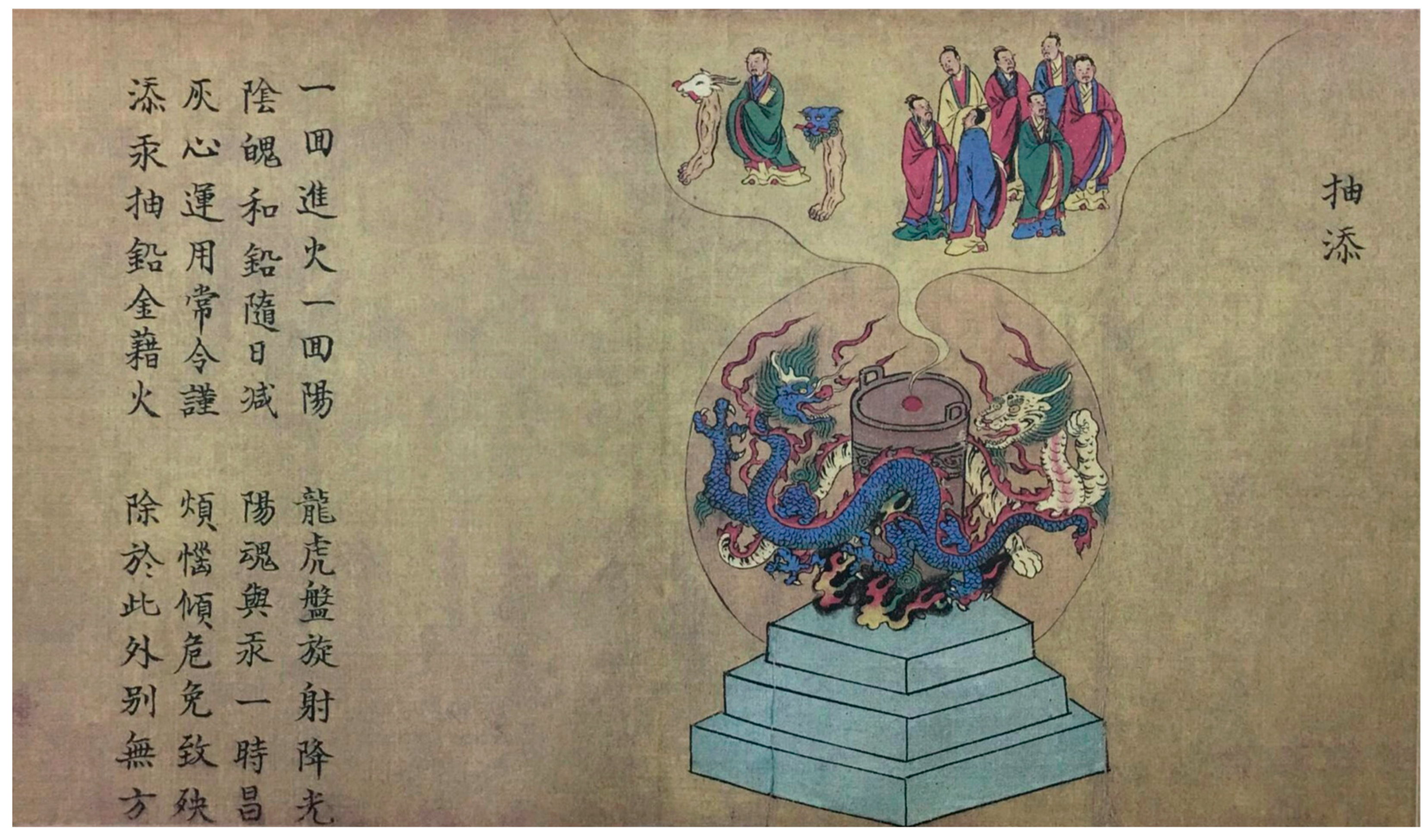
In Daoist Neidan iconography, the Sanshi are uncommon yet significant visual elements that embody unique Daoist theological and spiritual cultivation values. A typical depiction of the Sanshi appears in the 15th figure of Verification Diagrams of the Golden Elixir and Reverted Cinnabar (金液還丹印證圖), attributed to the Song Dynasty (960–1279). Daoist Long (fl. 1208–1224) and currently housed at the White Cloud Temple 白雲觀 in Beijing (see Figure 1). This colored album, a rare intact Neidan atlas, was recreated in the Qing Dynasty (1644–1911) based on the original Song Dynasty woodblock version. It consists of 20 exquisite illustrations depicting distinct stages of Neidan practice. The 15th figure, titled “Extracting and Supplementing” (Choutian 抽添), combined with its accompanying inscription: “Yinpo and lead wane daily; Yanghun and mercury flourish instantly.” 陰魄和鉛隨日減,陽魂與汞一時昌 depicts the transition from minggong, which focuses on physical refinement, to xinggong, which emphasizes spiritual cultivation. Xu Yilan 許宜蘭 identifies this as the process by which the soul transforms from a state of mixed Yin and Yang to a pure Yang entity (Y. Xu 2015).
Beneath the figure are the common Neidan symbols of the Elixir Cauldron (Danding 丹鼎) and Dragon-Tiger (Longhu 龍虎). Above, however, the divine figures attract particular attention: on the right stands seven conventional Daoist deities robed in official attire; on the left is a distinctive ensemble of two one-legged, beast-headed spirits paired with a robed humanoid deity. Based on iconographic features and the accompanying text, these figures are confirmed to represent the Sanshi1.

3.1. The Formation, Evolution, and Visualization of the Sanshi Concept

The Daoist concept of the Sanshi emerged early, with references in numerous ancient texts such as the Han Dynasty (202B.C.E.–220C.E.). Daoist classic Taiping Jing 太平經 (Scripture of Great Peace)2, the apocryphal text Hetu Jiming Fu 河圖紀命符 (Talisman of the River Chart Recording Destinies). The Taiping Jing describes the Sanshi as follows: “Within the body reside Sanshi worms, dwelling in the three Dantians 丹田. They delight in human nature and seek early death. On each Gengshen Day, they ascend to report to the Supreme Deity, requesting calamities upon humans, thus causing many to die prematurely or suffer misfortune. Practitioners who eliminate them through techniques and medicines can attain longevity.” 身中有三屍蟲, 居三丹田,好感人性,欲得早亡,每至庚申日上逸於帝,請降災禍于人,故人多夭枉過厄。修煉者用術及藥去之,則年長不死 (M. Wang 1960). The Hetu Jiming Fu provides a more detailed account: “The Sanshi are akin to spirits, ghosts, and soul-essences. Desiring to hasten human death, they aim to become ghosts, wandering freely and feasting on sacrificial offerings. On the last day of each LiuJia cycle, they ascend to inform the Director of Destinies (Siming 司命) of the Daoist practitioner’s transgressions. Severe offenses result in the deduction of one’s lifespan (Ji 紀), while minor ones reduce one’s fortune (Suan 算). Thus, those seeking immortality must first eliminate the Sanshi— by cultivating tranquility, suppressing desires, calming the spirit, clarifying inner-nature, accumulating good deeds—only then will medicinal elixirs be effective, and immortality attainable.” 三屍之為物,實魂魄鬼神之屬也。欲使人早死,此屍當得作鬼,自放縱遊行,饗食人祭拜。每到六甲窮日,輒上天白司命,道人罪過,過大者奪人紀,過小者奪人算。故求仙之人,先去三屍,恬淡無欲,神靜性明,積眾善,乃服藥有效,乃成仙 (Yasui and Akira 1994). Both texts define the Sanshi as spirits dwelling within the human body, monitoring behavior, and seeking to induce early death—forming the core interpretation of the Sanshi in subsequent Daoist tradition.
By the Wei-Jin period, Daoist texts further elaborated on the Sanshi’ roles and assigned them specific names and forms. The Daoist scripture Zhonghuang Jing 中黃經 (Scripture of the Central Yellow) states: “The Upper Worm resides in the Upper Dantian, within the brain and heart. White-green in color, it is named Peng Ju 彭鋸, inciting gluttony and stagnant desires… The Middle Worm, named Peng Zhi 彭質, white-yellow in color, dwells in the Middle Dantian, provoking greed for wealth, emotional excess, and confusion of the true void, causing the Sanshi to transform and the Qipo… The Lower Worm, named Peng Jiao 彭矯, white-black in color, resides in the Lower Dantian, inducing obsession with clothing, wine, and sensual pleasures.” 上蟲居上丹田,腦心中是也。其色白而青,名日彭鋸,使人好味,嗜慾癡滯…… 中蟲名彭質,其色白而黃,居中丹田,使人責財賄,好喜怒,濁亂真無,令三屍變易,七魄流蕩…… 下屍其色白而黑,名日彭矯,居下丹田,使人愛衣裳,耽酒色 (Daozang 1988, vol. 18, pp. 385–86). The Zhonghuang Jing is listed in Ge Hong’s Baopuzi Neipian 抱樸子內篇 (Inner Chapters of the Baopuzi) among the Daoist scriptures collected by Zheng Yin 鄭隱, primarily recording practices such as Qi absorption (Fuqi 服氣) and grain avoidance (Bigu 辟穀). Alternative, rare names for the Sanshi appear in other texts—for example, the Zhenzhong Ji 枕中記 (Record from the Pillow) refers to them as Cyan Maiden (Qing Gu 青姑), White Maiden (Bai Gu 白姑), and Blood Corpse (Xue Shi 血屍) (Zhonghua Daozang 2004, vol. 23, p. 666).
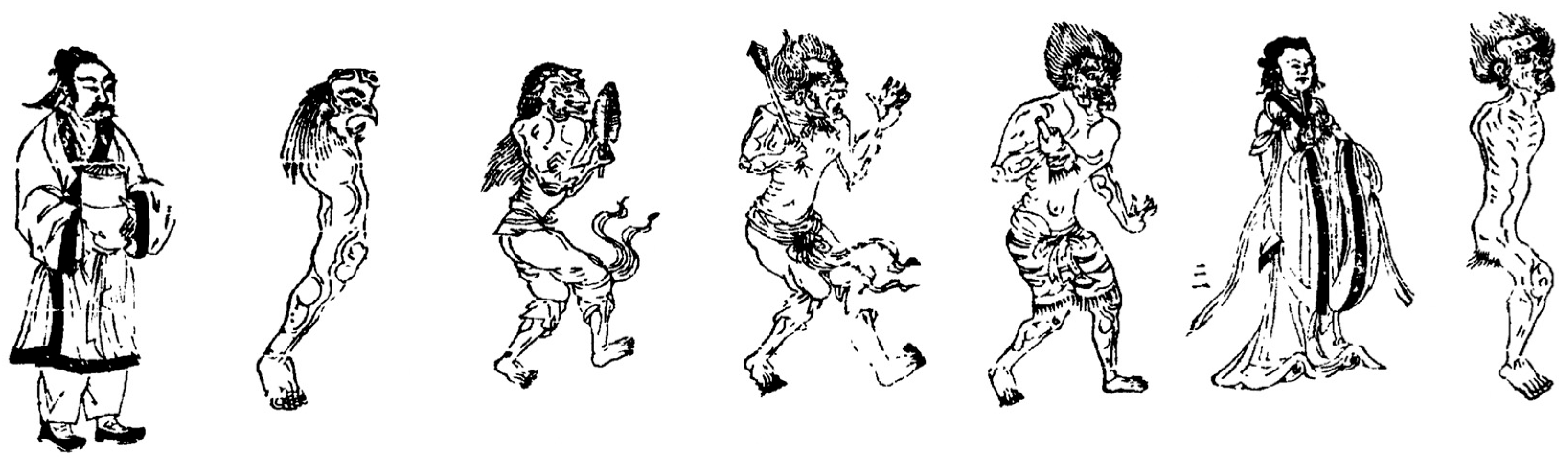
By the Tang Dynasty (618–907), the theoretical system surrounding the Sanshi had matured. Together with the Jiuchong, the Sanshi developed into a theological and ontological description constructed around this concept, along with corresponding medicines, rituals, and cultivation methods. This maturation is marked by the compilation of the Taishang Chu Sanshi Jiuchong Baosheng Jing 太上除三屍九蟲保生經 (Supreme Scripture on Eliminating the Sanshi jiuchong to Protect Life), a text dedicated exclusively to the Sanshi jiuchong, which also includes specialized illustrations of the Sanshi (see Figure 2). This scripture provided the primary textual foundation for the Sanshi concept in subsequent Daoist medicine and Neidan practice, signifying its transformation from an isolated concept to a centralized religious theoretical system.
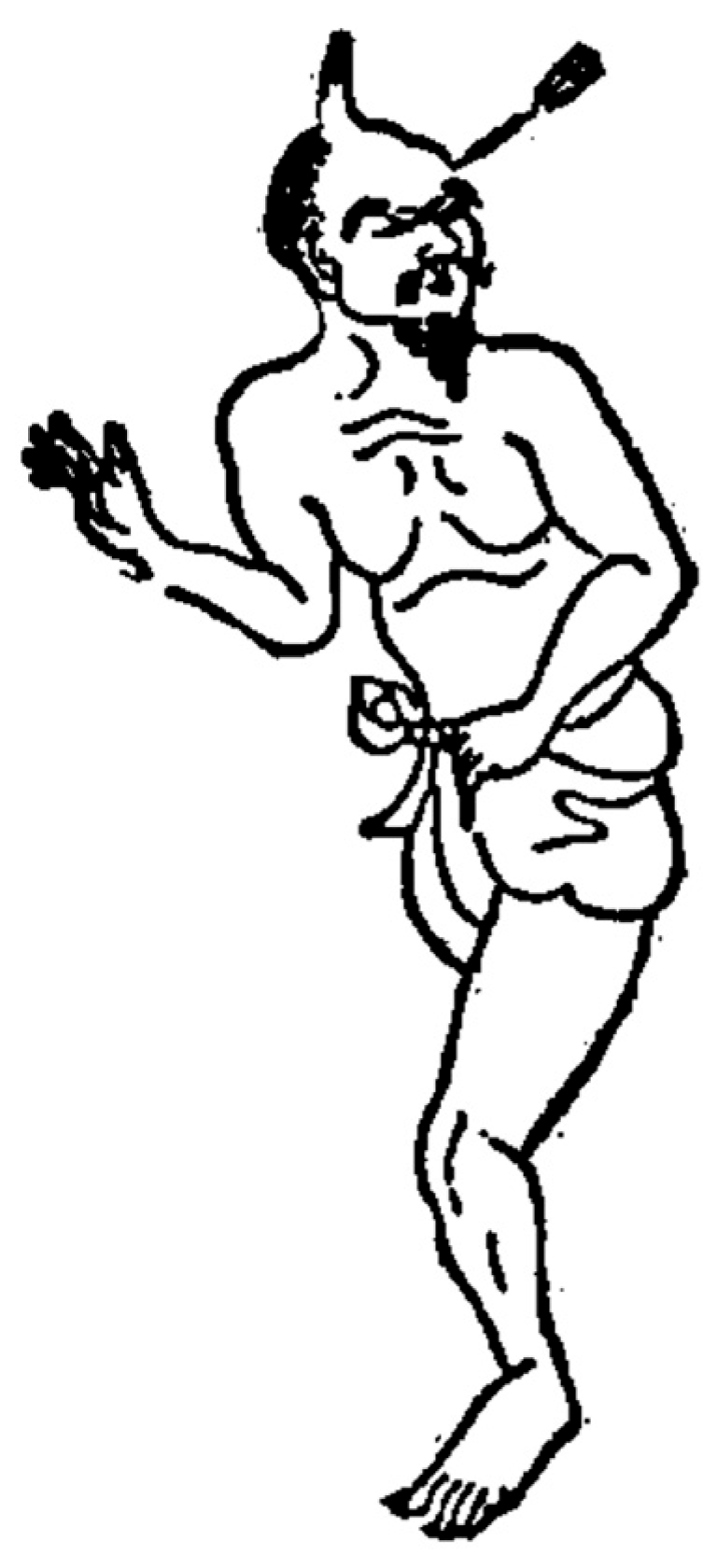
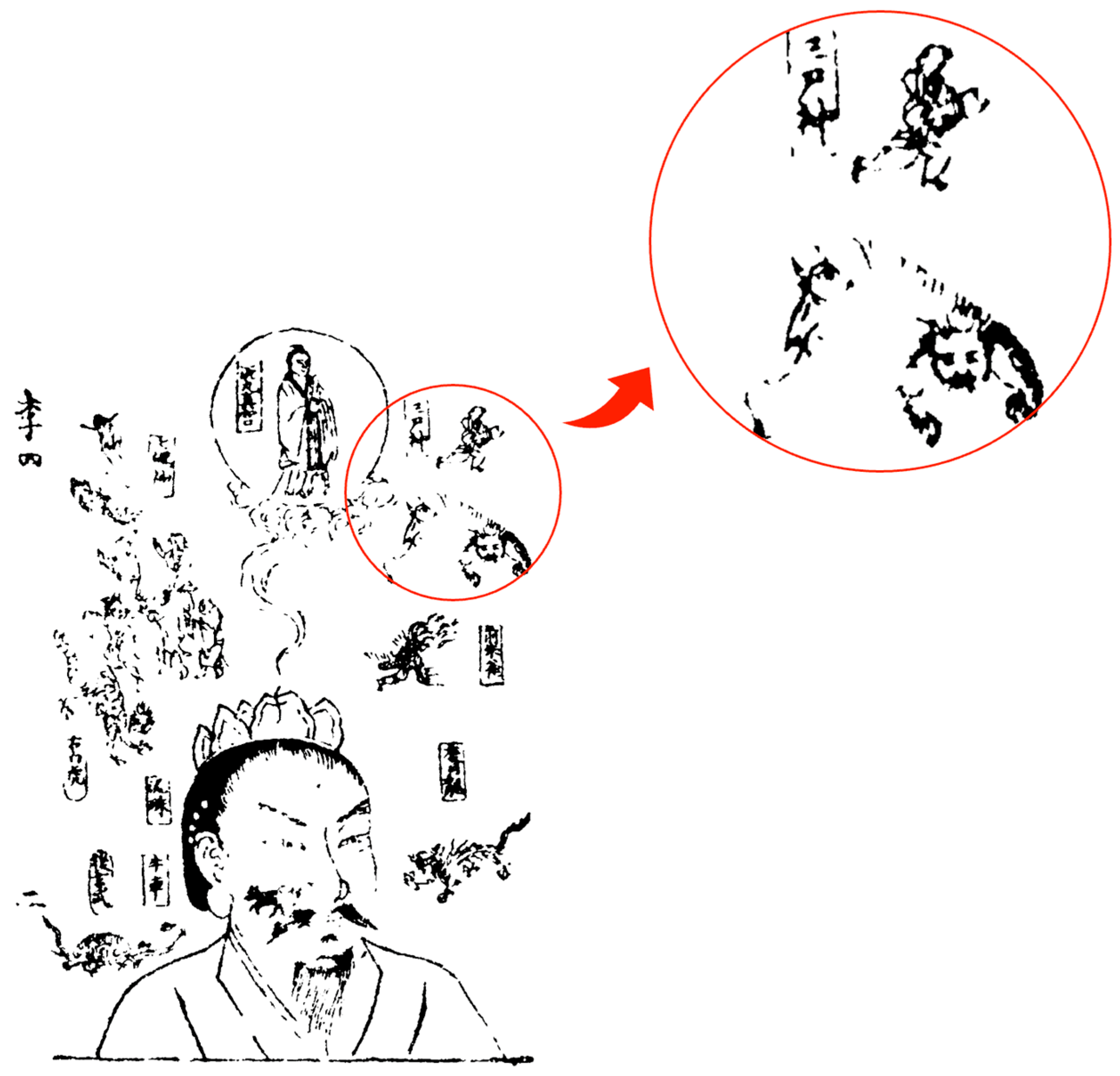
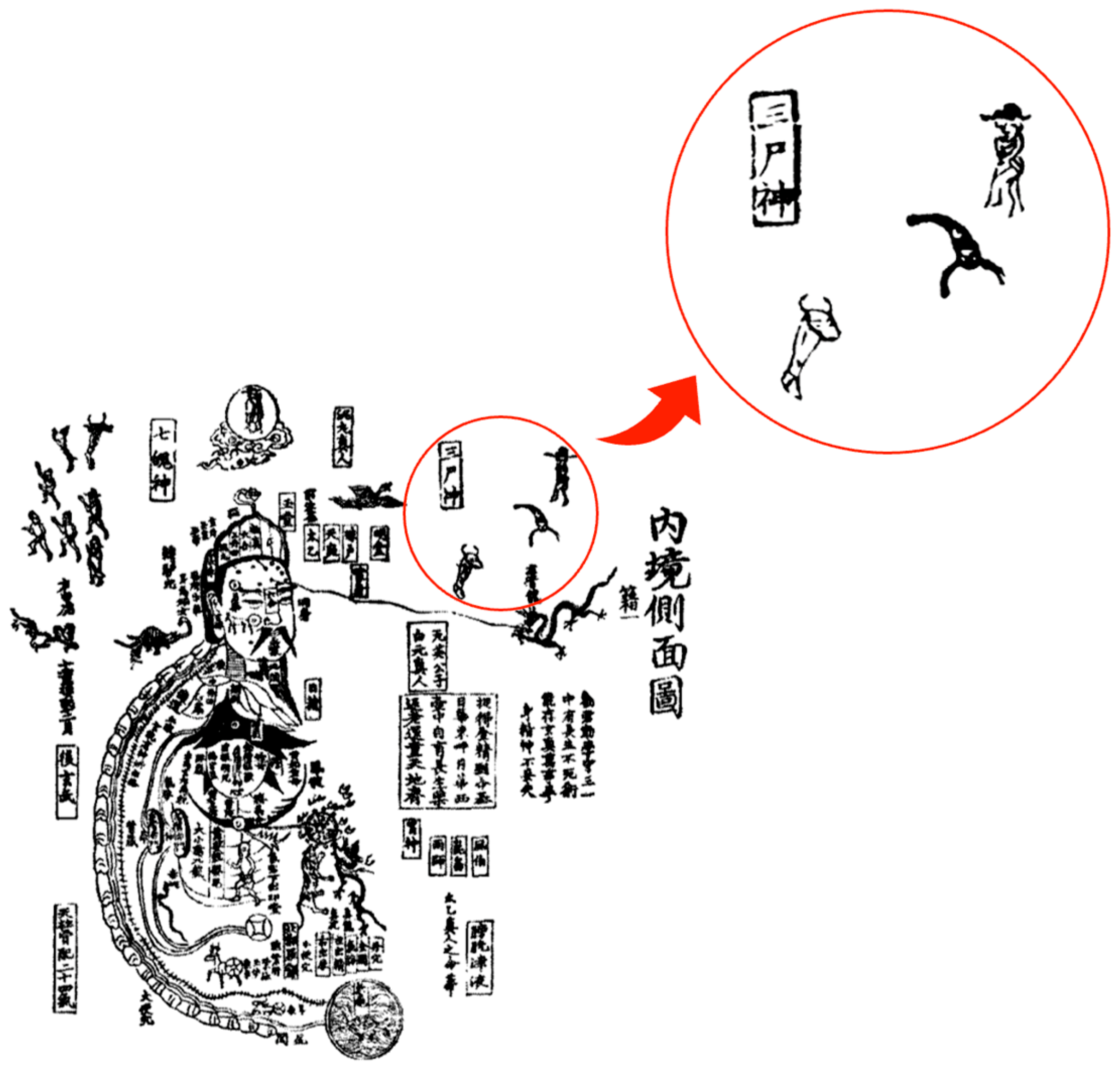
Depictions of the Sanshi in Daoist art are not uniform. Beyond the combination of two one-legged spirits (one ram-headed, one lion-headed) and a humanoid deity in Jinye Huandan Yinzheng Tu (金液還丹印證圖), common representations in Neidan iconography include: (1) one-legged beast-headed, beast-form, and humanoid figures; and (2) one-legged beast-headed, reptilian, and humanoid figures. For instance: (1) In the Taishang Chu Sanshi Jiuchong Baosheng Jing, the Sanshi appear as a one-legged ox-headed spirit, a lion-like beast, and a robed humanoid (see Figure 2); (2) In the Five Dynasties Daoist Yan Luozi 煙蘿子’s Yan Luozi Chaozhen Tu (煙蘿子朝真圖), in the upper section, the Sanshi are faintly distinguishable as a humanoid, a one-legged beast-headed figure, and a beast-form—consistent with their depiction in the Taishang Chu Sanshi Jiuchong Baosheng Jing (see Figure 3); (3) The Annotated and Illustrated Commentary on the Nanjing by Huangdi (黃帝八十一難經纂圖句解), in its Ming Dynasty (1368–1644) woodblock edition, presents a Daoist anatomical diagram in the form of an “inner vision map” (Neijing Tu 內景圖). In the upper right, the Sanshi are depicted as a one-legged beast, a robed humanoid, and a reptile (see Figure 4). Analysis of Daoist Sanshi iconography reveals that despite variations in form and composition, at least one or two one-legged, beast-headed figures are consistently present—this is the key distinguishing feature of Sanshi imagery.

3.2. Analysis of the Origins of the Sanshi Concept and Iconography

For religious terminology, sorting out the formation and development of a concept within its textual framework is fundamental to research. Exploring the origins of the concept and its iconography from a broader religious perspective represents a deeper extension of this work, facilitating a more thorough understanding of the concept’s theoretical evolution. For the Sanshi, two core clues guide origin tracing: their essential definition as spirits dwelling within the human body, tasked with reporting human behavior to heaven and seeking to induce early death; and their iconic one-legged, beast-headed form.
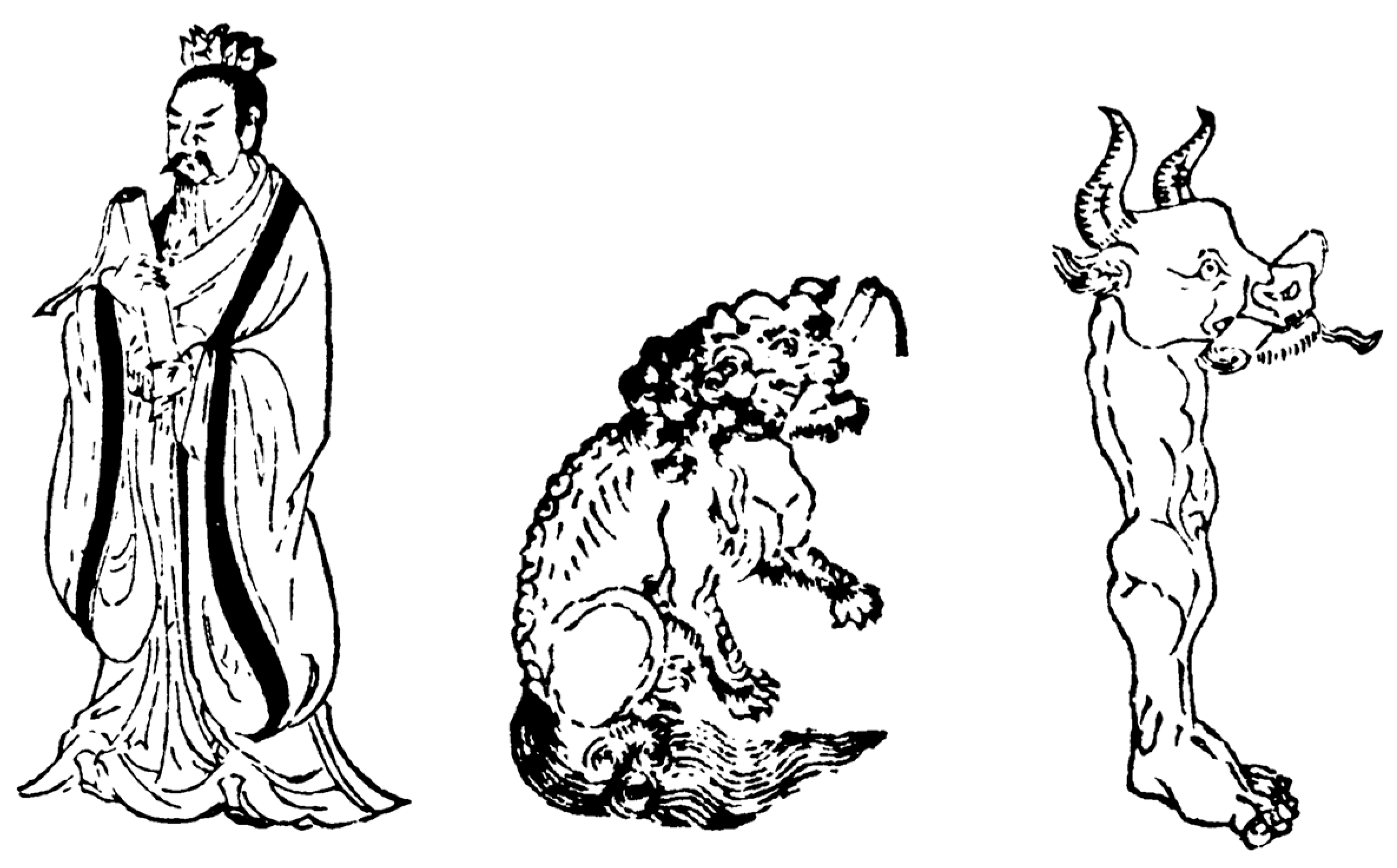
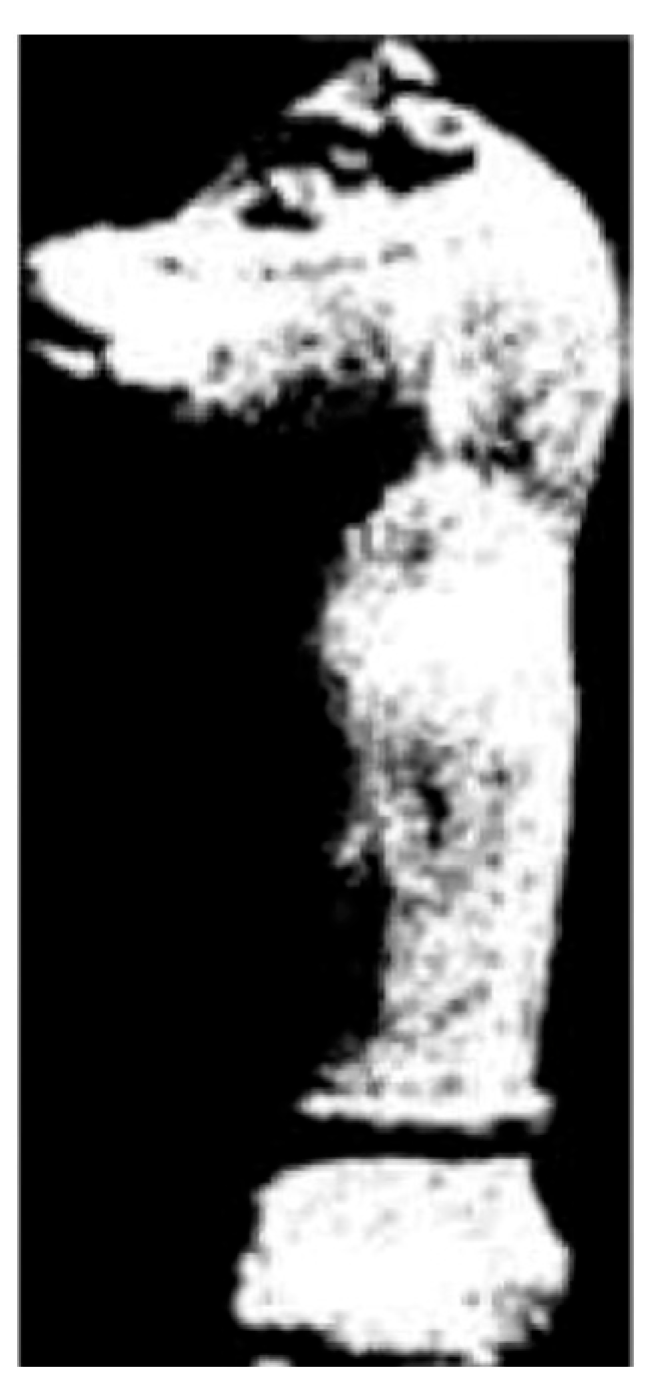
Shih-shan Susan Huang 黃士珊 argues that the key one-legged, beast-headed imagery of the Sanshi draws inspiration from the prevalent motif of one-legged demons in early and medieval Chinese art. For example, a one-legged, ox-headed pottery figurine unearthed from a Southern Song Dynasty tomb of the Yang clan 楊氏家族 in Mianyang 綿陽, Sichuan (see Figure 5), is described by He Guozhi 何國志 (cited by Huang) as “an animal head with two horns; its mouth carries an object; its body is shaped like a leg with a hoof.” (S.-s. S. Huang 2012). This figure bears striking similarities to the one-legged, beast-headed Sanshi depicted in the Taishang Chu Sanshi Jiuchong Baosheng Jing and other Daoist atlases. Notably, the figurine’s “object in its mouth” corresponds to the scroll-like items held in the beaks of the two one-legged, beast-headed Sanshi in Verification Diagrams of the Golden Elixir and Reverted Cinnabar (金液還丹印證圖) (see Figure 1)—a detail echoing the Sanshi’ role as monitors of human behavior and reporters to the Heavenly Court.
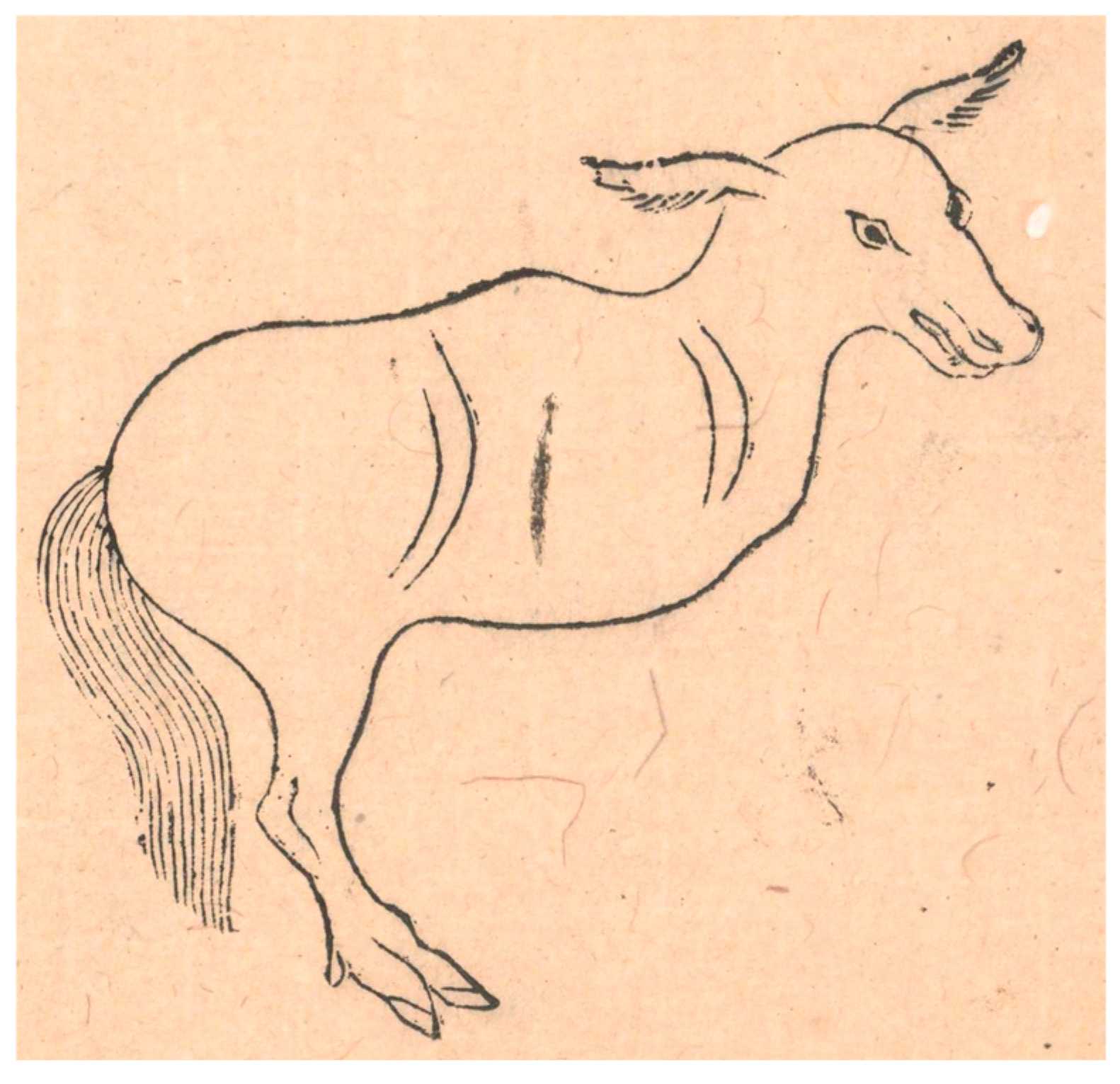
Shih-shan Susan Huang 黃士珊 further notes parallels between the Sanshi and certain disease ghosts (binggui 病鬼) illustrated in Binggui Wang Tu 病鬼王圖 (Diagram of the Disease Ghost King), a text derived from the Daoist-influenced Esoteric Buddhist scripture Qiyao Xingchen Bie Xing Fa 七曜星辰別行法 (Alternative Practices of the Seven Stars) (S.-s. S. Huang 2012). For instance, the demon controlled by the Literary Star (Wenxing 文星), a one-legged figure with a goat’s beard and horns, is said to cause back pain (see Figure 6). The Sanshi also shares similarities with disease-symbolizing demons and mythical beasts like the Kuiniu (夔牛) in the Shanhai Jing 山海經 (Classic of Mountains and Seas) (see Figure 7). Huang concludes: “The material souls and deathbringers depicted in the Scripture for the Protection of Life gradually took shape as part of the visualization of disease demons pervasive in medieval China. The shared depiction of one-legged anthropomorphic diseases may have been inspired by a prototype derived from ancient mythological descriptions of life in foreign lands.” (S.-s. S. Huang 2012).
Beyond Huang’s iconographic analysis, I also note that the term “Shi” (Corpse 屍) in Sanshi which carries distinct connotations differing from ordinary Daoist deities offers crucial insights into the Sanshi’ origins, reflecting connections to early Chinese religious beliefs. In Shuowen Jiezi 說文解字 (Explaining Simple and Analyzing Compound Characters), “Shi” (屍) has dual meanings: first, the state of a body lying down, implying death; second, a ritual effigy representing a deity, symbolizing the physical form of a deity (S. Xu 1963). This duality is vividly manifested in the Shanhai Jing, which records numerous deities referred to as “XX屍”, forming the unique concept of “corpse state” (Shixiang 屍象). Ma Changyi 馬昌儀 explains: “Shixiang is a distinctive mythological phenomenon in the Shanhai Jing, referring to certain gods who, having been killed for various reasons, continue to act in the form of ‘corpses’ with their souls remaining immortal.” (Ma 2022). As a special state of existence for deceased gods, the “XX屍” in the Shanhai Jing are generally depicted with mutilated or alienated bodies—for example, “The Corpse of Jubi” (Jubi zhi Shi 據比之屍) is described as “having a broken neck, disheveled hair, and missing one hand,” 折頸披髮, 無一手 (Luan 2019, p. 467) while “The Corpse of King Xuan of Rong” (Rong Xuan Wang Shi 戎宣王屍) is “a horse shape without a head.” 馬狀無首 (Luan 2019, p. 601).
Clearly, the concept of Shi in the Shanhai Jing—both in meaning and form—shares significant parallels with the Sanshi. This further suggests that the origins of the Sanshi may be traced to early Chinese primitive religious beliefs, with the term Shi inherently conveying symbolic associations with death. As spirits in a Shi state, their inherent connection to death links them to disease and mortality: as physical remnants of death, corpses were seen as sources of illness and demise due to decay and contamination; as spiritual remnants of death, they were associated with spiritual decline, embodying the roots of negative human desires and spiritual flaws.

4. Jiuchong and Qipo Imagery: An Interpretation of Its Connections with Sanshi

In addition to appearing directly in Neidan practice imagery, Daoist Sanshi imagery often features in “inner vision diagrams” (內景圖) that depict the structure of the human body and even the spirit, serving to intuitively express the physical and spiritual constitution of humans. In these Sanshi-related images, the Sanshi typically form fixed combinations with other body-concept elements such as the Jiuchong and Qipo, conveying the religious connotations of the Sanshi from different perspectives.

4.1. The Jiuchong and the Sanshi

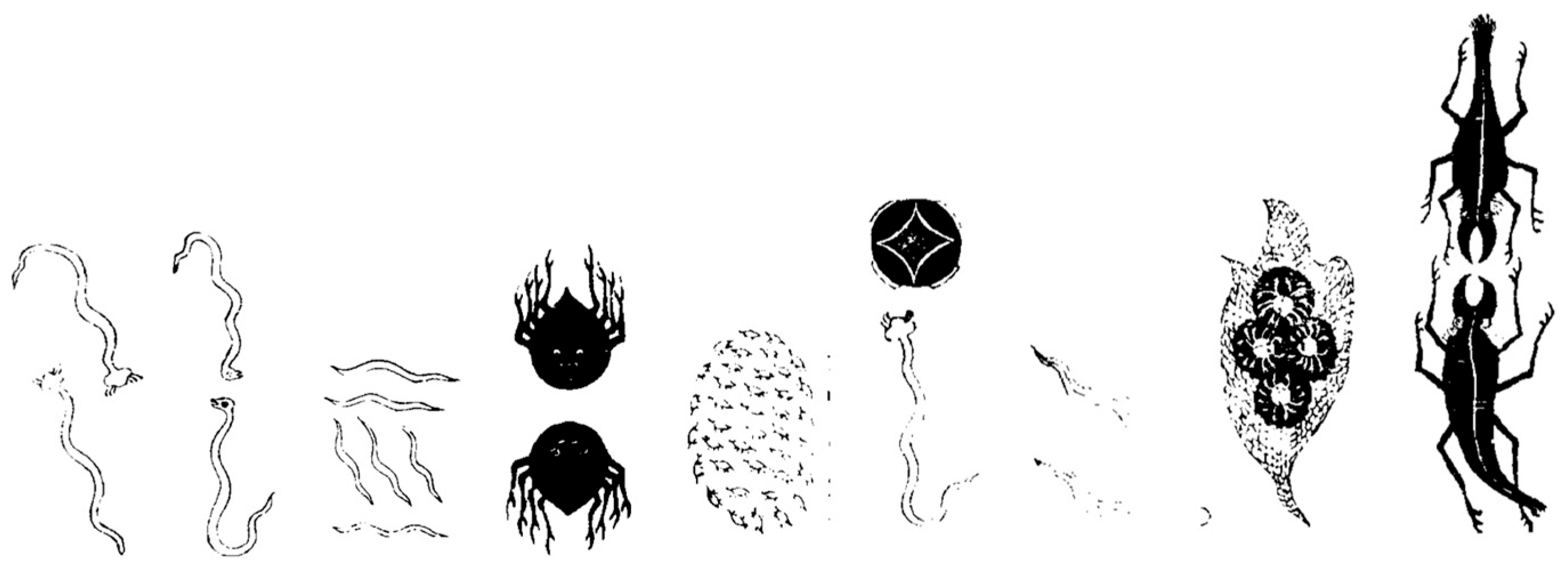
In Daoist iconography, the combination of the Sanshi and the Jiuchong is common, embodying the Daoist understanding of human decline and its triggering factors from both physical and spiritual dimensions. For instance, in the Taishang Chu Sanshi Jiuchong Baosheng Jing, in addition to describing the Sanshi as ghostly figures, it also depicts the Jiuchong in the forms of worm or insects (see Figure 8), which demonstrates the typical understanding of insect/worm-borne disease factors in Daoist medicine.
According to the Taishang Chu Sanshi Jiuchong Baosheng Jing, the Jiuchong have distinct names and colors and can cause various physical diseases. The Daoist concept of the Jiuchong evolved from the earlier concept of “Three Worms” (Sanchong 三蟲), which emerged no later than the Han Dynasty. For example, Wang Chong 王充 of the Western Han Dynasty (202B.C.E.–8C.E.) mentioned Sanchong in his Lunheng 論衡 (Balanced Discourses): “There are sanchong in the human abdomen. In the marshes of the lower realm, the worm is called leech, which eats human feet; the sanchong eat the intestines.” 人腹中有三蟲,下地之澤其蟲曰蛭,蛭食人足,三蟲食腸 (C. Wang 1974). These mainly refer to human intestinal parasites. By approximately the Jin Dynasty (266–420), the term Sanchong had evolved into Jiuchong and was combined with Sanshi to form the specialized term Sanshi jiuchong. Subsequently, this term began to appear frequently in medical texts. For example, in Chao Yuanfang 巢元方’s Zhubing yuanhou Lun 諸病源候論 (Treatise on the Etiology and Symptoms of Diseases) of the Sui Dynasty (581–618), Sanshi jiuchong primarily referred to gastrointestinal parasites in modern medical terms: “The Sanshi Jiuchong reside in the human intestines and stomach, and start to move when the intestines and stomach are weak. The upward movement will eat the five organs of a person, producing symptoms of panic and chest tightness, and the teeth, gums and lips will develop sores. The downward movement will eat the intestines of a person, causing symptoms of anal injury and decay.” 三屍九蟲,常居人腸胃,腸胃虛則動,上食於五臟,則心懊而悶,齒齦、唇口並生瘡; 下食於腸,則肛門傷爛,而穀道開也 (Ding 2013). In the Zhubing Yuanhou Lun 諸病源候論 (Treatise on the Etiology and Symptoms of Diseases), Chao Yuanfang 巢元方 provides a detailed description of the names, sizes and shapes of the Jiuchong: The Jiuchong are as follows: the first is called the Fu Chong (伏蟲), approximately one centimeter long3; the second is called the Hui Chong (roundworm 蛔蟲), approximately one foot long; the third is called the Bai Chong (white worm 白蟲), approximately three centimeters long; the fourth is called the Rou Chong (flesh worm 肉蟲), shaped like a rotten plum; the fifth is called the Fei Chong (lung worm 肺蟲), shaped like a silkworm; the sixth is called the Wei Chong (stomach worm 胃蟲), shaped like a toad; the seventh is called the Rou Chong (weak worm 弱蟲), shaped like a melon petal; the eighth is called the Chi Chong (red worm 赤蟲), shaped like raw meat; the ninth is called the Nao Chong (pin worm 蟯蟲), very tiny, shaped like worms inhabiting vegetables.4 九蟲者,一曰伏蟲,長四分; 二曰蛔蟲,長一尺; 三曰白蟲,長一寸; 四曰肉蟲,狀如爛李; 五曰肺蟲,狀如蠶; 六曰胃蟲,狀如蛤蟆; 七曰弱蟲,狀如瓜瓣; 八曰赤蟲,狀如生肉; 九曰蟯蟲,至細微,形如菜蟲. (Ding 2013, p. 352).
The Jiuchong mentioned in Taishang Chu Sanshi Jiuchong Baosheng Jing mainly cite the descriptions of the Jiuchong “forms and disease-causing effects from Zhubing yuanhou Lun. In particular, the description of the Fei Chong holds that it causes contagious consumptive disease” (Chuanshi Laobing 傳屍癆病) (Daozang 1988, vol. 18, p. 700), linking the Sanshi and Jiuchong to pulmonary tuberculosis—a new account not found in Zhubing yuanhou Lun. From the Song Dynasty onward, the Sanshi and Jiuchong became largely specifically associated with pulmonary tuberculosis, and the theory of the Sanshi Jiuchong served as the foundation for the lung consumption treatment masters who emerged during the Song and Yuan dynasties and the anti-consumption rituals they practiced, which employed Daoist Thunder Magic (Leifa 雷法).
Overall, the concept of the Jiuchong mainly refers to the physical destructive factors within the human body, or more specifically to pathogenic organisms represented by internal parasites. This clearly corresponds to Daoism’s understanding of the destructive factors affecting the physical body of humans—for example, a large number of worms emerging from decaying corpses and insects growing in rotten grains. Worms and insects are regarded as one of the causes of human physical decline, thus forming the concept of the Jiuchong. Correspondingly, under the philosophical view of the balance between body and spirit, Daoism has constructed a spiritual factor of decline corresponding to the material and physical factors of decline, which is the concept of the Sanshi.

4.2. The Qipo and the Sanshi

In Daoist images, the Sanshi and Qipo are also common combinations, expressing Daoism’s understanding of negative spiritual factors in human nature from two perspectives: internal and external origins. In Daoism, the understanding of the functions of the Qipo is placed within the framework of the Yin-Yang 陰陽 theory, holding that the human soul consists of the Yang-attributed Three Hun (Sanhun 三魂) and the Yin-attributed Qipo. Among them, the Sanhun are regarded as positive spiritual factors, while the Qipo represent negative spiritual elements such as negative emotions and desires, and thus are also considered spiritual factors leading to premature human death.
As Ge Hong 葛洪 stated in Baopuzi Neipian: “Although the Sanshi are formless, they are indeed among the spiritual beings like Po, spirits, and ghosts.” 三屍之為物,雖無形而實魄靈鬼神之屬也 (M. Wang 1983). The Sanshi and Qipo in Daoism share many similarities in connotation and even in image. For example, the diagrams of the Qipo recorded in Taishang Chu Sanshi Jiuchong Baosheng Jing show numerous similarities with those of the Sanshi. In which, “Swallowing Thieves Tunzei” (Tunzei 吞賊) and “Eliminating Impurities” (Chuhui 除穢) among the Qipo are in human form, while “Flying Poison” (Feidu 飛毒) and “Sparrow Yin” (Queyin 雀陰) are depicted as one-legged beast heads. Additionally, there are “Stinking Lung” (Choufei 臭肺), “Crouching Excrement” (Fushi 伏矢), and “Corpse Dog” (Shigou 屍狗), all with incomplete or distorted body shapes (see Figure 9). These images not only feature the typical one-legged, beast-headed form commonly seen in depictions of the Sanshi but also include names with universal negative connotations, such as the character “Shi” (屍).
Beyond their iconographic similarities, the Taishang Chu Sanshi Jiuchong Baosheng Jing also describes the functions of the Qipo in a manner analogous to those of the Sanshi, in which states: “The Qipo are accumulated Yin Qi 陰氣, shaped like ghosts. They cause people to have excessive desires, suffer fatigue, feel stuffy and constrained, prefer filth, and dislike conflict. They can turn humans into walking corpses, directing them away from life and toward death, prompting flattery, deceit, obsession with female beauty, and the constant arousal of evil, hastening early death.” 夫七魄積陰之氣,其形類於鬼也。令人多欲傷勞,窒塞拘急,好穢不好爭。能使行屍,背生向死,諂曲詭詐,慕戀女色,日夜興惡,催人早死 (Daozang 1988, vol. 18, p. 698). This text attributes human sensory desires and negative mental traits entirely to the functions of the Qipo, and similarly holds that the existence of the Qipo “hastens early death.” It is evident that the Sanshi and the Qipo overlap substantially both in function and imagery. Their core difference lies in that the Sanshi are regarded as external, heterogeneous negative spiritual factors alien to human nature, while the Qipo are inherent negative spiritual components that constitute human essence. The Sanshi and the Qipo thus represent two distinct understandings of the origin of negativity in human nature.
In Chinese philosophical debates on the inherent goodness or evil of human nature, there existed a dispute between the theory of original goodness and the theory of original evil. Proponents of original goodness, represented by Mencius 孟子, argued that human nature is inherently good—like water flowing downward, a natural inclination—and that subsequent evil arises from environmental influences or self-indulgence. In contrast, advocates of original evil, represented by Xunzi 荀子, maintained that humans are born with desires for profit, sensual pleasure, and jealousy. Regarding human evil deeds, the divergence between the two schools lies in that one attributes evil to inducement by external, non-essential factors, while the other regards it as a manifestation of human nature itself. Although the debate between original goodness and original evil primarily emerged within Confucianism, the question of human nature was a concern across various ideological schools. In Daoist thought, human behavior is embodied by spiritual entities such as the Sanhun and Qipo or Sansi. In this sense, the Sanshi and the Qipo, which are associated with human spirit and symbolize negativity or death, thus can be seen as manifestations of ancient Chinese debates on human nature within Daoist religious concepts. Many Daoist texts adopt a parallel description of the Sanshi and the Qipo, asserting that human nature inherently contains the negative spiritual component of the Qipo, which, combined with the inducement of the external Sanshi, jointly lead to spiritual decline.
Beyond the general understanding of the Sanshi as external and the Qipo as internal negative spiritual entities, some Daoist images and texts present more diverse interpretations of their relationship with human nature from an anthropological perspective.
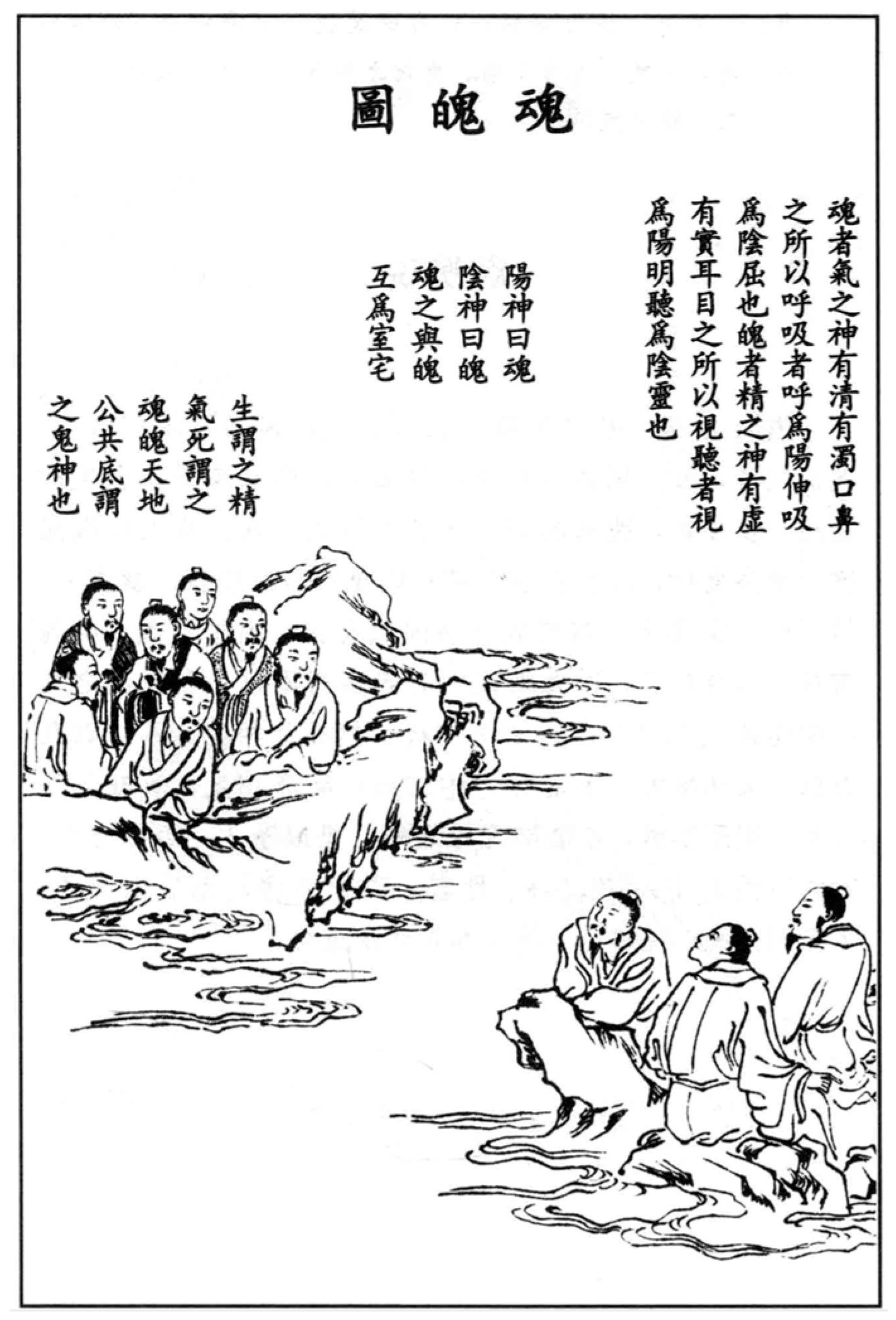
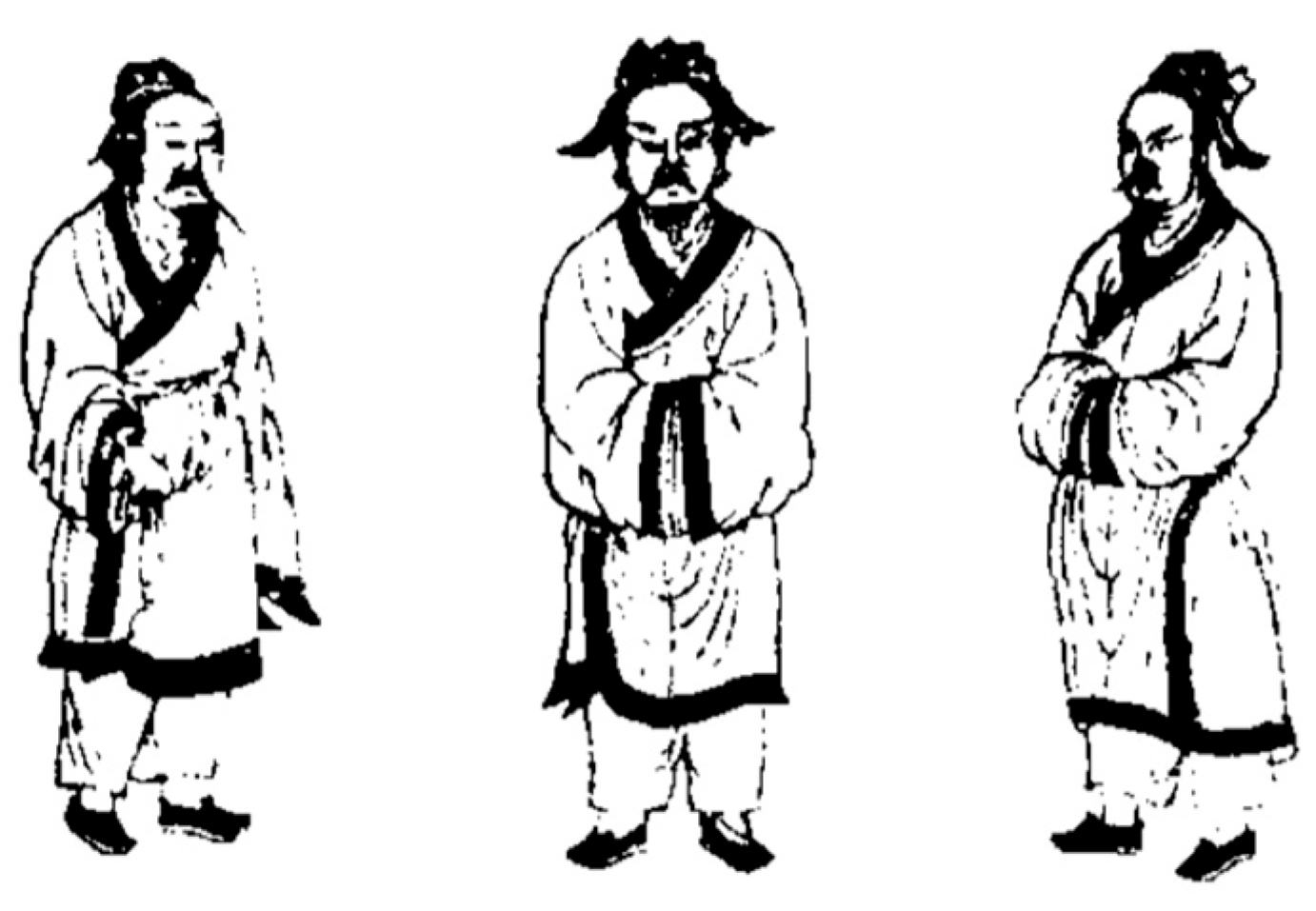
First is the change in the images of the Qipo. In the Taishang Chu Sanshi Jiuchong Baosheng Jing, some members of both the Sanshi and the Qipo are depicted as single-legged, beast-headed or beast -like figures, used to symbolize their evil nature. For the Sanshi, which represent external negative spiritual factors, they are generally portrayed as ghost-like images to express their heterogeneous nature distinct from humans; however, the Qipo are usually regarded as a part of human soul—an integral component of human essence—so their portrayal as ghost figures is controversial. Therefore, different representations of the Qipo can be seen in some images. In the soul diagrams (魂魄圖) from Xingming Guizhi 性命圭旨 (Essentials of Life and Inner-nature), a Daoist health-preserving text carved in the Qing Dynasty, the Sanhun and Qipo are depicted in images. It is noteworthy that the Qipo in Xingming Guizhi (see Figure 10) are portrayed as hermit figures dressed similarly to the Sanhun in the Taishang Chu Sanshi Jiuchong Baosheng Jing (see Figure 11). This change in imagery precisely reflects the altered understanding of the Qipo. As noted in the image caption: “Po is the spirit of essence, both intangible and tangible, and the basis for the ears and eyes to see and hear.” 魄者,精之神。有虛有實,耳目之所以視聽者. The Po were regarded as the bearers of human sensory functions rather than negative spiritual elements causing decline and death. Thus, in this case, the images of the Qipo transformed from inhuman, alienated forms to human figures, demonstrating the illustrator’s more positive understanding of the Qipo.
The second is A More Positive Understanding of the Sanshi. In certain Daoist texts, the Sanshi are also understood as essential elements constituting human personality, similar to the functions of the Qipo. For instance, the Yunji Qiqian 雲笈七簽 (Seven Tablets in a Cloudy Satchel) includes an interesting allegorical text titled Meng Sanshi Shuo 夢三屍說 (Tale of Dreaming of the Sanshi), which discusses the significance of the Sanshi in human nature.
The allegory given there is about a man from Guangyang 廣羊 named Song Yanhua 宋彥華, who resided on the banks of the Pu River 濮上. He was fond of Confucian literature and various arts and techniques. Having obtained numerous methods and medicines from Daoist masters, he sought to eliminate the Sanshi. One night, he suddenly dreamed of three men standing in the hall, dressed in ancient official robes and hats.
In the dream, Yanhua reproached the Sanshi angrily: “I was born by the mandate of Heaven, and Heaven has assigned me a lifespan—whether long or short, it is predetermined. I have heard that you delight in abiding within my body, slandering and deceiving me, disturbing my spirit, and rejoicing in bringing me misfortune, evil, and premature death. What have I done to wrong you! Now, my Daoist masters have taught me techniques to kill you. If you do not leave at once, you shall suffer severe torment.”
The Sanshi said: “If you will listen to us, we will defend ourselves against these false accusations, and then take our leave. Will you allow it?”
Yanhua replied: “Speak.”
The Sanshi said:
Our clan is formed from the essence of Yin and Yang, linked to the Great Void 太虛, emerging from non-existence into existence. When a mortal is born with a physical form, the Supreme Deity dispatches my brothers and me to dwell within humans, governing their souls, safeguarding their nature, and preserving their inner harmony. Alas, when humans reach adulthood, they indulge in countless pursuits: coveting wealth and food, indulging in sensual pleasures, practicing deceit and fraud, being slanderous, cunning, and dishonest—appearing upright outwardly, yet harboring devious intentions inwardly. They are unfilial to parents, unfriendly to siblings, unkind to others, oppress the people and seize their property, flaunt their power and status, devise secret schemes to enrich their own families, rejoice in profit and envy the virtuous, disdain the poor and curry favor with the wealthy. They toil us day and night; my brothers and I are utterly exhausted! Weary as we are, we record their gravest offenses and bring harm upon them, hoping they will die soon so that we may find respite. Otherwise, how could we ever find peace? Now, if you truly desire the Dao 道, you need not eliminate us. Simply cultivate integrity, abandon glory and sensual pleasures, withdraw from the world and renounce desires, cease all toil and conceal your radiance, purify your Three Dantians, and stabilize your Nine Mansions (Jiufu 九腑). Let the sun and moon shine within you, and the stars and constellations overlook you from on high. Then my brothers and I will live in ease and tranquility; even for ten thousand years, we will remain by your side, guarding you from external harms. Free from toil, how dare we ever neglect our duties—let alone slander or deceive you! But now, you cling to glory and luxury, covet worldly fame and life, scheme for wealth and sensual pleasures, yet blame us for your troubles. We shall leave now. If the Upper Peng 上彭 departs, your words will become muddled, your ears and eyes will grow dull, and you will no longer derive joy from appearances or tastes. If the Middle Peng 中彭 departs, your plans will fail, your governance will be flawed, and your glory, career, literary works, and skills will no longer flourish. If the Lower Peng 下彭 departs, your passion for life will fade, you will struggle in all endeavors, and you will no longer be strong in sitting or standing. Your descendants will perish, and your soul will drift aimlessly. You will become a walking corpse—not a human being. When humans dwell in the world, they rely on my brothers and me for discernment, knowledge, and thought. You fail to cultivate integrity and preserve your primal qi, yet falsely accuse us of crimes. Is this not unjust?
Having spoken, they bowed to Yanhua and prepared to leave. In the dream, Yanhua grabbed their sleeves to detain them, saying: “Since ancient times, all humans must die, and no one can survive without wealth. Now, I can no longer preserve my true essence. Stay with me, and help me amass wealth—I will never turn back to the Dao again.”
The Three Peng suddenly leaped into his nostrils. Yanhua awoke with a start, confused and alarmed. From then on, he devoted himself entirely to accumulating wealth and never spoke of Daoism or its techniques again.
有廣羊人,宋彥華,家於濮上,好儒文及術伎,因於道者處受術及藥百計,求去三屍。忽一夕夢三人,古冠服而立堂閤之內。彥華問曰:君何人乎?答曰:吾即是君身中三彭也。欲辭子,故來相告耳。彥華夢中責之曰:吾受生於天,天賦有命,命有短長,必自悉矣。聞君好居吾身中,讒賊幻惑惱亂吾神,使邪夭禍厄,則喜而去,吾何負於君輩哉!今吾師道術以殺汝,汝不速去,必遭楚苦。三屍曰:子能聽我言,將以辨吾非罪,而以辭子,可歟。彥華曰:何也?答曰:吾之族,陰陽之精也。上系太虛,自無入有。凡人有生質,則上帝乃頒吾兄弟賦於人中,主其魂魄,護其性而保其中也。蓋人中及壯,則百緒之為,貪財食,溺邪淫,矯詐欺誣,訐狡佞妄,外示正直,內趨僻違,不孝友,不慈惠,抑民掠財,逞形恃勢,濳窺陰計,自豐其家,喜利忌賢,輕貧葉富,晝夜役使,兄弟甚勞苦哉!吾之疲倦,且錄其尤以害之得速死,冀吾有暇耳。不如是,何得適哉!今子若好道,不必去吾兄弟。子但修中正,拋榮去味,遠世棄欲,息役沉光,滌清三宮,凝定九府,日月內燭,星斗高臨。則吾兄弟優遊清閑,雖千萬歲,與子周旋,賓護外物,吾無勞役,又何敢怠?況讒賊乎!今子且愛榮好奢,戀世情命,矯謀財色,既而返逐於我,我今去矣。若上彭去,則子言語倒錯,耳室目暗,容貌滋味無復暢也;中彭去,則子規謀失筭,治官乖政,榮業壯圖、文詞術藝無復適也;下彭去,則子風月蕩絕,馳騁艱難,坐立無復強也。子孫廢滅,魂魄飄沉,如此則子返為行屍,非人也。夫人之處世,賴我兄弟以為精識思慮。子不修中正,保元氣,而誣我以罪,豈非戾乎!言訖,揖彥華將去。彥華夢中牽其袂而留之,曰:自古皆有死,民無財不活,今吾不能保其真矣。子且為我留居,共子謀財,不復反覆矣。三彭倏然躍入其鼻,怳而驚乃寤。自後但以積財為業,不復更言道術
(Daozang 1988, vol. 22, pp. 587–88)
In this allegory, the Sanshi are regarded as constituent elements of human nature: the presence of the Upper Corpse (Shangshi 上屍) ensures the normal functioning of the senses; the presence of the Middle Corpse (Zhongshi 中屍) endows humans with wisdom as well as literary and political talents; and the presence of the Lower Corpse (Xiashi 下屍) provides humans with desires for reproduction and competition. If the Sanshi are eliminated, humans will become walking corpses. It argues that eliminating the Sanshi does not require technical means such as taking elixirs; instead, maintaining inner peace and minimizing desires is sufficient to avoid their harm. This text is a rare positive depiction of the Sanshi, similarly reflecting in-depth reflections on the relationship between human nature and desires in some Daoist texts.

5. Two Approaches to Addressing the Sanshi in Neidan

In general perception, the Sanshi are regarded as spiritual entities within the human body that induce decay and even death. Consequently, eliminating the Sanshi is a recurring theme in Daoist longevity practices. Early Daoism primarily employed methods such as taking elixirs or engaging in religious activities like observing the Gengshen vigil to dispel or mitigate the influence of the Sanshi. In Neidan, however, the Sanshi are mostly integrated into the realm of spiritual cultivation. Neidan texts outline two main approaches to eliminating the Sanshi: spiritual visualization and self-cultivation of inner-nature.

5.1. Eliminating the Sanshi Through Spiritual Visualization

Daoist Neidan formulas often include descriptions of eliminating the Sanshi. For instance, Zhang Boduan 張伯端, a representative figure of the Southern School of the Golden Elixir tradition (Jingdan Pai Nanzong 金丹派南宗), stated in his Wuzhen Pian 悟真篇 (The Awakening to Reality): “Only when the Sanshi are completely slain can the Dao be attained.” 殺盡三屍道可期 (Daozang 1988, vol. 2, p. 948). This reflects a particular understanding of the relationship between the Sanshi and the practitioner themself —framing the Sanshi as demonic obstacles hindering Neidan practice, thus advocating active confrontation to eradicate them. Many Neidan classics mention the method of “internal observation and igniting fire” (neiguan qihuo 內觀起火) to eliminate the Sanshi.
Chen Nan 陳楠, a representative of the Jingdan Pai Nanzong, wrote in his Ziting Jing 紫庭篇 (Scripture of the Purple Court): “Who knew the flames would burn ten thousand feet red, slaying the Sanshi as the jade cauldron still cools.” 誰知火焰萬丈紅,接殺三屍玉鑪寒 (Daozang 1988, vol. 4, p. 614). This Neidan formula describes the practice of visualizing flames to incinerate the Sanshi. Qiu Chuji 邱處機, a leading figure of the Quanzhen School (Quanzhen Pai 全真派), provided a more detailed account of this method in his Dadan Zhizhi 大丹直指 (Direct Instructions on the Great Elixir): “Guard against yin ghosts, external demons, the Qipo, and the Sanshi that follow, mingling with true essence to disrupt the yang spirit and prevent it from ascending to the heavenly palace. There is an inherent method of internal observation and igniting fire: promote the refinement of Qi, and Qi converges into spirit—timing must not be mistaken.” 防其陰鬼外魔,七魄三屍相隨,雜天真以亂陽神,不能得上入天官。自有內觀起火之法,推以鍊氣,氣聚為神,不可差其時也 (Daozang 1988, vol. 4, p. 399). Through internal visualization of the “true fire” (Zhenghuo 真火) generated by the Wuzhang, practitioners distinguish, burn, and dispel internal demonic obstacles such as the Sanshi.
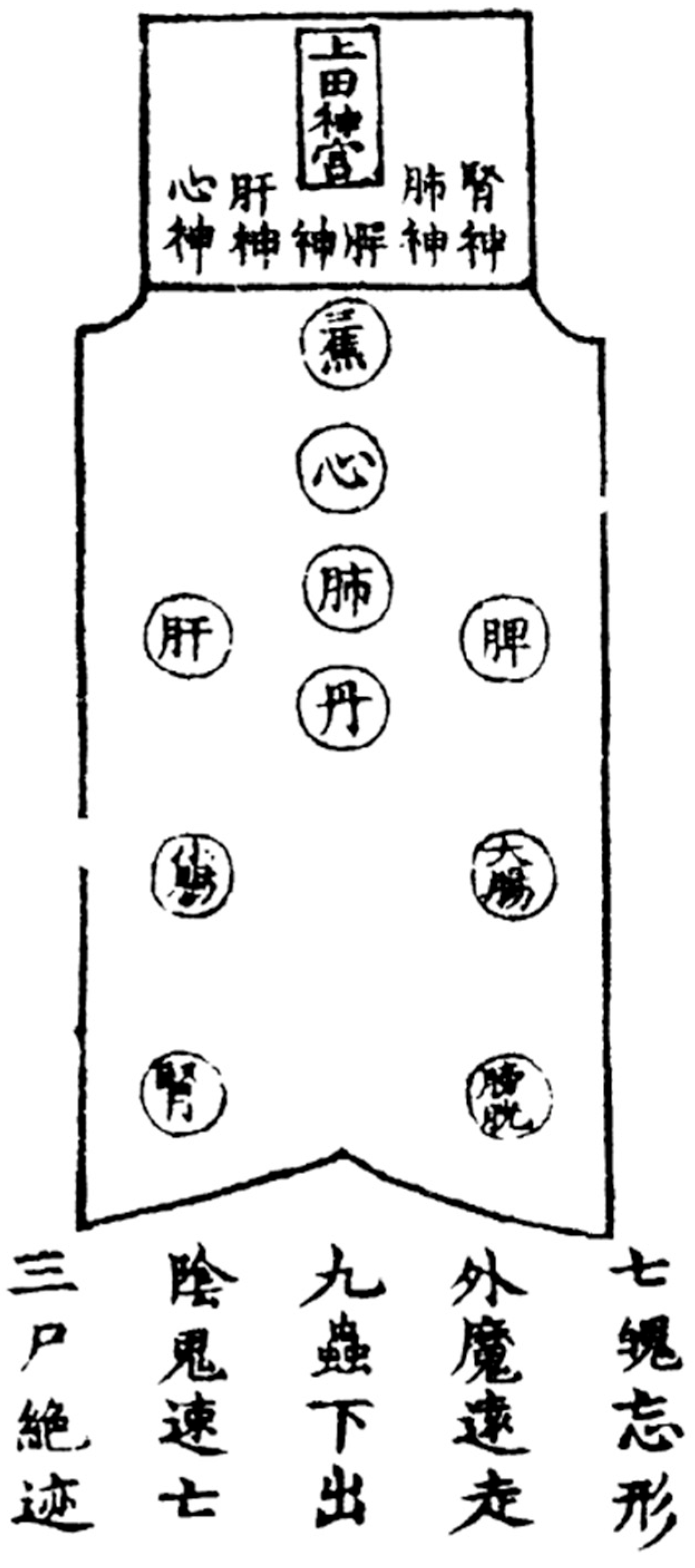
Additionally, the Dadan Zhizhi includes an illustration titled “Diagram of Internal Observation, Igniting Fire, Refining Spirit, and Uniting with the Dao” (Neiguan qihuo lianxing hedao tu) 內觀起火煉神合道圖 which symbolically depicts the elimination of the Sanshi through spiritual visualization (see Figure 12). Named after “Refining Spirit and Uniting with the Dao” (lianshen Hedao 煉神合道)—a realm of Neidan practice—the diagram indicates its role in spiritual cultivation. In the center, texts label the five zang-organs (Wuzhang 五臟) and three jiaos (Sanjiao 三焦), small intestine, and large intestine of the six fu-organs (Liufu 六腑), with “Elixir” (Dan 丹) marked at the core. The upper section is labeled “Divine Palace” (Shengong 神宮) along with “Heart Spirit” (Xinsheng 心神) and the spirits of the Wuzhang. The lower section contains the inscriptions: “The Qipo lose their form; external demons flee far; the Jiuchong exit downward; yin ghosts perish swiftly; the Sanshi vanish without a trace.” 七魄忘形,外魔遠走,九蟲下出,陰鬼速亡,三屍絕跡. This expresses how refining the spirits of the Wuzhang through internal elixir fire dispels physical and spiritual destructive factors such as yin demons, the Sanshi, and the Jiuchong from the human body.
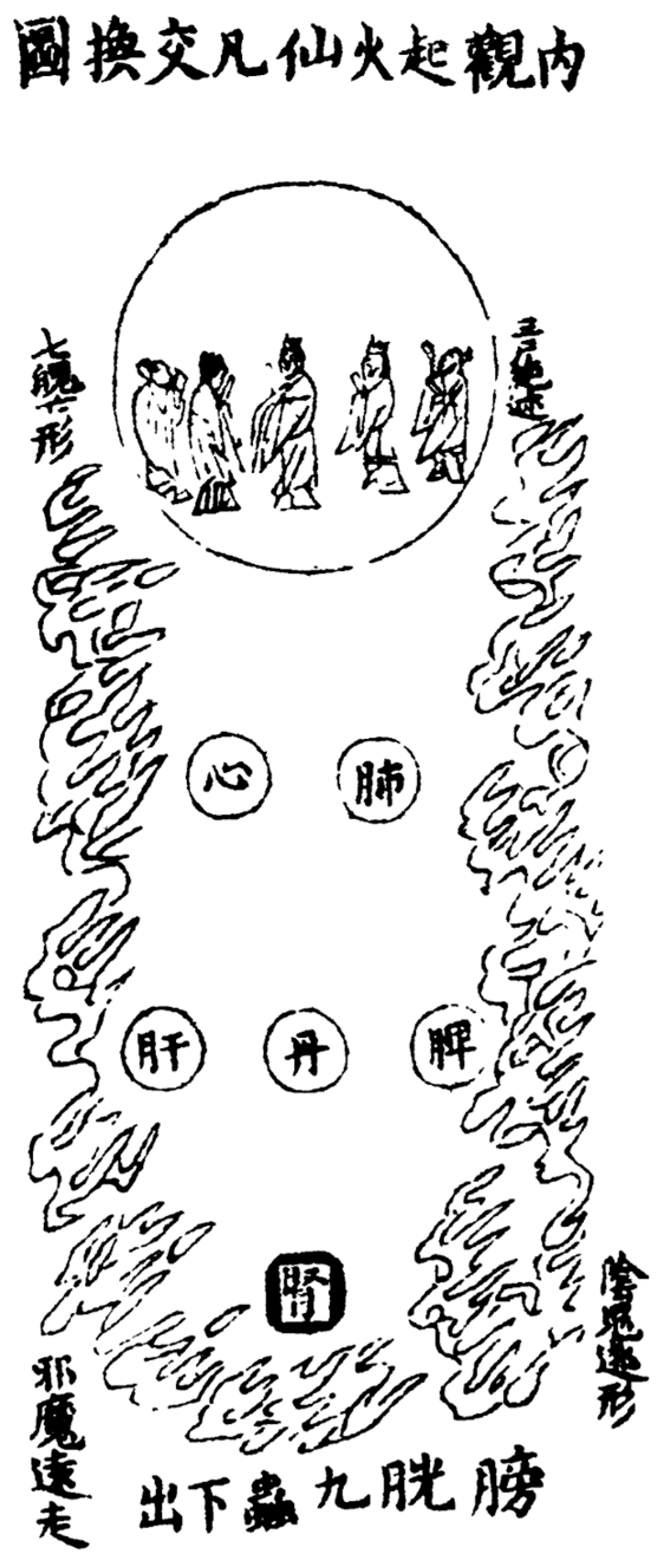
Another Neidan atlas likely dating to the Song-Yuan period, Xiuzhen Taiji Hunyuan Zhixuan Tu 修真太極混元指玄圖 (Mysterious Diagram of Cultivating Truth, Taiji, and Primordial Chaos), includes the “Diagram of Neidan Fire Ignition and the Transformation Between Immortal and Mortal,” (Neidan qihuo xianfan jiaohuan Tu 內丹起火仙凡交換圖) which conveys the same theme of eliminating the Sanshi through the imagery of visualized flames as Qiu Chuji 邱處機’s diagram (see Figure 13). More vivid and detailed than Qiu’s work, this diagram features the character “Elixir” (Dan 丹) and the Wuzhang in the center, surrounded by flame motifs. Divine figures are painted in the upper section, accompanied by annotations: “The Sanshi vanish without a trace 三屍絕跡” and “The Qipo conceal their forms.” 七魄匿形 The lower section includes annotations: “Yin ghost (Yingui 陰鬼) hide their shapes” 陰鬼遁形 and “Demons (Xiemo 邪魔) flee far,” 邪魔遠走 with the bottom inscription “The Jiuchong exit downward by the bladder” 膀胱九蟲下出. Supplementary scriptures alongside the image state that visualizing the internal elixir fire can dispel various internal and external demonic obstacles in Neidan practice, such as the Sanshi, Qipo, and Jiuchong.

5.2. Eliminating the Sanshi Through Inner-Nature Cultivation

In addition to the aforementioned meditation techniques for eliminating the Sanshi, another approach found in Neidan texts is self-cultivation of inner-nature. For example, Bai Yuchan 白玉蟾, another key representative of the Jingdan Pai nanzong, claimed in his Neidan formulas that the Sanshi could be dispelled through self-cultivation rather than taking elixirs or visualization. In his Yinyang Shengjiang Lun 陰陽升降論 (Treatise on the Rise and Fall of Yin and Yang), Bai Yuchan stated: “If one can focus the mind on guarding it without distraction, true essence will naturally assemble, primal Qi will naturally converge, the Valley Spirit will naturally connect, the Sanshi will naturally depart, and the Jiuchong will naturally perish—this is the path to longevity and eternal vision.” 人能一意守之而不散,則真精自朝,元黑自聚,穀神自接,三屍自去,九蟲自滅,此乃長生久視之道也 (Daozang 1988, vol. 4, p. 625). He further noted: “If one can achieve a mind without thoughts, a thought without clinging, pure and unblemished—this is called pure yang (chunyang 純陽). At this moment, the Sanshi are eliminated, and the Six Thieves beg (liuzei 六賊) for surrender.” 人但能心中無心,念中無念,純清絕點,謂之純陽。當此之時,三屍消滅,六賊乞降 (Daozang 1988, vol. 4, p. 625). Bai Yuchan 白玉蟾 argued that eliminating the Sanshi could be achieved through ascetic self-cultivation. His perspective aligns with the allegory Meng Sanshi Shuo mentioned earlier, which advocates restraining the Sanshi through self-regulation of inner-nature.
Comparing these two approaches to removing the Sanshi reveals differing understandings of the relationship between the Sanshi and the practitioner: One views the Sanshi as entirely external, heterogeneous destructive factors, advocating the use of spiritual confrontation techniques such as visualizing elixir fire to dispel and eradicate them. The other considers the influence of the Sanshi within the framework of human nature, arguing that their destructive power is manifested through human inner-nature. Thus, eliminating the Sanshi does not entail a spiritual confrontation between the practitioner and the Demons; instead, it emphasizes cultivating a Daoist ascetic inner-nature through practices such as tranquility, desirelessness, non-thinking, and returning to primal unity. This latter approach reflects a closer understanding of the connection between the Sanshi and human inner-nature, while also returning to the Daoist principle of selfless non-action advocated in the Daode Jing 道德經 which said “Can one embrace the soul (Ying 營) and essence (Po 魄), holding fast to the One, without separation? Can one concentrate vital energy to attain gentleness, like an infant? Can one purify the profound insight, remaining unblemished?”. 載營魄抱一,能無離乎?專氣致柔,能如嬰兒乎?滌除玄覽,能無疵乎? (Lou 2008). It demonstrates a divergence in anthropological understanding compared to the confrontational visualization method for eliminating the Sanshi.

6. Conclusions

This study conducts a comprehensive investigation of the texts and images related to the Sanshi in Daoism, primarily from the perspective of Neidan studies. It argues that the Daoist concept of the Sanshi is a religious embodiment of negative spiritual factors: on one hand, it corresponds to the Jiuchong—destructive factors of the physical body; on the other hand, it relates to the Qipo—inherent negative spiritual elements. The formation of this concept may be linked to the Shixiang in the Shanhai Jing, while its iconography likely derives from the prevalent motif of one-legged disease- or death-inducing demons in ancient China. Based on different theoretical understandings of the relationship between the Sanshi and human nature, two main approaches to addressing the Sanshi emerged in Neidan: the confrontational path of spiritual visualization (through internal observation and igniting fire) and the self-cultivation path of inner-nature refinement. In summary, within Neidan, the Sanshi centrally embody the dimension of spiritual cultivation, while also encompassing Daoist understandings of the mind–body relationship and human nature.

Funding

This research was funded by National Social Science Fund of China, grant number 23XZX006.

Institutional Review Board Statement

Not applicable.

Informed Consent Statement

Not applicable.

Data Availability Statement

No new data were created or analyzed in this study. Data sharing is not applicable to this article.

Acknowledgments

I would like to express my gratitude to Liu Yongming 劉永明 from the School of History and Culture, Lanzhou University, and Lu Min 路旻 from the School of Philosophy and Social Sciences, Northwest Normal University, for their valuable assistance and suggestions during the completion of this article.

Conflicts of Interest

The author declares no conflicts of interest.

Notes

1
In the book edited by Stephen Little and Shawn Eichman, Taoism and the Arts of China, when discussing this painting, the authors identified the three deities on the left as the Three souls (Sanhun 三魂). However, based on their iconographic characteristics, a more accurate conclusion should be that they are the Three Corpses (Sanshi 三屍). (Little and Eichman 2001).
2
The original text of Taiping Jing (The Scripture of Great Peace) has been lost. The passages cited in this book are taken from Mr. Wang Ming 王明’s Collated Text of the Taiping Jing, which was compiled and emended on the basis of Taiping Jing Chao 太平經鈔 (Excerpts from the Scripture of Great Peace) included in the Daozang, combined with quotations from Taiping Jing preserved in other ancient texts.
3
To make it easier to understand, here I have converted the ancient Chinese expressions for units of length into the modern metrics of centimeters.
4
In the Zhubing yuanhou Lun Xiaozhu (Proofreading & Interpretation of Treatise on the Origin of Diseases) edited by Ding Guangdi, it is believed that the Fu Chong 伏虫 referred to here may refer to the hookworm in modern medicine, the Bai Chong (white worm 白虫) corresponds to the tapeworm, and Chi Chong (red worm 赤虫) may correspond to the ginger worm. (Ding 2013, p. 370).

References

  1. Arthur, Shawn. 2013. Early Daoist Dietary Practices: Examining Ways to Health and Longevity. Lexington: Lexington Books, p. 79. [Google Scholar]
  2. Chen, Wen, and Xiaoxing Zhang. 2025. The Verifiability of Daoist Somatic Mystical Experience. Ergo: An Open Access Journal of Philosophy 12: 671–699. [Google Scholar] [CrossRef]
  3. Cheng, Lesong 程樂松. 2017. Shenti Bushi He Shenmizhuyi 身體不死與神秘主義 [Body, Immortality and Mysticism]. Beijing: Peking University Press, p. 144. [Google Scholar]
  4. Daozang 道藏 [Daoist Canon]. 1988. Beijing: Cultural Relics Press. Shanghai: Shanghai Bookstore Publishing House. Tianjin: Ancient Books Publishing House.
  5. Dazhengzang 大正藏 [Taishō Canon]. 1990. Taipei: New Culture Publishing Co., Ltd.
  6. Despeux, Catherine. 2012. Taoism and Self-Knowledge: The Chart for the Cultivation of Perfection (Xiuzhen Tu). Translated by Jonathan Pettit. Leiden and Boston: Brill, pp. 11–29. [Google Scholar]
  7. Ding, Guangdi 丁光迪, ed. 2013a. Zhubing yuanhou Lun Xiaozhu 諸病源流論校注 [Collated and Annotated Treatise on the Etiology and Symptoms of Diseases]. Beijing: People’s Health Publishing House, p. 352, 370. [Google Scholar]
  8. Gai, Jianmin 蓋建民. 2001. Daojiao Yixue 道教醫學 [Daoist Medicine]. Beijing: Religious Culture Press, p. 281. [Google Scholar]
  9. He, Zhiguo 何志國. 1988. Sichuan Mianyang Yangjia Songmu 四川綿陽楊家宋墓 [Song Tomb by the Yang Family in Mianyang, Sichuan]. Kaogu yu wenwu 考古與文物 1: 69–72. [Google Scholar]
  10. Hu, Wenhuan 胡文煥. c. 1558–c. 1617. Shanhaijing Tu 海經圖 [Illustrations of the Classic of Mountains and Seas]. Beijing: National Library of China. [Google Scholar]
  11. Huang, Shih-shan Susan. 2011. Daoist Imagery of Body and Cosmos, Part 2: Body Worms and Internal Alchemy. Journal of Daoist Studies 4: 32–62. [Google Scholar] [CrossRef]
  12. Huang, Shih-shan Susan. 2012. Picturing the True Form: Daoist Visual Culture in Traditional China. Cambridge and London: Harvard University Press, pp. 52–58. [Google Scholar]
  13. Huang, Yongfeng 黃永鋒. 2008. Daojiao Fushi Jishu Yanjiu 道教服食技術研究 [A Study on Taoist Food and Elixir Techniques]. Beijing: Oriental Press, pp. 88–93. [Google Scholar]
  14. Jiang, Sheng 薑生. 2010. Daojiao He Zhongguo Gudai Jishengchongxue 道教和中國古代寄生蟲學 [Daoism and Ancient Chinese Parasitology]. Sichuan Daxue Xuebao 四川大學學報 4: 57–64. [Google Scholar]
  15. Jiang, Shoucheng 薑守誠. 2008. A Preliminary Study on the Worm Disease Theory in the Taiping Jing <太平經> 的蟲病理論初探. Journal of Liaoning Medical University 遼寧醫學院學報 4: 43–48. [Google Scholar]
  16. Lin, FuShi 林富士. 2001. Jibing Zhongjiezhe Zhongguo Zaoqi De Daojiao Yixue 疾病終結者:中國早期的道教醫學 [The Terminator of Diseases: Early Chinese Taoist Medicine]. Taipei: Sanmin Book Company 三民書局, pp. 72–74. [Google Scholar]
  17. Little, Stephen, and Shawn Eichman. 2001. Taoism and the Arts of China. Chicago: The Art Institute of Chicago, p. 345. [Google Scholar]
  18. Liu, Tsun-Yan. 1971. The Taoist’s Knowledge of Tuberculosis in the Twelfth Century. T’oung Pao 57: 285–301. [Google Scholar] [CrossRef]
  19. Long, Meizi 龍眉子. fl. 1208–1224. Jinye Huandan Yinzheng Tu 金液還丹印證圖 [Verification Diagrams of the Golden Elixir and Reverted Cinnabar Tu], Re-painted edition from Qing Dynasty, Preserved at White Cloud Temple 白雲觀 in Beijing.
  20. Lou, Yulie 樓宇烈. 2008. Laozi Daodejing Jiaoshi 老子道德經校釋 [Collated and Annotated Laozi Daode Jing]. Beijing: Zhonghua Book Company, pp. 22–23. [Google Scholar]
  21. Lu, Sun. 2024. A Brief Exploration of the Daoist Personality Shadow. Advances in Education, Humanities and Social Science Research 12: 854–860. [Google Scholar] [CrossRef]
  22. Luan, Baoqun 欒保群. 2019. Shanhaijing Xiangzhu 山海經詳注 [Detailed Annotations on the Shanhai Jing]. Beijing: Zhonghua Book Company, pp. 476, 601. [Google Scholar]
  23. Ma, Changyi 馬昌儀. 2022. Guben Shanhaijing Tushuo 古本山海經圖說 [Illustrated Notes on Ancient Versions of the Shanhai Jing]. Shanghai: SDX Joint Publishing Company, p. 838. [Google Scholar]
  24. Needham, Joseph. 2011. Science and Civilisation in China. Vol. 5: Chemistry and Chemical Technology, Part 5: Spagyrical Discovery and Invention: Physiological Alchemy. Beijing: Science Press, Shanghai: Shanghai Classical Publishing House, p. 98. [Google Scholar]
  25. Ohanami, Heiroku 小花波平六. 1988. Kōshin Shinkō 庚申信仰 [Gengshen Belief]. Tokyo: Yūzankaku, pp. 344–65. [Google Scholar]
  26. Wang, Chong 王充. 1974. Lunheng 論衡 [Balanced Discourses]. Shanghai: Shanghai People’s Publishing House, p. 253. [Google Scholar]
  27. Wang, Guiping 汪桂平. 2012. Jiangzhe Minjian De Gengshenjing He Gengshen Hui 江浙民間的 <庚申經> 與庚申會 [The Folk Gengshen Scripture and Gengshen Associations in Jiangsu and Zhejiang]. Studies in World Religions 世界宗教研究 1: 96–108. [Google Scholar]
  28. Wang, Ming 王明. 1960. A Collated Edition of the Taiping Jing 太平經合校. Beijing: Zhonghua Book Company, p. 27. [Google Scholar]
  29. Wang, Ming 王明. 1983. Baopuzi Neipian Jiaoshi 抱樸子內篇校釋 [Collated and Annotated Inner Chapters of the Baopuzi]. Beijing: Zhonghua Book Company, p. 125. [Google Scholar]
  30. Xu, Sheng 許慎. 1963. Shuowen Jiezi Zhu 說文解字 [Explaining Simple and Analyzing Compound Characters with Annotations]. Annotated by Duan Yucai 段玉裁. Shanghai: Shanghai Chinese Classics Publishing House, p. 400. [Google Scholar]
  31. Xu, Yilan 許宜蘭. 2015. Daojing Tuxiang Yanjiu 道經圖像研究 [A Study on Taoist Scripture Images]. Chengdu: Bashu Book Company, p. 186. [Google Scholar]
  32. Yamada, Toshiaki. 1989. Taoist Meditation and Longevity Techniques. In Michigan Monographs in Chinese Studies. Edited by Livia Kohn. Ann Arbor: University of Michigan Center for Chinese Studies, vol. 61, p. 110. [Google Scholar]
  33. Yasui, Kōzan 安居香山, and Akira Nakamura 中村璋八, eds. 1994. Weishu Jicheng 緯書集成 [A Comprehensive Collection of Apocryphal Texts]. Shijiazhuang: Hebei People’s Publishing House, p. 1196. [Google Scholar]
  34. Yin, Zhen Gaodi 尹真高弟. 2012. Xingming Guizhi 性命圭旨 [Essentials of Life and Inner-Nature]. Beijing: Central Compilation & Translation Press, p. 47. [Google Scholar]
  35. Yin, Zhihua 尹志華. 2023. Lun Daojiao Shentiguan De Erchongxing 論道教身體觀的二重性 [On the Duality of Taoist Body Concept]. Studies in World Religions 世界宗教研究 7: 55–65. [Google Scholar]
  36. Yoshimoto, Akiharu 吉元昭治. 1992. Daojiao Yu Bulao Changshou Yixue 道教與不老長壽醫學 [Daoism and the Medicine of Immortality and Longevity]. Translated by Yang Yu 楊宇. Chengdu: Chengdu Publishing House, p. 272. [Google Scholar]
  37. Zhang, Xunliao 張勳燎, and Bai Bin 白斌. 2006. Zhongguo Daojiao Kaogu 中國道教考古 [Archaeological Research on Daoism in China]. Beijing: Thread-Bound Book Press, pp. 1272–83. [Google Scholar]
  38. Zhonghua Daozang 中華道藏 [Chinese Daoist Canon]. 2004. Beijing: Huaxia Publishing Company.
Figure 1. The Sanshi in the Verification Diagrams of the Golden Elixir and Reverted Cinnabar tu (Long fl. 1208–1224).
Religions 17 00016 g001
Figure 2. The Sanshi in Taishang Chu Sanshi Jiuchong Baosheng Jing (Daozang 1988, vol. 18, p. 699).
Religions 17 00016 g002
Figure 3. The Sanshi in Yan Luozi Chaozhen Tu (Daozang 1988, vol. 4, p. 690). This image was locally magnified to facilitate more distinct recognition of its elements.
Religions 17 00016 g003
Figure 4. The Sanshi in Annotated and Illustrated Commentary on the Nanjing by Huangdi (Daozang 1988, vol. 21, p. 595). This image was locally magnified to facilitate more distinct recognition of its elements.
Religions 17 00016 g004
Figure 5. The Single-Legged, Beast-Headed Sculpture from the Song Dynasty Tomb in Mianyang (He 1988).
Religions 17 00016 g005
Figure 6. The Disease Ghost in Binggui Wang Tu (Dazhengzang 1990, vol. 21, p. 456).
Religions 17 00016 g006
Figure 7. The Kuiniu as depicted in Shanhai Jing Tu (Hu c. 1558–c. 1617).
Religions 17 00016 g007
Figure 8. The Jiuchong in Taishang Chu Sanshi Jiuchong Baosheng Jing (Daozang 1988, vol. 18, pp. 700–1).
Religions 17 00016 g008
Figure 9. The Qipo in Taishang Chu Sanshi Jiuchong Baosheng Jing (Daozang 1988, vol. 18, p. 698).
Religions 17 00016 g009
Figure 10. The Hun and Po Tu in Xingming Guizhi (Z. G. Yin 2012).
Religions 17 00016 g010
Figure 11. The Shanhun tu in Taishang Chu Sanshi Jiuchong Baosheng Jing (Daozang 1988, vol. 18, p. 697).
Religions 17 00016 g011
Figure 12. The Shanshi in Neiguan qihuo lianxing hedao tu (from Dadan Zhizhi) (Daozang 1988, vol. 4, p. 399).
Religions 17 00016 g012
Figure 13. The Neidan qihuo xianfan jiaohuan Tu (from Xiuzhen Taiji Hunyuan Zhixuan Tu) (Daozang 1988, vol. 3, p. 102).
Religions 17 00016 g013
Disclaimer/Publisher’s Note: The statements, opinions and data contained in all publications are solely those of the individual author(s) and contributor(s) and not of MDPI and/or the editor(s). MDPI and/or the editor(s) disclaim responsibility for any injury to people or property resulting from any ideas, methods, instructions or products referred to in the content.