


Kṛṣṇanāṭṭam Performance: Kṛṣṇa Devotion, Ritual Ecology, and Colonial Transformation in South India

Abstract
1. Introduction: Kṛṣṇanāṭṭam as Ritual and Political Practice
2. Critical Questions and Contemporary Paradoxes
3. Historical and Cultural Context of Kṛṣṇanāṭṭam: Sovereignty, Devotion, and Patronage in 17th-Century Kerala
3.1. Bhakti, Kingship, and the Ritual Synthesis of Kṛṣṇanāṭṭam

| Episode | Narrative Focus | Political Allegory |
|---|---|---|
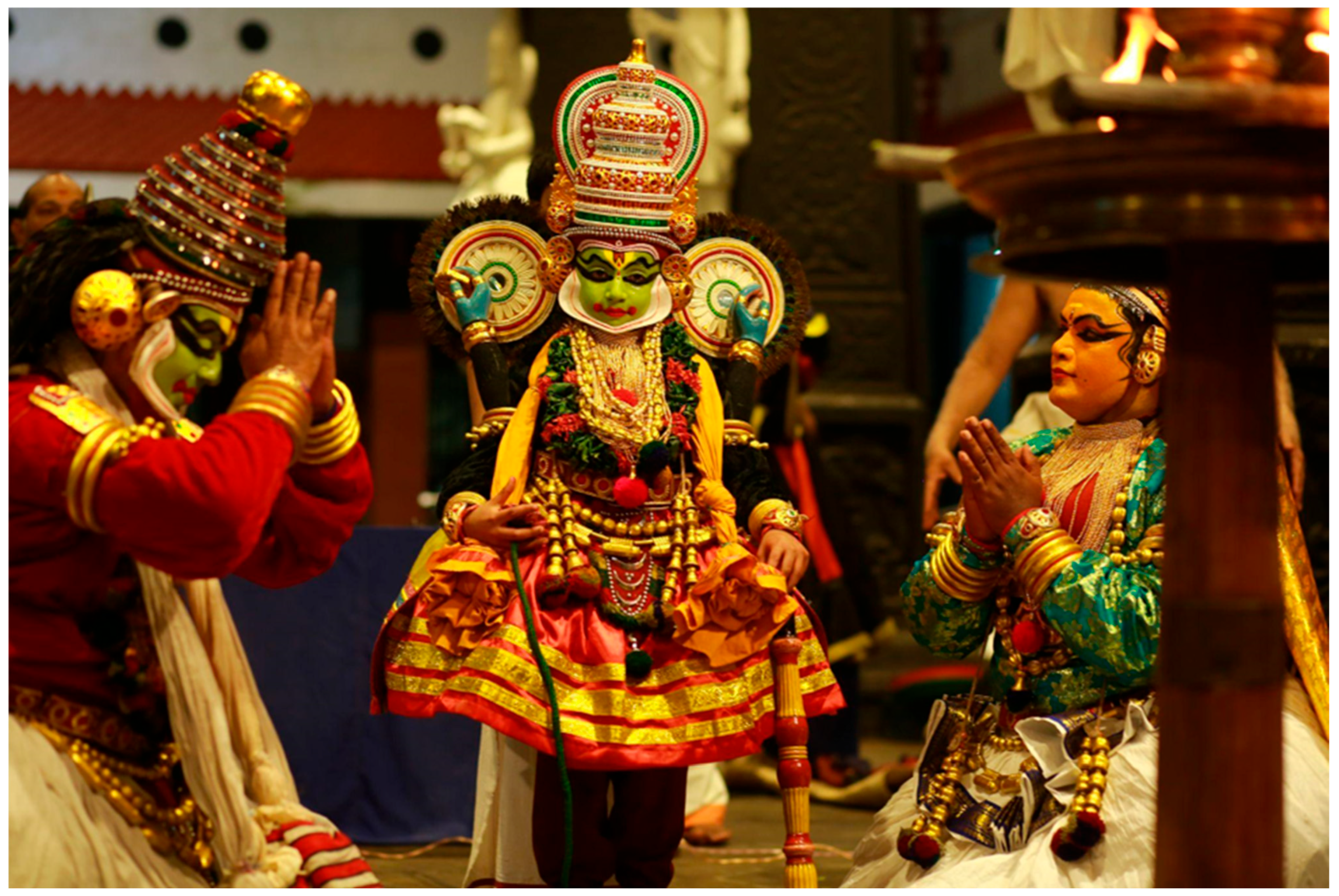
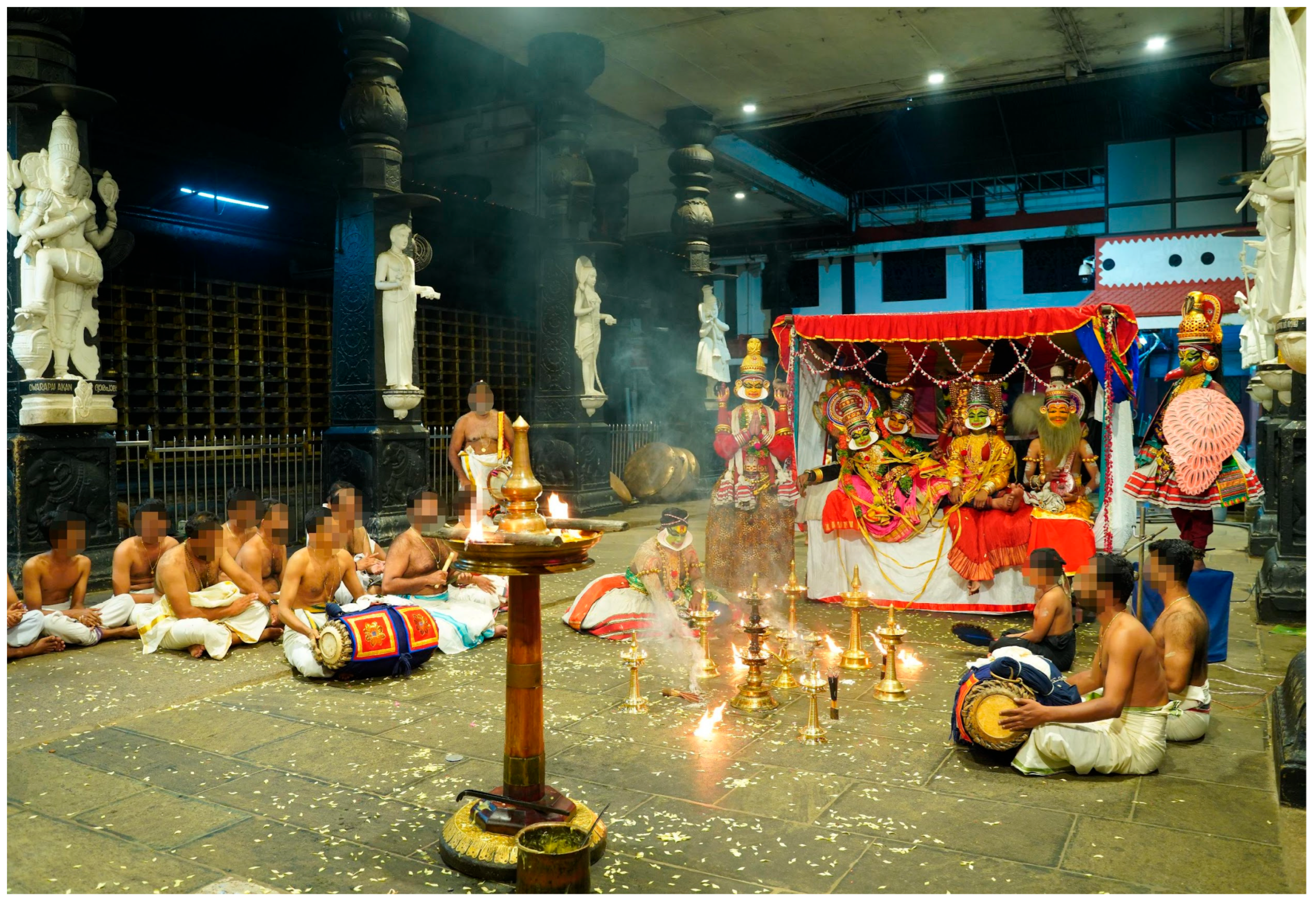
| Avatāram | Kṛṣṇa’s birth amid tyranny (See Figure 1) | Divine sanction for Zamorin’s rule |
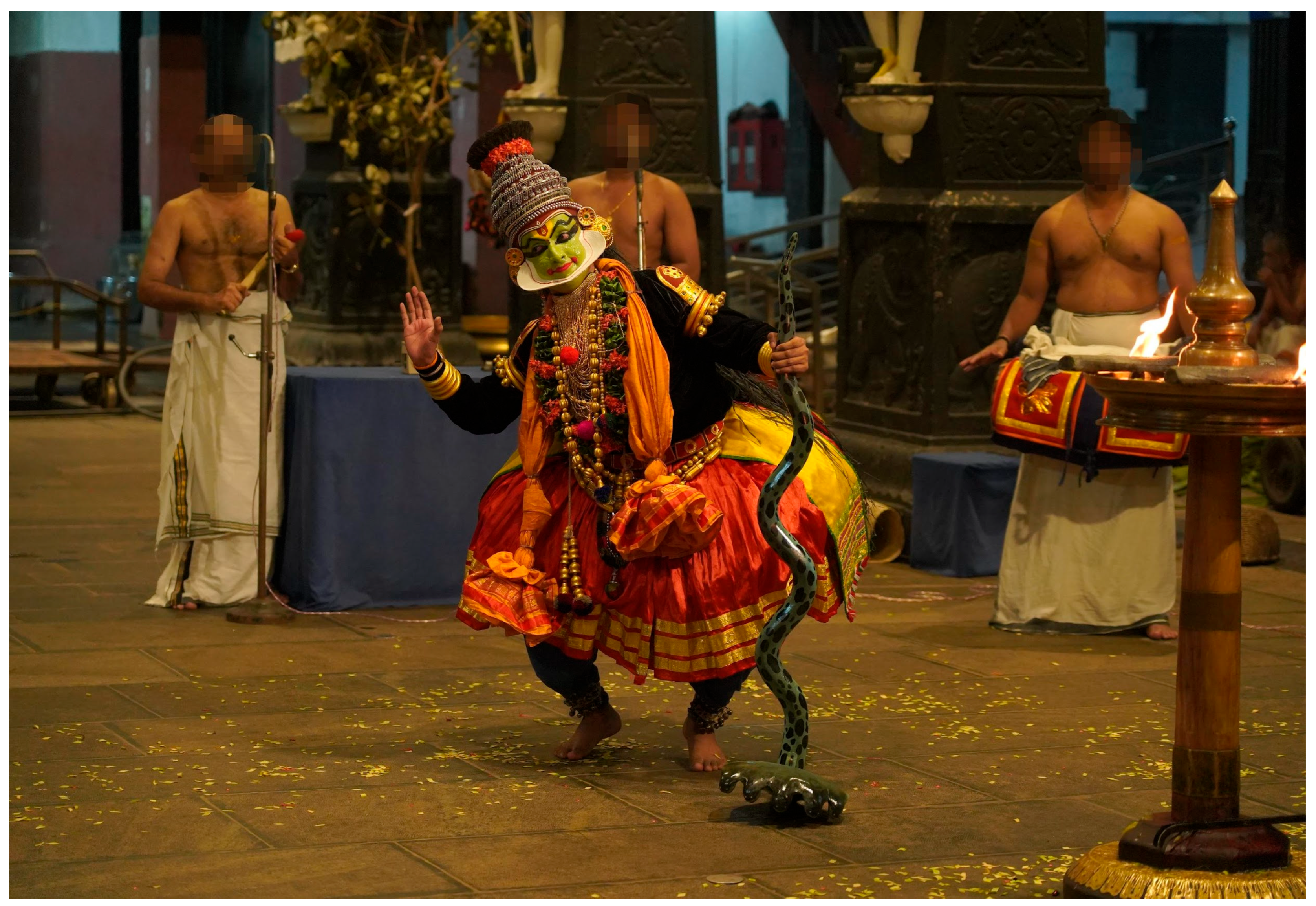
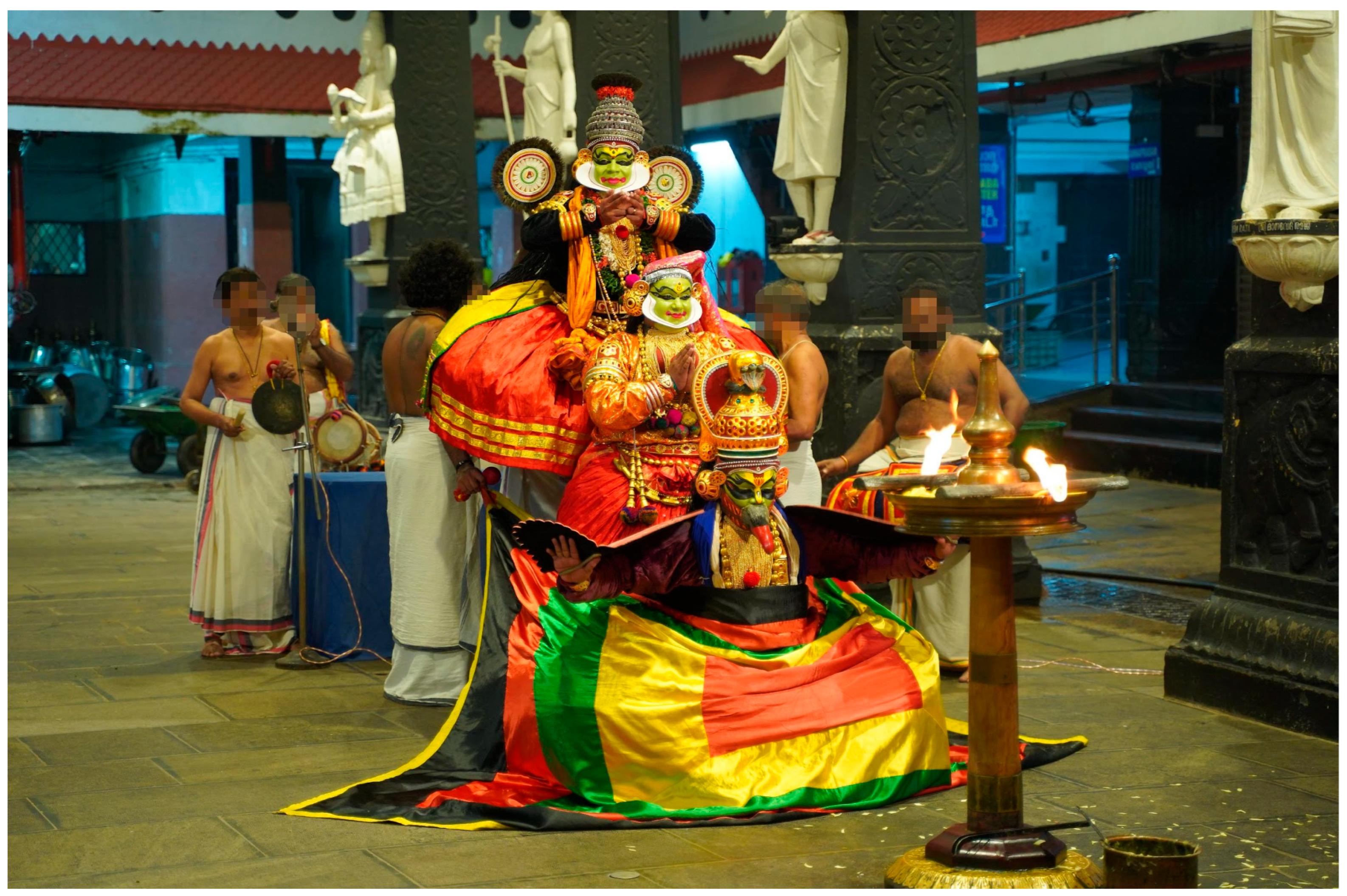
| Kaliya Mardhanam | Slaying the serpent Kāliya (See Figure 2) | King as destroyer of chaos |
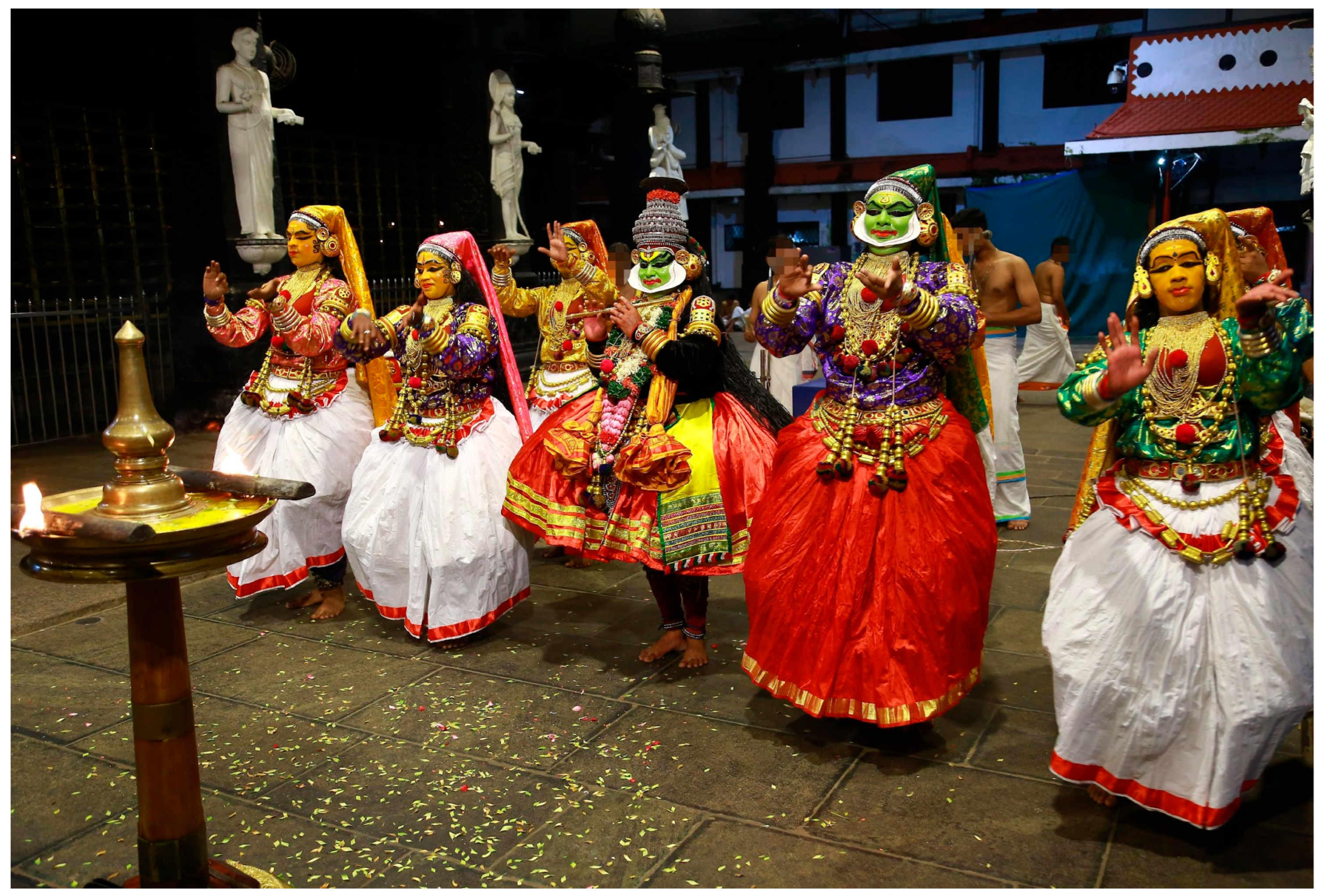
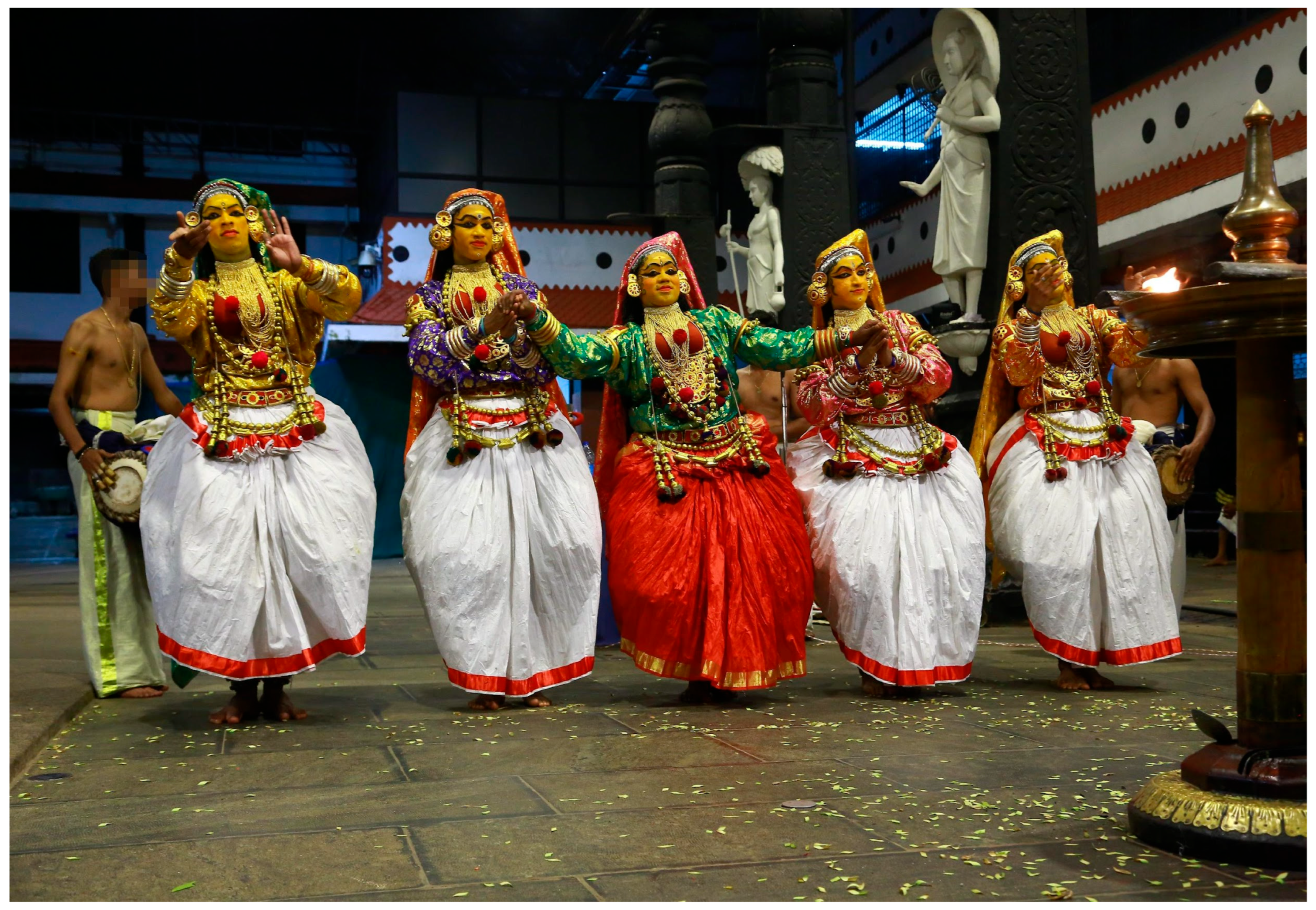
| Rāsakrīḍa | Dance with gopikas (See Figure 3) | Harmony under royal patronage |
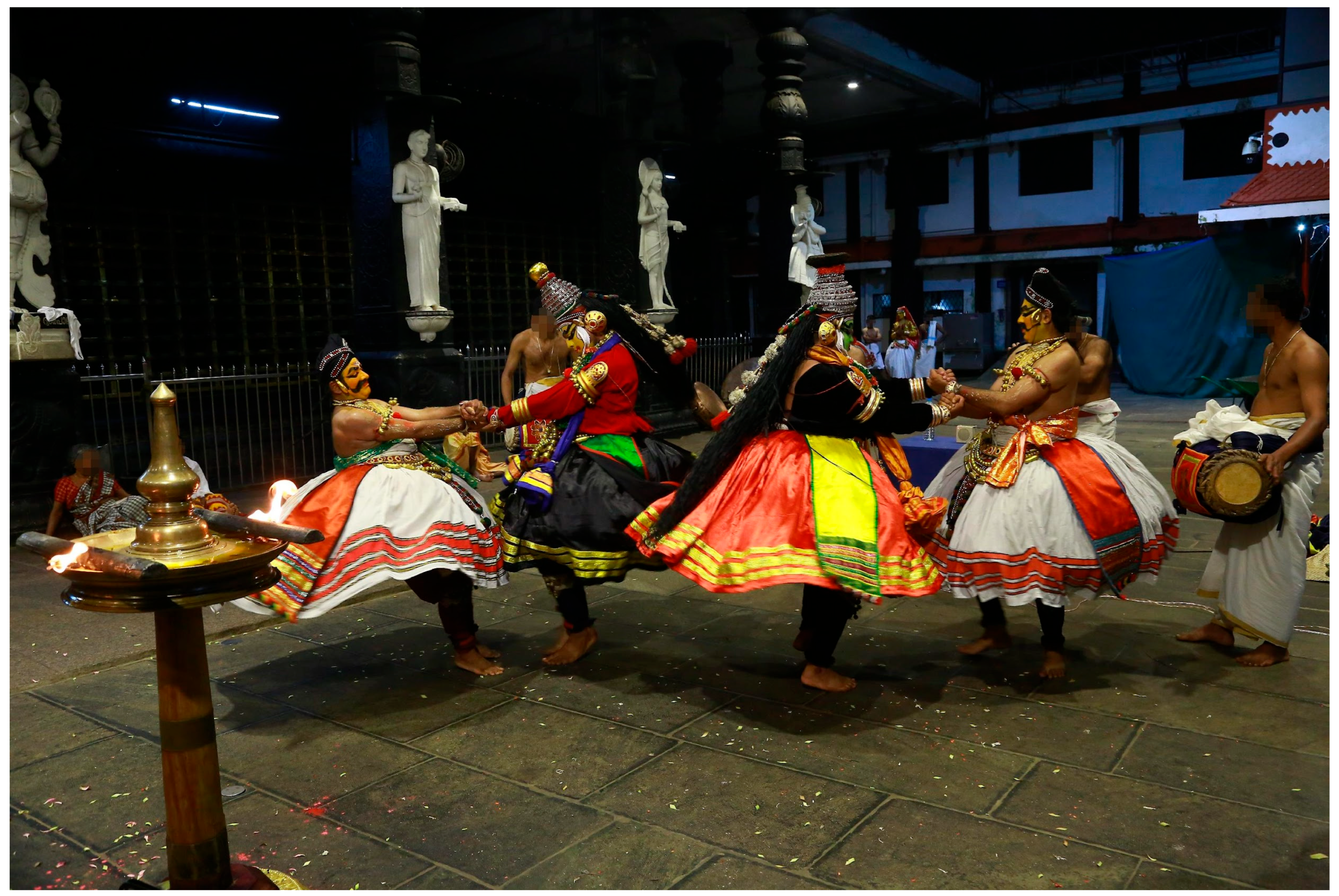
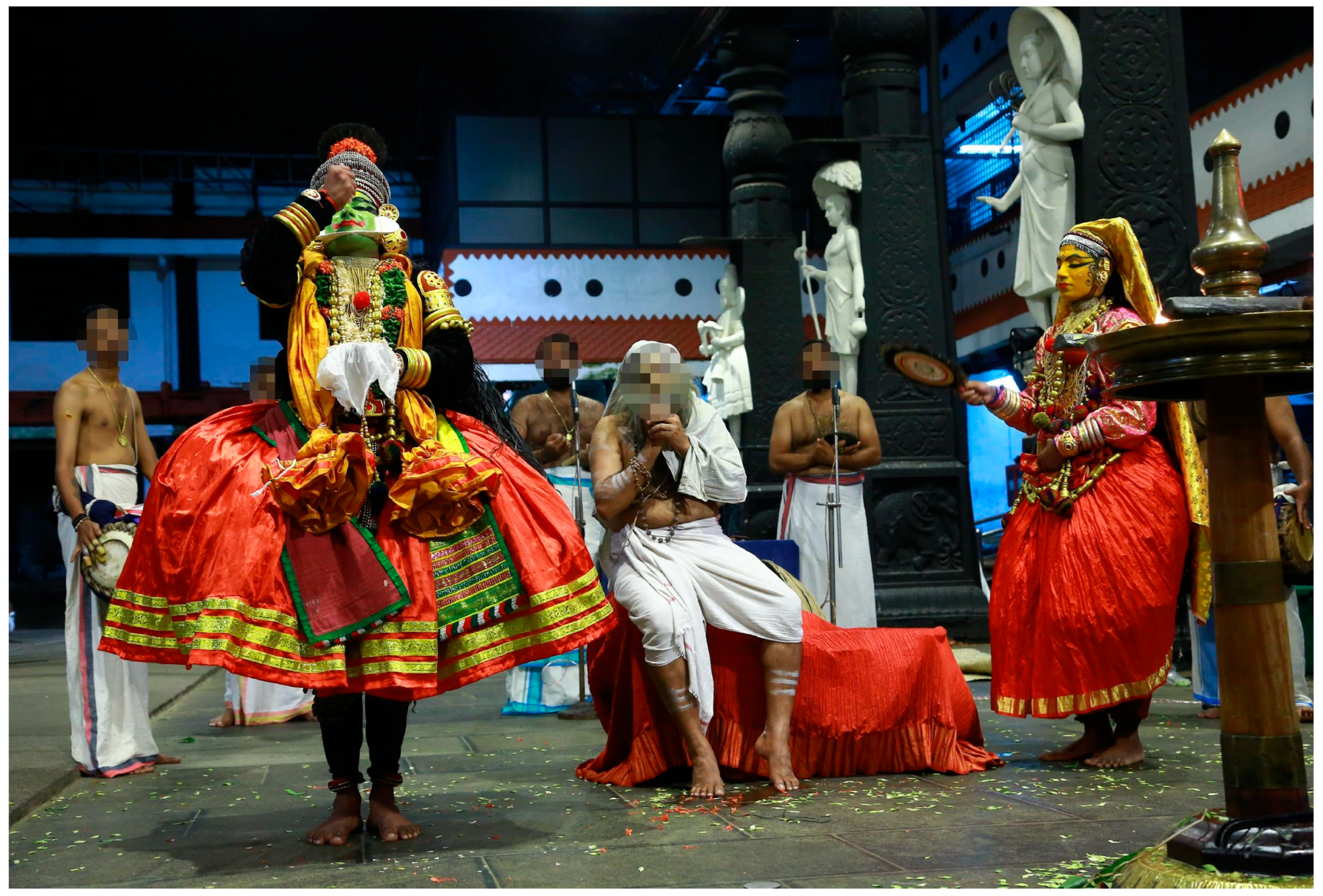
| Kaṃsavadham | Killing the tyrant Kaṃsa (See Figure 4) | Defeat of rival powers (e.g., Travancore) |
| Swayaṃvaram | Marriage to Rukmiṇī and Sathyābhāmā (See Figure 5) | Royal alliances through matrimony |
| Bāṇayuddham | Battle against the demon Bāṇa (See Figure 6) | Defense of kingdom |
| Vividha Vadham | Annihilation of Vividha (minister-turned-demon) (See Figure 7) | Punishment of treason |
| Svargārohaṇam | Kṛṣṇa’s ascension → Avatāram reprised (See Figure 8 and Figure 9) | Cyclical renewal of kingship |
3.2. Temple, Caste and Ritual Sovereignty in Medieval Kerala
3.3. Political Catalysts: Warfare, Colonialism, and Ritual Legitimation
4. Aesthetic and Performative Elements of Kṛṣṇanāṭṭam: Negotiating Sanskritization, Vernacularity, and Colonial Disruption
4.1. Sanskritic Cosmopolitanism and Vernacular Substrata: A Contested Synthesis
4.2. Ritual Aesthetics in the Sacred Space: Syncretism Under Siege
- Music: The ensemble śuddha maddaḷam (Temple drum for rhythm), edakka (Hourglass drum for melody), śaṅkhu (conch shell for divine fanfare) employed softer timbres than Kathakali’s chenda (Cylindrical drum), preserving temple sanctity (Zarrilli 2000, p. 78). The Sopāna vocal style, with its cascading melodies, embodied vernacular devotion within the Sanskrit framework.
- Movement: Choreography fused kūṭiyāṭṭam mudras with the kinetic energy of kalarippayattu10, especially in battle scenes like bāṇayuddham (Zarrilli 2000, p. 78). Circular, flowing patterns contrasted with Kathakali’s angularity, reflecting a distinct temple-based aesthetic.
- Visual Theology: The unmasked Kṛṣṇa, adorned with peacock feathers and gold-bordered kasavu11, signified transcendent divinity. In stark contrast, the ritually consecrated, oversized demon kolams (Isacco and Dallapiccola 1982, p. 67), crafted by subaltern artisans, materialized evil as chaotic and “other.” The use of pacha (green) for kings and queens established visual codes later adopted by Kathakali. Colonial intervention profoundly disrupted this ecology. The kūttampalam’s transformation from a ritually charged mandala12 into a managed “heritage site” under colonial (and later Devaswom Board) administration severed the art from the integrated political and economic framework of its original sacral purpose. The introduction of ticketed performances for colonial elites (Seth 2010, p. 158) initiated a process of commodification that introduced a new mode of spectatorship alongside the enduring practice of devotional darshan. This shift began to erode the exclusive immersive experience for which the aesthetics were originally calibrated, even as the performance’s core identity as a ritual offering (vazhipadu) was preserved within the temple’s own kūttampalam.
4.3. Kathakali’s Vernacular Turn: Colonial Catalysis and Caste Continuities
5. The Architecture of Exclusion: Caste, Space, and Performance in Kṛṣṇanāṭṭam
5.1. Hereditary Privilege and Ritual Purity: Casting the Divine and the Demonic
5.2. Spatializing Caste Hierarchy: The Kūttampalam as Enforced Boundary
6. Colonial Intervention and Ritual Non-Interference: The Bifurcated Strategy in Guruvayur
“… if at any time any action needs to be taken concerning the wealth [of the temple], it must be done together with and with the knowledge of us, Mallisseri.”“The treasury and accounting records must be kept securely as before by the samudaya15 manager and the accountant, under the custody of both them and Mallisseri. The method for withdrawing money from the treasury shall be done with the knowledge of all, but the accounting records can be fetched and examined by the manager and the accountant alone.”(Register No. 52, Sl. No. 54. 1854. Malayalam Manuscript, RAK)
6.1. Colonial Rupture: Dismantling the Ritual Ecology
6.2. Spatial Transformation and the Seeds of Commodification
7. The Contradictions of Revival: Colonial Legacies and Caste in Postcolonial Kṛṣṇanāṭṭam
8. Conclusions: Ritual Rebirth, Colonial Shadows, and the Unfinished Decolonization of Kṛṣṇanāṭṭam
Author Contributions
Funding
Institutional Review Board Statement
Informed Consent Statement
Data Availability Statement
Acknowledgments
Conflicts of Interest
| 1 | The Zamorin (Malayalam: Sāmūtiri; anglicized from Portuguese Samorim) of Kozhikode (Calicut) was the hereditary title of the Hindu sovereigns who ruled the medieval Kingdom of Kozhikode on the Malabar Coast. The dynasty, which exercised authority from approximately the 12th to the 18th century CE, established its capital at the port city of Kozhikode, transforming it into a preeminent hub of Indian Ocean commerce. The origins of the Zamorin lineage are traced to the chiefs of Eranāḍu (Eranad), a land-locked chiefdom situated in the region of present-day Malappuram district. Their initial political base was at Nediyiruppu in Kondotty. It was from this position that the Eraḍi (ruler of Eranāḍu) gradually expanded his territory, culminating in the foundation of Kozhikode and the subsequent development of its port. Through strategic acumen and control over the lucrative spice trade, this lineage, which thereafter became known as the Zamorin, ascended to become one of the most potent political and economic forces in medieval South India (Haridas 2016). |
| 2 | The performance tradition of Kṛṣṇanāṭṭam was fundamentally structured by the hereditary caste roles of Kerala’s pre-colonial social order. A symbiotic division of labor existed between Nambūtiri Brahmins and Nāirs. The Nambūtiris held exclusive rights to the most sacred roles, particularly that of Kṛṣṇa, and to the vocal rendition of the Sanskrit text, embodying the ritual purity and sacerdotal authority essential to the performance’s status as a temple offering (dṛśya-seva). The Nāirs, as the martial and landholding aristocracy, were integral as performers in non-divine roles (heroes, demons), musicians, and as the administrative and protective force that managed the temple lands and revenues which funded the performances. This collaboration between Brahminical ritual supremacy and secular Nāirs authority was the bedrock of the “ritual polity” that sustained artistic traditions like Kṛṣṇanāṭṭam. See (M. G. S. Narayanan 2013) |
| 3 | The modern Guruvayur Devaswom Board, established in 1978, is the current statutory body managing the Śrī Kṛṣṇa Temple. Its formation represents the culmination of a long process of state intervention in temple administration, beginning with colonial-era land settlements and formalized through legislation like the 1925 Travancore Religious and Charitable Endowments Act. The Board now oversees all ritual, financial, and administrative functions within a legal framework that mandates the preservation of traditional practices. |
| 4 | The theological and political strategy of designating Guruvayur as “Dakṣiṇa Dvārakā” (Southern Dvārakā) integrated the temple into a pan-Indian sacred geography. By linking it to Kṛṣṇa’s legendary royal capital of Dvārakā in Gujarat, this title elevated Guruvayur from a regional shrine to a major subcontinental center of Kṛṣṇa bhakti, emphasizing the deity’s sovereignty (aiśvarya). This move is analyzed in the context of medieval South India by Champakalakshmi (2011). |
| 5 | All figures reproduced in this article were photographed by the official photographer of the Guruvayur Devaswom Board, and permission for their use has been duly obtained from the Board. A consent and authorization letter from Dr. V. K. Vijayan, Chairman of the Guruvayur Devaswom Board, confirms the temple authority’s approval to observe the performance and to use the official photographs in this research and publication. |
| 6 | In the South Indian context, especially in Kerala and Tamil Nadu, Brahmadēyam villages (Brahmadēya grāmam) were important institutions that shaped local agrarian and ritual economies, as they often resulting in the establishment of Brahmin settlements (agrahārams) near temples, temple culture, and land administration. |
| 7 | Dēvadāna (gift to a deity) denotes land or property donated to temples or deities, usually to sustain rituals, festivals, or temple staff. |
| 8 | Gupta Age (c. 320–550 CE): A period in ancient Indian history marked by the rule of the Gupta dynasty, noted for developments in art, architecture, literature, science, religion, and the growth of Hindu temple culture. |
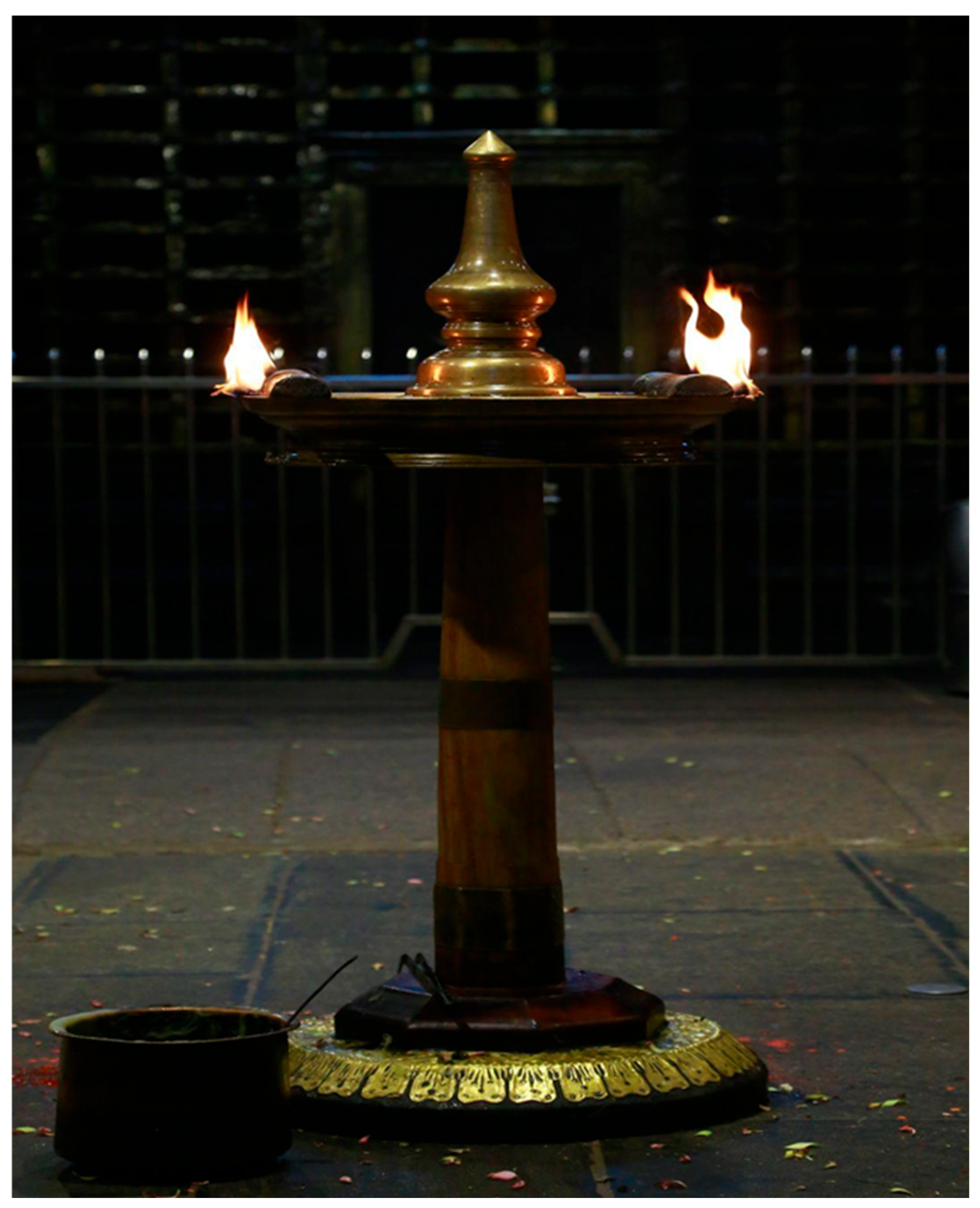
| 9 | kūttampalam (Malayalam): A consecrated theatre hall within a Kerala temple complex, architecturally integrated into the sacred precinct and designed specifically for the performance of ritual dance-dramas such as Kūṭiyāṭṭam and Kṛṣṇanāṭṭam. It is not a secular stage but a ritually demarcated space where performance functions as a visual offering to the deity. |
| 10 | kalarippayattu (Malayalam): A traditional martial art from Kerala with a documented history spanning centuries. It is a holistic system encompassing armed and unarmed combat, physical conditioning, breath control (prāṇāyāma), and therapeutic practices. Its kinetic vocabulary and disciplinary regimes have historically influenced and integrated with Kerala’s performative traditions and ritual arts. |
| 11 | kasavu (Malayalam): Refers to the distinctive gold zari (metallic thread) border on a traditionally off-white, handwoven Kerala saree. More broadly, it denotes the saree itself, which is a marker of cultural identity and ritual purity, commonly worn for festivals, temple visits, and other auspicious occasions. |
| 12 | maṇḍala (Sanskrit): A geometrically structured diagram used in Hindu and Buddhist traditions for ritual and meditative purposes. Within the kūttampalam, a maṇḍala was ritually drawn on the performance space to consecrate it, transforming the stage into a microcosm aligned with cosmic principles and thereby sacralizing the dramatic enactment. |
| 13 | An āṭṭakkatha (plural: āṭṭakkathas) is the dramatic libretto of Kathakali, written in a blend of Malayalam and Sanskrit [Manipravalam], which provides the sung narrative and detailed performance guidelines for the actor-dancers. |
| 14 | Izhavas (also spelled Ezhavas) constitute a prominent caste community in Kerala, traditionally associated with toddy tapping, coconut cultivation, and related occupations. Historically categorized as a subordinate or avarna (non-Brahmin) group within Kerala’s caste hierarchy. Is this fine. |
| 15 | Samudayam (Malayalam; from Sanskrit samudāya, “collective”): A corporate, caste-based collective responsible for the management and execution of temple affairs in pre-modern Kerala. These communities held hereditary rights and duties pertaining to ritual performance, financial administration, and the oversight of temple lands. |
References
Primary Sources
Court Order Register No. 52, Sl. No. 54. Malayalam Manuscript. Regional Archives, Kozhikode. 1854.Government of Madras. A Collection of Papers Relating to the Inam Settlement in the Madras Presidency [Unpublished manuscript]. Kozhikode Regional Archives, Kozhikode. 1906.Kṛṣṇagīti. Composed by Mānavēda Zamorin. 1655.Nārāyaṇīyam. Composed by Melpathur Nārāyaṇa Bhaṭṭatiri. 1586.Old Survey Settlement Register for Ponnani Taluk, Guruvayur Desham. [Unpublished manuscript, Serial No. 377]. Kozhikode Regional Archives, Kozhikode. 1906.Thrissur District Court. “History.” Available online: https://thrissur.dcourts.gov.in/about-department/history/ (accessed on 26 October 2023).Secondary Sources
- Appadurai, Arjun. 1981. Worship and Conflict Under Colonial Rule: A South Indian Case. Cambridge: Cambridge University Press. [Google Scholar]
- Ashley, Katherine, and Barbara Holloman. 1982. From Ritual to Theatre in Kerala. The Drama Review 26: 59–72. [Google Scholar] [CrossRef]
- Ashton-Sikora, Mary, Ravi Sikora, A. Purushothaman, and A. Harindranath. 2015. The Royal Temple Theatre of Kṛṣṇanāṭṭam. New Delhi: D.K. Printworld. [Google Scholar]
- Barba, Eugenio, and Simonne Sanzenbach. 1967. The Kathakali Theatre. Tulane Drama Review 11: 37–50. [Google Scholar] [CrossRef]
- Bayly, Susan. 1989. Saints, Goddesses and Kings: Muslims and Christians in South Indian Society, 1700–1900. Cambridge: Cambridge University Press. [Google Scholar]
- Bell, Catherine. 1992. Ritual Theory, Ritual Practice. Oxford: Oxford University Press. [Google Scholar]
- Bergunder, Michael, Heiko Frese, and Lambert Schmithausen, eds. 2015. Ritual, Caste, and Religion in Colonial South India. New Delhi: Primus Books. [Google Scholar]
- Brittlebank, Kate. 1997. Tipu Sultan’s Search for Legitimacy: Islam and Kingship in a Hindu Domain. Delhi: Oxford University Press. [Google Scholar]
- Chakyar, Mani Madhava. 2015. Kutiyattam and Kerala Temples. Delhi: Nag Publishers. [Google Scholar]
- Champakalakshmi, R. 1996. The Making of a Religious Tradition: Perspectives from Pre-Colonial South India. New Delhi: Oxford University Press. [Google Scholar]
- Champakalakshmi, R. 2011. Religion, Tradition, and Ideology: Pre-Colonial South India. New Delhi: Oxford University Press. [Google Scholar]
- Chatterjee, Partha. 1993. The Nation and Its Fragments: Colonial and Postcolonial Histories. Princeton: Princeton University Press. [Google Scholar]
- Claus, Peter J. 1997. Scandalizing the Goddess: Ritual Purity and Subaltern Agency in Kṛṣṇanāṭṭam. Asian Folklore Studies 56: 197–213. [Google Scholar]
- Dirks, Nicholas B. 1987. The Hollow Crown: Ethnohistory of an Indian Kingdom. Cambridge: Cambridge University Press. [Google Scholar]
- Dirks, Nicholas B. 2001. Castes of Mind: Colonialism and the Making of Modern India. Princeton: Princeton University Press. [Google Scholar]
- Frazier, Jessica, ed. 2014. The Bloomsbury Companion to Hindu Studies. London: Bloomsbury Academic. [Google Scholar]
- Freeman, Rich. 1998. Rubies and Coral: The Lapidary Crafting of Language in Kerala. The Journal of Asian Studies 57: 38–65. [Google Scholar] [CrossRef]
- Freeman, Rich. 2001. Religion and Public Culture: Encounters and Identities in Modern South India. Richmond: Curzon Press. [Google Scholar]
- Freeman, Rich. 2003. Genre and Society: The Literary Culture of Premodern Kerala. In Literary Cultures in History: Reconstructions from South Asia. Edited by Sheldon Pollock. Berkeley: University of California Press, pp. 437–500. [Google Scholar]
- Fuller, Christopher John. 1984. Servants of the Goddess: The Priests of a South Indian Temple. Cambridge: Cambridge University Press. [Google Scholar]
- Ganesh, K. N. 1997. Keralathinte Innalekal (The Bygone Days of Kerala). Thiruvananthapuram: Kerala Bhasha Institute. [Google Scholar]
- Gentes, Mary J. 1992. Scandalizing the Goddess at Kodungallur. Asian Folklore Studies 51: 295–322. [Google Scholar] [CrossRef]
- Guha-Thakurta, Tapati. 2004. Monuments, Objects, Histories: Institutions of Art in Colonial and Postcolonial India. New York: Columbia University Press. [Google Scholar]
- Haridas, V. V. 2016. Zamorins and the Political Culture of Medieval Kerala. Hyderabad: Orient BlackSwan. [Google Scholar]
- Heitzman, James. 1991. Ritual Polity and Economy: The Transactional Network of an Imperial Temple in Medieval South India. Journal of the Economic and Social History of the Orient 34: 23–54. [Google Scholar] [CrossRef]
- Isacco, Enrico, and Anna L. Dallapiccola, eds. 1982. Krishna, the Divine Lover: Myth and Legend Through Indian Art. London: Serindia Publications. Boston: David R. Godine. [Google Scholar]
- Jaiswal, Suvira. 2015. The Origin and Development of Vaisnavism: Vaisnavism from 200 BC to AD 500, 2nd ed. New Delhi: Munshiram Manoharlal Publishers Pvt. Ltd. [Google Scholar]
- Kareem, C. K. 1973. Kerala Under Haidar Ali and Tipu Sultan. Kochi: Paico Publishing House. [Google Scholar]
- Krishna Ayyar, K. V. 1986. Guruvayoor Charitham (History of Guruvayoor). Guruvayoor: Guruvayoor Devaswam Publication. [Google Scholar]
- Krishnan, Sanjana, and Rahul C. Jambhulkar. 2015. Caste, Religious Institutions and Domination. Economic and Political Weekly 50: 15–18. [Google Scholar]
- Kulke, Hermann. 1993. Kings and Cults: State Formation and Legitimation in India and Southeast Asia. New Delhi: Manohar. [Google Scholar]
- Kulke, Hermann. 2014. The Cult of Jagannath and the Regional Tradition of Orissa, rev. ed. New Delhi: Manohar. [Google Scholar]
- Kumar, Dharma. 1965. Land and Caste in South India: Agricultural Labour in the Madras Presidency During the Nineteenth Century. Cambridge: Cambridge University Press. [Google Scholar]
- Kurup, K. K. N. 1986. Teyyam: A Ritual Dance of Kerala; Thiruvananthapuram: Department of Public Relations, Government of Kerala.
- Kurup, K. K. N. 2014. Sree Guruvayoor Kshethram: Puravruthavum Charithravum (Sacred Guruvayur Temple: Antiquarian Accounts and History). Kozhikode: Mathrubhumi Books, pp. 28–29. [Google Scholar]
- Logan, William. 1887. Malabar Manual. Madras: Government Press, vol. 2. [Google Scholar]
- Menon, A. Sreedhara. 1967. A Survey of Kerala History. Kottayam: DC Books. [Google Scholar]
- Menon, A. Sreedhara. 2011. Kerala History and Its Makers. Kottayam: DC Books. [Google Scholar]
- Menon, Divya M., and D. Sreejith. 2021. Reading Theyyam as an Archive of the Subaltern Community of Northern Kerala. ShodhKosh: Journal of Visual and Performing Arts 2: 91–101. [Google Scholar] [CrossRef]
- Moore, Lewis. 1950. Malabar Law and Customs. Madras: Higginbotham & Co. [Google Scholar]
- Mukund, Kanakalatha. 2005. The View from Below: Indigenous Society, Temples, and the Early Colonial State in Tamilnadu, 1700–1835. Hyderabad: Orient Blackswan. [Google Scholar]
- Nagaraj, Doḍḍabaḷḷāpura Rāmayya. 1993. The Flaming Feet: A Study of the Dalit Movement in India. Bangalore: South Forum Press. [Google Scholar]
- Narayanan, Muttayil G. S. 1969. The Identity and Date of King Manukuladitya. Proceedings of the Indian History Congress 31: 73–78. [Google Scholar]
- Narayanan, Muttayil G. S. 2005. Perumals of Kerala: Political and Social Conditions of Kerala Under the Cēra Perumals of Makotai (c. 800 A.D.–1124 A.D.). Thrissur: Xavier Press. [Google Scholar]
- Narayanan, Muttayil G. S. 2013. Perumals of Kerala: Brahmin Oligarchy and Ritual Monarchy. Kerala: Cosmo Books. [Google Scholar]
- Narayanan, P. 2019. Agre Pashyami. Kerala: Vallathol Vidyapeetham. [Google Scholar]
- Navaneeth, Krishnan S. 2018. Revisiting the Endangered Folk Religion of Kerala. Proceedings of the Indian History Congress 79: 329–37. [Google Scholar]
- Nayar, S. K. 2013. Theyyam: An Analytical Study of the Folk Culture, Wisdom and Personality. Delhi: Indian Publishers Distributors. [Google Scholar]
- O’Hanlon, Rosalind. 2017. Caste and Its Histories in Colonial India: A Reappraisal. Modern Asian Studies 51: 432–61. [Google Scholar] [CrossRef]
- Packert, Cyrithia. 2010. The Art of Loving Krishna: Ornamentation and Devotion. Bloomington: Indiana University Press. [Google Scholar]
- Padmanabhan, Mannath. 2013. Mannath Padmanabhan’s Speeches, 3rd ed. Changanassery: Nair Service Society, p. 265. [Google Scholar]
- Pasty-Abdul Wahid, Marianne. 2017. When Theatre Makes the Ritual Work: Imitation, Materialisation and Reactualization in the Malayali Ritual Theatre Muṭiyēṯṯu. In Theatrical and Ritual Boundaries in South Asia. Edited by Ewa Debicka-Borek and Elisa Ganser. Kraków: Jagiellonian University Press, pp. 34–60. [Google Scholar]
- Pati, George. 2019. Religious Devotion and the Poetics of Reform. London: Routledge. [Google Scholar]
- Pollock, Sheldon. 2006. The Language of the Gods in the World of Men: Sanskrit, Culture, and Power in Premodern India. Berkeley: University of California Press. [Google Scholar]
- Presler, Franklin A. 1987. Religion Under Bureaucracy: Policy and Administration for Hindu Temples in South India. Cambridge: Cambridge University Press. [Google Scholar]
- Rajagopalan, L. S. 2000. Kūṭiyāṭṭam: Preliminaries and Performance. Delhi: D.K. Printworld. [Google Scholar]
- Ranganathan, Edwina. 1975. KṚṢṆANĀṬṬAM: A Traditional Dance-Drama. Journal of South Asian Literature 10: 275–87. [Google Scholar]
- Ricci, Ronit. 2019. Banishment and Belonging: Exile and Diaspora in Sarandib, Lanka and Ceylon. Cambridge: Cambridge University Press. [Google Scholar]
- Sankar, Rithwik. 2021. An Analysis of Reverential Ecofear in Theyyam. International Journal of Fear Studies 3: 108–17. [Google Scholar]
- Saranya, Jayaprakash A., and M. Senguttuvan. 2024. Upending the Norms: The Representation of Theyyam in Kerala’s Popular Culture. Cogent Arts & Humanities 11: 2438488. [Google Scholar] [CrossRef]
- Sarkar, H. 1978. An Architectural Survey of Temples of Kerala. New Delhi: Archaeological Survey of India. [Google Scholar]
- Seth, Pepita. 2010. Heaven on Earth: The Universe of Kerala’s Guruvayur Temple. New Delhi: Niyogi Books. [Google Scholar]
- Shaheen, K. 2019. The Afterlife of Tipu Sultan S Khudadad Sarkar in Malabar 1792 to the Present. Ph.D. thesis, Jawaharlal Nehru University, New Delhi, India. [Google Scholar]
- Sharma, Krishna. 2003. Bhakti and Bhakti Movement: A New Perspective. New Delhi: Munshiram Manoharlal Publishers. [Google Scholar]
- Simmons, Caleb. 2019. Devotional Sovereignty: Kingship and Religion in India. New York: Oxford University Press. [Google Scholar]
- Simmons, Caleb. 2021. Devotional Foundations of Earthly Sovereignty: Conceptualizing Sovereignty and the Role of Devotion in Narrative Political Theology in Premodern India. Religions 12: 911. [Google Scholar] [CrossRef]
- Sutherland, Peter. 2021. T(r)opologies of Rule (rāj): Ritual Sovereignty and Theistic Subjection. Religions 12: 1014. [Google Scholar] [CrossRef]
- Thurston, Edgar, and K. Rangachari. 1909. Castes and Tribes of Southern India. Madras: Government Press, vol. 7. [Google Scholar]
- Varghese, Anna. 2010. Temple Service Groups in Ancient and Medieval Keralam. Proceedings of the Indian History Congress 71: 88–96. [Google Scholar]
- Varghese, Anna. 2012. Temple Ritual Groups in Keralam. Proceedings of the Indian History Congress 73: 1426–27. [Google Scholar]
- Varghese, Anna. 2013. Ugachchan or Kottigal-The Temple Drummers from Kēralam. Proceedings of the Indian History Congress 74: 940–41. [Google Scholar]
- Varghese, Anna. 2015. Temple Managerial Groups in Early Keralam. Proceedings of the Indian History Congress 76: 69–75. [Google Scholar]
- Veluthat, Kesavan. 1982. The Status of the Monarch: A note on the Rituals Pertaining to Kingship and their Significance in the Tamil Country (A.D 600–1200). Proceedings of the Indian History Congress 43: 147–57. [Google Scholar]
- Veluthat, Kesavan. 1985. Socio-Political Background of Kulasekhara Alvar’s Bhakti. Journal of Indian History 63: 1–24. [Google Scholar]
- Veluthat, Kesavan. 1993. Religious Symbols in Political Legitimation. Social Scientist 21: 23–33. [Google Scholar] [CrossRef]
- Veluthat, Kesavan. 2009. The Early Medieval in South India. New Delhi: Oxford University Press. [Google Scholar]
- Vinai, R., and E. Prasuna. 2017. Circumscribed by Space and Time: Performative Bodies in South India. New Delhi: Sahitya Akademi. [Google Scholar]
- Warrier, S. S. 2004. Guruvayur: God’s Own Temple. Delhi: Samrat Publishers. [Google Scholar]
- Washbrook, David A. 1976. The Emergence of Provincial Politics: The Madras Presidency 1870–1920. Cambridge: Cambridge University Press. [Google Scholar]
- Zarrilli, Phillip B. 2000. Kathakali Dance-Drama: Where Gods and Demons Come to Play. London: Routledge. [Google Scholar]
Disclaimer/Publisher’s Note: The statements, opinions and data contained in all publications are solely those of the individual author(s) and contributor(s) and not of MDPI and/or the editor(s). MDPI and/or the editor(s) disclaim responsibility for any injury to people or property resulting from any ideas, methods, instructions or products referred to in the content. |
© 2025 by the authors. Licensee MDPI, Basel, Switzerland. This article is an open access article distributed under the terms and conditions of the Creative Commons Attribution (CC BY) license (https://creativecommons.org/licenses/by/4.0/).
Share and Cite
Mohan P, A.; Ashraf, M.N.; Varghese, A. Kṛṣṇanāṭṭam Performance: Kṛṣṇa Devotion, Ritual Ecology, and Colonial Transformation in South India. Religions 2025, 16, 1503. https://doi.org/10.3390/rel16121503
Mohan P A, Ashraf MN, Varghese A. Kṛṣṇanāṭṭam Performance: Kṛṣṇa Devotion, Ritual Ecology, and Colonial Transformation in South India. Religions. 2025; 16(12):1503. https://doi.org/10.3390/rel16121503
Chicago/Turabian StyleMohan P, Aswathy, Muhammed Niyas Ashraf, and Anna Varghese. 2025. "Kṛṣṇanāṭṭam Performance: Kṛṣṇa Devotion, Ritual Ecology, and Colonial Transformation in South India" Religions 16, no. 12: 1503. https://doi.org/10.3390/rel16121503
APA StyleMohan P, A., Ashraf, M. N., & Varghese, A. (2025). Kṛṣṇanāṭṭam Performance: Kṛṣṇa Devotion, Ritual Ecology, and Colonial Transformation in South India. Religions, 16(12), 1503. https://doi.org/10.3390/rel16121503

