Article

Kṛṣṇanāṭṭam Performance: Kṛṣṇa Devotion, Ritual Ecology, and Colonial Transformation in South India

by
Aswathy Mohan P
1,
Muhammed Niyas Ashraf
2,3 and
Anna Varghese
1,*
1
Department of International Studies, Political Science and History, CHRIST University, Bengaluru 560029, India
2
Department of History, GITAM (Deemed to be University), Bengaluru 560064, India
3
Faculty of Arts and Philosophy, Campus Boekentoren, Ghent University, 9000 Gent, Belgium
*
Author to whom correspondence should be addressed.
Religions 2025, 16(12), 1503; https://doi.org/10.3390/rel16121503
Submission received: 29 August 2025 / Revised: 31 October 2025 / Accepted: 13 November 2025 / Published: 27 November 2025
(This article belongs to the Special Issue The Encounter of Colonialism and Indian Religious Traditions)

Abstract

This paper critically explores Kṛṣṇanāṭṭam, a Sanskrit ritual dance-theater tradition from Kerala, as a product of socio-political and religious transformations in early modern South India. Conceived in the mid-17th century by the Zamorin King Mānavēda, author of the Sanskrit text Kṛṣṇagīti, Kṛṣṇanāṭṭam was both a devotional offering to Lord Kṛṣṇa and a strategic expression of ritual sovereignty. Rooted in Kṛṣṇa bhakti (devotion), the tradition reflects how religious performance was mobilized to assert political legitimacy, particularly amid rivalry with regional powers such as Travancore. The Guruvayur Sri Krishna Temple, situated in the Malabar region of northern Kerala and central to the performance of Kṛṣṇanāṭṭam, emerged as a vital sacred space where royal patronage, ritual authority, and caste hierarchy intersected. The performance’s exclusivity restricted to Hindu audiences within temple premises reinforced patterns of spatial control and caste-based exclusion. Institutional support codified the tradition, sustaining it across generations within a narrow sociocultural framework. With the decline of Zamorin rule and the onset of colonialism, Kṛṣṇanāṭṭam faced structural disruptions. Colonial interventions in temple administration, landholding, and religious patronage weakened its ritual foundations. Guruvayur’s transformation into a public devotional center reflected wider shifts in ritual ecology and sacred geography under colonial modernity. In both the colonial and postcolonial periods, Kṛṣṇanāṭṭam struggled to survive, nearly facing extinction before its revival under the Guruvayur temple’s custodianship. By examining Kṛṣṇa devotion, royal ambition, caste dynamics, and colonial transformation, this paper offers a critical lens on Kerala’s evolving religious and cultural landscapes.

1. Introduction: Kṛṣṇanāṭṭam as Ritual and Political Practice

Kṛṣṇa (Krishna), the divine cowherd and cosmic sovereign of Hindu tradition, has captivated the hearts of millions across South Asia for centuries. His stories of love, valor, and divine play (līlā) are not merely mythological narratives but form the bedrock of a vibrant bhakti (devotional) tradition that transcends regional and linguistic boundaries. Nowhere is this interplay more vividly manifested than in Kṛṣṇanāṭṭam, the 17th-century Sanskrit dance-theater tradition of Kerala. Kṛṣṇanāṭṭam conceived as a ritual offering (dṛśya-seva, “visual service”) that enacts the divine play of Kṛṣṇa through a cycle of eight plays. Staged over successive nights outside the sacred kūttampalam (theater hall) of the Guruvayur Temple, a space historically accessible only to Hindus, each four-hour performance employs a sophisticated language of rhythmic movement (nṛtta), expressive mime (abhinaya), and codified hand gestures (mudrās) to narrate the deity’s life. The form’s immersive power derives from its synthesis of visual and sonic elements: performers, transformed into divine beings through intricate costuming, stylized make-up (āharya), and majestic headgear (muṭi), are animated by a soundscape of melodic sopāna saṅgītam (“temple music”) and the rhythmic foundation of the maḍḍaḷam (barrel drum) and ceṇḍa (cylindrical drum), and the punctuation of cymbals. Eschewing elaborate sets, Kṛṣṇanāṭṭam uses this choreographic and musical complexity to evoke sacred spaces and enact celestial drama directly within the ritual precinct. Emerging from the medieval Bhakti movement a spiritual revolution that democratized access to the divine through emotional devotion Kṛṣṇa-centric practices like Kṛṣṇanāṭṭam in Kerala exemplify how ritual performances became arenas for negotiating power, identity, and transcendence. This paper understands its development and transformation through the framework of “ritual ecology” (Bell 1992), the interdependent network of temple space, caste hierarchy, royal patronage, and performative practice that sustained it as a living, sacred tradition. Conceived by Zamorin1 King Mānavēda (1595 to 1658) through his text Kṛṣṇagīti, this ritual performance transcended aesthetics to become a strategic instrument of ritual sovereignty fusing Kṛṣṇa bhakti (devotion) with royal authority to legitimize the Zamorin dynasty amid rivalries with powers like Travancore (Haridas 2016, p. 234). Yet its history also reveals colonialism’s enduring grip on India’s religious institutional structures and the very logic of ritual sovereignty, eight decades after Independence. As Arjun Appadurai argues, temples functioned as “paradigmatic sovereigns” under precolonial regimes (Appadurai 1981, p. 78), but colonial rule fractured this sacral-political order, forcing traditions like Kṛṣṇanāṭṭam into near extinction before their contested revival. This article explores the interplay of devotion, politics, and aesthetics in temple-based performances, using Kṛṣṇanāṭṭam as a lens to unravel the cultural and theological dynamics of South Asian societies.
This paper examines how colonialism irrevocably transformed Kṛṣṇanāṭṭam’s ritual ecology, the network of temple space, caste hierarchy, and royal patronage that sustained it. The Guruvayur Śrī Kṛṣṇa Temple, where performances were staged, embodied spatialized power: its kūttampalam (theater) restricted access to Hindu elites, reinforcing caste boundaries while aligning Kṛṣṇa’s divinity with Zamorin authority (Vinai and Prasuna 2017, p. 12). Colonialism dismantled this ecosystem. British land reforms and temple administration reforms severed royal patronage; the shift of Guruvayur to a “public devotional center” mirrored capitalism’s erosion of ritual sovereignty (Bayly 1989, p. 203). The performance’s cyclical narrative culminating in Kṛṣṇa’s rebirth (Avatāram) after his ascension (Svargārohaṇam) once symbolized eternal kingship (Dirks 1987, p. 5). Under colonialism, it became a metaphor for resilience, yet also a reminder of tradition’s fragility.
Kṛṣṇanāṭṭam embodies a complex interplay of ritual sovereignty, spatial politics, bhakti aesthetics, and caste-colonial dynamics, serving as a critical lens to examine how temple performances mediated power and identity in precolonial, colonial, and postcolonial Kerala. Drawing on Hermann Kulke’s theorization of kingship as a “sacralized political order” (Kulke 1993, p. 112), we analyze how the tradition functioned as an instrument of devotional sovereignty. Commissioned by the Zamorin dynasty through the Sanskrit text Kṛṣṇagīti, it embedded royal authority within the cyclical temporality of Kṛṣṇa’s līlā (divine play), with episodes like Svargārohaṇam (ascension) followed by Avatāram (rebirth) symbolically eternalizing kingship as divine guardians of dharma (Dirks 1987, p. 5). This analysis is further refined through Caleb Simmons’s concept of “devotional sovereignty,” which argues that premodern Indian kingship was articulated and legitimized through public performances of devotion, wherein the king’s intimate relationship with the deity became the very foundation of his earthly authority (Simmons 2019, p. 4). This framework is essential for understanding how Mānavēda Zamorin’s authorship of the Kṛṣṇagīti was not merely an act of patronage but a profound performance of his dual role as supreme devotee (dīkṣitar) and sovereign, thereby “conceptualizing sovereignty” itself through “narrative political theology” (Simmons 2021, p. 112). Similarly, Peter Sutherland’s exploration of “ritual sovereignty” illuminates how the “theistic subjection” of the king to the deity did not diminish but rather constituted his political power, a dynamic perfectly staged within the kūttampalam (Sutherland 2021, p. 8).
Arjun Appadurai’s transactional model (Appadurai 1981, p. 78) further illuminates the Guruvayur Temple’s kūttampalam (theater) as a site of spatialized power. Here, caste-based exclusion restricted audiences to Hindu elites, while the nine-day performance cycle ritualized Brahminical cosmic order. Colonial disruptions later repurposed these sacred spaces into public devotional centers, fracturing the ritual ecology (Bayly 1989, p. 203). Tensions in bhakti aesthetics emerge through Sheldon Pollock’s “cosmopolitan vs. vernacular” framework (Pollock 2006, p. 23): Kṛṣṇanāṭṭam’s Sanskrit libretto reinforced elite authority, contrasting with Kathakali’s democratizing Malayalam adaptations and mirroring the Bhakti movement’s paradox of devotional inclusivity alongside social exclusion (Pati 2019, p. 102). A classical dance-drama from Kerala, Kathakaḷi is famous for its elaborate costumes, colorful make-up, and highly stylized movements. It tells stories from Hindu epics such as the Mahabhārata and Rāmayaṇa, using gestures, expressions, and rhythmic dance to convey meaning. This linguistic and social tension was a fundamental feature of its pre-colonial ritual ecology, where the use of Sanskrit served as a key mechanism of royal and Brahminical control within the temple’s spatial and social hierarchy. The colonial disruption of this ritual ecology, however, did not dissolve this hierarchical structure but repurposed it. The caste-colonial nexus reveals how British land reforms and temple administration amplified preexisting hierarchies. Hereditary performers like Nambūtiri Brahmins and Nāirs2) embodied D.R. Nagaraj’s “caste aesthetics” (Nagaraj 1993, p. 72), while colonial policies calcified these boundaries, actively shaping caste as a central, manageable category of colonial governance (Dirks 2001). The tradition’s near-extinction and fraught revival underscore colonialism’s enduring socio-religious fractures (Vinai and Prasuna 2017, p. 12).

2. Critical Questions and Contemporary Paradoxes

This study confronts two pivotal questions: How did kūttampalam performances mediate Kerala’s caste hierarchies and colonial tensions? And why did the cyclical rebirth (Avatāram) after ascension (Svargārohaṇam) function as both theological eternity and political resistance? Today, Kṛṣṇanāṭṭam’s revival epitomizes the journal’s core inquiry: Can religious traditions ever decolonize? Its survival hinges on the Guruvayur Devaswom Board3, a colonial-era administrative relic while caste barriers persist despite nominal audience democratization (Navaneeth 2018, p. 323). The tradition thus mirrors India’s broader struggle to reconcile devotion with modernity’s inequities: a nation achieving lunar exploration while perpetuating ritual exclusion. As Partha Chatterjee argues, colonialism’s “rule of difference” (Chatterjee 1993, p. 18) continues to haunt heritage reclamation, exposing an unresolved dialectic between decolonization and enduring inequality. Through this lens, Kṛṣṇanāṭṭam emerges as a microcosm of Kerala’s cultural politics where devotion and power remain inextricably linked, and colonial shadows stretch deep into the postcolonial present. By interweaving these frameworks, we argue that Kṛṣṇanāṭṭam epitomizes the unfinished decolonization of Indian religious traditions where the past’s shadows loom over contemporary revival.
This study employs the framework of ‘ritual ecology’—understood as the interdependent network of temple space, caste hierarchy, royal patronage, and performative practice that sustains a living tradition. This concept allows us to analyze Kṛṣṇanāṭṭam not as an isolated aesthetic form, but as a dynamic system embedded within Kerala’s socio-political and religious landscape. To trace the transformations of this ecology, the research adopts a multidisciplinary methodology, integrating historical, textual, and ethnographic approaches. The research, conducted over a period of seven months, combined archival work, fieldwork, and critical engagement with secondary scholarship. Primary source analysis formed the historical backbone of this study, drawing on temple records, the foundational Sanskrit text Śrī Kṛṣṇagīti, and colonial-era court documents from the Kerala State Archives and the Guruvayur Devaswom Library, which reveal administrative and legal interventions in temple management.
This archival research was complemented by intensive fieldwork at the Guruvayur Temple. The primary period of observation was during the Vijayadashami season, when the complete cycle of eight Kṛṣṇanāṭṭam plays is performed. Through systematic observation documented via ethnographic notes and authorized photographic evidence, the study analyzed the enduring aesthetic and ritual practices firsthand. This ethnographic component was vital for understanding the tradition as a living practice. Detailed interactions were held with key informants, including performers from the Kṛṣṇanāṭṭam troupe, senior temple authorities, and officials from the Guruvayur Devaswom Board, whose insights provided invaluable context for the performance’s contemporary ritual and administrative status. By triangulating evidence from archives, court records, field observation, and literary analysis, this methodology examines Kṛṣṇanāṭṭam not merely as a static art form but as a dynamic node within a network of power, devotion, and social hierarchy, tracing its evolution from a pre-colonial instrument of ritual sovereignty to a postcolonial heritage object and living devotional practice.

3. Historical and Cultural Context of Kṛṣṇanāṭṭam: Sovereignty, Devotion, and Patronage in 17th-Century Kerala

The emergence of Kṛṣṇanāṭṭam in mid-17th-century Kerala represents a convergence of political exigency, religious fervor, and cultural innovation. This ritual dance-theater tradition, conceived under the Zamorin dynasty of Calicut, transcended aesthetic performance to become a strategic instrument of statecraft and devotion. Kerala in this era was a contested landscape: the Zamorins faced Dutch commercial incursions, Portuguese evangelical aggression, and military pressure from the expanding Travancore kingdom (Veluthat 1993, p. 132). Amidst this turmoil, the Zamorin Mānavēda (r. 1655–1658), a polymath poet-king, composed the Sanskrit text Kṛṣṇagīti and institutionalized its performance at Guruvayur Temple the site into “Dakṣiṇa Dvārakā” (Southern Dwarka)4, a cosmic-political hub where divine and royal authority merged (Ashton-Sikora et al. 2015, p. 27).
The genesis of Kṛṣṇanāṭṭam Kerala’s seminal Sanskrit dance-theater tradition is inextricably linked to the visionary synthesis of political authority, devotional fervor, and artistic innovation embodied by its creator, Mānavēda Zamorin (r. 1655–1658). As both ruler of Calicut and author of its foundational text Kṛṣṇagīti, Mānavēda forged a dual identity that transcended conventional kingship, materializing Nicholas Dirks’ concept of “ritual sovereignty” where performative acts sacralized political power (Dirks 1987, p. 5). Central to this legacy is the legend of his divine vision: aided by the saint Vilvamaṅgalam Swāmiyār, Mānavēda glimpsed Kṛṣṇa, who vanished leaving a peacock feather. As Pepita Seth’s ethnography reveals, this myth “sacralize[d] royal authority through sensory encounter,” framing Mānavēda as a dīkṣitar (initiate-king) whose legitimacy flowed from direct divine communion, bypassing Brahminical mediation (Seth 2010, p. 158). This feather inspired Kṛṣṇagīti’s composition and the tradition’s iconic costuming, transforming aesthetic production into theological praxis.
Complementing this revelatory authority was Mānavēda’s onomastic strategy: his deliberate alternation between the Malayalam name “Manavēdan” and Sanskritized title “Manavēda” epitomized Sheldon Pollock’s theory of “vernacularization”a process where rulers “code-switched” linguistically to balance regional identity with Sanskritic universalism (Pollock 2006, p. 23). This duality mirrored Kṛṣṇanāṭṭam’s own structural hybridity, bridging Kerala’s Kūṭiyāṭṭam theater with Bhāgavata Purāṇa cosmology. In Veluthat’s incisive phrasing, “The peacock feather was his scepter; the Sanskrit verse, his decree” (Veluthat 1993, p. 27) a testament to how Mānavēda engineered devotion as statecraft. Within this liminal space between revelation and rule, vernacular emotion and cosmopolitan order, Kṛṣṇanāṭṭam emerged as both an act of bhakti and a performance of sovereignty, forever altering Kerala’s ritual-political landscape.

3.1. Bhakti, Kingship, and the Ritual Synthesis of Kṛṣṇanāṭṭam

The Bhakti movement, which crystallized in South India by the 7th century CE, redefined spirituality by prioritizing personal devotion (bhakti mārga) over ritual orthodoxy. Poets like the Āḻvārs and Nāyaṉārs composed ecstatic hymns in Tamil that celebrated Kṛṣṇa (as Viṣṇu) and Śiva, respectively, while also challenging caste hierarchies and institutionalized religion. The theological bedrock of Kṛṣṇanāṭṭam in Kerala was built upon this bhakti ethos, shaped by a confluence of devotional, literary, and socio-political developments. One of the earliest expressions of Kṛṣṇa. devotion in Kerala came through the 9th-century king Kulaśekhara Āḻvār, whose Mukunda Māla hymns articulated bhakti as mādhurya an intimate and emotional love for the divine, rather than ritualistic obedience (Veluthat 1985, p. 23).
This Tamil devotional emotionality resonated with Jayadeva’s 12th-century Gītagovinda, a Sanskrit lyrical work that eroticized devotion through the līlā of Rādhā and Kṛṣṇa. Its performance in temples such as Guruvayur fused the aesthetic grandeur of Sanskrit with the emotive intensity of Tamil bhakti (Zarrilli 2000, p. 45). The 16th-century scholar Melpathur Nārāyaṇa Bhaṭṭatiri added a reformist dimension with his Nārāyaṇīyam, a reworking of the Bhāgavata Purāṇa that critiqued caste hierarchy and promoted a more egalitarian devotional vision, an influence clearly visible in Mānavēda’s own bhakti aesthetics despite his royal lineage.
The culmination of these devotional currents came with Mānavēda who synthesized these traditions into Kṛṣṇagīti, the textual and performative basis of Kṛṣṇanāṭṭam. This Sanskrit dance-drama cycle, institutionalized under the Zamorin rulers of Calicut and performed at the Guruvayur temple, dramatized Kṛṣṇa’s life not merely as spiritual entertainment, but as a form of ritual sovereignty consolidating both royal authority and Vaishnavite devotion. Rooted in early medieval India’s feudal social structure, the Kerala manifestation of bhakti thus navigated a complex terrain, where egalitarian impulses met entrenched caste hierarchies (Sharma 2003, p. 127). Mānavēda’s genius lay in synthesizing these devotional and literary streams into Kṛṣṇagīti, a text that rendered bhakti as performative theology and a legitimizing performance of divine kingship. As R. Champakalakshmi notes, this reflected a broader South Indian trend where “temples became theaters for staging sovereignty through devotion” (Champakalakshmi 1996, p. 112).
The culmination of these devotional currents materialized through Mānavēda Zamorin’s Kṛṣṇagīti, which synthesized Kerala’s Bhakti heritage into a performative theology of sovereignty. As Kesavan Veluthat argues, South Indian bhakti was inherently “temple-based,” with royal patrons like the Zamorins leveraging devotional practices to consolidate power (Veluthat 1982). Susan Bayly’s study further reveals how the Zamorins positioned themselves as “ritual sovereigns,” mediating between divine and earthly realms through temple patronage (Bayly 1989, p. 156). Kṛṣṇanāṭṭam epitomized this synthesis: its eight episodes dramatized Kṛṣṇa’s life as both a divine savior and a model king, reinforcing the ruler’s role as protector of dharma.
The cyclical structure of the eight plays performed over nine nights ritualized Kṛṣṇa’s līlā while mirroring the Zamorin’s idealized kingship5 as summarized in Table 1.
Table 1. The Cyclical Structure of Kṛṣṇanāṭṭam: Narrative and Political Allegory.
EpisodeNarrative FocusPolitical Allegory
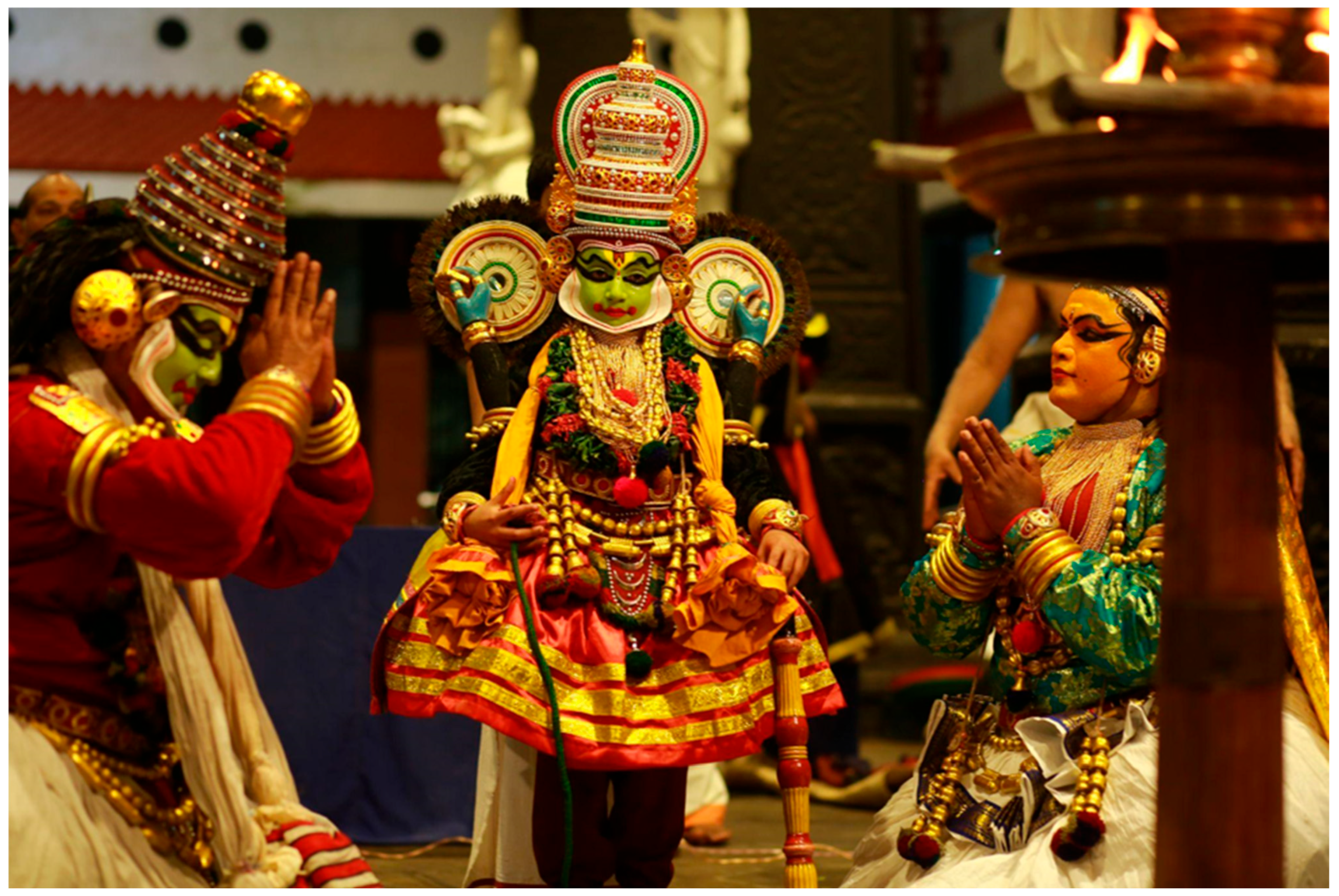
AvatāramKṛṣṇa’s birth amid tyranny
(See Figure 1)
Divine sanction for Zamorin’s rule
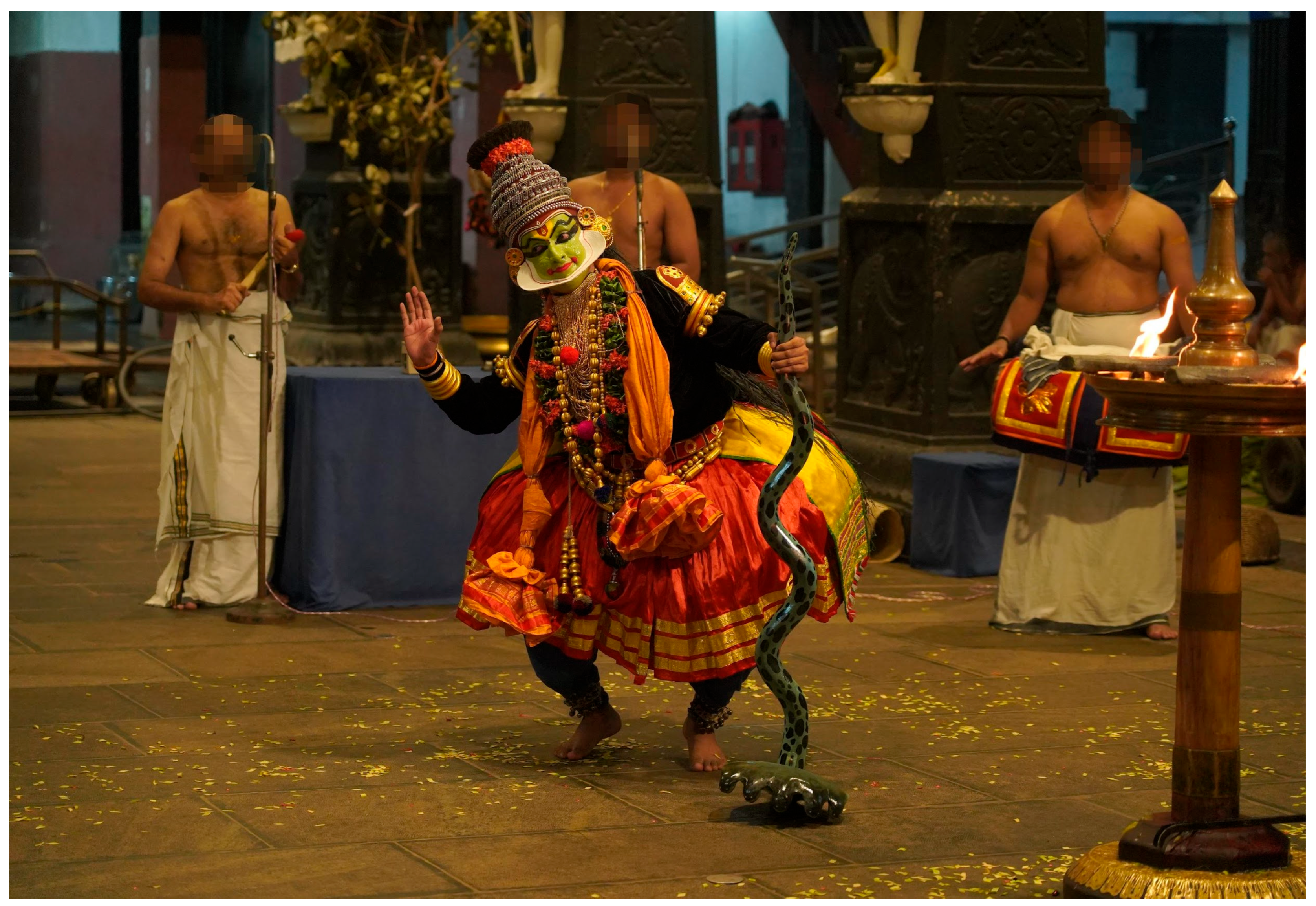
Kaliya MardhanamSlaying the serpent Kāliya
(See Figure 2)
King as destroyer of chaos
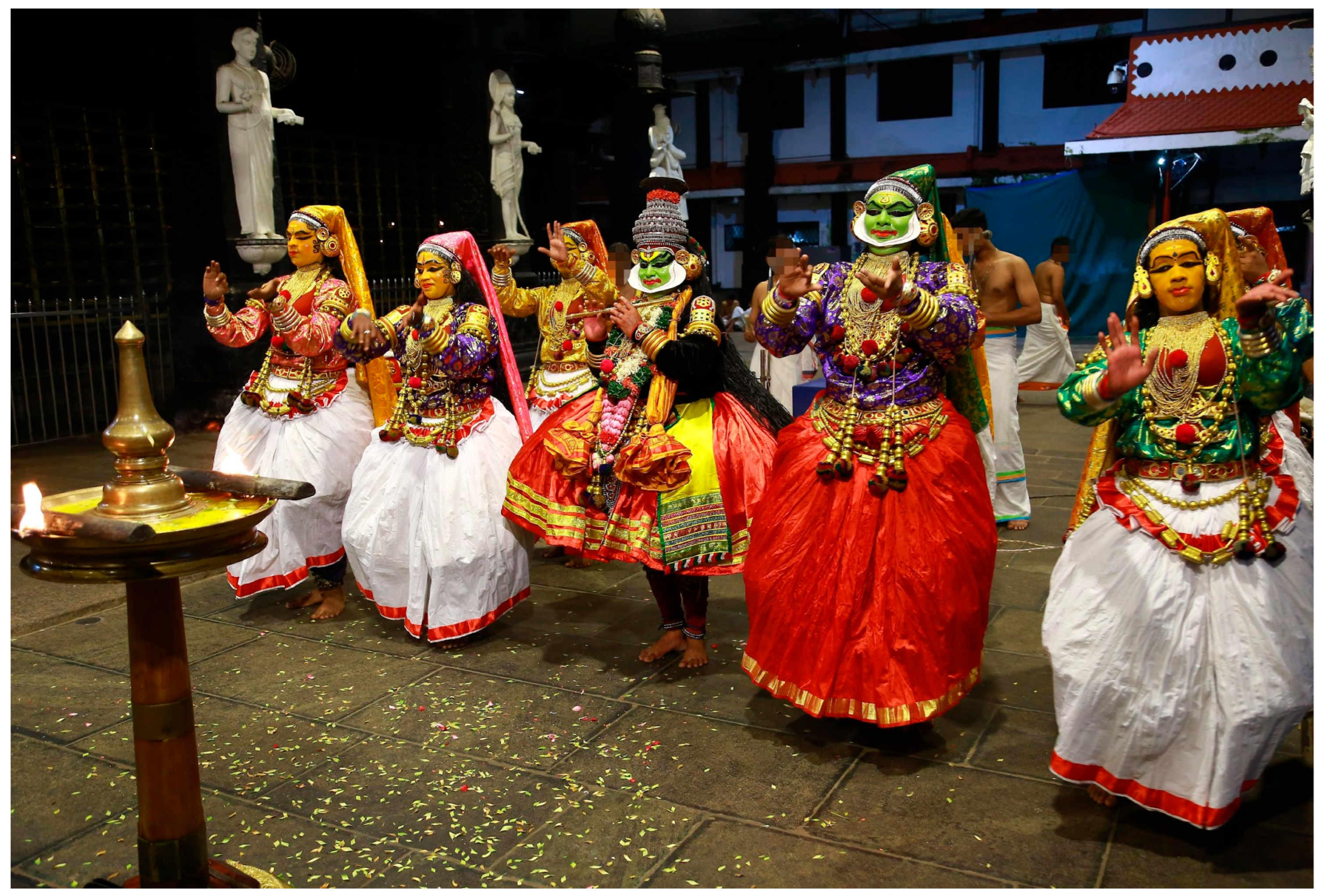
RāsakrīḍaDance with gopikas
(See Figure 3)
Harmony under royal patronage
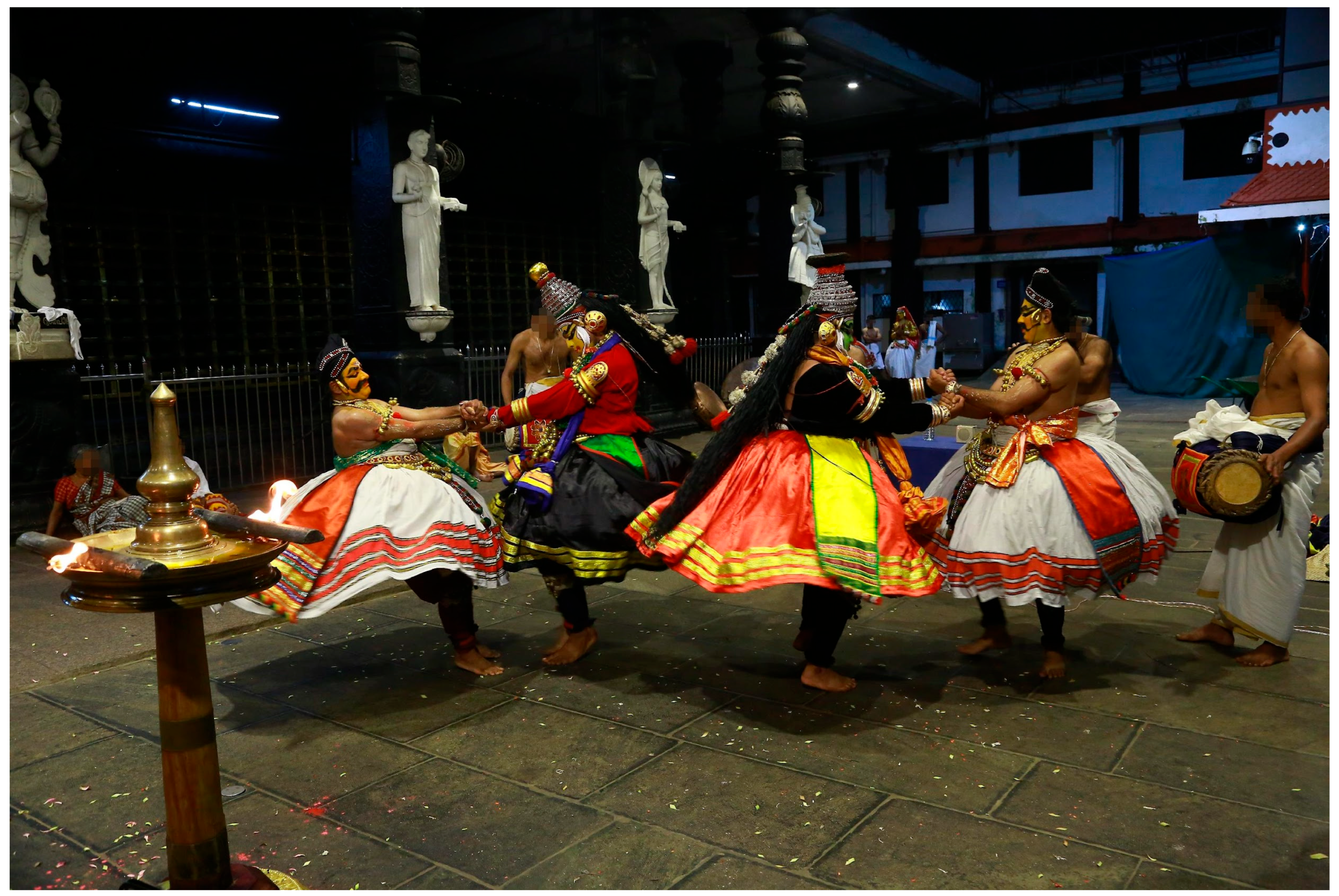
KaṃsavadhamKilling the tyrant Kaṃsa
(See Figure 4)
Defeat of rival powers (e.g., Travancore)
SwayaṃvaramMarriage to Rukmiṇī and Sathyābhāmā
(See Figure 5)
Royal alliances through matrimony
ṇayuddhamBattle against the demon Bāṇa
(See Figure 6)
Defense of kingdom
Vividha VadhamAnnihilation of Vividha (minister-turned-demon)
(See Figure 7)
Punishment of treason
SvargārohaṇamKṛṣṇa’s ascension → Avatāram reprised
(See Figure 8 and Figure 9)
Cyclical renewal of kingship
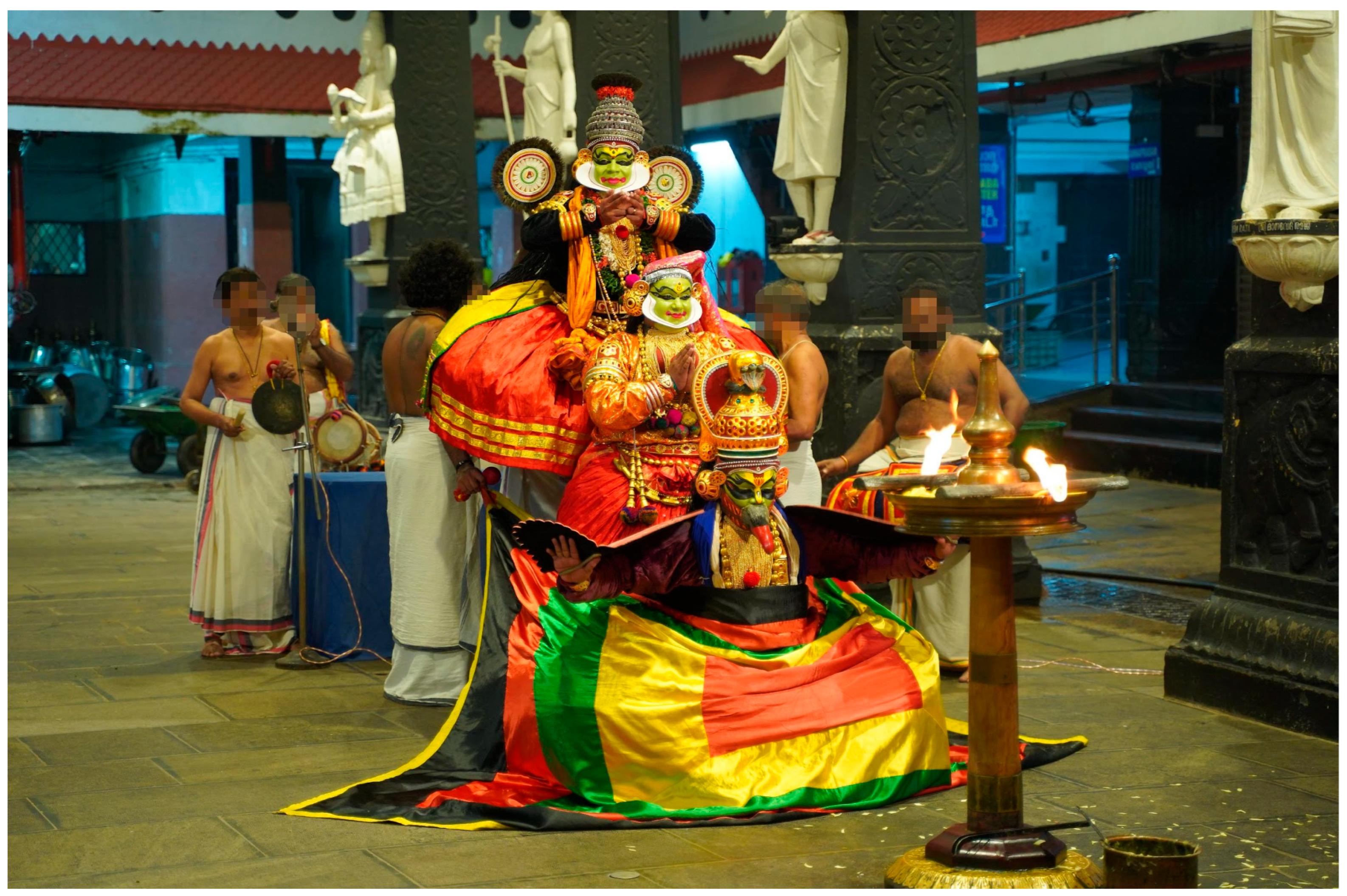
Figure 1. Avatāram—Kṛṣṇa’s birth amid tyranny.
Religions 16 01503 g001
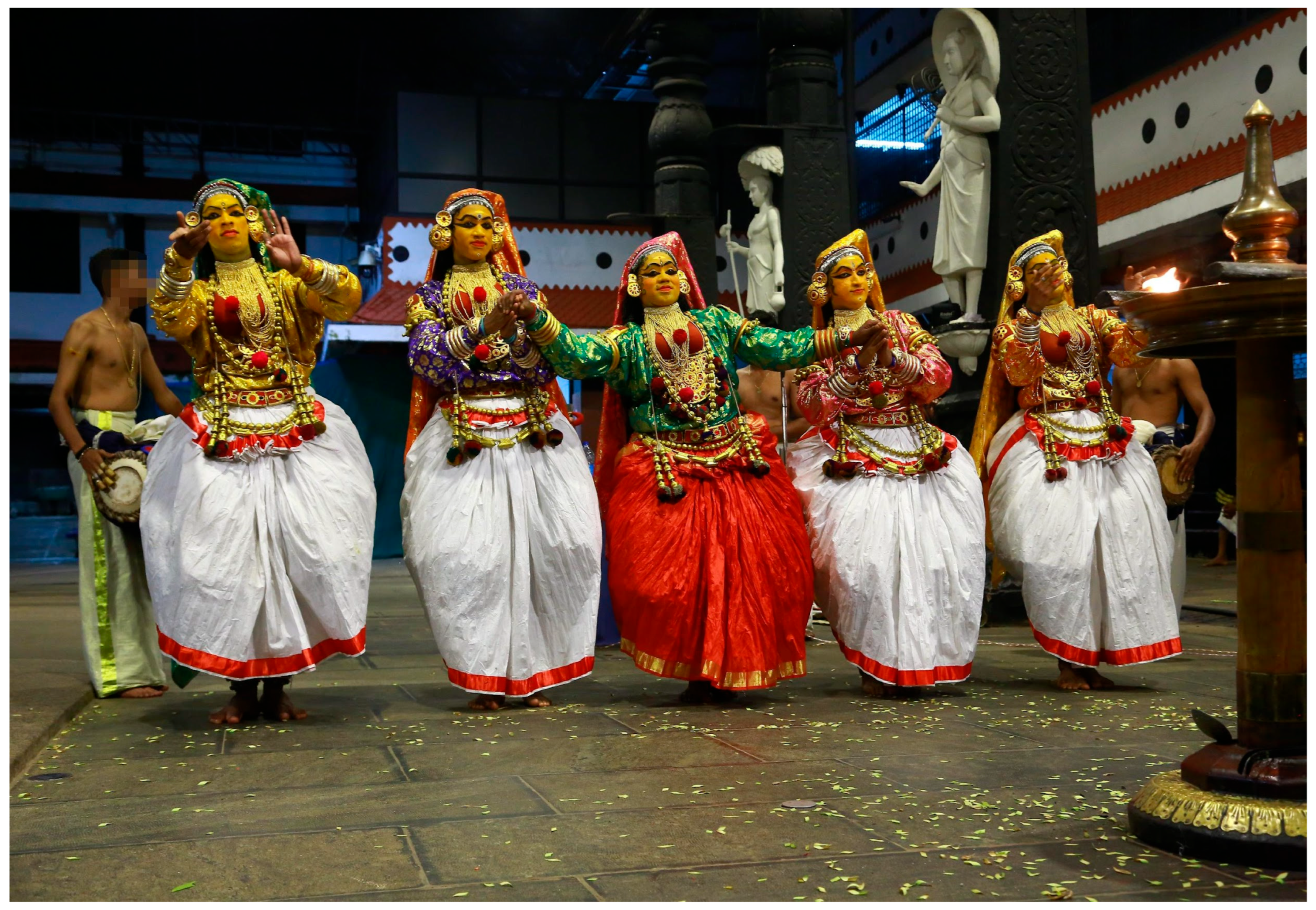
Figure 2. Kāliya Mardhanaṃ. Kṛṣṇa slaying the evil serpent Kāliya. In the background, singers and percussionists, such as the maddaḷam and ilatāḷam players, provide rhythmic and melodic support to the performance.
Religions 16 01503 g002
Figure 3. Rāsakrīḍa. Kṛṣṇa’s dance with gopikas.
Religions 16 01503 g003
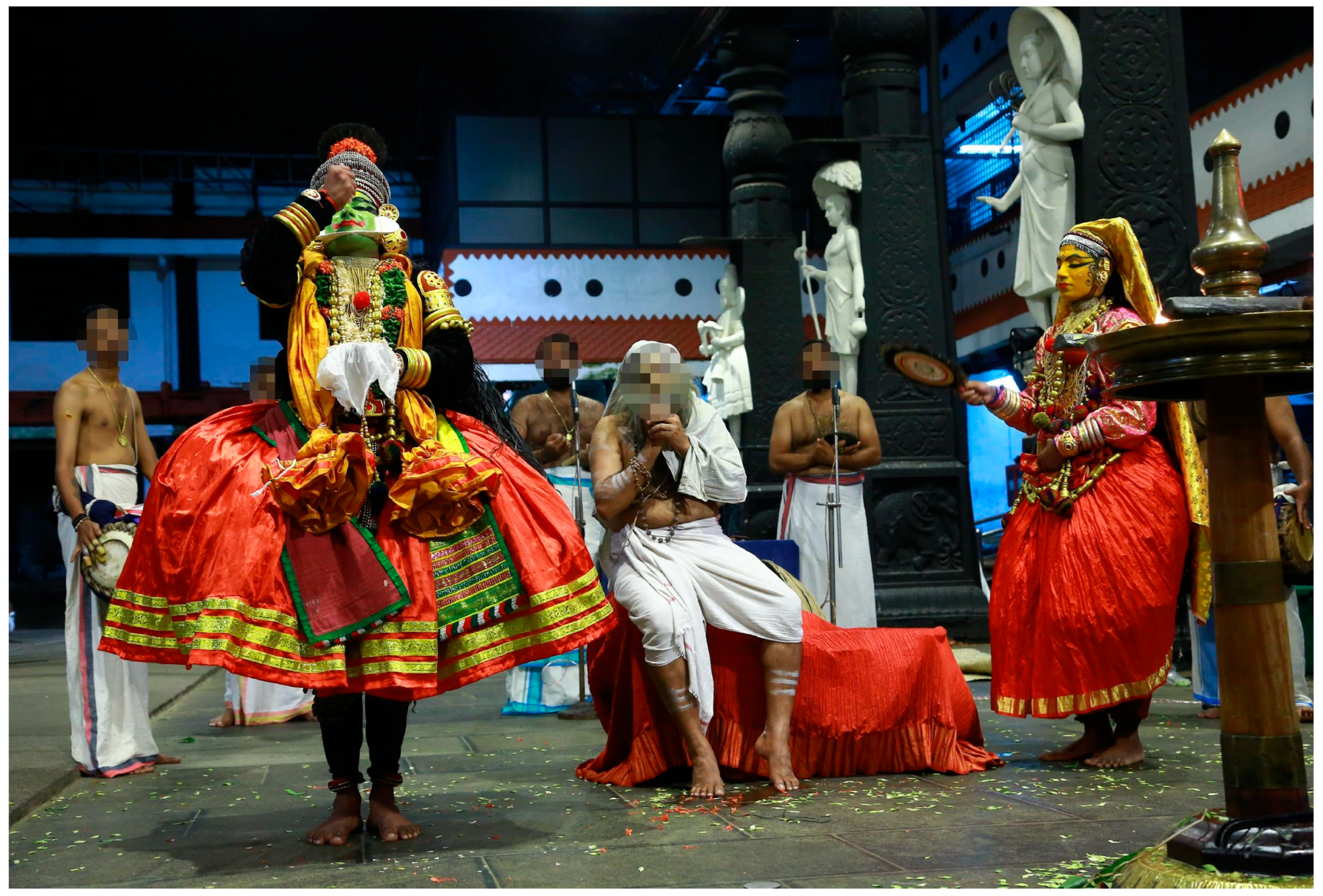
Figure 4. Kaṃsavadham—Kṛṣṇa killing the tyrant Kaṃsa.
Religions 16 01503 g004
Figure 5. Swayaṃvaram—Kṛṣṇa’s marriage to Rukmiṇī and Sathyābhāmā.
Religions 16 01503 g005
Figure 6. Bāṇayuddham. Kṛṣṇa’s battle against the demon Bāṇa.
Religions 16 01503 g006
Figure 7. Vividha Vadham—Kṛṣṇa’s Annihilation of Vividha (minister-turned-demon).
Religions 16 01503 g007
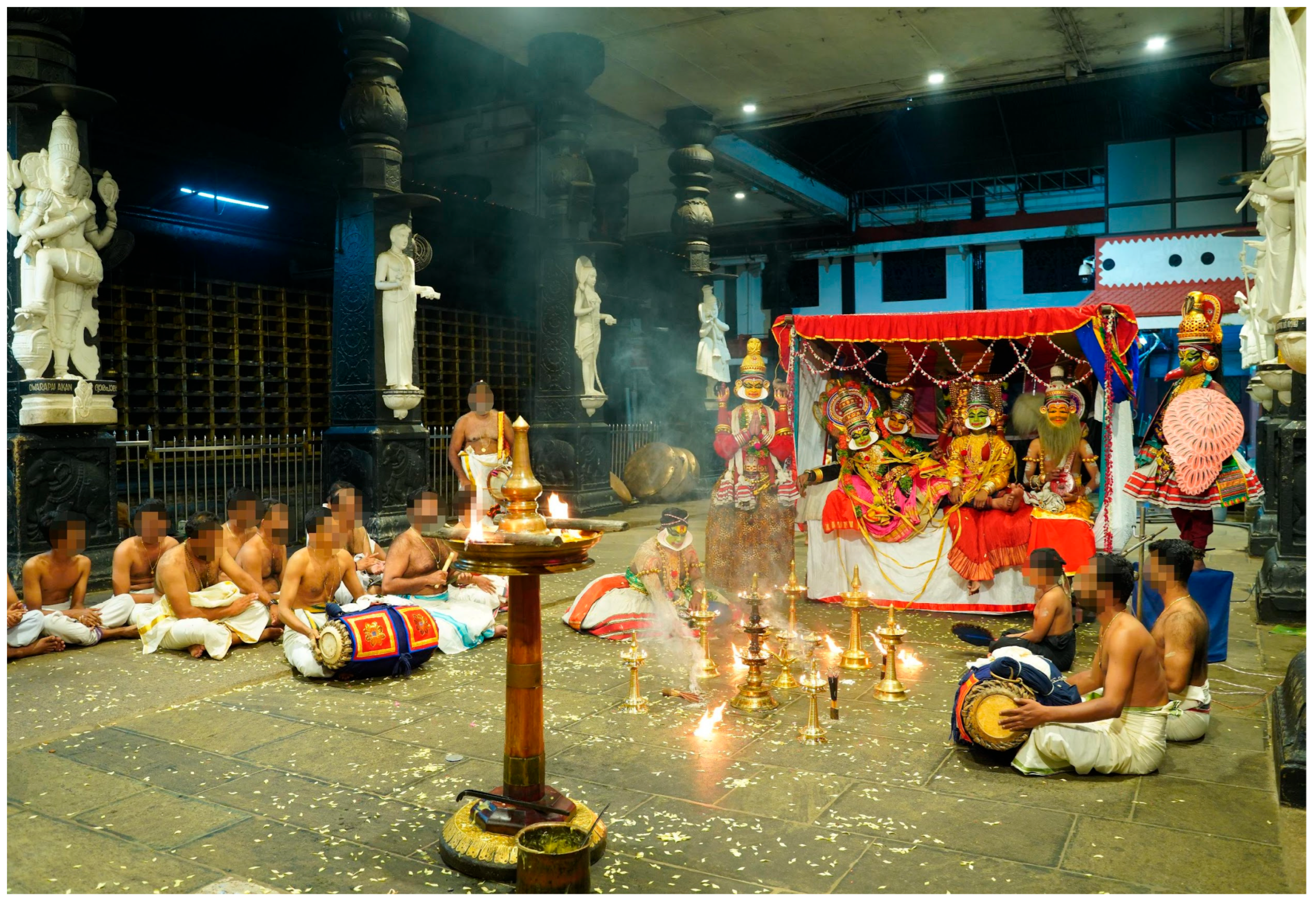
Figure 8. Svargārohaṇam. Kṛṣṇa’s ascension → Avatāram reprised.
Religions 16 01503 g008
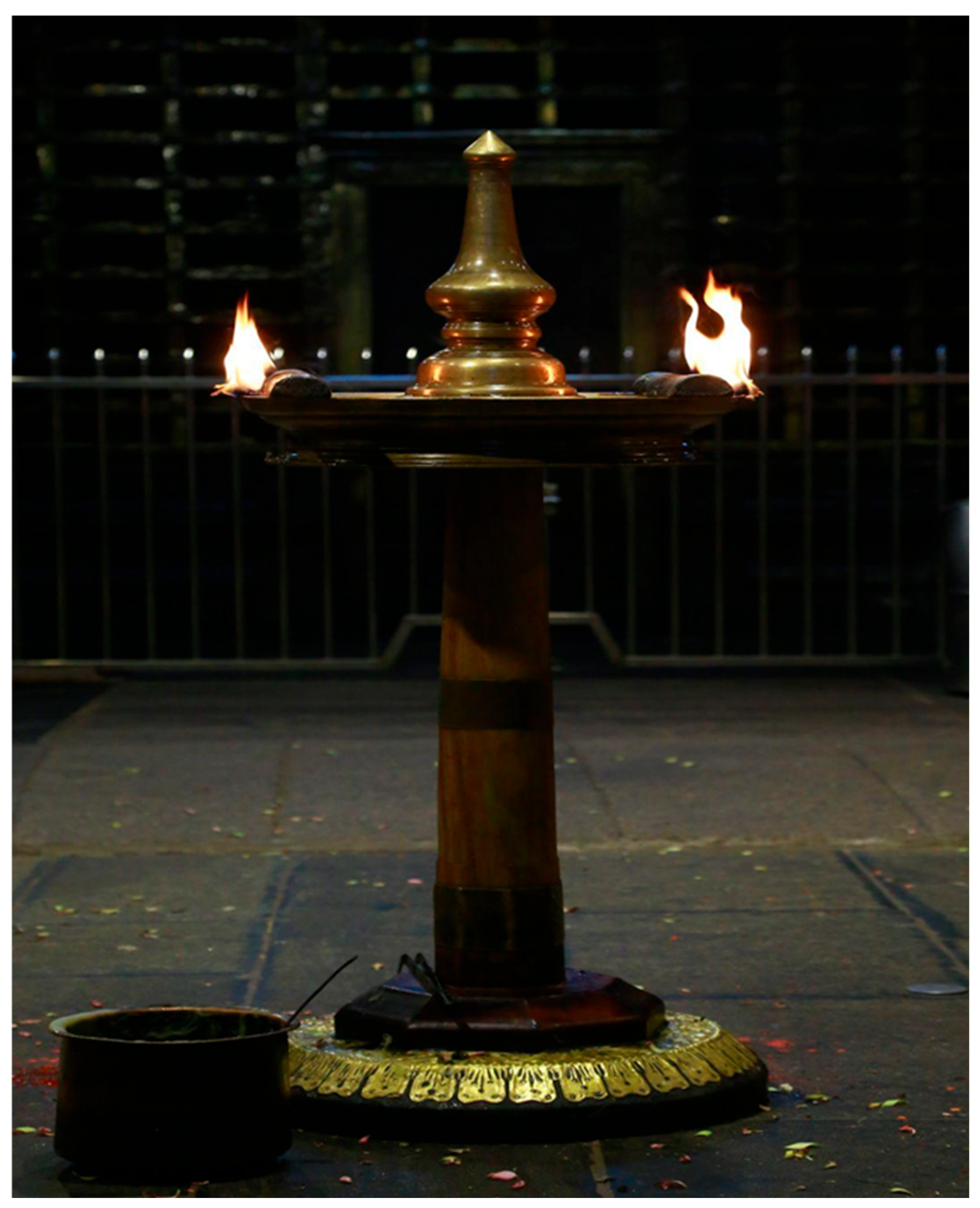
Figure 9. The Kaḷi Viḷakku (an oil lamp of the play) is traditionally kept in front of the performance space within the temple, on the north side of the sanctum sanctorum, marking the ritual and symbolic beginning of the theatrical or ceremonial enactment.
Religions 16 01503 g009
As Table 1 illustrates, the narrative arc from divine birth to ascension and rebirth was meticulously crafted to align Kṛṣṇa’s līlā with Zamorin statecraft. The ninth night’s return to Avatāram was pivotal: it symbolized the eternal return of divine kingship, offering hope against political instability (Dirks 1987, p. 73).
Yet, unlike subaltern traditions like Theyyam where Dalit performers embodied deities to critique caste oppression (Navaneeth 2018, p. 325) Kṛṣṇanāṭṭam’s Sanskrit libretto (Kṛṣṇagīti) and Brahmin-Nāirs exclusivity mirrored Kerala’s feudal hierarchy, tempering Bhakti’s radical potential (Sharma 2003, p. 145). The tradition’s power, however, lay in its profound ritual efficacy. As scholars of Kerala’s performative traditions argue, the elaborate “imitation” of deities in ritual theater does not merely represent but ontologically creates their divine presence (Freeman 2003; Pasty-Abdul Wahid 2017). Performance genres like muṭiyēṯṯu do not simply “represent” deities but work to “actualize” them, creating a “ritually real” presence for the duration of the enactment (Freeman 2003, p. 442). This concept of divine materialization is further elaborated by Pasty-Abdul Wahid, who demonstrates that through precise choreography, costuming, and invocation, the performer’s body becomes the “support” (ādhāra) for the deity, effectively collapsing the distinction between representation and reality (Pasty-Abdul Wahid 2017, p. 12). Cynthia Packert’s work illuminates how ritual ornamentation, elaborate costumes, jewelry, and floral offerings transformed performers into living embodiments of divinity (Packert 2010, p. 58). Thus, in Kṛṣṇanāṭṭam, the actor adorned as Kṛṣṇa became a living vessel of the god, a process culminating in the cyclical narrative’s climax. The nine-night cycle’s return from Svargārohaṇam (ascension) to Avatāram (rebirth) ritually reaffirmed Kṛṣṇa’s—and by extension, the Zamorin’s—eternal return. As Ronit Ricci notes, this mythic repetition, invoking Carl Schmitt’s political theology, functioned to eternalize royal authority (Ricci 2019, p. 112). The Svargārohaṇam to Avatāram sequence was thus a ritual engine of legitimacy, embedding the Zamorin’s kingship within cosmic time by harnessing a divine embodiment accessible only to the highest castes.

3.2. Temple, Caste and Ritual Sovereignty in Medieval Kerala

Many scholars have explored the significance of ritual and ritual sovereignty in medieval Kerala temples. The Periyapuranam (12th-century Saiva hagiology) gives evidence to the coronation ceremony of Cēraman Perumāḷ on the Cēra throne, which made him one of the three crowned monarchs along with the Cōḷa (Valavar) and the Pāṇḍya (Celiyar), whose duty was to carry out justice according to the canons laid down by Manu. The ritual bath, the garland, the smearing, the incense smoke, the ceremonial lamp, food offerings, etc., which were the services offered to the Gods, were offered to him (Veluthat 1982). The significance of claims to higher ritual status by rulers in early medieval Kerala is evident in two key developments: the expanding authority of local administrative units and the growing economic power of temple corporations. Bodies like the sabhā and pariṣad—exclusive councils of elders—wielded considerable influence over the socio-political affairs of the region, particularly in temple administration. Concurrently, the economic foundation of this system rested on temple landholdings, primarily brahmasvom lands, which were managed by and for Brahmins, and devaswom lands, whose revenue was dedicated to temple maintenance and ritual functions. The interests of the corporate entities managing these endowments—the brahmadēya (supporting Brahmin priests)6 and dēvadāna7 (funding temple worship)—consolidated and propagated their ideology through the temple-centric bhakti movement (Veluthat 1982). Both types of endowments were integral to the temple-centered agrarian economy, linking ritual, land control, and local governance. This intricate system of land tenure, temple administration, and ritual practice constituted a robust “ritual ecology” that sustained the political and spiritual order. The temple was the nucleus of this ecology, functioning not just as a religious site but as a central economic, administrative, and cultural institution, whose operation was entirely dependent on a complex, caste-defined hierarchy of labor.
The pre-colonial ritual ecology of Kṛṣṇanāṭṭam was fundamentally structured by the symbiotic yet hierarchical relationship between the Nambūdiri Brahmins and the Nāirs, a duality that extended across Kerala’s social, political, and religious life. The Nambūdiri held ultimate ritual authority as the custodians of temple liturgy and Vedic knowledge, their status defined by a rigid ideology of purity (śuddham). The Nāirs, as the martial and land-holding aristocracy, provided administrative, managerial, and martial support to the temple and the state. This social compact was replicated within Kṛṣṇanāṭṭam, where performance rights were treated as hereditary monopolies (varṇāśrama-dharma- the vedic socioreligious system organizing society into four hierarchical classes [varṇa] and four stages of life [āśrama]), much like in other Kerala performing arts such as Kūṭiyāṭṭam, preserving both artistic knowledge and socio-ritual status within specific lineages.
This hierarchical system, however, was marked by internal tensions and explicit subordination, even among its high-caste participants. A telling example is found in the relationship between the Mallisseri Brahmins, who, as the Ūrāḻar (hereditary trustees), held the formal ownership and ritual authority over the Guruvayur temple, and the Nāirs who provided administrative support. While the Brahmins relied on the Nāir for administrative support and resource mobilization, they simultaneously enforced a rigid ritual boundary, regarding them as second-class participants (P. Narayanan 2019, p. 108). This inherent contradiction—where the Nāirs administrative role was essential yet their ritual status was deemed inferior—is central to understanding the nineteenth-century conflict. The Mallisseri Nambūdiri’s fierce resistance to the Zamorin’s claims was rooted in this caste logic; as a Brahmin Ūrāḻar, he could not accept the authority of a non-Brahmin, and a Kshatriya of questionable purity at that, over a temple traditionally governed by Brahmins. Temple regulations strictly reserved the innermost sanctum and the moment of offering for the officiating Brahmins alone. This dynamic is vividly captured in a recollection by social reformer Mannath Padmanabhan, who noted the palpable discrimination: “I heard that in this Guruvayur temple, ‘Nāir, get out’ was shouted three times... Moreover, ‘Nāirs are not allowed to enter and touch the eastern side …’.” (Padmanabhan 2013, p. 265). Such practices underscore the intense Brahminical exclusivity that characterized early twentieth-century temple culture, a context that also explains the Mallisseri Nambūdiri’s resistance to the Zamorin—a Kshatriya Nāir—exerting administrative authority over the temple in the preceding century.
It was within this framework that the most sacred role of Kṛṣṇa was reserved exclusively for Nambūdiri Brahmins—a privilege rooted in the orthodox principle that only those possessing the highest ritual purity could serve as the vessel (ādhāra) for embodying the divine. This was not merely a performance but a ritual act of becoming. Conversely, other roles, including those of heroes, demons, and queens, were allocated to high-status Nāirs, mirroring their secular feudal roles as warriors and administrators. As Varghese’s detailed studies of temple service groups in Kēraḷam illustrate, the temple machinery was operated by distinct hereditary groups (varṇas), each with specific, non-interchangeable roles from the Nambūdiri Brahmins who performed the core rituals to the various Ambalavāsi castes (like Pushpakas, Warriers, and others) who managed temple upkeep, music, and offerings, and down to the lower-caste groups who handled cleaning, gardening, and other “polluting” tasks (Varghese 2010, pp. 88–96). This division of labor was not merely administrative but was a “ritual taxonomy” that physically enacted and reinforced the cosmic and social order within the temple’s sacred space (Varghese 2012, pp. 1426–427). The management of these groups and the vast temple assets was handled by specific managerial elites, often drawn from the very same high-caste Nambūtiri Brahmin and Nāirs communities that dominated ritual performance. These elites held hereditary positions such as ūralar (trustees) and pōṭṭis (accountants), wielding executive authority over the devasvam properties that funded the entire ritual complex (Varghese 2015, p. 69). Their control was not merely administrative; it was a form of socio-economic and ritual governance. By overseeing land revenue, allocating resources for ceremonies, and regulating temple labor, these managerial elites functioned as the operational core of the “ritual ecology,” directly translating economic capital into sustained religious and social authority. Kṛṣṇanāṭṭam was born from and existed within this meticulously ordered world, its performance roles mirroring this sacred hierarchy.
The kūttampalam (theater hall) within the temple complex represents the ideal ritual locus for performances like Kṛṣṇanāṭṭam—a consecrated architectural space specifically designed for Sanskrit drama. As permanent structures emerged in major Kerala temples between the 14th and 15th centuries (Sarkar 1978), the kūttampalam became a physical manifestation of the integrative yet hierarchical kingship model. Its architecture was not neutral; as Rajagopalan argues, the hall’s design, including its specific proportions, pillars, and oil-lit lamp, was meticulously calibrated to create a ritually charged environment (Rajagopalan 2000, p. 45). Within this sacralized space, performances were believed to ritually affirm the cosmic and social order, a function elucidated by Chakyar, who describes the kūttampalam as a “microcosm” where enacted myths reinforced dharma and royal authority (Chakyar 2015, p. 112). However, the performance history of Kṛṣṇanāṭṭam itself reveals a critical tension within this idealized model. Despite the existence of the kūttampalam at Guruvayur, the tradition was historically performed on a temporary platform (pandal) erected outside the temple’s main walls. This physical separation is not incidental; it is a direct reflection of the caste-based spatial politics that governed the tradition. While the Nambūtiri and Nāirs performers and elite patrons operated within the sanctified boundaries, the very location of the performance enforced a logic of exclusion, barring Dalits and other marginalized communities from both the sacred space and the ritual offering (dṛśya-seva). Thus, the geography of Kṛṣṇanāṭṭam’s performance—simultaneously tied to the temple yet physically excluded from its most consecrated theater—materializes the complex and discriminatory social hierarchies that the “ritual ecology” was built upon (Gentes 1992; Vinai and Prasuna 2017).
Heitzman argues that for rulers in ritual polities, the most important forms of legitimization were the long-term support of religious institutions, such as temples or monasteries-concrete manifestations of the protection of dharma (Heitzman 1991). Rulers in ritual polity, maintained institutions and participated in events that continually renewed their legitimacy as the upholders of cosmic order. Even though Heitzman draws his arguments based on the Chola inscriptions, one can see a similar case in medieval Kerala, too. The Tiruvalla Copper Plate inscriptions of King Bhāskara Ravi Varman (Travancore Archeological Series. Vol. 2.) mention lands allotted, income fixed, and rules laid down for pandīradi pūja, details of land allotted for agram, burning of perpetual lamps, and a schedule of expenditure for Ōṇam festival and individual donations of land. This inscription, dated to 11c CE, is the longest Copper plate inscription received from the land of Kerala, and the temple of Tiruvallavāl̤appan in the 11th c CE is considered to be one of the excellent representatives of fully developed, structured temples of early medieval Kerala. Among the donors who set up the perpetual lamps, there is a mention of the Perumāḷ, referring to the king, Vīraśōḷar and Kīlanaḍigal, identified as Parantaka Chola I and his queen, mother of Rajāditya, Ēran Saňgaran, the governor of Purakīla-nāḍu. Among the donors who made food offerings to the temple was Manukuladichchadēvar (Manukulādityadēva). M. G. S. Narayanan (1969, 2013) argued that Manukulādityadēva and Bhāskara Ravivarman are the same person and the same king on the basis of inscriptional and astronomical evidences. Thus the mentioning of the Perumāḷ, Vīraśōḷar and Kīlanaḍigal, the governor of Purakīla-nāḍu and Manukuladichchadēvar (Manukulādityadēva) as donors to the (large) structural temple of Tiruvalla, showcases the aspect of ritual polity in the land of Kerala and one catered by the rulers, district governors and kings of the time period, those from the Cēra and Pāṇḍya kingdoms.
Along with the spread of Hindu temples, medieval Kerala also saw the spread of the cult of Vaiṣṇavism. Evidence of Vaiṣṇava presence in the southern part of the Indian subcontinent dates to at least the 4th century C.E. The Penukoṇḍa Copper Plate inscription of the Gaṅga king Madhava II (III), dated to the second half of the 5th century CE, begins with an invocation to the god Padmanābha (Viṣṇu), and the records of the early Cālukya kings showcase invocations to the Boar incarnation of Viṣṇu (Varāha) (Jaiswal 2015, pp. 145–50; Veluthat 2009, p. 89). The image of Varāha (incarnation of Viṣṇu in the form of Indian boar, third among the Daśāvatāra) is depicted in their seals and coins and the kings adopted the title of Śrī- pṛthvīvallabha. Jaiswal (2015) traces the process of assimilating non-conformist elements into Vaiṣṇavism to a period preceding the Gupta age8, identifying this strategy as a foundational impulse in the development of Mahābhārata and Purāṇic Vaiṣṇavism. She further contends that, in the early centuries CE, this same process served to accommodate popular cults within a Vaiṣṇava framework, thereby reinforcing the ideological basis of the varṇa social order. The migration and settlement of Vaiṣṇava communities in the region of Kēraḷam, and their subsequent integration into the socio-religious fabric, has been studied by scholars who often contextualize this history alongside the established life and traditions of Kerala’s Brahminical communities (see, for example, (M. G. S. Narayanan 2013, pp. 112–25)). The pōṭṭis (name referring to a group of brahmins) of South Kerala were considered to be the Vaiṣṇavas who came to regions of Thiruvananthapuram (present capital of the state of Kerala, in South Kerala) during the reign of the later Cēra kings (Ganesh 1997).
Medieval Kerala saw the presence and consolidation of social differentiation and stratification according to the occupational groups largely associated with the temples, increased patronage meted out to the temples, and the influence and interference of Kings and local chiefs in the matters of the temple administration revealing the concept of ritual polity and ritual sovereignty in the region.

3.3. Political Catalysts: Warfare, Colonialism, and Ritual Legitimation

The creation of Kṛṣṇanāṭṭam emerged as a direct response to three intersecting crises that threatened the Zamorin dynasty’s sovereignty in mid-17th-century Kerala. Military aggression from Travancore—particularly its annexation of Venad in the 1640s combined with Dutch monopolization of the Malabar pepper trade, severely weakened Calicut’s political and economic authority. These threats found symbolic resonance in episodes like Kaṃsavadham, where Kṛṣṇa’s slaying of the tyrant Kaṃsa allegorized the Zamorin’s struggle against rival powers, framing Travancore as “demonic usurpers” (Haridas 2016, p. 92). As Caleb Simmons argues in other regional contexts, such periods of threat often catalyze the most explicit articulations of “devotional sovereignty,” where kings double down on their unique devotional relationship with the divine to counter earthly challenges to their authority (Simmons 2019, p. 15). Simultaneously, a colonial cultural onslaught intensified as Portuguese Franciscans, entrenched in Kochi since 1503, systematically destroyed Hindu temples and coerced conversions. In response, Kṛṣṇanāṭṭam weaponized Sanskrit liturgy and Vedic chants (Sāma Gāna) as acts of resistance; a strategy colonial ethnographer William Logan later termed “Sanskrit as a shield against the Lusitanian cross” (Logan 1887, p. 391). This cultural defiance permeated the cycle’s structure: the Bāṇayuddham episode, depicting Kṛṣṇa’s battle against the demon Bāṇa, mirrored real-world defenses against European incursions. Compounding these pressures was a ritual sovereignty vacuum. As Travancore’s kings elevated the Padmanābhaswāmy Temple into a rival sacro-political hub, the Zamorins countered by transforming Guruvayur into Dakṣiṇa Dvārakā.
This cosmological rebranding positioned Kṛṣṇa and thus the Zamorin as eternal sovereigns (Kulke 1993, p. 118). The cyclical narrative arc of Kṛṣṇanāṭṭam ritualized this claim: beginning with Avatāram (divine birth amid tyranny) and culminating in Svargārohaṇam (ascension), the ninth night’s return to Avatāram embodied Nicholas Dirks’ concept of “the theater of kingship” (Dirks 1987, p. 74). This repetition was not merely theological but a political manifesto asserting that royal authority, like Kṛṣṇa’s līlā, was eternally renewable despite temporal threats. The Vividha Vadham episode annihilating a treasonous minister-demon further reinforced this ideology, punishing dissent while projecting the dynasty’s indestructibility. Thus, every element of Kṛṣṇanāṭṭam, from its Sanskrit mantras to its cyclical rebirth motif, functioned as ritual armor against disintegration a performance where devotion and dominion became indistinguishable.

4. Aesthetic and Performative Elements of Kṛṣṇanāṭṭam: Negotiating Sanskritization, Vernacularity, and Colonial Disruption

Kṛṣṇanāṭṭam’s aesthetic fabric exemplifies Sheldon Pollock’s “cosmopolitan-vernacular” dialectic (Pollock 2006, p. 23), a dynamic negotiation central to its pre-colonial ritual ecology but irrevocably altered by colonialism. While royal chronicles propagated a myth of “purely indigenous origin” (Ashton-Sikora et al. 2015, p. 27), the tradition was fundamentally syncretic, embodying Veluthat’s “ritual bilingualism” (Veluthat 1993, p. 27) where Sanskritic hegemony and Dravidian vernacularity intertwined under royal patronage. It emerged from a deep-rooted South Indian tradition of sacred theater performed within the ritual precincts of temples, most notably the ancient Kūṭiyāṭṭam (Sanskrit drama) which it closely resembles in its use of the kūttampalam theater hall, its slow, deliberate pacing, and its primary function as an offering (dṛśya-seva, visual service) to the deity. Unlike secular performances, these temple arts were integral to the ritual calendar and were believed to have tangible effects on the cosmos and the patron’s fortunes.

4.1. Sanskritic Cosmopolitanism and Vernacular Substrata: A Contested Synthesis

The Zamorin’s commissioning of the Sanskrit Kṛṣṇagīti, rooted in the pan-Indian Bhāgavata Purāṇa, was a deliberate act of “devotional sovereignty” (Haridas 2016, p. 234). It positioned the dynasty within a Brahminical cosmopolitan order, leveraging Sanskrit’s sacral authority for political legitimation (Pollock 2006, p. 23; Dirks 1987, p. 5). The Zamorin’s use of Sanskrit in Kṛṣṇagīti projected a vision of pan-Indian, cosmopolitan sovereignty, yet this Sanskritic superstructure was built upon and reinforced the local caste hierarchy it ostensibly sought to transcend. This created a fundamental conundrum: the performance’s claim to universal divinity and kingship was mediated through a rigidly exclusive social order. The most sacred role of Kṛṣṇa was reserved for Nambūtiri Brahmins, affirming their ritual supremacy, while other roles were allocated to high-status Nāirs, mirroring the secular feudal structure. This Sanskritic superstructure, however, rested upon deep vernacular foundations. The performance’s sonic and devotional foundation was sopāna sangeetham—a devotional musical tradition sung by Ambalavāsi temple service castes during worship. Its characteristic descending melodic patterns (sopanam), which mirror the stepped architecture of the temple entrance it was traditionally performed upon, were essential for evoking the localized bhakti that emotionally anchored the Sanskrit drama. (Freeman 1998, p. 45; Ranganathan 1975, p. 279). This sonic vernacularity, essential for devotional resonance, existed in tension with the elite language of the text. Even the author’s dual name, Mānavēda/Mānavēdan, reflects this strategic onomastic negotiation between cosmopolitan Sanskrit and vernacular Malayalam identities (Pollock 2006, p. 23).
Material culture further revealed this duality: the divine inspiration for Kṛṣṇa’s peacock-feather crown (Seth 2010, p. 158) symbolized royal-Sanskritic authority, while the grotesque wooden kolam masks for demons, crafted from anacardium wood by marginalized artisans, often from Dalit communities such as the Kolla-Vannans (who were also traditional drummers) or other woodworking castes (Varghese 2013, pp. 940–41), represented subaltern contributions that were systematically marginalized within the ritual sphere. This marginalization, established in the pre-colonial period, was epitomized by rules of ritual purity that deemed the mask polluting after use, forcibly severing the artisan from their creation (Claus 1997, p. 197). Colonialism irrevocably fractured this synthesis. The restructuring of temple economies and the severance of royal patronage (Bayly 1989, p. 203) eroded the very conditions that sustained vernacular practices like Sopāna Sangeetham (Zarrilli 2000, p. 210). This marginalization was accelerated by a colonial—and later, state—administrative focus that privileged the Sanskrit textual heritage of Kṛṣṇanāṭṭam as “classical,” systematically devaluing the localized musical and performative vernaculars that constituted its living devotional core (Freeman 1998). This antiquarian preference for text over practice reflected a broader colonial tendency to codify and fossilize Indian traditions, obscuring their dynamic, vernacular soul in the process.

4.2. Ritual Aesthetics in the Sacred Space: Syncretism Under Siege

Kṛṣṇanāṭṭam functioned as a total ritual theater within the sacralized space of the kūttampalam9, a spatial manifestation of paradigmatic sovereign temple complex (Appadurai 1981, p. 78). Its aesthetic elements were meticulously calibrated for this ritual context:
  • Music: The ensemble śuddha maddaḷam (Temple drum for rhythm), edakka (Hourglass drum for melody), śaṅkhu (conch shell for divine fanfare) employed softer timbres than Kathakali’s chenda (Cylindrical drum), preserving temple sanctity (Zarrilli 2000, p. 78). The Sopāna vocal style, with its cascading melodies, embodied vernacular devotion within the Sanskrit framework.
  • Movement: Choreography fused kūṭiyāṭṭam mudras with the kinetic energy of kalarippayattu10, especially in battle scenes like bāṇayuddham (Zarrilli 2000, p. 78). Circular, flowing patterns contrasted with Kathakali’s angularity, reflecting a distinct temple-based aesthetic.
  • Visual Theology: The unmasked Kṛṣṇa, adorned with peacock feathers and gold-bordered kasavu11, signified transcendent divinity. In stark contrast, the ritually consecrated, oversized demon kolams (Isacco and Dallapiccola 1982, p. 67), crafted by subaltern artisans, materialized evil as chaotic and “other.” The use of pacha (green) for kings and queens established visual codes later adopted by Kathakali. Colonial intervention profoundly disrupted this ecology. The kūttampalam’s transformation from a ritually charged mandala12 into a managed “heritage site” under colonial (and later Devaswom Board) administration severed the art from the integrated political and economic framework of its original sacral purpose. The introduction of ticketed performances for colonial elites (Seth 2010, p. 158) initiated a process of commodification that introduced a new mode of spectatorship alongside the enduring practice of devotional darshan. This shift began to erode the exclusive immersive experience for which the aesthetics were originally calibrated, even as the performance’s core identity as a ritual offering (vazhipadu) was preserved within the temple’s own kūttampalam.

4.3. Kathakali’s Vernacular Turn: Colonial Catalysis and Caste Continuities

The rigid exclusivity of Kṛṣṇanāṭṭam, enforced by Zamorin authority within the temple’s caste-bound space (Vinai and Prasuna 2017, p. 12), became unsustainable under shifting colonial-era power dynamics. The Zamorin’s refusal to share the art with the Kottayam Raja, a political act occurring within the emerging colonial order, directly catalyzed the creation of Rāmanāṭṭam/Kathakali (Zarrilli 2000, p. 67). Kathakali’s shift to Malayalam āṭṭakkathas13—vernacular performance libretti composed in a blend of Sanskrit and Malayalam that guide the enactment of epic narratives—epitomized Pollock’s “vernacularization” (Pollock 2006, p. 23). This was a strategic adaptation for survival and broader reach outside the crumbling temple-royal nexus. Its expanded repertoire (beyond Kṛṣṇa), flamboyant costumes, and codified color symbolism (e.g., red/black for evil) (Barba and Sanzenbach 1967, p. 41) created a more accessible, theatrically potent form suited to courtly and public venues emerging under colonial modernity.
However, this “democratization” was deeply paradoxical. While Kathakali’s vernacular language and secularized stages expanded audiences, colonial land and temple policies inadvertently reinforced caste boundaries within the performative sphere (Menon 2011, p. 154). Kathakali troupes remained dominated by Nāirs and Izhavas14, systematically excluding Dalits (Nagaraj 1993, p. 89). Thus, the vernacular turn, necessitated and shaped by the collapse of the old ritual ecology under colonialism, replicated the social hierarchies of its predecessor. It offered aesthetic liberation from Sanskritic and spatial constraints but failed to dismantle the “caste aesthetics” (Nagaraj 1993, p. 72) governing participation, demonstrating how colonial transformations could simultaneously disrupt and re-entrench social inequities within cultural forms. Kṛṣṇanāṭṭam’s aesthetic legacy persisted in Kathakali, but its ritual core, inseparable from the pre-colonial network of temple space, royal patronage, and sanctioned caste hierarchy, could not survive the colonial rupture.

5. The Architecture of Exclusion: Caste, Space, and Performance in Kṛṣṇanāṭṭam

Kṛṣṇanāṭṭam’s pre-colonial existence was embedded in a complex ritual ecology characterized by the interdependence of Sanskritic temple orthodoxy, caste-based social hierarchies, and the sovereign patronage of the Zamorin dynasty. This arrangement exemplifies Hermann Kulke’s concept of “integrative kingship,” wherein royal support for temple rituals such as Kṛṣṇanāṭṭam functioned not only as religious duty but as a mechanism for legitimizing rulership and integrating disparate social groups within a hierarchically structured sacral polity (Kulke 2014). Appadurai posits that in the pre-colonial context, temples such as Guruvayur served as nodal points where “ritual and governance intersected,” consolidating religious and political authority (Appadurai 1981, p. 78). The Zamorins’ strategic patronage of Kṛṣṇanāṭṭam performed in the temple’s kūttampalam thus operated as an articulation of what Haridas terms “devotional sovereignty,” reinforcing political legitimacy through sacred performance (Haridas 2016, p. 234). This ritual complex was embedded in what Appadurai has described as a “transactional model” of sovereignty, in which the temple functioned as a central institution for spatialized power.
Crucially, the ritual ecology of Kṛṣṇanāṭṭam was shaped by the rigid logic of caste, which structured every aspect of the tradition from performer eligibility and audience composition to spatial organization and the very conception of sacred space. This system was an expression of the pre-colonial “sacralized political order” of Kerala kingship, in which temple and monarchy functioned in tandem to enforce social boundaries through religious orthopraxy (Kulke 1993, p. 112). The intricate regulation of ritual roles and access, premised on notions of purity and pollution, sustained a performative cosmos meticulously bounded by caste hierarchies. D.R. Nagaraj’s notion of “caste aesthetics” is particularly illuminating in this context, capturing how artistic forms like Kṛṣṇanāṭṭam were deeply imbricated with caste structures wherein one’s social position dictated not only the right to perform but also the entitlement to witness (Nagaraj 1993, p. 72). In this way, Kṛṣṇanāṭṭam was not merely a devotional or aesthetic practice but an enactment of a hierarchical social order sacralized through performance.
This caste-based structuring of ritual performance transitions seamlessly into the logic of hereditary privilege and ritual purity that governed the casting of divine and demonic roles within Kṛṣṇanāṭṭam. Performance roles were strictly defined by caste, reflecting the broader division of temple labor and reinforcing a ritual taxonomy where access to sacred embodiment whether as gods, sages, or demons was mediated through inherited social status.

5.1. Hereditary Privilege and Ritual Purity: Casting the Divine and the Demonic

Performance roles in Kṛṣṇanāṭṭam were strictly defined by caste, reflecting the broader division of temple labor. The most sacred role, that of Viṣṇu/Kṛṣṇa, particularly in the climactic Svargārohaṇam, was reserved exclusively for Nambūtiri Brahmins or specific Ambalavasi castes (temple servants like Pushpakas or Warriers), embodying the highest ritual purity (Ashton-Sikora et al. 2015, p. 34; Oral tradition cited). Singers (pattakkar) were also predominantly Brahmins Nambūtiri or Tamil Ayyars) and Ambalavasis, a category of temple-service castes whose specific subgroups—notably the Mārār, Kurupu, and Nampyār—held the hereditary duty of providing instrumental and vocal music in Kerala’s temples (Thurston and Rangachari 1909, p. 234). This allocation of ritual roles aligned with the broader caste-based division of temple labor. This structure exemplifies what Peter Sutherland terms the “tropologies of rule”—the ways in which ritual codes and spatial arrangements naturalize and sanctify a hierarchical social and political order (Sutherland 2021, p. 3). Drummers (maddalam, edakka) could be drawn from Brahmins, Ambalavasis, or the Nāir caste, the latter historically serving as the martial aristocracy and feudal lords with established cultural interests, including kalarippayattu (Ashton-Sikora et al. 2015, p. 34; Krishna Ayyar 1986). Dancers for non-divine roles (heroes, demons, queens) were typically from these same upper-caste groups or subgroups: Nambūtiri, Ayyars, Ambalavasis, or Nāirs. This allocation of roles precisely mirrored the broader social organization of temple labor documented by A. Varghese, wherein these groups held a monopoly over core ritual duties due to their perceived ritual purity (Varghese 2012, p. 1426).
Crucially, the creation of essential performance elements involved subaltern castes whose contributions were indispensable yet systematically marginalized by the ritual logic of caste. This is starkly illustrated by the demonic kolam masks by marginalized Dalit artisans such as the Kolla-Vannans (Varghese 2013, pp. 940–41). However, the caste logic enforced a strict separation, ensuring their role remained ritually effaced: “The mask of the demon was carved by untouchable hands; the dancer who wore it could never touch it again after the performance” (Claus 1997, p. 197). This practice starkly illustrates the reliance on subaltern labor while enforcing boundaries of purity, ensuring the (upper-caste) performer remained uncontaminated. Gender further restricted participation; Kṛṣṇanāṭṭam, like Kūṭiyāṭṭam (performed exclusively by Cākyārs and Nampyārs/Naṅṅyārs, specific upper-caste temple servants (M. G. S. Narayanan 2005, p. 344), was a strictly male domain, with all roles performed by men, reflecting patriarchal norms governing orthodox ritual space (Frazier 2014, p. 279).

5.2. Spatializing Caste Hierarchy: The Kūttampalam as Enforced Boundary

The kūttampalam was the physical and ritual heart of Kṛṣṇanāṭṭam’s exclusionary logic. Permanent structures emerged in major Kerala temples between the 14th and 15th centuries, becoming consecrated spaces where caste hierarchy was performed and reinforced. Access was rigorously policed: only upper caste Hindus like Nambūtiri Brahmins, Ambalavasis, and Nāirs—were permitted entry (Gentes 1992, p. 301; Vinai and Prasuna 2017, p. 12). Dalits and lower castes were categorically barred from witnessing the ritual offering (seva), physically enacting their social exclusion. This spatial segregation mirrored the temporal structure of the nine-day performance cycle, which ritually reaffirmed Brahminical notions of cosmic order and divine kingship. The kūttampalam thus functioned as a microcosm of the paradigmatic sovereign temple, where spatial access defined social and ritual status within the integrative, yet deeply hierarchical, kingship model.
Kṛṣṇanāṭṭam’s rigid, caste-bound structure contrasts sharply with other Kerala forms, highlighting its specific mode of exclusion. Kathakali’s emergence, catalyzed by the Zamorin’s refusal to share Kṛṣṇanāṭṭam (Zarrilli 2000, p. 67), embodied Sheldon Pollock’s “vernacularization” (Pollock 2006, p. 23). Its adoption of Malayalam attakkathas and performance in courts/public spaces broadened its audience significantly. However, this linguistic and spatial democratization did not extend to caste among performers; participation remained restricted to Nāirs and Izhavas, systematically excluding Dalits (Nagaraj 1993, p. 89), thus replicating the core social hierarchy. In stark contrast to the state-managed, Sanskritic, and caste-bound revival of Kṛṣṇanāṭṭam, the Dalit-led ritual tradition of Theyyam presents a radical model of subaltern assertion and symbolic decolonization. Performed predominantly by communities like the Vannāns (washermen) and Malayars (basket weavers) in decentralized village shrines rather than Brahmin-controlled temples, Theyyam inverts the very social hierarchies that Kṛṣṇanāṭṭam’s ritual ecology was designed to enforce. During a Theyyam performance, the Dalit performer undergoes a profound transformation; through invocatory rituals, music, and trance-states, he ceases to be a marginalized individual and becomes the living embodiment of a deity (theyyattam) or ancestral spirit. In this empowered state, he transcends the pollution/purity codes of everyday life. He delivers oracles, blesses assembled devotees—including those from upper castes who would otherwise observe strict social distance—and accepts ritual offerings. (Freeman 2001, p. 156; Kurup 1986; Ashley and Holloman 1982, p. 62; Menon and Sreejith 2021, p. 95) While similar oracular functions are performed by the vellichapadu (oracle), a role often filled by Nāirs in certain Brahminical temples, the Theyyam performer’s embodiment is fundamentally different. The vellichapadu operates within the sanctioned hierarchy of the temple, whereas the Theyyam performer, typically from Dalit or Adivasi communities, channels the deity in decentralized, often open-air village shrines, temporarily inverting the very social and ritual hierarchies that the temple system upholds. In this context, his acts constitute a direct and potent appropriation of ritual privileges typically reserved for the Brahminical elite. This ritual inversion is intensified through potent aesthetic choices that directly critique Brahminical orthodoxy. The use of blood offerings (often of chickens or goats) stands in direct opposition to the vegetarian saattvic offerings of Sanskritic temple ritual, reclaiming a visceral, non-Vedic sacrality. The performance, often culminating in an ecstatic trance, validates direct, personal possession by the divine, bypassing the need for Brahminical textual mediation or ritual intercession (Sankar 2021, p. 108). Therefore, Theyyam is not merely a folk performance but a complex socio-ritual phenomenon. It functions as a major form of worship in the temples of Kannur and neighboring districts, sponsored and attended by devotees across caste lines. Yet, its transformative power lies in the specific ritual mechanics it enacts: when a Dalit performer becomes the deity, the very social hierarchies that structure everyday life are temporarily suspended and inverted. In this possessed state, he challenges the spatial and ritual exclusion of Dalits from sanctified spaces and, through his embodied divinity, demonstrates that the capacity to channel the divine is contingent on devotion and ritual practice, not Brahminical birthright. Its enduring vitality outside the state-managed bureaucratic system highlights the limitations of Kṛṣṇanāṭṭam’s institutional revival and offers a powerful vision of what a truly decolonized religious practice—one that dismantles, rather than preserves, caste aesthetics—might look like.
This intricate architecture of exclusion spatially enforced within the kūttampalam and socially encoded in its hereditary performance roles established a pre-colonial “ritual ecology” that was both rigid and stable. It was precisely this entrenched, sacralized hierarchy that the British colonial administration encountered and, recognizing its utility, chose to manage rather than dismantle. The colonial policy of non-interference in ritual was not a benevolent preservation of tradition but a pragmatic decision to harness this existing system of social control. By refusing to challenge the ritual status quo of temples like Guruvayur, the colonial state effectively outsourced the maintenance of social order to Brahminical authorities, ensuring stability for its own economic and political aims. Thus, the pre-colonial “caste aesthetics” (Nagaraj 1993) became the unspoken groundwork for colonial policy; the bifurcated strategy of administrative intervention and ritual non-interference was a calculated move to govern through the very hierarchies that the architecture of exclusion had already so firmly established.

6. Colonial Intervention and Ritual Non-Interference: The Bifurcated Strategy in Guruvayur

British colonialism pursued a calculated policy of bifurcated engagement with the Guruvayur temple: intensive intervention in its economic and administrative affairs coupled with a deliberate and pragmatic non-interference in its ritual core. The colonial state sought to control the temple’s wealth and leverage its social hierarchy for stability while fearing that disrupting its religious practices would threaten the social harmony essential for their own sovereignty. This strategy was initiated immediately following the British annexation of Malabar in 1792, a region left destabilized by the preceding Mysore invasions (1766–1792). The campaigns of Hyder Ali and Tipu Sultan created a period of profound political turmoil and a power vacuum by displacing the region’s traditional rulers (Haridas 2016). The impact of their campaigns on temple life in Kerala remains a subject of historical debate. Traditional narratives, as documented by A. Sreedhara Menon (1967), emphasize the concealment of sacred images, extortion of funds, and widespread disruption of temple festivals. However, revisionist historiography complicates this picture of pure iconoclasm. Archival evidence, including grants recorded in the Inam Settlement papers and the Old Survey Settlement Register for Guruvayur, confirms that the Mysore rulers also issued dēvadāna (temple endowments), pointing to a pragmatic policy that combined predation with selective patronage (Government of Madras 1906; Ponnani Taluk Settlement Register 1906; Warrier 2004). According to Kurup, in 1786 CE (Kollam Era 963), Tipu Sultan made a grant of 354 acres of brahmadēva land-tax-exempt land traditionally donated to Brahmins for religious or scholarly purposes (Kurup 2014, pp. 28–29), reflects both political negotiation and religious patronage within the regional context. This nuanced view, which interprets Mysore’s actions as strategic statecraft rather than purely religiously motivated destruction, is central to the revisionist scholarship of Brittlebank (1997). As Kareem’s (1973, p. 152) detailed study argues, this was a calculated blend of “predation and patronage.” Furthermore, (Shaheen 2019) demonstrates how this period of upheaval became a pivotal point in Malabar’s social and historical memory, showing that Mysorean rule effectively destabilized the old political order without succeeding in imposing a stable new one. Despite the complexities of their direct patronage, the overarching result was the collapse of the existing political order, creating the unstable context into which the British stepped. The new colonial government pointedly refused to restore the sovereign ‘positions’ of these returning rulers. The Zamorin, who had reigned as the political and ritual head of Malabar for five centuries, was thus transformed into an “ordinary citizen” and pensioner of the Company. He was granted an annual allowance but was stripped of his formal sovereignty and suzerainty over temples (P. Narayanan 2019, p. 107). As the British jurist Moore noted, the suzerainty—the general supervisory authority over temples like Guruvayur—entered a “temporary and uncertain state” (Moore 1950, p. 360).
The English East India Company decided to utilize the information and influence of the deposed kings to establish peace and collect taxes, but without restoring their official status. This power vacuum set the stage for the nineteenth century’s central drama concerning Guruvayur: the protracted legal conflict between the Zamorin and the Mallisseri Nambūdiri (the ūralar, or hereditary Brahmin trustee) over administrative control of the temple. This conflict, which had origins in the first quarter of the eighteenth century, became the primary channel for colonial engagement with the temple. The Mallisseri Nambūdiri fiercely resisted the Zamorin’s claims, a struggle rooted in caste dynamics; he could not accept the authority of a non-Brahmin, and a Kshatriya of questionable purity at that, over a temple traditionally governed by seventy-two Brahmins. This dispute unfolded through a series of “legal dramas” in Anglo-Indian courts, generating a rich archive of colonial interaction. A pivotal 1853 order from the Thrissivaperur District Court (operating under the Kingdom of Cochin’s colonial-era judiciary established by Diwan Colonel Munro in 1812) meticulously regulated the temple’s economy to resolve the conflict. The court order (No. 54 of 1029 K.E.) stipulated arrangements acceptable to Mallisseri, and its clauses are highly revealing:
“… if at any time any action needs to be taken concerning the wealth [of the temple], it must be done together with and with the knowledge of us, Mallisseri.”
“The treasury and accounting records must be kept securely as before by the samudaya15 manager and the accountant, under the custody of both them and Mallisseri. The method for withdrawing money from the treasury shall be done with the knowledge of all, but the accounting records can be fetched and examined by the manager and the accountant alone.”
(Register No. 52, Sl. No. 54. 1854. Malayalam Manuscript, RAK)
This ruling demonstrates the colonial priority: to bureaucratize and control the temple’s wealth and land revenue. The court appointed a manager and an accountant responsible for collecting revenue from Devaswom lands, paying taxes, and maintaining all accounts, effectively inserting a colonial-approved administrative layer. Crucially, however, the order also reinstated the power of the Mallisseri Nambūdiri, ensuring his veto over expenditure and his role in reporting derelict functionaries like the melsanti (chief priest). The British thus legally engineered a power-sharing arrangement that brought the temple’s finances under judicial oversight while leveraging the existing Brahminical social structure for day-to-day control.
Most significantly, the court explicitly did not interfere with or change the daily ritualistic practices or offerings of prayers. This model of economic sanitization without ritual interference reached its apogee with the imposition of the Court of Wards. The Court took over the estates of the Zamorin Kovilakam on 17 September 1915, following an application by the then Zamorin Raja, Manavikrama Kittunni, with J.A. Thome as the first Estate Collector (Annual Administrative Reports of the Court of Wards, 1915–1927). Established in the Madras Presidency in 1804 to prevent the alienation of large estates, the Court brought “new order and discipline” to the temple’s administration. Its published reports show a significant increase in temple income through the systematic management of its assets, including sanitation projects, dairy farming, and agriculture. Yet, these reports consistently highlight that the Court of Wards did not directly involve itself in “temple ritual things.” This policy of ritual non-interference was not born of respect but of pragmatic fear. The British intuitively understood, as Peter Sutherland’s analysis would frame it, that the “ritual sovereignty” of the temple was the bedrock of the local social and political order (“theistic subjection”). To disrupt it would be to dismantle the very mechanism that produced compliant subjects, thereby unleashing instability (Sutherland 2021, p. 12). This finding is supported by Kanakalatha Mukund’s work in Tamil Nadu. She argues that the colonial state and local elites were engaged in a “fierce yet subtle struggle for attention and dominance” where the temple was a central arena of contestation (Mukund 2005, p. 12). The British understood that the ritual domain was the core of the “sacralized political order” (Kulke 1993, p. 112). To disrupt it would be to ignite a broad conflict that could threaten the stability essential for revenue extraction. Thus, as Arjun Appadurai’s model suggests, colonial rule transformed the temple from a “paradigmatic sovereign” into an institution managed through bureaucratic frameworks (Appadurai 1981, p. 78), but it left the ritual core intact. The colonial rupture of Kṛṣṇanāṭṭam’s ritual ecology was therefore profound but specific: it shattered the royal patronage and economic autonomy that sustained the performance while deliberately preserving its aesthetic and ritual shell, now managed by a colonial-era bureaucracy, that was characteristic of the new administrative and political order in the region (Washbrook 1976), rather than a sacred king.

6.1. Colonial Rupture: Dismantling the Ritual Ecology

Colonial rule irreversibly disrupted the ecosystem that had sustained Kṛṣṇanāṭṭam for centuries, dismantling the Zamorin’s integrative model of kingship and replacing it with a fragmented and bureaucratic form of sovereignty. The British defeat of the Zamorin in 1792 severed the essential link between royal patronage and temple ritual, stripping Kṛṣṇanāṭṭam of its political and ceremonial support (Ashton-Sikora et al. 2015, p. 34). More insidiously, colonial economic interventions directly targeted the temple’s financial autonomy. The imposition of the Ryotwari and Permanent Settlement systems dismantled traditional land tenure arrangements such as devasvam holdings, which had historically funded temple activities, including elaborate Kṛṣṇanāṭṭam performances (Kumar 1965, pp. 112–15; Bayly 1989, p. 203). This restructuring was part of a broader transformation of the agrarian and political landscape of the Madras Presidency under colonial rule (Washbrook 1976). Revenue extraction served the priorities of the colonial state, crippling the economic infrastructure needed to sustain ritual culture.
Simultaneously, colonial authorities began interfering in temple administration, displacing traditional Brahminical trustees and sectarian leaders with bureaucratically sanctioned bodies like the Guruvayur Devaswom Board. This shift marked a profound transition from ritual logic to institutional governance, effectively undermining the performative sovereignty that had defined the temple’s earlier function (Presler 1987, p. 67; Bergunder et al. 2015). Without the ritual authority of kingship or the financial security of temple landholdings, Kṛṣṇanāṭṭam entered a period of decline. Economic strangulation led to a steep reduction in the frequency and grandeur of performances, with troupes dwindling and the tradition teetering on the edge of extinction by the late nineteenth and early twentieth centuries (Menon 2011, p. 187). Unlike the Zamorins, the colonial regime had no investment in maintaining Kṛṣṇanāṭṭam as a symbol of sacral kingship or cultural cohesion, accelerating its marginalization in modern Kerala.

6.2. Spatial Transformation and the Seeds of Commodification

Colonialism also redefined the meaning and function of sacred spaces, particularly within temple complexes such as Guruvayur. The kūttampalam, once a ritually potent mandala designed for invoking the divine presence, gradually shifted into a managed performance space under colonial oversight. Driven by the colonial administration’s emphasis on bureaucratic order and revenue generation, temples were restructured to serve as “public devotional centers,” distancing them from their earlier ritual centrality (Bayly 1989, p. 203). This transformation marked a shift from sacral sovereignty to institutional control, altering both the use and perception of temple space.
Alongside this spatial reconfiguration, colonial rule also initiated the commodification of temple performance. As documented by Seth, the introduction of ticketed Kṛṣṇanāṭṭam performances for select European officials and Indian elites during the colonial era reflected an early move toward commodifying what was once a deeply sacred and exclusive ritual practice (Seth 2010, p. 158). While this nominally broadened the audience outside the strict kūttampalam context over time (though access within often remained restricted well into the 20th century (Freeman 2001, p. 156), it did not dismantle caste barriers to participation as performers. Furthermore, colonial policies, while disrupting the old order, often utilized and sometimes reinforced caste categories for administrative control (O’Hanlon 2017, pp. 432–61), potentially calcifying social boundaries even as the economic and political foundations shifted (Vinai and Prasuna 2017, p. 12). This shift introduced a new, secularized form of spectatorship for colonial and elite Indian audiences, who attended ticketed performances. However, for the majority of Hindu devotees, the experience remained one of darshan—a sacred act of witnessing the performance as a ritual offering. This created a dual reception, fragmenting the previously more unified devotional context of the performance. Such changes laid the foundation for Kṛṣṇanāṭṭam’s later framing as a heritage art form, increasingly detached from its ritual origins and absorbed into a broader logic of cultural display.

7. The Contradictions of Revival: Colonial Legacies and Caste in Postcolonial Kṛṣṇanāṭṭam

Kṛṣṇanāṭṭam’s post-independence survival embodies a profound paradox, epitomizing Partha Chatterjee’s concept of the colonial “rule of difference” (Chatterjee 1993, p. 18) and demonstrating the “unfinished decolonization” of Indian religious traditions. Its revival is fundamentally mediated through the Guruvayur Devaswom Board, a direct institutional legacy of colonial administrative interventions designed to manage temple affairs (Bergunder et al. 2015, p. 112; Navaneeth 2018, p. 323). This bureaucratic entity, replacing the organic ritual-patronage network of the Zamorin era, now manages performances, funds, and access, perpetuating colonial administrative structures and symbolizing the fragmented sovereignty that supplanted pre-colonial integrative kingship (Appadurai 1981, p. 78; Kulke 2014, p. 205). The Board’s control ensures survival but anchors the tradition within a colonial framework.
Despite nominal democratization for audiences outside the traditional kūttampalam context including tourists and non-Hindus in secular stagings, caste barriers persist insidiously, revealing the limits of surface-level change. Spatial segregation remains entrenched, as access to the inner sanctum or prime ritual viewing spaces during performances at Guruvayur Temple often still reflects traditional hierarchies, effectively limiting full ritual participation (darshan as sacred engagement) primarily to Savarnas (Fuller 1984, p. 185; Vinai and Prasuna 2017, p. 23). Concurrently, hereditary claims and implicit norms of ritual purity continue to significantly influence performer recruitment, particularly for the most sacred role of Kṛṣṇa, even if less overtly codified than in the pre-colonial era (Ashton-Sikora et al. 2015, p. 89). Most critically, the essential contributions of subaltern communities remain systematically marginalized, epitomized by the Dalit artisans who carved the demonic kolam masks labor ritually erased as “untouchable” historically (Claus 1997, p. 197) yet still unintegrated into the revival’s narrative and practice, perpetuating their exclusion (Krishnan and Jambhulkar 2015). These layered exclusions demonstrate how caste operates through spatial, performative, and narrative channels, resisting superficial reform.
The framing of revived Kṛṣṇanāṭṭam as a “living heritage” spectacle, promoted for cultural tourism and state pride (Guha-Thakurta 2004, p. 287), actively obscures its complex history. This heritage discourse prioritizes aesthetic preservation and Sanskritic “classicism,” often sidelining critical engagement with its social history of exclusion, the vernacular elements like sopāna sangeetham integral to its devotional power (Freeman 1998, p. 45), and the colonial rupture that nearly caused its extinction. The focus on timeless tradition masks the violence of its near-demise and the ongoing marginalization of those whose labor built it.
This elite-centric, bureaucratically managed revival model stands in stark contrast to the trajectory of Dalit-led forms like Theyyam. While Kṛṣṇanāṭṭam relies on state patronage and colonialiy-derived institutions like the Devaswom Board, Theyyam thrives through decentralized, community-based practice in open village spaces (Nayar 2013, p. 89; Saranya et al. 2024). Theyyam’s enduring vitality underscores the limitations of Kṛṣṇanāṭṭam’s institutional model in achieving true decolonization, which demands dismantling hierarchies, not just preserving forms. Even Kathakali’s “vernacular turn” (Pollock 2006, p. 23), while broadening linguistic and spatial access for audiences, replicated caste exclusion among performers in the colonial and early post-colonial eras, with participation historically restricted to Nāirs and Izhavas while systematically barring Dalits (Nagaraj 1993, p. 89). However, the contemporary landscape of Kathakali has undergone a significant democratization, particularly within secular and institutional spaces. Led by major institutions like Kerala Kalamandalam, the art form is now broadly accessible, with selection based on merit and training, welcoming individuals regardless of caste, gender, or religion (Pati 2019). It is crucial to note, however, that this inclusivity is often circumscribed in the few performances still held within temple precincts, where traditional norms regarding the socio-religious identity of performers can persist.
The cyclical narrative of Kṛṣṇanāṭṭam itself—Svargārohaṇam (ascension) followed by Avatāram (rebirth) once symbolized the eternal nature of divine and royal authority (Dirks 1987, p. 5). In the postcolonial context, this rebirth functions as a powerful metaphor for the tradition’s contested survival. It signifies cultural resilience but also embodies profound paradoxes: revival dependent on a colonial relic, devotional expression intertwined with enduring caste exclusion, and heritage celebration obscuring histories of rupture and erasure. Kṛṣṇanāṭṭam thus becomes a microcosm of India’s broader struggle, capable of lunar exploration yet perpetuating ritual exclusion, reflecting Chatterjee’s “rule of difference” haunting heritage reclamation. It stands as a poignant testament to “unfinished decolonization,” where the aspiration for cultural revival remains locked in an unresolved dialectic with the enduring shadows of caste inequality and colonial administrative legacies. The “untouchable hands” that shaped its very material essence remain symbolically and substantively marginalized—their essential contributions acknowledged in scholarly footnotes, perhaps, but their full participation and recognition within the tradition’s sacred ecology still denied (Claus 1997, p. 197). True decolonization would require not just the performance’s survival, but the integration of these erased histories and communities into its living practice and meaning.

8. Conclusions: Ritual Rebirth, Colonial Shadows, and the Unfinished Decolonization of Kṛṣṇanāṭṭam

Kṛṣṇanāṭṭam’s modern identity is split. On one hand, it remains a vital ritual offering (vazhipadu) within the sacred ecology of Guruvayur Temple, a living channel of devotion for countless bhaktas. On the other, it is curated and presented as a postcolonial “heritage” spectacle. This dual faced reality—the tradition as both a sacred act and a cultural commodity—epitomizes the unresolved dialectic between India’s project of cultural reclamation and the enduring weight of its colonial-caste inheritance. Its survival hinges on a profound paradox: revival is sustained by the very colonial systems that nearly destroyed it. The Guruvayur Devaswom Board, a bureaucratic relic of colonial temple administration now funds and frames performances, perpetuating institutional control while simultaneously enabling the tradition’s continuity. Yet this lifeline cannot mask deeper fractures in its ritual ecology.
The tradition’s enduring vitality lies in its living devotional practice, where bhaktas experience performances as transformative communion. Countless devotees witness Kṛṣṇanāṭṭam with devotional rapture, seeking divine blessings (darshan). This sacred engagement manifests in deeply personal votive acts, such as childless parents who commission Avatāram to seek progeny, families who arrange for the performance of Swayamvaram to overcome marital delays, and devotees who offer Bāṇayuddham for success or Kamsavadham to overcome adversaries.
These rituals are sacralized through meticulously structured performances that transcend mere aesthetics. At night, after the sanctum closes, the lighting of the giant lamp (vilakku) (see Figure 8) initiates a liminal space. The sequence opening Keli (musical prelude), thodayam (invocatory dance), and the raising of the thiraseela curtain (demarcating sacred/profane realms) ritually constructs the kūttampalam as a transcendent domain. The purappadu (ceremonial entrance of Kṛṣṇa/Balarama), strategically deployed across episodes (Avatāram initially, mid-way in Kamsavadha, doubly in Vividavadha), marks divine theophany, focusing collective devotional intensity.
Yet this vibrant devotion coexists with unresolved colonial-caste fissures. Spatial hierarchies persist, restricting meaningful ritual participation (such as proximity during darshan or access to consecrated zones) to privileged castes, despite nominal democratization of peripheral audiences. This spatial exclusion is compounded by performative gatekeeping: recruitment for divine roles, particularly Kṛṣṇa, continues to privilege hereditary claims among Brahmin and Ambalavasi lineages, reflecting enduring if less codified ritual purity norms that colonial administrative policies inadvertently calcified. Most critically, the tradition’s narrative and institutional memory systematically erase subaltern contributions, epitomized by the Dalit artisans whose labor carved the ritually essential kolam masks. Their creative legacy remains marginalized echoing the pre-colonial practice where masks touched by “untouchable hands” were deemed polluting post-performance, a symbolic erasure that perpetuates caste violence within the very fabric of revival.
The framing of Kṛṣṇanāṭṭam as Sanskritic “classical heritage” further obscures its vernacular soul, the Malayalam sopāna music that once animated its emotional core and silences its near-extinction under colonial land reforms. The cyclical Avatāram, once a theological symbol of eternal kingship, now embodies this duality: it signifies cultural resilience for devotees seeking rebirth through ritual, yet simultaneously mirrors India’s broader failure to reconcile modernity with exclusion.
True decolonization remains unrealized. As the works of Simmons and Sutherland demonstrate, the pre-colonial model was one of integrative, ritualized sovereignty. The colonial model replaced this with a bifurcated system of bureaucratic economic control and ritual non-interference, which froze and managed caste hierarchies rather than dismantling them. This legacy is evident in the divergent paths of Kerala’s performance traditions. Kṛṣṇanāṭṭam’s state-managed revival stands in stark contrast to Theyyam’s living subaltern defiance, where Dalit performers ritually invert social hierarchies in open village spaces. Even Kathakali’s vernacular turns democratized audiences while replicating caste barriers among performers. Until revival confronts these fissures centering the “untouchable hands” that built its material and spiritual foundations Kṛṣṇanāṭṭam will remain a testament to devotion’s captive potential.
In the end, Kṛṣṇanāṭṭam is India’s unfinished decolonization made visible: a tradition where Avatāram offers ritual rebirth, but not yet liberation. Its cyclical return promises renewal, yet true transformation demands dismantling the colonial logics and caste hierarchies that continue to bind its sacred ecology.

Author Contributions

Conceptualization, A.M.P., M.N.A. and A.V.; methodology, A.M.P., M.N.A. and A.V.; software, Not applicable validation, A.M.P., M.N.A. and A.V.; formal analysis, A.M.P., M.N.A. and A.V.; investigation, A.M.P. resources, A.M.P., M.N.A. and A.V.; data curation, Aswathy Mohan P; writing—original draft preparation, A.M.P., M.N.A. and A.V.; writing—review and editing, A.M.P., M.N.A. and A.V.; visualization, A.M.P., M.N.A. and A.V.; supervision, M.N.A. and A.V.; project administration, A.M.P., M.N.A. and A.V.; funding acquisition, not applicable. All authors have read and agreed to the published version of the manuscript.

Funding

This study was conducted without any external financial support.

Institutional Review Board Statement

Not applicable. The study did not involve human participants or animals. It is based on archival materials, secondary sources, and publicly available documents.

Informed Consent Statement

Not applicable. This study did not involve human participants, as it is based solely on archival materials and secondary sources.

Data Availability Statement

The original contributions presented in this study are included in the article. Further inquiries can be directed to the corresponding author.

Acknowledgments

The authors gratefully acknowledge the support and permission provided by V. K. Vijayan, Chairman of the Guruvayur Devaswom Board, during this study.

Conflicts of Interest

The authors declare no conflicts of interest.

Notes

1
The Zamorin (Malayalam: Sāmūtiri; anglicized from Portuguese Samorim) of Kozhikode (Calicut) was the hereditary title of the Hindu sovereigns who ruled the medieval Kingdom of Kozhikode on the Malabar Coast. The dynasty, which exercised authority from approximately the 12th to the 18th century CE, established its capital at the port city of Kozhikode, transforming it into a preeminent hub of Indian Ocean commerce. The origins of the Zamorin lineage are traced to the chiefs of Eranāḍu (Eranad), a land-locked chiefdom situated in the region of present-day Malappuram district. Their initial political base was at Nediyiruppu in Kondotty. It was from this position that the Eraḍi (ruler of Eranāḍu) gradually expanded his territory, culminating in the foundation of Kozhikode and the subsequent development of its port. Through strategic acumen and control over the lucrative spice trade, this lineage, which thereafter became known as the Zamorin, ascended to become one of the most potent political and economic forces in medieval South India (Haridas 2016).
2
The performance tradition of Kṛṣṇanāṭṭam was fundamentally structured by the hereditary caste roles of Kerala’s pre-colonial social order. A symbiotic division of labor existed between Nambūtiri Brahmins and Nāirs. The Nambūtiris held exclusive rights to the most sacred roles, particularly that of Kṛṣṇa, and to the vocal rendition of the Sanskrit text, embodying the ritual purity and sacerdotal authority essential to the performance’s status as a temple offering (dṛśya-seva). The Nāirs, as the martial and landholding aristocracy, were integral as performers in non-divine roles (heroes, demons), musicians, and as the administrative and protective force that managed the temple lands and revenues which funded the performances. This collaboration between Brahminical ritual supremacy and secular Nāirs authority was the bedrock of the “ritual polity” that sustained artistic traditions like Kṛṣṇanāṭṭam. See (M. G. S. Narayanan 2013)
3
The modern Guruvayur Devaswom Board, established in 1978, is the current statutory body managing the Śrī Kṛṣṇa Temple. Its formation represents the culmination of a long process of state intervention in temple administration, beginning with colonial-era land settlements and formalized through legislation like the 1925 Travancore Religious and Charitable Endowments Act. The Board now oversees all ritual, financial, and administrative functions within a legal framework that mandates the preservation of traditional practices.
4
The theological and political strategy of designating Guruvayur as “Dakṣiṇa Dvārakā” (Southern Dvārakā) integrated the temple into a pan-Indian sacred geography. By linking it to Kṛṣṇa’s legendary royal capital of Dvārakā in Gujarat, this title elevated Guruvayur from a regional shrine to a major subcontinental center of Kṛṣṇa bhakti, emphasizing the deity’s sovereignty (aiśvarya). This move is analyzed in the context of medieval South India by Champakalakshmi (2011).
5
All figures reproduced in this article were photographed by the official photographer of the Guruvayur Devaswom Board, and permission for their use has been duly obtained from the Board. A consent and authorization letter from Dr. V. K. Vijayan, Chairman of the Guruvayur Devaswom Board, confirms the temple authority’s approval to observe the performance and to use the official photographs in this research and publication.
6
In the South Indian context, especially in Kerala and Tamil Nadu, Brahmadēyam villages (Brahmadēya grāmam) were important institutions that shaped local agrarian and ritual economies, as they often resulting in the establishment of Brahmin settlements (agrahārams) near temples, temple culture, and land administration.
7
Dēvadāna (gift to a deity) denotes land or property donated to temples or deities, usually to sustain rituals, festivals, or temple staff.
8
Gupta Age (c. 320–550 CE): A period in ancient Indian history marked by the rule of the Gupta dynasty, noted for developments in art, architecture, literature, science, religion, and the growth of Hindu temple culture.
9
kūttampalam (Malayalam): A consecrated theatre hall within a Kerala temple complex, architecturally integrated into the sacred precinct and designed specifically for the performance of ritual dance-dramas such as Kūṭiyāṭṭam and Kṛṣṇanāṭṭam. It is not a secular stage but a ritually demarcated space where performance functions as a visual offering to the deity.
10
kalarippayattu (Malayalam): A traditional martial art from Kerala with a documented history spanning centuries. It is a holistic system encompassing armed and unarmed combat, physical conditioning, breath control (prāṇāyāma), and therapeutic practices. Its kinetic vocabulary and disciplinary regimes have historically influenced and integrated with Kerala’s performative traditions and ritual arts.
11
kasavu (Malayalam): Refers to the distinctive gold zari (metallic thread) border on a traditionally off-white, handwoven Kerala saree. More broadly, it denotes the saree itself, which is a marker of cultural identity and ritual purity, commonly worn for festivals, temple visits, and other auspicious occasions.
12
maṇḍala (Sanskrit): A geometrically structured diagram used in Hindu and Buddhist traditions for ritual and meditative purposes. Within the kūttampalam, a maṇḍala was ritually drawn on the performance space to consecrate it, transforming the stage into a microcosm aligned with cosmic principles and thereby sacralizing the dramatic enactment.
13
An āṭṭakkatha (plural: āṭṭakkathas) is the dramatic libretto of Kathakali, written in a blend of Malayalam and Sanskrit [Manipravalam], which provides the sung narrative and detailed performance guidelines for the actor-dancers.
14
Izhavas (also spelled Ezhavas) constitute a prominent caste community in Kerala, traditionally associated with toddy tapping, coconut cultivation, and related occupations. Historically categorized as a subordinate or avarna (non-Brahmin) group within Kerala’s caste hierarchy. Is this fine.
15
Samudayam (Malayalam; from Sanskrit samudāya, “collective”): A corporate, caste-based collective responsible for the management and execution of temple affairs in pre-modern Kerala. These communities held hereditary rights and duties pertaining to ritual performance, financial administration, and the oversight of temple lands.

References

  1. Primary Sources 

    Court Order Register No. 52, Sl. No. 54. Malayalam Manuscript. Regional Archives, Kozhikode. 1854.
    Government of Madras. A Collection of Papers Relating to the Inam Settlement in the Madras Presidency [Unpublished manuscript]. Kozhikode Regional Archives, Kozhikode. 1906.
    Kṛṣṇagīti. Composed by Mānavēda Zamorin. 1655.
    Nārāyaṇīyam. Composed by Melpathur Nārāyaṇa Bhaṭṭatiri. 1586.
    Old Survey Settlement Register for Ponnani Taluk, Guruvayur Desham. [Unpublished manuscript, Serial No. 377]. Kozhikode Regional Archives, Kozhikode. 1906.
    Thrissur District Court. “History.” Available online: https://thrissur.dcourts.gov.in/about-department/history/ (accessed on 26 October 2023).
  2. Secondary Sources 

  3. Appadurai, Arjun. 1981. Worship and Conflict Under Colonial Rule: A South Indian Case. Cambridge: Cambridge University Press. [Google Scholar]
  4. Ashley, Katherine, and Barbara Holloman. 1982. From Ritual to Theatre in Kerala. The Drama Review 26: 59–72. [Google Scholar] [CrossRef]
  5. Ashton-Sikora, Mary, Ravi Sikora, A. Purushothaman, and A. Harindranath. 2015. The Royal Temple Theatre of Kṛṣṇanāṭṭam. New Delhi: D.K. Printworld. [Google Scholar]
  6. Barba, Eugenio, and Simonne Sanzenbach. 1967. The Kathakali Theatre. Tulane Drama Review 11: 37–50. [Google Scholar] [CrossRef]
  7. Bayly, Susan. 1989. Saints, Goddesses and Kings: Muslims and Christians in South Indian Society, 1700–1900. Cambridge: Cambridge University Press. [Google Scholar]
  8. Bell, Catherine. 1992. Ritual Theory, Ritual Practice. Oxford: Oxford University Press. [Google Scholar]
  9. Bergunder, Michael, Heiko Frese, and Lambert Schmithausen, eds. 2015. Ritual, Caste, and Religion in Colonial South India. New Delhi: Primus Books. [Google Scholar]
  10. Brittlebank, Kate. 1997. Tipu Sultan’s Search for Legitimacy: Islam and Kingship in a Hindu Domain. Delhi: Oxford University Press. [Google Scholar]
  11. Chakyar, Mani Madhava. 2015. Kutiyattam and Kerala Temples. Delhi: Nag Publishers. [Google Scholar]
  12. Champakalakshmi, R. 1996. The Making of a Religious Tradition: Perspectives from Pre-Colonial South India. New Delhi: Oxford University Press. [Google Scholar]
  13. Champakalakshmi, R. 2011. Religion, Tradition, and Ideology: Pre-Colonial South India. New Delhi: Oxford University Press. [Google Scholar]
  14. Chatterjee, Partha. 1993. The Nation and Its Fragments: Colonial and Postcolonial Histories. Princeton: Princeton University Press. [Google Scholar]
  15. Claus, Peter J. 1997. Scandalizing the Goddess: Ritual Purity and Subaltern Agency in Kṛṣṇanāṭṭam. Asian Folklore Studies 56: 197–213. [Google Scholar]
  16. Dirks, Nicholas B. 1987. The Hollow Crown: Ethnohistory of an Indian Kingdom. Cambridge: Cambridge University Press. [Google Scholar]
  17. Dirks, Nicholas B. 2001. Castes of Mind: Colonialism and the Making of Modern India. Princeton: Princeton University Press. [Google Scholar]
  18. Frazier, Jessica, ed. 2014. The Bloomsbury Companion to Hindu Studies. London: Bloomsbury Academic. [Google Scholar]
  19. Freeman, Rich. 1998. Rubies and Coral: The Lapidary Crafting of Language in Kerala. The Journal of Asian Studies 57: 38–65. [Google Scholar] [CrossRef]
  20. Freeman, Rich. 2001. Religion and Public Culture: Encounters and Identities in Modern South India. Richmond: Curzon Press. [Google Scholar]
  21. Freeman, Rich. 2003. Genre and Society: The Literary Culture of Premodern Kerala. In Literary Cultures in History: Reconstructions from South Asia. Edited by Sheldon Pollock. Berkeley: University of California Press, pp. 437–500. [Google Scholar]
  22. Fuller, Christopher John. 1984. Servants of the Goddess: The Priests of a South Indian Temple. Cambridge: Cambridge University Press. [Google Scholar]
  23. Ganesh, K. N. 1997. Keralathinte Innalekal (The Bygone Days of Kerala). Thiruvananthapuram: Kerala Bhasha Institute. [Google Scholar]
  24. Gentes, Mary J. 1992. Scandalizing the Goddess at Kodungallur. Asian Folklore Studies 51: 295–322. [Google Scholar] [CrossRef]
  25. Guha-Thakurta, Tapati. 2004. Monuments, Objects, Histories: Institutions of Art in Colonial and Postcolonial India. New York: Columbia University Press. [Google Scholar]
  26. Haridas, V. V. 2016. Zamorins and the Political Culture of Medieval Kerala. Hyderabad: Orient BlackSwan. [Google Scholar]
  27. Heitzman, James. 1991. Ritual Polity and Economy: The Transactional Network of an Imperial Temple in Medieval South India. Journal of the Economic and Social History of the Orient 34: 23–54. [Google Scholar] [CrossRef]
  28. Isacco, Enrico, and Anna L. Dallapiccola, eds. 1982. Krishna, the Divine Lover: Myth and Legend Through Indian Art. London: Serindia Publications. Boston: David R. Godine. [Google Scholar]
  29. Jaiswal, Suvira. 2015. The Origin and Development of Vaisnavism: Vaisnavism from 200 BC to AD 500, 2nd ed. New Delhi: Munshiram Manoharlal Publishers Pvt. Ltd. [Google Scholar]
  30. Kareem, C. K. 1973. Kerala Under Haidar Ali and Tipu Sultan. Kochi: Paico Publishing House. [Google Scholar]
  31. Krishna Ayyar, K. V. 1986. Guruvayoor Charitham (History of Guruvayoor). Guruvayoor: Guruvayoor Devaswam Publication. [Google Scholar]
  32. Krishnan, Sanjana, and Rahul C. Jambhulkar. 2015. Caste, Religious Institutions and Domination. Economic and Political Weekly 50: 15–18. [Google Scholar]
  33. Kulke, Hermann. 1993. Kings and Cults: State Formation and Legitimation in India and Southeast Asia. New Delhi: Manohar. [Google Scholar]
  34. Kulke, Hermann. 2014. The Cult of Jagannath and the Regional Tradition of Orissa, rev. ed. New Delhi: Manohar. [Google Scholar]
  35. Kumar, Dharma. 1965. Land and Caste in South India: Agricultural Labour in the Madras Presidency During the Nineteenth Century. Cambridge: Cambridge University Press. [Google Scholar]
  36. Kurup, K. K. N. 1986. Teyyam: A Ritual Dance of Kerala; Thiruvananthapuram: Department of Public Relations, Government of Kerala.
  37. Kurup, K. K. N. 2014. Sree Guruvayoor Kshethram: Puravruthavum Charithravum (Sacred Guruvayur Temple: Antiquarian Accounts and History). Kozhikode: Mathrubhumi Books, pp. 28–29. [Google Scholar]
  38. Logan, William. 1887. Malabar Manual. Madras: Government Press, vol. 2. [Google Scholar]
  39. Menon, A. Sreedhara. 1967. A Survey of Kerala History. Kottayam: DC Books. [Google Scholar]
  40. Menon, A. Sreedhara. 2011. Kerala History and Its Makers. Kottayam: DC Books. [Google Scholar]
  41. Menon, Divya M., and D. Sreejith. 2021. Reading Theyyam as an Archive of the Subaltern Community of Northern Kerala. ShodhKosh: Journal of Visual and Performing Arts 2: 91–101. [Google Scholar] [CrossRef]
  42. Moore, Lewis. 1950. Malabar Law and Customs. Madras: Higginbotham & Co. [Google Scholar]
  43. Mukund, Kanakalatha. 2005. The View from Below: Indigenous Society, Temples, and the Early Colonial State in Tamilnadu, 1700–1835. Hyderabad: Orient Blackswan. [Google Scholar]
  44. Nagaraj, Doḍḍabaḷḷāpura Rāmayya. 1993. The Flaming Feet: A Study of the Dalit Movement in India. Bangalore: South Forum Press. [Google Scholar]
  45. Narayanan, Muttayil G. S. 1969. The Identity and Date of King Manukuladitya. Proceedings of the Indian History Congress 31: 73–78. [Google Scholar]
  46. Narayanan, Muttayil G. S. 2005. Perumals of Kerala: Political and Social Conditions of Kerala Under the Cēra Perumals of Makotai (c. 800 A.D.–1124 A.D.). Thrissur: Xavier Press. [Google Scholar]
  47. Narayanan, Muttayil G. S. 2013. Perumals of Kerala: Brahmin Oligarchy and Ritual Monarchy. Kerala: Cosmo Books. [Google Scholar]
  48. Narayanan, P. 2019. Agre Pashyami. Kerala: Vallathol Vidyapeetham. [Google Scholar]
  49. Navaneeth, Krishnan S. 2018. Revisiting the Endangered Folk Religion of Kerala. Proceedings of the Indian History Congress 79: 329–37. [Google Scholar]
  50. Nayar, S. K. 2013. Theyyam: An Analytical Study of the Folk Culture, Wisdom and Personality. Delhi: Indian Publishers Distributors. [Google Scholar]
  51. O’Hanlon, Rosalind. 2017. Caste and Its Histories in Colonial India: A Reappraisal. Modern Asian Studies 51: 432–61. [Google Scholar] [CrossRef]
  52. Packert, Cyrithia. 2010. The Art of Loving Krishna: Ornamentation and Devotion. Bloomington: Indiana University Press. [Google Scholar]
  53. Padmanabhan, Mannath. 2013. Mannath Padmanabhan’s Speeches, 3rd ed. Changanassery: Nair Service Society, p. 265. [Google Scholar]
  54. Pasty-Abdul Wahid, Marianne. 2017. When Theatre Makes the Ritual Work: Imitation, Materialisation and Reactualization in the Malayali Ritual Theatre Muṭiyēṯṯu. In Theatrical and Ritual Boundaries in South Asia. Edited by Ewa Debicka-Borek and Elisa Ganser. Kraków: Jagiellonian University Press, pp. 34–60. [Google Scholar]
  55. Pati, George. 2019. Religious Devotion and the Poetics of Reform. London: Routledge. [Google Scholar]
  56. Pollock, Sheldon. 2006. The Language of the Gods in the World of Men: Sanskrit, Culture, and Power in Premodern India. Berkeley: University of California Press. [Google Scholar]
  57. Presler, Franklin A. 1987. Religion Under Bureaucracy: Policy and Administration for Hindu Temples in South India. Cambridge: Cambridge University Press. [Google Scholar]
  58. Rajagopalan, L. S. 2000. Kūṭiyāṭṭam: Preliminaries and Performance. Delhi: D.K. Printworld. [Google Scholar]
  59. Ranganathan, Edwina. 1975. KṚṢṆANĀṬṬAM: A Traditional Dance-Drama. Journal of South Asian Literature 10: 275–87. [Google Scholar]
  60. Ricci, Ronit. 2019. Banishment and Belonging: Exile and Diaspora in Sarandib, Lanka and Ceylon. Cambridge: Cambridge University Press. [Google Scholar]
  61. Sankar, Rithwik. 2021. An Analysis of Reverential Ecofear in Theyyam. International Journal of Fear Studies 3: 108–17. [Google Scholar]
  62. Saranya, Jayaprakash A., and M. Senguttuvan. 2024. Upending the Norms: The Representation of Theyyam in Kerala’s Popular Culture. Cogent Arts & Humanities 11: 2438488. [Google Scholar] [CrossRef]
  63. Sarkar, H. 1978. An Architectural Survey of Temples of Kerala. New Delhi: Archaeological Survey of India. [Google Scholar]
  64. Seth, Pepita. 2010. Heaven on Earth: The Universe of Kerala’s Guruvayur Temple. New Delhi: Niyogi Books. [Google Scholar]
  65. Shaheen, K. 2019. The Afterlife of Tipu Sultan S Khudadad Sarkar in Malabar 1792 to the Present. Ph.D. thesis, Jawaharlal Nehru University, New Delhi, India. [Google Scholar]
  66. Sharma, Krishna. 2003. Bhakti and Bhakti Movement: A New Perspective. New Delhi: Munshiram Manoharlal Publishers. [Google Scholar]
  67. Simmons, Caleb. 2019. Devotional Sovereignty: Kingship and Religion in India. New York: Oxford University Press. [Google Scholar]
  68. Simmons, Caleb. 2021. Devotional Foundations of Earthly Sovereignty: Conceptualizing Sovereignty and the Role of Devotion in Narrative Political Theology in Premodern India. Religions 12: 911. [Google Scholar] [CrossRef]
  69. Sutherland, Peter. 2021. T(r)opologies of Rule (rāj): Ritual Sovereignty and Theistic Subjection. Religions 12: 1014. [Google Scholar] [CrossRef]
  70. Thurston, Edgar, and K. Rangachari. 1909. Castes and Tribes of Southern India. Madras: Government Press, vol. 7. [Google Scholar]
  71. Varghese, Anna. 2010. Temple Service Groups in Ancient and Medieval Keralam. Proceedings of the Indian History Congress 71: 88–96. [Google Scholar]
  72. Varghese, Anna. 2012. Temple Ritual Groups in Keralam. Proceedings of the Indian History Congress 73: 1426–27. [Google Scholar]
  73. Varghese, Anna. 2013. Ugachchan or Kottigal-The Temple Drummers from Kēralam. Proceedings of the Indian History Congress 74: 940–41. [Google Scholar]
  74. Varghese, Anna. 2015. Temple Managerial Groups in Early Keralam. Proceedings of the Indian History Congress 76: 69–75. [Google Scholar]
  75. Veluthat, Kesavan. 1982. The Status of the Monarch: A note on the Rituals Pertaining to Kingship and their Significance in the Tamil Country (A.D 600–1200). Proceedings of the Indian History Congress 43: 147–57. [Google Scholar]
  76. Veluthat, Kesavan. 1985. Socio-Political Background of Kulasekhara Alvar’s Bhakti. Journal of Indian History 63: 1–24. [Google Scholar]
  77. Veluthat, Kesavan. 1993. Religious Symbols in Political Legitimation. Social Scientist 21: 23–33. [Google Scholar] [CrossRef]
  78. Veluthat, Kesavan. 2009. The Early Medieval in South India. New Delhi: Oxford University Press. [Google Scholar]
  79. Vinai, R., and E. Prasuna. 2017. Circumscribed by Space and Time: Performative Bodies in South India. New Delhi: Sahitya Akademi. [Google Scholar]
  80. Warrier, S. S. 2004. Guruvayur: God’s Own Temple. Delhi: Samrat Publishers. [Google Scholar]
  81. Washbrook, David A. 1976. The Emergence of Provincial Politics: The Madras Presidency 1870–1920. Cambridge: Cambridge University Press. [Google Scholar]
  82. Zarrilli, Phillip B. 2000. Kathakali Dance-Drama: Where Gods and Demons Come to Play. London: Routledge. [Google Scholar]
Disclaimer/Publisher’s Note: The statements, opinions and data contained in all publications are solely those of the individual author(s) and contributor(s) and not of MDPI and/or the editor(s). MDPI and/or the editor(s) disclaim responsibility for any injury to people or property resulting from any ideas, methods, instructions or products referred to in the content.