The Dual Role of NOX4 in Cardiovascular Diseases: Driver of Oxidative Stress and Mediator of Adaptive Remodeling

Abstract
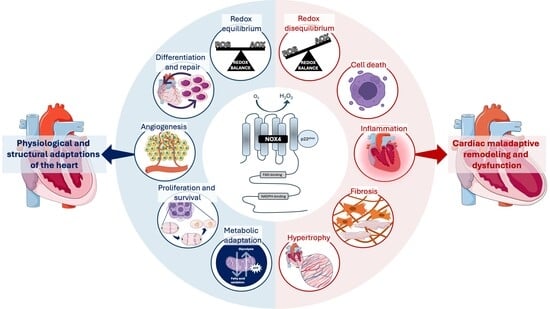
1. Introduction
2. NOX4 Characteristics
2.1. Structure
2.2. Alternative Splicing
2.3. Functional Regulation
2.4. Subcellular Localization in the Heart
3. Physiological Roles and Stress-Responsive Regulation of NOX4 in the Heart
3.1. NOX4 in Cardiac Differentiation and Development
3.2. NOX4 in Angiogenesis and Endothelial Adaptation
3.3. NOX4 in Cardiac Homeostasis and Resistance to Acute Stress
3.4. NOX4 as a Redox Sensor in Response to Environmental Stress
4. NOX4 in Heart Diseases
4.1. Deteleterious Role of Induced NOX4 in Cardiac Pathologies
4.1.1. Contribution of Induced NOX4 in Heart Failure
4.1.2. Contribution of Induced NOX4 in Myocardial Infarction
4.1.3. Contribution of Induced NOX4 in Ischemia/Reperfusion Injury
4.1.4. Contribution of Induced NOX4 in Atrial Fibrillation (AF) and Arrythmia
4.1.5. Contribution of Induced NOX4 in Other Heart Diseases
4.2. Beneficial Role of Induced NOX4 in Cardiac Pathologies
4.2.1. Beneficial Contribution of Induced NOX4 in Heart Failure
4.2.2. Beneficial Contribution of Induced NOX4 in MI
4.2.3. Beneficial Contribution of Induced NOX4 in I/R
4.2.4. Beneficial Contribution of Induced NOX4 Atrial Fibrillation and Arrhythmia
5. Evidence Explaining the Discrepancies of Deleterious and Beneficial Cardiac Effects of NOX4
6. NOX4: A Potential Therapeutic Target for Heart Disease?
6.1. Direct Targeting in Preclinical Models
6.1.1. Direct Targeting in Preclinical Models of Heart Failure
6.1.2. Direct Targeting in Preclinical Models of Myocardial Infarction
6.1.3. Direct Targeting in Preclinical Models of Ischemia/Reperfusion Injury
6.1.4. Direct Targeting in Preclinical Models of Atrial Fibrillation and Arrhythmia
6.1.5. Direct Targeting in Preclinical Models of Diabetic Cardiomyopathy
6.2. Indirect Targeting in Preclinical Models
6.2.1. Indirect Targeting in Preclinical Models of Heart Failure
6.2.2. Indirect Targeting in Preclinical Models of Myocardial Infarction and I/R Injury
6.2.3. Indirect Targeting in Preclinical Models of Atrial Fibrillation
6.2.4. Indirect Targeting in Preclinical Models of Diabetic Cardiomyopathy and Metabolic Disorders
6.2.5. Indirect Targeting in Preclinical Models of Cardiotoxicity and Myocarditis
6.3. Inhibition of NOX4 in Clinical Settings
7. Conclusions
8. Future Perspectives on NOX4 and Cardiac Function
Author Contributions
Funding
Conflicts of Interest
References
- Miller, F.J., Jr. Nox4 NADPH oxidase: Emerging from the veil of darkness. Eur. Heart J. 2015, 36, 3457–3459. [Google Scholar] [CrossRef] [PubMed]
- Ide, T.; Tsutsui, H.; Kinugawa, S.; Suematsu, N.; Hayashidani, S.; Ichikawa, K.; Utsumi, H.; Machida, Y.; Egashira, K.; Takeshita, A. Direct evidence for increased hydroxyl radicals originating from superoxide in the failing myocardium. Circ. Res. 2000, 86, 152–157. [Google Scholar] [CrossRef] [PubMed]
- Gray, S.P.; Shah, A.M.; Smyrnias, I. NADPH oxidase 4 and its role in the cardiovascular system. Vasc. Biol. 2019, 1, H59–H66. [Google Scholar] [CrossRef]
- Kuroda, J.; Ago, T.; Matsushima, S.; Zhai, P.; Schneider, M.D.; Sadoshima, J. NADPH oxidase 4 (Nox4) is a major source of oxidative stress in the failing heart. Proc. Natl. Acad. Sci. USA 2010, 107, 15565–15570. [Google Scholar] [CrossRef]
- Lambeth, J.D. NOX enzymes and the biology of reactive oxygen. Nat. Rev. Immunol. 2004, 4, 181–189. [Google Scholar] [CrossRef]
- Tsutsui, H.; Kinugawa, S.; Matsushima, S. Oxidative stress and heart failure. Am. J. Physiol. Heart Circ. Physiol. 2011, 301, H2181–H2190. [Google Scholar] [CrossRef]
- Chen, F.; Haigh, S.; Barman, S.; Fulton, D.J. From form to function: The role of Nox4 in the cardiovascular system. Front. Physiol. 2012, 3, 412. [Google Scholar] [CrossRef]
- Pare, G.; Chasman, D.I.; Parker, A.N.; Zee, R.R.; Malarstig, A.; Seedorf, U.; Collins, R.; Watkins, H.; Hamsten, A.; Miletich, J.P.; et al. Novel associations of CPS1, MUT, NOX4, and DPEP1 with plasma homocysteine in a healthy population: A genome-wide evaluation of 13 974 participants in the Women’s Genome Health Study. Circ. Cardiovasc. Genet. 2009, 2, 142–150. [Google Scholar] [CrossRef]
- van Meurs, J.B.; Pare, G.; Schwartz, S.M.; Hazra, A.; Tanaka, T.; Vermeulen, S.H.; Cotlarciuc, I.; Yuan, X.; Malarstig, A.; Bandinelli, S.; et al. Common genetic loci influencing plasma homocysteine concentrations and their effect on risk of coronary artery disease. Am. J. Clin. Nutr. 2013, 98, 668–676. [Google Scholar] [CrossRef]
- Raffield, L.M.; Ellis, J.; Olson, N.C.; Duan, Q.; Li, J.; Durda, P.; Pankratz, N.; Keating, B.J.; Wassel, C.L.; Cushman, M.; et al. Genome-wide association study of homocysteine in African Americans from the Jackson Heart Study, the Multi-Ethnic Study of Atherosclerosis, and the Coronary Artery Risk in Young Adults study. J. Hum. Genet. 2018, 63, 327–337. [Google Scholar] [CrossRef] [PubMed]
- Mo, T.; Long, P.; Wang, Y.; Peng, R.; Niu, R.; Wang, Q.; Jiang, J.; Shi, L.; Yang, H.; Xu, C.; et al. Genetic susceptibility, homocysteine levels, and risk of all-cause and cause-specific mortality: A prospective cohort study. Clin. Chim. Acta 2023, 538, 1–8. [Google Scholar] [CrossRef]
- Arumugam, S.; Thandavarayan, R.A.; Veeraveedu, P.T.; Nakamura, T.; Arozal, W.; Sari, F.R.; Giridharan, V.V.; Soetikno, V.; Palaniyandi, S.S.; Harima, M.; et al. Beneficial effects of edaravone, a novel antioxidant, in rats with dilated cardiomyopathy. J. Cell. Mol. Med. 2012, 16, 2176–2185. [Google Scholar] [CrossRef]
- Mishra, P.K.; Tyagi, N.; Sen, U.; Joshua, I.G.; Tyagi, S.C. Synergism in hyperhomocysteinemia and diabetes: Role of PPAR gamma and tempol. Cardiovasc. Diabetol. 2010, 9, 49. [Google Scholar] [CrossRef]
- Xu, Q.; Dalic, A.; Fang, L.; Kiriazis, H.; Ritchie, R.H.; Sim, K.; Gao, X.M.; Drummond, G.; Sarwar, M.; Zhang, Y.Y.; et al. Myocardial oxidative stress contributes to transgenic beta(2)-adrenoceptor activation-induced cardiomyopathy and heart failure. Br. J. Pharmacol. 2011, 162, 1012–1028. [Google Scholar] [CrossRef] [PubMed]
- Maalouf, R.M.; Eid, A.A.; Gorin, Y.C.; Block, K.; Escobar, G.P.; Bailey, S.; Abboud, H.E. Nox4-derived reactive oxygen species mediate cardiomyocyte injury in early type 1 diabetes. Am. J. Physiol. Cell Physiol. 2012, 302, C597–C604. [Google Scholar] [CrossRef]
- Moe, K.T.; Yin, N.O.; Naylynn, T.M.; Khairunnisa, K.; Wutyi, M.A.; Gu, Y.; Atan, M.S.; Wong, M.C.; Koh, T.H.; Wong, P. Nox2 and Nox4 mediate tumour necrosis factor-alpha-induced ventricular remodelling in mice. J. Cell. Mol. Med. 2011, 15, 2601–2613. [Google Scholar] [CrossRef]
- Mongirdiene, A.; Skrodenis, L.; Varoneckaite, L.; Mierkyte, G.; Gerulis, J. Reactive Oxygen Species Induced Pathways in Heart Failure Pathogenesis and Potential Therapeutic Strategies. Biomedicines 2022, 10, 602. [Google Scholar] [CrossRef]
- Thomson, M.J.; Frenneaux, M.P.; Kaski, J.C. Antioxidant treatment for heart failure: Friend or foe? QJM 2009, 102, 305–310. [Google Scholar] [CrossRef]
- van der Pol, A.; van Gilst, W.H.; Voors, A.A.; van der Meer, P. Treating oxidative stress in heart failure: Past, present and future. Eur. J. Heart Fail. 2019, 21, 425–435. [Google Scholar] [CrossRef] [PubMed]
- Teixeira, G.; Szyndralewiez, C.; Molango, S.; Carnesecchi, S.; Heitz, F.; Wiesel, P.; Wood, J.M. Therapeutic potential of NADPH oxidase 1/4 inhibitors. Br. J. Pharmacol. 2017, 174, 1647–1669. [Google Scholar] [CrossRef] [PubMed]
- Bunsawat, K.; Ratchford, S.M.; Alpenglow, J.K.; Park, S.H.; Jarrett, C.L.; Stehlik, J.; Drakos, S.G.; Richardson, R.S.; Wray, D.W. Chronic antioxidant administration restores macrovascular function in patients with heart failure with reduced ejection fraction. Exp. Physiol. 2020, 105, 1384–1395. [Google Scholar] [CrossRef]
- Keith, M.E.; Jeejeebhoy, K.N.; Langer, A.; Kurian, R.; Barr, A.; O’Kelly, B.; Sole, M.J. A controlled clinical trial of vitamin E supplementation in patients with congestive heart failure. Am. J. Clin. Nutr. 2001, 73, 219–224. [Google Scholar] [CrossRef]
- Sylvester, A.L.; Zhang, D.X.; Ran, S.; Zinkevich, N.S. Inhibiting NADPH Oxidases to Target Vascular and Other Pathologies: An Update on Recent Experimental and Clinical Studies. Biomolecules 2022, 12, 823. [Google Scholar] [CrossRef] [PubMed]
- Beretta, M.; Santos, C.X.; Molenaar, C.; Hafstad, A.D.; Miller, C.C.; Revazian, A.; Betteridge, K.; Schroder, K.; Streckfuss-Bomeke, K.; Doroshow, J.H.; et al. Nox4 regulates InsP(3) receptor-dependent Ca2+ release into mitochondria to promote cell survival. EMBO J. 2020, 39, e103530. [Google Scholar] [CrossRef] [PubMed]
- Sciarretta, S.; Zhai, P.; Shao, D.; Zablocki, D.; Nagarajan, N.; Terada, L.S.; Volpe, M.; Sadoshima, J. Activation of NADPH oxidase 4 in the endoplasmic reticulum promotes cardiomyocyte autophagy and survival during energy stress through the protein kinase RNA-activated-like endoplasmic reticulum kinase/eukaryotic initiation factor 2alpha/activating transcription factor 4 pathway. Circ. Res. 2013, 113, 1253–1264. [Google Scholar] [CrossRef] [PubMed]
- O’Neill, K.M.; Campbell, D.C.; Edgar, K.S.; Gill, E.K.; Moez, A.; McLoughlin, K.J.; O’Neill, C.L.; Dellett, M.; Hargey, C.J.; Abudalo, R.A.; et al. NOX4 is a major regulator of cord blood-derived endothelial colony-forming cells which promotes post-ischaemic revascularization. Cardiovasc. Res. 2020, 116, 393–405. [Google Scholar] [CrossRef]
- Pun, S.H.; O’Neill, K.M.; Edgar, K.S.; Gill, E.K.; Moez, A.; Naderi-Meshkin, H.; Malla, S.B.; Hookham, M.B.; Alsaggaf, M.; Madishetti, V.V.; et al. PLAC8-Mediated Activation of NOX4 Signalling Restores Angiogenic Function of Endothelial Colony-Forming Cells in Experimental Hypoxia. Cells 2023, 12, 2220. [Google Scholar] [CrossRef]
- Zhang, M.; Brewer, A.C.; Schroder, K.; Santos, C.X.; Grieve, D.J.; Wang, M.; Anilkumar, N.; Yu, B.; Dong, X.; Walker, S.J.; et al. NADPH oxidase-4 mediates protection against chronic load-induced stress in mouse hearts by enhancing angiogenesis. Proc. Natl. Acad. Sci. USA 2010, 107, 18121–18126. [Google Scholar] [CrossRef]
- Nabeebaccus, A.A.; Zoccarato, A.; Hafstad, A.D.; Santos, C.X.; Aasum, E.; Brewer, A.C.; Zhang, M.; Beretta, M.; Yin, X.; West, J.A.; et al. Nox4 reprograms cardiac substrate metabolism via protein O-GlcNAcylation to enhance stress adaptation. JCI Insight 2017, 2, e96184. [Google Scholar] [CrossRef]
- Zhang, Y.; Murugesan, P.; Huang, K.; Cai, H. NADPH oxidases and oxidase crosstalk in cardiovascular diseases: Novel therapeutic targets. Nat. Rev. Cardiol. 2020, 17, 170–194. [Google Scholar] [CrossRef]
- Ramos-Mondragon, R.; Lozhkin, A.; Vendrov, A.E.; Runge, M.S.; Isom, L.L.; Madamanchi, N.R. NADPH Oxidases and Oxidative Stress in the Pathogenesis of Atrial Fibrillation. Antioxidants 2023, 12, 1833. [Google Scholar] [CrossRef]
- Nabeebaccus, A.A.; Reumiller, C.M.; Shen, J.; Zoccarato, A.; Santos, C.X.C.; Shah, A.M. The regulation of cardiac intermediary metabolism by NADPH oxidases. Cardiovasc. Res. 2023, 118, 3305–3319. [Google Scholar] [CrossRef] [PubMed]
- Visnagri, A.; Oexner, R.R.; Kmiotek-Wasylewska, K.; Zhang, M.; Zoccarato, A.; Shah, A.M. Nicotinamide Adenosine Dinucleotide Phosphate Oxidase-Mediated Signaling in Cardiac Remodeling. Antioxid. Redox Signal 2023, 38, 371–387. [Google Scholar] [CrossRef]
- Matsushima, S.; Tsutsui, H.; Sadoshima, J. Physiological and pathological functions of NADPH oxidases during myocardial ischemia-reperfusion. Trends Cardiovasc. Med. 2014, 24, 202–205. [Google Scholar] [CrossRef] [PubMed]
- Teuber, J.P.; Essandoh, K.; Hummel, S.L.; Madamanchi, N.R.; Brody, M.J. NADPH Oxidases in Diastolic Dysfunction and Heart Failure with Preserved Ejection Fraction. Antioxidants 2022, 11, 1822. [Google Scholar] [CrossRef]
- Muthusamy, V.R.; Kannan, S.; Sadhaasivam, K.; Gounder, S.S.; Davidson, C.J.; Boeheme, C.; Hoidal, J.R.; Wang, L.; Rajasekaran, N.S. Acute exercise stress activates Nrf2/ARE signaling and promotes antioxidant mechanisms in the myocardium. Free Radic. Biol. Med. 2012, 52, 366–376. [Google Scholar] [CrossRef]
- Geiszt, M.; Kopp, J.B.; Varnai, P.; Leto, T.L. Identification of renox, an NAD(P)H oxidase in kidney. Proc. Natl. Acad. Sci. USA 2000, 97, 8010–8014. [Google Scholar] [CrossRef] [PubMed]
- Shiose, A.; Kuroda, J.; Tsuruya, K.; Hirai, M.; Hirakata, H.; Naito, S.; Hattori, M.; Sakaki, Y.; Sumimoto, H. A novel superoxide-producing NAD(P)H oxidase in kidney. J. Biol. Chem. 2001, 276, 1417–1423. [Google Scholar] [CrossRef]
- Rousset, F.; Zhang, L.; Lardy, B.; Morel, F.; Nguyen, M.V.C. Transmembrane Nox4 topology revealed by topological determination by Ubiquitin Fusion Assay, a novel method to uncover membrane protein topology. Biochem. Biophys. Res. Commun. 2020, 521, 383–388. [Google Scholar] [CrossRef]
- Ogboo, B.C.; Grabovyy, U.V.; Maini, A.; Scouten, S.; van der Vliet, A.; Mattevi, A.; Heppner, D.E. Architecture of the NADPH oxidase family of enzymes. Redox Biol. 2022, 52, 102298. [Google Scholar] [CrossRef]
- Nisimoto, Y.; Diebold, B.A.; Cosentino-Gomes, D.; Lambeth, J.D. Nox4: A hydrogen peroxide-generating oxygen sensor. Biochemistry 2014, 53, 5111–5120. [Google Scholar] [CrossRef]
- Martyn, K.D.; Frederick, L.M.; von Loehneysen, K.; Dinauer, M.C.; Knaus, U.G. Functional analysis of Nox4 reveals unique characteristics compared to other NADPH oxidases. Cell. Signal 2006, 18, 69–82. [Google Scholar] [CrossRef]
- Brandes, R.P.; Weissmann, N.; Schroder, K. Nox family NADPH oxidases: Molecular mechanisms of activation. Free Radic. Biol. Med. 2014, 76, 208–226. [Google Scholar] [CrossRef] [PubMed]
- Ambasta, R.K.; Kumar, P.; Griendling, K.K.; Schmidt, H.H.; Busse, R.; Brandes, R.P. Direct interaction of the novel Nox proteins with p22phox is required for the formation of a functionally active NADPH oxidase. J. Biol. Chem. 2004, 279, 45935–45941. [Google Scholar] [CrossRef] [PubMed]
- Prior, K.K.; Leisegang, M.S.; Josipovic, I.; Lowe, O.; Shah, A.M.; Weissmann, N.; Schroder, K.; Brandes, R.P. CRISPR/Cas9-mediated knockout of p22phox leads to loss of Nox1 and Nox4, but not Nox5 activity. Redox Biol. 2016, 9, 287–295. [Google Scholar] [CrossRef]
- Goyal, P.; Weissmann, N.; Rose, F.; Grimminger, F.; Schafers, H.J.; Seeger, W.; Hanze, J. Identification of novel Nox4 splice variants with impact on ROS levels in A549 cells. Biochem. Biophys. Res. Commun. 2005, 329, 32–39. [Google Scholar] [CrossRef]
- Anilkumar, N.; San Jose, G.; Sawyer, I.; Santos, C.X.; Sand, C.; Brewer, A.C.; Warren, D.; Shah, A.M. A 28-kDa splice variant of NADPH oxidase-4 is nuclear-localized and involved in redox signaling in vascular cells. Arterioscler. Thromb. Vasc. Biol. 2013, 33, e104–e112. [Google Scholar] [CrossRef]
- Varga, Z.V.; Pipicz, M.; Baan, J.A.; Baranyai, T.; Koncsos, G.; Leszek, P.; Kusmierczyk, M.; Sanchez-Cabo, F.; Garcia-Pavia, P.; Brenner, G.J.; et al. Alternative Splicing of NOX4 in the Failing Human Heart. Front. Physiol. 2017, 8, 935. [Google Scholar] [CrossRef] [PubMed]
- Matsushima, S.; Kuroda, J.; Zhai, P.; Liu, T.; Ikeda, S.; Nagarajan, N.; Oka, S.; Yokota, T.; Kinugawa, S.; Hsu, C.P.; et al. Tyrosine kinase FYN negatively regulates NOX4 in cardiac remodeling. J. Clin. Investig. 2016, 126, 3403–3416. [Google Scholar] [CrossRef]
- Chen, G.; An, N.; Shen, J.; Chen, H.; Chen, Y.; Sun, J.; Hu, Z.; Qiu, J.; Jin, C.; He, S.; et al. Fibroblast growth factor 18 alleviates stress-induced pathological cardiac hypertrophy in male mice. Nat. Commun. 2023, 14, 1235. [Google Scholar] [CrossRef]
- Lyle, A.N.; Deshpande, N.N.; Taniyama, Y.; Seidel-Rogol, B.; Pounkova, L.; Du, P.; Papaharalambus, C.; Lassegue, B.; Griendling, K.K. Poldip2, a novel regulator of Nox4 and cytoskeletal integrity in vascular smooth muscle cells. Circ. Res. 2009, 105, 249–259. [Google Scholar] [CrossRef] [PubMed]
- Serrander, L.; Cartier, L.; Bedard, K.; Banfi, B.; Lardy, B.; Plastre, O.; Sienkiewicz, A.; Forro, L.; Schlegel, W.; Krause, K.H. NOX4 activity is determined by mRNA levels and reveals a unique pattern of ROS generation. Biochem. J. 2007, 406, 105–114. [Google Scholar] [CrossRef]
- Matsunaga, S.; Kohda, A.; Kamakura, S.; Hayase, J.; Miyano, K.; Shiose, A.; Sumimoto, H. Hypoxia stabilizes the H2O2-producing oxidase Nox4 in cardiomyocytes via suppressing autophagy-related lysosomal degradation. Genes. Cells 2024, 29, 63–72. [Google Scholar] [CrossRef]
- Colston, J.T.; de la Rosa, S.D.; Strader, J.R.; Anderson, M.A.; Freeman, G.L. H2O2 activates Nox4 through PLA2-dependent arachidonic acid production in adult cardiac fibroblasts. FEBS Lett. 2005, 579, 2533–2540. [Google Scholar] [CrossRef]
- Lassegue, B.; Sorescu, D.; Szocs, K.; Yin, Q.; Akers, M.; Zhang, Y.; Grant, S.L.; Lambeth, J.D.; Griendling, K.K. Novel gp91(phox) homologues in vascular smooth muscle cells: Nox1 mediates angiotensin II-induced superoxide formation and redox-sensitive signaling pathways. Circ. Res. 2001, 88, 888–894. [Google Scholar] [CrossRef]
- Ahmarani, L.; Avedanian, L.; Al-Khoury, J.; Perreault, C.; Jacques, D.; Bkaily, G. Whole-cell and nuclear NADPH oxidases levels and distribution in human endocardial endothelial, vascular smooth muscle, and vascular endothelial cells. Can. J. Physiol. Pharmacol. 2013, 91, 71–79. [Google Scholar] [CrossRef] [PubMed]
- Moreno, M.U.; Gallego, I.; Lopez, B.; Gonzalez, A.; Fortuno, A.; San Jose, G.; Valencia, F.; Gomez-Doblas, J.J.; de Teresa, E.; Shah, A.M.; et al. Decreased Nox4 levels in the myocardium of patients with aortic valve stenosis. Clin. Sci. 2013, 125, 291–300. [Google Scholar] [CrossRef]
- Zou, H.X.; Hu, T.; Zhao, J.Y.; Qiu, B.Q.; Zou, C.C.; Xu, Q.R.; Liu, J.C.; Lai, S.Q.; Huang, H. Exploring Dysregulated Ferroptosis-Related Genes in Septic Myocardial Injury Based on Human Heart Transcriptomes: Evidence and New Insights. J. Inflamm. Res. 2023, 16, 995–1015. [Google Scholar] [CrossRef]
- Van Buul, J.D.; Fernandez-Borja, M.; Anthony, E.C.; Hordijk, P.L. Expression and localization of NOX2 and NOX4 in primary human endothelial cells. Antioxid. Redox Signal 2005, 7, 308–317. [Google Scholar] [CrossRef]
- Matsushima, S.; Kuroda, J.; Ago, T.; Zhai, P.; Park, J.Y.; Xie, L.H.; Tian, B.; Sadoshima, J. Increased oxidative stress in the nucleus caused by Nox4 mediates oxidation of HDAC4 and cardiac hypertrophy. Circ. Res. 2013, 112, 651–663. [Google Scholar] [CrossRef] [PubMed]
- Hirschhauser, C.; Bornbaum, J.; Reis, A.; Bohme, S.; Kaludercic, N.; Menabo, R.; Di Lisa, F.; Boengler, K.; Shah, A.M.; Schulz, R.; et al. NOX4 in Mitochondria: Yeast Two-Hybrid-Based Interaction with Complex I Without Relevance for Basal Reactive Oxygen Species? Antioxid. Redox Signal 2015, 23, 1106–1112. [Google Scholar] [CrossRef]
- Camargo, L.L.; Harvey, A.P.; Rios, F.J.; Tsiropoulou, S.; Da Silva, R.N.O.; Cao, Z.; Graham, D.; McMaster, C.; Burchmore, R.J.; Hartley, R.C.; et al. Vascular Nox (NADPH Oxidase) Compartmentalization, Protein Hyperoxidation, and Endoplasmic Reticulum Stress Response in Hypertension. Hypertension 2018, 72, 235–246. [Google Scholar] [CrossRef] [PubMed]
- Ago, T.; Kuroda, J.; Pain, J.; Fu, C.; Li, H.; Sadoshima, J. Upregulation of Nox4 by hypertrophic stimuli promotes apoptosis and mitochondrial dysfunction in cardiac myocytes. Circ. Res. 2010, 106, 1253–1264. [Google Scholar] [CrossRef]
- Li, J.; Stouffs, M.; Serrander, L.; Banfi, B.; Bettiol, E.; Charnay, Y.; Steger, K.; Krause, K.H.; Jaconi, M.E. The NADPH oxidase NOX4 drives cardiac differentiation: Role in regulating cardiac transcription factors and MAP kinase activation. Mol. Biol. Cell 2006, 17, 3978–3988. [Google Scholar] [CrossRef]
- Bekhite, M.M.; Figulla, H.R.; Sauer, H.; Wartenberg, M. Static magnetic fields increase cardiomyocyte differentiation of Flk-1+ cells derived from mouse embryonic stem cells via Ca2+ influx and ROS production. Int. J. Cardiol. 2013, 167, 798–808. [Google Scholar] [CrossRef] [PubMed]
- Crespo, F.L.; Sobrado, V.R.; Gomez, L.; Cervera, A.M.; McCreath, K.J. Mitochondrial reactive oxygen species mediate cardiomyocyte formation from embryonic stem cells in high glucose. Stem Cells 2010, 28, 1132–1142. [Google Scholar] [CrossRef]
- Murray, T.V.; Smyrnias, I.; Shah, A.M.; Brewer, A.C. NADPH oxidase 4 regulates cardiomyocyte differentiation via redox activation of c-Jun protein and the cis-regulation of GATA-4 gene transcription. J. Biol. Chem. 2013, 288, 15745–15759. [Google Scholar] [CrossRef] [PubMed]
- Milosevic, N.; Bekhite, M.M.; Sharifpanah, F.; Ruhe, C.; Wartenberg, M.; Sauer, H. Redox stimulation of cardiomyogenesis versus inhibition of vasculogenesis upon treatment of mouse embryonic stem cells with thalidomide. Antioxid. Redox Signal 2010, 13, 1813–1827. [Google Scholar] [CrossRef]
- Murray, T.V.; Smyrnias, I.; Schnelle, M.; Mistry, R.K.; Zhang, M.; Beretta, M.; Martin, D.; Anilkumar, N.; de Silva, S.M.; Shah, A.M.; et al. Redox regulation of cardiomyocyte cell cycling via an ERK1/2 and c-Myc-dependent activation of cyclin D2 transcription. J. Mol. Cell. Cardiol. 2015, 79, 54–68. [Google Scholar] [CrossRef]
- Crescini, E.; Gualandi, L.; Uberti, D.; Prandelli, C.; Presta, M.; Dell’Era, P. Ascorbic acid rescues cardiomyocyte development in Fgfr1(-/-) murine embryonic stem cells. Biochim. Biophys. Acta 2013, 1833, 140–147. [Google Scholar] [CrossRef]
- Brewer, A.C.; Murray, T.V.; Arno, M.; Zhang, M.; Anilkumar, N.P.; Mann, G.E.; Shah, A.M. Nox4 regulates Nrf2 and glutathione redox in cardiomyocytes in vivo. Free Radic. Biol. Med. 2011, 51, 205–215. [Google Scholar] [CrossRef] [PubMed]
- Hancock, M.; Hafstad, A.D.; Nabeebaccus, A.A.; Catibog, N.; Logan, A.; Smyrnias, I.; Hansen, S.S.; Lanner, J.; Schroder, K.; Murphy, M.P.; et al. Myocardial NADPH oxidase-4 regulates the physiological response to acute exercise. elife 2018, 7, e41044. [Google Scholar] [CrossRef]
- Wang, M.; Murdoch, C.E.; Brewer, A.C.; Ivetic, A.; Evans, P.; Shah, A.M.; Zhang, M. Endothelial NADPH oxidase 4 protects against angiotensin II-induced cardiac fibrosis and inflammation. ESC Heart Fail. 2021, 8, 1427–1437. [Google Scholar] [CrossRef] [PubMed]
- Mongue-Din, H.; Patel, A.S.; Looi, Y.H.; Grieve, D.J.; Anilkumar, N.; Sirker, A.; Dong, X.; Brewer, A.C.; Zhang, M.; Smith, A.; et al. NADPH Oxidase-4 Driven Cardiac Macrophage Polarization Protects Against Myocardial Infarction-Induced Remodeling. JACC Basic. Transl. Sci. 2017, 2, 688–698. [Google Scholar] [CrossRef]
- Zhang, M.; Mongue-Din, H.; Martin, D.; Catibog, N.; Smyrnias, I.; Zhang, X.; Yu, B.; Wang, M.; Brandes, R.P.; Schroder, K.; et al. Both cardiomyocyte and endothelial cell Nox4 mediate protection against hemodynamic overload-induced remodelling. Cardiovasc. Res. 2018, 114, 401–408. [Google Scholar] [CrossRef]
- Smyrnias, I.; Zhang, X.; Zhang, M.; Murray, T.V.; Brandes, R.P.; Schroder, K.; Brewer, A.C.; Shah, A.M. Nicotinamide adenine dinucleotide phosphate oxidase-4-dependent upregulation of nuclear factor erythroid-derived 2-like 2 protects the heart during chronic pressure overload. Hypertension 2015, 65, 547–553. [Google Scholar] [CrossRef]
- Santos, C.X.; Hafstad, A.D.; Beretta, M.; Zhang, M.; Molenaar, C.; Kopec, J.; Fotinou, D.; Murray, T.V.; Cobb, A.M.; Martin, D.; et al. Targeted redox inhibition of protein phosphatase 1 by Nox4 regulates eIF2alpha-mediated stress signaling. EMBO J. 2016, 35, 319–334. [Google Scholar] [CrossRef]
- Wen, X.; Iwata, K.; Ikuta, K.; Zhang, X.; Zhu, K.; Ibi, M.; Matsumoto, M.; Asaoka, N.; Liu, J.; Katsuyama, M.; et al. NOX1/NADPH oxidase regulates the expression of multidrug resistance-associated protein 1 and maintains intracellular glutathione levels. FEBS J. 2019, 286, 678–687. [Google Scholar] [CrossRef]
- Steinhorn, B.; Sartoretto, J.L.; Sorrentino, A.; Romero, N.; Kalwa, H.; Abel, E.D.; Michel, T. Insulin-dependent metabolic and inotropic responses in the heart are modulated by hydrogen peroxide from NADPH-oxidase isoforms NOX2 and NOX4. Free Radic. Biol. Med. 2017, 113, 16–25. [Google Scholar] [CrossRef] [PubMed]
- Yu, Q.; Lee, C.F.; Wang, W.; Karamanlidis, G.; Kuroda, J.; Matsushima, S.; Sadoshima, J.; Tian, R. Elimination of NADPH oxidase activity promotes reductive stress and sensitizes the heart to ischemic injury. J. Am. Heart Assoc. 2014, 3, e000555. [Google Scholar] [CrossRef]
- Matsushima, S.; Kuroda, J.; Ago, T.; Zhai, P.; Ikeda, Y.; Oka, S.; Fong, G.H.; Tian, R.; Sadoshima, J. Broad suppression of NADPH oxidase activity exacerbates ischemia/reperfusion injury through inadvertent downregulation of hypoxia-inducible factor-1alpha and upregulation of peroxisome proliferator-activated receptor-alpha. Circ. Res. 2013, 112, 1135–1149. [Google Scholar] [CrossRef]
- Diebold, I.; Petry, A.; Hess, J.; Gorlach, A. The NADPH oxidase subunit NOX4 is a new target gene of the hypoxia-inducible factor-1. Mol. Biol. Cell 2010, 21, 2087–2096. [Google Scholar] [CrossRef]
- Roshan Milani, S.; Pourheydar, B.; Daneshfar, S.; Chodari, L. Decreased Cardiac NOX4 and SIRT-1 Protein Levels Contribute to Decreased Angiogenesis in the Heart of Diabetic Rats: Rescue Effects of IGF-1 and Exercise. Adv. Pharm. Bull. 2023, 13, 202–209. [Google Scholar] [CrossRef]
- Kasai, S.; Shimizu, S.; Tatara, Y.; Mimura, J.; Itoh, K. Regulation of Nrf2 by Mitochondrial Reactive Oxygen Species in Physiology and Pathology. Biomolecules 2020, 10, 320. [Google Scholar] [CrossRef]
- Lozhkin, A.; Vendrov, A.E.; Ramos-Mondragon, R.; Canugovi, C.; Stevenson, M.D.; Herron, T.J.; Hummel, S.L.; Figueroa, C.A.; Bowles, D.E.; Isom, L.L.; et al. Mitochondrial oxidative stress contributes to diastolic dysfunction through impaired mitochondrial dynamics. Redox Biol. 2022, 57, 102474. [Google Scholar] [CrossRef] [PubMed]
- Li, W.; Wu, X.; Li, M.; Wang, Z.; Li, B.; Qu, X.; Chen, S. Cardamonin Alleviates Pressure Overload-induced Cardiac Remodeling and Dysfunction Through Inhibition of Oxidative Stress. J. Cardiovasc. Pharmacol. 2016, 68, 441–451. [Google Scholar] [CrossRef] [PubMed]
- Stevenson, M.D.; Canugovi, C.; Vendrov, A.E.; Hayami, T.; Bowles, D.E.; Krause, K.H.; Madamanchi, N.R.; Runge, M.S. NADPH Oxidase 4 Regulates Inflammation in Ischemic Heart Failure: Role of Soluble Epoxide Hydrolase. Antioxid. Redox Signal 2019, 31, 39–58. [Google Scholar] [CrossRef]
- Zeng, S.Y.; Chen, X.; Chen, S.R.; Li, Q.; Wang, Y.H.; Zou, J.; Cao, W.W.; Luo, J.N.; Gao, H.; Liu, P.Q. Upregulation of Nox4 promotes angiotensin II-induced epidermal growth factor receptor activation and subsequent cardiac hypertrophy by increasing ADAM17 expression. Can. J. Cardiol. 2013, 29, 1310–1319. [Google Scholar] [CrossRef] [PubMed]
- Cheng, D.; Tu, W.; Chen, L.; Wang, H.; Wang, Q.; Liu, H.; Zhu, N.; Fang, W.; Yu, Q. MSCs enhances the protective effects of valsartan on attenuating the doxorubicin-induced myocardial injury via AngII/NOX/ROS/MAPK signaling pathway. Aging 2021, 13, 22556–22570. [Google Scholar] [CrossRef]
- Zhong, Z.; Tian, Y.; Luo, X.; Zou, J.; Wu, L.; Tian, J. Extracellular Vesicles Derived from Human Umbilical Cord Mesenchymal Stem Cells Protect Against DOX-Induced Heart Failure Through the miR-100-5p/NOX4 Pathway. Front. Bioeng. Biotechnol. 2021, 9, 703241. [Google Scholar] [CrossRef]
- Xiong, X.; Li, J.; Chen, Z.; Luo, C.; Wei, W.; Li, B.; Kang, Y.; Nong, X.; Ai, F.; Zhang, J. Peroxiredoxin 3 Inhibits Cardiac Fibrosis in Mice via NOX4-P38 Signalling. Cell J. 2023, 25, 391–398. [Google Scholar] [CrossRef]
- Xu, X.; Jiang, T.; Li, Y.; Kong, L. Endostatin attenuates heart failure via inhibiting reactive oxygen species in myocardial infarction rats. Biosci. Rep. 2021, 41, BSR20200787. [Google Scholar] [CrossRef]
- Chen, R.; Chen, W.; Huang, X.; Rui, Q. Tanshinone IIA attenuates heart failure via inhibiting oxidative stress in myocardial infarction rats. Mol. Med. Rep. 2021, 23, 404. [Google Scholar] [CrossRef]
- Zhang, Y.; Shimizu, H.; Siu, K.L.; Mahajan, A.; Chen, J.N.; Cai, H. NADPH oxidase 4 induces cardiac arrhythmic phenotype in zebrafish. J. Biol. Chem. 2014, 289, 23200–23208. [Google Scholar] [CrossRef]
- He, X.; Liu, J.; Gu, F.; Chen, J.; Lu, Y.W.; Ding, J.; Guo, H.; Nie, M.; Kataoka, M.; Lin, Z.; et al. Cardiac CIP protein regulates dystrophic cardiomyopathy. Mol. Ther. 2022, 30, 898–914. [Google Scholar] [CrossRef]
- Schnelle, M.; Sawyer, I.; Anilkumar, N.; Mohamed, B.A.; Richards, D.A.; Toischer, K.; Zhang, M.; Catibog, N.; Sawyer, G.; Mongue-Din, H.; et al. NADPH oxidase-4 promotes eccentric cardiac hypertrophy in response to volume overload. Cardiovasc. Res. 2021, 117, 178–187. [Google Scholar] [CrossRef]
- Kakoki, M.; Bahnson, E.M.; Hagaman, J.R.; Siletzky, R.M.; Grant, R.; Kayashima, Y.; Li, F.; Lee, E.Y.; Sun, M.T.; Taylor, J.M.; et al. Engulfment and cell motility protein 1 potentiates diabetic cardiomyopathy via Rac-dependent and Rac-independent ROS production. JCI Insight 2019, 4, e127660. [Google Scholar] [CrossRef] [PubMed]
- Vendrov, A.E.; Xiao, H.; Lozhkin, A.; Hayami, T.; Hu, G.; Brody, M.J.; Sadoshima, J.; Zhang, Y.Y.; Runge, M.S.; Madamanchi, N.R. Cardiomyocyte NOX4 regulates resident macrophage-mediated inflammation and diastolic dysfunction in stress cardiomyopathy. Redox Biol. 2023, 67, 102937. [Google Scholar] [CrossRef]
- Theccanat, T.; Philip, J.L.; Razzaque, A.M.; Ludmer, N.; Li, J.; Xu, X.; Akhter, S.A. Regulation of cellular oxidative stress and apoptosis by G protein-coupled receptor kinase-2; The role of NADPH oxidase 4. Cell. Signal 2016, 28, 190–203. [Google Scholar] [CrossRef] [PubMed]
- Yang, Q.; Wen, L.; Meng, Z.; Chen, Y. Blockage of endoplasmic reticulum stress attenuates nilotinib-induced cardiotoxicity by inhibition of the Akt-GSK3β-Nox4 signaling. Eur. J. Pharmacol. 2018, 822, 85–94. [Google Scholar] [CrossRef] [PubMed]
- Sun, Y.; Zhang, L.; Liu, J.; Zhang, X.; Su, Y.; Yin, Q.; He, S. Effects of lunar dust simulant on cardiac function and fibrosis in rats. Toxicol. Res. 2019, 8, 499–508. [Google Scholar] [CrossRef]
- Tao, Y.; Zhou, H.; Huang, L.; Xu, X.; Huang, Y.; Ma, L.; Li, L.; Yao, X.; Zhang, R.; Zhang, Y.; et al. Schisandrin B Protects against Acute Ethanol-Induced Cardiac Injury by Downregulating Autophagy via the NOX4/ROS Pathway. Pharmacology 2021, 106, 177–188. [Google Scholar] [CrossRef]
- Chen, L.; Zhao, M.; Li, J.; Wang, Y.; Bao, Q.; Wu, S.; Deng, X.; Tang, X.; Wu, W.; Liu, X. Critical role of X-box binding protein 1 in NADPH oxidase 4-triggered cardiac hypertrophy is mediated by receptor interacting protein kinase 1. Cell Cycle 2017, 16, 348–359. [Google Scholar] [CrossRef]
- Kyriazis, I.D.; Hoffman, M.; Gaignebet, L.; Lucchese, A.M.; Markopoulou, E.; Palioura, D.; Wang, C.; Bannister, T.D.; Christofidou-Solomidou, M.; Oka, S.I.; et al. KLF5 Is Induced by FOXO1 and Causes Oxidative Stress and Diabetic Cardiomyopathy. Circ. Res. 2021, 128, 335–357. [Google Scholar] [CrossRef]
- Labbe, P.; Martel, C.; Shi, Y.F.; Montezano, A.; He, Y.; Gillis, M.A.; Higgins, M.E.; Villeneuve, L.; Touyz, R.; Tardif, J.C.; et al. Knockdown of ANGPTL2 promotes left ventricular systolic dysfunction by upregulation of NOX4 in mice. Front. Physiol. 2024, 15, 1320065. [Google Scholar] [CrossRef] [PubMed]
- Kang, J.Y.; Mun, D.; Chun, Y.; Park, D.S.; Kim, H.; Yun, N.; Joung, B. Engineered small extracellular vesicle-mediated NOX4 siRNA delivery for targeted therapy of cardiac hypertrophy. J. Extracell. Vesicles 2023, 12, e12371. [Google Scholar] [CrossRef] [PubMed]
- Huang, Q.; Chen, Y. NADPH oxidase 4 contributes to oxidative stress in a mouse model of myocardial infarction. Physiol. Res. 2023, 72, 177–186. [Google Scholar] [CrossRef]
- Wu, C.Z.; Li, X.; Hong, L.; Han, Z.N.; Liu, Y.; Wei, C.X.; Cui, X. NOX4/Src regulates ANP secretion through activating ERK1/2 and Akt/GATA4 signaling in beating rat hypoxic atria. Korean J. Physiol. Pharmacol. 2021, 25, 159–166. [Google Scholar] [CrossRef]
- Li, Z.Y.; Liu, Y.; Wang, Y.Y.; Li, X.; Han, Z.N.; Hong, L.; Li, Y.S.; Cui, X. NOX4 stimulates ANF secretion via activation of the Sirt1/Nrf2/ATF3/4 axis in hypoxic beating rat atria. Mol. Med. Rep. 2022, 25, 84. [Google Scholar] [CrossRef]
- Han, Z.N.; Lin, X.X.; Wang, Y.Y.; Ding, R.; Hong, L.; Cui, X. Cholecystokinin Octapeptide Promotes ANP Secretion through Activation of NOX4-PGC-1alpha-PPARalpha/PPARgamma Signaling in Isolated Beating Rat Atria. Oxid. Med. Cell. Longev. 2022, 2022, 5905374. [Google Scholar] [CrossRef] [PubMed]
- Siu, K.L.; Lotz, C.; Ping, P.; Cai, H. Netrin-1 abrogates ischemia/reperfusion-induced cardiac mitochondrial dysfunction via nitric oxide-dependent attenuation of NOX4 activation and recoupling of NOS. J. Mol. Cell. Cardiol. 2015, 78, 174–185. [Google Scholar] [CrossRef]
- Xiao, L.; Gu, Y.; Ren, G.; Chen, L.; Liu, L.; Wang, X.; Gao, L. miRNA-146a Mimic Inhibits NOX4/P38 Signalling to Ameliorate Mouse Myocardial Ischaemia Reperfusion (I/R) Injury. Oxid. Med. Cell. Longev. 2021, 2021, 6366254. [Google Scholar] [CrossRef]
- Lu, G.; Xu, C.; Tang, K.; Zhang, J.; Li, Q.; Peng, L.; Wang, Y.; Huang, Z.; Gao, X. H2S inhibits angiotensin II-induced atrial Kv1.5 upregulation by attenuating Nox4-mediated ROS generation during atrial fibrillation. Biochem. Biophys. Res. Commun. 2017, 483, 534–540. [Google Scholar] [CrossRef] [PubMed]
- Yeh, Y.H.; Kuo, C.T.; Chan, T.H.; Chang, G.J.; Qi, X.Y.; Tsai, F.; Nattel, S.; Chen, W.J. Transforming growth factor-beta and oxidative stress mediate tachycardia-induced cellular remodelling in cultured atrial-derived myocytes. Cardiovasc. Res. 2011, 91, 62–70. [Google Scholar] [CrossRef]
- Yeh, Y.H.; Kuo, C.T.; Chang, G.J.; Qi, X.Y.; Nattel, S.; Chen, W.J. Nicotinamide adenine dinucleotide phosphate oxidase 4 mediates the differential responsiveness of atrial versus ventricular fibroblasts to transforming growth factor-beta. Circ. Arrhythm. Electrophysiol. 2013, 6, 790–798. [Google Scholar] [CrossRef] [PubMed]
- Philip, J.L.; Razzaque, M.A.; Han, M.; Li, J.; Theccanat, T.; Xu, X.; Akhter, S.A. Regulation of mitochondrial oxidative stress by β-arrestins in cultured human cardiac fibroblasts. Dis. Model. Mech. 2015, 8, 1579–1589. [Google Scholar] [CrossRef]
- Cucoranu, I.; Clempus, R.; Dikalova, A.; Phelan, P.J.; Ariyan, S.; Dikalov, S.; Sorescu, D. NAD(P)H oxidase 4 mediates transforming growth factor-beta1-induced differentiation of cardiac fibroblasts into myofibroblasts. Circ. Res. 2005, 97, 900–907. [Google Scholar] [CrossRef]
- Shih, Y.C.; Chen, C.L.; Zhang, Y.; Mellor, R.L.; Kanter, E.M.; Fang, Y.; Wang, H.C.; Hung, C.T.; Nong, J.Y.; Chen, H.J.; et al. Endoplasmic Reticulum Protein TXNDC5 Augments Myocardial Fibrosis by Facilitating Extracellular Matrix Protein Folding and Redox-Sensitive Cardiac Fibroblast Activation. Circ. Res. 2018, 122, 1052–1068. [Google Scholar] [CrossRef] [PubMed]
- Liu, X.H.; Pan, L.L.; Deng, H.Y.; Xiong, Q.H.; Wu, D.; Huang, G.Y.; Gong, Q.H.; Zhu, Y.Z. Leonurine (SCM-198) attenuates myocardial fibrotic response via inhibition of NADPH oxidase 4. Free Radic. Biol. Med. 2013, 54, 93–104. [Google Scholar] [CrossRef]
- Pan, L.L.; Liu, X.H.; Shen, Y.Q.; Wang, N.Z.; Xu, J.; Wu, D.; Xiong, Q.H.; Deng, H.Y.; Huang, G.Y.; Zhu, Y.Z. Inhibition of NADPH oxidase 4-related signaling by sodium hydrosulfide attenuates myocardial fibrotic response. Int. J. Cardiol. 2013, 168, 3770–3778. [Google Scholar] [CrossRef]
- Siddesha, J.M.; Valente, A.J.; Sakamuri, S.S.; Yoshida, T.; Gardner, J.D.; Somanna, N.; Takahashi, C.; Noda, M.; Chandrasekar, B. Angiotensin II stimulates cardiac fibroblast migration via the differential regulation of matrixins and RECK. J. Mol. Cell. Cardiol. 2013, 65, 9–18. [Google Scholar] [CrossRef]
- Somanna, N.K.; Valente, A.J.; Krenz, M.; Fay, W.P.; Delafontaine, P.; Chandrasekar, B. The Nox1/4 Dual Inhibitor GKT137831 or Nox4 Knockdown Inhibits Angiotensin-II-Induced Adult Mouse Cardiac Fibroblast Proliferation and Migration. AT1 Physically Associates with Nox4. J. Cell. Physiol. 2016, 231, 1130–1141. [Google Scholar] [CrossRef]
- Siddesha, J.M.; Valente, A.J.; Sakamuri, S.S.; Gardner, J.D.; Delafontaine, P.; Noda, M.; Chandrasekar, B. Acetylsalicylic acid inhibits IL-18-induced cardiac fibroblast migration through the induction of RECK. J. Cell. Physiol. 2014, 229, 845–855. [Google Scholar] [CrossRef] [PubMed]
- Wang, P.; Zhou, S.; Xu, L.; Lu, Y.; Yuan, X.; Zhang, H.; Li, R.; Fang, J.; Liu, P. Hydrogen peroxide-mediated oxidative stress and collagen synthesis in cardiac fibroblasts: Blockade by tanshinone IIA. J. Ethnopharmacol. 2013, 145, 152–161. [Google Scholar] [CrossRef]
- Avlas, O.; Bragg, A.; Fuks, A.; Nicholson, J.D.; Farkash, A.; Porat, E.; Aravot, D.; Levy-Drummer, R.S.; Cohen, C.; Shainberg, A.; et al. TLR4 Expression Is Associated with Left Ventricular Dysfunction in Patients Undergoing Coronary Artery Bypass Surgery. PLoS ONE 2015, 10, e0120175. [Google Scholar] [CrossRef]
- Zeng, C.; Duan, F.; Hu, J.; Luo, B.; Huang, B.; Lou, X.; Sun, X.; Li, H.; Zhang, X.; Yin, S.; et al. NLRP3 inflammasome-mediated pyroptosis contributes to the pathogenesis of non-ischemic dilated cardiomyopathy. Redox Biol. 2020, 34, 101523. [Google Scholar] [CrossRef]
- Koentges, C.; Pepin, M.E.; Musse, C.; Pfeil, K.; Alvarez, S.V.V.; Hoppe, N.; Hoffmann, M.M.; Odening, K.E.; Sossalla, S.; Zirlik, A.; et al. Gene expression analysis to identify mechanisms underlying heart failure susceptibility in mice and humans. Basic. Res. Cardiol. 2018, 113, 8. [Google Scholar] [CrossRef]
- Wang, X.; Liu, W.; Li, H.; Ding, J.; Feng, Y.; Chen, Z. Exploring the Role of Obesity in Dilated Cardiomyopathy Based on Bio-informatics Analysis. J. Cardiovasc. Dev. Dis. 2022, 9, 462. [Google Scholar] [CrossRef]
- Borchi, E.; Bargelli, V.; Stillitano, F.; Giordano, C.; Sebastiani, M.; Nassi, P.A.; d’Amati, G.; Cerbai, E.; Nediani, C. Enhanced ROS production by NADPH oxidase is correlated to changes in antioxidant enzyme activity in human heart failure. Biochim. Biophys. Acta 2010, 1802, 331–338. [Google Scholar] [CrossRef]
- Zhang, J.; Youn, J.Y.; Kim, A.Y.; Ramirez, R.J.; Gao, L.; Ngo, D.; Chen, P.; Scovotti, J.; Mahajan, A.; Cai, H. NOX4-Dependent Hydrogen Peroxide Overproduction in Human Atrial Fibrillation and HL-1 Atrial Cells: Relationship to Hypertension. Front. Physiol. 2012, 3, 140. [Google Scholar] [CrossRef]
- Hagler, M.A.; Hadley, T.M.; Zhang, H.; Mehra, K.; Roos, C.M.; Schaff, H.V.; Suri, R.M.; Miller, J.D. TGF-β signalling and reactive oxygen species drive fibrosis and matrix remodelling in myxomatous mitral valves. Cardiovasc. Res. 2013, 99, 175–184. [Google Scholar] [CrossRef] [PubMed]
- Zhong, L.; Yang, H.; Zhu, B.; Zhao, X.; Xie, M.; Cao, M.; Liu, C.; Zhao, D.; Lyu, Y.; Shang, W.; et al. The TBX1/miR-193a-3p/TGF-beta2 Axis Mediates CHD by Promoting Ferroptosis. Oxid. Med. Cell. Longev. 2022, 2022, 5130546. [Google Scholar] [CrossRef]
- Braunersreuther, V.; Montecucco, F.; Asrih, M.; Pelli, G.; Galan, K.; Frias, M.; Burger, F.; Quindere, A.L.; Montessuit, C.; Krause, K.H.; et al. Role of NADPH oxidase isoforms NOX1, NOX2 and NOX4 in myocardial ischemia/reperfusion injury. J. Mol. Cell. Cardiol. 2013, 64, 99–107, Erratum in J. Mol. Cell. Cardiol. 2014, 66, 189. https://doi.org/10.1016/j.yjmcc.2013.11.012. [Google Scholar] [CrossRef]
- Altenhofer, S.; Kleikers, P.W.; Radermacher, K.A.; Scheurer, P.; Rob Hermans, J.J.; Schiffers, P.; Ho, H.; Wingler, K.; Schmidt, H.H. The NOX toolbox: Validating the role of NADPH oxidases in physiology and disease. Cell. Mol. Life Sci. 2012, 69, 2327–2343. [Google Scholar] [CrossRef]
- Infanger, D.W.; Cao, X.; Butler, S.D.; Burmeister, M.A.; Zhou, Y.; Stupinski, J.A.; Sharma, R.V.; Davisson, R.L. Silencing nox4 in the paraventricular nucleus improves myocardial infarction-induced cardiac dysfunction by attenuating sympathoexcitation and periinfarct apoptosis. Circ. Res. 2010, 106, 1763–1774. [Google Scholar] [CrossRef]
- Zeng, S.Y.; Yang, L.; Yan, Q.J.; Gao, L.; Lu, H.Q.; Yan, P.K. Nox1/4 dual inhibitor GKT137831 attenuates hypertensive cardiac remodelling associating with the inhibition of ADAM17-dependent proinflammatory cytokines-induced signalling pathways in the rats with abdominal artery constriction. Biomed. Pharmacother. 2019, 109, 1907–1914. [Google Scholar] [CrossRef]
- Li, Y.Q.; Li, X.B.; Guo, S.J.; Chu, S.L.; Gao, P.J.; Zhu, D.L.; Niu, W.Q.; Jia, N. Apocynin attenuates oxidative stress and cardiac fibrosis in angiotensin II-induced cardiac diastolic dysfunction in mice. Acta Pharmacol. Sin. 2013, 34, 352–359. [Google Scholar] [CrossRef] [PubMed]
- Okabe, K.; Matsushima, S.; Ikeda, S.; Ikeda, M.; Ishikita, A.; Tadokoro, T.; Enzan, N.; Yamamoto, T.; Sada, M.; Deguchi, H.; et al. DPP (Dipeptidyl Peptidase)-4 Inhibitor Attenuates Ang II (Angiotensin II)-Induced Cardiac Hypertrophy via GLP (Glucagon-Like Peptide)-1-Dependent Suppression of Nox (Nicotinamide Adenine Dinucleotide Phosphate Oxidase) 4-HDAC (Histone Deacetylase) 4 Pathway. Hypertension 2020, 75, 991–1001. [Google Scholar] [CrossRef] [PubMed]
- Cheng, Y.; Chao, J.; Dai, D.; Dai, Y.; Zhu, D.; Liu, B. AQP4-knockout aggravation of isoprenaline-induced myocardial injury is mediated by p66Shc and endoplasmic reticulum stress. Clin. Exp. Pharmacol. Physiol. 2017, 44, 1106–1115. [Google Scholar] [CrossRef]
- Yu, L.; Yang, G.; Zhang, X.; Wang, P.; Weng, X.; Yang, Y.; Li, Z.; Fang, M.; Xu, Y.; Sun, A.; et al. Megakaryocytic Leukemia 1 Bridges Epigenetic Activation of NADPH Oxidase in Macrophages to Cardiac Ischemia-Reperfusion Injury. Circulation 2018, 138, 2820–2836. [Google Scholar] [CrossRef]
- Szekeres, F.L.M.; Walum, E.; Wikstrom, P.; Arner, A. A small molecule inhibitor of Nox2 and Nox4 improves contractile function after ischemia-reperfusion in the mouse heart. Sci. Rep. 2021, 11, 11970. [Google Scholar] [CrossRef]
- Bidwell, P.A.; Liu, G.S.; Nagarajan, N.; Lam, C.K.; Haghighi, K.; Gardner, G.; Cai, W.F.; Zhao, W.; Mugge, L.; Vafiadaki, E.; et al. HAX-1 regulates SERCA2a oxidation and degradation. J. Mol. Cell. Cardiol. 2018, 114, 220–233. [Google Scholar] [CrossRef]
- Zhang, Y.; Qi, Y.; Li, J.J.; He, W.J.; Gao, X.H.; Zhang, Y.; Sun, X.; Tong, J.; Zhang, J.; Deng, X.L.; et al. Stretch-induced sarcoplasmic reticulum calcium leak is causatively associated with atrial fibrillation in pressure-overloaded hearts. Cardiovasc. Res. 2021, 117, 1091–1102. [Google Scholar] [CrossRef]
- Yang, X.; An, N.; Zhong, C.; Guan, M.; Jiang, Y.; Li, X.; Zhang, H.; Wang, L.; Ruan, Y.; Gao, Y.; et al. Enhanced cardiomyocyte reactive oxygen species signaling promotes ibrutinib-induced atrial fibrillation. Redox Biol. 2020, 30, 101432. [Google Scholar] [CrossRef]
- Chi, J.; Yu, S.; Liu, C.; Zhao, X.; Zhong, J.; Liang, Y.; Ta, N.; Yin, X.; Zhao, D. Nox4-dependent ROS production is involved in CVB(3)-induced myocardial apoptosis. Biochem. Biophys. Res. Commun. 2018, 503, 1641–1644. [Google Scholar] [CrossRef]
- Arozal, W.; Watanabe, K.; Veeraveedu, P.T.; Ma, M.; Thandavarayan, R.A.; Suzuki, K.; Tachikawa, H.; Kodama, M.; Aizawa, Y. Effects of angiotensin receptor blocker on oxidative stress and cardio-renal function in streptozotocin-induced diabetic rats. Biol. Pharm. Bull. 2009, 32, 1411–1416. [Google Scholar] [CrossRef][Green Version]
- Xia, N.; Daiber, A.; Habermeier, A.; Closs, E.I.; Thum, T.; Spanier, G.; Lu, Q.; Oelze, M.; Torzewski, M.; Lackner, K.J.; et al. Resveratrol reverses endothelial nitric-oxide synthase uncoupling in apolipoprotein E knockout mice. J. Pharmacol. Exp. Ther. 2010, 335, 149–154. [Google Scholar] [CrossRef]
- Fukuda, M.; Nakamura, T.; Kataoka, K.; Nako, H.; Tokutomi, Y.; Dong, Y.F.; Yasuda, O.; Ogawa, H.; Kim-Mitsuyama, S. Ezetimibe ameliorates cardiovascular complications and hepatic steatosis in obese and type 2 diabetic db/db mice. J. Pharmacol. Exp. Ther. 2010, 335, 70–75. [Google Scholar] [CrossRef]
- Guo, Z.; Qin, Z.; Zhang, R.; Li, J.; Yin, Y. Effect of rosiglitazone on the expression of cardiac adiponectin receptors and NADPH oxidase in type 2 diabetic rats. Eur. J. Pharmacol. 2012, 685, 116–125. [Google Scholar] [CrossRef]
- Zhong, X.; Wang, L.; Wang, Y.; Dong, S.; Leng, X.; Jia, J.; Zhao, Y.; Li, H.; Zhang, X.; Xu, C.; et al. Exogenous hydrogen sulfide attenuates diabetic myocardial injury through cardiac mitochondrial protection. Mol. Cell. Biochem. 2012, 371, 187–198. [Google Scholar] [CrossRef]
- Arozal, W.; Watanabe, K.; Veeraveedu, P.T.; Thandavarayan, R.A.; Harima, M.; Sukumaran, V.; Suzuki, K.; Tachikawa, H.; Kodama, M.; Aizawa, Y. Beneficial effects of angiotensin II receptor blocker, olmesartan, in limiting the cardiotoxic effect of daunorubicin in rats. Free Radic. Res. 2010, 44, 1369–1377. [Google Scholar] [CrossRef]
- Sukumaran, V.; Veeraveedu, P.T.; Gurusamy, N.; Yamaguchi, K.; Lakshmanan, A.P.; Ma, M.; Suzuki, K.; Kodama, M.; Watanabe, K. Cardioprotective effects of telmisartan against heart failure in rats induced by experimental autoimmune myocarditis through the modulation of angiotensin-converting enzyme-2/angiotensin 1-7/mas receptor axis. Int. J. Biol. Sci. 2011, 7, 1077–1092. [Google Scholar] [CrossRef]
- Jaquet, V.; Scapozza, L.; Clark, R.A.; Krause, K.H.; Lambeth, J.D. Small-molecule NOX inhibitors: ROS-generating NADPH oxidases as therapeutic targets. Antioxid. Redox Signal 2009, 11, 2535–2552. [Google Scholar] [CrossRef]
- Hahn, D.; Kumar, R.A.; Muscato, D.R.; Ryan, T.E.; Schroder, K.; Ferreira, L.F. Nox4 Knockout Does Not Prevent Diaphragm Atrophy, Contractile Dysfunction, or Mitochondrial Maladaptation in the Early Phase Post-Myocardial Infarction in Mice. Cell. Physiol. Biochem. 2021, 55, 489–504. [Google Scholar] [CrossRef] [PubMed]
- Mahmood, E.; Jeganathan, J.; Feng, R.; Saraf, M.; Khabbaz, K.; Mahmood, F.; Venkatachalam, S.; Liu, D.; Chu, L.; Parikh, S.M.; et al. Decreased PGC-1alpha Post-Cardiopulmonary Bypass Leads to Impaired Oxidative Stress in Diabetic Patients. Ann. Thorac. Surg. 2019, 107, 467–476. [Google Scholar] [CrossRef] [PubMed]



| Model | Stimuli | Main Outcomes |
|---|---|---|
| Heart homeostasis—resistance to stress, cardiac metabolism | ||
| Neonatal rat cardiomyocytes | NOX4 overexpression (adenovirus) | Increased cell proliferation, cell cycle pathway activation (c-myc, cyclin D2) and fatty acid oxidation via protein O-GlcNAcylation [29,69] |
| Tg NOX4 mice; cardiac specific—αMHC promoter (C57BL/6 background) | Increased cardiac antioxidant/detoxifying Nrf2-regulated genes expression, cardiomyocytes cell cycling activity (cyclin D2), proliferative capacity and fatty acid oxidation via protein O-GlcNAcylation [29,69,71] | |
| Tg NOX4 mice; endothelium specific—tie2 promoter (C57BL/6 background) | Eccentric cardiac hypertrophy with a physiological pattern of slightly enhanced LV systolic function [73] | |
| Heart failure | ||
| Tg NOX4 mice; cardiac specific—αMHC promoter (C57BL/6 background) | TAC (suprarenal banding); 9 weeks | Preserved systolic/diastolic function and decreased cardiac hypertrophy and fibrosis; Increased angiogenic markers expression (VEGF, Hif1α); Increased fatty acid oxidation via protein O-GlcNAcylation [28,29] |
| Tg NOX4 mice; endothelium specific—tie2 promoter (C57BL/6 background) | Angiotensin II | Protection against myocardial fibrosis, inflammatory cell infiltration and endothelial activation [73] |
| Myocardial ischemia | ||
| Neonatal rat cardiomyocytes; Rat H9c2 cardiomyoblasts | Hypoxia + NOX4 overexpression (adenovirus) | Increased angiogenic marker expressions (VEGF, Hif1α) [28] |
| Tg NOX4 mice; cardiac specific—αMHC promoter (C57BL/6 background) | Left coronary artery ligation | Increased survival rate, preserved LV systolic and diastolic function; Decreased cardiac hypertrophy, fibrosis and MMP2 activity [74] |
| Myocardial ischemia/reperfusion injury | ||
| Tg NOX4 mice; cardiac specific—αMHC promoter (C57BL/6 background) | I (30 min)/R (3–7 days) | Preserved LV systolic function; Increased macrophages proportion and polarization toward an M2 phenotype [74] |
| Compound/Method | Specie/Cell Type | Stimuli | Main Outcomes |
|---|---|---|---|
| Heart differentiation and resistance to stress | |||
| Tg inducible cardiomyocytes-specific NOX4-KO mice; (C57BL/6 background) | Acute exercise stress | Decreased LV contractile function, cardiac Nrf2 and antioxidant markers expression [72] | |
| riNOX4 (ribozyme); anti-NOX4 siRNA or shRNA | Murine embryonic stem cells | Differentiation protocol | Decreased beating activity and cardiac genes expression (Nkx2.5, MEF2C) [64,66] |
| Differentiation protocol + thalidomide | Decreased cardiac (α-actinin-positive) area formation and impaired cardiomyogenesis [68] | ||
| Differentiation protocol + static magnetic fields | Decreased cardiac foci area and mRNA expression of cardiac genes (MLC2, α- and β-MHC, Nkx-2.5, GATA-4) [65] | ||
| Murine embryonal carcinoma cells | Differentiation protocol | Decreased expression of cardiac markers (GATA-4, MEF2C, α-MHC) [67] | |
| Neonatal rat cardiomyocytes | Decreased protein O-GlcNAcylation and fatty acid oxidation [29] | ||
| Heart failure | |||
| NOX4-KO mice; systemic (C57BL/6 background) | TAC (aortic arch); 2 weeks | Exaggerated cardiac dysfunction and increased cardiac hypertrophy and fibrosis; Decreased angiogenic marker expressions (VEGF, Hif1α) [75] | |
| TAC (suprarenal aortic banding); 6 weeks | Exaggerated cardiac dysfunction and increased cardiac hypertrophy and fibrosis; Decreased angiogenic marker expressions (VEGF, Hif1α) [28] | ||
| Decreased cardiac Nrf2 expression and its target cytoprotective genes [76] | |||
| NOX4-KO mice; endothelium specific (C57BL/6 background) | TAC (suprarenal aortic banding); 6 weeks | Exaggerated cardiac dysfunction and increased cardiac hypertrophy and fibrosis; Decreased angiogenic marker expressions [75] | |
| Tg inducible cardiomyocytes-specific NOX4-KO mice; (C57BL/6 background) | |||
| Anti-NOX4 shRNA | H9c2 cells | Tunicamycin | Decreased myocyte survival and increased cell apoptosis [77] |
| Neonatal rat cardiomyo-cytes | Phenylephrine | Decreased cardiac Nrf2 expression and its target cytoprotective genes [76] | |
| NOX4-disrupted H9c2 cells by CRISPR-Cas9 genome editing | Acrolein or methyl vinyl ketone (MVK) | Exacerbated the decrease in cell viability [78] | |
| Cardiomyocytes isolated from NOX4-KO mice (Jackson Lab; #022996) | Isoproterenol + insulin | Prevented insulin-induced attenuation of cardiomyocyte contractility and β-adrenergic signaling activity [79] | |
| Myocardial ischemia | |||
| NOX4-KO mice; cardiac specific (C57BL/6J background) | Fasting (48 h) | Decreased LV contractile function, myocardial ATP content and autophagy activation [25] | |
| Prolonged ischemia (3 h) | Increased infarct size and necrosis [25] | ||
| Anti-NOX4 siRNA or shRNA | Neonatal rat cardiomyocytes | Glucose deprivation | Decreased ROS production, autophagy activation and cell survival; Increased cell apoptosis [25] |
| Serum deprivation | Increased cell death (necrosis), mitochondrial depolarization and calcium levels [24] | ||
| H9c2 cells | Cobalt chloride (CoCl2) | Decreased redox-regulated Hif1α expression [28] | |
| Myocardial ischemia/reperfusion injury | |||
| NOX4-KO mice; systemic (C57BL/6 background) | I (25 min)/R (1 h) in Langendorff-perfused heart | Increased infarct size and ER stress-associated cell death [77] | |
| I (25 min)/R (30 min) in Langendorff-perfused heart | Higher cardiomyocyte death (release of cTnI); Lower recovery of contractile function after reperfusion [24] | ||
| Tg-P437H (a dominant negative of NOX4; competes with both NOX4 and Nox2) mice; cardiac specific (C57BL/6J background) | I (25 min)/R (1 h) in Langendorff-perfused heart | Increased infarct size and mitochondrial ROS production; Decreased NAD(P)+/NAD(P)H, myocardial energetics and contractile performance [80] | |
| I (30 min)/R (24 h) | Increased infarct size and myocardial apoptosis and triglyceride content; Decreased cardiac ROS production and angiogenic marker (Hif1α) expression [81] | ||
| NOX4-KO; cardiac specific × Nox2-KO; systemic mice (C57BL/6J background) | I (30 min)/R (24 h) | Increased infarct size and myocardial apoptosis and triglyceride content; Decreased cardiac ROS production and angiogenic marker (Hif1α) expression [81] | |
| Dominant-negative Nox or shNOX4 + shNox2 | Neonatal rat cardiomyocytes | Hypoxia (12 h)/reoxygenation (24 h) | Decreased cell viability, mitochondrial biogenesis and O2− production [81] |
| Model | Stimuli | Main Outcomes |
|---|---|---|
| Heart failure | ||
| Tg NOX4 mouse; cardiac specific (FVB background) | TAC (aortic arch); 2 weeks | Exacerbated LV contractile dysfunction, cardiac hypertrophy and apoptosis [4,49] |
| Tg NOX4 mouse; cardiac specific (FVB background) | Continuous infusion of phenylephrine | Exacerbated cardiac hypertrophy and oxidative stress [60] |
| Tg NOX4 mouse; mitochondrial-specific (NOX4TG61; C57BL/6J background) | Diastolic dysfunction, increased myocardial fibrosis and Ca2+ influx, altered/disrupted Z-disc structure; Mitochondrial oxidative stress, DNA damage and dysfunction [85] | |
| H9c2 cells | NOX4 overexpression | Increased cell death [86] and cytokine production [87] |
| Neonatal rat cardiomyocytes | Increased cell apoptosis [63], cell size and hypertrophic markers expression [88] | |
| H9c2 cells | Doxorubicin + NOX4 overexpression | Aggravated doxorubicin-induced oxidative stress and apoptosis [89] |
| AC16 cells | Doxorubicin + HucMSC-EVs + NOX4 overexpression | Abolished the protective effects of HucMSC-EVs on cell apoptosis and oxidative stress [90] |
| Neonatal rat cardiomyocytes | Isoproterenol + FGF18 and NOX4 overexpression | Abolished the protective effect of FGF18 and aggravates cardiomyocyte hypertrophy, apoptosis and fibrosis [50] |
| C57BL/6J mouse | Isoproterenol + AAV9-NOX4 and AAV9-Prx-3 | Abrogated the improvement of LV contractile dysfunction and mitigates the anti-fibrosis effects of Prx-3 [91] |
| Myocardial infarction (MI) | ||
| Sprague-Dawley rat | LAD coronary artery ligation + NOX4 and Endostatin adenoviral overexpression | Abrogated endostatin-mediated beneficial effects on MI: increased LV systolic dysfunction, myocardial oxidative stress and fibrosis [92] |
| LAD coronary artery ligation + Tanshinone IIA + NOX4 adenoviral overexpression | Abrogated Tanshinone IIA-mediated beneficial effects on MI: increased LV systolic dysfunction and myocardial fibrosis [93] | |
| Myocardial ischemia/reperfusion injury (I/R) | ||
| Tg NOX4 mouse; cardiac specific (FVB background) | I (25 min)/R (1 h) in a Langendorff system | Increased infarct size and decreased cardiac energetics and contractile performance [80] |
| Atrial fibrillation and arrythmia | ||
| Zebrafish embryo | Human NOX4 RNA—injection at one-cell stage | Phenotype of irregular heartbeats, with increased superoxide production and CaMKII activation [94] |
| Duchenne muscular dystrophy | ||
| Tg Mdx mice | NOX4 overexpression (AAV9) | Accelerated cardiac remodeling and fibrosis [95] |
| Age-related heart failure | ||
| Tg NOX4 mice; cardiac specific (FVB background) | Aging; 13–14 months | LV contractile dysfunction without cardiac hypertrophy; increased myocardial fibrosis, apoptosis, oxidative stress and mitochondrial dysfunction [63] |
| Compound/Method | Specie/Cell Type | Stimuli | Main Outcomes |
|---|---|---|---|
| Heart failure | |||
| NOX4-KO mice; cardiac specific (C57BL/6J background) | TAC (aortic arch; 2–4 weeks) | Improved LV contractile function and decreased cardiac hypertrophy, interstitial fibrosis and apoptosis [4,60] | |
| Phenylephrine—continuous infusion | Decreased cardiac hypertrophy and O2• production [60] | ||
| Isoproterenol (ISO) | Preserved diastolic function; Reduced inflammasome activation, cytokine levels, pro-inflammatory macrophage subpopulations, cardiac fibroblasts activation and interstitial fibrosis [98] | ||
| NOX4-KO mice; systemic (C57BL/6 background) | Aortocaval fistula (Shunt); 2 weeks | Limited LV dilatation and hypertrophy, without effect on cardiac fibrosis [96] | |
| NOX4-KO mice (cardiac specific) × FYN-KO mice | TAC (aortic arch); 2 weeks | Rescued the exaggerated cardiac hypertrophy; Decreased cardiac ROS production and apoptosis [49] | |
| NOX4-KO (Jackson Lab; #022996) Elmo1-hypermorphic mouse | Alleviated the dilated cardiomyopathy phenotype: restored cardiac morphology and LV contractile function [97] | ||
| Anti-NOX4 siRNA | Human adult cardiomyocytes | TNF-α | Decreased ROS production and upregulation of inflammatory cytokines (IL-1β, IL-6) [16] |
| Anti-NOX4 siRNA | H9c2 cell line (rat embryonic ventricular myocytes) | Isoproterenol (ISO) | Decreased mitochondrial oxidative stress and apoptotic signaling [99] |
| Nilotinib | Decreased cell apoptosis, mitochondrial dysfunction and ROS production [100] | ||
| Lunar dust simulant | Decreased collagen1α1 and Nrf2 expression, ROS production [101] | ||
| Ethanol | Decreased cell autophagy and apoptosis [102] | ||
| Doxorubicin | Decreased cell apoptosis and ROS production [89] | ||
| Anti-NOX4 siRNA | Neonatal rat cardiomyocytes | Isoproterenol (ISO) | Decreased cell size, hypertrophic markers expression and ROS production [103] |
| Angiotensin II | Decreased cell size, hypertrophic markers expression and ROS production [88,103] | ||
| Anti-NOX4 shRNA | Phenylephrine | Decreased cell size, ANP expression, ROS production, HDAC4 oxidation and nuclear exit [60] | |
| Anti-NOX4 shRNA | AC16 cells | KLF5 overexpression | Decreased ROS production and increased mitochondrial abundance [104] |
| Anti-NOX4 shRNA | Tg Angptl2-KD mice; systemic (C57BL/6 background) | Attenuated LV contractile dysfunction and increased cardiac antioxidant response [105] | |
| Heart-targeting small extracellular vesicles + anti-NOX4 siRNA | C57BL/6 mouse | Angiotensin II | Decreased LV contractile dysfunction, cardiac hypertrophy and fibrosis [106] |
| iPSC-vCM | Decreased cardiomyocytes size and hypertrophic markers expression [106] | ||
| Myocardial ischemia | |||
| NOX4-KO mice; systemic (C57BL/6J background) | LAD coronary artery ligation | Decreased infarct area and myocardial oxidative stress, DNA damage, macrophage infiltration and apoptosis [87] | |
| In vivo grade anti-NOX4 siRNA | C57BL/6J mouse | LAD coronary artery ligation | Abrogated LV contractile dysfunction and attenuated myocardial infarct size and oxidative stress [107] |
| GLX351322 | Isolated beating left atria (Sprague-Dawley rat) | Hypoxia | Decreased ROS production and ANP secretion [108]; Decreased ANP secretion [109] |
| GLX351322 | Isolated beating left atria (Sprague-Dawley rat) | Sulfated CCK-8 (CCK-8s) | Decreased ANP secretion and ROS production [110] |
| Myocardial ischemia/reperfusion injury | |||
| NOX4-KO mice; systemic and cardiac-specific (C57BL/6J background) | I (30 min)/R (24 h) | Decreased myocardial infarct size/area at risk, myocardial apoptosis and O2• production [81] | |
| In vivo grade anti-NOX4 siRNA | Langendorff- perfused hearts (C57BL6 mouse) | I (20 min)/R (60 min) | Decreased infarct size and mitochondrial superoxide production [111] |
| Anti-NOX4 siRNA | Neonatal rat cardiomyocytes | Hypoxia (30 min)/reoxygenation (24 h) | Increased cell viability; Decreased inflammatory markers expression and ROS production [112] |
| Anti-NOX4 shRNA | Hypoxia (12 h)/reoxygenation (24 h) | Increased cell viability and decreased O2• production [81] | |
| Atrial fibrillation and arrythmia | |||
| Anti-NOX4 siRNA | Neonatal rat atrial myocytes | Angiotensin II | Decreased ROS production and Kv1.5 expression [113] |
| HL-1 cell line (atrial myocytes) | Tachypacing | Decreased ROS production and myosin degradation [114] | |
| Cardiac fibrosis | |||
| Plumbagin (specific NOX4 inhibitor) | Adult rat atrial fibroblasts | TGF-β1 | Decreased ROS production and fibronectin expression [115] |
| Anti-NOX4 siRNA | |||
| Anti-NOX4 siRNA | Human cardiac fibroblasts (from failing LVs) | Decreased myofibroblast transformation, collagen synthesis and mitochondrial oxidative stress [116] | |
| Anti-NOX4 siRNA | Human cardiac fibroblasts | Inhibited O2• production, reduced TGF-β1-induced expression of α-SMA and decreased cardiac fibroblasts differentiation into myofibroblasts [117] | |
| Anti-NOX4 siRNA | Human cardiac fibroblasts | TXNDX5 overexpression | Decreased cell proliferation, ROS production and ECM protein upregulation [118] |
| Anti-NOX4 siRNA | Neonatal rat cardiac fibroblasts | Angiotensin II | Limited fibrotic response (decreased MMP-2, MMP-9, α-SMA expression) [119] |
| Decreased pro-fibrotic marker (CTGF) expression [120] | |||
| Anti-NOX4 siRNA | Adult mouse cardiac fibroblasts | Angiotensin II | Decreased cell proliferation, migration and H2O2 generation [121,122] |
| IL-18 | Decreased cell migration, H2O2 generation and MMP9 expression [123] | ||
| Anti-NOX4 siRNA | Adult rat ventricular fibroblasts | H2O2 | Decreased cell proliferation and fibronectin levels [124] |
| Compound | Specie/Cell Type | Stimuli | Main Outcomes |
|---|---|---|---|
| Heart failure | |||
| Setanaxib (GKT137831) | Tg NOX4 mice; mitochondrial-specific (NOX4TG61; C57BL/6J background) | Inhibited mitochondrial oxidative stress, decreased LV fibrosis and prevented development of diastolic dysfunction [85] | |
| Setanaxib (GKT137831) | Sprague-Dawley rat | Abdominal aortic constriction | Attenuated cardiac hypertrophy, fibrosis, oxidative stress and inflammation [136] |
| Apocynin | C57BL/6 mouse | Angiotensin II | Decreased cardiac hypertrophy, fibrosis and oxidative stress [137] |
| Setanaxib (GKT137831) | Neonatal rat ventricular myocytes | Attenuated cardiac hypertrophy and ROS production [138] | |
| Setanaxib (GKT137831) | C57BL/6J mouse | Doxorubicin | Attenuated LV contractile dysfunction and myocardial damage, pyroptosis and inflammation [126] |
| Setanaxib (GKT137831) | H9c2 cells | Reduced ROS production, NLRP3 inflammasome activation and mitochondrial fission [126] | |
| Diphenylene iodonium | H9c2 cells | Decreased cell apoptosis and oxidative stress [89] | |
| Setanaxib (GKT137831) | Neonatal rat cardiomyocytes | Reduced NLRP3 inflammasome activation and pyroptosis [126] | |
| Setanaxib (GKT137831) | Wild-type mouse | Isoproterenol | Preserved diastolic function; Decreased cardiac mitochondrial ROS production, inflammation and fibrosis [98] |
| Apocynin | AQP4-KO mice | Decreased cardiac hypertrophy, ROS production and inflammation [139] | |
| Setanaxib (GKT137831) | Neonatal rat cardiomyocytes | Decreased cell size and hypertrophy markers expression, fibrosis, apoptosis and ROS production [50] | |
| Setanaxib (GKT137831) | Neonatal mouse cardiomyocytes | Decreased inflammasome activity [98] | |
| Myocardial ischemia/reperfusion injury | |||
| Setanaxib (GKT137831) | C57BL/6 mouse | Ischemia–reperfusion | Attenuated infarct size and LV contractile dysfunction [140] |
| GLX481304 | C57BL/6 mouse | Hypoxia- reoxygenation in Langendorff-perfused hearts | Improved whole heart contractility [141] |
| Mouse cardiomyocytes | Hypoxia-reoxygenation | Decreased ROS production and improved cell contractility [141] | |
| Apocynin | HAX-1-KO mice | Ischemia–reperfusion in Langendorff-perfused heart | Decreased infarct size and improves contractile recovery [142] |
| Atrial fibrillation and arrythmia | |||
| Diphenylene iodonium | C57BL/6 mouse | TAC (aortic arch); 4 weeks | Decreased left atrium oxidative stress and diastolic sarcoplasmic reticulum Ca2+ leak [143] |
| Apocynin | C57BL/6 mouse | ||
| Apocynin | C57BL/6 mouse | Ibrutinib + burst pacing | Reduced AF susceptibility and atrial electrical remodeling and fibrosis [144] |
| Cardiac fibrosis | |||
| Setanaxib (GKT137831) | Adult mouse cardiac fibroblasts | Angiotensin II | Decreased cell proliferation and migration, H2O2 generation and AT1/NOX4 binding [122] |
| Human primary cardiac fibroblast | TXNDX5 overexpression | Decreased cell proliferation, ROS production and ECM protein upregulation [118] | |
| Myocarditis | |||
| Diphenylene iodonium | BALB/c mouse | Coxsackievirus B3 | Attenuated myocardial inflammation, fibrosis and necrosis [145] |
| HeLa cells | Decreased ROS production and apoptosis [145] | ||
Disclaimer/Publisher’s Note: The statements, opinions and data contained in all publications are solely those of the individual author(s) and contributor(s) and not of MDPI and/or the editor(s). MDPI and/or the editor(s) disclaim responsibility for any injury to people or property resulting from any ideas, methods, instructions or products referred to in the content. |
© 2025 by the authors. Licensee MDPI, Basel, Switzerland. This article is an open access article distributed under the terms and conditions of the Creative Commons Attribution (CC BY) license (https://creativecommons.org/licenses/by/4.0/).
Share and Cite
Labbé, P.; Thorin, E.; Thorin-Trescases, N. The Dual Role of NOX4 in Cardiovascular Diseases: Driver of Oxidative Stress and Mediator of Adaptive Remodeling. Antioxidants 2025, 14, 1137. https://doi.org/10.3390/antiox14091137
Labbé P, Thorin E, Thorin-Trescases N. The Dual Role of NOX4 in Cardiovascular Diseases: Driver of Oxidative Stress and Mediator of Adaptive Remodeling. Antioxidants. 2025; 14(9):1137. https://doi.org/10.3390/antiox14091137
Chicago/Turabian StyleLabbé, Pauline, Eric Thorin, and Nathalie Thorin-Trescases. 2025. "The Dual Role of NOX4 in Cardiovascular Diseases: Driver of Oxidative Stress and Mediator of Adaptive Remodeling" Antioxidants 14, no. 9: 1137. https://doi.org/10.3390/antiox14091137
APA StyleLabbé, P., Thorin, E., & Thorin-Trescases, N. (2025). The Dual Role of NOX4 in Cardiovascular Diseases: Driver of Oxidative Stress and Mediator of Adaptive Remodeling. Antioxidants, 14(9), 1137. https://doi.org/10.3390/antiox14091137