The Connectomic Glutamate Framework for Depression: Bridging Molecular Plasticity and Network Reorganization


Abstract
1. Introduction
2. Materials and Methods
- glutamatergic mechanisms and rapid-acting antidepressants, and
- network-level findings and connectomic remodeling.
3. Depression as a Network Dysfunction: From Monoamines to Circuits
4. Molecular and Cellular Mechanisms
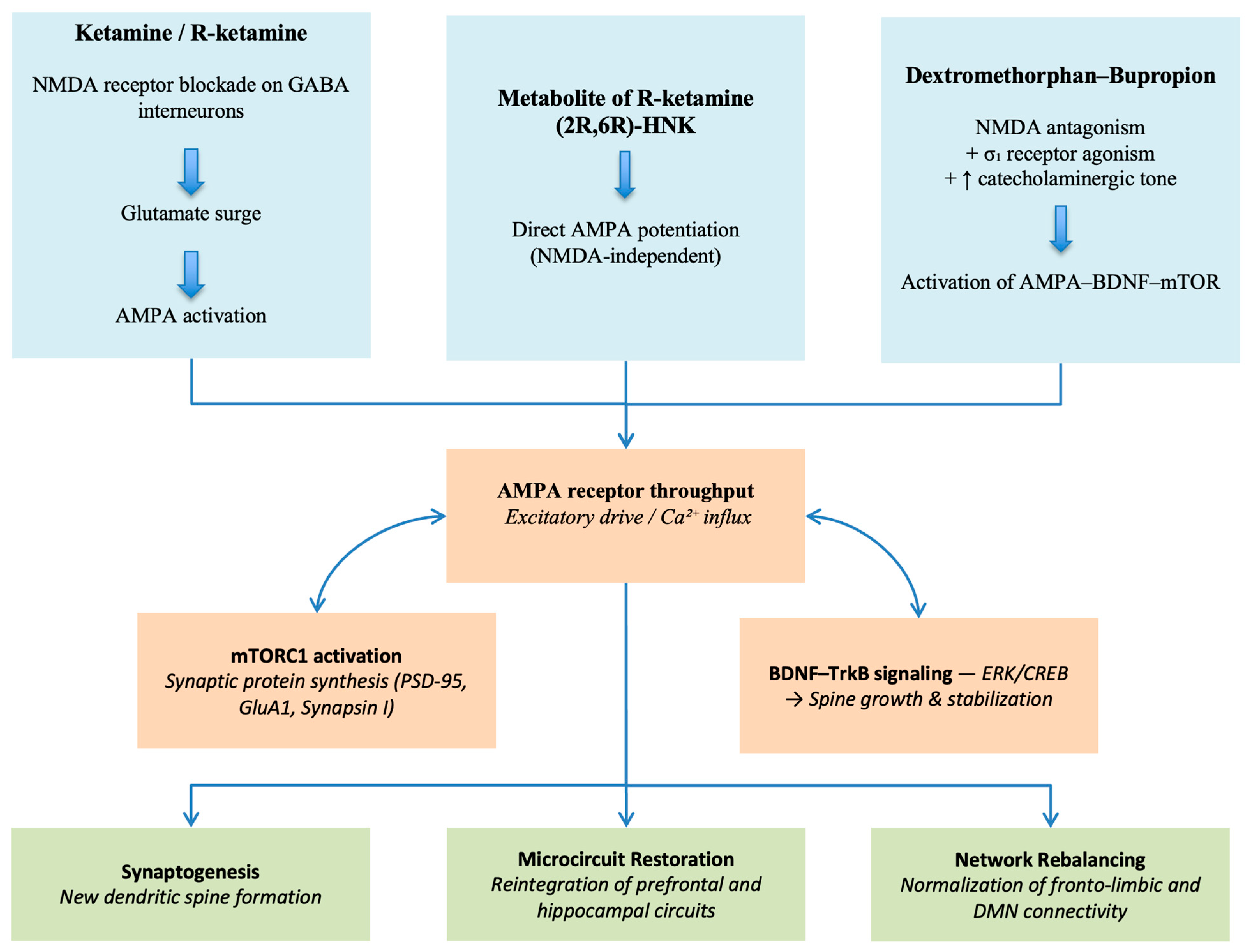
4.1. NMDA Receptor Blockade and AMPA Throughput
4.2. mTORC1 Signaling and Synaptogenesis
4.3. BDNF-TrkB Signaling
4.4. Spine Formation and Structural Plasticity
4.5. Enantiomers and Metabolites
4.6. Convergence with Dextromethorphan-Bupropion
5. Glial Modulation of Plasticity
5.1. Astrocytes and Synaptic Regulation
5.2. Microglia and the Quad-Partite Synapse
6. Clinical Evidence for Rapid-Acting Glutamatergic Antidepressants
6.1. Ketamine: From Discovery to Clinical Application
6.2. Esketamine: Translating Mechanism into Practice
6.3. Dextromethorphan-Bupropion and Emerging Oral Agents
6.4. Novel and Experimental Compounds
7. Network Remodeling and Connectomic Evidence
7.1. Default Mode Network Normalization
7.2. Fronto-Limbic Reconnection
7.3. Salience Network and Triple-Network Rebalancing
8. The Connectomic Glutamate Framework for Depression: An Integrative Model
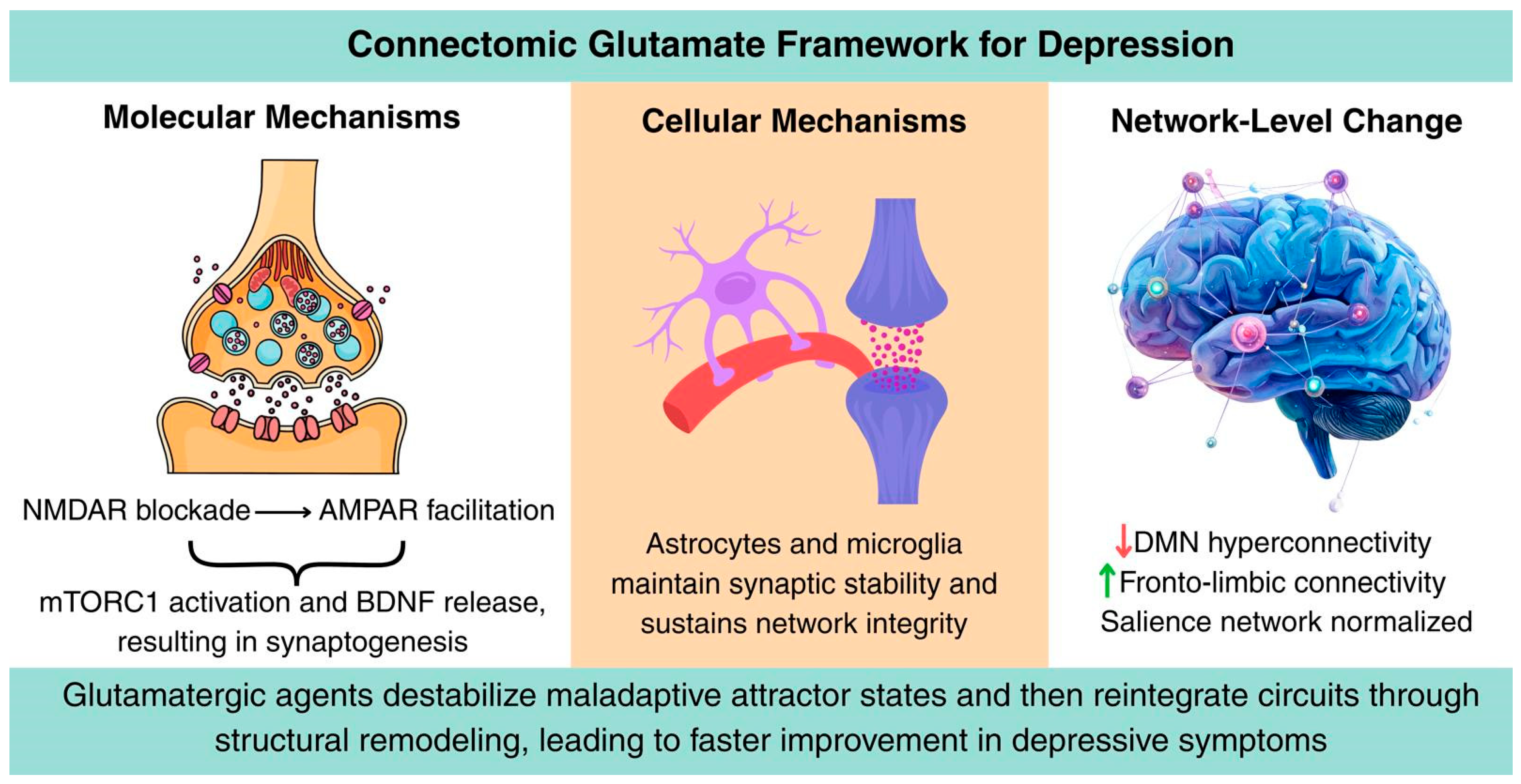
8.1. Molecular-to-Network Cascade
8.2. Clinical Translation and Bidirectional Model
8.3. Boundary Conditions and Patient-Level Moderators
9. Clinical Challenges and Research Priorities
9.1. Durability and Safety
9.2. Predictors, Mechanisms, and Biomarkers
9.3. Implementation, Access, and Equity
10. Conclusions and Future Directions
Funding
Data Availability Statement
Conflicts of Interest
References
- Greicius, M.D.; Flores, B.H.; Menon, V.; Glover, G.H.; Solvason, H.B.; Kenna, H.; Reiss, A.L.; Schatzberg, A.F. Resting-state functional connectivity in major depression: Abnormally increased contributions from subgenual cingulate cortex and thalamus. Biol. Psychiatry 2007, 62, 429–437. [Google Scholar] [CrossRef] [Scilit]
- Sheline, Y.I.; Price, J.L.; Yan, Z.; Mintun, M.A. Resting-state functional MRI in depression unmasks increased connectivity between networks via the dorsal nexus. Proc. Natl. Acad. Sci. USA 2010, 107, 11020–11025. [Google Scholar] [CrossRef] [Scilit]
- Delgado, P.L. Depression: The case for a monoamine deficiency. J. Clin. Psychiatry 2000, 61, 7–11. [Google Scholar] [PubMed]
- Rush, A.J.; Trivedi, M.H.; Wisniewski, S.R.; Nierenberg, A.A.; Stewart, J.W.; Warden, D.; Niederehe, G.; Thase, M.E.; Lavori, P.W.; Lebowitz, B.D.; et al. Acute and longer-term outcomes in depressed outpatients requiring one or several treatment steps: A STAR*D report. Am. J. Psychiatry 2006, 163, 1905–1917. [Google Scholar] [CrossRef]
- Duman, R.S.; Aghajanian, G.K.; Sanacora, G.; Krystal, J.H. Synaptic plasticity and depression: New insights from stress and rapid-acting antidepressants. Nat. Med. 2016, 22, 238–249. [Google Scholar] [CrossRef] [Scilit]
- Kang, H.J.; Voleti, B.; Hajszan, T.; Rajkowska, G.; AStockmeier, C.; Licznerski, P.; Lepack, A.; Majik, M.S.; Jeong, L.S.; Banasr, M.; et al. Decreased expression of synapse-related genes and loss of synapses in major depressive disorder. Nat. Med. 2012, 18, 1413–1417. [Google Scholar] [CrossRef] [Scilit]
- Rajkowska, G.; Miguel-Hidalgo, J.J. Gliogenesis and glial pathology in depression. CNS Neurol. Disord. Drug Targets 2007, 6, 219–233. [Google Scholar] [CrossRef] [Scilit]
- Radley, J.J.; Rocher, A.B.; Miller, M.; Janssen, W.G.M.; Liston, C.; Hof, P.R.; McEwen, B.S.; Morrison, J.H. Repeated stress induces dendritic spine loss in the rat medial prefrontal cortex. Cereb. Cortex 2006, 16, 313–320. [Google Scholar] [CrossRef] [Scilit]
- McEwen, B.S.; Morrison, J.H. Brain On Stress: Vulnerability and Plasticity of the Prefrontal Cortex Over the Life Course. Neuron 2013, 79, 16–29. [Google Scholar] [CrossRef] [Scilit]
- Santarelli, L.; Saxe, M.; Gross, C.; Surget, A.; Battaglia, F.; Dulawa, S.; Weisstaub, N.; Lee, J.; Duman, R.; Arancio, O.; et al. Requirement of hippocampal neurogenesis for the behavioral effects of antidepressants. Science 2003, 301, 805–809. [Google Scholar] [CrossRef] [Scilit]
- Berman, R.M.; Cappiello, A.; Anand, A.; Oren, D.A.; Heninger, G.R.; Charney, D.S.; Krystal, J.H. Antidepressant effects of ketamine in depressed patients. Biol. Psychiatry 2000, 47, 351–354. [Google Scholar] [CrossRef] [Scilit] [PubMed]
- Zarate, C.A.; Singh, J.B.; Carlson, P.J.; Brutsche, N.E.; Ameli, R.; Luckenbaugh, D.A.; Charney, D.S.; Manji, H.K. A randomized trial of an N-methyl-D-aspartate antagonist in treatment-resistant major depression. Arch. Gen. Psychiatry 2006, 63, 856–864. [Google Scholar] [CrossRef] [Scilit]
- Krystal, J.H.; Sanacora, G.; Duman, R.S. Rapid-acting glutamatergic antidepressants: The path to ketamine and beyond. Biol. Psychiatry 2013, 73, 1133–1141. [Google Scholar] [CrossRef] [Scilit]
- Li, N.; Lee, B.; Liu, R.-J.; Banasr, M.; Dwyer, J.M.; Iwata, M.; Li, X.-Y.; Aghajanian, G.; Duman, R.S. mTOR-dependent synapse formation underlies the rapid antidepressant effects of NMDA antagonists. Science 2010, 329, 959–964. [Google Scholar] [CrossRef] [Scilit]
- Liu, R.-J.; Lee, F.S.; Li, X.-Y.; Bambico, F.; Duman, R.S.; Aghajanian, G.K. Brain-derived neurotrophic factor Val66Met allele impairs basal and ketamine-stimulated synaptogenesis in prefrontal cortex. Biol. Psychiatry 2012, 71, 996–1005. [Google Scholar] [CrossRef] [Scilit]
- Moda-Sava, R.N.; Murdock, M.H.; Parekh, P.K.; Fetcho, R.N.; Huang, B.S.; Huynh, T.N.; Witztum, J.; Shaver, D.C.; Rosenthal, D.L.; Alway, E.J.; et al. Sustained rescue of prefrontal circuit dysfunction by antidepressant-induced spine formation. Science 2019, 364, eaat8078. [Google Scholar] [CrossRef] [Scilit]
- Scheidegger, M.; Walter, M.; Lehmann, M.; Metzger, C.; Grimm, S.; Boeker, H.; Boesiger, P.; Henning, A.; Seifritz, E. Ketamine decreases resting state functional network connectivity in healthy subjects: Implications for antidepressant drug action. PLoS ONE 2012, 7, e44799. [Google Scholar] [CrossRef] [Scilit]
- Gärtner, M.; Aust, S.; Bajbouj, M.; Fan, Y.; Wingenfeld, K.; Otte, C.; Heuser-Collier, I.; Böker, H.; Hättenschwiler, J.; Seifritz, E.; et al. Functional connectivity between prefrontal cortex and subgenual cingulate predicts antidepressant effects of ketamine. Eur. Neuropsychopharmacol. 2019, 29, 501–508. [Google Scholar] [CrossRef] [Scilit] [PubMed]
- Sanacora, G.; Treccani, G.; Popoli, M. Towards a glutamate hypothesis of depression: An emerging frontier of neuropsychopharmacology for mood disorders. Neuropharmacology 2012, 62, 63–77. [Google Scholar] [CrossRef] [Scilit] [PubMed]
- Kaiser, R.H.; Andrews-Hanna, J.R.; Wager, T.D.; Pizzagalli, D.A. Large-Scale Network Dysfunction in Major Depressive Disorder: A Meta-analysis of Resting-State Functional Connectivity. JAMA Psychiatry 2015, 72, 603–611. [Google Scholar] [CrossRef] [Scilit]
- Zhou, H.-X.; Chen, X.; Shen, Y.-Q.; Li, L.; Chen, N.-X.; Zhu, Z.-C.; Castellanos, F.X.; Yan, C.-G. Rumination and the default mode network: Meta-analysis of brain imaging studies and implications for depression. Neuroimage 2020, 206, 116287. [Google Scholar] [CrossRef] [Scilit]
- McMillan, R.; Muthukumaraswamy, S.D. The neurophysiology of ketamine: An integrative review. Rev. Neurosci. 2020, 31, 457–503. [Google Scholar] [CrossRef] [Scilit]
- Mulders, P.C.; van Eijndhoven, P.F.; Schene, A.H.; Beckmann, C.F.; Tendolkar, I. Resting-state functional connectivity in major depressive disorder: A review. Neurosci. Biobehav. Rev. 2015, 56, 330–344. [Google Scholar] [CrossRef] [Scilit]
- Sheline, Y.I.; Barch, D.M.; Price, J.L.; Rundle, M.M.; Vaishnavi, S.N.; Snyder, A.Z.; Mintun, M.A.; Wang, S.; Coalson, R.S.; Raichle, M.E. The default mode network and self-referential processes in depression. Proc. Natl. Acad. Sci. USA 2009, 106, 1942–1947. [Google Scholar] [CrossRef] [Scilit]
- Hamilton, J.P.; Farmer, M.; Fogelman, P.; Gotlib, I.H. Depressive Rumination, the Default-Mode Network, and the Dark Matter of Clinical Neuroscience. Biol. Psychiatry 2015, 78, 224–230. [Google Scholar] [CrossRef] [Scilit]
- Manoliu, A.; Meng, C.; Brandl, F.; Doll, A.; Tahmasian, M.; Scherr, M.; Schwerthöffer, D.; Zimmer, C.; Förstl, H.; Bäuml, J.; et al. Insular dysfunction within the salience network is associated with severity of symptoms and aberrant inter-network connectivity in major depressive disorder. Front. Hum. Neurosci. 2013, 7, 930. [Google Scholar] [CrossRef] [Scilit]
- Öngür, D.; Drevets, W.C.; Price, J.L. Glial reduction in the subgenual prefrontal cortex in mood disorders. Proc. Natl. Acad. Sci. USA 1998, 95, 13290. [Google Scholar] [CrossRef] [Scilit]
- Choudary, P.V.; Molnar, M.; Evans, S.J.; Tomita, H.; Li, J.Z.; Vawter, M.P.; Myers, R.M.; Bunney, W.E.; Akil, H.; Watson, S.J.; et al. Altered cortical glutamatergic and GABAergic signal transmission with glial involvement in depression. Proc. Natl. Acad. Sci. USA 2005, 102, 15653–15658. [Google Scholar] [CrossRef] [Scilit]
- Holmes, S.E.; Scheinost, D.; Finnema, S.J.; Naganawa, M.; Davis, M.T.; DellaGioia, N.; Nabulsi, N.; Matuskey, D.; Angarita, G.A.; Pietrzak, R.H.; et al. Lower synaptic density is associated with depression severity and network alterations. Nat. Commun. 2019, 10, 1529. [Google Scholar] [CrossRef] [Scilit]
- Hamilton, J.P.; Chen, G.; Thomason, M.E.; Schwartz, M.E.; Gotlib, I.H. Investigating neural primacy in Major Depressive Disorder: Multivariate granger causality analysis of resting-state fMRI time-series data. Mol. Psychiatry 2011, 16, 763–772. [Google Scholar] [CrossRef] [Scilit]
- Vargas-Medrano, J.; Sotelo, D.; Vidal Martínez, G.; Thompson, P.M. Exploratory study of the dysregulation of age-related changes in neural/glial antigen 2 and neuroinflammation markers in individuals with major depression. Brain Behav. Immun. Health 2025, 49, 101107. [Google Scholar] [CrossRef] [Scilit]
- Nagy, C.; Maitra, M.; Tanti, A.; Suderman, M.; Théroux, J.-F.; Davoli, M.A.; Perlman, K.; Yerko, V.; Wang, Y.C.; Tripathy, S.J.; et al. Single-nucleus transcriptomics of the prefrontal cortex in major depressive disorder implicates oligodendrocyte precursor cells and excitatory neurons. Nat. Neurosci. 2020, 23, 771–781. [Google Scholar] [CrossRef] [Scilit]
- Gerhard, D.M.; Pothula, S.; Liu, R.-J.; Wu, M.; Li, X.-Y.; Girgenti, M.J.; Taylor, S.R.; Duman, C.H.; Delpire, E.; Picciotto, M.; et al. GABA interneurons are the cellular trigger for ketamine’s rapid antidepressant actions. J. Clin. Investig. 2020, 130, 1336–1349. [Google Scholar] [CrossRef] [Scilit]
- Ghosal, S.; Duman, C.H.; Liu, R.-J.; Wu, M.; Terwilliger, R.; Girgenti, M.J.; Wohleb, E.; Fogaca, M.V.; Teichman, E.M.; Hare, B.; et al. Ketamine rapidly reverses stress-induced impairments in GABAergic transmission in the prefrontal cortex in male rodents. Neurobiol. Dis. 2020, 134, 104669. [Google Scholar] [CrossRef] [Scilit]
- Homayoun, H.; Moghaddam, B. NMDA receptor hypofunction produces opposite effects on prefrontal cortex interneurons and pyramidal neurons. J. Neurosci. 2007, 27, 11496–11500. [Google Scholar] [CrossRef] [Scilit]
- Vestring, S.; Veleanu, M.; Perez, M.C.; Schuberth, L.E.; Bronnec, M.; Li, A.; Würz, L.M.; Erdogdu, F.; Stocker, J.; Moos, J.; et al. The NMDA receptor subunit GluN2D is a potential target for rapid antidepressant action. Nat. Commun. 2025, 16, 10613. [Google Scholar] [CrossRef] [Scilit]
- Maeng, S.; Zarate, C.A.; Du, J.; Schloesser, R.J.; McCammon, J.; Chen, G.; Manji, H.K. Cellular Mechanisms Underlying the Antidepressant Effects of Ketamine: Role of α-Amino-3-Hydroxy-5-Methylisoxazole-4-Propionic Acid Receptors. Biol. Psychiatry 2008, 63, 349–352. [Google Scholar] [CrossRef] [Scilit]
- Koike, H.; Iijima, M.; Chaki, S. Involvement of AMPA receptor in both the rapid and sustained antidepressant-like effects of ketamine in animal models of depression. Behav. Brain Res. 2011, 224, 107–111. [Google Scholar] [CrossRef] [Scilit]
- Aleksandrova, L.R.; Phillips, A.G. Neuroplasticity as a convergent mechanism of ketamine and classical psychedelics. Trends Pharmacol. Sci. 2021, 42, 929–942. [Google Scholar] [CrossRef] [Scilit]
- Yang, C.; Ren, Q.; Qu, Y.; Zhang, J.-C.; Ma, M.; Dong, C.; Hashimoto, K. mTOR-independent antidepressant effects of (R)-ketamine in a social defeat stress model. Biol. Psychiatry 2017, 83, 18–28. [Google Scholar] [CrossRef] [Scilit]
- Chen, M.-H.; Li, C.-T.; Lin, W.-C.; Hong, C.-J.; Tu, P.-C.; Bai, Y.-M.; Cheng, C.-M.; Su, T.-P. Rapid inflammation modulation and antidepressant efficacy of a low-dose ketamine infusion in treatment-resistant depression: A randomized, double-blind control study. Psychiatry Res. 2018, 269, 207–211. [Google Scholar] [CrossRef] [Scilit]
- Autry, A.E.; Adachi, M.; Nosyreva, E.; Na, E.S.; Los, M.F.; Cheng, P.; Kavalali, E.T.; Monteggia, L.M. NMDA Receptor Blockade at Rest Triggers Rapid Behavioural Antidepressant Responses. Nature 2011, 475, 91–95. [Google Scholar] [CrossRef] [Scilit]
- Duman, R.; Deyama, S.; Fogaça, M. Role of BDNF in the pathophysiology and treatment of depression: Activity dependent effects distinguish rapid acting antidepressants. Eur. J. Neurosci. 2021, 53, 126–139. [Google Scholar] [CrossRef] [Scilit]
- Yang, C.; Shirayama, Y.; Zhang, J.-C.; Ren, Q.; Yao, W.; Ma, M.; Dong, C.; Hashimoto, K. R-ketamine: A rapid-onset and sustained antidepressant without psychotomimetic side effects. Transl. Psychiatry 2015, 5, e632. [Google Scholar] [CrossRef] [Scilit]
- Zanos, P.; Moaddel, R.; Morris, P.J.; Georgiou, P.; Fischell, J.; Elmer, G.I.; Alkondon, M.; Yuan, P.; Pribut, H.J.; Singh, N.S.; et al. NMDAR inhibition-independent antidepressant actions of ketamine metabolites. Nature 2016, 533, 481–486. [Google Scholar] [CrossRef] [Scilit]
- Jones, A.; Streicher, C.; Alter, S.; Thomas, Z.; Tabuteau, H. Rapid Antidepressant Effects and MADRS Item Improvements with AXS-05 (DEXTROMETHORPHAN-BUPROPION), an Oral NMDA Receptor Antagonist in Major Depressive Disorder: Results from Two Randomized Double-Blind, Controlled Trials. CNS Spectr. 2023, 28, 263. [Google Scholar] [CrossRef] [Scilit]
- Iosifescu, D.V.; Jones, A.; O’Gorman, C.; Streicher, C.; Feliz, S.; Fava, M.; Tabuteau, H. Efficacy and Safety of AXS-05 (Dextromethorphan-Bupropion) in Patients with Major Depressive Disorder: A Phase 3 Randomized Clinical Trial (GEMINI). J. Clin. Psychiatry 2022, 83, 21m14345. [Google Scholar] [CrossRef] [Scilit]
- Kruyer, A.; Kalivas, P.W.; Scofield, M.D. Astrocyte regulation of synaptic signaling in psychiatric disorders. Neuropsychopharmacology 2023, 48, 21–36. [Google Scholar] [CrossRef] [Scilit]
- Verkhratsky, A.; Parpura, V. Astrogliopathology in neurological, neurodevelopmental and psychiatric disorders. Neurobiol. Dis. 2016, 85, 254–261. [Google Scholar] [CrossRef] [Scilit]
- Rothstein, J.D.; Dykes-Hoberg, M.; Pardo, C.A.; Bristol, L.A.; Jin, L.; Kuncl, R.W.; Kanai, Y.; Hediger, M.A.; Wang, Y.; Schielke, J.P.; et al. Knockout of glutamate transporters reveals a major role for astroglial transport in excitotoxicity and clearance of glutamate. Neuron 1996, 16, 675–686. [Google Scholar] [CrossRef] [Scilit]
- Parpura, V.; Heneka, M.T.; Montana, V.; Oliet, S.H.R.; Schousboe, A.; Haydon, P.G.; Stout, R.F., Jr.; Spray, D.C.; Reichenbach, A.; Pannicke, T.; et al. Glial cells in (patho)physiology. J. Neurochem. 2012, 121, 4–27. [Google Scholar] [CrossRef] [Scilit] [PubMed]
- Paolicelli, R.C.; Bolasco, G.; Pagani, F.; Maggi, L.; Scianni, M.; Panzanelli, P.; Giustetto, M.; Ferreira, T.A.; Guiducci, E.; Dumas, L.; et al. Synaptic pruning by microglia is necessary for normal brain development. Science 2011, 333, 1456–1458. [Google Scholar] [CrossRef] [Scilit]
- Yirmiya, R.; Rimmerman, N.; Reshef, R. Depression as a microglial disease. Trends Neurosci. 2015, 38, 637–658. [Google Scholar] [CrossRef] [Scilit]
- Chen, Q.; Feng, J.; Liu, L.; Wang, X.; Wan, Y.; Li, M.; Wang, M.; Zhang, C. The effect of ketamine on microglia and proinflammatory cytokines in the hippocampus of depression-like rat. Neuropsychiatry 2017, 7, 77–85. [Google Scholar] [CrossRef]
- Schafer, D.P.; Lehrman, E.K.; Stevens, B. The “Quad-partite” Synapse: Microglia-Synapse Interactions in the Developing and Mature CNS. Glia 2013, 61, 24–36. [Google Scholar] [CrossRef] [Scilit]
- Santello, M.; Toni, N.; Volterra, A. Astrocyte function from information processing to cognition and cognitive impairment. Nat. Neurosci. 2019, 22, 154–166. [Google Scholar] [CrossRef] [Scilit]
- Schafer, D.P.; Stevens, B. Microglia Function in Central Nervous System Development and Plasticity. Cold Spring Harb. Perspect. Biol. 2015, 7, a020545. [Google Scholar] [CrossRef] [Scilit]
- Setiawan, E.; Wilson, A.A.; Mizrahi, R.; Rusjan, P.M.; Miler, L.; Rajkowska, G.; Suridjan, I.; Kennedy, J.L.; Rekkas, P.V.; Houle, S.; et al. Role of translocator protein density, a marker of neuroinflammation, in the brain during major depressive episodes. JAMA Psychiatry 2015, 72, 268–275. [Google Scholar] [CrossRef] [Scilit]
- Skolnick, P.; Layer, R.T.; Popik, P.; Nowak, G.; Paul, I.A.; Trullas, R. Adaptation of N-methyl-D-aspartate (NMDA) receptors following antidepressant treatment: Implications for the pharmacotherapy of depression. Pharmacopsychiatry 1996, 29, 23–26. [Google Scholar] [CrossRef] [Scilit]
- Dean, R.L.; Hurducas, C.; Hawton, K.; Spyridi, S.; Cowen, P.J.; Hollingsworth, S.; Marquardt, T.; Barnes, A.; Smith, R.; McShane, R.; et al. Ketamine and other glutamate receptor modulators for depression in adults with unipolar major depressive disorder. Cochrane Database Syst. Rev. 2021, 9, CD011612. [Google Scholar] [CrossRef] [Scilit]
- Daly, E.J.; Trivedi, M.H.; Janik, A.; Li, H.; Zhang, Y.; Li, X.; Lane, R.; Lim, P.; Duca, A.R.; Hough, D.; et al. Efficacy of Esketamine Nasal Spray Plus Oral Antidepressant Treatment for Relapse Prevention in Patients with Treatment-Resistant Depression: A Randomized Clinical Trial. JAMA Psychiatry 2019, 76, 893–903. [Google Scholar] [CrossRef] [Scilit]
- Popova, V.; Daly, E.J.; Trivedi, M.; Cooper, K.; Lane, R.; Lim, P.; Mazzucco, C.; Hough, D.; Thase, M.E.; Shelton, R.C.; et al. Efficacy and Safety of Flexibly Dosed Esketamine Nasal Spray Combined with a Newly Initiated Oral Antidepressant in Treatment-Resistant Depression: A Randomized Double-Blind Active-Controlled Study. Am. J. Psychiatry 2019, 176, 428–438. [Google Scholar] [CrossRef] [Scilit]
- Daly, E.J.; Singh, J.B.; Fedgchin, M.; Cooper, K.; Lim, P.; Shelton, R.C.; Thase, M.E.; Winokur, A.; Van Nueten, L.; Manji, H.; et al. Efficacy and Safety of Intranasal Esketamine Adjunctive to Oral Antidepressant Therapy in Treatment-Resistant Depression: A Randomized Clinical Trial. JAMA Psychiatry 2018, 75, 139–148. [Google Scholar] [CrossRef] [Scilit]
- Tabuteau, H.; Jones, A.; Anderson, A.; Jacobson, M.; Iosifescu, D.V. Effect of AXS-05 (Dextromethorphan-Bupropion) in Major Depressive Disorder: A Randomized Double-Blind Controlled Trial. Am. J. Psychiatry 2022, 179, 490–499. [Google Scholar] [CrossRef] [Scilit]
- Burgdorf, J.; Zhang, X.; Nicholson, K.L.; Balster, R.L.; Leander, J.D.; Stanton, P.K.; Gross, A.L.; Kroes, R.A.; Moskal, J.R. GLYX-13, a NMDA receptor glycine-site functional partial agonist, induces antidepressant-like effects without ketamine-like side effects. Neuropsychopharmacology 2013, 38, 729–742. [Google Scholar] [CrossRef] [Scilit] [PubMed]
- Sanacora, G.; Smith, M.A.; Pathak, S.; Su, H.-L.; Boeijinga, P.H.; McCarthy, D.J.; Quirk, M.C. Lanicemine: A low-trapping NMDA channel blocker produces sustained antidepressant efficacy with minimal psychotomimetic adverse effects. Mol. Psychiatry 2014, 19, 978–985. [Google Scholar] [CrossRef] [Scilit] [PubMed]
- Duman, R.S.; Aghajanian, G.K. Synaptic dysfunction in depression: Potential therapeutic targets. Science 2012, 338, 68–72. [Google Scholar] [CrossRef] [Scilit] [PubMed]
- Drysdale, A.T.; Grosenick, L.; Downar, J.; Dunlop, K.; Mansouri, F.; Meng, Y.; Fetcho, R.N.; Zebley, B.; Oathes, D.J.; Etkin, A.; et al. Resting-state connectivity biomarkers define neurophysiological subtypes of depression. Nat. Med. 2017, 23, 28–38. [Google Scholar] [CrossRef] [Scilit]
- Marchetti, I.; Koster, E.H.W.; Sonuga-Barke, E.J.; De Raedt, R. The default mode network and recurrent depression: A neurobiological model of cognitive risk factors. Neuropsychol. Rev. 2012, 22, 229–251. [Google Scholar] [CrossRef] [Scilit]
- Disner, S.G.; Beevers, C.G.; Haigh, E.A.P.; Beck, A.T. Neural mechanisms of the cognitive model of depression. Nat. Rev. Neurosci. 2011, 12, 467–477. [Google Scholar] [CrossRef] [Scilit]
- Yang, Y.; Cui, Y.; Sang, K.; Dong, Y.; Ni, Z.; Ma, S.; Hu, H. Ketamine blocks bursting in the lateral habenula to rapidly relieve depression. Nature 2018, 554, 317–322. [Google Scholar] [CrossRef] [Scilit] [PubMed]
- Murrough, J.W.; Collins, K.A.; Fields, J.; DeWilde, K.E.; Phillips, M.L.; Mathew, S.J.; Wong, E.; Tang, C.Y.; Charney, D.S.; Iosifescu, D.V. Regulation of neural responses to emotion perception by ketamine in individuals with treatment-resistant major depressive disorder. Transl. Psychiatry 2015, 5, e509. [Google Scholar] [CrossRef] [Scilit]
- Abdallah, C.G.; Averill, L.A.; Collins, K.A.; Geha, P.; Schwartz, J.; Averill, C.; DeWilde, K.E.; Wong, E.; Anticevic, A.; Tang, C.Y.; et al. Ketamine Treatment and Global Brain Connectivity in Major Depression. Neuropsychopharmacology 2017, 42, 1210–1219. [Google Scholar] [CrossRef] [Scilit]
- Carlson, P.J.; Diazgranados, N.; Nugent, A.C.; Ibrahim, L.; Luckenbaugh, D.A.; Brutsche, N.; Herscovitch, P.; Manji, H.K.; Carlos AZarate, J.; Drevets, W.C. Neural Correlates of Rapid Antidepressant Response to Ketamine in Treatment-Resistant Unipolar Depression: A preliminary PET study. Biol. Psychiatry 2013, 73, 1213. [Google Scholar] [CrossRef] [Scilit]
- Muthukumaraswamy, S.D.; Shaw, A.D.; Jackson, L.E.; Hall, J.; Moran, R.; Saxena, N. Evidence that Subanesthetic Doses of Ketamine Cause Sustained Disruptions of NMDA and AMPA-Mediated Frontoparietal Connectivity in Humans. J. Neurosci. 2015, 35, 11694–11706. [Google Scholar] [CrossRef] [Scilit]
- Nugent, A.C.; Ballard, E.D.; Gould, T.D.; Park, L.T.; Moaddel, R.; Brutsche, N.E.; Zarate, C.A. Ketamine has distinct electrophysiological and behavioral effects in depressed and healthy subjects. Mol. Psychiatry 2019, 24, 1040–1052. [Google Scholar] [CrossRef] [Scilit] [PubMed]
- McMillan, R.; Sumner, R.; Forsyth, A.; Campbell, D.; Malpas, G.; Maxwell, E.; Deng, C.; Hay, J.; Ponton, R.; Sundram, F.; et al. Simultaneous EEG/fMRI recorded during ketamine infusion in patients with major depressive disorder. Prog. Neuropsychopharmacol. Biol. Psychiatry 2020, 99, 109838. [Google Scholar] [CrossRef] [Scilit]
- Barnett, B.S.; Anand, A. Attenuation of severe ketamine-induced neuropsychiatric side effects by lamotrigine in a patient with treatment resistant bipolar depression: A case report. Psychiatry Res. Case Rep. 2023, 2, 100167. [Google Scholar] [CrossRef] [Scilit]
- Krystal, J.H.; Abdallah, C.G.; Sanacora, G.; Charney, D.S.; Duman, R.S. Ketamine: A Paradigm Shift for Depression Research and Treatment. Neuron 2019, 101, 774–778. [Google Scholar] [CrossRef] [Scilit] [PubMed]
- Abdallah, C.G.; Sanacora, G.; Duman, R.S.; Krystal, J.H. Ketamine and rapid-acting antidepressants: A window into a new neurobiology for mood disorder therapeutics. Annu. Rev. Med. 2015, 66, 509–523. [Google Scholar] [CrossRef] [Scilit]
- Banasr, M.; Duman, R.S. Glial loss in the prefrontal cortex is sufficient to induce depressive-like behaviors. Biol. Psychiatry 2008, 64, 863–870. [Google Scholar] [CrossRef] [Scilit] [PubMed]
- Duman, R.S.; Li, N. A neurotrophic hypothesis of depression: Role of synaptogenesis in the actions of NMDA receptor antagonists. Philos. Trans. R. Soc. Lond. B Biol. Sci. 2012, 367, 2475–2484. [Google Scholar] [CrossRef] [Scilit] [PubMed]
- Deco, G.; Kringelbach, M.L. Great expectations: Using whole-brain computational connectomics for understanding neuropsychiatric disorders. Neuron 2014, 84, 892–905. [Google Scholar] [CrossRef] [Scilit] [PubMed]
- Abdallah, C.G.; Averill, C.L.; Salas, R.; Averill, L.A.; Baldwin, P.R.; Krystal, J.H.; Mathew, S.J.; Mathalon, D.H. Prefrontal Connectivity and Glutamate Transmission: Relevance to Depression Pathophysiology and Ketamine Treatment. Biol. Psychiatry Cogn. Neurosci. Neuroimaging 2017, 2, 566–574. [Google Scholar] [CrossRef] [Scilit]
- Kraguljac, N.V.; Frölich, M.A.; Tran, S.; White, D.M.; Nichols, N.; Barton-McArdle, A.; Reid, M.A.; Bolding, M.S.; Lahti, A.C. Ketamine modulates hippocampal neurochemistry and functional connectivity: A combined magnetic resonance spectroscopy and resting-state fMRI study in healthy volunteers. Mol. Psychiatry 2017, 22, 562–569. [Google Scholar] [CrossRef] [Scilit]
- Williams, L.M. Precision psychiatry: A neural circuit taxonomy for depression and anxiety. Lancet Psychiatry 2016, 3, 472–480. [Google Scholar] [CrossRef] [Scilit]
- Phillips, J.L.; Norris, S.; Talbot, J.; Birmingham, M.; Hatchard, T.; Ortiz, A.; Owoeye, O.; Batten, L.A.; Blier, P. Single, Repeated, and Maintenance Ketamine Infusions for Treatment-Resistant Depression: A Randomized Controlled Trial. Am. J. Psychiatry 2019, 176, 401–409. [Google Scholar] [CrossRef] [Scilit]
- Jones, C.; Nemeroff, C.B. Precision Psychiatry: Biomarker-Guided Tailored Therapy for Effective Treatment and Prevention in Major Depression. Adv. Exp. Med. Biol. 2021, 1305, 535–563. [Google Scholar] [CrossRef] [Scilit]
- Morgan, C.J.A.; Curran, H.V. Ketamine use: A review. Addiction 2012, 107, 27–38. [Google Scholar] [CrossRef] [Scilit]
- Shahani, R.; Streutker, C.; Dickson, B.; Stewart, R.J. Ketamine-associated ulcerative cystitis: A new clinical entity. Urology 2007, 69, 810–812. [Google Scholar] [CrossRef] [Scilit]
- Liang, H.J.; Lau, C.G.; Tang, A.; Chan, F.; Ungvari, G.S.; Tang, W.K. Cognitive impairments in poly-drug ketamine users. Addict. Behav. 2013, 38, 2661–2666. [Google Scholar] [CrossRef] [Scilit]
- Morgan, C.J.A.; Dodds, C.M.; Furby, H.; Pepper, F.; Fam, J.; Freeman, T.P.; Hughes, E.; Doeller, C.; King, J.; Howes, O.; et al. Long-Term Heavy Ketamine Use is Associated with Spatial Memory Impairment and Altered Hippocampal Activation. Front. Psychiatry 2014, 5, 149. [Google Scholar] [CrossRef] [Scilit] [PubMed]
- Olney, J.W.; Labruyere, J.; Wang, G.; Wozniak, D.F.; Price, M.T.; Sesma, M.A. NMDA antagonist neurotoxicity: Mechanism and prevention. Science 1991, 254, 1515–1518. [Google Scholar] [CrossRef] [Scilit] [PubMed]
- Wajs, E.; Aluisio, L.; Holder, R.; Daly, E.J.; Lane, R.; Lim, P.; George, J.E.; Morrison, R.L.; Sanacora, G.; Young, A.H.; et al. Esketamine Nasal Spray Plus Oral Antidepressant in Patients with Treatment-Resistant Depression: Assessment of Long-Term Safety in a Phase 3, Open-Label Study (SUSTAIN-2). J. Clin. Psychiatry 2020, 81, 19m12891. [Google Scholar] [CrossRef] [Scilit]
- Zaki, N.; Chen, L.N.; Lane, R.; Doherty, T.; Drevets, W.C.; Morrison, R.L.; Sanacora, G.; Wilkinson, S.T.; Popova, V.; Fu, D.-J. Long-term safety and maintenance of response with esketamine nasal spray in participants with treatment-resistant depression: Interim results of the SUSTAIN-3 study. Neuropsychopharmacology 2023, 48, 1225–1233. [Google Scholar] [CrossRef] [Scilit]
- Cornwell, B.R.; Salvadore, G.; Furey, M.; Marquardt, C.A.; Brutsche, N.E.; Grillon, C.; Zarate, C.A. Synaptic potentiation is critical for rapid antidepressant response to ketamine in treatment-resistant major depression. Biol. Psychiatry 2012, 72, 555–561. [Google Scholar] [CrossRef] [Scilit]
- Scangos, K.W.; Khambhati, A.N.; Daly, P.M.; Makhoul, G.S.; Sugrue, L.P.; Zamanian, H.; Liu, T.X.; Rao, V.R.; Sellers, K.K.; Dawes, H.E.; et al. Closed-loop neuromodulation in an individual with treatment-resistant depression. Nat. Med. 2021, 27, 1696–1700. [Google Scholar] [CrossRef] [Scilit]
- Wilkinson, S.T.; Ballard, E.D.; Bloch, M.H.; Mathew, S.J.; Murrough, J.W.; Feder, A.; Sos, P.; Wang, G.; Zarate, C.A.; Sanacora, G. The Effect of a Single Dose of Intravenous Ketamine on Suicidal Ideation: A Systematic Review and Individual Participant Data Meta-Analysis. Am. J. Psychiatry 2018, 175, 150–158. [Google Scholar] [CrossRef] [Scilit] [PubMed]
- Grunebaum, M.F.; Galfalvy, H.C.; Choo, T.-H.; Keilp, J.G.; Moitra, V.K.; Parris, M.S.; Marver, J.E.; Burke, A.K.; Milak, M.S.; Sublette, M.E.; et al. Ketamine for Rapid Reduction of Suicidal Thoughts in Major Depression: A Midazolam-Controlled Randomized Clinical Trial. Am. J. Psychiatry 2018, 175, 327–335. [Google Scholar] [CrossRef] [Scilit]
- Cullen, K.R.; Amatya, P.; Roback, M.G.; Albott, C.S.; Westlund Schreiner, M.; Ren, Y.; Eberly, L.E.; Carstedt, P.; Samikoglu, A.; Gunlicks-Stoessel, M.; et al. Intravenous Ketamine for Adolescents with Treatment-Resistant Depression: An Open-Label Study. J. Child Adolesc. Psychopharmacol. 2018, 28, 437–444. [Google Scholar] [CrossRef] [Scilit]
- Rot, M.A.H.; Collins, K.A.; Murrough, J.W.; Perez, A.M.; Reich, D.L.; Charney, D.S.; Mathew, S.J. Safety and efficacy of repeated-dose intravenous ketamine for treatment-resistant depression. Biol. Psychiatry 2010, 67, 139–145. [Google Scholar] [CrossRef] [Scilit]
- Murrough, J.W.; Iosifescu, D.V.; Chang, L.C.; Al Jurdi, R.K.; Green, C.E.; Perez, A.M.; Iqbal, S.; Pillemer, S.; Foulkes, A.; Shah, A.; et al. Antidepressant efficacy of ketamine in treatment-resistant major depression: A two-site randomized controlled trial. Am. J. Psychiatry 2013, 170, 1134–1142. [Google Scholar] [CrossRef] [Scilit] [PubMed]
- Miller, O.H.; Yang, L.; Wang, C.-C.; Hargroder, E.A.; Zhang, Y.; Delpire, E.; Hall, B.J. GluN2B-containing NMDA receptors regulate depression-like behavior and are critical for the rapid antidepressant actions of ketamine. Elife 2014, 3, e03581. [Google Scholar] [CrossRef] [Scilit] [PubMed]
- Wade, B.S.C.; Loureiro, J.; Sahib, A.; Kubicki, A.; Joshi, S.H.; Hellemann, G.; Espinoza, R.T.; Woods, R.P.; Congdon, E.; Narr, K.L. Anterior default mode network and posterior insular connectivity is predictive of depressive symptom reduction following serial ketamine infusion. Psychol. Med. 2022, 52, 2376–2386. [Google Scholar] [CrossRef] [Scilit] [PubMed]



| Study (Year) | Design | Sample(s) | Key Findings | Clinical Implications |
|---|---|---|---|---|
| Berman et al. (2000) [11] | Randomized, placebo-controlled, crossover trial | 7 depressed patients (MDD and bipolar) | Single IV ketamine (0.5 mg/kg) produced rapid antidepressant effects within hours. | First evidence of rapid antidepressant action of ketamine; opened the field for glutamatergic treatments. |
| Zarate et al. (2006) [12] | Randomized controlled trial | 18 TRD patients | Single IV ketamine infusion produced robust and rapid antidepressant effects lasting up to 1 week. | Landmark trial demonstrates efficacy of ketamine in TRD; pivotal for clinical translation. |
| Li et al. (2010) [14] | Preclinical mechanistic study | Rodent models | Ketamine activated the mTOR pathway, increased synaptic proteins, and spine formation in the PFC. | Identified mTOR-dependent synaptogenesis as a mechanism for the rapid effects of ketamine. |
| Murrough et al. (2013) [102] | Two-site randomized controlled trial | 73 TRD patients | Single IV ketamine produced a significant antidepressant response within 24 h compared to midazolam. | Confirmed rapid antidepressant efficacy in TRD; strengthened evidence base for ketamine. |
| Yang et al. (2015) [44] | Preclinical comparative study | Rodent models | R-ketamine produced more potent and longer-lasting antidepressant effects than S-ketamine without psychotomimetic side effects. | Suggested R-ketamine as a safer and more effective enantiomer for clinical development. |
| Miller et al. (2014) [103] | Review of mechanistic biomarkers | Not applicable | Discussed immune, inflammatory, and glutamatergic mechanisms underlying depression and ketamine response. | Highlighted translational biomarkers linking glutamatergic modulation to clinical efficacy. |
| Zanos et al. (2016) [45] | Preclinical mechanistic study | Rodent models | Identified (2R,6R)-hydroxynorketamine as an active ketamine metabolite with antidepressant-like effects independent of NMDA blockade. | Shifted focus toward ketamine metabolites as potential novel therapeutics. |
| Daly et al. (2019) [61] | Randomized, double-blind, relapse prevention trial | 705 patients with TRD | Esketamine nasal spray, combined with oral antidepressant, significantly delayed the time to relapse compared to placebo and antidepressant. | Established the role of esketamine in maintenance treatment, led to FDA approval for TRD. |
| Yang et al. (2018) [71] | Randomized, double-blind, active-controlled trial | 63 patients with TRD randomized to R-ketamine or S-ketamine | Evaluated effects of ketamine enantiomers on depressive symptoms; confirmed differential profiles. | Extended translational evidence for R-ketamine as a candidate treatment. |
| Iosifescu et al. (2022) [47] | Randomized, double-blind, controlled trial (GEMINI) | 327 patients with MDD | AXS-05 (dextromethorphan-bupropion) demonstrated a significant improvement in MADRS scores compared to placebo. | Demonstrated efficacy and safety of oral NMDA/sigma-1 modulation in MDD. |
| Study (Year) | Design | Sample(s) | Key Findings | Clinical Implications |
|---|---|---|---|---|
| Sheline et al. (2010) [2] | Resting-state fMRI | 18 MDD, 17 controls | Identified “dorsal nexus” in dorsomedial PFC with abnormal hyperconnectivity across DMN, CCN, and AN. Connectivity strength correlated with depression severity. | Dorsal nexus may serve as a hub of pathological connectivity in MDD; potential biomarker and target for neuromodulation. |
| Hamilton et al. (2011) [30] | Resting-state fMRI | 25 MDD, 25 controls | Elevated DMN activity linked to rumination; failure to deactivate DMN during tasks. | Rumination arises from the inability to disengage DMN; treatment should normalize DMN suppression. |
| Scheidegger et al. (2012) [17] | Double-blind, placebo-controlled, crossover fMRI | 16 healthy subjects | Ketamine reduced connectivity between sgACC-mPFC and within DMN. | Provides first evidence of ketamine-induced network remodeling in humans. |
| Kaiser et al. (2015) [20] | Meta-analysis of rs-fMRI | 27 studies (556 MDD, 518 controls) | Consistent hypoconnectivity within FPN and between FPN-DAN; hyperconnectivity within DMN and DMN-FPN. | Supports triple-network dysfunction; imbalance explains rumination and impaired cognitive control. |
| Abdallah et al. (2017) [73] | Resting-state fMRI (GBCr) | 18 MDD, 25 controls | Reduced prefrontal global connectivity at baseline; ketamine normalized GBCr in PFC; responders showed increases in lateral PFC, caudate, and insula. | GBCr may be a biomarker of rapid antidepressant response; it supports the synaptic homeostasis model. |
| Gärtner et al. (2019) [18] | Prospective fMRI | 24 TRD patients | Ketamine increased connectivity between the right lateral PFC and sgACC; low baseline FC predicted better response. | PFC-sgACC connectivity is a predictive and explanatory biomarker of ketamine response. |
| McMillan & Muthukumaraswamy (2020) [22] | Systematic review | 33 ketamine neuroimaging studies | Ketamine generally preserves cortico-subcortical but disrupts corticocortical connectivity. | Highlights consistent ketamine modulation of networks; evidence for network-based biomarkers. |
| Zhou et al. (2020) [21] | Resting-state fMRI + graph theory | 66 MDD, 62 controls | Increased connectivity in DMN and decreased integration in cognitive control networks. | Confirms DMN dominance and inefficient network communication in MDD. |
| Holmes et al. (2019) [29] | PET ([11C]UCB-J) + resting-state fMRI | 26 unmedicated MDD/PTSD patients + 21 controls | Lower synaptic density (SV2A) in dlPFC, ACC, hippocampus correlated with depression severity and reduced functional connectivity between dlPFC and PCC. | First in vivo evidence linking synaptic loss to network dysfunction in MDD; supports synaptogenesis as a mechanistic target for rapid-acting antidepressants. |
| Scangos et al. (2021) [97] | Intracranial EEG + fMRI (precision psychiatry) | TRD patient, individualized | Identified state-dependent network biomarkers predicting mood fluctuations; guided targeted stimulation. | Illustrates the feasibility of personalized network-guided interventions in TRD. |
| Wade et al. (2022) [104] | Multimodal MRI + machine learning | 60 TRD, 19 controls | Pretreatment anterior DMN-posterior insula connectivity and SLF microstructure predicted symptom reduction after serial ketamine. | Anterior DMN and insula connectivity may guide patient stratification; a potential predictive biomarker. |
Disclaimer/Publisher’s Note: The statements, opinions and data contained in all publications are solely those of the individual author(s) and contributor(s) and not of MDPI and/or the editor(s). MDPI and/or the editor(s) disclaim responsibility for any injury to people or property resulting from any ideas, methods, instructions or products referred to in the content. |
© 2025 by the authors. Licensee MDPI, Basel, Switzerland. This article is an open access article distributed under the terms and conditions of the Creative Commons Attribution (CC BY) license.
Share and Cite
Carmellini, P.; Pinzi, M.; Rescalli, M.B.; Cuomo, A. The Connectomic Glutamate Framework for Depression: Bridging Molecular Plasticity and Network Reorganization. Brain Sci. 2026, 16, 18. https://doi.org/10.3390/brainsci16010018
Carmellini P, Pinzi M, Rescalli MB, Cuomo A. The Connectomic Glutamate Framework for Depression: Bridging Molecular Plasticity and Network Reorganization. Brain Sciences. 2026; 16(1):18. https://doi.org/10.3390/brainsci16010018
Chicago/Turabian StyleCarmellini, Pietro, Mario Pinzi, Maria Beatrice Rescalli, and Alessandro Cuomo. 2026. "The Connectomic Glutamate Framework for Depression: Bridging Molecular Plasticity and Network Reorganization" Brain Sciences 16, no. 1: 18. https://doi.org/10.3390/brainsci16010018
APA StyleCarmellini, P., Pinzi, M., Rescalli, M. B., & Cuomo, A. (2026). The Connectomic Glutamate Framework for Depression: Bridging Molecular Plasticity and Network Reorganization. Brain Sciences, 16(1), 18. https://doi.org/10.3390/brainsci16010018