
Minimally Invasive Supraorbital vs. Traditional Pterional Approaches in Unruptured Aneurysm Surgery: Evaluating Risks and Results

 , and
, and
Abstract
1. Introduction
2. Materials and Methods
2.1. Patients and Methods
2.2. Patients
2.3. Operative Technique
2.4. Outcome
2.5. Statistical Analysis
3. Results
3.1. Demographic Characteristics
3.2. Aneurysm and Approach Related Characteristics
3.3. Complications
3.4. Outcome
3.4.1. One Month Postoperatively
3.4.2. Twelve Months Postoperatively
4. Discussion
Clinical Implications
5. Study Limitations
6. Conclusions
Author Contributions
Funding
Institutional Review Board Statement
Informed Consent Statement
Data Availability Statement
Conflicts of Interest
References
- Chalouhi, N.; Hoh, B.L.; Hasan, D. Review of cerebral aneurysm formation, growth, and rupture. Stroke 2013, 44, 3613–3622. [Google Scholar] [CrossRef]
- Etminan, N.; Ruigrok, Y.M.; Hackenberg, K.A.M.; Vergouwen, M.D.I.; Krings, T.; Rinkel, G.J.E. Epidemiology, pathogenesis, and emerging concepts in unruptured intracranial aneurysms. Lancet Neurol. 2025, 24, 945–957. [Google Scholar] [CrossRef]
- Roquer, J.; Cuadrado-Godia, E.; Guimaraens, L.; Conesa, G.; Rodríguez-Campello, A.; Capellades, J.; García-Arnillas, M.P.; Fernández-Candil, J.L.; Avellaneda-Gómez, C.; Giralt-Steinhauer, E.; et al. Short- and long-term outcome of patients with aneurysmal subarachnoid hemorrhage. Neurology 2020, 95, e1819–e1829. [Google Scholar] [CrossRef] [PubMed]
- Molyneux, A.; Kerr, R.; Stratton, I.; Sandercock, P.; Clarke, M.; Shrimpton, J.; Holman, R.; International Subarachnoid Aneurysm Trial (ISAT) Collaborative Group. International Subarachnoid Aneurysm Trial (ISAT) of neurosurgical clipping versus endovascular coiling in 2143 patients with ruptured intracranial aneurysms: A randomised trial. Lancet 2002, 360, 1267–1274. [Google Scholar] [CrossRef] [PubMed]
- da Silva, A.M.P.; de Bastos Maximiano, M.L.; Cabeça, L.S.; Corin, A.S.; de Deus, O.; Cunha, A.B.M.; Vieira, G.S.; Franco, J.O.; Figueiredo, E.G.; Noleto, G.S. Endovascular coiling vs microsurgical clipping for unruptured aneurysms of the anterior circulation: A systematic review and meta-analysis. J. Clin. Neurosci. 2025, 139, 111419. [Google Scholar] [CrossRef] [PubMed]
- Starke, R.M.; Turk, A.; Ding, D.; Crowley, R.W.; Liu, K.C.; Chalouhi, N.; Hasan, D.M.; Dumont, A.S.; Jabbour, P.; Durst, C.R.; et al. Technology developments in endovascular treatment of intracranial aneurysms. J. Neurointerv. Surg. 2016, 8, 135–144. [Google Scholar] [CrossRef]
- Hernesniemi, J.; Dashti, R.; Lehecka, M.; Niemelä, M.; Rinne, J.; Lehto, H.; Ronkainen, A.; Koivisto, T.; Jääskeläinen, J.E. Microneurosurgical management of anterior communicating artery aneurysms. Surg. Neurol. 2008, 70, 8–28; discussion 29. [Google Scholar] [CrossRef]
- Brown, N.J.; Gendreau, J.; Patel, S.; Rahmani, R.; Catapano, J.S.; Lawton, M.T. Minimally invasive keyhole craniotomies for microsurgical clipping of cerebral aneurysms: Comparative meta-analysis of the mini-pterional and supraorbital keyhole approaches. Neurosurg. Rev. 2024, 47, 352. [Google Scholar] [CrossRef]
- Oliveira, M.P.R.; Piñeiro, G.T.O.; Souza, D.C.R.; Sandes, P.H.F.; Santos, V.E.C.; Medrado-Nunes, G.S.; Lawton, M.T.; Figueiredo, E.G.; Solla, D.J.F. Pterional vs. mini-pterional craniotomy for intracranial aneurysms: A systematic review and meta-analysis. Neurosurg. Rev. 2025, 48, 36. [Google Scholar] [CrossRef]
- Fischer, G.; Stadie, A.; Reisch, R.; Hopf, N.J.; Fries, G.; Böcher-Schwarz, H.; van Lindert, E.; Ungersböck, K.; Knosp, E.; Oertel, J.; et al. The keyhole concept in aneurysm surgery: Results of the past 20 years. Neurosurgery 2011, 68 Suppl. S1, 45–51; discussion 51. [Google Scholar] [CrossRef]
- Genesan, P.; Haspani, M.S.M.; Noor, S.R.M. A Comparative Study between Supraorbital Keyhole and Pterional Approaches on Anterior Circulation Aneurysms. Malays. J. Med. Sci. 2018, 25, 59–67. [Google Scholar] [CrossRef] [PubMed]
- Florez-Perdomo, W.A.; Zabala-Otero, C.E.; Herrea, H.R.; Moscote-Salazar, L.R.; Abdulla, E.; Janjua, T.; Chaturvedi, J.; Chouksey, P.; Agrawal, A. Supraorbital vs. pterional keyhole for anterior circulation aneurysms: A systematic review and meta-analysis. World Neurosurg. X 2023, 19, 100177. [Google Scholar] [CrossRef] [PubMed]
- Azab, M.A.; Sarhan, K.; Atallah, O.; Hernández-Hernández, A.; Ibrahim, I.A.; Shama, M.N.; Hazim, A.; Kammoun, B. Technical approaches for preservation of the temporalis muscle in neurosurgery: A systematic review. Ann. Med. Surg. 2025, 87, 4442–4451. [Google Scholar] [CrossRef] [PubMed]
- van Lindert, E.; Perneczky, A.; Fries, G.; Pierangeli, E. The supraorbital keyhole approach to supratentorial aneurysms: Concept and technique. Surg. Neurol. 1998, 49, 481–489; discussion 489–490. [Google Scholar] [CrossRef]
- Pichugin, A.; Danilov, G.; Pashaev, B.; Shayakhmetov, N.; Danilov, V.; Alekseev, A. Supraorbital eyebrow approach and pterional approach in surgical treatment of ruptured and unruptured aneurysms: A propensity score-matched analysis. Neurosurg. Rev. 2023, 46, 179. [Google Scholar] [CrossRef]
- Kang, H.J.; Lee, Y.S.; Suh, S.J.; Lee, J.H.; Ryu, K.Y.; Kang, D.G. Comparative Analysis of the Mini-pterional and Supraorbital Keyhole Craniotomies for Unruptured Aneurysms with Numeric Measurements of Their Geometric Configurations. J. Cerebrovasc. Endovasc. Neurosurg. 2013, 15, 5–12. [Google Scholar] [CrossRef]
- Xin, W.Q.; Wang, W.H.; Yin, Q.; Xin, Q.Q.; Cai, S.F.; Yang, X.Y. Meta-Analysis of Pterional Versus Supraorbital Keyhole Approach for Clipping Intracranial Aneurysms: Direct Comparison of Approach-Related Complications. World Neurosurg. 2020, 135, e246–e257. [Google Scholar] [CrossRef]
- Parikh, K.A.; Nguyen, V.N.; Motiwala, M.; Orr, T.J.; Yagmurlu, K.; Nichols, C.S.; Arthur, A.S.; Sorenson, J.M.; Michael, L.M., II; Khan, N.R. Cranial-orbital approaches for vascular pathology: A review of surgical approach selection and technical considerations. Surg. Neurol. Int. 2025, 16, 191. [Google Scholar] [CrossRef]
- Madhugiri, V.S.; Ambekar, S.; Pandey, P.; Guthikonda, B.; Bollam, P.; Brown, B.; Ahmed, O.; Sonig, A.; Sharma, M.; Nanda, A. The pterional and suprabrow approaches for aneurysm surgery: A systematic review of intraoperative rupture rates in 9488 aneurysms. World Neurosurg. 2013, 80, 836–844. [Google Scholar] [CrossRef]
- Lan, Q.; Zhang, H.; Zhu, Q.; Chen, A.; Chen, Y.; Xu, L.; Wang, Z.; Yuan, L.; Liu, S. Keyhole Approach for Clipping Intracranial Aneurysm: Comparison of Supraorbital and Pterional Keyhole Approach. World Neurosurg. 2017, 102, 350–359. [Google Scholar] [CrossRef]
- Wu, X.; Zhang, S.; Cheng, Z.; Aung, T.T.; Fang, Y.; Li, C. Comparison of Supraorbital and Pterional Keyhole Approach for Clipping Middle Cerebral Artery Aneurysm: A Chinese Population-Based Study. World Neurosurg. 2019, 121, e596–e604. [Google Scholar] [CrossRef]
- Shin, D.; Park, J. Unruptured Supraclinoid Internal Carotid Artery Aneurysm Surgery: Superciliary Keyhole Approach versus Pterional Approach. J. Korean Neurosurg. Soc. 2012, 52, 306–311. [Google Scholar] [CrossRef]



| Demographic Characteristics | Pterional n (%) | Supraorbital n (%) | p-Value |
|---|---|---|---|
| Number of patients | 170 (70.5%) | 71 (29.5%) | |
| Age at admission (median) | 56 | 56 | 0.983 |
| Sex | 0.265 | ||
| Male | 42 (24.7%) | 23 (32.4%) | |
| Female | 128 (75.3%) | 48 (67.6%) | |
| mRS at admission | 0.690 | ||
| No symptoms (0) | 67 (39.4%) | 30 (42.3%) | |
| No significant disability (1) | 71 (41.8%) | 28 (39.4%) | |
| Slight disability (2) | 21 (12.4%) | 10 (14.1%) | |
| Moderate disability (3) | 10 (5.9%) | 3 (4.2%) | |
| Moderate severe disability (4) | 1 (0.6%) | 0 (0%) | |
| ASA classification | 0.428 | ||
| ASA 1 | 18 (10.6%) | 11 (15.5%) | |
| ASA 2 | 80 (47.1%) | 40 (56.3%) | |
| ASA 3 | 39 (22.9%) | 14 (19.7%) | |
| ASA 4 | 2 (1.2%) | 2 (2.8%) | |
| Not recorded | 30 (17.6%) | 5 (7%) |
| Distribution of Treated Aneurysms | Pterional n (%) | Supraorbital n (%) | p-Value |
|---|---|---|---|
| <0.001 | |||
| Number of aneurysms | 183 | 83 | |
| ACA | 28 (15.3%) | 30 (36.1%) | |
| A1 | 5 (2.7%) | 1 (1.2%) | |
| ACOM | 23 (12.5%) | 29 (34.9%) | |
| ICA | 9 (4.9%) | 15 (18%) | |
| C5 | 0 (0%) | 1 (1.2%) | |
| C6 | 1 (0.5%) | 7 (8.4%) | |
| C7 | 6 (3.3%) | 4 (4.8%) | |
| C7/M1 | 0 (0%) | 1 (1.2%) | |
| C7/PCOM | 2 (1%) | 2 (2.4%) | |
| MCA | 145 (79.2%) | 35 (42.2%) | |
| M1 | 61 (33.3%) | 14 (16.9%) | |
| M1/M2 | 69 (37.7%) | 17 (20.5%) | |
| M2 | 14 (7.7%) | 4 (4.8%) | |
| M2/M3 | 1 (0.5%) | 0 (0%) | |
| PCOM | 1 (0.5%) | 3 (3.6%) |
| Aneurysm and Approach-Related Characteristics | Pterional Mean ± SD | Supraorbital Mean ± SD | p-Value |
|---|---|---|---|
| Aneurysm characteristics | |||
| Aneurysm width (mm) | 6.88 ± 3.23 | 5.04 ± 2.20 | <0.01 |
| Aneurysm height (mm) | 7.17 ± 3.41 | 5.50 ± 2.13 | 0.02 |
| Aspect Ratio | 1.65 ± 0.64 | 1.37 ± 0.49 | 0.013 |
| Approach-related characteristics | |||
| Craniotomy area (cm2) | 20.35 ± 9.17 | 4.98 ± 1.36 | <0.01 |
| Operative time (min) | 148.03 ± 42.19 | 141.62 ± 25.73 | 0.151 |
| Temporary clipping (min) | 2.92 ± 4.23 | 3.10 ± 4.99 | 0.836 |
| Surgical Strategies | Pterional n (%) | Supraorbital n (%) | p-Value |
|---|---|---|---|
| Number of aneurysms | 183 | 83 | 0.506 |
| Clipping only | 143 (78.1%) | 59 (71.1%) | |
| Wrapping only | 6 (3.3%) | 2 (2.4%) | |
| Clipping and Wrapping | 33 (18%) | 21 (25.3%) | |
| Attempt/probatory | 1 (0.5%) | 1 (1.2%) |
| Complications | Pterional n (%) | Supraorbital n (%) | p-Value |
|---|---|---|---|
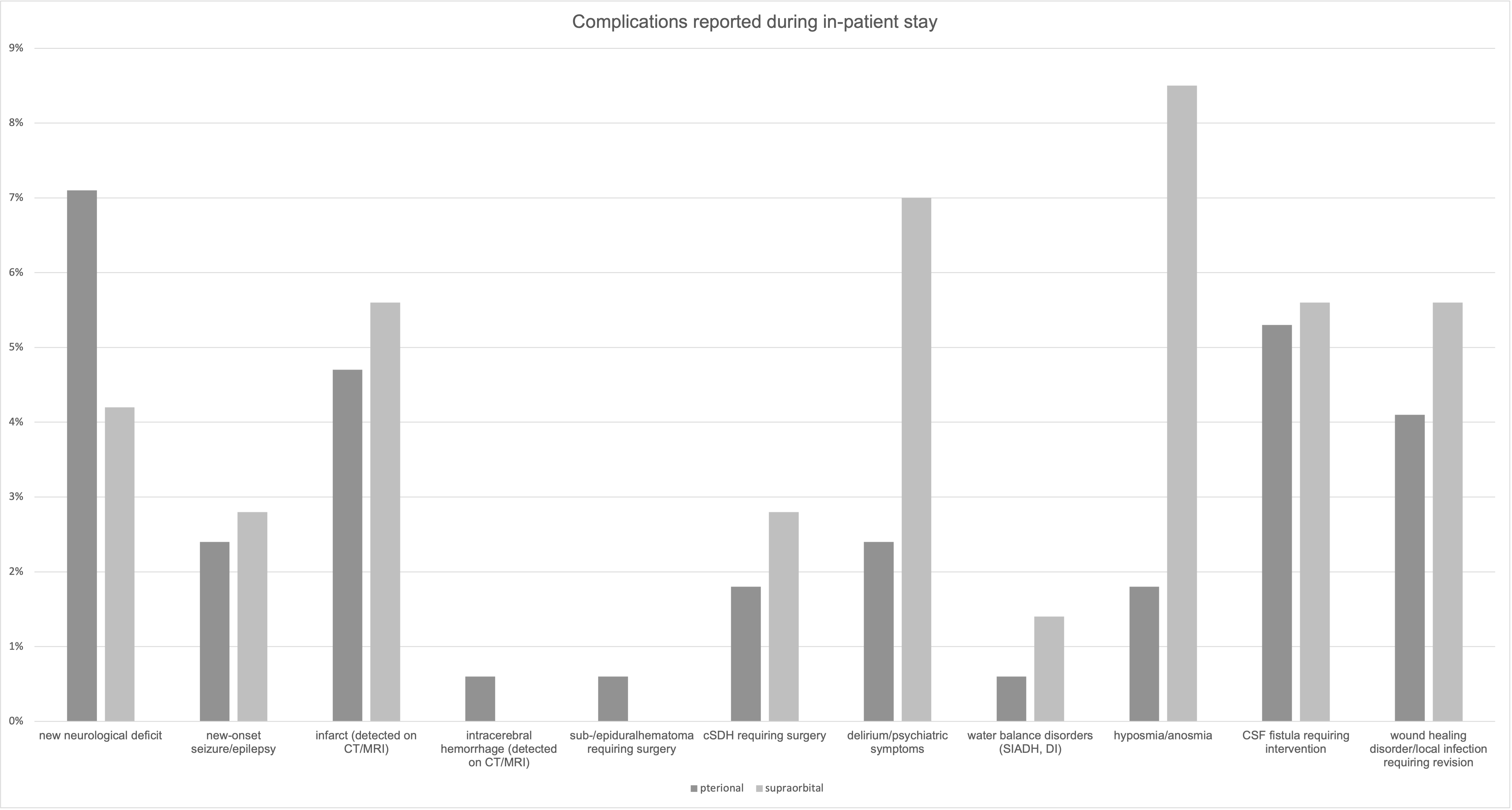
| Complications reported during in-patient stay | 53 | 31 | 0.049 |
| New neurological deficit | 12 (7.1%) | 3 (4.2%) | 0.563 |
| New-onset seizure/epilepsy | 4 (2.4%) | 2 (2.8%) | 1.000 |
| Infarct (detected on CT/MRI) | 8 (4.7%) | 4 (5.6%) | 0.752 |
| Intracerebral hemorrhage (detected on CT/MRI) | 1 (0.6%) | 0 (0%) | 1.000 |
| Sub-/epidural hematoma requiring surgery | 1 (0.6%) | 0 (0%) | 1.000 |
| CSDH requiring surgery | 3 (1.8%) | 2 (2.8%) | 0.633 |
| Delirium/psychiatric symptoms | 4 (2.4%) | 5 (7%) | 0.129 |
| Water balance disorders (SIADH, DI) | 1 (0.6%) | 1 (1.4%) | 0.500 |
| Hyposmia/anosmia | 3 (1.8%) | 6 (8.5%) | 0.021 |
| CSF fistula requiring intervention | 9 (5.3%) | 4 (5.6%) | 1.000 |
| Wound healing disorder/local Infection requiring revision | 7 (4.1%) | 4 (5.6%) | 0.736 |
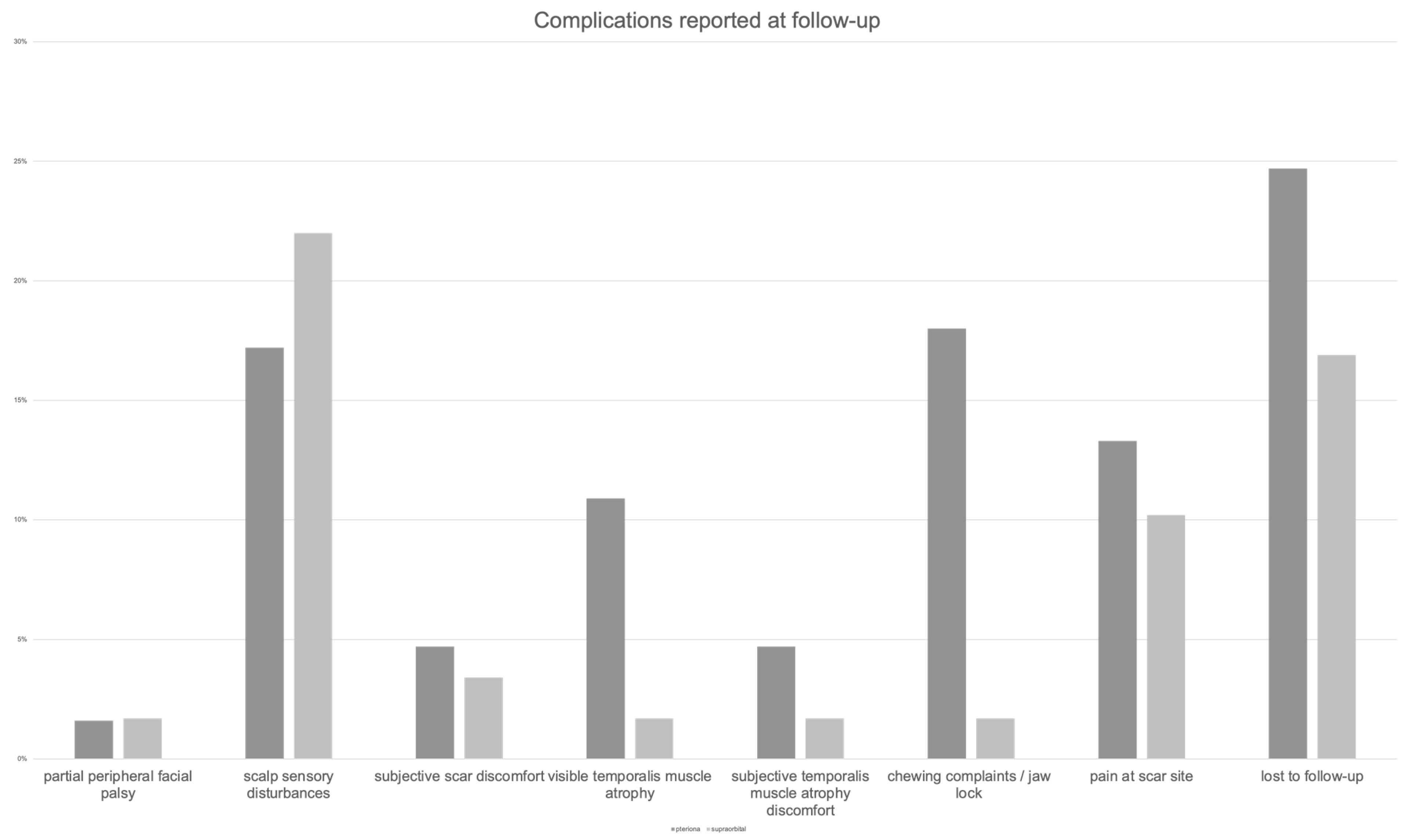
| Complications reported during follow-up | 90 | 25 | 0.331 |
| Partial peripheral facial palsy | 2 (1.6%) | 1 (1.7%) | 1.000 |
| Scalp sensory disturbances | 22 (17.2%) | 13 (22%) | 0.543 |
| Subjective scar discomfort | 6 (4.7%) | 2 (3.4%) | 1.000 |
| Visible temporalis muscle atrophy | 14 (10.9%) | 1 (1.7%) | 0.029 |
| Subjective temporalis muscle atrophy discomfort | 6 (4.7%) | 1 (1.7%) | 0.432 |
| Chewing complaints/jaw lock | 23 (18%) | 1 (1.7%) | 0.002 |
| Pain at scar site | 17 (13.3%) | 6 (10.2%) | 0.635 |
| Lost to follow-up | 42 (24.7%) | 12 (16.9%) |
| Neurological Outcome | Pterional n (%) | Supraorbital n (%) | p-Value |
|---|---|---|---|
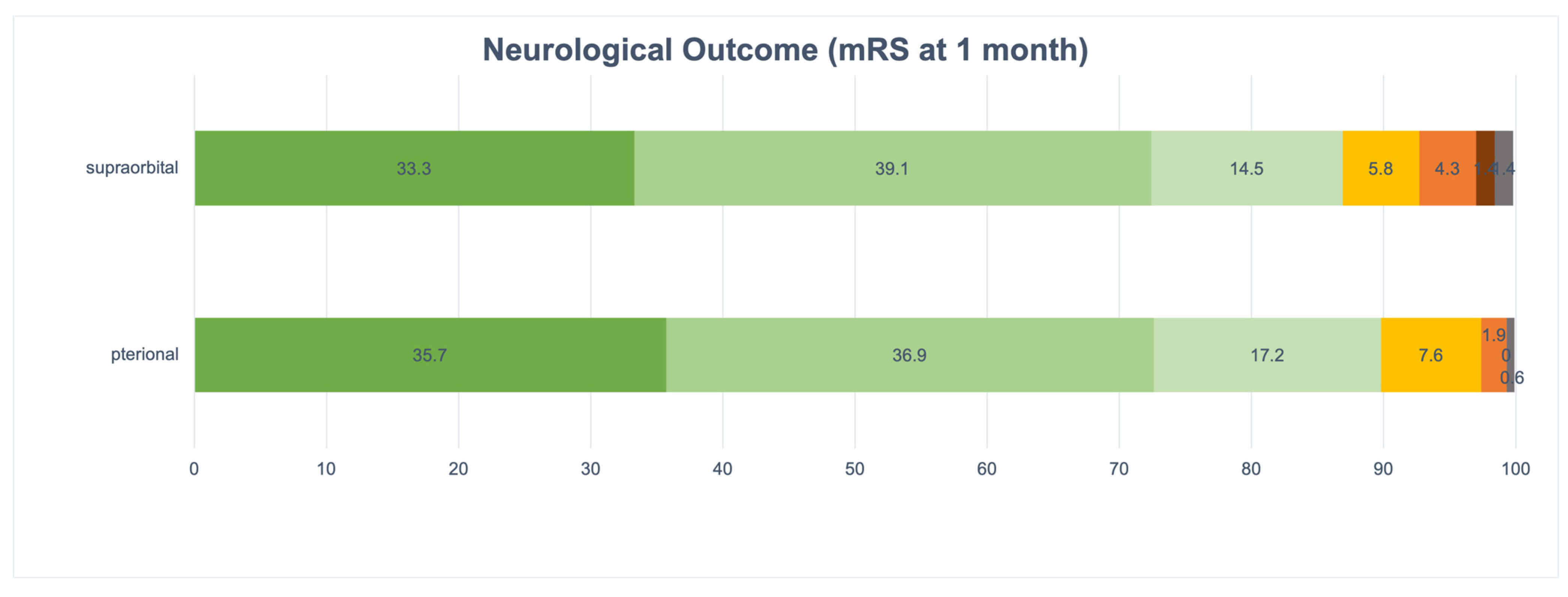
| Neurological Outcome (mRS at 1 month) | 0.707 | ||
| No symptoms (0) | 56 (35.7%) | 23 (33.3%) | |
| No significant disability (1) | 58 (36.9%) | 27 (39.1%) | |
| Slight disability (2) | 27 (17.2%) | 10 (14.5%) | |
| Moderate disability (3) | 12 (7.6%) | 4 (5.8%) | |
| Moderately severe disability (4) | 3 (1.9%) | 3 (4.3%) | |
| Severe disability (5) | 0 (0%) | 1 (1.4%) | |
| Dead (6) | 1 (0.6%) | 1 (1.4%) | |
| Not recorded | 13 (7.6%) | 2 (2.9%) | |
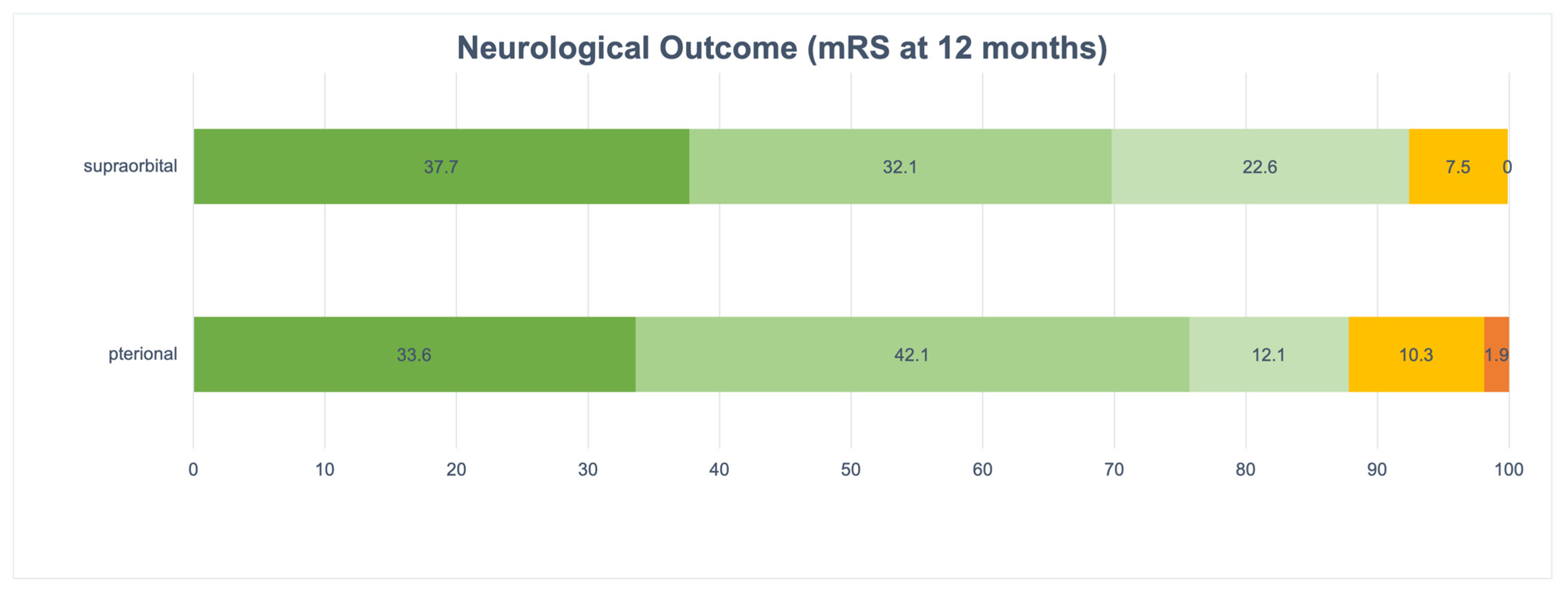
| Neurological Outcome (mRS at 12 months) | 0.899 | ||
| No symptoms (0) | 36 (33.6%) | 20 (37.7%) | |
| No significant disability (1) | 45 (42.1%) | 17 (32.1%) | |
| Slight disability (2) | 13 (12.1%) | 12 (22.6%) | |
| Moderate disability (3) | 11 (10.3%) | 4 (7.5%) | |
| Moderately severe disability (4) | 2 (1.9%) | 0 (0%) | |
| Severe disability (5) | 0 (0%) | 0 (0%) | |
| Dead (6) | 0 (0%) | 0 (0%) | |
| Not recorded | 63 (37.1%) | 18 (25.4%) |
Disclaimer/Publisher’s Note: The statements, opinions and data contained in all publications are solely those of the individual author(s) and contributor(s) and not of MDPI and/or the editor(s). MDPI and/or the editor(s) disclaim responsibility for any injury to people or property resulting from any ideas, methods, instructions or products referred to in the content. |
© 2025 by the authors. Licensee MDPI, Basel, Switzerland. This article is an open access article distributed under the terms and conditions of the Creative Commons Attribution (CC BY) license (https://creativecommons.org/licenses/by/4.0/).
Share and Cite
Brunner, A.; Rainer, M.; Pongratz, U.; Leber, K.; Fehér, M.; Micko, A.; Wolfsberger, S. Minimally Invasive Supraorbital vs. Traditional Pterional Approaches in Unruptured Aneurysm Surgery: Evaluating Risks and Results. Brain Sci. 2025, 15, 1315. https://doi.org/10.3390/brainsci15121315
Brunner A, Rainer M, Pongratz U, Leber K, Fehér M, Micko A, Wolfsberger S. Minimally Invasive Supraorbital vs. Traditional Pterional Approaches in Unruptured Aneurysm Surgery: Evaluating Risks and Results. Brain Sciences. 2025; 15(12):1315. https://doi.org/10.3390/brainsci15121315
Chicago/Turabian StyleBrunner, Anna, Marlene Rainer, Uschi Pongratz, Klaus Leber, Máté Fehér, Alexander Micko, and Stefan Wolfsberger. 2025. "Minimally Invasive Supraorbital vs. Traditional Pterional Approaches in Unruptured Aneurysm Surgery: Evaluating Risks and Results" Brain Sciences 15, no. 12: 1315. https://doi.org/10.3390/brainsci15121315
APA StyleBrunner, A., Rainer, M., Pongratz, U., Leber, K., Fehér, M., Micko, A., & Wolfsberger, S. (2025). Minimally Invasive Supraorbital vs. Traditional Pterional Approaches in Unruptured Aneurysm Surgery: Evaluating Risks and Results. Brain Sciences, 15(12), 1315. https://doi.org/10.3390/brainsci15121315