Article

Fusing Deep Learning and Gradient Boosting for Robust Minute-Level Atmospheric Visibility Nowcasting

by
Yuguo Ni
1,2,
Chenbo Xie
1,3,*,
Zichen Zhang
1,2 and
Jianfeng Chen
1,3,*
1
State Key Laboratory of Laser Interaction with Matter, Anhui Institute of Optics and Fine Mechanics, HFIPS, Chinese Academy of Sciences, Hefei 230031, China
2
School of Environment and Energy Engineering, Anhui Jianzhu University, Hefei 230009, China
3
Science Island Branch of Graduate School, University of Science and Technology of China, Hefei 230026, China
*
Authors to whom correspondence should be addressed.
Geosciences 2026, 16(3), 104; https://doi.org/10.3390/geosciences16030104
Submission received: 10 November 2025 / Revised: 22 February 2026 / Accepted: 27 February 2026 / Published: 3 March 2026
(This article belongs to the Section Climate and Environment)

Abstract

Atmospheric visibility nowcasting is vital for safety-critical operations but remains challenging due to complex atmospheric dynamics. We propose a compact stacking ensemble merging a multilayer perceptron (MLP) and gradient-boosted regression trees (GBRT). The model, trained on seven months of minute-scale resolution data with a variability-adaptive filter to suppress sensor noise, employs cross-validation. Results demonstrate that the ensemble achieves its peak performance in the operationally critical low-visibility regime (V < 5 km). This range is particularly significant as it encompasses the Category I and II (CAT I/II) operational thresholds defined by the World Meteorological Organization (WMO) for aviation and surface transportation safety. In this regime, the ensemble yields an R2 of 0.82 and an MAE≈385 m, significantly outperforming single learners during rapid weather transitions. Conversely, in the high-visibility regime (V > 20 km), the explanatory power decreases (R2 of 0.46) due to inherent forward-scattering sensor uncertainties and low aerosol concentrations. Despite these range-specific physical limitations, the model maintains high robustness with narrowly centered residuals. This efficient approach, utilizing cost-effective in situ sensors, is highly suitable for airport and road-weather applications and offers strong potential for multi-site scalability.

1. Introduction

Reduced visibility poses a major threat to the safety and throughput of airports and highway networks. In aviation operations, visibility determines the transition between landing categories (CAT I, II, and III) [1]. A sudden drop can reduce runway capacity by up to 50% or lead to costly diversions. Similarly, in road traffic, “patchy fog” or rapid visibility changes often outpace driver reaction times, significantly increasing the risk of multi-vehicle collisions. Rather than a simple state variable, visibility is a product of non-linear interactions between aerosol hygroscopic growth, boundary-layer structure, and thermodynamics (Gultepe and Milbrandt et al. (2010)) [2,3]. Given that these microphysical processes evolve rapidly, there is a critical need for high-frequency predictive frameworks that can provide actionable intelligence beyond the temporal resolution of standard meteorological reports. Existing studies often rely on short-term case studies; however, to ensure operational reliability for infrastructure such as airports, it is essential to validate predictive models across diverse visibility regimes [4].
Over the past decade, data-driven models—from linear baselines and support vector machines to random forests, gradient-boosted trees, and recurrent neural networks—have improved visibility prediction at hourly to daily scales [4,5]. However, three critical gaps persist in minute-level visibility research: (i) the limited high-fidelity coupling between visibility and co-located meteorological parameters (e.g., liquid water content and droplet microphysics) at high temporal resolutions; (ii) challenges in handling of non-stationary noise and stochastic outliers inherent in operational sensor data during rapid weather transitions; and (iii) the relatively sparse model verification specifically focused on hazardous low-visibility regimes (e.g., V < 1 km and V < 5 km for aviation safety), where the non-linear impact of aerosol hygroscopic growth is most pronounced. Furthermore, the “black-box” nature of many advanced machine learning models often obscures the physical interpretability required for operational forecasting in safety-critical environments such as airports and highway networks (Yu et al. (2021)) [6].
To address these gaps, we develop a compact stacking ensemble that blends a multilayer perceptron (MLP) and gradient-boosted regression trees (GBRT) under a transparent linear meta-learner trained with Huber Loss. The design is intentionally application-oriented: it uses inexpensive in situ sensors, incorporates a variability-adaptive filter to attenuate transient artefacts without oversmoothing genuine changes, and follows temporally ordered cross-validation to respect serial dependence. We further emphasize regime-aware assessment by verifying performance across visibility classes and examining residual structure and tails for robustness [7]. This study advances minute-level visibility nowcasting in four ways:
Dataset and alignment: we compile seven months of collocated, 1 min observations at an urban site and apply strict time alignment and basic QC to ensure station-scale consistency.
Robust preprocessing: a lightweight, variability-adaptive filter reduces the leverage of spikes and dropouts while preserving rapid transitions that are critical for operations.
Stacked learning with robust loss: complementary base learners (MLP for smooth nonlinear interactions; GBRT for threshold-like structures) are fused by a linear meta-learner optimized with Huber Loss to balance flexibility and stability.
Operational verification: beyond global scores (R2, MAE, correlation), we evaluate performance by visibility classes, with emphasis on V < 5 km, and analyze residual concentration and tail behavior as indicators of robustness and deployability.
This study proceeds as follows: Section 2 covers the site, data, preprocessing, and modeling workflow; Section 3 details the model construction; Section 4 presents results (including stratified verification and residual diagnostics) and discusses implications, limitations, and extensions to multi-site/probabilistic forecasting; and Section 5 concludes with practical deployment takeaways for road-weather and airport settings.

2. Data and Methods

2.1. Data Sources

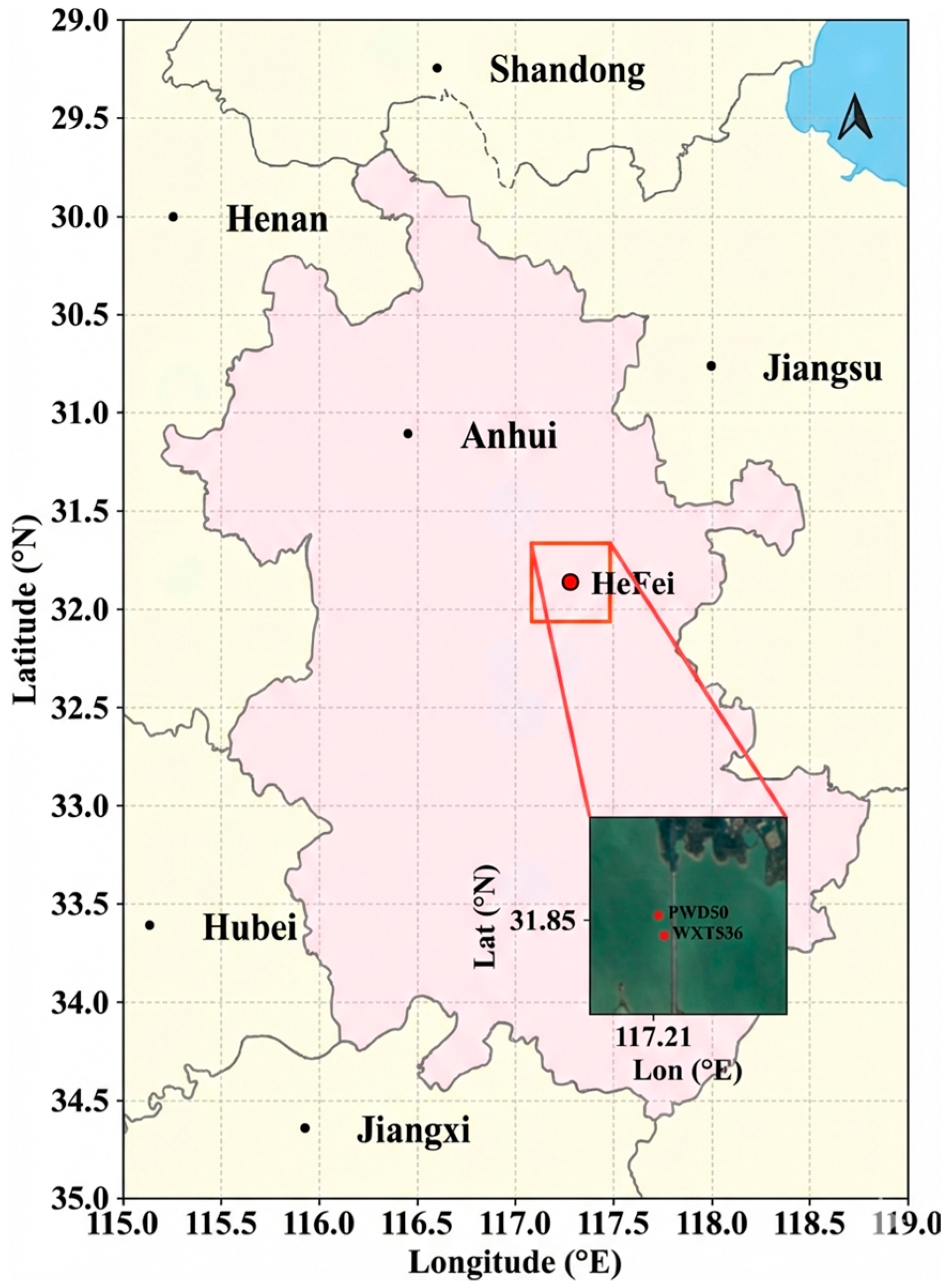
Hefei lies in central Anhui Province on the alluvial plain between the Yangtze and Huai Rivers. The visibility observations used in this study were collected at a meteorological sensor station located beside Dongpu Reservoir in Hefei (31.87° N, 117.22° E; ~37.3 m a.s.l.), on the western edge of the urban area and approximately 5 km from the city center. The station’s location is shown in Figure 1.
From May to December 2024, a seven-month campaign was conducted at this site to study the evolution of low-visibility events in the Yangtze–Huaihe region and their links to key meteorological factors. Instrument specifications and sampling settings are summarized in Table 1.
To ensure temporal consistency, data were synchronized to a 1 min resolution. Specifically, the high-frequency measurements from the WXT536 sensor (~10 s intervals) were aggregated into 1 min averages (scalar averaging for Ta, RH, P, and WS; vector averaging for WD) to align with the PWD50 output (mR and visibility). This was followed by standard quality control and normalization. Guided by the physical relationships between visibility and meteorological parameters established by Gultepe et al. (2007, 2010) [2,8] we performed model training and hyperparameter optimization using the processed dataset [9].

2.2. Methods

Traditional visibility-prediction studies often rely on a single model and pay limited attention to how the choice of loss function and stacking protocol affects generalization. To improve robustness and operational value, we adopt a stacked ensemble in which a multilayer perceptron (MLP; Figure S1) and gradient-boosted regression trees (GBRT; Figure S2) serve as base learners, and a linear regression (LR) acts as the meta-learner [10]. The stacking ensemble is trained using five-fold cross-validation. In each iteration, out-of-fold (OOF) predictions are generated by the MLP and GBRT base models on the validation fold and then fed into the LR meta-learner to optimize the meta-weights. During the inference stage, predictions from both base models are concatenated and passed to the trained LR for the final visibility estimate. To reflect operational priorities, we perform graded verification by visibility classes with emphasis on the low-visibility regime. Model structures and implementation details are provided in Section 3.1, Section 3.2 and Section 3.3, and prediction results are assessed in Section 4.2.
Model skill is evaluated using the Pearson correlation coefficient (CC), mean absolute error (MAE), coefficient of determination (R2), and residual diagnostics (RD). In addition, we examine the distribution of standardized residuals (center, spread, and tails). These metrics jointly assess linear association, absolute error magnitude, goodness-of-fit, categorical hit performance, and robustness (distribution and tail behavior of residuals), providing a comprehensive evaluation across regimes.

3. Model Construction

The model uses the following seven input features: temperature (Ta), relative humidity (RH), wind speed (WS), wind direction (WD), atmospheric pressure (P), and 1 min precipitation rate (mR).

3.1. Gradient Boosting Regression Tree (GBRT)

3.1.1. GBRT Introduction

Gradient Boosting Regression Trees (GBRT), also known as Gradient Boosted Machines (GBM), represent an advanced ensemble learning technique that sequentially constructs decision trees to optimize predictive performance. The fundamental principle of GBRT lies in its gradient descent optimization framework, where each subsequent tree is trained to approximate the negative gradient (i.e., residuals) of the current ensemble model, thereby progressively minimizing the specified loss function [11,12,13].

3.1.2. GBRT Structure and Parameter Configuration

To enhance model robustness and generalization, the GBRT model is carefully configured with a set of hyperparameters that control tree complexity, regularization, and optimization behavior. The key settings are shown in Table S1. The training details are shown in Algorithm 1.
Algorithm 1. GBRT algorithm table
Geosciences 16 00104 i001

3.2. Multilayer Perceptron (MLP)

3.2.1. MLP Introduction

Multilayer perceptrons (MLPs), a type of feedforward neural network, show strong potential for nonlinear regression in atmospheric science. This study explores MLPs for visibility prediction, emphasizing their ability to model complex relationships among meteorological variables, along with network design, optimization, and advantages over traditional methods [14,15,16,17].

3.2.2. MLP Structure and Parameter Configuration

To model complex nonlinear relationships between meteorological factors and visibility, this study proposes a deep MLP with two hidden layers, implemented in PyTorch2.7.0. The architecture includes normalization, activation functions, dropout regularization, and weight initialization to improve generalization and training stability. Parameter settings are given in Table S2, and training details are shown in Algorithm 2.
Algorithm 2. MLP algorithm table
Geosciences 16 00104 i002
The model is set to training mode to activate dropout and batch normalization, and gradients are reset before each iteration. Forward propagation generates predictions, followed by Huber Loss computation, backpropagation for gradient calculation, and parameter updates via the Adam optimizer. This process ensures effective modeling of nonlinear meteorological–visibility relationships with stable training and strong generalization.

3.3. Stacked MLP-GBRT Ensemble Framework

3.3.1. Stacked Strategy Introduction

Current mainstream ensemble learning methods include Boosting, Bagging, Stacking, and Deep Ensembles [18,19,20]. In this study, we employ a Stacking framework that integrates neural networks and tree-based models as base learners, with linear regression serving as the meta-model to enhance the accuracy and robustness of interval predictions. The following validation strategy is adopted: the dataset is first partitioned into training and testing sets using an 8:2 ratio. For the Gradient Boosted Regression Trees (GBRT) model, a 5-fold cross-validation is performed on the training set to generate out-of-fold (OOF) predictions, which are then used as input features for the meta-model. The Multi-Layer Perceptron (MLP) and GBRT act as base models, and their predicted outputs are combined and fed into the linear regression meta-model for the final prediction. During GBRT training, 10% of the training data are held out as a validation set to monitor performance and trigger early stopping, thereby preventing overfitting. Additionally, residual analysis is conducted to examine the presence of heteroscedasticity in the model errors, ensuring reliable uncertainty estimation.

3.3.2. Loss Function

The loss function measures the difference between predictions and true values, guiding parameter optimization. Mean Squared Error (MSE), widely used in regression, computes the average of squared prediction errors.
M S E = 1 n i = 1 n y i y ^ i 2
To integrate the complementary predictive strengths of the MLP and GBRT base models, we employ a linear regression meta-learner optimized via Huber loss. Huber Loss is a robust regression loss function that combines the benefits of MSE and MAE. It is less sensitive to outliers than MSE while remaining differentiable, making it suitable for gradient-based optimization [2,21]. Unlike the traditional least squares method, which is highly sensitive to sensor artifacts and extreme visibility fluctuations, the Huber-based optimization provides a robust weighting scheme by transitioning from a quadratic loss for small residuals to a linear loss for larger outliers.
L δ ( y , y ^ ) = 1 2 ( y y ^ ) 2 f o r   | y y ^ | δ , δ | y y ^ | 1 2 δ o t h e r w i s e   .
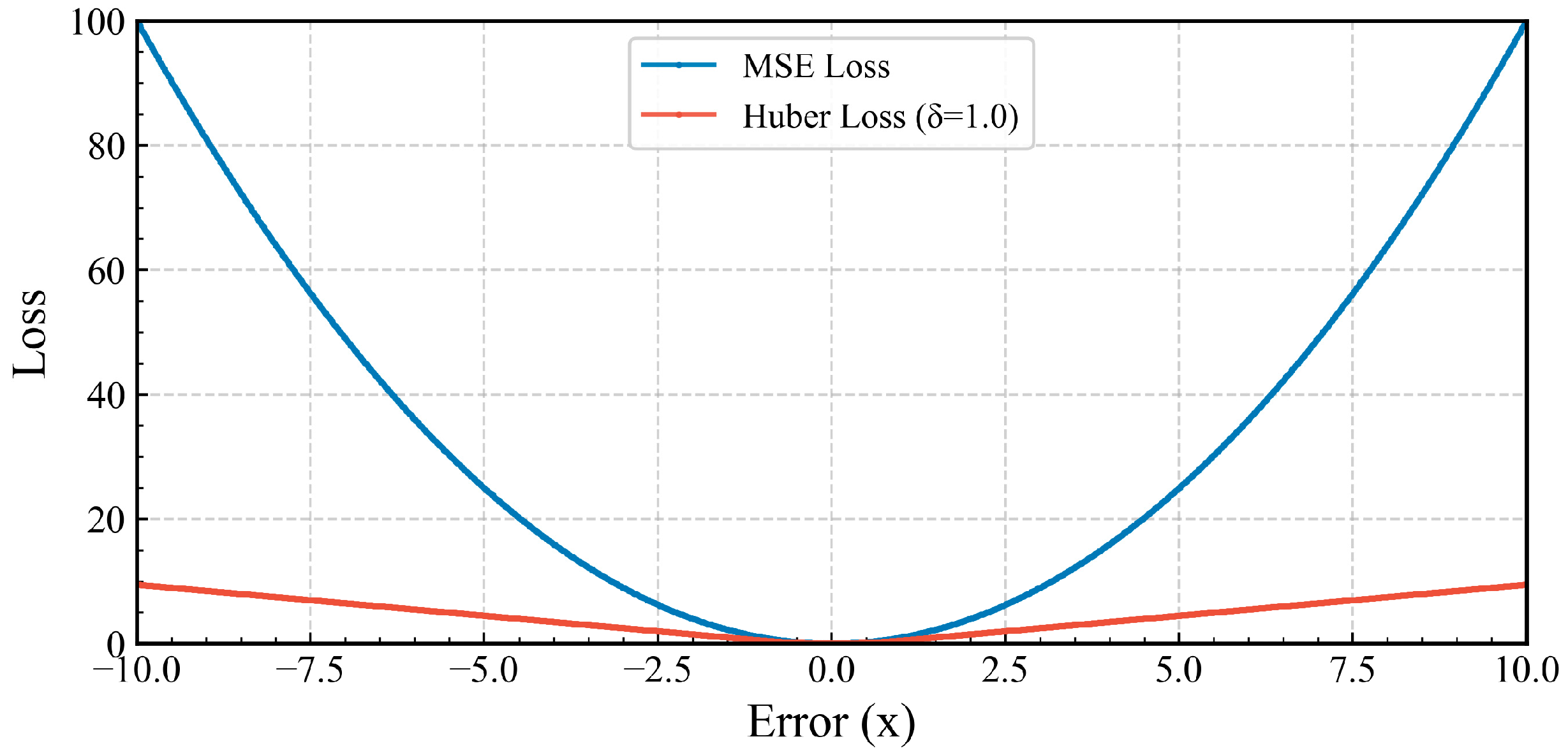
Compared to MSE, Huber Loss demonstrates more robust performance, and their relationship is shown in Figure 2.
The red dashed line represents the MSE (Mean Squared Error), which is highly sensitive to outliers. As the error increases, the loss grows quadratically, making it prone to being dominated by large errors. The blue solid line represents the Huber Loss. For small errors (less than δ = 1.0), it behaves similarly to MSE. However, for larger errors, the loss grows linearly instead of quadratically, which significantly reduces its sensitivity to outliers.

4. Experimental Results

4.1. Experimental Environment and Data

Between August and December 2024, Hefei, Anhui, experienced multiple severe haze pollution events, characterized by frequent periods of significantly reduced visibility.

4.1.1. Visibility Changing Trend in Hefei City for 2024

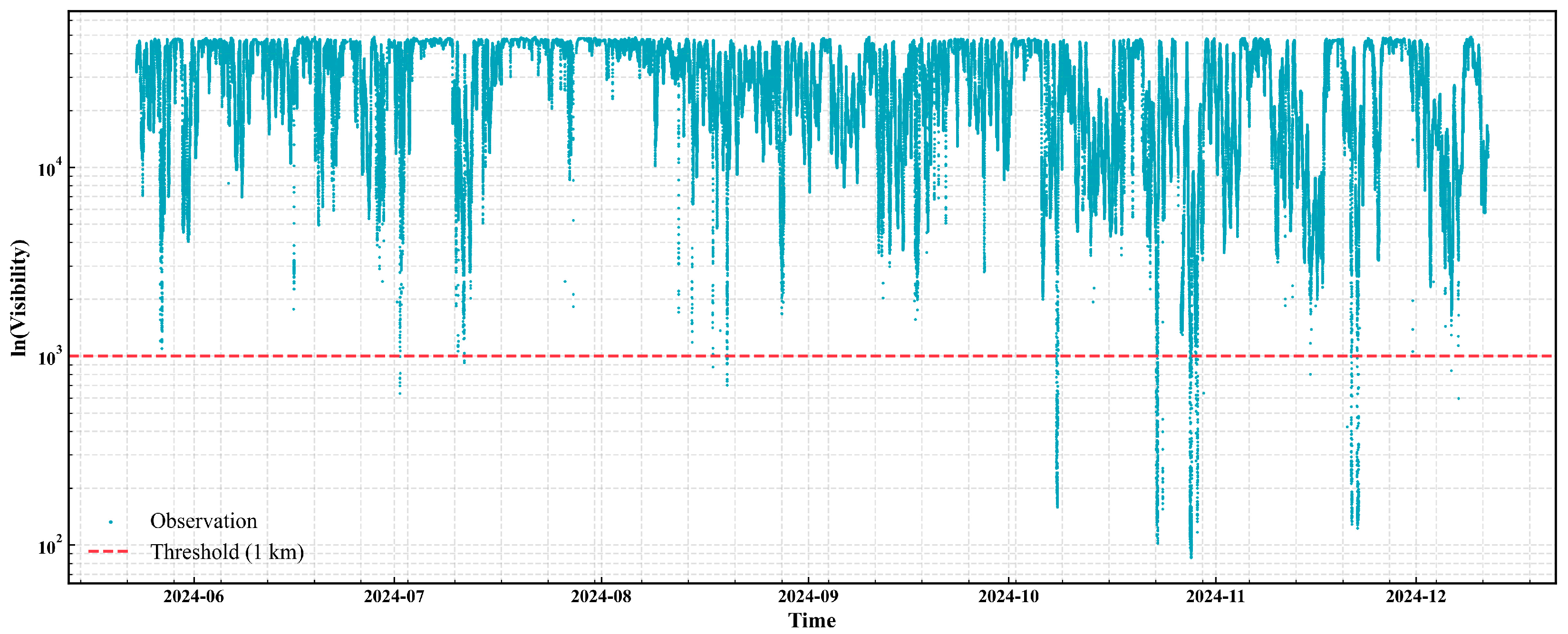
This study examines the variation in atmospheric visibility in Hefei based on meteorological data collected from 08:18 on 23 May 2024 to 17:40 on 11 December 2024, encompassing a total of 198,197 records, with a 1 min interval. Figure 3 presents the visibility data in Hefei after dynamic filtering processing. Table 2 summarizes the average values of meteorological parameters under different visibility conditions.

4.1.2. Monthly Average Trends of Meteorological Parameters in Hefei for 2024

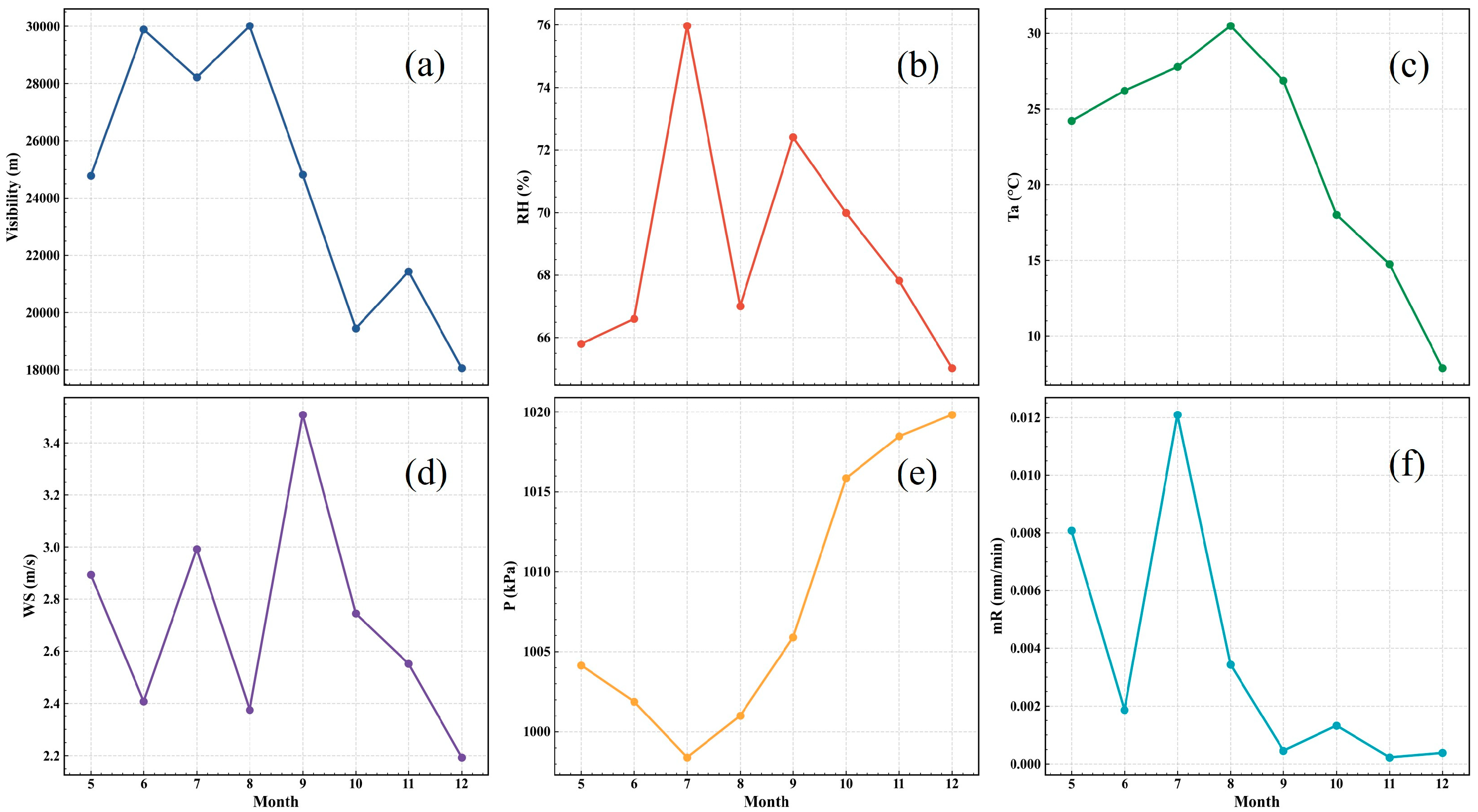
To examine whether the observed visibility variations are physically consistent with established meteorological mechanisms, we first analyze the monthly relationships between visibility and key atmospheric variables. Figure 4 illustrates the monthly variations in visibility and its associated meteorological factors, including relative humidity (RH) and minute Rain (mR).

4.1.3. Analysis of the Impact of Various Meteorological Parameters on Visibility

The selection of input features for visibility nowcasting must transcend statistical correlation to encompass the underlying thermo-hygrometric and dynamical processes of the atmosphere. To verify the physical consistency of the observational dataset and the interpretability of the subsequent machine learning models, we analyze the multi-dimensional dependencies of visibility on primary meteorological drivers.
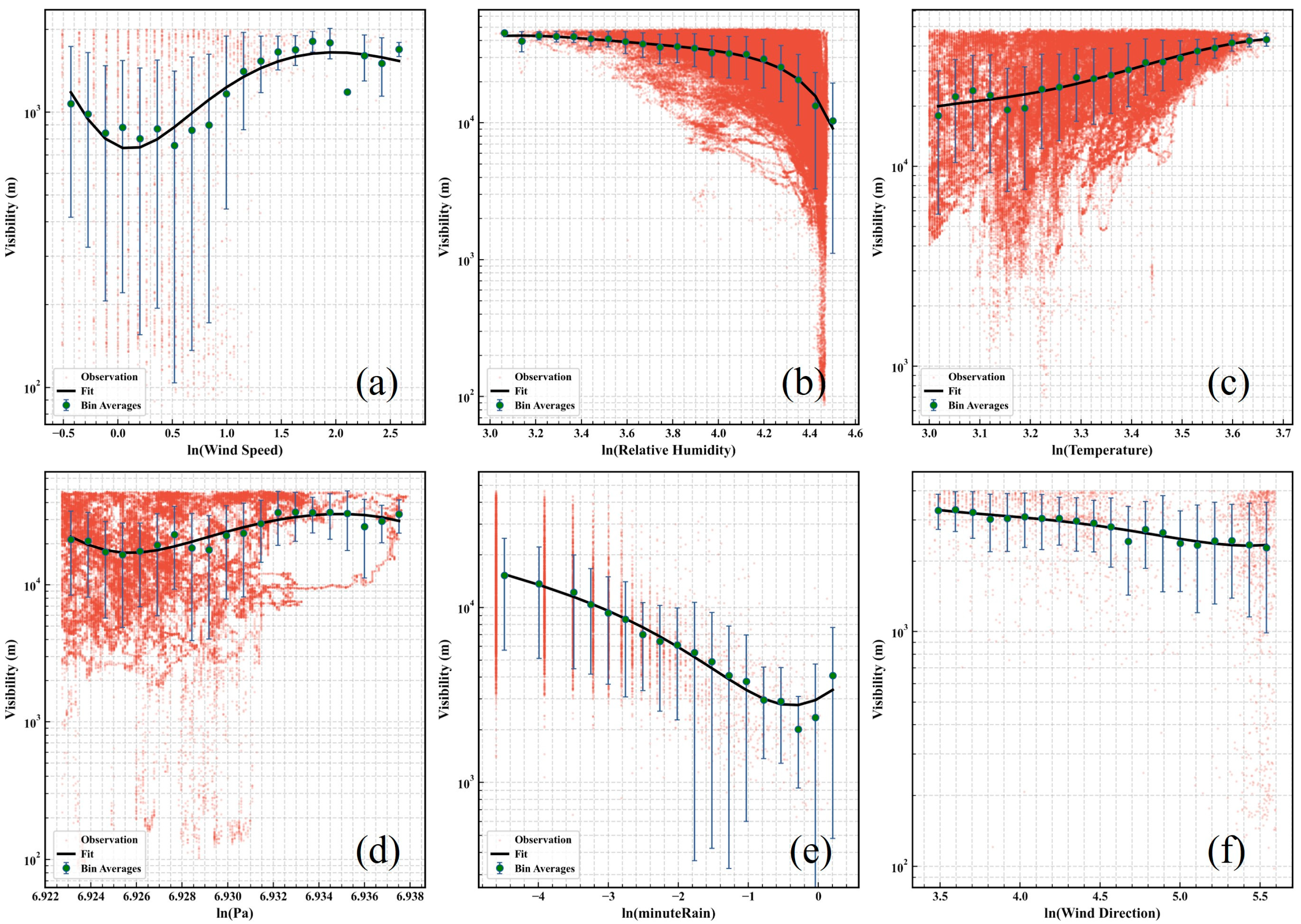
Figure 5 illustrates the physical dependencies between 1 min atmospheric visibility (V) and key meteorological parameters, providing an empirical foundation that aligns with established atmospheric physics.
(a)
Wind speed (WS) exhibits a non-linear relationship with visibility; high-frequency low-visibility events at low WS reflect stagnant conditions favoring aerosol accumulation, while increasing WS facilitates mechanical turbulence and the dispersion of atmospheric pollutants.
(b)
Relative humidity (RH) shows a robust negative correlation with visibility (V), characterized by a sharp, non-linear decay as RH approaches saturation (>80%). This is consistent with the hygroscopic growth of aerosols, which significantly enhances light extinction and reduces visibility, as discussed in the frameworks of Gultepe et al. (2009, 2010) [22,23].
(c)
Air temperature (Ta) thermal effects indicate that when Ta exceeds 20 °C, the probability of low-visibility occurrences drops substantially, likely due to the increased water-holding capacity of warmer air inhibiting saturation.
(d)
Surface pressure (Pa) acts as a secondary indicator, where higher visibility is more frequent under localized low-pressure systems often associated with post-frontal clearing or unstable convective conditions in this dataset.
(e)
The 1 min Rain is inversely proportional to V, as falling hydrometeors significantly increase the extinction coefficient through Mie scattering, leading to severe visibility reduction distinct from aerosol-driven pollution events. Months with enhanced precipitation rates tend to coincide with reduced visibility, supporting the physical link between hydrometeor presence and optical extinction. Although the present analysis is based on monthly mean values rather than event-scale statistics, the observed Vis–RH and Vis–mR relationships exhibit trends comparable to those reported by Gultepe et al. in JAM [2], indicating that the dominant physical mechanisms controlling visibility degradation remain consistent across different climatic regions and temporal scales.
(f)
Wind direction further illustrates the potential influence of localized moisture or pollutant sources on visibility fluctuations. These observed relationships validate that the input features are physically grounded and essential for robust minute-level nowcasting.
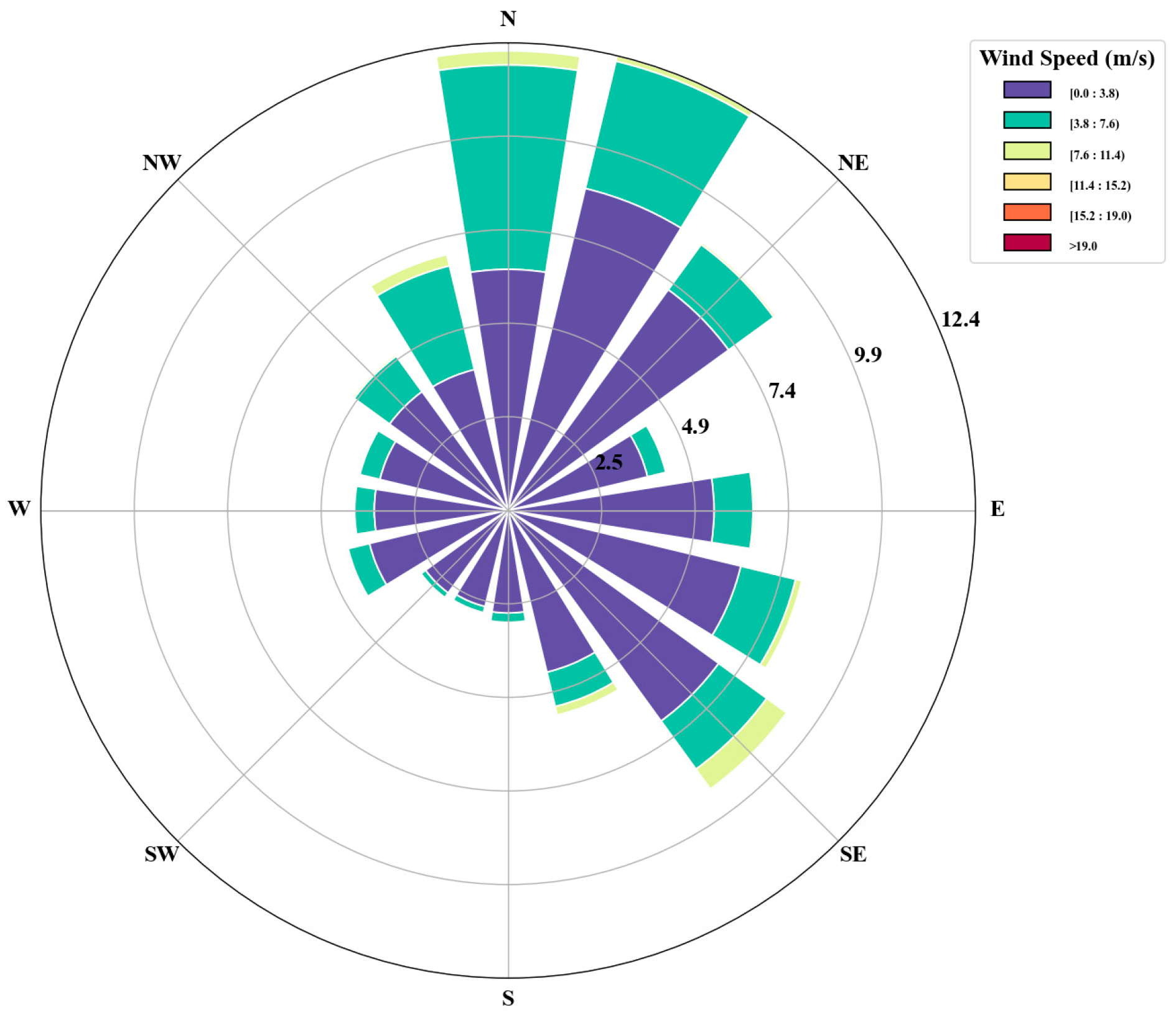
Figure 6 shows a wind rose diagram, where the circular scale represents the wind direction, and the radial scale indicates the frequency of occurrence for wind speed in that direction. The wind rose showed that northeast (N-E) emerged as the dominant wind direction. The predominant directions for high wind speeds (6–9 m/s and 9–12 m/s) predominantly occur from the N-E, E, N-W, and W. Conversely, the southwest (S-W), southeast (S-E), and south (S) display predominantly low-intensity winds, with 87% of occurrences confined to the 0–6 m/s range, reflecting calmer atmospheric conditions.

4.2. Model Performance Evaluation

In this study, visibility prediction is first treated as a continuous regression problem over the range of 0–10 km. This formulation allows for a quantitative evaluation of model accuracy, error characteristics, and numerical stability across the full dynamic range of visibility, without introducing artificial boundaries associated with categorical thresholds [24,25].
However, operational applications in transportation and aviation are typically based on discrete visibility categories defined by the World Meteorological Organization (WMO). Therefore, after assessing the continuous prediction performance, a category-based verification is further conducted according to WMO visibility standards to evaluate the practical skill of the proposed method under different visibility regimes. Performing categorical verification alone may obscure systematic prediction biases within individual visibility classes, especially near class boundaries. By first analyzing continuous prediction errors, we ensure that the model learns physically meaningful relationships rather than merely optimizing category-level accuracy.

4.2.1. Performance Evaluation of Continuous Visibility Regression

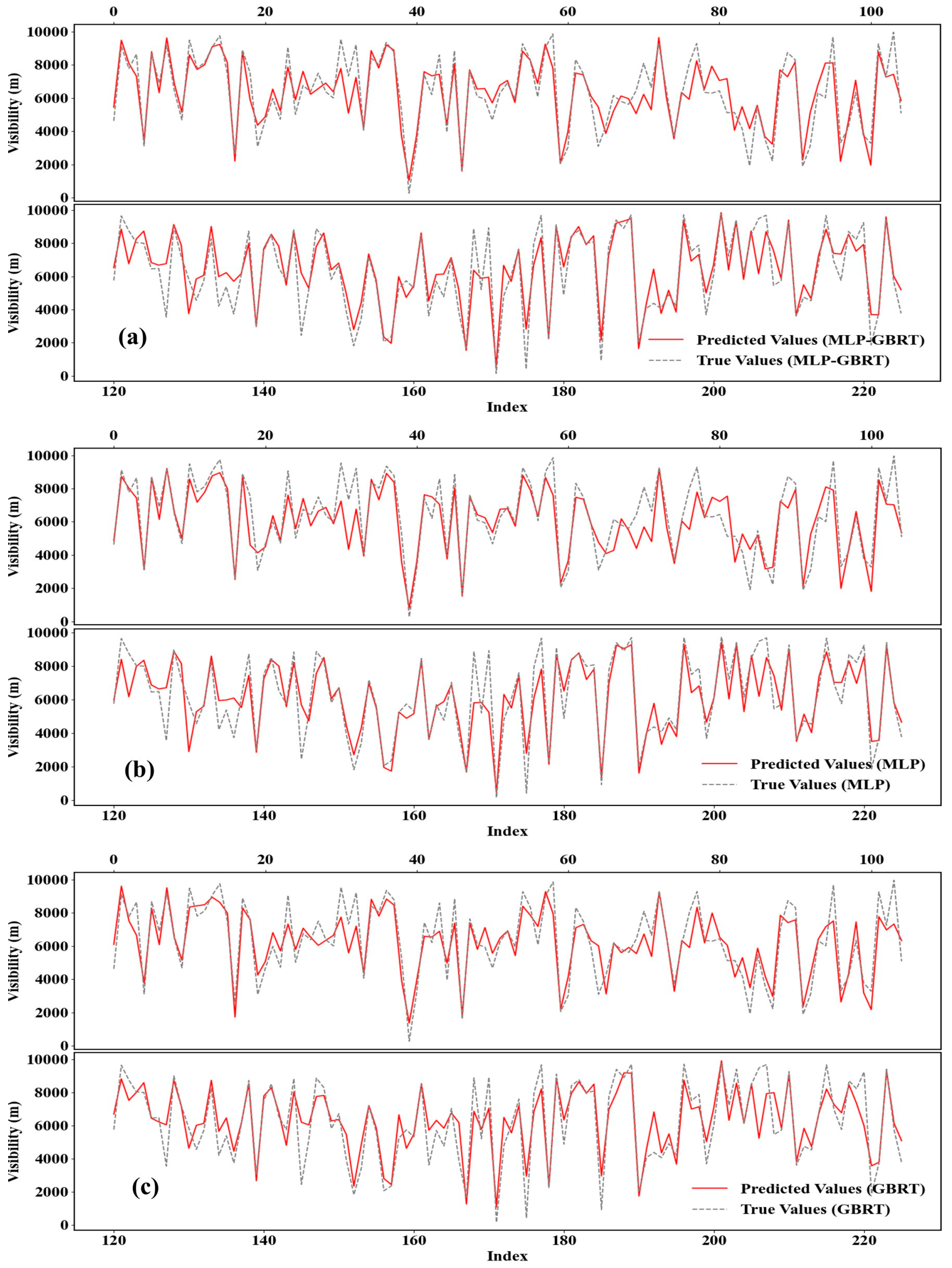
All models track the observed visibility, with the largest errors during rapid transitions, as shown in Figure 7. The stacked ensemble attains the lowest error and the best agreement with observations. This performance arises from stacking an MLP and GBRT as base learners with a linear meta-model, which integrates their complementary strengths. MLP captures smooth nonlinear interactions but can overfit without strong regularization; GBRT models threshold-like relations and performs implicit feature selection, yet may propagate noisy splits [26,27]. Their combination balances flexibility and robustness, improving performance across regimes. The linear meta-model yields interpretable, stable weights on base outputs, enhancing reliability under complex and rapidly changing conditions [16,19,28].
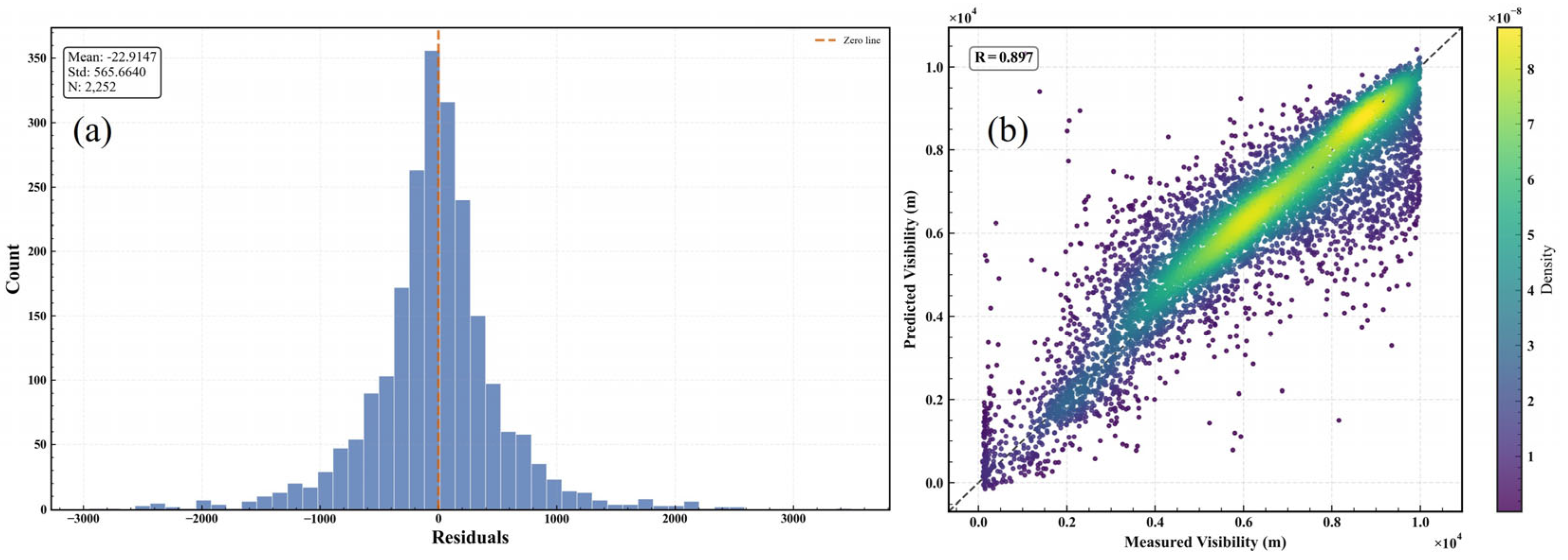
Figure 8 evaluates the predictive integrity and error characteristics of the proposed stacked ensemble model. (Figure 8a) The residual histogram reveals that the error distributions are tightly centered near zero with a sharp, symmetric peak (Mean: −22.91 m), indicating minimal systematic bias and high predictive precision. The near-normal distribution of residuals, characterized by light tails, confirms that the model satisfies key regression assumptions and maintains robust performance with few significant outliers across the 7-month dataset. (Figure 8b) The density scatter plot further illustrates the high degree of agreement between measured and predicted visibility (V), achieving a strong correlation coefficient (R = 0.897). The concentration of data points along the 1:1 dashed line—particularly in the high-density (yellow-coded) regions—demonstrates the model’s ability to accurately capture the non-linear extinction dynamics across both clear-air and hazardous low-visibility regimes. This dual-validation confirms that the stacked framework effectively translates complex meteorological inputs into reliable visibility nowcasts.

4.2.2. Visibility Stratified Verification

In operational visibility forecasting, categorical verification is essential for assessing model performance across distinct visibility regimes. Accordingly, we evaluate the forecasts using a six-class scheme (Table 3) based on WMO standards. In our classification validation, we strategically focused on categories I and II (Visibility < 5.0 km). This decision is based on the fact that visibility below 5 km represents the critical threshold for aviation safety and traffic management. By emphasizing the model’s performance in these high-impact ranges, we ensure that the predicted extinction coupling is most accurate where it is most needed for operational safety.
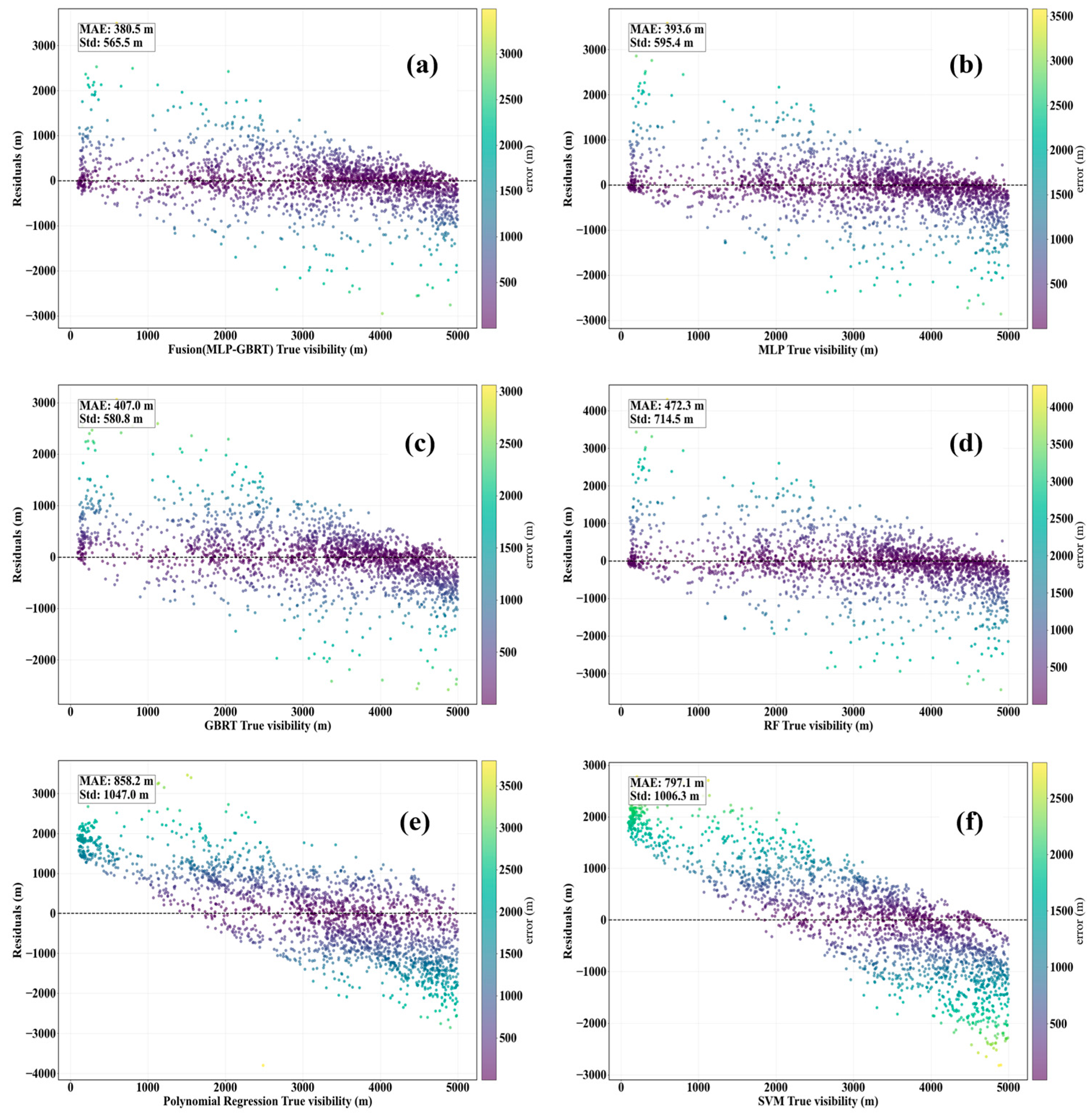
Figure 9 shows residual distributions for each model under conditions of “Significant Obstruction to Vision,” defined here by merging Classes I and II (visibility < 5 km). This strategic merging was performed to ensure statistical robustness and representative training, as independent Class I observations (<1 km) were relatively sparse in the high-frequency sampling dataset. Residuals—defined as prediction minus observation—summarize each model’s errors; narrow, centered residuals indicate better performance. Visually, our stacked model (Figure 9a) shows the tightest, most centered residuals, outperforming MLP (Figure 9b), GBRT (Figure 9c), RF (Figure 9d), polynomial regression (Figure 9e), and SVM (Figure 9f).
We also report mean absolute error (MAE) and standard deviation (Std) as complementary metrics: within this merged low-visibility regime (<5 km), the MLP–GBRT stack attains MAE = 380.5 m and Std = 565.4 m, improving on MLP (393.6 m; 595.4 m) and GBRT (407.0 m; 580.8 m). Traditional baselines (RF, PR, SVM) underperform. These gains likely stem from combining the complementary error structures of MLP and GBRT and from regularized training (e.g., shrinkage/early stopping), which prioritizes accuracy while limiting overfitting.
The enhanced robust performance in this regime is intrinsically linked to the physical dependencies identified in Section 4.1.3. Specifically, the integration of GBRT’s threshold-capturing capability and MLP’s nonlinear mapping allows the model to better represent the exponential decrease in visibility as relative humidity (RH) approaches saturation—a key driver for aerosol hygroscopic growth and the subsequent onset of severe visibility impairment. By effectively weighting these meteorological drivers, the model mitigates the typical “over-smoothing” issue of single learners during rapid transitions, thereby providing more reliable warnings for safety-critical operations under high-humidity or stagnant wind conditions that trigger low-visibility events.

4.2.3. Comparison of Performance Metrics Among Models

Given that the PWD and WXT sensors used in this study have a maximum effective detection range of 50 km, all visibility observations exceeding this threshold were capped or filtered to ensure data integrity.
Within this constrained observational framework, we evaluate the proposed approach against six baselines on the same dataset: our stacked model (“Fusion”), MLP, GBRT, RF, SVM, and polynomial regression (PR). MLP is a feed-forward neural network suited to nonlinear function approximation. GBRT and RF are tree ensembles: GBRT boosts shallow trees sequentially, whereas RF aggregates decorrelated trees via Bagging and random feature subspaces. SVM (SVR) performs kernel-based regression in a high-dimensional feature space. PR augments linear regression with polynomial basis terms to capture smooth nonlinear trends. Together, these models span complementary families for visibility prediction. Performance—reported as R2 (coefficient of determination), CC (correlation coefficient), and MAE (mean absolute error)—is summarized in Table 4.
Across four visibility regimes, the proposed MLP–GBRT ensemble consistently demonstrates superior predictive skill compared to standalone models (MLP, GBRT, RF, SVM, and PR). The stacking framework achieves its highest explanatory power in Dataset I/Ⅱ (V < 5 km), with R2 = 0.82, CC = 0.90, and the lowest MAE = 380.5 m. This performance significantly exceeds that of MLP (R2 = 0.78) and GBRT (R2 = 0.77), indicating that the ensemble effectively captures the complex nonlinearities of aerosol hygroscopic growth under high-humidity conditions.
However, as visibility increases, a general decline in model performance is observed, a trend consistent with the physical limitations of forward-scattering sensors. In Dataset V (V > 20 km and V < 50 km), the stack still outperforms other models with the lowest MAE = 2866.5 m and CC = 0.68; the R2 values drop across all architectures (R2 = 0.46 for the stack). This reduction in skill is likely due to the decreased signal-to-noise ratio in sensor measurements during clear-air conditions, where lower aerosol concentrations lead to weaker scattering signals. Despite this range-dependent sensitivity, the results confirm that stacking leverages the complementary strengths of neural networks (MLP) and Gradient Boosting (GBRT). This synergy yields more reliable forecasts for operationally critical low-visibility events while maintaining state-of-the-art performance in clearer conditions.
To further contextualize the performance of the proposed MLP–GBRT stacking framework, it is essential to compare it with both established physical parameterizations and the conventional machine learning models evaluated in this study. Specifically, Gultepe et al. developed visibility schemes based on droplet microphysics, which remain benchmarks in the field. However, these physical models often struggle with high-frequency fluctuations in minute-level datasets due to their reliance on steady-state assumptions and the difficulty of obtaining real-time microphysical inputs (e.g., liquid water content). In contrast, our data-driven approach implicitly captures these rapid transitions by leveraging the synergistic effect of MLP’s nonlinear mapping—well-suited for representing exponential aerosol hygroscopic growth—and GBRT’s thresholding capability, which excels at identifying abrupt meteorological shifts.

5. Discussion and Conclusions

5.1. Discussion

The superior performance of the stacked MLP–GBRT model, particularly in the low-visibility regime (V < 5 km), highlights the effectiveness of combining neural networks with gradient-boosted trees to capture non-linear atmospheric transitions. By utilizing a linear meta-learner optimized via Huber Loss, the framework mitigates the influence of extreme outliers often found in minute-level sensor data, ensuring a stable and deployment-ready pipeline.
However, the observed decrease in model skill for the high-visibility regime (V > 20 km) reflects a fundamental physical constraint rather than a structural flaw in the model. As aerosol concentrations drop, the signal-to-noise ratio of forward-scattering sensors decreases, leading to higher ground-truth uncertainty. Furthermore, while the current model achieves high predictive accuracy, it functions as a “black-box” nowcaster without explicit causal attribution. To bridge this gap, future research should integrate vertical profiling data, such as ceilometer backscatter, to better account for boundary layer dynamics and atmospheric stratification.

5.2. Conclusions

This study evaluates a compact stacked MLP–GBRT framework for minute-level visibility nowcasting based on a seven-month urban observation period. By coupling a conservative variability-adaptive filter with a linear meta-learner optimized via Huber Loss, the model provides a deployment-ready pipeline for road-weather and airport applications. The core quantitative findings and performance metrics are summarized as follows:
The framework exhibits robust performance in the operationally critical low-visibility regime (V < 5 km), which encompasses Categories I and II (CAT I/II), achieving an R2 = 0.82 and an MAE of approximately 385 m.
Model skill notably decreases in high-visibility conditions (V > 20 km), where a lower signal-to-noise ratio in forward-scattering sensors increases ground-truth uncertainty.
The compact stacking architecture maintains stable performance across multiple metrics while ensuring computational efficiency for real-time edge deployment.
In conclusion, while the model excels in capturing nonlinear transitions for near-surface visibility, future work will focus on expanding the dataset across diverse climatic zones and multiple years. Subsequent research will integrate auxiliary sensors, such as ceilometer backscatter, and develop probabilistic forecasting methods to further enhance decision support across varied weather regimes.

Supplementary Materials

The following supporting information can be downloaded at: https://www.mdpi.com/article/10.3390/geosciences16030104/s1, Figure S1: The structure of MLP; Figure S2: The structure of GBRT; Figure S3: PWD50; Figure S4: WXT5360; Table S1: GBRT Parameters Table; Table S2: MLP Parameters Table.

Author Contributions

Y.N.: Methodology, formal analysis, investigation, writing—original draft. C.X. and J.C.: Writing—review and editing, visualization, funding acquisition. Z.Z.: Data curation, Software. All authors have read and agreed to the published version of the manuscript.

Funding

This work was supported by the China Postdoctoral Science Foundation—Anhui Joint Support Program under Grant Number 2025T017AH, the Strategic Priority Research Program of the Chinese Academy of Sciences (XDA17040524), and the Anhui Province 2017 High-level Science and Technology Talent Team Project (010567900).

Data Availability Statement

The raw data supporting the conclusions of this article will be made available by the authors upon request.

Acknowledgments

I would like to thank the National Meteorological Center of China for the data.

Conflicts of Interest

The authors declare no conflicts of interest. The authors declare that they have no known competing financial interests or personal relationships that could have appeared to influence the work reported in this paper.

References

  1. Bartok, J.; Šišan, P.; Ivica, L.; Bartoková, I.; Malkin Ondík, I.; Gaál, L. Machine Learning-Based Fog Nowcasting for Aviation with the Aid of Camera Observations. Atmosphere 2022, 13, 1684. [Google Scholar] [CrossRef]
  2. Gultepe, I.; Tardif, R.; Michaelides, S.C.; Cermak, J.; Bott, A.; Bendix, J.; Müller, M.D.; Pagowski, M.; Hansen, B.; Ellrod, G.; et al. Fog Research: A Review of Past Achievements and Future Perspectives. Pure Appl. Geophys. 2007, 164, 1121–1159. [Google Scholar] [CrossRef]
  3. Gultepe, I. A Review on Weather Impact on Aviation Operations: Visibility, Wind, Precipitation, Icing. JAOAM 2023, 2, 1–44. [Google Scholar] [CrossRef]
  4. Advanced Predictive Modelling of Urban Expansion and Land Surface Temperature Dynamics Using Multi-Scale Machine Learning Approaches. Available online: https://www.sciencedirect.com/science/article/pii/S027311772501227X (accessed on 1 February 2026).
  5. Liu, J.; Wang, Y.; Chu, B.; Zhang, C.; Huang, W.; Liu, Q.; Li, S.; Liu, Y.; Chen, T.; Li, H.; et al. Machine Learning-Driven Identification of Factors Governing Secondary Organic Aerosol Formation During Autumn in Beijing. Geophys. Res. Lett. 2025, 52, e2025GL119745. [Google Scholar] [CrossRef]
  6. Yu, Z.; Qu, Y.; Wang, Y.; Ma, J.; Cao, Y. Application of Machine-Learning-Based Fusion Model in Visibility Forecast: A Case Study of Shanghai, China. Remote Sens. 2021, 13, 2096. [Google Scholar] [CrossRef]
  7. Wang, H.; Shao, Y. Fast truncated Huber loss SVM for large scale classification. Knowl.-Based Syst. 2023, 260, 110074. [Google Scholar] [CrossRef]
  8. Gultepe, I.; Milbrandt, J.A. Probabilistic Parameterizations of Visibility Using Observations of Rain Precipitation Rate, Relative Humidity, and Visibility. J. Appl. Meteorol. Climatol. 2010, 49, 36–46. [Google Scholar] [CrossRef]
  9. Wolpert, D.H. Stacked generalization. Neural Netw. 1992, 5, 241–259. [Google Scholar] [CrossRef]
  10. Huang, L.; Kang, J.; Wan, M.; Fang, L.; Zhang, C.; Zeng, Z. Solar Radiation Prediction Using Different Machine Learning Algorithms and Implications for Extreme Climate Events. Front. Earth Sci. 2021, 9, 596860. [Google Scholar] [CrossRef]
  11. Li, D.; Cohen, J.B.; Qin, K.; Xue, Y.; Rao, L. Absorbing Aerosol Optical Depth From OMI/TROPOMI Based on the GBRT Algorithm and AERONET Data in Asia. IEEE Trans. Geosci. Remote Sens. 2023, 61, 4100210. [Google Scholar] [CrossRef]
  12. Hu, G.; Kwok, K.C.S. Predicting wind pressures around circular cylinders using machine learning techniques. J. Wind. Eng. Ind. Aerodyn. 2020, 198, 104099. [Google Scholar] [CrossRef]
  13. Du, S.; Chen, S.; Cheng, S.; He, J.; Liu, C.; Lian, L.; Zhang, C.; Zhao, D.; Yin, N.; Guan, Y. Data-driven approach for air pollutant concentrations forecasting: A window-based multi-output GBRT approach. Atmos. Res. 2024, 307, 107459. [Google Scholar] [CrossRef]
  14. Rathbun, T.F.; Rogers, S.K.; DeSimio, M.P.; Oxley, M.E. MLP iterative construction algorithm. Neurocomputing 1997, 17, 195–216. [Google Scholar] [CrossRef]
  15. Pinkus, A. Approximation theory of the MLP model in neural networks. Acta Numer. 1999, 8, 143–195. [Google Scholar] [CrossRef]
  16. Rynkiewicz, J. General bound of overfitting for MLP regression models. Neurocomputing 2012, 90, 106–110. [Google Scholar] [CrossRef]
  17. Evaluation of the Added Value of Probabilistic Nowcasting Ensemble Forecasts on Regional Ensemble Forecasts|Advances in Atmospheric Sciences. Available online: https://link.springer.com/article/10.1007/s00376-022-2056-8?utm_source=xmol&utm_medium=affiliate&utm_content=meta&utm_campaign=DDCN_1_GL01_metadata (accessed on 1 June 2025).
  18. Probabilistic Weather Forecasting with Machine Learning|Nature. Available online: https://www.nature.com/articles/s41586-024-08252-9?utm_source=xmol&utm_medium=affiliate&utm_content=meta&utm_campaign=DDCN_1_GL01_metadata (accessed on 1 June 2025).
  19. Bouallègue, Z.B.; Clare, M.C.A.; Magnusson, L.; Gascón, E.; Maier-Gerber, M.; Janoušek, M.; Rodwell, M.; Pinault, F.; Dramsch, J.S.; Lang, S.T.K.; et al. The Rise of Data-Driven Weather Forecasting: A First Statistical Assessment of Machine Learning–Based Weather Forecasts in an Operational-Like Context. Bull. Am. Meteorol. Soc. 2024, 105, E864–E883. [Google Scholar] [CrossRef]
  20. Huber Loss Based Distributed Robust Learning Algorithm for Random Vector Functional-Link Network, Artificial Intelligence Review—X-MOL. Available online: https://www.x-mol.com/paper/1607436403581087744?adv (accessed on 3 June 2025).
  21. Gultepe, I.; Zhou, B.; Milbrandt, J.; Bott, A.; Li, Y.; Heymsfield, A.J.; Ferrier, B.; Ware, R.; Pavolonis, M.; Kuhn, T.; et al. A review on ice fog measurements and modeling. Atmos. Res. 2015, 151, 2–19. [Google Scholar] [CrossRef]
  22. Gultepe, I.; Pearson, G.; Milbrandt, J.A.; Hansen, B.; Platnick, S.; Taylor, P.; Gordon, M.; Oakley, J.P.; Cober, S.G. The Fog Remote Sensing and Modeling Field Project. Bull. Am. Meteorol. Soc. 2009, 90, 341–360. [Google Scholar] [CrossRef]
  23. Gultepe, I.; Milbrandt, J.; Binbin, Z. Visibility Parameterization For Forecasting Model Applications. In Proceedings of the 5th International Conference on Fog, Fog Collection and Dew, Münster, Germany, 25–30 July 2010. [Google Scholar]
  24. Gultepe, E.; Wang, S.; Blomquist, B.; Fernando, H.J.S.; Kreidl, O.P.; Delene, D.J.; Gultepe, I. Machine learning analysis and nowcasting of marine fog visibility using FATIMA Grand Banks campaign measurements. Front. Earth Sci. 2024, 11, 1321422. [Google Scholar] [CrossRef]
  25. Huang, Z.; Zhao, T.; Tian, Y.; Chen, X.; Duan, Q.; Wang, H. Reliability of Ensemble Climatological Forecasts. Water Resour. Res. 2023, 59, e2023WR034942. [Google Scholar] [CrossRef]
  26. Berry, L.R.; West, M. Bayesian Forecasting of Many Count-Valued Time Series. J. Bus. Econ. Stat. 2019, 38, 872–887. [Google Scholar] [CrossRef]
  27. Weyn, J.A.; Durran, D.R.; Caruana, R.; Cresswell-Clay, N. Sub-Seasonal Forecasting With a Large Ensemble of Deep-Learning Weather Prediction Models. J. Adv. Model. Earth Syst. 2021, 13, e2021MS002502. [Google Scholar] [CrossRef]
  28. You, Y.; Lu, C.; Wang, W.; Tang, C.-K. Relative CNN-RNN: Learning Relative Atmospheric Visibility From Images. IEEE Trans. Image Process. 2019, 28, 45–55. [Google Scholar] [CrossRef] [PubMed]
Figure 1. Geographic location of the weather station.
Geosciences 16 00104 g001
Figure 2. MSE vs. Huber Loss (δ = 1.0).
Geosciences 16 00104 g002
Figure 3. Time series of log-transformed observed visibility (ln(Visibility)) from May to December 2024. (The red dashed line denotes the 1 km visibility threshold).
Geosciences 16 00104 g003
Figure 4. Monthly variations in meteorological parameters from May to December 2024: (a) Mean visibility (km); (b) relative humidity (RH, %); (c) air temperature (Ta, °C); (d) wind speed (WS, m/s); (e) atmospheric pressure (P, kPa); and (f) minute Rain (mR, mm/min). The markers represent the monthly average values, illustrating the coupling between visibility degradation and thermo-hygrometric fluctuations during the transition from summer to winter.
Geosciences 16 00104 g004
Figure 5. Co-variation trends between visibility and associated meteorological parameters. (a) The relationship between wind speed (WS) and visibility (V). (b) The relationship between relative humidity (RH) and visibility (V). (c) The relationship between temperature (Ta) and visibility (V). (d) The relationship between atmospheric pressure (Pa) and visibility (V). (e) The relationship between minuteRain (mR) and visibility (V). (f) The relationship between wind direction (WD) and visibility (V).
Geosciences 16 00104 g005
Figure 6. Wind rose diagram.
Geosciences 16 00104 g006
Figure 7. Performance comparison of the fusion model vs. base models in visibility prediction. (a) The result of the fusion model (MLP-GBRT), (b) the result of MLP, and (c) the result of GBRT.
Geosciences 16 00104 g007
Figure 8. (a) MLP-GBRT Residual Histogram, (b) Predicted-Measured Residual Plot.
Geosciences 16 00104 g008
Figure 9. Residual distribution of different models under low visibility conditions: (a) residual distribution of the fusion model (MLP-GBRT), (b) residual distribution of the MLP, (c) residual distribution of the GBRT, (d) residual distribution of the RF, (e) residual distribution of the PR, and (f) Residual distribution of the SVM.
Geosciences 16 00104 g009
Table 1. Table of measured meteorological parameters.
InstrumentsParameterAbbreviationUnitDescription
WXT536TemperatureTemp°CTen-second average air temperature
Wind SpeedWSm/sTen-second average wind speed
Relative HumidityRH%Ten-second average relative humidity
PressurePhPaTen-second average barometric pressure
Wind DirectionWDDegreeTen-second average wind direction
PWD50VisibilityVmMinute-average visibility
minute RainmRmm/minMinute-average Rain
Table 2. Mean values of meteorological parameters across different visibility ranges.
Visibility Range/km[0, 1)[1, 5)[5, 10)[10, 20)[20, 50)
Averaged P/hPa1018.271012.961012.051009.621007.009
Averaged Ta/°C12.0716.1317.8821.2224.65
Averaged WD/°287.29213.58192.83162.43157.84
Averaged RH/%86.0483.2879.1074.1563.60
Averaged mR/(mm/min)0.010.020.0060.0010.0002
Averaged WS/(m/s)1.492.302.392.732.84
Table 3. Visibility Classification Criteria Table (WMO standards).
Visibility Range/kmClassLevel
<1.0Low Visibility
[1.0, 5.0)Poor Visibility
[5.0, 10.0)Moderate Visibility
[10.0, 20.0)Good Visibility
[20.0, 50.0)Very Good Visibility
>50.0Excellent Visibility
Table 4. Model performance comparison table.
ModelⅠ/Ⅱ
R2CCMAER2CCMAER2CCMAER2CCMAE
Fusion
(MLP-
GBRT)
0.860.93380.50.820.91565.80.610.781620.00.460.682866.5
MLP0.780.88393.60.740.86585.40.570.752697.80.460.673056.9
GBRT0.770.87407.00.710.84603.00.540.742964.40.410.632992.2
RF0.680.82472.30.430.651506.50.260.513688.80.110.335157.4
SVM0.430.661006.30.400.632249.70.140.384327.60.180.423947.0
PR0.380.611047.00.480.691384.00.170.424232.80.130.374073.1
Disclaimer/Publisher’s Note: The statements, opinions and data contained in all publications are solely those of the individual author(s) and contributor(s) and not of MDPI and/or the editor(s). MDPI and/or the editor(s) disclaim responsibility for any injury to people or property resulting from any ideas, methods, instructions or products referred to in the content.