
You are currently viewing a new version of our website. To view the old version click .
Geosciences
  • Article
  • Open Access

27 November 2025

Research on the Impact of Regional-Scale Soil Mechanics Parameter Disturbances on Rainfall Landslides Warning

,
,
,
,
,
,
and
1
School of Architecture and Civil Engineering, Zhongyuan University of Technology, Zhengzhou 450007, China
2
Key Laboratory of Mountain Hazards and Earth Surface Process, Institute of Mountain Hazards and Environment, Chinese Academy of Sciences, Chengdu 610041, China
*
Authors to whom correspondence should be addressed.
This article belongs to the Special Issue Landslides: The Contribution of Multi-Source Multi-Temporal Data for Monitoring, Analysis and Risk Mitigation

Abstract

The spatial uncertainty of soil mechanical parameters remains a major challenge in physical models for the prediction of rainfall landslides. Currently, the widely adopted stochastic methods for parameter selection disregard the lithological variations and fail to account for rainfall infiltration’s attenuation effects on soil mechanical parameters. Through field sampling and laboratory testing, this study examined the distribution of mechanical parameters across five lithological zones in Fengjie County, Chongqing, China. The soil mechanical parameters at liquid and plastic limits were used as boundaries, and nine attenuation scenarios of mechanical parameters were devised based on disturbance ratios from 0.1 to 0.9, simulating the attenuation effect of rainfall infiltration on parameters. The prediction performance across different attenuation scenarios was then explored. The findings revealed that different lithologies displayed unique normal distribution characteristics. Prediction results from slope units indicate lower disturbance ratios (0.1–0.3) yield ideal miss rates (below 10%) but very high false alarm rates. With higher disturbance ratios (0.4–0.9), missing alarm rates increased while false alarm rates continually decreased. At 0.4 disturbance ratio, both the false and missed alarm rates are optimal. This study recommends setting the disturbance ratio of soil mechanical parameters to 0.4 to achieve a preferable predictive performance in Fengjie County.

1. Introduction

The greenhouse effect has resulted in increased extreme precipitation events worldwide [1]. In mountainous regions of developing nations, the surface is blanketed with extensive Quaternary soil layers. These soil layers are mainly composed of cohesive soil, floury soil, sand, and blocky gravel soil, characterized by a fragmented and loose structure. During extreme rainfall, as the soil water content rises, mechanical parameters such as cohesion and internal friction angle progressively decrease, becoming critical factors that trigger landslides. Numerous studies have demonstrated that rainfall-induced landslides in these soil layers pose a significant threat to mountain residents [2,3,4,5]. Developing scientifically robust early warning technologies for group-occurring rainfall landslides is essential for disaster prevention and management.
Recent advancements in Geographic Information System (GIS) and machine learning have led to numerous early warning methods for regional-scale rainfall landslides prediction. These methods are classified into statistical and physical approaches [5,6,7,8,9,10,11,12,13,14,15,16]. Statistical methods analyze historical landslide and rainfall data to construct rainfall threshold curves, while physical methods use hydromechanical analyses to calculate safety factors or instability probabilities for early warning. Researchers have developed various physical models for rainfall landslides, including the SINMAP [17], TRIGRS [18,19], SLIDE [20], HIRESSS [21], SLIP [22], SHIA_Landslide [23], FSLAM [24], TRIBS-VEGGIE-landslide [25], H-slider [26], PRL-STIM [27]. Physical methods’ accuracy depends on the underlying parameters like mechanics, hydrology, topography and geology, with soil mechanical parameters such as cohesion force and internal friction angle directly influence safety factor calculation and significantly impacting forecasting outcomes [28].
Currently, mechanical parameters in physical models can be assigned deterministically or stochastically. In the deterministic approach, each forecasting unit (slope unit or grid cell) uses fixed mechanical parameters to calculate the safety factor, assuming the physical state of soil remains unchanged prior to sliding. The deterministic approach is straightforward, requiring minimal sampling and testing, reducing costs. However, it fails to capture internal uncertainty of mechanical parameters within a forecast unit [29,30,31]. A common alternative is the stochastic parameter assignment method. In recent years, stochastic approaches have been frequently utilized to describe the spatial uncertainty of mechanical parameters, often employing probability distributions such as normal [32,33,34,35,36] and uniform distributions [37,38,39,40,41,42]. For instance, Raia (2013) proposed that the normal distribution suits small regions with detailed hydrogeological data, while uniform distribution is more suitable for larger regions where such data are difficult to acquire [43]. Although stochastic approaches consider spatial uncertainty in mechanical parameters to some extent, they have some limitations that cannot be ignored.
Firstly, regional landslide early warnings are often required at the administrative level (such as counties). For the county scale, which spans thousands of square kilometers, multiple lithological zones exist with different soil parameter distributions, making it difficult to describe them using a single probability function. Detailed sampling and testing at this scale is prohibitively costly, limiting physical methods’ application at the county level. Second, according to soil mechanics theory, mechanical parameters vary with soil water content. In Quaternary loose soils, increased rainfall changes soil from solid to plastic to flowing state, causing soil mechanical parameters to diminish during rainfall infiltration. For instance, the mechanical parameters at the plastic limit are considerably higher than those at the liquid limit [37], this indicates that during rainfall infiltration, the distribution characteristics of soil mechanical parameters are in a state of flux; However, there is currently no suitable method for simulating this process, leaving the optimal method for assigning soil mechanical parameters to achieve the preferable predictive performance remains unresolved.
To address these issues, this study selected Fengjie County in Chongqing, a landslide-prone region, as the study area. Through field sampling and geotechnical testing, the mechanical parameters in different lithological zones were analyzed. Nine attenuation scenarios of soil mechanical parameter were established using liquid and plastic limits as boundaries to simulate soil parameter changes under rainfall infiltration. The instability probability of slope unit for each scenario was calculated using Monte Carlo techniques and hydro-mechanical analyses. Using the “8.31” rainfall-induced landslide event of Fengjie county as a case study, the forecasting performance Nine attenuation scenarios was analyzed. This study aims to provide scientific basis and data for mechanical parameters determination in physical prediction models.

2. Method and Data

2.1. Study Area

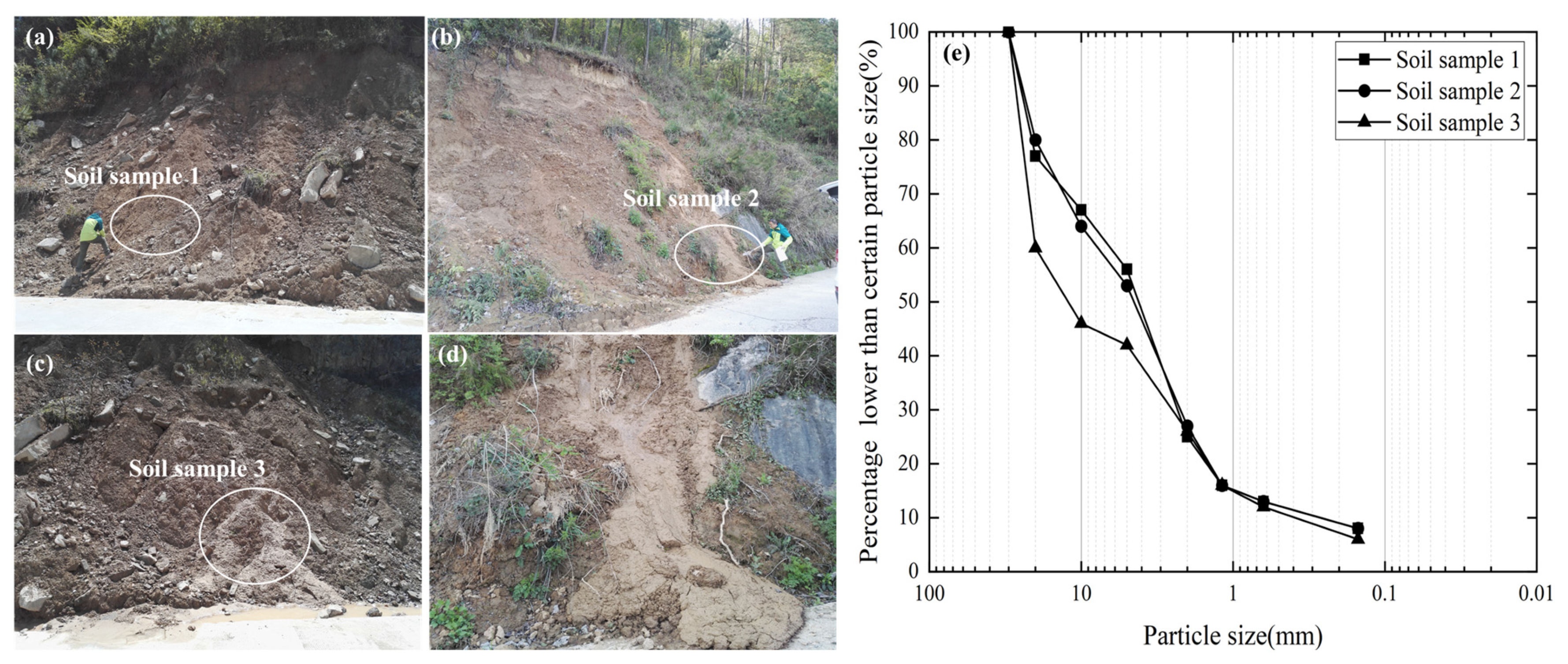
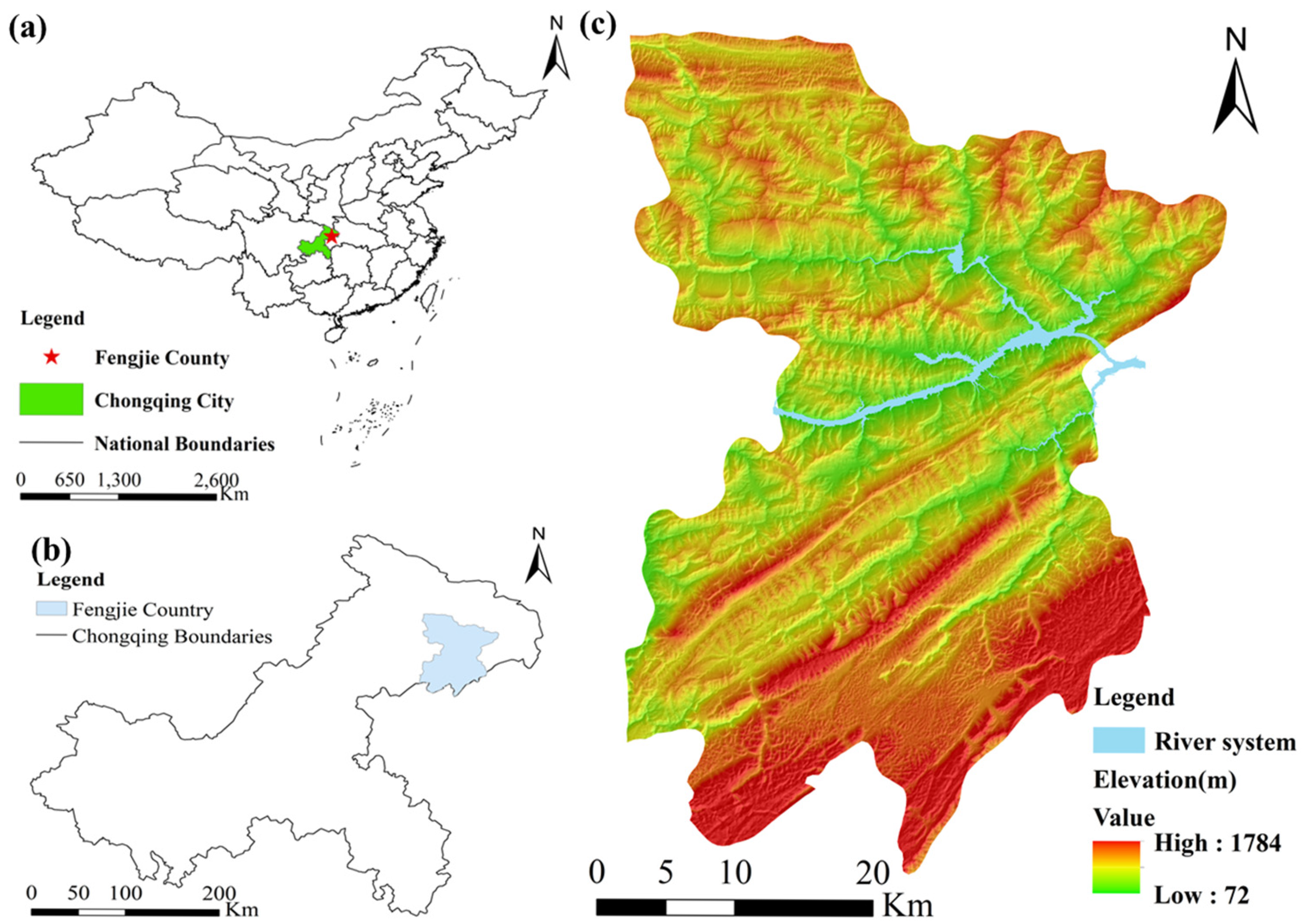
Fengjie County is located in the eastern part of Chongqing, China (Figure 1a,b), with geographic coordinates of 109°1′17″–109°45′58″ E longitude and 30°29′19″–31°22′33″. The county covers a total area of 4087 km2, with mountainous terrain accounting for 88.3% of its total area. The Yangtze River runs through the county from west to east (Figure 1c). Fengjie County has a subtropical humid monsoon climate with an average annual precipitation of 1145 mm. The rainy season lasts from July to September, during which precipitation accounts for 42% of the annual precipitation. The strata in the area predominantly consist of sedimentary rock layers, encompassing geological periods from the Silurian to the Quaternary. The Quaternary strata extend to a depth of 40 m below the ground surface, with outcrops featuring cohesive soil and gravelly soil, characterized by a fragmented and loose structure. Geological disasters such as landslides, debris flows, and collapses are widely distributed throughout Fengjie, among which rainstorm-induced clustered landslides are the most severe. Figure 2a–c show common shallow landslides that occurred following heavy rainstorms during the rainy season. Field investigations have revealed that rainfall-induced landslides are primarily distributed within Quaternary clay layers. We conducted field sampling and laboratory particle size distribution tests on rainfall-induced landslides, and the gradation curves are shown in Figure 2d. As shown in Figure 2d, the gradation curves of the sliding soil bodies were relatively steep, indicating well-graded fine-grained soils that easily become saturated under rainfall, making them an important factor in triggering landslides.
Figure 1. Geographic location and the DEM of study area. ((a): The geographical location of Chongqing City in China; (b): The geographical location of Fengjie County in Chongqing Municipality; (c): Fengjie County DEM).
Figure 2. The common shallow landslides during the rainy season ((ad): the shallow landslides and soil sample location; (e): gradation curves for soil sample 1–3).

2.2. Soil Sample and Soil Direct Tests

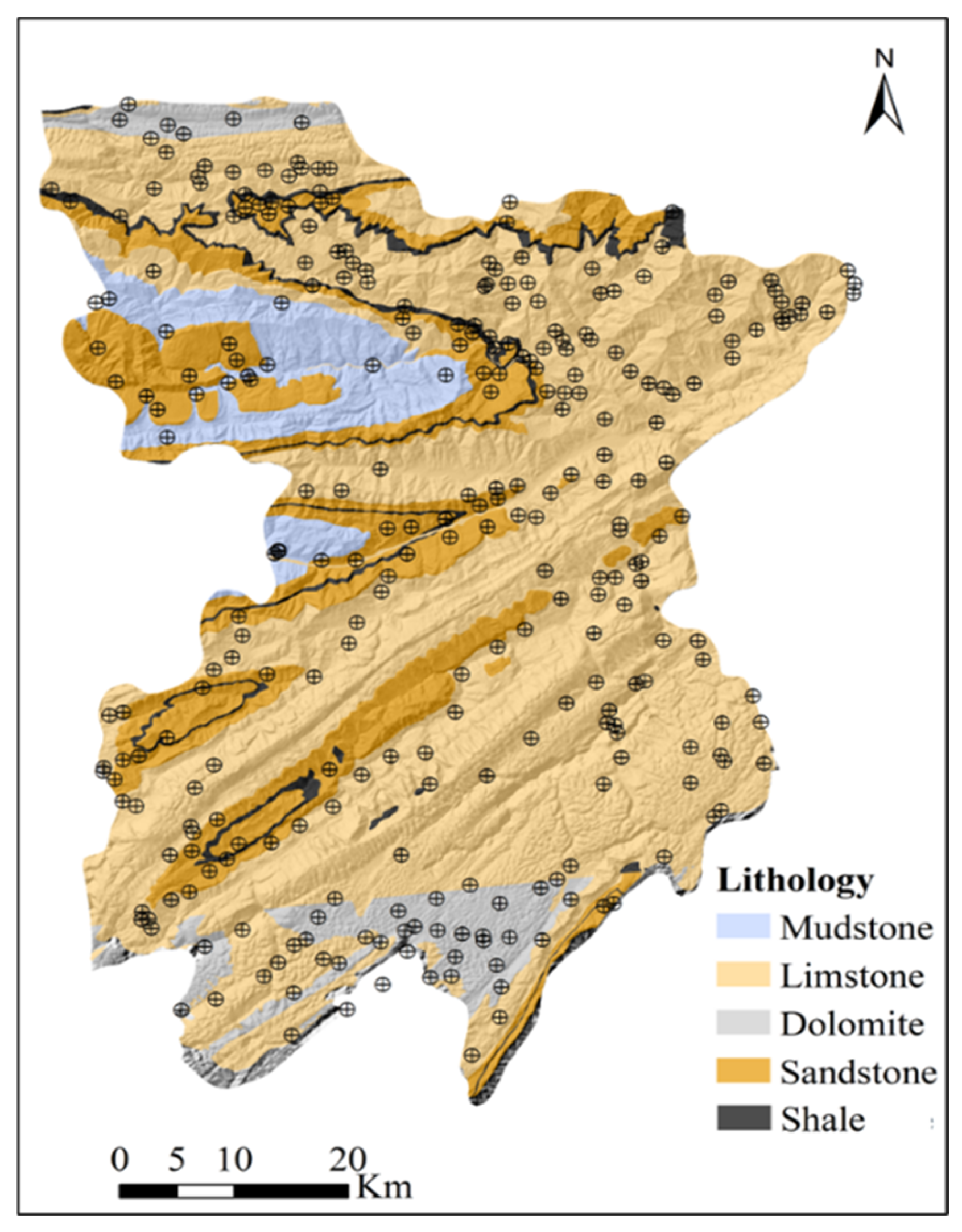
The local government of Fengjie County provided the lithological distribution map (Figure 3). As shown in Figure 3, there are five types of lithologies in the Fengjie area: limestone, dolomite, mudstone, sandstone, and shale. We conducted field sampling in each lithological zone and collected 312 soil samples, with the number of samples from each lithological area listed in Table 1. Subsequently, hundreds of groups of laboratory direct shear tests were conducted to obtain the mechanical parameters for each sample site. The Atterberg limits are commonly used to describe changes in the physical state of fine-grained soil layers. For example, the plastic limit water content is the moisture content at which the soil transitions from a plastic to semi-solid state, and the liquid limit water content is the moisture content at which the soil transitions from a liquid to plastic state. Therefore, this study used both liquid and plastic water content limits as the testing moisture content. Since there were as many as 312 sampling sites, conducting on-site dry density tests for each sample would cost substantial labor and material resources. Based on geological survey data provided by the Fengjie County Land Bureau, the dry density of soil within a 10-m thickness ranges from 1.7 to 1.8 g/cm3. Therefore, the dry density of each soil samples is randomly selected within this range. In accordance with the ASTM-d3080 [44] standard, 312 groups of liquid-plastic limit tests and 624 groups of undrained direct shear tests were performed to obtain the mechanical parameters of each sample at both the liquid and plastic water content limits, with partial results shown in Table 2.
Figure 3. Map of Lithological Zones and Sample Point Distribution (The symbol ⊕ refer to a sampling point).
Table 1. Number of Sample Points in Different Lithological Zones.
Table 2. Mechanical parameters of some selected sample points under plastic and liquid limit water content.

2.3. Distribution Characteristics of Mechanical Parameters in Different Lithological Zones

2.3.1. Distribution Characteristics of Mechanical Parameters Under Liquid Limit and Plastic Limit of Different Lithological Zones

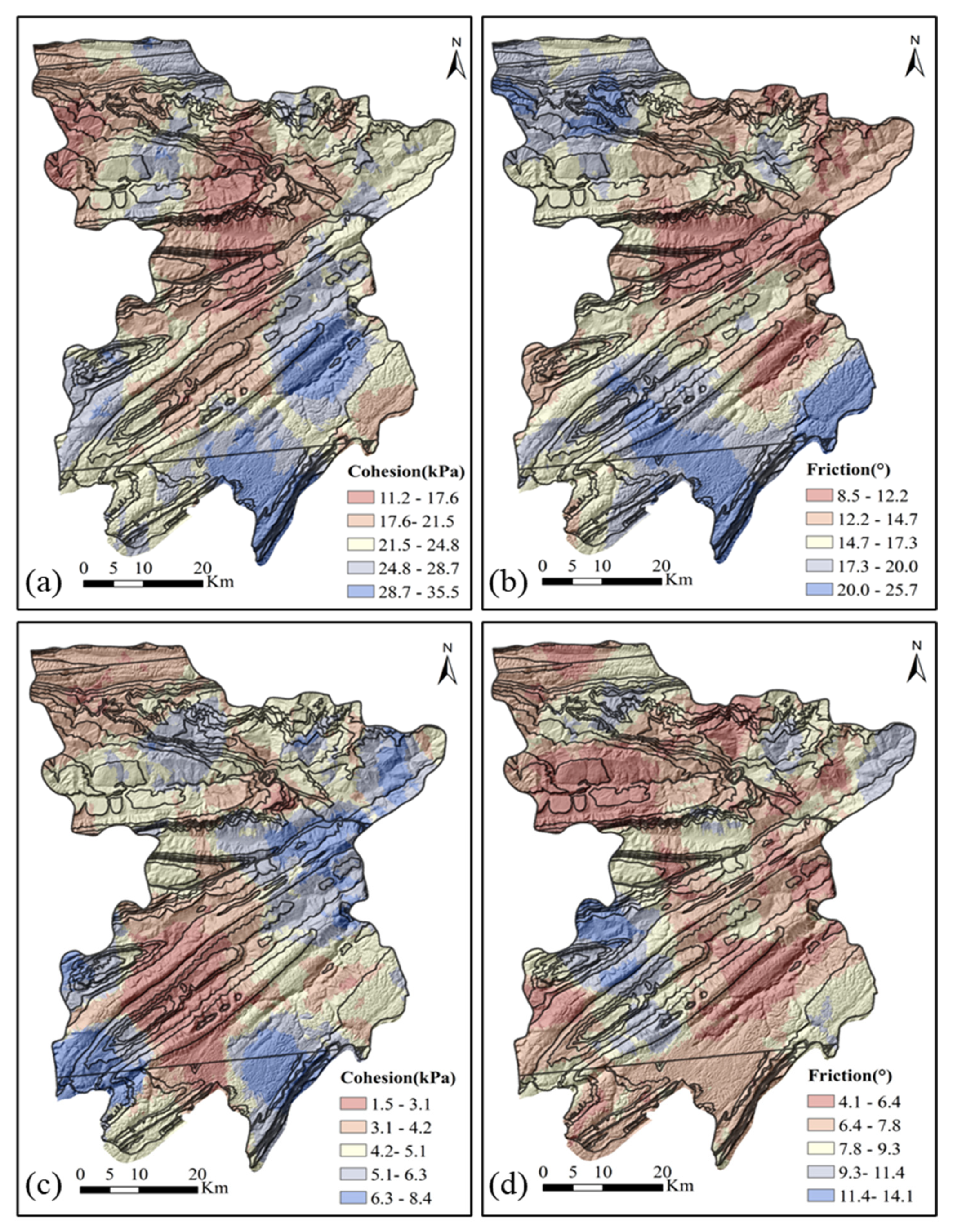
Based on the mechanical parameter data from the sample points, the K-S and S-W tests were used to analyze the distribution characteristics of the mechanical parameters in different lithologic zones. The K-S test is applicable when the sample size is greater than 50, whereas the S-W test is suitable for sample sizes less than 50. The distribution characteristics of the mechanical parameters at the plastic limit moisture content are shown in Table 3, and those at the liquid limit moisture content are shown in Table 4. As indicated in Table 3 and Table 4, the significance p values are all greater than 0.05, which suggests that the mechanical parameters in different lithologic zones at both the plastic limit and liquid limit follow a normal distribution. Subsequently, the Kriging interpolation technique integrated into the ARCGIS toolbox (arcgis 10.7) was used to generate regional-scale distribution maps of the mechanical parameters, as shown in Figure 4. As depicted in Figure 4, at the liquid limit, the apparent cohesion in different lithologic zones ranged from 1.5 to 8.4 kPa, and the apparent internal friction angle ranged from 4.1° to 14.1°; at the plastic limit, the apparent cohesion ranged from 11.2 to 35.5 kPa, and the apparent internal friction angle ranged from 8.5° to 25.7°.
Table 3. Distribution characteristics of mechanical parameters at the plastic limit water content in different lithological zones.
Table 4. Distribution characteristics of mechanical parameters at liquid limit water content in different lithological zones.
Figure 4. Distribution of mechanical parameters in different lithological zones at liquid limit and plastic limit water contents ((a): the apparent cohesion (kPa) at plastic limit; (b): the apparent friction angle (°) at plastic limit; (c): the apparent cohesion (kPa) at liquid limit; (d): the apparent friction angle (°) at liquid limit; black solid lines indicate lithological boundaries).

2.3.2. Distribution Characteristics of Mechanical Parameters Under Different Disturbance Conditions

To investigate the impact of different mechanical parameter perturbations on regional landslide prediction, we established a series of disturbance scenarios. Different disturbance scenarios describe the influence of the change in soil saturation on mechanical parameters. The specific method is as follows: for each lithological region, the mechanical parameters at the liquid limit, cl_mean and φl_mean, were taken as the lower boundary, whereas the parameters at the plastic limit, cp_mean and φp_mean, were considered as the upper boundary. The disturbance states are set according to different disturbance ratios αi. In this study, the disturbance ratio αi started from 0.1 and ended at 0.9, with intervals of 0.1, resulting in a total of nine disturbance states. Under each disturbance state, the mechanical parameters of the slope unit HSU were determined as follows:
ci = cl + (cpcli
φi = φl + (φpφli
In Equations (1) and (2), αi represents the disturbance ratio, where i = 1, 2, 3, …, 9; cL and φL are the mechanical parameters at the liquid limit, and cP and φP are the mechanical parameters at the plastic limit. For each lithologic zone, Statistic Package for Social Science SPSS software (SPSS 27.0.1) was used to calculate the mean and standard deviation of the mechanical parameters (such as apparent cohesion and apparent internal friction angle) under various disturbance conditions, as shown in Table 5. As indicated in Table 5, the significance p-values under different disturbance states were all greater than 0.05, indicating that the distribution characteristics of the mechanical parameters followed a normal distribution.
Table 5. Distribution characteristics of mechanical parameters under different disturbance conditions.
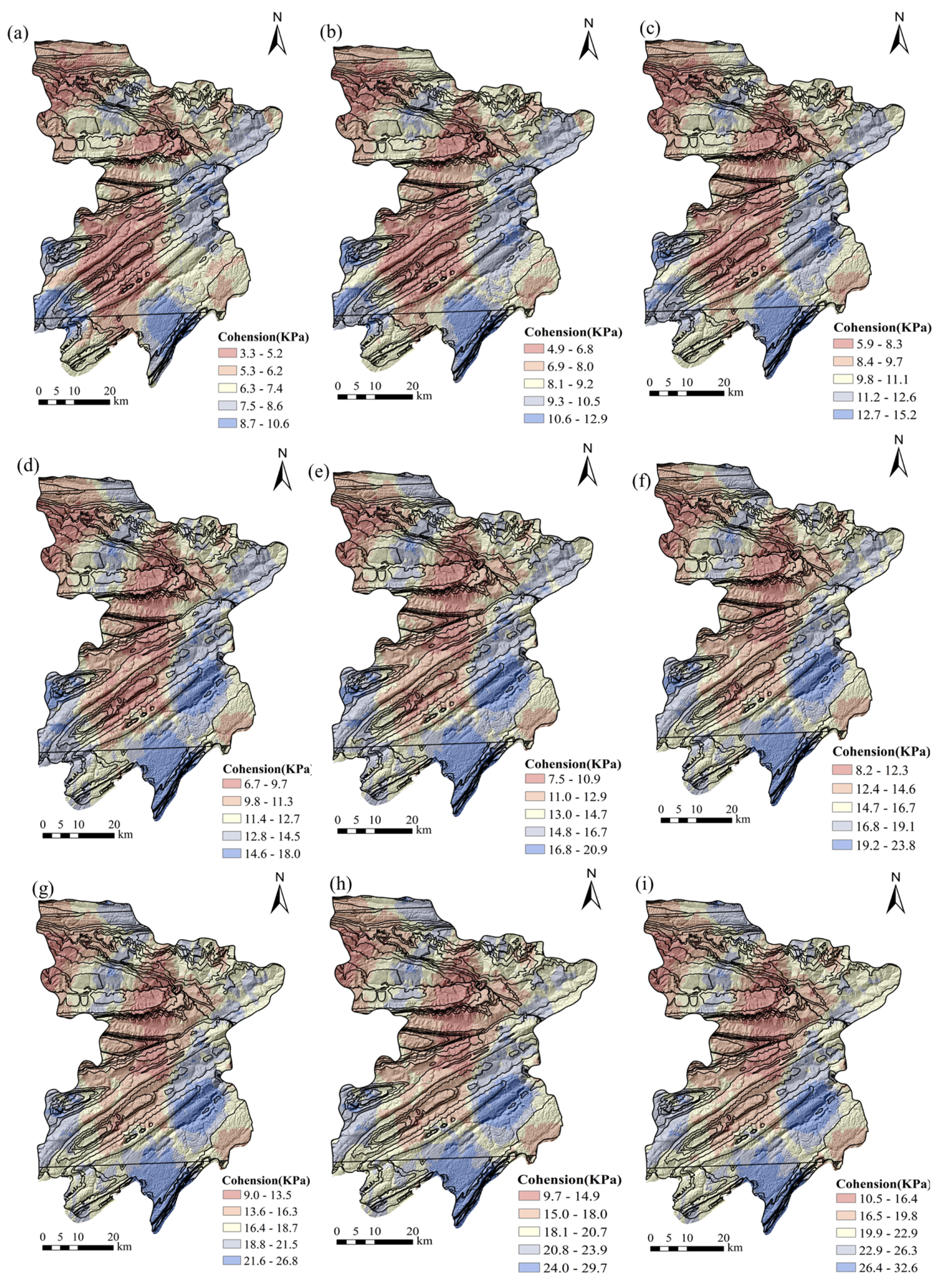
Based on the Kriging spatial interpolation technology provided by the ARCGIS toolbox, the apparent cohesion force distribution maps under different disturbance ratios are shown in Figure 5. As illustrated in Figure 5, as the disturbance ratio increases, the apparent cohesion force shows an increasing trend. Specifically, when the disturbance ratio is 0.1, apparent cohesion is between 3.3 and 10.6 kPa. At a disturbance ratio of 0.2, apparent cohesion force is between 4.9 and 12.9 kPa. For a disturbance ratio of 0.3, apparent cohesion ranges from 5.9 to 15.2 kPa. When the disturbance ratio is 0.4, apparent cohesion force is from 6.7 to 18.0 kPa. At 0.5 disturbance ratio, apparent cohesion force is between 7.5 and 20.9 kPa. With a disturbance ratio of 0.6, apparent cohesion force ranges from 8.2 to 23.8 kPa. At 0.7, the apparent cohesion force is between 9.0 and 26.8 kPa. When the disturbance ratio is 0.8, apparent cohesion force is from 9.7 to 29.7 kPa. Finally, at a disturbance ratio of 0.9, apparent cohesion ranges from 10.5 to 32.6 kPa.
Figure 5. Distribution of apparent cohesion force under different disturbance factors ((a): αi = 0.1; (b): αi = 0.2; (c): αi = 0.3; (d): αi = 0.4; (e): αi = 0.5; (f): αi = 0.6; (g): αi = 0.7; (h): αi = 0.8; (i): αi = 0.9).
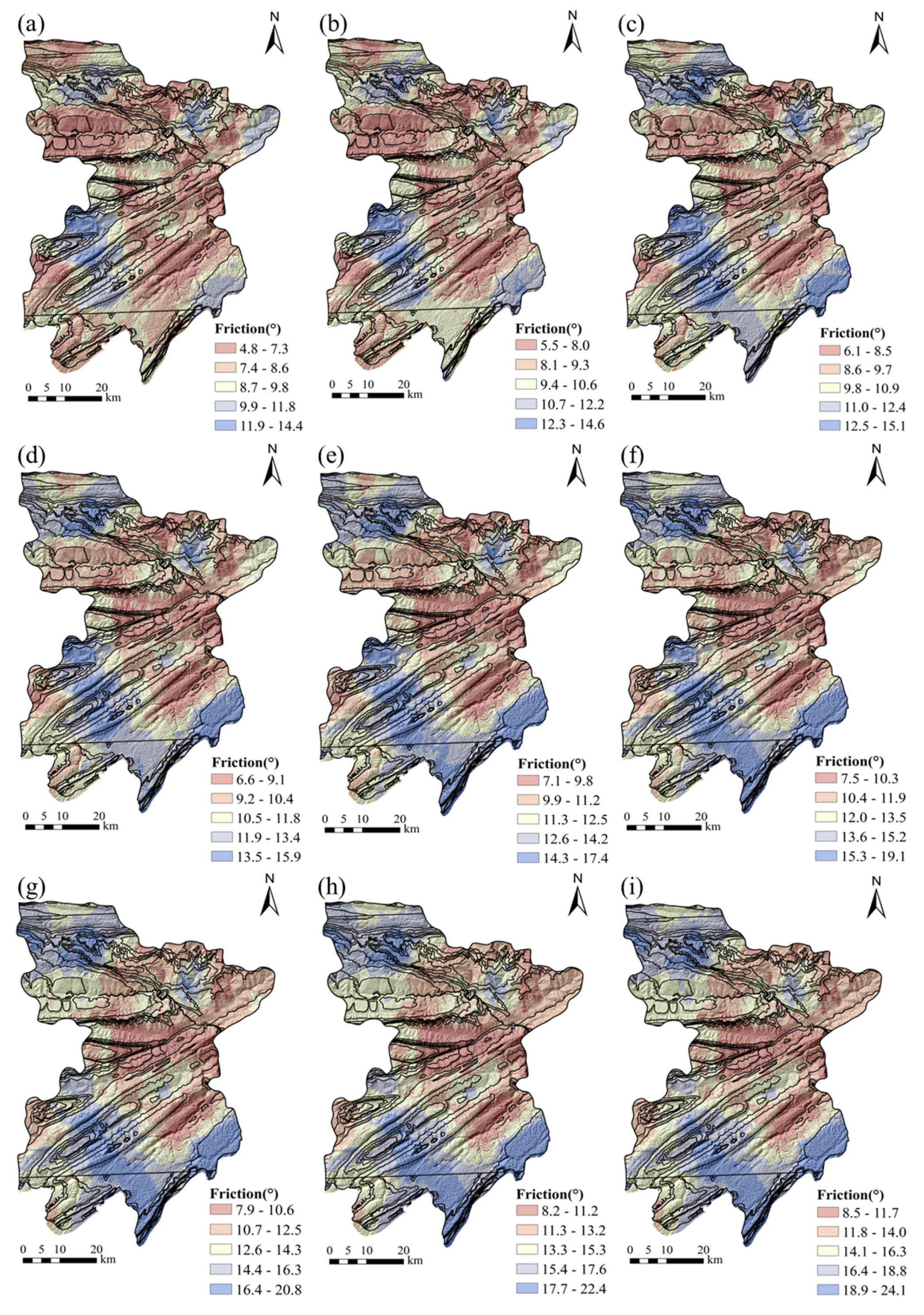
The apparent internal friction angle distribution under different disturbance ratios are shown in Figure 6. As depicted in Figure 6, as the disturbance ratio increases, the apparent internal friction angle also shows an increasing trend. Specifically, when the disturbance ratio is 0.1, the apparent internal friction angle ranges from 4.8° to 14.4°; at a disturbance ratio of 0.2, it ranges from 5.5° to 14.6°; at 0.3, it spans from 6.1° to 15.1°; at 0.4, it extends from 6.6° to 15.9°; at 0.5, it varies from 7.1° to 17.4°; at 0.6, it ranges from 7.5° to 19.1°; at 0.7, it stretches from 7.9° to 20.8°; at 0.8, it covers from 8.2° to 22.4°; and at a disturbance ratio of 0.9, it ranges from 8.5° to 24.1°.
Figure 6. Distribution of apparent friction angle under different disturbance factors ((a): αi = 0.1; (b): αi = 0.2; (c): αi = 0.3; (d): αi = 0.4; (e): αi = 0.5; (f): αi = 0.6; (g): αi = 0.7; (h): αi = 0.8; (i): αi = 0.9).

2.4. Calculation of HSU Instability Probability Under Each Disturbance Condition

2.4.1. The Extraction of HSUs

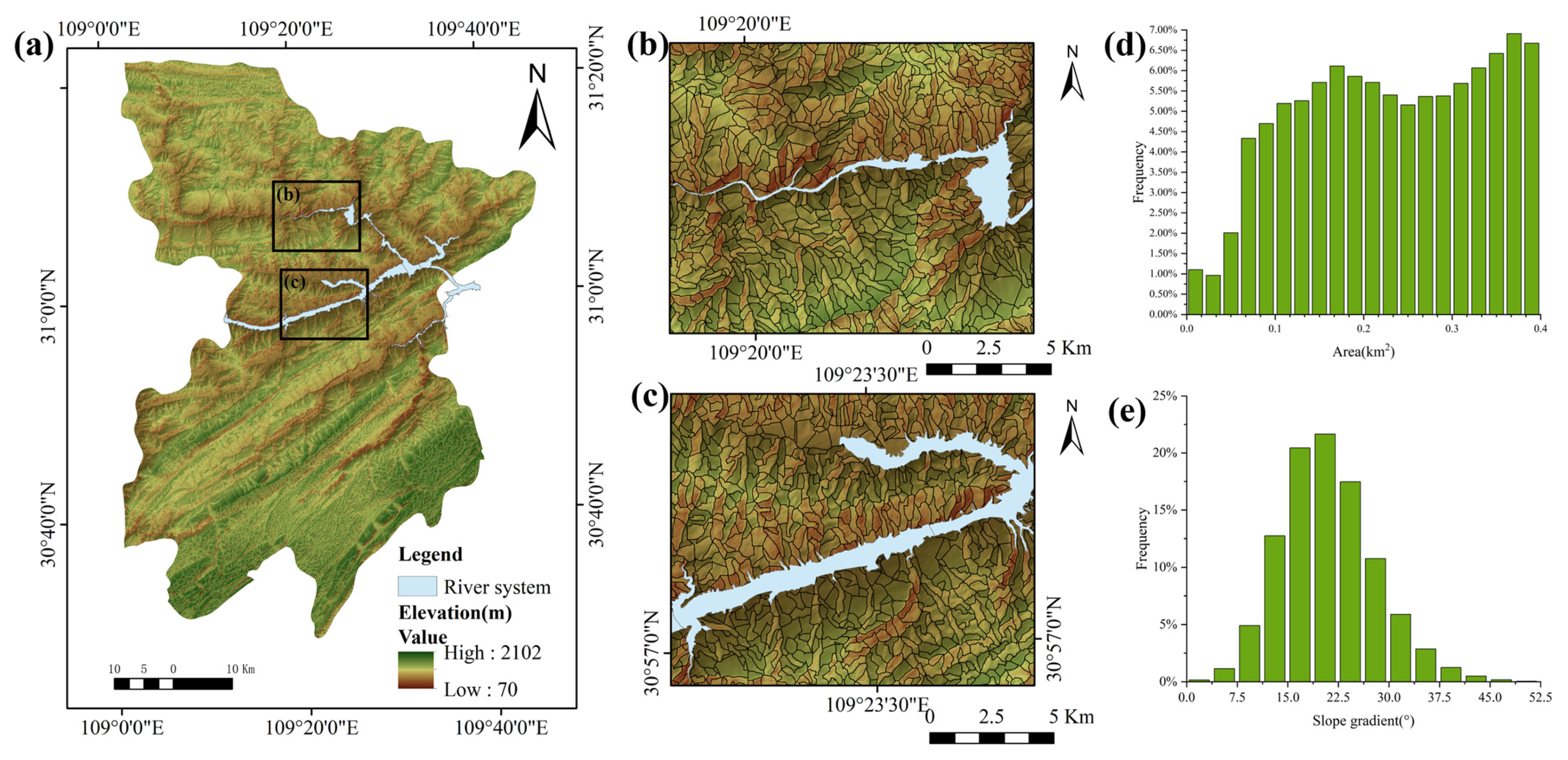
The MIA-HSU method has been used for slope unit extraction [28,37]. The MIA method defines each slope unit as a continuous, homogeneous, and closed geomorphic area in three-dimensional space (referred to as HSU), with uniform slope and aspect characteristics within the unit. Based on the Fengjie 20 m DEM (Figure 7a), the MIA-HSU method extracted a total of 17,547 HSUs (Figure 7b,c). The number of slope units within the different lithological zones is listed in Table 6, and the histograms of the slope and area distributions are shown in Figure 7d. As shown in Figure 7d, the slope of the HSUs followed a normal distribution, with 85.4% of the units having slopes within the 10–30° range. According to previous studies, rainfall-induced shallow landslides are more likely to occur within this range. As shown in Figure 5e, the average area of an HSU is 0.23 km2, with 53.9% of slope units having an area of less than 0.25 km2. Because the sliding depth of shallow landslides is typically 2–3 m, most HSUs can represent small-to medium-sized landslides (with volumes less than 500,000 m3). According to the spatial interpolation results presented in Section 2.3.2, the zonal statistics tool in ArcGIS was used to obtain the apparent internal friction angle φ (°) and apparent cohesion (kPa) data for each HSU under different disturbance scenarios.
Figure 7. Division of HSUs in Fengjie County ((a). Fengjie DEM; (b,c). Extraction results for selected regions: Enlarged View; (d). Histogram of slope distribution of HSUs; (e). Histogram of area distribution of HSUs).
Table 6. Number of Slope Units in Different Lithological Zones.

2.4.2. The Safety Factor Fs Calculation of HSUs

For each disturbance state, the corresponding normal distribution mean and standard deviation characteristics (Table 5, Section 2.3.2) were used. The Monte Carlo method was employed to generate random numbers that conform to the characteristics of the normal distribution, thereby producing a series of apparent cohesion and apparent internal friction angle combinations. For each value combination, the simplified Bishop method was used to calculate the HSU safety factor Fs under the current mechanical parameter combination, as shown in Equation (3):
F S = i = 1 n W i tan φ + ( u s tan φ b + c ) B / cos α i ( 1 + tan α i tan φ / F s ) i = 1 n W i sin α i
In Equation (3), clower and cupper are the lower bounds for the values of soil apparent cohesion and apparent internal friction angle, respectively; φlower and φupper are the upper bounds for the values of soil apparent cohesion and apparent internal friction angle, respectively; n is the number of soil strips; B is the width of the soil strip; Wi is the weight of the soil strip; αi is the inclination angle at the bottom of the soil strip; c, φ, and us are the soil’s apparent cohesion, apparent internal friction angle, and matric suction, respectively; φb is the suction friction angle, which is close to the apparent internal friction angle φ when the matric suction us is low.

2.4.3. The Hydrological Simulation Process

In order to obtain the hydrological parameter (the matrix suction us) required for safety factor Fs calculation, the one dimensional Richards infiltration equation was used to solve the moisture content distribution in the slope unit during the rainfall infiltration process:
θ t = z [ D ( θ ) θ z ] K ( θ ) z
where D(θ) represents the value of soil water diffusivity under unsaturated conditions and has D ( θ ) = K ( θ ) / d θ d ψ m .
The finite difference scheme outlined above was formulated for numerical simulation of hydrological processes. The lower boundary, identified as impermeable, is based on the maximum soil depth of the slope unit. The upper boundary of each slope unit was designated as an infiltration boundary. When the rainfall intensity I(t) is less than the infiltration capacity of the topsoil, all precipitation infiltrates into the soil, and no runoff is generated. In this scenario, the infiltration boundary of precipitation was governed by the following differential equation:
D ( θ ) θ Z + K ( θ ) = I ( t )
When the rainfall intensity exceeded the soil infiltration capacity, the excess portion was transformed into overland flow. In this situation, the rainfall infiltration boundary was governed by the following equation:
θ = θs
The matrix suction us can be calculated by the Van Genuchten model [45]:
S e = θ θ r θ s θ r = 1 1 + ( α w × u s ) n m
where Se represents the saturation degree, θ denotes the soil water content of the HSU, θs and θr are the saturated and residual water content, respectively. The parameters αw, n and m characterize the shape of the soil–water characteristic curve, with the relationship n = 1 − 1/m.

2.4.4. The Calculation of Instability Probability of the HSUs

In this study, 500 sets of mechanical parameter combinations were generated for each HSU. The instability probability of the HSU was calculated using Equation (8):
H S U p r o b = S u m F s < 1 500
Then, based on the internationally recognized four-level blue-yellow-orange-red early warning mechanism, the correspondence between the instability probability and warning level was established, as shown in Table 7.
Table 7. Relationship between HSUprob and warning levels.

2.5. Rainfall Data

Radar-based Quantitative Precipitation Estimation (QPE) and Quantitative Precipitation Forecasting (QPF) products were used as the source of rainfall data. The QPE is used to estimate regional rainfall data in the past, and is therefore helpful for calculating antecedent effective rainfall AER. The AER is used to provide the initial conditions for hydrological process simulation and can be calculated as follows:
A E R = i = 1 n α n R i
where AER is the antecedent effective rainfall, a is the attenuation coefficient, which is equal to 0.84 based on the studies conducted in Fengjie County [2,3], and n is the number of days before the landslide occurrence. QPF is commonly used to predict regional rainfall in the future. QPF uses the movement characteristics of radar reflectivity to extrapolate its future characteristics of the radar reflectivity, and the empirical equations of (Z–R) are used to predict the future rainfall intensity. Currently, the QPF data from the Meteorological Administration of Chongqing City are the rainfall products in the next 1 h.

3. Application: “8.31” Rainfall-Induced Landslide Forecast

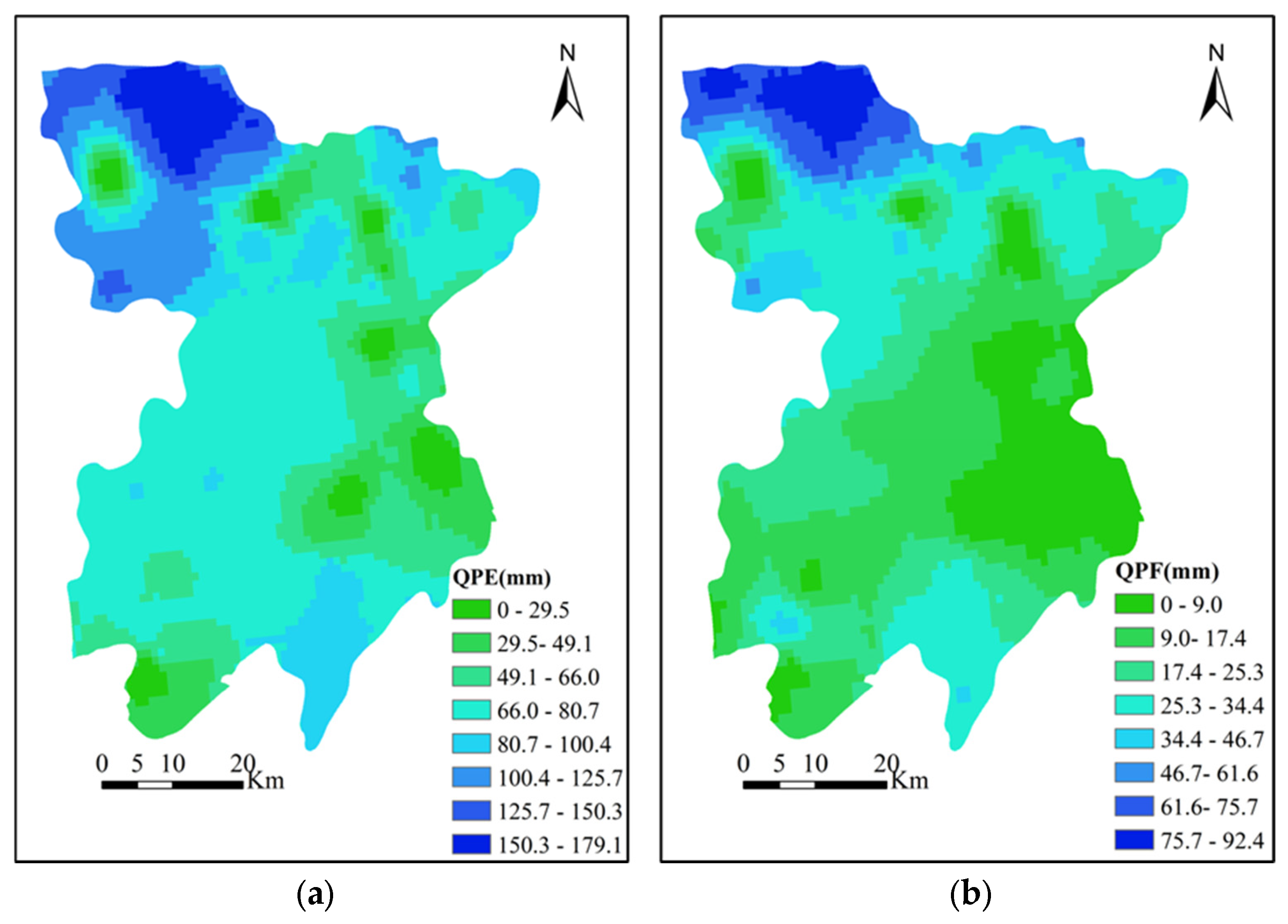
From 15 August to 31, 2014, Fengjie experienced continuous rainfall. On 31 August, a series of landslide disasters occurred in the area, resulting in hundreds of thousands of casualties and direct economic losses exceeding 500 million Yuan. Figure 8a shows the precipitation data for the 15 days before the landslides occurred. As shown in Figure 6a, the highest precipitation during this period was 179.10 mm, which occurred in the northwestern region. The radar-forecasted precipitation (QPF) data for 31 August 2014, are shown in Figure 8b. As depicted in Figure 6b, the maximum precipitation on 31 August was 92.4 mm, which also occurred in the northwestern part of the region.
Figure 8. QPE and QPF data ((a): Effective precipitation in the previous 15 days; (b): 24-h accumulated precipitation on “8.31”).
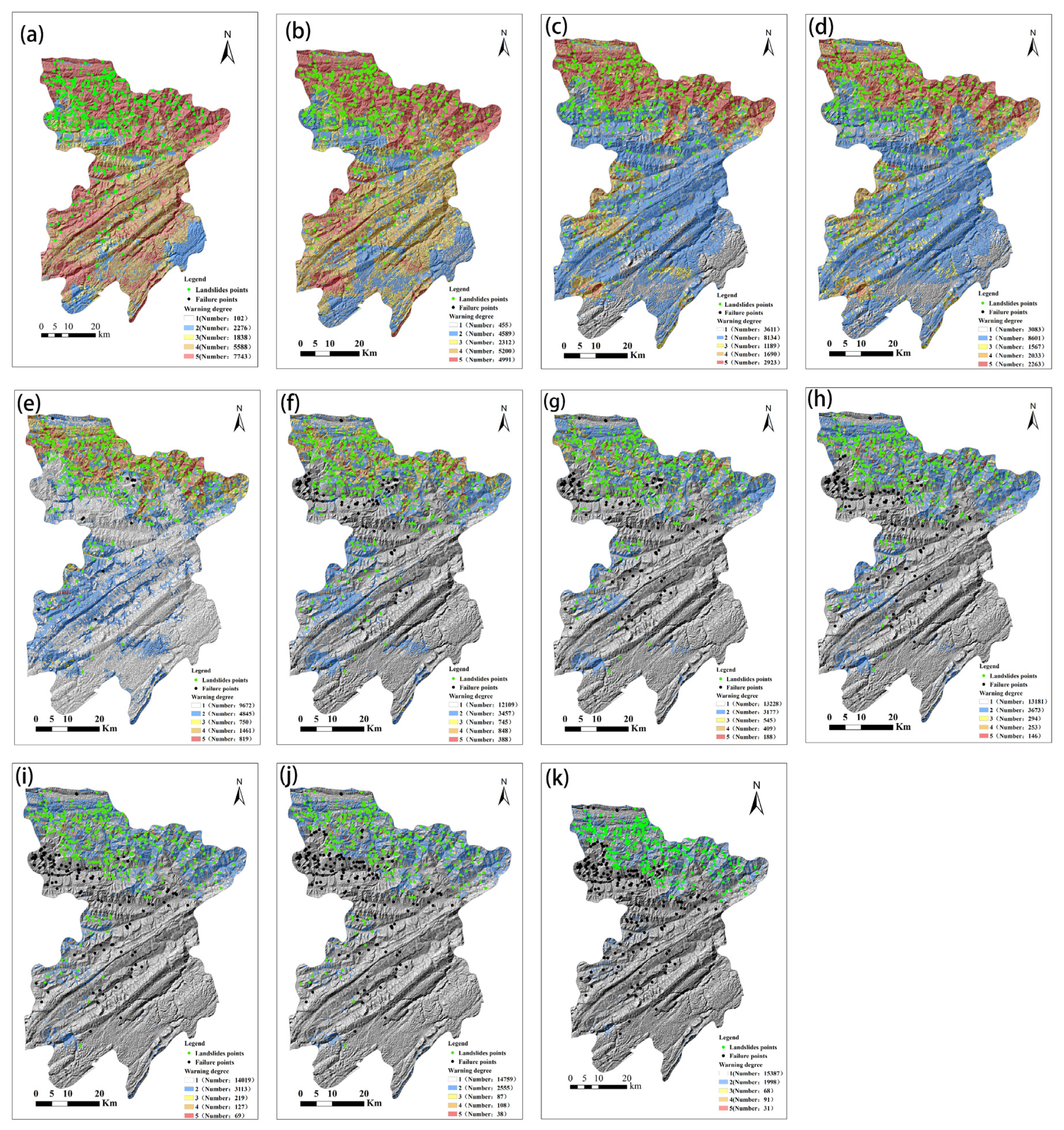
The Fengjie County Land and Resources Bureau provided data on landslide disaster points triggered by the “8.31” rainfall event. A total of 583 landslide incidents were induced by this heavy rainfall, mainly concentrated in the northern and southwestern regions of the county (as shown by the green and black solid dots in Figure 9). In this study, previous QPE and QPF precipitation data (Figure 6) were used as inputs to forecast the landslide events of 31 August. The 24-h landslide forecast results under different disturbance ratios are shown in Figure 9a–i. As illustrated in Figure 9, there were significant differences in the forecast results for different disturbance ratios. Initially, when the disturbance coefficient is between 0.1 and 0.3, almost all the HSUs become unstable. As the disturbance coefficient increases (0.4–0.5), the number of unstable slope units decreased significantly, mainly concentrated in the northern and southwestern regions of the county, which generally aligns with the distribution of disaster points. With further increases in the disturbance coefficient (0.6–0.9), the range of unstable HSUs continued to shrink, becoming mainly concentrated in the northern region.
Figure 9. The 24-h forecast results under different disturbance ratios αi ((a): αi = 0.0; (b): αi = 0.1; (c): αi = 0.2; (d): αi = 0.3; (e): αi = 0.4; (f): αi = 0.5; (g): αi = 0.6; (h): αi = 0.7; (i): αi = 0.8; (j): αi = 0.9; (k): αi = 1.0).
This study uses the ROC method to analyze the differences in forecasting performance under different perturbation ratios [46]. For physically based prediction models based on slope units, the ROC method describes the following four possible states using a contingency table:
True Positive (TP): The slope unit is unstable and contains landslide points within it.
True Negative (TN): The slope unit is stable and does not contain any landslide points.
False Positive (FP): The slope unit is unstable but contains no landslide points within it.
False Negative (FN): The slope unit is stable but contains landslide points within it.
According to GIS spatial statistics, the 583 landslide points triggered by the 8.31 rainfall event were contained within 425 slope units. These slope units were used in this study as the reference basis for the ROC evaluation, and the quantities of TP, TN, FP, and FN results were calculated. According to the ROC method, the true positive rate (TPR), missing alarm rate (MAR), and false positive rate (FPR) can be calculated using the following equations:
TPR = 100% × TP/(TP + FN)
MAR = 100% × FN/425
FPR = 100% × FP/(FP + TN)
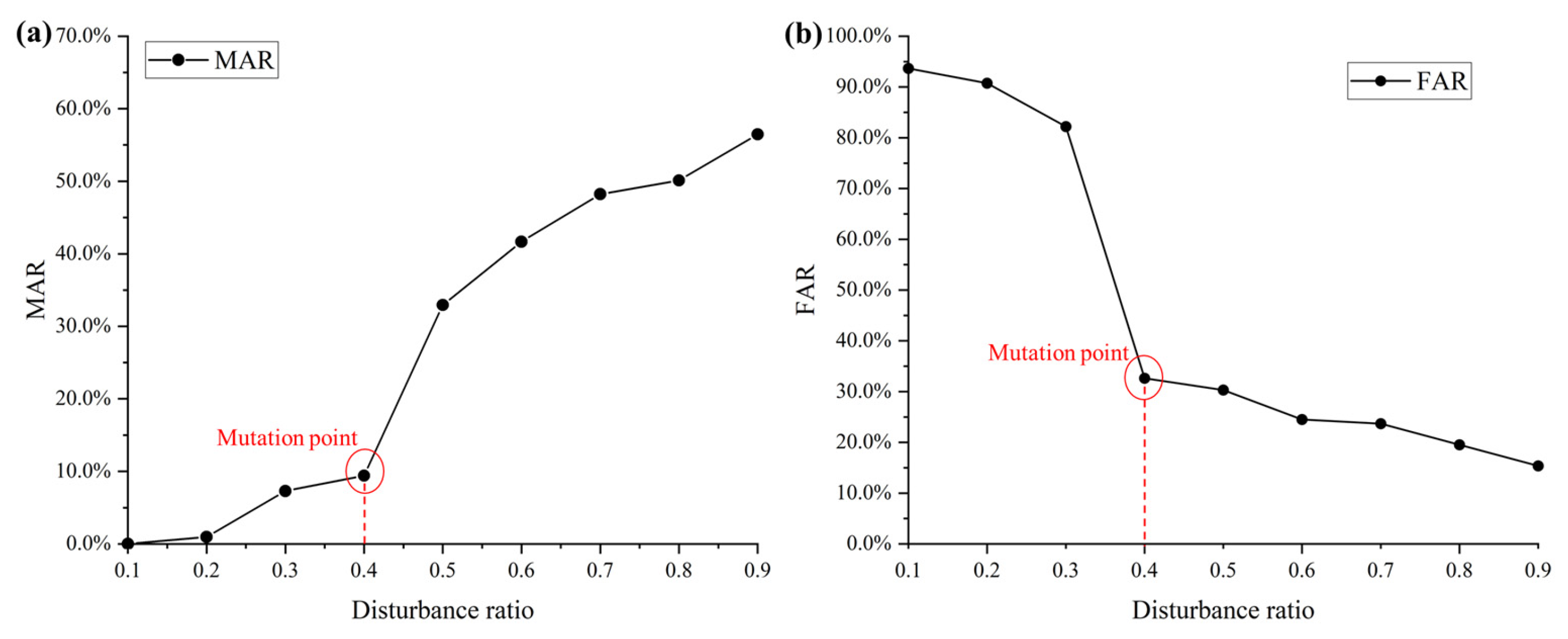
The detailed forecasting calculation results for different disturbance ratios are presented in Table 8. As indicated in Table 8, smaller disturbance ratios (such as 0.1–0.3) have a more favorable missed alarm rate (less than 10%), but the false alarm rate is extremely high. For example, when the disturbance coefficient is 0.3, the false-alarm rate reaches 82%. As the disturbance ratio increases (0.4–0.9), owing to the rapid decrease in the number of unstable units, the missed alarm rate in the forecasting results shows a sharp upward trend; when the disturbance coefficient is 0.9, the missed alarm rate reaches 56.47%. Meanwhile, the false alarm rate continues to decrease, and when the disturbance coefficient is 0.9, the false alarm rate drops to 15.37%. Figure 10 shows the curves indicating the changes in the false alarm and missed alarm rates at different disturbance ratios. Notably, when the disturbance coefficient is 0.4, there is an obvious mutation in both the false alarm and missed alarm rate curves; at this point, the missed alarm rate for slope units is 9.41%, and the false alarm rate is 32.63%.
Table 8. Forecast results under different disturbance ratios.
Figure 10. The MAR and FAR curves under different disturbance ratios ((a): MAR curve; (b): FAR curve).
According to the ROC method, the precision and accuracy under a 0.4 perturbation ratio were calculated as follows:
Precision = TPR/(TPR + FPR)
Accuracy = (TP + TN)/(TP + FN + TN + FP)
At the disturbance ratio of 0.4, the calculation results for 18–24 h are shown in Table 9. As indicated in Table 9, the accuracy ranged from 67.93% to 71.47%, and the precision ranged from 70.91% to 73.52%, which can meet the requirements for emergency early warning. Therefore, this study suggests that for future group landslide forecasts in the Fengjie area, the disturbance ratio of the mechanical parameters should be set at 0.4.
Table 9. Hourly forecast results at the disturbance ratio of 0.4.

4. Conclusions

The selection of mechanical parameters at the regional scale is a challenging issue in physical modeling. Current random selection methods ignore the impact of lithological differences on mechanical parameters at the regional scale and do not reflect the attenuation effect of rainfall on the mechanical properties of soils. Based on field sampling and laboratory testing, this study analyzed the distribution characteristics of mechanical parameters for different lithologies at liquid and plastic water content limits. Subsequently, a regional landslide forecasting model was established using slope units. For each lithological area, nine mechanical parameter attenuation scenarios were set to analyze the forecasting performance of the slope units under different attenuation conditions. The conclusions are as follows:
(1) Hundreds of geotechnical tests were conducted in the Fengjie area to obtain the distribution characteristics of the mechanical parameters for five different lithological areas: dolomite, limestone, mudstone, sandstone, and shale. The mechanical parameters of different lithologies at liquid and plastic water content limits follow a normal distribution, but there are significant differences in the mean and standard deviation. This indicates that lithological differences at the regional scale have a notable impact on mechanical parameters and should not be ignored.
(2) Evident differences were observed in the forecasting results for slope units under different disturbance ratios. Smaller disturbance ratios (for example, 0.1–0.3) achieve ideal missing alarm rates (below 10%), but the false alarm rates are extremely high; for instance, when the disturbance coefficient is 0.3, the false alarm rate reaches 82%. As the disturbance ratio increased (0.4–0.9), the missing alarm rate of the forecasts increased rapidly owing to the sharp decrease in the number of unstable units. When the disturbance coefficient was 0.9, the missing alarm rate reached 56.47%. Simultaneously, the false alarm rate continues to decrease; when the disturbance coefficient is 0.9, the false alarm rate drops to 15.37%.
(3) Notably, when the disturbance coefficient is 0.4, there is an obvious sudden change in the variation curves of both the false alarm and missing alarm rates. At this value, the missing alarm rate was 9.41%, but the false alarm rate remained relatively high at 32.63%. A high false alarm rate is a common problem in physical models; with a disturbance coefficient of 0.4, the accuracy at different forecasting times ranges from 67.93% to 71.47%, and the precision ranges from 70.91% to 73.52%, which can meet the requirements for emergency early warning systems. In summary, this study suggests that for forecasting clustered landslides in the Fengjie area in the future, the disturbance ratio for mechanical parameters should be set at 0.4.
In the mountainous regions of southwest China, each annual flood season poses severe threats to the lives and property of residents, the operation and maintenance of critical infrastructure, and the planning of land use types due to rainfall-induced landslides. The method introduced in this paper enables local governments to swiftly estimate regional-scale mechanical parameters and forecast landslide stability during the rainy season, thereby reducing the workload and economic costs associated with emergency warnings and defense measures. This holds significant importance for civil protection and regional planning for impoverished mountainous regions in the developing world.

Author Contributions

Conceptualization, Writing—original draft, Supervision, K.W.; Supervision, Visualization, Writing—original draft, S.X.; Investigation, Data curation, Validation, L.X.; Methodology, Resources, Validation, S.Z.; Investigation, Software, L.Z.; Investigation, Visualization, F.Q.; Writing—review and editing, Resources, H.L.; Formal analysis, Investigation, X.Z. All authors have read and agreed to the published version of the manuscript.

Funding

This research was funded by the National Natural Science Foundation of China (Grant No. 42301083), the Key Research Project of Henan Province Higher Education Institutions (Grant No. 24A170033), and the Henan Province Higher Education Institutions Young Backbone Teachers Training Program.

Data Availability Statement

The data that support the findings of this study are available from the corresponding author, [K.W.], upon reasonable request.

Conflicts of Interest

All authors declare no conflicts of interest. We declare that we do not have any commercial or associative interests that represent a conflict of interest in connection with the work submitted.

References

  1. Chen, C.W.; Tung, Y.S.; Liou, J.J.; Li, H.C.; Cheng, C.T.; Chen, Y.M.; Oguchi, T. Assessing landslide characteristics in a changing climate in northern Taiwan. Catena 2019, 175, 263–277. [Google Scholar] [CrossRef]
  2. Zhou, Z.; Shen, J.H.; Li, Y.; Duan, W.F.; Yang, R.C.; Shu, J.C.; Li, H.W.; Tao, S.Y.; Zheng, S.Z. Mechanism of colluvial landslide induction by rainfall and slope construction: A case study. J. Mt. Sci. 2021, 18, 1013–1033. [Google Scholar] [CrossRef]
  3. Zhang, J.; Luo, Y.; Zhou, Z.; Victor, C.; Duan, M. Research on the rainfall-induced regional slope failures along the Yangtze River of Anhui, China. Landslides 2021, 18, 1801–1821. [Google Scholar] [CrossRef]
  4. Liu, S.; Yin, K.; Du, J.; Chen, L.; Xie, X.; Zhu, S.; Zhang, X. Landslides triggered by the extreme rainfall on July 4, 2023, Wanzhou, China. Landslides 2024, 22, 2935–2947. [Google Scholar] [CrossRef]
  5. Yang, J.; Wang, X.; Hu, S.; Wang, D.; Lian, B.; Xue, C.; Liu, K. Controlling effect of sliding zone soil on rainfall-triggered colluvial landslide in Qinling-Bashan Mountains—A typical case study. Earth Surf. Process. Landf. 2025, 50, e70134. [Google Scholar] [CrossRef]
  6. Danese, M.; Lazzari, M. A kernel density estimation approach for landslide susceptibility assessment. In Proceedings of the International Conference on “Mountain Risks: Bringing Science to Society”, Florence, Italy, 24–26 November 2010; pp. 101–107. [Google Scholar]
  7. Lazzari, M.; Danese, M. A multitemporal kernel density estimation approach for new triggered landslide forecasting and susceptibility assessment. Disaster Adv. 2012, 5, 100–108. [Google Scholar]
  8. Wang, X.; Zhang, L.; Wang, S.; Lari, S. Regional landslide susceptibility zoning with considering the aggregation of landslide points and the weights of factors. Landslides 2014, 11, 399–409. [Google Scholar] [CrossRef]
  9. Bezak, N.; Šraj, M.; Mikoš, M. Copula-based IDF curves and empirical rainfall thresholds for flash floods and rainfall-induced landslides. J. Hydrol. 2016, 541, 272–284. [Google Scholar] [CrossRef]
  10. Bogaard, T.A.; Greco, R. Hydrological perspectives on precipitation intensity-duration thresholds for a landslide initiation: Proposing hydro-meteorological thresholds. Nat. Hazards Earth Syst. Sci. 2018, 18, 31–39. [Google Scholar] [CrossRef]
  11. Cuomo, S.; Di Perna, A.; Martinelli, M. Modelling the spatio-temporal evolution of a rainfall-induced retrogressive landslide in an unsaturated slope. Eng. Geol. 2021, 294, 106371. [Google Scholar] [CrossRef]
  12. Kalantar, B.; Ueda, N.; Saeidi, V.; Ahmadi, K.; Halin, A.A.; Shabani, F. Landslide susceptibility mapping: Machine and ensemble learning based on remote sensing big data. Remote Sens. 2020, 12, 1737. [Google Scholar] [CrossRef]
  13. Zhang, S.J.; Ma, Z.G.; Li, Y.J.; Hu, K.H.; Zhang, Q.; Li, L. A grid-based physical model to analyze the stability of slope unit. Geomorphology 2021, 391, 107887. [Google Scholar] [CrossRef]
  14. Pinho, T.M.; Augusto Filho, O. Landslide susceptibility mapping using the infinite slope, SHALSTAB, SINMAP, and TRIGRS models in Serra do Mar, Brazil. J. Mt. Sci. 2022, 19, 1018–1036. [Google Scholar] [CrossRef]
  15. Zheng, H.; Ding, M. Spatiotemporal changes of landslide susceptibility in response to rainfall and its future prediction—A case study of Sichuan Province, China. Ecol. Inform. 2024, 84, 102862. [Google Scholar] [CrossRef]
  16. Feng, Q.; Ding, M.; Cai, J.; He, Y.; Ming, Y.; Ren, H.; Li, F. Spatiotemporal landslide susceptibility assessment integrating typhoon tracks: A case study of typhoon Lekima. J. Mt. Sci. 2025, 22, 3017–3037. [Google Scholar] [CrossRef]
  17. Wang, P.; Teng, H.; Wang, M.; Deng, Y.; Liu, F.; Mu, H. Hazard Assessment of Shallow Loess Landslides Under Different Rainfall Intensities Based on the SINMAP Model: A Case Study of Yuzhong County. Appl. Sci. 2025, 15, 11556. [Google Scholar] [CrossRef]
  18. Baum, R.L.; Savage, W.Z.; Godt, J.W. TRIGRS—A Fortran Program for Transient Rainfall Infiltration and Grid-Based Regional Slope-stability Analysis; Version 2.0; Open-File Report No. 2008-1159; US Geological Survey: Reston, VA, USA, 2008; p. 75. [Google Scholar]
  19. Baum, R.L.; Savage, W.Z.; Godt, J.W. Trigrs: A Fortran Program for Transient Rainfall Infiltration and Grid-Based Regional Slope-Stability Analysis; Open-File Report 2002-424; US Geological Survey: Reston, VA, USA, 2002. [Google Scholar]
  20. Montrasio, L.; Valentino, R. A model for triggering mechanisms of shallow landslides. Nat. Hazards Earth Syst. Sci. 2008, 8, 1149–1159. [Google Scholar] [CrossRef]
  21. Rossi, G.; Catani, F.; Leoni, L.; Segoni, S.; Tofani, V. HIRESSS: A physically based slope stability simulator for HPC applications. Nat. Hazards Earth Syst. Sci. 2013, 13, 151–166. [Google Scholar] [CrossRef]
  22. Montrasio, L.; Valentino, R. Modelling rainfall-induced shallow landslides at different scales using SLIP-Part II. Procedia Eng. 2016, 158, 482–486. [Google Scholar] [CrossRef]
  23. Aristizábal, E.; Vélez, J.I.; Martínez, H.E.; Jaboyedoff, M. SHIA_Landslide: A distributed conceptual and physically based model to forecast the temporal and spatial occurrence of shallow landslides triggered by rainfall in tropical and mountainous basins. Landslides 2016, 13, 497–517. [Google Scholar] [CrossRef]
  24. Medina, V.; Hürlimann, M.; Guo, Z.; Lloret, A.; Vaunat, J. Fast physically-based model for rainfall-induced landslide susceptibility assessment at regional scale. Catena 2021, 201, 105213. [Google Scholar] [CrossRef]
  25. Arnone, E.; Francipane, A.; Dialynas, Y.G.; Noto, L.V.; Bras, R.L. Implications of terrain resolution on modeling rainfall-triggered landslides using a TIN-based model. Environ. Model. Softw. 2021, 141, 105067. [Google Scholar] [CrossRef]
  26. Liang, W.; Uchida, T. Performance and topographic preferences of dynamic and steady models for shallow landslide prediction in a small catchment. Landslides 2022, 19, 51–66. [Google Scholar] [CrossRef]
  27. Cui, H.; Ji, J.; Hürlimann, M.; Medina, V. Probabilistic and physically-based modelling of rainfall-induced landslide susceptibility using integrated GIS-FORM algorithm. Landslides 2024, 21, 1461–1481. [Google Scholar] [CrossRef]
  28. Wang, K.; Zhang, S.; DelgadoTéllez, R.; Wei, F. A new slope unit extraction method for regional landslide analysis based on morphological image analysis. Bull. Eng. Geol. Environ. 2019, 78, 4139–4151. [Google Scholar] [CrossRef]
  29. Tufano, R.; Formetta, G.; Calcaterra, D.; De Vita, P. Hydrological control of soil thickness spatial variability on the initiation of rainfall-induced shallow landslides using a three-dimensional model. Landslides 2021, 18, 3367–3380. [Google Scholar] [CrossRef]
  30. Zhang, S.; Zhao, L.; Delgado-Tellez, R.; Bao, H. A physics-based probabilistic forecasting model for rainfall-induced shallow landslides at regional scale. Nat. Hazards Earth Syst. Sci. 2018, 18, 969–982. [Google Scholar] [CrossRef]
  31. Marin, R.J.; Velásquez, M.F.; Sánchez, O. Applicability and performance of deterministic and probabilistic physically based landslide modeling in a data-scarce environment of the Colombian Andes. J. S. Am. Earth Sci. 2021, 108, 103175. [Google Scholar] [CrossRef]
  32. Park, H.J.; Lee, J.H.; Woo, I. Assessment of rainfall-induced shallow landslide susceptibility using a GIS-based probabilistic approach. Eng. Geol. 2013, 161, 1–15. [Google Scholar] [CrossRef]
  33. Lee, J.H.; Park, H.J. Assessment of shallow landslide susceptibility using the transient infiltration flow model and GIS-based probabilistic approach. Landslides 2016, 13, 885–903. [Google Scholar] [CrossRef]
  34. Marin, R.J.; Mattos, A.J. Physically-based landslide susceptibility analysis using Monte Carlo simulation in a tropical mountain basin. Georisk 2020, 14, 192–205. [Google Scholar] [CrossRef]
  35. Ajith, A.; Pillai, R.J. TRIGRS-FOSM: Probabilistic slope stability tool for rainfall-induced landslide susceptibility assessment. Nat. Hazards 2025, 121, 3401–3430. [Google Scholar] [CrossRef]
  36. Zeng, T.; Guo, Z.; Wang, L.; Xu, C.; Wu, F.; Jin, B.; Peduto, D. Hazard prediction modeling for typhoon-triggered shallow landslides by integrating physically-based model and extreme rainfall analysis. Bull. Eng. Geol. Environ. 2025, 84, 356. [Google Scholar] [CrossRef]
  37. Wang, K.; Zhang, S.J.; Xie, W.L.; Guan, H. Prediction of the instability probability for rainfall induced landslides: The effect of morphological differences in geomorphology within mapping units. J. Mt. Sci. 2023, 20, 1249–1265. [Google Scholar] [CrossRef]
  38. Meisina, C.; Scarabelli, S. A comparative analysis of terrain stability models for predicting shallow landslides in colluvial soils. Geomorphology 2007, 87, 207–223. [Google Scholar] [CrossRef]
  39. Terhorst, B.; Kreja, R. Slope stability modelling with SINMAP in a settlement area of the Swabian Alb. Landslides 2009, 6, 309–319. [Google Scholar] [CrossRef]
  40. Yilmaz, I.; Keskin, I. GIS based statistical and physical approaches to landslide susceptibility mapping (Sebinkarahisar, Turkey). Bull. Eng. Geol. Environ. 2009, 68, 459–471. [Google Scholar] [CrossRef]
  41. Schmidt, J.; Turek, G.; Clark, M.P.; Uddstrom, M.; Dymond, J.R. Probabilistic forecasting of shallow, rainfall-triggered landslides using real-time numerical weather predictions. Nat. Hazards Earth Syst. Sci. 2008, 8, 349–357. [Google Scholar] [CrossRef]
  42. Miao, Z.; Xiong, Y.; Cheng, Z.; Wu, B.; Wang, W.; Peng, Z. Quantifying Root Cohesion Spatial Heterogeneity Using Remote Sensing for Improved Landslide Susceptibility Modeling: A Case Study of Caijiachuan Landslides. Sensors 2025, 25, 4221. [Google Scholar] [CrossRef] [PubMed]
  43. Raia, S.; Alvioli, M.; Rossi, M.; Baum, R.L.; Godt, J.W.; Guzzetti, F. Improving predictive power of physically based rainfall-induced shallow landslide models: A probabilistic approach. arXiv 2013, arXiv:1305.4803. [Google Scholar] [CrossRef]
  44. ASTM D6528-17; Standard Test Method for Consolidated Undrained Direct Simple Shear Testing of Fine Grain Soils. ASTM International: West Conshohocken, PA, USA, 2017.
  45. Ghorbani, A.; Babaeian, E.; Sadeghi, M.; Durner, W.; Jones, S.B.; van Genuchten, M.T. An improved van Genuchten soil water characteristic model to account for surface adsorptive forces. J. Hydrol. 2025, 661, 133692. [Google Scholar] [CrossRef]
  46. Fawcett, T. An introduction to ROC analysis. Pattern Recognit. Lett. 2006, 27, 861–874. [Google Scholar] [CrossRef]
Disclaimer/Publisher’s Note: The statements, opinions and data contained in all publications are solely those of the individual author(s) and contributor(s) and not of MDPI and/or the editor(s). MDPI and/or the editor(s) disclaim responsibility for any injury to people or property resulting from any ideas, methods, instructions or products referred to in the content.

Article Metrics

Citations

Article Access Statistics

Multiple requests from the same IP address are counted as one view.