1. Introduction
In cases where a company with a social welfare or other publicly important aspect becomes insolvent, the state may be faced with difficult decisions. One possibility is to bail out the enterprise and another is to use ordinary insolvency proceedings, with or without government funding (
Couwenberg and Lubben 2019). An alternative option, which may have public support, is to nationalise the failing entity. This latter issue has gained prominence in the UK due to the persistent underperformance and financial instability of public service providers, particularly in water, energy and transportation sectors (
Kishimoto and Petitjean 2017;
Youds 2019;
Labour Party 2019). There has been particularly vigorous discussion, in recent years, in relation to the failing utility Thames Water (
UNISON 2024;
Barradale 2026). The situation raises fundamental questions of equity: should privately-owned public service providers retain the privilege of profit accumulation during prosperous periods while transferring financial burdens to the public during crises? Such perceived inequities in this and other cases have fuelled arguments for the re-nationalisation of essential public services. The process of nationalisation is not, however, a simple matter, as it may require legislative implementation and it will often have a global dimension due to investment patterns and bilateral investment treaties.
The importance of the international investment context can be seen from the most recent statistics on foreign ownership of shares in the UK, which reached a record high of 58.8% of the value of the UK stock market (
Office for National Statistics 2026). Increases in foreign ownership have been evident in other countries too (
De La Cruz et al. 2019). Whilst listed companies are not obvious candidates for insolvencies, in cases where they get into trouble, they can raise “too big to fail” concerns and talk of nationalisation. We note, as an example, the large foreign ownership of major utility suppliers (
UK Parliament 2015). In the event of service supplier distress, nationalisation might seem like an appealing option, but foreign ownership levels raise the possibility of compensation, as nationalisation inevitably entails the expropriation of shares. This international trade and investment context brings to the fore well-developed compensation schemes; however, in this paper, we note a problem that creates distortions. Investment treaties will typically take market value as a basis and lack any provision to reflect the value that a failing enterprise would have in insolvency proceedings. We consider how this anomalous position can be resolved. Lying at the intersection of insolvency law and international economic law, this is an area which has almost entirely escaped academic commentary.
The paper proceeds in ten sections.
Section 2 sets the context with an overview of recent nationalisation examples and the UK legal framework for nationalisation.
Section 3 reviews the existing literature, identifying gaps at the intersection of international investment law and insolvency law.
Section 4 provides a detailed case study based on a hypothetical nationalisation of Thames Water, illustrating the complexities arising from foreign ownership of UK essential service providers.
Section 5 and
Section 6 analyse compensation standards under bilateral investment treaties, examining general principles and their specific application to Thames Water’s diverse shareholder base.
Section 7 and
Section 8 address compensation under the European Convention on Human Rights, covering both substantive standards and procedural questions of shareholder standing.
Section 9, the paper’s core contribution, proposes a graduated framework for addressing distressed essential service providers: enhanced regulatory intervention, upstream reorganisation, ordinary insolvency procedures, and nationalisation as a last resort, with compensation based on insolvency counterfactuals rather than hypothetical market values.
Section 10 concludes with recommendations for reform.
2. Context
By 2000, over 1400 cases of remunicipalisation and nationalisation had been documented across 58 countries, encompassing more than 2400 cities (
Kishimoto et al. 2020). This global trend signals a marked departure from the neoliberal privatisation wave of the 1980s and 1990s, driven by economic mismanagement, high debt and widespread consumer dissatisfaction (
Sahin 2024;
Weghmann and Hall 2021). Not all were therefore prompted by concerns about insolvency, although there were notable examples of this type in response to the global financial crisis in 2008, primarily in relation to financial institutions, some of which we discuss below. Notably, a large foreign ownership angle was not evident at that time.
Typically, the nationalisation process is carried out through an Act of Parliament to establish one or more companies as publicly-owned holding vehicles. An appointed date is set on which all equity will vest in the holding vehicle(s). The terms might also transfer debt securities. The Aircraft and Shipbuilding Industries Act 1977 is an example. Two holding companies, British Aerospace and British Shipbuilders, were established. Aerospace subsumed the assets of four “aircraft and guided weapons” companies and Shipbuilders subsumed the assets of 19 shipbuilding firms and related companies, namely four diesel manufacturers.
More recently, within the UK transport sector, the Passenger Railway Services (Public Ownership) Act 2024 might have been thought to have signalled a shift by allowing rail operators to be brought back to public ownership once their contracts expire. Under this scheme, the country’s Southwestern Railway was the first privately operated service transferred into public ownership and the Greater Anglia railway service followed in October 2025. The 2024 Act is part of a broader strategy aimed at bringing most services under the Great British Railways umbrella by 2027 (
Benson 2025). Advanced preparations for railway nationalisation have perhaps created an impression that such transitions can be executed smoothly. However, this railway scenario represents a special case as the expiration of contracts creates distinct parameters that do not necessarily apply to other sectors. Other than the railways, there has not been a significant UK nationalisation since 2008.
There can be many reasons for nationalisations, including changed circumstances and obsolescent bargains (
Sahin 2024), addressing poor service and also, in the current focus, ensuring continuity of service if there are difficulties with the private sector of essential public services. The UK has also implemented nationalisation measures selectively in the past in relation to companies having financial distress. For instance, Rolls-Royce’s financial difficulties led to government intervention (
Vickers and Yarrow 1988, p. 164). Similarly, Johnson Matthey Bankers’ insolvency in 1984 triggered state action. In addition, the 2008 financial crisis necessitated the nationalisation of troubled major mortgage lenders, e.g., Bradford and Bingley and Northern Rock. We consider Northern Rock’s example later, as it proved complicated and problematic compared to other nationalisation cases, as domestic and foreign investors received zero compensation for their investment, given Northern Rock’s financial position.
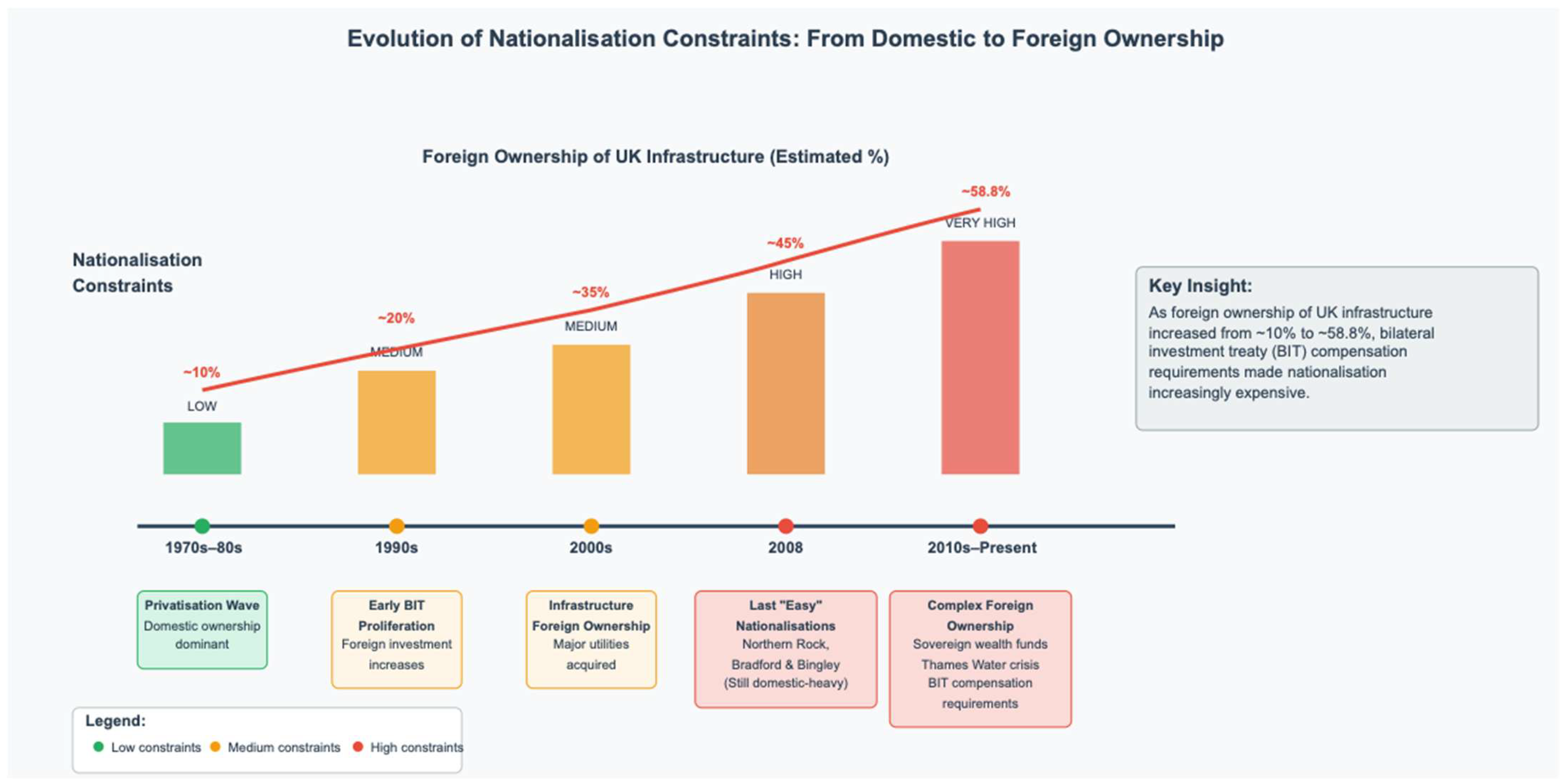
A point that has often been overlooked, however, is the increasing difficulty of nationalisation in a modern context, as illustrated in
Figure 1. As foreign ownership of UK public service providers has grown, the process of nationalisation has prospectively become more expensive, owing to the compensation provisions of bilateral investment treaties. Moreover, as we will discuss, bilateral investment treaties will typically fail to have anticipated a need for market value compensation to take account of the insolvency of the nationalised enterprise.
Other alternatives, including the use of restructuring procedures, might therefore be more suitable. We will consider in
Section 9 a four-stage roadmap that will view nationalisation as a last resort.
This discussion is timely, as Thames Water, England and Wales’s largest water utility, has been facing calls for nationalisation due to its £20 billion debt burden, chronic underinvestment and repeated penalties for operational failures in water treatment and network management, including repeated pollution incidents. According to (
Violation Tracker UK 2026), the company has incurred more than 100 enforcement actions and about £178 million in fines since 2010 (
Godwin 2025). In this context, it can be argued that nationalisation can be seen as a practical response to weak regulation and the failure of privatised essential service providers.
3. Literature Review
Scholarship on public service providers has traditionally focused on municipalisation and re-nationalisation as strategies to address failing public service providers (
Kishimoto et al. 2020;
Weghmann 2020). While these studies generally acknowledge nationalisation as an effective measure, they emphasise that it should be a last resort due to fiscal burdens, legal complexities, and political challenges (
Weghmann and Hall 2021). As we will discuss, the fiscal burden can be substantial, as shareholders typically expect full market value compensation. Legal challenges may arise from parliamentary opposition or judicial scrutiny under the Human Rights Act 1998 and international conventions such as the European Convention on Human Rights (
Clifford Chance 2019).
However, the literature on public services has not adequately addressed nationalisation from international investment and insolvency law perspectives. Most investment law scholarship focuses on the possibility of unlawful nationalisation claims by foreign investors under bilateral investment treaties (BITs) and multilateral treaties such as the Energy Charter Treaty (ECT), without considering the insolvency context.
Hall and Weghmann (
2019a) discuss appropriate compensation levels for investors in nationalisation, analysing how various valuation methods impact the UK economy. In subsequent work, they argue that the actual risk of legal actions under BITs or the ECT remains relatively low, likely confined to approximately 20% of investors, with the length and uncertainty of arbitration potentially deterring even eligible investors from pursuing claims (
Hall and Weghmann 2019b).
The most relevant study is
Calamita’s (
2010) analysis of British bank nationalisations from an international law perspective, examining whether UK compensation schemes for Northern Rock and Bradford & Bingley complied with obligations to foreign investors. However, this article focuses on acute financial crisis interventions rather than chronic essential service provider failures. The gap in the existing scholarship is at the intersection of international investment law and insolvency law in public service provider nationalisation. While the public ownership literature identifies compensation costs, investment law scholarship analyses treaty obligations, and insolvency law examines creditor rights (
de Weijs 2013;
Payne 2018;
Parry et al. 2026), no sustained analysis bridges these domains to examine how investment treaty compensation standards should apply when nationalisation displaces insolvency proceedings. Building on Calamita’s work, this paper contributes by examining Thames Water as a case study, illustrating tensions between public interest and investor protection from both international investment law and insolvency perspectives, developing a framework that synthesises these distinct legal domains.
4. Thames Water: From Its Privatisation to Calls for Nationalisation
Thames Water Utilities Limited, England and Wales’s largest water utility serving 16 million customers, exemplifies the legal and financial complexities of nationalising distressed essential service providers with significant foreign ownership. Privatised in 1989 with zero debt as part of the Thatcher government’s utility reforms (
Pratley 2024), the company has since undergone multiple ownership changes that demonstrate both the globalisation of UK infrastructure ownership and the governance failures that can result from highly leveraged private ownership structures.
Following initial listing on the London Stock Exchange (
Pryke 2021), Thames Water was acquired by German energy company RWE in 2001, then sold to Australian investment bank Macquarie Group in 2006. The Macquarie ownership period (2006–2017) has attracted criticism for aggressive financial engineering: the company was heavily leveraged to fund substantial dividend distributions to shareholders while capital investment in ageing infrastructure was deferred (
Robinson 2017). During this period, Thames Water paid approximately £1.6 billion in dividends whilst accumulating £10.6 billion in debt and facing repeated regulatory penalties for sewage discharges and service failures. In 2017, Thames Water was sold privately to a consortium of institutional investors operating through the Kemble Group holding company (
James and Knuth 2025).
Ownership as of October 2025 was dominated by foreign pension funds and sovereign wealth funds, as illustrated in
Table 1. This snapshot is significant for two reasons: it captures the foreign ownership structure that would have determined BIT exposure if the UK had nationalised Thames Water at this point, and it illustrates the precarious position of equity holders who, at the time of writing, face total loss in the anticipated second restructuring if creditors impose a debt-for-equity swap, as discussed below. The contrast between these shareholders’ potential BIT claims for market value compensation under nationalisation, versus their likely zero recovery in market-based restructuring, highlights the distorted incentives created by current investment treaty frameworks.
This ownership structure would create significant bilateral investment treaty exposure for any UK nationalisation. The UK has BITs with Canada, China, and the UAE (among others), whilst Australian and European investors may pursue claims under other investment treaties or the Energy Charter Treaty. Collectively, foreign shareholders control approximately 75% of Thames Water’s equity, meaning that any nationalisation compensation would predominantly flow to foreign investors rather than UK pensioners or taxpayers.
Thames Water’s financial position has deteriorated dramatically. The company reported losses of £1.65 billion for the year ending March 2024, with total debt reaching £18.7 billion. The debt burden generates annual interest costs exceeding £500 million, consuming resources needed for infrastructure investment and creating a classic debt overhang problem where creditors’ claims likely exceed asset values. Separately, Ofwat has estimated that Thames Water requires approximately £23 billion in infrastructure investment over the next decade to address deteriorating assets, ageing systems, and regulatory compliance failures (
Isaac 2024). Credit rating agencies have downgraded Thames Water’s bonds to junk status, reflecting market assessment that the company faces substantial insolvency risk without some form of intervention.
Efforts to address the crisis through market-based restructuring have encountered significant obstacles. Thames Water pursued extended finance through a restructuring plan under Part 26A of the Companies Act 2006, intended to be an interim solution to enable a second restructuring later. The restructuring plan is a procedure available to companies that have encountered, or are likely to encounter, financial difficulties affecting their ability to continue as a going concern. Under Part 26A, a company proposes a compromise or arrangement to creditors, who vote in classes on whether to approve the plan. The plan requires court sanction and, crucially, permits cross-class cram-down under Section 901G: even where a class of creditors fails to reach the required majority to approve the plan, the court can sanction it over their objection if satisfied that dissenting creditors would be no worse off than in the “relevant alternative”, which is typically the outcome if the restructuring failed.
In March 2024, two competing restructuring plans emerged from different creditor groups (Class A and Class B), each offering further finance on different terms. Class A’s plan ultimately prevailed, securing £3 billion in additional funding from existing creditors to meet immediate liquidity needs. Class B creditors opposed the plan, but the court exercised its cram-down powers under Section 901G, finding that Class B would be no worse off under the restructuring than in the relevant alternative of special administration under the Water Industry Act 1991, where they would have been “out of the money.” The first instance court emphasised that there was “a public policy in favour of rescuing the Thames Water Group and giving the market a chance to agree a permanent restructuring plan.”
1 The judgment also noted concerns that special administration, as a formal insolvency procedure, could cause reputational damage affecting the company’s ability to operate and raise capital. The Court of Appeal upheld the decision sanctioning the plan,
2 and permission to appeal to the Supreme Court was denied.
3However, this outcome merely deferred rather than resolved the fundamental problem of unsustainable capital structure. Critically, the restructuring plan’s success depends on regulatory approval from Ofwat for tariff increases sufficient to service the enlarged debt burden, creating continued uncertainty about long-term viability. The restructuring provided temporary liquidity but left unresolved whether Thames Water can generate sufficient revenue under regulatory constraints to service £18.7 billion in debt while simultaneously funding the £23 billion infrastructure investment programme identified as necessary for regulatory compliance. The plan thus represents a holding measure, “kicking the can down the road” rather than a sustainable resolution, illustrating the limitations of restructuring procedures when fundamental business model viability remains questionable.
Distressed debt investors have accumulated positions in Thames Water bonds (
Smith et al. 2024), purchasing at substantial discounts from risk-averse institutional holders. These specialist investors provide further finance but typically at high cost. The presence of such investors can complicate any consensual resolution, as they have different risk appetites and strategic objectives than traditional infrastructure investors. Moreover, regulatory constraints limit Thames Water’s ability to raise tariffs sufficiently to satisfy creditor demands whilst maintaining affordable service.
Two years on from the first restructuring, the current position is uncertain. On 16 March 2026, a creditor consortium (L&VW) proposed a comprehensive restructuring providing £3.35 billion of new equity and up to £6.55 billion of new debt to fund Thames Water’s Performance Improvement and Turnaround Plan (2025–2030) (
Thames Water 2026). The proposal contemplates balance sheet recapitalisation through a 30% write-down of Class A debt, complete write-off of Class B debt, and total elimination of existing shareholder equity. Under this market-based solution, the foreign pension funds and sovereign wealth funds illustrated in
Table 1, collectively holding approximately 72% of Thames Water equity, would receive nothing.
This example illustrates clearly the tension at the heart of this paper. As discussed in the next part, shareholders in a hypothetical nationalisation prior to the restructuring would have enjoyed full market value compensation if benefiting from BITs. This contrasts sharply with their position in an insolvency procedure, which is likely to be zero, or close to it. This is demonstrated by the L&VW proposal, where sophisticated infrastructure investors and distressed debt specialists have valued existing equity at zero when Thames Water’s liabilities and capital needs are properly assessed. This market determination contradicts any claim that existing shares possess positive “fair market value” deserving of investment treaty compensation.
The timing also creates a stark illustration of investment treaty perversity. Current shareholders, particularly those entering in 2017–2021 when debt levels were rising and the company continued paying dividends despite infrastructure underinvestment, now face total loss in private restructuring, yet potentially could have claimed billions in BIT compensation if the UK had nationalised first, as we demonstrate below. The L&VW proposal thus crystallises the moral hazard problem: investment treaty protections would reward investors for positions that sophisticated market participants, including the investors themselves in their capacity as creditors proposing the restructuring, have determined to be worthless.
The timing reveals a second moral hazard problem in essential service provision investments, which is the “too important to fail” dynamic. Factors such as continuity of public service access and employment level maintenance are important in governmental decisions to nationalise public service providers that are regarded as too important to fail (
Hall 2023). In sectors that provide essential services, governments are unable, both politically and practically, to permit market failure, since any serious disruption would undermine essential social functions (
Azgad-Tromer 2017). However, the expectation that the state will not allow such failure creates a moral hazard in practice (
de Weijs 2013). Sophisticated and opportunist investors may have invested in Thames Water when it already carried substantial debt and faced regulatory criticism, calculating that water supply to 16 million people creates an implicit government backstop. This was a moral hazard previously seen and addressed in the banking sector (
Buffa Di Perrero et al. 2012).
Compensating these shareholders at “fair market value” would validate precisely the moral hazard that contributed to Thames Water’s distress. It signals to infrastructure investors that essential service providers offer asymmetric returns: upside from successful operation accrues privately through dividends and capital gains, while downside from failure transfers to taxpayers through bailouts or generous nationalisation compensation. This potentially encourages excessive leverage, inadequate reserves, and insufficient asset maintenance. These were the governance failures characterising Thames Water’s trajectory under private ownership. The next section examines the international standard compensation for nationalisation under international agreements to which the UK is a party, which leads to the full market compensation anomaly in the context of insolvent pubic service providers.
5. The International Standard of Compensation for Expropriation/Nationalisation Under the UK Model BITs
Nationalisation derives from state sovereignty and, as an exercise of that sovereignty, does not require the consent of affected property owners (
Erkan 2010). However, the exercise of this sovereign power is constrained by international law, particularly where foreign investors are affected. Contemporary international investment law, as reflected in bilateral investment treaties (BITs) and multilateral instruments, permits nationalisation only when four cumulative conditions are satisfied: (1) the measure serves a genuine public purpose; (2) it is non-discriminatory; (3) it follows due process of law; and (4) the state pays “prompt, adequate and effective” compensation. This four-part test appears in substantially similar form across most investment treaties, including those to which the UK is party. Article 13(1) of the Energy Charter Treaty, for example, codifies these requirements and specifies that compensation “shall amount to the fair market value of the Investment expropriated at the time immediately before the Expropriation or impending Expropriation became known in such a way as to affect the value of the Investment.”
The compensation standard is known as the Hull Formula after US Secretary of State Cordell Hull’s articulation during the 1930s Mexican expropriations. It establishes three distinct requirements (
Mouyal 2016). “Prompt” compensation means payment within a reasonable timeframe, with interest accruing from the date of taking until settlement if payment is delayed (
Salacuse 2021). “Adequate” compensation requires payment of the full market value of the expropriated asset (
Collins 2023, p. 201), assessed at the moment immediately before the expropriation or before it became publicly known, to prevent the state from benefiting from value destruction caused by its own actions (
Wälde and Sabahi 2008). In the
Compañía del Desarrollo de Santa Elena SA v Costa Rica4 case, the arbitral tribunal stated [78] that: “the expropriated property is to be evaluated as of the date on which the governmental ‘interference’ has deprived the owner of his rights or has made those rights practically useless”. “Effective” compensation demands payment in freely convertible currency that the investor can actually use, preventing states from satisfying their obligations through payment in devalued or non-convertible domestic currency (
Collins 2023, p. 201).
Most BITs employ variations of the “fair market value” standard, using terms such as “market value,” “genuine value,” “real value,” or “actual value” (
Ripinsky and Williams 2008). Investment tribunals have consistently interpreted these formulations as equivalent to full fair market value. In
Siemens AG v Argentine Republic5, the tribunal interpreted the unqualified term “value” in the relevant BIT as requiring “full market value”. The
Starrett Housing Corp v Iran6 decision by the Iran–US Claims Tribunal and the World Bank Guidelines on the Treatment of Foreign Direct Investment have become standard reference points for defining market value (
Radi 2020, p. 184). Article 4(3) of the Guidelines issued by the
World Bank (
1992) provides that compensation is “adequate” if based on “the fair market value of the taken asset as such value is determined immediately before the time at which the taking occurred or the decision to take the asset became publicly known.”
As a capital-exporting country, the UK has concluded 110 BITs, mostly with developing countries, since 1975 (United Nations Conference on Trade and Development). Nevertheless, only 81 remain in force, as some were mutually terminated, while others were signed but never entered into force. These 81 BITs currently in force employ various formulations such as “real value,” “full value,” and “genuine value”, but these are uniformly interpreted as requiring full market value compensation (
Radi 2020, pp. 184–85;
Marboe 2006, p. 730). The UK–China BIT (
United Nations Trade and Development 1986) (Article 5) provides that compensation “shall amount to the real value of the investment expropriated immediately before the expropriation or before the impending expropriation became public knowledge.” The UK–Poland and UK–UAE BITs contain analogous provisions. Given that, under the Hull Formula, “adequate” compensation means payment at market value, it is prudent to read ambiguous phrases in UK BITs, such as “genuine”, “real” or “full” through that same lens (
Calamita 2010). This approach is supported by the decision of the tribunal in
CME Czech Republic v Czech Republic,7 which confirmed that “genuine value” language in the Netherlands–Czech BIT required full market value equivalent to the Hull Formula standard, establishing a clear interpretive presumption that any “value” formulation in investment treaties means full fair market value.
This compensation framework, however, was developed for and remains conceptually suited to the expropriation of functioning, profitable enterprises. The paradigmatic case is an arbitrary seizure of a viable business, such as a profitable mine, a functioning factory, or an operating utility generating positive cash flows. In such circumstances, fair market value compensation serves its intended purpose: placing the investor in the position they would have occupied but for the wrongful taking, consistent with the
Factory At Chorzów, Germany v Poland,8 principle that reparation must “wipe out all the consequences of the illegal act and re-establish the situation which would, in all probability, have existed if that act had not been committed.” Crucially, the counterfactual, where the entity is nationalised because it is failing, is not anticipated in the BITs. We consider in
Section 9 how valuation might alternatively be approached in such cases based on the
Factory At Chorzów case.
6. Applying the UK BIT Compensation Standards to Thames Water’s Covered and Uncovered Foreign Shareholders
In this section, we consider what the position would have been in a hypothetical nationalisation of Thames Water prior to the March 2025 restructuring proposal. As we discuss, this would have triggered substantial compensation exposure, despite the company’s insolvency. The amount payable as compensation would have depended critically on shareholders’ nationalities and applicable treaty frameworks. Foreign shareholders from states with UK bilateral investment treaties would have been able to invoke international arbitration and claim “prompt, adequate and effective” compensation at “fair market value,” while domestic shareholders and those from non-treaty jurisdictions would have had to rely on UK domestic law and potentially the European Convention on Human Rights, which applies more deferential standards. This section maps the treaty landscape, identifies which shareholders listed in
Table 1 would have benefited from international protections and considers what the options for other shareholders would have been.
6.1. Shareholders with BIT Protection and Arbitration Rights
Two major Thames Water shareholders benefit from UK BITs that would have provided both substantive protection and investor–state dispute settlement (ISDS) mechanisms in the event of the hypothetical nationalisation:
China Investment Corporation (8.7%) holds protection under the UK–China BIT (
United Nations Trade and Development 1986). The treaty defines investment to include “shares, stock and debentures of companies,” clearly covering CIC’s equity stake. Article 5 requires that expropriation be accompanied by compensation amounting to “the real value of the investment expropriated immediately before the expropriation or before the impending expropriation became public knowledge.” The treaty’s arbitration clause, however, is narrower than standard BIT provisions: it permits investor–state arbitration only regarding “the amount of compensation,” not the lawfulness of the taking itself. Any CIC challenge would therefore need to accept that nationalisation is permissible and dispute only the quantum of compensation. This jurisdictional limitation would reduce litigation risk for the UK but ensure that the compensation amount itself remained subject to international arbitration.
Infinity Investments SA (9.9%), an Abu Dhabi Investment Authority subsidiary, benefits from the UK–UAE BIT (
United Kingdom and United Arab Emirates 1992). Article 5 requires “prompt, adequate and effective” compensation reflecting the “genuine value” of expropriated investments, with “genuine value” interpreted consistently with international practice as full fair market value. Unlike the UK–China BIT, the UK–UAE treaty contains comprehensive International Centre for Settlement of Investment Disputes (ICSID) arbitration provisions under Article 8, permitting disputes over both the lawfulness of expropriation and the adequacy of compensation. Infinity therefore possesses the strongest procedural position of any Thames Water shareholder: full ICSID access with no jurisdictional limitations.
Together, these two shareholders control 18.6% of Thames Water equity. If nationalisation had occurred prior to the restructuring and they pursued arbitration seeking full market value compensation, the UK would face claims potentially valued at hundreds of millions of pounds. We argue later in
Section 9, however, that this might more appropriately be zero, depending on how “market value” and “genuine value” are interpreted for an insolvent company.
6.2. Shareholders Without BIT Protection
A larger portion of Thames Water’s foreign ownership would have lacked access to investment treaty arbitration in the event of the hypothetical nationalisation:
Ontario Municipal Employees Retirement System (31.8%), British Columbia Investment Management Corporation (8.7%) and Aquila GP Inc. (5.0%), collectively holding 45.5%, would not have been able to invoke BIT protections because the UK has no bilateral investment treaty with Canada. The UK–Canada Trade Continuity Agreement (
United Kingdom and Canada 2020), which largely incorporates the EU–Canada Comprehensive Economic and Trade Agreement (CETA), expressly suspends CETA’s investor–state dispute settlement provisions (Chapter 8, Section F) pending future review. These substantial Canadian shareholders would therefore have had to rely exclusively on UK domestic law remedies and, after exhausting local remedies, potential European Convention on Human Rights (ECHR) claims under Article 1, Protocol 1, as discussed below. This Article protects the right to peaceful enjoyment of possessions and permits deprivation of property only in the public interest with compensation.
Stichting Pensioenfonds Zorg en Welzijn (2.2%), the Dutch pension fund, similarly would not have benefited from treaty access. Although the UK–EU Trade and Cooperation Agreement (
United Kingdom and European Union 2020) includes investment protection provisions addressing market access and non-discrimination, it provides only state-to-state arbitration, not investor–state mechanisms. Post-Brexit, Dutch investors in UK assets have no treaty route to challenge UK government actions through international arbitration.
Queensland Investment Corporation (5.4%) would have faced the same limitation. While the UK and Australia are parties to the Australia–UK Free Trade Agreement (
United Kingdom and Australia 2021), its investment chapter omits ISDS provisions entirely. Queensland would have needed to pursue a case in the UK courts and potentially the ECtHR after exhausting domestic remedies.
Universities Superannuation Scheme (19.7%) and Hermes GPE (8.7%), as UK domestic entities, would not have been able to bring BIT claims against their own government under international law principles prohibiting states from invoking their own treaties against themselves. The option for them perhaps would have been to pursue a claim for compensation in the UK’s domestic courts—although, as will be discussed in the next paragraph, this may have been fruitless—and then the ECHR route, which is also discussed below.
Before the European Convention on Human Rights becomes relevant, shareholders who lack protection under a BIT must first pursue domestic remedies in the UK courts (ECHR, Article 35 (1)). If compensation is fixed by an act of the UK Parliament, the courts must first attempt to read and interpret the statute’s compatibility with Convention rights under section 3 of the Human Rights Act 1998 (HRA). If such an interpretation is not possible to invoke section 3(1), the courts can issue a declaration of incompatibility under section 4 of the HRA (
Riaz 2021). In contrast, where the dispute concerns an executive valuation decision, compensation scheme, or another act of a public authority, claimants could rely directly on sections 6 and 7 of the HRA. In such cases, they may seek an appropriate remedy under section 8, including an award for damages where the court considers it just and appropriate.
Only after these domestic remedies have been fully exhausted would an application to the ECtHR become possible. This preliminary domestic stage is significant as it explains why UK shareholders, as well as foreign shareholders without recourse to treaty arbitration, do not move directly to Strasbourg, and why the practical protection available to them may diverge from that available under BIT regimes.
The next section looks at the compensation standards imparted under the ECHR, focusing on the compensation standard available for the expropriated or nationalised property owners of each of domestic and foreign shareholders, identifying those who cannot benefit from investor–state dispute settlement mechanisms under BITs.
7. Compensation for Expropriation Under the European Convention on Human Rights
For Thames Water shareholders in the hypothetical nationalisation who lacked bilateral investment treaty protection—comprising 81.4% of the company’s equity, including the substantial Canadian holdings (40.5%), domestic UK investors (19.7%), and others—the European Convention on Human Rights provides an alternative, albeit more deferential, forum for challenging inadequate compensation. Article 1 of Protocol No. 1 (A1P1) protects property rights for all persons within ECHR signatory states’ jurisdiction, regardless of nationality. However, as will be discussed, ECHR case law establishes fundamentally different compensation standards depending on whether the claimant is a national of the expropriating state or a foreign investor, with significant potential implications for how Thames Water nationalisation compensation would be assessed.
A1P1 provides that “no one shall be deprived of his possessions except in the public interest and subject to the conditions provided for by law and by the general principles of international law.” This apparently universal protection conceals a crucial distinction: the phrase “general principles of international law” applies only to non-nationals of the expropriating state, while nationals are assessed under the Convention’s own jurisprudence applying a more flexible “fair balance” test.
The European Court of Human Rights established this dual standard in
James v United Kingdom9 and
Lithgow v United Kingdom,
10 both involving UK nationalisations. In
James, concerning leasehold reform legislation, the court held that A1P1 “does not guarantee a right to full compensation in all circumstances” and that “legitimate objectives of ‘public interest,’ such as pursued in measures of economic reform or measures designed to achieve greater social justice, may call for less than reimbursement of the full market value.” The Court in
James v United Kingdom at para 63 explicitly justified differential treatment of nationals versus non-nationals:
“Especially as regards a taking of property effected in the context of a social reform, there may well be good grounds for drawing a distinction between nationals and non-nationals as far as compensation is concerned. To begin with, non-nationals are more vulnerable to domestic legislation: unlike nationals, they will generally have played no part in the election or designation of its authors nor have been consulted on its adoption. Secondly…there may well be legitimate reason for requiring nationals to bear a greater burden in the public interest than non-nationals.”
This reasoning creates a hierarchy: foreign investors without BIT protection receive “general principles of international law” compensation (effectively the Hull Formula standard), while domestic investors receive whatever compensation satisfies the less demanding “fair balance” test (
Kriebaum and Reinisch 2019). Potentially, the payment of compensation, which is substantially less than market value, is justified by public interest considerations. In the hypothetical Thames Water example above, all except USS and Hermes would be entitled to international law standard compensation but must exhaust UK remedies first and overcome ECHR admissibility requirements. USS and Hermes could potentially have gotten nothing.
The domestic/foreign distinction arguably creates perverse incentives: UK pension funds investing in UK utilities receive a lower level of protection than foreign pension funds making identical investments. Moreover, the international law standard that foreign investors would receive through the ECHR effectively replicates the BIT standard of full market value compensation. This means that the absence of BITs with Canada, Australia, and the Netherlands may not have reduced the UK’s exposure as much as the treaty gap suggests.
The UK’s 2008 nationalisation of Northern Rock Bank provides the most directly relevant precedent for Thames Water, as it concerned an insolvent bank. Northern Rock’s business model, which had heavy reliance on short-term wholesale funding for long-term mortgage lending, collapsed when credit markets froze in 2007. Unable to roll over short-term debt, the bank faced an acute liquidity crisis and became dependent on Bank of England emergency lending as a lender of last resort. In February 2008, the Banking (Special Provisions) Act authorised the Treasury to bring Northern Rock into public ownership to protect financial stability and taxpayers (
HM Treasury 2009;
Kay 2018).
The Northern Rock Plc Compensation Scheme Order 2008 appointed an independent valuer to determine compensation for expropriated shareholders (
HM Treasury 2009). The valuer’s methodology was crucial. They were to assess the value of shares “on the assumption that there was no financial assistance provided by the Bank of England and that no compensation was payable.” This eliminated both the state support that had prevented Northern Rock’s immediate collapse and any expectation that nationalisation itself would create value through government backing. Under these assumptions, Northern Rock would have entered insolvency immediately, rendering equity worthless. The independent valuer accordingly determined compensation at zero.
Former shareholders challenged this outcome domestically and before the ECtHR in
Grainger v United Kingdom.
11 As briefly noted above, both UK courts and the Strasbourg Court upheld zero compensation, but their reasoning differs instructively. The UK courts focused on statutory interpretation and lawfulness under domestic law. The Court of Appeal held that the valuation assumptions were not “manifestly without reasonable foundation”
12 given that Northern Rock would have failed without state support: “The problems…were due to the failures of its managers, rather than the State’s lack of regulation.”
13 The assessment was essentially insolvency-based: what would shareholders have received if the state had not intervened? Answer: nothing, because the bank would have failed.
In contrast, the ECtHR applied A1P1’s fair balance test at para 39, granting the UK a “wide margin of appreciation” given the macroeconomic aspects and economic crisis context. Nationalisation had been a last resort when “no viable commercial solution could be found which would have prevented the bank from going into liquidation without continued support from public funds” (para 39). Northern Rock had survived temporarily only due to government support, and that had ended. The court emphasised that this support had been aimed at maintaining investor confidence, but the aim was also to avoid encouraging other banks to make bad business decisions in expectation of getting a similar safety net (para 42). In its decision, the court in Grainger & Others v The United Kingdom, App no 3494/10 (10 July 2012) para 36, stated that:
Because of their direct knowledge of their society and its needs, the national authorities are in principle better placed than the international judges to appreciate what is in the public interest on social or economic grounds, and the Court will generally respect the legislature’s policy choice unless it is “manifestly without reasonable” foundation.
Crucially, the court held that preventing shareholders from capturing value created by state support was not arbitrary. Rather, the lender of last resort assistance created value that belonged to taxpayers, not private shareholders who had presided over the bank’s failure.
Principles can be gleaned from Northern Rock and applied to a hypothetical nationalisation of Thames Water. Firstly, it does not violate A1P1 to value expropriated shares based on what shareholders would have received without state support, including in insolvency. Also, if nationalisation occurs because a company requires state rescue, shareholders cannot claim compensation, including the value created by that rescue. Furthermore, the courts will defer substantially to government judgement in handling systemic crises. However, there are also some distinctions to be drawn. Northern Rock involved an acute systemic financial crisis requiring immediate intervention, while Thames Water represents a longstanding operational and financial failure in a single utility. Moreover, Northern Rock’s shareholders were predominantly retail investors who were viewed as having clear responsibility through their bank’s risk-taking, while Thames Water’s institutional shareholders might argue that they purchased distressed assets, attempting a turnaround, not causing the original failures.
Moreover, there was a different outcome in relation to the Dutch nationalisation of SNS Bank in 2013. There, the opposite conclusion was reached despite similar factual circumstances, indicating that insolvency alone does not necessarily mandate zero compensation. SNS Bank faced capital inadequacy below Basel III requirements, and the Dutch National Bank indicated that emergency measures were imminent. The Dutch government expropriated both equity and subordinated debt under the Intervention Act, which required compensation for “damage directly and inevitably suffered…which represents the actual value of the expropriated” instruments.
The key difference arguably lies in valuation methodology. Rather than adopting Northern Rock’s approach of value assuming immediate insolvency without state support, the Dutch courts valued the securities as if sold in a hypothetical free market transaction during bankruptcy proceedings. Expert evidence demonstrated that even in bankruptcy, an orderly run-off of SNS’s loan book would generate sufficient cash flows to repay senior creditors fully, leaving residual value for subordinated debt. The Dutch Supreme Court therefore awarded compensation equal to the discounted present value of future bankruptcy distributions, not zero. Therefore, the approach to compensation in cases where an insolvent entity is nationalised will depend critically on the methodology adopted and assumptions about which insolvency process applies and how that process would unfold.
8. Shareholder Standing Under the European Convention on Human Rights
A crucial threshold question regarding ECHR compensation is whether a disappointed shareholder possesses standing to bring claims in their own right, or whether only the company itself qualifies as a “victim” under Article 34 of the Convention. If shareholders lack standing, only the entity being nationalised can challenge compensation adequacy, creating the obvious problem that a state-owned company is unlikely to sue its owner over the terms of its own acquisition.
The ECtHR’s jurisprudence establishes a general rule against shareholder standing, with narrow exceptions. In
Agrotexim v Greece,
14 the court held that “in the majority of national legal systems shareholders do not normally have the right to bring action for damages in respect of an act or omission that is prejudicial to their company”
15 (
Tishler 2015). This principle reflects the fundamental corporate law distinction between the company as a separate legal person and its shareholders. That is, harms to corporate property harm the company, not shareholders directly, even though shareholder economic interests are indirectly affected through reduced share value.
The court, in paragraph 66, recognised limited exceptions where shareholder standing is permissible: “in exceptional circumstances where it is clearly established that it is impossible for the company to apply to the Convention institutions through the organs set up under its articles of incorporation or, in the event of liquidation, through its liquidators.” This exception contemplates scenarios where the company cannot act to protect its own interests, typically where the company has been dissolved, its organs are controlled by the state that committed the violation, or liquidators lack authority or resources to pursue claims.
Grainger v United Kingdom,
16 the Northern Rock nationalisation case, demonstrates how this analysis applies in practice. Former Northern Rock shareholders brought ECHR claims in their own capacity, and the court accepted jurisdiction despite the general bar on shareholder standing. The court did not explicitly address standing, suggesting it either found that exceptional circumstances existed (the company was state-owned following nationalisation, eliminating the realistic possibility of corporate claims) or that shareholders challenging nationalisation compensation occupied a different position than shareholders challenging ordinary corporate harm.
Having examined the compensation standards applicable under bilateral investment treaties and the European Convention on Human Rights using a hypothetical nationalisation of Thames Water to illustrate the practical complexities, we now turn to proposing a structured framework for addressing the nationalisation of failing public service providers more generally.
9. Suggested Roadmap for Failing Public Service Providers
Under our four-stage roadmap, we first take a step backwards, as preventive regulatory approaches are preferable in all cases. Upstream restructuring is then favoured if the entity gets into difficulties. Ordinary proceedings can then be considered, for example, to facilitate a transfer of undertakings, and only if these options do not provide a suitable basis for continuity of service should nationalisation be considered. As for the compensation to be paid to investors in such circumstances, we set out an approach that is tailored to insolvency cases. We set out a suggested approach and also consider counterarguments.
9.1. Regulatory Approaches
First, we recommend strengthening regulatory frameworks. Adopting more proactive and stringent regulatory measures could prevent public service providers from descending into financial crisis. This would involve earlier regulatory intervention and stricter oversight of financial management and infrastructure investment. Second, we advocate for the establishment of public–private partnerships (PPPs) with revised risk allocation. Redesigning contractual frameworks to distribute risks more equitably between private operators and the public sector could help maintain private efficiency while safeguarding public interests. Finally, we suggest implementing mandatory financial safety nets. Requiring public service providers to contribute contingency funds through levies or a specialised insurance scheme could secure service continuity even in the event of financial failure where restructuring is not viable (
Schwarcz 2017, p. 792).
Enhanced regulatory intervention is an attractive response in principle, but it is not legally frictionless when it is directed at existing investors rather than future entrants. For instance, the insertion of umbrella clauses may create an obstacle for enhanced regulatory state intervention. An umbrella clause is a treaty provision under which the host state undertakes to observe obligations it has entered into with investors or in respect of their investments, even though such clauses are often expressed in deceptively neutral language (
Collins 2025, p. 257). For instance, Netherlands–Poland BIT (
Netherlands and Poland 1992): “Each Contracting Party shall observe any obligations it may have entered into with regard to investments of investors of the other Contracting Party.” (
Reinisch and Schreuer 2020, p. 857) Traditionally, international law has treated a state’s breach of contract as insufficient, in itself, to engage direct international responsibility (
Collins 2025, p. 257). Umbrella clauses, however, may alter that position by elevating certain contractual or specific commitments to the level of treaty obligations. Consequently, where a state has previously given assurances or entered into commitments with incumbent investors, a subsequent move to impose stricter regulation may be framed not merely as ordinary public interest regulation, but as a failure to honour treaty-protected obligations. This does not mean that stronger regulation is necessarily unlawful. It does, however, suggest that enhanced regulation is often more effective as an ex ante mechanism of risk prevention than as a comprehensive solution to a crisis that has already matured. Once specific undertakings have been given and investors are already established, regulatory reform may itself become the subject of further treaty-based dispute, thereby impeding or significantly delaying the practical operation of new rules.
9.2. Upstream Financial or Operational Restructuring
In the event that these approaches do not work, the next step should be the use of restructuring laws. In recent years, approaches to large enterprises have focused on these pre-insolvency collective measures, “upstream” of insolvency, which offer frameworks for deals with creditors (
Payne and Van Zwieten 2025). In the UK, this is the Companies Act 2006, Part 26A, discussed above in relation to Thames Water. This approach can work well to address financial or operational issues where an entity has underlying viability.
However, restructuring plans and other pre-insolvency procedures have significant limitations when applied to struggling systemically, or at least socially, important enterprises providing essential services. The Thames Water case illustrates the prolonged uncertainty that can result: despite initial success in securing emergency funding, the company’s future remains unresolved, with regulatory approaches only recently being tightened and the ultimate viability of any restructuring plan uncertain. If the fundamental business model is broken, and not simply a matter of being over-leveraged, it is unlikely that creditor negotiation can produce a suitable outcome, and the plan may add yet more costs, potentially of an “eye-watering” nature.
17 The extended timeframes inherent in restructuring negotiations, particularly where multiple competing proposals emerge from different creditor groups, all of whom will have their own economic interests at heart, may also be incompatible with the urgent need to maintain essential service provision.
9.3. Ordinary Insolvency Procedures (Liquidation and Administration)
If a restructuring fails or proves inappropriate, traditional insolvency procedures can also be used (
West and Boothman 2022). Administration, governed by Schedule B1 of the Insolvency Act 1986, serves three hierarchical purposes set out in para 3: rescuing the company as a going concern, achieving a better result for creditors than would be possible in an immediate liquidation, or realising property to distribute to secured or preferential creditors. The administrator, as an officer of the court, owes duties to creditors as a whole and exercises extensive management powers to pursue these objectives. In theory, the administration of a large enterprise such as an airline could lead to sale as a going concern, preserving jobs and service continuity while maximising creditor returns.
In practice, however, administration proves inadequate for certain categories of distressed enterprise. It can be difficult to find any insolvency practitioner willing to take high-risk cases as an administrator, due to professional liability concerns (
West and Boothman 2022). Where an administrator is appointed, their duty to creditors may conflict with broader social imperatives to keep services operating (
Parry and Bisson 2020, pp. 437–43). Moreover, market failure may mean that no suitable private purchaser exists: the capital requirements may be prohibitive, regulatory uncertainties may deter investors, or the business may be profitable only with a public subsidy that private buyers will not accept (
Vaccari and Marique 2026). The social costs of service disruption, unemployment, and regional economic impact fall outside the administrator’s statutory remit. This creates a “too important to fail” scenario distinct from but analogous to “too big to fail” financial institutions (
Azgad-Tromer 2017). Here, the concern arises not because the entity’s collapse would trigger systemic financial contagion but because the direct social consequences of service interruption are politically and practically unacceptable. For this reason, in the UK, many sectors have special administration regimes which offer state funding for the costs of the procedure, modified objectives which allow public interest objectives, and an indemnity for the administrator (
Parry et al. 2026). Although there are many special administration procedures, few have been used, and only the financial special administrations have been used with regularity.
Liquidation represents the ultimate insolvency endpoint under the Insolvency Act 1986: the realisation of assets and distribution to creditors according to statutory priority. Section 143 defines the liquidator’s general functions as “to secure that the assets of the company are got in, realised and distributed to the company’s creditors, and, if there is a surplus, to the persons entitled to it.” This statutory framework contemplates asset realisation and corporate dissolution, not ongoing service provision (
Parry et al. 2026).
However, recent UK practice has seen compulsory liquidation deployed as a vehicle for publicly controlled managed wind-down of systemically important service providers (
West and Boothman 2022). When Thomas Cook collapsed in 2019, the Official Receiver, a public insolvency practitioner employed by the Insolvency Service, was appointed liquidator and oversaw an orderly cessation of operations, customer repatriation, and the creditor claims process. Similarly, Carillion’s 2018 compulsory liquidation saw the Official Receiver manage a controlled wind-down of major construction projects and public service contracts while maintaining critical services during the transition to alternative providers. These cases demonstrate that compulsory liquidation can serve as a mechanism for state-controlled insolvency management when essential functions require orderly transfer rather than immediate cessation.
A potential further option would be a state bailout without nationalisation. This might appear to offer a middle path: injecting public funds to stabilise the enterprise while leaving it in private ownership. However, this approach combines the worst features of public and private control. The state assumes the financial risk and burden on taxpayers, yet shareholders and creditors who presided over the company’s failure retain their interests and may benefit from the upside of recovery funded by public money. This creates severe moral hazard, rewarding poor management and excessive risk-taking while signalling to other distressed companies that the state will intervene to protect private interests (
de Weijs 2013). The government gains no corresponding control rights to ensure the funds are properly deployed or to prevent the repetition of past failures. Furthermore, bailouts may constitute unlawful state aid or breach competition law principles requiring market economy operator analysis (
Parry and Chisman-Russell 2026). Unlike nationalisation, which represents a clear market exit for failed private owners, bailouts may perpetuate zombie companies and distort competitive markets by sustaining enterprises that market forces have determined should be restructured or removed (
Chang et al. 2021). Where public funds must be deployed, public ownership provides accountability, control, and the possibility of eventual returns to taxpayers through re-privatisation once the enterprise is stabilised.
9.4. Nationalisation
It is at this point, when restructuring plans have failed to produce a viable solution, when no private buyer emerges in administration, and when liquidation is socially impossible and bailouts are rejected on economic grounds, that nationalisation provides a necessary final option. Nationalisation, therefore, represents not a rejection of market mechanisms but rather that the end of the line has been reached. It occurs only after market-based restructuring and market-based sale processes have both proven inadequate to resolve the crisis while maintaining essential service provision.
The critical question in nationalisation is, as discussed, the compensation payable to expropriated shareholders and, potentially, to creditors. We have previously noted, illustrated by the Northern Rock example, that British shareholders have been found to be entitled to zero compensation in the event of nationalisation of an insolvent entity. In contrast, non-national investors find themselves on quite a different footing where their home state has a BIT. We propose a subjective and proportionate approach taking account of the entity’s insolvency, whilst noting that precedents do not augur well. To date, no investment arbitral tribunal has accepted a company’s financial distress or insolvency as a valid reason to reduce the compensation owed to foreign investors. Additionally, a subjective approach based on the circumstances of the case was not taken in
Santa Elena v Costa Rica and Metalclad v United Mexican States,
18 where environmental damages were not recognised by investment arbitral tribunals as a valid reason for paying less compensation for the nationalised property. We consider that a different approach to compensation should, however, be considered.
Although international investment law, particularly bilateral investment treaties (BITs), typically requires “prompt, adequate and effective” compensation reflecting fair market value, this standard was developed for functioning enterprises arbitrarily seized by states, not insolvent ones that are nationalised to enable the continuity of public services (
Kriebaum 2007). This basic rule is ill-suited to such cases. The seminal case of
Factory at Chorzów requires a comparison between “the situation which would, in all probability, have existed if [the wrongful act] had not been committed” with the actual situation following the breach. If applied to the nationalisation of insolvent companies, this comparison supports insolvency-based compensation. Although that case was factually different in considering compensation for a factory that came into Polish territory when Silesia voted to be part of Poland rather than Germany in 1922, the subjective approach set out is persuasive in the insolvency context.
Hypothetically, for example, if Thames Water were nationalised in circumstances where shareholders would have received nothing had it instead gone through a restructuring plan, administration, or liquidation, this could arguably justify compensating them at zero on the basis of the Chorzów standard. The expropriation would have caused them no loss, because they would have lost their investment through insolvency in any event. Rather than asking “what if the company had continued operating successfully?” it is better to ask “what would shareholders have received through the alternative legal process (insolvency) that nationalisation displaced?”
Admittedly, investment tribunals have rarely applied
Chorzów in this manner, as we have noted. The favoured approach is generally to value expropriated assets as going concerns without regard to pre-existing financial difficulties. However, this approach reflects interpretive choices and does not inevitably follow from
Chorzów itself. For example, the tribunal in
Quiborax v Bolivia19 demonstrated that pre-existing liabilities (in that case, environmental clean-up costs) can reduce compensation on the basis that the company would have had to pay these anyway. Similarly, in compensation cases arising from the Argentine crisis,
LG&E Energy Corp v Argentina20 and
Continental Casualty v Argentina,
21 it was accepted that compensation must reflect actual economic circumstances rather than hypothetical scenarios that ignore context. Admittedly, care should be taken not to translate approaches from regulatory measures in an economic crisis to the nationalisation of an insolvent entity outside of an economic crisis. These cases, however, illustrate that there can be discounts on subjective grounds (
Marboe 2006;
Kriebaum 2007).
Extending this approach to the nationalisation of an insolvent company, it could be argued that if a company’s financial position was such that shareholders faced total loss through insolvency, compensating them at that level (zero) properly applies
Chorzów by ensuring that they are in the position they would have occupied without the state’s intervention. Where, as in the SNS example above, there was a prospect of some return in an insolvency, the compensation could reflect that. Paying full market value compensation would, however, ignore the reality that market-based solutions have been exhausted. That is, if the company had genuine market value, private buyers such as distressed debt investors would have emerged (
Paterson 2020).
A further refinement concerns prior public support. Where an essential public service provider entered and remained in its crisis phase only because of extraordinary state aid, the compensation exercise should do more than simply disregard the value generated by that intervention. Where the governing legal framework permits, it should also consider whether crisis phase public support ought to be reflected as a negative adjustment in the valuation, so that investors do not recover value created by the state rather than by the undertaking itself (
Calamita 2010). This is particularly compelling where the undertaking’s continued existence depended, from the outset of the crisis period, on rescue finance, guarantees, or comparable public measures.
The point is not punitive. It is to ensure that compensation remains anchored to genuine loss and does not permit investors to appropriate the benefits of public intervention (
Marzal 2024). The Northern Rock compensation model is instructive in this respect. It required the valuer to proceed on the assumptions that all Bank of England and Treasury assistance had been withdrawn, that no future assistance would be available, and that Northern Rock was not a going concern but in administration, thereby stripping out value that was attributable to state support rather than to the undertaking’s own position (
Calamita 2010). Read alongside the ECHR-oriented valuation analysis discussed by (
Marzal 2024), there is also a principled basis for the view that, in exceptional financial-sector cases, valuation assumptions may legitimately reflect public-policy concerns such as the avoidance of moral hazard.
The suggested approach offers several advantages. It avoids what may be seen as unjust enrichment of investors who presided over corporate failure. It respects the creditor priority hierarchy established by insolvency law, and it ensures that nationalisation costs reflect genuine loss rather than hypothetical going-concern value that the market demonstrably did not support. Whilst this may create tension with BIT obligations, which typically contain limited exceptions for regulatory measures and are unlikely to have expressly contemplated insolvency of the expropriated entity, the argument can be advanced that compensation principles should adapt to context. If nationalisation occurs specifically because the enterprise is insolvent and no private solution exists, the relevant comparator for “adequate” compensation is what would have happened in an insolvency, not an artificial market value that presumes solvency. This approach would require an expansive approach to proportionality as a basis for compensation, although we also note criticism of deferential approaches by (
Henckels 2013). Failing that, it would require renegotiation of investment treaty standards or acceptance of potential treaty claims. We consider, however, that it provides a defensible basis for compensation that is both economically rational and consistent with domestic insolvency law principles that would otherwise govern creditor and shareholder entitlements.
9.5. Counterarguments Against the Suggested Approach
The proposal to compensate investors for the expropriation of an insolvent entity at a value that reflects its insolvency, rather than full market value, might give rise to several significant objections, which we consider in this section. We will consider the strongest anticipated arguments against the framework and evaluate whether they undermine its viability.
First, foreign investors will argue that they made investment decisions in reasonable reliance on bilateral investment treaty protections, guaranteeing full market value compensation for expropriation. For example, when a Canadian pension fund or Australian infrastructure investor acquired Thames Water shares, they did so understanding that UK law provided regulatory stability and that international treaties offered protection against uncompensated takings. To retrospectively apply insolvency-based valuation, it might be argued, constitutes a fundamental breach of the investment bargain and violates the rule of law principle that legal rules should not be changed retroactively to the detriment of those who relied upon them (
Fuller 1969).
This objection has force but ultimately fails to distinguish between legitimate cases based on state arbitrariness and illegitimate expectations (
Henckels 2020). It is a fundamental rule that an investment in any company carries the risk of insolvency. No legal system can guarantee shareholders protection from commercial failure, and insolvency proceedings commonly provide that shareholders receive nothing when liabilities exceed assets, for example, under the UK waterfall discussed in
Re Nortel Companies and others22. Foreign investors purchasing shares in UK companies are not investing in some special risk-free asset class; they acquire equity subject to all the normal incidents of share ownership under English law, including subordination to creditors and exposure to insolvency risk. Accordingly, the legitimate expectation when investing in UK utilities, without some undertaking or representation by the state,
23 is that UK law will govern the company’s affairs, including insolvency if it occurs. What investors cannot legitimately expect is that the state will rescue their failed investment at public expense by paying market value compensation untethered to what those shares would actually be worth in the insolvency proceedings that nationalisation displaces.
Moreover, as we have noted, investment treaty protections were designed to prevent arbitrary or discriminatory expropriation of functioning businesses, not to transform insolvency into a windfall for shareholders who would otherwise receive nothing. If a government seized a profitable foreign-owned mine for political kudos, full market value compensation is appropriate because the mine had genuine value that the state has appropriated. In contrast, if the government nationalises a failing water company to prevent service collapse, paying “market value” for shares that would be worthless in liquidation does not compensate for lost value; rather, it creates value where none existed.
24 The investor’s legitimate expectation extends to protection against arbitrary state action, not to insurance against commercial failure.
25A related objection focuses on potential consequences rather than individual fairness. If the UK adopts insolvency-based compensation for nationalisations, it can be anticipated that foreign investors will rationally adjust their behaviour. Either they will avoid investing in UK essential service providers entirely, or they will demand substantially higher returns to compensate for the perceived expropriation risk. This could deprive the UK of necessary foreign capital for infrastructure investment, or make such capital prohibitively expensive.
This argument overstates the practical risk, however. First, the framework that is proposed applies only in relatively unusual cases where companies are genuinely insolvent or failing. These are contexts where market-based approaches have failed and private investors have already lost confidence and withdrawn capital. If Thames Water reaches the point where nationalisation becomes necessary, this indicates that private capital markets have already determined that the company is not viable under current ownership. The proposed approach does not apply to the seizure of profitable, well-managed utilities; rather, it is a framework for intervention when private ownership has demonstrably failed. Rational investors can distinguish between these scenarios. An investor considering a stake in a well-capitalised, competently managed UK utility has no reason to fear insolvency-based compensation.
Second, the current system creates perverse incentives that may be more damaging to capital allocation than the proposed framework. If investors believe that struggling essential service providers will always be bailed out at full market value, either through direct state subsidy or through generous nationalisation compensation, this presents problems of moral hazard and encourages excessive risk-taking and poor governance (
de Weijs 2013). Investors have less incentive to monitor management or enforce prudent capital structures if they believe the state will ultimately absorb downside risk while they retain upside potential.
Even if insolvency-based compensation is defensible in principle, critics might argue that it is impractical because it will trigger widespread investment treaty arbitration, damage the UK’s reputation as an investment destination (
Allee and Peinhardt 2011, p. 401), and create legal uncertainty that outweighs any savings on compensation. If major pension funds and sovereign wealth funds commence ICSID arbitrations claiming billions in treaty violations, the UK faces protracted litigation, potential adverse awards, and significant reputational harm in international capital markets. The prudent course, this argument suggests, is to pay full market value compensation, avoid arbitration, and maintain the UK’s standing as a reliable, rule-of-law jurisdiction.
The fact that investors may bring treaty claims does not establish that such claims would succeed, however. International investment tribunals operate according to legal standards, and if insolvency-based compensation can be defended as consistent with BIT obligations, as we argued above, arbitration risk exists but is manageable. The UK could robustly defend such claims by arguing that: (1) the measure falls within regulatory discretion for addressing corporate insolvency; (2) compensation is “adequate” when measured against what investors would receive in the alternative scenario of insolvency proceedings; (3) the public interest in maintaining essential services justifies the measure; and (4) treaty protections were not intended to guarantee bailouts for failing companies.
Moreover, there are strategic reasons why the threat of widespread arbitration may be exaggerated (
Hall and Weghmann 2019b). Individual shareholders face collective action problems, high arbitration costs, and uncertain prospects of success. Institutional investors must consider the reputational consequences of being seen to profit from state rescue of their failed investments. This is particularly so for sovereign wealth funds and public pension schemes that face political accountability. Class actions in investment arbitration are not available, meaning each claimant must pursue individual proceedings, multiplying costs and creating coordination challenges. While some claims would likely be filed, a flood of arbitrations is not inevitable.
As for reputational damage, the counter-narrative is that the UK demonstrates commitment to the rule of law by refusing to reward failed private ownership at taxpayer expense. A government that pays full market value for insolvent companies signals that foreign investors are insulated from the consequences of poor governance and mismanagement. This is hardly a message that inspires confidence in market discipline. Conversely, a transparent framework that applies insolvency principles consistently demonstrates that the UK adheres to its own legal norms even in politically difficult circumstances. International investors sophisticated enough to hold major stakes in UK utilities are also sophisticated enough to understand that equity investment carries insolvency risk.
A further practical objection concerns the difficulty of determining insolvency counterfactual values, particularly for complex, systemically important companies. What would Thames Water shareholders receive in a hypothetical administration or liquidation? This requires assessing whether the company is balance-sheet insolvent, what assets could be realised and at what values, what priority creditors would absorb, what administration costs would be incurred, and whether equity would receive anything at all. These are contested, technical questions vulnerable to manipulation and disagreement. In the SNS example discussed above, it took ten years for shareholders to receive compensation (
Jones Day 2023). The compensation determination process could become as protracted and expensive as full market value appraisals, negating any supposed advantages.
UK insolvency law has developed increasingly sophisticated approaches to valuation in restructuring proceedings, however (
Zaman 2022). This could be supported with an independent valuation mechanism to assess the impact of the insolvency, with appropriate appeal rights for disputing parties. As previously noted, a similar approach was taken in the Northern Rock compensation scheme, which employed independent valuers to assess what shareholders would have received without state intervention.
Finally, critics might argue that insolvency-based compensation addresses only symptoms rather than causes. If Thames Water failed due to regulatory capture, inadequate Ofwat oversight, or perverse incentive structures in water industry regulation, then changing nationalisation compensation rules does nothing to prevent future failures. The government might still face recurring crises requiring intervention, and the fundamental question of how to ensure that essential services are competently managed and adequately capitalised remains unanswered. Focusing on compensation methodology may distract from more important reforms, which is why we put sound governance at the first stage of our roadmap and nationalisation as the last. The compensation question arises after other measures have failed. It addresses what happens when, despite optimal regulation and governance structures, a systemically important company nevertheless becomes distressed. In that scenario, having a principled, defensible approach to compensation remains important even if prevention would have been preferable.
None of the anticipated objections to insolvency-based compensation arguably prove fatal to the proposal. The strongest arguments are those concerning legitimate expectations and capital allocation effects, but there are persuasive responses grounded in fundamental principles of corporate law and investment risk. Practical challenges around valuation and arbitration risk exist but are manageable through appropriate institutional design. Major insolvencies are hard cases, and perfect response systems are difficult to achieve. Our suggested framework respects both the rule of law and basic principles of equity that shareholders in failed companies should not be enriched at public expense and that nationalisation should serve public interests rather than rescue private investors from the consequences of commercial failure.
10. Conclusions
Nationalisation is part of the toolbox that can be employed with respect to important service providers who are in financial difficulties but preferably should be deployed only after market-based solutions have been exhausted. In this paper, we set out a four-tier framework: enhanced regulation, upstream restructuring prior to insolvency, the usage of ordinary insolvency procedures in preference to bailouts, and, ultimately, nationalisation. This is an approach that respects market mechanisms but also acknowledges their limitations when public services are at stake. We have discussed how the Thames Water situation exemplifies the challenges: this is a company providing an essential service to 16 million users but where private ownership appears to have failed both financially and operationally and where the use of the restructuring plan has seen prolonged uncertainty without guaranteed resolution.
As we have discussed, the principal obstacle to the rational use of nationalisation as a crisis response tool will often be the compensation regime imposed by bilateral investment treaties. The requirement to pay “prompt, adequate and effective” compensation at full market value, with no possibility for a discount in the event of an insolvency having been anticipated, transforms nationalisation from a measure to address corporate failure into an expensive state bailout that rewards the very investors who enjoyed the upside when the enterprise was healthy. This creates a perverse dynamic: the worse a company’s performance and the more clearly private ownership has failed, the less politically sustainable it becomes to pay market-value compensation. Yet, the typical BIT appears to mandate precisely that outcome.
The alternative approach advanced here would value expropriated interests on a subjective and proportionate basis (
Marboe 2006), taking account of the worthless value of such interests in insolvency. This approach offers both economic rationality and alignment with domestic legal principles. If shareholders would receive nothing in an insolvency procedure, the compensation payable in nationalisation should reflect that reality. If creditors would receive only a fraction of their claims in administration, that fraction represents the appropriate baseline. Compensation on this basis reflects that nationalisation in these circumstances is being used in place of insolvency procedures and should be valued accordingly.
Implementing this approach, however, requires confronting the constraints of international investment law. BITs were designed to protect against the arbitrary expropriation of functioning enterprises, not to guarantee market-value bailouts for failed companies. There is scope for an argument that “adequate” compensation in the insolvency context should be measured against what investors would receive in insolvency proceedings. However, pragmatically, achieving this framework may require sympathetic approaches in arbitration, as there is no direct precedent. Otherwise, there is the difficult approach of the renegotiation of investment treaties to include explicit carve-outs for the nationalisation of insolvent or failing essential service providers or the acceptance that some treaty claims may arise. The rise in the foreign ownership of shares arguably necessitates that this approach be taken.
Without reform, governments face a difficult trilemma if market options do not offer a solution. This is whether to allow essential services to fail (which would be politically unacceptable), to bail out failed companies at full market value (which is economically wasteful and morally hazardous), or to nationalise while paying compensation on a market value basis that bears no relation to underlying value (effectively, the state subsidy of private investment losses). The insolvency-based compensation framework that we have set out offers an escape from this trilemma, enabling the state to intervene decisively when markets fail, while ensuring that compensation reflects genuine rather than hypothetical value, in cases where the entity is insolvent. For Thames Water and other distressed essential service providers, this approach would allow nationalisation to serve its proper function: not as a wealth transfer to failed investors and opportunists, but as a crisis resolution mechanism of last resort that protects public services while respecting the principle that equity and debt investors in insolvent companies should bear the consequences of commercial failure.