Article

Comparative Study of Motor Current–and RPM–Based Methods for Roll Force Estimation in Rolling Mill

1
Department of Mechanical Engineering, Chung-Ang University, Seoul 06974, Republic of Korea
2
Department of Mechanical Engineering, Iowa State University, Ames, IA 50011, USA
3
Department of Mechanical Engineering, Dong-A University, Busan 49315, Republic of Korea
*
Authors to whom correspondence should be addressed.
These authors equally contributed to this work as corresponding author.
Machines 2026, 14(1), 45; https://doi.org/10.3390/machines14010045 (registering DOI)
Submission received: 29 October 2025 / Revised: 8 December 2025 / Accepted: 23 December 2025 / Published: 29 December 2025
(This article belongs to the Section Electrical Machines and Drives)

Abstract

This study proposes an indirect approach that estimates roll force from motor current signals in a rolling mill. Motor current is first converted to motor torque using an induction-motor equivalent-circuit model, then to roll torque via the gear ratio, and finally to roll force through a torque-arm relationship. A laboratory-scale rolling mill was designed and fabricated to experimentally validate the approach. Two torque-conversion schemes were examined: Method A, which determines the slip of the induction motor from measured rpm and recalculated motor parameters, and Method B, which estimates slip from measured motor current and applies a finite element (FE)–based response surface function to calibrate the converted torque. The converted roll torques were validated against FE analysis, and the resulting roll forces were compared with load cell measurements under various rolling conditions. Deviation, defined as the average difference between the FE-predicted torque and the converted torques, ranged from −11.9% to 28.8% for Method A and −7.2% to 13.8% for Method B. Roll force deviations from measurements ranged from −14.1% to 14.9% for Method A and −3.7% to 14.2% for Method B. Method A provided a straightforward and computationally light conversion route but was more sensitive to rpm-measurement noise, whereas Method B yielded smoother temporal behavior at the cost of FE-based calibration. The results demonstrate that both methods can reproduce the overall evolution of roll torque and roll force using only motor-side measurements, offering a practical foundation for real-time monitoring in rolling mills where stand-by-stand load cells are unavailable.

1. Introduction

Rod mills typically consist about 30 rolling stands, including 13 roughing stands and 16–18 finishing stands, sequentially arranged to reduce a 160 mm square billet to a 5.5 mm diameter rod at elevated temperatures (950 °C and 1100 °C)—a common customer-specified rod product size [1]. A rolling stand (or simply stand) is a functional unit consisting of a driving motor, housing, spindle, gearbox, and a pair of grooved rolls aligned in an upper–lower configuration.
Unlike hot strip mills, which usually consist of 2–4 roughing stands and 6–7 finishing stands [2] and are equipped with load cells at each stand, most rod mills lack stand-by-stand load cells for direct roll force measurement. This absence is mainly due to two factors. First, installing and maintaining load cells across dozens of stands results in entails prohibitively high capital and operational costs. Second, rod rolling lines generally do not employ automatic gauge control (AGC) systems that adjust roll gaps in real time based on roll force feedback.
Nevertheless, roll force data in rod mill remains highly desirable. It supports optimized roll pass design, including precise roll gap settings for low-temperature rolling [3]; and it enables early detection of abnormal roll wear [4] and surface defects in the rolled material [5]. However, retrofitting load cell systems into existing rod mills is practically infeasible due to structural complexity and unavoidable production downtime, even if cost is disregarded. Therefore, alternative approaches for torque and roll force estimation in rod mills are essential.
Research on indirect torque estimation in induction motors can be broadly classified into two categories: (1) sensorless methods, which estimate torque using only terminal quantities without additional torque or speed sensors, and (2) speed-sensor-based methods, in which torque is calculated from slip or from speed–torque characteristics.
In the first group, Bastiaensen et al. [6] investigated the sensitivity of sensorless algorithms to parameter errors and measurement uncertainty in air-gap–based torque calculations, and proposed basic guidelines for evaluating sensorless torque estimation schemes. Aarniovuori et al. [7] examined the accuracy achievable when torque is estimated solely from motor terminal voltage and current, and discussed the practical limits of such methods. More recently, Yamamoto and Hirahara [8] presented a practical estimation method that incorporates stray-load loss into an equivalent-circuit model, enabling improved torque estimation without torque or speed meters.
In the second group, Hsu et al. [9] introduced a simple slip-based torque calculation approach in the context of induction-motor efficiency evaluation. Yamazaki et al. [10] improved torque prediction by considering speed-dependent stray-load loss and harmonic torque. Kawamura et al. [11] further increased accuracy by simultaneously estimating rotor speed and stator resistance using a predictive algorithm.
These studies provide an important foundation for indirect torque estimation of induction motors. However, they primarily address general drive applications and do not explicitly consider torque or roll-force estimation under rolling-mill operating conditions. This limitation motivates the present work, in which we develop and validate a current- and rpm-based torque-conversion, in which we build and validate a current and rpm–torque conversion framework using a laboratory-scale rolling mill.
In this study, a laboratory-scale rolling mill driven by a three-phase induction motor and equipped with a proper measurement system was designed and fabricated to experimentally validate the proposed roll-force estimation framework. The system was configured to simultaneously measure motor current, roll rotational speed, and roll force, thereby enabling sequential conversion of the measured current into motor torque, roll torque, and ultimately roll force. Rolling tests were conducted under various rolling conditions, including different roll gaps and specimen widths. The motor current was converted into motor torque by applying the equivalent circuit model of an induction motor [12,13], which represents the electromagnetic behavior of the motor as a simplified single-phase network at rated frequency, capturing the relationships among input voltage, current, internal impedance, power losses, and magnetic flux. The roll torque is then obtained by applying the mechanical gear ratio between the motor and the rolls. Once the roll torque is then determined, the corresponding roll force is determined using the classical torque(lever)-arm model [14], which assumes that the resultant roll pressure acts at a certain distance from the roll center.
The current–rpm–torque conversion framework proposed in this study is governed solely by the electromechanical characteristics of the drive system and is therefore independent of the particular rolling configuration—whether strip, plate, bar or rod rolling process. Provided that the system-level constraints are satisfied, and proper geometric alignment is maintained, the same conversion principles can be applied directly to hot rod rolling. In such cases, only the magnitude of the rolling torque and force changes, while the fundamental electromechanical relationships remain unchanged.
The proposed indirect torque-conversion approach eliminates the need for costly load-cell installations and avoids production downtime associated with sensor retrofitting, offering a practical and reliable alternative for real-time roll-force estimation in existing rod mills. Furthermore, the roll force estimated in real time can be directly utilized to optimize key rolling parameters, such as roll-gap settings and roll speed, enabling more stable and adaptive process control.

2. Procedure for Roll Force Estimation Using Motor Current

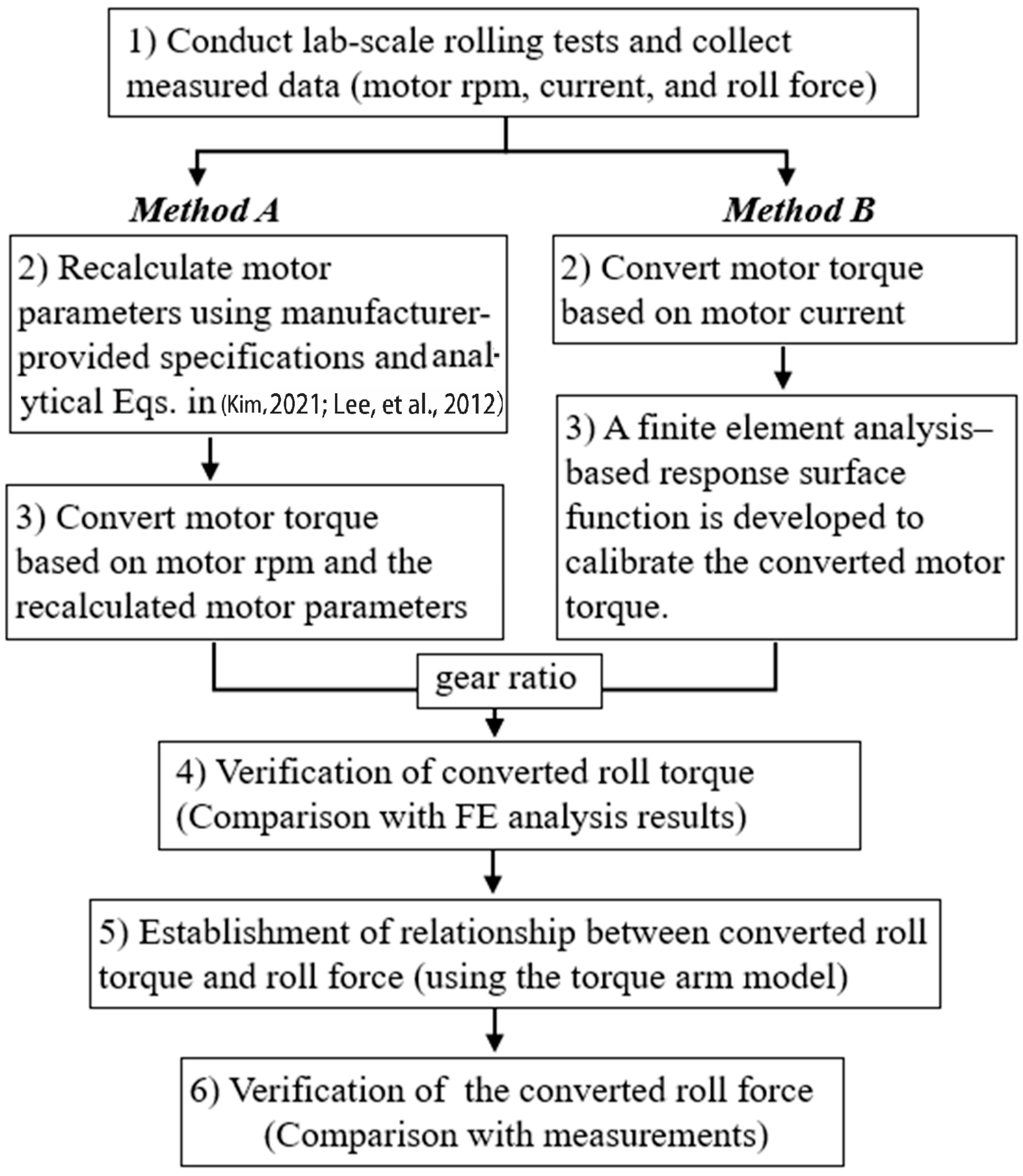
As illustrated in Figure 1, the proposed roll-force estimation procedure comprises six sequential steps. Laboratory-scale rolling tests are first performed using the fabricated experimental mill to acquire fundamental process data, namely motor rotational speed (rpm), motor current, and roll force. Two approaches—Method A and Method B—are then applied to convert these electrical signals into torque using the equivalent-circuit model of an induction motor.
In Method A, the motor parameters are recalculated from the manufacturer-provided specifications using analytical equations [15,16], as the induction motor had been operated frequently for approximately one year. During prolonged operation in the rolling tests, effects such as thermal aging, magnetic saturation, and occasional overloads can alter the electrical characteristics of the motor; therefore, parameter recalibration is required. Using the recalculated parameters, motor torque is obtained via the measured rpm through the equivalent-circuit relations.
In Method B, the motor torque is estimated directly from the measured motor current signals. However, when only current signals are used, subtle variations in slip cannot be captured accurately, which leads to non-negligible errors in the current-to-torque conversion, as also noted in recent studies in the motor current-to-torque conversion [17]. To compensate for the errors, a finite-element (FE)–based response surface function is constructed. In the FE simulations, torque and roll force are calculated under a range of rolling conditions—specifically, different reduction ratios, specimen widths, and roll diameters—chosen to match the laboratory rolling tests. Based on these results, a response surface function is constructed as a function of reduction ratio and specimen width and used to calibrate the converted motor torque.
For both methods, the converted motor torque is transferred to roll torque through the mechanical gear ratio and then verified by comparison with FE analysis results. The roll force was subsequently calculated using the classical torque–arm relationship. The final verification step, the predicted roll forces are compared with the measured roll-force data.
Either method can be chosen depending on user preference, the available measurement signals, and the capability to perform FE analysis. The proposed indirect torque-conversion framework can also be extended to rolling conditions involving temperature variations and dynamic loading. Because it is based on the electromechanical behavior of the drive system rather than on the specific deformation characteristics of the material, the framework remains applicable under varying thermal and transient load conditions.

3. Experiments

3.1. Laboratory-Scale Pilot Rolling Mill

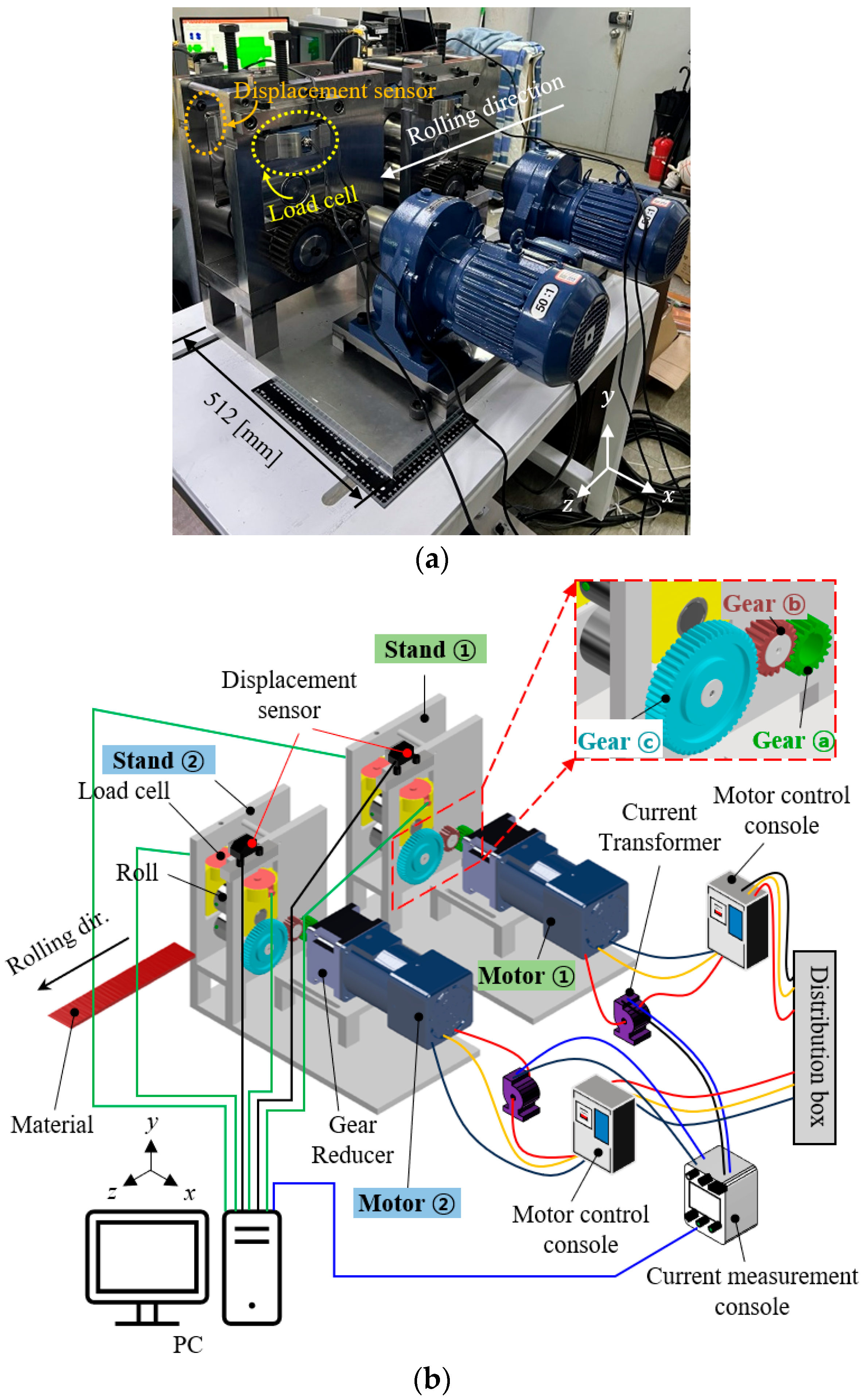
Figure 2a illustrates the lab. scale rolling mill that was designed and fabricated by the authors’ research team. While the proposed methodology is intended for application in rod or bar rolling, cold strip-rolling tests were performed because the cold strip rolling minimizes measurement errors associated with thermal effects and reduces alignment errors along the longitudinal axis of the specimen, which are common in rod rolling test.
The pilot rolling mill is powered by a three-phase geared induction motor (model F1HM15, Hyosung Heavy Industries, Seoul, Republic of Korea), featuring a gear reduction ratio of 50:1. The motor specifications include a rated voltage of 220/380 V, rated frequency of 60 Hz, 4 poles, and a synchronous speed of 1800 rpm. For compactness and structural efficiency of the pilot rolling mill, the gearbox was mounted directly onto the mill housing. After reduction, the motor delivers an output power of 0.75 kW and a maximum torque of 207 N·m. Motor speed was controlled using an FM3-007LF-NF inverter (Hyosung Heavy Industries, Seoul, Republic of Korea).
Two types of work rolls were used with diameters of 85 mm and 100 mm, and a barrel length of 105 mm. The rolls were designed to withstand a maximum torque of 413.8 N·m and were fabricated from SKD11 tool steel by computer numerical control (CNC) machining (Boo-il Precision Co., Ltd., Siheung-si, Gyeonggi-do, Republic of Korea). All structural components of the mill were fabricated from SS400-grade steel, resulting in a total machine weight of approximately 250 kg, including the rolls and housing. To ensure consistent feeding direction and entry height during experiments, an adjustable entry guide was designed, allowing repositioning to accommodate specimens of different widths.

3.2. Data Acquisition

3.2.1. Motor Current Measurement

A current transformer (CT) was used to measure the current supplied to the induction motor in real time. It was installed such that the motor power cable passed through its center as shown in Figure 2b. For precise current measurement, the CT was mounted according to the polarity markings on its housing, ensuring the motor-side (L) and breaker-side (K) directions were correctly followed.
The measured current was filtered to remove electrical noise and converted to root mean square (RMS) values before being transmitted to a programmable logic controller (PLC). The RMS value was obtained by sampling the instantaneous current at a fixed rate, squaring each sample, averaging the squared values over the acquisition interval, and then taking the square root of the mean, following I R M S = 1 N i = 1 N I i 2 .
The PLC was connected to a human-machine interface (HMI), enabling real-time current monitoring both on the current measurement console and PC. In general rolling systems, the PLC issues real-time control commands to actuators while simultaneously monitoring system status and enforcing safety interlocks. In the rolling system employed in this study, however, no control modules or actuators are installed. Consequently, the PLC is dedicated solely to acquiring sensor outputs at a fixed sampling rate, performing initial signal conditioning and timing synchronization, and buffering data to prevent loss during data transmission.

3.2.2. Roll Force Measurement

Rolling forces were measured using two LC8701-T005 load cells (rated capacity: 49 kN each) from AND Co., AND Co., Seoul, Republic of Korea. One load cell is mounted on each side of the upper roll, as shown in Figure 2b, providing a total load capacity of up to 98 kN. The load cells are connected to an indicator (AD-4321P; AND Co., Seoul, Republic of Korea) and transmitted data to a PC via RS-232C communication.

3.2.3. Roll Rpm Measurement

The roll speed was measured using an AS5048A magnetic encoder. This non-contact absolute angle sensor detects the position of a magnet mounted on the end section of the rotating roll shaft on the operator side, enabling precise measurement of angular position and corresponding roll speed. The measured data are transmitted in real time to a PC (Personal Computer) via a wireless network based on a hybrid SPI (Serial Peripheral Interface)—Ethernet architecture, allowing continuous monitoring and analysis during rolling operations.

3.3. Specimens and Test Conditions

Pure copper (C1100P) [18] was used as the specimen material. The specimens were prepared in strip form with an initial thickness of 2 mm and a length of 400 mm. Rolling tests were carried out under 12 different conditions, combining two roll diameters (100 mm and 85 mm), different reduction ratios, and two specimen widths (25 mm and 40 mm). To ensure the reliability and reproducibility of the results, each test condition was repeated three times.
Copper was selected because of practical constraints associated with constructing and operating a laboratory-scale rolling mill. This material choice satisfies several design limitations of the experimental setup, including restricted installation space, the need for easy assembly and disassembly, and the requirement that two students must be able to safely change the rolls. If steel strips were used, the substantially higher rolling loads would require a much larger stand structure, a higher-capacity motor, and increased system stiffness—requirements that exceed what is feasible in a laboratory environment.
All tests were conducted at a constant room temperature (25 °C) under dry conditions, with no additional lubricant applied between the roll and the specimen. To accurately determine the reduction ratio, the specimen thickness was measured before and after rolling using a PMU150-25MX micrometer (Mitutoyo, Japan). The device provides a maximum measurement range of 25 mm and a resolution of 0.001 mm.
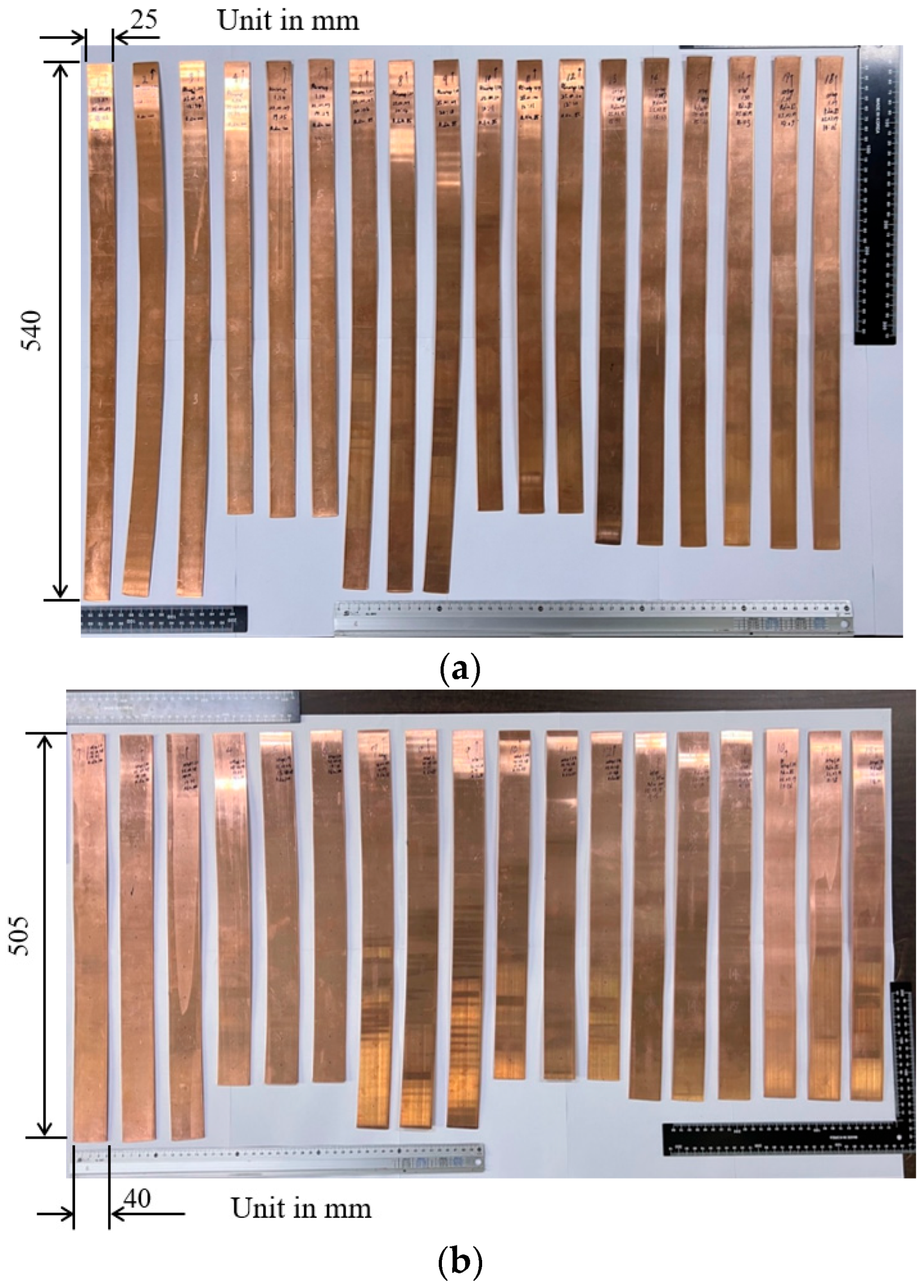
Thickness measurements were taken at 13 positions along the longitudinal direction of the specimen at 30 mm intervals. Each measurement point was located at the center along the width of the specimen. This measurement protocol allowed for a comprehensive evaluation of thickness variation along the entire specimen length. Figure 3 shows the appearance of the specimen after rolling test.

4. Motor Torque and Roll Force

4.1. Recalculation of Motor Parameter for Method A and Current-Voltage Relation for Method B

The parameter values listed in the column ‘Method B’ column in Table 1 correspond to the manufacturer-supplied specifications. For Method A, parameter values (No. 2–6 in Table 1) are recalculated by substituting these specifications into the analytical equations reported in Refs. [15,16]. This recalculation is necessary because the laboratory-scale rolling mill, including its electric motor, had been in operation for about one year, during which repeated loading may have caused the actual motor parameters to deviate from the supplier’s original values
The synchronous speed ω s m , i.e., the speed of the rotating magnetic field produced by the stator windings, is expressed as
ω s m = 120 f p
The slip s is then defined as
s = ω s m n m ω s m
For Method B, the slip s can be obtained using various equivalent-circuit models, including the L-type, T-type, and IEEE 112 standard models. Among these, the IEEE 112 model was adopted in this study for its accuracy in predicting both nominal and peak torque values, as demonstrated by Tezcan et al. [12]. The relationship between motor stator current I s and stator voltage V s can be written as
I s = V s r 0   + r s + r r s 2 +   x m + x s +   x r 2 r 0 r s   +   r r s x m x s + x r 2 + x m r s   + r r s + r 0 x s +   x r 2
The slip s is determined by rearranging Equation (3). Once the slip is obtained, the motor torque T m for both methods can be computed by substituting the motor parameter values into Equation (4) [13].
T m = 3 r r V t h 2 s ω s m   β s 2 + 2 R t h r r / β s + r r 2 / β
V t h T h e v e n i n   v o l t a g e = x m V s r s 2 + x s + x m 2
R t h T h e v e n i n   r e s i s t a n c e = r s x m 2 r s 2 + x m + x s 2
X t h T h e v e n i n   r e a c t a n c e = r s 2 x m + x m x s x m + x s r s 2 + x m + x r 2
β = R t h 2 + X t h + x r 2
When Method B was applied, the converted motor torque deviated from the FE-predicted torque ranging from approximately −67.8 to +17.4%. This discrepancy arises from the fundamental difference between the two quantities. The FE-derived torque represents the physical torque required to induce material deformation, whereas Method B yields an idealized air-gap torque based on the equivalent circuit model. The latter does not include mechanical losses, or load-dependent stray-load losses [8]; because these losses significantly reduce the actual shaft torque, direct comparison of the ideal and physical torques inevitably leads to substantial deviation.
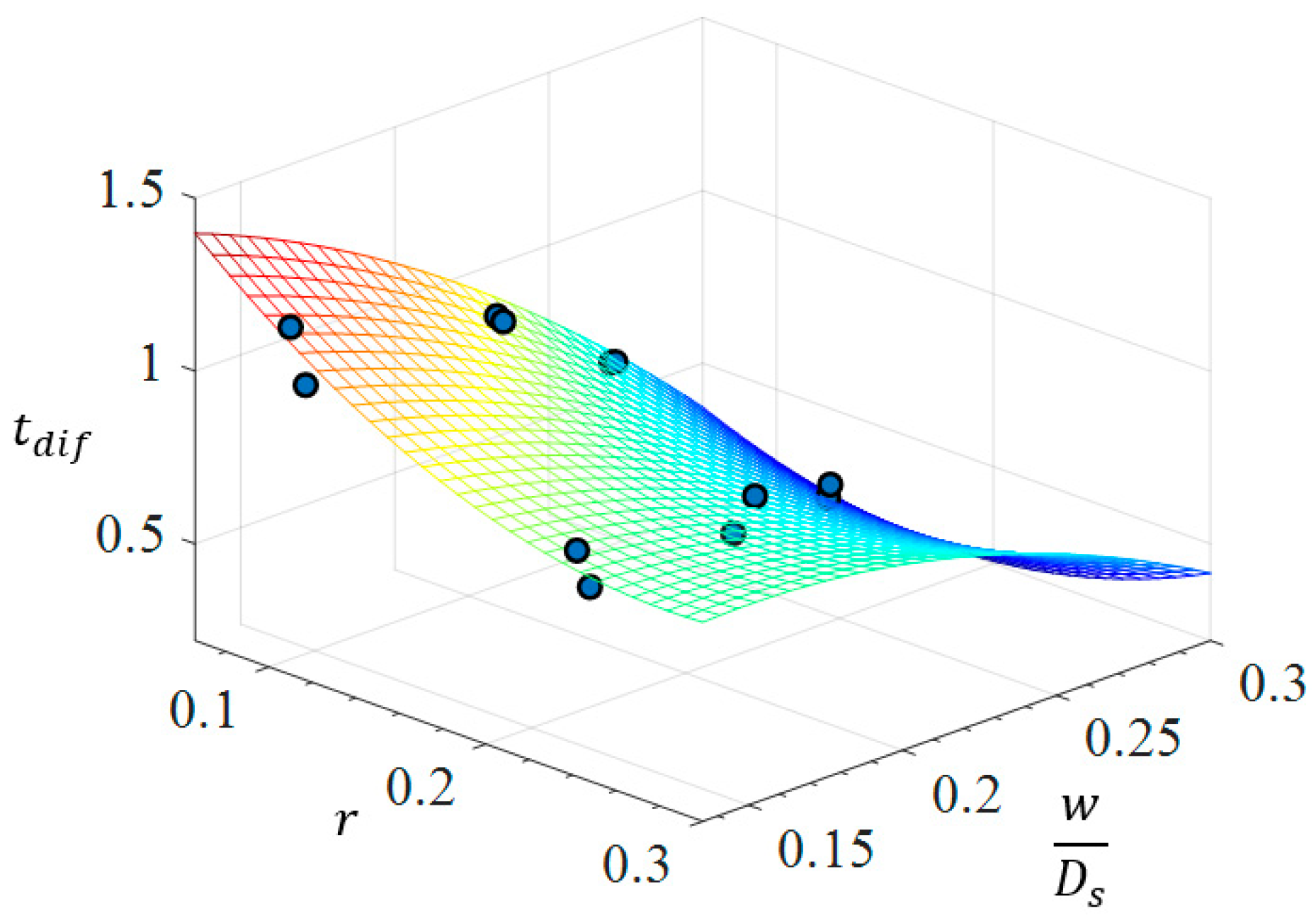
To address this mismatch, additional FE simulations of the laboratory-scale rolling tests were conducted for various combination of rolling conditions (reduction ratios, roll diameters and specimen widths). On the basis of these simulations, a response-surface function was constructed to calibrate the ideal torque obtained from Method B to the FE-derived physical torque. For each rolling condition, the torque deviation was quantified, and a response surface was generated using the MATLAB Curve Fitter Toolbox (R2024a). The resulting surface (Figure 4) is expressed as a functional relationship in which the parameter t d i f denotes the ratio of the converted motor torque to the FE-predicted torque.
The torque deviations obtained from the FE analysis were fitted using a least-squares minimization procedure, yielding the optimal coefficients of the response surface function. The function was designed to capture second-order behavior with respect to the reduction ratio and second-order behavior with respect to the normalized specimen width, while only first-order interaction terms between the two variables were included.
The coefficients in the response surface function were determined by curve fitting as follows
f r , w = n 1 r + n 2 w D s + n 3 r 2 + n 4 r w D s + n 5 w D s 2 + n 6
where n 1 =   9.4734 , n 2 = 0.1261 ,   n 3 = 12.6802 ,   n 4 = 16.7043 ,   n 5 = 17.119 ,     n 6 = 2.1151 . Here, r denotes the reduction ratio, w the specimen width, and Ds the roll diameter, normalized by a reference value of 185 mm (the nominal roll diameter used in the experiments; data from 85 mm and 100 mm rolls were included in the calibration).
Detailed explanations of Methods A and B have been provided, and their main advantages and disadvantages are summarized in Table 2.

4.2. Conversion of Motor Torque to Roll Torque and Roll Force

Once the motor torque T m is obtained, the corresponding roll torque T r is calculated by applying the gear ratio between the motor and the rolls. The roll force F r is then computed from T r using the following relationship:
F r = T r a T
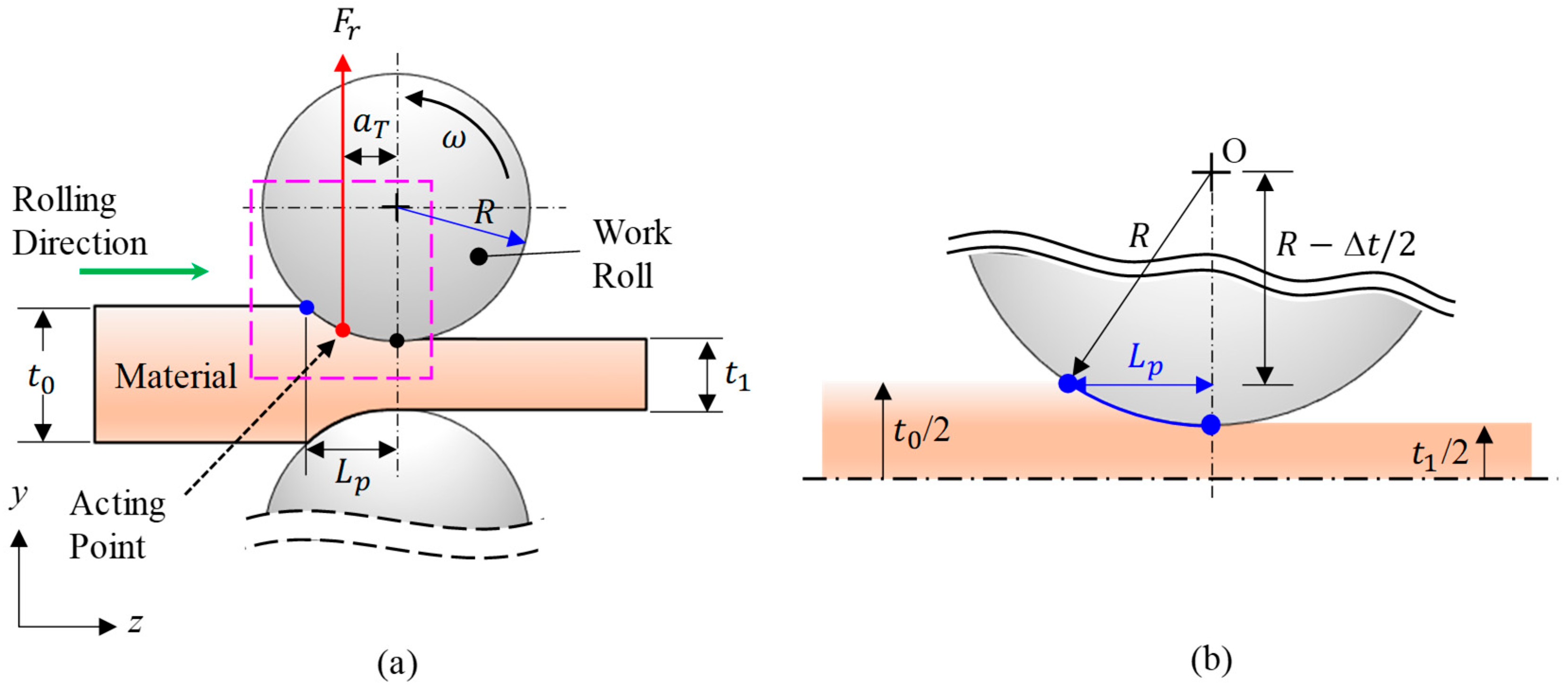
where the torque arm a T is defined as the distance between the roll center and the acting point, i.e., the point where the resultant roll force acts. This term is used to convert roll torque into roll force through the torque-arm model [14], but it does not act in the reverse direction and therefore does not alter the motor-generated torque generated by the motor. Figure 5a schematically illustrates the roll-gap region, the torque arm, and the projection of the contact length.
a T = L p λ
Here, L p is the projected contact length between the roll and the workpiece, and is given by
L p = R 2 R t 2 2 = t R t 2 4
where R is the roll radius and t ( = t 0 t 1 ) is the thickness reduction of the workpiece. To clarify the derivation of L p , an enlarged schematic highlighting the geometric construction is provided in Figure 5b.
In Equation (11), λ represents the ratio of the torque arm to the contact-arc length, which varies with the entry thickness, reduction ratio, and roll radius. To obtain a more accurate value of λ, the present study adopted a modified expression proposed by Sun et al. [19], excluding the terms associated with roll force and front/back tension, as shown below:
λ = a 1 t 0 + t 1 2 R t a 2 + a 3 ( r ) a 4 + a 5 b a v g b a 6
where r and b a v g denote the reduction ratio and average width of the rolled material, respectively. The constants in Equation (13) were determined via FE analysis of the laboratory-scale rolling mill as follow a 1 =   0.5350 ,   a 2 = 0.2089 ,   a 3 = 0.0001 ,   a 4 =   3, a 5 =   0.0075 ,   a 6 =   3 . For Method A, in which FE simulation is not used, a constant value of λ = 0.4 was adopted.

5. FE Analysis of Rolling

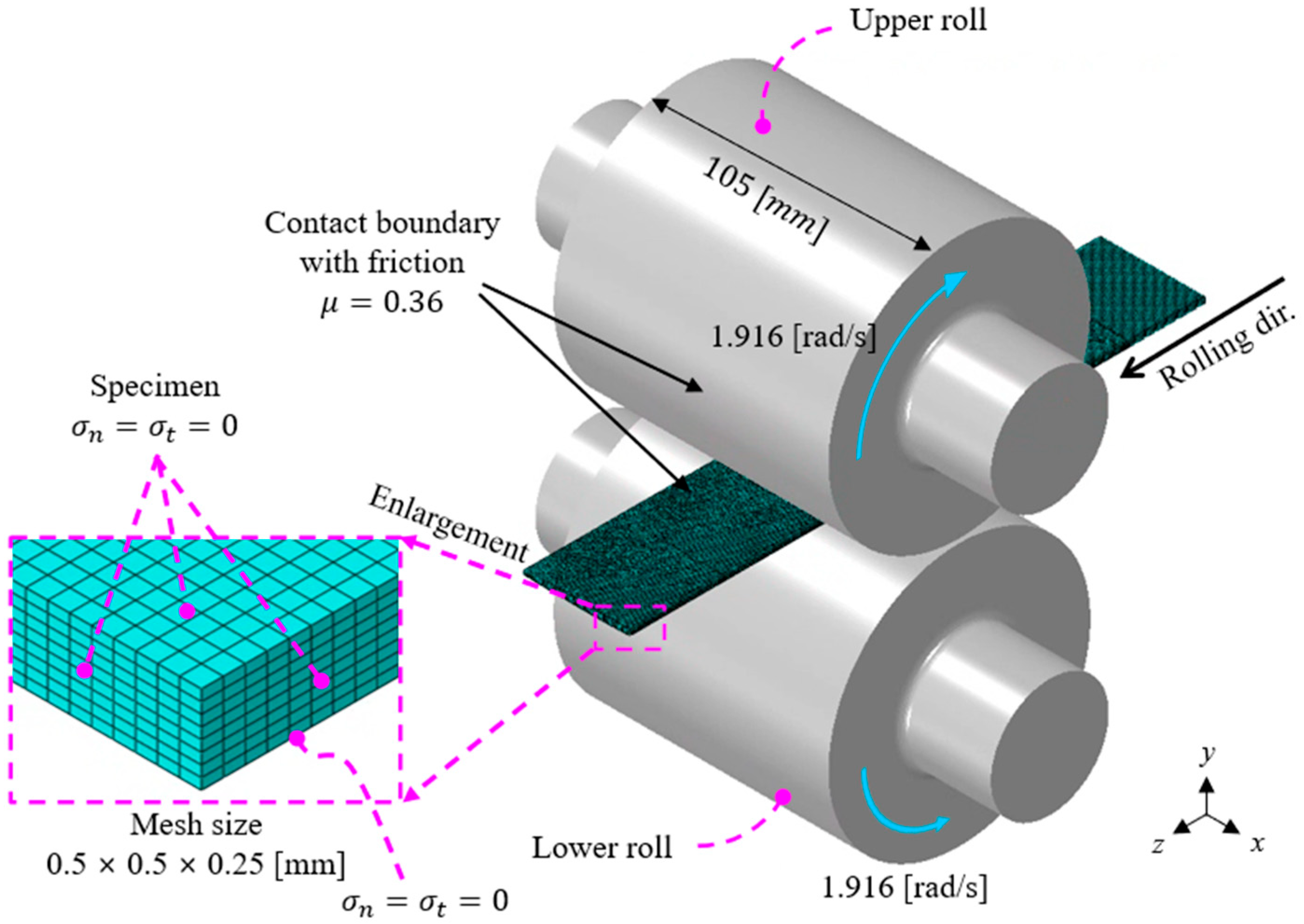
To ensure the validity of the motor current-to-roll torque conversion method, the estimated roll torque was compared with finite element (FE) analysis results. Figure 6 shows the boundary conditions and mesh used in the FE analysis of rolling. In this study, the commercial FEA software Abaqus (2017) was used to perform the FE analysis. The roll was assumed to be a rigid body and the full size of the material was adopted as the analysis model. A no-load condition was applied at both ends of the material, as no external traction ( σ n = σ t = 0 ) was applied.
At the boundary where the rolls and copper material come in contact, Coulomb’s law of friction was applied with a friction coefficient μ = 0.36 [20]. The flow stress σ ¯ was determined using Hockett-Sherby constitutive model [21]. The mesh type used for the analysis was C3D8RT (8-node trilinear displacement and temperature, reduced integration) with 256,000 elements. Element size for the specimen was 0.5 × 0.5 × 0.25 mm (x:y:z), and the roll’s rotational speed was 1.916 rad/s.

6. Results and Discussion

6.1. Motor Current Variation

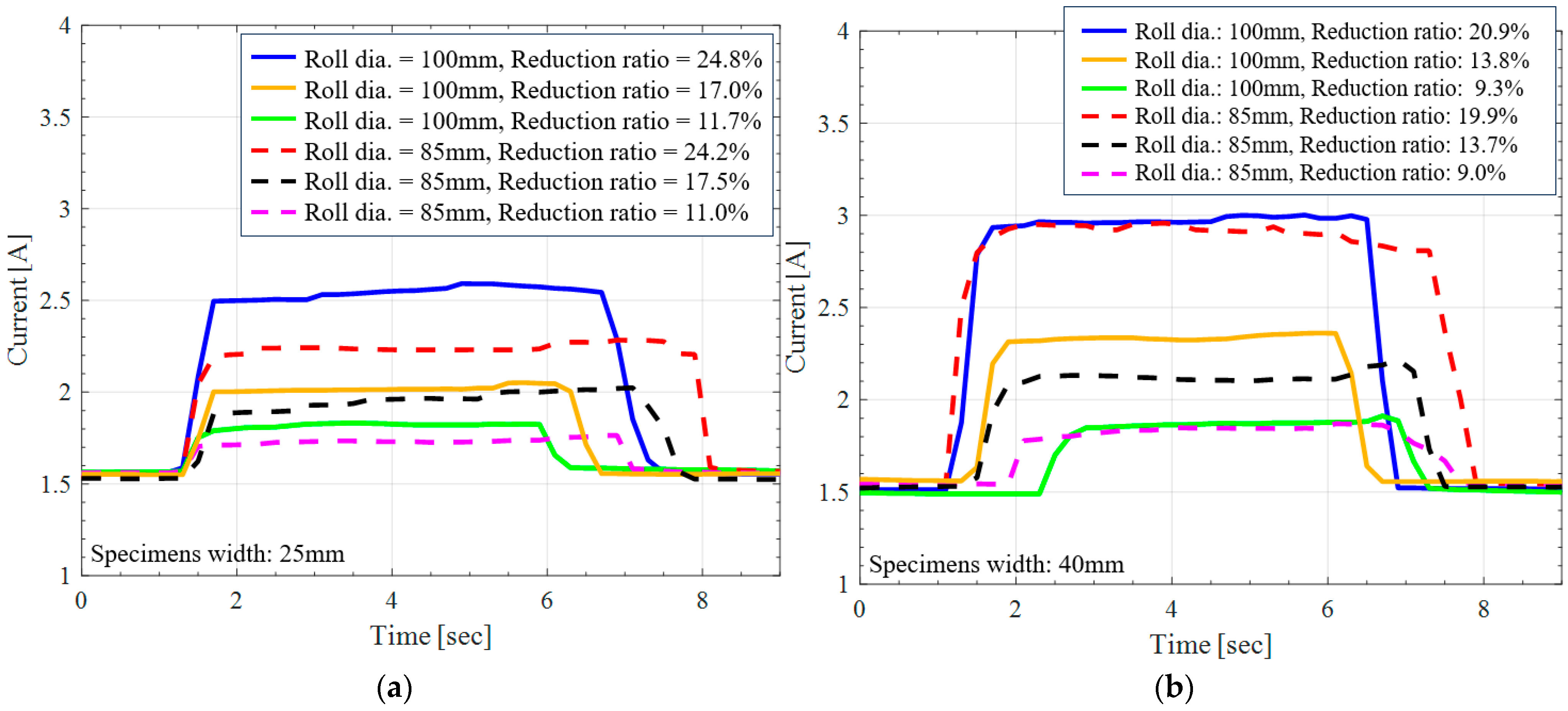
Figure 7 presents the time variation of three-phase induction motor current measured during rolling tests performed under different combinations of roll diameter (100 mm and 85 mm), reduction ratio (9.0–24.8%), and specimen width (25 mm and 40 mm). Each curve represents the transient current response of the motor as the specimen passes through the roll bite. A rapid rise in current is observed immediately after the roll entry, corresponding to the onset of deformation and the sudden increase in rolling load. The current remains nearly constant during steady-state rolling and then drops sharply as the specimen exits the roll gap.
As the reduction ratio increases, the measured motor current increases proportionally, indicating a higher required motor torque. This behavior reflects the greater deformation resistance associated with increased thickness reduction. For a given reduction ratio, larger roll diameters result in slightly higher steady-state current values due to the larger contact arc length and increased frictional contribution to the torque.
A comparison between specimens of different widths (25 mm and 40 mm) shows that both the peak and steady-state current values are higher for the wider specimens. The concurrent increase in motor current can be attributed to the larger roll–material contact area and the greater volume of material deformed per unit time, which requires higher mechanical power input from the motor. These trends collectively demonstrate that the measured motor current reliably reflects the combined effects of roll geometry, reduction ratio, and specimen width on the rolling load, thereby validating its suitability as an indirect indicator of rolling torque and force.

6.2. Converted Roll Torque vs. FE Analysis

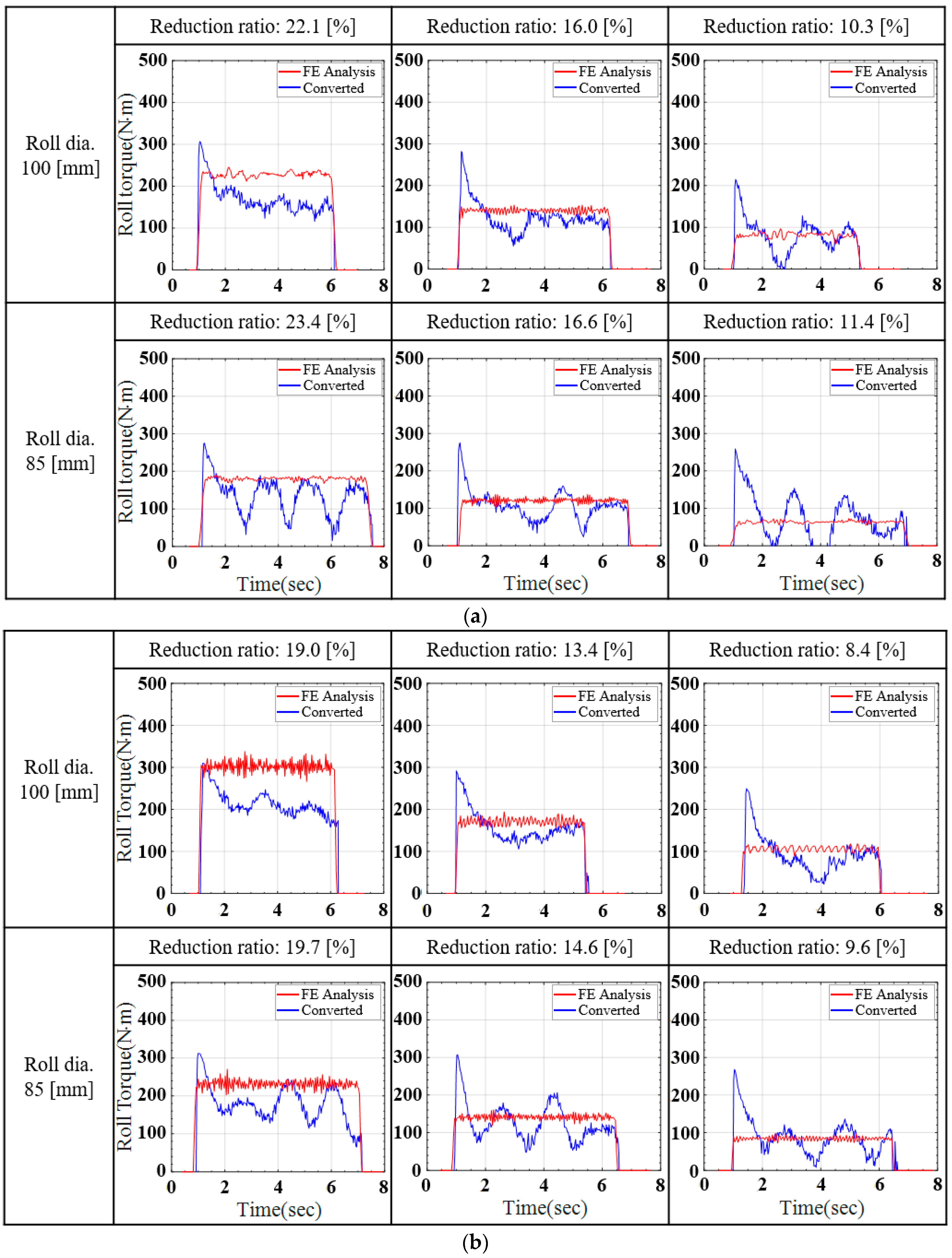
As shown in Figure 8, the roll torque converted from the measured motor current using Method A captures the overall trend of the FE-predicted roll torque, including the initial peak corresponding to material entry into the roll bite and the gradual decrease toward the end of rolling. Hereafter, the term “torque” refers to the roll torque for simplicity. Deviation is defined as the average difference between the FE-predicted torque and the converted torque during the steady-state interval (excluding the initial 1 sec. transient after material entry). The deviation ranges from −11.9% to +28.8% for twelve rolling conditions that are combinations of reduction ratio, roll diameter, and specimen width. However, the converted torque exhibits noticeable time-dependent fluctuations, whereas the FE results remain comparatively smooth. These fluctuations may arise from dynamic effects in the experimental system—such as torsional oscillation of the motor shaft, gear backlash, elastic deformation in the drive train, and transient noise in the measured current. In contrast, the FE analysis assumes quasi-static conditions and idealized contact behavior, excluding such dynamic disturbances. Despite these discrepancies, the average torque levels predicted by the conversion method agree reasonably with the FE predictions.
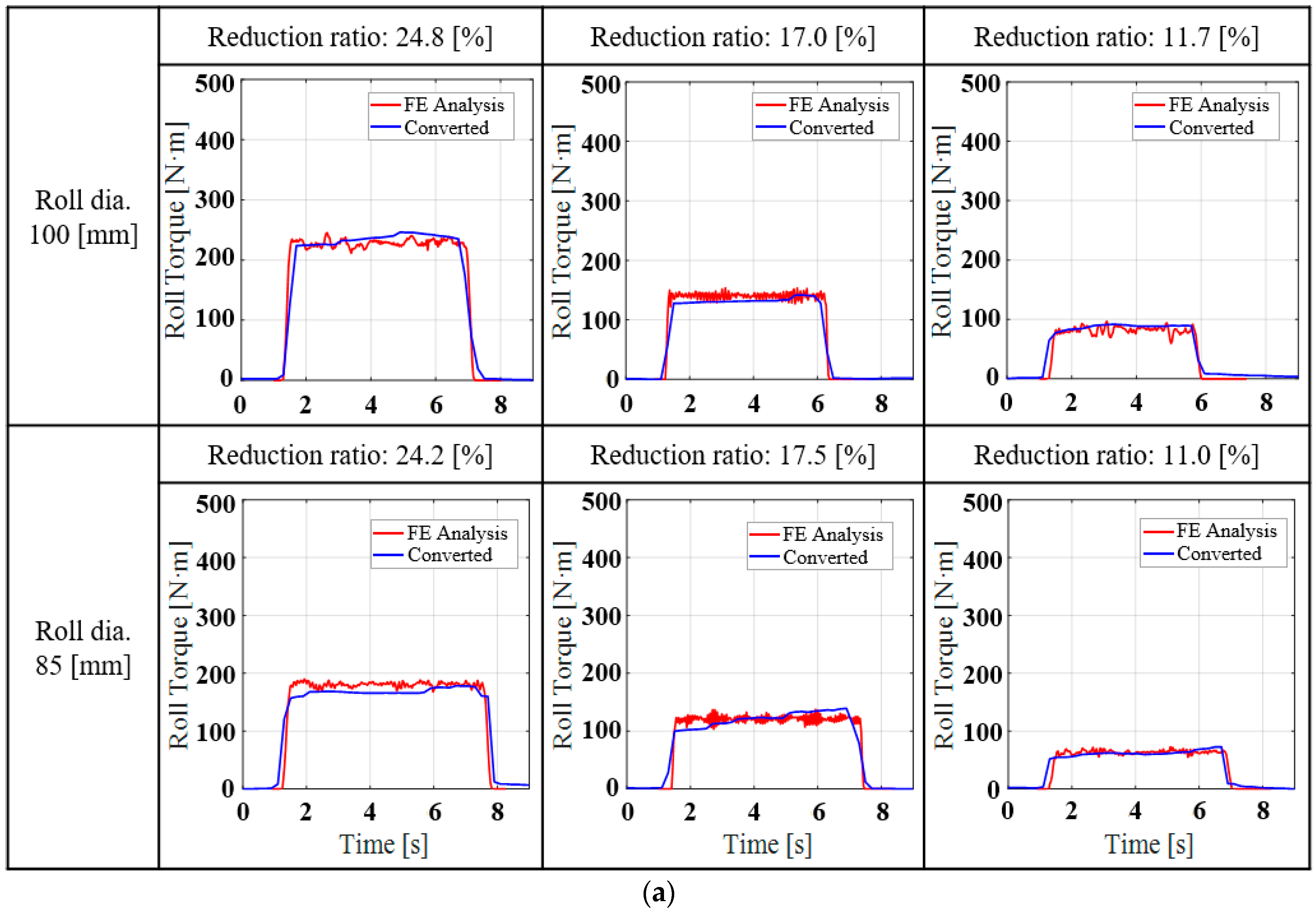
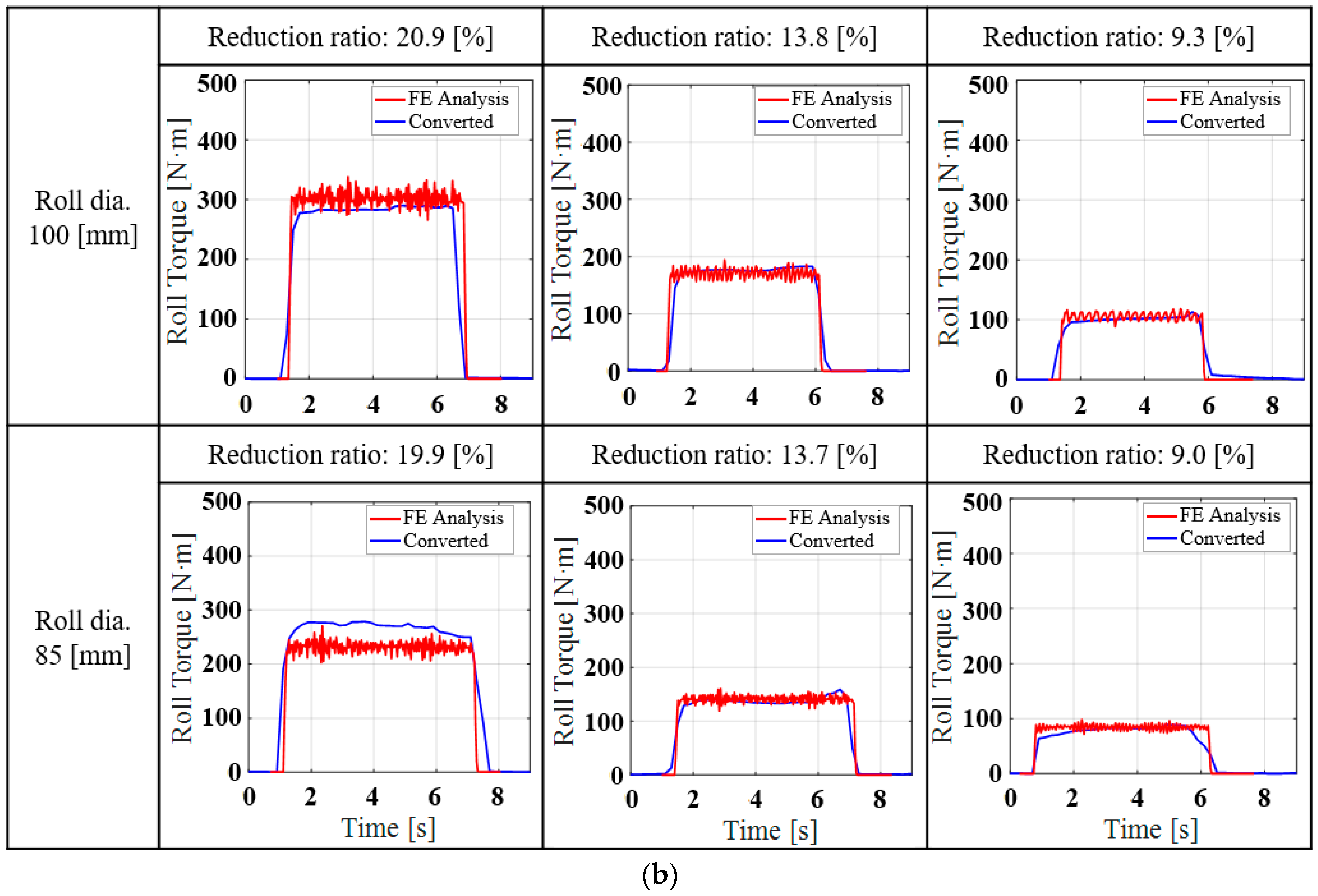
Figure 9 compares the torque converted from the measured motor current using Method B with the torque predicted by the FE analysis. The deviation between the FE-predicted and measured values was within −7.2% to +13.8% for twelve rolling conditions examined. The converted torque obtained through Method B closely follows the FE-predicted torque in both magnitude and time-dependent response, with only minor deviations near the transient regions of roll entry and exit. Overall, Method B exhibits higher apparent accuracy and smoother temporal behavior than Method A. However, it cannot be conclusively stated that Method B is better than Method A. Although the results of Figure 9 (Method B) show smoother and more stable behavior than those of Figure 8 (Method A), the deviations between the FE-predicted and converted torques show no statistically significant difference. Moreover, these results were obtained by applying a surface response function derived from FE analysis of lab-scale rolling mill. Developing such a surface response function is complex and time-consuming, as numerous rolling conditions—such as roll diameter, reduction ratio, and specimen width—must be individually simulated and analyzed.
It should be noted that minor differences in the measured reduction ratios between the two methods arise because the specimen thickness varies slightly even when the roll gap is accurately set. Such small variations are inevitable in laboratory-scale rolling tests due to material inhomogeneity and elastic deformation of the rolls.

6.3. Converted Roll Force vs. Roll Force Measured by Load Cell

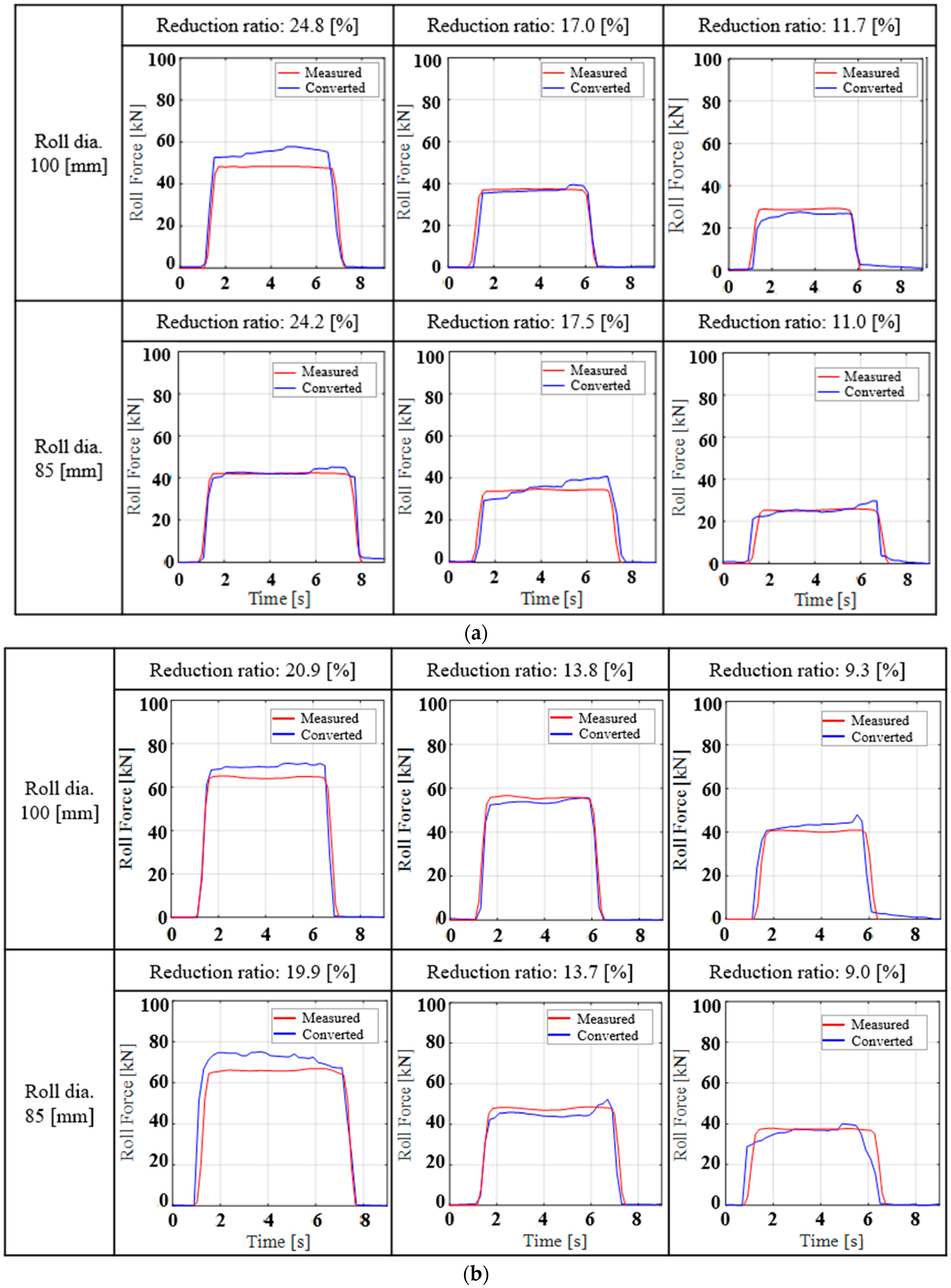
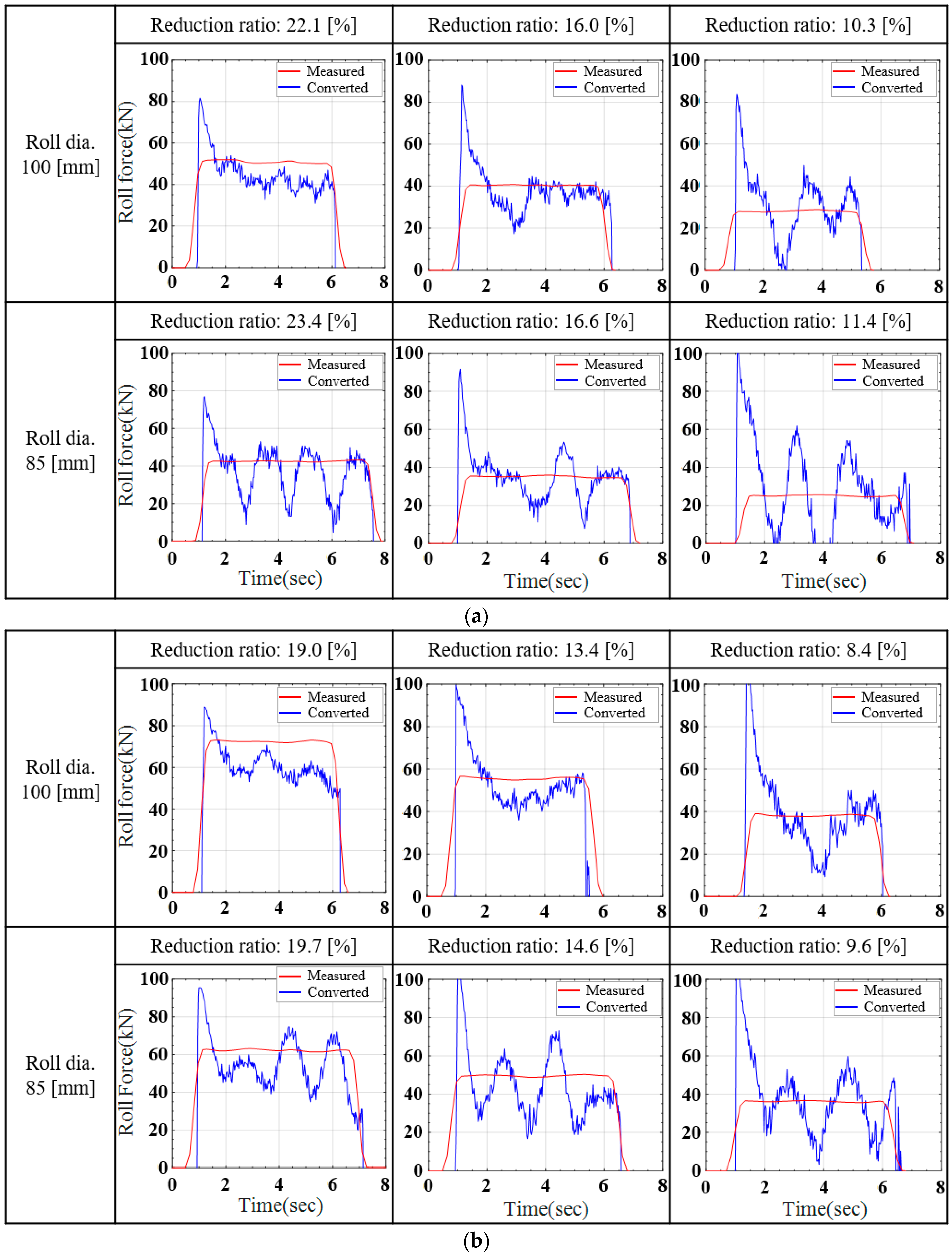
Figure 10 compares the roll force converted from motor torque using Method A with the roll force measured by load cell under various rolling conditions. The converted roll force successfully reproduces the overall trend of the measured data, including the initial rise at roll bite entry and the subsequent drop as the specimen exits the rolls. Across all rolling conditions, the deviation between the converted roll force and experimental measurements remained within −14.1% to +14.9% for twelve rolling conditions. However, noticeable fluctuations are observed in the converted force, particularly during the steady-state region, whereas the measured values remain comparatively smooth. These fluctuations likely arise from mechanical vibration of the rolling stand, elastic deformation of drive components, and transient variations in friction, which are not captured in the simplified torque-to-force conversion model. From a practical perspective, the indirect estimation method proves useful, as the average roll force predicted using the conversion method matches the measured values to a certain degree, without requiring expensive load cells.
Figure 11 compares the roll force converted from motor torque using Method B with the roll force measured by load cell under various rolling conditions. The converted roll forces show overall agreement with the measured data across all combinations of roll diameter, reduction ratio, and specimen width, with deviations ranging from −3.7% to +14.2%. Both data sets show similar temporal evolution—characterized by a sharp rise at roll entry, a stable plateau during steady-state deformation, and small oscillations upon roll exit. Although Method B appears to capture the transient response of the rolling process more accurately, this apparent superiority largely results from calibration using the surface response function obtained from FE analysis of lab-scale rolling mill, which requires a lot of cost and time.
The comparative results obtained from Figure 8, Figure 9, Figure 10 and Figure 11 highlight the distinct characteristics of the two torque-conversion schemes. Method A, which estimates slip from the measured rpm, provides a straightforward and computationally efficient means of torque and roll force estimation, even when motor-parameter recalculation—simple in practice—is included. However, torque estimation is more sensitive to transient variations in rotational speed and electrical noise. Hence, the accuracy of Method A largely depends on the precise and stable measurement of the motor’s rotational speed.
Meanwhile, Method B, which determines slip from the motor current, yields smoother and more stable responses but requires calibration of the converted motor torque using an FE-derived surface response function. Developing such a surface response function on the basis of FE analysis is complex and time-consuming, as numerous rolling conditions must be simulated to ensure adequate generality and accuracy.
In summary, Method A provides a simple procedure when reliable roll-rpm data are available, whereas Method B yields smoother temporal responses but requires FE-based calibration and exhibits higher sensitivity to uncertainties in motor parameters. Table 3 presents a qualitative and quantitative comparison between the two approaches.
Regarding the sources of deviation, several mechanical, sensor-related, and model-related factors contribute to the observed torque and roll-force estimation errors. Dynamic disturbances—including torsional oscillations, gear backlash, and elastic deformation of the drive train—generate high-frequency fluctuations in both rpm and current signals (Figure 8, Figure 9, Figure 10 and Figure 11). The retrofitted magnetic encoder also exhibits limited precision and high sensitivity to vibration, while the measured current is influenced by inverter harmonics and electrical noise, which propagate directly into the torque-conversion process.
In this context, the limitations and challenges of this work are summarized as follows. First, the laboratory rolling tests were performed under room-temperature, low-load conditions using soft copper, which limits their representativeness for industrial hot rolling conditions. In addition, simplifying assumptions in the FE model of laboratory-scale rolling mill, together with geometry- and reduction-dependent nonlinearities, lead to condition-dependent deviations in the predicted torque and roll force.

7. Concluding Remarks

This study evaluated two indirect torque-conversion methods—an RPM-based approach (Method A) and a current-based approach (Method B)—for estimating roll torque and roll force in a laboratory-scale rolling mill. Method B yielded smoother temporal behavior but required FE-based calibration to compensate for the errors in the current-to-torque conversion. Method A provided a straightforward and transparent conversion path but exhibited a relatively large average deviation from FE-predicted torque and force, compared with Method B.
Experimental results confirmed that both methods successfully reproduced the overall torque and roll force trends during steady-state rolling. Method A demonstrated greater robustness in the recalculated motor parameters, whereas the response-surface function applied in Method B improved agreement with FE predictions, indicating its usefulness in situations where FE simulation of rolling mill are feasible in terms of computational time and cost.
Overall, the proposed framework reliably captured the evolution of roll torque and roll force across a range of geometries and reduction conditions, providing a solid foundation for real-time roll force estimation in rolling mills. Nonetheless, several limitations remain—most notably the use of soft copper strip material, reduced dynamic loading, and room-temperature operation. Measurement accuracy was also influenced by sensor-related factors, including encoder precision and drive-train compliance.
Future work will focus on integrating higher-precision speed-sensing technologies, extending validation to elevated-temperature rolling and more industrially relevant materials, and improving the equivalent circuit model that converts induction motor current into torque.


Author Contributions

Conceptualization, Y.L., S.-M.B. and G.N.; methodology, G.N. and J.J.; software, D.L., G.N. and J.J.; validation, G.N., J.J. and S.-G.K.; formal analysis, G.N., J.J. and D.L.; investigation, G.N., J.J., D.L., Y.L. and S.-M.B.; writing—original draft preparation, G.N.; writing—review and editing, Y.L. and S.-M.B.; visualization, G.N., J.J., S.-G.K. and D.L.; supervision, Y.L. and S.-M.B.; All authors have read and agreed to the published version of the manuscript.

Funding

This work was supported by the Dong-A University research fund.

Institutional Review Board Statement

Not applicable.

Informed Consent Statement

Not applicable.

Data Availability Statement

The original contributions presented in this study are included in the article. Further inquiries can be directed to the corresponding authors.

Conflicts of Interest

The authors declare no conflicts of interest.

Abbreviations

The following abbreviations are used in this manuscript:
AGCAutomatic Gauge Control
CNCComputer Numerical Control
CTCurrent Transformer
FE Finite Element
FEAFinite Element Analysis
HMIHuman–Machine Interface
IEEEInstitute of Electrical and Electronics Engineers
PCPersonal Computer
PLCProgrammable Logic Controller
RMSRoot Mean Square
RS-232CRecommended Standard 232 Revision C
SPISerial Peripheral Interface
Symbols
Motor equivalent circuit and operation
V s Stator voltage
r s Stator resistance
r r Rotor resistance
x m Magnetizing reactance
x s Stator leakage reactance
x r Rotor leakage reactance
r 0 Core loss resistance
f Frequency
p Number of poles
ω s m Synchronous angular speed
n m Motor speed (rpm)
s Slip
I s Stator current
T m Motor torque
V t h Thevenin voltage
R t h Thevenin resistance
X t h Thevenin reactance
β Auxiliary parameter in torque equation
Rolling and geometry
T r Roll torque
F r Roll force
a T Torque arm
L p Projected contact length
R Roll radius
t Thickness reduction
t 0 Entry thickness
t 1 Exit thickness
r Reduction ratio
b a v g Average width
b Reference   width   used   in   normalization   of   b a v g
α Angle of contact (=angle of bite)
λ Lever arm coefficient
Response surface and correction
t d i f Torque deviation factor
D s Nominal roll diameter
w Specimen width
n 1 ,   n 2 ,   n 3 ,   n 4 ,   n 5 ,   n 6 Coefficients of torque-correction response surface
a 1 ,   a 2 ,   a 3 ,   a 4 ,   a 5 ,   a 6 Coefficients in the lever-arm coefficient expression λ
Material/FE analysis
μ Coefficient of friction
σ n Normal stress
σ t Tangential stress
σ ¯ Flow stress from the Hockett-Sherby constitutive model

References

  1. Lee, Y. Rod and Bar Rolling: Theory and Applications; Marcel Dekker, Inc.: New York, NY, USA, 2004; ISBN 0-8247-5649-5. [Google Scholar]
  2. Hong, S.-C. Roll speed set-up in hot strip finishing rolling mill. IFAC Proc. 2007, 40, 237–242. [Google Scholar] [CrossRef]
  3. Chakravarty, K.; Kumar, S. Increase in energy efficiency of a steel billet reheating furnace by heat balance study and process improvement. Energy Rep. 2020, 6, 343–349. [Google Scholar] [CrossRef]
  4. Lundberg, S.-E.; Gustafsson, T. The influence of rolling temperature on roll wear, investigated in a new high temperature test rig. J. Mater. Process. Technol. 1994, 42, 239–291. [Google Scholar] [CrossRef]
  5. Lee, D.; Roh, Y.H.; Lee, Y. Experimental study on the surface defects of materials in bar rolling with a processing map applicable to billet-to-oval groove rolling. Proc. Inst. Mech. Eng. Part B J. Eng. Manuf. 2025, 239, 250–263. [Google Scholar] [CrossRef]
  6. Bastiaensen, C.; Deprez, W.; Symens, W.; Driesen, J. Parameter sensitivity and measurement uncertainty propagation in torque-estimation algorithms for induction machines. IEEE Trans. Ind. Appl. 2008, 57, 2727–2732. [Google Scholar] [CrossRef]
  7. Aarniovuori, L.; Karkkainen, H.; Niemela, M.; Lindh, P.; Pyrhonen, J. Induction motor torque estimation accuracy using motor terminal variables. In Proceedings of the 2017 IEEE International Electric Machines and Drives Conference, Miami, FL, USA, 21–24 May 2017. [Google Scholar]
  8. Yamamoto, S.; Hirahara, H. Torque estimation of variable-speed induction motors without torque and rotational speed meters. IEEJ J. Ind. Appl. 2024, 13, 233–242. [Google Scholar] [CrossRef]
  9. Hsu, J.; Kueck, J.; Olszewski, M.; Casada, D.; Otaduy, P.; Tolbert, L. Comparison of induction motor field efficiency evaluation methods. IEEE Trans. Ind. Appl. 1998, 34, 117–125. [Google Scholar] [CrossRef]
  10. Yamazaki, K.; Suzuki, A.; Ohto, M.; Takaura, T. Circuit parameter determination involving stray load loss and harmonic torques for high-speed induction motors fed by inverters. IEEE Trans. Energy Convers. 2013, 28, 154–163. [Google Scholar] [CrossRef]
  11. Kawamura, N.; Zanma, T.; Koiwa, K.; Liu, K.Z.; Hasegawa, M. Simultaneous estimation of rotor speed and stator resistance in speed-sensorless vector control of IMs. IEEJ J. Ind. Appl. 2021, 10, 469–480. [Google Scholar] [CrossRef]
  12. Tezcan, M.M.; Yetgin, A.G.; Canakoglu, A.I.; Cevher, B.; Turan, M.; Ayaz, M. Investigation of the effects of the equivalent circuit parameters on induction motor torque using three different equivalent circuit models. In MATEC Web of Conferences; EDP Sciences: Les Ulis, France, 2018; p. 01019. [Google Scholar]
  13. Aree, P. Analytical approach to determine speed–torque curve of induction motor from manufacturer data. Procedia Comput. Sci. 2016, 86, 293–296. [Google Scholar] [CrossRef]
  14. Wusatowski, Z. Fundamentals of Rolling; Pergamon: Oxford, UK, 1969. [Google Scholar]
  15. Kim, J.-G. Calculation of parameters of equivalent circuit diagram using induction motor nameplate values. Trans. Korean Inst. Electr. Eng. 2021, 70P, 127–132. [Google Scholar] [CrossRef]
  16. Lee, K.; Frank, S.; Sen, P.K.; Gentile-Polese, L.; Alahmad, M.; Waters, C. Estimation of induction motor equivalent circuit parameters from nameplate data. In Proceedings of the 2012 North American Power Symposium (NAPS), Champaign, IL, USA, 9–11 September 2012; pp. 1–6. [Google Scholar]
  17. Kumar, R.; Andriollo, M.; Cirrincione, G.; Cirrincione, M.; Tortella, A. A comprehensive review of conventional and intelligence-based approaches for the fault diagnosis and condition monitoring of induction motors. Energies 2022, 15, 8938. [Google Scholar] [CrossRef]
  18. Lin, H.; Guo, X.; Song, K.; Feng, J.; Li, S.; Zhang, X. Synergistic strengthening mechanism of copper matrix composite reinforced with nano-Al2O3 particles and micro-SiC whiskers. Nanotechnol. Rev. 2021, 10, 62–72. [Google Scholar] [CrossRef]
  19. Sun, J.; Zhang, W.; Li, Y. Mathematical model of lever arm coefficient in cold rolling process. Int. J. Adv. Manuf. Technol. 2018, 97, 1847–1859. [Google Scholar] [CrossRef]
  20. Engineering Toolbox. Available online: https://www.engineeringtoolbox.com/friction-coefficients-d_778.html (accessed on 9 October 2025).
  21. Hockett, J.E.; Sherby, O.D. Large strain deformation of polycrystalline metals at low homologous temperatures. J. Mech. Phys. Solids 1975, 23, 87–98. [Google Scholar] [CrossRef]
Figure 1. Workflow of the proposed roll-force estimation procedure using measured motor rpm and current. Two approaches (Method A and Method B) are applied to convert motor signals to roll torque and roll force through the equivalent-circuit model and torque-arm relationship [15,16].
Machines 14 00045 g001
Figure 2. Experimental apparatus used in this study: (a) photograph of the laboratory-scale pilot rolling mill; (b) schematic of the measurement configuration. The pilot mill consists of two motor-driven stands (Stand 1 and Stand 2) coupled through a gear reducer train, and is instrumented with a load cell, a displacement sensor for roll gap displacement measurement, and a current transformer for motor current measurement. Motor operation is controlled through the motor control console.
Machines 14 00045 g002
Figure 3. Appearance of the rolled copper specimens for two different widths: (a) 25 mm and (b) 40 mm.
Machines 14 00045 g003
Figure 4. Three-dimensional response-surface function used to calibrate the motor torque obtained with Method B. The surface represents the torque-deviation factor t d i f , defined as the ratio of converted motor torque to FE-predicted torque, as a function of reduction ratio r and normalized specimen width w / D s .
Machines 14 00045 g004
Figure 5. Schematic illustration of (a) the roll force, torque arm, and acting point in the roll-gap region, and (b) the projected contact length used for roll force analysis. In (a), the entry and exit thicknesses are denoted by t0 and t1, and the resultant roll force Fr acts normal to the roll surface at a distance aT (torque arm) from the roll center. The acting point, deformation zone, and geometrical relationship are indicated.
Machines 14 00045 g005
Figure 6. Finite element (FE) model of the laboratory-scale rolling test: overall view of the roll–specimen system, including boundary conditions and mesh configuration.
Machines 14 00045 g006
Figure 7. Time variation of measured motor current during lab-scale rolling tests for various combinations of roll diameter, reduction ratio, and specimen width: (a) 25 mm and (b) 40 mm. Higher reduction ratios and wider specimens result in increased motor current.
Machines 14 00045 g007
Figure 8. Comparison of roll torques converted using Method A with FE-predicted roll torques under varying reduction ratios and roll diameters: (a) specimen width = 25 mm, (b) specimen width = 40 mm.
Machines 14 00045 g008
Figure 9. Comparison of roll torques converted using Method B with FE-predicted roll torques under varying reduction ratios and roll diameters: (a) specimen width = 25 mm, (b) specimen width = 40 mm.
Machines 14 00045 g009aMachines 14 00045 g009b
Figure 10. Comparison of roll forces converted from motor torque using Method A with roll forces measured by load cells under varying reduction ratios and roll diameters: (a) specimen width = 25 mm, (b) specimen width = 40 mm.
Machines 14 00045 g010
Figure 11. Comparison of roll forces converted from motor torque using Method B with roll forces measured by load cells under varying reduction ratios and roll diameters: (a) specimen width = 25 mm, (b) specimen width = 40 mm.
Machines 14 00045 g011
Table 1. Motor parameters used in the equivalent-circuit model for Methods A and B.
NoParametersDescriptionsMethod AMethod B
1 V s Stator voltage [V]210
2 r s Stator resistance [Ω]6.16712.4060
3 r r Rotor resistance [Ω]5.16131.5574
4 x m Magnetization reactance [Ω]97.063385.3835
5 x s Stator leakage reactance [Ω]32.94213.6426
6 x r Rotor leakage reactance [Ω]32.94214.1685
7 r 0 Core loss resistance [Ω]-5808
8 f Frequency [Hz]60
9 p Number of poles4
Table 2. Advantages and disadvantages of Method A (rpm-based) and Method B (current-based) for indirect torque estimation.
MethodAdvantagesDisadvantages
A
  • Exact slip can be obtained from the measured motor speed.
  • FE analysis is not required to compensate for the errors in the current-to-torque conversion. Only rpm measurements are needed.
  • Motor speed must be measured using a tacho-meter or encoder (additional speed sensor required).
  • Motor parameter values must be recalculated using equations in Refs. [15,16].
B
  • No additional speed sensing equipment is required.
  • Only motor current is required, which can be easily measured using a current transformer without system modification.
  • Because the exact slip cannot be obtained from the motor current, a surface response function based on FE analysis is required.
  • Computing capabilities are required to derive the surface response function.
Table 3. Comparison of Method A (rpm-based) and Method B (current-based) in terms of complexity, noise sensitivity, implementation difficulty, industrial applicability, and deviation in converted torque and roll force.
CategoryMethod A (RPM-Based)Method B (Current-Based)
ComplexityRelatively low (requires only
parameter recalculation)
High (requires time consuming FE-based calibration)
Noise sensitivityRPM measurement noise may propagate into torque estimationCurrent signal can be filtered effectively; less sensitive to noise
Implementation
difficulty
Simple once parameters are recalculatedMore complex due to FE analysis and surface-fitting requirements
Industrial
applicability
Suitable when accurate rpm measurements are availableSuitable when only motor current measurement is available
Deviation (%)Torque: −11.9 to 28.8%Torque: −7.2 to 13.8%
Roll force: −14.1 to 14.9%Roll force: −3.7 to 14.2%
Disclaimer/Publisher’s Note: The statements, opinions and data contained in all publications are solely those of the individual author(s) and contributor(s) and not of MDPI and/or the editor(s). MDPI and/or the editor(s) disclaim responsibility for any injury to people or property resulting from any ideas, methods, instructions or products referred to in the content.