1. Introduction
Driven by the “Dual Carbon” objectives, the synergistic advancement of vehicle electrification, intelligence, and connectivity is significantly accelerating the development of intelligent and connected new energy vehicles [
1,
2]. The logistics sector, being a major contributor to carbon emissions, faces a growing imperative for intelligent transformation. Upgrading logistics intelligence in confined operational areas such as industrial parks, port terminals, and large-scale warehousing centers has become a critical measure for enhancing operational efficiency and reducing costs. In this context, electric commercial vehicles, which represent the integration of vehicle electrification and logistics intelligence, are regarded as an ideal platform for achieving efficient and sustainable transportation within park environments. This is attributed to their demonstrated advantages in environmental friendliness, economic viability, and operational controllability [
3,
4]. However, in commercial applications, the high cost of batteries and stringent energy efficiency requirements impose significant challenges for pure electric commercial vehicles in park logistics, particularly in managing operational costs. Among various energy-saving technological approaches, global path planning serves as a critical decision-making factor that substantially influences overall vehicle energy consumption, thereby providing an effective pathway for operational cost optimization. Consequently, the development of an energy-optimal global path planning method tailored for pure electric commercial vehicles in park logistics scenarios holds considerable theoretical importance and practical value for reducing operational expenses and improving economic efficiency.
Global path planning, serving as the foundation for autonomous vehicle navigation, can be broadly categorized into graph search-based, sampling-based, optimization-based, and learning-based methodologies according to their algorithmic principles and implementation mechanisms [
5]. The graph search-based approach formulates path planning problems using graph theory, where the operational environment is modeled as a graph comprising nodes representing feasible states or locations and edges denoting possible transitions or actions between them [
6]. Lu et al. [
7] introduced a methodology involving dynamic adjustment of heuristic function weights and novel heuristic designs to balance search efficiency and optimality. This approach effectively mitigates issues of computational complexity and local optima convergence commonly associated with the traditional A* algorithm in high-complexity environments. Feng et al. [
8] proposed a hybrid path planning methodology integrating the A* algorithm with the Dynamic Window Approach (DWA). In their framework, an enhanced A* algorithm generates globally optimal paths while DWA handles local dynamic obstacle avoidance, adjusting robot velocity and trajectory based on real-time sensor data. This integrated approach demonstrates high real-time performance and effectively overcomes the inherent limitations of individual algorithms. Separately, Hu et al. [
9] introduced a hierarchical graph search method that decomposes global planning into multiple layers through a structured hierarchical graph construction, substantially reducing computational complexity in large-scale environments. Graph search-based path planning demonstrates satisfactory real-time performance for identifying globally optimal paths in low-dimensional dynamic and static environments. However, its computational demands grow exponentially with environmental complexity, making it unsuitable for large-scale or high-dimensional applications requiring real-time response. Additionally, the generated paths typically lack smoothness and exhibit unreliable performance in high-dimensional spaces. In contrast, sampling-based methods construct roadmaps through random sampling and connection of points, thereby eliminating the need for complete environment modeling. While this approach proves effective for high-dimensional and complex environments, it sacrifices optimality guarantees to achieve enhanced planning efficiency [
10]. Ganesan et al. [
11] developed a novel goal-oriented sampling strategy that biases sample generation toward target regions, significantly reducing random exploration in invalid spaces. This approach accelerates initial path discovery in high-dimensional spaces and enhances convergence to optimal solutions. Separately, Huang et al. [
12] introduced the Agile-Rapidly Exploring Random Tree* algorithm to substantially improve path planning speed and robustness in complex environments. By incorporating adaptive sampling strategies and path optimization mechanisms, their method accelerates the acquisition of initial feasible solutions and increases the convergence rate toward optimal paths, thereby effectively enhancing motion planning efficiency in challenging scenarios. Liu et al. [
13] proposed a hybrid path planning method integrating Probabilistic Roadmap Method (PRM) and D, designated as PRM-D. During the preprocessing phase, PRM constructs a global roadmap, while the D* algorithm performs efficient incremental replanning in dynamic environments. This methodology achieves higher success rates with fewer sampling points, maintains rapid global planning capability, and enhances dynamic obstacle avoidance performance. Sampling-based path planning proves effective in high-dimensional and complex environments by rapidly generating feasible trajectories without requiring explicit environmental modeling. However, this approach cannot guarantee global optimality, and the resulting paths may lack smoothness. Furthermore, inappropriate sampling strategies can significantly degrade planning performance, particularly in narrow passages, due to insufficient sampling coverage [
14]. Conversely, optimization-based methods formulate path planning as a mathematical optimization problem. These approaches typically generate an initial coarse path and subsequently refine it through numerical optimization techniques subject to defined objective functions and constraints. Tao et al. [
15] developed an improved particle swarm optimization (IPSO) algorithm specifically designed to address the premature convergence and local optima limitations inherent in traditional PSO. Their approach incorporates crossover operations for position updates and integrates mutation mechanisms to prevent entrapment in local optimal solutions. Separately, Li et al. [
16] proposed an improved hybrid artificial fish swarm algorithm that enhances the original algorithm’s global search capability and convergence speed through the integration of mechanisms from other intelligent optimization methodologies. Wu et al. [
17] developed a multi-layer vehicle routing framework integrating both static and dynamic planning elements. By incorporating a blockage factor as a negative feedback mechanism to enhance the ACO algorithm, their method significantly improves operational efficiency while reducing overall task execution costs. Su et al. [
18] proposed a combined strategy incorporating Genetic Algorithm (GA) and Sequential Quadratic Programming (SQP). Their systematic methodology first leverages GA’s global search capability to generate a coarse initial path, then employs SQP for localized refinement, effectively circumventing the tendency of conventional methods to converge to local optima. Optimization-based path planning demonstrates the capability to generate high-quality trajectories characterized by smoothness, safety, and dynamic feasibility. However, these methods are generally computationally intensive, highly sensitive to initial solution quality, and prone to convergence to local optima. In contrast, learning-based approaches acquire navigation policies or environmental models directly from data. The fundamental premise involves autonomous learning of mapping relationships from perceptual inputs to planning outputs through pre-collected datasets. Wang et al. [
19] introduced Neural-Rapidly exploring Random Tree, a methodology that integrates deep learning with classical sampling-based planners. Their approach employs neural networks to learn spatial structural features of environments, predicting sampling distributions that guide RRT toward regions with higher probability of generating optimal paths, thereby mitigating the blindness of random exploration. Furthermore, Lu et al. [
20] developed a hybrid neural architecture combining Convolutional Neural Networks with Long Short-Term Memory (CNN-LSTM). This framework utilizes convolutional neural networks to extract spatial features from sensor data while employing long short-term memory networks to capture temporal dependencies in environmental information, enabling enhanced adaptability to novel complex environments and generating smoother velocity profiles. Despite their advantages in autonomous navigation policy learning from data, strong adaptability, and capability to process high-dimensional perceptual inputs, learning-based global path planning methods require extensive training datasets, incur high computational costs during training, face challenges in reward function design, and cannot guarantee absolute optimality and reliability [
21].
Although various path planning methods exhibit respective advantages in different scenarios, under the backdrop of the continuous proliferation of electric vehicles and the deepening concept of green autonomous driving, energy consumption has increasingly become a critical factor constraining vehicle economy, driving range, and the overall sustainability of the system. Therefore, integrating energy consumption optimization into the path planning framework has become an important research direction and development trend in this field. Wang et al. [
22], addressing the limited driving range of pure electric vehicles, established a precise energy consumption model validated by open-road driving tests. Based on this model and road information, they achieved accurate prediction of future energy consumption. In practical tests on different types of roads, the measured energy consumption consistently fell within the prediction range of the model. Bruni et al. [
23], targeting the energy consumption uncertainty faced by electric freight vehicles during delivery tasks, proposed a two-stage stochastic programming model and a decomposition algorithm. Their case studies verified the necessity of explicitly considering such uncertainty in path planning. While the aforementioned studies have made progress in energy consumption prediction and uncertainty modeling, in real-world road networks, terrain undulations leading to road slopes can significantly alter the vehicle’s longitudinal forces and energy consumption distribution. Huang et al. [
24] proposed a three-dimensional multi-objective path planning method for electric vehicles. This method, by constructing an estimation model that considers slope energy consumption characteristics and a distance fusion model, jointly optimizes energy consumption and travel distance. It employs a chaotic optimizer to adaptively determine objective weights. Simulation results show that the paths generated by this method can significantly reduce energy consumption compared to traditional distance-optimal methods. Wang et al. [
25] proposed an energy-saving speed planning strategy for connected and automated vehicles based on vehicle-to-everything information and road slope awareness. This strategy proactively adjusts vehicle speed on uphill and downhill sections through a model predictive control approach to reduce battery output power, demonstrating significant advantages in battery energy conservation. Furthermore, during actual transportation, vehicle load is a key factor affecting energy consumption. Increased load significantly alters the vehicle’s driving resistance and power demand, thereby influencing travel energy consumption distribution. Meanwhile, regenerative braking, as a crucial energy recovery mechanism for electric vehicles, sees its actual recovery efficiency also affected by load variations. In this regard, research in related fields has explored this issue from different dimensions. Ji et al. [
26] proposed a driver-intention-based regenerative braking control strategy utilizing fuzzy recognition. They designed energy recovery modes covering various scenarios such as accelerator pedal release, brake pedal application, and simultaneous release of both pedals. This strategy effectively enhances energy recovery efficiency while ensuring braking stability, providing a technical reference for optimizing electric vehicle energy consumption and implementing single-pedal control. Park et al. [
27], focusing on autonomous electric vehicles, proposed a method to maximize regenerative braking energy recovery by solving for optimal control variables, and designed a corresponding braking strategy based on this. Simulation results indicate that this strategy outperforms the traditional maximum generation torque strategy in terms of energy recovery effectiveness. Zheng et al. [
28], addressing the insufficient adaptability of commercial vehicle regenerative braking strategies under dynamic conditions and varying loads, proposed an adaptive strategy based on intelligent condition recognition and parameter optimization. This strategy allocates braking force by integrating load state and real-time operating conditions, effectively improving energy recovery efficiency under different loads. It provides a methodological reference for quantifying the impact of load on regenerative braking within path planning. In some specific scenarios, such as the Shell Eco-marathon competition which pursues extreme energy efficiency, related studies offer unique perspectives for energy optimization. Gechev et al. [
29], targeting hydrogen-powered racing cars, significantly reduced the vehicle’s overall energy consumption on a fixed track by establishing a dynamic simulation model and optimizing strategies like no-load speed. Thibault et al. [
30] dedicated their efforts to alleviating range anxiety without increasing battery costs. They proposed a set of model-based trip energy consumption prediction and optimization strategies. Compared to traditional methods, their approach achieved significant improvements in pre-trip energy-saving route planning, in-trip energy consumption prediction, and eco-driving assistance. While the existing research mentioned above has separately explored the impact of factors such as slope, load, and regenerative braking on energy consumption, most studies focus on analyzing a single or partial set of factors, failing to fully consider the interactions among these factors during actual driving. Therefore, how to comprehensively consider the aforementioned factors within a unified framework remains a key problem that current research needs to overcome. It is also a crucial direction for achieving systematic energy savings for electric vehicles in real-world operation.
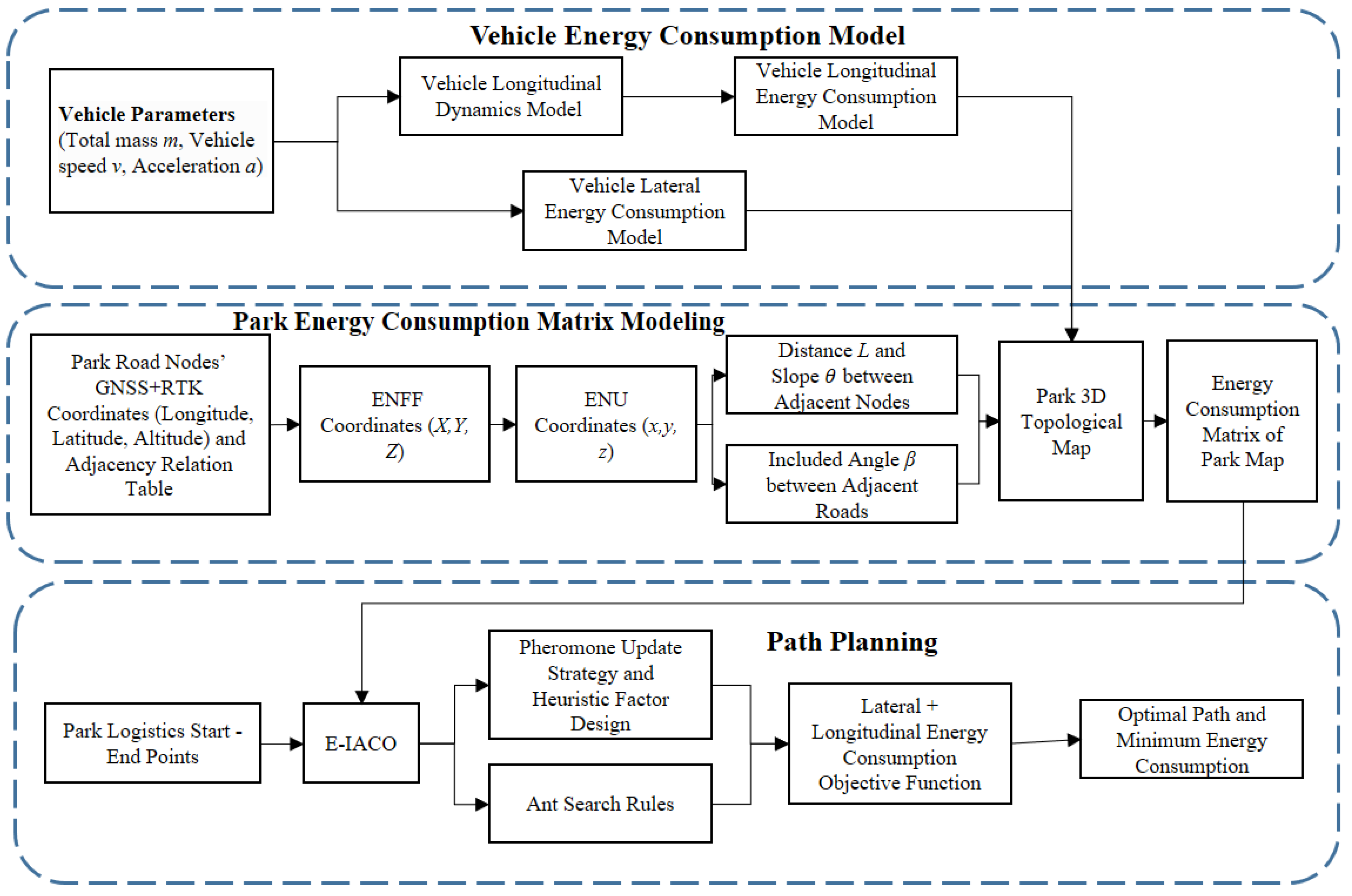
In summary, this paper proposes a globally optimized path planning method for minimizing energy consumption in electric commercial vehicles operating within industrial park logistics scenarios. The system architecture of this method, as shown in
Figure 1, primarily consists of three components: the vehicle energy consumption model, the industrial park energy consumption matrix modeling, and the path planning module. First, establish a multi-factor coupled vehicle energy consumption model that comprehensively considers slope, road angle between nodes, load capacity, motor efficiency, battery charge/discharge characteristics, and energy recovery, encompassing both lateral and longitudinal dynamics modeling; Second, coordinate transformation converts World Geodetic System 84 (WGS-84) positioning data into East-North-Up (ENU) coordinates within the global coordinate system, generating a 3D topological map incorporating slope and length information. This is integrated with the energy consumption model to produce a campus energy consumption matrix; Finally, an improved ant colony optimization algorithm is employed. An exponential energy consumption heuristic factor is introduced during path construction, and low-energy paths are reinforced during the pheromone update phase. This enables global energy-optimized path search from origin to destination, outputting the optimal path along with its estimated energy consumption.
The main contributions of this study include: (1) Establishing a multi-factor coupled energy consumption assessment model that comprehensively considers road network gradients, load variations, braking energy recovery, and steering. This provides a theoretical foundation for precise energy consumption prediction of commercial vehicles in campus scenarios; (2) Designing a method for constructing an energy consumption matrix. This matrix comprehensively and intuitively presents path energy consumption information, effectively enhancing the accuracy of path selection; (3) An E-IACO path planning algorithm based on the energy consumption model was developed, achieving global energy optimization while ensuring path feasibility.
2. Global Path Planning Method Based on Energy Consumption Optimization
To establish an energy-optimal global path planning framework, it is essential to first characterize the mathematical relationship between vehicle energy consumption and operating conditions through a comprehensive energy model. This paper innovatively develops both longitudinal and lateral rotational energy consumption models. Subsequently, a 3D topological map is constructed using high-precision positioning data of road nodes, transforming detailed geographic information including gradients and curvatures into a graph structure. This representation, when processed through the vehicle energy model, yields an energy consumption matrix for the 3D topological environment, thereby creating a structured search space oriented toward energy optimization for the enhanced ant colony algorithm. Finally, building upon conventional ACO, we introduce an exponentially formulated heuristic factor based on vehicle energy consumption to prevent negative-weight edges during path optimization. Additionally, a pheromone update strategy incorporating both travel and steering energy consumption is implemented to guide ants toward lower-energy paths.
2.1. Establish an Energy Consumption Model for Pure Electric Commercial Vehicles
Conventional dynamic models fail to accurately capture the longitudinal and lateral energy losses in pure electric commercial vehicles during low-speed high-torque operations such as hill climbing and steering maneuvers. To address this limitation, this paper presents a comprehensive analysis of the powertrain system and establishes a detailed mapping relationship between multidimensional variables and energy consumption. The proposed model incorporates not only fundamental resistance components including rolling, aerodynamic, and gradient resistances, but also accounts for steering system energy dissipation, motor efficiency characteristics, and battery charge–discharge efficiency. This refined energy consumption model provides a more accurate and reliable foundation for subsequent energy-optimal path planning methodologies.
2.1.1. Vehicle Longitudinal Energy Consumption Model
To determine the energy consumption of the entire vehicle during longitudinal motion, a longitudinal energy consumption model is established based on the vehicle longitudinal dynamics model as follows:
where
denotes the total vehicle mass;
represents the acceleration;
indicates the driving force;
signifies the rolling resistance;
corresponds to the aerodynamic drag;
refers to the gravitational resistance;
is the rolling resistance coefficient;
represents the road gradient;
denotes the air density;
is the aerodynamic drag coefficient;
indicates the frontal area;
represents the vehicle velocity;
denotes the drive motor torque;
is the transmission ratio;
refers to the final drive ratio;
represents the tire rolling radius; and
signifies the mechanical efficiency.
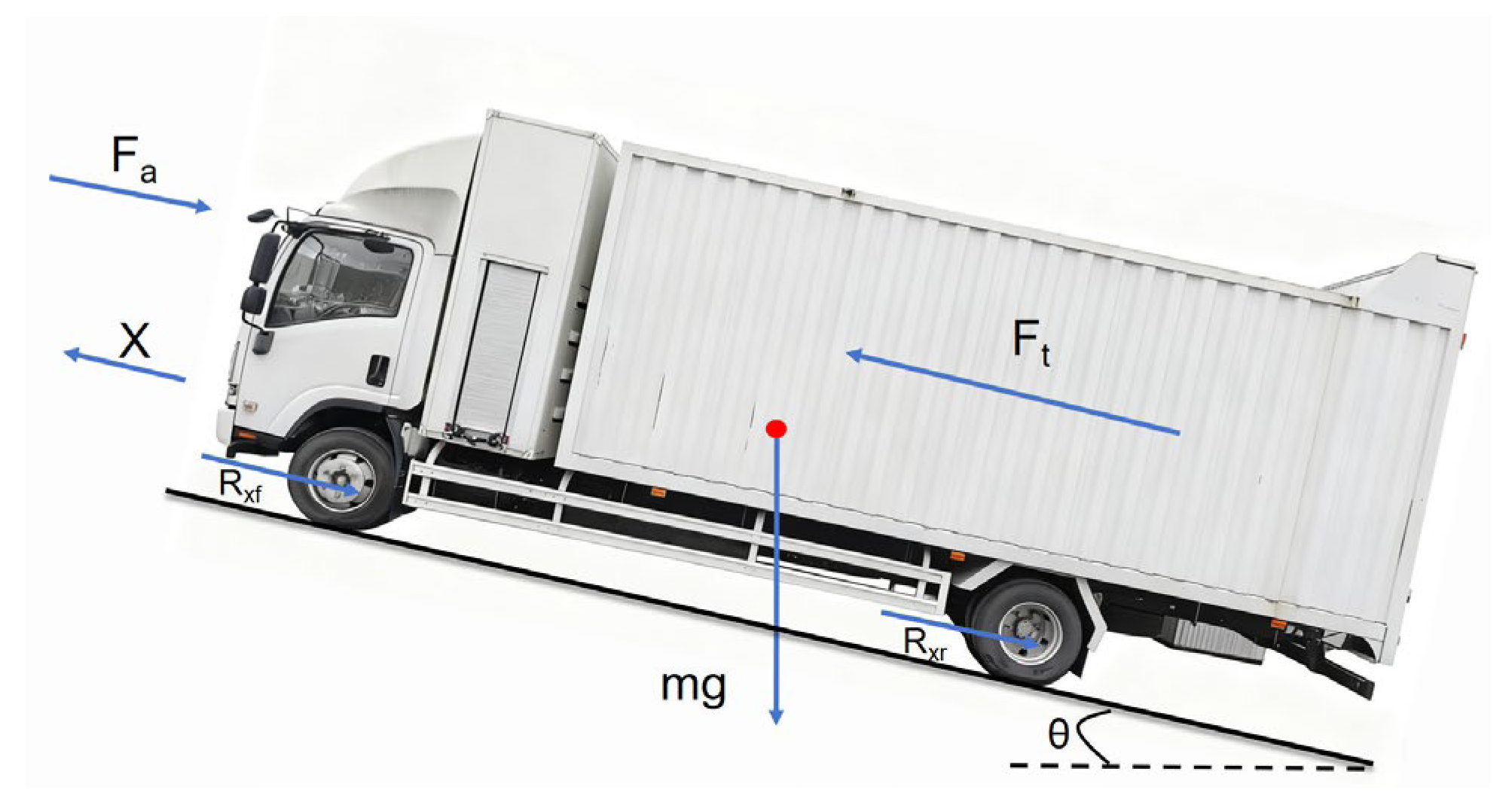
The schematic diagram of the vehicle force analysis is shown in
Figure 2.
Based on the motor torque and rotational speed, locate the efficiency value
corresponding to the motor efficiency map (power consumption or generation). Calculate the motor power
. Then, combined with the battery’s charge/discharge efficiency
, compute the battery’s charge/discharge power
. Subsequently, calculate the energy consumption
for traversing the distance
between two points on the topology, as shown below:
where if
> 0, the system operates in driving mode with
> 0; whereas if
< 0, it operates in energy regeneration mode with
< 0.
2.1.2. Vehicle Lateral Energy Consumption Model
To obtain the vehicle lateral motion energy consumption model, the lateral steering energy consumption model for the vehicle is established as follows:
where
represents the energy consumed for steering during a single turn maneuver;
denotes the energy consumption coefficient, which is a factor integrating the vehicle’s total mass, tire characteristics, steering efficiency, and other variables; in this paper, this coefficient is set based on engineering experience;
indicates the turning arc; and
signifies the steering system efficiency.
To enable the practical application of theoretical energy consumption values derived from the pure electric commercial vehicle energy model, these values must be transformed into computationally tractable forms. This is achieved by constructing an energy consumption matrix based on high-definition maps, whereby the continuous road network is discretized into a graph structure. This transformation subsequently provides a structured search space, explicitly oriented toward energy consumption optimization, for the enhanced ACO algorithm.
2.2. Establishing an Energy Consumption Matrix Based on Road Node Information
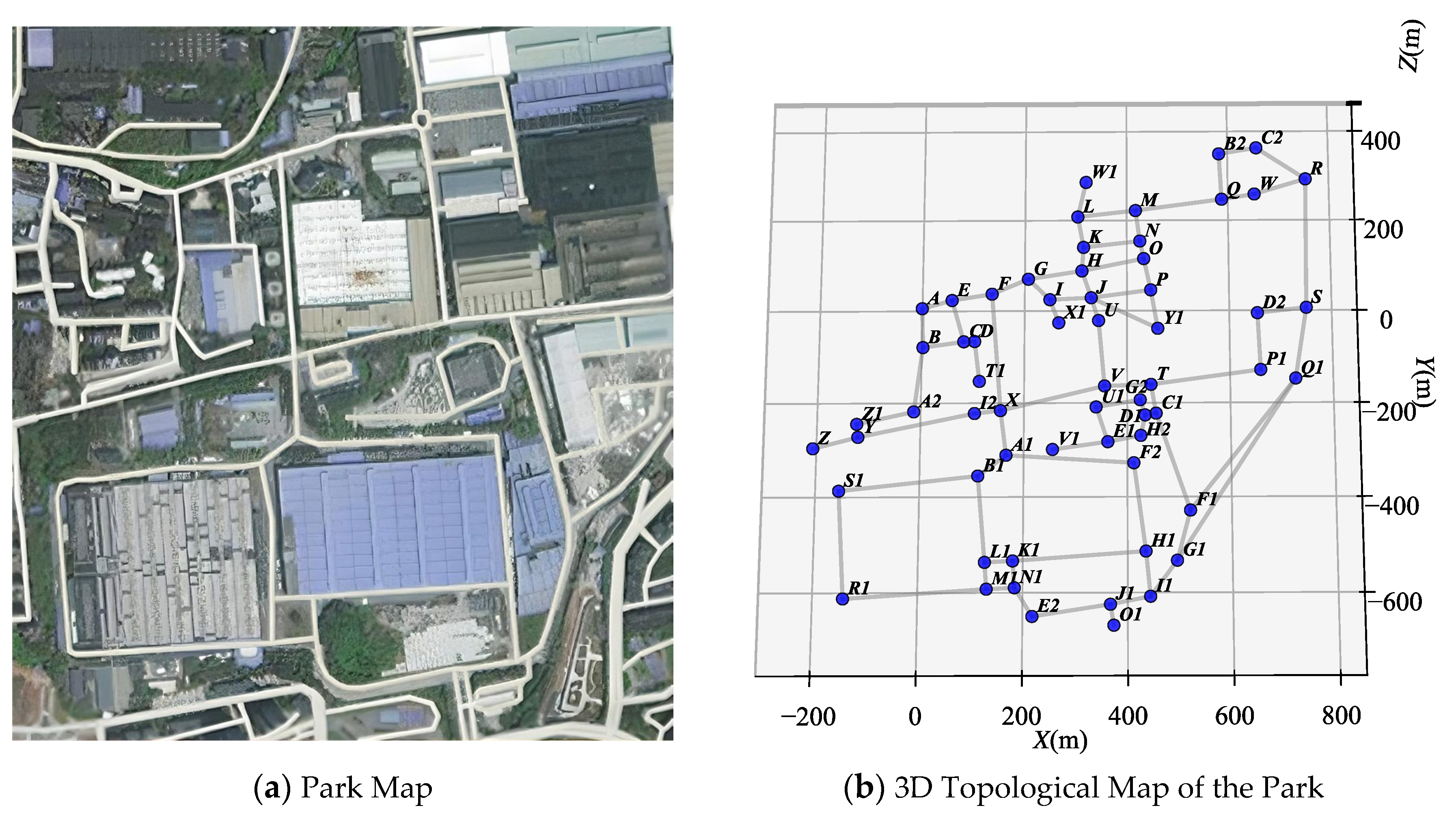
This study utilizes Global Navigation Satellite System (GNSS) and Real-Time Kinematic (RTK) technologies to obtain high-precision positioning data, specifically longitude, latitude, and altitude, for road nodes within the park environment. These geodetic coordinates are converted into a global coordinate system to construct a 3D topological map. Subsequently, integrated with the vehicle energy consumption model, this framework enables the establishment of an energy consumption matrix for the park road network.
2.2.1. Conversion from WGS-84 to Local Coordinate System
First, obtain precise road node positioning information. GNSS technology provides global positioning, while RTK technology enables real-time correction through base stations and mobile stations, achieving sub-centimeter accuracy and acquiring elevation data. Road nodes obtained using GNSS and RTK technology can be represented in the WGS-84 coordinate system (Earth-centered coordinate system) as
, where
denotes longitude,
denotes latitude, and
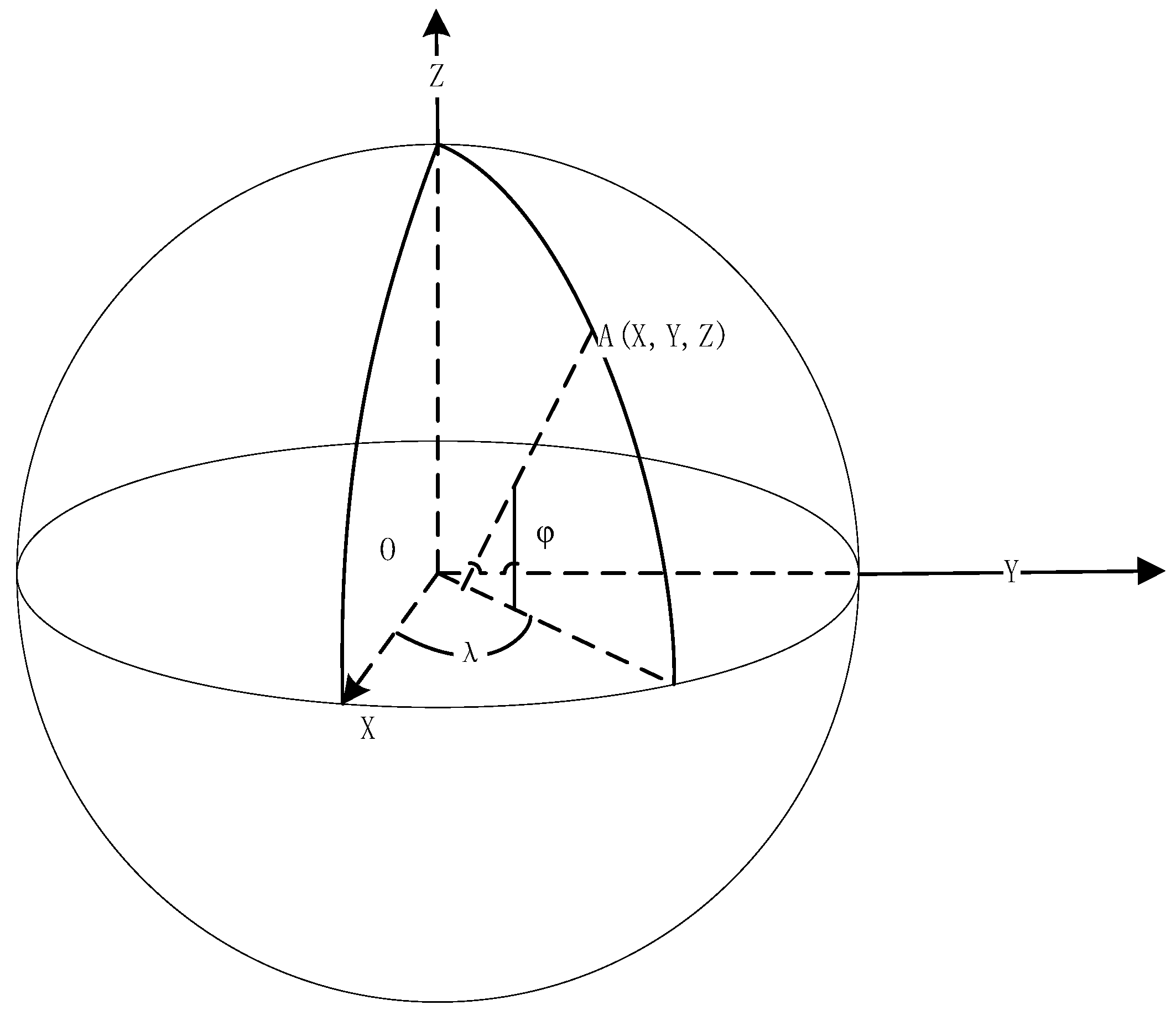
denotes elevation. The ECEF coordinate system is a geocentric coordinate system with its origin at the Earth’s center of mass. The Z-axis points toward the North Pole, the X-axis toward the intersection of the prime meridian and the equator, and the X, Y, and Z axes comply with the right-hand rule. Let the position of the target in the ECEF coordinate system be denoted as
. The formula for converting from
to
is [
31]:
where the curvature radius
of the east–west circle at target position
where
represents the Earth’s eccentricity constant, and
represents the Earth’s ellipsoid semi-major axis constant.
Next, the coordinates in the ECEF coordinate system must be transformed to ENU. The ENU coordinate system is defined relative to a reference point A on the Earth’s surface, which is typically selected as the vehicle’s initial position or a predetermined fixed reference point. The ECEF and geodetic coordinate systems are illustrated in
Figure 3.
Let the coordinates of point A in the WGS-84 coordinate system be denoted as
, in the ECEF coordinate system as
, and in the ENU coordinate system as
. The transformation from ECEF to ENU coordinates is expressed as follows [
32]:
Using the ECEF coordinate system as an intermediate step, convert WGS-84 coordinates to ENU coordinates to subsequently construct the energy consumption matrix for the 3D topological map.
2.2.2. Construct an Energy Consumption Matrix
Calculate the distance d and slope angle
between adjacent nodes based on the ENU coordinate information obtained from high-precision maps, using the Euclidean distance formula as shown in Equation (8):
where
and
represent the three-dimensional coordinates of two adjacent nodes.
Slope is one of the key factors affecting vehicle energy consumption. It is typically calculated based on the elevation difference between adjacent nodes, as shown in Equation (9):
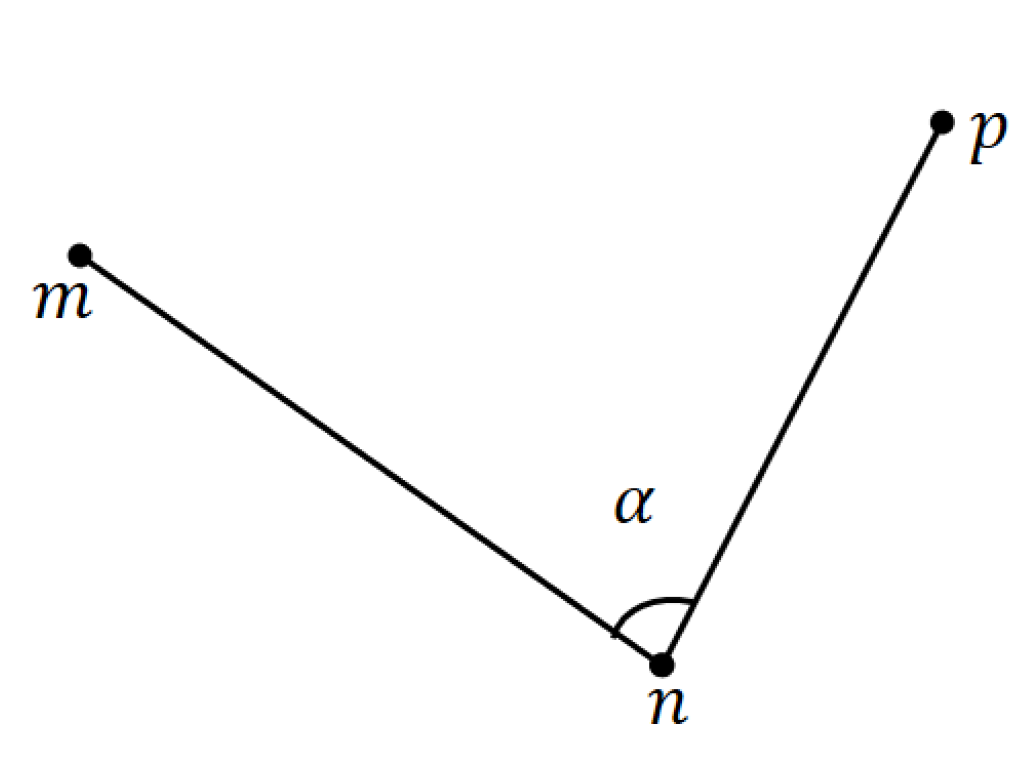
The energy cost of turning angles between the preceding node and the subsequent node is illustrated below.
Figure 4 shows the positional diagram for parent node
, child node
, and adjacent node
.
Calculate vectors
and
and their angle
using Equation (10).
where
represents the angle
in degrees converted to radians.
Based on the pure electric commercial vehicle energy consumption model (Equations (1)–(4)), the energy consumed between any two adjacent map points and the turning energy at the junction of two consecutive road segments can be calculated, thereby constructing an energy-consumption matrix. During this construction, nodes are placed according to the following rules: (1) A node is created at every road intersection. (2) An extra node is inserted at any location where the slope changes by more than 5%. The high-definition-map-based energy-consumption matrix defines the cost space for path planning, providing the prerequisite for shifting the optimization objective of the improved ant-colony algorithm from geometric shortest distance to minimum energy consumption.
2.3. Energy-Optimized Enhanced Ant Colony Algorithm
This study addresses the global path planning problem of identifying energy-optimal routes within given road networks, comprehensively considering factors including vehicle load, road gradient, and steering energy consumption. Among various intelligent bionic algorithms applied across different task scenarios in recent years, ACO demonstrates exceptional computational capability and optimization efficiency, making it particularly suitable for path planning applications. The complex road network and multiple influencing factors characteristic of our planning scenario justify the selection of ACO as our solution framework.
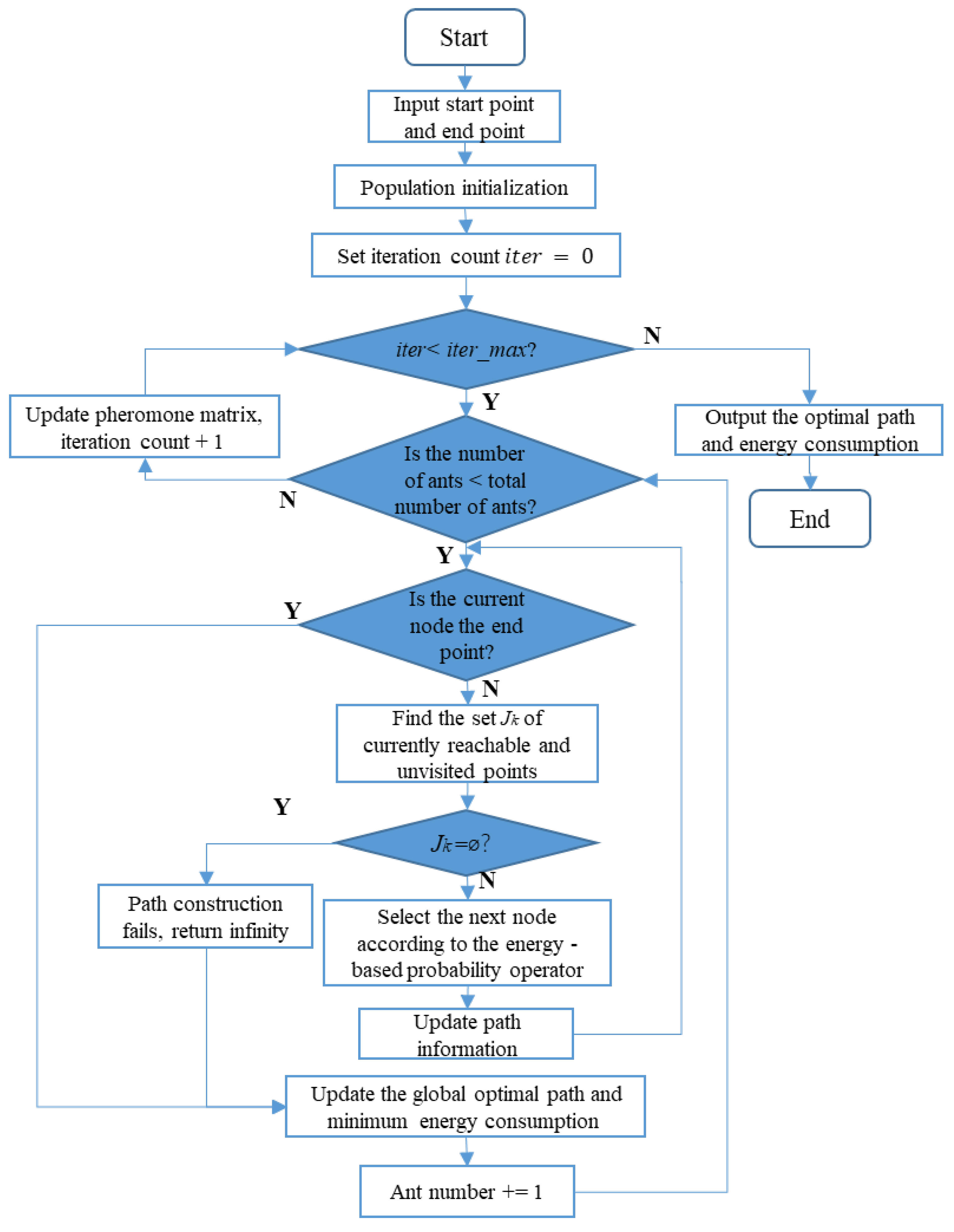
Traditional ACO algorithms draw inspiration from ants’ foraging behavior in nature, employing positive feedback mechanisms to guide more ants toward paths with higher pheromone concentrations. In the path planning problem studied within the logistics scenario of this industrial park, the optimization objective focuses on actual vehicle energy consumption rather than the traditional shortest path model framework. Special consideration has been given to the energy recovery effect generated by regenerative braking during downhill driving conditions, resulting in segments of the path map exhibiting negative weight characteristics. To address the aforementioned issues, this paper proposes targeted improvements to the node selection strategy of the ant colony optimization algorithm. This paper introduces an exponential heuristic function centered on energy consumption, comprehensively considering two critical factors: turning energy consumption and travel energy consumption. While preserving the relative relationships of heuristic information, this approach ensures the non-negativity of probability values, thereby providing a feasible solution for energy-optimized path search under negative-weight graph structures. The solution process of the E-IACO algorithm adopted in this paper is illustrated in
Figure 5.
2.3.1. Construction of the Energy Consumption Objective Function
To reduce commercial vehicle operating costs and extend vehicle range, the key lies in optimizing energy consumption. This paper employs a combined objective function of overall vehicle energy consumption and steering energy consumption, fully leveraging the energy recovery characteristics of pure electric commercial vehicles to obtain the optimal energy consumption path for point-to-point tasks within the park. Energy consumption objective function:
where
denotes the set of all nodes in the road network.
is the travel energy consumed by the vehicle when moving from node i to node j,
is the turning energy expended by the vehicle at the transition from node i to node j, and
equals 1 if the vehicle traverses edge
and 0 otherwise.
2.3.2. Energy-Based Heuristic Node Selection
When selecting the next node at any given node, the vehicle comprehensively considers factors such as pheromone concentration on the road and energy consumption. It employs a roulette wheel method to choose the next node from the set of candidate nodes. The candidate-node set consists of all nodes that are connected to the current node and have not yet been visited, guaranteeing that any single path is traversed only once during one mission. The calculation method for the transition probability when selecting the next node is as follows:
where
represents the pheromone from node
to node
;
is an energy-based heuristic factor that accounts for the energy consumed by the vehicle traveling from node
to node
, comprehensively considering both travel energy
and turning energy
.
denotes the set of candidate nodes for ant
at node, i.e., paths connected to the node that have not yet been traversed.
and
represent the pheromone concentration coefficient and heuristic coefficient, respectively.
2.3.3. Pheromone Volatility
In each iteration of the algorithm, pheromones on all paths within the road network evaporate at a rate of . This prevents the infinite accumulation of pheromones, thereby rapidly discarding previously traversed inferior paths. Simultaneously, each ant releases pheromones along its traversed path. In traditional ACO, shorter paths release more pheromones. However, this does not align with the objective of minimizing total energy consumption as required in this paper. Therefore, the algorithm is modified such that paths consuming less total energy release more pheromones, increasing the probability that the next generation of ants will traverse paths with lower energy consumption
During each iteration, pheromones deposited on every edge are evaporated at rate
, as given in Equation (15). At the beginning of the search a relatively large
is adopted to strengthen global exploration and to keep the algorithm from being trapped prematurely in poor local optima; as the iterations proceed
is gradually reduced to speed up convergence. This dynamic-evaporation scheme not only prevents unlimited pheromone accumulation but also helps eliminate the inferior paths discovered in early stages. Meanwhile, after an ant completes its tour, it deposits pheromone according to the quality of the path. The traditional ACO usually takes path length as the basis for pheromone enhancement. However, this paper aims to minimize the total energy consumption as the optimization objective. Therefore, the pheromone update strategy is adjusted as follows: the lower the total energy consumption of the path, the more pheromones are released. Through this mechanism, subsequent ants are guided to select paths with lower energy consumption with a higher probability, thereby gradually approaching the global optimal solution. The pheromone update is shown in Equation (16), Specifically:
where
denotes the number of iterations;
denotes the maximum number of iterations.
denotes the pheromone concentration on edge
in the
generation, and
denotes the variation in pheromone concentration on edge
by ant
in the
generation;
denotes the total number of ants.
denotes the total energy consumption of the path traversed by the ant
;
denotes the set of road segments traversed by the ant
;
denotes the constant of total pheromone quantity.
4. Conclusions and Future Works
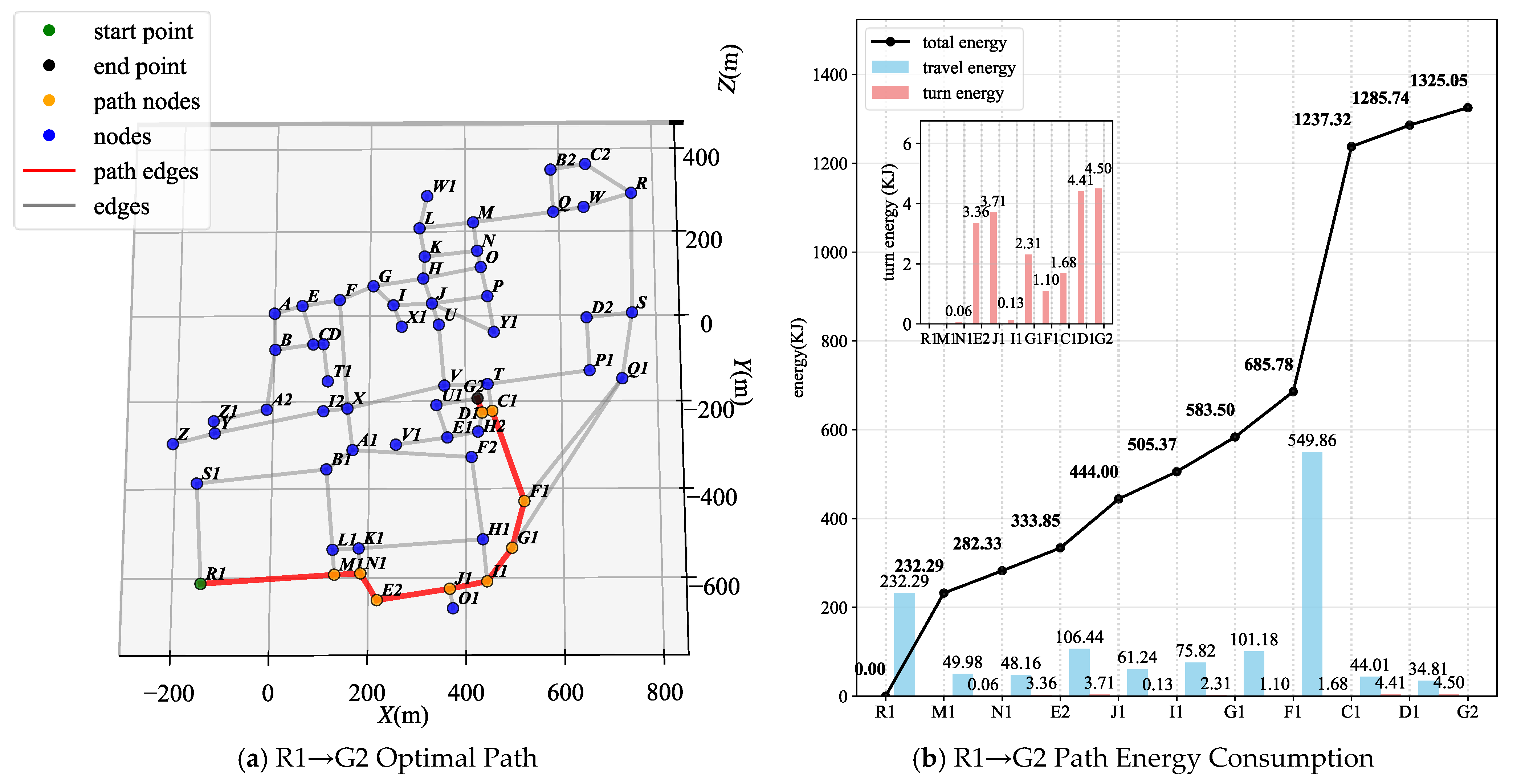
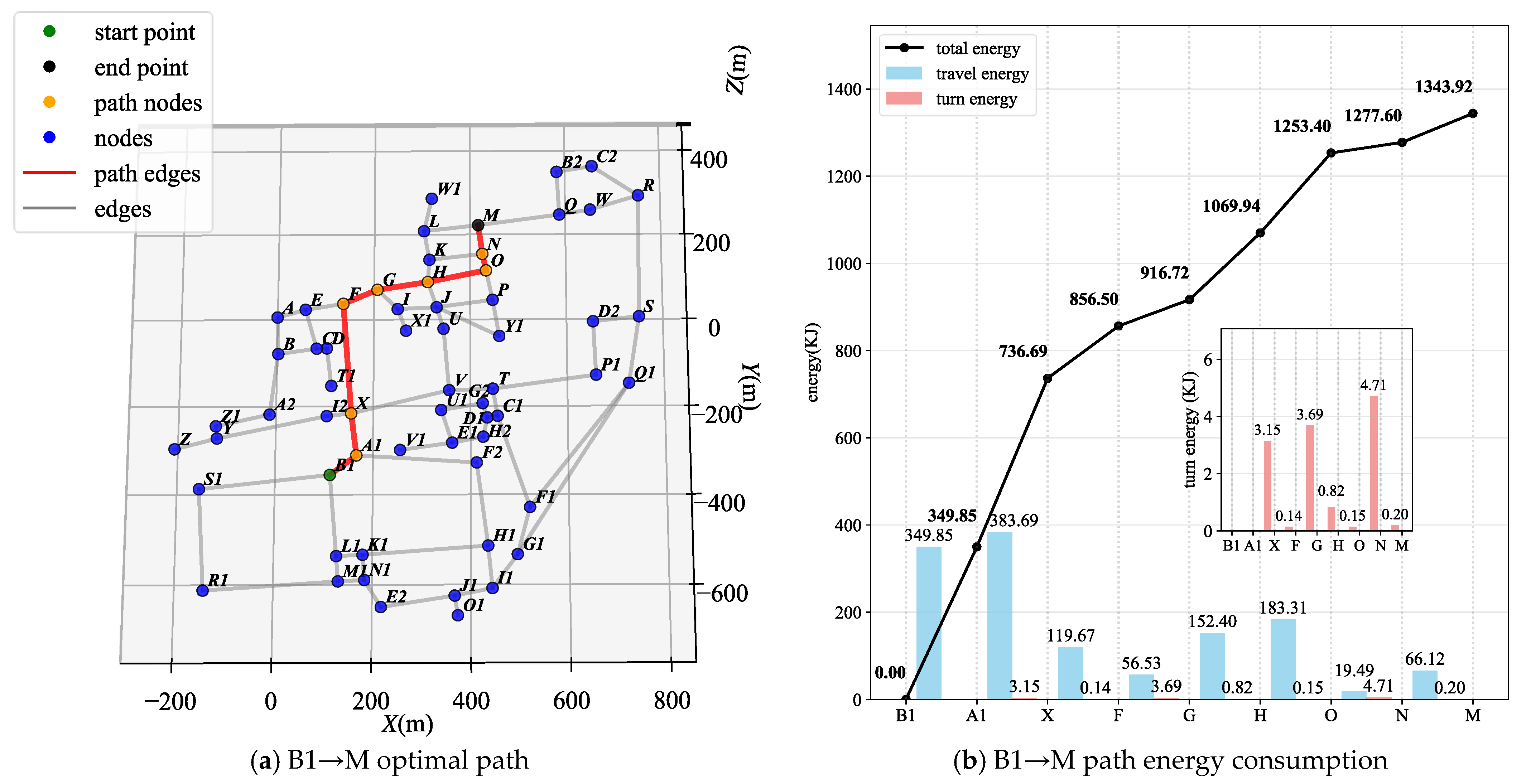
This paper presents an enhanced global path planning method based on E-IACO for energy consumption minimization, effectively addressing the critical limitation of conventional planning approaches that neglect road gradient, steering dynamics, variable payload, and regenerative braking characteristics in park logistics scenarios. The principal contributions are threefold: (1) Development of a refined vehicle energy consumption model that transcends conventional dynamic modeling by systematically integrating gradient resistance, load variations, steering losses, and regenerative braking effects, establishing a theoretical foundation for accurate energy prediction; (2) Proposal of a methodology for constructing 3D topological maps from high-precision positioning data, fused with the energy model to generate an energy consumption matrix, thereby transforming continuous high-definition road network information into a structured search space for subsequent path optimization; (3) Design of an energy-oriented E-IACO algorithm incorporating an exponential energy-based heuristic factor and simultaneous consideration of steering energy consumption, effectively guiding the search toward globally energy-optimal paths while computing corresponding energy values. Simulation results in a 3D industrial park environment demonstrate the method’s effectiveness. Compared to classical A* and standard ACO algorithms, the proposed E-IACO achieves a maximum energy reduction of 10.57% versus A* and 4.90% versus ACO, with average savings of 5.14% and 1.97%, respectively, across varied topographic conditions. The algorithm also exhibits consistent energy-saving performance under different vehicle loads, confirming its robustness and practical relevance for park logistics.
This study comprehensively considers spatial factors of the scenario, such as slope and curvature variations, as well as the overall vehicle energy consumption model, achieving phased results in global path planning based on energy consumption optimization in 3D scenarios. To clearly demonstrate the influence mechanism of spatial factors, we have temporarily set speed as a constant variable. Future research will focus on the coupling mechanism between speed variation and optimal energy consumption as the core direction. Emphasis will be placed on in-depth exploration of local path planning in scenarios with significant speed changes, such as vehicle startup, parking, and intersection navigation. We will further refine the high-fidelity overall vehicle energy consumption model for local path planning scenarios, continuously optimize model accuracy and computational efficiency, and conduct real-world road tests to enhance the practicality and robustness of the path planning method.