1. Introduction
It is known that the Coxeter arrangements are free; see V. I. Arnold [
1,
2], and K. Saito [
3]. This was generalized to the case of unitary reflection groups by H. Terao [
4]. T. Józefiak and B. E. Sagan [
5] explicitly constructed the basic derivations of some classes of subarrangements of Coxeter arrangements. P. H. Edelman and V. Reiner [
6] characterized the freeness and supersolvability of subarrangements between
and
combinatorially. Stanley [
7] characterized the freeness and supersolvabilitiy of graphic arrangements associated with chordal graphs. Abe [
8] also gave the characteristic polynomial of a multiarrangement. T. Zaslavsky [
9] described that graphic and sign-symmetric arrangements can be reduced to ordinary graph theory; arrangements that are neither graphic nor sign-symmetric can also be handled, but they require a theory of signed graphs. At present, the graphic arrangements associated with signed graphs are still very active areas of research, especially the freeness of hyperplane arrangements (e.g., M. Yoshinaga [
10], Ziegler [
11] and Bailey [
12]). In this paper, we focus on the freeness of signed graphic arrangements.
A hyperplane arrangement is a collection of finite hyperplanes, H, which comprise the kernel of a linear form of variables in the vector space . A graph is an ordered pair in which , called the vertex set, and is called the edge set of G, which is the collection of two-element subsets of V.
A
signed graph is a tuple
[
13] where
- (1)
is a finite set called the set of vertices;
- (2)
is a subset of called the set of positive edges;
- (3)
is a subset of called the set of negative edges;
- (4)
is a subset of called the set of loops.
Let
G be a signed graph with
l vertices, let
be a field, let
, and let
be a basis for the dual space
. Associated with the signed graph
G, the
signed graphic arrangement in the
l-dimensional vector space over
is defined as follows:
where
L is the loop set of the graph
G; in this paper, we focus on the case of
and
, and we assume that
.
Some results for the freeness of signed graphic arrangements have been obtained. Suyama, Michele, and Tsujie [
14] characterized the freeness of signed graphic arrangements corresponding to graphs in the case
, and they show that when the signed graph
G with
, the arrangement
is free if and only if
is divisionally free or
G is a balanced chordal. Michele and Tsujie [
15] generalized this result, and they give a complete characterization for the freeness of arrangements between Boolean arrangements and Weyl arrangements of type
in terms of signed graphs. However, there are many unknown results for the freeness of signed graphic arrangements. In this article, we characterized the freeness of three other kinds of signed graphic arrangements. The following theorems are our main results.
Theorem 1. For a signed graph G, denoted by V and E, the vertex set and the edge set, respectively, T is a chordal subgraph of G, , and . The signed graphic arrangement is free if the vertex satisfies one of the following conditions:
- (1)
For all , , i.e., v is an isolated point.
- (2)
There exists only such that .
- (3)
If there exist two different and , then it implies .
Theorem 2. If the signed graphic hyperplane arrangement satisfies the following conditions, then it is free.
- (1)
The graph , T is a chordal graph, and , Q satisfies and .
- (2)
The graph Q is switching equivalent to or , where e is an edge of .
Theorem 3. For a graph , T is a chordal subgraph of G, , , and the subgraph U is a cycle containing an odd number of negative edges. Then, the signed graphic hyperplane arrangement is free.
The organization of this article is as follows. In
Section 2, we review some basic definitions and results of the hyperplane arrangement, including the combinatorial and algebraic properties, which are helpful for studying freeness. Some related examples and theorems are also shown in this section. In
Section 3, we mainly characterize the freeness of four signed graphic arrangements,
,
,
, and
; their corresponding graphs are the subgraphs in our main theorems. In
Section 4, we focus on proving the main theorems. In
Section 5, we raise some questions about the freeness of signed graphic arrangements for further research.
2. Preliminaries
In this section, we briefly review some basic definitions and results from [
16].
Let
be a finite hyperplane arrangement denoted by
the
intersection partial ordered set of
.
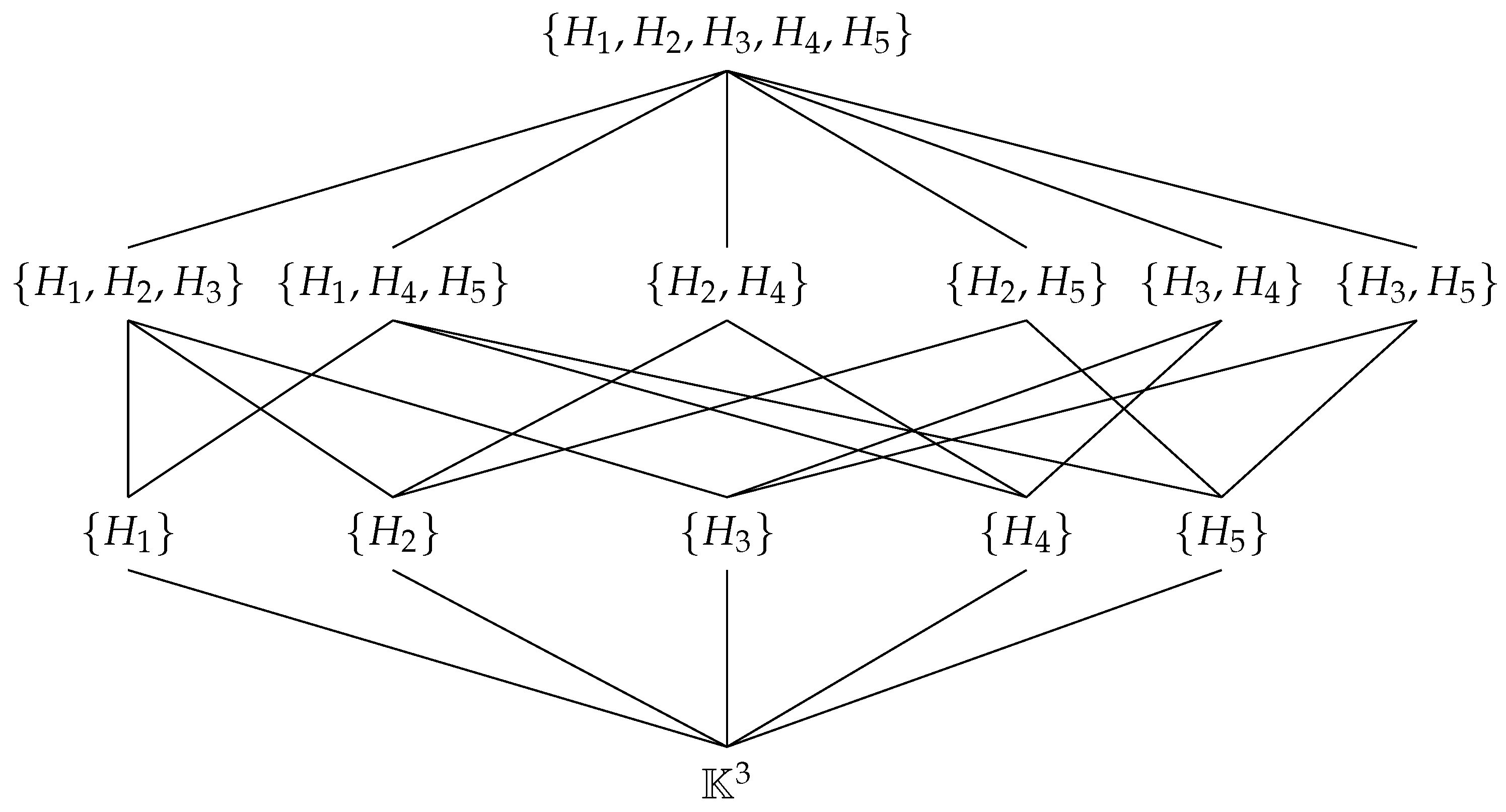
An arrangement is central if the intersection of all hyperplanes is not empty, and is a geometric lattice for central arrangements. We only discuss the central case in this paper since every signed graphic arrangement contains the origin as its center.
For an arrangement , the meet of is defined by , and their join is defined by . A pair is called a modular pair if for all , one has . A pair is a modular pair if and only if , where r is the rank function of L. An element X is called a modular element if it forms a modular pair with each .
For an
, the
localization of
at
is the subarrangement
and the
restriction is the arrangement
For a given hyperplane , we have a triple of arrangements where and .
The
characteristic polynomial of an arrangement
is defined by
where
denotes the
Möbius function of
, defined recursively by
For a vector space
V,
is the symmetric algebra of the dual space
. Given a basis of
, then
S is isomorphic to a polynomial ring
. Denoted by Der
, the
module of derivations of
S is
Let
be an arrangement in
V with the
defining polynomial
where
ker
. We define
as a module over the polynomial ring
S as follows
If is a free S-module of rank l, we call the arrangement a free arrangement. It is known that if is free, there exists a homogeneous basis for satisfying the following property: for each where is zero or a homogeneous polynomial of the degree , the degree sequence is called the exponent of and is denoted by .
According to Terao’s factorization theorem [
17], if
is a central and free arrangement with
, then its characteristic polynomial
can be factorable as follows:
This theorem can help us to distinguish whether some arrangements are free or not; in particular, the arrangement is not free if its characteristic polynomial is not factorable.
Example 1. Let be a complete graph with n vertices; for any two vertices joined by an edge, the corresponding arrangement is called the braid arrangement, and it is free. The intersection of the partially ordered set is isomorphic to the partition lattice, and its characteristic polynomial can be calculated through its Möbius function; it is factorable as follows: People have found many other ways to study the freeness of a hyperplane arrangement. We will introduce the corresponding definitions and theorems in the following section.
An
induction table between two free arrangements
and
is a sequence of free arrangements.
If an
l-arrangement
has a maximal chain of modular elements, we then call
supersolvable; see [
6].
An equivalent definition of the modular coatom is given in [
18]. A subarrangement
is a
modular coatom of an arrangement
if
- (1)
For all hyperplane pairs , there always exists a hyperplane such that .
- (2)
Rank = rank .
An arrangement is
supersolvable if
has an M-chain
of subarrangements in which each
is a modular coatom of
for
.
The following statements are known.
- (1)
If
is supersolvable, then
is free [
16].
- (2)
If
is an arrangement associated with a chordal graph, then
is supersolvable [
6].
We now give some properties of a signed graph [
13].
For a given signed graph
, the sign function of
G is the function
, defined by
For a given signed graph G and a map , we find a signed graph which has the same underlying graph and is equivalent to a permutation on the coordinates of G. If , then . We call the switching of G by and denote it as .
If there exists a switching function such that , we say they are switching equivalent and write .
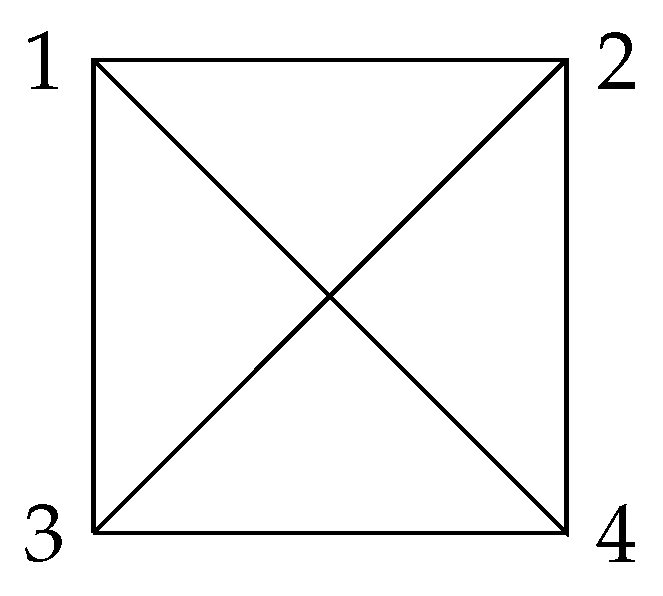
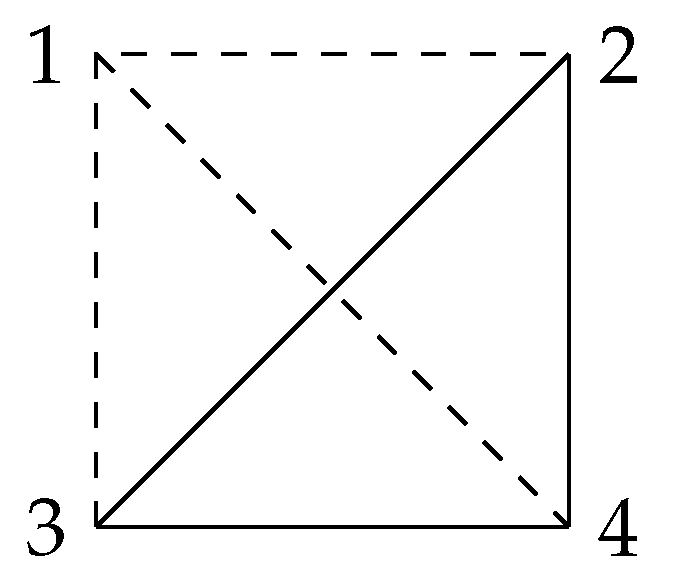
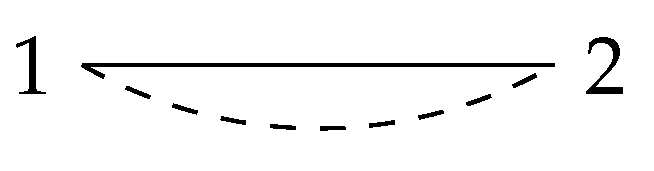
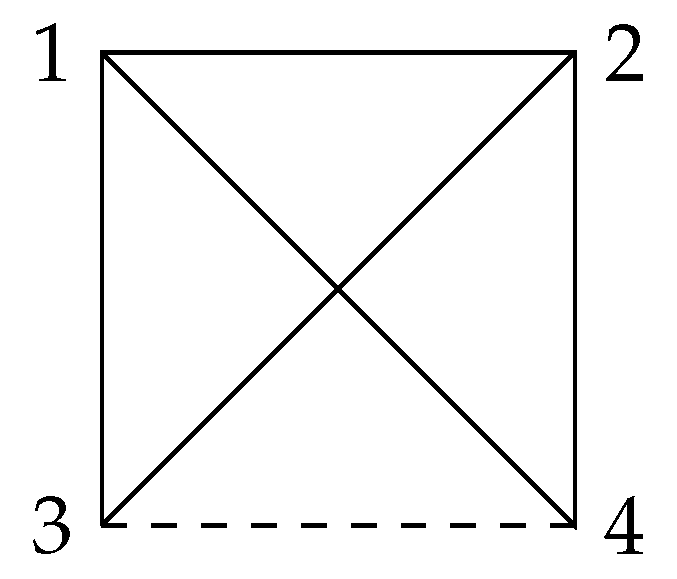
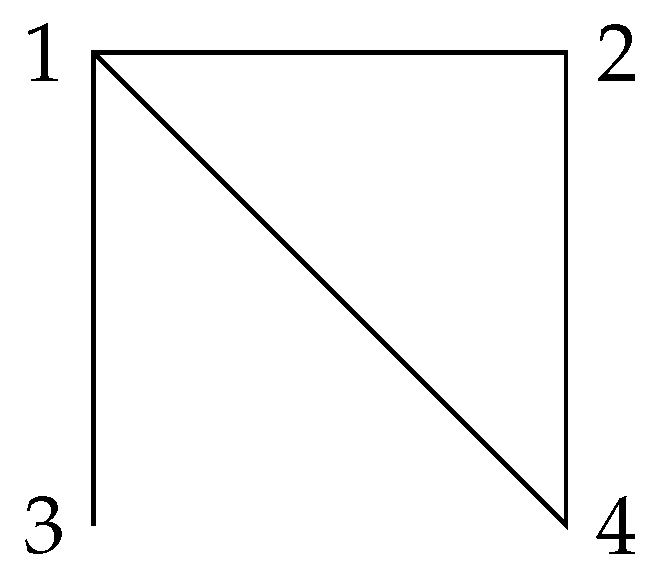
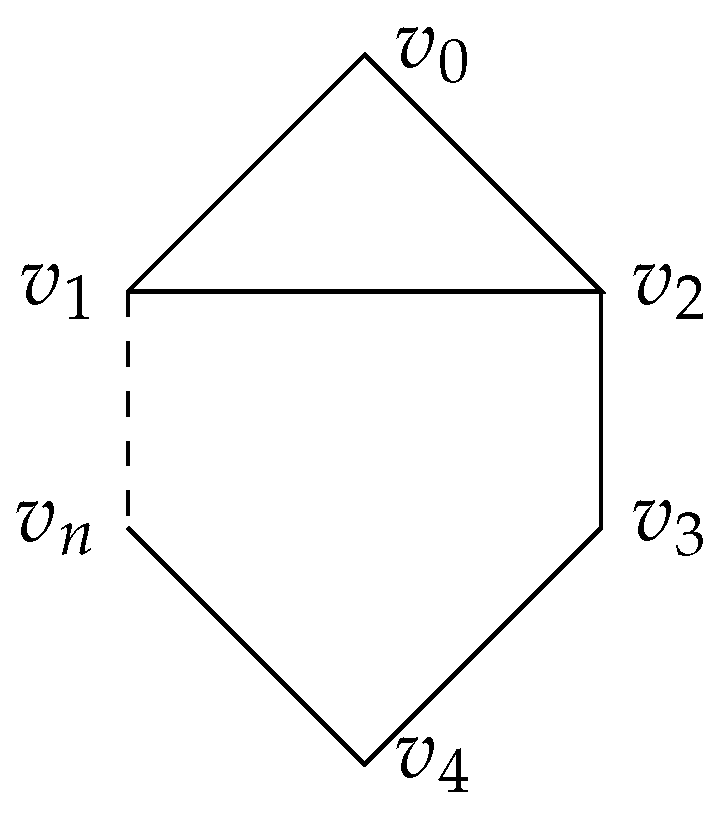
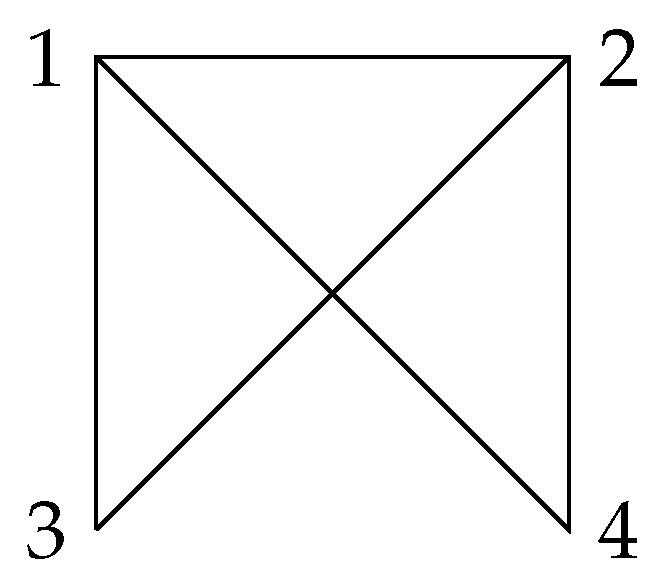
Since switching is an equivalent relationship, switching operations classify signed graphs into different classes. In this paper, our discussion is always based on switching equivalence because the degrees of freeness of two switching-equivalent arrangements are same. For example, the following two graphs,
in
Figure 1 and
in
Figure 2, are switching equivalent, while the corresponding arrangements
and
are both free with the same factorable characteristic polynomials.
The following theorems are used frequently in this paper. Abe and Yamaguchi gave a theorem on the free path [
19].
Theorem 4. Let , and let . If and are both free, then at least one of and is free.
Orlik and Terao gave the theorems as follows in [
16].
Theorem 5 (
addition)
. Let be a triple of arrangements. If and are both free with and , i.e., , then is free with .
Theorem 6 (
deletion)
. Let be a triple of arrangements. If and are both free with and , i.e., , then is free with .
Theorem 7 (
addition–deletion)
. Let be a triple. Any two of the following statements imply the third.
- (1)
is free with .
- (2)
is free with .
- (3)
is free with .
4. Proof of Main Results
In this section, we prove our main results.
Proof of Theorem 1. If the vertex satisfies conditions (1) and (2), the graph G is obviously switching equivalent to a chordal graph, so we only need to prove (3).
Firstly, we prove the situation in which there is only one vertex
that satisfies condition (3). Assume the hyperplanes
correspond to the edges
, respectively; then,
are contained in the hyperplane
of
. Let
; then,
is a modular coatom of
, and we can obtain a modular coatom chain according to the same method.
We denote by the arrangement associated with in which has two cases.
CASE 1. If the number of edges incident to the vertex v is even, we can finally obtain an isolated vertex of ; then, is a chordal graph. Therefore, is supersolvable, and is also supersolvable and free.
CASE 2. If the number of edges incident to the vertex v is odd, then there only exists a vertex such that . In this case, is switching equivalent to a chordal graph, so is supersolvable. Therefore, is also supersolvable and free.
If there are more than one vertices in satisfying condition (3), we can prove the freeness of by induction using the number of such vertices in . □
Proof of Theorem 2. According to Theorem 7, for the hyperplane H associated with the negative edge, the deletion is as same as or . The restriction is the same as or .
The deletion arrangement
is obviously associated with a chordal graph; thus,
is free. Next, we prove the freeness of
. According to Lemmas 1 and 2,
is supersolvable, so we can obtain a modular coatom
of
by deleting two hyperplanes in
associated with two positive edges. For the the arrangement
, if we delete the same two hyperplanes, we can then obtain a modular coatom
associated with the graph
, which is switching equivalent to a chordal graph; then,
is supersolvable., and we can obtain an M-chain of
,
So, is supersolvable and free, and is free by Theorem 7. □
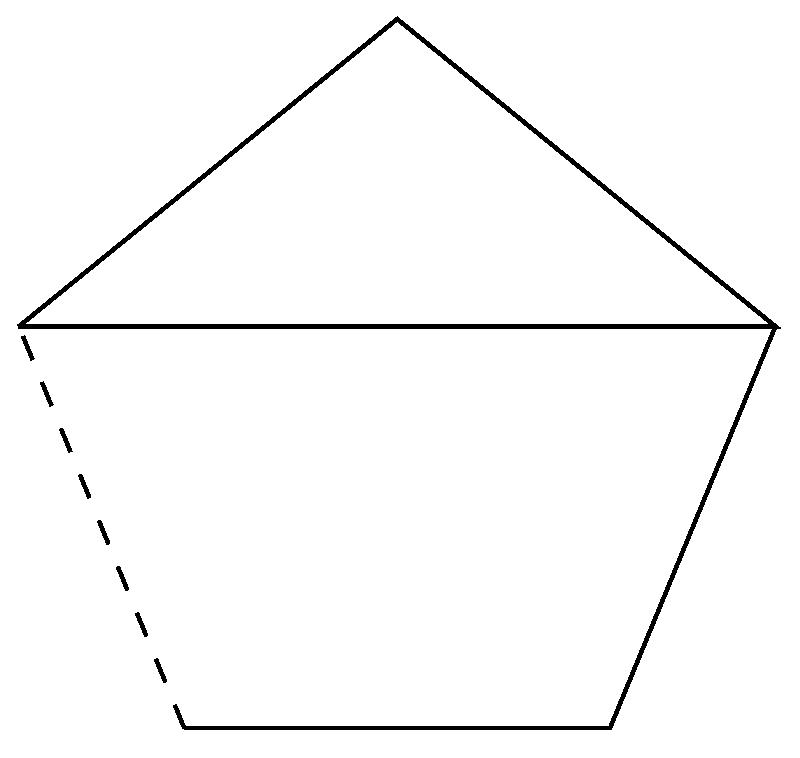
Next we will prove Theorem 3 through the signed graph
(
Figure 13) containing a cycle with 5 vertices.
Proof of Theorem 3. Assume
. Firstly, we consider
and
T to be a triangle and prove that the arrangement
associated with the graph
in
Figure 13 is free. For the hyperplane
H that is associated with one negative edge, the deletion
is always associated with a chordal graph, and
is a restriction of
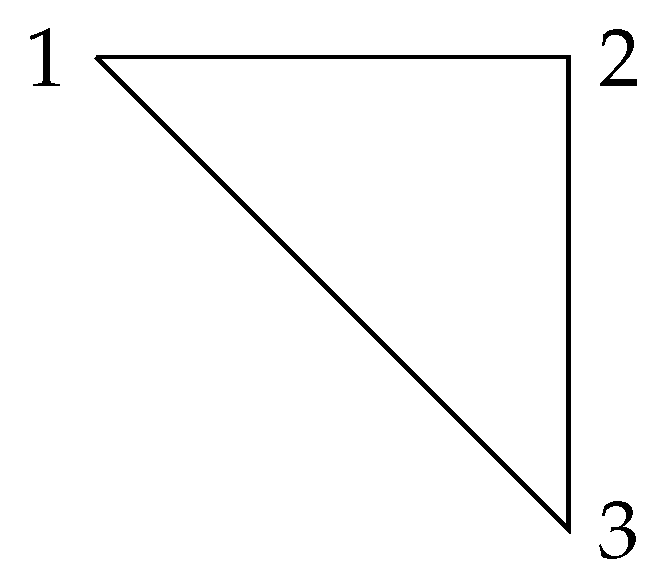
in which
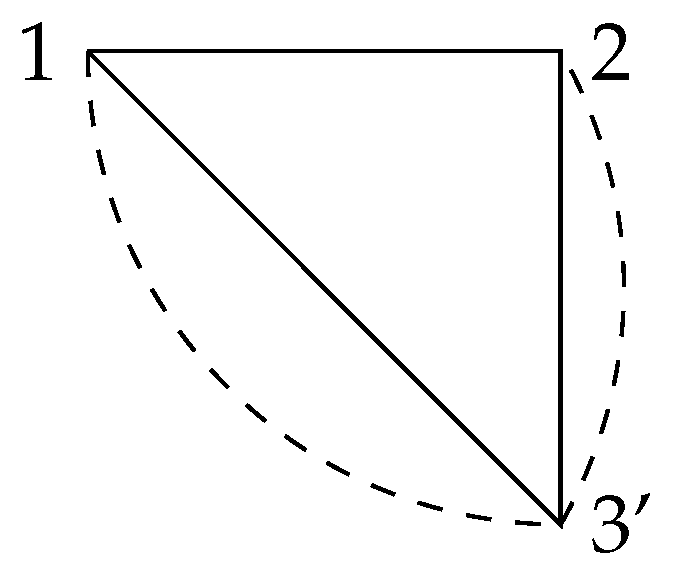
in
Figure 14 is a restriction of the graph
. According to Theorem 7, to prove that
is free, it suffices to prove that
is free. Similarly, for another hyperplane
that is associated with the negative edge, the deletion
is always associated with a chordal graph, and
is a restriction of
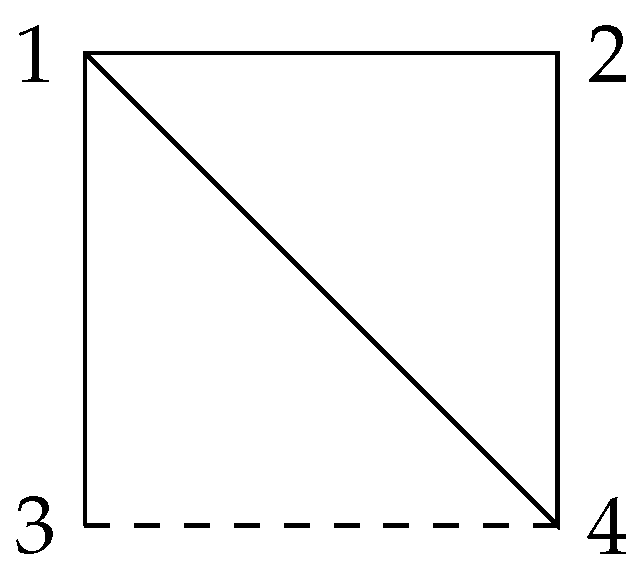
in which
is a restriction of the graph
. According to Lemma 4, the signed graphic hyperplane arrangement
is free.
When and T is a triangle, we can also conclude the freeness of by the same deletions and restrictions. If T is not a triangle, then after the same process, the final arrangement we need to prove satisfies the condition of Theorem 2. □
The characteristic polynomial of a free arrangement is factorable. When
and
T is a triangle, we calculate the characteristic polynomial of
, which is also factorable