2.1.1. Hedging Policy for Single Reservoir Operations
Hedging policies are primarily designed for reservoirs to rationally allocate the limited water resources in drought conditions. By water rationing in filling or emptying or both phases of the reservoir water supply operation, the hedging policy can smooth fluctuations in water deficits and avoid unacceptable single period shortages of high percentage that may occur in future. The three most common forms of hedging policy are: (1) continuous hedging, where the slope of the hedging portion can vary continuously [
7]; (2) zone-based hedging, where hedging values are a series of discrete proportions of target demands for different zones of water availability [
9]; and (3) two-point type hedging, where a linear hedging policy (slope < 1) connects a first point somewhere up from the origin on the shortage portion of the SOP rule to a second point occurring on the target release line [
6,
19]. However, whatever the form of hedging rules, the following two critical questions must to be answered: (1) when to hedge? and (2) how much to hedge? A two-point type hedging policy, developed by Srinivasan and Philipose [
6], which is characterized by three constant parameters (fixed values for the whole year), namely, starting water availability (
SWA, above which the release is to be hedged), ending water availability (
EWA, at which hedging is stopped) and hedging factor (
HF, degree of hedging), gives an ideal answer to the two questions. In this section, an extended version of the two-point type hedging policy that considers the temporal variation (
i.e., parameters
SWA,
EWA, and
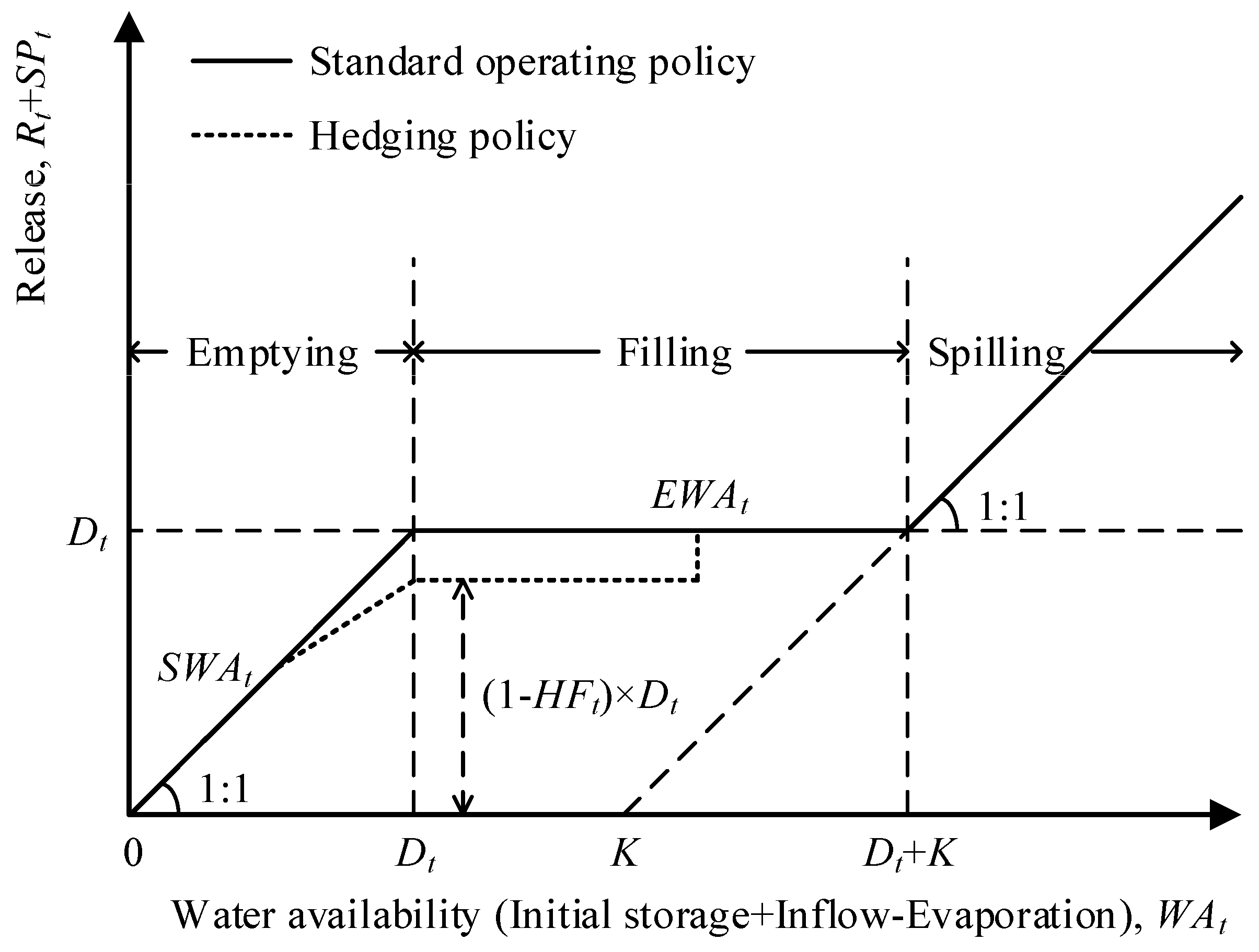
HF are varying with time) is employed as the operation rules for guiding releases of a single reservoir, as illustrated in
Figure 1.
Figure 1.
Two-point type time-varying hedging policy for a single period.
Figure 1.
Two-point type time-varying hedging policy for a single period.
For a reservoir with water supply purpose, the water availability in period
t is defined as
where
= water availability in period
;
= active storage in reservoir at the beginning of period
, which is constrained between empty and the reservoir active capacity
,
i.e.,
;
= predicted inflow to reservoir in period
; and
= water loss volume in period
due to evaporation and seepage. As is shown in
Figure 1, the reservoir release volume in each time period
is determined according to what phase
is in and the three time-varying parameters (
,
,
). The mathematical expressions of the employed hedging rules for a single reservoir are as follows.
For
,
i.e., in the emptying phase
For
,
i.e., in the filling phase
For
,
i.e., in the spilling phase
where
= planned or target water demand in period
;
= reservoir water supply volume in period
,
;
= reservoir spill flow (unused release) in period
;
= starting water availability at period
,
;
= ending water availability at period
,
; and
= hedging factor,
i.e., the reduction percentage,
, 0 denoting a null hedging (no rationing) and 1 denoting a full hedging (no release).
The storage at the end of period
is computed using the continuity equation:
in which
, if
. Other basic constraints that should be considered in the optimization model are: mass balance equation for each reservoir, reservoir minimum storage constraint, and the minimum reservoir release for downstream ecological requirements.
2.1.2. Allocation Policy of Common Water Demand between Parallel Reservoirs
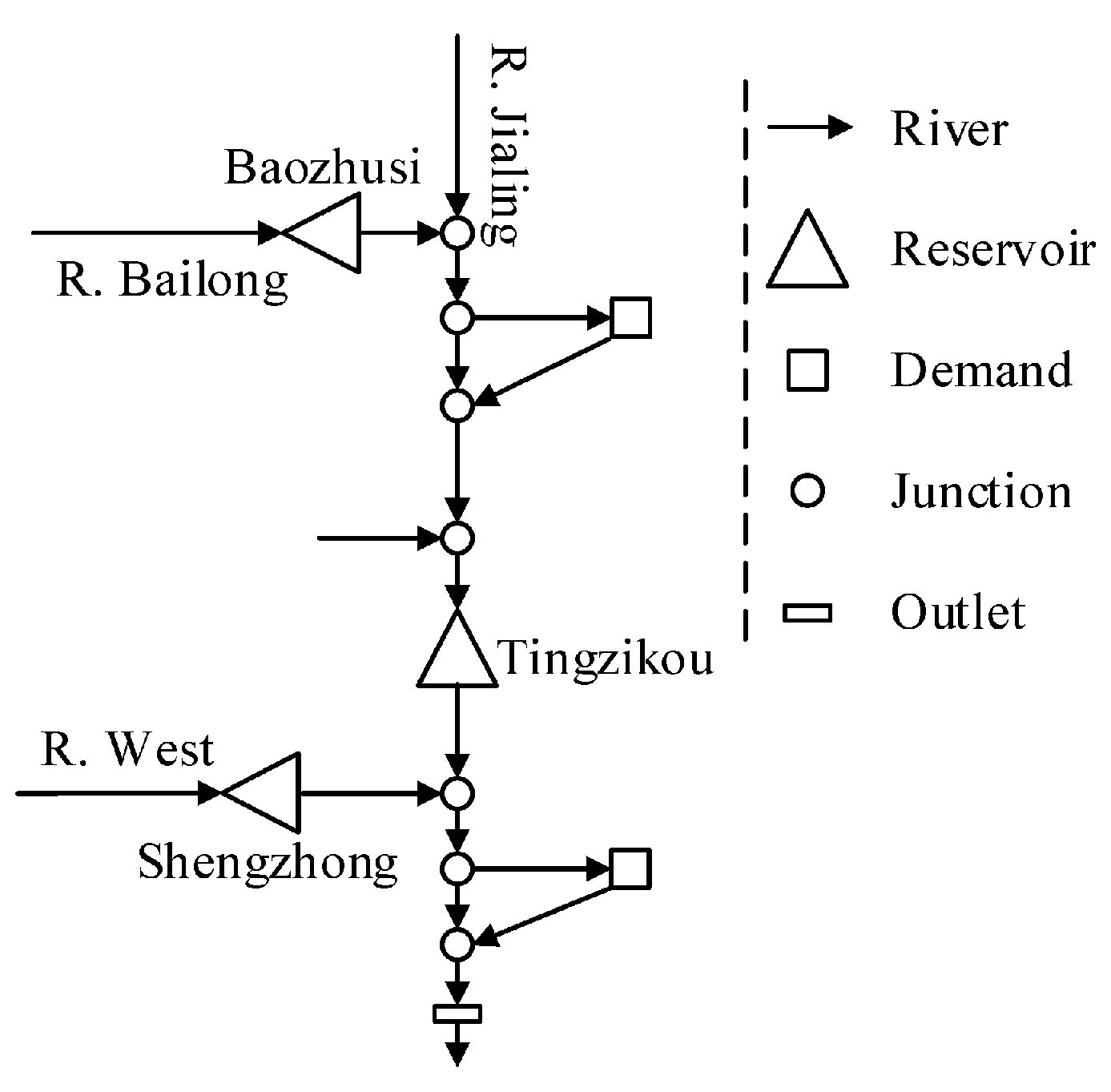
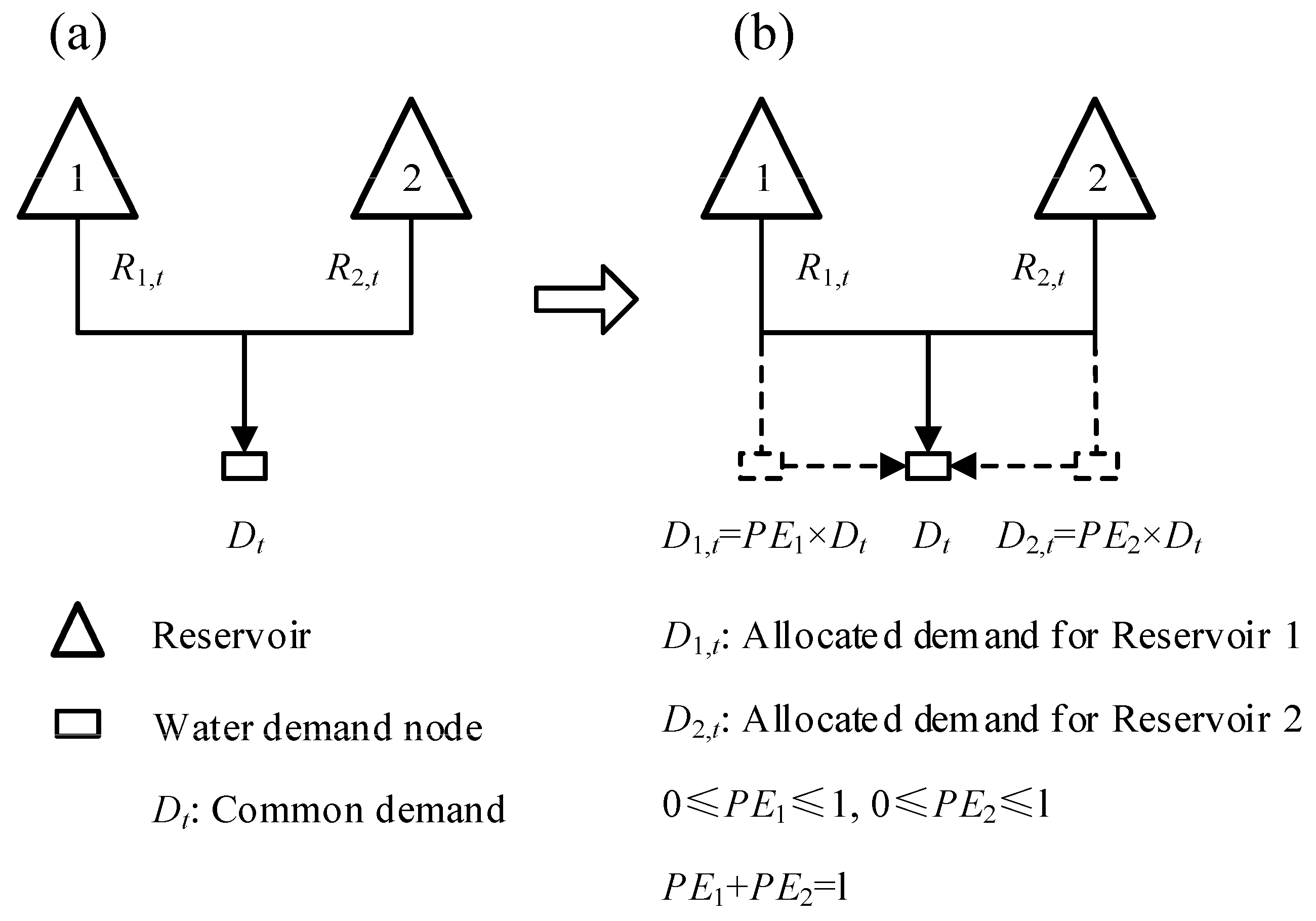
Hedging policy can normally guide the operation of a single reservoir only when the target delivery is specified beforehand. However, for a complex multireservoir water supply system, there are always some reservoirs in parallel topology and they jointly provide downstream common water demand, which means the total amount of water supply to downstream is the summation of releases from all parallel reservoirs. It is difficult to implement hedging policy in this special configuration because the task assignment of common water demand between parallel reservoirs is inconstant and uncertain. Therefore, a proportional allocation policy is put forward to deal with this issue, shown in
Figure 2.
Figure 2a is the simplest two-reservoir in parallel connection; where
R1,t and
R2,t are releases from Reservoirs 1 and 2, respectively. Assume that the percentage of target demand allocated for each reservoir are
PE1 and
PE2, which are determined according to the reservoir storage capacities and respective inflow conditions. For example,
PE1 = 0.4 and
PE2 = 0.6. Then the water supply target for Reservoir 1 is
D1,t =
PE1 ×
Dt and
D2,t =
PE2 ×
Dt for Reservoir 2 shown as
Figure 2b. For a parallel configuration with more than two reservoirs, the allocation policy of
Dt is also in proportion.
Figure 2.
(a) The parallel two-reservoir system; (b) allocation policy of common water demand.
Figure 2.
(a) The parallel two-reservoir system; (b) allocation policy of common water demand.
2.1.3. Objective Functions
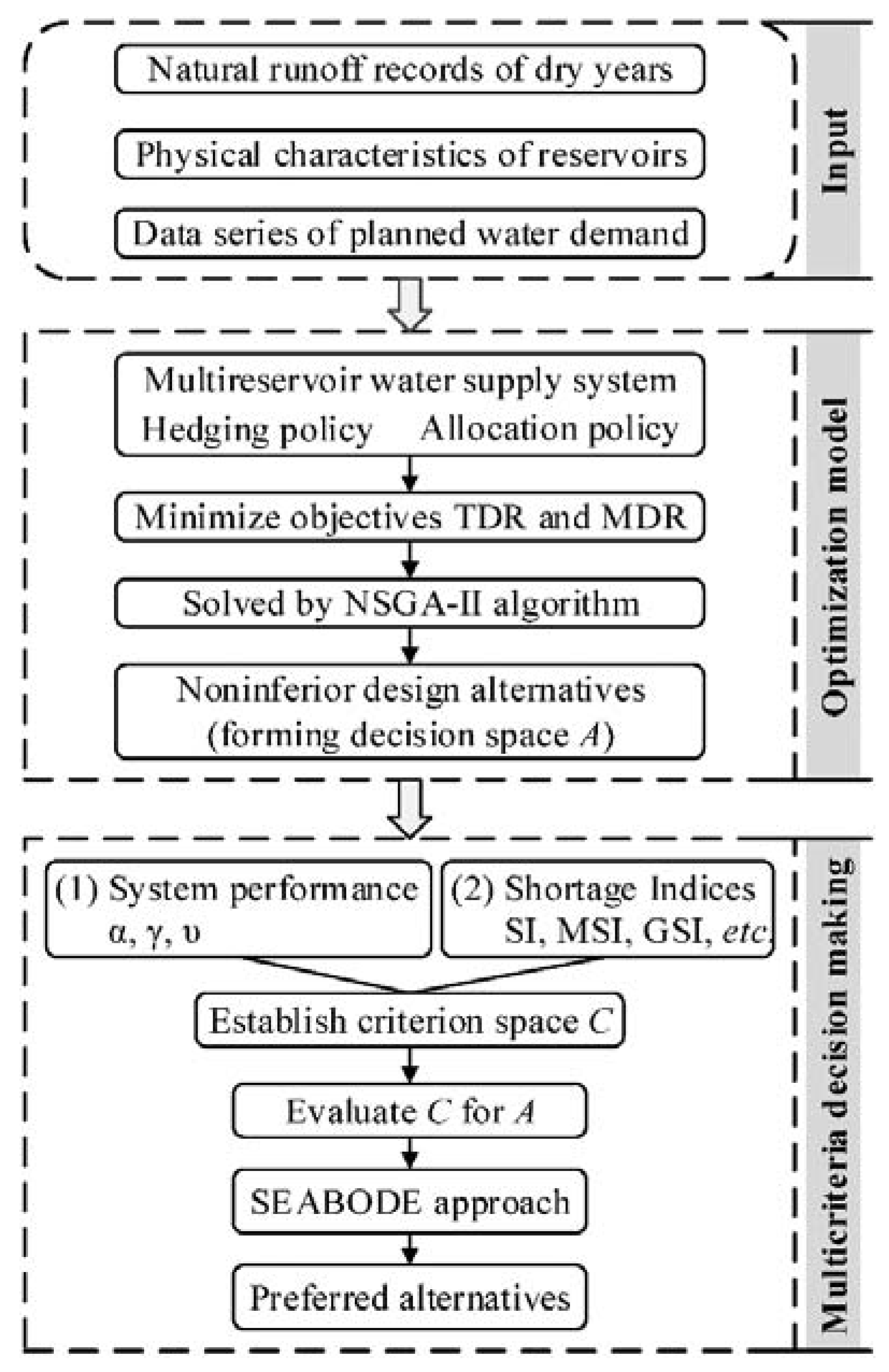
Suppose a system with NM water supply reservoirs and i denote the reservoir index, i = 1, 2, ..., NM. The allocation policy helps determine the allocated demand task Di,t for each parallel reservoir i by the coefficient PEi and planned common water demand. Then reservoirs could operate in order according to their respective time-varying hedging rules, represented by a parameter vector (SWAi,t, EWAi,t, HFi,t). So, in optimization of a multireservoir water supply system, our purpose is to find the optimal hedging policy that makes the system perform best. Two objective functions are concerned: (1) minimizing the total deficit ratio (TDR) of all demands of the entire system in operation horizon and (2) minimizing the maximum deficit ratio (MDR) of water supply in a single period.
A deficit occurs when the reservoir releases for water supply is insufficient. The total deficit ratio of the system is defined as the ratio of total water supply deficits to the total projected demands over the operation horizon, which is expressed as
where T is the length of operation periods.
To guard against unacceptable deficits of large magnitude, minimizing single-period deficit is also important during droughts.
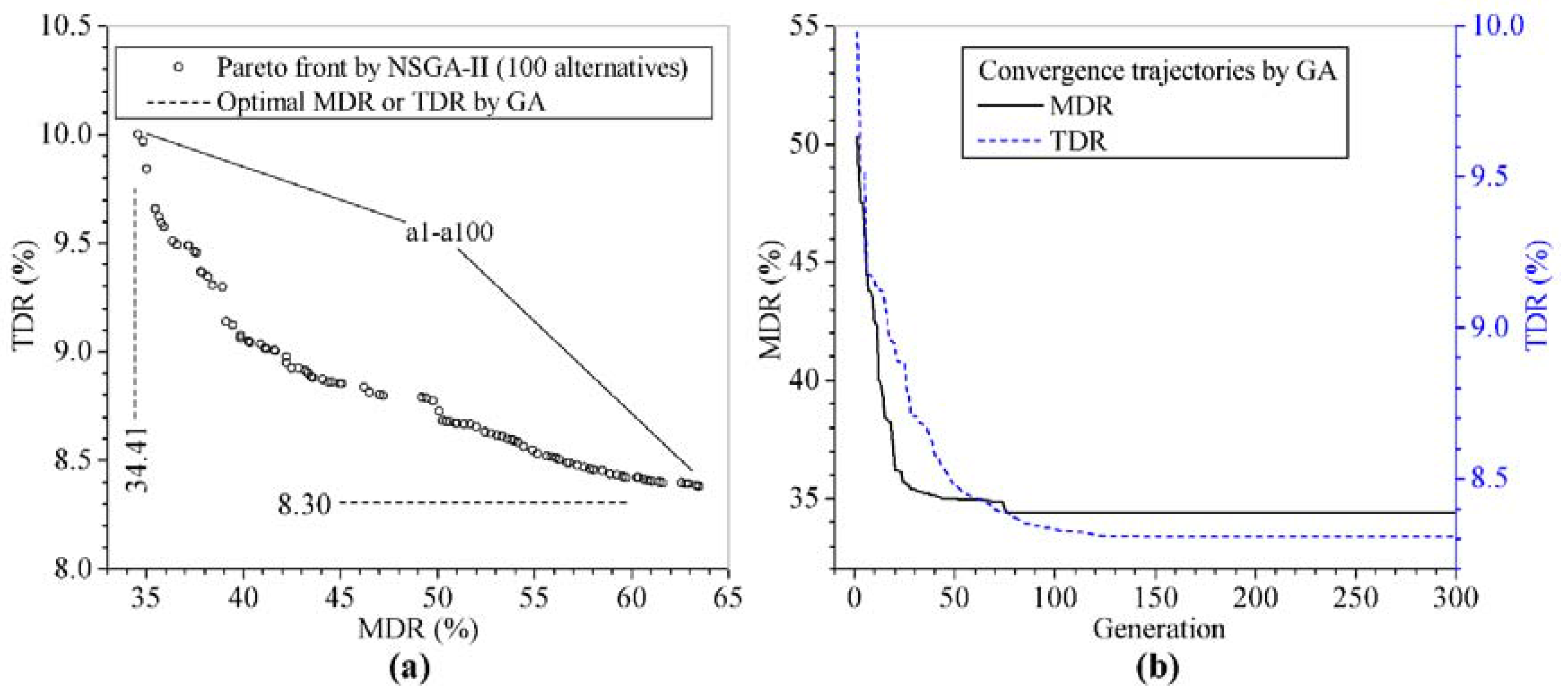
Actually, objectives TDR and MDR are conflicting: reservoir release for water demand at each time period should be as full as possible to minimize MDR, but no hedging would induce frequent deficit events and sacrifice long-term water supply reliability, which may increase TDR; conversely, satisfying the TDR would enlarge the MDR [
11,
18].
2.1.4. Solution Technique to Extract Design Alternatives
The NSGA-II, developed by Deb
et al. [
20], is one of the most efficient and steady population-based MOEAs and has been widely reported by various investigators in solving water resource systems-related problems. Some recent applications are: parameter calibration of hydrologic models [
21,
22], optimal design and management of flood control on watershed scale [
23,
24], reservoir systems optimization [
14,
25,
26,
27], and extraction of optimal operation policies [
13].
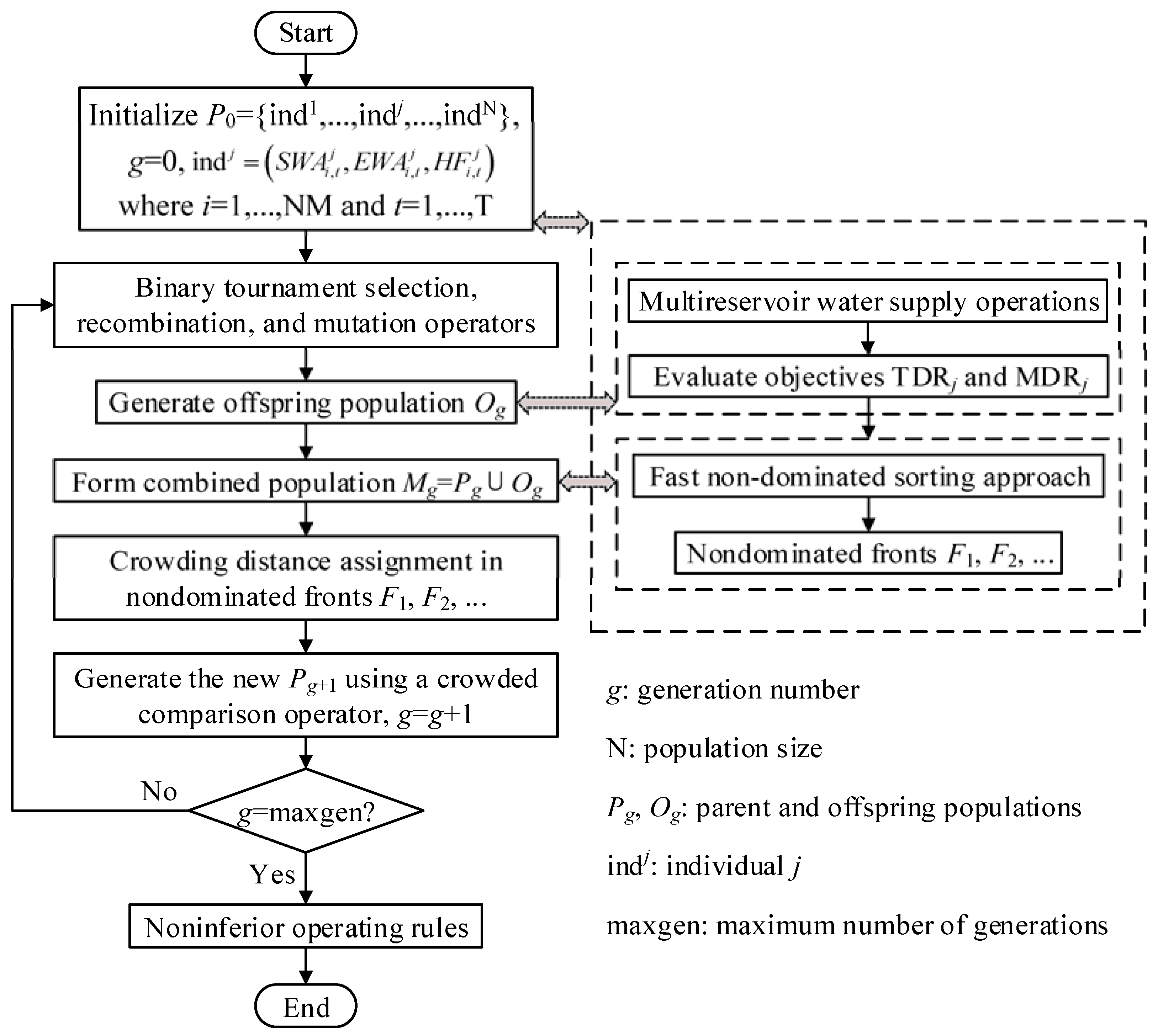
Figure 3 shows the flowchart of applying the NSGA-II to derive a noninferior set of operation rules for a multireservoir water supply system. The main steps are summarized as follows:
Step 1: Create initial parent population of size and set the generation number ; the individual represents a scheme of hedging policy, i.e., variables , , with and .
Step 2: For different in , implement the water supply operations of reservoirs one by one, then calculate objectives and .
Step 3: Sort based on non-domination and assign a rank to each individual equal to its non-domination level (1 is the best level, 2 is the next-best level, and so on).
Step 4: Generate an offspring population of size using binary tournament selection, crossover, and mutation operators.
Step 5: Evaluate offspring population ; the same as step 2.
Step 6: Combine the parent and offspring population to form a mating pool of size , .
Step 7: Sort by the fast non-dominated sorting algorithm to identify all non-dominated fronts ,,…
Step 8: Estimate the crowding distance of each individual in different non-dominated fronts (crowding-distance-assignment).
Step 9: Perform the crowded comparison operator on to generate a new parent population, .
Step 10: Set , and go to Step 4. Repeat steps 4–9 until the stopping criterion is satisfied ().
Figure 3.
Flowchart to optimize a multireservoir water supply system using the NSGA-II.
Figure 3.
Flowchart to optimize a multireservoir water supply system using the NSGA-II.