Next Article in Journal
Smart Farming Technologies for Groundwater Conservation in Transboundary Aquifers of Northwestern México
Previous Article in Journal
Application and Comparison of Two Transformer-Based Deep Learning Models in Short-Term Precipitation Nowcasting
 
 
Due to scheduled maintenance work on our servers, there may be short service disruptions on this website between 11:00 and 12:00 CEST on March 28th.
Article

Multi-Factor Air–Sea Heat Exchange Study on the Thermal Discharge Diffusion at Coastal Nuclear Power Plants: Sensitivity and Contribution Analysis

China Institute for Radiation Protection, Taiyuan 030006, China
*
Author to whom correspondence should be addressed.
These authors contributed equally to this work.
Water 2026, 18(6), 758; https://doi.org/10.3390/w18060758
Submission received: 7 January 2026 / Revised: 4 March 2026 / Accepted: 19 March 2026 / Published: 23 March 2026
(This article belongs to the Section Oceans and Coastal Zones)

Abstract

Solar radiation, longwave radiation, sensible heat flux, and latent heat flux constitute the primary forms of air–sea heat exchange, serving as crucial computational parameters in numerical simulations of thermal discharge. This study investigates a coastal nuclear power plant and employs a modified Morris screening method to quantitatively assess the contribution rates of various air–sea heat exchange processes to the spatial distribution of temperature rise under different operating conditions. The results indicate that the influence of air–sea heat exchange processes on the thermal discharge envelope exhibits a nonlinear pattern. The individual parameter sensitivity of shortwave radiation, sensible heat flux and latent heat flux is higher in the low temperature rise region ( T     1   ° C ) than in the high temperature rise region ( T     4   ° C ), with the individual parameter sensitivities of longwave radiation and latent heat flux displaying distinct threshold effects. The dominant heat exchange mechanisms vary across temperature rise regions: longwave radiation predominates in the high temperature rise region ( T     4   ° C ), contributing approximately 74.71%, whereas latent and sensible heat fluxes dominate in the low temperature rise region ( T     1   ° C ), accounting for a combined contribution of about 88.58%. These findings provide a scientific basis for model simplification and targeted parameterization.

1. Introduction

Nuclear power, as a crucial component of China’s electricity generation system, has drawn increasing public attention due to its potential ecological and environmental impacts. Coastal areas are the preferred locations for nuclear power plants [1,2,3]. During power plant operation, the continuously discharged cooling water can lead to abnormal increases in sea temperature in nearshore areas, exerting adverse effects on the surrounding marine ecosystems, aquaculture activities, and aquatic communities [4,5]. Therefore, understanding the thermal diffusion patterns of discharged cooling water is essential for assessing its impacts on the marine ecological environment [6].
The four principal approaches employed in current thermal discharge research include field observations, numerical simulations [7], satellite remote sensing [8], and physical modeling experiments. In recent years, with the advancement of computational capacity, numerical simulation has gradually become the primary approach for investigating the transport and dispersion processes of thermal discharges [9,10]. Gaoqiang Kong et al. employed a three-dimensional hydro-heat flux numerical model and reported that estuarine water temperature exhibits high sensitivity to thermal discharge, resulting in an average winter temperature increase of approximately 0.52 °C across the entire bay [11]. Jie Lin et al. utilized daily scale MODIS sea surface temperature (SST) data from 2002 to 2017 to assess the spatial extent and intensity of thermal discharge impacts. Their results indicated a strong correlation between the installed capacity of nuclear power plants and the SST increase within 0–2 km of the coastline, with thermal anomalies induced by discharge being most pronounced during summer [12]. Jia Houlei et al. demonstrated that the influence range of thermal discharges is not only constrained by plant-specific characteristics but is also significantly affected by regional geographical conditions. The temperature rise was greatest in bay areas, followed by estuaries, and was minimal in open sea regions [13]. Maria et al. employed a coupled wave-3D hydrodynamics model, integrating oceanic environmental characteristics with power plant operational conditions, and designed multiple scenarios to investigate the actual dispersion behavior of thermal discharges [9]. Zhu Xueqiang et al. conducted a systematic comparative analysis of the key parameters influencing thermal discharges diffusion using a parameter sensitivity analysis approach. Their results indicated that the heat-transfer coefficient exhibits high sensitivity to the area of the 1 °C temperature rise region [14]. The comprehensive heat-transfer coefficient is an important physical parameter, representing the combined effects of convection, evaporation, and radiation on the air–sea exchange. However, its estimation is method-dependent; different computational algorithms for the heat-transfer coefficient can lead to significant discrepancies in the estimated values [15] and often fail to accurately represent the contributions of specific processes such as latent and sensible heat fluxes [16]. Sea surface temperature (SST) is regulated by multiple processes, including solar radiation, heat transfer, and the exchange of sensible and latent heat fluxes [17]. Rinehimer and Tomson reported that shortwave radiation dominates heat exchange in marine and tidal flat environments, while longwave radiation and turbulent heat fluxes play crucial roles under nighttime or cloudy conditions. The relationship between turbulent surface heat fluxes and SST exhibits clear scale dependence, with a stronger correlation observed at smaller spatial scales [10]. Chengji Chen et al. found that under persistent SST warming, latent heat flux shows a pronounced increasing trend [18]. Similarly, Alfiya Fathima Paradan et al. pointed out that variations in latent heat flux exert a dominant influence on seawater temperature in bay regions; when latent heat flux weakens, ocean cooling is reduced [19].
Therefore, this study differs from conventional approaches that parameterize the comprehensive heat-transfer coefficient by explicitly incorporating air–sea heat exchange processes, namely solar shortwave radiation, effective longwave radiation from the sea surface, oceanic latent heat flux, and sensible heat flux driven by the air–sea temperature and humidity gradient into the numerical simulations. Taking a coastal nuclear power plant located in the East China Sea as a representative case study, this study employed a modified Morris screening method to systematically evaluate the sensitivity of the 1 °C and 4 °C temperature rise regions near the discharge outlet to variations in different heat exchange mechanisms, and to quantify their respective contribution rates to the spatial distribution of thermal discharge.

2. Materials and Methods

2.1. Study Area

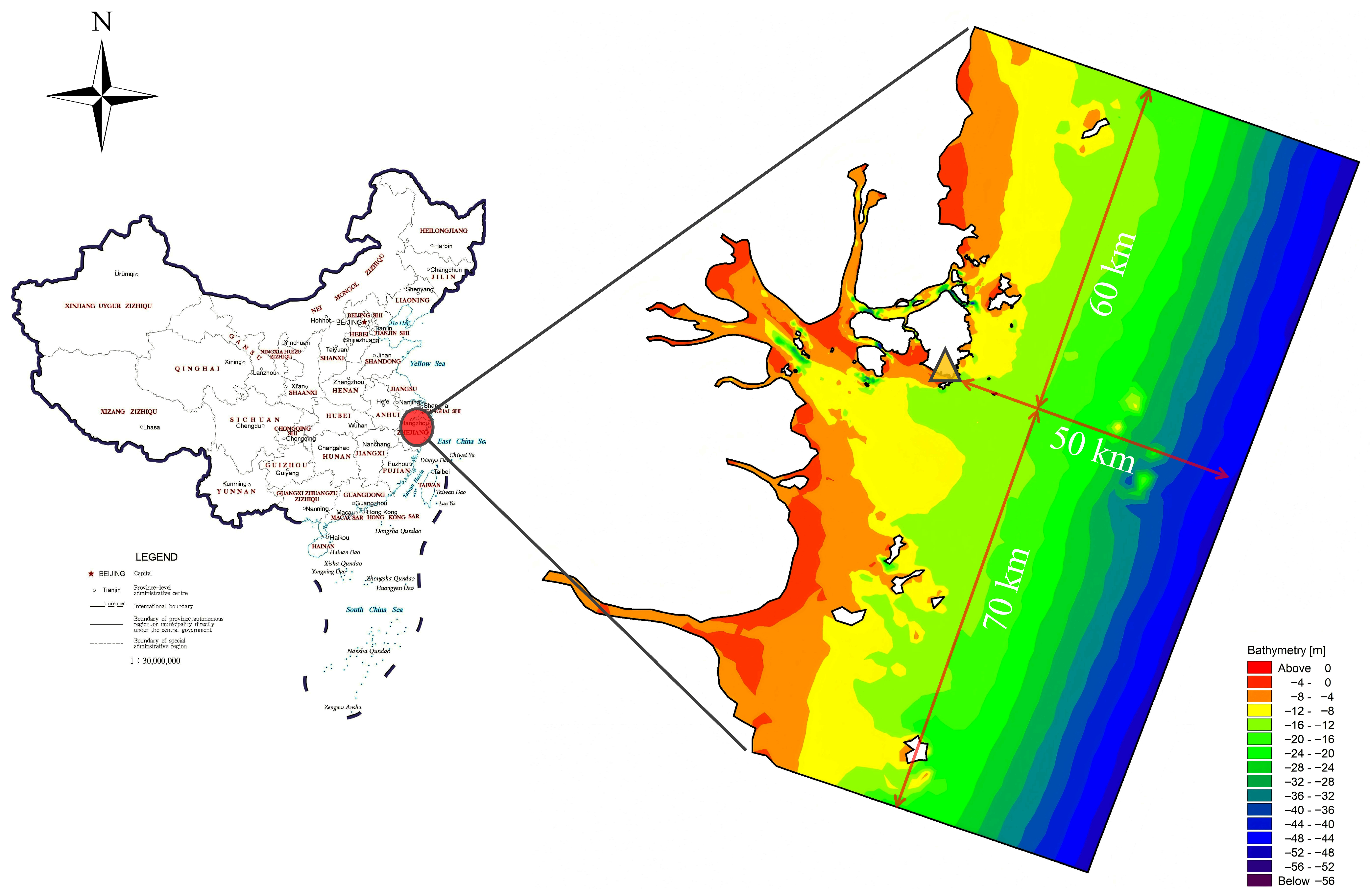
The study area centers on a coastal nuclear power plant in the East China Sea, China. The computational domain extends approximately 50 km eastward, 60 km northward, and 70 km southward from the nuclear power plant site (see Figure 1). The region is located in the subtropical monsoon climate zone, with a moderate annual mean temperature and a clear distinction among the four seasons. The bathymetry around the plant site is relatively gentle, with water depths predominantly ranging from 10 m to 15 m. A deep marine trough is located to the south of the plant, providing favorable hydrodynamic conditions, while a muddy tidal flat extends to the southwest. The area is dominated by a typical semidiurnal tidal regime, and the tidal currents exhibit a reciprocating flow pattern.

2.2. Numerical Modeling

This study employed the DHI MIKE 3 model for numerical simulation. MIKE 3 has been widely applied in various fields, including water resources management and planning, environmental impact assessment, climate change impact studies, and disaster risk evaluation. The model is capable of reproducing three-dimensional hydrodynamic, transport, and ecological processes within water bodies. It supports multi-scale simulations and coupling of multiple physical processes, featuring a modular design with high flexibility and strong scalability [20].
(1) 3D governing equations in water
The model is formulated based on the three-dimensional incompressible Reynolds-averaged Navier–Stokes equations (RANS), under the assumptions of Boussinesq approximation and hydrostatic pressure, to describe large-scale flows in estuarine and coastal regions. The governing equations in the σ -coordinate system are as follows:
σ = z ζ h
where ζ x ,   y is the tidal elevation at point (x, y); h represents the total water depth ( m ); σ varies between −1 at the bottom and 0 at the surface
h t + h u x + h v y + h ω σ = h S
h u t + h u 2 x + h v u y + h ω u σ =
  f v h g h η x h g ρ 0 σ 0 ρ x d σ + h F u + σ v t h u σ + h u s S
h v t + h u v x + h v 2 y + h ω v σ =
f u h g h η y h g ρ 0 σ 0 ρ y d σ + h F v + σ v t h v σ + h v s S  
ω = 1 h w + u d x + v d y σ h t + u h x + v h y
where t is the time; u , v denote the horizontal velocity components ( m / s ); ω represents the vertical velocity component in the σ coordinate system ( s 1 ); η is the surface elevation; ρ / x ,   ρ / y is the baroclinic term arising from density gradients; f is the Coriolis parameter ( s 1 ); ν t is the vertical turbulent viscosity ( m 2 s ), determined by the log-law model; ρ 0 is the reference density of water ( kg / m 3 ); S is the magnitude of the discharge due to a point source; ( u s , v s ) is the velocity by which the water is discharged into the ambient water ( m / s ); and F u and F v constitute the horizontal shear stress terms ( m / s 2 ).
(2) Transport equation for temperature
h T t + h u T x + h v T y + h w T σ = h F T + σ D v h T σ + h H ̑ + h T S S
where T is the temperature ( ° C ); F T represents the horizontal diffusion term ( ° C / s ); D v is the vertical turbulent diffusion coefficient ( m 2 s ); T s is the temperature of the source ( ° C ); other parameters are as defined above.

2.2.1. Initial and Boundary Conditions

(1) Initial Conditions
The initial conditions for the three-dimensional model consist of hydrodynamic and thermal field specifications. The initial hydrodynamic field is set to steady flow conditions, with the initial water temperature established as the ambient water temperature.
(2) Boundary Conditions
1. Hydrodynamic Conditions
The coastal boundary was prescribed as a closed, impermeable boundary, whereas the open boundary was forced with tidal elevations obtained from the Global Tide Model. The moving boundary was resolved using a wetting-drying algorithm, with threshold depths defined as 0.005 m for drying, 0.05 m for flooding, and 0.1 m for wet conditions.
2. Temperature Conditions
The shoreline and bottom boundaries were specified as adiabatic, while the open boundary adopted the ambient water temperature. The free surface was treated as a heat-exchange boundary, where the heat fluxes were computed using the heat exchange module. The air temperature input was obtained from the ERA5 hourly reanalysis dataset provided by the European Centre for Medium-Range Weather Forecasts (ECMWF), representing conditions at 2 m above the sea surface.
(3) Source term conditions
The source term was defined based on a relative temperature rise approach. The thermal discharge was modeled with an in-out coupled source configuration, where the outlet temperature was dynamically linked to the intake temperature, such that the outlet water temperature was determined as the sum of the intake water temperature and the cooling water temperature increase.

2.2.2. Grid Configuration

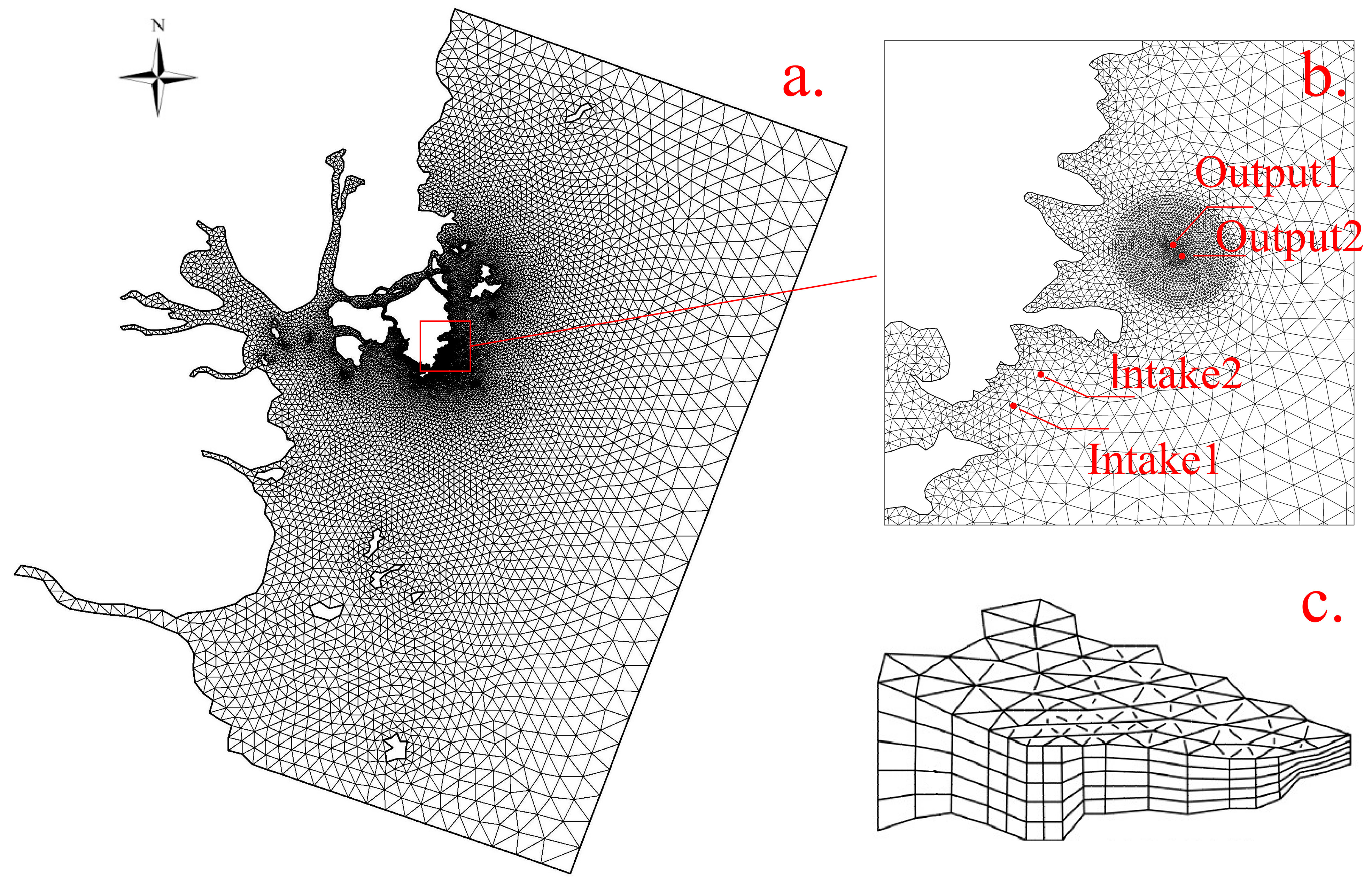
The computational domain was discretized using an unstructured triangular mesh with gradually refined resolution from the offshore area to the engineering site. The mesh near the discharge outlet was further refined to accurately resolve the high-temperature area of the thermal plume. The minimum and maximum cell sizes were approximately 10 m and 4.5 km, respectively, resulting in a total of 24,134 grids (see Figure 2). Vertically, the water column was divided into six layers using σ -coordinate system. Bathymetric data of varying scales were employed, with inshore areas derived from field surveys at 1:1000 and 1:10,000 scales and offshore areas from nautical charts at 1:25,000, 1:50,000, 1:75,000, 1:100,000, 1:200,000, and 1:500,000 scales.

2.2.3. Model Parameters

(1) Bed roughness
The spatial and temporal variation in the bed roughness coefficient is influenced by multiple factors, including flow characteristics, seabed composition, and the irregularity of cross-sectional geometry [21]. Typically, its representative values range from 0.02 to 0.05 [22]. In the study area, the bathymetry is relatively flat and the seabed’s geological type is uniform; therefore, a roughness coefficient of 0.02 was adopted.
(2) Eddy viscosity
The horizontal eddy viscosity was computed using the Smagorinsky formulation, with a coefficient of 0.28 [23,24]. The vertical eddy viscosity was determined using a log-law formulation [20].
(3) Air–sea heat exchange
The air–sea heat exchange in this study primarily includes shortwave radiation, effective longwave radiation, latent heat flux, and sensible heat flux. The sea surface temperature (SST) was derived from the five-year mean for January-February, whereas the wind speed and relative humidity were derived from the corresponding three-year mean. All heat fluxes were computed with the formulations given below:
Net shortwave radiation:
q s r , n e t = ( 1 α ) q s
Net longwave radiation:
q l r , n e t = σ s b ( T a i r   +   T K ) 4 ( a b e d ) ( c   +   d n n d )
Latent heat flux:
q v = L C E ( a 1   +   b 1 W 2 m ) ( Q w a t e r Q a i r )
Sensible heat flux:
q c = ρ a i r c a i r C H W 10 m ( T a i r T w a t e r )
where α is the sea surface albedo; q s represents clear-sky solar radiation; σ sb is the Stefan-Boltzmann constant; n is the number of sunshine hours, n d is the maximum sunshine duration; the coefficients a, b, c, d are set as follows: 0.56; 0.077 mb 1 / 2 , 0.1, 0.9; L is the latent heat vaporization, taken as 2.5 × 10⁶ J / kg ; C E moisture transfer coefficient, taken as −1.32 × 10⁻³; values for   a 1 and b 1 are 0.5 and 0.9, respectively [20]. Q w a t e r is the water vapor density close to the surface; Q a i r is the water vapor density in the atmosphere; W is the wind speed; ρ air is the air density, taken as 1.225 kg / m 3 ; c a i r is the specific heat of air, taken as 1007 J / kg · ° K ; C H indicates the sensible transfer coefficient, taken as 0.0011 in this study [25]. Table 1 summarizes the heat flux values associated with different heat exchange processes.

2.2.4. Sensitivity and Contribution Rates

In this study, a modified Morris screening method was employed to conduct sensitivity analysis. The Morris method is a widely used local sensitivity analysis approach, which is based on randomly perturbing individual parameters within their respective ranges and evaluating the resulting changes in the model output [26], represented by the objective function
Y ( x ) = y ( x 1 , x 2 , x 3 , , x n )
Parameter variations are applied with fixed step sizes, and the sensitivity and contribution rates indices are normalized. To reduce potential bias from the cancellation of positive and negative effects in the traditional Morris method and to enable better comparison, absolute mean values were used in all calculations [27]. The computation formulas are as follows:
e i   =   y * y i
where y * presents the model output after the parameter perturbation; y is the original parameter value; i indicates the range of variation for the parameter i.
E E i = Y ( x i , . . x i 1 , x i + , x i + 1 , , x k ) Y ( x )
E E i * = E E i · x Y
E E i is the output value of the influence to determine the influential degree of the parameter change; E E i * represents the normalized value of E E i , representing the individual parameter sensitivity of x i .
S = i = 0 n 1 ( Y i + 1 Y i ) / Y 0 ( P i + 1 P i ) / 100 / ( n 1 )
C ( X i ) = S ( X i ) 0 i S ( X i )
S represents the grouped sensitivity, which reflects the sensitivity index of the air–sea heat exchange process; Y i represents the model output at the i th operation, Y i + 1 corresponds to the output at the subsequent iteration (i + 1), and Y 0 denotes the reference output after parameter calibration, serving as the baseline for comparison; P i denotes the percentage change in the i th model run relative to the calibrated parameter value; P i + 1 denotes the percentage change in the (i + 1) th run relative to the calibrated parameter value; and n is the number of model operations. C ( X i ) is the contribution rate of X i , S ( X i ) is grouped sensitivity of X i [26].

2.3. Model Calibration

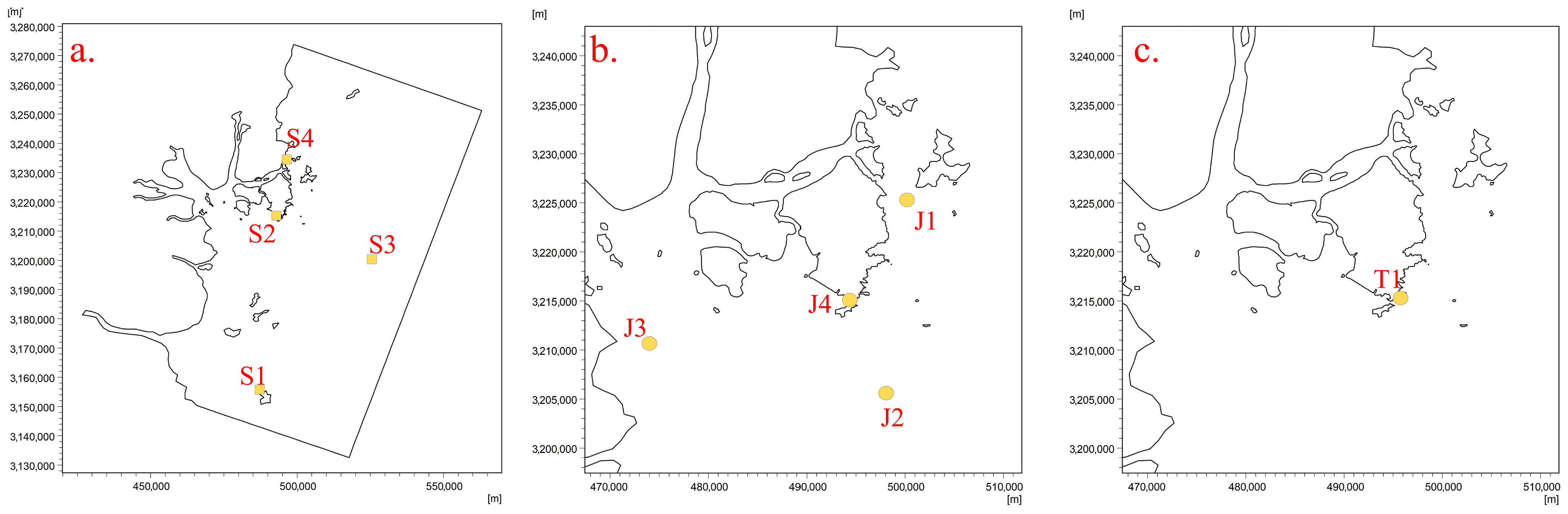
The model was calibrated and validated using observational data. The dataset comprised four tide gauge stations (S1, S2, S3, S4), four current measurement stations (J1, J2, J3, J4), and a water temperature monitoring station (T1) selected in the main temperature rise area (see Figure 3). The tide gauge stations (S1–S4) recorded continuous observations from 00:00 19 January to 23:00 18 February 2024, at an hourly interval. J1–J4 and T1 were sampled at 30 min intervals during three discrete periods: 26 January 15:00–27 January 17:00, 30 January 17:00–31 January 19:00, and 2 February 15:00–3 February 17:00, 2024. Observational data underwent rigorous quality control. Data preprocessing was conducted in accordance with the national standard (GB/T 12763.2-2007) [28]. Instrument accuracies: tide gauges (RBR (Laoshan, China), ± 3 cm), ADCP (Teledyne RD Instruments (Shanghai, China), ± 0.5 cm/s), and CTD (Sea-Bird Scientific (Bellevue, WA, USA), ± 0.002 °C). The simulated results were extracted from the model at locations consistent with the observation stations and temporally aligned with the observations at the corresponding sampling intervals. Model performance was evaluated using the root mean square error (RMSE), normalized root mean square error (NRMSE), and the correlation coefficient (R), calculated as follows:
R M S E = 1 N i = 1 N ( S i M i ) 2
N R M S E = i = 1 N ( S i M i ) 2 i = 1 N M i 2
R = C o v ( S i , M i ) V a r ( S i ) V a r ( M i )
where S i represents the simulated values and M i represents the observed values; N is the number of samples.

2.3.1. Hydrodynamics Validation

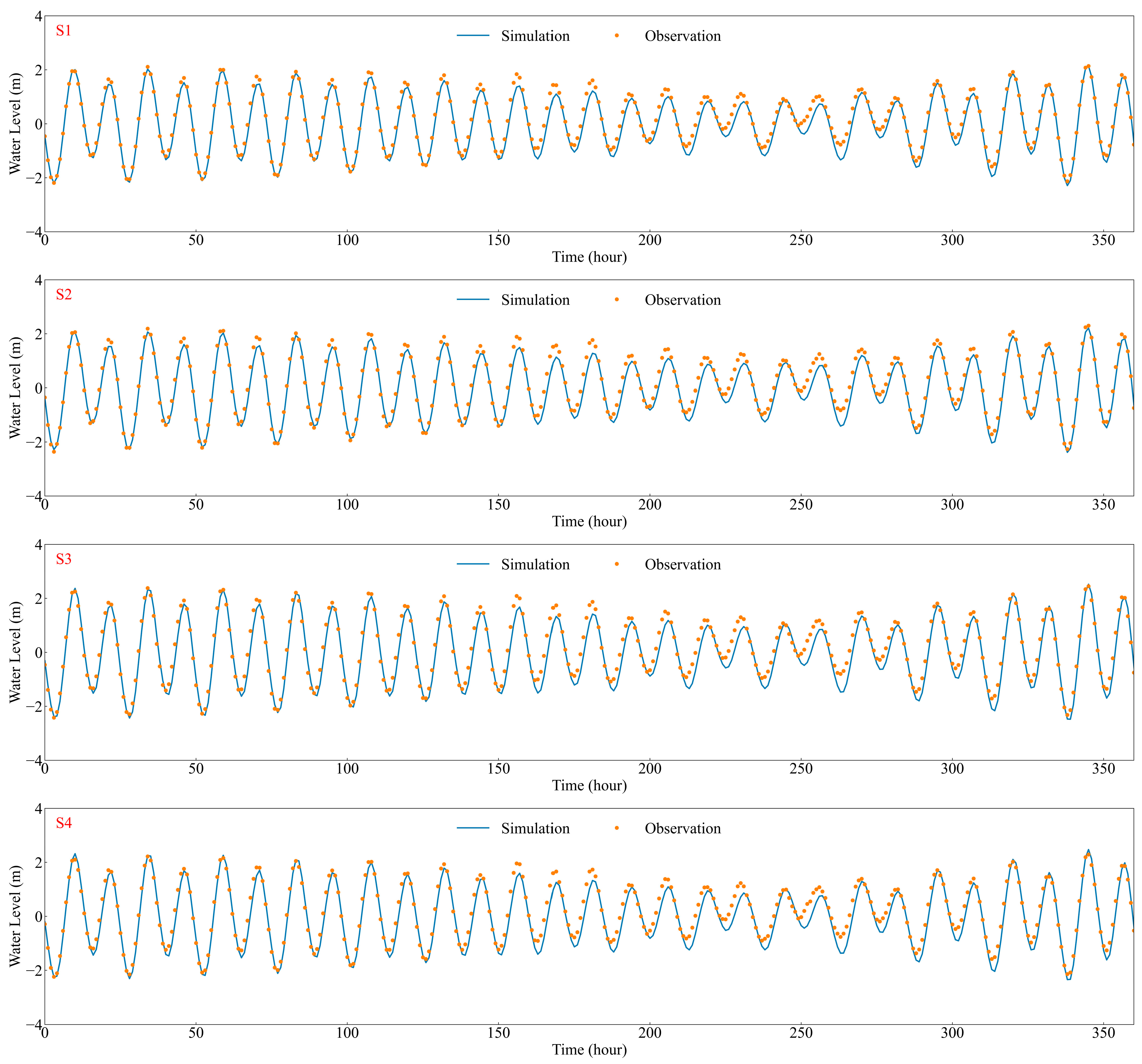
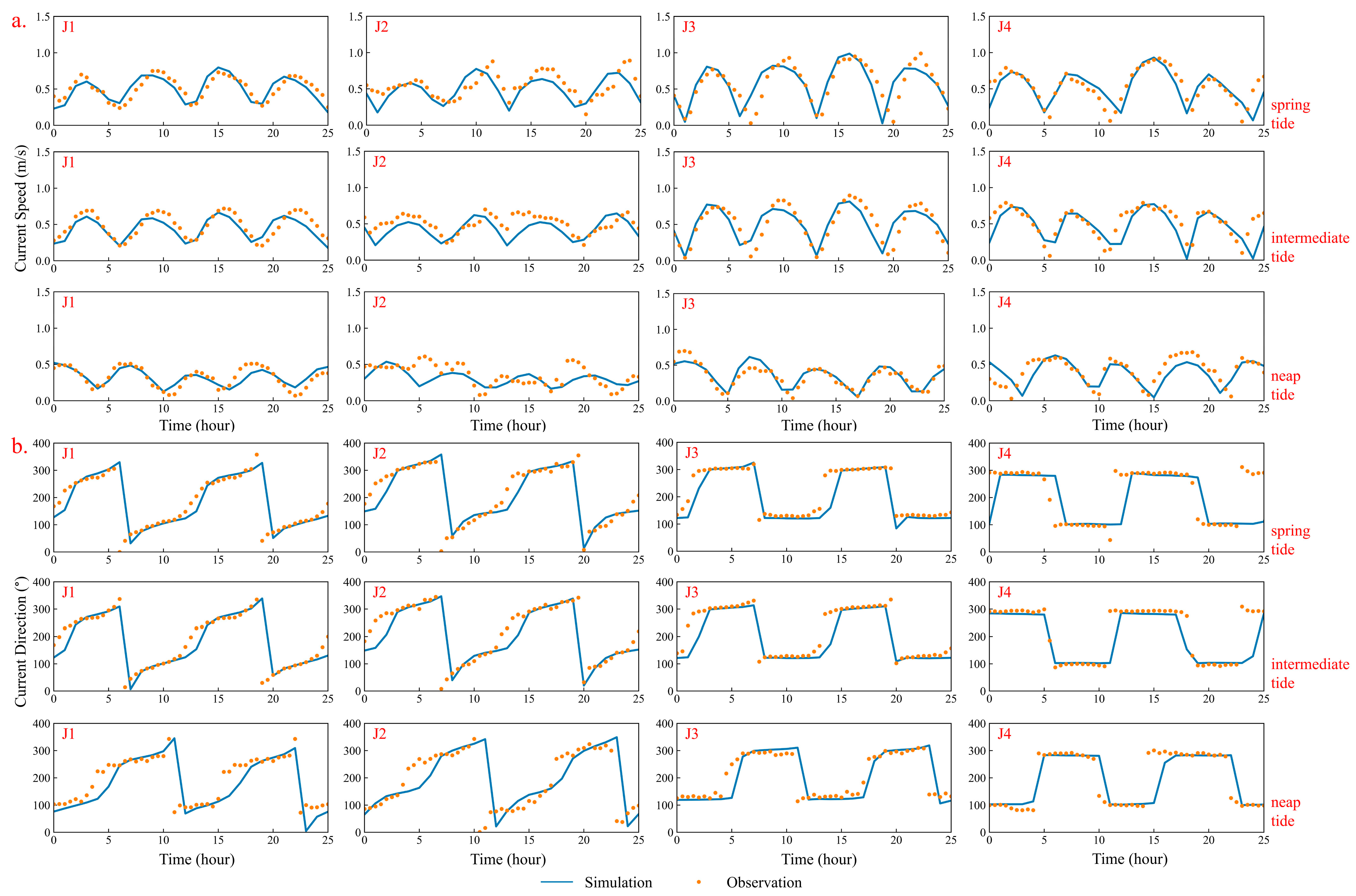
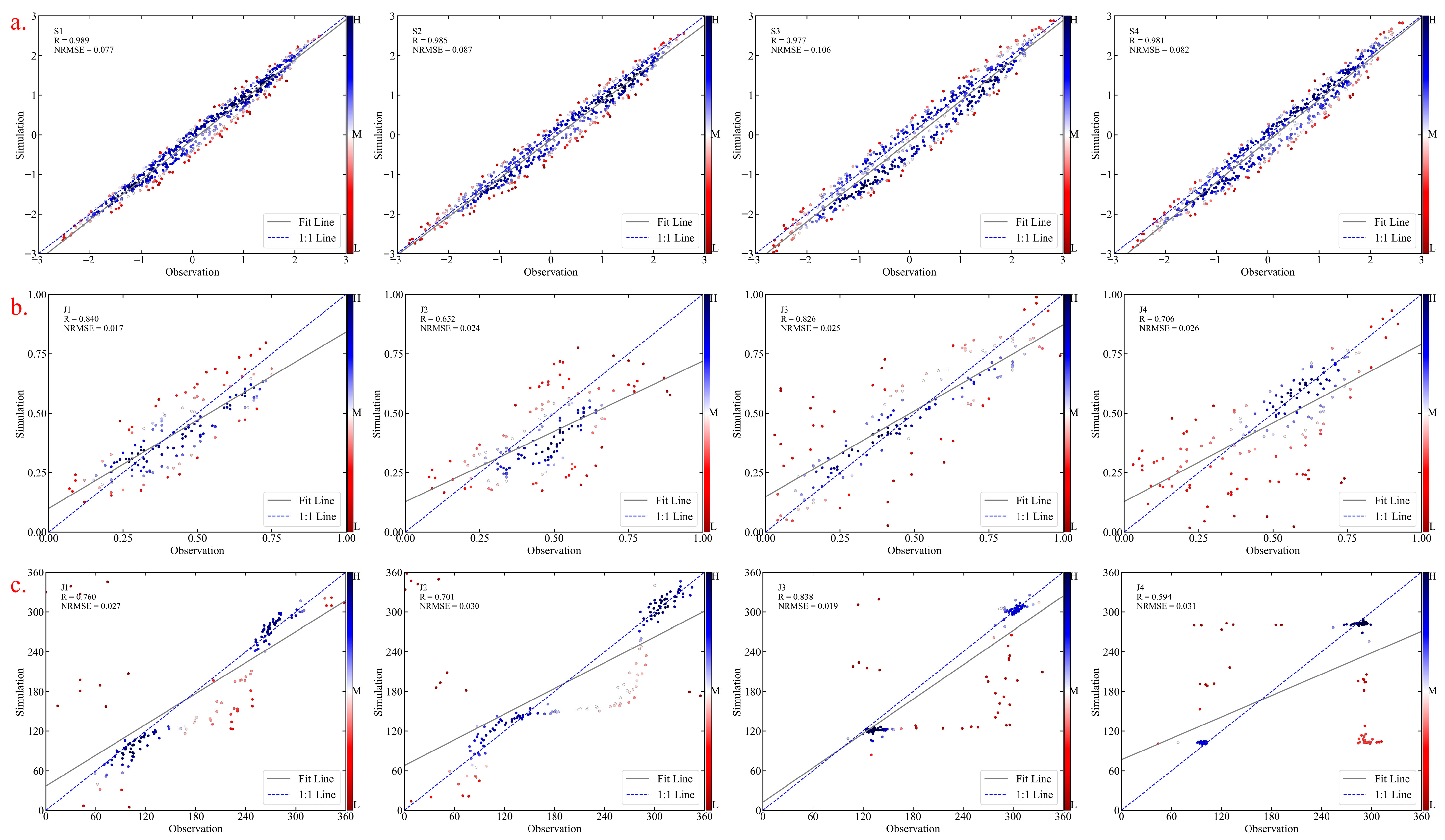
The phase differences in both tidal elevation and current velocity are less than 0.5 h. The maximum deviations in high and low water levels are within ± 8.09 cm, which is below the 10 cm tolerance commonly adopted in tidal validation studies [29]. The mean deviations in current velocity during the flood and ebb periods are both below the 10%. The deviation in the principal flow direction is less than the allowable limit of 10°. Figure 4 and Figure 5 present the validation results for water levels and currents. The model evaluation indicates that the NRMSE at all tide gauge stations did not exceed 0.1, while the correlation coefficients (R) were all greater than 0.9 (see Figure 6a), demonstrating that the simulated water levels closely matched the observed data in both phase and amplitude. For currents, the validation results show that the NRMSE of both velocity and flow direction at the current measurement stations remained below 0.1, with minimum correlation coefficients of 0.652 and 0.594, respectively (see Figure 6b,c). The slightly lower correlation for flow direction can be attributed to the inherently oscillatory nature of the hydrodynamic processes in the study area. Although minor discrepancies occur between the simulated and observed directions during flow reversal, the overall errors remain within acceptable limits. As shown in Table 2, the p-values for both water level and current velocity are less than 0.001, indicating strong statistical significance.
Overall, the simulated results exhibit a high degree of agreement with the observed data. The model accurately reproduced the intensity, phase, and periodic characteristics of the tidal currents, indicating that the tidal hydrodynamic model developed in this study is reliable.

2.3.2. Temperature Validation

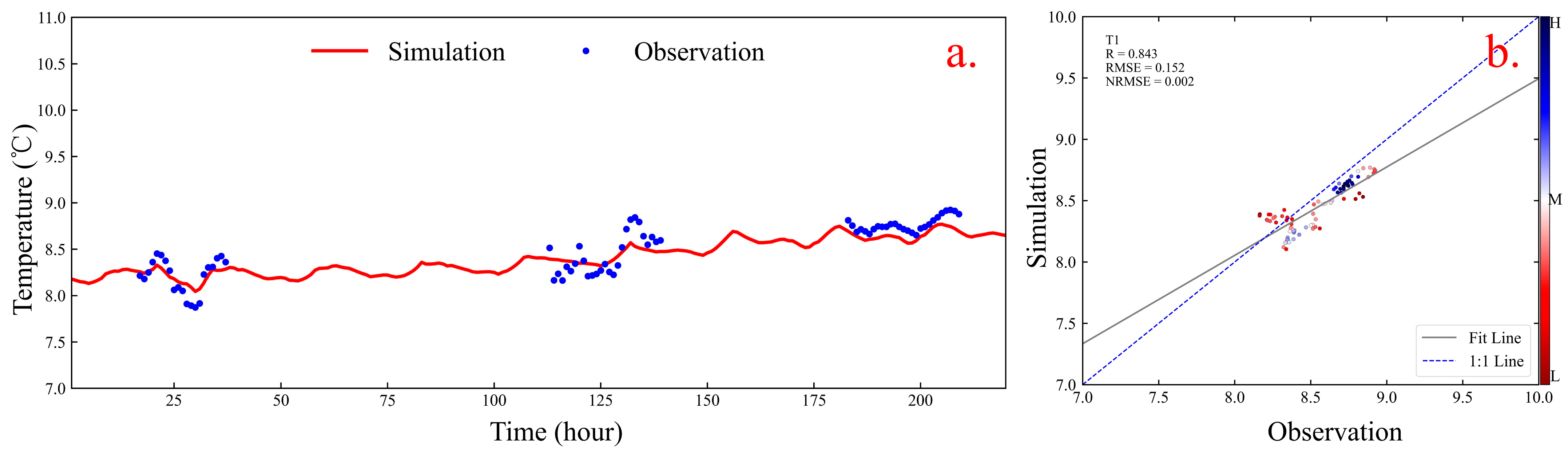
This study focuses on sea–air heat exchange and since vertical temperature variations are minimal, model validation is limited to surface water temperature. Figure 7a shows that the simulated and observed sea surface temperatures (SST) exhibit broadly consistent temporal trends, although noticeable discrepancies occur at several individual time points. These deviations are mainly attributed to abrupt changes in meteorological conditions, which can induce rapid short-term fluctuations in SST. Across all tidal conditions, the NRMSE is 0.002 and the correlation coefficient (R) is 0.843, The p-value is 6.674298 × 10⁻²², less than 0.001, and the confidence interval is [0.763, 0.900], indicating strong statistical significance; RMSE is 0.152 °C, with a mean error below 0.5 °C, meeting the validation accuracy requirement (see Figure 7b). Overall, these results indicate agreement between the simulations and observations, demonstrating that the model captures the temporal variability of water temperature in the study area and provides a reliable basis for subsequent heat flux analyses.
It should be noted that publicly available satellite SST products have inherent limitations for nearshore temperature validation. Their spatial resolution is generally too coarse to resolve detailed coastal thermal structures, and retrievals in nearshore waters are often affected by land adjacency effects and cloud cover. Additionally, satellite-derived temperatures require calibration against in situ measurements to ensure accuracy. Therefore, this study relies on high-accuracy in situ observations (CTD,   ± 0.002 °C), which provides direct ground-truth data with known precision. These in situ measurements provide sufficient and reliable data to support model validation, ensuring the accuracy required for the sensitivity analysis and fully meeting the objectives of this study.

3. Results

3.1. Simulation Scenarios

This study quantitatively analyzes the sensitivity and relative contribution of the four primary air–sea heat flux components, shortwave radiation, longwave radiation, latent heat flux, and sensible heat flux, to the temperature rise regions. For the individual parameter sensitivity analysis, a “one-at-a-time” approach was adopted [30], whereby a single parameter was varied by a prescribed proportion while keeping all other parameters constant, and its influence on the model outputs was subsequently quantified.
The discharge outlets are configured at the second layer and consist of two outlets. The nuclear power plant includes four generating units, each with an installed capacity of 1250 MW. According to the engineering design specifications, the discharge flow rates are 135.6 m 3 / s for Output 1 and 140 m 3 / s for Output 2, with a discharge temperature rise of T = 7.5   ° C . The specific locations of outlets are shown in Figure 2b. The calibrated and validated parameters are employed as the baseline simulation scenario (A0), upon which the subsequent sensitivity and contribution rates analyses are performed. Details of the computational scenarios are summarized in Table 3.

3.2. Results and Discussion

3.2.1. Thermal Discharge Diffusion

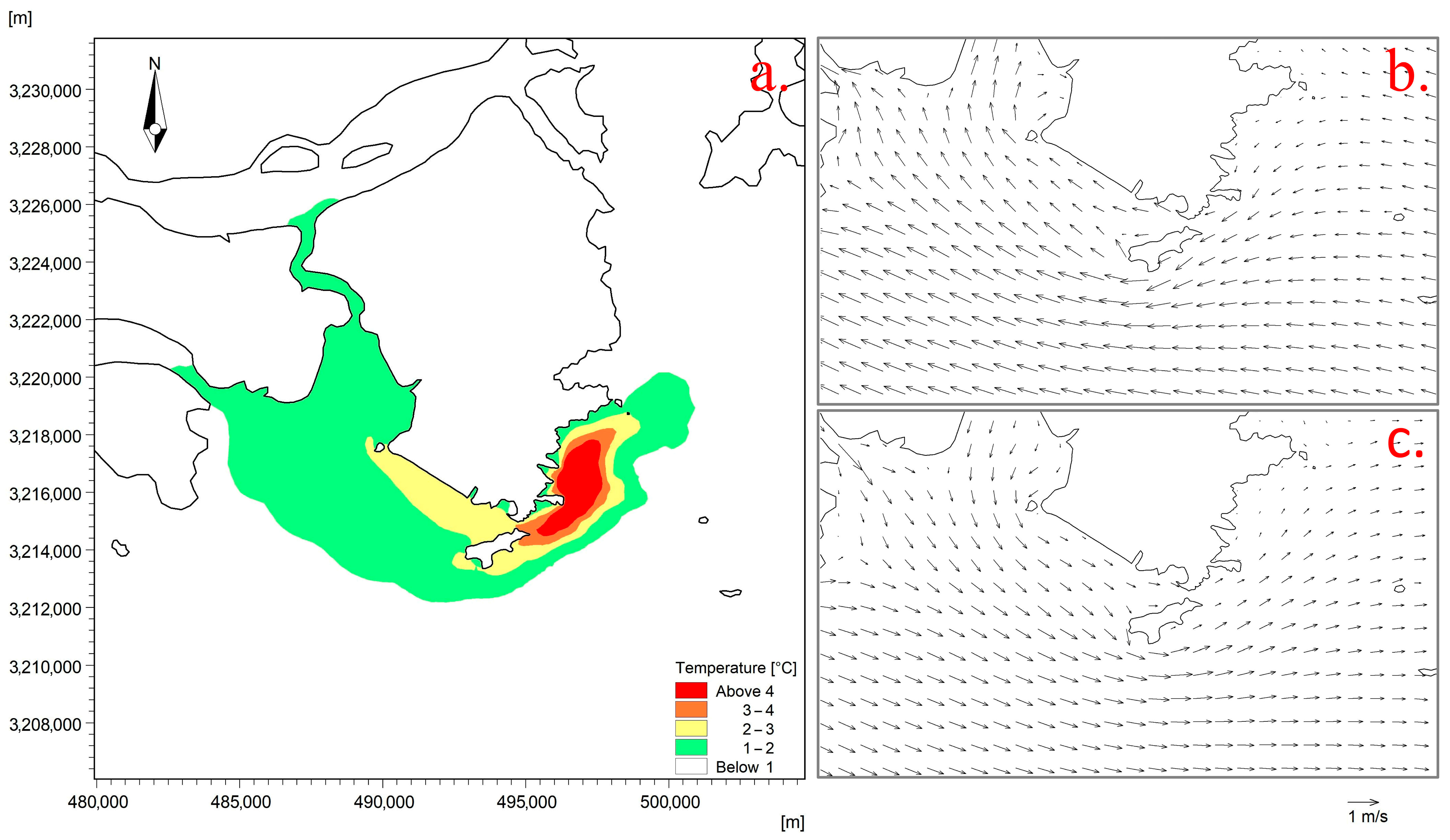
According to the results of the baseline simulation case (A0), the thermal discharge plume primarily disperses along the northeast-southwest direction (see Figure 8a). This distribution pattern is governed by the tidal current regime in the study area, where the alongshore flow is predominantly southwestward during flood tide and northeastward during ebb tide. Consequently, the thermal discharge exhibits a bidirectional oscillatory dispersion along the coast. As shown in Figure 8b,c, the flow velocity on the western side of the area is generally higher than that on the eastern side, resulting in a more pronounced southwestward transport of the elevated-temperature boundary.
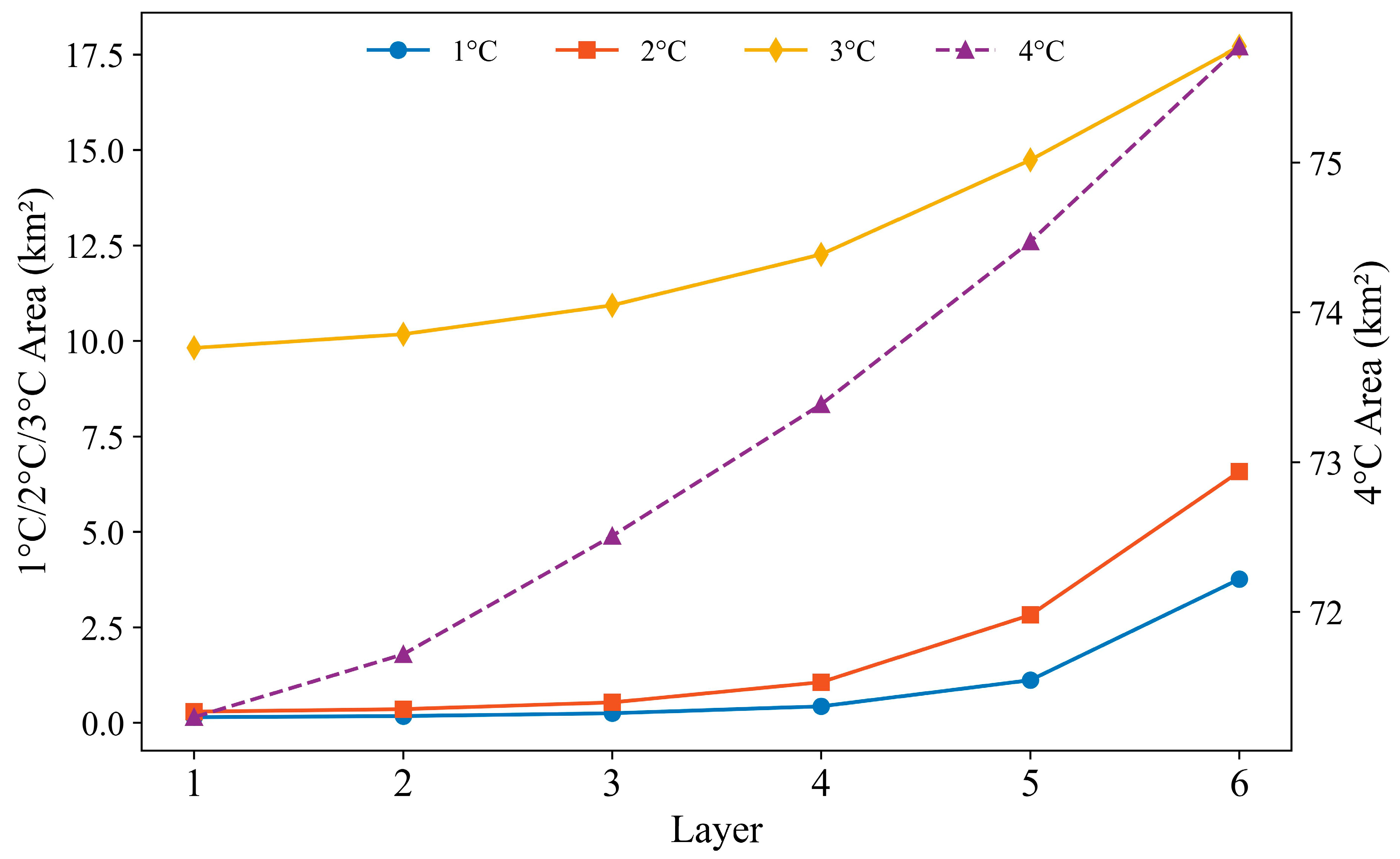
After thermal discharge, the temperature envelope in the vicinity of the outlet exhibits a periodic variation in response to the tidal cycle. Thermal stratification in the study area is pronounced, with the surface layer reaching the maximum envelope area for all temperature rise levels (4 °C, 3 °C, 2 °C, 1 °C) (see Figure 9) [31]. In areas experiencing 3 °C and 4 °C temperature increases, the surface area is substantially larger than that of the bottom layer. Conversely, in areas experiencing 1 °C and 2 °C temperature increases, as the thermal plume dilutes and buoyancy effects weaken, vertical mixing becomes more uniform, resulting in a marked reduction in the area differences among layers.

3.2.2. Sensitivity

The sensitivity of the four primary air–sea heat exchange processes, shortwave radiation, longwave radiation, latent heat flux, and sensible heat flux, to the temperature rise field was analyzed. The simulation results indicate that the individual parameter sensitivity and grouped sensitivity of shortwave radiation, latent heat flux and sensible heat flux for the 1 °C temperature rise envelope area are markedly higher than those for the 4 °C temperature rise envelope area. In the high temperature rise region ( T     4   ° C ), near the discharge outlet, the temperature rise distribution is predominantly governed by the discharge flow rate and the initial temperature difference, exhibiting a characteristic source-dominated pattern [32]. In this area, the influence of variations in the air–sea exchange processes is minor on both temporal and spatial scales compared with the heat input from the discharge itself, and air–sea heat exchange processes only induce slight perturbations in the overall temperature field; thus, their effect on the envelope area of high temperature regions is limited. In contrast, in the low temperature rise region ( T     1   ° C ) farther from the outlet, the transport and dissipation of heat are more susceptible to modulation by air–sea heat exchange, and consequently, the spatial extent of the temperature rise exhibits higher sensitivity to variations in heat fluxes.
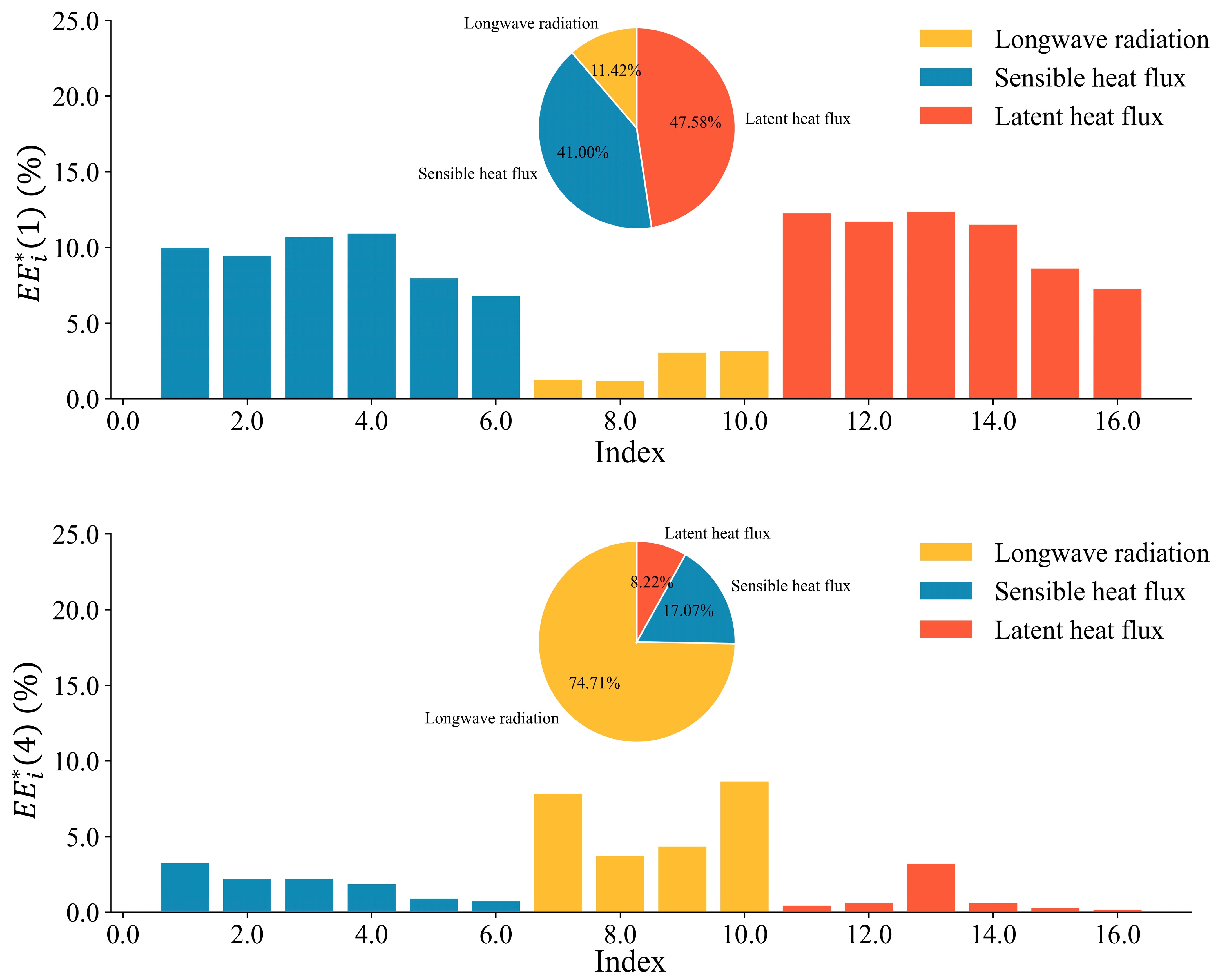
As shown in Table 4 and Figure 10, the effects of the various heat exchange processes on the temperature rise envelope areas exhibit nonlinear characteristics. Shortwave radiation, as the sole heat-absorbing flux, shows individual parameter sensitivities of 0.32% for the high temperature rise region ( T     4   ° C ) and 0.33% for the low temperature rise region ( T     1   ° C ), with all sensitivities remaining below 1%. Among the heat-loss terms, a 40% increase in longwave radiation intensity leads to a rise in the individual parameter sensitivity for the 1 °C temperature rise region from 3.21% to 11.64%. Further analysis indicates that when longwave radiation is amplified by approximately 26%, the sensitivity increases from 3.21% to 7.31%, suggesting the emergence of a threshold effect. This pronounced enhancement in sensitivity within the low temperature rise region can be attributed to the nonlinear dependence of the longwave radiative flux on sea surface temperature, reflecting the combined effects of the underlying physical mechanism and the nonlinear terms in the numerical computation. When latent heat flux is reduced by 20% (A21), its individual parameter sensitivity in the high temperature rise region ( T     4   ° C ) increases by approximately fivefold compared with other simulation scenarios (A19, A20, A22, A23, A24), highlighting the critical role of evaporative cooling in sustaining near-source high temperature areas and indicating the presence of a threshold effect. In contrast, the individual parameter sensitivity of the sensible heat flux remains relatively stable, showing no significant fluctuations.
Furthermore, in the high temperature rise region ( T     4   ° C ), the net longwave radiation exhibits a strong sensitivity to the temperature rise envelope area, with a grouped sensitivity of 10.78%, while the grouped sensitivities of sensible and latent heat fluxes are 2.46% and 1.19%, respectively. In the low temperature rise region ( T     1   ° C ), the grouped sensitivity of longwave radiation is markedly reduced, falling below 3%, whereas the grouped sensitivities of sensible and latent heat fluxes increased to 10.15% and 11.87%, respectively. These results indicate that the sensitivities of different air–sea heat exchange processes vary across temperature rise regions: The sensitivity of longwave radiation dominates in high temperature rise regions ( T     4   ° C ), whereas latent and sensible heat fluxes exert greater sensitivity in low temperature rise regions ( T     1   ° C ).

3.2.3. Contribution Rates

Based on the sensitivity analysis of interactive air–sea heat exchange processes, the sensitivity of longwave radiation may be distorted when its parameter exceeds a certain threshold. Considering that the sensitivity of shortwave radiation, the sole heat-absorbing flux, is relatively low, this study focuses on the contribution analysis of the three heat-loss processes: longwave radiation, latent heat flux, and sensible heat flux, under the selected simulation scenarios (A7–A10, A13–A18, A19–A24).
As shown in Table 5 and Figure 10, among the three heat-loss processes, longwave radiation dominates in the high temperature rise region ( T     4   ° C ), contributing 74.71%, whereas in the low temperature rise region ( T     1   ° C ), its contribution rate drops to only 11.42%. In contrast, the contribution rates of sensible and latent heat fluxes increase to 41.00% and 47.58%, respectively. These results indicate that in the low temperature rise region ( T     1   ° C ), the cooling effect of latent heat flux is dominant, followed by sensible heat flux.

4. Discussion

Environmental management of thermal discharges is typically based on specified temperature rise thresholds (1 °C and 4 °C isotherms) to delineate the mixing zone. The results of this study show that within the high temperature rise region ( T     4   ° C ), excess heat in the near-field is primarily dissipated through enhanced net longwave radiative loss. In contrast, within the broader area affected by a lower temperature rise ( T     1   ° C ), air–sea turbulent heat exchange plays a dominant role in controlling the spatial extent of thermal plume dispersion. These findings reveal a temperature scale-dependent difference in heat exchange mechanisms within the affected region of thermal discharge. This implies that when environmental assessments focus on near-field impacts (e.g., benthic communities in the vicinity of the outfall), accurate representation of longwave radiation processes is essential. Conversely, when far-field impacts are of concern (e.g., fisheries resources or marine protected areas), priority should be given to improving the parameterization of turbulent heat fluxes. Misrepresentation of these processes may lead to overestimation or underestimation of the thermal impact extent, thereby either compromising ecological protection effectiveness or resulting in overly conservative discharge limits.
At present, conventional thermal discharge models commonly employ a heat-transfer coefficient to simplify the air–sea heat exchange processes. The results of this study indicate that such simplification may obscure the spatially differentiated roles of individual heat flux components. Based on our findings, the following modeling recommendations are proposed:
  • When assessing impacts in the high temperature rise region ( T     4   ° C ): The model should incorporate a detailed longwave radiation scheme, as longwave radiative loss represents the primary mechanism of heat dissipation in this region. Latent and sensible heat fluxes may be parameterized using simplified bulk formulations, given their relatively minor contributions.
  • When assessing impacts in the low temperature rise region ( T     1   ° C ): latent and sensible heat become dominant and should be accurately represented, with explicit consideration of wind speed, humidity, and the air–sea temperature difference. The use of a constant bulk heat exchange coefficient in this region may introduce substantial errors.
The model adopted in this study was developed for a specific study area (the coastal region of the East China Sea) under winter conditions. Therefore, the results are subject to certain regional and seasonal limitations. Hydrodynamic regimes, meteorological characteristics, and geographic settings vary among different coastal environments, which may influence the absolute contributions of individual heat exchange components. Nevertheless, this framework is not inherently dependent on specific model parameter values or regional settings and therefore has applicability. The modified Morris screening method employed in this study effectively identifies the key heat exchange processes and quantifies their relative importance across different temperature rise regions. This provides a scientific basis for model simplification and targeted parameterization. The proposed framework can be extended to other coastal nuclear power plants, different seasonal conditions, and even to studies of other types of nearshore thermal pollution. Future research will incorporate multi-season observational data, comparative analyses across different marine environments, higher resolution validation approaches, and investigations into the effects of short-term heat exchange processes on the area of temperature increase, in order to further test and refine the conclusions.

5. Conclusions

This study preliminarily investigates the influence of air–sea heat exchange processes, including shortwave radiation, longwave radiation, sensible heat flux, and latent heat flux, on the thermal discharge of a coastal nuclear power plant. The modified Morris screening method was employed to analyze the sensitivities and contribution rates of these four heat exchange processes. The analysis results indicate that:
  • The influence of air–sea heat exchange processes on the temperature rise envelope areas exhibits nonlinear characteristics, with the individual parameter sensitivities of longwave radiation and latent heat flux showing pronounced threshold effects. Individual parameter sensitivity and grouped sensitivities of shortwave radiation, sensible heat flux, and latent heat flux in the low temperature rise region ( T     1   ° C ) exceed those in the high temperature rise region ( T     4   ° C ). The temperature rise distribution within the high temperature rise region ( T     4   ° C ) is primarily controlled by the discharge flow rate and the initial temperature difference, reflecting a characteristic source-dominated pattern.
  • The dominant heat-loss processes vary across different temperature rise regions. In the high temperature rise region ( T     4   ° C ), longwave radiation accounts for 74.71% of the total heat-loss contribution, thus playing a leading role. In contrast, in the low temperature rise region ( T     1   ° C ), latent and sensible heat fluxes contribute 47.58% and 41.00%, respectively, while the contribution of longwave radiation drops to only 11.42%. Under these conditions, the cooling effect of latent heat flux dominates, with sensible heat flux playing a secondary role.

Author Contributions

Conceptualization, K.L. and F.C.; methodology, K.L.; software, A.Z.; validation, K.L., F.C. and R.L.; formal analysis, K.L.; investigation, K.L.; resources, T.L.; data curation, K.L. and F.C.; writing—original draft preparation, K.L.; writing—review and editing, K.L. and F.C.; visualization, K.L.; supervision, T.L.; project administration, T.L. All authors have read and agreed to the published version of the manuscript.

Funding

This research received no external funding.

Data Availability Statement

The original contributions presented in this study are included in the article. Further inquiries can be directed to the corresponding author.

Conflicts of Interest

Author Kezheng Lei, Fangfang Cheng, Tuantuan Liu, Ruini Liu, Aiming Zhang were employed by the company China Institute for Radiation Protection. The remaining authorsdeclare that the research was conducted in the absence of any commercial or financial relationships that could be construed as a potential conflict of interest.

References

  1. Fei, Y.J.; Chen, B.R.; Zhao, J.Y. The Use of TATR (Total Amount of Temperature Rise) Index in Numerical Simulation of Xiangshan Bay’s Temperature Rise. Adv. Mater. Res. 2013, 726–731, 2004–2011. [Google Scholar] [CrossRef]
  2. Faulkner, A.; Bulgin, C.E.; Merchant, C.J. Characterising industrial thermal plumes in coastal regions using 3-D numerical simulations. Environ. Res. Commun. 2021, 3, 045003. [Google Scholar] [CrossRef]
  3. Yavari, S.M.; Qaderi, F. Determination of thermal pollution of water resources caused by Neka power plant through processing satellite imagery. Environ. Dev. Sustain. 2020, 22, 1953–1975. [Google Scholar] [CrossRef]
  4. Salgueiro, D.V.; Pablo, H.D.; Neves, R.; Mateus, M. Modelling the thermal effluent of a near coast power plant (Sines, Portugal). Rev. Gestão Costeira Integr. 2015, 15, 533–544. [Google Scholar] [CrossRef]
  5. Scherer, C.R. On the efficient allocation of environmental assimilative capacity: The case of thermal emissions to a large body of water. Water Resour. Res. 1975, 11, 180–181. [Google Scholar] [CrossRef]
  6. Nordell, B. Thermal pollution causes global warming. Glob. Planet. Change 2003, 38, 305–312. [Google Scholar] [CrossRef]
  7. Yunli, Y.; Deguan, W.; Zhigang, W.; Xijun, L. Numerical simulation of thermal discharge based on FVM method. J. Ocean Univ. China 2006, 5, 7–11. [Google Scholar] [CrossRef]
  8. Schott, J.R.; Volchok, W.J. Thematic Mapper Thermal Infrared Calibration. Photogramm. Eng. Remote Sens. 1985, 51, 1351–1357. [Google Scholar]
  9. Gaeta, M.G.; Samaras, A.G.; Archetti, R. Numerical investigation of thermal discharge to coastal areas: A case study in South Italy. Environ. Model. Softw. 2020, 124, 104596. [Google Scholar] [CrossRef]
  10. Rinehimer, J.P.; Thomson, J.T. Observations and modeling of heat fluxes on tidal flats. J. Geophys. Res. Oceans 2014, 119, 133–146. [Google Scholar] [CrossRef]
  11. Kong, G.; Li, L.; Guan, W. Influences of Tidal Flat and Thermal Discharge on Heat Dynamics in Xiangshan Bay. Front. Mar. Sci. 2022, 9, 850672. [Google Scholar] [CrossRef]
  12. Lin, J.; Zou, X.; Huang, F.; Yao, Y. Quantitative estimation of sea surface temperature increases resulting from the thermal discharge of coastal power plants in China. Mar. Pollut. Bull. 2021, 164, 112020. [Google Scholar] [CrossRef] [PubMed]
  13. Jia, H.; Zheng, S.; Xie, J.; Ying, X.; Zhang, C. Influence of geographic setting on thermal discharge from coastal power plants. Mar. Pollut. Bull. 2016, 111, 106–114. [Google Scholar] [CrossRef]
  14. Zhu, X.; Huang, C. Sensitivity analysis of parameters in thermal discharge numerical simulation. Radiat. Prot. Commun. 2021, 36, 6–10. (In Chinese) [Google Scholar]
  15. Zhu, Q.; Huang, C.; Xia, Y.; Yang, Y.; Guo, J.; Xia, C.; Qiao, F. Observation and Assessment of Heat Transfer Coefficient of Thermal Discharge for Coastal Nuclear Power Plants. J. Ocean Univ. China 2025, 24, 281–288. [Google Scholar] [CrossRef]
  16. Geng, B.; Lu, L.; Cao, Q.; Zhou, W.; Li, S.; Wen, D.; Hong, M. Three-dimensional numerical study of cooling water discharge of Daya Bay Nuclear Power Plant in southern coast of China during summer. Front. Mar. Sci. 2023, 9, 1012260. [Google Scholar] [CrossRef]
  17. Chen, C.; Wang, Q. Latent Heat Flux Trend and Its Seasonal Dependence over the East China Sea Kuroshio Region. J. Mar. Sci. Eng. 2024, 12, 722. [Google Scholar] [CrossRef]
  18. Sun, X.; Wu, R. Spatial scale dependence of the relationship between turbulent surface heat flux and SST. Clim. Dyn. 2022, 58, 1127–1145. [Google Scholar] [CrossRef]
  19. Paradan, A.F.; Gafoor, F.A.; AlShehhi, M.R. Intensification of marine heatwaves and their climate drivers in the Arabian Gulf. Sci. Rep. 2025, 15, 34506. [Google Scholar] [CrossRef]
  20. DHI. MIKE 21 & MIKE 3 Flow Model FM-Hydrodynamic and Transport Module; DHI: Hørsholm, Denmark, 2017; Available online: https://www.dhigroup.com/upload/dhisoftwarearchive/shortdescriptions/marine/HydrodynamicModuleHD.pdf (accessed on 14 October 2022).
  21. Al-Hashimi, S.A.M.; Madhloom, H.M.; Nahi, T.N.; Al-Ansari, N. Channel Slope Effect on Energy Dissipation of Flow over Broad Crested Weirs. Engineering 2016, 8, 837–851. [Google Scholar] [CrossRef][Green Version]
  22. Jeppson, R. Open Channel Flow, 1st ed.; CRC Press: Boca Raton, FL, USA, 2010; Available online: https://www.perlego.com/book/1475624/open-channel-flow-numerical-methods-and-computer-applications-pdf (accessed on 14 October 2022).
  23. Fang, L. A new dynamic formula for determining the coefficient of Smagorinsky model. Theor. Appl. Mech. Lett. 2011, 1, 032002. [Google Scholar] [CrossRef]
  24. Smagorinsky, J. General Circulation Experiments with the Primitive Equations: I. The Basic Experiment. Mon. Weather Rev. 1963, 91, 99–164. [Google Scholar] [CrossRef]
  25. Moum, J. Small Scale Processes in Geophysical Fluid Flows. Phys. Today 2001, 54, 74–75. [Google Scholar] [CrossRef][Green Version]
  26. Lin, J.; Zou, X.; Huang, F. Quantitative analysis of the factors influencing the dispersion of thermal pollution caused by coastal power plants. Water Res. 2021, 188, 116558. [Google Scholar] [CrossRef] [PubMed]
  27. Campolongo, F.; Cariboni, J.; Saltelli, A. An effective screening design for sensitivity analysis of large models. Environ. Model. Softw. 2007, 22, 1509–1518. [Google Scholar] [CrossRef]
  28. GB/T-12763.2-2007; Specifications for Oceanographic Survey—Part 2: Marine Hydrographic Observation. China Standards Press: Beijing, China, 2007. (In Chinese)
  29. International Hydrographic Organization. Manual on Hydrography; International Hydrographic Organization: Monte Carlo, Monaco, 2020. [Google Scholar]
  30. Simmons, J.; Price, L.M.; Turner, I.L.; Splinter, K.; Cox, R.J.; Harley, M.D.; Hanslow, D.J.; Kinsela, M.A. A more rigorous approach to calibrating and assessing the uncertainty of coastal numerical models. In Proceedings of the Australasian Coasts & Ports Conference 2015, Auckland, New Zealand, 15–18 September 2015. [Google Scholar]
  31. Yang, C.; Xu, X.; Xiong, J.; Chen, L.; Ma, J.; Li, A. Flow and evolution characteristics of the thermal plumes above an inclined area heat source. Energy Built Environ. 2025; in press. [Google Scholar] [CrossRef]
  32. Kong, G.; Guan, W. Diffusion Characteristics and Mechanisms of Thermal Plumes from Coastal Power Plants: A Numerical Simulation Study. J. Mar. Sci. Eng. 2024, 12, 429. [Google Scholar] [CrossRef]
Figure 1. Schematic topography of the study sea area.
Water 18 00758 g001
Figure 2. (a) Grid of the study area; (b) Grid of the area around the discharge outlet; (c) Schematic of sigma vertical layers.
Water 18 00758 g002
Figure 3. (a) Tide gauge station sites; (b) tidal current station sites; (c) water temperature monitoring station site.
Water 18 00758 g003
Figure 4. Water level validation.
Water 18 00758 g004
Figure 5. (a) Validation of vertically averaged velocity; (b) validation of vertically averaged flow direction (observation, simulation).
Water 18 00758 g005
Figure 6. (a) Distribution density map of water level; (b) distribution density map of current velocity; (c) distribution density map of current flow direction.
Water 18 00758 g006
Figure 7. (a) Temperature validation of SST. (b) Distribution density map of SST.
Water 18 00758 g007
Figure 8. (a). Surface temperature rise in the baseline simulation case (A0); (b) flow field in the engineering area during ebb tide; (c) flow field in the engineering area during flood tide.
Water 18 00758 g008
Figure 9. Vertical envelope area of temperature rise ( T = 4 °C, 3 °C, 2 °C, 1 °C) for the baseline simulation case (A0).
Water 18 00758 g009
Figure 10. Individual parameter sensitivities and contribution rates.
Water 18 00758 g010
Table 1. Summary table of heat exchange processes and their corresponding heat flux values.
ParameterParameter DescriptionValue
q s r , n e t Net shortwave radiative heat flux per degree Celsius4.61 W / m 2 · ° C
q l r , n e t Net longwave radiative heat flux per degree Celsius−11.83 W / m 2 · ° C
q v Latent heat flux per degree Celsius−11.10 W / m 2 · ° C
q c Sensible heat flux per degree Celsius−5.18 W / m 2 · ° C
Note: “−” indicates heat loss from the sea surface.
Table 2. p-values and confidence interval for water level, current velocity and direction.
Water Level
StationS1S2S3S4
p-values0000
confidence interval[0.986, 0.990][0.982, 0.987][0.972, 0.980][0.977, 0.983]
Current Speed
StationJ1J2J3J4
p-values1.376 × 10−431.414 × 10−205.282 × 10−412.426 × 10⁻²⁵
confidence interval[0.788, 0.881][0.552, 0.733][0.770, 0.870][0.619, 0.777]
Current Direction
StationJ1J2J3J4
p-values3.679 × 10−318.590 × 10−253.538 × 10−431.662 × 10⁻¹⁶
confidence interval[0.685, 0.819][0.612, 0.772][0.785, 0.879][0.482, 0.686]
Table 3. Table of simulation scenarios.
ScenariosNet Shortwave
Radiation
Net Longwave
Radiation
Latent Heat FluxSensible Heat Flux
A0----
A140%---
A260%---
A380%---
A4120%---
A5140%---
A6160%---
A7-40%--
A8-60%--
A9-80%--
A10-120%--
A11-140%--
A12-160%--
A13--40%-
A14--60%-
A15--80%-
A16--120%-
A17--140%-
A18--160%-
A19---40%
A20---60%
A21---80%
A22---120%
A23---140%
A24---160%
Notes: All simulation scenarios were derived from the baseline simulation case (A0), with the corresponding parameters adjusted proportionally. “-” indicates consistency with A0; “ % ” represents the proportion relative to A0.
Table 4. Results of the sensitivity analysis.
Temperature Rise Region ( km 2 ) EE i * ( 4 ) S ( 4 ) EE i * ( 1 ) S ( 1 )
4 °C3 °C2 °C1 °C
Reference Group3.776.5817.7175.77----
Shortwave radiationA13.776.5917.7275.870.32%0.32%0.20%0.33%
A23.776.5817.7175.870.00%0.31%
A33.776.5817.7175.870.00%0.61%
A43.776.5817.6775.720.00%0.37%
A53.776.5817.6675.720.00%0.19%
A63.776.5817.6575.710.00%0.13%
Longwave radiationA73.596.3916.6675.187.88%10.78%1.15%2.83%
A83.716.4217.0075.403.77%0.98%
A93.736.4917.3475.304.40%2.64%
A103.836.6418.0876.268.69%3.21%
A113.926.7819.0479.3010.41%11.64%
A124.026.9220.0783.8811.31%17.82%
sensible heatA133.846.7118.2580.343.31%2.46%10.05%10.14%
A143.806.6718.0278.662.25%9.51%
A153.786.6517.8177.402.26%10.73%
A163.756.5517.5274.111.91%10.97%
A173.756.5117.3873.340.95%8.04%
A183.756.4617.2872.660.80%6.86%
latent heatA193.786.6517.9481.360.49%1.19%12.29%11.77%
A203.786.6117.8879.340.67%11.75%
A213.796.6117.8077.653.25%12.40%
A223.776.5317.6474.020.64%11.55%
A233.776.5117.5173.150.32%8.67%
A243.776.4917.4372.440.21%7.32%
Notes: EE i * ( 4 ) and EE i * ( 1 ) indicate the individual parameter sensitivities at 4 °C and 1 °C, respectively; S ( 4 ) and S ( 1 ) indicate the grouped sensitivities at 4 °C and 1 °C, respectively.
Table 5. Contribution rates of the heat-loss mechanisms to the temperature rise envelope areas.
Longwave Radiation
(A7–A10)
Sensible Heat
(A13–A18)
Latent Heat
(A19–A24)
C ( x i ) 1   ° C 11.42%41.00%47.58%
4   ° C 74.71%17.07%8.22%
Disclaimer/Publisher’s Note: The statements, opinions and data contained in all publications are solely those of the individual author(s) and contributor(s) and not of MDPI and/or the editor(s). MDPI and/or the editor(s) disclaim responsibility for any injury to people or property resulting from any ideas, methods, instructions or products referred to in the content.